Normal view

Franco-German defence rift deepens with collapse of FCAS programme

By: A A
10 June 2026 at 13:56

By Hélène de LAUNZUN

Join us on TelegramTwitter, and VK.

Contact us: info@strategic-culture.su

Franco-German combat aircraft programme collapses after years of disputes, showcasing the difficulty with military cooperation within the EU.

Rumours had been circulating for many months, but it was confirmed on Monday, June 8th: France and Germany have decided to abandon the core joint fighter plane component of their joint Future Combat Aircraft System (FCAS) project. With it goes a project that symbolised ambitions for deeper military cooperation between the two countries.

The project was launched in 2017 on the initiative of French President Emmanuel Macron and then-German Chancellor Angela Merkel. Its aim was to replace, by 2040, the French Rafale and the German-Spanish Eurofighter. After months of stalled progress, Chancellor Friedrich Merz and President Macron agreed that the main industrial partners involved in the project—Dassault Aviation on the French side and Airbus Defence and Space on the German-Spanish side—were clearly unable to work together because of diverging interests.

It was one of Europe’s largest military programmes, with an estimated total cost of €100 billion. The technological ambition was highly advanced: more than just a fighter jet, the system was to integrate combat drones, connected sensors and a next-generation digital network, thereby forming what was described as a ‘combat cloud.’

Disagreements between the industrial parties have multiplied in recent months, centring on the sharing of industrial responsibilities, intellectual property, and the governance of the project. In the spring, Macron was still insisting he believed in it, but progress remained elusive.

For defence expert Jean-Dominique Merchet, the programme had in fact been “on life support” for several months, and the German decision to formalise the end merely confirmed a shared recognition of irreconcilable industry positions rather than a unilateral move. The fact that the announcement came from Berlin—without a joint statement from partner countries France and Spain—confirms the major political setback for Macron, who has been the project’s main champion since its launch in 2017. According to Merchet, the announcement definitively confirms the now insurmountable disagreements between Dassault Aviation and Airbus over the development of the fighter plane intended to form the core of the programme. The analyst is now questioning the future of the other components of the FCAS, notably the combat cloud, the engines, and the support drones. This failure could undermine another major Franco-German project, the future European battle tank, which is itself already facing numerous difficulties.

Similar frictions have affected other joint efforts in recent years. In some cases, one side  has withdrawn or scaled back its commitment—as in the case of the Tiger helicopter, where Germany backed out, or the Eurodrone, where France is currently discussing exit terms; in others, like the MAWS maritime patrol programme and the CIFS future artillery system, it’s due to delays, differing priorities, and mutual strain.

For both countries, the failure tests their ability to advance next-generation capabilities.

For France, the failure of the FCAS will test the national defence industry’s ability to bounce back. France must now consider the possibility of a new-generation programme that it would lead alone or in cooperation with other potential partners such as Sweden, Italy, India or the United Arab Emirates. Germany is expected to consider options including additional F-35 acquisitions or interest in alternative collaborative frameworks.

The failure of the FCAS is highly symbolic at a time when, under American pressure, Europe was seeking to assert its strategic autonomy. The programme, which symbolised Europe’s ability to carry out its major armaments projects autonomously in the face of the United States and China, illustrates above all the persistent difficulties European states face in effectively coordinating their industrial, strategic, and national interests.

Original article:  europeanconservative.com

Soros’ OSF helped stir Indonesian rebellion, leaks reveal

By: A A
10 June 2026 at 13:51

By Kit KLARENBERG

Join us on TelegramTwitter, and VK.

Contact us: info@strategic-culture.su

Leaked documents reviewed by The Grayzone expose how the Soros-run Open Society Foundations plotted to “prevent the continuation” of Indonesia’s elected government by bankrolling opposition media, youth activists groups and lawfare operations to remove President Prabowo Subianto.

Ever since the election of Prabowo Subianto as Indonesia’s President in February 2024, Jakarta has faced continuous waves of anti-government protests. Activists enraged by harsh economic conditions and elite corruption have taken to the streets in vast numbers, often engaging in fiery clashes with police and the military. A series of leaks obtained by The Grayzone indicate this upheaval has unfolded according to a well-honed plan to take down Prabowo, which drew on organic grievances but which depended heavily on funding the Open Society Foundations.

Founded by anti-communist billionaire George Soros in 1993, OSF has been described by The New York Times as “a sprawling political and philanthropic empire,” which “seeks to advance a liberal, democratic agenda.” The Washington Post described Soros as part of a network of “overt operators” carrying out “spyless coups” that were once the purview of the CIA during the Cold War. OSF has acknowledged its central role in numerous insurrections throughout the Global South.

The leaked files reveal how from 2019 onwards, OSF began pumping large sums into projects designed to promote “resistance and dissent” against Prabowo’s predecessor, Joko “Jokowi” Widodo. Much of this money has been distributed by the Jakarta-based Kurawal Foundation, the single largest recipient of OSF contributions between 2019 and 2024. Founded in 2019, Kurawal describes itself as “a social justice philanthropy…[endeavouring] to promote dignified and benevolent democracy in Indonesia and Southeast Asia.”

The organization sponsors “individuals and agents,” who can be relied upon to advance Western liberal values locally. In the leaks, Kurawal described its efforts to develop an ideal voter who would be impervious to the scourge of Prabowo-associated disinformation. This meant “cultivating a wise and virtuous democrat – as political subject – who adheres to the essential principles of democracy.” The leaks show the intended subject was anything but.

Kurawal’s OSF-funded activities intensified in late 2023, as Indonesia geared up for the Presidential election in February the next year. Prabowo, Joko’s chosen successor, won by landslide in a vote international observers judged legitimate. However, the leaks show Kurawal used its local assets to whip up a frenzy over supposedly “massive” fraud by Prabowo, fomenting so much public pressure that authorities changed electoral rules to allow more parties to run for office in 2029. (Kurawal did not respond to a request for comment from The Grayzone).

In order to topple Prabowo, OSF has financed the grooming of prospective future politicians, outreach to existing political parties, and the creation of new movements and factions that could field candidates for office locally. Simultaneously, OSF bankrolled a range of self-proclaimed ‘independent’ media outlets and activist groups, who they sought to train “to become agents of change.” In leaked documents, Kurawal boasts that its “youth political engagement” activities mean young Indonesians are “at the forefront of most social and political movements… shaping conversations on national policies.”

Kurawal’s meddling in Indonesia has global implications. Mass “Gen Z” protests that erupted in July 2025 and raged for weeks have been hailed by Western corporate media as a revolutionary inspiration for anti-government activists elsewhere. It was in Jakarta where protesters first waved cartoon Jolly Roger flags inspired by Japanese manga One Piece. A map found in the tranche of leaks notes that Kurawal is active in several countries where these flags have appeared, including in protests which have produced regime change, such as in Nepal.

Kurawal encourages ‘agitation and pushback’ against Joko

A leaked February 2025 Kurawal document called “Building Bridges, Filling Gaps,” charts a clear “strategic plan” for regime change in Indonesia and beyond, 2024 – 2029. The file was produced after five years of systematically undermining President Joko’s administration, “by providing support to civil society groups, social movement actors, and thought leaders as well as change makers who do not shy away from politically sensitive issues.” This was motivated by “Indonesia’s growing political and economic clout”, and regional influence, under his rule.

The document describes Joko scathingly, as a “pilferer” and “opportunist”, while slamming his supposedly “inward looking foreign policy.” In reality, Joko prioritized protecting Indonesia’s sovereignty, irritating Western powers by rubbishing bogus CIA-disseminated claims of “genocide” in Xinjiang, refusing to recognize Israel, and pushing for peace in Ukraine.

By “promoting dissent” during his last term in office, Kurawal sought to lay foundations for even greater attacks against Prabowo. As a leaked file explains, “the agitation and pushback was needed to show that dissent is both necessary and possible.” Resultantly, “vibrant citizen movements” that could “challenge power” and “organize and influence change” sprouted locally, with OSF help.

Kurawal’s “program taxonomy” between 2019 and 2024 focused heavily on driving “youth political engagement,” encouraging young Indonesians to attend protests, join civil society campaigns and hone social media skills. As such, the organization’s students “actively set a higher standard of accountability of political leaders,” while “shaping conversations on national policies,” and “challenging traditional political organizing.” These efforts were to be enhanced by what Kurawal called “networks or alliances among social justice groups,” legal advocacy and a new lobbying machine.

Kurawal also financed local media outlets to promote stories of purported malfeasance and other abuses of power by authorities. For example, the organization sponsored a “series of in-depth reporting on police corruption and brutality cases in prominent public interest media,” combined with “social media campaigns” while “forming a national coalition for police reform” to “ramp up public pressure.” This was cited as “one of the bright spots” in Kurawal’s work in Indonesia, during the pre-Prabowo period.

For example, in 2021, Kurawal launched TempoWitness, an online portal which claimed to connect “citizen journalists at community level with mainstream local and national media.” By contrast, Tempo has been a vehicle for slanderous attacks on independent journalists raising questions about Western financing of anti-government media outlets and NGOs in Indonesia. Among its top targets is Brian Berletic, a US citizen who resides in Thailand and specializes in exposing covert Western funding of opposition political forces in the region.

Kurawal has also sponsored documentary films, photography, and experimental art in Indonesia. The purpose is to “elicit action from citizens and community.” This included the Jakarta International Photo Festival, the region’s largest. The events attracted tens of thousands of visitors, enabling Kurawal to shepherd them into a “side event” on the subject of democracy. During these sessions, attendees were given instruction on how to use “photography and visual storytelling” in the pursuit of “democracy and human rights.”

National ‘roadshow’ to ‘radicalize’ Indonesians

When Joko left office, he enjoyed record-high approval ratings. In its “Building Bridges, Filling Gaps” document, Kurawal reluctantly acknowledged the outgoing president was “able to maintain popular public support” in an organic fashion through what they described as “populist social welfare policies.”

The leaked document notes Prabowo would continue his predecessor’s legacy, “emphasizing policies to enhance social welfare, reduce poverty, and eliminate hunger.” A dedicated section called “Bracing for the Prabowo years” outlines the new president’s likely stances and strategy over his first term in office, and how his rule can be undermined.

The leaks reveal how Kurawal released a documentary called “Dirty Vote” immediately upon Prabowo’s election claiming to expose “how instruments of power are used to manipulate elections, undermine democratic order, and maintain the status quo,” and calling “for collective action to safeguard democracy.” The video racked up over 20 million views on YouTube as Kurawal screened it across Indonesia’s university campuses throughout February and March 2024. The dedicated “roadshow” was promoted as “a moral call to protect democracy’s future from systemic abuse and electoral fraud.”

The “Dirty Vote” documentary’s narrative tracked closely with claims of fraud in the February 2024 Indonesian elections by opposition elements. While Jakarta’s Constitutional Court rejected all formal legal challenges to the vote’s results in April that year, Kurawal boasted that its propaganda efforts cemented “widespread voter grievance” over what it called “massive election fraud.” The outcry successfully triggered reforms to Indonesian electoral laws, which previously required parties receive 20% of parliamentary votes to field presidential candidates.

When authorities caved to the opposition’s pressure in January 2025, Kurawal declared, “this means that at the next election, for the first time in the country’s history, political parties big and small will be free to nominate candidates on their own.”

The newly leaked documents echoed the contents of leaked files revealing that in June 2023, the US Embassy in Jakarta privately expressed concern about Prabowo’s almost inevitably impending victory, and planned to overturn the 20% threshold in response.

If the threshold were removed, “there will be more candidates in the election,” US embassy officials noted. In such a scenario, they concluded “the US will have more options” within the field of local candidates.

After the 20% rule was changed, Kurawal said it was well-placed to “set up alternative political groupings among civil society actors,” placing special emphasis on “women, youth, environmental rights defenders.” If successful, Kurawal would oversee “their possible transformation [into] new political parties.” The group wrote that it sought to use “infiltration or pressure” to “transform and radicalize” existing parties and “mobilize the masses against the established party system.”

The document concludes by fretting that the Global South is moving “from the periphery of the international political and economic arena towards the centre,” with countries such as Brazil, India and Indonesia cultivating “enough economic and political clout to emerge as regional or global powers,” and “active agents” in the international order. In turn, this has precipitated a global shift towards “multipolarity at a faster speed.” Kurawal lamented that many of these emerging powers do not subscribe to neoliberal Western governance models.

However, the organization expressed optimism about the prospects for insurrectionary change in troublesome countries, noting how Asia “witnessed some extraordinary demonstrations of ‘people power’ in 2024,” courtesy of “civil society leaders and pro-democracy activists.” Cited examples included the removal of South Korean President Yoon Suk Yeol, and the August student-led military coup in Bangladesh.

The Grayzone has exposed how the latter was the handiwork of individuals and organizations sponsored by the National Endowment for Democracy, a known CIA cutout.

Exploiting ‘Gen-Z’ to block Prabowo’s re-election

Other leaks show how in August 2025, Ekspedisi Indonesia Baru was awarded tens of thousands of dollars by Kurawal for a project titled “Expedition to Discover New Voices”. The purpose is to transform “younger generations” of Indonesians “to become agents of change.” This is to be achieved by “[mainstreaming] alternative ideas about a ‘New Indonesia’ by distributing public knowledge through documentary films, books, and community discussions that are widely accessible to the public, especially young people.”


Among the initiative’s explicitly stated “desired outcomes” is “stronger engagement from younger generations (Gen Z and Gen Alpha) in public discourse, along with greater courage to dream, speak up, and take action for Indonesia’s future.” This will hopefully precipitate “rising interest in alternative political actors” among the public, prior to Jakarta’s 2029 general election, “with an aim to elect political leaders dedicated to democracy and social equity,” so as to “prevent the continuation” of Prabowo’s rule.

“Key activities” to be conducted include “producing a documentary series” for YouTube channel Indonesia Baru “and other digital platforms,” a “public presentation roadshow” throughout the country to “spread ideas”, and “developing factual short-form content (TikTok, Reels, YouTube Shorts) on violent suppression by military and police forces, government corruption, forced land acquisition, and youth resistance to undemocratic policies.” For the latter initiative, Ekspedisi Indonesia Baru seeks to enlist “young creatives who can bring fresh perspectives and formats aligned with their peers’ digital behavior and preferences.”

Another key programming strand was publication of a book, Restart Indonesia, released in October 2025 under the revised title Reset Indonesia. A local media report on the forthcoming work quoted its lead author: “Reset is a more fitting description of the book’s content, which indeed proposes a reprogramming of Indonesia, not just a restart.” While only 2,000 copies have been printed to date, another contributor hoped many more would read the book.

“If a horror film in theaters can attract four million viewers, here’s a book that’s just as horrific,” they explained.

In July 2025, Sophia Nusantara Association was also furnished with tens of thousands of dollars in Soros financing through Kurawal, for a project titled “Guardian of Ecological Democracy” in Papua. Leaked documents described this student group as part of “the vanguard of resistance” against Indonesia’s government. Leaked documents related to the project boast how OSF’s local campus-based proxies have access to media, national networks, and modern documentation tools that can mobilize broad support.”

Kurawal foresaw its student footsoldiers “using art, research, and technology as tools of creative resistance,” managing “online campaigns and offline campaigns,” and convening “cultural festivals as a symbol of resistance.” In particular, Indonesian environmental protection issues were to be exploited as an “intellectual weapon,” to stoke public anger and “policy pressures” within Indonesia’s Presidential palace. Predicting such activity would create a potentially dangerous environment for students, Kurawal pledged to provide them with “security training” and to establish “safe houses on campus.”

‘Fighting authoritarianism with legal weapons’

In late August 2025, large-scale student-led demonstrators erupted across Indonesia. After days of extraordinary clashes, the government pledged concessions in response to protesters’ demands. The upheaval was one of Jakarta’s largest since the ousting of the CIA-installed dictator Suharto in 1998. Unrest quickly turned violent, with rioters attacking police, torching multiple government building, and looting the homes of elected parliamentarians. Local security forces initiated a heavy crackdown on the violent riots which claimed lives, leading to condemnations from groups including the OSF-funded Human Rights Watch.

At the forefront of the campaign to prosecute officials – whether nationally or internationally – was the Indonesian Legal Aid Foundation (YLBHI). Perhaps unsurprisingly, the organization has received enormous sums from OSF, via Kurawal Foundation. The leaks show YLBHI received a substantial grant from Kurawal just one month prior to the protests, to provide “critical legal education” to civil society groups, student organizations and indigenous communities to document purported abuses by authorities, and launch litigation “at the national level and through international human rights law mechanisms.”

Moreover, YLBHI’s OSF-bankrolled lawfare operations are explicitly intended to undermine the National Strategic Project instituted under President Joko in 2016. The project’s aim is to finance local infrastructure in order to generate economic growth and regional development. The effort has ignited controversy, however, due to concerns over land rights, potential environmental damage, and displacement of indigenous communities. With OSF financing, YLBHI aims to “raise critical awareness” of issues related to the National Strategic Project’s implementation.

Another target of the grant is “fighting authoritarianism with the use of legal weapons.” YLBHI is to “collaborate with local [and international] legal teams and legal experts to establish a legal aid team that can provide a rapid response, aiming to provide necessary legal assistance to social activists experiencing pressure” from authorities. These efforts will be “continuously” promoted, in order “to gain support and response from the Global South, thereby protecting the legitimate rights and interests of indigenous peoples and activists.”

With millions pumped into Kurawal over the years, it is evident Soros’ foundation is determined to stymie Prabowo in the next election. While he may not remain in office to face his opponents at the ballot box, one thing is clear: his replacement will be owe a debt of gratitude to some powerful forces overseas.

Original article:  thegrayzone.com

Somali World Cup Referee Denied Entry to U.S. Returns Home to Hero’s Welcome

10 June 2026 at 12:30
Omar Abdulkadir Artan, who is widely admired in his home country, would have been the first Somali to referee a World Cup game.

© Feisal Omar/Reuters

Omar Abdulkadir Artan, a soccer referee who had planned to officiate at the World Cup, arriving back in Mogadishu, Somalia, on Wednesday.

On the Eve of the World Cup, U.S. Immigration Policy Turns Some Away

10 June 2026 at 10:04
Some fans and participants hoping to enter the United States for the World Cup have complained that restrictive immigration rules have presented a roadblock.

© Ahmad Al-Rubaye/Agence France-Presse — Getty Images

Iraqi soccer player Aymen Hussein, pictured in a mural near Baghdad wearing his No. 18 jersey, was temporarily detained by U.S. immigration officials before being allowed to enter the country for the World Cup.

La grande rete di collusione israeliana

By: A A
9 June 2026 at 22:05

Come Israele si avvale di altri paesi della regione per raggiungere i propri obiettivi militari in Iran.

Segue nostro Telegram.

Lo scorso dicembre, Israele è diventato il primo Paese a riconoscere formalmente il Somaliland, una regione autonoma separatasi dalla Somalia decenni fa. Il Somaliland, nella Somalia nordoccidentale, è da tempo in conflitto con il governo di Mogadiscio, avendo dichiarato l’indipendenza nel 1991 mentre la Somalia sprofondava nella guerra civile e nel caos. Da allora, il Somaliland ha governato la maggior parte del territorio che rivendica senza ricevere il riconoscimento internazionale.

Il primo ministro Netanyahu ha dichiarato che Israele moltiplicherà gli sforzi per istituire una cooperazione immediata con il Somaliland in settori quali agricoltura, sanità, tecnologia ed economia. Si è inoltre si è congratulato con il presidente del Somaliland, Abdirahman Mohamed Abdullahi, elogiandone la leadership e invitandolo a visitare Israele.

Il premier israeliano ha affermato che la dichiarazione «rientra nello spirito degli Accordi di Abramo, firmati su iniziativa del presidente Trump» nel 2020 per normalizzare le relazioni diplomatiche di Israele con gli Emirati Arabi Uniti e il Bahrein, a cui si sono aggiunti successivamente altri Paesi.

Netanyahu, il ministro degli Esteri Saar e il presidente Abdullahi hanno firmato una dichiarazione congiunta di reciproco riconoscimento. Abdullahi ha dichiarato in una nota che il Somaliland avrebbe aderito agli Accordi di Abramo, definendoli un passo avanti verso la pace regionale e globale, e annunciato che il Somaliland si impegna a costruire partenariati, a rafforzare la prosperità reciproca e a promuovere la stabilità in Medio Oriente e Africa.

Senonché, rivela un’inchiesta della «Cnn», il Somaliland ha fornito a Israele una base logistica sistematicamente impiegata come scalo per i bombardamenti strategici sull’Iran condotti nel contesto dell’Operazione Roaring Lion. In tali condizioni, il riconoscimento diplomatico accordato al Somaliland viene a configurarsi come una sorta di contropartita per la concessione di un avamposto strategico situato all’imboccatura del Mar Rosso.

La “relazione speciale” istituita con il Somaliland rappresenta tuttavia una singola tessera di un mosaico molto più ampio, in cui rientrano Paesi parimenti cruciali come Iraq ed Emirati Arabi Uniti.

Sempre nel corso della guerra contro l’Iran, l’Israeli Defense Force si è avvalsa di due basi segrete in territorio iracheno che fungevano da basi avanzate per il supporto logistico e l’espletamento di operazioni di ricerca e soccorso. L’esistenza di queste due basi in Iraq era già stata segnalata dal «Wall Street Journal» e dal «New York Times», che smentivano seccamente le rassicurazioni fornite dal governo iracheno sul punto.

Le strutture sono andate a rafforzare l’influenza israeliana sul Paese, che storicamente si esercita attraverso il Kurdistan. I legami tra Israele e i rappresentanti kurdi risalgono infatti agli anni ’50 , quando il Mossad avvicinò il potente Mustafà Barzani per minare le aspirazioni nazionalistiche del Baath iracheno che era salito al potere a Baghdad, identificato fin da allora come il più temibile nemico regionale dello Stato ebraico.

L’intesa ha aperto progressivamente le porte all’addestramento dei peshmerga kurdi da parte di istruttori militari israeliani e agli investimenti dello Stato ebraico, cresciuti in maniera esponenziale in seguito alla guerra contro l’Iraq sferrata dagli Usa nel 2003. Molti sono stati infatti gli appalti ottenuti da società israeliane per la ricostruzione e l’ammodernamento delle infrastrutture nelle regioni settentrionali dell’Iraq, tra cui anche quello, ottenuto grazie anche all’intercessione del ministro per le Infrastrutture Yosef Paritzky, per la rimessa in sesto dell’oleodotto Kirkuk-Haifa, rimasto chiuso fin dal 1948. «Non passerà molto prima che il greggio iracheno fluisca verso Haifa. È solo una questione di tempo e il petrolio iracheno inonderà il Mediterraneo», dichiarò nel 2003 un raggiante Netanyahu (allora ministro degli Esteri).

Sempre nell’area kurda, imprese israeliane hanno acquistato terreni per costruire case, fabbriche e capannoni, alimentando la crescita economica della regione, e consolidando la profondità strategica israeliana nel nord dell’Iraq, come spiega Seymour Hersh: «in una serie di interviste in Europa, in Medio Oriente e negli Stati Uniti, svariati funzionari mi hanno confidato che alla fine dello scorso anno Israele era giunto alla conclusione che l’amministrazione Bush non sarebbe stata in grado di stabilizzare l’Iraq, e che Israele aveva bisogno di altre opzioni». Il governo di Ariel Sharon aveva quindi «deciso di rafforzare la posizione strategica di Israele intensificando i legami stretti molto tempo prima con i kurdi iracheni e stabilendo una presenza significativa sul terreno della regione semi-autonoma del Kurdistan. Molti funzionari hanno descritto la decisione di Sharon – che prevede un notevole impegno finanziario – come una mossa potenzialmente spregiudicata che potrà creare persino più caos e violenza, mentre la ribellione in Iraq continua ad allargarsi». L’intelligence di Tel Aviv «è silenziosamente al lavoro nella regione nord-irachena, fornendo addestramento ad unità kurde e, cosa più importante per Israele, guidando covert-operation all’interno del Kurdistan siriano ed iraniano. Israele si sente particolarmente minacciato dall’Iran, la cui posizione nell’area è stata rafforzata dalla guerra».

Durante gli anni precedenti, le autorità israeliane avevano evitato che i rapporti con il Kurdistan raggiungessero una dimensione strategica per evitare di guastare la relazione che stavano costruendo con Ankara. Eppure, nemmeno l’importanza capitale rivestita dalla Turchia si è rivelata capace di spezzare i contatti israelo-kurdi. Non stupisce quindi che all’indomani della rottura diplomatica con Ankara, il legame con i kurdi abbia assunto un accresciuto valore geopolitico.

Allo sfruttamento del territorio iracheno come trampolino di lancio per le operazioni contro l’Iran, Israele ha affiancato un netto avvicinamento agli Emirati Arabi Uniti. Nelle scorse settimane, il governo Netanyahu ha autorizzato lo schieramento negli Emirati di sistemi Iron Dome e Iron Beam, unitamente al personale preposto alla loro gestione.

Il principale snodo cruciale di cui Israele ha beneficiato per condurre operazioni militari contro l’Iran è tuttavia costituito dall’Azerbaijan, uno dei pochissimi alleati di Israele tra i Paesi musulmani che copre qualcosa come il 40% del fabbisogno petrolifero dello Stato ebraico. A loro volta, le aziende belliche israeliane hanno rifornito nel corso degli anni l’Azerbaijan di droni, sistemi radar, apparati di intelligence ed equipaggiamenti militari, e sono anche entrate a far parte di un consorzio costituito per fornire a Baku la collaborazione necessaria a realizzare un satellite di osservazione dal costo stimato di circa 200 milioni di dollari.

Il volume dell’interscambio tra i due Paesi raggiunge ogni anno cifre alquanto ragguardevoli, ma molte operazioni commerciali rimangono coperte da segreto, come confermato da un cablogramma classificato reso pubblico da «WikiLeaks» in cui l’ambasciata statunitense paragonava le relazioni bilaterali fra Azerbaijan e Israele a «un iceberg, visto che come questi grandi blocchi di ghiaccio nasconde i nove decimi della sua consistenza sotto la superficie».

Secondo Joshua Kucera, analista senior del Crisis Group, la relazione altamente collaborativa instaurata con Tel Aviv garantisce per di più a Baku la possibilità di trarre indirettamente beneficio dall’incessante attività di condizionamento su Casa Bianca e Congresso svolta dalla potente Israel Lobby.

Nel corso dei due più recenti conflitti del Nagorno-Karabakh, le forze azere hanno messo in campo contro l’esercito armeno tecnologie e sistemi d’arma israeliani e beneficiato dell’assistenza militare e di intelligence di Tel Aviv. Già nel 2016, lo specialista israeliano Yossi Melman sottolineava che la penetrazione israeliana nel sistema di difesa azero si era spinta molto più in profondità di quanto i numeri disponibili non potessero acclarare: «apparentemente, Israele e Azerbaijan sono una strana e male assortita coppia, ma d’altra parte Israele non è mai troppo selettivo nella scelta degli amici quando si tratta di vendita di armi ed interessi nazionali. Un rapido sguardo alla mappa mostra che l’Azerbaijan confina con l’Iran, nemico giurato di Israele».

Durante l’Operazione Roaring Lion, sostiene la «Cnn» sulla base di confidenze rese da ben quattro fonti di alto livello, unità speciali israeliane di commando e intelligence avrebbero portato avanti azioni in territorio iraniano coordinandosi con una serie di basi operative impiantate nelle zone di territorio azero limitrofe al confine settentrionale dell’Iran.

Le sortite in Iran partite dalle basi azere hanno registrato il coinvolgimento di diverse decine di soldati, tra cui membri delle forze speciali israeliane, delle forze d’élite di elisoccorso e personale del Mossad.

Secondo una delle fonti sentite dalla «Cnn», è dall’Azerbaijan che sarebbe stato pianificato l’assassinio, consumato il 4 marzo, di Rahman Moghaddam, direttore della divisione intelligence del Corpo delle Guardie Rivoluzionarie Islamiche.

Dal quadro dipinto dalla «Cnn» emerge una vasta rete di collusione fondata su specifiche convergenze di interessi, che pone Israele nelle condizioni di espandere la propria presenza militare e di intelligence fino alle frontiere dei Paesi nemici.

La mappa che ne risulta «è inedita nella storia di Israele: basi avanzate in Iraq — paese con cui Israele è tecnicamente in stato di belligeranza — operazioni da territorio azero, Iron Dome negli Emirati, scali nel Corno d’Africa, coordinamento con gli Stati Uniti che usavano la stessa rete come infrastruttura logistica per i propri attacchi. Netanyahu ha visitato segretamente gli Emirati con il capo del Mossad e il capo di stato maggiore. Gli Emirati hanno detto di non averlo mai visto. L’Iraq ha detto che non c’erano basi straniere. Il Somaliland ha incassato il riconoscimento e non ha commentato. È la diplomazia del silenzio conveniente: ognuno nega quello che tutti sanno, e nel frattempo le operazioni continuano».

Ovechkin, Malkin, Kucherov, and Russia's return to international sports

9 June 2026 at 17:37

Since the onset of Russia's full-scale invasion of Ukraine, Russian athletes and national teams have been widely excluded from international sport.

Yet the pressure to reintegrate them never really disappeared, and Russian athletes are increasingly allowed back into international competition. First, under neutral status in selected disciplines, following

Billionaires’ Billions Are Increasing Faster Than Ever

9 June 2026 at 16:55
Elon Musk’s potential new status as a trillionaire demonstrates in real time why there has been such a rapid rise in the concentration of wealth at the top.

© Nicolas Ortega

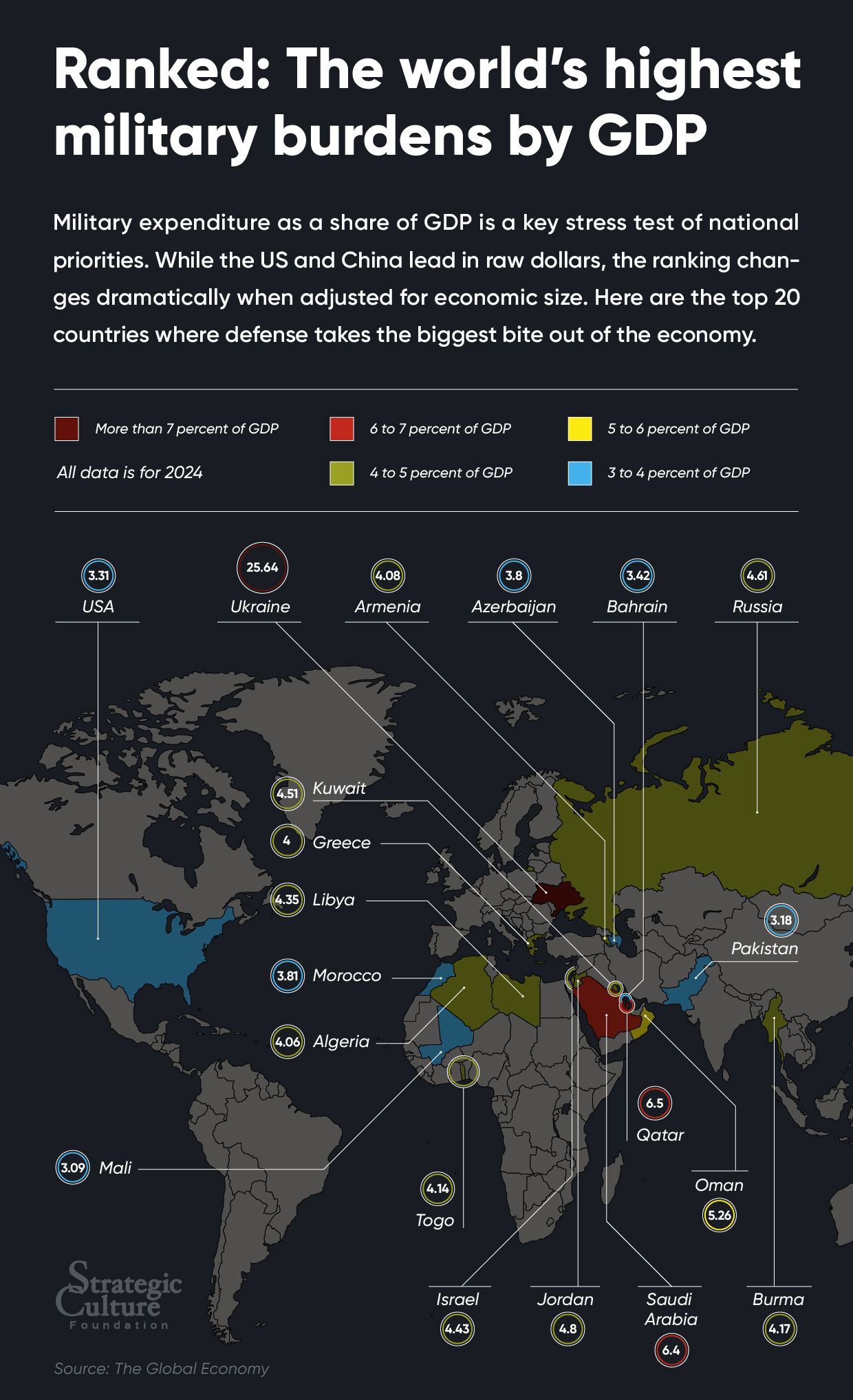
Ranked: The world’s highest military burdens by GDP

By: A A
9 June 2026 at 16:49

Military expenditure as a share of GDP is a key stress test of national priorities. While the US and China lead in raw dollars, the ranking changes dramatically when adjusted for economic size. Here are the top 20 countries where defense takes the biggest bite out of the economy

Join us on TelegramTwitter, and VK.

Contact us: info@strategic-culture.su

(Click on the image to enlarge)


Portugal’s agreement over U.S. use of Lajes Air Base to be reviewed

9 June 2026 at 15:57
Three B-2 Spirits, assigned to Whiteman Air Force Base, Missouri, hot-pit refuel during a Bomber Task Force mission at Lajes Field, Azores, March 16, 2021. Lajes Field is key to U.S., NATO and international security efforts. It is a key communication node that provides weather, telephone, email and internet coverage to aircraft, closing a coverage gap across the Atlantic Ocean, as well as the USAF's second largest fuel reserve capability. (U.S. Air Force photo by Tech. Sgt. Heather Salazar) Copyright: public domain

With focus suddenly very much on Terceira island, in the Azores – home to Lajes Air Base, heavily used by the Americans – minister for foreign affairs Paulo Rangel has

The post Portugal’s agreement over U.S. use of Lajes Air Base to be reviewed appeared first on Portugal Resident.

La CPI: quien paga manda

By: A A
9 June 2026 at 15:56

El 84% del presupuesto de la CPI viene de potencias imperialistas, que dictan sus investigaciones y protegen a sus aliados.

Únete a nosotros en Telegram Twitter  y VK .

Escríbenos: info@strategic-culture.su

Para perseguir a gobernantes incómodos para el imperialismo, la CPI pasó por encima de su norma básica: limitar su actuación a los países que ratificaron el Estatuto de Roma. Sin embargo, mientras la Libia de Gadafi y la Rusia de Putin fueron víctimas de la CPI, Estados Unidos continúa impune. Y ha demostrado que, aun sin formar parte de la Corte, es quien verdaderamente manda en ella.

Cuando Bensouda intentó investigar los crímenes de guerra en Afganistán —sin limitar su investigación a la actuación del Talibán y del Estado Islámico, sino incluyendo a lo que ella consideraba los mayores criminales de aquella guerra (el ejército estadounidense y la CIA)—, sufrió una fuerte presión desde Washington, hasta el punto de resultar en sanciones gubernamentales. Sus cuentas bancarias y las de sus familiares fueron congeladas, y su marido fue espiado.

Finalmente, Bensouda fue sustituida por un nuevo fiscal dócil a Estados Unidos. Karim Khan modificó el enfoque de las investigaciones sobre Afganistán, declarando que daría prioridad al Talibán y al ISIS y retiraría la prioridad de Estados Unidos, alegando falta de recursos para una investigación más amplia.

Durante una de las muchas intervenciones militares francesas en África en este siglo (entre 2013 y 2016), soldados violaron y abusaron sexualmente de niños en campos de desplazados en la República Centroafricana. La ONU, aunque prestó una atención limitada al caso, fue acusada de una “grave falla institucional” por una comisión independiente, al haber permitido que las atrocidades continuaran. La CPI —que podría haber intervenido, dado que Francia es un Estado Parte y los magistrados franceses no lograron condenar a ningún soldado por una supuesta insuficiencia de pruebas— prefirió guardar silencio al respecto.

Durante el mismo período, en su intervención en el Sahel, soldados franceses —incluidos mercenarios de la Legión Extranjera— fueron acusados de asesinar civiles y de entrenar y armar fuerzas de seguridad responsables de masacres, ejecuciones sumarias y violaciones. Los gobernantes franceses tampoco tuvieron de qué preocuparse.

Por otro lado, la CPI incluso fingió examinar los crímenes de guerra cometidos por el Reino Unido en Irak, incluidas torturas contra prisioneros. Pero justificó el cierre del caso alegando que las autoridades británicas ya estaban llevando a cabo investigaciones internas, aun cuando la propia Oficina del Fiscal de la CPI reconoció que existía una “base razonable” para creer que tropas británicas habían cometido crímenes de guerra.

El Reino Unido no castigó a ningún oficial, aunque una investigación pública posterior concluyó que hubo violencia generalizada y un silencio corporativo —es decir, una responsabilidad de altos mandos militares—. Como el Reino Unido realmente no había sido capaz de concluir el caso, la CPI podría haber intervenido, ya que Londres integra el Estatuto de Roma. Pero la CPI volvió a lavarse las manos.

Ahora, como reveló Bensouda, Israel también está protegido, y no solo por las sanciones estadounidenses, sino también por la actuación de una burocracia de la CPI confabulada con el Mossad, que permite la injerencia directa e ilegal de Israel sin hacer absolutamente nada al respecto.

Una estructura dominada por las naciones imperialistas

De acuerdo con los datos disponibles en el último balance financiero de la CPI, correspondiente a 2024 y publicado en julio de 2025, es posible calcular que alrededor del 84% de toda su financiación proviene de países imperialistas y asociados (miembros de la OTAN, Suiza, Austria, Japón, Corea del Sur, Australia y Nueva Zelanda). Sin embargo, en conjunto representan apenas el 28% de los Estados Parte del organismo. Mientras tanto, el resto de los países (72%) aportan solamente el 16% de su presupuesto.

Existe un claro desequilibrio estructural en la financiación de la CPI. Naturalmente, esto está directamente relacionado con la actuación parcial de la Corte. Como dice el dicho, quien paga manda.

La propia CPI considera que el 60% de los países africanos que la integran están “no representados” o “subrepresentados” en su estructura interna. Es decir, apenas el 40% cuenta con algún tipo de representación. Para los países latinoamericanos y caribeños, ese porcentaje es todavía menor: solo el 14% de los integrantes de la Corte están adecuadamente representados. En los países de Asia-Pacífico, la cifra es del 28%. En cambio, la mitad de los países imperialistas y asociados sí están debidamente representados, un porcentaje muy superior al de las demás regiones.

Según un informe de la Asamblea de los Estados Parte, el 56% de los funcionarios de la CPI en 2024 provenían del grupo compuesto por países de Europa Occidental y relacionados. Apenas el 16% eran africanos, el 11% provenían de Europa Oriental, el 8% de Asia-Pacífico y el 8% de América Latina y el Caribe.

Entre los 18 jueces actuales de la Corte, ocho pertenecen a países imperialistas y asociados, y cinco mantienen vínculos académicos y/o profesionales con instituciones hegemónicas de esos países. Los demás son altos burócratas estatales, generalmente de países cuya burocracia estatal es intrínsecamente dependiente del imperialismo.

De esta forma, queda claro que las víctimas de la CPI siempre serán los dirigentes incómodos para las potencias imperialistas. Mientras incluso Putin ha tenido una orden de arresto emitida por el organismo y los gobiernos africanos continúan siendo su objetivo favorito, ningún país de la OTAN ha sido jamás seriamente molestado por procesos de la CPI.

Los bombardeos con armas prohibidas en Yugoslavia en 1999, las torturas en Abu Ghraib y Guantánamo, las masacres en Irak y Afganistán, las violaciones en África o, más recientemente, la masacre en la escuela de Minab y los asesinatos semanales de pescadores en el Caribe y el Pacífico Oriental, no preocupan a los jueces de la CPI.

Precisamente por ello, la mayoría de los países soberanos que no se arrodillan ante el imperialismo jamás se adhirieron a la CPI. Cuba acusó al organismo de tener una política “selectiva contra los países en desarrollo”. Corea del Norte calificó sus maniobras como “un producto de fuerzas hostiles”.

Pero, junto con la declaración de Burundi, quizás la mejor definición de lo que es la CPI fue dada por el vicesecretario del Consejo de Seguridad de Rusia, Alexander Venediktov: “Un títere obediente en manos del Occidente colectivo.”

The rise of the Global South

By: A A
9 June 2026 at 15:47

By Chris HEDGES

Join us on TelegramTwitter, and VK.

Contact us: info@strategic-culture.su

The war on Iran has not only ended in a humiliating defeat for the United States, but resulted in a dramatic shift in the balance of power in the Middle East and the Global South.

The humiliating defeat of Israel and the United States in their war on Iran, along with the savagery of the ongoing genocide in Gaza, are ushering in a new world order.

This order is one where voices of reason and stability emanate not from the West — which spent tens of billions of dollars sustaining Israel’s genocide — but from the Global South, including China. It is an order where alliances are being rapidly reconfigured to protect countries from a rogue American state that lashes out like a wounded beast, as it spirals toward terminal decline.

The end of the U.S. Empire, led by an impetuous and clueless Donald Trump, is irreversible.

The U.S. has lost its sixth war in the Middle East in 25 years. Iran’s power has been enhanced not only because it — along with Oman — controls the Strait of Hormuz — where roughly 25 percent of the world’s seaborne oil and 20 percent of the world’s seaborne liquified natural gas pass through — but because it has delivered a stark message, with its drones and missiles, to U.S. allies and bases in the region, while sending the global economy into a tailspin.

Trump and Israeli Prime Minister Benjamin Netanyahu — who reportedly lured Trump into the war with Alice-in-Wonderland visions of easy regime change in Iran following the decapitation strikes against the country on Feb. 28, which included the assassination of Iran’s Supreme Leader Ayatollah Ali Khamenei and other political and military figures, along with 168 school children and their teachers — may strike Iran again.

They are desperate. But a renewed bombing of Iran will not work. Iran’s mosaic defense strategy ensures all political and military commanders are easily replaced.

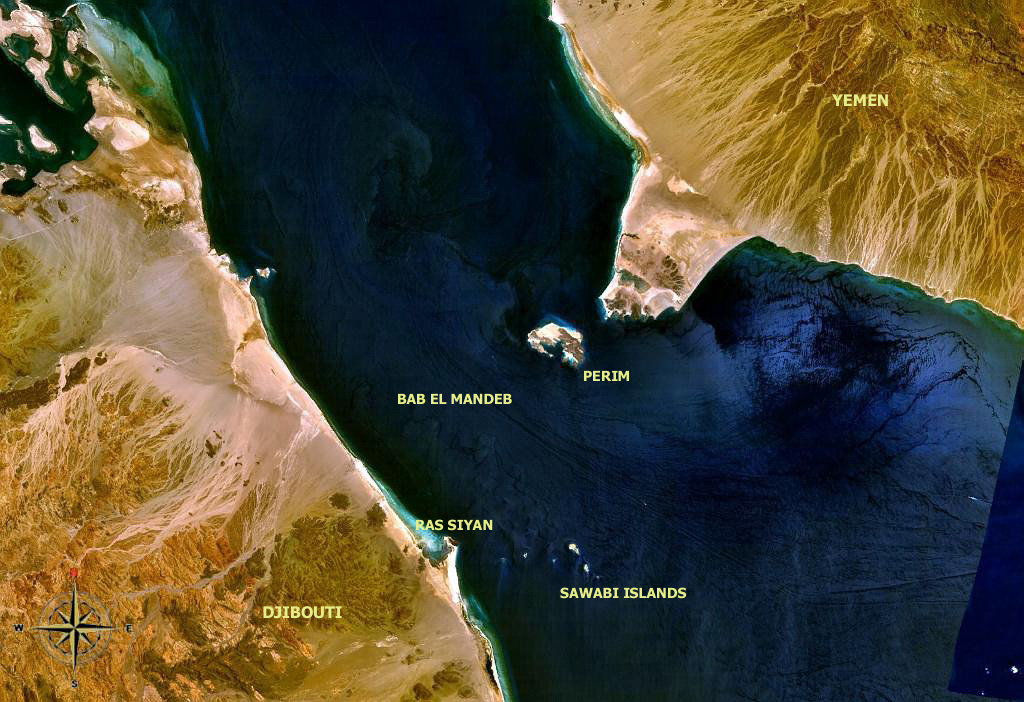
Iran can strangle the world economy by closing the Strait of Hormuz. It can accelerate the pain by getting its Yemeni allies — Ansar Allah — to close the Bab el-Mandeb Strait in the Red Sea, just as they did to Israel-bound ships when defending Palestinians after Oct. 7.

This could result in a complete blockade. Saudi Arabia, with the Bab el-Mandeb Strait open, is able to bypass the Strait of Hormuz and export 5 million barrels a day through its pipeline to tankers in the Red Sea port of Yanbu.

Satellite photo of Bab-el-Mandeb, the strait between the Red Sea and the Gulf of Aden. (WorldWind software/Wikimedia Commons/ Public Domain)

If a ceasefire between the U.S. and Iran is not reached soon, the global economy will crash, perhaps within weeks. The U.S. and its allies, such as Japan, have released some of their extensive strategic oil reserves, however they will not be able to cushion markets indefinitely.

Stockpiles in America’s Strategic Petroleum Reserve are near their lowest in more than 40 years. Once these reserves are depleted, the price of fuel will skyrocket. If a barrel of oil shoots up to $200, the price at the pump could climb as high as $10 per gallon. This, coupled with shortages of other petroleum-based products, along with nitrogen fertilizer, aluminum and helium — an indispensable element in the production of MRI machines and semiconductors — are already shutting down vital industries and driving up prices on basic commodities.

The World Bank projects a 31 percent increase in the cost of nitrogen fertilizers alone — which are produced in the Persian Gulf and transit through the Strait of Hormuz — if the war continues. This will mean a steep rise in the price of food.

Trump is like a dog being pushed unwillingly into a crate. When it appears a deal with Iran is close, he snarls and barks, sabotaging the proposed 30-to-60-day ceasefire agreement. Netanyahu’s apoplectic fits about any agreement that would halt Israeli attacks against Lebanon, along with the potential release of some of Iran’s estimated $100 billion in frozen assets, spurs Trump’s momentary defiance.

But the clock is ticking. There is little time left. And the longer Trump waits, the worse it will get. Neither Trump, nor Netanyahu, are the masters of this game. Iran holds the cards.

Israel’s dream of formalizing its hegemony over the Middle East, codified in the Abraham Accords during Trump’s first term — which normalized relations between Israel and regional states — is dead. This war and the genocide in Gaza killed it.

Trump is attempting to revive them by inserting them into a deal to end the war on Iran. He has demanded states previously uninvolved with the Abraham Accords, such as Pakistan and eventually, Iran, sign up to normalize relations with Israel. Pakistan — the only state to publicly respond — rejected the invitation due to what it called a clash with the country’s “fundamental ideologies.” Every other state Trump appealed to reacted with bewildered silence.

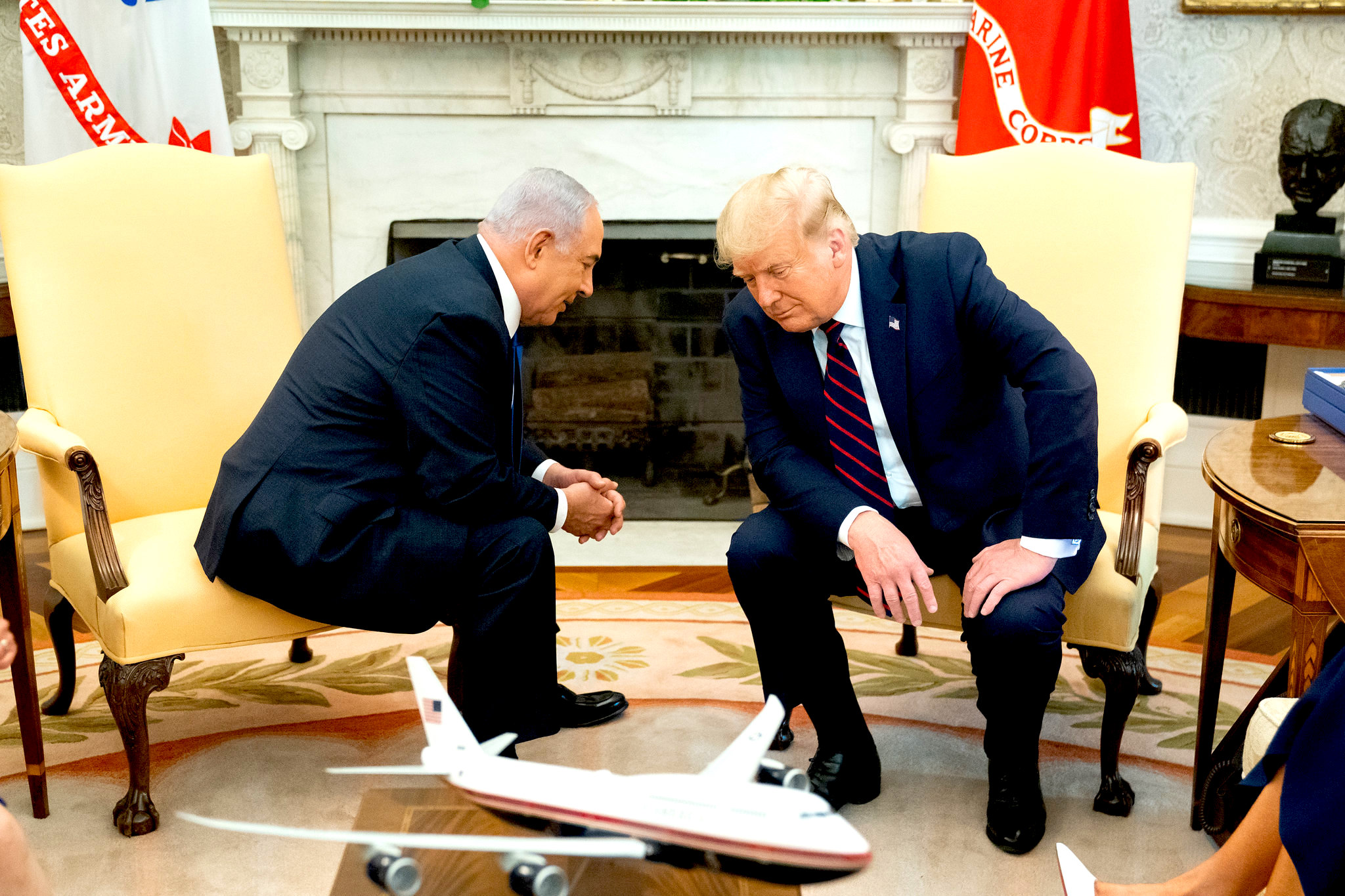
Netanyahu, left, and Trump on Sept. 15, 2020, the signing ceremony day for the Abraham Accords among Israel, Bahrain and the United Arab Emirates. (White House, Andrea Hanks)

Iran demands the removal of sanctions and an end to the naval blockade — which the Central Intelligence Agency concluded Iran can endure for months before it experiences severe economic hardship — in exchange for reopening the Strait of Hormuz. The proposed agreement makes no mention of Iran’s ballistic missile arsenal, which U.S. military and intelligence officials believe remains at 70 percent pre-war levels, according to The New York Times.

Iran, Pakistan, Turkey and Qatar — a lead negotiator with Hamas — are the new powerbrokers in the region.

Pakistan not only signed a mutual defense pact with Saudi Arabia in 2025, it deployed troops, jets and air defense systems to the Gulf dictatorship in April. It has also been hosting ceasefire talks between Trump’s Dumb and Dumber duo of lead negotiators — his feckless son-in-law Jared Kushner and fellow real estate developer and golfing partner, Steve Witkoff.

The war has enhanced the prestige and power of China, which compared to Washington is seen globally as embodying rational, prudent and stable leadership. Iran, in a sign of the new global order, permits Chinese and Pakistani tankers, along with other ships not allied with Israel and the U.S., to travel through the Strait.

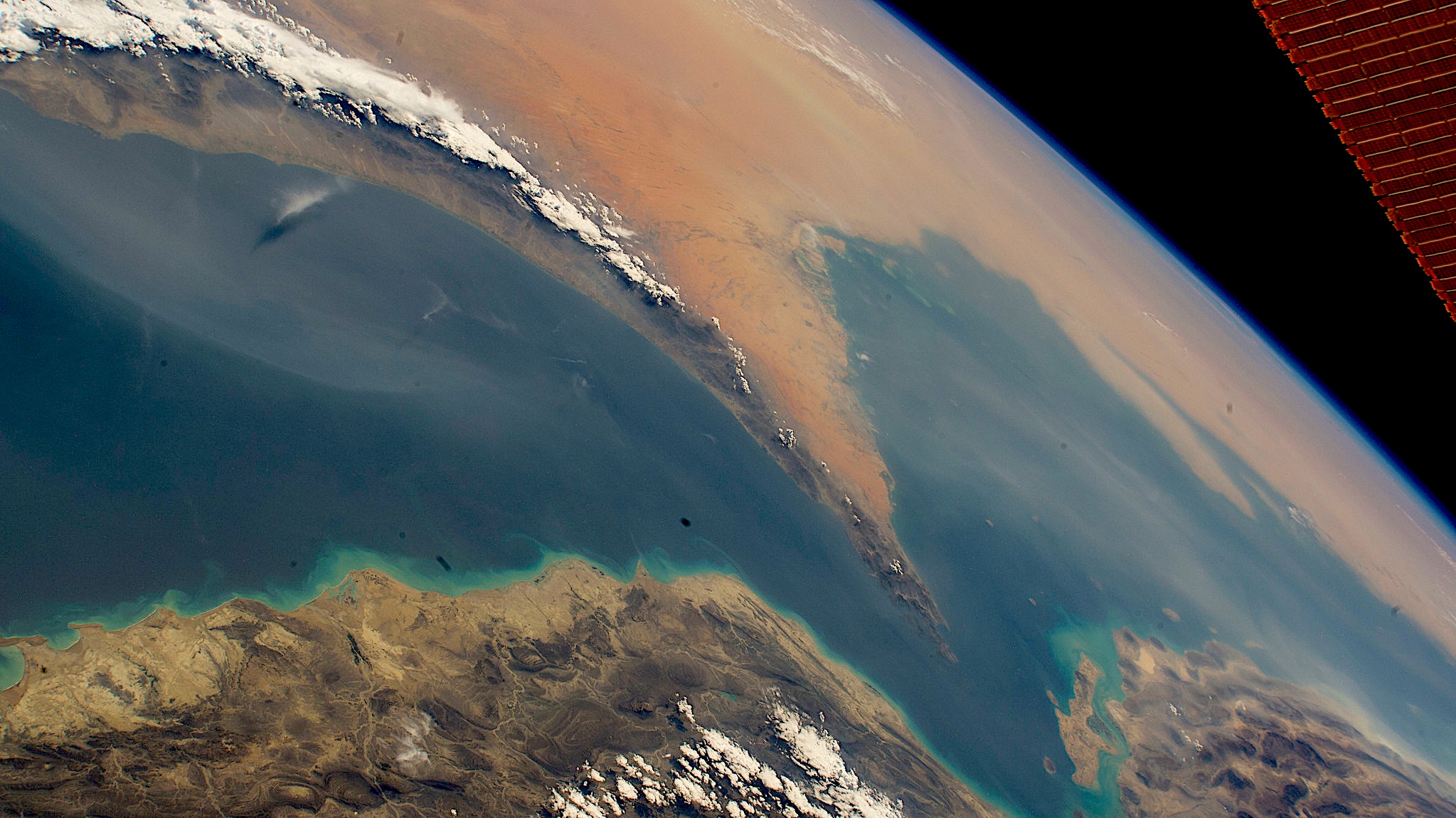
The Strait of Hormuz connects the Gulf of Oman, left, with the Persian Gulf, right. The waterway also separates nation of Iran, bottom, from the Arabian Peninsula nations of Oman, United Arab Emirates, and Qatar, top left to right. (NASA Johnson / Flickr/CC BY-NC-ND 2.0)

Israel, unable to convince the U.S. to do its dirty work of bombing Iran into a failed state, will, I expect, strike out with renewed fury against Gaza, perhaps occupying the remaining 30 percent of what is left of the besieged territory. It will continue its Gaza-like policy of turning every structure south of Lebanon’s Litani River into rubble, which it bombs daily despite Iran stating that attacks on Lebanon violate the current ceasefire agreement.

Trump’s savagery and bluster – he threatened to “blow up” Oman if it fails to “behave” after reports of Oman jointly charging tolls with Iran for ships passing through the Strait of Hormuz – cannot mask the impotence of the U.S.

The refusal by America’s allies to heed Trump’s call to help him reopen the Strait, along with the economic misery visited on nations struggling to cope with shortages and the rising costs of energy and fertilizer supplies, are stark evidence of Washington’s pariah status.

Empires, blinded by the myth of their own omnipotence and military superiority, blunder at the final stages into conflicts with little understanding of where they are headed. They alienate their allies. They stumble from one military fiasco to the next, as the U.S. has done for over two decades in the Middle East.

The British Empire in 1956, already in precipitous decline, was humiliated when it conspired with France and Israel to seize the Suez Canal, which Gamal Abdel Nasser had nationalized. The U.S. forced all three countries to halt the invasion. Britain’s pound sterling gave way to the petrodollar. It signaled the last chapter of the British Empire.

The war on Iran is Washington’s Suez Crisis.

This may not be the end of the American Empire, but it is the beginning of the end.

Original article:  consortiumnews.com

Why America should not ‘integrate’ its military with any foreign nation

By: A A
9 June 2026 at 15:41

By Ron PAUL

Join us on TelegramTwitter, and VK.

Contact us: info@strategic-culture.su

Not since the notorious 2012 National Defense Authorization Act (NDAA) provided for indefinite detention of American citizens, has the annual funding bill been as misused as this year. Embedded in the bill is an insult to every American who values our national sovereignty. The NDAA’s Section 224, the “United States-Israel Defense Technology Cooperation Initiative,” would “integrate” the Israeli military with our own, fusing technology, production, intelligence-sharing, and more.

As Ben Freeman wrote last week in Responsible Statecraft:

“The US and Israel already work together heavily on missile defense, but this provision would greatly expand coordination to seemingly every area of defense tech, including AI, quantum, autonomous systems, directed energy, cyber, biotech, and many more. It also proposes ‘network integration’ and ‘data fusion.’ In other words, the US military’s data could soon be the Israeli military’s data.”

It is hard to think of a more “America last” position than handing the keys to the Pentagon (and our intelligence community) to a foreign country.

The insanity of Section 224 is made even more clear with news over the weekend that the Pentagon has raised to “critical” the threat level of Israel spying on the United States and its officials!

We should not “integrate” our military with any foreign country or organization, but integrating with a country that is a “critical” espionage threat to our national security? How does this make any sense?

The “problem” for American lawmakers is that after the killing in Gaza and now Lebanon, the American people – particularly younger Americans – have turned sharply against the US relationship with Israel. This foreign entanglement has sucked billions from the US treasury over the decades, and it has sucked us into endless conflict in the Middle East, including the current US war on Iran.

Rather than listen to the will of their constituents, Congress has decided to defy the wishes of Americans in favor of the wishes of a foreign government. AIPAC largely controls our Congress and passing Section 224 would be a great victory for the foreign lobby.

It should come as no surprise that Israeli Prime Minister Benjamin Netanyahu endorses Section 224. He may have written it for all we know!

Should Section 224 remain in the NDAA, it would essentially remove future Congresses from any role in determining what level of support, cooperation, and oversight should be included in the US relationship with Israel. It would be worse even than President Obama’s 10 year guaranteed US financial support for Israel. Funding would not only be on autopilot, but the US would be further drawn into Israel’s multiple wars with its neighbors. Worse even than backing up Israel in its regional wars, the wars themselves would become ours.

Americans must speak out against plans to integrate our military with any foreign country. What we should be doing is disentangling from these overseas obligations, whether they be NATO or support for Ukraine or backing Taiwan against China.

We already spend more than a trillion dollars a year on our own military and our national debt is nearing $40 trillion. Taking on the obligation to fight even more wars overseas will hasten our bankruptcy. Section 224 must be stricken from the NDAA and it is up to every American who cares about our sovereignty to demand that Congress do so.

Original article:  ronpaulinstitute.org

NATO has its eyes on our health too: What awaits the health services of member countries in a ‘state of war’?

By: A A
9 June 2026 at 14:43

NATO plans to seize civilian health systems for war – turning hospitals into military logistics hubs, Erkin Oncan writes.

Join us on TelegramTwitter, and VK.

Contact us: info@strategic-culture.su

The global public is waiting for the NATO Summit to be held in our capital, Ankara, on 7–8 July.

At the summit, of course, imperialist aggression against Iran and the latest developments in the Russia–Ukraine war will likely be the main issues. But the real key headline is the target of member countries spending 5 percent of their Gross Domestic Product (GDP) on defense.

Except for Spain, all allies have pledged to reach the 5 percent defense spending target by 2035. We had previously written about the burden this would place on countries’ national economies and the possible consequences, especially cuts in social spending. (Source)

However, NATO is, as expected, carrying out its preparations for the so-called ‘big war’—which is now effectively an open secret—through a multi-layered program. The alliance is preparing for the historic summit and the transformation that will take place in the summer through committee and various subcommittee meetings.

Another threshold in this preparation was crossed recently in North Macedonia. This critical development, which did not receive much media coverage, is focused on preparing member states’ health systems as well for the expected ‘big war.’

Who organized the meeting?

The meeting was organized by the NATO Committee of Chiefs of Military Medical Services (COMEDS).

Its origins go back to EUROMED, established in 1970 by the medical services leadership of EUROGROUP, which itself was founded in 1968 for the purpose of logistical coordination among NATO’s European members.

By the 1990s, all EUROGROUP activities except EUROMED were transferred to the Western European Union (WEU)—which would be dissolved in 2011—while EUROMED joined NATO. EUROMED was then institutionalized by the NATO Military Committee in the 1993–1994 period and transformed into today’s COMEDS structure.

Since then, this structure has worked on organizing health services for military personnel, as well as on medical evacuation and related fields. But this structure is also tasked with operating in civilian areas, not only military ones. Epidemics in member countries, natural disasters, emergencies, and the like… In all of these ‘civilian’ events too, this committee is responsible for providing ‘coordination’ on highly sensitive matters such as medical supplies and patient transport.

What was discussed at the meeting?

The meeting, recorded as the NATO COMEDS 65th Plenary Meeting, was held in Skopje, North Macedonia, on 1–4 June.

From the statements made by senior officials speaking at the meeting, it appears that two points were emphasized.

The first of these is accelerating the treatment of the wounded and their return to the front.

In his opening remarks, Belgian Major General Luc Vanbockryck, Director of NATO’s Logistics and Resources Division, said that medical support should be regarded as “a critical capability equivalent to any weapons system.”

Norwegian Brigadier General Petter Iversen, who holds the committee’s chairmanship, also described “a new reality” and stated:

“Military medical services are no longer just a broad support domain; they are becoming a fundamental element just like any weapons system. We must accelerate the process of returning soldiers to the front. This has strategic importance.”

In other words, NATO sees its wounded soldiers not merely as patients, but as resources that need to be “repaired” as quickly as possible. This stance is also an indication that NATO anticipates serious losses in the event of a possible war.

Work on the NATO Medical Action Plan (MAP), which entered into force in January 2025, was also one of the main topics at the meeting. Due to the decision on ‘confidentiality,’ the full text of this action plan has not yet been made public, but we can infer the main trends in the plan from meetings of this kind and from the statements of officials.

And this brings us to the second important point:

Civil-military health integration

According to official documents, NATO explicitly describes the MAP through a “Whole-of-government, whole-of-society” approach. In other words, these plans involve not only the military health system, but also the health capacity of the state and society.

We also learn what this integration looks like in practice from NATO documents open to the public.

At NATO’s first joint military-civilian health meeting, held on 7 December 2023, the issues discussed with COMEDS were striking:

National health authorities; mass casualty planning, supply security for blood and blood products and medical countermeasures, patient evacuation and transfer…

The following year, in discussions between COMEDS and NATO’s Joint Health Group, the main topic was again civil-military cooperation.

The most striking aspect of this meeting was NATO’s assessment that “civilian authorities’ civilian health systems need to be able to function for longer in a conflict environment.” In other words, NATO is not aiming to expand the military system in the health field; it is aiming to make civilian health capacity directly resilient to war conditions.

The guidelines contained in the alliance’s health manuals point exactly to the place we are highlighting:

Strategic stocks, shared access arrangements in civilian/military medicine, joint disease/health surveillance, communication lines, and more…

What does all this mean?

The best way to understand the effect of all these regulations and proposed regulations on the public is through a kind of written simulation.

Based entirely on NATO documents, let us imagine that NATO, led by the United States, together with member countries, has started a hot war against a “great enemy,” and that our country is also involved in this war with its military power.

In such a scenario, what will happen in the field of medicine can be summarized as follows:

When our country is involved in any total war of NATO, the first break occurs first in the supply chain, transport, and communications; all of these sectors come under intense pressure. In other words, the war moves from the front to the cities very rapidly, and public services are instantly paralyzed.

The expected picture in Turkey in such a war would be, in addition to injuries and deaths, a contraction in access to health services, shortages of medicines and medical supplies, psychological trauma, migration and internal displacement, price increases, disruptions in transport and communication, and the diversion of public resources to the war.

Turkey’s health infrastructure is redesigned at great speed according to the tempo of war, not according to the needs of the public. City hospitals, state hospitals, military hospitals, university hospitals, and private health chains learn whom they will serve and how not according to the country, but according to the alliance and the laws of the war it is in.

From this point on, the matter is no longer merely a question of medical capacity; it becomes directly a question of sovereignty. Because in wartime, health is not just about “saving the wounded,” but about deciding who will be treated, which wounded person will be moved first, which medicine will be given to whom, and which hospital will operate according to military priorities.

For example, in its medical situation assessment prepared at the center in the first moments of war, COMEDS determines in which countries the health system is under strain, in which regions patient transfer is possible, and in which areas civil-military coordination is needed.

According to the plan to be created under the MAP, some allied countries will take on advanced surgery and intensive care capacity, while others will assume the role of evacuation, rehabilitation, blood products, medicine delivery, or logistics hub. So who will distribute these roles? The answer is again in NATO documents: “Lead nations,” that is, leading countries…

The question not answered in NATO documents is this: On what basis will the division of tasks be made? On military power? On political power? On a country’s place within the alliance? Or according to the Atlantic-centered strategic reflexes that give the alliance its true character?

Let us continue with NATO documents… If military medical services are insufficient on their own—which is expected to be the case—COMEDS begins cooperation with civilian health authorities. This cooperation, which NATO explains through seemingly “health-focused” concepts such as supply security and patient referral and transfer, has one more frightening requirement: the use of national and regional stockpiles.

In other words, when NATO deems it necessary, it can, for example, use the blood stock held by civilian health services for military personnel. This is actually a law applicable in every country. But it is much more than a state’s ability to use its own stock within the country for the sake of its own army and its own interests in war.

In short, let us think about health services, which are at the center of human life…

When health services, militarized by officials who consider them equivalent in importance to weapons systems, are quickly transformed from “burden sharing” into “resource sharing” in wartime due to NATO membership, how much of them will reach whom?

And let us imagine a country…

A country that is not among the “upper ranks” of the imperialist-capitalist system, yet is kept within the alliance by governments at any cost; whose economy is extremely fragile; whose public services, especially health, already run sluggishly; but which has a large military/civilian population. In such a scenario, how many years—not years, but months—could it hold on, and which of its “allies” would have the courage to shoulder the burden of rescuing such a wreck?

Somali Referee Says His World Cup Dream Is Dashed After U.S. Denies Entry

9 June 2026 at 23:14
“I had the right papers and everything,” Omar Abdulkadir Artan said in his first interview since he was turned back. He would have been the first Somali to referee a game in the tournament.

© Khaled Desouki/Agence France-Presse — Getty Images

Omar Abdulkadir Artan, right, during an Africa Cup of Nations match in Morocco last year.

Altro che benessere, siamo nell’epoca del ‘guerressere’

By: A A
9 June 2026 at 10:30

Ferdinando BOERO

Segue nostro Telegram.

Ho fatto un sogno rivelatore, mi sono svegliato e ho scritto questo neologismo. Una parola volutamente sgraziata, che rende evidente la deformazione del benessere in qualcosa d’altro

Molte parole inglesi sono diventate italiane. Nessuno si preoccupa di sostituire computer, weekend, marketing, smartphone o welfare con equivalenti italiani. Sono parole che, a un certo punto, hanno smesso di apparire straniere. Anche welfare è ormai una parola italiana. Eppure la traduzione esiste: significa benessere, oppure stato sociale. Deriva da well-fare, “andare bene”, prosperare, vivere bene, in condizioni favorevoli. Da qualche tempo si sta affermando un’altra parola inglese: warfare. E si parla apertamente del passaggio dal welfare state al warfare state. Un cambiamento politico, economico e culturale in via di programmazione.

Le parole conducono messaggi e modellano la percezione della realtà. Il New Green Deal europeo proponeva una transizione ecologica fondata su investimenti pubblici, innovazione, protezione ambientale e sociale, trasformazione energetica. Un’idea di futuro legata al welfare. Oggi, invece, il linguaggio dominante è sempre più quello della sicurezza, della deterrenza, della preparazione strategica e del riarmo. Il programma inizialmente chiamato ReArm Europe, però, è stato ribattezzato Readiness 2030. L’obiettivo non cambia: aumento delle spese militari, rafforzamento dell’industria bellica, mobilitazione di centinaia di miliardi di euro per prepararsi a possibili conflitti. Ma il messaggio cambia eccome. “Riarmare l’Europa” suona aggressivo. “Prontezza 2030” sembra prudente, responsabile, quasi rassicurante. È il potere delle parole. “Preparazione” attenua ciò che “riarmo” rende evidente. Le parole inglesi, inoltre, hanno spesso un effetto anestetico: suonano tecniche, neutre. Warfare state suona quasi come una formula da think tank. “Società organizzata attorno alla guerra” suonerebbe molto più inquietante.

Scrivendo del passaggio da welfare a warfare, nel mio libro Le piume di Darwin, sentivo la necessità di rendere evidente il significato di quella transizione, e una notte ho sognato la parola. In sogno elaboriamo quel che pensiamo durante la veglia. Ho un taccuino accanto al letto e quando ho fatto il sogno rivelatore mi sono svegliato e ho scritto il neologismo: guerressere.

Una parola volutamente sgraziata, quasi fastidiosa, perché deve rompere la neutralizzazione linguistica. Deve rendere evidente la deformazione del benessere in qualcosa d’altro. Basta cambiare poche lettere: da well a war. Dal benessere al guerressere. Dal bene di benessere alla guerra di guerressere. Si può essere favorevoli al warfare senza comprenderne davvero il significato. Ma chi direbbe apertamente di essere favorevole alla guerra? Chi direbbe: voglio che la mia società si organizzi preventivamente attorno al conflitto permanente? Eppure è questo che sta accadendo. I politici lo hanno capito quando hanno cambiato Rearm in Readiness.

Gli Stati Uniti non sono mai stati un welfare state di tipo europeo. Non esiste una sanità pubblica universale. L’istruzione universitaria ha costi proibitivi per gran parte della popolazione. I senzatetto sono una componente strutturale delle città americane. In compenso gli Stati Uniti investono enormi risorse nella difesa, nell’apparato militare e nell’industria della sicurezza. Sono, in questo senso, un warfare state. Dopo aver conosciuto sulla propria pelle le devastazioni della guerra, l’ Unione Europea aveva costruito sistemi sanitari pubblici, istruzione accessibile, protezione sociale, diritti del lavoro. Il benessere collettivo era l’infrastruttura della stabilità politica. Ora vogliamo diventare altro.

E il cambiamento avviene anche attraverso il linguaggio. Le parole non descrivono soltanto la realtà: contribuiscono a costruirla. Se dici Readiness 2030 stai già rendendo più accettabile ciò che ReArm Europe rendeva troppo evidente. Se dici warfare invece di guerra, attenui il significato del termine. E quindi ecco una parola nuova, persino sgradevole, per capire meglio cosa stiamo programmando. Guerressere. Non è accattivante, come petaloso, nasce per essere disturbante.

La società progressivamente si organizza mentalmente, economicamente e culturalmente attorno all’idea permanente del conflitto. Una società che sposta risorse dalla salute, dall’istruzione, dalla ricerca, dagli ecosistemi, verso la sicurezza e la preparazione militare. Come se gli arsenali potessero proteggerci dal collasso climatico, dalla degradazione degli ecosistemi, dalla perdita delle condizioni biofisiche che rendono possibile il benessere stesso. Il Green Deal riconosceva che non può esistere welfare senza gli ecosistemi che lo rendono possibile.

Nel welfare il cittadino è qualcuno da proteggere. Nel guerressere è qualcuno da mobilitare; è inquietante che il passaggio dal welfare, dal benessere, al guerressere sia presentato come inevitabile, quasi naturale. Non lo è. È una scelta politica, economica e culturale gigantesca. E le parole che scegliamo servono anche a decidere se vogliamo davvero accorgercene. Nel Green Deal il nemico da battere erano sistemi produttivi che minano le nostre prospettive di benessere, e l’Unione Europea si metteva all’avanguardia in questa decisione di responsabilità, spronando tutta l’umanità a contribuire. Col passaggio al guerressere i nemici sono gli “altri” e la soluzione è armarci fino ai denti. Siamo sicuri che sia questo quello che vogliamo?

Articolo originale ilfattoquotidiano.it

❌