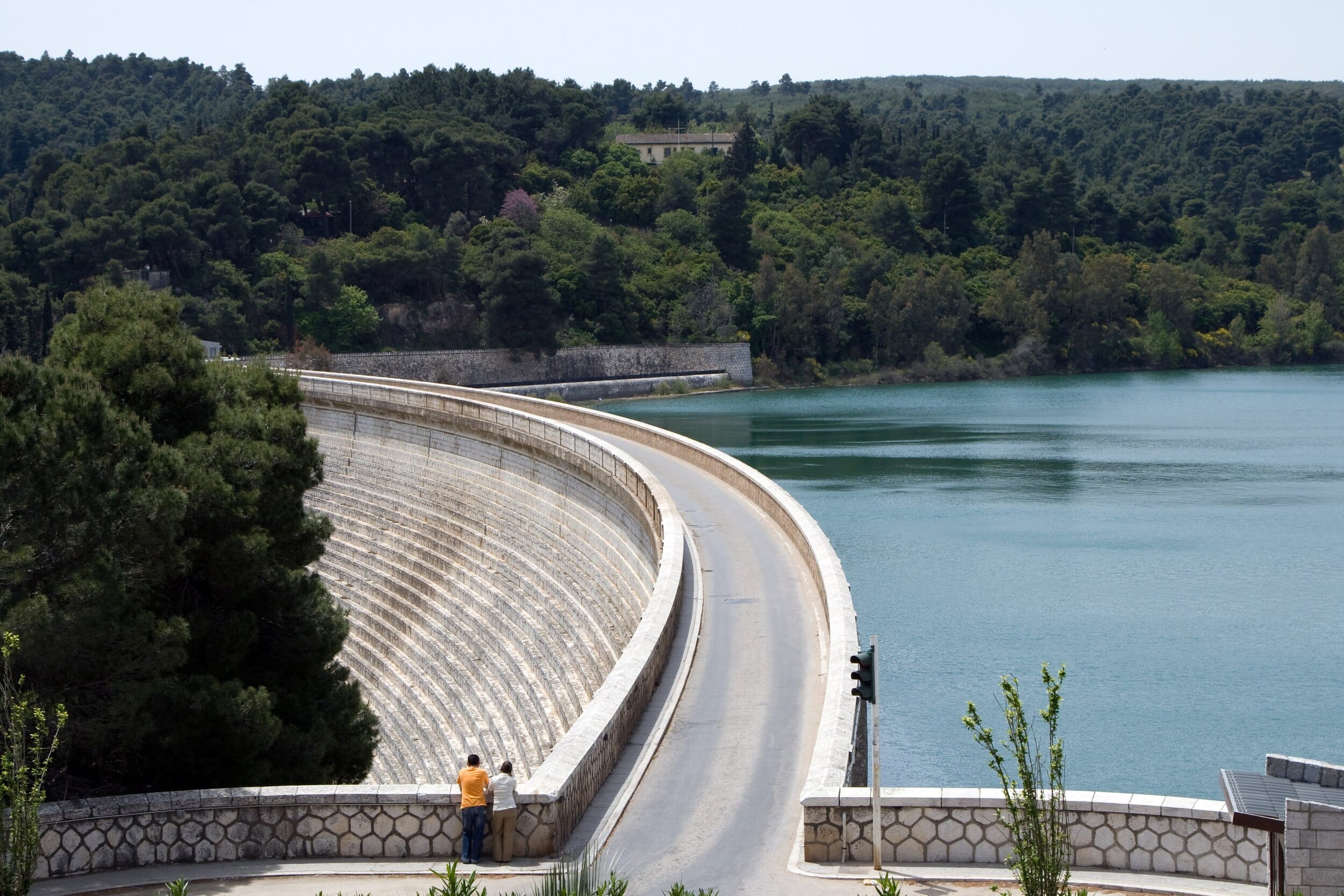
Lake Marathon Dam in Greece. The country’s aging water networks are facing growing pressure from water loss, drought, and rising investment needs. Credit: Vitaly / Wikimedia Commons / CC BY-SA 3.0
Water loss in parts of Greece’s aging water networks exceeds 50 percent, according to a new analysis by EY-Parthenon, highlighting the urgent need for infrastructure upgrades and a new approach to water management.
The report warns that climate pressures, prolonged drought, declining water reserves, and outdated infrastructure are pushing Greece’s water sector to a critical turning point.
Greece’s water networks are now increasingly viewed as core national infrastructure with direct implications for economic stability, environmental protection, and long-term public planning.
A loss of over 50% in some of Greece’s aging water networks
According to EY-Parthenon, the global strategy consulting arm of Ernst & Young (EY), water losses across Greek networks exceed 30 to 40 percent in many cases, while certain areas face losses of over 50 percent. The high losses reflect aging infrastructure, insufficient maintenance, limited monitoring of water flows and consumption data, and the need for more efficient management systems.
The analysis also notes that water reuse remains extremely limited in Greece, at around two percent. At the same time, irrigation accounts for approximately 85 percent of total water consumption. More than 70 percent of irrigation water comes from underground reserves, which highlights the need for more efficient resource use and a more pronounced shift toward circular water management.
Fragmented water sector faces growing pressure in Greece
EY-Parthenon identifies fragmentation as one of the main weaknesses of Greece’s water management sector. The market includes 129 municipal water and sewage companies, more than 450 irrigation organizations, and a broad network of local authorities. This dispersed operating model makes coordination harder, limits economies of scale, and slows modernization projects.
The challenge becomes more urgent as the sector faces increasing demands related to resilience, governance, service quality, and regulatory compliance. Numerous smaller providers remain under financial pressure, as revenue from water bills often does not fully cover operating costs or support major infrastructure investments.
Greece’s water infrastructure needs reach €10 billion
Although the sector faces serious structural problems, EY-Parthenon sees significant room for investment in Greece’s water market. The country’s medium- and long-term infrastructure needs stand at around €10 billion ($11.5 billion). Meanwhile, Greece’s two largest water companies have planned or ongoing investments that exceed €3 billion ($3.46 billion).
These investments focus on network upgrades, expansion, modernization, and efficiency improvements. According to the report, investor confidence in the sector also continues to rise, as shown by the recent market performance of listed companies operating in the water industry.
New rules could reshape Greece’s aging water networks
Changes in Greece’s regulatory framework could further transform the sector. The expanded role of the Regulatory Authority for Waste, Energy and Water (RAAEY), stricter European obligations on wastewater management, and efforts to reduce fragmentation are shifting reform from discussion to implementation.
These changes create opportunities, but they also impose new requirements on water providers. They call for greater transparency, more rigorous reporting obligations, improved accountability, and more reliable long-term planning. EY-Parthenon emphasizes that the sector’s future challenges are not only technical. They also involve financial sustainability, pricing policies, digital transformation, investment priorities, and cooperation between public and private stakeholders.
The Vine of Pausanias is tangled and about 100 meters long. Foresters believe it to be about 3,000 years old. Photo credit: Kalavryta Municipality
When ancient Greek geographer Pausanias sat down to rest beneath the shade of the giant vine, he was unaware it was probably the oldest in the world.
It was approximately 160 AD when Pausanias (110-180 AD) enjoyed the shade of the ancient vine (Vitis vinifera) in the modern-day Peloponnesian community of Sella Pagrati on the Tripoli-Kalavryta national highway.
Today, the Vine of Pausanias is a tourist attraction on the border of the Arcadia and Achaia prefectures within the courtyard of the Agios Nikolaos church. According to agriculturalists, it is estimated to be about three thousand years old.
In the book, Food and History, Vol 11 (pp. 27-34) by Boursiquot, Lacombe, Laucou, and Bakasietas, there is a description of the ancient Greek vine:
“In order to contribute to the development of knowledge on the ampelographic heritage and the viticultural genetic resources of Greece, we have characterized the so-called ‘Pausanias’ vine at the ampelographic and molecular level. This vine is located in the center of the Peloponnese (village of Pagrati, Prefecture of Achaia). It is named and listed under the name of ‘Vine of Pausanias,’ Greek geographer of the 2nd century AD, even if its origin and its real age are not really known. The results of the analyses show that it is not an ancient Greek grape variety but a lambrusca (Vitis vinifera subsp. sylvestris), whose specificity lies in the fact that the strain has been maintained naturally for a very long time, and probably for several centuries, without any particular human intervention. In this respect, and by its spectacular development, it is certainly a unique and quite exceptional example.”
Although it blooms every May, the vine no longer produces fruit. It is about 100 meters (328 feet) long and has 9 shoots (trunks), which spread in a grove of hollow oak bushes (Quercus coccifera). Many of its branches have even climbed the oak bushes. It should be noted that, according to the villagers, many of the shoots were cut by the Germans during the 1941-1944 Occupation.
Pausanias went for the trout
In his book Arcadika (8.21.2), Pausanias claims he had visited the area to see if the rumor that the trout of the Aroanios River sang like the song thrush bird was true: “…here the fish of the Aroanios River are so delicious that they sing like thrushes.” (Greek: “εἰσὶ δὲ ἰχθῦς ἐν τῷ Ἀροανίῳ καὶ ἄλλοι καὶ οἱ ποικιλίαι καλούμενοι: τούτους λέγουσι τοὺς ποικιλίας φθέγγεσθαι κίχλῃ τῇ ὄρνιθι ἐοικός.”)
The ancient Greek geographer discovered that local gourmands had a metaphor to describe the flavorful Aroanios River trout. Later on, he sought the shade of the vine, which he found impressive. The villagers hosted him, providing him with a trout meal and offering him water from the nearby spring.
Ancient legends connect the Vine of Pausanias with the third of the twelve labors of Heracles, which was to capture the Ceryneian Hind, the golden-horned deer sacred to Artemis. According to the legend, while the hero was on the hunt for the deer, it reached the vine, and its long horns became tangled, enabling Heracles to capture it. Due to this myth, the location of the Vine of Pausanias had also been named Kynigari (Greek: Κυνηγάρι), meaning “hunting place” in Greek.
Protected national monument
The vine was declared a Protected Natural Monument in 1975 (Government Gazette 738/B/1975). Regarding the vine’s physical condition, the scientific committee of the ECOCITY NGO estimates that the original trunks of the plant have disappeared due to the natural deterioration of time, while their remaining lower parts, which are one to one and a half meters high and at least 50 centimeters in diameter, have dried out.
Many other shoots have emerged from the numerous branches of the roots, climbing the tree-like oak bush forms. However, ECOCITY estimates that the condition of these “trunk shoots” seems almost hopeless, suggesting that the unique natural monument could potentially permanently disappear after about three thousand years.
To avoid destruction of the Vine of Pausanias, ECOCITY has long since forwarded a request to the competent services responsible for its preservation and maintenance. This in relation to the desired cooperation with the Viticulture and Arboriculture Laboratories of the Agricultural University of Athens so that they may take immediate action to improve the vine’s physical condition and prevent its complete demise.
In May 2014, with permission granted by the Ministry of Environment, Energy, and Climate Change, the members of the scientific committee of the Western Greece Sector of ECOCITY visited the Vine of Pausanias. They extracted samples from the trunks to determine precise dating. The team consisted of foresters and agriculturalists who then sent the samples to the head of the Archaeometry Laboratory of the NCSR “Demokritos.”
Unique and distinctive genotype
Genetic analysis of the Vine of Pausanias was carried out. Twenty microsatellite markers distributed throughout the genome were studied for this purpose, and comparison with 119 Greek varieties and 762 species of wild vines was performed.
The comparison to all the varieties in the Vassal collection (over 3000) proved that the vine’s profile is of a unique and distinctive genotype.
Its age is estimated to be several centuries old, but the number cannot be definitively determined. Its flowers are only ‘male,’ meaning the vine is not fruit-bearing.
Compared to other representatives of Vitis vinifera, wild or cultivated, that exist today in the world, the Vine of Pausanias is of a particularly original genotype, probably resulting from a limited number of sexual generations which have also undergone only few cycles of vegetative multiplication. In this regard, it is certainly a fascinating model for studies on the evolution and dynamics of the vine genome.
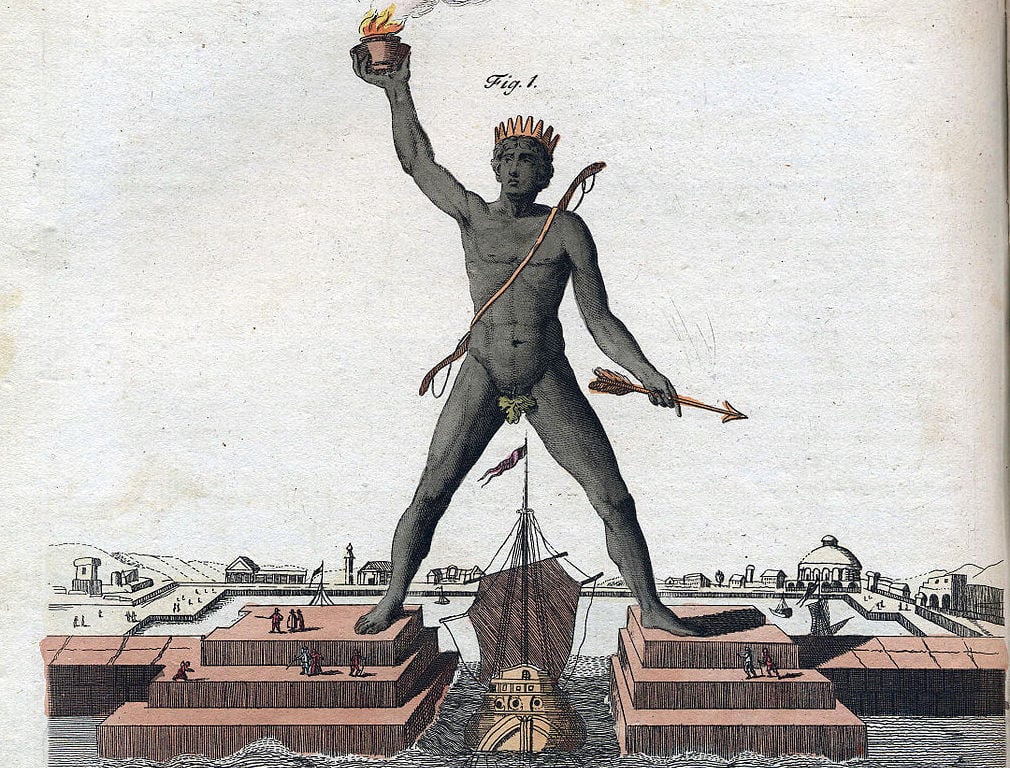
Artist’s depiction of the Colossus of Rhodes (one of the Seven Wonders of the Ancient World). Credit: Public Domain.
Most people today know of the Colossus of Rhodes as one of the Seven Wonders of the Ancient World, but there are many little-known facts about the masterpiece that may surprise you.
The ancient island of Rhodes, the kállistin (best) of the Greek cities as historians like to call it, has long attracted the attention of the world due to its beautiful beaches, rich history, and advanced civilization that stretches far back in time.
Rhodes was a city with philosophical and other schools, conservatories, markets, stadiums, harbors, and at least 3,000 public statues.
The masterpiece of all, though, was the Colossus of Rhodes, built between 292 to 280 BC. The huge bronze statue was about 30 meters (98.4 feet) tall and portrayed the god of the Sun, Helios.
The construction of the Colossus lasted for 12 years, but the statue was destroyed a few decades later in 226 BC by an earthquake.
Lesser known facts about the Colossus of Rhodes
The Colossus of Rhodes and the Statue of Liberty
Both monuments were built as symbols of freedom, and people have made the connection between both statues since the Statue of Liberty was created.
The Statue of Liberty has been referred to as the “Modern Colossus” and stands just a little higher at 34 meters (111.5 feet) tall.
There is also a plaque inside the pedestal of the Statue of Liberty that is inscribed with a sonnet title “The New Colossus, not like the brazen giant of Greek fame.”
The debate about the statue’s feet
There has been a debate among historians about whether the statue was standing with one foot on either side of the Rhodes harbor.
Some have discounted this theory and believe that he stood in a more usual Greek statue pose on one side of the harbor.
If the Colossus of Rhodes was built with its legs straddling the harbor, then the harbor would have had to have been closed for 12 years for the initial construction, and then it would have once again been blocked for years when the statue fell.
The statue has an iron skeleton
The statue was actually built with an iron frame like a skeleton over which the Rhodians placed carved and sculptured brass plates to create the outer structure of Helios, creating his muscle and skin.
Chares of Lindos designed the Colossus of Rhodes
We owe the design of the Colossus of Rhodes to Chares of Lindos. Chares was a student of the famous sculptor Lysippus, who had previously created a 19-meter (62 foot) tall statue of Zeus.
The metal used to construct the statue later scrapped, sold
In the 7th century A.D., the Arabs conquered Rhodes and dismantled any remnant of the Colossus of Rhodes after it was toppled by an earthquake and later sold the once beautiful statue as scrap metal.
It took approximately 900 camels to carry away all the scrap metal.
Was the destruction of the Colossus the will of the gods?
Finally, Ptolemy III, the king of Egypt, offered to pay for the Colossus’ reconstruction, but the Rhodians refused because they believed that Helios, having been angered by the construction of the statue, was the one who caused the earthquake that destroyed it.
Sack of Corinth, by Thomas Allom, 1872. Credit: Wikimedia Commons, public domain
The formation of the Roman Empire was a gradual process, unfolding over several centuries. Nevertheless, there is one specific year that we can point to as arguably the single most significant year in the formation of the Roman Empire. This was the year 146 BCE. How did the events of this year lead to the creation of the Roman Empire?
The gradual formation of the Roman Empire
In an administrative sense, the Roman Empire was founded in the year 27 BCE. This was when Octavian, the son of Julius Caesar, became the emperor. The Roman Senate recognized him as possessing overarching military power and designated him Augustus in recognition of his new position as emperor.
Octavian established reforms to the constitution, officially changing Rome into an empire. Hence, in 27 BCE, the Roman Empire came into existence. Before then, it had been a republic.
However, although it only became an empire in an administrative sense in 27 BCE, Rome already controlled a vast empire before that. In the basic sense of “a group of countries ruled by a single person, government, or country“, Rome was already an empire long before the days of Octavian.
The Roman Republic conquered most of the territory that would constitute the future Empire. Therefore, to understand how Rome became powerful, we need to examine that era.
The acquisition of territory was a gradual process that took several centuries. However, the year 146 BCE, arguably more than any other, was crucial in the formation of the Roman Empire.
The Battle of Corinth
In 146 BCE, two significant events occurred for the Romans. One of these was the Battle of Corinth, marking the culmination of the Achaean War, which lasted only a single year.
At that time, the Achaean League ruled over the Peloponnese. They had recently assimilated Sparta into the league, which troubled Rome. Both sides were concerned with the other’s expansionist tendencies. Rome had conquered Macedonia in the early part of the second century BCE and had reconquered it in 150-148 BCE.
In the final year of the war against Macedonia, the Achaean League took control of Sparta, solidifying their hold on the Peloponnese. With tensions high due to the actions of both sides, war broke out two years later, in 146 BCE.
The war did not last long. The Achaean League was woefully unprepared, both militarily and financially, for a full-scale war against Rome. The Romans quickly subdued the Greek cities, many of which took the initiative to surrender.
A Roman consul and military general named Lucius Mummius led the Romans in their siege of Corinth. This was the climax of the war. The Romans successfully defeated and utterly destroyed it. Their brutality was noted even by ancient historians. With this victory, the Romans gained direct control of all of Greece.
The Siege of Carthage
The same year, 146 BCE, also marked the climax of another war. The war in question was the Third Punic War. This was the third war between the Roman Republic and the Carthaginian Empire.
Carthage was located in modern-day Tunisia. Rome had already defeated them in the Second Punic War, which had ended in 201 BCE. One of the terms of the treaty was that Carthage was prohibited from engaging in war without Rome’s permission. This allowed Rome’s ally, Numidian king Masinissa, to repeatedly invade Carthage’s territory.
Carthage’s decision to fight back and send an army against Masinissa in 149 BCE provided the Romans with a justification for a third war against Carthage. In reality, Rome harbored animosity towards Carthage and was merely seeking an excuse to destroy it.
When the Roman army arrived, the Carthaginians offered a complete surrender. Nevertheless, the Romans persisted and besieged the city. Eventually, after considerable brutality and bloodshed, the Romans utterly destroyed their enemy.
Just like Corinth in that same year, Carthage was completely, mercilessly destroyed, and the Romans took over the territory.
How the year 146 BCE led to the creation of the Roman Empire
Given this information, 146 BCE can be regarded as vital in the creation of the Roman Empire. The Romans achieved two major victories this year: the defeat of the Achaean League and the defeat of Carthage.
Both of these victories significantly expanded the territory of the Roman Republic. Rome took over control of all of Greece and also the core territory of the Carthaginian Empire in Tunisia. Granted, this was only a tiny portion of what later became the territory of Rome’s vast empire.
However, the main impact that this year had on the formation of the Roman Empire was not the territory gained. Rather, it was the geopolitical consequences of these victories that mattered the most.
Carthage and the Achaean League were both major powers in the Mediterranean. With their defeat, Rome became the undisputed master of that part of the earth. While it still had numerous enemies to confront, it no longer had a single, major, powerful rival.
Over in Anatolia, Pergamon was friendly with Rome. Ptolemaic Egypt was also their ally, with Rome exerting considerable influence over that region. With Greece and Carthage out of their way, Rome’s position as the dominant force in the Mediterranean was firmly established. It is for that reason that we can consider 146 BCE as such a crucial year in the formation of the Roman Empire.
The ruins of Delphi—once believed to be the centre of the world—where Ancient Greeks sought divine answers to life’s mysteries. Credit: Berthold Werner, CC BY-SA 3.0, via Wikimedia Commons.
The very air we breathe here in Greece, the same air that ancient philosophers inhaled, often seems to carry ideas that still intrigue modern minds. And among them, few are as stubbornly persistent and as profoundly unsettling as that ancient riddle that became known by Epicurus.
The question that has endured throughout millennia, posing a challenge to both theologians and laypeople, is referred to as the Epicurean paradox, more commonly recognized as the Problem of Evil. It asks, plainly and simply, how a truly good, all-powerful God can exist alongside a world so utterly overflowing with suffering.
This conundrum has sparked numerous theological and philosophical debates, challenging us to confront its deeply significant implications.
Epicurus was a Greek philosopher, born in 341 BC on the island of Samos in an Athenian family. Credit: Richard Mortel, Wikimedia Commons, CC-BY-2.0
The Epicurean paradox is a challenge to the divine
Now, while we often attribute this to Epicurus, the exact words we use—”Either God wants to abolish evil and cannot; or he can and does not want to. Or he wants to and can, and he is good. So, where does evil come from?” These were put down much later by a Christian man named Lactantius.
He was only trying to sum up what he understood of Epicurean thought. But you can bet your last drachma that the core of the problem, that uneasy tension between divine attributes and human experience, absolutely resonated within the Lyceum and the Academy of Athens, two of the most famous philosophical schools of Ancient Greece. Just imagine, if you will, those heated debates under the Athenian sun, where bright young minds wrestled with the implications of a whole pantheon of powerful, often quite moody, gods and the undeniable reality of plague, famine, and all-out war. This was truly a fascinating time to be alive.
How, then, could you possibly square the benevolent side of gods like Zeus, the protector of justice, with the glaring injustices you saw all around you? The Epicurean paradox, therefore, wasn’t just a logic puzzle; it was a full-blown existential crisis, a question that cut right to the very core of how Ancient Greeks understood the universe and their tiny place within it.
Wrestling with the Epicurean paradox from Ancient Greece to modern thought
Fast forward a few centuries, and this problem intensified with the arrival of monotheistic religions, especially Christianity, which, of course, posits a single, all-loving, all-powerful God. This really made the intellectual and emotional burden of The Epicurean paradox even bigger. If God truly is omnipotent, capable of absolutely anything, and omnibenevolent, desiring nothing but good, then why do we still witness such unspeakable horrors around the globe? Why the gut-wrenching agony of a child, the sheer devastation of a natural disaster, the creeping, insidious grip of disease, the unfathomable destruction of war?
Think about the Lisbon earthquake of 1755, a cataclysm that shook Enlightenment Europe to its core, inspiring Voltaire to write his biting satire Candide, which skewered the overly optimistic philosophies of the day. That earthquake, a seemingly random act of immense suffering, became a crucial symbol of the problem of evil, forcing thinkers around Europe to stare down the uncomfortable truth that even in an age of supposed reason, the existence of suffering remained a massive issue for anyone who believed in a good and powerful God. The entire debate, in essence, shifted from the sometimes whimsical nature of many gods to the unsettling feeling of indifference or impotence from just one.
Christianity often comes under attack by atheists, who use the argument of the Epicurean paradox. The Last Supper by Leonardo da Vinci (1495-1498). Credit: Unknown photographer via Wikimedia Commons. Public Domain
Why the problem of evil still resonates
Even today, in our supposedly secular age, the Epicurean paradox continues to provoke debates worldwide. While most people might not frame it in theological terms, that fundamental question just won’t leave humanity alone: why is there so much suffering in the world? We see it every day in the news, in the quiet struggles of individuals, and in the grand, sweeping stories of human history across civilizations.
The “New Atheists” of our time often brandish the problem of evil like a sword against religious belief, arguing that the mere existence of suffering is an insurmountable logical contradiction for any benevolent, omnipotent God. And yet, religious thinkers, from ancient Church Fathers like Augustine right up to modern theologians, have offered a dazzling array of “theodicies”—attempts to make sense of God’s attributes in light of evil. Some argue that suffering is simply the unfortunate consequence of free will, a necessary price for genuine moral agency.
Others suggest it serves some greater, grander, perhaps utterly inscrutable, divine plan, maybe to foster compassion or spiritual growth. Still, others just admit that our tiny human brains can’t grasp the full scope of divine purpose. The true genius of these arguments, however, isn’t that they definitively solve the paradox, but rather that they wrestle with it, reflecting humanity’s endless, sometimes heartbreaking, efforts to find meaning in a world that often seems utterly devoid of it.
Ultimately, the Epicurean paradox, whether debated by Ancient Greeks who argued about their gods or by modern minds contemplating a singular deity, remains relevant today. It’s a question that forces us to squarely face the uncomfortable realities of existence, to grapple with the limits of our understanding, and constantly re-think our place in a world that is both beautiful and, at times, heartbreakingly cruel.
So, the next time you are wandering through some ancient ruins in Greece or elsewhere, or even just scrolling through the daily headlines of current affairs, take a moment to consider the power of Epicurus’ ancient challenge. It’s a question that, far from offering easy answers, invites us all into a profound and, quite frankly, ongoing conversation about faith, reason, and that beautiful, bewildering mystery we call life, suffering, and God.
Did Odysseus Travel to Ireland? Credit: Public Domain
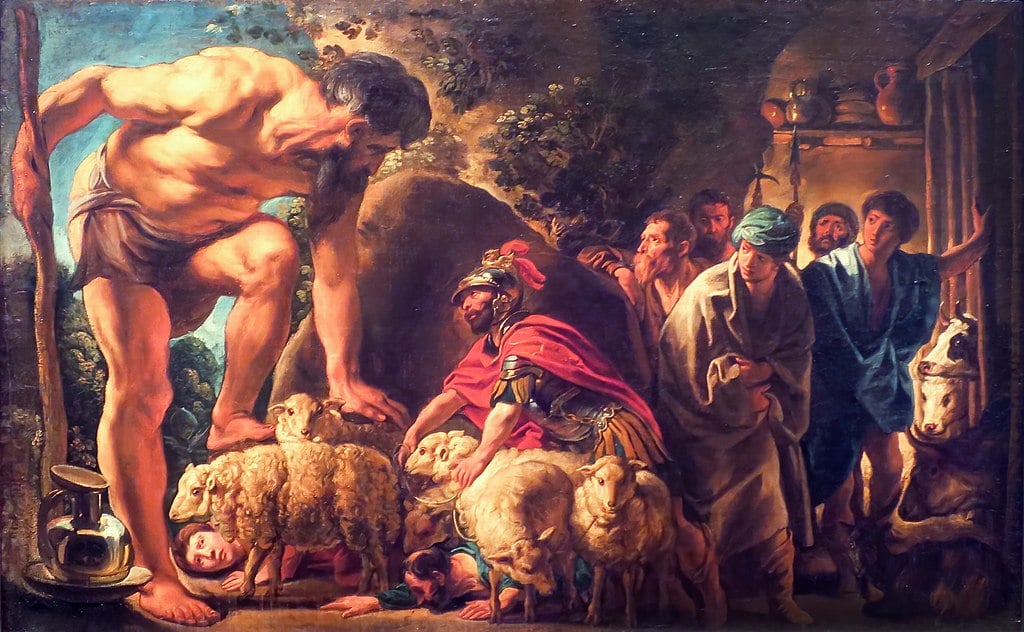
Homer’s Odysseytells the tale of Odysseus returning to his home after the Trojan War. For a variety of reasons, the trip is not an easy one. It takes him a full ten years to return home.
But the journey from Troy to Ithaca, Odysseus’ home island, should not have been too difficult and certainly not a ten-year trip. For this reason, some researchers have claimed that Odysseus actually traveled outside of the Mediterranean. There is even the suggestion that he traveled to Ireland.
Odysseus travel to Ogygia and its connection to Ireland
In the Odyssey, one of the places Odysseus visits is an island called Ogygia. This was the home of the nymph Calypso, who offers Odysseus immortality if he agrees to marry her. She refuses to let him leave otherwise. The gods intervene and force Calypso to release him. Hence, after seven years on the island, Odysseus builds a raft and sails away.
The location of Ogygia has been the subject of considerable speculation. According to Homer’s account, the island is a place of beautiful meadows, fountains, woods, and various types of birds. However, none of this is particularly helpful. All sorts of islands could fit this description.
In ancient times, various suggestions were made as to where Ogygia might actually be located. More recently, some scholars have argued that Ogygia is identical to Ireland. If this identification is correct, this would mean that Odysseus spent seven years in Ireland.
The most notable scholar to have come to this conclusion was Roderick O’Flaherty. In 1685, he used the name ‘Ogygia’ as a synonym for Ireland in the title of one of his books. It was called: Ogygia: Or a Chronological Account of Irish Events.
Plutarch’s account of Ogygia
One of the key pieces of evidence used to support the identification of Ireland as Ogygia is a passage written by Plutarch, a historian of the first century CE. He wrote about Homer’s account of Ogygia in conjunction to other additional information he provided. According to Plutarch, Ogygia was situated to the west of Britain, which is where Ireland is in fact located.
Additionally, Plutarch tells us that Ogygia was five thousand stadia away from the ‘great continent’ which surrounded the ‘great sea.’ Several scholars have suggested that this ‘great continent’ actually refers to America. Examples include Wilhelm von Christ, an eighteenth-century German scholar, and Johannes Kepler, a sixteenth-century German scholar.
If the ‘great continent’ mentioned by Plutarch really was America, then that would mean that Ogygia was actually an island somewhere between Britain and America. Since Plutarch says that Ogygia was five thousand stadia from the great continent but only several days distant from Britain, this indicates that it was much closer to Britain than to America. Therefore, Ireland would seem to be a good match.
Problems with identifying Ogygia as Ireland
While Ireland does match Plutarch’s basic description, there are certain issues with this identification. For one thing, Ireland is not five thousand stadia from America. This distance would be the equivalent of a little over nine hundred kilometers. Nevertheless, the distance between Ireland and America is about three thousand kilometers.
Hence, the distance specified by Plutarch means that Ireland is in fact not Ogygia, if America was indeed the ‘great continent’ to which he referred. Clearly, however, there is no other option for the great continent that would fit the passage.
Another problem is that Plutarch states that it takes five days of sailing to travel between Britain and Ogygia. This would indicate an island much further west than Ireland because it would barely take two days of sailing to reach Ireland from the furthest part of the western side of Britain.
In reality, there is no island which is exactly five days’ sailing away from Britain and also five thousand stadia away from America. The measurements simply do not correspond to any real location.
Perhaps, then, some researchers could use this as evidence that the measurements must be incorrect, meaning that Ireland could still be the intended location. Alternatively, it could of course also mean that Plutarch was not really describing an actual location at all.
Greek fire was the mysterious weapon used by the Byzantines to destroy enemies and prospective invaders, keeping the Empire strong and awe-inspiring.
The Byzantine liquid fire that protected the Empire was a terror-inspiring incendiary weapon that protected the Empire for centuries. Widely known as Greek Fire, this mighty weapon enabled the Byzantine Empire to survive and maintain its power through many attacks from various enemies.
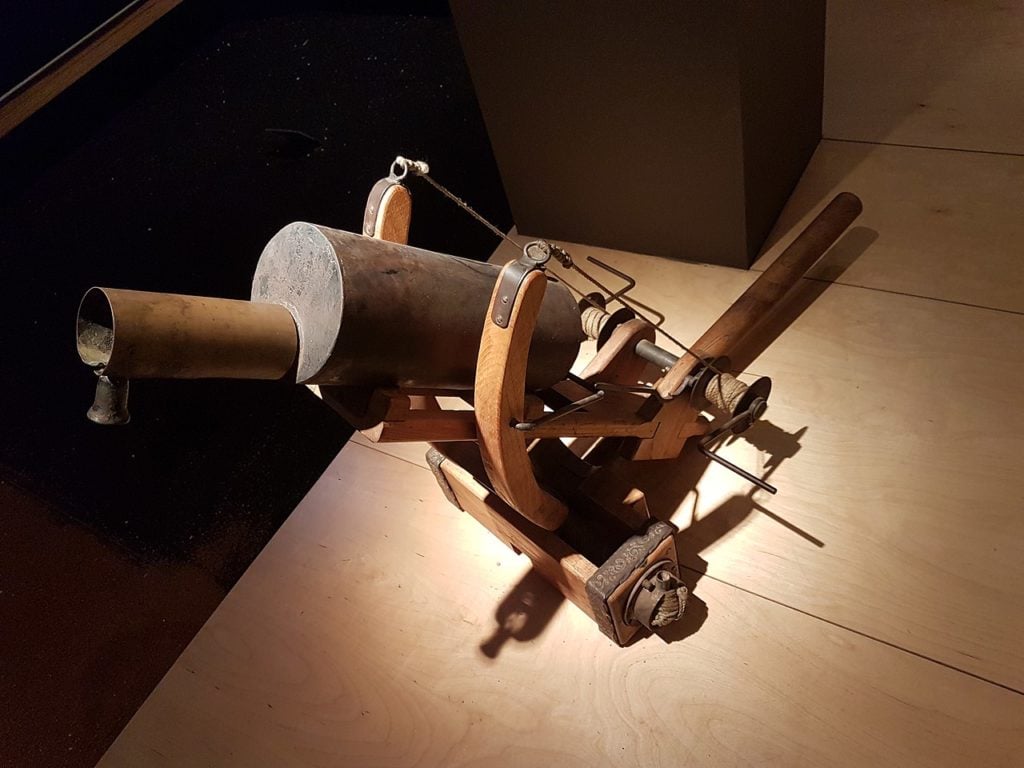
The weapon could be compared to the modern day flame-thrower. To the enemy in Byzantine times, it looked like a machine spewing destructive fire from hell. However, its exact origin remains unclear, and the recipe for this formidable weapon is still unknown, puzzling scientists and historians.
A Byzantine ship using Greek fire against a ship . On top, Greek alphabet in Byzantine form. Credit: Public Domain
Records suggest Greek fire contained a mix of petroleum, quicklime, and other unknown ingredients. This potent combination is believed to have made it one of the most flammable and dangerous substances of its time. What was truly amazing about the Byzantine liquid fire weapon was that it continued to burn on water and was practically impossible to put out with medieval means.
It helped the Empire maintain sovereignty over the mass land it occupied, spanning all of Southern Europe, North Africa, and Asia Minor. The weapon’s impact on the course of history is undeniable. It played a key role in the defense of Constantinople and the preservation of the Byzantine Empire.
A Brilliant Invention
Fire as a weapon had been used for centuries but never in such a sophisticated and destructive means as the Greek fire (or Υγρόν πυρ – Hygron pyr, as it was referred to in Greek). It was the Crusaders who referred to it as Greek fire or “liquid fire,” “Roman fire,” or “sea fire.” It was a significant weapon that never ceased to terrify the enemy.
This innovative weapon would fire massive flames in a continuous jet, burning a trail of destruction in its path that was nearly impossible to extinguish. When it came to naval warfare, it was a weapon that was impossible for the enemy to defend their ships from. Yet, the exact recipe for the liquid fire substances the Byzantines used remains a mystery to this day.
The Greek fire cannon-like machine was created in the seventh century. It most likely was the invention of Kallinikos of Heliopolis, a Jewish architect who fled from Syria to Constantinople. It was between 674 and 678 when the Byzantine Empire was attacked by the Islamic fleet of the Umayyad caliphate that had already taken over parts of Syria.
Concerned about an Islamic attack against Constantinople, Kallinikos experimented with a variety of materials until he discovered a mix for an incendiary weapon. Kallinikos sent the formula to the Byzantine emperor, and authorities developed a siphon that operated somewhat like a syringe, propelling the fiery concoction toward enemy ships.
Emperor Constantine IV reluctantly ordered the use of Greek fire to destroy the Umayyad fleet. However, the Byzantine weapon was very successful. According to historian Kelly DeVries and his book Medieval Military Technology, it was the first reported use of an incendiary weapon in battle.
Was Byzantine Liquid Fire a State Secret?
Some historians believe the reason the recipe for liquid fire remains unknown is because Byzantine emperors wanted to keep it a state secret, never to fall into the hands of the enemy. The vast Empire was surrounded by numerous enemies coveting its lands. Liquid fire was a potent deterrent to any army that would think of invading.
Constantine VII Porphyrogenitus warned his son Romanos II to not reveal the recipe “and not to prepare this fire but for Christians, and only in the imperial city.”
Anna Komnene, daughter of Emperor Alexios I Komnenos (r. 1081-1118) and a historian, wrote about the recipe for Greek fire:
This fire is made by the following arts: From the pine and certain such evergreen trees, inflammable resin is collected. This is rubbed with sulfur and put into tubes of reed, and is blown by men using it with violent and continuous breath. Then in this manner it meets the fire on the tip and catches light and falls like a fiery whirlwind on the faces of the enemies.
It was not that straight-forward, of course. Otherwise, it would be easy for the enemy to recreate the fiery weapon. It seems indeed that the Byzantines intended to keep the process of creating the liquid fire top secret, as no friend or enemy ever managed to gain insight into this so as to construct their own similar weapon.
Use of a hand-siphon, a portable flame-thrower, from a siege tower. Detail from the medieval manuscript Codex Vaticanus Graecus 1605. Public Domain
Greek Fire in Battle
In his book, Devries explains that Greek fire can refer to three different weapons: firstly, a fiery liquid pumped out of a nozzle; secondly, a liquid weapon that was filled in small grenades; and thirdly, a solid incendiary probably based on gunpowder.
The third is impossible to have been used in Byzantium. Its reported use started in the fourteenth century in Western Europe. However, there are Byzantine era depictions of men carrying hand-held tubes spitting fire that look even more like modern flame-throwers.
In fact, Greek fire was rarely used except primarily in naval battles, as the apparatus was complicated and required technically equipped handlers. Furthermore, it was dangerous to have an incendiary mechanism on a wooden ship.
In 727, Emperor Leo sent a fleet to burn that of Hellas and Cyclades, who had been revolting against him. In 941, a Rus naval raid from Kiev across the Black Sea was stopped, and their fleet was annihilated by the Byzantines.
Reportedly, in the eleventh century, Viking Ingvar the Far Travelled encountered ships equipped with the weapon, which he described as “a brass (or bronze) tube and from it flew much fire against one ship, and it burned up in a short time so that all of it became white ashes…”
However, by the end of the twelfth century and the Angeloi emperors, the Empire started to decline, losing more and more land to the rising Ottoman Empire. As Byzantium began to fade, so did the use of Greek fire until it became but a simple chapter in the great history of the Byzantine Empire.
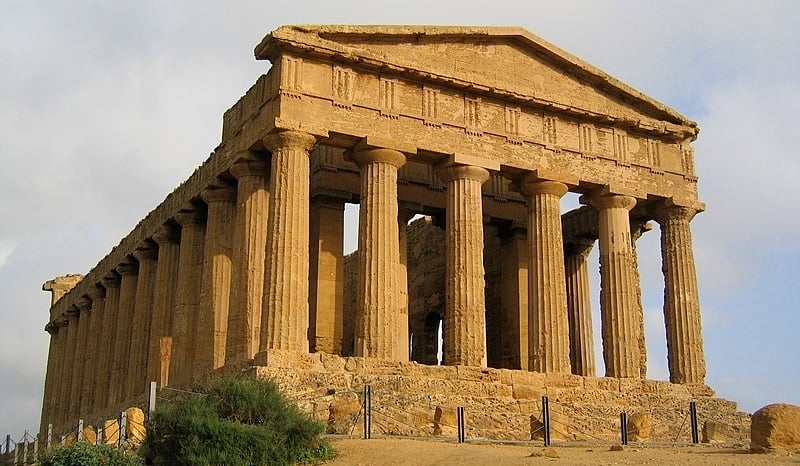
Temple of Concordia – Agrigento, Italy. Credit: Public Domain
When you think about Italy and ruins, your mind’s eye automatically brings up scenes of the Roman Forum and the Colosseum. However, Italy is home to countless ruins which are actually ancient Greek—many of which remain in stellar condition.
The country’s mainland, as well as the island of Sicily, are dotted with Greek ruins—some of which are integrated into modern-day cities and are still even used to host events! Others can be found in isolated locations well off the beaten path.
Ancient Greek Ruins of Italy
As you travel through Italy, as you really should if you call yourself a well-traveled individual, be sure to say “Opa!” as often as you say “Mamma mia!” The following are just some of the truly jaw-dropping ancient Greek ruins which are scattered throughout the Italian countryside.
Paestum
Located in southern Italy along the coast of the Tyrrhenian Sea in what was then called “Greater Greece” or Magna Graecia, this was a major Greek city in ancient times. The ruins date back to 600 to 450 B.C. and are some of the best-preserved Greek temples in the world!
The three famous ancient Greek temples at this site are of the Doric type, and the ancient city walls and amphitheater are mostly intact. The bottom section of walls from many other structures are completely intact.
It is an amazing experience to be able to walk along the ancient stone-paved roads and view the buildings along the roadsides just as the ancients did. The site is open to the public, and there is a modern national museum on-site for you to check out as well.
Another plus is that this archeological site is well off the beaten path and is seldom crowded with visitors!
Locri Epizefiri
Also on the mainland of Italy, in Reggio di Calabria, you will come across the ancient ruins at Locri. The ancient city has been mostly taken over by the encroachment of the nearby towns.
However, the area is very much worth a visit because the atmosphere quiets as you pass through shady olive groves and meander along the overgrown pathways. It is here where you will inevitably, and literally, stumble across a treasure of ancient ruins.
Greek temples, amphitheaters, and the well-known Sanctuary of Persephone grace the Locri area. The magical experience is truly something you shouldn’t miss out on.
On the island of Sicily, some truly remarkable ruins are yours to explore, starting with the still-used ancient Greek Theater of Taormina!
The Ancient Greek Theater of Taormina
With the beautiful Mediterranean sea lapping at the shores below and the active volcano of Etna looming over the city, Taormina is an upscale destination, featuring cultural events, museums, and priceless antiquities—right in the middle of a bustling city!
The ancient theatre of Taormina. Credit: Public Domain
Here you will find an ancient Greek amphitheater with exquisite views of both the volcano and the sea. While there, you might even be lucky enough to see a show at the ancient theater. It was originally built in 300’s B.C. and subsequently rebuilt by the Romans in the second century B.C.
Valle dei Templi in Agrigento
In Argrigento, you will be treated to refreshing views of expansive fields and woodlands—as well as one of the most pristine ancient Greek ruins in existence in the Valle dei Templi (the Valley of Temples).
Many of the temples and ruins here are not fenced off, so travelers may walk inside and be transported back to the fifth century B.C., when the Greeks first built the ancient city of Akragas. One of the most well-preserved Greek temples in the world, the Temple of Concord, is in this valley.
Segesta Archaeological Site
Segesta is located only 70 kilometers (43 miles) southwest of Palermo. Fortunate travelers here can visit what is perhaps the second most well-preserved temple in the world after those in the Valle dei Templi. Segesta also boasts a beautiful amphitheater, situated atop Mount Barbaro, which is also in pristine condition.
The temple dates back to the fifth century B.C. and has typical Doric architecture. Each summer the ancient amphitheater hosts a series of classical Greek dramas performed in Italian. If you’re lucky enough to visit during the summertime, be sure to catch a show.
Ancient Greek Colony in Siracusa
A favorite for all are the ancient ruins at Siracusa (Syracuse), where the ancient Greek colony dates back to the 5th century B.C. This area boasts a Greek theater and the Temple of Apollo, which dates back to the 6th century. Siracusa also has the ruins of the famous Altar of Hieron II—the largest altar from ancient Greece!
Located on the southeastern coast of Sicily and founded by ancient Greeks from Corinth, the city of Siracusa was once one of the most powerful city-states of ancient times. It was once described by the Roman orator Cicero as “the greatest Greek city, and the most beautiful of them all.”
Siracusa is so rich in historical treasures that it is listed as a UNESCO World Heritage Site.
Of course, there are many other Greek ruins that you will come across in your travels through Italy and Sicily, and we have merely scratched the surface in highlighting some of the more popular and well-preserved sites.
Be sure to work a little bit of Greek history into your itinerary on your visit to Italia!
Hermogenes of Tarsus developed the seven ancient Greek styles of speech to explain how rhetoric shapes clarity, emotion, persuasion, character, and intellectual power. Credit: GreekReporter archive.
Among the greatest rhetorical theorists stood Hermogenes of Tarsus, an Ancient Greek sophist and rhetorician who lived during the second century AD and developed a sophisticated theory of style that categorized speech according to seven major rhetorical qualities or styles of speech. These included Clarity (saphēneia), Grandeur (megethos), Beauty (kallos or omorphia), Rapidity (gorgotēs), Ethos, Sincerity, and Force (deinotēs).
Although many people mistakenly associate these rhetorical categories with the rhetorician Demosthenes, the systematic classification belongs to Hermogenes himself. Together, these categories formed a complete philosophy of expression. Hermogenes did not view rhetoric as ornamental alone. Instead, he treated speech as a living art capable of shaping thought, emotion, and public action.
The Ancient Greek Hermogenes and the art of rhetoric qualities or styles of speech
Ancient Greek rhetoric shaped political life, education, philosophy, and literature for centuries. Public speech held enormous importance in the Greek world because success in courts, assemblies, and intellectual debates depended upon persuasive expression. As rhetoric evolved, Greek thinkers attempted to classify the qualities that made speech effective, elegant, and emotionally powerful.
Hermogenes of Tarsus gained fame at a very young age. He was a rhetorical prodigy whose abilities astonished teachers and audiences alike, and he later composed several influential rhetorical treatises, especially On Types of Style. This work became one of the most significant manuals of rhetoric in late antiquity and Byzantium. Byzantine scholars such as George of Trebizond studied Hermogenes extensively, and introduced his theories in the West during the Renaissance.
Unlike simpler rhetorical systems, Hermogenes established a highly nuanced approach. He understood that persuasive speech requires flexibility rather than rigid formulas. Differing situations demand different styles, tones, and emotional effects. For this reason, his seven categories of styles of speech function less as isolated techniques and more as interconnected dimensions of expression.
“Clarity,” or Saphēneia, as a critical style of speech according to the Ancient Greek Hermogenes
Hermogenes considered clarity the foundation of all effective speech. Without clarity, audiences are unable to follow arguments or comprehend meaning. A speaker may possess intelligence and passion, yet confusion eradicates persuasion. Clarity therefore requires precise vocabulary, logical structure, and direct expression. Sentences should communicate ideas without unnecessary obscurity.
Nevertheless, Hermogenes did not reduce clarity to simplicity alone. Clear speech can still remain elegant and intellectually sophisticated. The goal involves illumination rather than oversimplification.
Greek philosophers also highly valued clarity. The philosopher Plato often criticized sophists who concealed weak arguments beneath decorative language. Similarly, Aristotle emphasized intelligibility as an essential feature of rhetoric. Hermogenes continued this tradition while developing a more refined stylistic analysis.
Plato criticized the sophists in his work “Gorgias.” Credit: Sebastian Bertrand. flickr
“Grandeur” as one of the most significant rhetorical qualities
Grandeur introduces elevation, dignity, and majesty into speech. This style suits heroic themes, political crises, moral exhortation, and public ceremonies. A grand style expands language through emotional intensity, powerful imagery, and elevated rhythm. Speakers using grandeur aim to inspire awe and admiration. Demosthenes often exemplified this quality in his speeches against Philip of Macedon. His rhetoric combined patriotic urgency with emotional force.
However, Hermogenes warned against excess. Grandeur must remain controlled. Otherwise, speech becomes inflated and artificial. True grandeur emerges from harmony between content and expression. Noble themes require compatible, equally noble language, yet authentic emotion must guide rhetorical elevation.
Statue of Greek God Zeus. Credit: flickr / Richard Mortel CC BY 2.0
The speech style of “Beauty,” or Omorphia
Beauty in rhetoric concerns elegance, harmony, and aesthetic pleasure. Hermogenes believed that beautiful speech delights audiences through rhythm, imagery, and balanced structure. This quality resembles artistic composition in poetry, sculpture, or music. Beautiful speech flows smoothly and creates emotional resonance through sound and proportion.
Greek culture deeply associated beauty with order and harmony. Philosophers often linked external beauty with inner balance. Hermogenes applies this principle directly to language. A beautiful style does not merely persuade intellectually. It also captivates emotionally and aesthetically.
Writers achieve beauty through careful word choice, graceful transitions, and balanced phrasing. Metaphors, cadence, and musicality all contribute to this effect. Nonetheless, Hermogenes again emphasizes moderation. Excessive ornament weakens rhetorical effectiveness. Beauty must support meaning rather than overwhelm it.
Doryphoros statue. Roman copy of the late 1st century BC — early 1st century AD, replica of a Greek bronze original by Polykleitos of the 5th century. Credit: flickr / Sergey Sosnovskiy cc by 2.0
The speech style of “Rapidity,” or Gorgotēs
Rapidity injects speech with energy, movement, and urgency. Hermogenes used the term gorgotēs to describe swift and dynamic expression that propels audiences forward. This style relies upon shorter clauses, quick transitions, and vigorous pacing. Rapid speech creates excitement and emotional momentum.
Orators often utilized this technique during moments of tension or conflict. Fast-moving rhetoric can produce feelings of urgency, danger, or passionate conviction. At the same time, rapidity demands careful control. If speech moves too quickly, audiences lose comprehension. Therefore, speakers must balance speed with clarity.
Hermogenes admired speakers who could accelerate rhythm without sacrificing coherence. Rapidity also reflects psychological intensity. Passionate conviction naturally produces energetic language and movement.
Hermes Logios was the god that protected rhetoricians. Courtesy of Vatican Museums. Credit: Public domain, via Wikimedia Commons
Styles of speech, “Ethos,” and “Sincerity”
Ethos concerns character and moral presence within speech. Aristotle had already emphasized ethos as one of the three pillars of persuasion. Hermogenes expanded this concept stylistically. A speaker’s language reveals personality, values, and emotional disposition. Audiences trust speakers who appear honorable, wise, and sincere.
Ethos therefore demands moral credibility and emotional authenticity. Differing rhetorical situations also require varying forms of ethos. A judge, philosopher, general, or grieving citizen each projects distinct moral qualities through speech.
Hermogenes understood that persuasion depends heavily upon the audience’s perception of character. Even brilliant arguments fail when listeners distrust the speaker. Thus, rhetorical success involves ethical presence as much as intellectual ability.
Sincerity is another trait that creates emotional truthfulness and human immediacy. Hermogenes recognized that audiences respond deeply to speech that feels genuine. A sincere speaker avoids excessive theatricality or artificial ornament. Instead, sincerity emerges through direct emotional connection and honest expression. This style often appears in personal appeals, lamentations, or moral reflections. Sincere rhetoric results in intimacy between the speaker and audience.
Greek tragedy frequently employed this quality during scenes of grief or confession. Philosophers also valued sincerity because truth required alignment between speech and inner conviction. Hermogenes therefore treated sincerity as a rhetorical strength rather than weakness. Genuine emotion can persuade more powerfully than technical brilliance alone. Nonetheless, sincerity still requires artistic control. Raw emotion without structure can become chaotic or ineffective.
According to the philosopher Plutarch, Dionysus was also the god of sincerity. Credit: just.Luc / Flickr CC BY 2.0
“Force,” or Deinotēs, as the seventh of the major Ancient Greek styles of speech
Force represents the culmination of rhetorical power. Hermogenes viewed deinotēs as the ability to overwhelm audiences through intensity, authority, and commanding presence. This style combines emotional energy, intellectual precision, and persuasive momentum. Forceful rhetoric strikes listeners with irresistible impact. Demosthenes often embodied this quality during political speeches. His words carried urgency, moral conviction, and strategic precision simultaneously.
Force differs from mere aggression. True rhetorical force arises from mastery over every dimension of speech. Clarity, grandeur, rhythm, sincerity, and ethos all contribute to it. Hermogenes considered this quality extremely challenging to achieve, and only highly skilled speakers could combine all rhetorical elements harmoniously. Force therefore represented the highest form of rhetorical excellence.
Heracles, the strongest hero depicted on red-figure style Ancient Greek pottery. Credit: Louvre Museum / Public domain / Wikimedia Commons
The unity of the seven styles of speech
Hermogenes never intended these categories to function separately. Great rhetoric combines multiple styles according to circumstance. A political speech may require grandeur during patriotic appeals, clarity during argumentation, sincerity during emotional moments, and force during conclusions. This flexibility explains the lasting influence of Hermogenes. His system recognized the complexity of human communication.
Hermogenes of Tarsus shaped rhetorical education for more than a thousand years. Byzantine scholarship practically treated his works as sacred manuals of eloquence. Renaissance humanists later read his theories and incorporated them into European education. His influence extended beyond rhetoric into theology, literature, and philosophy. Christian preachers especially valued his understanding of emotional and ethical persuasion.
Even today, modern communication still reflects principles Hermogenes identified centuries ago in his seven styles of speeches. Political speeches, courtroom arguments, literature, and public debates all rely upon clarity, emotional force, sincerity, and character.
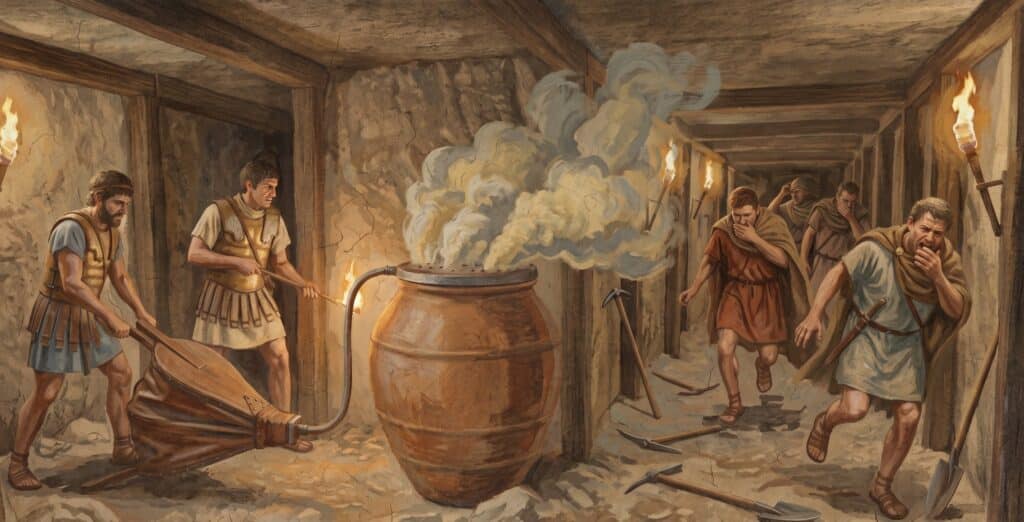
The burning feathers tactic used by the Ancient Greeks is considered one of the first chemical weapons in human history. Credit: Greek Reporter archive
In 189 BC, Ancient Greeks defending the city of Ambracia used an early form of chemical warfare against Roman forces during a siege, deploying a clay jar filled with burning chicken feathers.
At first, the story sounds almost absurd, but it becomes far more striking once the details are unpacked and we understand what was happening beneath the city walls—and, more importantly, why this moment even matters in the history of ancient warfare.
Ancient Greeks turn to chemical warfare and burning feathers as siege intensifies
The Romans arrived in Ambracia with overwhelming force. Consul Marcus Fulvius Nobilior deployed battering rams under a two-hundred-foot covered gallery, a massive mobile shed designed to protect his engineers from arrows and boiling pitch as they hammered away at the walls. The Ambraciot defenders held firm. The walls didn’t collapse.
Frustrated and running out of options above ground, the attackers eventually turned underground. Their plan was straightforward enough: tunnel beneath the city, collapse the foundations, and force the stubborn Greeks to surrender. For a while, the effort proceeded in silence. Then the Greeks noticed the piles of excavated earth building up outside the camp and understood exactly what was going on. Locating the tunnel was another matter. The Greeks solved it with one of the most clever pieces of field engineering in ancient history.
They placed thin bronze vessels against the ground at various points inside the city and then pressed their ears to them to listen. The vibrations traveling through the earth from the pickaxes told them exactly where the tunnel was heading. It functioned as an early acoustic detection system, and it worked brilliantly. They then dug a counter-tunnel and broke through into the mine. What followed was the kind of close-quarters underground fighting where normal weapons become useless. Spears are too long, shields too wide, and you can’t even see the man you’re fighting, so they built something new.
The Greeks took a large clay jar, a pithos, sized to precisely fit the tunnel, capped it with an iron lid drilled with holes, inserted an iron tube connected to a blacksmith’s bellows, and filled the jar with glowing charcoal covered in a dense layer of fine feathers, creating what can be described as an early chemical warfare device. When it was pushed into the tunnel and activated with the bellows, it produced a thick cloud of acrid, choking smoke that billowed forward into the darkness.
The Roman miners couldn’t breathe, couldn’t see, and had nowhere to go. They abandoned their tools and fled to the surface to escape the choking fumes. The Greeks had driven off a superior Roman force solely with clay, iron, fire, and feathers. Military historian Adrienne Mayor has pointed to this episode as evidence of just how sophisticated ancient weapons technology really was.
This deliberate act of chemical engineering would be remembered in later accounts of ancient warfare. The pithos was matched to the tunnel width specifically to prevent blowback. The feathers were chosen for the particular quality of smoke they produced when burned at high temperatures. Someone thought this through. The parallels to later warfare are hard to ignore. The same basic horror—an invisible, suffocating enemy in a dark enclosed space—would define trench warfare on the Western Front more than two thousand years later.
The psychology hasn’t changed even if the chemistry has. Ambracia ultimately surrendered. Cut off and outnumbered, the city eventually negotiated terms rather than fight on indefinitely, but the defenders had already shown what was possible. Historians now regard what happened in those tunnels as one of the earliest documented uses of asphyxiating chemical weaponry in a tactical military context—a genuine milestone in the history of warfare.
During the Roman siege of Ambracia in 189 BC, the defenders deployed what is one of the earliest recorded uses of a chemical weapon in history — and they used it underground. Rome was besieging the Greek city, held by the Aetolian League. When the walls held and the siege artillery failed, the Romans turned to mining — digging a tunnel beneath the walls, concealed behind a two-hundred-foot covered walkway, worked in relays day and night. For days the defenders didn’t notice. Then the pile of excavated earth grew too large to hide. Unable to see the tunnel, the defenders pressed bronze vessels against the ground to detect the vibration of digging, located the Roman mine, and dug a counter-tunnel straight toward it. The two tunnels met. Soldiers fought face to face in darkness too cramped to swing a sword. When direct combat failed, the defenders built a device described in detail by the historian Polybius: a clay jar fitted to the tunnel’s width, packed with feathers over burning coals, sealed with a perforated iron lid, and connected to a blacksmith’s bellows. They pumped the choking smoke directly into the Roman tunnel. The Romans were driven out of their own mine. According to Polybius, it was among the first uses of toxic smoke in the history of war. Further reading — Polybius, The Histories: https://amzn.to/4uWM9wN #AncientHistory#RomanEmpire#Ambracia#Shorts#HistoryShorts#ChemicalWarfare#TimelineHistory#history#shorts#ancientrome#education
Military expenditure as a share of GDP is a key stress test of national priorities. While the US and China lead in raw dollars, the ranking changes dramatically when adjusted for economic size. Here are the top 20 countries where defense takes the biggest bite out of the economy
Greece’s Supreme Court ruling has prompted loan servicers to freeze interest on thousands of restructured household loans pending further legal clarification. Credit: Wikimedia Commons / acediscovery / CC BY 4
Loan servicers are freezing interest charges on thousands of restructured household loans in Greece after a Supreme Court ruling raised questions over how debt repayments should be calculated.
Law 3869/2010, commonly known in Greece as the Katseli Law, covers the loans. The crisis-era framework allowed over-indebted individuals to seek court-supervised debt restructuring. Until the Supreme Court clarifies the legal implications of the ruling, affected borrowers will continue solely paying down the principal with no additional interest charges.
The decision has triggered concern across Greece’s financial sector because it challenges the traditional method for calculating interest on regulated debts. Loan servicers are now reviewing the ruling and plan to seek formal clarification from the Supreme Court before applying a final methodology.
Supreme Court ruling changes interest calculation
Supreme Court Plenary Decision 6/2026 sits at the center of the issue. The court found that lenders should calculate interest on debts restructured under Law 3869/2010 based on the monthly installment set by the court rather than on the total outstanding debt balance.
That interpretation marks a significant departure from standard banking practice. In a conventional repayment schedule, lenders calculate interest on the remaining balance of the loan. At the beginning of repayment, interest usually takes up a larger share of the monthly installment. As the borrower gradually repays principal, the interest portion decreases.
The Supreme Court adopted an alternative approach for loans covered by the debt-relief framework. According to the ruling, calculating interest on the monthly installment better serves the original purpose of the law, which aimed to help over-indebted individuals recover financially and return to economic and social activity.
Borrowers will only pay principal for now
Until the Supreme Court clarifies the ruling, loan servicers plan to suspend interest charges on affected loans. This means borrowers whose debts fall under the crisis-era framework will continue making payments, but those payments will reduce principal rather than cover interest.
Legal representatives for borrowers argue that the court’s interpretation could make many of these loans almost interest-free in practice. Under that view, lenders would divide the total regulated debt by the number of installments ordered by the court and then calculate interest only on that fixed monthly amount.
Some financial-sector representatives, however, interpret the decision differently, saying the ruling necessitates further clarification before servicers can apply a reliable calculation method. A senior source from the loan-servicing sector has reportedly said the industry should not adopt any interpretation before the Supreme Court provides additional guidance. Servicers are therefore preparing to submit a formal request for clarification.
Around 300,000 loans could be affected
Market estimates suggest that the affected framework may cover approximately 300,000 loans, with a total value of about €6 billion ($6.9 billion). Greek banks no longer hold most of these loans directly, after transferring, selling, or securitizing them during the cleanup of the country’s banking system.
Early market estimates place the potential cost for creditors at around €1 billion ($1.15 billion), depending on how the authorities and courts ultimately apply the ruling. The final impact will also depend on whether the decision guides only future calculations or opens the way for claims over interest already paid. That question remains especially sensitive. The ruling does not clearly settle whether it has retroactive effect, leaving borrowers, servicers, funds, and banks waiting for further legal clarity.
Possible impact on Greece’s loan securitizations
The ruling may also affect recoveries from securitized loan portfolios. Many loans covered by the debt-relief framework entered transactions linked to Greece’s “Hercules” asset-protection scheme, which helped banks reduce non-performing loans through state guarantees.
If collections from affected loans fall sharply, financial-sector sources warn that pressure could increase on certain securitizations. In a worst-case scenario, lower-than-expected recoveries could raise concerns over whether the state may eventually need to honor guarantees under the Hercules program.
For now, the extent of the risk remains uncertain. It will depend on the Supreme Court’s final interpretation, the number of loans directly affected, and whether courts or regulators allow any retroactive adjustment of interest already charged.
Broader concerns over Greece’s interest freeze on restructured loans
Banking sources are also monitoring whether the decision could influence borrowers who utilized other restructuring tools, such as Greece’s out-of-court debt settlement mechanism. If other vulnerable borrowers seek similar treatment, the financial consequences could extend beyond loans regulated under Law 3869/2010.
At this stage, the immediate effect applies only to borrowers whose debts fall under the crisis-era framework. However, the case could become an important reference point in future disputes over household debt, creditor recoveries, and the legal limits of debt-relief protection.
Greece’s new bank account limit will allow debtors to keep up to €1,600 protected from seizures. Credit: Greek Reporter
Greece is set to increase the protected bank account threshold from €1,250 ($1,445) to €1,600 ($1,850), allowing debtors an additional €350 ($405) per month to remain shielded from account seizures. The measure, announced in Parliament by Finance Minister Kyriakos Pierrakakis, is expected to go into effect on July 1. It is part of a wider government initiative aimed at easing financial pressure on households and businesses with outstanding debts.
The current exemption limit has remained unchanged since 2014, when it was introduced during the fiscal crisis. Twelve years on, the government says the revision reflects both rising living costs and the need to update Greece’s debt enforcement system. Pierrakakis noted that the new ceiling marks a 28 percent increase, outpacing cumulative inflation over the same period, which he estimated at 20.8 percent.
How the new protected bank account threshold in Greece will work
The protected bank account limit sets the amount of money a debtor can keep accessible in a designated account, even when seizure procedures are in place. Under the new rules, balances of up to €1,600 ($1,850) in a declared protected account will be exempt from seizures related to debts owed to the state. Each individual is allowed to declare one protected account at a single credit institution through the Independent Authority for Public Revenue (AADE).
In practice, if a debtor has €1,500 ($1,735) in their protected account, the entire amount remains untouched. If the balance increases to €1,900 ($2,198), authorities may only seize the €300 ($347) that exceeds the €1,600 ($1,850) threshold. The measure does not cancel debts or suspend enforcement actions. Instead, it raises the amount individuals can hold onto for everyday expenses and essential financial obligations.
Which debtors in Greece will benefit from the new bank account limit?
The change to Greece’s protected bank account threshold is expected to benefit individuals whose accounts are subject to, or at risk of, seizure due to overdue obligations. This includes salaried employees, pensioners, self-employed professionals, and other taxpayers who need greater protection for funds held in their declared accounts.
More than two million people in Greece currently have outstanding debts to the tax authorities. Of these, around 1.7 million have already been affected by enforcement measures such as account seizures, freezes, or other compulsory collection actions.
For those whose monthly income or deposits exceed the existing €1,250 ($1,445) limit, the increase could offer up to €350 ($405) in additional protected funds each month, easing pressure on everyday finances.
Measure tied to Greece’s private debt strategy
The increase in the protected bank account threshold is part of a broader policy package aimed at tackling private debt. The provision is expected to be included in the government’s upcoming bill on illegal gambling, which is currently under public consultation.
Private debt in Greece stands at 94.5% of GDP, below the European Union average of 121.4%. Authorities say the measure is designed to provide additional relief while maintaining enforcement mechanisms for overdue obligations.
The move comes as Greece continues to report stronger banking sector indicators. Non-performing loans in the country’s banking system have declined sharply to 3.3%, down from 48.5% in 2016. At the same time, debt arrangements totaling €6.8 billion ($7.86 billion) have been completed in 2025, reflecting ongoing efforts to restructure and manage outstanding liabilities across households and businesses.
Bank account seizures could be lifted
The same policy package introduces a separate provision for taxpayers whose bank accounts have already been seized. Under the proposed framework, debtors will be able to request the lifting of a seizure if they pay 25% of the principal debt upfront and agree to a repayment plan for the remaining balance. This option would be available once per debtor and is intended to encourage a return to regular repayments.
The new approach effectively replaces the “gradual protected account system” introduced in 2019, which was never implemented in practice. That model envisaged a step-by-step increase in protected funds for debtors who consistently met repayment obligations, but it was ultimately deemed too complex and remained inactive.
Implementation details still pending for Greece’s new bank account limit
The main outstanding issue is how the new €1,600 ($1,850) threshold will be applied to bank accounts that have already been declared as protected.
Authorities are expected to provide further clarification on the implementation process, including whether existing declarations submitted through AADE will be updated automatically or whether taxpayers will need to take additional steps to maintain or adjust their protected account status under the new regulations.
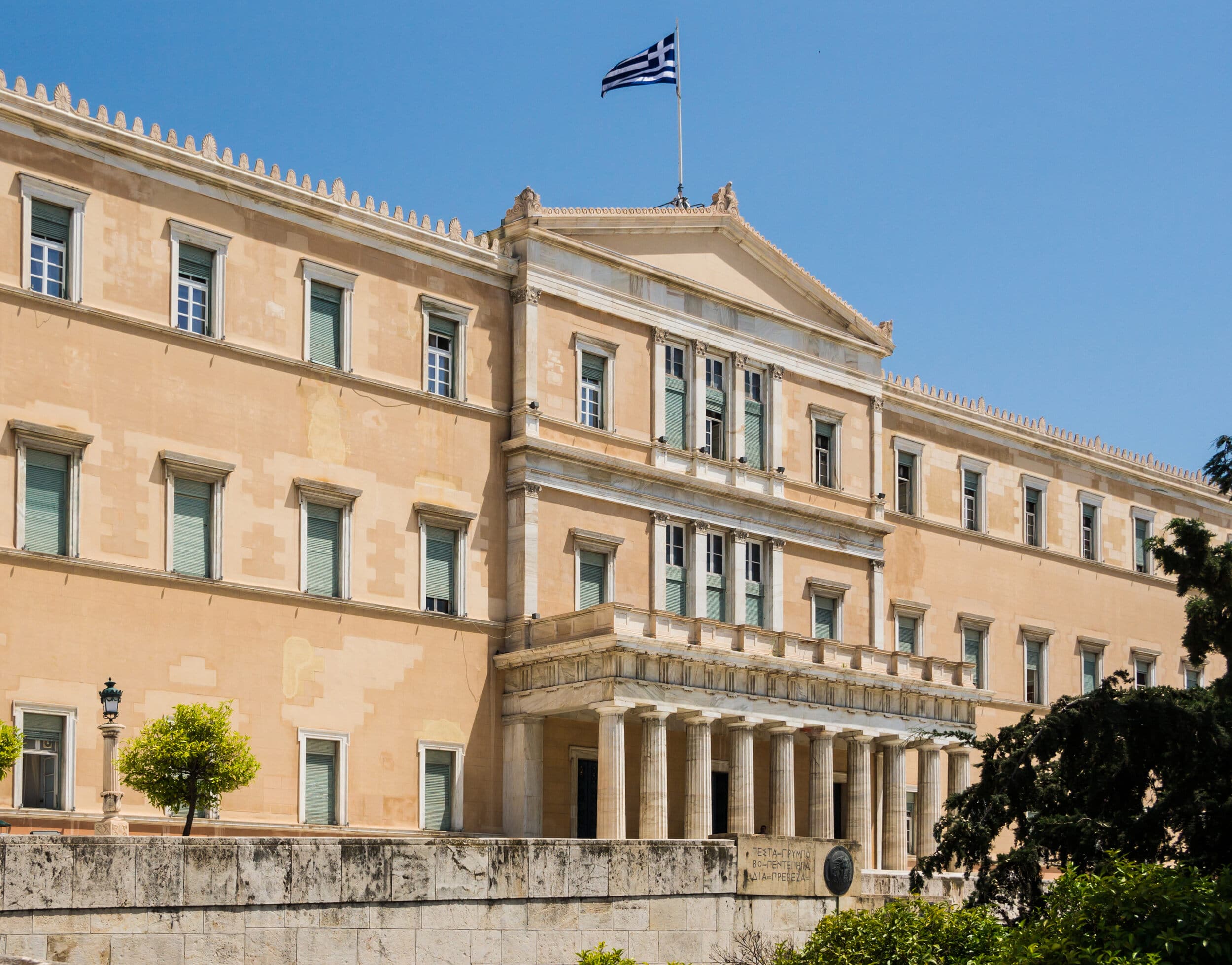
Hellenic Parliament in Athens. Greece’s Ombudsman reported record complaints over failures across public services. Credit: Wikimedia Commons/ Jebulon / Public Domain
Greece’s Ombudsman, the country’s independent administrative watchdog, received more than 20,000 complaints in a single year for the first time in its history, according to its latest quarterly bulletin, highlighting persistent failures across the country’s public administration.
The Ombudsman reported that the upward trend recorded in 2025 continued during the first four months of 2026 with no sign of slowing down. The figure underscores the strained relationship between citizens, residents, legal entities, and public services in Greece, where bureaucracy remains one of the most persistent sources of public frustration.
The bulletin, which covers January to April 2026, details cases involving social insurance, labor rights, disability certification, digital access to public services, and environmental protection.
Greece’s ombudsman acts on complaints over large family exemption
One notable case involved a large family that lost its exemption from municipal fees after some of its children reached adulthood.
The competent authority had apparently treated the exemption as temporary, although Greek law provides lifetime protection for families with four or more children, a category that carries a specific legal status in Greece. Following the Ombudsman’s intervention, the authority restored the family’s lifetime exemption.
Low-income pensioners asked to repay state errors
The bulletin also refers to the pension agency operating under the legacy structure of the former Agricultural Insurance Organization (OGA), which Greece later absorbed into the unified social security body e-EFKA. The agency attempted to recover money from low-income pensioners in order to correct errors that its own employees had made over several years.
In a separate case, a disabled citizen was expected to go through a prolonged bureaucratic process simply to have a disability assessment issued by the Army’s Supreme Health Committee converted into digital form. The conversion was necessary to obtain Greece’s Digital Disability Card.
Greece’s ombudsman intervenes in labor rights cases
Labor rights also featured prominently in the Ombudsman’s findings. The authority recommended heavy sanctions against a company that unlawfully dismissed a pregnant employee.
It also secured recognition of a 22-day special leave entitlement for two mothers of children with developmental disorders after their public-sector employers had repeatedly refused to grant the leave.
Disabled citizens report conduct of physicians
The bulletin also highlighted a pattern of complaints from disabled citizens regarding the behavior of certain doctors at KEPA, Greece’s disability certification centers, which operate under e-EFKA.
Following the Ombudsman’s intervention, the agency issued instructions for behavioral training and the adoption of a professional code of conduct.
Environmental complaints include noise, flooding, and illegal construction
Environmental issues formed another major area of concern. The Ombudsman criticized the ministries of Health and Development as well as the police over a legislative gap in noise regulation. According to the authority, the gap leaves residents living near open-air concert venues without adequate protection from noise pollution.
In two separate cases, the Ombudsman referred local government inaction to prosecutors. The cases concerned delays in flood prevention projects and the failure to demolish illegal structures in Oropos, in East Attica, and Ikaria, an island in the Eastern Aegean.
In the northwestern region of Thesprotia, the Ombudsman’s intervention also halted the illegal infilling of a stream.
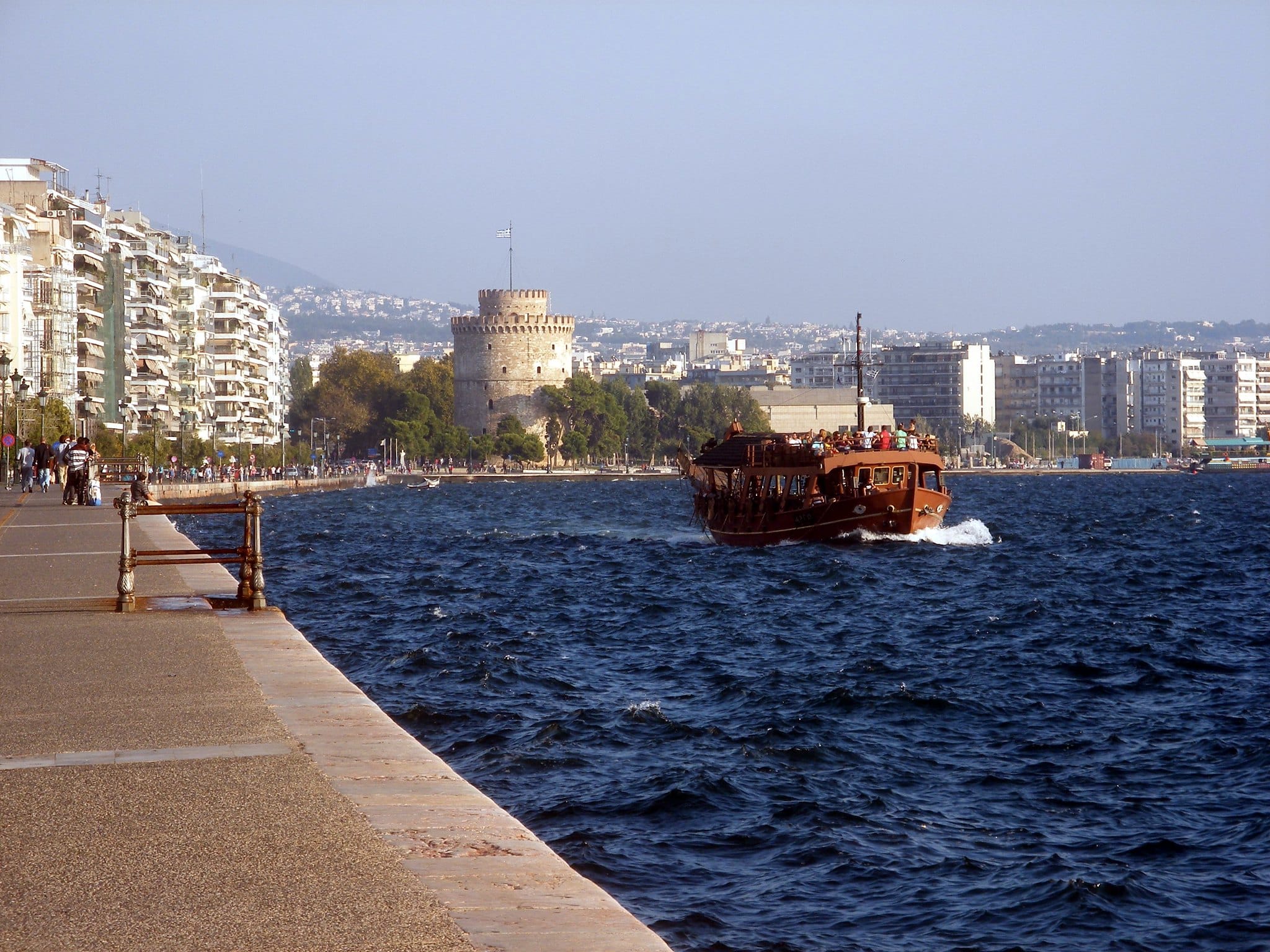
Thessaloniki waterfront and the White Tower on the Thermaikos Gulf, where algal blooms have triggered environmental concerns. Credit: Flickr / Anders Sandberg/ CC BY NC 2
A large algal bloom, also referred to in Greece as the “Red Tide,” has once again turned the waters of the Thermaikos Gulf along the Thessaloniki waterfront a murky brown, raising environmental concerns in Greece’s second-largest city as warmer weather and favorable winds intensify the phenomenon.
In recent days, large sections of the city’s seafront have been covered by a thick, brownish layer of phytoplankton slime. The bloom has produced unpleasant odors and altered the appearance of one of Thessaloniki’s most recognizable public spaces, affecting areas used daily by both residents and visitors.
Brown algal bloom spreads along Thessaloniki’s seafront
Drone footage highlights the scale of the algal bloom, showing brown waters stretching along Thessaloniki’s seafront from the Concert Hall area toward the city’s historic promenade.
According to local reports, rising temperatures and southerly winds have helped drive the algae toward the shoreline. As a result, the material has accumulated along the coast, forming a continuous layer across the water’s surface in several parts of the gulf.
Scientists point to eutrophication as cause of Thessaloniki waterfront algal bloom
Scientists attribute the phenomenon to eutrophication, a process driven by excessive concentrations of nutrients such as nitrogen and phosphorus entering the marine environment.
In the case of the Thermaikos Gulf, these nutrients can originate from urban wastewater, river runoff and agricultural fertilizers. Combined with higher sea temperatures, this leads to the creation of ideal conditions for the rapid growth of phytoplankton. This, in turn, can result in dense algal blooms that alter the color of the water and generate strong odors as the organic material begins to decompose.
Thermaikos Gulf remains vulnerable
Environmental experts have repeatedly warned that the Thermaikos Gulf is particularly vulnerable to such episodes due to long-standing pressures linked to urban development, agricultural activity, and climate-related factors.
Similar outbreaks have periodically been recorded in recent years, especially during warmer months, making algal blooms a recurring problem for Thessaloniki and the wider coastal area.
Cleanup operations underway as algal bloom spreads across Thessaloniki
The latest bloom follows earlier signs of eutrophication that have been reported in the Thermaikos Gulf since the beginning of the year.
Authorities have continued cleanup and monitoring efforts, including operations by the anti-pollution vessel Alkippi. The vessel has been deployed to assist in the collection of floating organic material and limit the impact of the bloom on coastal areas.
Long-term measures needed
Experts stress that algal blooms are generally natural biological processes, but they can be intensified by human activity and environmental pressures.
Reducing the frequency and severity of such outbreaks will require long-term measures to improve water quality, limit nutrient inflows, and strengthen environmental management across the wider Axios-Thermaikos Basin.
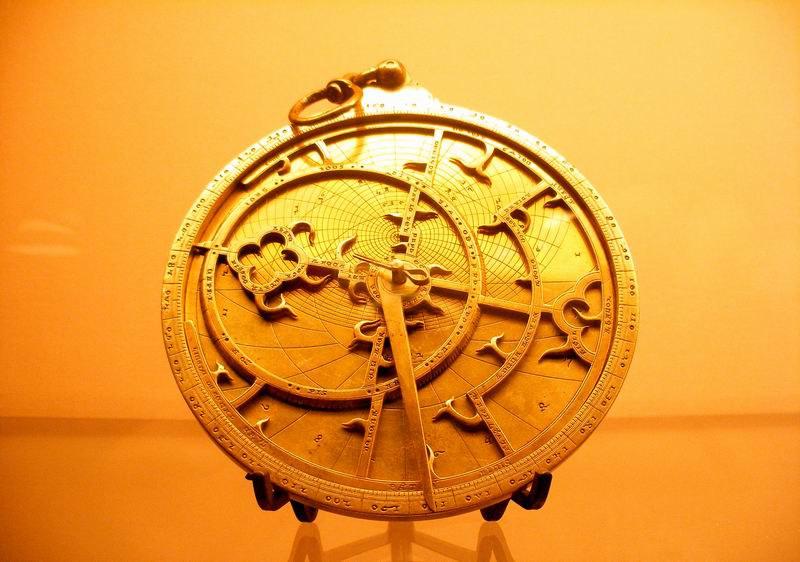
Ancient civilizations pioneered early versions of contemporary mechanisms, offering valuable insights into the origins of modern technology. An astrolabe. Credit: Anders Sandberg / Flickr / CC-BY-2.0
Across history, ancient civilizations crafted prototypes for many of the modern mechanisms that have become integral to contemporary life. From the compass’s early forms that transformed navigation to the predecessors of today’s vending machines, these ancient artifacts offer insights into the roots of modern technology.
Although some of these ancient mechanisms were lost over time, their hidden potential was eventually revealed by subsequent generations, shedding light on the remarkable foresight of the ancient inventors.
Baghdad Battery
Baghdad Battery
found near Baghdad,considered galvanic cell that was created 2,000 years before A.Volta was born.The "battery"was a 13-centimeter vessel.Its neck was filled with bitumen an iron rod passed through it.Inside the vessel was a copper cylinder with an iron rod in it pic.twitter.com/zpPi36yxs7
An ancient artifact, which became known as the Baghdad Battery, has fascinated the minds of scientists for the last century. According to chemist Dr. Von Handorf, this find allows to believe that “an ancient tinkerer could have invented an electroplating process.”
Discovered in 1938 by a German archaeologist Wilhelm Konig, the Baghdad Battery is potentially around 2,000 years old. It comprises a clay jar, a copper cylinder, and an iron rod. When filled with a mild acid, such as vinegar, this assembly generates approximately 1-2 volt of electricity.
Attention to the mechanism arose with new force after the Second World War. American scientist Willard Gray conducted experiments in the post-war period, making copies and demonstrating that the device could generate two volts of electricity when filled with electrolyte. German researchers in the 1970s replicated this setup and successfully used it to electroplate a thin layer of silver, proving its potential as a battery.
Several theories have been proposed regarding the purpose of the Baghdad Battery. One hypothesis suggests that its primary use was for therapeutic purposes, drawing inspiration from the ancient Greek practice of using electricity to relieve pain. Another theory suggests that the batteries could have been hidden inside religious statues or idols. Dr. Paul T Craddock suggested that those who touched the statues would “experience a little shock with a small, mysterious flash of blue light.”
However, this mystery is likely destined to remain unsolved, since the artifact was stolen from the National Museum of Iraq in 2003.
The Lycurgus Cup
The Lycurgus Cup appears jade green, but changes color to a rich blood red when lit from behind. Credit: Public Domain / Wikimedia Commons
This 1600-year-old cup has a feature that proves that the ancient Romans were pioneers of nanotechnology. The perfectly preserved artifact amazed minds with its ability to change color depending on position and lighting.
Since the 1950s, the Lycurgus Cup has been in the British Museum. It received its name because of the masterfully depicted king of Thrace, Lycurgus. According to ancient Greek legends, he was at enmity with the god of wine Dionysus and is depicted on a cup entangled in a trap of grapevines.
When lit from the front, the cup appears jade green, but changes color to a rich blood red when lit from behind. This unusual and extremely modern property for that era has amazed scientists for decades.
Subsequently, scientists still managed to solve the mystery of the ancient mechanism behind the cup. They examined the glass under a microscope and discovered that Roman artisans had impregnated it with particles of silver and gold. These grains were so small that their size was less than one thousandth of a grain of table salt. Researcher Ian Freestone from University College London called the painstaking work of the ancient craftsmen “an amazing feat.”
The operation of the color changing mechanism has also found its explanation. When hit by light, the electrons belonging to the metal particles vibrate in such a way that they change color depending on the position of the observer. Gan Logan Liu, a professor at the University of Illinois at Urbana-Champaign, said that when the cup was filled with liquid, it changed the way the vibrating electrons in the glass interacted. He underlined that the romans “knew how to make and use nanoparticles for beautiful art.” Consequently, the color of the cup also changes.
This ancient technology is reflected in the modern world. Thus, home pregnancy tests use nanoparticles that turns the white line into pink.
South-Pointing Chariot, Ancient Mechanism Before Compass
A model of a south-pointing chariot. Credit: Andy Dingley / CC-BY-3.0 / Wikimedia Commons
The prototype of a navigational instrument, this Chinese south-pointing chariot became an ancient analogue of the compass. The history of this ancient mechanism dates back to approximately 5th century BC.
The chariot was described as a horse-drawn cart indicating the southern direction. It featured a figure that consistently pointed south, irrespective of the cart’s orientation. Employing differential gears, the mechanism comprised four wooden gears and additional gearing connecting the differential to the wheels. As the wheels turned, the gears rotated the figure to maintain its southern alignment. Notably, the chariot necessitated manual adjustment at the start of every journey, unlike a compass, which aligns automatically.
Chinese scientists rapidly developed their technologies and learned to magnetize iron needles back in the 7th–8th centuries AD. However, for several more centuries they did not use magnetic compasses and continued to produce chariots. It is believed that they went out of use only around the year 1300.
First Vending Machine
Vending machines are older than you might think.
The first such machine was designed and produced by Heron of Alexandria in the 1st century BC.
Vending machines, which have become a common attribute of modern life, owe their appearance to the ancient Greek scientist Heron. One of the best ancient mathematicians and inventors, he lived and worked in Alexandria. Heron developed many remarkable ancient mechanisms, and even the first steam engine of its kind.
His vending machine was a very modern mechanism for dispensing holy water. To use it, a person had to insert a coin into a special slot. Then it fell onto a tray connected to a lever. The weight of the coin opened the valve, from which water flowed out for the liars. Eventually, a coin would then slide off the tray, causing the lever to return to its place.
Astrolabe, Ancient Mechanism that Could Measure Time
An exploded view of an astrolabe, an instrument that was invented by the Greek scientist Ptolemy. Credit: Elrond / CC BY-SA 4.0 / Wikimedia Commons
Alexandria was home to another brilliant ancient inventor, Ptolemy, who invented a mechanism that could measured time.
This ancient instrument for timekeeping and celestial observation included the planispheric type, allowing astronomers to compute the positions of the Sun and stars relative to the horizon and meridian.
Originating in the 6th century, astrolabes gained prominence in the early Middle Ages across Europe and the Islamic world. It become crucial for maritime navigation by the mid-15th century before the emergence of sextants. Ranging from 3 to 18 inches, the typical planispheric astrolabe was predominantly crafted from brass or iron. It featured the base plate with celestial coordinates, the open-pattern disk illustrating stellar maps, and the alidade used for celestial sightings.
The astrolabe’s intricate construction and widespread usage underscored its significance as a multifunctional scientific tool in the medieval period. Its application extended beyond astronomy, finding utility in fields such as geography, timekeeping, and surveying.
The ancient Greek Acropolises meant very different things to different people across history. A new study finds its symbolic meaning shifted dramatically over centuries, starting as a marker of civic pride and freedom before becoming firmly associated with tyranny and oppression.
Robin Rönnlund, an archaeologist at the University of Gothenburg in Sweden, published the study in the Annual of the British School at Athens. He examined ancient texts from Homer through the second century A.D. and traced how writers, philosophers, and inscription makers actually understood the word “acropolis” across roughly 1,000 years.
The research directly challenges a widely accepted scholarly narrative. For decades, historians described acropolises as prehistoric royal strongholds that were later abandoned and converted into either religious sanctuaries or civilian refuges during attacks.
Scholars built a false narrative around misread Aristotle
Rönnlund traces this narrative back to a misreading of a passage in Aristotle’s Politics, in which Aristotle theorized that acropolises suited oligarchies and monarchies.
Past scholars interpreted this theoretical statement as a historical sequence rather than a practical observation about fortifications, and the misreading quietly shaped academic thinking for generations.
Remains of the Temple of Artemis with the Acropolis. Credit: Carole Raddato / Wikimedia Commons / CC BY-SA 2.0
The word itself is also commonly misunderstood. Rönnlund explains “acropolis” does not mean “upper city,” as dictionaries suggest. It more precisely means “the farthest polis” or “the polis on the edge,” and it first appeared in the Odyssey in reference to Troy.
In early Greek poetry, the ancient Greek acropolis carried an unmistakably positive meaning. Simonides described the Acropolis as a symbol of Greek resistance to Persian invaders.
Ancient Greek Acropolis once stood for freedom and pride
Sparta was celebrated as the “acropolis of Greece” in the famous Lysander monument at Delphi. Philosophers extended the metaphor further. Plato called the head the “acropolis of the soul.”
Diocles of Karystos described the mind as a sacred statue placed on the acropolis of the body. These uses reflected strength, protection, and honor.
The meaning turned darker as foreign military occupation became widespread. Ancient sources contain 66 passages linking tyrants to acropolises. Plutarch recorded a warning that Caesar should not be established as “tyrant in the acropolis.”
Macedonian forces turned a civic symbol into oppression
After 322 B.C., Macedonian forces systematically garrisoned acropolises across Greece to keep conquered cities under control. Both Demosthenes and Isocrates described how garrisoned acropolises kept entire regions in submission.
Civilian populations almost never used acropolises as refuges, contrary to popular assumption. The sites lacked sufficient water and supplies for prolonged occupation, and literary sources confirm people typically fled to the walled city below or into the countryside during attacks.
Rönnlund reviewed 133 individual acropolises mentioned in ancient sources and calls for future research combining archaeology, epigraphy, and field surveys to properly reconstruct how these sites functioned in ancient Greek life.
Mycenaean religious practice included structured sacred spaces, and the evidence challenges the idea that Mycenaean temples did not exist. Credit: Wikimedia Commons, Andreas Trepte, www.avi-fauna.info, CC-BY-SA-2.5
According to a long-standing urban legend, the Mycenaeans did not build temples but worshiped outdoors under open skies. This claim appears in popular books, casual discussions, and also surfaced in earlier scholarly interpretations of Bronze Age Greece.
However, archaeological evidence challenges this view. Material finds, Linear B texts, and remains of cult architecture all point in a different direction. The Mycenaeans did not restrict worship to open-air rituals alone; they also used structured sacred spaces within buildings. In fact, they developed organized religious environments that functioned in ways comparable to early temples.
The origin of the “open-air only” idea
The idea that the Mycenaeans worshiped exclusively outdoors stems from early comparisons with Minoan Crete. Some early researchers assumed that Bronze Age societies possessed no formal religious architecture and interpreted the absence of large, classical-style temples as evidence of informal worship practices.
In addition, early archaeologists often struggled to identify religious buildings at Mycenaean sites. Many structures appeared domestic or administrative in character, leading to an underestimation of their possible ritual functions. Over time, these assumptions produced a simplified narrative suggesting that Mycenaean religion remained primitive or underdeveloped. In this interpretation, formal temple construction was seen as something that emerged only in later Greek civilization.
Today, this view is considered outdated and overlooks both textual and archaeological evidence. It also projects later Greek architectural expectations onto an earlier cultural and historical context.
What the Linear B tablets reveal about Mycenaean temples and religious practice
The Iliad already refers to a temple within the Trojan citadel that houses the statue of a goddess, suggesting that structured sacred spaces were part of early Greek religious imagination. Beyond literary tradition, the Linear B tablets provide some of the strongest evidence against the “open-air-only” interpretation. These tablets preserve administrative and religious records from Mycenaean palace centers, offering a rare direct glimpse into how cult activity was organized.
They record offerings and mention deities associated with the later Greek pantheon, including Zeus, Poseidon, Hera, Artemis, and Hermes, while also documenting the management of cult resources by officials. This points to a system of structured worship rather than purely spontaneous outdoor ritual.
Importantly, the tablets often connect deities with specific locations, referring to sanctuaries, priests, and offerings tied to defined, organized spaces. This suggests that religious practice was not confined to natural settings but also embedded within institutional environments. Taken together, this written evidence weakens the idea of exclusively outdoor worship. Instead, it reveals planning, hierarchy, and dedicated sacred functions within Mycenaean religious life.
Tablet with Linear B Script from the Palace of Knossos – 1375 BC. Credit: TimeTravelRome. CC BY 2.0/flickr
Archaeological evidence of cult spaces
Archaeology strengthens this conclusion. Excavations at Mycenaean sites have uncovered buildings with clearly identifiable ritual functions, including altars, offering areas, and religious artifacts. One of the most significant examples comes from Mycenae itself. The so-called “Tsountas House” provides key evidence for structured cult activity within a designed landscape.
The Tsountas House is located near the citadel of Mycenae and was first excavated during early investigations led by Christos Tsountas. The structure dates to the Late Bronze Age. At first glance, the building does not resemble a later classical temple, lacking the monumental stone columns associated with later Greek religious architecture. However, its interior evidence tells a different story. Researchers such as Kim Shelton have identified signs of ritual activity within the structure, including figurines, offering vessels, and spatial arrangements that suggest ceremonial use. The layout also indicates controlled movement through the building, reinforcing the impression of organized ritual practice.
Taken together, these features are significant. They show that Mycenaeans used enclosed architectural spaces for ritual purposes, effectively functioning as cult centers. Worship was not confined solely to mountains, peak sanctuaries, or open courtyards. Instead, structured sacred environments existed within administrative and residential settings. This evidence points to a broader religious system in which cult activity, palace administration, offerings recorded in Linear B texts, and outdoor sacred landscapes all formed interconnected components of Mycenaean religious life rather than isolated or competing practices.
Remarkable gold artifacts discovered within the Mycenaean citadel. Credit: Xuan Che / CC BY 2.0
Why the “no temples during the Mycenaean period” narrative fails
The “no temples” narrative fails largely because it relies on a narrow, anachronistic definition of what a temple must be. If one expects Mycenaean sacred architecture to resemble later classical Doric structures, then such buildings will not appear in the archaeological record. However, this expectation sets a false standard. It overlooks architectural evolution over time and ignores the cultural and functional differences between the Bronze Age and later Greek periods.
Mycenaean sacred architecture followed its own internal logic. Ritual spaces were frequently integrated into palatial complexes or elite residences, and smaller, multi-functional buildings often served religious purposes in place of large, freestanding temples. For this reason, the absence of classical-style temples does not imply the absence of religious architecture.
At the same time, Mycenaeans did perform rituals outdoors, likely at natural features such as hills, caves, and mountain peaks. Outdoor worship was an important component of Bronze Age religious practice, a pattern that continued into later Greek tradition. Nonetheless, outdoor ritual activity did not exclude indoor sacred spaces. Rather, both forms coexisted and fulfilled different roles within a broader religious system.
Mycenaean religion combined palace-based cult administration, offerings recorded in Linear B texts, enclosed ritual spaces, and outdoor sacred sites in the landscape. Together, these elements formed a structured, multi-layered system operating across both constructed environments and the natural world. This combination underscores not only complexity and organization but also continuity with later Greek religion. Structured sacred space did not emerge suddenly in the Classical period but developed gradually from earlier Bronze Age practices.
Kadmeion. Mycenaean palace complex of Thebes. Credit: Zde / Wikimedia Commons CC BY-SA 4.0
Why the myth persists today
The persistence of the “no temples” myth can be traced to three main sources. First, early scholarship shaped the expectations of later generations. Once an interpretation enters textbooks and reference works, it tends to persist, even when new evidence complicates or overturns it.
Secondly, the very word “temple” carries a strong classical bias. Readers often imagine columns, symmetry, and monumental marble architecture. When such features are absent in the Bronze Age record, this is interpreted as a lack of temples rather than a difference in architectural form.
Lastly, simplified narratives tend to spread more easily than nuanced archaeological interpretations. The idea of “primitive outdoor worship” is easy to remember and communicate, whereas the actual picture is more complex and layered. In reality, the Mycenaeans did not rely exclusively on open-air worship but also built and used structured indoor spaces for ritual activity that can reasonably be understood as early temple forms.
The claim that Mycenaeans lacked organized religious buildings does not withstand scrutiny. It reflects early interpretive bias more than archaeological evidence. Mycenaean religion combined indoor and outdoor elements and showed early forms of institutional organization. In this sense, it laid important foundations for the development of later Greek religious architecture and practice.
Marx and Aristotle, though centuries apart, both recognized that value is rooted in social relations rather than in objects themselves. Credit: GreekReporter Archive
When the philosopher Karl Marx set out to unravel the mysteries of value, exchange, and labor in capitalist society, he found a surprising intellectual ally in Aristotle, the ancient Greek philosopher who lived two millennia earlier. Despite their different historical contexts, both thinkers examined how value arises not inherently from things but from their social relations—especially through the lens of use and exchange.
Marx, in Capital, openly acknowledged Aristotle’s importance. Not only did Aristotle lay the groundwork for distinguishing use-value from exchange-value but his reflections on early human society, property, and the role of labor and technology revealed a conceptual framework that Marx would radicalize for modern critique.
Use-value and exchange-value: Aristotle’s anticipation
Aristotle’s analysis of value in Politics distinguishes between two uses of a commodity. One is proper and natural while the other is improper or derivative. He writes:
“Every commodity has two uses: both belong to the thing itself, but not in the same manner—one is the proper use, the other is not. For example, a shoe serves either to be worn or to be exchanged; both are uses of the shoe, for he who gives a shoe in exchange to someone who needs it, receiving in return money or food, uses the shoe as a shoe, but not according to its proper use, for it was not made to be exchanged.”
This distinction—between use-value and exchange-value—is a cornerstone of Marx’s analysis. For Marx, this Aristotelian formulation prefigures what he calls the “value-form” of the commodity. Commodities are useful in particular ways (use-value), but also enter into a social system of equivalence when exchanged (exchange-value).
Marx directly builds on this by showing that exchange-value does not exist inherently in an object but arises through the abstraction of labor—because human labor makes different useful things commensurable. Aristotle notes that a shoe does not exist for exchange. Marx took this insight and asked: What kind of society inverts this logic and makes objects valuable only in proportion to their exchangeability rather than their utility?
From the household to the marketplace: society before exchange
Aristotle’s theory of the household (oikos) as the first form of society was essential for Marx’s historical materialism. In Politics, Aristotle describes early society as beginning with families. In these families, property was communal and exchange unnecessary. It was only as the population grew and self-sufficiency gave way to interdependence that markets and money emerged.
Marx adopts this trajectory in Capital and his Grundrisse notebooks, writing that commodity exchange is not a timeless activity. Instead, it is a historically specific development that reflects changes in social relations and property forms. The transition from common property to private ownership and from useful production to production for exchange is the material foundation of class society.
In Aristotle, we already see the seeds of this analysis. He distinguishes between natural wealth-getting (production for use) and unnatural chrematistics (the accumulation of wealth for its own sake). Marx seizes upon this distinction to critique capitalism as a system in which the unnatural pursuit of profit replaces human need as the goal of production.
A statue of Aristotle. Credit: Public Domain, via Wikimedia Commons
The machine and slavery
One of the most striking moments in Capital (Vol. I) occurs when Marx discusses machinery and automation. Here, he ironically invokes Aristotle’s dream that if tools could operate themselves, no slaves would be needed:
“If—dreamed Aristotle, the greatest thinker of antiquity—if every tool could perform its task at command or even by anticipation, like the statues of Daedalus that moved of their own accord, or the tripods of Hephaestus that spontaneously began their sacred work, if the shuttles of the loom wove by themselves, then master craftsmen would not need assistants, nor masters slaves.”
This vision did not remain uniquely Aristotelian. Antipatros, a Greek poet from the era of Cicero, hailed the invention of the watermill—the earliest rudimentary form of productive machinery—not simply as a technical advancement but as a social revolution. He praised it as the liberator of enslaved women who had been condemned to grind grain by hand. He envisioned it as the usher of a new golden age of human dignity and freedom.
In these ancient myths and poetic praises, technology is seen not merely as efficiency but as emancipation. The ancients, despite their slave-based economies, understood that the highest purpose of tools was to free people from servitude.
Gaziantep Zeugma Museum Daedalus mosaic. Credits: Dosseman / Wikimedia Commons CC BY-SA 4.0
Marx’s irony and the betrayal of the promise of automation
Marx, however, saw this ancient hope turned upside down in modern capitalist society. In his words, what was supposed to free labor had become its jailer:
“Ah, those idolaters! They knew nothing of political economy or Christianity, as discovered by clever Bastiat and even cleverer McCulloch. They failed to understand, among other things, that the machine is the most reliable means for lengthening the working day.”
Here, Marx mocks the liberal economists of his time. Frédéric Bastiat and John Ramsay McCulloch, champions of laissez-faire capitalism, celebrated mechanization without recognizing its role in intensifying exploitation. Unlike the “idol-worshiping pagans,” who at least had the imagination to conceive of automation as a force for liberation, these modern theorists lacked even that mythical foresight.
Marx continues with biting irony:
“They failed to understand, among other things, that the machine is the most reliable means for lengthening the working day.
Thus the strange phenomenon arises in the history of modern industry. That the machine, the most powerful instrument for reducing labor time, becomes the most unfailing means of converting the whole life of the worker and his family into labor-time for capital’s valorization.”
The true paradox for Marx is that mechanization offers a means to liberate humanity but capital instead weaponizes it to intensify exploitation. The ancients envisioned automation as a means of human emancipation. Capitalism uses it to deepen alienation and dependency.
The irony is profound: the ancients dreamed of freedom through the machine, and capitalism delivered machines that reinforce dependency. In this way, Marx reclaims the ancient vision but also shows how the promise of automation has been betrayed.
Antipatros celebrated the invention of the watermill as a liberating force, heralding it as a symbol of a new golden age of human dignity. Credit: Pietro da Cortona, Wikimedia Commons, Public Domain
Aristotle and Marx: From ancient slavery to modern compulsion
Marx’s dialogue with Aristotle was not just academic—it was dialectical. He admired Aristotle’s clarity in distinguishing between types of value and his historical insight into the development of exchange. However, Marx also showed how the slave economy of antiquity historically constrained Aristotle’s ideas.
Ironically, in an age in which full automatism is increasingly possible, the prevailing economic model continues to reproduce the conditions that Aristotle associated with slavery—not through direct ownership of people but through economic compulsion and structural inequality. In that sense, Marx saw in Aristotle both the seed of critical insight and the limit of pre-modern social theory.
Hence, while Aristotle could not imagine that labor determines value in commodities, he sensed something essential: that value is not a thing but a relation and that social forms of labor determine the shape of society itself.
Portrait of the king of Pontus Mithridates VI as Heracles, a mythical association that Alexander the Great often touted. Marble, Roman imperial period (1st century), Credit: Musée du Louvre, Paris, Public Domain.
Alexander the Great’s (356-323 BC) death meant his vision for a Greco-Persian Empire was extinguished with him—or was it?
A hodgepodge of East and West, Mithridates’ Pontic Empire emerges as a compelling possibility of what Alexander’s empire could’ve been, a faint apparition of that fleeting dream.
Alexander 2.0
Mithridates (135–63 BC) was the inheritor of two cultures and, naturally, an incarnation of two worlds. He delighted in his Macedonian heritage as much as his Persian forbearers.
Claiming Macedonian ancestry on one side and Persian dynastic lineage on the other, Mithridates used his mixed descent to reveal the commonalities between his diverse subjects.
Taking on Alexander’s mantle of global empire, Mithridates envisioned an alternative to Roman supremacy, a new world order.
To achieve this ambitious aim, the Pontian King united his Greek, Anatolian, and Persian subjects under an anti-Roman cross-cultural coalition.
The result of this cooperation was three wars mounted against Rome, wars that escalated to the point of genocide.
How could he amass such a diverse following against such a formidable foe?
Mithridates took a page from Alexander’s book and embodied East and West, both in appearance and idea.
Pontus: Alexander’s vision of empire?
Map of the Kingdom of Pontus. Credit: Photograph by Javierfv1212, Public Domain, via Wikimedia Commons.
Mithridates hailed from the Kingdom of Pontus, a cultural melting pot that Alexander the Great would have approved of.
The north of Pontus’s snow-clad Alps was a largely Hellenic-dominated coastline. There, Greek colonists had erected the city of Sinope, Mithridates’ capital.
The historian Strabo, himself a Pontian, claimed that it was “the most noteworthy of the cities in the region.”
South of the Alps was known as Katpatuka (land of horses) by the Iranians and, later, Cappadocia by the Greeks. There, villages predominated apart from a few settlements, such as Amaseia, Strabo’s hometown, and Cabeira.
While Hellenic culture dominated the coast, the Cappadocian hinterland preserved its old Anatolian non-Greek heritage. Rostovtzeff (1932), a pioneer in Pontic history, described the Hellenic influence around the Black Sea as “a thin Greek shell around a hard native kernel.”
The third influence on the region was Iranian. The enduring relics of Persian rule would have been visible to many a Hellenistic Pontian. Strabo says that the Pontic people took sacred vows at the state temple, Zela, which were dedicated to Persian deities: Anaitis, Omanus, and Anadatus.
Moreover, Zeus Stratios, most likely a syncretic reincarnation of Ahura Mazda, received lavish offerings from Persian Kings, which Pontian rulers, including Mithridates Eupator, continued. The continuation of Persian religious customs well after an eclipse of Achaemenid authority attests to the impression Persian presence had made on Pontic royalty and their subjects.
In the subsequent Hellenistic period, the increasing pace of Hellenization of the kingdom meant that the Mithridates Dynasty had to evolve. There needed to be a balance between the new incoming wave of this ancient form of globalization with their Perso-Anatolian traditions that still held sway in their domain.
Divine descent
Mithridates Eupator depicted as Dionysus, Credit PHGCOM, Public Domain, via Wikimedia Commons.
Mithridates Eupator’s dual lineages afforded him illustrious ancestors and a unique hybrid set of dynastic customs. He was a Helleno-Persian Prince who practiced mixed religious rites.
Mithradates divine connections are well in accordance with Alexander the Great’s own claims. Like the Pontic King, Alexander claimed Heracles and Dionysus, among other numinous figures, as ancestors.
Consequently, the Pontic King embodied redemptive qualities resonating in the Greek and Perso-Anatolian worlds. For the Greeks, he established a mythical connection with Dionysus, the god of liberation and new beginnings, and took the theonym Mithridates Eupator Dionysus.
Likewise, Mithridates claimed heritage from Herakles, who emancipated the titan Prometheus, humanity’s creator. On the other hand, Mithridates’ star-signaling birth was said to fulfill Persian prophecies of a coming savior from the East, as did his name, “Mithras-sent.”
Global principles
Persian Magus-king conducting a fire ritual. Mithradates’ fire ceremony followed the traditional customs of his Persian ancestors. Detail from red-figure vase 3297, side A, by the Underworld Painter, 4th century BC. Credit: Staatliche Antikensamm lungen und Glyptothek, Munich, Public Domain
In addition to religious mediation, Mithridates weaponized the growing resentment of his subjects. Just like Alexander’s vision for his diverse empire, the Pontian King tried to respect Greek and Iranian values.
Both Greeks and Perso-Anatolians were chafing under Roman occupation. In mainland Greece and Anatolia, the common hatred towards Roman rule provoked a transcultural antagonism against Roman hegemony.
Debt accrued by Roman taxation hindered asa or Truth, a prominent Persian tenet. For the Greeks, Roman occupation was seen as compromising their eleutheria, or freedom, which was fundamental to Greek identity.
Mithridates acknowledged these grievances in his speeches, along with coins and other allusions. By showing sensitivity to both cultures, the Pontian King illustrated how compatible Iranian and Greek cultures could be.
This may be surprising, considering the tumultuous history that plagued the relations between Greeks and Iranians. Egregious crimes were committed in Athens by the Persians and by Greeks in Persepolis at Alexander’s instigation as punishment.
Yet Mithridates successfully harmonized the two cultures, as Alexander the Great’s policies aimed to accomplish.
Was Mithridates’ Pontian kingdom what Alexander’s empire could have been?
Sensitive to Greek and Perso-Anatolian culture, Mithridates entangled much of the Eastern Mediterranean in opposition to Rome. Mithridates carried on Alexander’s vision for an international empire even though he was unsuccessful in his wars against Rome. By doing so, the Pontian king proved Alexander the Great’s Helleno-Persian hypothesis was possible.
Alexander’s vision for joining East and West wasn’t an idyllic dream but was ultimately an achievable reality.

 Login
Login