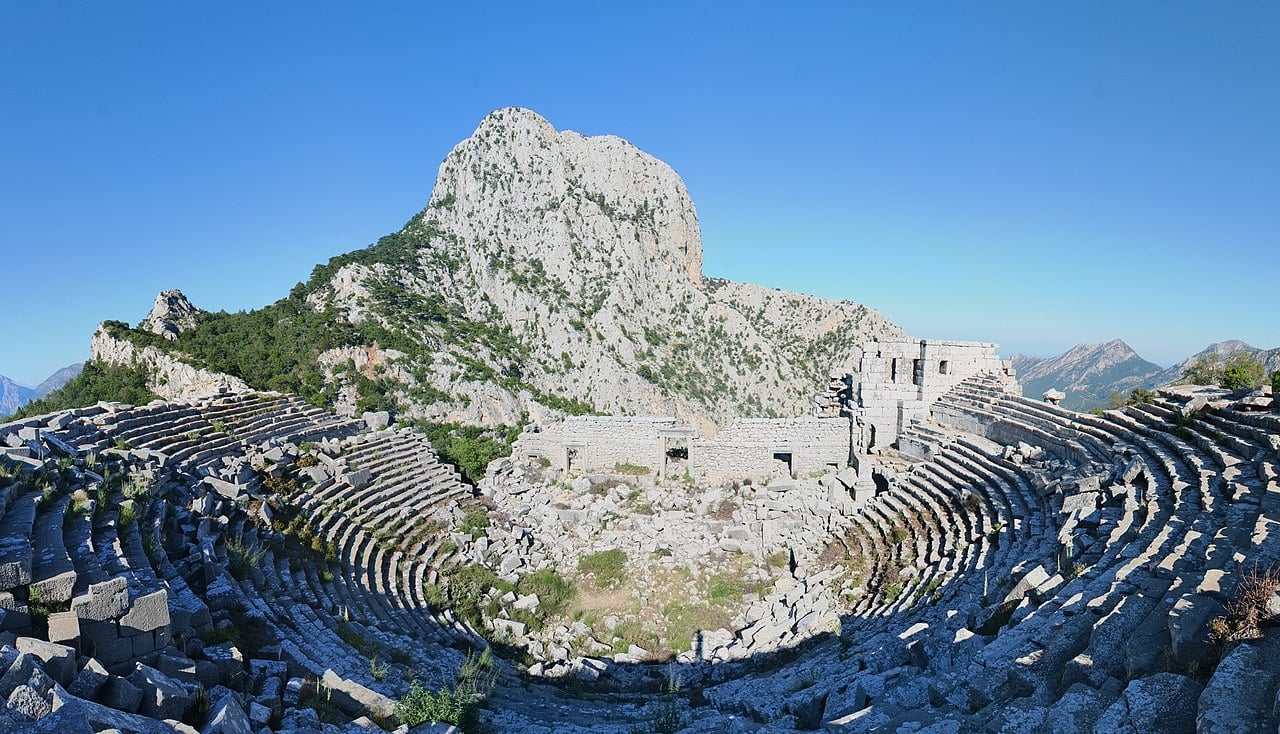
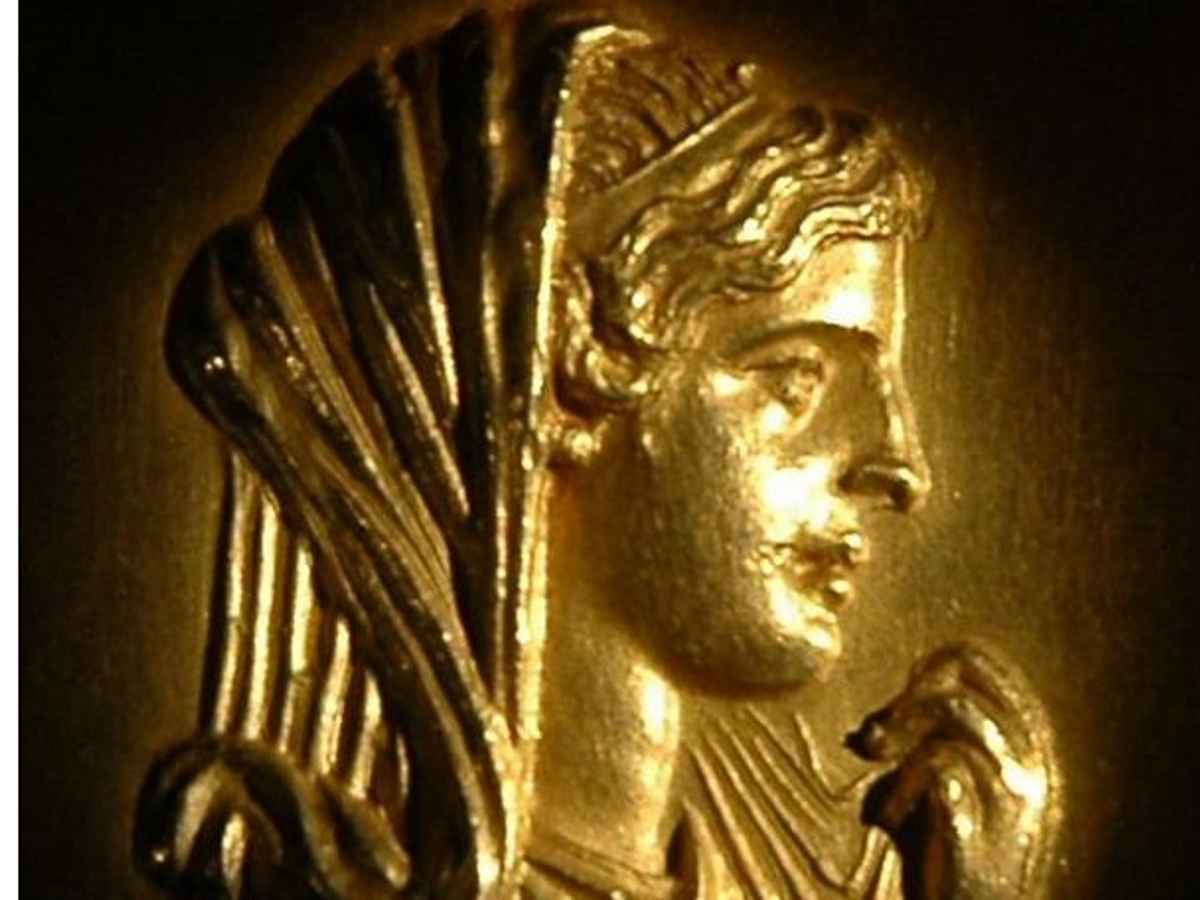
Researchers working at the ancient Greek city of Termessos (Greek: Τερμησσός) in modern-day Turkey have identified two Greek inscriptions that are shedding new light on the city’s political identity and ritual life in antiquity.
Located in the mountains of ancient Pisidia near modern Antalya, Termessos was part of the wider Greek world that emerged across Anatolia during the Hellenistic period. Perched more than 1,000 meters (aprox. 3,000 ft) above sea level, the city is renowned for its dramatic landscape, well-preserved ruins, and long association with Alexander the Great.
The discoveries were made during ongoing studies at the site inside Güllük Mountain National Park, one of the eastern Mediterranean’s most striking archaeological landscapes.
Inscription proclaims civic independence
Researchers identified one inscription on a heavily weathered section near a collapsed city gate. They made the text readable using digital modeling and modern documentation techniques.
According to researchers, the inscription contains a phrase that may be translated as: “May the rights of the independent Termessians endure forever.”
Prof. Dr. Mustafa Koçak of Antalya Bilim University, director of the excavation, explained that the inscription once stood at the entrance of the city, where it announced Termessos’ status to visitors entering the settlement.
AI reconstruction of a newly deciphered stone inscription from ancient Termessos. Credit: Greek Reporter Archive
The message is particularly significant because of the city’s famous encounter with Alexander the Great. Ancient sources record that Alexander failed to capture Termessos in 333 BC during his campaign through Anatolia. The episode helped establish the city’s reputation as a formidable mountain stronghold.
The newly deciphered text provides rare written evidence of how the people of Termessos understood their own civic identity and autonomy. Placed at the city gate, the inscription served not only as a marker of entry but also as a public statement of political identity.
Oracle reveals ancient divination practices
Researchers also identified a second inscription linked to divination using astragali, small ankle bones typically taken from sheep or goats. In antiquity, these bones were thrown like dice to seek guidance from the gods, a practice widely known throughout the Greek world.
Prof. Dr. Fatih Onur of Akdeniz University’s Department of Ancient Languages and Cultures explained that such systems used either five or seven bones. The Termessos inscription belongs to the seven-bone system, which produced 120 possible combinations. The resulting numbers directed users to specific written responses.
Three inscription blocks of this type have survived, and one remains visible at the site today. Researchers believe travelers and merchants may have consulted the oracle before journeys, trade, or other important decisions.
According to Onur, the responses were written in poetic language, suggesting that the texts were intended for ritual use rather than simple instruction.
New insight into life at Termessos
Together, the inscriptions offer a rare glimpse into both public and private life in ancient Termessos. One reflects the city’s civic identity and independence, while the other reveals how people sought divine guidance in everyday life.
For archaeologists, the discoveries deepen understanding of a city that stood at the crossroads of local Pisidian traditions and the broader Greek and Hellenistic world that shaped the eastern Mediterranean for centuries.
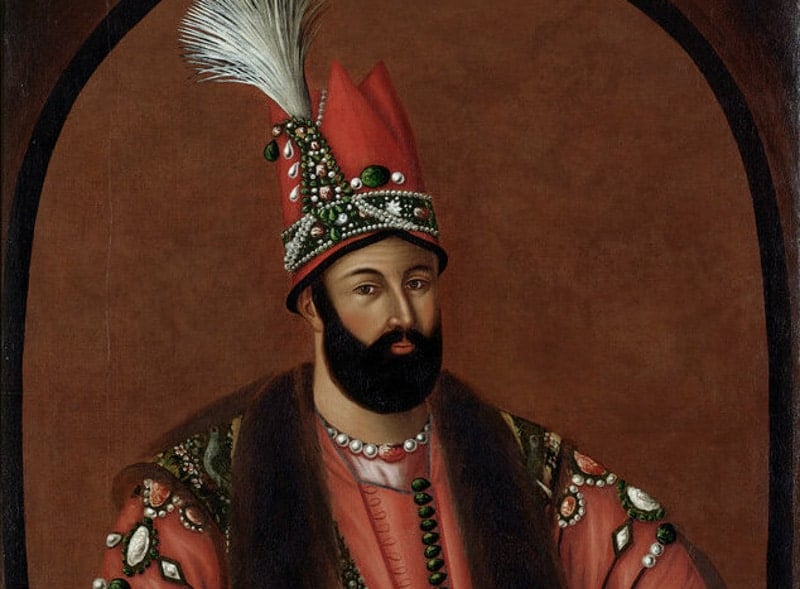
Occult-scientific manuals for rulers were common in early modern Persia (1500-1800). Oil portrait of Nadir Shah of Persia (1732-1747). Credit: Public Domain
The early modern Persian world produced a substantial body of occult-scientific manuals dedicated to one of humanity’s oldest political ambitions: world domination. This was a distinct genre of literature that promised access to universal sovereignty through mastery of the hidden forces governing the cosmos.
In his study “How to Rule the World: Occult-Scientific Manuals of the Early Modern Persian Cosmopolis,” historian Matthew Melvin-Koushki examines texts that reveal an intellectual culture in which political authority, scientific inquiry, and esoteric knowledge were deeply intertwined.
Between the 15th and 17th centuries, the Persian cosmopolis stretched across a vast geographical area, encompassing regions ruled by the Timurids, Safavids, Mughals, and Ottomans. Persian functioned as a language of administration, scholarship, and elite culture throughout much of the Islamic world. Within this environment, occult sciences held a prestigious position. Far from being marginalized superstition, disciplines such as astrology, lettrism, talismanic science, geomancy, and astral magic were widely regarded as legitimate branches of knowledge capable of revealing the hidden structure of reality.
Rulers across the wider early modern Persian world cultivated an image of themselves as universal, sacral, and cosmocratic sovereigns. In this context, Alexander the Great, famous for conquering much of Asia, served as one of the key historical models of world rulership.
Resāla-ye Ḥorūf (On the Letters) by Ebn Torka Esfahāni is an influential treatise on lettrism, the occult power of letters and language. It was written to support the ambitions of a Timurid ruler and presents an explicitly imperial application of occult knowledge. Kholāsat al-Baḥrayn (Epitome of the Two Seas) by Lotf-Allāh Nishāpuri Samarqandi is a Timurid manual combining geomancy and talismanic magic squares. The “two seas” refer to these two occult disciplines.
Historian of science Sonja Brentjes has argued that the traditional distinction between “scientific” and “occult” disciplines often obscures how knowledge was organized in pre-modern Islamic societies. Her research shows that astrology, astronomy, mathematics, and related fields frequently coexisted within shared scholarly frameworks. Rather than treating occult sciences as marginal pursuits, many learned communities regarded them as legitimate fields of inquiry tied to broader investigations of nature and causality.
World domination and universal kingship in Persian occult-scientific manuals
The central premise of many Persian occult-scientific manuals was that the universe operated according to precise correspondences linking celestial bodies, divine names, letters, numbers, and earthly events. A skilled practitioner could decipher these relationships and harness them for practical purposes. Political power was one of the most significant of these ends. Sovereignty was not understood solely as a matter of military force or administrative competence. It was also conceived as a cosmological phenomenon rooted in the proper alignment of ruler, heavens, and sacred knowledge.
One of the defining features of these manuals was their emphasis on universal kingship. Authors frequently addressed rulers who aspired not merely to govern territories but to establish dominion over the entire inhabited world. Such ambitions reflected broader political developments of the period. The rise of large imperial formations, including the Safavid and Mughal empires, fostered ideological visions of global sovereignty. Occult sciences provided a language through which these aspirations could be articulated and legitimized.
A notable example of such a text is Kāshefi Jr.’s Herz al-amān (Amulet of Safety from the Seditions of the Times), which promises to enable officials and bureaucrats to exert extraordinary influence over sovereigns even to the point of what the text frames as magical mind control. Asrār-e Qāsemī (Qāsemian Secrets) by Hosayn Vāʿez Kāshefi engages with illusionism and terrestrial magic.
These manuals typically promised access to what might be described as technologies of sovereignty. Through the manipulation of sacred letters, numerical formulas, planetary configurations, and ritual procedures, rulers could acquire charisma, victory, obedience, and divine favor. These techniques were often presented as scientific rather than magical. Their authors argued that they operated according to discoverable laws embedded within creation itself. Mastery of occult science thus became analogous to mastery of astronomy, medicine, or mathematics: a disciplined pursuit of knowledge that yielded predictable effects.
Importance of letters
A particularly important branch of this intellectual tradition was the science of letters (ʿilm al-ḥurūf). Drawing on centuries of Islamic mystical speculation, practitioners argued that letters constituted the fundamental building blocks of reality. According to this belief, just as God created the universe through speech, letters possessed creative and transformative power. By arranging, calculating, and invoking letters according to specific procedures, the practitioner could influence events in the material world.
Toḥfa-ye Rūḥānī (A Spiritual Boon) by Jalāl al-Din Davāni is a concise treatise on political letter magic. Written for a Khalji sultan in central India, it continued the Timurid tradition of applying occult knowledge to governance. Soʾl al-Molūk (Query of Kings) by Ebn Torka Esfahāni is a more extensive handbook of political letter magic intended to guide rulers seeking power and legitimacy through occult practices.
For rulers, the implications were profound. The science of letters promised more than personal enlightenment. It also offered practical written methods for governing subjects, defeating enemies, and securing dynastic stability. These occult-scientific manuals frequently contained instructions for constructing talismans, calculating auspicious moments for military campaigns, or invoking divine assistance through combinations of sacred names and letters. Books were more socially significant in early modern Islamdom than in Christendom and, as a rule, were considerably more encyclopedic in scope.
Melvin-Koushki argues that these texts should not be dismissed as irrational relics of a pre-modern worldview. Such interpretations impose modern distinctions between science and magic that did not exist in the same form during the early modern period. For many Persian scholars, the occult sciences represented advanced forms of natural philosophy. They sought to uncover causal mechanisms operating beyond ordinary perception yet still embedded within the natural order. Political success became inseparable from the ability to understand and manipulate the hidden architecture of existence.
This perspective helps explain why prominent intellectuals devoted considerable attention to occult subjects. Scholars who wrote on astronomy, philosophy, theology, and medicine frequently engaged with occult disciplines as well. Court patronage further elevated their status. Rulers sought astrologers, letter mystics, and talismanic experts not because they rejected rational inquiry but because they viewed these specialists as possessors of powerful forms of knowledge essential to successful governance.
Occult and the empire
The relationship between occult science and empire was particularly significant. Early modern rulers faced immense challenges, including administering diverse populations, maintaining military superiority, and legitimizing their authority across vast territories. Persian occult-scientific manuals addressed these concerns directly. They promised techniques for enhancing royal charisma, predicting political developments, and securing divine support for imperial projects. In effect, they offered a comprehensive theory of power that united metaphysical insight with practical statecraft.
At the same time, these manuals illuminate important dimensions of Islamic intellectual history that are often overlooked in conventional narratives. Modern accounts frequently emphasize legal scholarship, theology, or philosophy while marginalizing esoteric traditions. Yet the evidence suggests that the occult sciences occupied a central place within elite culture. These texts were copied, studied, translated, and circulated across political boundaries. Their practitioners moved between courts and scholarly networks, contributing to a shared intellectual world that extended from Anatolia to India.
The popularity of these texts also reflects broader transformations across early modern Eurasia. In many cultures, periods of imperial expansion generated heightened interest in universal systems of knowledge. European courts patronized astrologers and alchemists, Chinese emperors consulted cosmological experts, and rulers throughout the wider Persian world sought guidance from occult scientists. In each case, political ambition encouraged efforts to understand and control the forces believed to shape history. The pursuit of world rule was simultaneously a quest to master the hidden workings of the cosmos.
Liana Saif, a historian specializing in Islamic esotericism and the occult, stresses that practitioners understood occult operations as grounded in a structured cosmology. She notes that many authors viewed magical and talismanic practices as operating through hidden natural causes rather than supernatural violations of nature. In this interpretation, the occult sciences functioned as extensions of natural philosophy rather than alternatives to it.
Language and symbolism in Persian occult-scientific manuals
Noah Gardiner, a professor of religious studies specializing in Sufism and the occult, highlights the importance of language and symbolism in Islamic esoteric thought. He demonstrates that letter mysticism was not merely a form of speculative theology but a sophisticated intellectual tradition concerned with the relationship between divine speech, creation, and human knowledge. Such ideas helped support broader claims that mastery of letters could provide access to hidden dimensions of power.
Melvin-Koushki argues that the influence of Persian occult-scientific manuals should not be exaggerated. Their promises were often grandiose, and their practical effectiveness remains impossible to evaluate by modern standards. Historically, however, what matters is not whether their techniques worked but why educated individuals considered them credible. Their authority rested on coherent intellectual frameworks that integrated religion, philosophy, mathematics, and cosmology. Within these frameworks, occult science appeared neither irrational nor marginal but deeply meaningful.
This perspective helps explain why prominent intellectuals devoted considerable attention to occult subjects. Scholars who wrote on astronomy, philosophy, theology, and medicine frequently engaged with occult disciplines as well. Court patronage further elevated their status. Rulers sought astrologers, letter mystics, and talismanic experts not because they rejected rational inquiry but because they viewed these specialists as possessors of powerful forms of knowledge essential to successful governance.
The decline of these traditions resulted largely from changing epistemological assumptions introduced during the modern period. New distinctions between science and superstition gradually relegated occult disciplines to the margins of intellectual life. As a result, much of their historical significance became obscured. Recent scholarship, including Melvin-Koushki’s work, seeks to recover these traditions not as curiosities but as integral components of early modern knowledge systems.
Portrait of the king of Pontus Mithridates VI as Heracles, a mythical association that Alexander the Great often touted. Marble, Roman imperial period (1st century), Credit: Musée du Louvre, Paris, Public Domain.
Alexander the Great’s (356-323 BC) death meant his vision for a Greco-Persian Empire was extinguished with him—or was it?
A hodgepodge of East and West, Mithridates’ Pontic Empire emerges as a compelling possibility of what Alexander’s empire could’ve been, a faint apparition of that fleeting dream.
Alexander 2.0
Mithridates (135–63 BC) was the inheritor of two cultures and, naturally, an incarnation of two worlds. He delighted in his Macedonian heritage as much as his Persian forbearers.
Claiming Macedonian ancestry on one side and Persian dynastic lineage on the other, Mithridates used his mixed descent to reveal the commonalities between his diverse subjects.
Taking on Alexander’s mantle of global empire, Mithridates envisioned an alternative to Roman supremacy, a new world order.
To achieve this ambitious aim, the Pontian King united his Greek, Anatolian, and Persian subjects under an anti-Roman cross-cultural coalition.
The result of this cooperation was three wars mounted against Rome, wars that escalated to the point of genocide.
How could he amass such a diverse following against such a formidable foe?
Mithridates took a page from Alexander’s book and embodied East and West, both in appearance and idea.
Pontus: Alexander’s vision of empire?
Map of the Kingdom of Pontus. Credit: Photograph by Javierfv1212, Public Domain, via Wikimedia Commons.
Mithridates hailed from the Kingdom of Pontus, a cultural melting pot that Alexander the Great would have approved of.
The north of Pontus’s snow-clad Alps was a largely Hellenic-dominated coastline. There, Greek colonists had erected the city of Sinope, Mithridates’ capital.
The historian Strabo, himself a Pontian, claimed that it was “the most noteworthy of the cities in the region.”
South of the Alps was known as Katpatuka (land of horses) by the Iranians and, later, Cappadocia by the Greeks. There, villages predominated apart from a few settlements, such as Amaseia, Strabo’s hometown, and Cabeira.
While Hellenic culture dominated the coast, the Cappadocian hinterland preserved its old Anatolian non-Greek heritage. Rostovtzeff (1932), a pioneer in Pontic history, described the Hellenic influence around the Black Sea as “a thin Greek shell around a hard native kernel.”
The third influence on the region was Iranian. The enduring relics of Persian rule would have been visible to many a Hellenistic Pontian. Strabo says that the Pontic people took sacred vows at the state temple, Zela, which were dedicated to Persian deities: Anaitis, Omanus, and Anadatus.
Moreover, Zeus Stratios, most likely a syncretic reincarnation of Ahura Mazda, received lavish offerings from Persian Kings, which Pontian rulers, including Mithridates Eupator, continued. The continuation of Persian religious customs well after an eclipse of Achaemenid authority attests to the impression Persian presence had made on Pontic royalty and their subjects.
In the subsequent Hellenistic period, the increasing pace of Hellenization of the kingdom meant that the Mithridates Dynasty had to evolve. There needed to be a balance between the new incoming wave of this ancient form of globalization with their Perso-Anatolian traditions that still held sway in their domain.
Divine descent
Mithridates Eupator depicted as Dionysus, Credit PHGCOM, Public Domain, via Wikimedia Commons.
Mithridates Eupator’s dual lineages afforded him illustrious ancestors and a unique hybrid set of dynastic customs. He was a Helleno-Persian Prince who practiced mixed religious rites.
Mithradates divine connections are well in accordance with Alexander the Great’s own claims. Like the Pontic King, Alexander claimed Heracles and Dionysus, among other numinous figures, as ancestors.
Consequently, the Pontic King embodied redemptive qualities resonating in the Greek and Perso-Anatolian worlds. For the Greeks, he established a mythical connection with Dionysus, the god of liberation and new beginnings, and took the theonym Mithridates Eupator Dionysus.
Likewise, Mithridates claimed heritage from Herakles, who emancipated the titan Prometheus, humanity’s creator. On the other hand, Mithridates’ star-signaling birth was said to fulfill Persian prophecies of a coming savior from the East, as did his name, “Mithras-sent.”
Global principles
Persian Magus-king conducting a fire ritual. Mithradates’ fire ceremony followed the traditional customs of his Persian ancestors. Detail from red-figure vase 3297, side A, by the Underworld Painter, 4th century BC. Credit: Staatliche Antikensamm lungen und Glyptothek, Munich, Public Domain
In addition to religious mediation, Mithridates weaponized the growing resentment of his subjects. Just like Alexander’s vision for his diverse empire, the Pontian King tried to respect Greek and Iranian values.
Both Greeks and Perso-Anatolians were chafing under Roman occupation. In mainland Greece and Anatolia, the common hatred towards Roman rule provoked a transcultural antagonism against Roman hegemony.
Debt accrued by Roman taxation hindered asa or Truth, a prominent Persian tenet. For the Greeks, Roman occupation was seen as compromising their eleutheria, or freedom, which was fundamental to Greek identity.
Mithridates acknowledged these grievances in his speeches, along with coins and other allusions. By showing sensitivity to both cultures, the Pontian King illustrated how compatible Iranian and Greek cultures could be.
This may be surprising, considering the tumultuous history that plagued the relations between Greeks and Iranians. Egregious crimes were committed in Athens by the Persians and by Greeks in Persepolis at Alexander’s instigation as punishment.
Yet Mithridates successfully harmonized the two cultures, as Alexander the Great’s policies aimed to accomplish.
Was Mithridates’ Pontian kingdom what Alexander’s empire could have been?
Sensitive to Greek and Perso-Anatolian culture, Mithridates entangled much of the Eastern Mediterranean in opposition to Rome. Mithridates carried on Alexander’s vision for an international empire even though he was unsuccessful in his wars against Rome. By doing so, the Pontian king proved Alexander the Great’s Helleno-Persian hypothesis was possible.
Alexander’s vision for joining East and West wasn’t an idyllic dream but was ultimately an achievable reality.
The location is one of the most iconic landmarks in military history, marking the definitive starting point of Alexander the Great’s triumph over the Persian Empire. Public Domain
The Turkish Ministry of Culture and Tourism has officially declared the Granicus Battlefield—where Alexander the Great secured his first major victory against the Persian Empire—a “protected historical and archaeological site.”
According to a ministry announcement and statements shared on social media by Culture and Tourism Minister Mehmet Nuri Ersoy, the decision was based on recent archaeological discoveries and scientific studies in the Biga district of Çanakkale (Dardanelles).
Following extensive field surveys, scientific data evaluation, and the analysis of ancient sources linked to the Battle of the Granicus, the Çanakkale Regional Council for the Conservation of Cultural Property determined that the area meets all criteria for designation as an archaeological site.
The ministry highlighted the location as one of the most iconic landmarks in military history, marking the definitive starting point of Alexander the Great’s triumph over the Persian Empire.
Battle of the Granicus: “A Turning Point in World History”
In a social media post, Minister Mehmet Nuri Ersoy stated:
“We have officially placed the grounds of a battle that reshaped world history under state protection. The Granicus Battlefield, where Alexander the Great achieved his first major victory against the Persians and paved his way into Asia, has now been designated a ‘historical site.’ Located in Biga, Çanakkale, this unique landmark is officially protected in light of archaeological finds and rigorous scientific research. We believe this crucial step will significantly contribute to historical scholarship, boost cultural tourism, and enrich our country’s cultural routes.”
The Battle of Granicus
The Biga River, historically known as the Granicus River, near the site of the Battle of Granicus fought in 334 BC. Credit: Kizildeniz/CC BY-SA 4.0
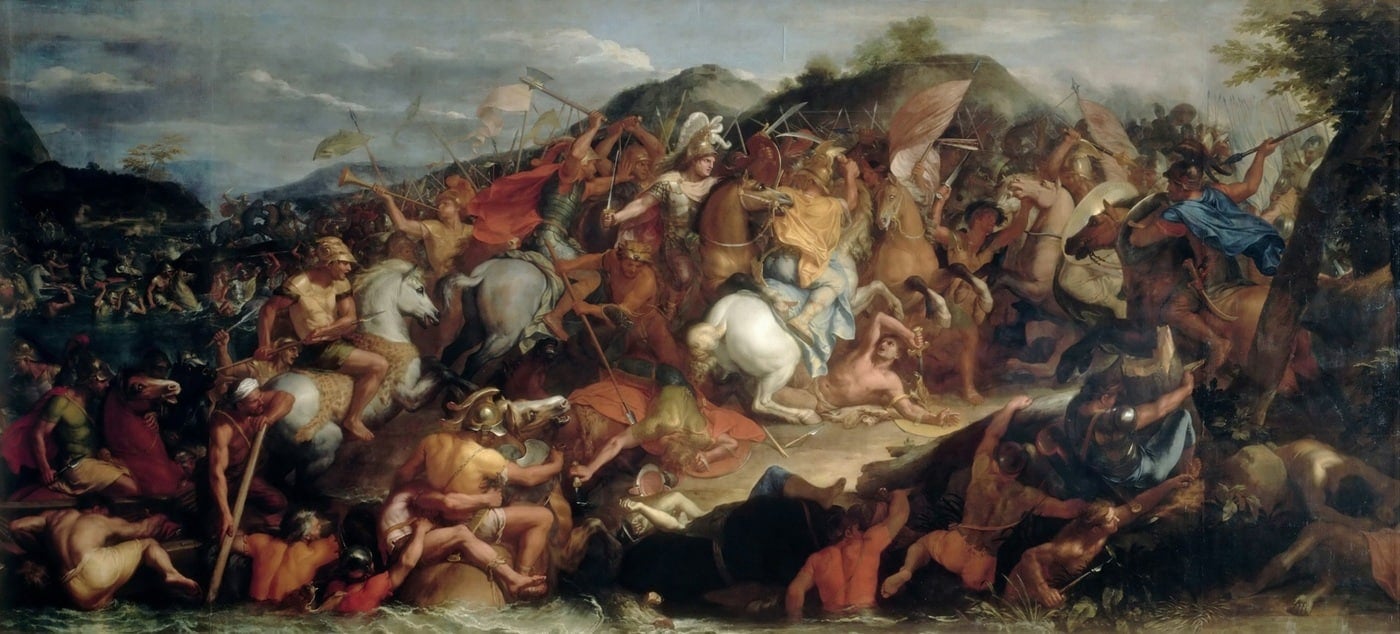
The Battle of the Granicus, fought in May 334 BC near modern-day Biga in northwestern Turkey, was Alexander the Great’s dramatic opening salvo against the Persian Empire. Having recently crossed the Hellespont into Asia Minor with roughly 32,000 infantry and 5,100 cavalry, the 21-year-old Macedonian king confronted a combined force of local Persian satraps (governors) and highly capable Greek mercenaries.
The Persians, positioned defensively along the steep, muddy eastern banks of the Granicus River, hoped to neutralize Alexander’s aggressive tactical style by forcing him to fight from a disadvantageous position in the water. Rejecting the cautious advice of his veteran general Parmenion to delay the attack, Alexander ordered an immediate, highly risky amphibious assault in broad daylight.
The engagement quickly devolved into a chaotic, brutal melee within the riverbed and up the muddy slopes. Alexander personally led the elite Companion Cavalry from the right wing, instantly becoming a prime target due to his conspicuous, brightly plumed helmet.
The fighting was so fierce that Alexander was nearly killed; a Persian noble shattered his helmet with a battleaxe, and just as another was about to deliver a fatal blow, his captain Cleitus the Black severed the attacker’s arm, saving the young king’s life.
Once the formidable Macedonian phalanx (infantry formation) crossed the river to support the cavalry, the Persian battle lines shattered. The victory was absolute: the Persian leadership was decimated, the surviving Greek mercenaries were ruthlessly executed or enslaved, and the psychological myth of Persian invincibility was shattered, effectively throwing open the gates of Asia Minor to Alexander’s conquering army.
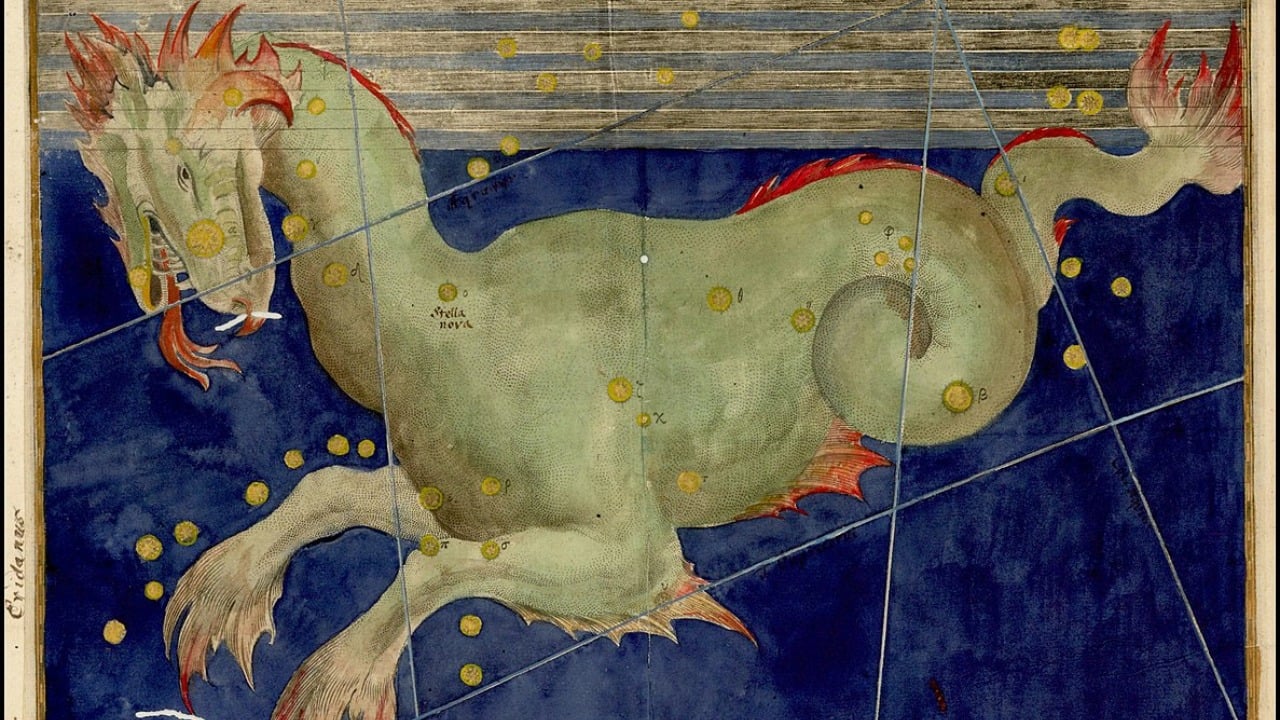
Alexander the Great is said to have encountered sea monsters during his campaigns. Credit: Johann Bayer / Public domain / Wikimedia Commons
As one of the most famous figures in human history, it comes as little surprise that the life of Alexander the Great is tied to several legends of mythic proportions, of which several concern the conqueror’s encounters with sea monsters.
Alexander’s armies traversed much of the known ancient world, leaving their native Macedon far behind them. Over the course of their long campaigns, they encountered many strange sights, some of which may have inspired later myths and legends.
At least two historians, from the ancient and medieval periods, described Alexander the Great and his encounters with sea monsters. The first was Diodorus Sciulus, a Greek historian of the 1st century BC and the Arab scholar Ibn Khaldun of the 14th century AD.
The sea creature at the siege of Tyre, 332 BC
In 323 BC, the intrepid Macedonian king laid siege to Tyre, a well-fortified Phoenician city-state on the coast of the Mediterranean. The city was extremely difficult to penetrate because it was located on an island and was defended by high walls that came right up to the sea.
Nevertheless, it was necessary to capture Tyre to deny the Persians access to a strategically important naval base. Thus, Alexander ordered his engineers to prepare artillery pieces and siege works for an assault on the city.
However, whilst this effort was underway, a strange event in which the army of Alexander the Great encountered a sea monster in the waters around Tyre occurred, according to the writings of Diodorus Siculus.
Late 5th century ancient Greek red-figure pottery depicting a hippocamp, a mythical creature with a horse’s body and the tail of a fish. Credit: Metropolitan Museum of Art / CC0, / Wikimedia Commons
“As the Macedonian construction came within range of their missiles, portents were sent by the gods to them in their danger,” wrote Diodorus Siculus. “Out of the sea, a tidal wave tossed a sea monster of incredible size into the midst of the Macedonian operations.”
“It crashed into the mole but did it no harm, remained resting a portion of its body against it for a long time and then swam off into the sea again,” continued the Greek historian. “This strange event threw both sides into superstition, each imagining that the portent signified that Poseidon would come to their aid, for they were swayed by their own interest in the matter.”
A less fantastical explanation for this incident is possible than a mythical sea monster sent by Poseidon. The creature in question may have been a shark, dolphin, whale, or other entirely normal aquatic inhabitant.
Alexander the Great and the sea monsters of Alexandria
The siege of Tyre was not the only time Alexander is said to have encountered a sea monster. According to the Arab scholar Ibn Khaldun, he saw several mythical aquatic beasts in Egypt.
In fact, Ibn Khaldun claimed that sea monsters initially halted the construction of Alexandria until Alexander devised a way to scare them away from the area.
“Sea monsters prevented Alexander from building Alexandria,” wrote the scholar. “He took a wooden container in which a glass box was inserted, and dived in it to the bottom of the sea. There he drew pictures of the devilish monsters he saw.”
According to Ibn Khaldun, “He then had metal effigies of these animals made and set them up opposite the place where building was going on. When the monsters came out and saw the effigies, they fled. Alexander was thus able to complete the building of Alexandria.”
Olympias, the mother of Alexander the Great, who shaped his course and the fate of the Macedonian Kingdom. Credit: Fotogeniss, CC by sa 3.0.
No other woman in Ancient Greek history inspired as much fascination, fear, and controversy as Olympias, the mother of Alexander the Great. She is described as passionate, intelligent, ruthless, and deeply religious. Enemies portrayed her as dangerous and manipulative, while supporters viewed her as a fiercely loyal mother and protector of Alexander’s destiny.
Behind the legends and accusations, however, stood a woman who exercised enormous political influence during one of history’s most transformative periods. Olympias shaped Alexander from childhood, influenced the succession crisis after Philip II’s death, and later played a decisive role in the violent struggles that followed Alexander’s empire.
Her presence loomed over Macedon for decades. Even after Alexander conquered much of the known world, Olympias continued to influence the royal court and the fate of the Argead dynasty.
Alexander the Great’s mother, Olympias, and her Molossian origins
Olympias came from Epirus, a Greek kingdom west of Macedonia. She belonged to the royal Molossian dynasty, which claimed descent from Neoptolemus, the son of Achilles. This heroic ancestry carried enormous symbolic value in the Greek world. Her original name may have been Polyxena or Myrtale. The biographer Plutarch suggests she later adopted the name Olympias after Philip achieved victory at the Olympic Games.
From an early age, Olympias displayed strong religious devotion.They initiated her with mystery cults and ecstatic rituals connected with Dionysus and the mysteries of the Cabeiri to whom she became a high-ranking priestess. These cults emphasized sacred initiation, hidden knowledge, and intense spiritual experiences. Her religious identity later became central to the legends surrounding Alexander’s birth.
The snakes and the divine birth of Alexander
Ancient authors repeatedly connect Olympias with snakes and mystery rituals. Plutarch wrote that Philip once saw a serpent lying beside Olympias while she slept. Legends claimed that she begot Alexander with Zeus through intercourse with snakes. According to later traditions, this event contributed to the belief that Zeus himself fathered Alexander.
These stories shaped Alexander’s image ever since childhood. Olympias appears to have encouraged the belief that her son possessed divine ancestry. Such ideas naturally fit within the heroic traditions of the Greek world in which exceptional rulers often claimed descent from gods. The symbolism of Zeus held enormous political importance. Alexander did not simply present himself as a king but increasingly viewed himself as a chosen figure with a cosmic mission. Of course, Olympias likely played a major role in nurturing this mindset.
Ancient religion did not sharply separate politics from divine legitimacy. A ruler with sacred ancestry possessed more potent authority and prestige. Olympias therefore strengthened Alexander’s position both psychologically and politically. The stories involving snakes also reflected the mystical atmosphere surrounding cults. Serpents symbolized rebirth, divine wisdom, chthonic forces, and sacred power in many Greek traditions. As a priestess connected with such cults, Olympias cultivated an aura of mystery that impressed supporters and frightened enemies.
The turbulent relationship between Alexander the Great and his father, Philip II of Macedon, was one of the most complex and layered family dynamics in ancient history. Credit: Egisto Sani. CC BY-2.0/flickr
Olympias’ relationship with Philip II, the father of Alexander the Great
The marriage between Olympias and Philip II began as a political alliance, yet tensions soon emerged between them. Philip married several women during his reign, partly for diplomatic reasons. However, these marriages threatened Alexander’s position as heir. Olympias fiercely defended her son’s claim to the throne and distrusted rival factions within the Macedonian court.
Conflict intensified after Philip married Cleopatra Eurydice, a Macedonian noblewoman. Her marriage resulted in the possibility of a fully Macedonian heir, which endangered Alexander’s succession. Plutarch describes a famous banquet confrontation during which insulted Alexander by implying doubts concerning his legitimacy. The quarrel severely damaged relations within the royal family.
Olympias soon withdrew from Macedon temporarily and returned to Epirus. Alexander also left for a period before reconciliation occurred. These events led to an atmosphere of suspicion and instability that surrounded Philip’s final years.
Marble bust portrait thought to depict Philip II of Macedon. Credit: Richard Mortel / CC BY 2.0 / Wikimedia Commons
The assassination of Philip and Alexander’s accession
Philip II passed away in 336 BC after assassination during a public celebration at Aegae. His bodyguard, Pausanias, killed him before guards immediately cut the assassin down. The assassination remains one of antiquity’s great mysteries. Plutarch and the historian Arrian often suspected Olympias of involvement. Some even claimed she honored Pausanias afterward or placed a crown upon his corpse. Other traditions accuse Alexander indirectly as well.
No definitive evidence proves these accusations. However, Olympias clearly benefited politically from Philip’s death because Alexander immediately became king. She acted quickly afterward to eliminate threats against her son’s rule. The geographer Pausanias accuses her of orchestrating brutal acts against Cleopatra Eurydice and her child. Whether entirely accurate or exaggerated by hostile writers, these accounts reveal Olympias’ fierce determination to secure Alexander’s position. In the brutal world of Macedonian succession politics, hesitation often meant destruction.
Even after Alexander launched his campaigns into Asia, Olympias continued influencing Macedonian affairs from afar. Alexander maintained regular correspondence with her and respected her opinions deeply. Both Arrian and Plutarch suggested that Olympias frequently warned him about political rivals and court intrigues. At times, her intense personality resulted in tension with Antipater, whom Alexander left in charge of Macedon during the eastern campaigns. Their rivalry became one of the defining political conflicts of the period.
Olympias viewed herself not merely as the king’s mother but also as guardian of the Argead dynasty and protector of Alexander’s divine mission. Meanwhile, Alexander’s own behavior increasingly reflected the heroic and semi-divine identity cultivated since childhood. His visit to the oracle of Zeus-Ammon in Siwa of Egypt supported these beliefs further when the Egyptian priest proclaimed him as “child of Ammon.” The foundations of this worldview likely originated partly through Olympias’ influence, as previously mentioned.
Alexander the Great before the Oracle at Siwa. Credit: Francesco Salviati (Italy, Florence, 1510-1563) Wikimedia Commons, Public Domain
The chaos after Alexander’s death
Alexander’s death in 323 BC plunged the empire into chaos. Without a clear successor, powerful generals fought for control over the vast territories he conquered. Olympias returned to political life aggressively during this turbulent period, supporting the rights of Alexander IV, Alexander’s young son by Roxana. Olympias viewed him as the legitimate continuation of the Argead dynasty.
In order to defend her grandson’s claim, she entered the brutal wars of the Successors. During this struggle, Olympias captured and executed Philip III Arrhidaeus and his wife Eurydice. These actions shocked many Macedonians and intensified divisions within the kingdom.
Nevertheless, Olympias believed she acted to preserve Alexander’s bloodline and royal legitimacy. Her enemies, however, saw only cruelty and vengeance.
Agamemnon’s initiation to the Samothracean Cabeiri mystery cult. Marble, Greek archaic artwork, ca. 560 BC. Credit: Jastrow, Wikimedia Commons, Public Domain
The fall of Olympias
Cassander, one of the most powerful Successors, eventually marched against Olympias. Many Macedonians abandoned her cause as political exhaustion, and civil war consumed the kingdom. After siege and defeat, Olympias surrendered.
Cassander condemned her to death in 316 BC. Plutarch claims that soldiers initially hesitated to execute her because of her royal status and dominant personality. Eventually, however, relatives of her victims carried out the killing. With Olympias’ death, the final collapse of the Argead dynasty was all the more imminent. Soon afterward, Cassander eliminated Alexander IV and Roxana, as well, and thus ended the bloodline of Philip and Alexander.
Olympias remains one of antiquity’s most complex female figures, having shaped Alexander psychologically ever since childhood and having encouraged his belief in divine destiny. She defended his succession fiercely during critical political crises and later fought relentlessly to preserve the dynasty after his death. Without Olympias, Alexander’s rise may have unfolded quite differently.
At the same time, her actions contributed to the violence and instability that destroyed Macedon after Alexander’s empire fragmented. She therefore stands both as creator and destroyer: a queen, priestess, mother, and political strategist whose influence changed the ancient world forever.

 Login
Login