Some fans and participants hoping to enter the United States for the World Cup have complained that restrictive immigration rules have presented a roadblock.
Iraqi soccer player Aymen Hussein, pictured in a mural near Baghdad wearing his No. 18 jersey, was temporarily detained by U.S. immigration officials before being allowed to enter the country for the World Cup.
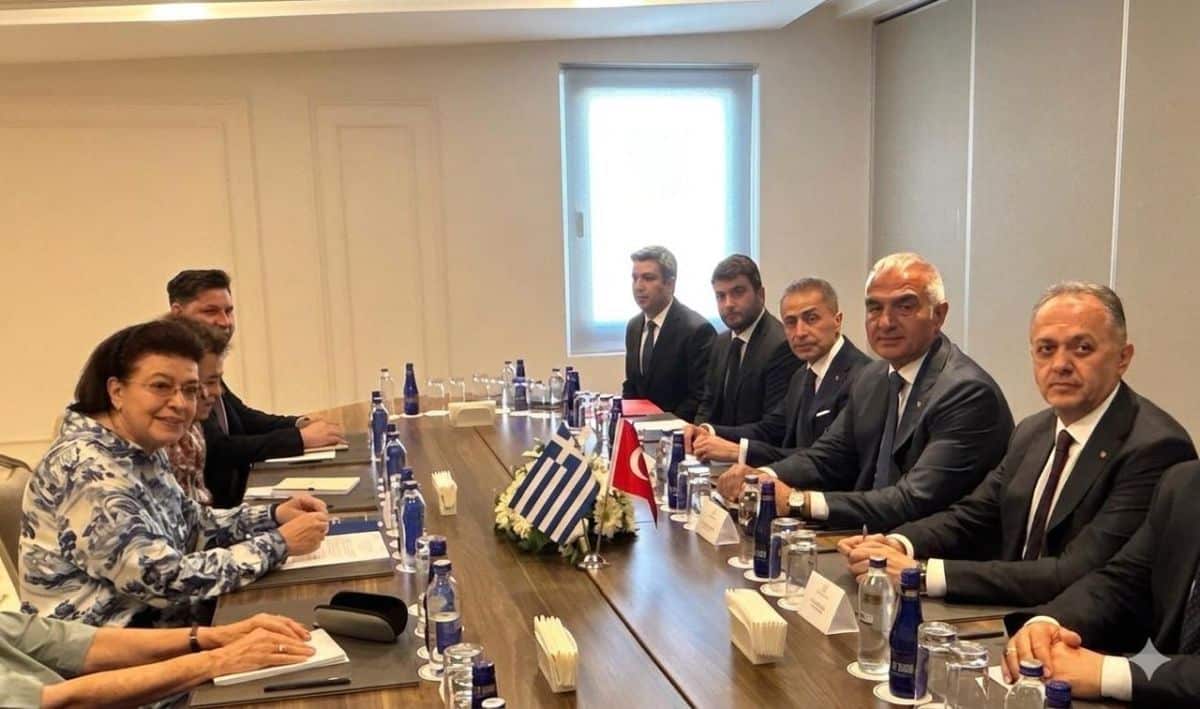
Greek Culture Minister Lina Mendoni and Turkish Culture and Tourism Minister Mehmet Nuri Ersoy. Credit: Ministry of Culture
Greece and Turkey have established a permanent cultural forum to strengthen bilateral cooperation in cultural heritage, museums, research, education, and new technologies, creating a new institutional framework for dialogue between the two countries.
The Greece-Türkiye Cultural Forum was formally established last week through a Joint Declaration signed by Greek Culture Minister Lina Mendoni and Turkish Culture and Tourism Minister Mehmet Nuri Ersoy during the forum’s inaugural session in Cappadocia. Under the agreement, the forum will meet regularly in both countries and serve as a platform for exchanging expertise and developing joint initiatives. “Culture is perhaps the deepest and most enduring field of communication between our societies,” Mendoni said.
The forum is the latest outcome of efforts to strengthen Greek-Turkish relations following the Athens Declaration on Friendship and Good Neighbourly Relations signed by Prime Minister Kyriakos Mitsotakis and President Recep Tayyip Erdogan in December 2023. It also builds on a Memorandum of Cultural Cooperation signed by the two culture ministers during the 6th Supreme Cooperation Council in Ankara.
Heritage protection and cultural cooperation between Greece and Turkey
During the forum, Mendoni outlined Greece’s approach to heritage protection, noting that Greek legislation safeguards all monuments equally—ancient, Byzantine, Ottoman, post-Byzantine and modern—regardless of their religious or cultural origin. She also stated that all are incorporated into the country’s cultural routes and tourism networks.
Furthermore, the forum featured presentations by officials and experts from both countries on the restoration and conservation of Byzantine and Ottoman monuments, heritage management, historical research, and the use of new technologies in the cultural sector. Discussions also focused on combating the illicit trafficking of cultural goods, an area in which Greece and Turkey have cooperated since signing a bilateral protocol in 2013.
“The exchange of information, the cooperation of competent services and the use of international mechanisms are crucial tools for effectively combating the illegal trafficking of cultural goods and securing their return to their place of origin,” Mendoni said. The Joint Declaration also highlights the importance of digitalization and improving public access to cultural resources through digital technologies, while encouraging closer cooperation in the use of emerging technologies in heritage management.
On the sidelines of the forum, Mendoni thanked Ersoy for Turkey’s support at UNESCO’s Intergovernmental Committee regarding the return of the Parthenon Sculptures. She noted that his confirmation that no Ottoman document ever authorized Lord Elgin’s removal of the sculptures strengthens the international case for their reunification in Athens.
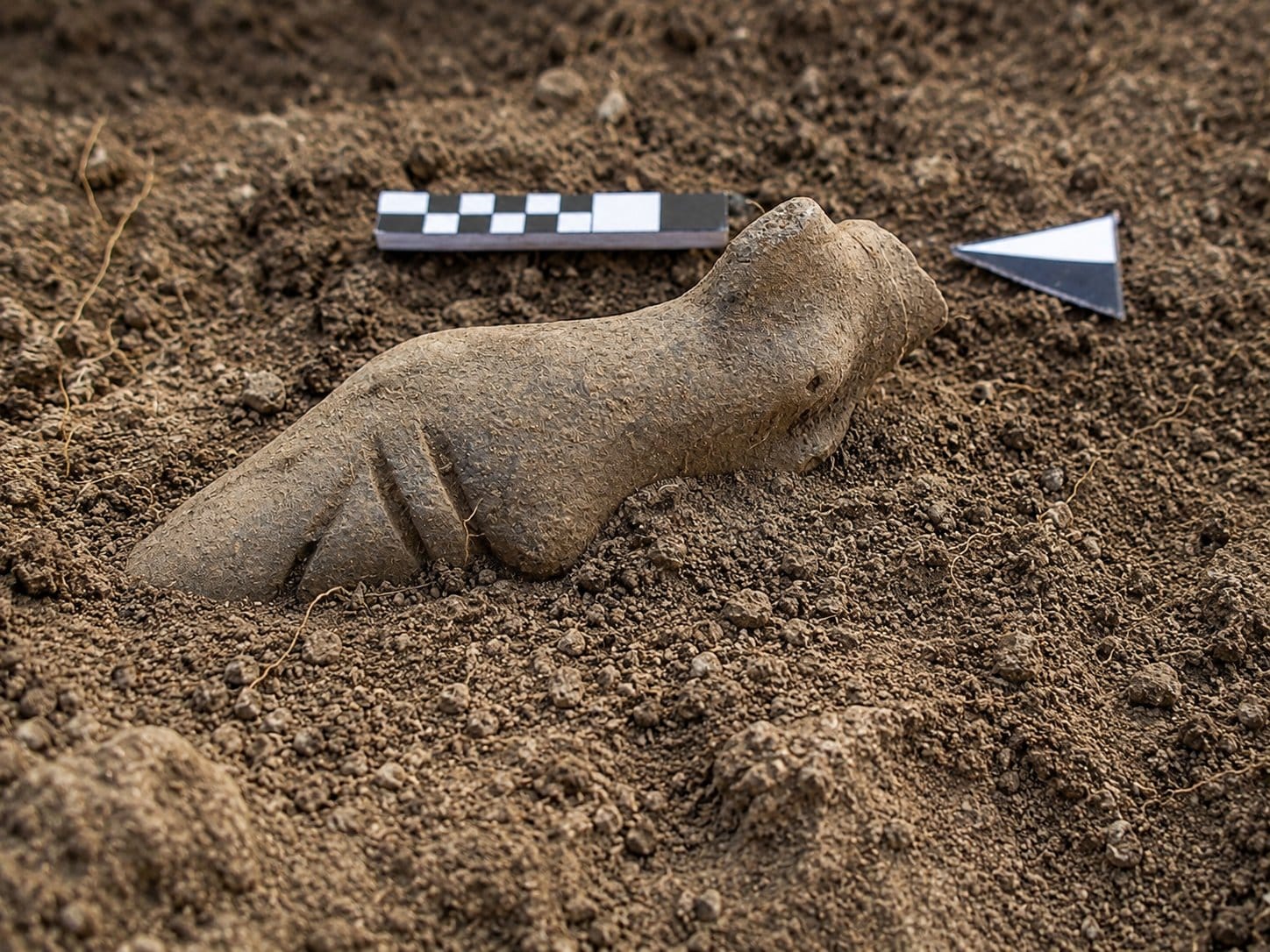
AI reconstruction of a Neolithic female figurine discovered at Kanlıtaş mound. Credit: Greek Reporter Archive
Archaeologists in Turkey have uncovered four headless female figurines dating back about 8,000 years, a discovery that is offering new insight into ritual practices among some of Anatolia’s earliest farming communities.
The terracotta figurines were found at Kanlıtaş mound near the Inönü district of Eskişehir in northwestern Turkey. Excavations at the site have been conducted since 2013 under the direction of Anadolu University.
Kanlıtaş is considered one of the earliest known settlements in the region spanning modern-day Eskişehir, Afyonkarahisar, and Kütahya. Researchers say the site provides important evidence about daily life, settlement patterns, and cultural traditions during the Neolithic period.
Figurines discovered inside ancient structures
Professor Ali Umut Türkcan, who leads the excavation team and teaches archaeology at Anadolu University, said the figurines were uncovered within fill layers at the bases of rectangular buildings.
Researchers determined that the artifacts belong to the final phase of the Neolithic period. All four figurines depict women. The largest measures about 12 to 13 centimeters (5 inches) in length, while the others are approximately 5 to 6 centimeters long.
Although female figurines are common at Neolithic sites across Anatolia, the Kanlıtaş examples stand out because of their condition and context. Several were found with their heads intentionally broken off.
Eskişehir’in İnönü ilçesindeki Kanlıtaş Höyüğü’nde bulunan 8 bin yıllık 4 başsız figürün Neolitik dönem yapı ritüellerinde kullanıldığı tespit edildi. pic.twitter.com/MkBkOCI6Wt
“The presence of headless or broken-headed female figurines in spaces that appear to have been intentionally sealed suggests they may have been left as offerings during the closure of structures,” Türkcan said.
Researchers believe the figurines were deliberately deposited when buildings were abandoned or taken out of use. Similar practices have been identified at other Neolithic settlements, including Çatalhöyük in central Turkey, one of the world’s most extensively studied prehistoric sites.
Distinctive features set the figurines apart
The Kanlıtaş figurines also display characteristics that distinguish them from many other Neolithic figurines found in Turkey.
Türkcan noted that the figures place unusual emphasis on the hip area. This stylistic feature resembles female figurines discovered in parts of the Balkans, particularly regions once associated with the Neolithic Vinca culture.
The similarity suggests that communities living in different parts of southeastern Europe and Anatolia may have shared artistic traditions or symbolic ideas during the Neolithic era.
Discovery may strengthen evidence of cultural links
Researchers also pointed to possible connections between Kanlıtaş and the broader Porsuk cultural sphere of western central Anatolia. Archaeologists have long debated links between the Porsuk culture and Neolithic communities in the Balkans.
According to Türkcan, radiocarbon dating results indicate that the Porsuk culture may predate some neighboring cultural traditions. The findings could help explain how cultural influences spread between Anatolia and southeastern Europe thousands of years ago.
The discovery adds to growing evidence that Neolithic communities maintained complex social and symbolic traditions. The figurines not only provide clues about ritual behavior but may also help researchers better understand cultural interactions across a wide region.
The excavation team plans to publish the findings in a comprehensive scientific monograph and reference volume in the coming years. Further research may reveal more about the role these Neolithic figurines played in the beliefs and practices of early communities in Turkey.
From ski resorts to prehistoric ruins and mountain hikes to Michelin stars, Annabel Grossman shares the destinations you might not have previously considered
The US support and Israel’s military and strategic capabilities, coupled with occupational aspirations, made the country a threat to the region. The country’s hostilities and strategic reorientation suggest that it now seeks to confront Turkey. Israel’s escalating aggression with Turkey has sparked new threats in Middle Eastern geopolitics. The Zionist leaders have a decades-old dream […]
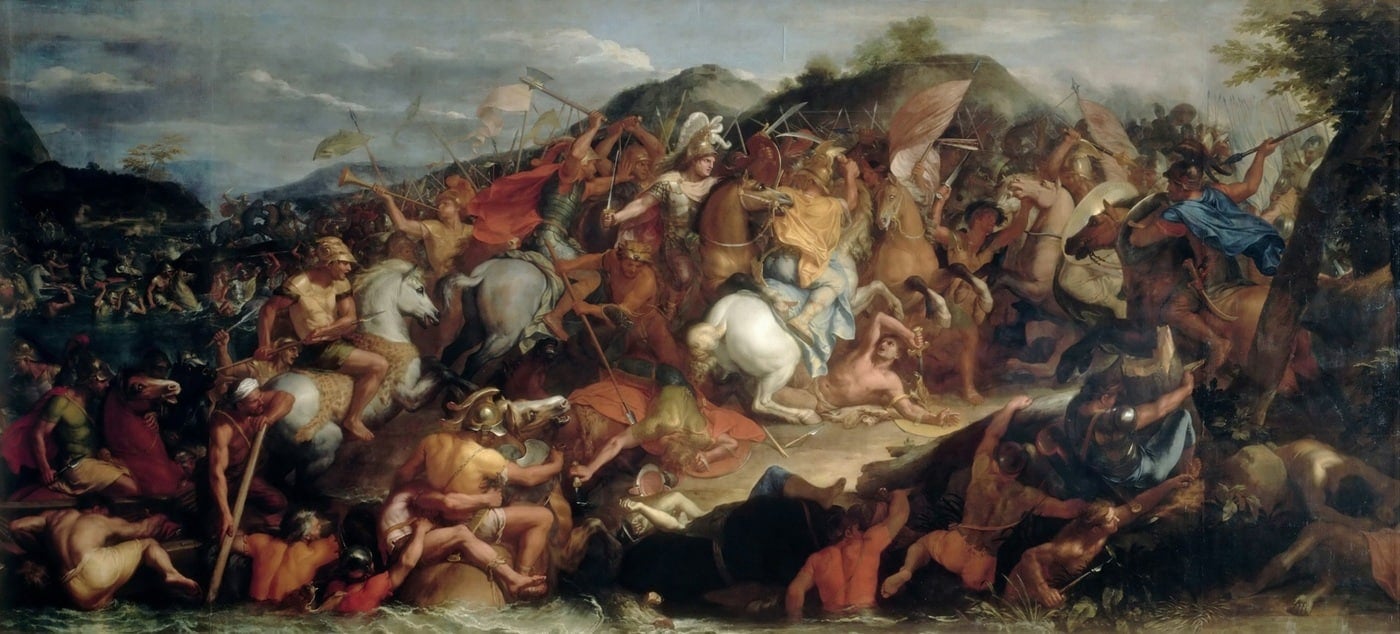
The location is one of the most iconic landmarks in military history, marking the definitive starting point of Alexander the Great’s triumph over the Persian Empire. Public Domain
The Turkish Ministry of Culture and Tourism has officially declared the Granicus Battlefield—where Alexander the Great secured his first major victory against the Persian Empire—a “protected historical and archaeological site.”
According to a ministry announcement and statements shared on social media by Culture and Tourism Minister Mehmet Nuri Ersoy, the decision was based on recent archaeological discoveries and scientific studies in the Biga district of Çanakkale (Dardanelles).
Following extensive field surveys, scientific data evaluation, and the analysis of ancient sources linked to the Battle of the Granicus, the Çanakkale Regional Council for the Conservation of Cultural Property determined that the area meets all criteria for designation as an archaeological site.
The ministry highlighted the location as one of the most iconic landmarks in military history, marking the definitive starting point of Alexander the Great’s triumph over the Persian Empire.
Battle of the Granicus: “A Turning Point in World History”
In a social media post, Minister Mehmet Nuri Ersoy stated:
“We have officially placed the grounds of a battle that reshaped world history under state protection. The Granicus Battlefield, where Alexander the Great achieved his first major victory against the Persians and paved his way into Asia, has now been designated a ‘historical site.’ Located in Biga, Çanakkale, this unique landmark is officially protected in light of archaeological finds and rigorous scientific research. We believe this crucial step will significantly contribute to historical scholarship, boost cultural tourism, and enrich our country’s cultural routes.”
The Battle of Granicus
The Biga River, historically known as the Granicus River, near the site of the Battle of Granicus fought in 334 BC. Credit: Kizildeniz/CC BY-SA 4.0
The Battle of the Granicus, fought in May 334 BC near modern-day Biga in northwestern Turkey, was Alexander the Great’s dramatic opening salvo against the Persian Empire. Having recently crossed the Hellespont into Asia Minor with roughly 32,000 infantry and 5,100 cavalry, the 21-year-old Macedonian king confronted a combined force of local Persian satraps (governors) and highly capable Greek mercenaries.
The Persians, positioned defensively along the steep, muddy eastern banks of the Granicus River, hoped to neutralize Alexander’s aggressive tactical style by forcing him to fight from a disadvantageous position in the water. Rejecting the cautious advice of his veteran general Parmenion to delay the attack, Alexander ordered an immediate, highly risky amphibious assault in broad daylight.
The engagement quickly devolved into a chaotic, brutal melee within the riverbed and up the muddy slopes. Alexander personally led the elite Companion Cavalry from the right wing, instantly becoming a prime target due to his conspicuous, brightly plumed helmet.
The fighting was so fierce that Alexander was nearly killed; a Persian noble shattered his helmet with a battleaxe, and just as another was about to deliver a fatal blow, his captain Cleitus the Black severed the attacker’s arm, saving the young king’s life.
Once the formidable Macedonian phalanx (infantry formation) crossed the river to support the cavalry, the Persian battle lines shattered. The victory was absolute: the Persian leadership was decimated, the surviving Greek mercenaries were ruthlessly executed or enslaved, and the psychological myth of Persian invincibility was shattered, effectively throwing open the gates of Asia Minor to Alexander’s conquering army.
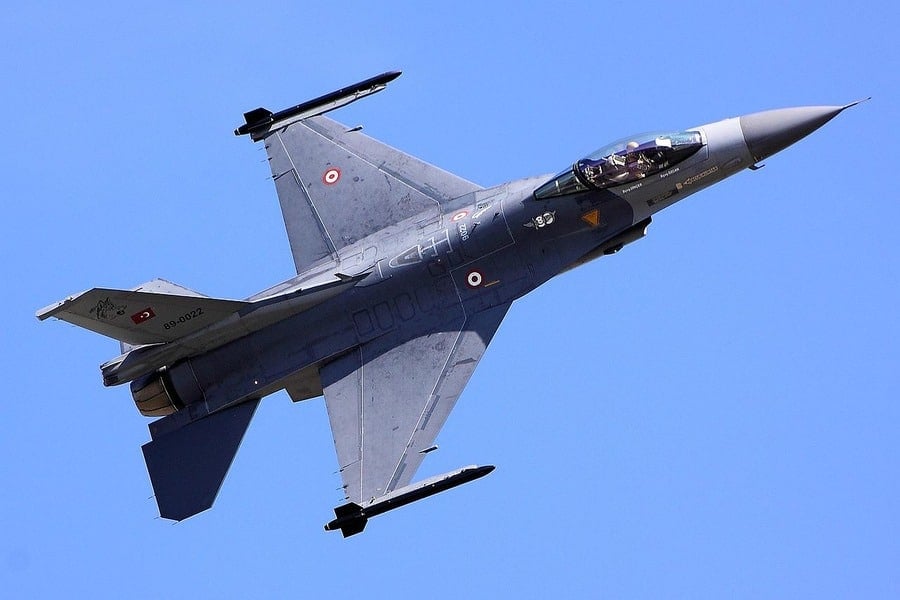
Two Turkish F-16 fighter jets tracked the official state aircraft of the European ministers from a distance. Credit: Wikimedia Commons, Tim Felce, CC BY SA 2
Turkey denied that its jets harassed the military aircraft carrying Greek National Defense Minister Nikos Dendias and his French and Dutch counterparts to Cyprus.
Earlier, it was reported that the “control tower” of the illegal Tymbou Airport in occupied Cyprus attempted to jam the aircrafts’ communications system. Furthermore, according to Philenews, two Turkish F-16 fighter jets scrambled from Tymbou, tracking the official state aircraft of the European ministers from a distance as they headed toward Cyprus.
A statement from the Turkish Presidency said that “claims in certain news media and social media accounts” about such harassment on Sunday and about Turkish warplanes violating Greek airspace were “completely false.”
The statement said that four of the six aircraft heading from Greece to Cyprus “breached the airspace” of Turkish-occupied northern Cyprus, and as a result two Turkish F-16 fighters took off from the ethnically divided island’s north “as a precaution.”
It said the F-16s did not enter Cypriot airspace and “there was no harassment” of the four aircraft.
The incident took place just hours before France and Cyprus were set to sign a Status of Forces Agreement (SOFA) on Monday, which will allow Paris to station military forces on the island.
France and Cyprus to sign military deployment agreement
The agreement will be signed in Nicosia by French Defense Minister Catherine Vautrin and her Cypriot counterpart, Vassilis Palmas. Both ministers are scheduled to attend an informal meeting of the EU Foreign Affairs Council (Defense) on the same day.
The Turkish Cypriot side condemned the agreement as “null, void, and legally invalid.” They expressed concerns that the deal could alter the balance of power on the island, disregard Turkish Cypriot rights, and escalate regional tensions. They further argued that the Republic of Cyprus lacks the authority to sign such an agreement on behalf of the entire island.
India is expanding ties with Greece, Cyprus, Armenia, and Israel to counter Turkey’s growing regional influence and its partnership with Pakistan. By strengthening defense cooperation and strategic partnerships, New Delhi is increasing its footprint in the Middle East and Eastern Mediterranean. As a result, the India–Turkey rivalry has the potential to develop into a new […]
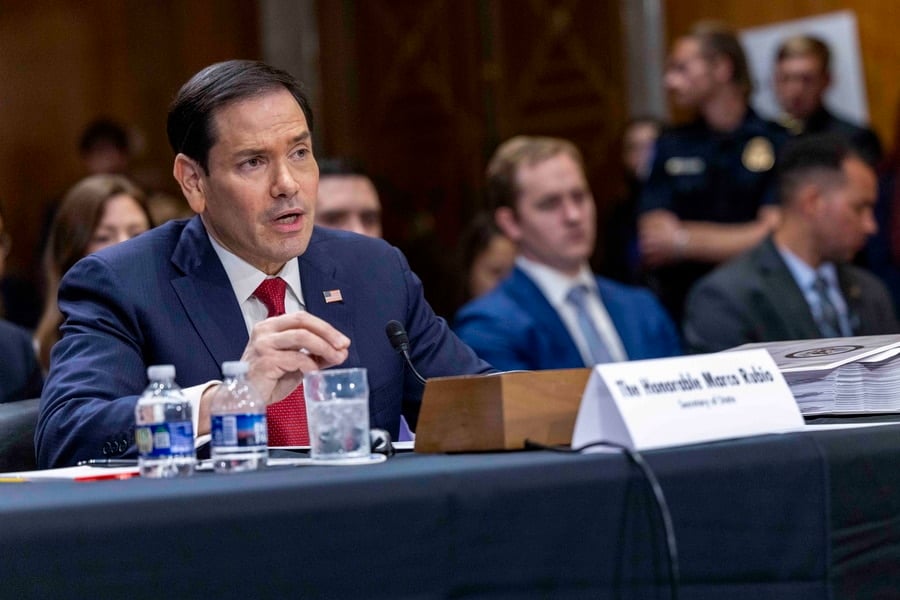
Secretary of State Marco Rubio says Turkey’s return to the F-35 program is blocked by US law over Ankara’s S-400 purchase. Credit: Shawn Thew / EPA via AMNA
US Secretary of State Marco Rubio said the Trump administration currently lacks the legal authority to restore Turkey to the F-35 fighter jet program, citing statutory restrictions linked to Ankara’s acquisition of Russia’s S-400 air defense system.
Rubio made the remarks during a House Foreign Affairs Committee hearing after Representative Dina Titus questioned him about recent comments by US Ambassador to Turkey Tom Barrack. Barrack had suggested that Washington should allow Turkey back into the F-35 program. Titus said that position appeared to conflict with existing US law and long-standing American policy.
Titus asked whether Turkey could receive advanced US fighter jets, including F-35s, under the current legal framework.
Rubio says Turkey’s F-35 return is blocked by law
Rubio said Turkey had originally participated in the F-35 program before Washington removed Ankara over its purchase of the Russian-made S-400 missile defense system.
“The reason why they can’t get them is because they purchased the S-400 system from the Russians,” Rubio said.
Turkey’s acquisition of the S-400 has remained a major source of tension in US-Turkey defense relations. Washington argues that the Russian system conflicts with NATO defense architecture and could create security risks for the F-35 platform.
Rubio points to NDAA restrictions
Titus noted that Turkey still possesses the S-400 system and remains subject to mandatory sanctions. Rubio acknowledged the point, saying existing US law controls the issue and limits the administration’s discretion.
Rubio said the administration currently lacks the authority to make such a decision because US law restricts the matter, including provisions of the National Defense Authorization Act.
His remarks underscored that any potential change in Turkey’s access to the F-35 program would require action on legal restrictions imposed by Congress. Those restrictions stem from Ankara’s S-400 acquisition and broader US sanctions policy toward major defense transactions with Russia.
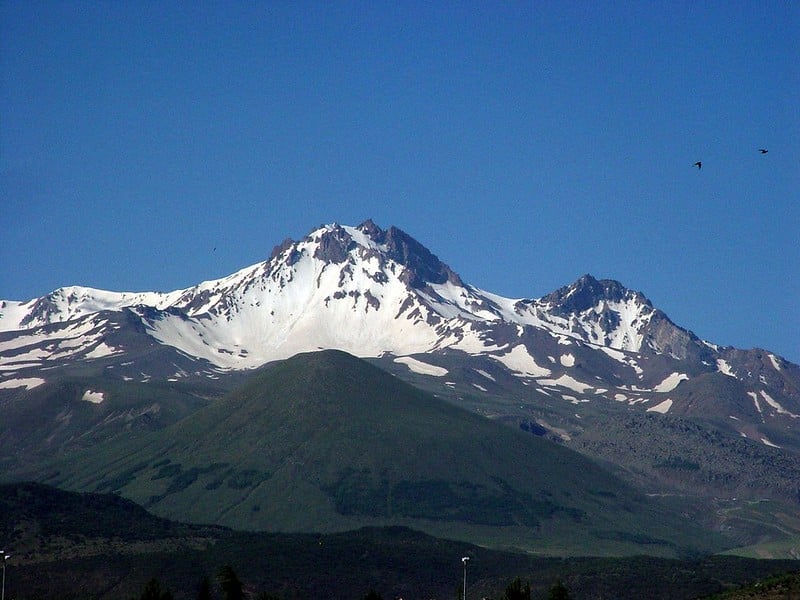
Seasonal snowmelt on Lifos Mountain in central Turkey has revealed the outline of a large ancient complex near the summit of a volcanic peak, bringing renewed attention to one of the region’s most mysterious archaeological sites.
The remains lie on Lifos Mountain in Kayseri province, within the Hacılar district north of Mount Erciyes. Drone footage captured after the snow melted shows extensive stone walls, settlement traces, cisterns, and possible building foundations spread across a high plateau.
The site sits at an elevation of 8,232 feet above sea level. The visible remains cover about 800,000 square feet, making it one of the largest known mountain-top archaeological sites in the area.
Massive walls surround the summit
Local historian and author Halit Erkiletlioğlu says the complex is far more than a simple hilltop ruin. According to his research, a perimeter wall stretches for roughly 0.6 miles around the summit and may once have stood between 10 and 13 feet high.
Built without mortar, the wall appears to have enclosed the mountain plateau in a carefully planned layout. Earlier descriptions of the site also mention towers, stone dwellings, cisterns, and arched tomb-like structures.
The summit itself has been described as a crater-shaped area measuring about 1,640 feet from north to south and 984 feet from east to west. Some accounts suggest towers were positioned at regular intervals of about 217 feet along the fortification line.
The scale of the construction suggests significant planning and organization. Building such a large complex at more than 8,200 feet above sea level would have required substantial effort and resources.
Sanctuary, fortress, or both?
The purpose of the site remains uncertain. Erkiletlioğlu has proposed that Lifos may have functioned as a pagan sanctuary or “temple city,” possibly linked to the worship of Zeus.
Elevated locations often held religious importance in the ancient world because they were viewed as places closer to the divine. However, the theory has not been confirmed through archaeological excavation.
Erciyes Dağı'nın kuzeyinde, 2 bin 509 metre yükseklikteki Lifos Dağı'nın zirvesine inşa edilen ve tapınak olduğu değerlendirilen yapı ile yerleşim alanları ve sur kalıntıları, karların erimesiyle ortaya çıktı.
The site may also have served a strategic role. Lifos overlooks the route toward Tekir Plateau, an important passage on the Erciyes massif. Its commanding position would have offered wide views across the surrounding landscape, making it useful for monitoring movement through the region.
In antiquity, religious and defensive functions often existed side by side. A sanctuary could also protect a route, while a fortified settlement could host ritual activity. Lifos may have combined both purposes.
Part of a wider Cappadocian landscape
The mountain stands close to Mount Erciyes, known in antiquity as Argaeus (Greek: Αργαίος). Rising 12,851 feet above the Kayseri plain, the dormant volcano was one of the defining landmarks of ancient Cappadocia.
Roman-era coins from ancient Caesarea frequently depicted the mountain, highlighting its cultural and symbolic importance. For ancient communities, Erciyes represented more than geography. It was a powerful symbol of identity, authority, and sacred space.
The Lifos complex also lies within a region rich in history. Nearby Kültepe-Kanesh served as the capital of the ancient Kingdom of Kanesh and a major center of Assyrian trade more than 4,000 years ago. The area remained an important crossroads throughout antiquity.
Preservation concerns grow
Researchers say preservation is now a priority. Erkiletlioğlu has warned that treasure hunters have already damaged parts of the site.
Archaeologists have not yet conducted a full scientific excavation. Detailed surveys and future excavations could help determine the site’s age, construction phases, and original purpose.
For now, the snowmelt has revealed a remarkable mountain complex that remained hidden beneath winter snow. Whether Lifos was a sanctuary, a fortress, a refuge, or a combination of all three remains unknown. The answer will likely depend on future archaeological work high above the plains of ancient Cappadocia.
Ongoing Turkish-Greek contradictions periodically remind one of the internal disagreements within the NATO bloc, which could escalate into a new hotspot of tension in Europe. France’s choice in favor of a military alliance with Greece has caused concern in Türkiye. France and Greece’s “Famous Alliance” In 2021, France and Greece signed a strategic partnership and […]
Amidst growing global disorder and a lack of central power, the Kazan Forum’s increasing significance reflects the rise of Russia’s diplomatic outreach. Kazan Forum as an Emerging Eurasian Interface The Kazan Forum has emerged as a reconfiguration of economic imagination, connectivity, and power across the Eurasian region. The XVII International Economic Forum “Russia-Islamic World: Kazan […]

 Login
Login