
Normal view

The 3,000-Year-Old Ancient Greek Vine of Pausanias

10 June 2026 at 11:55
Pausanias vine
The Vine of Pausanias is tangled and about 100 meters long. Foresters believe it to be about 3,000 years old. Photo credit: Kalavryta Municipality

When ancient Greek geographer Pausanias sat down to rest beneath the shade of the giant vine, he was unaware it was probably the oldest in the world.

It was approximately 160 AD when Pausanias (110-180 AD) enjoyed the shade of the ancient vine (Vitis vinifera) in the modern-day Peloponnesian community of Sella Pagrati on the Tripoli-Kalavryta national highway.

Today, the Vine of Pausanias is a tourist attraction on the border of the Arcadia and Achaia prefectures within the courtyard of the Agios Nikolaos church. According to agriculturalists, it is estimated to be about three thousand years old.

In the book, Food and History, Vol 11 (pp. 27-34) by Boursiquot, Lacombe, Laucou, and Bakasietas, there is a description of the ancient Greek vine:

“In order to contribute to the development of knowledge on the ampelographic heritage and the viticultural genetic resources of Greece, we have characterized the so-called ‘Pausanias’ vine at the ampelographic and molecular level. This vine is located in the center of the Peloponnese (village of Pagrati, Prefecture of Achaia). It is named and listed under the name of ‘Vine of Pausanias,’ Greek geographer of the 2nd century AD, even if its origin and its real age are not really known. The results of the analyses show that it is not an ancient Greek grape variety but a lambrusca (Vitis vinifera subsp. sylvestris), whose specificity lies in the fact that the strain has been maintained naturally for a very long time, and probably for several centuries, without any particular human intervention. In this respect, and by its spectacular development, it is certainly a unique and quite exceptional example.”

Although it blooms every May, the vine no longer produces fruit. It is about 100 meters (328 feet) long and has 9 shoots (trunks), which spread in a grove of hollow oak bushes (Quercus coccifera). Many of its branches have even climbed the oak bushes. It should be noted that, according to the villagers, many of the shoots were cut by the Germans during the 1941-1944 Occupation.

Pausanias went for the trout

In his book Arcadika (8.21.2), Pausanias claims he had visited the area to see if the rumor that the trout of the Aroanios River sang like the song thrush bird was true: “…here the fish of the Aroanios River are so delicious that they sing like thrushes.” (Greek: “εἰσὶ δὲ ἰχθῦς ἐν τῷ Ἀροανίῳ καὶ ἄλλοι καὶ οἱ ποικιλίαι καλούμενοι: τούτους λέγουσι τοὺς ποικιλίας φθέγγεσθαι κίχλῃ τῇ ὄρνιθι ἐοικός.”)

The ancient Greek geographer discovered that local gourmands had a metaphor to describe the flavorful Aroanios River trout. Later on, he sought the shade of the vine, which he found impressive. The villagers hosted him, providing him with a trout meal and offering him water from the nearby spring.

Ancient legends connect the Vine of Pausanias with the third of the twelve labors of Heracles, which was to capture the Ceryneian Hind, the golden-horned deer sacred to Artemis. According to the legend, while the hero was on the hunt for the deer, it reached the vine, and its long horns became tangled, enabling Heracles to capture it. Due to this myth, the location of the Vine of Pausanias had also been named Kynigari (Greek: Κυνηγάρι), meaning “hunting place” in Greek.

Protected national monument

The vine was declared a Protected Natural Monument in 1975 (Government Gazette 738/B/1975). Regarding the vine’s physical condition, the scientific committee of the ECOCITY NGO estimates that the original trunks of the plant have disappeared due to the natural deterioration of time, while their remaining lower parts, which are one to one and a half meters high and at least 50 centimeters in diameter, have dried out.

Many other shoots have emerged from the numerous branches of the roots, climbing the tree-like oak bush forms. However, ECOCITY estimates that the condition of these “trunk shoots” seems almost hopeless, suggesting that the unique natural monument could potentially permanently disappear after about three thousand years.

To avoid destruction of the Vine of Pausanias, ECOCITY has long since forwarded a request to the competent services responsible for its preservation and maintenance. This in relation to the desired cooperation with the Viticulture and Arboriculture Laboratories of the Agricultural University of Athens so that they may take immediate action to improve the vine’s physical condition and prevent its complete demise.

In May 2014, with permission granted by the Ministry of Environment, Energy, and Climate Change, the members of the scientific committee of the Western Greece Sector of ECOCITY visited the Vine of Pausanias. They extracted samples from the trunks to determine precise dating. The team consisted of foresters and agriculturalists who then sent the samples to the head of the Archaeometry Laboratory of the NCSR “Demokritos.”

Unique and distinctive genotype

Genetic analysis of the Vine of Pausanias was carried out. Twenty microsatellite markers distributed throughout the genome were studied for this purpose, and comparison with 119 Greek varieties and 762 species of wild vines was performed.

The comparison to all the varieties in the Vassal collection (over 3000) proved that the vine’s profile is of a unique and distinctive genotype.

Its age is estimated to be several centuries old, but the number cannot be definitively determined. Its flowers are only ‘male,’ meaning the vine is not fruit-bearing.

Compared to other representatives of Vitis vinifera, wild or cultivated, that exist today in the world, the Vine of Pausanias is of a particularly original genotype, probably resulting from a limited number of sexual generations which have also undergone only few cycles of vegetative multiplication. In this regard, it is certainly a fascinating model for studies on the evolution and dynamics of the vine genome.
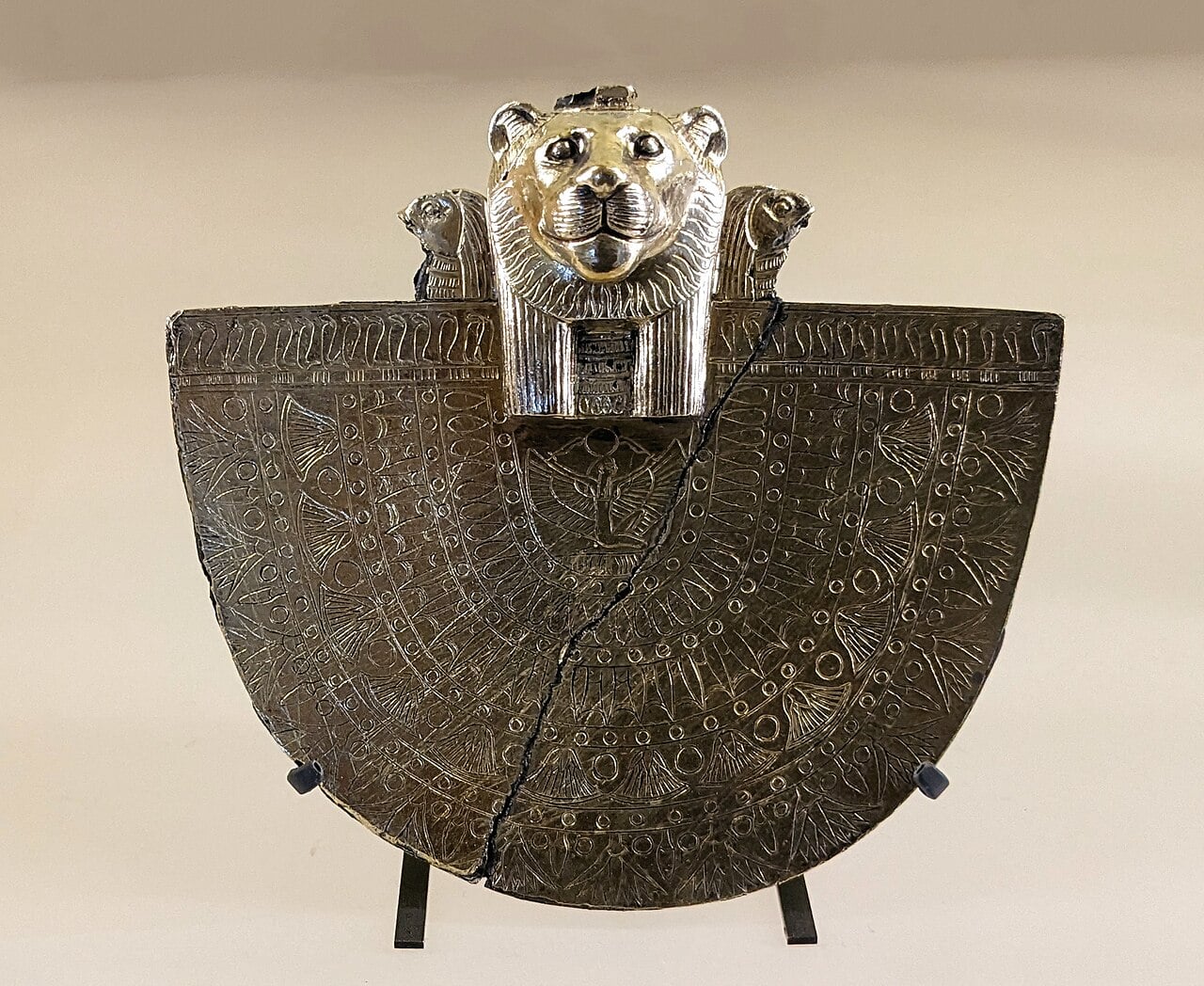
The Ancient Egyptian King Known as Heracles

2 June 2026 at 16:13
Aegis of Osorkon, the Egyptian Heracles, and his wife Tadibastet
Aegis of Osorkon, the Egyptian Heracles, and his wife Tadibastet, eighth century BC. Credit: Wikimedia Commons, public domain.

Heracles, also known as Hercules, is one of the most famous heroes of Greek mythology. Interestingly, ancient records reveal that an Egyptian king from the time before Homer also went by the same name of Heracles, but what do we know about him, and what might his connection to the Greek one be?

Heracles of Greek mythology

First of all, it’s worth looking into who Heracles actually was in Greek mythology. A demigod who was famed for his strength, his mother was Alcmene, while his father was Zeus, the king of the gods. The goddess Hera is known to be his greatest enemy. The irony in that is that his name actually means “Glory of Hera.”

Heracles participated in numerous adventures, including the quest for the Golden Fleece. However, the most famous series of events involving Heracles are his twelve labors. These seemingly impossible tasks involved killing a monstrous lion, defeating the Hydra, and capturing the Mares of Diomedes.

Without a doubt, Heracles was one of the most popular heroes within Greek mythology, and the same holds true to this day. This makes his potential connection to Ancient Egypt all the more interesting.

The Egyptian king Heracles

To any student of Egyptian history, the claim that an ancient king of Egypt also went by the name of “Heracles” might seem strange. After all, he’s not included on any standard list of Egyptian kings. However, we find a clear reference to him in the ancient source of Manetho’s king list.

Manetho was a historian who lived in the third century BC and wrote about the history of Ancient Egypt, its many kings, and dynasties. Unfortunately, the authentic source has not actually survived, but it has been referenced in later sources. For instance, in the version preserved by Eusebius of the late third to early fourth centuries AD, we find the following list:

“The Twenty-third Dynasty consisted of three kings of Tanis.

1. Petubastis,⁠ for 25 years.

2. Osorthon, for 9 years: the Egyptians called him Heracles.

3. Psammus, for 10 years.”

As can be seen, King Osorthon from the Twenty-Third Dynasty of Egypt was also known as Heracles, a fascinating discovery that potentially has some very intriguing ramifications for our understanding of early Greek mythology.

Who was the Egyptian Heracles?

Firstly, we need to understand who Osorthon actually was. This spelling used by Eusebius is actually a form of the Egyptian name “Osorkon.” There were several kings known as “Osorkon” throughout Egypt’s history within the first half of the first millennium BC, but which one was the one known as Heracles?

The traditional viewpoint has been that Manetho’s Osorthon was Osorkon III. The common dates for his rule place him in the early eighth century BC, and he ruled a few decades after a king named Pedubast I. That would fit Manetho’s Osorthon coming after a king named Petubastis.

However, there are certain issues with this. For one thing, it appears that Pedubast I and Osorkon III ruled Upper Egypt, or what is today southern Egypt (approximately). This is problematic, because Manetho refers to his kings as ruling Tanis, near Egypt’s northern coast.

Another viewpoint is more convincing and has been accepted by many modern scholars. This is that Manetho’s Osorthon is actually Osorkon IV. He came shortly, or perhaps even immediately, after Pedubast II according to many scholars. Therefore, this fits in well with Manetho listing Osorthon right after Petubastis.

Additionally, there is the crucial fact that Pedubast II and Osorkon IV were actually rulers of Tanis, just like Manetho described. Therefore, it is very likely that the Osorkon allegedly known as Heracles was Osorkon IV. He ruled in the north of Egypt, and scholars date his reign to the second half of the eighth century BC.

The fact that there was a historical figure who was known as Heracles and lived just prior to the earliest traces of the legend of Heracles in Greek mythology is quite interesting. Could this mean that Heracles is actually based, at least in part, on the historical Osorkon IV?

Was Osorkon IV the Heracles of Greek mythology?

Partially because relatively little is known about Osorkon IV and it is thus quite difficult to compare his life with the Greek legend of Heracles, we do not actually know if these two figures are one and the same. Nonetheless, the basic connection to Egypt is, surprisingly, something that we find in Greek records. Herodotus noted that Heracles’ parents, Alcmene and Amphitryon, were “both of Egypt by descent.”

As for Osorkon’s activities, he is known to have successfully prevented a devastating attack against his territory by the southern king of Egypt, Piye, right at the beginning of his career. Achieving this involved traveling to a temple to meet Piye. This could be associated with the legend of Heracles repelling a king’s invasion of his land, which likewise involved him going inside temples.

Another event in his life is recorded in Assyrian records. To appease Sargon of Assyria, Osorkon took and gifted twelve incredible, mighty horses. They impressed Sargon so much that he described them as “without equal in Assyria.” This could potentially be the origin of the story of Heracles capturing the mighty Mares, or Horses, of Diomedes and gifting them to King Eurystheus to appease him.

Lastly, numerous scholars believe that Osorkon fought against another king of Egypt named Bocchoris. This could be the origin of the story of Heracles fighting against the Egyptian king Busiris.

While none of these connections can definitively be confirmed, it is, nevertheless, possible that the Egyptian king Osorkon IV inspired the figure of Heracles in Greek mythology at least to an extent.

❌