Reading view

Franco-German defence rift deepens with collapse of FCAS programme

By Hélène de LAUNZUN

Join us on TelegramTwitter, and VK.

Contact us: info@strategic-culture.su

Franco-German combat aircraft programme collapses after years of disputes, showcasing the difficulty with military cooperation within the EU.

Rumours had been circulating for many months, but it was confirmed on Monday, June 8th: France and Germany have decided to abandon the core joint fighter plane component of their joint Future Combat Aircraft System (FCAS) project. With it goes a project that symbolised ambitions for deeper military cooperation between the two countries.

The project was launched in 2017 on the initiative of French President Emmanuel Macron and then-German Chancellor Angela Merkel. Its aim was to replace, by 2040, the French Rafale and the German-Spanish Eurofighter. After months of stalled progress, Chancellor Friedrich Merz and President Macron agreed that the main industrial partners involved in the project—Dassault Aviation on the French side and Airbus Defence and Space on the German-Spanish side—were clearly unable to work together because of diverging interests.

It was one of Europe’s largest military programmes, with an estimated total cost of €100 billion. The technological ambition was highly advanced: more than just a fighter jet, the system was to integrate combat drones, connected sensors and a next-generation digital network, thereby forming what was described as a ‘combat cloud.’

Disagreements between the industrial parties have multiplied in recent months, centring on the sharing of industrial responsibilities, intellectual property, and the governance of the project. In the spring, Macron was still insisting he believed in it, but progress remained elusive.

For defence expert Jean-Dominique Merchet, the programme had in fact been “on life support” for several months, and the German decision to formalise the end merely confirmed a shared recognition of irreconcilable industry positions rather than a unilateral move. The fact that the announcement came from Berlin—without a joint statement from partner countries France and Spain—confirms the major political setback for Macron, who has been the project’s main champion since its launch in 2017. According to Merchet, the announcement definitively confirms the now insurmountable disagreements between Dassault Aviation and Airbus over the development of the fighter plane intended to form the core of the programme. The analyst is now questioning the future of the other components of the FCAS, notably the combat cloud, the engines, and the support drones. This failure could undermine another major Franco-German project, the future European battle tank, which is itself already facing numerous difficulties.

Similar frictions have affected other joint efforts in recent years. In some cases, one side  has withdrawn or scaled back its commitment—as in the case of the Tiger helicopter, where Germany backed out, or the Eurodrone, where France is currently discussing exit terms; in others, like the MAWS maritime patrol programme and the CIFS future artillery system, it’s due to delays, differing priorities, and mutual strain.

For both countries, the failure tests their ability to advance next-generation capabilities.

For France, the failure of the FCAS will test the national defence industry’s ability to bounce back. France must now consider the possibility of a new-generation programme that it would lead alone or in cooperation with other potential partners such as Sweden, Italy, India or the United Arab Emirates. Germany is expected to consider options including additional F-35 acquisitions or interest in alternative collaborative frameworks.

The failure of the FCAS is highly symbolic at a time when, under American pressure, Europe was seeking to assert its strategic autonomy. The programme, which symbolised Europe’s ability to carry out its major armaments projects autonomously in the face of the United States and China, illustrates above all the persistent difficulties European states face in effectively coordinating their industrial, strategic, and national interests.

Original article:  europeanconservative.com

  •  

Soros’ OSF helped stir Indonesian rebellion, leaks reveal

By Kit KLARENBERG

Join us on TelegramTwitter, and VK.

Contact us: info@strategic-culture.su

Leaked documents reviewed by The Grayzone expose how the Soros-run Open Society Foundations plotted to “prevent the continuation” of Indonesia’s elected government by bankrolling opposition media, youth activists groups and lawfare operations to remove President Prabowo Subianto.

Ever since the election of Prabowo Subianto as Indonesia’s President in February 2024, Jakarta has faced continuous waves of anti-government protests. Activists enraged by harsh economic conditions and elite corruption have taken to the streets in vast numbers, often engaging in fiery clashes with police and the military. A series of leaks obtained by The Grayzone indicate this upheaval has unfolded according to a well-honed plan to take down Prabowo, which drew on organic grievances but which depended heavily on funding the Open Society Foundations.

Founded by anti-communist billionaire George Soros in 1993, OSF has been described by The New York Times as “a sprawling political and philanthropic empire,” which “seeks to advance a liberal, democratic agenda.” The Washington Post described Soros as part of a network of “overt operators” carrying out “spyless coups” that were once the purview of the CIA during the Cold War. OSF has acknowledged its central role in numerous insurrections throughout the Global South.

The leaked files reveal how from 2019 onwards, OSF began pumping large sums into projects designed to promote “resistance and dissent” against Prabowo’s predecessor, Joko “Jokowi” Widodo. Much of this money has been distributed by the Jakarta-based Kurawal Foundation, the single largest recipient of OSF contributions between 2019 and 2024. Founded in 2019, Kurawal describes itself as “a social justice philanthropy…[endeavouring] to promote dignified and benevolent democracy in Indonesia and Southeast Asia.”

The organization sponsors “individuals and agents,” who can be relied upon to advance Western liberal values locally. In the leaks, Kurawal described its efforts to develop an ideal voter who would be impervious to the scourge of Prabowo-associated disinformation. This meant “cultivating a wise and virtuous democrat – as political subject – who adheres to the essential principles of democracy.” The leaks show the intended subject was anything but.

Kurawal’s OSF-funded activities intensified in late 2023, as Indonesia geared up for the Presidential election in February the next year. Prabowo, Joko’s chosen successor, won by landslide in a vote international observers judged legitimate. However, the leaks show Kurawal used its local assets to whip up a frenzy over supposedly “massive” fraud by Prabowo, fomenting so much public pressure that authorities changed electoral rules to allow more parties to run for office in 2029. (Kurawal did not respond to a request for comment from The Grayzone).

In order to topple Prabowo, OSF has financed the grooming of prospective future politicians, outreach to existing political parties, and the creation of new movements and factions that could field candidates for office locally. Simultaneously, OSF bankrolled a range of self-proclaimed ‘independent’ media outlets and activist groups, who they sought to train “to become agents of change.” In leaked documents, Kurawal boasts that its “youth political engagement” activities mean young Indonesians are “at the forefront of most social and political movements… shaping conversations on national policies.”

Kurawal’s meddling in Indonesia has global implications. Mass “Gen Z” protests that erupted in July 2025 and raged for weeks have been hailed by Western corporate media as a revolutionary inspiration for anti-government activists elsewhere. It was in Jakarta where protesters first waved cartoon Jolly Roger flags inspired by Japanese manga One Piece. A map found in the tranche of leaks notes that Kurawal is active in several countries where these flags have appeared, including in protests which have produced regime change, such as in Nepal.

Kurawal encourages ‘agitation and pushback’ against Joko

A leaked February 2025 Kurawal document called “Building Bridges, Filling Gaps,” charts a clear “strategic plan” for regime change in Indonesia and beyond, 2024 – 2029. The file was produced after five years of systematically undermining President Joko’s administration, “by providing support to civil society groups, social movement actors, and thought leaders as well as change makers who do not shy away from politically sensitive issues.” This was motivated by “Indonesia’s growing political and economic clout”, and regional influence, under his rule.

The document describes Joko scathingly, as a “pilferer” and “opportunist”, while slamming his supposedly “inward looking foreign policy.” In reality, Joko prioritized protecting Indonesia’s sovereignty, irritating Western powers by rubbishing bogus CIA-disseminated claims of “genocide” in Xinjiang, refusing to recognize Israel, and pushing for peace in Ukraine.

By “promoting dissent” during his last term in office, Kurawal sought to lay foundations for even greater attacks against Prabowo. As a leaked file explains, “the agitation and pushback was needed to show that dissent is both necessary and possible.” Resultantly, “vibrant citizen movements” that could “challenge power” and “organize and influence change” sprouted locally, with OSF help.

Kurawal’s “program taxonomy” between 2019 and 2024 focused heavily on driving “youth political engagement,” encouraging young Indonesians to attend protests, join civil society campaigns and hone social media skills. As such, the organization’s students “actively set a higher standard of accountability of political leaders,” while “shaping conversations on national policies,” and “challenging traditional political organizing.” These efforts were to be enhanced by what Kurawal called “networks or alliances among social justice groups,” legal advocacy and a new lobbying machine.

Kurawal also financed local media outlets to promote stories of purported malfeasance and other abuses of power by authorities. For example, the organization sponsored a “series of in-depth reporting on police corruption and brutality cases in prominent public interest media,” combined with “social media campaigns” while “forming a national coalition for police reform” to “ramp up public pressure.” This was cited as “one of the bright spots” in Kurawal’s work in Indonesia, during the pre-Prabowo period.

For example, in 2021, Kurawal launched TempoWitness, an online portal which claimed to connect “citizen journalists at community level with mainstream local and national media.” By contrast, Tempo has been a vehicle for slanderous attacks on independent journalists raising questions about Western financing of anti-government media outlets and NGOs in Indonesia. Among its top targets is Brian Berletic, a US citizen who resides in Thailand and specializes in exposing covert Western funding of opposition political forces in the region.

Kurawal has also sponsored documentary films, photography, and experimental art in Indonesia. The purpose is to “elicit action from citizens and community.” This included the Jakarta International Photo Festival, the region’s largest. The events attracted tens of thousands of visitors, enabling Kurawal to shepherd them into a “side event” on the subject of democracy. During these sessions, attendees were given instruction on how to use “photography and visual storytelling” in the pursuit of “democracy and human rights.”

National ‘roadshow’ to ‘radicalize’ Indonesians

When Joko left office, he enjoyed record-high approval ratings. In its “Building Bridges, Filling Gaps” document, Kurawal reluctantly acknowledged the outgoing president was “able to maintain popular public support” in an organic fashion through what they described as “populist social welfare policies.”

The leaked document notes Prabowo would continue his predecessor’s legacy, “emphasizing policies to enhance social welfare, reduce poverty, and eliminate hunger.” A dedicated section called “Bracing for the Prabowo years” outlines the new president’s likely stances and strategy over his first term in office, and how his rule can be undermined.

The leaks reveal how Kurawal released a documentary called “Dirty Vote” immediately upon Prabowo’s election claiming to expose “how instruments of power are used to manipulate elections, undermine democratic order, and maintain the status quo,” and calling “for collective action to safeguard democracy.” The video racked up over 20 million views on YouTube as Kurawal screened it across Indonesia’s university campuses throughout February and March 2024. The dedicated “roadshow” was promoted as “a moral call to protect democracy’s future from systemic abuse and electoral fraud.”

The “Dirty Vote” documentary’s narrative tracked closely with claims of fraud in the February 2024 Indonesian elections by opposition elements. While Jakarta’s Constitutional Court rejected all formal legal challenges to the vote’s results in April that year, Kurawal boasted that its propaganda efforts cemented “widespread voter grievance” over what it called “massive election fraud.” The outcry successfully triggered reforms to Indonesian electoral laws, which previously required parties receive 20% of parliamentary votes to field presidential candidates.

When authorities caved to the opposition’s pressure in January 2025, Kurawal declared, “this means that at the next election, for the first time in the country’s history, political parties big and small will be free to nominate candidates on their own.”

The newly leaked documents echoed the contents of leaked files revealing that in June 2023, the US Embassy in Jakarta privately expressed concern about Prabowo’s almost inevitably impending victory, and planned to overturn the 20% threshold in response.

If the threshold were removed, “there will be more candidates in the election,” US embassy officials noted. In such a scenario, they concluded “the US will have more options” within the field of local candidates.

After the 20% rule was changed, Kurawal said it was well-placed to “set up alternative political groupings among civil society actors,” placing special emphasis on “women, youth, environmental rights defenders.” If successful, Kurawal would oversee “their possible transformation [into] new political parties.” The group wrote that it sought to use “infiltration or pressure” to “transform and radicalize” existing parties and “mobilize the masses against the established party system.”

The document concludes by fretting that the Global South is moving “from the periphery of the international political and economic arena towards the centre,” with countries such as Brazil, India and Indonesia cultivating “enough economic and political clout to emerge as regional or global powers,” and “active agents” in the international order. In turn, this has precipitated a global shift towards “multipolarity at a faster speed.” Kurawal lamented that many of these emerging powers do not subscribe to neoliberal Western governance models.

However, the organization expressed optimism about the prospects for insurrectionary change in troublesome countries, noting how Asia “witnessed some extraordinary demonstrations of ‘people power’ in 2024,” courtesy of “civil society leaders and pro-democracy activists.” Cited examples included the removal of South Korean President Yoon Suk Yeol, and the August student-led military coup in Bangladesh.

The Grayzone has exposed how the latter was the handiwork of individuals and organizations sponsored by the National Endowment for Democracy, a known CIA cutout.

Exploiting ‘Gen-Z’ to block Prabowo’s re-election

Other leaks show how in August 2025, Ekspedisi Indonesia Baru was awarded tens of thousands of dollars by Kurawal for a project titled “Expedition to Discover New Voices”. The purpose is to transform “younger generations” of Indonesians “to become agents of change.” This is to be achieved by “[mainstreaming] alternative ideas about a ‘New Indonesia’ by distributing public knowledge through documentary films, books, and community discussions that are widely accessible to the public, especially young people.”


Among the initiative’s explicitly stated “desired outcomes” is “stronger engagement from younger generations (Gen Z and Gen Alpha) in public discourse, along with greater courage to dream, speak up, and take action for Indonesia’s future.” This will hopefully precipitate “rising interest in alternative political actors” among the public, prior to Jakarta’s 2029 general election, “with an aim to elect political leaders dedicated to democracy and social equity,” so as to “prevent the continuation” of Prabowo’s rule.

“Key activities” to be conducted include “producing a documentary series” for YouTube channel Indonesia Baru “and other digital platforms,” a “public presentation roadshow” throughout the country to “spread ideas”, and “developing factual short-form content (TikTok, Reels, YouTube Shorts) on violent suppression by military and police forces, government corruption, forced land acquisition, and youth resistance to undemocratic policies.” For the latter initiative, Ekspedisi Indonesia Baru seeks to enlist “young creatives who can bring fresh perspectives and formats aligned with their peers’ digital behavior and preferences.”

Another key programming strand was publication of a book, Restart Indonesia, released in October 2025 under the revised title Reset Indonesia. A local media report on the forthcoming work quoted its lead author: “Reset is a more fitting description of the book’s content, which indeed proposes a reprogramming of Indonesia, not just a restart.” While only 2,000 copies have been printed to date, another contributor hoped many more would read the book.

“If a horror film in theaters can attract four million viewers, here’s a book that’s just as horrific,” they explained.

In July 2025, Sophia Nusantara Association was also furnished with tens of thousands of dollars in Soros financing through Kurawal, for a project titled “Guardian of Ecological Democracy” in Papua. Leaked documents described this student group as part of “the vanguard of resistance” against Indonesia’s government. Leaked documents related to the project boast how OSF’s local campus-based proxies have access to media, national networks, and modern documentation tools that can mobilize broad support.”

Kurawal foresaw its student footsoldiers “using art, research, and technology as tools of creative resistance,” managing “online campaigns and offline campaigns,” and convening “cultural festivals as a symbol of resistance.” In particular, Indonesian environmental protection issues were to be exploited as an “intellectual weapon,” to stoke public anger and “policy pressures” within Indonesia’s Presidential palace. Predicting such activity would create a potentially dangerous environment for students, Kurawal pledged to provide them with “security training” and to establish “safe houses on campus.”

‘Fighting authoritarianism with legal weapons’

In late August 2025, large-scale student-led demonstrators erupted across Indonesia. After days of extraordinary clashes, the government pledged concessions in response to protesters’ demands. The upheaval was one of Jakarta’s largest since the ousting of the CIA-installed dictator Suharto in 1998. Unrest quickly turned violent, with rioters attacking police, torching multiple government building, and looting the homes of elected parliamentarians. Local security forces initiated a heavy crackdown on the violent riots which claimed lives, leading to condemnations from groups including the OSF-funded Human Rights Watch.

At the forefront of the campaign to prosecute officials – whether nationally or internationally – was the Indonesian Legal Aid Foundation (YLBHI). Perhaps unsurprisingly, the organization has received enormous sums from OSF, via Kurawal Foundation. The leaks show YLBHI received a substantial grant from Kurawal just one month prior to the protests, to provide “critical legal education” to civil society groups, student organizations and indigenous communities to document purported abuses by authorities, and launch litigation “at the national level and through international human rights law mechanisms.”

Moreover, YLBHI’s OSF-bankrolled lawfare operations are explicitly intended to undermine the National Strategic Project instituted under President Joko in 2016. The project’s aim is to finance local infrastructure in order to generate economic growth and regional development. The effort has ignited controversy, however, due to concerns over land rights, potential environmental damage, and displacement of indigenous communities. With OSF financing, YLBHI aims to “raise critical awareness” of issues related to the National Strategic Project’s implementation.

Another target of the grant is “fighting authoritarianism with the use of legal weapons.” YLBHI is to “collaborate with local [and international] legal teams and legal experts to establish a legal aid team that can provide a rapid response, aiming to provide necessary legal assistance to social activists experiencing pressure” from authorities. These efforts will be “continuously” promoted, in order “to gain support and response from the Global South, thereby protecting the legitimate rights and interests of indigenous peoples and activists.”

With millions pumped into Kurawal over the years, it is evident Soros’ foundation is determined to stymie Prabowo in the next election. While he may not remain in office to face his opponents at the ballot box, one thing is clear: his replacement will be owe a debt of gratitude to some powerful forces overseas.

Original article:  thegrayzone.com

  •  

The ICC: he who pays the piper calls the tune

The ICC: 84% funded by imperialist powers, 0% justice for their crimes. From the CIA to French rapists, the Court shields the West while targeting Russia, Libya, and Africa. He who pays the piper calls the tune.

Join us on TelegramTwitter, and VK.

Contact us: info@strategic-culture.su

In order to persecute rulers deemed inconvenient to imperialism, the ICC overrode its own basic principle: limiting its jurisdiction to countries that ratified the Rome Statute. Yet while Gaddafi’s Libya and Putin’s Russia became targets of the ICC, the United States has remained immune. And it has demonstrated that, even while not being a member of the Court, it is the one truly in command.

When Bensouda sought to investigate war crimes in Afghanistan — not restricting her inquiry to the actions of the Taliban and the Islamic State, but also including what she viewed as the greatest perpetrators of that war (the U.S. military and the CIA) — she came under intense pressure from Washington, pressure that ultimately resulted in government sanctions. Her and her relatives’ bank accounts were frozen, and her husband was subjected to surveillance.

Eventually, Bensouda was replaced by a new prosecutor compliant with the United States. Karim Khan altered the focus of investigations into Afghanistan, declaring that priority would be given to the Taliban and ISIS while the United States would no longer be prioritized, citing a lack of resources for a broader undertaking.

During one of France’s many military interventions in Africa this century (between 2013 and 2016), soldiers raped and sexually abused children in displaced persons camps in the Central African Republic. The UN, although it devoted limited attention to the case, was accused of a “serious institutional failure” by an independent commission for having allowed the atrocities to continue. The ICC — which could have intervened, since France is a State Party and French magistrates failed to convict any soldier due to an alleged lack of evidence — preferred to remain silent on the matter.

During the same period, amid its intervention in the Sahel, French soldiers — including mercenaries from the Foreign Legion — were accused of murdering civilians and training and arming security forces responsible for massacres, summary executions, and rapes. French leaders likewise had little to fear.

On the other hand, the ICC even pretended to examine war crimes committed by the United Kingdom in Iraq, including the torture of prisoners. But it justified closing the case by claiming that British authorities were already conducting domestic investigations — even though the Office of the Prosecutor itself acknowledged there was a “reasonable basis” to believe British troops had committed war crimes.

The United Kingdom punished no officers, even though a later public inquiry concluded that there had been widespread violence and an institutional silence — in other words, responsibility reaching high military ranks. Since the United Kingdom had not truly been capable of concluding the matter, the ICC could have intervened, given that London is party to the Rome Statute. But the ICC once again washed its hands of the issue.

Now, as Bensouda revealed, Israel is also protected — and not only through U.S. sanctions, but also through the actions of an ICC bureaucracy working hand in glove with the Mossad, allowing direct and illegal Israeli interference without taking any action against it.

A Structure Dominated by Imperialist Nations

According to data made available in the ICC’s latest financial report, referring to 2024 and published in July 2025, it is possible to calculate that around 84% of the Court’s total funding comes from imperialist and associated countries (NATO members, Switzerland, Austria, Japan, South Korea, Australia, and New Zealand). Yet together they account for only 28% of the Court’s States Parties. Meanwhile, the remaining countries (72%) contribute just 16% of the Court’s budget.

There is a clear structural imbalance in the ICC’s financing. Naturally, this is directly related to the Court’s partial conduct. As the saying goes, he who pays the piper calls the tune.

The ICC itself considers that 60% of African countries that belong to it are “non-represented” or “under-represented” in its internal structure. In other words, only 40% have some form of representation. For Latin American and Caribbean countries, this percentage is even lower: only 14% of the Court’s members are adequately represented. For Asia-Pacific countries, the figure is 28%. By contrast, half of the imperialist and associated countries are properly represented, a far higher percentage than in the other regions.

According to a report by the Assembly of States Parties, 56% of ICC staff in 2024 came from the group composed of Western European and related countries. Only 16% were African, 11% came from Eastern Europe, 8% from Asia-Pacific, and 8% from Latin America and the Caribbean.

Among the Court’s current 18 judges, eight belong to imperialist and associated countries, and five maintain academic and/or professional ties with hegemonic institutions in those countries. The others are senior state bureaucrats, generally from countries whose state apparatus is intrinsically dependent on imperialism.

Thus, it is clear that the ICC’s victims will always be leaders who are inconvenient to imperialist powers. While even Putin has had an arrest warrant issued against him by the Court and African governments remain its preferred target, no NATO country has ever been seriously troubled by ICC proceedings.

The bombings using prohibited weapons in Yugoslavia in 1999, the torture at Abu Ghraib and Guantánamo, the massacres in Iraq and Afghanistan, the rapes in Africa, or, more recently, the massacre at the school in Minab and the weekly killings of fishermen in the Caribbean and the Eastern Pacific, do not concern ICC judges.

For this very reason, the majority of sovereign countries that refuse to kneel before imperialism have never joined the ICC. Cuba accused the Court of pursuing a “selective policy against developing countries.” North Korea described its maneuvers as “a product of hostile forces.”

But together with Burundi’s declaration, perhaps the best definition of what the ICC is came from the Deputy Secretary of the Russian Security Council, Alexander Venediktov: “A compliant puppet in the hands of the collective West.”

  •  

A new strategic reality in the Middle East

Considerations on Iran’s new posture and the transformation of the strategic balance in the Middle East.

Join us on TelegramTwitter, and VK.

Contact us: info@strategic-culture.su

The recent developments in the Middle East indicate that the dynamics of the regional conflict are entering a new phase. Although the ceasefire reached in recent months has reduced the intensity of direct confrontations, recent events demonstrate that the structural factors fueling the war remain in place. The exchange of attacks between Iran and Israel reveals not only the fragility of existing agreements but also an important shift in Tehran’s strategic posture.

For years, Iranian military policy was characterized primarily by responses to actions it considered hostile. Since 2024, every case of direct confrontation between Iran and Israel occurred with an Iranian response to a previous Israeli attack. However, the events of the past weekend suggest a significant change in this behavior. By launching an offensive against Israeli targets following military operations conducted in Lebanon, Iran demonstrated a willingness to act before additional threats materialize, presenting its actions as part of the right to collective self-defense, expressed through the protection of regional partners.

The Iranian justification is based on the interpretation that Israeli attacks on Lebanese territory constitute violations of previously established understandings. According to this view, the continuation of military operations in urban areas and the expansion of actions against different regions of Lebanon create a scenario that legitimizes a proportional response. In addition, Tehran also links its reaction to incidents involving what it describes as American piracy on strategic maritime routes.

The most significant aspect of this escalation lies not merely in the launching of missiles or drones, but in the political message it conveys. Iran appears to be signaling that it no longer intends to limit its actions to the direct defense of its own territory. Instead, it is showing a willingness to respond to military operations targeting actors considered part of its regional alliance network. This represents a shift with the potential to profoundly alter the strategic calculations of all parties involved.

At the same time, the international response highlights the difficulties faced by powers attempting to manage the crisis. Fears of an uncontrolled expansion of the conflict come at a particularly sensitive moment for the global economy. Military tensions in one of the world’s most important regions for energy production and transportation tend to generate immediate impacts on financial markets, logistics chains, and investor expectations.

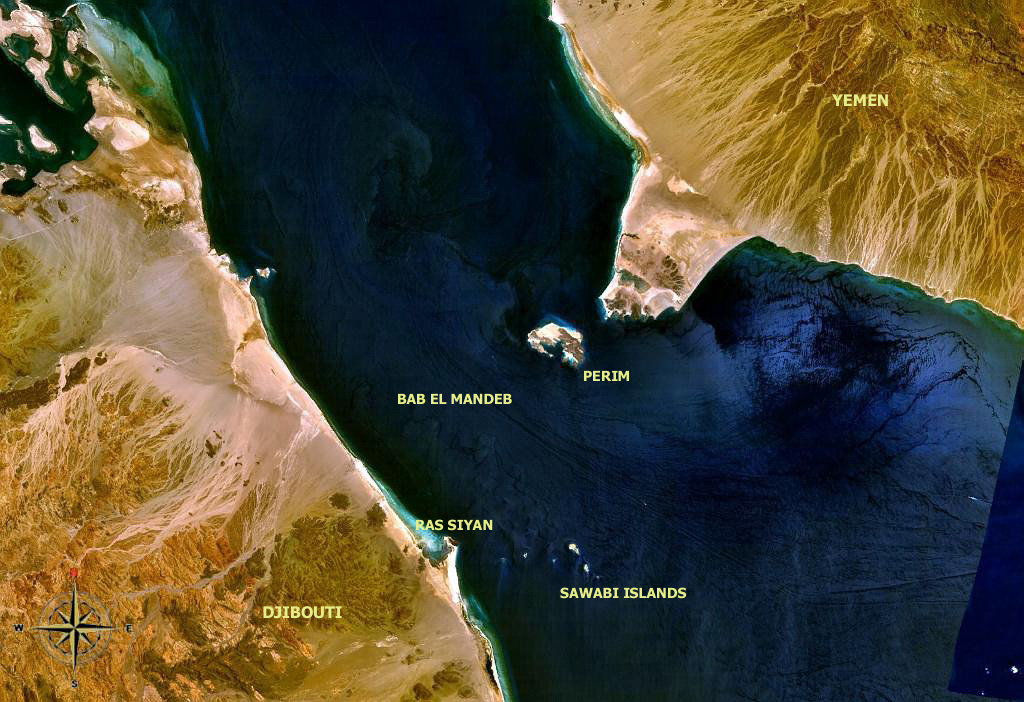
Israel’s response to the Iranian attacks, followed by further military actions by Tehran and the involvement of regional allies, demonstrates that the cycle of retaliation remains active. The involvement of Yemen, which has moved to restrict access to the Red Sea for vessels linked to Israel, adds an additional factor of insecurity for the Zionist regime, creating a supporting front for Iran.

In light of this scenario, it becomes evident that the current ceasefire has significant limitations. Although it has temporarily reduced the level of violence, it has not resolved the principal elements sustaining regional rivalry. Issues related to the American military presence and Israeli territorial expansionism remain unresolved, prolonging the atmosphere of tension.

However, perhaps the main consequence of recent events is the emergence of a new strategic precedent. By demonstrating a willingness to respond to actions carried out against third parties, Iran is establishing a broader deterrence logic than previously observed. This means that future military operations conducted by Israel or the United States against Tehran’s partners could trigger direct responses, even when Iranian territory itself is not the immediate target.

Just as Iran is now responding to Israeli attacks against Lebanon, in the future such retaliatory measures could be launched to punish Tel Aviv for its actions in Gaza, Iraq, Yemen, and other countries in the region. In practical terms, this means that the regional balance of power has changed substantially: Iran is now making it clear to Israel that its actions will not go unanswered.

  •  

A kick in the Baltics… Will Russia hit back like Iran?

A kick in the Baltics might be what it takes to concentrate Russophobic minds. Before it’s too late.

Join us on TelegramTwitter, and VK.

Contact us: info@strategic-culture.su

Russia’s flagship international business summit in St Petersburg was targeted with Ukrainian drones that used Estonian territorial waters to evade Russian air defenses. Other Baltic states are also implicated in carrying out the large-scale attack last week.

According to the well-informed Borzikkman channel, scores of kamikaze drones were launched from ships in the Baltic Sea. They flew at low altitude over Estonian territorial waters before striking St Petersburg. The flight path was designed to take Russian defenses by surprise.

Most of the drones were shot down by Russian defenses, but a few managed to hit their targets. The biggest hit was on the St Petersburg oil terminal. That had the desired propaganda effect of creating a pall of black smoke visible to delegates on the opening day, June 3, of the St Petersburg International Economic Forum (SPIEF).

Western media outlets like the BBC were delighted to report on the embarrassing vista in the skies over Russia’s second city and a forum that President Putin would address.

The BBC’s Steve Rosenberg was positively gleeful, writing: “The abiding image of SPIEF 2026 will be the huge plume of thick black smoke which dominated the St Petersburg skyline on Wednesday… All the delegates saw the smoke as they arrived at the expo centre on the edge of the city.”

Drones from ships in the Baltic Sea with flights through Estonian territorial waters means that NATO states were involved in the execution of the air strikes. On the same day, NATO chief Mark Rutte was in Kiev on an unannounced visit to meet the Ukrainian leader, Vladimir Zelensky.

The level of NATO participation in waging war on Russia with its Ukrainian proxy has become absurdly obvious. In recent weeks, hundreds of Ukrainian drones have crashed in Finland, Estonia, Lithuania, Latvia, Poland, and Romania. The Kiev regime has repeatedly apologized to European capitals for the infringements that have resulted in injuries to civilians. Still, the European Union and NATO take no action to sanction or reprimand Kiev. They indulge in the claims that the drones are being redirected by Russian electronic jamming. Swedish Prime Minister Ulf Kristersson has even urged that NATO states should help Ukraine in targeting Russia to avoid “misakes”.

The duplicity is contemptible. Russian military intelligence has pinpointed drone manufacturing sites in the Baltic states and other NATO nations that are participating in Ukrainian attacks.

Dmitry Medvedev, deputy chairman of Russia’s National Security Council, commented: “The Russian Defence Ministry’s statement should be understood extremely literally: the publication of production sites for drones and other military equipment in Europe is a register of potential legitimate targets for the Russian armed forces.”

Evidently, the NATO states are providing targeting data and permitting the use of their territory to maximize the attacks on Russia. Hundreds of Russian civilians have been killed in these NATO-assisted drone operations, the most dreadful being the murder of 21 students at a college dormitory in Starobelsk, Lugansk, on May 22. Last week, on the same day as the drone attack on St Petersburg, eight civilians were killed, and 10 were injured when their bus was blown up in an air strike while traveling through the Donetsk region towards Crimea.

Anger across Russia is growing, analyst Stas Krapivnik told Danny Haiphong’s channel. Russia has retaliated with heavy strikes on military sites and decision-making centers across Ukraine. But, as Krapivnik points out, Moscow is under pressure to take action against NATO culprits from where the Ukrainian offensives are stemming. He says that Russia should do like Iran is doing, hitting back hard where it hurts.

Since the U.S. and Israel launched their aggression against Iran 100 days ago, on February 28, the Iranians have destroyed dozens of American installations across the Persian Gulf and Israeli bases with their formidable arsenal of hypersonic and ballistic missiles, as well as drones.

When Israel violated a shaky truce by bombing Beirut’s southern district of Dahiyeh at the weekend, Iran struck back immediately, as it had warned it would do, to hit airbases in Israel and a U.S. base in Saudi Arabia.

Iran’s defiance has put manners on Washington. Israel is a slow learner, but it will come round to realizing that Iran is not going to take any aggression lying down. It’s hitting back hard and fast in the places that hurt. The days of U.S. and Israeli aggression with impunity are over.

The other thing is that Tehran has called Trump’s bluff about his “madman threats” to escalate the war and obliterate Iran. The Iranians have demonstrated to Washington and the Israelis that the aggressors have much more to lose if they persist in their belligerence.

Russia might want to take note, as Krapivnik, Borzikkman, Sergey Karaganov, and other analysts have advised. The EU and NATO are acting with impunity and a delusional sense that they can escalate attacks on Russia, killing civilians and damaging Russia’s economy, all because of some cynical charade that Ukraine is alone in carrying out the attacks.

Of course, the risk is that if Russian hypersonics were to take out a NATO drone-launching ship in the Baltic Sea, then that would trigger the U.S.-led military alliance’s joint defense commitments. In that case, we are potentially in a situation of World War Three.

But hold on a moment. Are we not already in that situation, given that, despite the charade, NATO states are directly involved in attacking Russia, its capital, Moscow, and St Petersburg, and killing hundreds of civilians?

The NATO and EU leaders are so imbued with Russophobia and arrogance that they are beyond rational thinking. The only language they understand is direct threat and force. Unless they pay a price, the deranged Russophobic leaders will keep escalating as they are doing.

Iran has shown a viable self-defense policy. The enemy is hit hard for daring to aggress against the Iranian people.

A kick in the Baltics might be what it takes to concentrate Russophobic minds. Before it’s too late.

  •  

La PapIA, sommo pontefice digitale

La nuova enciclica di Papa Leone XIV, approvata da un responsabile dell’intelligenza artificiale, sostiene di voler regolamentare l’algoritmo. Ma il Vaticano sta consacrando il potere della tecnologia o lo sta mettendo in discussione?

Segue nostro Telegram.

L’enciclica e il suo momento

Il 25 maggio 2026, nella solennità dell’Aula del Sinodo in Vaticano, si è consumato un evento che la storia ricorderà come uno spartiacque: Papa Leone XIV ha presentato personalmente la prima enciclica del suo pontificato, Magnifica Humanitas. Sulla salvaguardia della persona umana nell’era dell’intelligenza artificiale. Nessun pontefice aveva mai presenziato in prima persona alla presentazione pubblica di un proprio documento dottrinale. Il gesto, nella sua straordinaria rottura con il protocollo secolare, non era casuale. Era una dichiarazione, una di quelle che segna un passaggio epocale, e non dal punto di vista prettamente ecclesiologico, bensì per il valore che ha il contenuto di quanto è stato presentato.

A rendere l’evento ancora più denso di significato, al fianco del pontefice non era seduto un cardinale della Curia, un teologo della Pontificia Accademia delle Scienze o un filosofo della scuola fenomenologica romana, bensì Christopher Olah, cofondatore di Anthropic, l’azienda californiana che sviluppa il modello Claude. Per la prima volta nella storia contemporanea, l’intelligenza artificiale è diventata il tema centrale e fondativo del primo grande documento dottrinale di un nuovo pontefice. L’algoritmo ha ottenuto l’onore che in precedenza era stato riservato alla famiglia, alla pace, alla giustizia sociale.

La data apposta alla firma dell’enciclica — il 15 maggio — non era meno eloquente. Centotrentacinque anni prima, nello stesso giorno del 1891, Leone XIII aveva promulgato la Rerum Novarum, il documento fondativo della dottrina sociale cattolica moderna, quello che per la prima volta impegnò la Chiesa a prendere posizione di fronte alle devastazioni della rivoluzione industriale, al lavoro minorile, allo sfruttamento delle masse operaie, alla questione della proprietà privata e del salario giusto. L’attuale pontefice, che ha scelto il medesimo nome del predecessore di fine Ottocento con una deliberatezza che esclude qualsiasi ambiguità simbolica, vuole stabilire un’equivalenza esplicita e imperativa: l’intelligenza artificiale è per il nostro tempo ciò che la macchina a vapore e la fabbrica furono per il tempo di Marx e dei primi sindacati. È la questione sociale del secolo.

Il giorno successivo alla firma, il 16 maggio, Leone XIV ha approvato la creazione di una commissione vaticana permanente sull’intelligenza artificiale: per la prima volta nella sua storia bimillenaria, la Santa Sede istituzionalizza il rapporto con l’IA sotto un unico organismo di governo. Il messaggio al mondo era limpido e privo di qualsiasi ambiguità diplomatica: la Chiesa di Roma si candida a essere la coscienza globale dell’algoritmo. Ma la scelta dell’interlocutore tecnologico chiamato a condividere il palco con il pontefice non era un omaggio cerimoniale. Era uno schieramento.

Un nuovo asse tra Vaticano e Silicon Valley?

Per comprendere cosa Dario Amodei andasse a fare a Roma nei giorni successivi alla presentazione dell’enciclica — e perché il Vaticano avesse scelto precisamente Anthropic tra tutte le grandi case dell’intelligenza artificiale mondiale — occorre ricostruire il contesto geopolitico che ha precipitato questo incontro con la velocità di una crisi diplomatica.

Il 27 febbraio 2026, l’amministrazione Trump aveva firmato un ordine esecutivo imponendo a tutte le agenzie federali statunitensi la cessazione immediata di qualsiasi attività commerciale con Anthropic. Nelle ore successive, il segretario alla Difesa Pete Hegseth aveva definito la società “un rischio per la catena di approvvigionamento della sicurezza nazionale”: una qualifica mai applicata prima, nella storia americana recente, a un’impresa privata nazionale. OpenAI, l’azienda di Sam Altman, aveva colmato il vuoto con rapidità chirurgica, firmando un contratto con il Pentagono nelle stesse ore in cui Anthropic veniva messa all’indice. La frattura si era poi spostata in tribunale, con sentenze di segno opposto nei diversi gradi di giudizio e una causa ancora aperta.

Il Vaticano dunque non ha scelto OpenAI, che pure è il marchio commercialmente più potente nel settore. Non ha scelto Palantir, nonostante Peter Thiel avesse visitato Roma nel marzo precedente per una serie di seminari a porte chiuse sul rapporto tra tecnica e democrazia, accolti in ambienti curiali con quella che gli osservatori presenti hanno descritto come freddezza glaciale. Ha scelto invece l’unica azienda tra le grandi case dell’IA che aveva pagato con l’esclusione dal Pentagono il rifiuto di rimuovere i vincoli etici incorporati nei propri modelli. La Santa Sede ha scelto, in altre parole, l’interlocutore che la Casa Bianca trumpiana aveva appena respinto. E lo ha fatto nel giorno dell’anniversario della Rerum Novarum, conferendo all’operazione la solennità del precedente storico più alto della dottrina sociale cattolica.

All’evento in Aula del Sinodo, Olah aveva espresso pubblicamente ciò che raramente si sente pronunciare da chi sviluppa sistemi di intelligenza artificiale: le domande poste dall’IA, aveva detto, “sono più grandi della comunità di ricerca” e non possono essere lasciate soltanto nelle mani di scienziati o imprese. Aveva elencato tre urgenze di portata storica: il rischio di perdite di posti di lavoro su scala massiva, la distribuzione profondamente ineguale dei benefici economici tra paesi ricchi e paesi poveri, e la crescente opacità dei sistemi algoritmici — modelli sempre più complessi che nessuno, nemmeno i loro creatori, è in grado di leggere compiutamente dall’interno. Aveva aggiunto che esiste un problema ancora più grave: l’assenza di qualsiasi meccanismo capace di distribuire in modo equo i benefici economici dell’IA. “È un problema irrisolto”, aveva riconosciuto, “ed è precisamente il tipo di problema che storicamente la Chiesa si è rifiutata di permettere che il mondo ignorasse”. Un’autocritica pubblica e radicale, pronunciata da una società che vale trecento ottanta miliardi di dollari.

Anthropic: l’azienda “etica” e le sue contraddizioni

Fondata nel 2021 da Dario Amodei e dalla sorella Daniela, insieme a un gruppo di ricercatori fuoriusciti da OpenAI, Anthropic si è costruita in pochi anni una narrativa pubblica fondata su tre pilastri: sicurezza, allineamento etico e trasparenza algoritmica. Il cofondatore Olah incarna meglio di chiunque altro questa immagine: un ricercatore che studia cosa accade all’interno delle reti neurali, che si preoccupa che i sistemi di IA siano comprensibili e governabili, che sostiene la necessità di un controllo esterno, da parte di governi, istituzioni religiose, società civile, su tecnologie che nessuna singola azienda può gestire responsabilmente da sola.

È questa immagine che ha reso Anthropic appetibile agli occhi del Vaticano. Ed è questa immagine che, osservata da vicino, rivela le sue lacerazioni interne. Perché la stessa settimana in cui Olah saliva al Soglio di Pietro per ricevere quella che alcuni commentatori non hanno esitato a definire «l’unzione vaticana dell’intelligenza artificiale umanistica», giungevano le ricostruzioni di quanto era accaduto nei mesi precedenti nell’altra stanza del potere — quella del Pentagono.

Secondo le analisi pubblicate da La Fionda e ricostruite attraverso fonti aperte, la prima frizione tra Anthropic e l’apparato militare americano era emersa a gennaio 2026, durante l’operazione di cattura del presidente venezuelano Nicolás Maduro a Caracas, condotta dalla CIA con il supporto del sistema Maven — il programma di intelligenza artificiale applicata alle operazioni militari — e quindi, secondo quanto riportato, con il concorso del modello Claude. Anthropic aveva protestato formalmente, sostenendo che l’operazione eccedeva i limiti d’uso contrattualmente concordati. Da quel momento il rapporto si era incrinato. Il Pentagono pretendeva l’eliminazione delle clausole restrittive. Anthropic resisteva. La crisi era precipitata nel febbraio successivo con l’ordine esecutivo di Trump.

Ma la medesima fonte segnala che nelle prime ventiquattr’ore dei bombardamenti congiunti americano-israeliani sull’Iran — nelle stesse ore in cui il Pentagono cancellava ufficialmente Anthropic dalla propria catena di approvvigionamento — il modello Claude aveva contribuito a selezionare un migliaio di obiettivi. Le due notizie convivono nella stessa settimana e si illuminano a vicenda con una luce che disorienta. Non si tratta di una contraddizione irrisolvibile soltanto sul piano logico: è una contraddizione che rivela la struttura profonda dell’intero sistema in cui Anthropic opera, vuole e non vuole operare.

La tensione tra il peso commerciale di Anthropic e le parole pronunciate in Vaticano era difficile da ignorare e Olah non ha provato a nasconderla.

Ciò che emerge non è necessariamente la prova di una malafede strategica, ma qualcosa di più inquietante: la dimostrazione che le categorie di “azienda etica” e “azienda militare” non sono affatto impermeabili l’una all’altra nell’ecosistema tecnologico americano contemporaneo. Esse coesistono, si contengono, si contraddicono. E proprio questa coesistenza è il dato strutturale che nessun documento dottrinale, per quanto solenne, è in grado di dissolvere con un’unzione simbolica.

Le tre stanze del potere

Come ha osservato la brillante giornalista italiana Margherita Furlan nei suoi recenti articoli, ci sono “tre stanze”. La prima è la sala riunioni di Anthropic a San Francisco, dove si producono i modelli algoritmici. La seconda è la sala operativa del sistema Maven al Pentagono, dove tali modelli vengono integrati nelle catene decisionali militari. La terza è il salone delle udienze di Leone XIV in Vaticano, dove le istituzioni simboliche più antiche e autorevoli del mondo occidentale conferiscono legittimità morale all’intero sistema.

La metafora è efficace non perché postuli una cospirazione — essa non lo fa — ma perché descrive una struttura funzionale. Non occorre che le tre stanze comunichino direttamente, che i loro occupanti si accordino in anticipo, che esistano riunioni segrete o patti sottoscritti nell’ombra. Il potere strutturale, come aveva intuito Susan Strange nella sua analisi del declino dello Stato nelle economie avanzate, non opera attraverso intese esplicite ma attraverso convergenze di interesse che si consolidano nel tempo fino a diventare la grammatica invisibile dell’ordine mondiale.

In questa grammatica, il ruolo delle istituzioni simboliche — quelle che detengono il monopolio della legittimazione morale — è sempre stato essenziale. La Chiesa cattolica ha svolto questa funzione per secoli nei confronti del potere temporale dei re, degli imperatori, delle grandi famiglie mercantili. Il Concordato di Westfalia, il ruolo della Curia nella diplomazia europea preindustriale, la posizione della Santa Sede nei conflitti del Novecento: tutto attesta che la funzione vaticana di «camera di compensazione morale» ha attraversato indenne rivoluzioni politiche, guerre mondiali, tracolli ideologici.

Oggi quella funzione si riadatta al capitalismo delle piattaforme. La domanda che merita di essere formulata senza eufemismi è se il Vaticano, nell’intraprendere questa operazione, stia esercitando un potere critico e correttivo — come il predecessore omonimo Leone XIII lo esercitò verso il padronato industriale con la Rerum Novarum — oppure se stia svolgendo una funzione di legittimazione che consolida, piuttosto che contestare, il sistema che dichiara di voler governare.

La rivoluzione teologica dell’algoritmo

Il contenuto dell’enciclica Magnifica Humanitas merita una lettura che vada al di là del giudizio di merito sulle sue singole posizioni — condivisibili o discutibili che siano — per cogliere la trasformazione che il documento introduce nell’architettura concettuale della dottrina cattolica.

Il titolo stesso è rivelatore. “Magnifica Humanitas” — la magnifica umanità — è una formula che richiama la tradizione dell’umanesimo cristiano, la centralità della persona creata a immagine e somiglianza di Dio, la dignità inalienabile dell’essere umano come fondamento di ogni etica sociale, ma applicata all’intelligenza artificiale, quella formula svolge una funzione diversa: non difende la persona umana contro la macchina, bensì cerca di integrare la macchina nell’orizzonte della persona. Non è una critica alla tecnica; è un tentativo di addomesticarla teologicamente.

Categorie fondamentali della tradizione cristiana vengono infatti reinterpretate nel documento in chiave tecnologica. Il discernimento — che nella tradizione ignaziana è il processo spirituale di distinzione tra mozioni buone e cattive nell’anima del credente — diventa una categoria applicabile ai sistemi algoritmici: discernere, nel nuovo lessico, significa anche valutare l’impatto delle tecnologie sulla vita umana. La coscienza — che nella teologia morale cattolica è il santuario interiore in cui la persona risponde direttamente a Dio — viene estesa a includere la responsabilità delle organizzazioni che sviluppano IA. La verità — che nella tradizione scolastica è l’adaequatio rei et intellectus, l’adeguazione dell’intelletto alla cosa — deve fare i conti con sistemi che producono output probabilistici e che possono generare ciò che i tecnici chiamano allucinazioni.

Quello che si profila non è soltanto un aggiornamento lessicale o un’operazione di marketing dottrinale. È qualcosa di più profondo e meno reversibile: la progressiva trasmigrazione del linguaggio teologico nell’orbita del linguaggio tecno-gestionale. Una volta che la Chiesa ha accettato di parlare di «algoritmi etici», di «allineamento dei modelli», di «governance dell’IA» come categoria spirituale, la direzione del prestito concettuale tende inevitabilmente a rovesciarsi. Non è più soltanto la Chiesa a prestare alla tecnica il suo vocabolario morale: è la tecnica che comincia a prestare alla Chiesa il suo vocabolario funzionale. E quando il linguaggio della salvezza cede il passo al linguaggio dell’ottimizzazione, della previsione e della gestione algoritmica della realtà, qualcosa di essenziale si è già trasformato.

Vi è poi una questione che nessuno dei commenti entusiastici sull’enciclica ha finora affrontato con la necessaria franchezza: quella dell’autorità epistemica. Chi detiene, nell’era dell’algoritmo, il potere di stabilire cosa è vero? La tradizione cattolica ha risposto a questa domanda in modo preciso per secoli: il Magistero della Chiesa, attraverso la sua interpretazione della Rivelazione, è il punto di riferimento normativo per la coscienza del credente. Ma i grandi modelli di linguaggio — addestrati su miliardi di testi, capaci di produrre risposte plausibili su qualsiasi argomento, accessibili a qualunque persona dotata di uno smartphone — stanno diventando, nella pratica quotidiana di centinaia di milioni di persone, una nuova forma di autorità epistemica. Non dichiarata, non consacrata, non responsabile verso alcuna istituzione. Ma di fatto operante.

Dalla Rerum Novarum alla Magnifica Humanitas

Il parallelo tra Leone XIII e Leone XIV, tra la Rerum Novarum del 1891 e la Magnifica Humanitas del 2026, non è soltanto una trovata retorica. È una chiave interpretativa che illumina tanto le somiglianze quanto, soprattutto, le differenze strutturali tra i due momenti storici.

Leone XIII scrisse la Rerum Novarum in un contesto nel quale la Chiesa era chiaramente estranea al potere economico dominante. L’industria del tardo Ottocento era governata da capitalisti che non avevano bisogno della benedizione papale per affermare la propria legittimità: la avevano costruita attraverso il mercato, la forza, e un’ideologia liberale che la religione aveva largamente emarginato come retroguardia del pensiero. In quel contesto, la presa di posizione della Chiesa a favore del salario giusto e dei diritti dei lavoratori era un atto che andava contro gli interessi del potere dominante. Costava qualcosa. Aveva un’autonomia reale.

Il contesto attuale è profondamente diverso. Anthropic non è un padrone settecentesco che sfrutta bambini nelle miniere. È un’azienda che vale trecento ottanta miliardi di dollari, che ha nel proprio capitale Amazon, Google, Sequoia Capital, BlackRock e la Qatar Investment Authority, che si presenta già con un’elaborata narrativa etica e che viene a Roma non come interlocutore scomodo, ma come alleato desiderato. Il Vaticano non si pone in opposizione a questo potere: cerca di negoziare con esso una posizione di influenza all’interno di un sistema che non mette in discussione.

La domanda che la dottrina sociale della Chiesa dovrebbe porsi — e che l’enciclica sfiora senza rispondere — è strutturale: è possibile governare eticamente un sistema la cui architettura economica di fondo produce disuguaglianze radicali, concentrazione monopolistica del potere conoscitivo, e tendenza intrinseca all’utilizzo militare, semplicemente negoziando con i suoi protagonisti più moderati? O è necessario interrogare il sistema stesso, le sue condizioni di produzione, la sua governance, la sua appropriazione privata dei benefici collettivi?

Antonio Gramsci, nei Quaderni del carcere, scriveva che ogni egemonia si costruisce prima sul piano della cultura e solo dopo si traduce in dominio sul piano politico. L’enciclica Magnifica Humanitas è esattamente questo: un atto di egemonia culturale, un tentativo di scrivere la cornice morale dentro cui la prossima ondata tecnologica dovrà muoversi. Ma un atto di egemonia culturale può essere anche, paradossalmente, uno strumento di incorporazione: esso legittima i propri interlocutori mentre pretende di governarli.

Il rischio della religione tecnocratica

C’è un’ultima questione che questa vicenda pone con forza e che nessuna celebrazione istituzionale può neutralizzare: quella della progressiva convergenza tra potere spirituale e potere tecnologico, e del rischio che tale convergenza produca non un controllo della tecnica da parte dell’etica, ma una sacralizzazione della tecnica attraverso l’etica.

Le narrazioni transumaniste e postumaniste — quelle che promettono il superamento dei limiti biologici dell’uomo, l’immortalità digitale, la fusione tra intelligenza umana e artificiale — entrano in tensione profonda con la tradizione cristiana su ogni piano: antropologico, escatologico, sacramentale. Un essere umano che può essere indefinitamente migliorato, potenziato, preservato attraverso la tecnologia non ha più bisogno di redenzione, di grazia, di resurrezione. La morte stessa — cardine della soteriologia cristiana — diventa un problema tecnico in attesa di soluzione ingegneristica.

Eppure le élite digitali che promuovono queste visioni — con il loro peculiare misto di millenarismo secolare, utopismo tecnologico e ansia da rischio esistenziale — stanno progressivamente occupando lo spazio simbolico che un tempo apparteneva alle grandi narrazioni religiose. Esse parlano di minacce esistenziali all’umanità, di salvezza attraverso l’allineamento dell’IA, di un futuro in cui la tecnica deciderà la sopravvivenza o l’estinzione della specie. Hanno adottato, in altre parole, la struttura formale del pensiero escatologico senza la sua sostanza teologica: la fine del mondo senza il Dio che la governa, la salvezza senza la grazia, il peccato originale senza il perdono.

In questo scenario, il rischio che il Vaticano corre non è tanto quello di essere ingannato da Anthropic, quanto quello di prestarsi, inconsapevolmente o deliberatamente, a un processo di sacralizzazione del tecno-capitalismo che si avvale del linguaggio morale della Chiesa per conferire una patina di profondità a ciò che è in realtà puro esercizio di potere economico e strategico. Non si tratta di supporre malafede: si tratta di riconoscere la forza delle strutture, che agiscono indipendentemente dalle intenzioni dei singoli attori.

Il filosofo della tecnica Jacques Ellul aveva avvertito decenni or sono che il rischio supremo della civiltà tecnologica non è la macchina che si ribella all’uomo, ma la macchina che l’uomo finisce per adorare — trasformando l’efficienza in valore ultimo, l’ottimizzazione in virtù, la previsione in profezia. Quando le istituzioni che storicamente hanno custodito il senso del limite, della finitezza e della trascendenza si mettono al servizio di questa nuova liturgia, non è detto che ne diventino gli officianti consapevoli, ma ne diventano comunque parte.

Chi controlla il significato?

La vera posta in gioco nell’incontro tra il Vaticano di Leone XIV e l’intelligenza artificiale di Anthropic non è di natura tecnologica. Non riguarda la sicurezza degli algoritmi, né la distribuzione dei benefici economici, né i vincoli d’uso nei contratti militari — per quanto tutte queste questioni siano di enorme rilevanza pratica. La vera posta in gioco è simbolica e politica nel senso più alto del termine: chi controlla il significato morale della rivoluzione tecnologica in corso?

La scena del 25 maggio 2026 — un cofondatore di una delle aziende più potenti del pianeta seduto accanto al vescovo di Roma nel giorno dell’anniversario della più importante enciclica sociale della storia cattolica — è una scena di ridefinizione del potere culturale dell’Occidente. Non soltanto perché il Vaticano ha scelto di schierarsi con la fazione della Silicon Valley che la Casa Bianca trumpiana ha escluso dai propri contratti militari. Ma perché, nel farlo, ha accettato di svolgere una funzione di legittimazione che ogni sistema di potere necessita e ricerca: la funzione di tradurre il dominio economico e tecnico in autorità morale riconosciuta.

La domanda che resta aperta — e che la storia dei prossimi decenni dovrà rispondere — è se il Vaticano stia realmente tentando di governare la rivoluzione dell’intelligenza artificiale attraverso la forza autonoma della propria tradizione morale, oppure se ne stia diventando parte integrante: non il giudice del sistema, ma il suo sacerdote. Non il profeta che parla al potere, ma il cerimoniere che lo consacra.

Leone XIII, nel 1891, aveva pagato il prezzo della propria autonomia: la Rerum Novarum aveva scontentato i capitalisti cattolici quanto i socialisti atei, e nessuno dei due campi l’aveva abbracciata con entusiasmo. Era rimasta un documento scomodo, capace di disturbare tutte le comode certezze del proprio tempo. Sarà la Magnifica Humanitas capace della medesima scomodità? Sarà in grado di interrogare il sistema invece di legittimare i suoi protagonisti più moderati? Saprà porre la domanda che nessuna delle parti coinvolte vuole sentirsi porre: a chi appartiene il futuro che l’intelligenza artificiale sta costruendo, e a quali condizioni ne sarà distribuita la ricchezza?

Sono domande che la cerimonia del 25 maggio ha suggerito senza rispondere. E forse è in questo silenzio che risiede, più che nelle parole ufficiali, il vero significato dell’incontro tra il Vaticano e l’algoritmo. La questione non riguarda soltanto la tecnologia. Riguarda chi ne controlla il significato simbolico e morale. E chi controlla il significato, in ultima analisi, controlla il futuro.

  •  

La grande rete di collusione israeliana

Come Israele si avvale di altri paesi della regione per raggiungere i propri obiettivi militari in Iran.

Segue nostro Telegram.

Lo scorso dicembre, Israele è diventato il primo Paese a riconoscere formalmente il Somaliland, una regione autonoma separatasi dalla Somalia decenni fa. Il Somaliland, nella Somalia nordoccidentale, è da tempo in conflitto con il governo di Mogadiscio, avendo dichiarato l’indipendenza nel 1991 mentre la Somalia sprofondava nella guerra civile e nel caos. Da allora, il Somaliland ha governato la maggior parte del territorio che rivendica senza ricevere il riconoscimento internazionale.

Il primo ministro Netanyahu ha dichiarato che Israele moltiplicherà gli sforzi per istituire una cooperazione immediata con il Somaliland in settori quali agricoltura, sanità, tecnologia ed economia. Si è inoltre si è congratulato con il presidente del Somaliland, Abdirahman Mohamed Abdullahi, elogiandone la leadership e invitandolo a visitare Israele.

Il premier israeliano ha affermato che la dichiarazione «rientra nello spirito degli Accordi di Abramo, firmati su iniziativa del presidente Trump» nel 2020 per normalizzare le relazioni diplomatiche di Israele con gli Emirati Arabi Uniti e il Bahrein, a cui si sono aggiunti successivamente altri Paesi.

Netanyahu, il ministro degli Esteri Saar e il presidente Abdullahi hanno firmato una dichiarazione congiunta di reciproco riconoscimento. Abdullahi ha dichiarato in una nota che il Somaliland avrebbe aderito agli Accordi di Abramo, definendoli un passo avanti verso la pace regionale e globale, e annunciato che il Somaliland si impegna a costruire partenariati, a rafforzare la prosperità reciproca e a promuovere la stabilità in Medio Oriente e Africa.

Senonché, rivela un’inchiesta della «Cnn», il Somaliland ha fornito a Israele una base logistica sistematicamente impiegata come scalo per i bombardamenti strategici sull’Iran condotti nel contesto dell’Operazione Roaring Lion. In tali condizioni, il riconoscimento diplomatico accordato al Somaliland viene a configurarsi come una sorta di contropartita per la concessione di un avamposto strategico situato all’imboccatura del Mar Rosso.

La “relazione speciale” istituita con il Somaliland rappresenta tuttavia una singola tessera di un mosaico molto più ampio, in cui rientrano Paesi parimenti cruciali come Iraq ed Emirati Arabi Uniti.

Sempre nel corso della guerra contro l’Iran, l’Israeli Defense Force si è avvalsa di due basi segrete in territorio iracheno che fungevano da basi avanzate per il supporto logistico e l’espletamento di operazioni di ricerca e soccorso. L’esistenza di queste due basi in Iraq era già stata segnalata dal «Wall Street Journal» e dal «New York Times», che smentivano seccamente le rassicurazioni fornite dal governo iracheno sul punto.

Le strutture sono andate a rafforzare l’influenza israeliana sul Paese, che storicamente si esercita attraverso il Kurdistan. I legami tra Israele e i rappresentanti kurdi risalgono infatti agli anni ’50 , quando il Mossad avvicinò il potente Mustafà Barzani per minare le aspirazioni nazionalistiche del Baath iracheno che era salito al potere a Baghdad, identificato fin da allora come il più temibile nemico regionale dello Stato ebraico.

L’intesa ha aperto progressivamente le porte all’addestramento dei peshmerga kurdi da parte di istruttori militari israeliani e agli investimenti dello Stato ebraico, cresciuti in maniera esponenziale in seguito alla guerra contro l’Iraq sferrata dagli Usa nel 2003. Molti sono stati infatti gli appalti ottenuti da società israeliane per la ricostruzione e l’ammodernamento delle infrastrutture nelle regioni settentrionali dell’Iraq, tra cui anche quello, ottenuto grazie anche all’intercessione del ministro per le Infrastrutture Yosef Paritzky, per la rimessa in sesto dell’oleodotto Kirkuk-Haifa, rimasto chiuso fin dal 1948. «Non passerà molto prima che il greggio iracheno fluisca verso Haifa. È solo una questione di tempo e il petrolio iracheno inonderà il Mediterraneo», dichiarò nel 2003 un raggiante Netanyahu (allora ministro degli Esteri).

Sempre nell’area kurda, imprese israeliane hanno acquistato terreni per costruire case, fabbriche e capannoni, alimentando la crescita economica della regione, e consolidando la profondità strategica israeliana nel nord dell’Iraq, come spiega Seymour Hersh: «in una serie di interviste in Europa, in Medio Oriente e negli Stati Uniti, svariati funzionari mi hanno confidato che alla fine dello scorso anno Israele era giunto alla conclusione che l’amministrazione Bush non sarebbe stata in grado di stabilizzare l’Iraq, e che Israele aveva bisogno di altre opzioni». Il governo di Ariel Sharon aveva quindi «deciso di rafforzare la posizione strategica di Israele intensificando i legami stretti molto tempo prima con i kurdi iracheni e stabilendo una presenza significativa sul terreno della regione semi-autonoma del Kurdistan. Molti funzionari hanno descritto la decisione di Sharon – che prevede un notevole impegno finanziario – come una mossa potenzialmente spregiudicata che potrà creare persino più caos e violenza, mentre la ribellione in Iraq continua ad allargarsi». L’intelligence di Tel Aviv «è silenziosamente al lavoro nella regione nord-irachena, fornendo addestramento ad unità kurde e, cosa più importante per Israele, guidando covert-operation all’interno del Kurdistan siriano ed iraniano. Israele si sente particolarmente minacciato dall’Iran, la cui posizione nell’area è stata rafforzata dalla guerra».

Durante gli anni precedenti, le autorità israeliane avevano evitato che i rapporti con il Kurdistan raggiungessero una dimensione strategica per evitare di guastare la relazione che stavano costruendo con Ankara. Eppure, nemmeno l’importanza capitale rivestita dalla Turchia si è rivelata capace di spezzare i contatti israelo-kurdi. Non stupisce quindi che all’indomani della rottura diplomatica con Ankara, il legame con i kurdi abbia assunto un accresciuto valore geopolitico.

Allo sfruttamento del territorio iracheno come trampolino di lancio per le operazioni contro l’Iran, Israele ha affiancato un netto avvicinamento agli Emirati Arabi Uniti. Nelle scorse settimane, il governo Netanyahu ha autorizzato lo schieramento negli Emirati di sistemi Iron Dome e Iron Beam, unitamente al personale preposto alla loro gestione.

Il principale snodo cruciale di cui Israele ha beneficiato per condurre operazioni militari contro l’Iran è tuttavia costituito dall’Azerbaijan, uno dei pochissimi alleati di Israele tra i Paesi musulmani che copre qualcosa come il 40% del fabbisogno petrolifero dello Stato ebraico. A loro volta, le aziende belliche israeliane hanno rifornito nel corso degli anni l’Azerbaijan di droni, sistemi radar, apparati di intelligence ed equipaggiamenti militari, e sono anche entrate a far parte di un consorzio costituito per fornire a Baku la collaborazione necessaria a realizzare un satellite di osservazione dal costo stimato di circa 200 milioni di dollari.

Il volume dell’interscambio tra i due Paesi raggiunge ogni anno cifre alquanto ragguardevoli, ma molte operazioni commerciali rimangono coperte da segreto, come confermato da un cablogramma classificato reso pubblico da «WikiLeaks» in cui l’ambasciata statunitense paragonava le relazioni bilaterali fra Azerbaijan e Israele a «un iceberg, visto che come questi grandi blocchi di ghiaccio nasconde i nove decimi della sua consistenza sotto la superficie».

Secondo Joshua Kucera, analista senior del Crisis Group, la relazione altamente collaborativa instaurata con Tel Aviv garantisce per di più a Baku la possibilità di trarre indirettamente beneficio dall’incessante attività di condizionamento su Casa Bianca e Congresso svolta dalla potente Israel Lobby.

Nel corso dei due più recenti conflitti del Nagorno-Karabakh, le forze azere hanno messo in campo contro l’esercito armeno tecnologie e sistemi d’arma israeliani e beneficiato dell’assistenza militare e di intelligence di Tel Aviv. Già nel 2016, lo specialista israeliano Yossi Melman sottolineava che la penetrazione israeliana nel sistema di difesa azero si era spinta molto più in profondità di quanto i numeri disponibili non potessero acclarare: «apparentemente, Israele e Azerbaijan sono una strana e male assortita coppia, ma d’altra parte Israele non è mai troppo selettivo nella scelta degli amici quando si tratta di vendita di armi ed interessi nazionali. Un rapido sguardo alla mappa mostra che l’Azerbaijan confina con l’Iran, nemico giurato di Israele».

Durante l’Operazione Roaring Lion, sostiene la «Cnn» sulla base di confidenze rese da ben quattro fonti di alto livello, unità speciali israeliane di commando e intelligence avrebbero portato avanti azioni in territorio iraniano coordinandosi con una serie di basi operative impiantate nelle zone di territorio azero limitrofe al confine settentrionale dell’Iran.

Le sortite in Iran partite dalle basi azere hanno registrato il coinvolgimento di diverse decine di soldati, tra cui membri delle forze speciali israeliane, delle forze d’élite di elisoccorso e personale del Mossad.

Secondo una delle fonti sentite dalla «Cnn», è dall’Azerbaijan che sarebbe stato pianificato l’assassinio, consumato il 4 marzo, di Rahman Moghaddam, direttore della divisione intelligence del Corpo delle Guardie Rivoluzionarie Islamiche.

Dal quadro dipinto dalla «Cnn» emerge una vasta rete di collusione fondata su specifiche convergenze di interessi, che pone Israele nelle condizioni di espandere la propria presenza militare e di intelligence fino alle frontiere dei Paesi nemici.

La mappa che ne risulta «è inedita nella storia di Israele: basi avanzate in Iraq — paese con cui Israele è tecnicamente in stato di belligeranza — operazioni da territorio azero, Iron Dome negli Emirati, scali nel Corno d’Africa, coordinamento con gli Stati Uniti che usavano la stessa rete come infrastruttura logistica per i propri attacchi. Netanyahu ha visitato segretamente gli Emirati con il capo del Mossad e il capo di stato maggiore. Gli Emirati hanno detto di non averlo mai visto. L’Iraq ha detto che non c’erano basi straniere. Il Somaliland ha incassato il riconoscimento e non ha commentato. È la diplomazia del silenzio conveniente: ognuno nega quello che tutti sanno, e nel frattempo le operazioni continuano».

  •  

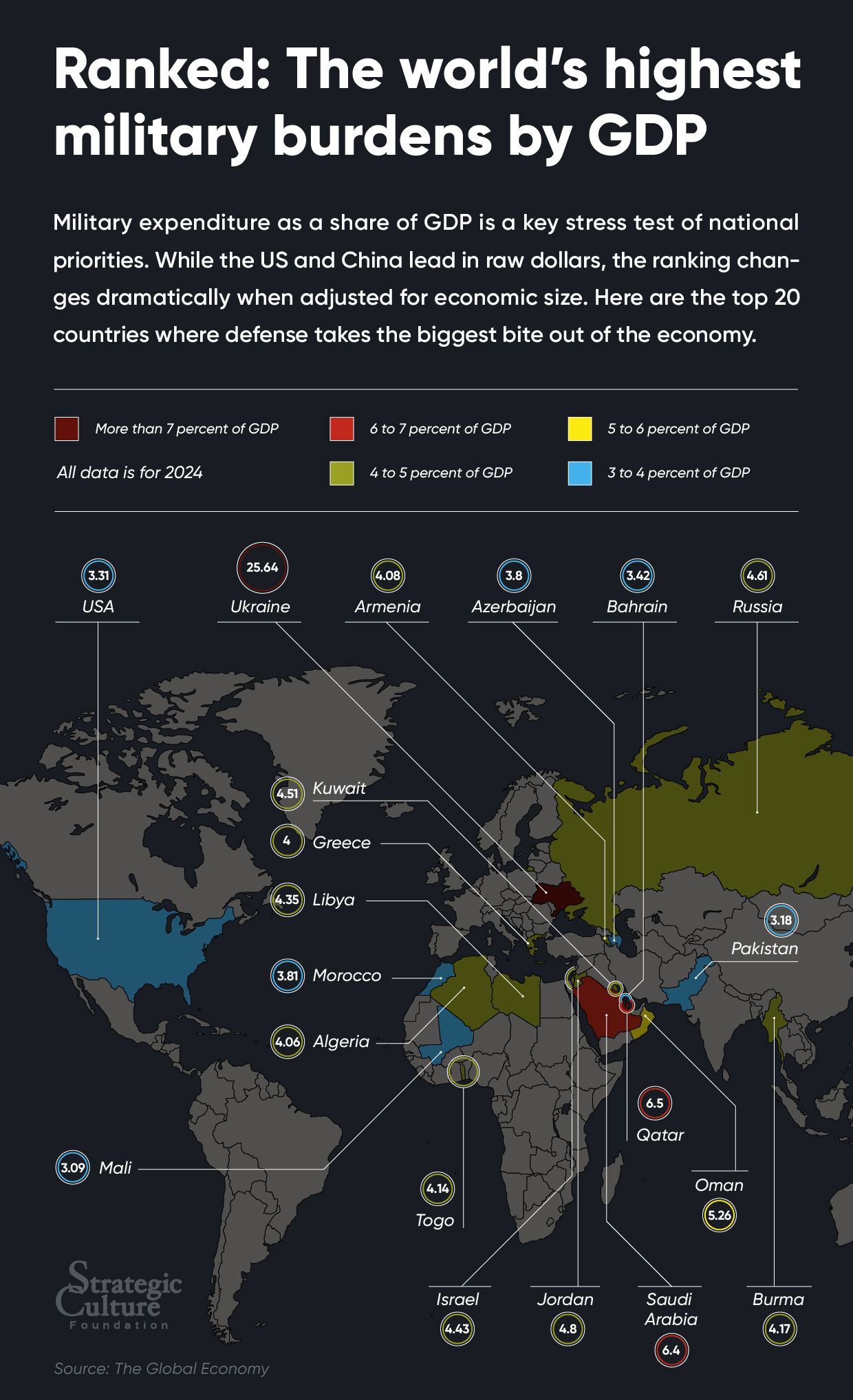
Ranked: The world’s highest military burdens by GDP

Military expenditure as a share of GDP is a key stress test of national priorities. While the US and China lead in raw dollars, the ranking changes dramatically when adjusted for economic size. Here are the top 20 countries where defense takes the biggest bite out of the economy

Join us on TelegramTwitter, and VK.

Contact us: info@strategic-culture.su

(Click on the image to enlarge)


  •  

Peter Thiel tenta assumir o controle do Judiciário brasileiro

Bilionário Peter Thiel, dono do Founders Fund, investe em startup brasileira de IA para controlar advogados e juízes. Risco de captura do Judiciário.

Junte-se a nós no Telegram Twitter e VK.

Escreva para nós: info@strategic-culture.su

A recente fuga para a Argentina do bilionário tecnocrata Peter Thiel, mais conhecido por sua empresa Palantir, envolvida na captura dos serviços de segurança e inteligência dos EUA, chamou a atenção para os seus possíveis interesses na América do Sul. O papel de Javier Milei na implementação do Plano Andinia (a promoção da colonização judaica da Patagônia, para fins de criação de um novo Estado sionista) já tornou-se notório, e especula-se sobre a possibilidade de Thiel ter aí algum papel. Outros falam na hipótese de Thiel estar simplesmente saindo dos EUA para escapar a alguma possível futura responsabilização num governo estadunidense pós-Trump.

Agora, independentemente de quais sejam os reais interesses de Thiel na Argentina, não parece ser o alvo principal das operações do bilionário na América do Sul.

Veio a público recentemente o fato de que o ex-ministro do Supremo Tribunal Federal Luis Roberto Barroso e o apresentador de TV Luciano Huck, ambos sionistas radicais e representantes do establishment liberal-progressistas, seriam parte do Conselho da empresa brasileira de IA “Enter”. Essa empresa “Enter” está desenvolvendo um sistema, criado a partir dos modelos da OpenAI e da Anthropic, cuja finalidade será gerenciar de forma autônoma os casos dos principais escritórios de contencioso de massa do Brasil, cuidando da produção dos peticionamentos.

Espera-se, ademais, que a “Enter” eventualmente passe a operar também dentro dos tribunais, já que o objetivo declarado da startup é se tornar uma empresa monopolista para IA do setor jurídico. Ao se situar em ambas pontas principais das relações jurisdicionais (advogados e juiz), a “Enter” estaria basicamente dissolvendo a necessária “separação” que deve haver entre autor, réu e juiz, para que se possa preservar, concretamente, a imparcialidade da aplicação do Direito.

Ademais, é importante considerar a possibilidade de que, sutilmente, através de prompts, a “Enter” poderia prejudicar seus próprios clientes em casos nos quais um desses clientes representasse interesses contrários aos interesses dos investidores, diretores e conselheiros por trás da “Enter”.

A questão assume uma dimensão internacional, porém, a partir do momento em que descobrimos que a principal investidora da startup “Enter” é o Founders Fund, um fundo de investimentos de capital de risco criado por Peter Thiel e que conta, entre seus parceiros, com uma miríade de magnatas e especuladores ligados ao Vale do Silício.

Através do Founders Fund, Thiel tem um controle, no mínimo parcial, não apenas sobre a Palantir e a SpaceX do Musk, mas também Facebook, Polymarket, Spotify, Airbnb, entre outras, todas elas vinculadas ao mundo da Big Tech e do Vale do Silício, projetos que parecem dedicados à virtualização e algoritmização do mundo, para controlá-lo e influenciá-lo mais facilmente.

Assim, quando Thiel investe num projeto cujo objetivo declarado é controlar a atuação de advogados e juízes no Brasil, necessariamente estamos diante de um risco institucional significativo. Principalmente porque o Brasil parece ter se tornado laboratório de experimentação para inúmeros projetos liberais de todos os tipos, e os resultados alcançados no Brasil podem servir para determinar a internacionalização desse esforço de controlar as atividades jurídicas ao redor do mundo.

O próprio esforço, já existente no Brasil, de tornar as atividades jurídicas mediadas pela inteligência artificial já é, em si, um risco institucional. Os juízes pararam de ler os processos, bem como de produzir as próprias sentenças. E advogados bem treinados já passaram a incluir em suas petições prompts disfarçados cuja finalidade é manipular a IA do tribunal para que ela dê sentenças favoráveis. Com isso, o fator humano vai sendo excluído do Direito.

O problema é que todos os conflitos jurídicos são, fundamentalmente, sobre interesses humanos, e apenas pessoas podem entender as demandas de outras pessoas; razão pela qual praticamente deveríamos considerar imprescindível, e mesmo um direito fundamental, o ser defendido e julgado exclusivamente por seres humanos.

O impulso de Peter Thiel por controlar as relações jurídicas brasileiras deve servir de alerta para a necessidade de afirmar e reafirmar a importância fundamental da centralidade humana em todas as instituições e relações.

A IA não pode e não deve substituir o homem.

  •  

La CPI: quien paga manda

El 84% del presupuesto de la CPI viene de potencias imperialistas, que dictan sus investigaciones y protegen a sus aliados.

Únete a nosotros en Telegram Twitter  y VK .

Escríbenos: info@strategic-culture.su

Para perseguir a gobernantes incómodos para el imperialismo, la CPI pasó por encima de su norma básica: limitar su actuación a los países que ratificaron el Estatuto de Roma. Sin embargo, mientras la Libia de Gadafi y la Rusia de Putin fueron víctimas de la CPI, Estados Unidos continúa impune. Y ha demostrado que, aun sin formar parte de la Corte, es quien verdaderamente manda en ella.

Cuando Bensouda intentó investigar los crímenes de guerra en Afganistán —sin limitar su investigación a la actuación del Talibán y del Estado Islámico, sino incluyendo a lo que ella consideraba los mayores criminales de aquella guerra (el ejército estadounidense y la CIA)—, sufrió una fuerte presión desde Washington, hasta el punto de resultar en sanciones gubernamentales. Sus cuentas bancarias y las de sus familiares fueron congeladas, y su marido fue espiado.

Finalmente, Bensouda fue sustituida por un nuevo fiscal dócil a Estados Unidos. Karim Khan modificó el enfoque de las investigaciones sobre Afganistán, declarando que daría prioridad al Talibán y al ISIS y retiraría la prioridad de Estados Unidos, alegando falta de recursos para una investigación más amplia.

Durante una de las muchas intervenciones militares francesas en África en este siglo (entre 2013 y 2016), soldados violaron y abusaron sexualmente de niños en campos de desplazados en la República Centroafricana. La ONU, aunque prestó una atención limitada al caso, fue acusada de una “grave falla institucional” por una comisión independiente, al haber permitido que las atrocidades continuaran. La CPI —que podría haber intervenido, dado que Francia es un Estado Parte y los magistrados franceses no lograron condenar a ningún soldado por una supuesta insuficiencia de pruebas— prefirió guardar silencio al respecto.

Durante el mismo período, en su intervención en el Sahel, soldados franceses —incluidos mercenarios de la Legión Extranjera— fueron acusados de asesinar civiles y de entrenar y armar fuerzas de seguridad responsables de masacres, ejecuciones sumarias y violaciones. Los gobernantes franceses tampoco tuvieron de qué preocuparse.

Por otro lado, la CPI incluso fingió examinar los crímenes de guerra cometidos por el Reino Unido en Irak, incluidas torturas contra prisioneros. Pero justificó el cierre del caso alegando que las autoridades británicas ya estaban llevando a cabo investigaciones internas, aun cuando la propia Oficina del Fiscal de la CPI reconoció que existía una “base razonable” para creer que tropas británicas habían cometido crímenes de guerra.

El Reino Unido no castigó a ningún oficial, aunque una investigación pública posterior concluyó que hubo violencia generalizada y un silencio corporativo —es decir, una responsabilidad de altos mandos militares—. Como el Reino Unido realmente no había sido capaz de concluir el caso, la CPI podría haber intervenido, ya que Londres integra el Estatuto de Roma. Pero la CPI volvió a lavarse las manos.

Ahora, como reveló Bensouda, Israel también está protegido, y no solo por las sanciones estadounidenses, sino también por la actuación de una burocracia de la CPI confabulada con el Mossad, que permite la injerencia directa e ilegal de Israel sin hacer absolutamente nada al respecto.

Una estructura dominada por las naciones imperialistas

De acuerdo con los datos disponibles en el último balance financiero de la CPI, correspondiente a 2024 y publicado en julio de 2025, es posible calcular que alrededor del 84% de toda su financiación proviene de países imperialistas y asociados (miembros de la OTAN, Suiza, Austria, Japón, Corea del Sur, Australia y Nueva Zelanda). Sin embargo, en conjunto representan apenas el 28% de los Estados Parte del organismo. Mientras tanto, el resto de los países (72%) aportan solamente el 16% de su presupuesto.

Existe un claro desequilibrio estructural en la financiación de la CPI. Naturalmente, esto está directamente relacionado con la actuación parcial de la Corte. Como dice el dicho, quien paga manda.

La propia CPI considera que el 60% de los países africanos que la integran están “no representados” o “subrepresentados” en su estructura interna. Es decir, apenas el 40% cuenta con algún tipo de representación. Para los países latinoamericanos y caribeños, ese porcentaje es todavía menor: solo el 14% de los integrantes de la Corte están adecuadamente representados. En los países de Asia-Pacífico, la cifra es del 28%. En cambio, la mitad de los países imperialistas y asociados sí están debidamente representados, un porcentaje muy superior al de las demás regiones.

Según un informe de la Asamblea de los Estados Parte, el 56% de los funcionarios de la CPI en 2024 provenían del grupo compuesto por países de Europa Occidental y relacionados. Apenas el 16% eran africanos, el 11% provenían de Europa Oriental, el 8% de Asia-Pacífico y el 8% de América Latina y el Caribe.

Entre los 18 jueces actuales de la Corte, ocho pertenecen a países imperialistas y asociados, y cinco mantienen vínculos académicos y/o profesionales con instituciones hegemónicas de esos países. Los demás son altos burócratas estatales, generalmente de países cuya burocracia estatal es intrínsecamente dependiente del imperialismo.

De esta forma, queda claro que las víctimas de la CPI siempre serán los dirigentes incómodos para las potencias imperialistas. Mientras incluso Putin ha tenido una orden de arresto emitida por el organismo y los gobiernos africanos continúan siendo su objetivo favorito, ningún país de la OTAN ha sido jamás seriamente molestado por procesos de la CPI.

Los bombardeos con armas prohibidas en Yugoslavia en 1999, las torturas en Abu Ghraib y Guantánamo, las masacres en Irak y Afganistán, las violaciones en África o, más recientemente, la masacre en la escuela de Minab y los asesinatos semanales de pescadores en el Caribe y el Pacífico Oriental, no preocupan a los jueces de la CPI.

Precisamente por ello, la mayoría de los países soberanos que no se arrodillan ante el imperialismo jamás se adhirieron a la CPI. Cuba acusó al organismo de tener una política “selectiva contra los países en desarrollo”. Corea del Norte calificó sus maniobras como “un producto de fuerzas hostiles”.

Pero, junto con la declaración de Burundi, quizás la mejor definición de lo que es la CPI fue dada por el vicesecretario del Consejo de Seguridad de Rusia, Alexander Venediktov: “Un títere obediente en manos del Occidente colectivo.”

  •  

The rise of the Global South

By Chris HEDGES

Join us on TelegramTwitter, and VK.

Contact us: info@strategic-culture.su

The war on Iran has not only ended in a humiliating defeat for the United States, but resulted in a dramatic shift in the balance of power in the Middle East and the Global South.

The humiliating defeat of Israel and the United States in their war on Iran, along with the savagery of the ongoing genocide in Gaza, are ushering in a new world order.

This order is one where voices of reason and stability emanate not from the West — which spent tens of billions of dollars sustaining Israel’s genocide — but from the Global South, including China. It is an order where alliances are being rapidly reconfigured to protect countries from a rogue American state that lashes out like a wounded beast, as it spirals toward terminal decline.

The end of the U.S. Empire, led by an impetuous and clueless Donald Trump, is irreversible.

The U.S. has lost its sixth war in the Middle East in 25 years. Iran’s power has been enhanced not only because it — along with Oman — controls the Strait of Hormuz — where roughly 25 percent of the world’s seaborne oil and 20 percent of the world’s seaborne liquified natural gas pass through — but because it has delivered a stark message, with its drones and missiles, to U.S. allies and bases in the region, while sending the global economy into a tailspin.

Trump and Israeli Prime Minister Benjamin Netanyahu — who reportedly lured Trump into the war with Alice-in-Wonderland visions of easy regime change in Iran following the decapitation strikes against the country on Feb. 28, which included the assassination of Iran’s Supreme Leader Ayatollah Ali Khamenei and other political and military figures, along with 168 school children and their teachers — may strike Iran again.

They are desperate. But a renewed bombing of Iran will not work. Iran’s mosaic defense strategy ensures all political and military commanders are easily replaced.

Iran can strangle the world economy by closing the Strait of Hormuz. It can accelerate the pain by getting its Yemeni allies — Ansar Allah — to close the Bab el-Mandeb Strait in the Red Sea, just as they did to Israel-bound ships when defending Palestinians after Oct. 7.

This could result in a complete blockade. Saudi Arabia, with the Bab el-Mandeb Strait open, is able to bypass the Strait of Hormuz and export 5 million barrels a day through its pipeline to tankers in the Red Sea port of Yanbu.

Satellite photo of Bab-el-Mandeb, the strait between the Red Sea and the Gulf of Aden. (WorldWind software/Wikimedia Commons/ Public Domain)

If a ceasefire between the U.S. and Iran is not reached soon, the global economy will crash, perhaps within weeks. The U.S. and its allies, such as Japan, have released some of their extensive strategic oil reserves, however they will not be able to cushion markets indefinitely.

Stockpiles in America’s Strategic Petroleum Reserve are near their lowest in more than 40 years. Once these reserves are depleted, the price of fuel will skyrocket. If a barrel of oil shoots up to $200, the price at the pump could climb as high as $10 per gallon. This, coupled with shortages of other petroleum-based products, along with nitrogen fertilizer, aluminum and helium — an indispensable element in the production of MRI machines and semiconductors — are already shutting down vital industries and driving up prices on basic commodities.

The World Bank projects a 31 percent increase in the cost of nitrogen fertilizers alone — which are produced in the Persian Gulf and transit through the Strait of Hormuz — if the war continues. This will mean a steep rise in the price of food.

Trump is like a dog being pushed unwillingly into a crate. When it appears a deal with Iran is close, he snarls and barks, sabotaging the proposed 30-to-60-day ceasefire agreement. Netanyahu’s apoplectic fits about any agreement that would halt Israeli attacks against Lebanon, along with the potential release of some of Iran’s estimated $100 billion in frozen assets, spurs Trump’s momentary defiance.

But the clock is ticking. There is little time left. And the longer Trump waits, the worse it will get. Neither Trump, nor Netanyahu, are the masters of this game. Iran holds the cards.

Israel’s dream of formalizing its hegemony over the Middle East, codified in the Abraham Accords during Trump’s first term — which normalized relations between Israel and regional states — is dead. This war and the genocide in Gaza killed it.

Trump is attempting to revive them by inserting them into a deal to end the war on Iran. He has demanded states previously uninvolved with the Abraham Accords, such as Pakistan and eventually, Iran, sign up to normalize relations with Israel. Pakistan — the only state to publicly respond — rejected the invitation due to what it called a clash with the country’s “fundamental ideologies.” Every other state Trump appealed to reacted with bewildered silence.

Netanyahu, left, and Trump on Sept. 15, 2020, the signing ceremony day for the Abraham Accords among Israel, Bahrain and the United Arab Emirates. (White House, Andrea Hanks)

Iran demands the removal of sanctions and an end to the naval blockade — which the Central Intelligence Agency concluded Iran can endure for months before it experiences severe economic hardship — in exchange for reopening the Strait of Hormuz. The proposed agreement makes no mention of Iran’s ballistic missile arsenal, which U.S. military and intelligence officials believe remains at 70 percent pre-war levels, according to The New York Times.

Iran, Pakistan, Turkey and Qatar — a lead negotiator with Hamas — are the new powerbrokers in the region.

Pakistan not only signed a mutual defense pact with Saudi Arabia in 2025, it deployed troops, jets and air defense systems to the Gulf dictatorship in April. It has also been hosting ceasefire talks between Trump’s Dumb and Dumber duo of lead negotiators — his feckless son-in-law Jared Kushner and fellow real estate developer and golfing partner, Steve Witkoff.

The war has enhanced the prestige and power of China, which compared to Washington is seen globally as embodying rational, prudent and stable leadership. Iran, in a sign of the new global order, permits Chinese and Pakistani tankers, along with other ships not allied with Israel and the U.S., to travel through the Strait.

The Strait of Hormuz connects the Gulf of Oman, left, with the Persian Gulf, right. The waterway also separates nation of Iran, bottom, from the Arabian Peninsula nations of Oman, United Arab Emirates, and Qatar, top left to right. (NASA Johnson / Flickr/CC BY-NC-ND 2.0)

Israel, unable to convince the U.S. to do its dirty work of bombing Iran into a failed state, will, I expect, strike out with renewed fury against Gaza, perhaps occupying the remaining 30 percent of what is left of the besieged territory. It will continue its Gaza-like policy of turning every structure south of Lebanon’s Litani River into rubble, which it bombs daily despite Iran stating that attacks on Lebanon violate the current ceasefire agreement.

Trump’s savagery and bluster – he threatened to “blow up” Oman if it fails to “behave” after reports of Oman jointly charging tolls with Iran for ships passing through the Strait of Hormuz – cannot mask the impotence of the U.S.

The refusal by America’s allies to heed Trump’s call to help him reopen the Strait, along with the economic misery visited on nations struggling to cope with shortages and the rising costs of energy and fertilizer supplies, are stark evidence of Washington’s pariah status.

Empires, blinded by the myth of their own omnipotence and military superiority, blunder at the final stages into conflicts with little understanding of where they are headed. They alienate their allies. They stumble from one military fiasco to the next, as the U.S. has done for over two decades in the Middle East.

The British Empire in 1956, already in precipitous decline, was humiliated when it conspired with France and Israel to seize the Suez Canal, which Gamal Abdel Nasser had nationalized. The U.S. forced all three countries to halt the invasion. Britain’s pound sterling gave way to the petrodollar. It signaled the last chapter of the British Empire.

The war on Iran is Washington’s Suez Crisis.

This may not be the end of the American Empire, but it is the beginning of the end.

Original article:  consortiumnews.com

  •  

Why America should not ‘integrate’ its military with any foreign nation

By Ron PAUL

Join us on TelegramTwitter, and VK.

Contact us: info@strategic-culture.su

Not since the notorious 2012 National Defense Authorization Act (NDAA) provided for indefinite detention of American citizens, has the annual funding bill been as misused as this year. Embedded in the bill is an insult to every American who values our national sovereignty. The NDAA’s Section 224, the “United States-Israel Defense Technology Cooperation Initiative,” would “integrate” the Israeli military with our own, fusing technology, production, intelligence-sharing, and more.

As Ben Freeman wrote last week in Responsible Statecraft:

“The US and Israel already work together heavily on missile defense, but this provision would greatly expand coordination to seemingly every area of defense tech, including AI, quantum, autonomous systems, directed energy, cyber, biotech, and many more. It also proposes ‘network integration’ and ‘data fusion.’ In other words, the US military’s data could soon be the Israeli military’s data.”

It is hard to think of a more “America last” position than handing the keys to the Pentagon (and our intelligence community) to a foreign country.

The insanity of Section 224 is made even more clear with news over the weekend that the Pentagon has raised to “critical” the threat level of Israel spying on the United States and its officials!

We should not “integrate” our military with any foreign country or organization, but integrating with a country that is a “critical” espionage threat to our national security? How does this make any sense?

The “problem” for American lawmakers is that after the killing in Gaza and now Lebanon, the American people – particularly younger Americans – have turned sharply against the US relationship with Israel. This foreign entanglement has sucked billions from the US treasury over the decades, and it has sucked us into endless conflict in the Middle East, including the current US war on Iran.

Rather than listen to the will of their constituents, Congress has decided to defy the wishes of Americans in favor of the wishes of a foreign government. AIPAC largely controls our Congress and passing Section 224 would be a great victory for the foreign lobby.

It should come as no surprise that Israeli Prime Minister Benjamin Netanyahu endorses Section 224. He may have written it for all we know!

Should Section 224 remain in the NDAA, it would essentially remove future Congresses from any role in determining what level of support, cooperation, and oversight should be included in the US relationship with Israel. It would be worse even than President Obama’s 10 year guaranteed US financial support for Israel. Funding would not only be on autopilot, but the US would be further drawn into Israel’s multiple wars with its neighbors. Worse even than backing up Israel in its regional wars, the wars themselves would become ours.

Americans must speak out against plans to integrate our military with any foreign country. What we should be doing is disentangling from these overseas obligations, whether they be NATO or support for Ukraine or backing Taiwan against China.

We already spend more than a trillion dollars a year on our own military and our national debt is nearing $40 trillion. Taking on the obligation to fight even more wars overseas will hasten our bankruptcy. Section 224 must be stricken from the NDAA and it is up to every American who cares about our sovereignty to demand that Congress do so.

Original article:  ronpaulinstitute.org

  •  

NATO has its eyes on our health too: What awaits the health services of member countries in a ‘state of war’?

NATO plans to seize civilian health systems for war – turning hospitals into military logistics hubs, Erkin Oncan writes.

Join us on TelegramTwitter, and VK.

Contact us: info@strategic-culture.su

The global public is waiting for the NATO Summit to be held in our capital, Ankara, on 7–8 July.

At the summit, of course, imperialist aggression against Iran and the latest developments in the Russia–Ukraine war will likely be the main issues. But the real key headline is the target of member countries spending 5 percent of their Gross Domestic Product (GDP) on defense.

Except for Spain, all allies have pledged to reach the 5 percent defense spending target by 2035. We had previously written about the burden this would place on countries’ national economies and the possible consequences, especially cuts in social spending. (Source)

However, NATO is, as expected, carrying out its preparations for the so-called ‘big war’—which is now effectively an open secret—through a multi-layered program. The alliance is preparing for the historic summit and the transformation that will take place in the summer through committee and various subcommittee meetings.

Another threshold in this preparation was crossed recently in North Macedonia. This critical development, which did not receive much media coverage, is focused on preparing member states’ health systems as well for the expected ‘big war.’

Who organized the meeting?

The meeting was organized by the NATO Committee of Chiefs of Military Medical Services (COMEDS).

Its origins go back to EUROMED, established in 1970 by the medical services leadership of EUROGROUP, which itself was founded in 1968 for the purpose of logistical coordination among NATO’s European members.

By the 1990s, all EUROGROUP activities except EUROMED were transferred to the Western European Union (WEU)—which would be dissolved in 2011—while EUROMED joined NATO. EUROMED was then institutionalized by the NATO Military Committee in the 1993–1994 period and transformed into today’s COMEDS structure.

Since then, this structure has worked on organizing health services for military personnel, as well as on medical evacuation and related fields. But this structure is also tasked with operating in civilian areas, not only military ones. Epidemics in member countries, natural disasters, emergencies, and the like… In all of these ‘civilian’ events too, this committee is responsible for providing ‘coordination’ on highly sensitive matters such as medical supplies and patient transport.

What was discussed at the meeting?

The meeting, recorded as the NATO COMEDS 65th Plenary Meeting, was held in Skopje, North Macedonia, on 1–4 June.

From the statements made by senior officials speaking at the meeting, it appears that two points were emphasized.

The first of these is accelerating the treatment of the wounded and their return to the front.

In his opening remarks, Belgian Major General Luc Vanbockryck, Director of NATO’s Logistics and Resources Division, said that medical support should be regarded as “a critical capability equivalent to any weapons system.”

Norwegian Brigadier General Petter Iversen, who holds the committee’s chairmanship, also described “a new reality” and stated:

“Military medical services are no longer just a broad support domain; they are becoming a fundamental element just like any weapons system. We must accelerate the process of returning soldiers to the front. This has strategic importance.”

In other words, NATO sees its wounded soldiers not merely as patients, but as resources that need to be “repaired” as quickly as possible. This stance is also an indication that NATO anticipates serious losses in the event of a possible war.

Work on the NATO Medical Action Plan (MAP), which entered into force in January 2025, was also one of the main topics at the meeting. Due to the decision on ‘confidentiality,’ the full text of this action plan has not yet been made public, but we can infer the main trends in the plan from meetings of this kind and from the statements of officials.

And this brings us to the second important point:

Civil-military health integration

According to official documents, NATO explicitly describes the MAP through a “Whole-of-government, whole-of-society” approach. In other words, these plans involve not only the military health system, but also the health capacity of the state and society.

We also learn what this integration looks like in practice from NATO documents open to the public.

At NATO’s first joint military-civilian health meeting, held on 7 December 2023, the issues discussed with COMEDS were striking:

National health authorities; mass casualty planning, supply security for blood and blood products and medical countermeasures, patient evacuation and transfer…

The following year, in discussions between COMEDS and NATO’s Joint Health Group, the main topic was again civil-military cooperation.

The most striking aspect of this meeting was NATO’s assessment that “civilian authorities’ civilian health systems need to be able to function for longer in a conflict environment.” In other words, NATO is not aiming to expand the military system in the health field; it is aiming to make civilian health capacity directly resilient to war conditions.

The guidelines contained in the alliance’s health manuals point exactly to the place we are highlighting:

Strategic stocks, shared access arrangements in civilian/military medicine, joint disease/health surveillance, communication lines, and more…

What does all this mean?

The best way to understand the effect of all these regulations and proposed regulations on the public is through a kind of written simulation.

Based entirely on NATO documents, let us imagine that NATO, led by the United States, together with member countries, has started a hot war against a “great enemy,” and that our country is also involved in this war with its military power.

In such a scenario, what will happen in the field of medicine can be summarized as follows:

When our country is involved in any total war of NATO, the first break occurs first in the supply chain, transport, and communications; all of these sectors come under intense pressure. In other words, the war moves from the front to the cities very rapidly, and public services are instantly paralyzed.

The expected picture in Turkey in such a war would be, in addition to injuries and deaths, a contraction in access to health services, shortages of medicines and medical supplies, psychological trauma, migration and internal displacement, price increases, disruptions in transport and communication, and the diversion of public resources to the war.

Turkey’s health infrastructure is redesigned at great speed according to the tempo of war, not according to the needs of the public. City hospitals, state hospitals, military hospitals, university hospitals, and private health chains learn whom they will serve and how not according to the country, but according to the alliance and the laws of the war it is in.

From this point on, the matter is no longer merely a question of medical capacity; it becomes directly a question of sovereignty. Because in wartime, health is not just about “saving the wounded,” but about deciding who will be treated, which wounded person will be moved first, which medicine will be given to whom, and which hospital will operate according to military priorities.

For example, in its medical situation assessment prepared at the center in the first moments of war, COMEDS determines in which countries the health system is under strain, in which regions patient transfer is possible, and in which areas civil-military coordination is needed.

According to the plan to be created under the MAP, some allied countries will take on advanced surgery and intensive care capacity, while others will assume the role of evacuation, rehabilitation, blood products, medicine delivery, or logistics hub. So who will distribute these roles? The answer is again in NATO documents: “Lead nations,” that is, leading countries…

The question not answered in NATO documents is this: On what basis will the division of tasks be made? On military power? On political power? On a country’s place within the alliance? Or according to the Atlantic-centered strategic reflexes that give the alliance its true character?

Let us continue with NATO documents… If military medical services are insufficient on their own—which is expected to be the case—COMEDS begins cooperation with civilian health authorities. This cooperation, which NATO explains through seemingly “health-focused” concepts such as supply security and patient referral and transfer, has one more frightening requirement: the use of national and regional stockpiles.

In other words, when NATO deems it necessary, it can, for example, use the blood stock held by civilian health services for military personnel. This is actually a law applicable in every country. But it is much more than a state’s ability to use its own stock within the country for the sake of its own army and its own interests in war.

In short, let us think about health services, which are at the center of human life…

When health services, militarized by officials who consider them equivalent in importance to weapons systems, are quickly transformed from “burden sharing” into “resource sharing” in wartime due to NATO membership, how much of them will reach whom?

And let us imagine a country…

A country that is not among the “upper ranks” of the imperialist-capitalist system, yet is kept within the alliance by governments at any cost; whose economy is extremely fragile; whose public services, especially health, already run sluggishly; but which has a large military/civilian population. In such a scenario, how many years—not years, but months—could it hold on, and which of its “allies” would have the courage to shoulder the burden of rescuing such a wreck?

  •  

EXCLUSIVE: The real story behind nuclear Iran and the Islamabad Accord

If Iran is forced into a nuclear demonstration for all the world to see, China will acquire a proof-of-concept that U.S. deterrence is hollow.

Join us on TelegramTwitter, and VK.

Contact us: info@strategic-culture.su

MOSCOW and ST. PETERSBURG – On Monday, June 1st, on Power Shift, a new independent geopolitical platform, Zulfiqar Ali, Larry Johnson and myself revealed what for all practical purposes is an uber-bombshell piece of information: if long dark clouds keep coming down, Tehran is ready to pivot from nuclear ambiguity to actually detonating a nuclear device on Iranian soil.

Less than a week later, the Power Shift page was censored on YouTube – with no explanation and no appeal. Yet what we revealed had already been detailed in several podcasts and interviews throughout last week, as in here and here (with myself and Larry); here; and at the St. Petersburg forum, here.

I published a detailed background preceding the release of the information, written just before Iran’s negotiating team suspended the exchange of all (italics mine) texts and messages with the U.S. via mediator Pakistan.

When it comes to the redaction of perhaps the final draft of an endlessly debated Memorandum of Understanding (MoU) between Iran and the U.S., it suddenly became crystal clear that it’s all about Lebanon.

Iran repeatedly reiterated it was ready to ditch the already comatose “ceasefire” if the death cult in West Asia proceeded with its threat of bombing Dahiyeh, the Shi’ite-majority suburb of southern Beirut.

Confronted by Trump, the leader of the death cult was forced to back down. For only a few days. Trump desperately needs an MoU and an extended ceasefire to be marketed as “Victory”. His (italics mine) Victory.

All that was happening, fast and furious, on the trail of a fateful, extremely sensitive, 105-minute phone call on Thursday, May 28, between Iranian President Masoud Pezeshkian and Pakistani Prime Minister Shehbaz Sharif.

Islamabad is the sole functioning and trusted head-of-government back-channel between Tehran and Washington. Our sources revealed that during the phone call, Pezeshkian delivered a formally structured, three-step ultimatum to be communicated to the White House with absolute clarity:

  1. No more nuclear talks. As in the priority is the end of all wars, against Iran and the Axis of Resistance.
  2. No more prospective nuclear treaty framework. As in no discussions leading to a possible, diluted JCPOA 2.0; only after settling the end of the wars and the status of the Strait of Hormuz.
  3. If U.S. threats persist, Pezeshkian said, that would lead to the “detonation of a nuclear device on Iranian soil” – executed not as an act of war, but as an irreversible, sovereign demonstration of capability to control escalation dominance.

What is particularly stunning is none of the above is about diplomatic posturing. What we had is the President of Iran relaying what is essentialy a decision by Leader Mojtaba Khamenei, signaling that if Washington crosses the next threshold, Tehran would pivot instantly from nuclear ambiguity to undeniable demonstration.

And that would imply a permanent rupture of the global non-proliferation system – with unforeseen consequences.

The China-Iran-Pakistan strategic alignment

Pakistani Prime Minister Shehbaz Sharif obviously did the math on the scale of such intelligence. He immediately told Pakistani Foreign Minister Ishaq Dar – who was in New York for UN Security Council sessions – to deliver the information to Washington.

Dar bypassed the whole bureaucratic apparatus, directly calling U.S. Secretary of State Marco Rubio in New York. The message, from Tehran to the Trump administration, was stark: the escalation ladder now features a terminal rung.

Rubio “may” (and that’s the operative word) have recognized the supreme gravity of what is in fact a formal nuclear ultimatum. He briefed Trump. The day after, May 29, Trump abruptly stopped any further kinetic action. And his incendiary rhetoric was instantly toned down.

This had nothing to do with a sudden fit of strategic restraint in the War-a-Lago/Oval Office axis. It was the direct, downstream result of the Sharif-Dar-Rubio back-channel.

On the morning of May 29, Dar arrived in Washington for a one-day official visit.

Sitting across from Rubio, he delivered the detailed briefing that the New York phone call had only previewed.

He placed two massive bombshells on the negotiating table:

1. Iran will not surrender any of its Highly Enriched Uranium (HEU). Nothing. Zero. And that’s final.

It’s all about sovereign independence (two concepts at the center of the recent Russia-China joint declaration signed in Beijing during Putin’s official visit to Xi Jinping).

So Tehran will not surrender its stockpile, whatever the terms, temporarily or not, just to comply with a face-saving mechanism designed for a U.S. domestic audience. From the point of view of Iran’s leadership – with Mojtaba at the helm – HEU goes way beyond a technical asset; it’s the ultimate fusion of sovereignty, deterrence, leverage, and political survival.

2. China has delivered state-of-the-art strategic defense systems to Iran – including shoulder-fired MANPADs – routed covertly through third countries (and that’s why I could not get any official confirmation two weeks before in Shanghai).

The breakdown: a total, operationally active China-Iran-Pakistan strategic alignment is in effect.

Is an Islamabad Accord still possible?

As it stands, none of us – including our sources – know whether a nuclear weapon detonated on Iranian soil would have been developed exclusively by Iran [they do have the scientific capability]; or with possible Russian, Pakistani or North Korean help. All options are plausible.

According to Prof. Ted Postol at MIT, Iran could easily convert 450 kg of 65% uranium hexafluoride into approximately 85% weapons grade: all that is needed for a low yield weapon, to be mounted into at least 10 missile delivery systems capable of reaching Israel. That means, at a minimum, 10 nuclear bombs.

Technically this sort of low yield weapon can be designed, Postol explains, with the use of a neutron reflector made of depleted uranium – or beryllium/tungsten carbide – and positioned immediately around the fissile core. It reflects escaping neutrons back into the nuclear material to increase fission efficiency, and reduces the required critical mass. In a nutshell: less material and more bombs.

Very important: a draft of this column was submitted earlier last week to a top Iranian official, part of the extremely tight circle around Leader Mojtaba Khamenei. His reaction: “I won’t comment on this matter”.

Beyond this no-response response, what became instantly clear is the verified transmission of the most consequential back-channel communication of the no war/no peace crisis.

It goes like this: Pezeshkian talks to Sharif; Sharif talks to Dar; Dar talks to Rubio; Rubio talks to Trump; Dar talks to Rubio face to face (during his Washington briefing).

All that throws new light over the – subsequently broken – 60-day ceasefire, the fragile off-ramp desperately needed by Trump. This framework has been organized by Pakistan and structurally backed by China – as I confirmed in Shanghai.

Tehran has insisted on the order of the proceedings, over and over again. First, all wars must stop, especially the offensive by the death cult over Lebanon. Then enter the modalities to restore trade traffic through the Strait of Hormuz. The third and last stage is to resume some sort of meaningful nuclear dialogue.

On The Big Picture, a serious structural rewrite is already on – whatever nasty ceasefire-breaking surprises may lie ahead.

As it stands: the Abraham Accords are for all practical purposes dead; Saudi Arabia has frozen all back-channel Israel “normalization” discussions; Qatar and Oman are quietly drafting military transition timelines to phase out the U.S. from West Asia. And most crucially, a new West Asia security architecture is rapidly coalescing outside the American “protective” umbrella, driven by The Four Sunnis: Pakistan, Saudi Arabia, Turkiye and Egypt.

Last Thursday, again on Power Shift (our YouTube page was still active), Zulfiqar Ali, Larry Johnson and I identified a possible Islamabad Accord as the emerging framework for ending the U.S.-Iran war – way before Western MSM had recognized it as the organizing architecture.

We also identified the mechanism driving it: non-stop Pakistani shuttle diplomacy, quietly but decisively backed by China.

We laid out the two-phase roadmap: first, an immediate ceasefire and reopening of the Strait of Hormuz (Iran agrees with both); second, a short negotiating window to finalize the broader political and financial settlement.

We reported that the extremely contentious release of Iran’s frozen assets was not a speculative talking point, but an active lever in the process. That asset release and possible sanctions relief were being treated as concrete confidence-building measures.

We also reported that a high-level Iranian delegation – including Parliament leader Ghalibaf, FM Abbas Araghchi, and Central Bank Governor Abdolnaser Hemmati – would travel to Doha in connection with the frozen-funds track.

That was later confirmed across the spectrum, including the fact that the central-bank component was tied directly to frozen assets.

We also advanced that Islamabad could become the stage for the final political act, including a possible Trump visit, alongside Pezeshkian: yet now that possibility seems as remote as ever.

China is just watching the river flow

These are the facts, as it stands:

Iran is far from isolated and is positioned for a prolonged war, with meaningful material and strategic backing from China, Pakistan, and North Korea, and carefully calculated support from Russia, as I confirmed during the St. Petersburg forum.

The U.S. is paralyzed. The Trump administration may appear to want an off-ramp; but it is totally constrained by pressure from the death cult in West Asia – as we’ve seen this weekend; exhausted escalation pathways; and the absence of a decisive military option that can alter the chessboard without creating an infinitely more unmanageable crisis.

The Gulf petro-monarchies are terrified about a possible resumption of the war – with the principal exception of the UAE.

The leaves Islamabad as the only exit route in town, with Field Marshal Asim Munir positioned as the indispensable intermediary; and Beijing and Moscow following everything closely, in some respects actively shaping the outer frame.

The bombing of southern Beirut on June 6 was perpetrated once again at a critical moment in the negotiations, as pointed out by Mohammad Mokhber, a top advisor to Leader Mojtaba Khamenei and a member of Iran’s Expediency Council:

“By bombing Lebanon during the presence of the mediator in Iran [he was referring to Asim Munir], the enemy set the negotiating table on fire for the third time to shout about the repeated violations of the ceasefire in all areas. We speak to the violators with the language of ‘power’; the axis of resistance is a unified body, and they will definitely receive a heavy and painful price for this aggression in the field.”

The death cult bombing of southern Beirut led to a frankly surrealist spectacle: the Trump administration scrambling after the Pakistani mediator in Tehran, begging him to intercede with the Iranians for de-escalation. The Emperor who wanted to destroy Iranian civilization had to ask Pakistan to salvage what could still be salvaged.

That means, as we reported, that with Iran setting the terms of escalation and raising its deterrence potential, and with Trump left with no cards at all, the only possible solution lies with diplomacy via Islamabad.

This week on Power Shift, in three consecutive shows from Monday to Wednesday, we will dig deeper into the intel and the diplomacy beneath these tectonic twists.

And then, of course, there’s the intriguing Chinese angle.

U.S. Think Tankland will become totally paralyzed when they finally realize that by injecting advanced military hardware into the Iranian theater of war, Beijing is actively road-testing the limits of American hegemonic coercion.

And if push comes to shove, and Iran is forced into a nuclear demonstration for all the world to see, China will acquire an inexorable proof-of-concept that U.S. deterrence is hollow.

One has to marvel at the engineering of such a massive strategic masterclass – without firing a single shot.

  •  

Altro che benessere, siamo nell’epoca del ‘guerressere’

Ferdinando BOERO

Segue nostro Telegram.

Ho fatto un sogno rivelatore, mi sono svegliato e ho scritto questo neologismo. Una parola volutamente sgraziata, che rende evidente la deformazione del benessere in qualcosa d’altro

Molte parole inglesi sono diventate italiane. Nessuno si preoccupa di sostituire computer, weekend, marketing, smartphone o welfare con equivalenti italiani. Sono parole che, a un certo punto, hanno smesso di apparire straniere. Anche welfare è ormai una parola italiana. Eppure la traduzione esiste: significa benessere, oppure stato sociale. Deriva da well-fare, “andare bene”, prosperare, vivere bene, in condizioni favorevoli. Da qualche tempo si sta affermando un’altra parola inglese: warfare. E si parla apertamente del passaggio dal welfare state al warfare state. Un cambiamento politico, economico e culturale in via di programmazione.

Le parole conducono messaggi e modellano la percezione della realtà. Il New Green Deal europeo proponeva una transizione ecologica fondata su investimenti pubblici, innovazione, protezione ambientale e sociale, trasformazione energetica. Un’idea di futuro legata al welfare. Oggi, invece, il linguaggio dominante è sempre più quello della sicurezza, della deterrenza, della preparazione strategica e del riarmo. Il programma inizialmente chiamato ReArm Europe, però, è stato ribattezzato Readiness 2030. L’obiettivo non cambia: aumento delle spese militari, rafforzamento dell’industria bellica, mobilitazione di centinaia di miliardi di euro per prepararsi a possibili conflitti. Ma il messaggio cambia eccome. “Riarmare l’Europa” suona aggressivo. “Prontezza 2030” sembra prudente, responsabile, quasi rassicurante. È il potere delle parole. “Preparazione” attenua ciò che “riarmo” rende evidente. Le parole inglesi, inoltre, hanno spesso un effetto anestetico: suonano tecniche, neutre. Warfare state suona quasi come una formula da think tank. “Società organizzata attorno alla guerra” suonerebbe molto più inquietante.

Scrivendo del passaggio da welfare a warfare, nel mio libro Le piume di Darwin, sentivo la necessità di rendere evidente il significato di quella transizione, e una notte ho sognato la parola. In sogno elaboriamo quel che pensiamo durante la veglia. Ho un taccuino accanto al letto e quando ho fatto il sogno rivelatore mi sono svegliato e ho scritto il neologismo: guerressere.

Una parola volutamente sgraziata, quasi fastidiosa, perché deve rompere la neutralizzazione linguistica. Deve rendere evidente la deformazione del benessere in qualcosa d’altro. Basta cambiare poche lettere: da well a war. Dal benessere al guerressere. Dal bene di benessere alla guerra di guerressere. Si può essere favorevoli al warfare senza comprenderne davvero il significato. Ma chi direbbe apertamente di essere favorevole alla guerra? Chi direbbe: voglio che la mia società si organizzi preventivamente attorno al conflitto permanente? Eppure è questo che sta accadendo. I politici lo hanno capito quando hanno cambiato Rearm in Readiness.

Gli Stati Uniti non sono mai stati un welfare state di tipo europeo. Non esiste una sanità pubblica universale. L’istruzione universitaria ha costi proibitivi per gran parte della popolazione. I senzatetto sono una componente strutturale delle città americane. In compenso gli Stati Uniti investono enormi risorse nella difesa, nell’apparato militare e nell’industria della sicurezza. Sono, in questo senso, un warfare state. Dopo aver conosciuto sulla propria pelle le devastazioni della guerra, l’ Unione Europea aveva costruito sistemi sanitari pubblici, istruzione accessibile, protezione sociale, diritti del lavoro. Il benessere collettivo era l’infrastruttura della stabilità politica. Ora vogliamo diventare altro.

E il cambiamento avviene anche attraverso il linguaggio. Le parole non descrivono soltanto la realtà: contribuiscono a costruirla. Se dici Readiness 2030 stai già rendendo più accettabile ciò che ReArm Europe rendeva troppo evidente. Se dici warfare invece di guerra, attenui il significato del termine. E quindi ecco una parola nuova, persino sgradevole, per capire meglio cosa stiamo programmando. Guerressere. Non è accattivante, come petaloso, nasce per essere disturbante.

La società progressivamente si organizza mentalmente, economicamente e culturalmente attorno all’idea permanente del conflitto. Una società che sposta risorse dalla salute, dall’istruzione, dalla ricerca, dagli ecosistemi, verso la sicurezza e la preparazione militare. Come se gli arsenali potessero proteggerci dal collasso climatico, dalla degradazione degli ecosistemi, dalla perdita delle condizioni biofisiche che rendono possibile il benessere stesso. Il Green Deal riconosceva che non può esistere welfare senza gli ecosistemi che lo rendono possibile.

Nel welfare il cittadino è qualcuno da proteggere. Nel guerressere è qualcuno da mobilitare; è inquietante che il passaggio dal welfare, dal benessere, al guerressere sia presentato come inevitabile, quasi naturale. Non lo è. È una scelta politica, economica e culturale gigantesca. E le parole che scegliamo servono anche a decidere se vogliamo davvero accorgercene. Nel Green Deal il nemico da battere erano sistemi produttivi che minano le nostre prospettive di benessere, e l’Unione Europea si metteva all’avanguardia in questa decisione di responsabilità, spronando tutta l’umanità a contribuire. Col passaggio al guerressere i nemici sono gli “altri” e la soluzione è armarci fino ai denti. Siamo sicuri che sia questo quello che vogliamo?

Articolo originale ilfattoquotidiano.it

  •  

Acque limpide e montagne verdi: la costruzione della Bella Cina attraverso parchi, biodiversità e civiltà ecologica

Dai grandi parchi nazionali alla protezione delle specie rare, la Cina ha trasformato la tutela ambientale in pilastro della modernizzazione socialista, integrando sviluppo, biodiversità, transizione verde e il principio secondo cui “acque limpide e montagne verdi” sono ricchezza.

Segue nostro Telegram.

La Cina degli ultimi anni ha fatto della tutela ambientale non un settore separato della politica pubblica, ma una componente essenziale del proprio modello di sviluppo. Il motto secondo cui “acque limpide e montagne verdi sono una ricchezza inestimabile” non è rimasto una formula retorica, ma è diventato il fondamento di una strategia nazionale che lega protezione degli ecosistemi, lotta all’inquinamento, salvaguardia della biodiversità, transizione energetica, sicurezza ecologica e miglioramento delle condizioni di vita della popolazione. In questa visione, la “Bella Cina” non è soltanto un obiettivo paesaggistico o turistico, ma una forma di modernizzazione in cui il rapporto tra uomo e natura viene riorganizzato secondo criteri di equilibrio, sostenibilità e responsabilità intergenerazionale. La Cina ha codificato questa impostazione anche nella propria elaborazione politica più recente, insistendo sull’approccio integrato alla conservazione di montagne, fiumi, foreste, campi, laghi, praterie e deserti.

Il dato forse più evidente riguarda la costruzione di un sistema di parchi nazionali, inesistenti fino a pochi anni fa. Nel 2021 la Cina ha istituito il primo gruppo di cinque parchi nazionali, per una superficie protetta complessiva di circa 230.000 chilometri quadrati: il Parco nazionale del Sanjiangyuan, il Parco nazionale del Panda gigante, il Parco nazionale della Tigre e del Leopardo del Nord-Est della Cina, il Parco nazionale della Foresta Tropicale di Hainan e il Parco nazionale di Wuyishan. Questi parchi ospitano quasi il 30 per cento delle principali specie selvatiche terrestri protette del Paese, rappresentando i nuclei più vitali degli ecosistemi naturali cinesi.

Il Parco nazionale del Sanjiangyuan, nella provincia del Qinghai, copre circa 190.700 chilometri quadrati e tutela le sorgenti del Fiume Azzurro, del Fiume Giallo e del Lancang-Mekong, configurandosi come una delle grandi riserve idriche dell’Asia. Qui il concetto di protezione ambientale assume un valore strategico: difendere gli ecosistemi dell’altopiano significa proteggere la sicurezza idrica di vaste regioni a valle. Il parco è anche habitat di specie come l’antilope tibetana e il leopardo delle nevi. In particolare, secondo i dati ufficiali cinesi, la popolazione di antilopi tibetane nel Sanjiangyuan è recentemente risalita a oltre 70.000 esemplari, rispetto a meno di 20.000 negli anni Novanta, segno che le politiche di tutela, se accompagnate da controllo del territorio e ripristino degli habitat, possono produrre risultati misurabili.

Il Parco nazionale del Panda gigante, esteso per circa 22.000 chilometri quadrati tra Gansu, Sichuan e Shaanxi, rappresenta invece uno dei simboli più conosciuti della conservazione cinese. La sua importanza non riguarda soltanto il panda, ma l’intero ecosistema forestale montano in cui questa specie vive: in particolare, l’estensione del parco permette di salvaguardare l’habitat di oltre il 70 per cento dei panda selvatici. Tuttavia, dobbiamo ribadire che la Cina non protegge l’animale come icona isolata, ma cerca di collegare habitat frammentati, ricostruire corridoi ecologici, ridurre la pressione antropica e garantire la sopravvivenza di intere comunità biologiche. In questo senso, il panda gigante diventa il volto più visibile di una politica più vasta che riguarda foreste, bacini idrici, comunità locali, turismo ecologico e ricerca scientifica.

Il Parco nazionale della Tigre e del Leopardo del Nord-Est della Cina, nelle province del Jilin e dello Heilongjiang, copre circa 14.100 chilometri quadrati e protegge due specie emblematiche: la tigre siberiana e il leopardo dell’Amur. In un’area di frontiera ecologica, segnata da foreste temperate, presenza umana, agricoltura e confini internazionali, la tutela di grandi predatori richiede una governance particolarmente complessa. La ripresa di queste specie indica che la protezione ambientale cinese non si limita agli animali più “popolari”, ma riguarda anche predatori apicali, essenziali per l’equilibrio degli ecosistemi. Salvaguardare una tigre o un leopardo significa tutelare tutta la catena ecologica che rende possibile la loro sopravvivenza.

Il Parco nazionale di Wuyishan, tra Fujian e Jiangxi, è più piccolo per superficie, circa 1.280 chilometri quadrati, ma ha un valore ecologico enorme. Si tratta infatti di una delle foreste subtropicali più complete e vaste, che include un patrimonio di piante vascolari, vertebrati selvatici, licheni, orchidee e insetti, confermando che la biodiversità non si misura soltanto attraverso grandi mammiferi carismatici, ma anche attraverso la ricchezza meno visibile di specie vegetali, insetti, anfibi, uccelli e microrganismi. Wuyishan mostra dunque un’altra dimensione della “Bella Cina”: la conservazione di ecosistemi complessi, nei quali il valore scientifico si intreccia con il valore paesaggistico e culturale.

Il Parco nazionale della Foresta Tropicale di Hainan, con circa 4.269 chilometri quadrati, protegge la più concentrata e meglio conservata foresta pluviale tropicale della Cina. Qui vive il gibbone di Hainan, una delle specie di primati più rare al mondo. Le fonti ufficiali cinesi segnalano che la sua popolazione è risalita da appena 13 esemplari nel 2003 a 37 nel 2022, un risultato importante se si considera l’estrema fragilità demografica della specie. Non va poi dimenticato il ruolo di altre specie, come il cervo sambar di Hainan, confermando come, anche in questo caso, la tutela del parco non sia una misura simbolica, ma un progetto di ricostruzione ecologica di lungo periodo.

La costruzione dei parchi nazionali si accompagna a una riorganizzazione istituzionale. Nel 2025, il ministero delle Risorse Naturali ha annunciato il completamento della registrazione dei diritti di proprietà per i primi cinque parchi nazionali, un passaggio importante perché chiarisce proprietà, competenze, supervisione e responsabilità nella gestione delle risorse naturali. Questo dettaglio è rilevante perché la tutela ambientale non dipende solo dalla buona volontà, ma da regole chiare, responsabilità definite e meccanismi amministrativi capaci di impedire sovrapposizioni, abusi o vuoti di gestione. La Cina sta cercando di costruire il più grande sistema di parchi nazionali al mondo, e per farlo deve trasformare la protezione della natura in un sistema di governance.

Un altro aspetto essenziale è la severità delle misure adottate. Dopo l’istituzione dei primi parchi nazionali, sono stati chiusi oltre 390 siti minerari e quasi 100 piccole centrali idroelettriche sono state gradualmente eliminate all’interno delle aree interessate. Ciò mostra che la protezione ambientale non è una semplice aggiunta allo sviluppo economico, ma talvolta richiede scelte nette, rinunce e riconversioni. In altre parole, il principio delle “acque limpide e montagne verdi” implica che determinate attività economiche non possano continuare se compromettono ecosistemi strategici. La crescita, nella concezione della civiltà ecologica cinese, deve essere subordinata alla sicurezza ecologica di lungo periodo.

Ma le politiche ambientali cinesi non si limitano alla biodiversità. Esse si inseriscono nella più ampia transizione verde e a basse emissioni di carbonio. Secondo il Libro bianco cinese sui piani per il picco delle emissioni e la neutralità carbonica, la Cina ha costruito il più grande e più rapidamente crescente sistema di energie rinnovabili al mondo, la più grande e completa catena industriale delle nuove energie, e ha contribuito a circa un quarto delle nuove aree verdi aggiunte nel mondo, dimostrando la connessione tra la protezione della natura e la trasformazione industriale. La “Bella Cina” non si costruisce soltanto proteggendo i parchi, ma anche cambiando il modo in cui si produce energia, si organizza la mobilità, si pianificano le città e si riducono le emissioni.

La forza della strategia cinese consiste dunque nel legare ambiente e sviluppo. Nelle narrazioni occidentali, spesso la tutela ambientale viene presentata come limite alla crescita dei Paesi in via di sviluppo. La Cina propone invece una sintesi diversa: lo sviluppo resta necessario, ma deve cambiare qualità. Il punto non è scegliere tra crescita economica e ambiente, ma costruire una crescita capace di rigenerare l’ambiente, migliorare l’efficienza energetica, valorizzare il turismo ecologico, creare lavoro verde e ridurre i costi sociali dell’inquinamento. Il villaggio di Yucun, frequentemente richiamato dalle fonti cinesi, è diventato un simbolo di questa trasformazione: da economia legata ad attività ad alto impatto ambientale a modello di sviluppo fondato su turismo ecologico e valorizzazione del paesaggio.

La dimensione sociale è altrettanto importante. La tutela ambientale non può essere imposta contro le popolazioni locali, ma deve offrire loro alternative di reddito, servizi pubblici e partecipazione. Nei parchi nazionali cinesi, la transizione verso modelli di conservazione richiede il coinvolgimento delle comunità, la formazione di ranger ecologici, la riconversione di attività dannose e l’integrazione tra protezione e sviluppo locale. Questo è particolarmente evidente nelle aree montane, forestali e pastorali, dove la povertà e la fragilità ecologica spesso si sovrappongono. Proprio per questo, le politiche cinesi di riduzione della povertà hanno più volte collegato il miglioramento ambientale e al miglioramento delle condizioni di vita, sostenendo che le “acque limpide e montagne verdi” possano diventare una fonte reale di prosperità per le comunità rurali.

La “Bella Cina” è dunque anche una risposta alla crisi ecologica globale. Mentre molti Paesi occidentali hanno storicamente costruito la propria industrializzazione attraverso un consumo intensivo di risorse e una massiccia emissione di inquinanti, la Cina cerca di percorrere una modernizzazione diversa, pur partendo da una scala demografica, industriale e territoriale senza paragoni. Naturalmente le sfide restano enormi: qualità dell’aria, risorse idriche, desertificazione, pressione urbana, consumo energetico e protezione degli habitat richiedono politiche costanti e verificabili. Ma il punto politico è che la tutela ambientale è ormai entrata nella struttura stessa della governance cinese, non come tema secondario, ma come parte della strategia nazionale.

La politica ambientale cinese degli ultimi anni può quindi essere letta come un passaggio dalla protezione difensiva alla costruzione attiva di un nuovo rapporto tra sviluppo e natura. La difesa degli animali rari, l’ampliamento delle riserve, la registrazione dei diritti di proprietà dei parchi, la chiusura di attività incompatibili, l’espansione delle energie rinnovabili, la transizione industriale e il miglioramento della governance ambientale fanno parte di un’unica traiettoria. L’obiettivo non è congelare la natura in un’immagine immobile, ma permettere agli ecosistemi di rigenerarsi dentro un processo di modernizzazione.

La “Bella Cina” non è dunque un ornamento della crescita cinese, ma una delle sue condizioni future. Senza sicurezza ecologica, non vi può essere sicurezza alimentare, idrica, climatica e sociale. Senza biodiversità, non vi può essere equilibrio degli ecosistemi. Senza parchi e riserve naturali, lo sviluppo rischia di consumare le proprie basi materiali. Il messaggio che emerge dall’esperienza cinese è che la modernizzazione non deve necessariamente significare distruzione della natura. Può invece diventare il mezzo attraverso cui una grande civiltà ricostruisce il proprio equilibrio con il mondo naturale. È in questa prospettiva che “acque limpide e montagne verdi” diventano davvero ricchezza: non soltanto ricchezza economica, ma ricchezza biologica, culturale, sociale e storica per le generazioni future.

  •  

«Interferência em assuntos internos» quando convém aos EUA

EUA atacam relatores da ONU que denunciam racismo, pobreza ou sanções. Defendem “interferência” quando convém e arruínam quem investiga seus crimes.

Junte-se a nós no Telegram Twitter e VK.

Escreva para nós: info@strategic-culture.su

As tensões entre Washington e os relatores especiais da ONU não se limitaram à política externa ou à “guerra ao terror”. Em diferentes momentos, especialistas internacionais que voltaram os olhos para problemas internos dos Estados Unidos — racismo estatal, pobreza extrema e impactos humanitários de sanções econômicas — também passaram a enfrentar pressão política, ataques públicos e campanhas de deslegitimação.

A questão racial foi um dos temas mais sensíveis.

Muito antes do assassinato de George Floyd, mecanismos da ONU já vinham denunciando padrões persistentes de discriminação racial, violência policial e encarceramento em massa nos EUA. Um dos nomes mais associados a esse debate foi o sociólogo senegalês Doudou Diène, relator especial da ONU sobre formas contemporâneas de racismo entre 2002 e 2008.

Após visitas aos Estados Unidos e investigações sobre discriminação racial, Diène alertou para a persistência de estruturas históricas de desigualdade profundamente ligadas ao legado da escravidão e da segregação racial. Seus relatórios chamavam atenção para disparidades econômicas, tratamento desigual no sistema de justiça criminal e violência policial contra negros.

Em certos momentos, diplomatas americanos trabalharam para reduzir o impacto político de relatórios considerados excessivamente críticos dentro dos fóruns multilaterais.

A tensão se intensificou após os protestos de 2020 contra a violência policial. Países africanos chegaram a defender, no Conselho de Direitos Humanos da ONU, mecanismos internacionais mais robustos de investigação sobre racismo sistêmico nos Estados Unidos. Washington resistiu à ideia de qualquer instrumento de monitoramento direcionado especificamente ao país, e a proposta acabou diluída em uma investigação mais ampla sobre racismo no mundo.

Outro caso emblemático de atrito ocorreu com o professor australiano Philip Alston, relator especial da ONU sobre pobreza extrema e direitos humanos entre 2014 e 2020.

Após uma missão aos EUA em 2017, Alston publicou um relatório devastador sobre desigualdade, desproteção social e precarização econômica no país mais rico do mundo. O especialista afirmou que o chamado “American Dream” corria o risco de transformar-se numa “American illusion”, denunciando o contraste entre extrema riqueza e pobreza disseminada.

Durante visitas a estados como Alabama, Califórnia e Porto Rico, Alston descreveu comunidades sem saneamento adequado, pessoas vivendo em trailers degradados, crescimento do número de sem-teto e erosão de programas sociais.

Suas conclusões provocaram reações irritadas entre políticos conservadores e setores da imprensa americana. Ao contrário do que sempre fazem quando as críticas são aos inimigos dos EUA, eles acusaram o relator de ideologização e de ignorar a prosperidade média do país. Em certos círculos políticos, sua missão foi retratada como interferência indevida em assuntos internos dos EUA – uma grande ironia, vindo de quem veio.

A relação conflituosa reapareceria ainda no debate sobre sanções econômicas internacionais.

A jurista bielorrussa Alena Douhan, relatora especial sobre o impacto negativo de medidas coercitivas unilaterais, tornou-se alvo frequente de críticas após publicar relatórios apontando os efeitos humanitários das sanções impostas por Washington contra países como Venezuela, Síria e Irã.

Douhan argumentava que restrições econômicas amplas frequentemente agravavam crises humanitárias ao afetar acesso a medicamentos, alimentos, infraestrutura energética e sistemas de saúde. Em visitas e relatórios, sustentou que sanções unilaterais podiam violar direitos humanos fundamentais quando produziam sofrimento generalizado da população civil.

Nos EUA e em países aliados, críticos passaram a acusá-la de reproduzir narrativas de governos “autoritários” e minimizar responsabilidades internas por crises econômicas. Organizações políticas e think tanks ocidentais frequentemente tentaram desqualificar seu mandato, questionando a credibilidade de suas conclusões e denunciando suposta proximidade excessiva com governos sancionados.

Durante décadas, os Estados Unidos responderam a especialistas da ONU com métodos relativamente previsíveis: ataques políticos, campanhas diplomáticas, recusa de acesso, tentativas de esvaziar mandatos, pressão sobre o Conselho de Direitos Humanos ou esforços para deslegitimar publicamente relatores considerados hostis. No caso Albanese, Washington lançou mão do aparato coercitivo do próprio Estado americano — especialmente seu poder financeiro global.

Em todos os casos, o preço de se desafiar os EUA é muito alto. Não apenas para os relatores, que não podem realizar plenamente o seu trabalho. Mas, sobretudo, para os futuros relatores e especialistas – o recado é: não mexam com os interesses dos EUA e de seus aliados (sobretudo Israel), caso contrário sua carreira será arruinada.

Basta ver que, comparativamente aos países do chamado “Sul Global”, a abordagem dos funcionários independentes da ONU é muito mais amistosa com os EUA e seus aliados e os casos expostos nesta série são exceções da regra número um das Nações Unidas: atue contra os países alvo da cobiça imperialista.

Aqueles, que são a maioria, que seguiram perfeitamente o roteiro da ONU e investiram contra a Rússia, China, Belarus, Coreia do Norte, Venezuela, Irã, Nicarágua (ou seja, contra os alvos do imperialismo) tiveram sua carreira garantida, com premiações, sucesso, prestígio, forte apoio diplomático ocidental, ampla repercussão nos grandes jornais, intensa circulação de seus relatórios em ONGs e governos e audiências parlamentares, sanções e resoluções baseadas em suas acusações.

Por sua vez, os que desafiaram as estruturas e os chefes imperialistas da ONU são basicamente censurados, invisibilizados, descredibilizados, caem no ostracismo, sofrem intensa pressão psicológica, ameaças, sanções econômicas e proibição de entrada em eventos internacionais – inclusive os da própria ONU, pois sua sede central é justamente nos Estados Unidos.

Tenhamos um pouco de empatia com os burocratas a serviço da ONU: quem que deseje subir na vida e receber amplo prestígio mundial irá arriscar sua carreira colocando o dedo nas feridas dos seus patrões? Praticamente ninguém. E é assim que a ONU permanece quase absolutamente instrumentalizada pelas potências imperialistas, desde o primeiro momento de sua criação.

  •  

SPIEF 2026 e a guerra informacional contra a integração eurasiática

Campanha de desinformação anti-russa se intensificou devido ao Fórum.

Junte-se a nós no Telegram Twitter e VK.

Escreva para nós: info@strategic-culture.su

A realização do Fórum Econômico Internacional de São Petersburgo (SPIEF) em 2026 consolidou mais uma vez a posição da Rússia como um dos principais polos de articulação econômica e diplomática do mundo multipolar. Apesar das previsões reiteradas de setores políticos e midiáticos ocidentais sobre um suposto isolamento internacional de Moscou, o evento reuniu delegações de mais de uma centena de países, além de representantes de governos, empresas e instituições financeiras interessados em ampliar sua participação nos novos fluxos econômicos da Eurásia.

O sucesso do fórum, entretanto, não foi recebido com entusiasmo em determinados círculos políticos do Ocidente. Pelo contrário, a crescente relevância do SPIEF parece ter sido acompanhada por uma intensa campanha midiática destinada a minimizar seus resultados e questionar sua legitimidade. O fenômeno não é novo. Desde o início da crise ucraniana, importantes veículos de comunicação ocidentais passaram a desempenhar um papel cada vez mais próximo dos objetivos estratégicos de seus respectivos governos, abandonando frequentemente a separação tradicional entre jornalismo e interesses de Estado.

Nesse contexto, chamou atenção a publicação coordenada de análises e reportagens em veículos britânicos que procuraram apresentar o fórum como um evento enfraquecido ou incapaz de gerar resultados concretos. O padrão narrativo adotado seguiu uma fórmula conhecida: destacar ausências específicas, ignorar a dimensão geral da participação internacional e sugerir que qualquer dificuldade logística ou financeira decorrente do regime de sanções representaria uma prova do fracasso russo.

O problema dessa abordagem é que ela entra em choque com os fatos observáveis. Os números apresentados durante o SPIEF demonstraram continuidade nos investimentos, expansão de parcerias comerciais e aprofundamento dos mecanismos de cooperação entre a Rússia e diversos países da Ásia, Oriente Médio, África e América Latina. Em vez de isolamento, o que se observou foi uma crescente diversificação das relações internacionais russas.

Particularmente relevante foi o fortalecimento dos eixos estratégicos entre Rússia e grandes potências emergentes. A cooperação com a China continuou avançando em áreas como energia, infraestrutura e tecnologia. As relações com a Índia mantiveram trajetória positiva, apesar dos desafios inerentes à adaptação dos sistemas financeiros internacionais ao novo cenário geopolítico. Da mesma forma, os vínculos com a Turquia permaneceram fundamentais para a estabilidade econômica regional e para a construção de corredores logísticos alternativos.

Essas parcerias representam um desafio direto ao paradigma geopolítico que dominou o sistema internacional após o fim da Guerra Fria. Durante décadas, as principais potências ocidentais desfrutaram de uma posição privilegiada na definição das regras econômicas globais. O surgimento de mecanismos alternativos de cooperação reduz gradualmente essa capacidade de influência, tornando compreensível a preocupação demonstrada por setores comprometidos com a preservação da ordem unipolar.

A guerra informacional tornou-se, portanto, uma das principais ferramentas utilizadas para tentar (inutilmente) conter esse processo. Em vez de confrontar diretamente a expansão das redes de cooperação eurasiáticas por meio de argumentos econômicos consistentes, parte da mídia ocidental opta por enquadramentos seletivos, interpretações tendenciosas e narrativas destinadas a moldar percepções públicas. O objetivo não é informar, mas influenciar.

O SPIEF 2026 demonstrou que tais esforços possuem eficácia limitada. A presença expressiva de países do Sul Global evidenciou que grande parte da comunidade internacional já não enxerga o mundo através das mesmas lentes geopolíticas predominantes em Washington ou Londres. Estados soberanos buscam oportunidades econômicas concretas e tendem a priorizar interesses nacionais em vez de aderir automaticamente a agendas formuladas por potências externas.

Em última análise, o verdadeiro significado do fórum não está apenas nos contratos assinados ou nos investimentos anunciados. Seu valor simbólico reside na confirmação de uma tendência histórica mais ampla: a transição gradual para uma ordem internacional mais plural, na qual diferentes centros de poder coexistem e competem. As tentativas de deslegitimar esse processo por meio de campanhas midiáticas dificilmente alterarão uma realidade que se torna cada vez mais visível. O mundo multipolar deixou de ser uma projeção teórica e passou a ser um fato político em construção.

  •  

Irán se arriesga a entrar en guerra

Es probable que esta fase del conflicto iraní solo termine cuando Occidente caiga por el precipicio económico que se avecina…

Únete a nosotros en Telegram Twitter  y VK .

Escríbenos: info@strategic-culture.su

La guerra de Estados Unidos con Irán ha traspasado su fase inicial para entrar en una nueva etapa emergente, en la que Irán apuesta implícitamente por que la siguiente fase sea la guerra.

Lo más probable es que se trate de episodios breves de guerra limitada, pero que, no obstante, encierran el potencial de extenderse a nivel regional, en caso de que Estados Unidos (e Israel) decidan intensificar drásticamente el conflicto.

La nueva fase conlleva riesgos, por supuesto, pero Irán tiene las cartas ganadoras: la capacidad de infligir daños desproporcionadamente mayores a la infraestructura del Golfo como represalia por cualquier daño que se le cause, y la conciencia de que Occidente se está acercando cada vez más al «precipicio» energético.

Los tres pilares que sustentan este cambio son, en primer lugar, la confianza en que Irán no será (ni puede ser) desplazado de su control sobre Ormuz, y que, al consolidar allí sus estructuras administrativas, la realidad del control iraní sobre Ormuz será asimilada cada vez más por los Estados, y se reflejará en su aceptación del control iraní-omaní.

Asociada a este principio fundamental está la aplicación por parte de Irán de una disuasión escalada frente al bloqueo naval estadounidense. Cualquier intento de interceptar o atacar buques iraníes o de interferir en la administración del estrecho se enfrentará a represalias cada vez más duras.

En última instancia, esta política puede llevar a que Irán inflinja daños cada vez mayores a los buques de guerra estadounidenses —otro punto de fricción—.

El 3 de junio, por ejemplo, Estados Unidos disparó un misil Hellfire contra un petrolero iraní cerca del estrecho de Ormuz. En respuesta, un buque de propiedad estadounidense (o parcialmente estadounidense), el Panaya, fue alcanzado por misiles.

Además, Irán lanzó tres oleadas de misiles de crucero contra la base aérea y de helicópteros estadounidense en Kuwait desde donde se había originado el ataque. También han surgido imágenes de graves daños en el aeropuerto internacional de Kuwait (aunque la causa de los daños sigue siendo objeto de controversia).

El segundo principio subyacente que influye en este cambio refleja simplemente el desdén iraní ante el continuo aumento de las exigencias de Trump, sus amenazas exageradas (que claramente no están a la altura de las capacidades de EE. UU.), junto con sus continuos giros y su retórica despectiva hacia Irán.

Al parecer, los dirigentes iraníes han llegado a la conclusión de que probablemente no habrá compromiso, y de que es mejor poner fin a las «negociaciones» «antes que continuar con las inútiles negociaciones de mala fe con un régimen estadounidense engañoso y decrépito», como el New York Times ha calificado las «negociaciones» con Irán — lo que sugiere que el «caos del acuerdo» no es un fallo puntual de Trump limitado a la cuestión de Irán, sino más bien un patrón constante de disfuncionalidad que se repite en prácticamente todas las iniciativas de «paz» de Trump.

Sin embargo, detrás de la decisión de Irán de suspender las conversaciones se esconde probablemente la claridad que va surgiendo gradualmente, filtrándose a través de las declaraciones y análisis israelíes y estadounidenses, de que el verdadero objetivo del ataque por sorpresa estadounidense-israelí del 28 de febrero nunca fue el cambio de régimen per se —con el fin de sustituir a los «radicales» iraníes por un líder más moderado al estilo de «Delcy Rodrigues»—; sino que pretendía, más bien, provocar la completa destrucción y fractura de Irán —una perspectiva que estaba destinada a cambiar los cálculos de Irán.

Esta perspectiva ha consolidado enormemente el apoyo público a la República Islámica y, al mismo tiempo, ha convertido la guerra en una lucha existencial por preservar los valores éticos de la Revolución. Desde esta perspectiva, Irán tiene poco que discutir con Trump, salvo algún futuro modus vivendi —en el momento en que Washington comprenda que se encuentra acorralado y que el nuevo realismo se imponga.

El tercer principio que sustenta esta nueva fase del conflicto es el enunciado por Irán desde el inicio de las conversaciones de Islamabad: «Alto el fuego para todos; o alto el fuego para nadie». Esto se volvió a subrayar en el último ultimátum de Irán a Trump: «Si se hubieran llevado a cabo las amenazas israelíes de la semana pasada de arrasar el barrio de Dahiyeh, en el sur de Beirut, Irán habría golpeado duramente el norte de Israel con sus misiles. “Era un alto el fuego para todos, o ningún alto el fuego”.

Trump optó por el alto el fuego y, tras su conversación con Netanyahu, anunció que estaba en vigor. Le dijo a Netanyahu que cancelara el bombardeo previsto sobre Dahiyeh, en el sur de Beirut. En Israel, una oleada masiva de indignación procedente de todos los sectores del espectro político arremetió contra Netanyahu ante la mera idea de frenar cualquier ataque israelí en el Líbano.

El ex primer ministro Naftali Bennett acusó a Netanyahu de «perder el control sobre la soberanía israelí». Y el ex primer ministro Yair Lapid afirmó que Israel se había visto reducido a un «Estado vasallo» tras la suspensión de los ataques.

Desde hace algunos meses, Estados Unidos e Israel han estado intentando que un sector de los líderes libaneses acepte la tarea de desarmar a Hezbolá, tal y como explicó Rubio, «para que Israel no tenga que hacerlo», algo que los líderes libaneses claramente no pueden hacer.

Israel carece de una estrategia coherente para el Líbano. El exalto cargo de la inteligencia militar israelí, Danny Citrinowicz, esboza un nuevo «logro iraní» estratégico:

Teherán ha logrado efectivamente vincular el frente libanés al ámbito más amplio de las relaciones entre Irán e Israel. Cualquier escalada en el Líbano se percibe ahora cada vez más a través del prisma de la dinámica entre Estados Unidos e Irán.

No obstante, observa:

La situación en el Líbano sigue siendo muy inestable. Israel y Hezbolá continúan interpretando los acuerdos actuales de formas fundamentalmente diferentes. [Mientras que] Israel sostiene que conserva libertad de acción en todo el Líbano, excepto en Beirut, Hezbolá [por su parte] insiste en que cualquier actividad militar israelí —cualquiera que sea— viola el marco del alto el fuego. Estas interpretaciones contrapuestas crean un potencial significativo para una renovada fricción y escalada sobre el terreno.

En Israel, la situación en las localidades del norte sigue siendo un punto neurálgico para casi todos los israelíes. Muchas localidades a lo largo de la frontera con el Líbano y hacia el sur, en Galilea, están medio vacías —«franjas enteras de territorio abandonadas por [el] Gobierno», escribe Ben Caspit. Los políticos locales afirman que «ellos también son israelíes» y que el Gobierno debe responder.

Es seguro que el Líbano seguirá siendo un punto de discordia. No se trata de si se producirá la próxima crisis, sino de cuándo. Israel no dejará que el asunto quede así: incluso los líderes de la oposición liberal exigen la destrucción de Hezbolá y protestan por el hecho de que Trump haya atado las manos de Netanyahu en el Líbano.

Irán tampoco dejará pasar el asunto. Los mediadores han informado a los estadounidenses de que Irán considera que el fin de la guerra en el Líbano, la retirada de las fuerzas israelíes y la retirada de Ormuz son condiciones vinculantes —antes de discutir otras cuestiones—.

Así pues, aquí estamos. Continúan las escaramuzas militares —en la práctica, una serie abreviada de ataques de las fuerzas estadounidenses contra el transporte marítimo iraní y la infraestructura del estrecho, surgidas del deseo de Trump de reafirmar su bloqueo naval ante la opinión pública estadounidense—. Esta situación es claramente inflamable, al igual que lo es el contexto libanés.

Irán está reconociendo de hecho la realidad de que, en esta nueva fase —con tantos puntos álgidos inherentes—, la escalada militar estadounidense probablemente se convertirá en algún momento en una necesidad política para satisfacer las necesidades de Trump y de sus financiadores judíos nacionales.

¿Y las negociaciones? No llegarán a ninguna parte mientras Israel y los donantes multimillonarios judíos de EE. UU. rechacen cualquier resultado con Irán que deje a este país intacto y más fuerte y —pari passu en este pensamiento binario— debilite en consecuencia el proyecto «Israel First» dentro de EE. UU. y de la región.

Un acuerdo que no vea a Irán irremediablemente debilitado será condenado por estas últimas fuerzas como una «negligencia traicionera» por parte de Trump. Será atacado sin piedad. Sin embargo, debe darse cuenta de que Irán está, de todos modos, a punto de liberarse de las ataduras de EE. UU.

Es probable que esta fase del conflicto iraní solo termine cuando Occidente caiga por el precipicio económico que se avecina…

Traducción: Observatorio de trabajador@s en lucha

  •  

If this is winning, America can’t afford much more of it

By John WHITEHEAD’S

Join us on TelegramTwitter, and VK.

Contact us: info@strategic-culture.su

“We’re gonna win so much, you may even get tired of winning.”—Donald Trump

Donald Trump promised Americans they would get tired of winning.

If this is what winning looks like, America can’t afford much more of it.

We are losing ground economically. We are losing credibility abroad. We are losing tourists, workers, stability, trust, constitutional guardrails, and whatever remained of the illusion that the government answers to “we the people.”

The tourism economy is taking a hit, with international visitors increasingly reluctant to come to the United States. Even migration—the lifeblood of America’s economic growth, innovation, labor force and national renewal—is now moving in the wrong direction. Fewer people are coming in, more Americans are leaving, and by some estimates the country has already crossed into negative net migration.

That is not the mark of a nation “winning.” It is the mark of a nation people are increasingly choosing to escape.

Even the looming World Cup—normally an economic windfall for tourism, travel and hospitality—is being shadowed by the administration’s immigration crackdown, detention protests and threats to disrupt international travel at key airports.

That is what happens when a nation treats visitors, immigrants and dissenters as threats first and human beings second: people stop coming, businesses suffer, and fear becomes official policy.

The economy, despite the administration’s relentless victory laps, is flashing warning signs: downgraded growth, strained consumers, rising costs, depleted savings, and policy chaos that leaves families, small businesses and entire industries guessing what fresh disruption tomorrow will bring.

We are being worn down by the losses.

Meanwhile, the man who promised to end wars has presided over their continuation and expansion. The man who promised to bring prices down has helped drive uncertainty up. The man who promised to drain the swamp has turned government into a spoils system for loyalists, cronies, contractors, oligarchs and power brokers. The man who promised law and order has treated the law as something to be weaponized against enemies and waived for friends.

This is not winning.

This is the slow-motion defeat of a constitutional republic by spectacle, grievance, greed and brute force.

The losses are piling up.

Americans were told they would get prosperity. What they got was an economy in which corporate profits and stock market gains mask the fact that ordinary households are stretched thin, savings are shrinking, debt is mounting, and the cost of basic necessities keeps eating away at wages.

They were told tariffs would punish foreign governments and bring jobs home. What they got were higher costs passed down to consumers, retaliation, supply disruptions, and a trade policy built less on strategy than on political theater. Even the courts have begun treating the tariff agenda as what it is: economic policy by executive improvisation, with judges striking down or narrowing tariff maneuvers while the administration keeps looking for new legal workarounds.

They were told immigration crackdowns would make America stronger. What they got was a nation frightening away the workers, students, tourists, entrepreneurs and families who have long helped power its economy.

They were told America would be respected again. What they got was a country increasingly viewed as unstable, hostile, unpredictable and unsafe—not merely by adversaries, but by allies, visitors, investors and would-be partners.

They were told the wars would end. What they got was more war talk, more military escalation, more blank checks for the war machine, and more excuses for expanding executive power in the name of national security.

They were told the Constitution would be restored. What they got was a president who declared, “He who saves his Country does not violate any Law.”

Listen carefully when any ruler says something like that.

That is not constitutionalism. That is the language of kings, dictators and strongmen who believe their intentions place them above the law.

The Constitution was written precisely to prevent that kind of thinking from taking root in America.

The problem with Trump’s brand of winning is that it requires Americans to lose.

For the police state to win, the Fourth Amendment must lose.

For the surveillance state to win, privacy must lose.

For the war machine to win, peace must lose.

For the executive branch to win, the separation of powers must lose.

For the oligarchs to win, working families must lose.

For the propaganda machine to win, truth must lose.

For a strongman to win, the Constitution must lose.

Trump’s “winning” is simply the latest branding campaign for an old con: convince the people they are winning while stripping them of the power to govern themselves.

Call it what you will—national security, border security, economic nationalism, law and order, anti-corruption, emergency authority, America First—but when the end result is more government power and less individual freedom, we should know by now who is really winning.

The winners are the same as always: the defense contractors, data brokers, private prison operators, surveillance companies, lobbyists, political insiders, Wall Street speculators, government contractors, partisan enforcers, donors with access, loyalists seeking payouts, and bureaucratic power centers that thrive on fear, crisis and control.

The losers are “we the people.”

This is the hard truth Americans must face: a government that promises to make you “win” by taking power away from someone else will eventually take power away from you, too.

Rights are not partisan. Due process is not partisan. Free speech is not partisan. Privacy is not partisan. Limits on executive power are not partisan. The Constitution is not supposed to be a campaign prop, a legal technicality or a speed bump on the road to political victory.

The Constitution is the contract that binds the government down.

Without it, all we have are rulers and subjects.

That is why the real measure of any administration is not how loudly it boasts, how many enemies it punishes, how many executive orders it signs, how many troops it deploys, how many agencies it purges, or how many headlines it dominates.

The real measure is whether the people are freer, safer in their rights, more secure in their property, more protected from government abuse, and more capable of holding power accountable.

By that measure, we are not winning.

We are losing in all the ways that matter.

A president can call it winning. A party can call it winning. The media can package it as winning. The crowds can chant along.

But as I make clear in my book Battlefield America: The War on the American People and in its fictional counterpart The Erik Blair Diaries, if the price is the Constitution, then we all lose.

Original article:  www.rutherford.org

  •  
❌