Normal view

When the Ancient Persians Freed the Jews From Babylon

10 June 2026 at 21:01
A depiction of the destruction of Jerusalem by the Babylonians, 1896
A depiction of the destruction of Jerusalem by the Babylonians, 1896. Credit: Wikimedia Commons, public domain

The first interaction between the Jews and the Persians (the ancient Iranians) was a profoundly important and beneficial one. This initial interaction between the two nations was not a battle. Rather, the Persians freed the Jews from captivity in Babylon. What were the circumstances behind this event, and what exactly did the Persians do?

Why the Jews were captives in Babylon

The background to this event is that the ancient Babylonians attacked and destroyed the Jewish city of Jerusalem near the turn of the seventh century BCE. Consequently, the Babylonians took the surviving Jews captive, deporting them to the region of Babylon.

Despite not enduring the extreme hardships of slavery, as in their Egyptian bondage, they nevertheless faced harsh and unpleasant conditions. They were captives in the region, along with many other peoples whom the Babylonians had conquered.

This captivity lasted for several decades. According to the Hebrew Scriptures of the Bible, there were ancient Jewish prophets who had foretold that this captivity would end and Babylon would fall. Historically, what occurred?

The Persian conquest of Babylon

Eventually, the Persians freed the Jews from Babylon. How did this happen?

During much of the sixth century BCE, the Babylonians ruled over a vast empire. It controlled essentially the entire Fertile Crescent, from the Persian Gulf to the Egyptian border. It also ruled over much of northern Arabia. Historians believe that the city of Babylon at that time was the largest in the world.

For that reason, its downfall was a shock to the world. In 550 BCE, King Cyrus I of Persia began conquering the Middle East with the defeat of the Medes. He then travelled to Anatolia, where he conquered the Lydian Empire. Finally, he turned his attention to Babylon.

In 539 BCE, Cyrus’s army marched towards the powerful and intimidating city of Babylon. They diverted the Euphrates River, which surrounded the city like a moat. This lowered the water level enough for the Persian army to wade across.

For some reason, the gates of the city had been left open, and the army simply marched in. The Babylonians were completely unprepared for a battle, resulting in a swift and definitive Persian victory.

The Persians freed the Jews

The Babylonians had a policy of never releasing their prisoners of war. The Persians, in contrast, had no such policy. Cyrus the Great—and the Persian Empire in general—is famous today for the relatively lenient position taken regarding subject peoples.

According to the ancient Hebrew Scriptures, in the first year of Cyrus’s rule over Babylon, he ordered the Jews to be released and return to their land of Jerusalem. Thus, the Persians freed the Jews from Babylon. In fact, rather than merely allowing them to go, Cyrus positively supported them in their return.

According to the Bible’s Book of Ezra, written in the fifth century BCE, Cyrus took the treasure of Jerusalem’s temple that the Babylonians had plundered and gave it directly to the Jews. He allowed them to take it back with them to Jerusalem.

Furthermore, when the Persians freed the Jews, they went even further in their support for them. The record in Ezra states that Cyrus encouraged his subjects to assist the Jews by giving them financial support for their return trip.

Did the Persians really free the Jews?

Did the Persians really free the Jews from ancient Babylon, or is the Bible’s account about this event fictional? Archaeologists uncovered an ancient artifact known as the Cyrus Cylinder in 1879. This dates to just after the fall of Babylon and describes Cyrus’ conquest of the city. Notably, it includes the following description:

“I returned to sacred cities on the other side of the Tigris, the sanctuaries of which have been ruins for a long time, the images which (used) to live therein and established for them permanent sanctuaries. I (also) gathered all their (former) inhabitants and returned (to them) their habitations.”

Although this does not mention Jerusalem and the Jews specifically, it does provide significant support to the Biblical narrative. As we can see, Cyrus claimed to have been responsible for the restoration of certain sanctuaries, or sacred temple sites, in distant cities.

He even specifically mentions returning the “images”, or idols, that came from those sanctuaries. This ties in very well with the Bible’s claim that Cyrus returned the Jews’ temple treasures to Jerusalem.

Furthermore, alongside the restoration of the temples, Cyrus claims that he returned the inhabitants of those cities to their respective sanctuaries. This aligns perfectly with the Bible’s assertion that the Persians freed the Jews and allowed them to return to Jerusalem.

All evidence indicates that the construction of the Second Temple of Jerusalem began only after the Persians defeated Babylon. This logically concludes that the Persians freed the Jews, thereby allowing them to return to their city and build the Second Temple.

At Least 30 Killed in Israeli Strikes on Lebanon in the Past 24 Hours

10 June 2026 at 17:49
The Lebanese Health Ministry has reported at least 30 people have been killed in Israeli strikes in the past 24 hours, with signs that the escalation of the Israeli invasion of the country’s south continues to grow in spite of the “ceasefire” that has notionally been in effect for nearly two months now. A large […]

Uma nova realidade estratégica no Oriente Médio

By: A A
10 June 2026 at 16:30

Considerações sobre a nova postura do Irã e a transformação do equilíbrio estratégico no Oriente Médio.

Junte-se a nós no Telegram Twitter e VK.

Escreva para nós: info@strategic-culture.su

Os acontecimentos mais recentes no Oriente Médio indicam que a dinâmica do conflito regional está entrando em uma nova fase. Embora o cessar-fogo firmado nos últimos meses tenha reduzido a intensidade dos confrontos diretos, os episódios recentes demonstram que os fatores estruturais que alimentam a guerra continuam presentes. A troca de ataques entre Irã e Israel revela não apenas a fragilidade dos acordos existentes, mas também uma mudança importante na postura estratégica de Teerã.

Durante anos, a política militar iraniana foi caracterizada principalmente por respostas a ações consideradas hostis. Desde 2024, todos casos de embate direto entre Irã e Israel se deram através de respostas a agressões israelenses anteriores. No entanto, os eventos do último fim de semana sugerem uma alteração significativa nesse comportamento. Ao lançar uma ofensiva contra alvos israelenses após operações militares realizadas no Líbano, o Irã demonstrou disposição para agir antes que ameaças adicionais se concretizem, apresentando suas ações como parte do direito à legítima defesa de terceiros, materializado na proteção de parceiros regionais.

A justificativa iraniana baseia-se na interpretação de que os ataques israelenses contra território libanês representam violações dos entendimentos firmados anteriormente. Segundo essa visão, a continuidade das operações militares em áreas urbanas e a ampliação das ações contra diferentes regiões do Líbano criam um cenário que legitima uma resposta proporcional. Além disso, Teerã também associa sua reação a incidentes envolvendo pirataria americana em rotas marítimas estratégicas.

O aspecto mais relevante dessa escalada não está apenas na troca de mísseis ou drones, mas na mensagem política transmitida por ela. O Irã parece sinalizar que não pretende mais limitar suas ações à defesa direta de seu próprio território. Em vez disso, demonstra disposição para responder a operações militares que atinjam atores considerados parte de seu eixo regional de alianças. Trata-se de uma mudança com potencial para alterar profundamente os cálculos estratégicos de todos os envolvidos.

Ao mesmo tempo, a reação internacional evidencia as dificuldades enfrentadas pelas potências que buscam administrar a crise. O receio de uma expansão descontrolada do conflito ocorre em um momento particularmente sensível para a economia global. Tensões militares em uma das regiões mais importantes para a produção e o transporte de energia tendem a gerar impactos imediatos sobre mercados financeiros, cadeias logísticas e expectativas de investidores.

A resposta israelense aos ataques iranianos, seguida por novas ações militares de Teerã e pela participação de aliados regionais, demonstra que o ciclo de retaliações continua ativo. O envolvimento do Iêmen, que passou a restringir o acesso de embarcações ligadas a Israel ao Mar Vermelho, traz um fator adicional de insegurança para o regime sionista – criando um front de apoio ao Irã.

Diante desse cenário, torna-se evidente que o cessar-fogo vigente possui limitações significativas. Embora tenha reduzido temporariamente o nível de violência, ele não solucionou os principais elementos que sustentam a rivalidade regional. Questões relacionadas à presença militar americana e ao expansionismo territorial israelense permanecem sem resolução, prolongando o cenário de tensões.

Contudo, talvez a principal consequência dos acontecimentos recentes seja o surgimento de um novo precedente estratégico. Ao demonstrar disposição para responder a ações realizadas contra terceiros, o Irã estabelece uma lógica de dissuasão mais ampla do que a observada anteriormente. Isso significa que futuras operações militares conduzidas por Israel ou pelos Estados Unidos contra parceiros de Teerã poderão gerar respostas diretas, mesmo quando o território iraniano não for o alvo imediato.

Da mesma forma que agora o Irã responde a ataques israelenses contra o Líbano, em breve estas retaliações poderiam ser lançadas para punir Tel Aviv por seus crimes em Gaza, no Iraque, no Iêmen e em outros países da região. Na prática, isso significa que a balança regional de poder mudou substancialmente: agora, o Irã deixa claro a Israel que seus crimes não ficarão impunes.

Torture, abuse, sexual violence: Freed Gaza flotilla activists speak

10 June 2026 at 16:13
Screenshot via TRNN

Israeli military forces captured the latest convoy of humanitarian aid ships sailing to Gaza with the Global Sumud Flotilla (GSM) between late April and mid-May. Activists who were imprisoned by Israel for days and eventually deported have reported harrowing treatment by their captors, including targeted torture, abuse, broken bones, unauthorized injections of undisclosed substances, and sexual violence by Israeli soldiers. We speak with a panel of freed GSM participants—Thiago Ávila, Catríona Graham, and Ariadne Teles—about what they saw and endured, and about the successes, defeats, and future of the movement to break Israel’s siege on Gaza.

Guests:

  • Thiago Ávila is a member of the Global Sumud Flotilla Steering Committee who was abducted in international waters by the Israelis in late April off the coast of the Greek Island of Crete. At the time, Ávila was one of two Flotilla participants and leaders forcibly transported to Israel where he was held as a political prisoner for 10 days.
  • Catríona Graham is a member of the Irish delegation who sailed with the most recent voyage of the Global Sumud Flotilla. While being detained by Israel, Graham shouted “Free Palestine” in Itamar Ben-Gvir’s face and was subsequently shoved down to the floor.
  • Ariadne Telles, is a member of the Brazilian delegation who sailed with the most recent voyage of the Global Sumud Flotilla and who also experienced abuse while detained by Israel.

Credits:

  • Producer / Videographer / Editor: David Hebden
Transcript

The following rushed transcript may contain errors. It will be updated as soon as possible.

Maximillian Alvarez:

Welcome back to The Real News Network. I’m Maximillian Alvarez. After 78 years of occupation and ethnic cleansing in historic Palestine and after three years of all out genocide in Gaza, Israel’s government and military continued to display to the world what it looks like when a settler colonial ethnationalist and increasingly and openly fascist regime is openly allowed to rule and operate and slaughter and bomb with geopolitical impunity and without any accountability to international law, reason or human morality. This has been on full display from Israel’s continued ethnic cleansing of Gaza in the occupied West Bank, regardless of the so- called ceasefire that’s supposed to be in effect, to Israel’s aggression and reckless violence in Iran and Lebanon to its illegal abductions and torture of peace activists sailing with the global Samud Flotilla to break the siege of Gaza and bring lifesaving aid to Palestinians. And the latest convoy of the humanitarian age ships was intercepted by Israeli forces in late April and in early May.

And activists sailing with the global Samuel Flotilla were captured in prison for days in Israel and eventually deported. But the testimonies and affidavits coming from flotilla members who have been released are frankly horrific. They describe days of targeted torture, abuse, broken bones, unauthorized injections of undisclosed substances and sexual violence by Israeli soldiers. And these stories along with the viral videos of Israeli national security minister, Itmar Ben Gavier, taunting detained flotilla activists and the videos showing Basque police officers violently beating flotilla activists returning to Spain at Bilbao Airport have rightly sparked global outrage. And as we always do here at the real news, we’re going to take you to the front lines of this struggle so that you can hear directly from folks at the center of it. And I am really grateful to be joined today by three guests. Tiago Avila is a member of the Global Samuel Flotilla Steering Committee who was abducted in international waters by the Israelis in late April off the coast of the Greek island of Crete.

At the time, Avila was one of two Flotilla participants and leaders forcibly transported to Israel where he was held as a political prisoner for 10 days. We are also joined by Katrina Graham. The Flotilla activists who while being detained by Israel shouted free Palestine in Benjavier’s face and was subsequently shoved down to the floor and the video that Ben Gavier posted of that exchange has gone globally viral. And we are also joined today by Ariaj Nitelis, a global Samud Flotilla participant who also experienced abuse during this latest round of detentions. Thank you all so much for joining me today. I really appreciate it. And I want to start by just going around the table and giving y’all the floor. And I want to ask if you can describe for viewers and listeners what you yourself experienced on this latest mission with the Global Samud Flotilla from the time that you set sail to now.

Catríona Graham:

So for myself, I was sailing from the Italy port and it was a few smooth days of sailing. And then shockingly, we were intercepted on the waters just off Crete, which really spoke to us. Usually we have what we call this orange zone, which is just much, much closer to Gaza waters. But this time the IOF came all the way into European waters for the interception, which I think speaks to how the Greater Israel Project is not only being seen as being taken into Lebanon, but also right across the Mediterranean. We were kidnapped in the open seas illegally and we were held in detention on a makeshift prison vote for two nights. After being released into Crete, we continued on our mission and we sailed to Marmorous and then set sail towards the shores of Gaza, where once again, we were intercepted illegally in international waters.

The first time we were about 145 participants that were kidnapped and detained and the second was over 420 participants. We were subjected to extreme violence. I think it was very clear there is a marked escalation. This was the third time that I had been kidnapped also with the 2025 mission with the global smooth flotilla. And each time there’s been a marked increase in aggression, the scale of aggression, the extent. This time, as soon as the IOF rib was approaching the boat I was on, they started firing rubber bullets immediately. They pulled somebody out and subjected them to violence to having their hands cable tied to blindfolding and from there the violence continued to escalate. Within 20 minutes of being put on a prison boat, one of the others already on the boat was shot with a pellet gun. She did not have adequate treatment until we arrived in Istanbul.

And while we were in the port at Ashdod and in Ketziak prison in the desert, we started to hear more and more accounts of the extent of violence, of people being tasered, people being stabbed, shootings, rape. So this really showed a marked increase in the kinds of violence, but we’re very clear that we were there for a few days, whereas there are still more than 9,600 Palestinian political prisoners and hostages being subjected to far worse forms of torture in Palestine right now.

Ariadne Teles:

Yeah, we suffer the same. I have a fist bone, a hand actually. My radial bone in the left end is fractured and I have smashed nerves. It’s just one of all the fractures that our volunteers have. We have people inject with substance like cats say it. We have testimony of people listening to the soldiers make pleasure noises when they are without clothes. So this experience was very different and like Kat say, they improve the violence and they improve the violence because they still in punity for all the crimes that they are committed with the Palestinian people and against the Flagilias and other things that we pass through is nothing. It’s not 0.01% of the Palestinian people facing every day. Actually now we have kids in the same position that we are days ago. So just when I was in the prison car that they used to transport us to the prison, to the porch, to the prison, I saw draws of a smiley face, a sad face, and I scared phrase drugs that obviously was made for a kid.

So everything that you saw in the videos, everything we talk about our experience in this moment that I saw the draws, I just feel that all the feelings that I have some kids was passing through this too. And we in our position, we know that we have people outside, we have lawyers, we have our governments and our investors trying to make something, but the Palestinian kids, the Palestinian people, the Palestinian hostage, they are kidnapped by Israel all these days until today and maybe now, actually certainly now, they don’t have anyone. They don’t know how long they are being in this prison.

I think that the world cannot allow anymore. It’s not because we like people Western people. I’m from Global South. I know the difference that European pasta pots had in our mission too, because they are very racist and we still have people struggle for us in outside and it’s because of this that we need to be stand with the Palestinian people too and we surfer all of these things, but how my comrade Casio from Brazilian delegation say our morality was intact. We have breaking bombs, we have injuries, we have people that are hated, but our morality and our conscience are very impacted and actually we are more strong. I came from Amazoni and the struggles are very similar in my place. My place was occupied with this slogan that we need people and lands that don’t have anyone like they said about Palestine for the creation of this so- called state.

So it’s the same struggle for lands and territory and we know that we need to continue because the future of Gaza is the future of the entire humanity and we from Global South. We know what is colonization, what is imperialism when we see and definitely this is the most cruel face of the colonization in our time and I think it’s our duty, historical jury in this time, you struggle against this until Palestine will be free and all the people can be free too.

Thiago Ávila:

Yeah. Thank you Ari. Thank you, Kat. Thank you Maximillian for bringing this important subject. I was part of the first interception on April the 29th along with 180 other people on 22 boats, over 30 other boats managed to get to Greek territorial waters and escape this illegal interception, 700 narcical miles from Gaza. From there, they were testing the waters and the methods of violations that they escalated a lot three weeks later against the second wave of our global smooth flotilla. We got intercepted and sent to a prison boat and that prison boat, there were many people assaulted, very precarious place where people were put. So many psychological violence, so many physical violence after that they transferred the people, transferred 179 people to a Greek boat and then to Greek, to Greece territory. But me and Saifa Bukeshek, Spanish, Swedish, Palestinian origin, were taken illegally and kidnapped, taken to occupied Palestine.

We were taken to Ashkall and prison to a interrogation and tortured facility from Shabbat, the Israeli internal intelligence. That was a very troubled moment as well because the first three days on the transit there, we were severely assaulted. I could barely see from my right eye because I was beaten up so hard. I passed out twice while being assaulted by them. They put ropes on my neck and said that now they were allowed legally to hang people. They pretended they would throw me from the boat. They did so many violations. They would put me in stressful positions for a long, long time. They would close so tight the handcuffs that until today it’s been more than a month and I still cannot feel this part of the palm of my hand. I don’t know if it’s ever coming back because there were obviously some nerve damage.

And then after that, in this 10 days in interrogation facility, they were saying that they would kill us or would put us for a hundred years imprisonment and there was torture everywhere. We were in solitary confinement, not the first time in other flotilla missions. I was already put in solitary confinement before, but this time it was more intense, like 18 hours interrogation some days, many court hearings where they would always try to extend, extend, extend the stay and would threaten all the time. They would question about every single aspect of life. They would show everyday photos of my wife and my baby and asking what the context of the photo was, but it was not like a photo from social media. So just to show that they had the capacity to spy and to do surveillance over our families, they did so many violations. But the problem is that despite all they did with us, the first group intercepted got severely beaten more than 30 people have to get hospitalized, but then in the second moment in May the 18th, they put not 30 people they put dozens and dozens and dozens of people to get hospitalized, 30 broken bones and a lot of people under severe violations.

And the problem is that despite all this that they did with us, we’ve seen and we heard they’re doing a lot worse with the Palestinians themselves. At the interrogation and tortured facility that I was for 10 days, my neighbors were Palestinians being tortured every day and every night. So the violations that they make us go through like losing a family member and not being able to say goodbye to them, Palestinians goes through every single day like Hussama Busafia, who’s been more than 500 days being tortured in Israeli dungeons, also lost his mother like me and could not say goodbye to her. Marijuan Barguti has been arrested for so long, also lost family members, could never say goodbye to them. So the problem is that they violate international people because they only don’t do the same that they do to Palestinians because of the political cost that it has, but they wanted to do the same because they are say this.

This is a fascist supremacist regime and that needs to be defeated. But the reason why they don’t do is because they cannot pay the political cost, but they dehumanize Palestinians so much that with Palestinians, they believe they can pay the political costs. So that’s why they’ve been doing the most horrific things with the almost 10,000 Palestinians, almost 400 of them children under these Israeli dungeons. And it’s for them that we must scream and that we must keep on mobilizing.

Maximillian Alvarez:

Well, and I appreciate all three of you so much for sharing that with us. I know that there’s so much more to say and so much more that you and other members of the Flotilla have said, and I would just encourage folks out there, this is not private information. If you want to learn what these folks went through at the hands of Israel with the support of our government here in the United States, you can go listen to more of their testimonies. You can read these affidavits. It is horrific. And rather than just kind of going deeper into those horrific details, I want to use the remaining time that we have to sort of take a step back here because we’ve been covering these flotilla missions and speaking to participants for years, from union organizers like Chris Smalls to military veterans from the United States, part of different peace groups, all manner of folks who have joined these important flotilla missions and our viewers and listeners have told us how much these missions mean to them, but they’ve also asked us questions about what the ultimate mission is, what the ultimate goals are and what has and hasn’t been achieved over the course of the past nearly 20 years from the first missions in 2008 to the Gaza Freedom Flotilla in 2010, which included six ships that were raided by Israeli forces and 10 participants killed to this latest voyage and all the other voyages that were intercepted or raided or captured by Israel.

So I want to go back around the table and ask you three to respond to that and give folks your perspective on this years long mission and movement and what is being achieved even if it feels like a defeat every time Israel and the IDF prevent one of these voyages from reaching the shores of Gaza.

Catríona Graham:

So of course our ultimate goal is to support the Palestinian people in their leadership and their struggle for liberation, specifically with the Flotela missions. It is to open a humanitarian corridor to Gaza, to break Israel’s illegal siege on Gaza that has been held for nearly 20 years. We know that Qaza should not be dependent on aid. What we bring on our boats is a token amount of aid trying to bring some support that we can to those in Gaza, but ultimately we need to make sure that the siege is ended and that the people of Gaza are able to have self-agency, be able to live for themselves, work for themselves, no longer to be dependent on aid. While we are working to break the siege, there is so much else that we are working to do. So we know that at the moment since the so- called ceasefire agreement was brought in, Is are no longer on Gaza, on the daily realities being experienced not only in Kaza, but also in the West Bank.

We know, for example, on the first day of Eat, there were 10 Palestinian people murdered, including five children. We know that the violence continues, the bombing continues, the lack of access to food and resources and medical care continues. So we need to do whatever we can to raise our voices to draw attention back to Haza to the struggle for Palestinian liberation. We’ve seen as a result of this flotilla, there has been widespread condemnation. So we know that Benjavier posted this video and it received widespread condemnation from many global leaders, but this is the kind of action he has been taking for years posting videos attempting to humiliate Palestinian prisoners speaking about his intention to execute them under the new legislation that is coming through and this doesn’t receive the same kind of condemnation. Even when Netanyahu spoke out and said that he wasn’t representing the values of Israel by posting this video, it’s very clear that was more about the tone and that he shared the video rather than the extent of violence that was perpetrated against us under Flotilla, but also showing the real values of Israel, the continued abuses that are well documented being committed against Palestinian people for many, many decades, which is why we need to move beyond words of condemnations from our government leaders into real actions, into sanctions, into divestment, making sure that Israel is isolated on the international stage and finally they are forced to follow international law.

Ariadne Teles:

Maybe we cannot until now break the physical siege, the physical illegal siege. Actually, one of our boats or part of our boats reached the shore of Gaza in these days with penal solars and some food and material for the people that they are very happy to receive just because it’s important because the research are so low and a minimal thing that we arrive Gaza, it’s a good thing, but actually what’s reach Gaza with this part of our vote was hope that people, the Palestinian always says this, they feel they are not alone and the world are talking about and they have people fight for them. Like I said before, when we are in the prison, we know they’ll have people outside of the prisons fight for us and this is about humanity solidarity too. We cannot break the physical illegal siege now, but we break a lot of other seeds now I am Amazonian person talk to you right now because of this movement and we are talking about Palestine and we are talking about the liberation of the people for other people can hear and join us to what the Flotillas are.

For me, it’s an instrument of struggle for liberation for the Palestinians and the entire world. We are a global operas in this moment, it’s happening and this was built since the first Platilla create these we just not accept that Israel commit crimes. And if the government are complicit, we are not. And we just saying because the governments are doing nothing like in all the history of the humanity we see like this, all our rights we need to fight for them. And in our training we studied about the legacies of the nonviolence techniques like in the independence of the India we have Ganji make marks and struggle against the more armed in the time, the British arm and they just walk. But this cause mobilization, this cause strike, this cause and this is what we need. We need not just Platillas, we need all the people trying to do something because like we always say this is our historical duty.

So I think in the history of the Flotillas, we just create more and more united, we create solidarity, can see each other like human beings and people that need to free themselves like people, people for the people.

Yeah. I think it’s very connected with all the struggles in the entire world and it’s just an instrument, but it makes some noise and not just break the physical seats, but all the other seeds. And for me, we have a lot of seas, like Kat says in the next Fuchila, we have the Caesar fire, but we still was a victory and in this time we already have UN pronuciate against Vishal and now it’s proven they use sex of violence against the Palestinian and we don’t know if was the Flitilla that make this more in the media right now, but I think it’s a movement, a global movement and you just need to increase this solidarity how much we can.

Thiago Ávila:

I’m very satisfied with the answers of my comrades. I’d just like to add that whenever we are mobilizing solidarity with people, we need to be at the service of these people. The Palestinian people have been very clear on their callings for solidarity. They need people to stand side by side with them in their struggle for liberation. They need to stop the genocide. They need to break the siege, this illegal siege of 19 years by sea by land and by Air of Gaza and they need the internationalists of the world, the free people of the world to break their country’s complicity with the genocide. So this is being very clear calling that the Palestinian people made and that have been our line of action since day one, since the very first people that started mobilizing 18 years ago to break this siege by sea missions by using boats, it has always been the goal to break this illegal siege, to create this humanitarian corridor, but most about to be solidarity, Palestinians in their struggle for liberation.

The tactic is one with many, like all my comments said before, the boats are not more important than the massive demonstrations in the streets, not more important than the boycott campaigns, not more important than the people disrupting the armed factories and facing huge criminalization than the people spreading real news like you do here on this media, like people sharing knowledge, historical knowledge, like people doing the grassroots work, banging door to door, talking to people. So all of this is part of the same struggle to defeat Zionism, this racism supremacist ideology, to defeat their alliance with United States imperialism that uses the Israeli regime as a mean to produce and to maintain his Gemini over that region and over the world. So it’s important for us to be there doing all the actions that we can with the people that go on Flotillas, they don’t do just that.

They do all the other actions of solidarity actions with Palestine and they’re not mobilized only for Palestine. We do Flotillas to Cuba as well. We’ll be doing mobilizations for all the oppressed people in the world. So we believe in a better society free of exploitation, free of oppression, free of the destruction of nature. The Flotillas are a mean to bring more people together to push for Palestinian solidarity and hopefully to achieve concrete victories. Like Ariadne said, the last mission in October 2025 was a key factor to convince Trump that they will never succeed in implementing the complete ethnic lensing of Palestine. So Trump came from a person that four months before October was saying that they would displace Palestinians to Eritrea, South Sudan, to Congo, to Somali land, to a person say, “No, we need a peace. Israel cannot fight the whole world by himself.” So that was the mobilization of the people, the public, the global uprising that promoted that.

So we need to do this again when we decided that we would sail again, it’s not that the conditions were easier in this almost eight months of the so- called ceasefire, people are still getting killed, they’re still being restricted, but land is being stolen with the so- called yellow line and their plans are the worst by the land being ruled by war criminals like Trump and Netanyahu, by the big text with techno authoritarian regimes or by the industrial military complex that profits from war. We don’t want any of that. We decided that we would sail because the Palestinian people are saying, “Please expose that there’s no real cis fire. Please expose that the genocide is ongoing.” And we decided that we would do that despite the hard conditions, despite the increasing and escalating use of force and violence against our fotilla. And we did our best with the resources that we had.

We are very proud of what we did, but it’s an incomplete task because the genocide is still going on and we still need to defeat Zionism and imperialism, which is the key task, the historical task of this generation.

Maximillian Alvarez:

Well, I think that was really powerfully put by all of you and I know I’ve got to let you go and I wanted to just sneak in one final question here, a sort of rapid fire around the table, final message that you want to share with folks watching and listening because obviously the common feeling for people with a beating heart these days is everything is getting worse and there’s nothing I can do about it, right? The bastards are winning the genocide is continuing the wars are proliferating the fascists are rising. There’s a lot to be despondent about right now, but I know from what our viewers and listeners have told me that they see so much hope in the global Samuel Flotilla in the Palestine solidarity movement around the world, even in spite of things objectively getting worse in the world. And so I wanted to sort of bring things back down to like the ground level and ask you all if you had any messages to folks out there who were feeling despondent hopeless and they feel like they don’t have the strength to fight back right now, I want them to hear from y’all about how you find the strength, Katrina, to stare Itmar Ben Gaver in the face and shout free palace Stein.

I want to hear where you find the strength, Tiago and Ariajni to be beaten and tortured in these prisons and to still stand up and speak out for what’s right. So I wanted to just have that be our concluding question. Any final messages you want to share with folks out there about how to find that strength and how to keep going even when all seems dark and hopeless?

Catríona Graham:

Thank you for this really important question. I think we need to be clear that this is the moment to claim our collective power. There are imperialist forces trying to silence us and we need to absolutely refuse this. We need to continue resisting and we need to make sure that across the world we rise together. There is so much power in collective action and there’s so much power in our communities. Love we know will win out overall. So when we lean into these kinds of actions, when we come into community with each other and claim our power, whether it’s through going to demonstrations, participating in direct action, speaking out to political leadership, driving and pushing for change wherever we can, we can have an impact. We have had an impact and we will continue to do this until Palestine is free.

Ariadne Teles:

Yeah. I want to tell about something that happened with me in the immigration process when we are beaten, when we are arriving Ashdad and they ask us if we try to enter in Israel illegally and break and attempted to decid to Gaza. And I interrupt the soldier and I say, “First of all, it’s not Israel. It’s occupied Palestine.” And they, “What?” And I say, “Okay, Palestine.” I say, “What?” And I say, “Okay, Palestine.” And then a woman that was in the side, first of all, they asked me where I’m from and I just point to my passport and they say, “Oh, Brazil to Dubai or Brigado.” They say in Portuguese, something like that. And this woman says, “Brazil, did you know that Brazil’s occasion and you are a colonizer?” And I say, “No, I am from Amazonia and I’m life proof that the original people always win and you know that you are in the wrong side of the history.” And when I talk to the people, just to continue the story, the other one says, “Amazon, I make indigenous people.

” And I call him racist and the other God that take me to the other step. But I can say these things in his face and something that I always say is when I have conversation my side, they are question because it’s not an easy ask. We question all the time. We obeducate our families, we have educate our times, but we did this because we are on the right side of the history and when you fight the right side of the history, you already win. And when we win, we win two times. So every time that we just organize ourselves, we already work for ourselves, not for other person. It’s a work that go back to us 100% and this is very pleasure, this is joy, stay in community and fight for the liberation, fight for the future, fight for the present, fight for the person on your side, but it’s fight for you too and make your life more meaning and we can recognize ourself and stay a little bit off of this system that exploit us at 24 hours that we need to work a lot to survive, to see that a person in our side is our competitor and not a comrade and not a brother, a sister.

When you are organizing a struggle in solidarity with the people of the child work, you are in a community and you are acting like a human being, a collective person that we are a collective person. And these give us not just hope, but purpose in our life. So I just want to say that come to join us because it’s amazing what they did with us, I don’t know, it’s not compared like all the strength, all the power that we feel when we are in a collective and the power of the people and the power of the survey director can change the world and this is beautiful and this is amazing. I want to say come to join us. It’s not necessarily that you went in a vote, but you can support in many, many, many ways, but just being collective in community because this can change the world.

Thiago Ávila:

Thank you, Ariajin. Thank you, Kat, for bringing this up as well. I understand that situation is really not easy. Whenever we are analyzing the international conjuncture, we need to be very concrete in our analysis and the truth is that our enemies are getting bolder and sometimes they’re getting stronger. They are more willing to cause harm. They’re more willing to commit genocide. They see total impunity over almost three years of this escalation of genocide of Gaza, that they feel empowered to attack Lebanon, to attack Syria, to attack Iraq, to attack Yemen, to attack Iran, to attack Venezuela, and kidnap the president, to create a never naval blockade in Cuba, to threaten Mexico, Colombia, Brazil, to intervene in elections. So we are going to a very hard moment of world politics and international relations. But on the other hand, thanks to the gift that the Palestinian people gave to humanity, people woke up billions of people understood what imperialism is by the lenses of the communicators from Gaza who gave their lives to livestream of genocide and to counter the lives of the mainstream media that was saying that that was not happening, that there was no starvation, that these homes were actually tunnels below, that these hospitals actually had weapons hidden.

They gave their lives to show that that was false, that was simply wrong. There was a genocide regime bombing hospitals, schools, shelters, residential areas, all in the name of a racist and supremacist ideology called Zionism, which was not actually new. This was part of eight decades of genocide and ethnic lensing that structured itself into an apartheid colonial state. So this factor changed things because people, once they became aware, they started mobilizing as well. So that for the first time we saw a general strike based on an international topic in Italy, for example, we’ve seen the history of revolutions, many general strikes in many countries, but never for an international topic like this, like the Italians went to the street to port Palestine. We’ve seen millions and millions of people in so many countries breaking the narrative of the governments, deteriorating their image with their complicity, challenging the mainstream media point of view and winning in public opinion when they challenge that.

So that is something that shows the power. It’s not like this battle is won. Actually, we have a long way ahead. It’s a long march to freedom, but we see the means. We see the popular mobilization can defeat even the most powerful empire of our generation. Can defeat Donald Trump? Can defeat Penjamini Taniau and can corner them so much that they need to change their strategy, that they need to find other ways. So we need to do this all of our lives all the time, every time more aligned, more together, every time more courageous, more bold, because this is the mission that we have. So it’s not that it’s easy, but we’ve seen that it work and the people together, they are more powerful than any army. All they have is their violence, their hate, their bombs, and their weapons. We have all the rest.

We have solidarity. We have love. We have the history of anti-colonial struggle that shows when people are decided to take this long march of freedom. They are unstoppable and we have the idea that all people deserve to be free and equal, deserve to have the right to live in peace, but not abstract peace, but a peace with justice, peace where people can live despite their religion, despite their ethnicity, despite their race, despite their gender, people can live with all their rights guarantee. And that’s what we are aiming for. That’s what we keep mobilizing. And that’s why we know that despite being very hard way, we see that we are advancing. Our enemies advancing one way, we advance in another. And if we organize better, if we mobilize more and more, we will be victorious.

💾

“We need to continue resisting and we need to make sure that across the world we rise together… We have had an impact and we will continue to do this until Palestine is free.”

Israeli Defense Giants Deliver Final Dossiers for Greece’s €3B ‘Achilles Shield’

10 June 2026 at 14:44
Greece Achilles Shield
Greece is close in approving the ‘Achilles Shield’, a program similar to the Iron Dome, the Israeli air defense system, which intercepted missiles fired from Iran, in Junee 2025. Credit: EPA/ABIR SULTAN via AMNA

A trio of major Israeli defense contractors recently delivered their final proposal dossiers for Greece’s €3 billion ($3.5 billion) ‘Achilles Shield’ program, a sophisticated, multi-layered air, anti-ballistic, and counter-drone defense network powered by cutting-edge Israeli technology.

The proposals by Israel Aerospace Industries (IAI), its subsidiary ELTA Systems, and Rafael Advanced Defense Systems, satisfy all criteria mandated by Greece’s General Directorate for Defense Investments and Armaments (GDAEE), according to a report by newmoney.gr.

The nationwide shield stands out as one of the most critical crown jewels within Greece’s broader Long-Term Defense Procurement Program (2025–2036), which outlines an overall budget of €30 billion.

Industrial co-production

The final procurement contracts are now navigating the signature pipeline through the Ministry of National Defence (YETHA) and the General Staffs. Officials are pushing to have the program formally added to the agenda of the upcoming KYSEA session, tentatively scheduled for June 18, 2026, or the subsequent meeting in early July.

The report notes that a pivotal victory for Greek industry was securing a domestic industrial participation rate locked at a minimum of 25%, spanning both localized manufacturing and technology transfers.

The Israeli consortium has already engaged in extensive talks with domestic contractors, signing several Memorandums of Understanding (MoUs) and strategic partnerships. Industrial analysts estimate that the final domestic footprint could realistically reach 30%, backed by fully drafted proposals to establish dedicated production lines on Greek soil.

Key examples and partners already tapped for the program include:

  • IAI & Hellenic Aerospace Industry (EAB): This existing partnership has already yielded results, notably the successful integration of Greece’s proprietary “Centaur” counter-drone system into the Barak weapon architecture.
  • Domestic Consortium Partners: Major Greek defense, industrial, and infrastructure players have secured preliminary roles, including Metlen, Miltech, Scytalys, Akmon, Salamis Shipyards, and GEK TERNA, with the roster expected to expand over the program’s three-year rollout.
  • Tactical Logistics: The specialized utility vehicles tasked with transporting the mobile defense systems will be sourced from IVECO, represented in Greece by the Syngelidis Group in partnership with Metlen.

The tech blueprint: Inside Greece’s ‘Achilles Shield’

The architecture of the shield relies on a unified, network-centric ecosystem. It is designed to seamlessly interface with Greece’s upcoming Belharra (FDI) frigates, upgraded F-16 Viper fighters, incoming F-35 stealth jets, and existing Patriot missile batteries.

The primary systems slated for integration comprise:

  • IAI Barak MX: Operating as the backbone of the entire network. Utilizing three missile variants with ranges spanning 35 to 150 kilometers, it will completely phase out legacy, Cold War-era Hawk systems.
  • Rafael David’s Sling: Tasked with mid-to-upper-tier interception of advanced ballistic missiles and long-range threats. This system will functionally replace the Soviet-origin S-300 systems currently in the Hellenic inventory.
  • Rafael SPYDER: Providing short-to-medium range coverage (15, 20, and 40 kilometers). These mobile batteries will replace aging eastern-bloc legacy systems like the OSA-AK and TOR-M1.
  • ELTA EL/M-2084 MMR Radars: These mobile, Multi-Mission Active Electronically Scanned Array (AESA) radars will overhaul the Hellenic Air Force’s Air Control System. The state-of-the-art arrays can simultaneously track up to 1,200 airborne targets at ranges up to 475 km, or up to 200 weapon ballistic trajectories within a 100 km radius.
  • Greek-Built C4I Hub: The vital Command, Control, Communications, Computers, and Intelligence (C4I) architecture will be co-developed and assembled in Greece alongside domestic software and engineering firms.


A new strategic reality in the Middle East

By: A A
10 June 2026 at 11:45

Considerations on Iran’s new posture and the transformation of the strategic balance in the Middle East.

Join us on TelegramTwitter, and VK.

Contact us: info@strategic-culture.su

The recent developments in the Middle East indicate that the dynamics of the regional conflict are entering a new phase. Although the ceasefire reached in recent months has reduced the intensity of direct confrontations, recent events demonstrate that the structural factors fueling the war remain in place. The exchange of attacks between Iran and Israel reveals not only the fragility of existing agreements but also an important shift in Tehran’s strategic posture.

For years, Iranian military policy was characterized primarily by responses to actions it considered hostile. Since 2024, every case of direct confrontation between Iran and Israel occurred with an Iranian response to a previous Israeli attack. However, the events of the past weekend suggest a significant change in this behavior. By launching an offensive against Israeli targets following military operations conducted in Lebanon, Iran demonstrated a willingness to act before additional threats materialize, presenting its actions as part of the right to collective self-defense, expressed through the protection of regional partners.

The Iranian justification is based on the interpretation that Israeli attacks on Lebanese territory constitute violations of previously established understandings. According to this view, the continuation of military operations in urban areas and the expansion of actions against different regions of Lebanon create a scenario that legitimizes a proportional response. In addition, Tehran also links its reaction to incidents involving what it describes as American piracy on strategic maritime routes.

The most significant aspect of this escalation lies not merely in the launching of missiles or drones, but in the political message it conveys. Iran appears to be signaling that it no longer intends to limit its actions to the direct defense of its own territory. Instead, it is showing a willingness to respond to military operations targeting actors considered part of its regional alliance network. This represents a shift with the potential to profoundly alter the strategic calculations of all parties involved.

At the same time, the international response highlights the difficulties faced by powers attempting to manage the crisis. Fears of an uncontrolled expansion of the conflict come at a particularly sensitive moment for the global economy. Military tensions in one of the world’s most important regions for energy production and transportation tend to generate immediate impacts on financial markets, logistics chains, and investor expectations.

Israel’s response to the Iranian attacks, followed by further military actions by Tehran and the involvement of regional allies, demonstrates that the cycle of retaliation remains active. The involvement of Yemen, which has moved to restrict access to the Red Sea for vessels linked to Israel, adds an additional factor of insecurity for the Zionist regime, creating a supporting front for Iran.

In light of this scenario, it becomes evident that the current ceasefire has significant limitations. Although it has temporarily reduced the level of violence, it has not resolved the principal elements sustaining regional rivalry. Issues related to the American military presence and Israeli territorial expansionism remain unresolved, prolonging the atmosphere of tension.

However, perhaps the main consequence of recent events is the emergence of a new strategic precedent. By demonstrating a willingness to respond to actions carried out against third parties, Iran is establishing a broader deterrence logic than previously observed. This means that future military operations conducted by Israel or the United States against Tehran’s partners could trigger direct responses, even when Iranian territory itself is not the immediate target.

Just as Iran is now responding to Israeli attacks against Lebanon, in the future such retaliatory measures could be launched to punish Tel Aviv for its actions in Gaza, Iraq, Yemen, and other countries in the region. In practical terms, this means that the regional balance of power has changed substantially: Iran is now making it clear to Israel that its actions will not go unanswered.

US strikes targets in Iran in response to downing of an Apache helicopter

10 June 2026 at 09:13

U.S. President Donald Trump has made good on his warning. U.S. forces deployed near the Persian Gulf struck targets in Iran early Wednesday after that country shot down a U.S. Apache helicopter flying over the waters of the Strait of Hormuz, according to Central Command, which is responsible for those troops in the Middle East. The news website Axios reported that the targets were radar and air defense systems in Iran.

Seguir leyendo

© CONTACTO vía Europa Press (CONTACTO vía Europa Press)

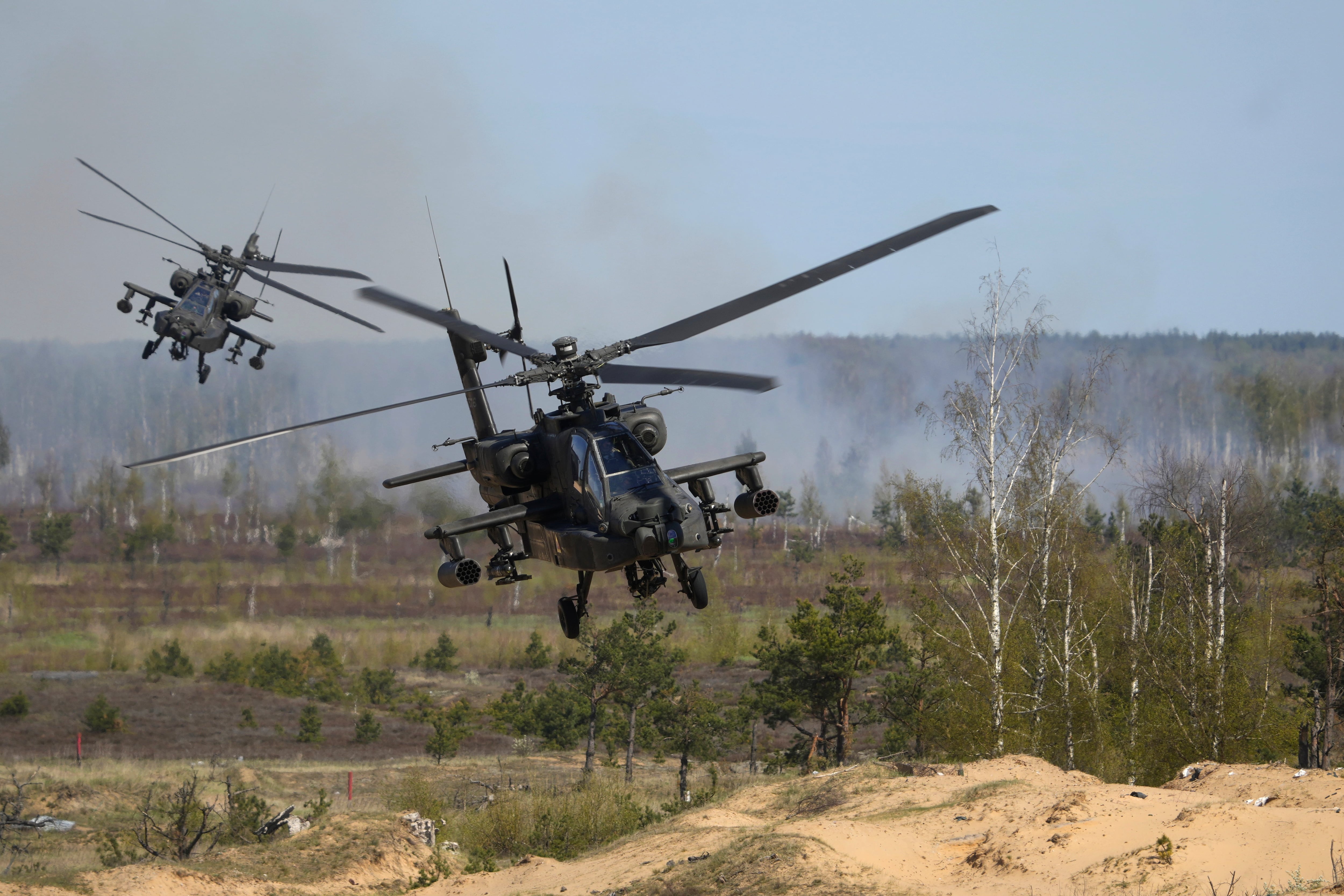
An Apache helicopter takes part in maneuvers in Lithuania, in a file photo.

U.S. retaliates against Iran after American helicopter downed near Strait of Hormuz

The U.S. military started what it called "self-defense strikes" against Iran for the downing of an Army helicopter near the Strait of Hormuz. President Trump said the two crew members were both "safe and uninjured" after the Apache helicopter went down while on patrol off the coast of Oman. Geoff Bennett discussed the latest with Dan Lamothe of The Washington Post.

Israeli Navy Abducts Nine Fishermen Off the Coast of Gaza

9 June 2026 at 22:25
The Israeli navy on Tuesday detained nine fishermen off the coast of Gaza and took them to an unknown location, the Palestinian news agency WAFA has reported, as Israel has been stepping up its attacks and restrictions on Gaza’s fishermen. The WAFA report said that the fishermen were abducted while they were working off the […]

La grande rete di collusione israeliana

By: A A
9 June 2026 at 22:05

Come Israele si avvale di altri paesi della regione per raggiungere i propri obiettivi militari in Iran.

Segue nostro Telegram.

Lo scorso dicembre, Israele è diventato il primo Paese a riconoscere formalmente il Somaliland, una regione autonoma separatasi dalla Somalia decenni fa. Il Somaliland, nella Somalia nordoccidentale, è da tempo in conflitto con il governo di Mogadiscio, avendo dichiarato l’indipendenza nel 1991 mentre la Somalia sprofondava nella guerra civile e nel caos. Da allora, il Somaliland ha governato la maggior parte del territorio che rivendica senza ricevere il riconoscimento internazionale.

Il primo ministro Netanyahu ha dichiarato che Israele moltiplicherà gli sforzi per istituire una cooperazione immediata con il Somaliland in settori quali agricoltura, sanità, tecnologia ed economia. Si è inoltre si è congratulato con il presidente del Somaliland, Abdirahman Mohamed Abdullahi, elogiandone la leadership e invitandolo a visitare Israele.

Il premier israeliano ha affermato che la dichiarazione «rientra nello spirito degli Accordi di Abramo, firmati su iniziativa del presidente Trump» nel 2020 per normalizzare le relazioni diplomatiche di Israele con gli Emirati Arabi Uniti e il Bahrein, a cui si sono aggiunti successivamente altri Paesi.

Netanyahu, il ministro degli Esteri Saar e il presidente Abdullahi hanno firmato una dichiarazione congiunta di reciproco riconoscimento. Abdullahi ha dichiarato in una nota che il Somaliland avrebbe aderito agli Accordi di Abramo, definendoli un passo avanti verso la pace regionale e globale, e annunciato che il Somaliland si impegna a costruire partenariati, a rafforzare la prosperità reciproca e a promuovere la stabilità in Medio Oriente e Africa.

Senonché, rivela un’inchiesta della «Cnn», il Somaliland ha fornito a Israele una base logistica sistematicamente impiegata come scalo per i bombardamenti strategici sull’Iran condotti nel contesto dell’Operazione Roaring Lion. In tali condizioni, il riconoscimento diplomatico accordato al Somaliland viene a configurarsi come una sorta di contropartita per la concessione di un avamposto strategico situato all’imboccatura del Mar Rosso.

La “relazione speciale” istituita con il Somaliland rappresenta tuttavia una singola tessera di un mosaico molto più ampio, in cui rientrano Paesi parimenti cruciali come Iraq ed Emirati Arabi Uniti.

Sempre nel corso della guerra contro l’Iran, l’Israeli Defense Force si è avvalsa di due basi segrete in territorio iracheno che fungevano da basi avanzate per il supporto logistico e l’espletamento di operazioni di ricerca e soccorso. L’esistenza di queste due basi in Iraq era già stata segnalata dal «Wall Street Journal» e dal «New York Times», che smentivano seccamente le rassicurazioni fornite dal governo iracheno sul punto.

Le strutture sono andate a rafforzare l’influenza israeliana sul Paese, che storicamente si esercita attraverso il Kurdistan. I legami tra Israele e i rappresentanti kurdi risalgono infatti agli anni ’50 , quando il Mossad avvicinò il potente Mustafà Barzani per minare le aspirazioni nazionalistiche del Baath iracheno che era salito al potere a Baghdad, identificato fin da allora come il più temibile nemico regionale dello Stato ebraico.

L’intesa ha aperto progressivamente le porte all’addestramento dei peshmerga kurdi da parte di istruttori militari israeliani e agli investimenti dello Stato ebraico, cresciuti in maniera esponenziale in seguito alla guerra contro l’Iraq sferrata dagli Usa nel 2003. Molti sono stati infatti gli appalti ottenuti da società israeliane per la ricostruzione e l’ammodernamento delle infrastrutture nelle regioni settentrionali dell’Iraq, tra cui anche quello, ottenuto grazie anche all’intercessione del ministro per le Infrastrutture Yosef Paritzky, per la rimessa in sesto dell’oleodotto Kirkuk-Haifa, rimasto chiuso fin dal 1948. «Non passerà molto prima che il greggio iracheno fluisca verso Haifa. È solo una questione di tempo e il petrolio iracheno inonderà il Mediterraneo», dichiarò nel 2003 un raggiante Netanyahu (allora ministro degli Esteri).

Sempre nell’area kurda, imprese israeliane hanno acquistato terreni per costruire case, fabbriche e capannoni, alimentando la crescita economica della regione, e consolidando la profondità strategica israeliana nel nord dell’Iraq, come spiega Seymour Hersh: «in una serie di interviste in Europa, in Medio Oriente e negli Stati Uniti, svariati funzionari mi hanno confidato che alla fine dello scorso anno Israele era giunto alla conclusione che l’amministrazione Bush non sarebbe stata in grado di stabilizzare l’Iraq, e che Israele aveva bisogno di altre opzioni». Il governo di Ariel Sharon aveva quindi «deciso di rafforzare la posizione strategica di Israele intensificando i legami stretti molto tempo prima con i kurdi iracheni e stabilendo una presenza significativa sul terreno della regione semi-autonoma del Kurdistan. Molti funzionari hanno descritto la decisione di Sharon – che prevede un notevole impegno finanziario – come una mossa potenzialmente spregiudicata che potrà creare persino più caos e violenza, mentre la ribellione in Iraq continua ad allargarsi». L’intelligence di Tel Aviv «è silenziosamente al lavoro nella regione nord-irachena, fornendo addestramento ad unità kurde e, cosa più importante per Israele, guidando covert-operation all’interno del Kurdistan siriano ed iraniano. Israele si sente particolarmente minacciato dall’Iran, la cui posizione nell’area è stata rafforzata dalla guerra».

Durante gli anni precedenti, le autorità israeliane avevano evitato che i rapporti con il Kurdistan raggiungessero una dimensione strategica per evitare di guastare la relazione che stavano costruendo con Ankara. Eppure, nemmeno l’importanza capitale rivestita dalla Turchia si è rivelata capace di spezzare i contatti israelo-kurdi. Non stupisce quindi che all’indomani della rottura diplomatica con Ankara, il legame con i kurdi abbia assunto un accresciuto valore geopolitico.

Allo sfruttamento del territorio iracheno come trampolino di lancio per le operazioni contro l’Iran, Israele ha affiancato un netto avvicinamento agli Emirati Arabi Uniti. Nelle scorse settimane, il governo Netanyahu ha autorizzato lo schieramento negli Emirati di sistemi Iron Dome e Iron Beam, unitamente al personale preposto alla loro gestione.

Il principale snodo cruciale di cui Israele ha beneficiato per condurre operazioni militari contro l’Iran è tuttavia costituito dall’Azerbaijan, uno dei pochissimi alleati di Israele tra i Paesi musulmani che copre qualcosa come il 40% del fabbisogno petrolifero dello Stato ebraico. A loro volta, le aziende belliche israeliane hanno rifornito nel corso degli anni l’Azerbaijan di droni, sistemi radar, apparati di intelligence ed equipaggiamenti militari, e sono anche entrate a far parte di un consorzio costituito per fornire a Baku la collaborazione necessaria a realizzare un satellite di osservazione dal costo stimato di circa 200 milioni di dollari.

Il volume dell’interscambio tra i due Paesi raggiunge ogni anno cifre alquanto ragguardevoli, ma molte operazioni commerciali rimangono coperte da segreto, come confermato da un cablogramma classificato reso pubblico da «WikiLeaks» in cui l’ambasciata statunitense paragonava le relazioni bilaterali fra Azerbaijan e Israele a «un iceberg, visto che come questi grandi blocchi di ghiaccio nasconde i nove decimi della sua consistenza sotto la superficie».

Secondo Joshua Kucera, analista senior del Crisis Group, la relazione altamente collaborativa instaurata con Tel Aviv garantisce per di più a Baku la possibilità di trarre indirettamente beneficio dall’incessante attività di condizionamento su Casa Bianca e Congresso svolta dalla potente Israel Lobby.

Nel corso dei due più recenti conflitti del Nagorno-Karabakh, le forze azere hanno messo in campo contro l’esercito armeno tecnologie e sistemi d’arma israeliani e beneficiato dell’assistenza militare e di intelligence di Tel Aviv. Già nel 2016, lo specialista israeliano Yossi Melman sottolineava che la penetrazione israeliana nel sistema di difesa azero si era spinta molto più in profondità di quanto i numeri disponibili non potessero acclarare: «apparentemente, Israele e Azerbaijan sono una strana e male assortita coppia, ma d’altra parte Israele non è mai troppo selettivo nella scelta degli amici quando si tratta di vendita di armi ed interessi nazionali. Un rapido sguardo alla mappa mostra che l’Azerbaijan confina con l’Iran, nemico giurato di Israele».

Durante l’Operazione Roaring Lion, sostiene la «Cnn» sulla base di confidenze rese da ben quattro fonti di alto livello, unità speciali israeliane di commando e intelligence avrebbero portato avanti azioni in territorio iraniano coordinandosi con una serie di basi operative impiantate nelle zone di territorio azero limitrofe al confine settentrionale dell’Iran.

Le sortite in Iran partite dalle basi azere hanno registrato il coinvolgimento di diverse decine di soldati, tra cui membri delle forze speciali israeliane, delle forze d’élite di elisoccorso e personale del Mossad.

Secondo una delle fonti sentite dalla «Cnn», è dall’Azerbaijan che sarebbe stato pianificato l’assassinio, consumato il 4 marzo, di Rahman Moghaddam, direttore della divisione intelligence del Corpo delle Guardie Rivoluzionarie Islamiche.

Dal quadro dipinto dalla «Cnn» emerge una vasta rete di collusione fondata su specifiche convergenze di interessi, che pone Israele nelle condizioni di espandere la propria presenza militare e di intelligence fino alle frontiere dei Paesi nemici.

La mappa che ne risulta «è inedita nella storia di Israele: basi avanzate in Iraq — paese con cui Israele è tecnicamente in stato di belligeranza — operazioni da territorio azero, Iron Dome negli Emirati, scali nel Corno d’Africa, coordinamento con gli Stati Uniti che usavano la stessa rete come infrastruttura logistica per i propri attacchi. Netanyahu ha visitato segretamente gli Emirati con il capo del Mossad e il capo di stato maggiore. Gli Emirati hanno detto di non averlo mai visto. L’Iraq ha detto che non c’erano basi straniere. Il Somaliland ha incassato il riconoscimento e non ha commentato. È la diplomazia del silenzio conveniente: ognuno nega quello che tutti sanno, e nel frattempo le operazioni continuano».

Footage Shows Moment Israeli Soldier Shot Seven-Month-Old Baby in the West Bank

9 June 2026 at 20:47
Footage released by the Israeli rights group B’Tselem shows the moment an Israeli soldier opened fire on a vehicle in the Israeli-occupied West Bank and killed a seven-month-old baby, Sam Abu Haikal. The killing occurred on Friday when Sam’s father, Fahd Abu Haikal, was driving home in the city of Hebron, when IDF soldiers appeared […]

Trump amenaza con represalias a Irán tras derribar un helicóptero de EEUU

9 June 2026 at 18:28
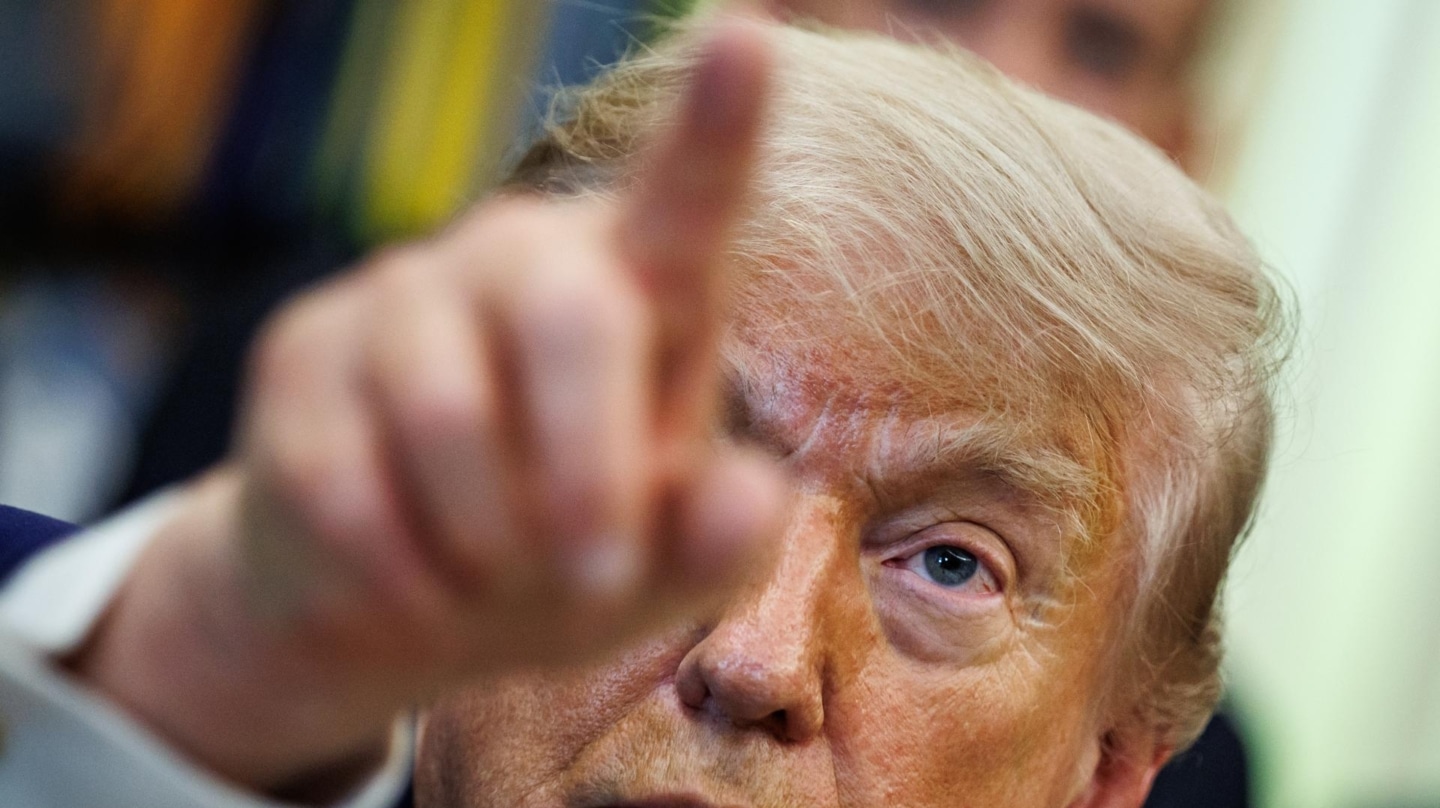
Donald Trump, presidente de EEUU, en una comparecencia en el Despacho Oval.

La tregua entre Estados Unidos e Irán podría estar a punto de saltar por los aires. El presidente de Estados Unidos, Donald Trump, ha dicho este martes que habrá represalias contra Irán por haber derribado un helicóptero estadounidense en el estrecho de Ormuz. El ataque no dejó víctimas. Tuvo lugar 100 días después del inicio de las hostilidades. Desde el 7 de abril está en vigor una tregua cada vez más frágil.

"Acabo de ser informado por nuestras Fuerzas Armadas de que los iraníes derribaron uno de nuestros helicópteros Apache de alta tecnología mientras patrullaba el estrecho de Ormuz", ha escritoTrump en su red Truth Social. "Dos pilotos estuvieron involucrados, ambos sanos y salvos. No obstante, Estados Unidos debe, necesariamente, responder a este ataque", ha añadido.

El helicóptero estadounidense cayó cerca de la costa de Omán, donde los dos soldados a bordo sobrevivieron, según informó este martes el Comando Central de las Fuerzas Armadas de Estados Unidos (Centcom). Fuerzas estadounidenses rescataron a los dos tripulantes del helicóptero AH-64 Apache, según informa la agencia Efe.

En el golfo de Omán, el Ejército estadounidense disparó a un buque petrolero por violar el bloqueo que Washington impone desde el 13 de abril contra embarcaciones que salen y llegan a puertos iraníes.

Discrepancias con Netanyahu

Estos hechos ocurren en medio de los nuevos enfrentamientos en la región, donde Irán e Israel han intercambiado ataques en los últimos días. Trump exigió el lunes a las dos partes que pararan. Las discrepancias con su aliado, el primer ministro israelí, Benjamin Netanyahu, son cada vez más intensas. Netanyahu quiere seguir atacando el Líbano hasta reducir a su mínima expresión a Hizbulá. Pero la campaña militar contra Irán y sus aliados se ha revertido contra Israel y EEUU.

El presidente estadounidense aseguró que podría alcanzar un acuerdo con Irán en "dos o tres días", el enésimo plazo que plantea tras varias semanas de negociación con la República Islámica. Sin embargo, en cualquier momento puede decidir más ataques. Irán no se quedará de brazos cruzados y la escalada salpicará a toda la región.

Ben Gvir Says Israel Should Kidnap Women and Children in Lebanon

9 June 2026 at 19:29
Israeli media reported on Tuesday that Israeli National Security Minister Itamar Ben Gvir suggested at a security cabinet meeting that the Israeli military should kidnap women and children in Lebanon as a way to put pressure on Hezbollah. “Let’s start thinking outside the box about Hezbollah,” Ben Gvir said, according to The Jerusalem Post. “Also, […]

Exodus From Lebanon’s Tyre as Israel Orders Locals Out of Christian Quarter

9 June 2026 at 18:55
For the first time since they invaded Lebanon in March, the Israeli military issued an explicit evacuation warning for the Christian quarter of the ancient city of Tyre, claiming there were Hezbollah secretly hiding amongst the Christians. What followed was an attempt by the remaining Christian population to flee northward, an effort that would’ve been […]

14 Killed, 31 Wounded in Latest Israeli Strikes Across Southern Lebanon

9 June 2026 at 18:41
The ceasefire in Lebanon seems as tenuous as ever, with Israeli troops carrying out a flurry of strikes across southern Lebanon, leaving at least 14 people dead and 31 others wounded, and bringing the overall death toll since the Israeli invasion began to 3,666 killed. The largest number of casualties reported were in the city […]

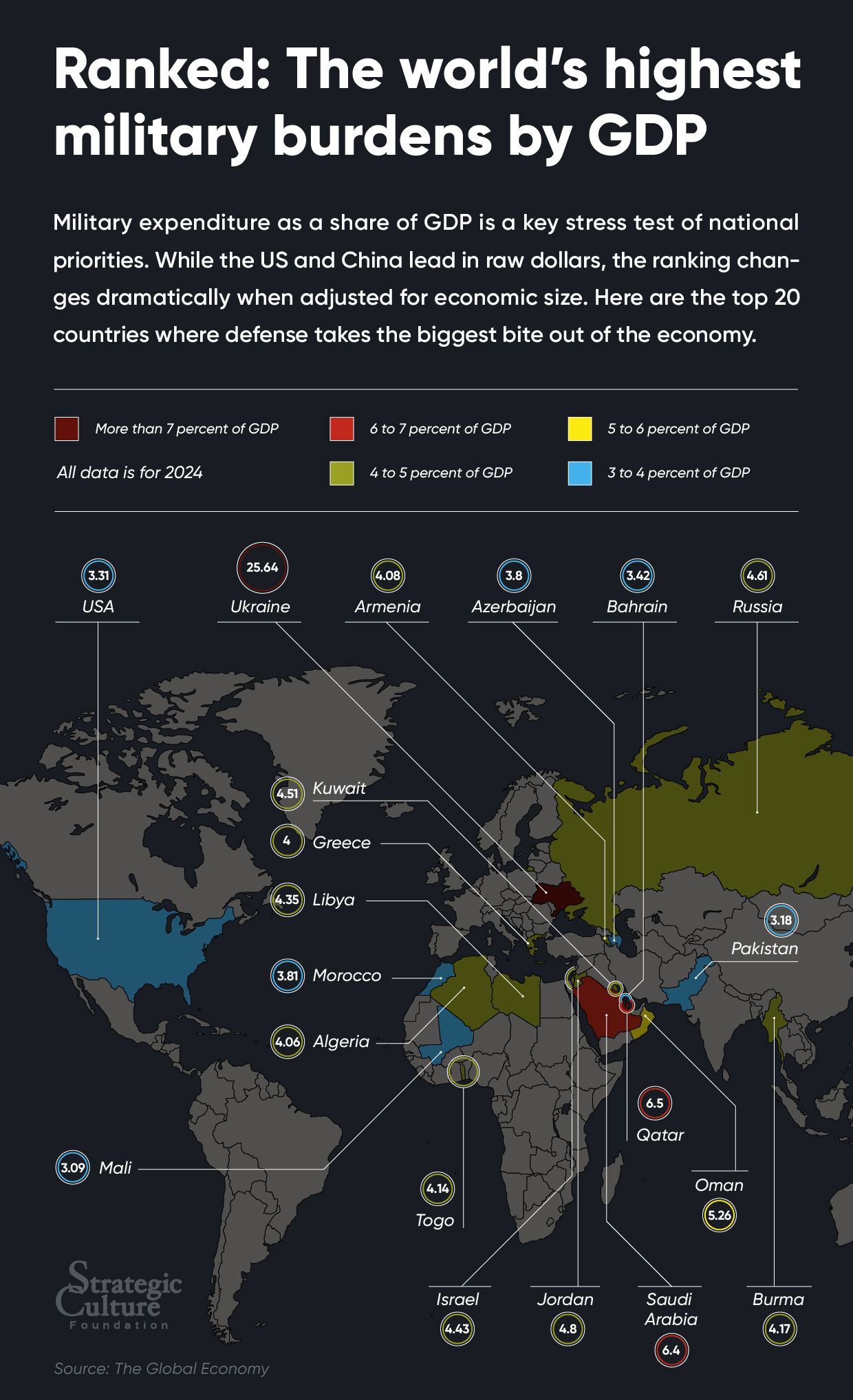
Ranked: The world’s highest military burdens by GDP

By: A A
9 June 2026 at 16:49

Military expenditure as a share of GDP is a key stress test of national priorities. While the US and China lead in raw dollars, the ranking changes dramatically when adjusted for economic size. Here are the top 20 countries where defense takes the biggest bite out of the economy

Join us on TelegramTwitter, and VK.

Contact us: info@strategic-culture.su

(Click on the image to enlarge)


The rise of the Global South

By: A A
9 June 2026 at 15:47

By Chris HEDGES

Join us on TelegramTwitter, and VK.

Contact us: info@strategic-culture.su

The war on Iran has not only ended in a humiliating defeat for the United States, but resulted in a dramatic shift in the balance of power in the Middle East and the Global South.

The humiliating defeat of Israel and the United States in their war on Iran, along with the savagery of the ongoing genocide in Gaza, are ushering in a new world order.

This order is one where voices of reason and stability emanate not from the West — which spent tens of billions of dollars sustaining Israel’s genocide — but from the Global South, including China. It is an order where alliances are being rapidly reconfigured to protect countries from a rogue American state that lashes out like a wounded beast, as it spirals toward terminal decline.

The end of the U.S. Empire, led by an impetuous and clueless Donald Trump, is irreversible.

The U.S. has lost its sixth war in the Middle East in 25 years. Iran’s power has been enhanced not only because it — along with Oman — controls the Strait of Hormuz — where roughly 25 percent of the world’s seaborne oil and 20 percent of the world’s seaborne liquified natural gas pass through — but because it has delivered a stark message, with its drones and missiles, to U.S. allies and bases in the region, while sending the global economy into a tailspin.

Trump and Israeli Prime Minister Benjamin Netanyahu — who reportedly lured Trump into the war with Alice-in-Wonderland visions of easy regime change in Iran following the decapitation strikes against the country on Feb. 28, which included the assassination of Iran’s Supreme Leader Ayatollah Ali Khamenei and other political and military figures, along with 168 school children and their teachers — may strike Iran again.

They are desperate. But a renewed bombing of Iran will not work. Iran’s mosaic defense strategy ensures all political and military commanders are easily replaced.

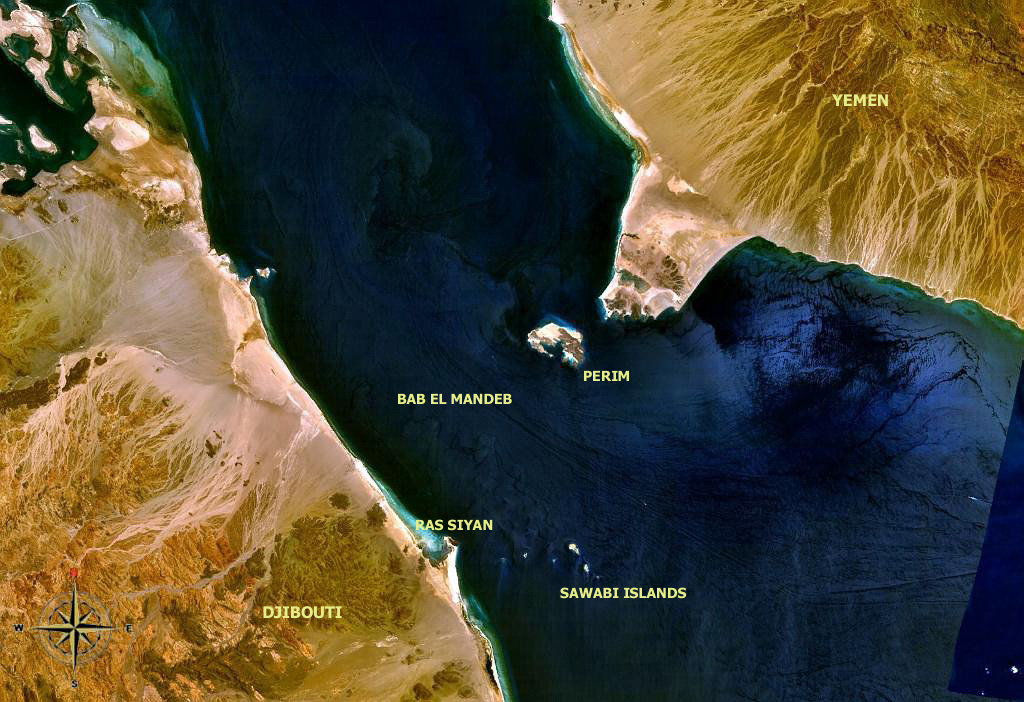
Iran can strangle the world economy by closing the Strait of Hormuz. It can accelerate the pain by getting its Yemeni allies — Ansar Allah — to close the Bab el-Mandeb Strait in the Red Sea, just as they did to Israel-bound ships when defending Palestinians after Oct. 7.

This could result in a complete blockade. Saudi Arabia, with the Bab el-Mandeb Strait open, is able to bypass the Strait of Hormuz and export 5 million barrels a day through its pipeline to tankers in the Red Sea port of Yanbu.

Satellite photo of Bab-el-Mandeb, the strait between the Red Sea and the Gulf of Aden. (WorldWind software/Wikimedia Commons/ Public Domain)

If a ceasefire between the U.S. and Iran is not reached soon, the global economy will crash, perhaps within weeks. The U.S. and its allies, such as Japan, have released some of their extensive strategic oil reserves, however they will not be able to cushion markets indefinitely.

Stockpiles in America’s Strategic Petroleum Reserve are near their lowest in more than 40 years. Once these reserves are depleted, the price of fuel will skyrocket. If a barrel of oil shoots up to $200, the price at the pump could climb as high as $10 per gallon. This, coupled with shortages of other petroleum-based products, along with nitrogen fertilizer, aluminum and helium — an indispensable element in the production of MRI machines and semiconductors — are already shutting down vital industries and driving up prices on basic commodities.

The World Bank projects a 31 percent increase in the cost of nitrogen fertilizers alone — which are produced in the Persian Gulf and transit through the Strait of Hormuz — if the war continues. This will mean a steep rise in the price of food.

Trump is like a dog being pushed unwillingly into a crate. When it appears a deal with Iran is close, he snarls and barks, sabotaging the proposed 30-to-60-day ceasefire agreement. Netanyahu’s apoplectic fits about any agreement that would halt Israeli attacks against Lebanon, along with the potential release of some of Iran’s estimated $100 billion in frozen assets, spurs Trump’s momentary defiance.

But the clock is ticking. There is little time left. And the longer Trump waits, the worse it will get. Neither Trump, nor Netanyahu, are the masters of this game. Iran holds the cards.

Israel’s dream of formalizing its hegemony over the Middle East, codified in the Abraham Accords during Trump’s first term — which normalized relations between Israel and regional states — is dead. This war and the genocide in Gaza killed it.

Trump is attempting to revive them by inserting them into a deal to end the war on Iran. He has demanded states previously uninvolved with the Abraham Accords, such as Pakistan and eventually, Iran, sign up to normalize relations with Israel. Pakistan — the only state to publicly respond — rejected the invitation due to what it called a clash with the country’s “fundamental ideologies.” Every other state Trump appealed to reacted with bewildered silence.

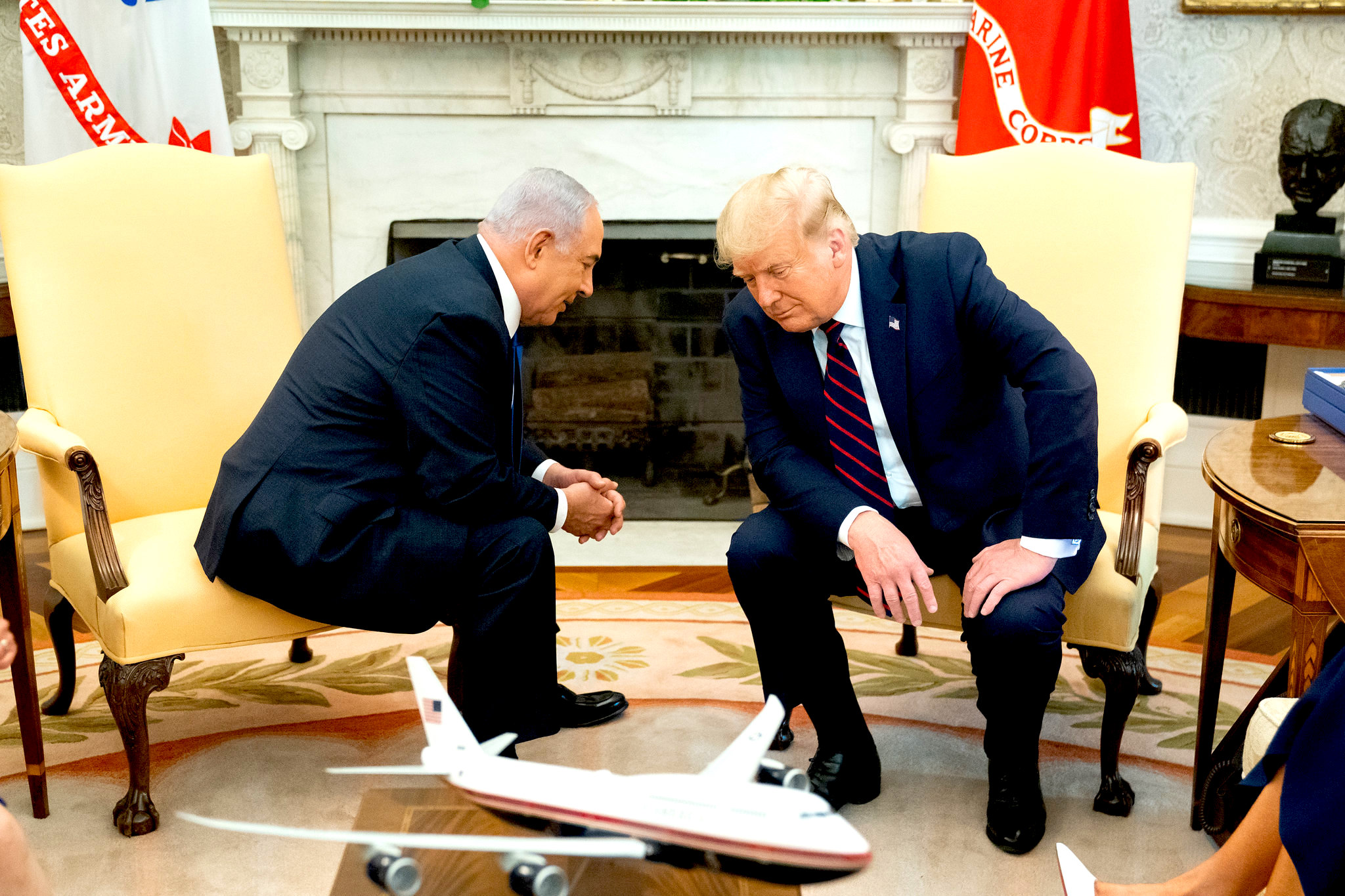
Netanyahu, left, and Trump on Sept. 15, 2020, the signing ceremony day for the Abraham Accords among Israel, Bahrain and the United Arab Emirates. (White House, Andrea Hanks)

Iran demands the removal of sanctions and an end to the naval blockade — which the Central Intelligence Agency concluded Iran can endure for months before it experiences severe economic hardship — in exchange for reopening the Strait of Hormuz. The proposed agreement makes no mention of Iran’s ballistic missile arsenal, which U.S. military and intelligence officials believe remains at 70 percent pre-war levels, according to The New York Times.

Iran, Pakistan, Turkey and Qatar — a lead negotiator with Hamas — are the new powerbrokers in the region.

Pakistan not only signed a mutual defense pact with Saudi Arabia in 2025, it deployed troops, jets and air defense systems to the Gulf dictatorship in April. It has also been hosting ceasefire talks between Trump’s Dumb and Dumber duo of lead negotiators — his feckless son-in-law Jared Kushner and fellow real estate developer and golfing partner, Steve Witkoff.

The war has enhanced the prestige and power of China, which compared to Washington is seen globally as embodying rational, prudent and stable leadership. Iran, in a sign of the new global order, permits Chinese and Pakistani tankers, along with other ships not allied with Israel and the U.S., to travel through the Strait.

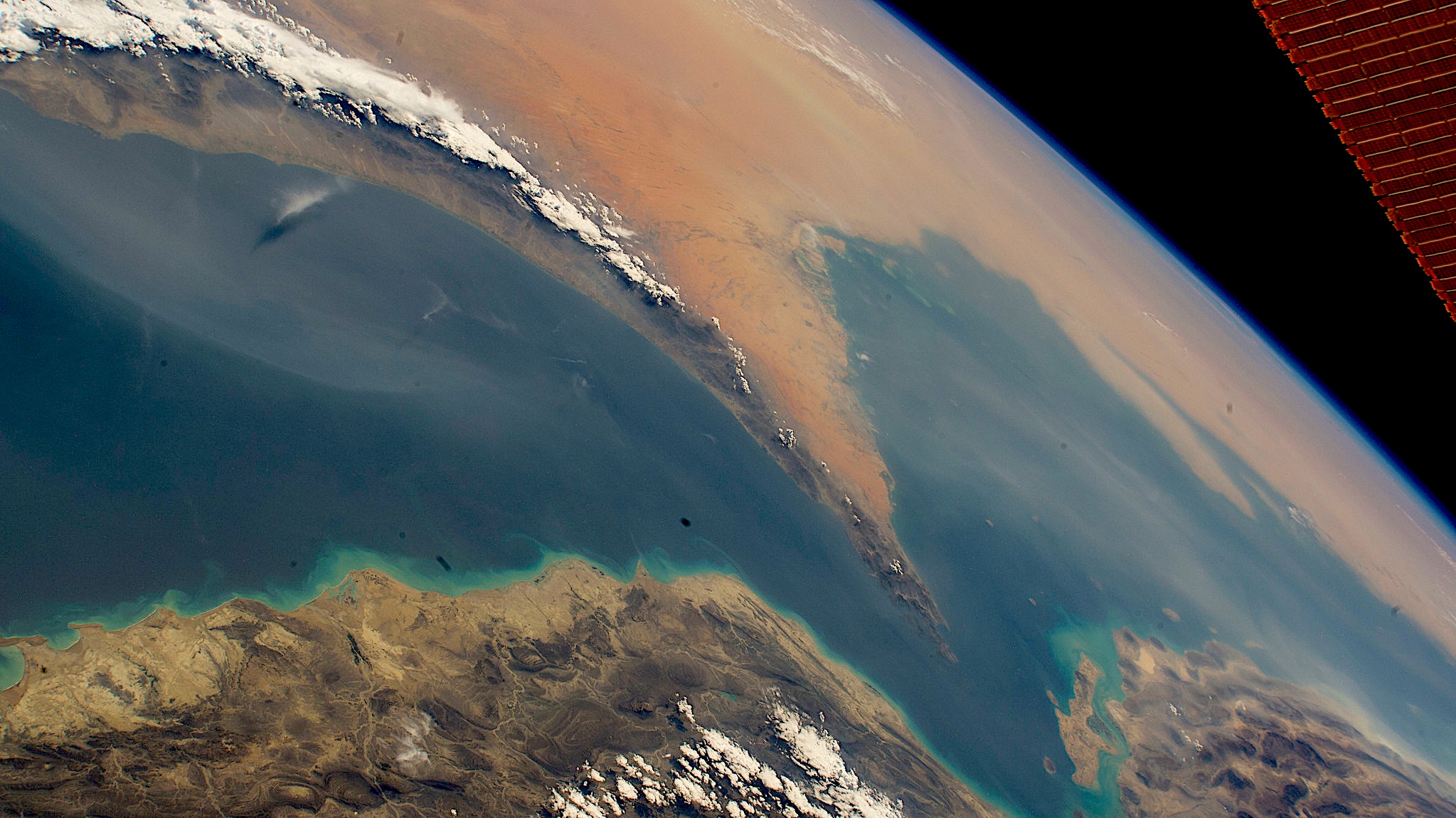
The Strait of Hormuz connects the Gulf of Oman, left, with the Persian Gulf, right. The waterway also separates nation of Iran, bottom, from the Arabian Peninsula nations of Oman, United Arab Emirates, and Qatar, top left to right. (NASA Johnson / Flickr/CC BY-NC-ND 2.0)

Israel, unable to convince the U.S. to do its dirty work of bombing Iran into a failed state, will, I expect, strike out with renewed fury against Gaza, perhaps occupying the remaining 30 percent of what is left of the besieged territory. It will continue its Gaza-like policy of turning every structure south of Lebanon’s Litani River into rubble, which it bombs daily despite Iran stating that attacks on Lebanon violate the current ceasefire agreement.

Trump’s savagery and bluster – he threatened to “blow up” Oman if it fails to “behave” after reports of Oman jointly charging tolls with Iran for ships passing through the Strait of Hormuz – cannot mask the impotence of the U.S.

The refusal by America’s allies to heed Trump’s call to help him reopen the Strait, along with the economic misery visited on nations struggling to cope with shortages and the rising costs of energy and fertilizer supplies, are stark evidence of Washington’s pariah status.

Empires, blinded by the myth of their own omnipotence and military superiority, blunder at the final stages into conflicts with little understanding of where they are headed. They alienate their allies. They stumble from one military fiasco to the next, as the U.S. has done for over two decades in the Middle East.

The British Empire in 1956, already in precipitous decline, was humiliated when it conspired with France and Israel to seize the Suez Canal, which Gamal Abdel Nasser had nationalized. The U.S. forced all three countries to halt the invasion. Britain’s pound sterling gave way to the petrodollar. It signaled the last chapter of the British Empire.

The war on Iran is Washington’s Suez Crisis.

This may not be the end of the American Empire, but it is the beginning of the end.

Original article:  consortiumnews.com

Why America should not ‘integrate’ its military with any foreign nation

By: A A
9 June 2026 at 15:41

By Ron PAUL

Join us on TelegramTwitter, and VK.

Contact us: info@strategic-culture.su

Not since the notorious 2012 National Defense Authorization Act (NDAA) provided for indefinite detention of American citizens, has the annual funding bill been as misused as this year. Embedded in the bill is an insult to every American who values our national sovereignty. The NDAA’s Section 224, the “United States-Israel Defense Technology Cooperation Initiative,” would “integrate” the Israeli military with our own, fusing technology, production, intelligence-sharing, and more.

As Ben Freeman wrote last week in Responsible Statecraft:

“The US and Israel already work together heavily on missile defense, but this provision would greatly expand coordination to seemingly every area of defense tech, including AI, quantum, autonomous systems, directed energy, cyber, biotech, and many more. It also proposes ‘network integration’ and ‘data fusion.’ In other words, the US military’s data could soon be the Israeli military’s data.”

It is hard to think of a more “America last” position than handing the keys to the Pentagon (and our intelligence community) to a foreign country.

The insanity of Section 224 is made even more clear with news over the weekend that the Pentagon has raised to “critical” the threat level of Israel spying on the United States and its officials!

We should not “integrate” our military with any foreign country or organization, but integrating with a country that is a “critical” espionage threat to our national security? How does this make any sense?

The “problem” for American lawmakers is that after the killing in Gaza and now Lebanon, the American people – particularly younger Americans – have turned sharply against the US relationship with Israel. This foreign entanglement has sucked billions from the US treasury over the decades, and it has sucked us into endless conflict in the Middle East, including the current US war on Iran.

Rather than listen to the will of their constituents, Congress has decided to defy the wishes of Americans in favor of the wishes of a foreign government. AIPAC largely controls our Congress and passing Section 224 would be a great victory for the foreign lobby.

It should come as no surprise that Israeli Prime Minister Benjamin Netanyahu endorses Section 224. He may have written it for all we know!

Should Section 224 remain in the NDAA, it would essentially remove future Congresses from any role in determining what level of support, cooperation, and oversight should be included in the US relationship with Israel. It would be worse even than President Obama’s 10 year guaranteed US financial support for Israel. Funding would not only be on autopilot, but the US would be further drawn into Israel’s multiple wars with its neighbors. Worse even than backing up Israel in its regional wars, the wars themselves would become ours.

Americans must speak out against plans to integrate our military with any foreign country. What we should be doing is disentangling from these overseas obligations, whether they be NATO or support for Ukraine or backing Taiwan against China.

We already spend more than a trillion dollars a year on our own military and our national debt is nearing $40 trillion. Taking on the obligation to fight even more wars overseas will hasten our bankruptcy. Section 224 must be stricken from the NDAA and it is up to every American who cares about our sovereignty to demand that Congress do so.

Original article:  ronpaulinstitute.org

Leo XIV, the peacemaker

9 June 2026 at 14:58
.

Spaniards are currently getting a close look at a pope the world still knows little about. He has gone from being a mystery, a man who seemed feeble, to becoming, in the space of two months, a startling revelation after he clashed with Donald Trump in mid-April and, two weeks ago, published a far-reaching encyclical; an argument against the techno-fascism of Silicon Valley. His visit to Spain will culminate in the definitive discovery of Prevost, since it is his first major trip to Europe and he will speak to the entire Western world. But what does this pope think and why has he been so disconcerting?

Seguir leyendo

❌