Normal view

Received yesterday — 9 June 2026 Strategic Culture Foundation

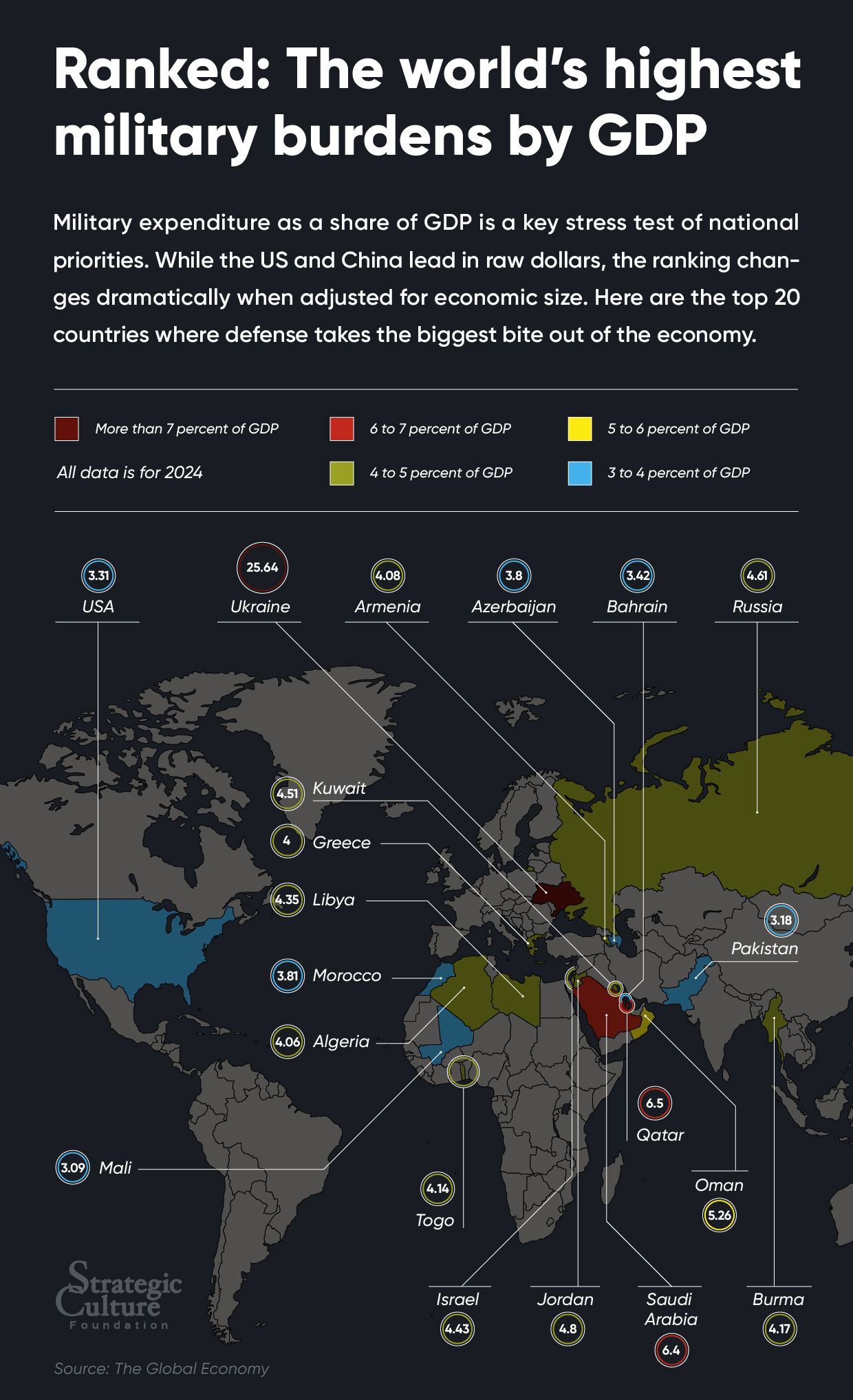
Ranked: The world’s highest military burdens by GDP

By: A A
9 June 2026 at 16:49

Military expenditure as a share of GDP is a key stress test of national priorities. While the US and China lead in raw dollars, the ranking changes dramatically when adjusted for economic size. Here are the top 20 countries where defense takes the biggest bite out of the economy

Join us on TelegramTwitter, and VK.

Contact us: info@strategic-culture.su

(Click on the image to enlarge)


Peter Thiel tenta assumir o controle do Judiciário brasileiro

By: A A
9 June 2026 at 16:00

Bilionário Peter Thiel, dono do Founders Fund, investe em startup brasileira de IA para controlar advogados e juízes. Risco de captura do Judiciário.

Junte-se a nós no Telegram Twitter e VK.

Escreva para nós: info@strategic-culture.su

A recente fuga para a Argentina do bilionário tecnocrata Peter Thiel, mais conhecido por sua empresa Palantir, envolvida na captura dos serviços de segurança e inteligência dos EUA, chamou a atenção para os seus possíveis interesses na América do Sul. O papel de Javier Milei na implementação do Plano Andinia (a promoção da colonização judaica da Patagônia, para fins de criação de um novo Estado sionista) já tornou-se notório, e especula-se sobre a possibilidade de Thiel ter aí algum papel. Outros falam na hipótese de Thiel estar simplesmente saindo dos EUA para escapar a alguma possível futura responsabilização num governo estadunidense pós-Trump.

Agora, independentemente de quais sejam os reais interesses de Thiel na Argentina, não parece ser o alvo principal das operações do bilionário na América do Sul.

Veio a público recentemente o fato de que o ex-ministro do Supremo Tribunal Federal Luis Roberto Barroso e o apresentador de TV Luciano Huck, ambos sionistas radicais e representantes do establishment liberal-progressistas, seriam parte do Conselho da empresa brasileira de IA “Enter”. Essa empresa “Enter” está desenvolvendo um sistema, criado a partir dos modelos da OpenAI e da Anthropic, cuja finalidade será gerenciar de forma autônoma os casos dos principais escritórios de contencioso de massa do Brasil, cuidando da produção dos peticionamentos.

Espera-se, ademais, que a “Enter” eventualmente passe a operar também dentro dos tribunais, já que o objetivo declarado da startup é se tornar uma empresa monopolista para IA do setor jurídico. Ao se situar em ambas pontas principais das relações jurisdicionais (advogados e juiz), a “Enter” estaria basicamente dissolvendo a necessária “separação” que deve haver entre autor, réu e juiz, para que se possa preservar, concretamente, a imparcialidade da aplicação do Direito.

Ademais, é importante considerar a possibilidade de que, sutilmente, através de prompts, a “Enter” poderia prejudicar seus próprios clientes em casos nos quais um desses clientes representasse interesses contrários aos interesses dos investidores, diretores e conselheiros por trás da “Enter”.

A questão assume uma dimensão internacional, porém, a partir do momento em que descobrimos que a principal investidora da startup “Enter” é o Founders Fund, um fundo de investimentos de capital de risco criado por Peter Thiel e que conta, entre seus parceiros, com uma miríade de magnatas e especuladores ligados ao Vale do Silício.

Através do Founders Fund, Thiel tem um controle, no mínimo parcial, não apenas sobre a Palantir e a SpaceX do Musk, mas também Facebook, Polymarket, Spotify, Airbnb, entre outras, todas elas vinculadas ao mundo da Big Tech e do Vale do Silício, projetos que parecem dedicados à virtualização e algoritmização do mundo, para controlá-lo e influenciá-lo mais facilmente.

Assim, quando Thiel investe num projeto cujo objetivo declarado é controlar a atuação de advogados e juízes no Brasil, necessariamente estamos diante de um risco institucional significativo. Principalmente porque o Brasil parece ter se tornado laboratório de experimentação para inúmeros projetos liberais de todos os tipos, e os resultados alcançados no Brasil podem servir para determinar a internacionalização desse esforço de controlar as atividades jurídicas ao redor do mundo.

O próprio esforço, já existente no Brasil, de tornar as atividades jurídicas mediadas pela inteligência artificial já é, em si, um risco institucional. Os juízes pararam de ler os processos, bem como de produzir as próprias sentenças. E advogados bem treinados já passaram a incluir em suas petições prompts disfarçados cuja finalidade é manipular a IA do tribunal para que ela dê sentenças favoráveis. Com isso, o fator humano vai sendo excluído do Direito.

O problema é que todos os conflitos jurídicos são, fundamentalmente, sobre interesses humanos, e apenas pessoas podem entender as demandas de outras pessoas; razão pela qual praticamente deveríamos considerar imprescindível, e mesmo um direito fundamental, o ser defendido e julgado exclusivamente por seres humanos.

O impulso de Peter Thiel por controlar as relações jurídicas brasileiras deve servir de alerta para a necessidade de afirmar e reafirmar a importância fundamental da centralidade humana em todas as instituições e relações.

A IA não pode e não deve substituir o homem.

La CPI: quien paga manda

By: A A
9 June 2026 at 15:56

El 84% del presupuesto de la CPI viene de potencias imperialistas, que dictan sus investigaciones y protegen a sus aliados.

Únete a nosotros en Telegram Twitter  y VK .

Escríbenos: info@strategic-culture.su

Para perseguir a gobernantes incómodos para el imperialismo, la CPI pasó por encima de su norma básica: limitar su actuación a los países que ratificaron el Estatuto de Roma. Sin embargo, mientras la Libia de Gadafi y la Rusia de Putin fueron víctimas de la CPI, Estados Unidos continúa impune. Y ha demostrado que, aun sin formar parte de la Corte, es quien verdaderamente manda en ella.

Cuando Bensouda intentó investigar los crímenes de guerra en Afganistán —sin limitar su investigación a la actuación del Talibán y del Estado Islámico, sino incluyendo a lo que ella consideraba los mayores criminales de aquella guerra (el ejército estadounidense y la CIA)—, sufrió una fuerte presión desde Washington, hasta el punto de resultar en sanciones gubernamentales. Sus cuentas bancarias y las de sus familiares fueron congeladas, y su marido fue espiado.

Finalmente, Bensouda fue sustituida por un nuevo fiscal dócil a Estados Unidos. Karim Khan modificó el enfoque de las investigaciones sobre Afganistán, declarando que daría prioridad al Talibán y al ISIS y retiraría la prioridad de Estados Unidos, alegando falta de recursos para una investigación más amplia.

Durante una de las muchas intervenciones militares francesas en África en este siglo (entre 2013 y 2016), soldados violaron y abusaron sexualmente de niños en campos de desplazados en la República Centroafricana. La ONU, aunque prestó una atención limitada al caso, fue acusada de una “grave falla institucional” por una comisión independiente, al haber permitido que las atrocidades continuaran. La CPI —que podría haber intervenido, dado que Francia es un Estado Parte y los magistrados franceses no lograron condenar a ningún soldado por una supuesta insuficiencia de pruebas— prefirió guardar silencio al respecto.

Durante el mismo período, en su intervención en el Sahel, soldados franceses —incluidos mercenarios de la Legión Extranjera— fueron acusados de asesinar civiles y de entrenar y armar fuerzas de seguridad responsables de masacres, ejecuciones sumarias y violaciones. Los gobernantes franceses tampoco tuvieron de qué preocuparse.

Por otro lado, la CPI incluso fingió examinar los crímenes de guerra cometidos por el Reino Unido en Irak, incluidas torturas contra prisioneros. Pero justificó el cierre del caso alegando que las autoridades británicas ya estaban llevando a cabo investigaciones internas, aun cuando la propia Oficina del Fiscal de la CPI reconoció que existía una “base razonable” para creer que tropas británicas habían cometido crímenes de guerra.

El Reino Unido no castigó a ningún oficial, aunque una investigación pública posterior concluyó que hubo violencia generalizada y un silencio corporativo —es decir, una responsabilidad de altos mandos militares—. Como el Reino Unido realmente no había sido capaz de concluir el caso, la CPI podría haber intervenido, ya que Londres integra el Estatuto de Roma. Pero la CPI volvió a lavarse las manos.

Ahora, como reveló Bensouda, Israel también está protegido, y no solo por las sanciones estadounidenses, sino también por la actuación de una burocracia de la CPI confabulada con el Mossad, que permite la injerencia directa e ilegal de Israel sin hacer absolutamente nada al respecto.

Una estructura dominada por las naciones imperialistas

De acuerdo con los datos disponibles en el último balance financiero de la CPI, correspondiente a 2024 y publicado en julio de 2025, es posible calcular que alrededor del 84% de toda su financiación proviene de países imperialistas y asociados (miembros de la OTAN, Suiza, Austria, Japón, Corea del Sur, Australia y Nueva Zelanda). Sin embargo, en conjunto representan apenas el 28% de los Estados Parte del organismo. Mientras tanto, el resto de los países (72%) aportan solamente el 16% de su presupuesto.

Existe un claro desequilibrio estructural en la financiación de la CPI. Naturalmente, esto está directamente relacionado con la actuación parcial de la Corte. Como dice el dicho, quien paga manda.

La propia CPI considera que el 60% de los países africanos que la integran están “no representados” o “subrepresentados” en su estructura interna. Es decir, apenas el 40% cuenta con algún tipo de representación. Para los países latinoamericanos y caribeños, ese porcentaje es todavía menor: solo el 14% de los integrantes de la Corte están adecuadamente representados. En los países de Asia-Pacífico, la cifra es del 28%. En cambio, la mitad de los países imperialistas y asociados sí están debidamente representados, un porcentaje muy superior al de las demás regiones.

Según un informe de la Asamblea de los Estados Parte, el 56% de los funcionarios de la CPI en 2024 provenían del grupo compuesto por países de Europa Occidental y relacionados. Apenas el 16% eran africanos, el 11% provenían de Europa Oriental, el 8% de Asia-Pacífico y el 8% de América Latina y el Caribe.

Entre los 18 jueces actuales de la Corte, ocho pertenecen a países imperialistas y asociados, y cinco mantienen vínculos académicos y/o profesionales con instituciones hegemónicas de esos países. Los demás son altos burócratas estatales, generalmente de países cuya burocracia estatal es intrínsecamente dependiente del imperialismo.

De esta forma, queda claro que las víctimas de la CPI siempre serán los dirigentes incómodos para las potencias imperialistas. Mientras incluso Putin ha tenido una orden de arresto emitida por el organismo y los gobiernos africanos continúan siendo su objetivo favorito, ningún país de la OTAN ha sido jamás seriamente molestado por procesos de la CPI.

Los bombardeos con armas prohibidas en Yugoslavia en 1999, las torturas en Abu Ghraib y Guantánamo, las masacres en Irak y Afganistán, las violaciones en África o, más recientemente, la masacre en la escuela de Minab y los asesinatos semanales de pescadores en el Caribe y el Pacífico Oriental, no preocupan a los jueces de la CPI.

Precisamente por ello, la mayoría de los países soberanos que no se arrodillan ante el imperialismo jamás se adhirieron a la CPI. Cuba acusó al organismo de tener una política “selectiva contra los países en desarrollo”. Corea del Norte calificó sus maniobras como “un producto de fuerzas hostiles”.

Pero, junto con la declaración de Burundi, quizás la mejor definición de lo que es la CPI fue dada por el vicesecretario del Consejo de Seguridad de Rusia, Alexander Venediktov: “Un títere obediente en manos del Occidente colectivo.”

The rise of the Global South

By: A A
9 June 2026 at 15:47

By Chris HEDGES

Join us on TelegramTwitter, and VK.

Contact us: info@strategic-culture.su

The war on Iran has not only ended in a humiliating defeat for the United States, but resulted in a dramatic shift in the balance of power in the Middle East and the Global South.

The humiliating defeat of Israel and the United States in their war on Iran, along with the savagery of the ongoing genocide in Gaza, are ushering in a new world order.

This order is one where voices of reason and stability emanate not from the West — which spent tens of billions of dollars sustaining Israel’s genocide — but from the Global South, including China. It is an order where alliances are being rapidly reconfigured to protect countries from a rogue American state that lashes out like a wounded beast, as it spirals toward terminal decline.

The end of the U.S. Empire, led by an impetuous and clueless Donald Trump, is irreversible.

The U.S. has lost its sixth war in the Middle East in 25 years. Iran’s power has been enhanced not only because it — along with Oman — controls the Strait of Hormuz — where roughly 25 percent of the world’s seaborne oil and 20 percent of the world’s seaborne liquified natural gas pass through — but because it has delivered a stark message, with its drones and missiles, to U.S. allies and bases in the region, while sending the global economy into a tailspin.

Trump and Israeli Prime Minister Benjamin Netanyahu — who reportedly lured Trump into the war with Alice-in-Wonderland visions of easy regime change in Iran following the decapitation strikes against the country on Feb. 28, which included the assassination of Iran’s Supreme Leader Ayatollah Ali Khamenei and other political and military figures, along with 168 school children and their teachers — may strike Iran again.

They are desperate. But a renewed bombing of Iran will not work. Iran’s mosaic defense strategy ensures all political and military commanders are easily replaced.

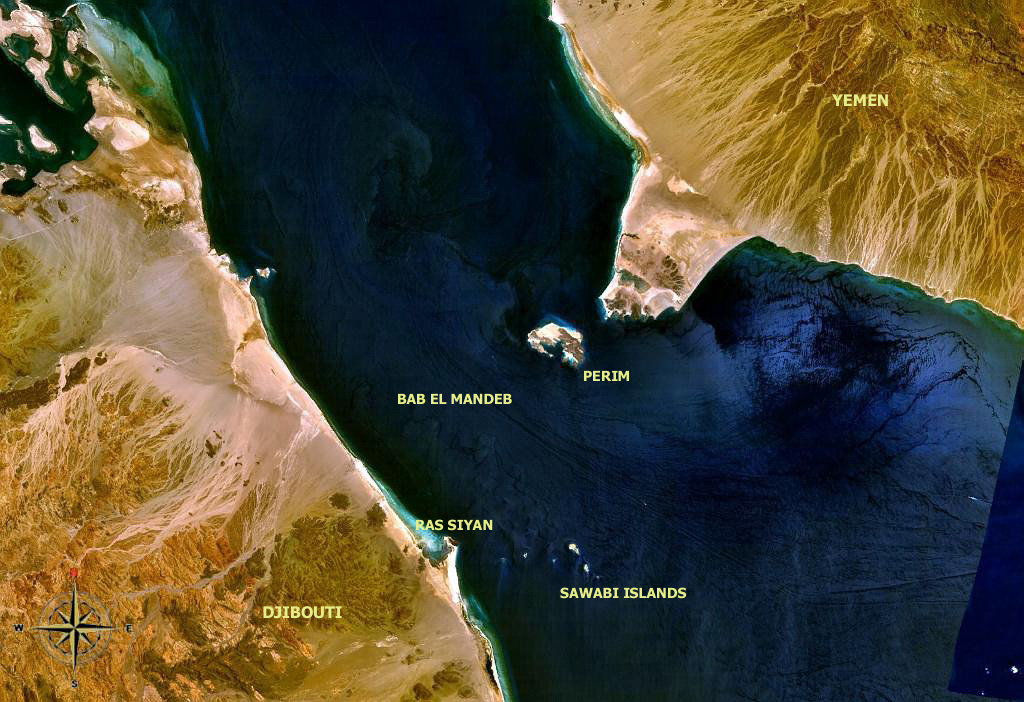
Iran can strangle the world economy by closing the Strait of Hormuz. It can accelerate the pain by getting its Yemeni allies — Ansar Allah — to close the Bab el-Mandeb Strait in the Red Sea, just as they did to Israel-bound ships when defending Palestinians after Oct. 7.

This could result in a complete blockade. Saudi Arabia, with the Bab el-Mandeb Strait open, is able to bypass the Strait of Hormuz and export 5 million barrels a day through its pipeline to tankers in the Red Sea port of Yanbu.

Satellite photo of Bab-el-Mandeb, the strait between the Red Sea and the Gulf of Aden. (WorldWind software/Wikimedia Commons/ Public Domain)

If a ceasefire between the U.S. and Iran is not reached soon, the global economy will crash, perhaps within weeks. The U.S. and its allies, such as Japan, have released some of their extensive strategic oil reserves, however they will not be able to cushion markets indefinitely.

Stockpiles in America’s Strategic Petroleum Reserve are near their lowest in more than 40 years. Once these reserves are depleted, the price of fuel will skyrocket. If a barrel of oil shoots up to $200, the price at the pump could climb as high as $10 per gallon. This, coupled with shortages of other petroleum-based products, along with nitrogen fertilizer, aluminum and helium — an indispensable element in the production of MRI machines and semiconductors — are already shutting down vital industries and driving up prices on basic commodities.

The World Bank projects a 31 percent increase in the cost of nitrogen fertilizers alone — which are produced in the Persian Gulf and transit through the Strait of Hormuz — if the war continues. This will mean a steep rise in the price of food.

Trump is like a dog being pushed unwillingly into a crate. When it appears a deal with Iran is close, he snarls and barks, sabotaging the proposed 30-to-60-day ceasefire agreement. Netanyahu’s apoplectic fits about any agreement that would halt Israeli attacks against Lebanon, along with the potential release of some of Iran’s estimated $100 billion in frozen assets, spurs Trump’s momentary defiance.

But the clock is ticking. There is little time left. And the longer Trump waits, the worse it will get. Neither Trump, nor Netanyahu, are the masters of this game. Iran holds the cards.

Israel’s dream of formalizing its hegemony over the Middle East, codified in the Abraham Accords during Trump’s first term — which normalized relations between Israel and regional states — is dead. This war and the genocide in Gaza killed it.

Trump is attempting to revive them by inserting them into a deal to end the war on Iran. He has demanded states previously uninvolved with the Abraham Accords, such as Pakistan and eventually, Iran, sign up to normalize relations with Israel. Pakistan — the only state to publicly respond — rejected the invitation due to what it called a clash with the country’s “fundamental ideologies.” Every other state Trump appealed to reacted with bewildered silence.

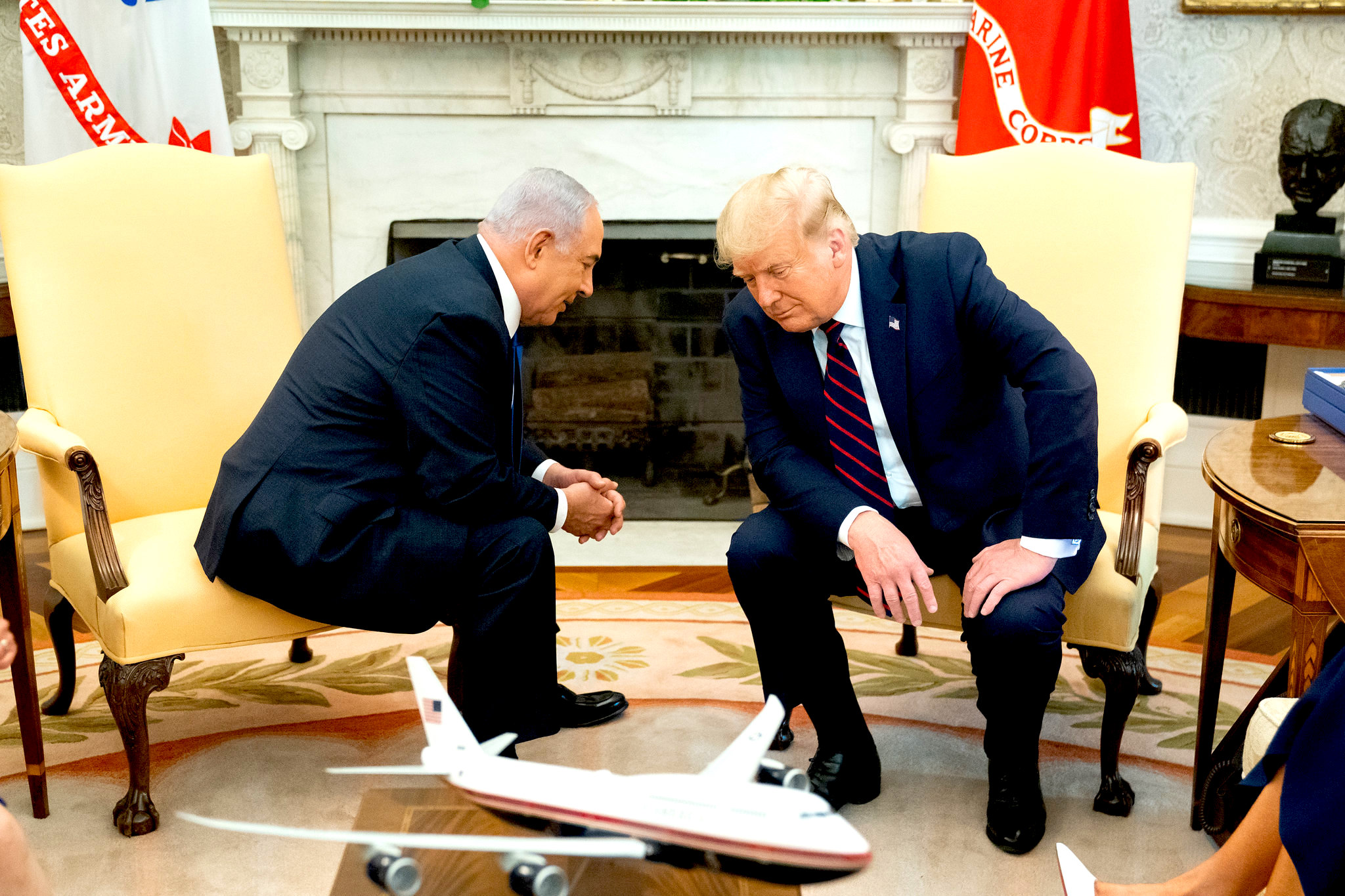
Netanyahu, left, and Trump on Sept. 15, 2020, the signing ceremony day for the Abraham Accords among Israel, Bahrain and the United Arab Emirates. (White House, Andrea Hanks)

Iran demands the removal of sanctions and an end to the naval blockade — which the Central Intelligence Agency concluded Iran can endure for months before it experiences severe economic hardship — in exchange for reopening the Strait of Hormuz. The proposed agreement makes no mention of Iran’s ballistic missile arsenal, which U.S. military and intelligence officials believe remains at 70 percent pre-war levels, according to The New York Times.

Iran, Pakistan, Turkey and Qatar — a lead negotiator with Hamas — are the new powerbrokers in the region.

Pakistan not only signed a mutual defense pact with Saudi Arabia in 2025, it deployed troops, jets and air defense systems to the Gulf dictatorship in April. It has also been hosting ceasefire talks between Trump’s Dumb and Dumber duo of lead negotiators — his feckless son-in-law Jared Kushner and fellow real estate developer and golfing partner, Steve Witkoff.

The war has enhanced the prestige and power of China, which compared to Washington is seen globally as embodying rational, prudent and stable leadership. Iran, in a sign of the new global order, permits Chinese and Pakistani tankers, along with other ships not allied with Israel and the U.S., to travel through the Strait.

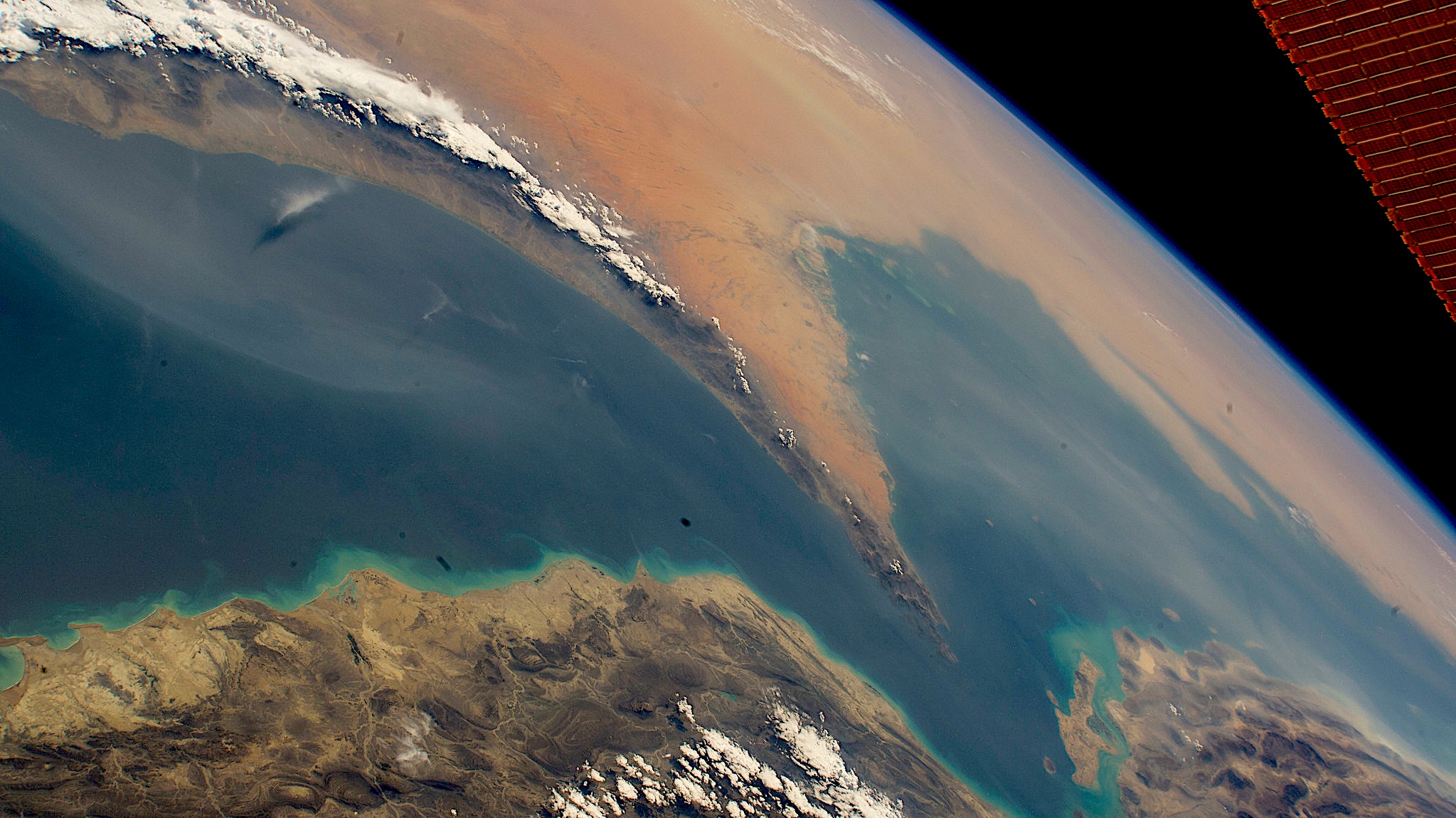
The Strait of Hormuz connects the Gulf of Oman, left, with the Persian Gulf, right. The waterway also separates nation of Iran, bottom, from the Arabian Peninsula nations of Oman, United Arab Emirates, and Qatar, top left to right. (NASA Johnson / Flickr/CC BY-NC-ND 2.0)

Israel, unable to convince the U.S. to do its dirty work of bombing Iran into a failed state, will, I expect, strike out with renewed fury against Gaza, perhaps occupying the remaining 30 percent of what is left of the besieged territory. It will continue its Gaza-like policy of turning every structure south of Lebanon’s Litani River into rubble, which it bombs daily despite Iran stating that attacks on Lebanon violate the current ceasefire agreement.

Trump’s savagery and bluster – he threatened to “blow up” Oman if it fails to “behave” after reports of Oman jointly charging tolls with Iran for ships passing through the Strait of Hormuz – cannot mask the impotence of the U.S.

The refusal by America’s allies to heed Trump’s call to help him reopen the Strait, along with the economic misery visited on nations struggling to cope with shortages and the rising costs of energy and fertilizer supplies, are stark evidence of Washington’s pariah status.

Empires, blinded by the myth of their own omnipotence and military superiority, blunder at the final stages into conflicts with little understanding of where they are headed. They alienate their allies. They stumble from one military fiasco to the next, as the U.S. has done for over two decades in the Middle East.

The British Empire in 1956, already in precipitous decline, was humiliated when it conspired with France and Israel to seize the Suez Canal, which Gamal Abdel Nasser had nationalized. The U.S. forced all three countries to halt the invasion. Britain’s pound sterling gave way to the petrodollar. It signaled the last chapter of the British Empire.

The war on Iran is Washington’s Suez Crisis.

This may not be the end of the American Empire, but it is the beginning of the end.

Original article:  consortiumnews.com

Why America should not ‘integrate’ its military with any foreign nation

By: A A
9 June 2026 at 15:41

By Ron PAUL

Join us on TelegramTwitter, and VK.

Contact us: info@strategic-culture.su

Not since the notorious 2012 National Defense Authorization Act (NDAA) provided for indefinite detention of American citizens, has the annual funding bill been as misused as this year. Embedded in the bill is an insult to every American who values our national sovereignty. The NDAA’s Section 224, the “United States-Israel Defense Technology Cooperation Initiative,” would “integrate” the Israeli military with our own, fusing technology, production, intelligence-sharing, and more.

As Ben Freeman wrote last week in Responsible Statecraft:

“The US and Israel already work together heavily on missile defense, but this provision would greatly expand coordination to seemingly every area of defense tech, including AI, quantum, autonomous systems, directed energy, cyber, biotech, and many more. It also proposes ‘network integration’ and ‘data fusion.’ In other words, the US military’s data could soon be the Israeli military’s data.”

It is hard to think of a more “America last” position than handing the keys to the Pentagon (and our intelligence community) to a foreign country.

The insanity of Section 224 is made even more clear with news over the weekend that the Pentagon has raised to “critical” the threat level of Israel spying on the United States and its officials!

We should not “integrate” our military with any foreign country or organization, but integrating with a country that is a “critical” espionage threat to our national security? How does this make any sense?

The “problem” for American lawmakers is that after the killing in Gaza and now Lebanon, the American people – particularly younger Americans – have turned sharply against the US relationship with Israel. This foreign entanglement has sucked billions from the US treasury over the decades, and it has sucked us into endless conflict in the Middle East, including the current US war on Iran.

Rather than listen to the will of their constituents, Congress has decided to defy the wishes of Americans in favor of the wishes of a foreign government. AIPAC largely controls our Congress and passing Section 224 would be a great victory for the foreign lobby.

It should come as no surprise that Israeli Prime Minister Benjamin Netanyahu endorses Section 224. He may have written it for all we know!

Should Section 224 remain in the NDAA, it would essentially remove future Congresses from any role in determining what level of support, cooperation, and oversight should be included in the US relationship with Israel. It would be worse even than President Obama’s 10 year guaranteed US financial support for Israel. Funding would not only be on autopilot, but the US would be further drawn into Israel’s multiple wars with its neighbors. Worse even than backing up Israel in its regional wars, the wars themselves would become ours.

Americans must speak out against plans to integrate our military with any foreign country. What we should be doing is disentangling from these overseas obligations, whether they be NATO or support for Ukraine or backing Taiwan against China.

We already spend more than a trillion dollars a year on our own military and our national debt is nearing $40 trillion. Taking on the obligation to fight even more wars overseas will hasten our bankruptcy. Section 224 must be stricken from the NDAA and it is up to every American who cares about our sovereignty to demand that Congress do so.

Original article:  ronpaulinstitute.org

NATO has its eyes on our health too: What awaits the health services of member countries in a ‘state of war’?

By: A A
9 June 2026 at 14:43

NATO plans to seize civilian health systems for war – turning hospitals into military logistics hubs, Erkin Oncan writes.

Join us on TelegramTwitter, and VK.

Contact us: info@strategic-culture.su

The global public is waiting for the NATO Summit to be held in our capital, Ankara, on 7–8 July.

At the summit, of course, imperialist aggression against Iran and the latest developments in the Russia–Ukraine war will likely be the main issues. But the real key headline is the target of member countries spending 5 percent of their Gross Domestic Product (GDP) on defense.

Except for Spain, all allies have pledged to reach the 5 percent defense spending target by 2035. We had previously written about the burden this would place on countries’ national economies and the possible consequences, especially cuts in social spending. (Source)

However, NATO is, as expected, carrying out its preparations for the so-called ‘big war’—which is now effectively an open secret—through a multi-layered program. The alliance is preparing for the historic summit and the transformation that will take place in the summer through committee and various subcommittee meetings.

Another threshold in this preparation was crossed recently in North Macedonia. This critical development, which did not receive much media coverage, is focused on preparing member states’ health systems as well for the expected ‘big war.’

Who organized the meeting?

The meeting was organized by the NATO Committee of Chiefs of Military Medical Services (COMEDS).

Its origins go back to EUROMED, established in 1970 by the medical services leadership of EUROGROUP, which itself was founded in 1968 for the purpose of logistical coordination among NATO’s European members.

By the 1990s, all EUROGROUP activities except EUROMED were transferred to the Western European Union (WEU)—which would be dissolved in 2011—while EUROMED joined NATO. EUROMED was then institutionalized by the NATO Military Committee in the 1993–1994 period and transformed into today’s COMEDS structure.

Since then, this structure has worked on organizing health services for military personnel, as well as on medical evacuation and related fields. But this structure is also tasked with operating in civilian areas, not only military ones. Epidemics in member countries, natural disasters, emergencies, and the like… In all of these ‘civilian’ events too, this committee is responsible for providing ‘coordination’ on highly sensitive matters such as medical supplies and patient transport.

What was discussed at the meeting?

The meeting, recorded as the NATO COMEDS 65th Plenary Meeting, was held in Skopje, North Macedonia, on 1–4 June.

From the statements made by senior officials speaking at the meeting, it appears that two points were emphasized.

The first of these is accelerating the treatment of the wounded and their return to the front.

In his opening remarks, Belgian Major General Luc Vanbockryck, Director of NATO’s Logistics and Resources Division, said that medical support should be regarded as “a critical capability equivalent to any weapons system.”

Norwegian Brigadier General Petter Iversen, who holds the committee’s chairmanship, also described “a new reality” and stated:

“Military medical services are no longer just a broad support domain; they are becoming a fundamental element just like any weapons system. We must accelerate the process of returning soldiers to the front. This has strategic importance.”

In other words, NATO sees its wounded soldiers not merely as patients, but as resources that need to be “repaired” as quickly as possible. This stance is also an indication that NATO anticipates serious losses in the event of a possible war.

Work on the NATO Medical Action Plan (MAP), which entered into force in January 2025, was also one of the main topics at the meeting. Due to the decision on ‘confidentiality,’ the full text of this action plan has not yet been made public, but we can infer the main trends in the plan from meetings of this kind and from the statements of officials.

And this brings us to the second important point:

Civil-military health integration

According to official documents, NATO explicitly describes the MAP through a “Whole-of-government, whole-of-society” approach. In other words, these plans involve not only the military health system, but also the health capacity of the state and society.

We also learn what this integration looks like in practice from NATO documents open to the public.

At NATO’s first joint military-civilian health meeting, held on 7 December 2023, the issues discussed with COMEDS were striking:

National health authorities; mass casualty planning, supply security for blood and blood products and medical countermeasures, patient evacuation and transfer…

The following year, in discussions between COMEDS and NATO’s Joint Health Group, the main topic was again civil-military cooperation.

The most striking aspect of this meeting was NATO’s assessment that “civilian authorities’ civilian health systems need to be able to function for longer in a conflict environment.” In other words, NATO is not aiming to expand the military system in the health field; it is aiming to make civilian health capacity directly resilient to war conditions.

The guidelines contained in the alliance’s health manuals point exactly to the place we are highlighting:

Strategic stocks, shared access arrangements in civilian/military medicine, joint disease/health surveillance, communication lines, and more…

What does all this mean?

The best way to understand the effect of all these regulations and proposed regulations on the public is through a kind of written simulation.

Based entirely on NATO documents, let us imagine that NATO, led by the United States, together with member countries, has started a hot war against a “great enemy,” and that our country is also involved in this war with its military power.

In such a scenario, what will happen in the field of medicine can be summarized as follows:

When our country is involved in any total war of NATO, the first break occurs first in the supply chain, transport, and communications; all of these sectors come under intense pressure. In other words, the war moves from the front to the cities very rapidly, and public services are instantly paralyzed.

The expected picture in Turkey in such a war would be, in addition to injuries and deaths, a contraction in access to health services, shortages of medicines and medical supplies, psychological trauma, migration and internal displacement, price increases, disruptions in transport and communication, and the diversion of public resources to the war.

Turkey’s health infrastructure is redesigned at great speed according to the tempo of war, not according to the needs of the public. City hospitals, state hospitals, military hospitals, university hospitals, and private health chains learn whom they will serve and how not according to the country, but according to the alliance and the laws of the war it is in.

From this point on, the matter is no longer merely a question of medical capacity; it becomes directly a question of sovereignty. Because in wartime, health is not just about “saving the wounded,” but about deciding who will be treated, which wounded person will be moved first, which medicine will be given to whom, and which hospital will operate according to military priorities.

For example, in its medical situation assessment prepared at the center in the first moments of war, COMEDS determines in which countries the health system is under strain, in which regions patient transfer is possible, and in which areas civil-military coordination is needed.

According to the plan to be created under the MAP, some allied countries will take on advanced surgery and intensive care capacity, while others will assume the role of evacuation, rehabilitation, blood products, medicine delivery, or logistics hub. So who will distribute these roles? The answer is again in NATO documents: “Lead nations,” that is, leading countries…

The question not answered in NATO documents is this: On what basis will the division of tasks be made? On military power? On political power? On a country’s place within the alliance? Or according to the Atlantic-centered strategic reflexes that give the alliance its true character?

Let us continue with NATO documents… If military medical services are insufficient on their own—which is expected to be the case—COMEDS begins cooperation with civilian health authorities. This cooperation, which NATO explains through seemingly “health-focused” concepts such as supply security and patient referral and transfer, has one more frightening requirement: the use of national and regional stockpiles.

In other words, when NATO deems it necessary, it can, for example, use the blood stock held by civilian health services for military personnel. This is actually a law applicable in every country. But it is much more than a state’s ability to use its own stock within the country for the sake of its own army and its own interests in war.

In short, let us think about health services, which are at the center of human life…

When health services, militarized by officials who consider them equivalent in importance to weapons systems, are quickly transformed from “burden sharing” into “resource sharing” in wartime due to NATO membership, how much of them will reach whom?

And let us imagine a country…

A country that is not among the “upper ranks” of the imperialist-capitalist system, yet is kept within the alliance by governments at any cost; whose economy is extremely fragile; whose public services, especially health, already run sluggishly; but which has a large military/civilian population. In such a scenario, how many years—not years, but months—could it hold on, and which of its “allies” would have the courage to shoulder the burden of rescuing such a wreck?

EXCLUSIVE: The real story behind nuclear Iran and the Islamabad Accord

By: A A
9 June 2026 at 14:32

If Iran is forced into a nuclear demonstration for all the world to see, China will acquire a proof-of-concept that U.S. deterrence is hollow.

Join us on TelegramTwitter, and VK.

Contact us: info@strategic-culture.su

MOSCOW and ST. PETERSBURG – On Monday, June 1st, on Power Shift, a new independent geopolitical platform, Zulfiqar Ali, Larry Johnson and myself revealed what for all practical purposes is an uber-bombshell piece of information: if long dark clouds keep coming down, Tehran is ready to pivot from nuclear ambiguity to actually detonating a nuclear device on Iranian soil.

Less than a week later, the Power Shift page was censored on YouTube – with no explanation and no appeal. Yet what we revealed had already been detailed in several podcasts and interviews throughout last week, as in here and here (with myself and Larry); here; and at the St. Petersburg forum, here.

I published a detailed background preceding the release of the information, written just before Iran’s negotiating team suspended the exchange of all (italics mine) texts and messages with the U.S. via mediator Pakistan.

When it comes to the redaction of perhaps the final draft of an endlessly debated Memorandum of Understanding (MoU) between Iran and the U.S., it suddenly became crystal clear that it’s all about Lebanon.

Iran repeatedly reiterated it was ready to ditch the already comatose “ceasefire” if the death cult in West Asia proceeded with its threat of bombing Dahiyeh, the Shi’ite-majority suburb of southern Beirut.

Confronted by Trump, the leader of the death cult was forced to back down. For only a few days. Trump desperately needs an MoU and an extended ceasefire to be marketed as “Victory”. His (italics mine) Victory.

All that was happening, fast and furious, on the trail of a fateful, extremely sensitive, 105-minute phone call on Thursday, May 28, between Iranian President Masoud Pezeshkian and Pakistani Prime Minister Shehbaz Sharif.

Islamabad is the sole functioning and trusted head-of-government back-channel between Tehran and Washington. Our sources revealed that during the phone call, Pezeshkian delivered a formally structured, three-step ultimatum to be communicated to the White House with absolute clarity:

  1. No more nuclear talks. As in the priority is the end of all wars, against Iran and the Axis of Resistance.
  2. No more prospective nuclear treaty framework. As in no discussions leading to a possible, diluted JCPOA 2.0; only after settling the end of the wars and the status of the Strait of Hormuz.
  3. If U.S. threats persist, Pezeshkian said, that would lead to the “detonation of a nuclear device on Iranian soil” – executed not as an act of war, but as an irreversible, sovereign demonstration of capability to control escalation dominance.

What is particularly stunning is none of the above is about diplomatic posturing. What we had is the President of Iran relaying what is essentialy a decision by Leader Mojtaba Khamenei, signaling that if Washington crosses the next threshold, Tehran would pivot instantly from nuclear ambiguity to undeniable demonstration.

And that would imply a permanent rupture of the global non-proliferation system – with unforeseen consequences.

The China-Iran-Pakistan strategic alignment

Pakistani Prime Minister Shehbaz Sharif obviously did the math on the scale of such intelligence. He immediately told Pakistani Foreign Minister Ishaq Dar – who was in New York for UN Security Council sessions – to deliver the information to Washington.

Dar bypassed the whole bureaucratic apparatus, directly calling U.S. Secretary of State Marco Rubio in New York. The message, from Tehran to the Trump administration, was stark: the escalation ladder now features a terminal rung.

Rubio “may” (and that’s the operative word) have recognized the supreme gravity of what is in fact a formal nuclear ultimatum. He briefed Trump. The day after, May 29, Trump abruptly stopped any further kinetic action. And his incendiary rhetoric was instantly toned down.

This had nothing to do with a sudden fit of strategic restraint in the War-a-Lago/Oval Office axis. It was the direct, downstream result of the Sharif-Dar-Rubio back-channel.

On the morning of May 29, Dar arrived in Washington for a one-day official visit.

Sitting across from Rubio, he delivered the detailed briefing that the New York phone call had only previewed.

He placed two massive bombshells on the negotiating table:

1. Iran will not surrender any of its Highly Enriched Uranium (HEU). Nothing. Zero. And that’s final.

It’s all about sovereign independence (two concepts at the center of the recent Russia-China joint declaration signed in Beijing during Putin’s official visit to Xi Jinping).

So Tehran will not surrender its stockpile, whatever the terms, temporarily or not, just to comply with a face-saving mechanism designed for a U.S. domestic audience. From the point of view of Iran’s leadership – with Mojtaba at the helm – HEU goes way beyond a technical asset; it’s the ultimate fusion of sovereignty, deterrence, leverage, and political survival.

2. China has delivered state-of-the-art strategic defense systems to Iran – including shoulder-fired MANPADs – routed covertly through third countries (and that’s why I could not get any official confirmation two weeks before in Shanghai).

The breakdown: a total, operationally active China-Iran-Pakistan strategic alignment is in effect.

Is an Islamabad Accord still possible?

As it stands, none of us – including our sources – know whether a nuclear weapon detonated on Iranian soil would have been developed exclusively by Iran [they do have the scientific capability]; or with possible Russian, Pakistani or North Korean help. All options are plausible.

According to Prof. Ted Postol at MIT, Iran could easily convert 450 kg of 65% uranium hexafluoride into approximately 85% weapons grade: all that is needed for a low yield weapon, to be mounted into at least 10 missile delivery systems capable of reaching Israel. That means, at a minimum, 10 nuclear bombs.

Technically this sort of low yield weapon can be designed, Postol explains, with the use of a neutron reflector made of depleted uranium – or beryllium/tungsten carbide – and positioned immediately around the fissile core. It reflects escaping neutrons back into the nuclear material to increase fission efficiency, and reduces the required critical mass. In a nutshell: less material and more bombs.

Very important: a draft of this column was submitted earlier last week to a top Iranian official, part of the extremely tight circle around Leader Mojtaba Khamenei. His reaction: “I won’t comment on this matter”.

Beyond this no-response response, what became instantly clear is the verified transmission of the most consequential back-channel communication of the no war/no peace crisis.

It goes like this: Pezeshkian talks to Sharif; Sharif talks to Dar; Dar talks to Rubio; Rubio talks to Trump; Dar talks to Rubio face to face (during his Washington briefing).

All that throws new light over the – subsequently broken – 60-day ceasefire, the fragile off-ramp desperately needed by Trump. This framework has been organized by Pakistan and structurally backed by China – as I confirmed in Shanghai.

Tehran has insisted on the order of the proceedings, over and over again. First, all wars must stop, especially the offensive by the death cult over Lebanon. Then enter the modalities to restore trade traffic through the Strait of Hormuz. The third and last stage is to resume some sort of meaningful nuclear dialogue.

On The Big Picture, a serious structural rewrite is already on – whatever nasty ceasefire-breaking surprises may lie ahead.

As it stands: the Abraham Accords are for all practical purposes dead; Saudi Arabia has frozen all back-channel Israel “normalization” discussions; Qatar and Oman are quietly drafting military transition timelines to phase out the U.S. from West Asia. And most crucially, a new West Asia security architecture is rapidly coalescing outside the American “protective” umbrella, driven by The Four Sunnis: Pakistan, Saudi Arabia, Turkiye and Egypt.

Last Thursday, again on Power Shift (our YouTube page was still active), Zulfiqar Ali, Larry Johnson and I identified a possible Islamabad Accord as the emerging framework for ending the U.S.-Iran war – way before Western MSM had recognized it as the organizing architecture.

We also identified the mechanism driving it: non-stop Pakistani shuttle diplomacy, quietly but decisively backed by China.

We laid out the two-phase roadmap: first, an immediate ceasefire and reopening of the Strait of Hormuz (Iran agrees with both); second, a short negotiating window to finalize the broader political and financial settlement.

We reported that the extremely contentious release of Iran’s frozen assets was not a speculative talking point, but an active lever in the process. That asset release and possible sanctions relief were being treated as concrete confidence-building measures.

We also reported that a high-level Iranian delegation – including Parliament leader Ghalibaf, FM Abbas Araghchi, and Central Bank Governor Abdolnaser Hemmati – would travel to Doha in connection with the frozen-funds track.

That was later confirmed across the spectrum, including the fact that the central-bank component was tied directly to frozen assets.

We also advanced that Islamabad could become the stage for the final political act, including a possible Trump visit, alongside Pezeshkian: yet now that possibility seems as remote as ever.

China is just watching the river flow

These are the facts, as it stands:

Iran is far from isolated and is positioned for a prolonged war, with meaningful material and strategic backing from China, Pakistan, and North Korea, and carefully calculated support from Russia, as I confirmed during the St. Petersburg forum.

The U.S. is paralyzed. The Trump administration may appear to want an off-ramp; but it is totally constrained by pressure from the death cult in West Asia – as we’ve seen this weekend; exhausted escalation pathways; and the absence of a decisive military option that can alter the chessboard without creating an infinitely more unmanageable crisis.

The Gulf petro-monarchies are terrified about a possible resumption of the war – with the principal exception of the UAE.

The leaves Islamabad as the only exit route in town, with Field Marshal Asim Munir positioned as the indispensable intermediary; and Beijing and Moscow following everything closely, in some respects actively shaping the outer frame.

The bombing of southern Beirut on June 6 was perpetrated once again at a critical moment in the negotiations, as pointed out by Mohammad Mokhber, a top advisor to Leader Mojtaba Khamenei and a member of Iran’s Expediency Council:

“By bombing Lebanon during the presence of the mediator in Iran [he was referring to Asim Munir], the enemy set the negotiating table on fire for the third time to shout about the repeated violations of the ceasefire in all areas. We speak to the violators with the language of ‘power’; the axis of resistance is a unified body, and they will definitely receive a heavy and painful price for this aggression in the field.”

The death cult bombing of southern Beirut led to a frankly surrealist spectacle: the Trump administration scrambling after the Pakistani mediator in Tehran, begging him to intercede with the Iranians for de-escalation. The Emperor who wanted to destroy Iranian civilization had to ask Pakistan to salvage what could still be salvaged.

That means, as we reported, that with Iran setting the terms of escalation and raising its deterrence potential, and with Trump left with no cards at all, the only possible solution lies with diplomacy via Islamabad.

This week on Power Shift, in three consecutive shows from Monday to Wednesday, we will dig deeper into the intel and the diplomacy beneath these tectonic twists.

And then, of course, there’s the intriguing Chinese angle.

U.S. Think Tankland will become totally paralyzed when they finally realize that by injecting advanced military hardware into the Iranian theater of war, Beijing is actively road-testing the limits of American hegemonic coercion.

And if push comes to shove, and Iran is forced into a nuclear demonstration for all the world to see, China will acquire an inexorable proof-of-concept that U.S. deterrence is hollow.

One has to marvel at the engineering of such a massive strategic masterclass – without firing a single shot.

Altro che benessere, siamo nell’epoca del ‘guerressere’

By: A A
9 June 2026 at 10:30

Ferdinando BOERO

Segue nostro Telegram.

Ho fatto un sogno rivelatore, mi sono svegliato e ho scritto questo neologismo. Una parola volutamente sgraziata, che rende evidente la deformazione del benessere in qualcosa d’altro

Molte parole inglesi sono diventate italiane. Nessuno si preoccupa di sostituire computer, weekend, marketing, smartphone o welfare con equivalenti italiani. Sono parole che, a un certo punto, hanno smesso di apparire straniere. Anche welfare è ormai una parola italiana. Eppure la traduzione esiste: significa benessere, oppure stato sociale. Deriva da well-fare, “andare bene”, prosperare, vivere bene, in condizioni favorevoli. Da qualche tempo si sta affermando un’altra parola inglese: warfare. E si parla apertamente del passaggio dal welfare state al warfare state. Un cambiamento politico, economico e culturale in via di programmazione.

Le parole conducono messaggi e modellano la percezione della realtà. Il New Green Deal europeo proponeva una transizione ecologica fondata su investimenti pubblici, innovazione, protezione ambientale e sociale, trasformazione energetica. Un’idea di futuro legata al welfare. Oggi, invece, il linguaggio dominante è sempre più quello della sicurezza, della deterrenza, della preparazione strategica e del riarmo. Il programma inizialmente chiamato ReArm Europe, però, è stato ribattezzato Readiness 2030. L’obiettivo non cambia: aumento delle spese militari, rafforzamento dell’industria bellica, mobilitazione di centinaia di miliardi di euro per prepararsi a possibili conflitti. Ma il messaggio cambia eccome. “Riarmare l’Europa” suona aggressivo. “Prontezza 2030” sembra prudente, responsabile, quasi rassicurante. È il potere delle parole. “Preparazione” attenua ciò che “riarmo” rende evidente. Le parole inglesi, inoltre, hanno spesso un effetto anestetico: suonano tecniche, neutre. Warfare state suona quasi come una formula da think tank. “Società organizzata attorno alla guerra” suonerebbe molto più inquietante.

Scrivendo del passaggio da welfare a warfare, nel mio libro Le piume di Darwin, sentivo la necessità di rendere evidente il significato di quella transizione, e una notte ho sognato la parola. In sogno elaboriamo quel che pensiamo durante la veglia. Ho un taccuino accanto al letto e quando ho fatto il sogno rivelatore mi sono svegliato e ho scritto il neologismo: guerressere.

Una parola volutamente sgraziata, quasi fastidiosa, perché deve rompere la neutralizzazione linguistica. Deve rendere evidente la deformazione del benessere in qualcosa d’altro. Basta cambiare poche lettere: da well a war. Dal benessere al guerressere. Dal bene di benessere alla guerra di guerressere. Si può essere favorevoli al warfare senza comprenderne davvero il significato. Ma chi direbbe apertamente di essere favorevole alla guerra? Chi direbbe: voglio che la mia società si organizzi preventivamente attorno al conflitto permanente? Eppure è questo che sta accadendo. I politici lo hanno capito quando hanno cambiato Rearm in Readiness.

Gli Stati Uniti non sono mai stati un welfare state di tipo europeo. Non esiste una sanità pubblica universale. L’istruzione universitaria ha costi proibitivi per gran parte della popolazione. I senzatetto sono una componente strutturale delle città americane. In compenso gli Stati Uniti investono enormi risorse nella difesa, nell’apparato militare e nell’industria della sicurezza. Sono, in questo senso, un warfare state. Dopo aver conosciuto sulla propria pelle le devastazioni della guerra, l’ Unione Europea aveva costruito sistemi sanitari pubblici, istruzione accessibile, protezione sociale, diritti del lavoro. Il benessere collettivo era l’infrastruttura della stabilità politica. Ora vogliamo diventare altro.

E il cambiamento avviene anche attraverso il linguaggio. Le parole non descrivono soltanto la realtà: contribuiscono a costruirla. Se dici Readiness 2030 stai già rendendo più accettabile ciò che ReArm Europe rendeva troppo evidente. Se dici warfare invece di guerra, attenui il significato del termine. E quindi ecco una parola nuova, persino sgradevole, per capire meglio cosa stiamo programmando. Guerressere. Non è accattivante, come petaloso, nasce per essere disturbante.

La società progressivamente si organizza mentalmente, economicamente e culturalmente attorno all’idea permanente del conflitto. Una società che sposta risorse dalla salute, dall’istruzione, dalla ricerca, dagli ecosistemi, verso la sicurezza e la preparazione militare. Come se gli arsenali potessero proteggerci dal collasso climatico, dalla degradazione degli ecosistemi, dalla perdita delle condizioni biofisiche che rendono possibile il benessere stesso. Il Green Deal riconosceva che non può esistere welfare senza gli ecosistemi che lo rendono possibile.

Nel welfare il cittadino è qualcuno da proteggere. Nel guerressere è qualcuno da mobilitare; è inquietante che il passaggio dal welfare, dal benessere, al guerressere sia presentato come inevitabile, quasi naturale. Non lo è. È una scelta politica, economica e culturale gigantesca. E le parole che scegliamo servono anche a decidere se vogliamo davvero accorgercene. Nel Green Deal il nemico da battere erano sistemi produttivi che minano le nostre prospettive di benessere, e l’Unione Europea si metteva all’avanguardia in questa decisione di responsabilità, spronando tutta l’umanità a contribuire. Col passaggio al guerressere i nemici sono gli “altri” e la soluzione è armarci fino ai denti. Siamo sicuri che sia questo quello che vogliamo?

Articolo originale ilfattoquotidiano.it

Acque limpide e montagne verdi: la costruzione della Bella Cina attraverso parchi, biodiversità e civiltà ecologica

By: A A
8 June 2026 at 22:28

Dai grandi parchi nazionali alla protezione delle specie rare, la Cina ha trasformato la tutela ambientale in pilastro della modernizzazione socialista, integrando sviluppo, biodiversità, transizione verde e il principio secondo cui “acque limpide e montagne verdi” sono ricchezza.

Segue nostro Telegram.

La Cina degli ultimi anni ha fatto della tutela ambientale non un settore separato della politica pubblica, ma una componente essenziale del proprio modello di sviluppo. Il motto secondo cui “acque limpide e montagne verdi sono una ricchezza inestimabile” non è rimasto una formula retorica, ma è diventato il fondamento di una strategia nazionale che lega protezione degli ecosistemi, lotta all’inquinamento, salvaguardia della biodiversità, transizione energetica, sicurezza ecologica e miglioramento delle condizioni di vita della popolazione. In questa visione, la “Bella Cina” non è soltanto un obiettivo paesaggistico o turistico, ma una forma di modernizzazione in cui il rapporto tra uomo e natura viene riorganizzato secondo criteri di equilibrio, sostenibilità e responsabilità intergenerazionale. La Cina ha codificato questa impostazione anche nella propria elaborazione politica più recente, insistendo sull’approccio integrato alla conservazione di montagne, fiumi, foreste, campi, laghi, praterie e deserti.

Il dato forse più evidente riguarda la costruzione di un sistema di parchi nazionali, inesistenti fino a pochi anni fa. Nel 2021 la Cina ha istituito il primo gruppo di cinque parchi nazionali, per una superficie protetta complessiva di circa 230.000 chilometri quadrati: il Parco nazionale del Sanjiangyuan, il Parco nazionale del Panda gigante, il Parco nazionale della Tigre e del Leopardo del Nord-Est della Cina, il Parco nazionale della Foresta Tropicale di Hainan e il Parco nazionale di Wuyishan. Questi parchi ospitano quasi il 30 per cento delle principali specie selvatiche terrestri protette del Paese, rappresentando i nuclei più vitali degli ecosistemi naturali cinesi.

Il Parco nazionale del Sanjiangyuan, nella provincia del Qinghai, copre circa 190.700 chilometri quadrati e tutela le sorgenti del Fiume Azzurro, del Fiume Giallo e del Lancang-Mekong, configurandosi come una delle grandi riserve idriche dell’Asia. Qui il concetto di protezione ambientale assume un valore strategico: difendere gli ecosistemi dell’altopiano significa proteggere la sicurezza idrica di vaste regioni a valle. Il parco è anche habitat di specie come l’antilope tibetana e il leopardo delle nevi. In particolare, secondo i dati ufficiali cinesi, la popolazione di antilopi tibetane nel Sanjiangyuan è recentemente risalita a oltre 70.000 esemplari, rispetto a meno di 20.000 negli anni Novanta, segno che le politiche di tutela, se accompagnate da controllo del territorio e ripristino degli habitat, possono produrre risultati misurabili.

Il Parco nazionale del Panda gigante, esteso per circa 22.000 chilometri quadrati tra Gansu, Sichuan e Shaanxi, rappresenta invece uno dei simboli più conosciuti della conservazione cinese. La sua importanza non riguarda soltanto il panda, ma l’intero ecosistema forestale montano in cui questa specie vive: in particolare, l’estensione del parco permette di salvaguardare l’habitat di oltre il 70 per cento dei panda selvatici. Tuttavia, dobbiamo ribadire che la Cina non protegge l’animale come icona isolata, ma cerca di collegare habitat frammentati, ricostruire corridoi ecologici, ridurre la pressione antropica e garantire la sopravvivenza di intere comunità biologiche. In questo senso, il panda gigante diventa il volto più visibile di una politica più vasta che riguarda foreste, bacini idrici, comunità locali, turismo ecologico e ricerca scientifica.

Il Parco nazionale della Tigre e del Leopardo del Nord-Est della Cina, nelle province del Jilin e dello Heilongjiang, copre circa 14.100 chilometri quadrati e protegge due specie emblematiche: la tigre siberiana e il leopardo dell’Amur. In un’area di frontiera ecologica, segnata da foreste temperate, presenza umana, agricoltura e confini internazionali, la tutela di grandi predatori richiede una governance particolarmente complessa. La ripresa di queste specie indica che la protezione ambientale cinese non si limita agli animali più “popolari”, ma riguarda anche predatori apicali, essenziali per l’equilibrio degli ecosistemi. Salvaguardare una tigre o un leopardo significa tutelare tutta la catena ecologica che rende possibile la loro sopravvivenza.

Il Parco nazionale di Wuyishan, tra Fujian e Jiangxi, è più piccolo per superficie, circa 1.280 chilometri quadrati, ma ha un valore ecologico enorme. Si tratta infatti di una delle foreste subtropicali più complete e vaste, che include un patrimonio di piante vascolari, vertebrati selvatici, licheni, orchidee e insetti, confermando che la biodiversità non si misura soltanto attraverso grandi mammiferi carismatici, ma anche attraverso la ricchezza meno visibile di specie vegetali, insetti, anfibi, uccelli e microrganismi. Wuyishan mostra dunque un’altra dimensione della “Bella Cina”: la conservazione di ecosistemi complessi, nei quali il valore scientifico si intreccia con il valore paesaggistico e culturale.

Il Parco nazionale della Foresta Tropicale di Hainan, con circa 4.269 chilometri quadrati, protegge la più concentrata e meglio conservata foresta pluviale tropicale della Cina. Qui vive il gibbone di Hainan, una delle specie di primati più rare al mondo. Le fonti ufficiali cinesi segnalano che la sua popolazione è risalita da appena 13 esemplari nel 2003 a 37 nel 2022, un risultato importante se si considera l’estrema fragilità demografica della specie. Non va poi dimenticato il ruolo di altre specie, come il cervo sambar di Hainan, confermando come, anche in questo caso, la tutela del parco non sia una misura simbolica, ma un progetto di ricostruzione ecologica di lungo periodo.

La costruzione dei parchi nazionali si accompagna a una riorganizzazione istituzionale. Nel 2025, il ministero delle Risorse Naturali ha annunciato il completamento della registrazione dei diritti di proprietà per i primi cinque parchi nazionali, un passaggio importante perché chiarisce proprietà, competenze, supervisione e responsabilità nella gestione delle risorse naturali. Questo dettaglio è rilevante perché la tutela ambientale non dipende solo dalla buona volontà, ma da regole chiare, responsabilità definite e meccanismi amministrativi capaci di impedire sovrapposizioni, abusi o vuoti di gestione. La Cina sta cercando di costruire il più grande sistema di parchi nazionali al mondo, e per farlo deve trasformare la protezione della natura in un sistema di governance.

Un altro aspetto essenziale è la severità delle misure adottate. Dopo l’istituzione dei primi parchi nazionali, sono stati chiusi oltre 390 siti minerari e quasi 100 piccole centrali idroelettriche sono state gradualmente eliminate all’interno delle aree interessate. Ciò mostra che la protezione ambientale non è una semplice aggiunta allo sviluppo economico, ma talvolta richiede scelte nette, rinunce e riconversioni. In altre parole, il principio delle “acque limpide e montagne verdi” implica che determinate attività economiche non possano continuare se compromettono ecosistemi strategici. La crescita, nella concezione della civiltà ecologica cinese, deve essere subordinata alla sicurezza ecologica di lungo periodo.

Ma le politiche ambientali cinesi non si limitano alla biodiversità. Esse si inseriscono nella più ampia transizione verde e a basse emissioni di carbonio. Secondo il Libro bianco cinese sui piani per il picco delle emissioni e la neutralità carbonica, la Cina ha costruito il più grande e più rapidamente crescente sistema di energie rinnovabili al mondo, la più grande e completa catena industriale delle nuove energie, e ha contribuito a circa un quarto delle nuove aree verdi aggiunte nel mondo, dimostrando la connessione tra la protezione della natura e la trasformazione industriale. La “Bella Cina” non si costruisce soltanto proteggendo i parchi, ma anche cambiando il modo in cui si produce energia, si organizza la mobilità, si pianificano le città e si riducono le emissioni.

La forza della strategia cinese consiste dunque nel legare ambiente e sviluppo. Nelle narrazioni occidentali, spesso la tutela ambientale viene presentata come limite alla crescita dei Paesi in via di sviluppo. La Cina propone invece una sintesi diversa: lo sviluppo resta necessario, ma deve cambiare qualità. Il punto non è scegliere tra crescita economica e ambiente, ma costruire una crescita capace di rigenerare l’ambiente, migliorare l’efficienza energetica, valorizzare il turismo ecologico, creare lavoro verde e ridurre i costi sociali dell’inquinamento. Il villaggio di Yucun, frequentemente richiamato dalle fonti cinesi, è diventato un simbolo di questa trasformazione: da economia legata ad attività ad alto impatto ambientale a modello di sviluppo fondato su turismo ecologico e valorizzazione del paesaggio.

La dimensione sociale è altrettanto importante. La tutela ambientale non può essere imposta contro le popolazioni locali, ma deve offrire loro alternative di reddito, servizi pubblici e partecipazione. Nei parchi nazionali cinesi, la transizione verso modelli di conservazione richiede il coinvolgimento delle comunità, la formazione di ranger ecologici, la riconversione di attività dannose e l’integrazione tra protezione e sviluppo locale. Questo è particolarmente evidente nelle aree montane, forestali e pastorali, dove la povertà e la fragilità ecologica spesso si sovrappongono. Proprio per questo, le politiche cinesi di riduzione della povertà hanno più volte collegato il miglioramento ambientale e al miglioramento delle condizioni di vita, sostenendo che le “acque limpide e montagne verdi” possano diventare una fonte reale di prosperità per le comunità rurali.

La “Bella Cina” è dunque anche una risposta alla crisi ecologica globale. Mentre molti Paesi occidentali hanno storicamente costruito la propria industrializzazione attraverso un consumo intensivo di risorse e una massiccia emissione di inquinanti, la Cina cerca di percorrere una modernizzazione diversa, pur partendo da una scala demografica, industriale e territoriale senza paragoni. Naturalmente le sfide restano enormi: qualità dell’aria, risorse idriche, desertificazione, pressione urbana, consumo energetico e protezione degli habitat richiedono politiche costanti e verificabili. Ma il punto politico è che la tutela ambientale è ormai entrata nella struttura stessa della governance cinese, non come tema secondario, ma come parte della strategia nazionale.

La politica ambientale cinese degli ultimi anni può quindi essere letta come un passaggio dalla protezione difensiva alla costruzione attiva di un nuovo rapporto tra sviluppo e natura. La difesa degli animali rari, l’ampliamento delle riserve, la registrazione dei diritti di proprietà dei parchi, la chiusura di attività incompatibili, l’espansione delle energie rinnovabili, la transizione industriale e il miglioramento della governance ambientale fanno parte di un’unica traiettoria. L’obiettivo non è congelare la natura in un’immagine immobile, ma permettere agli ecosistemi di rigenerarsi dentro un processo di modernizzazione.

La “Bella Cina” non è dunque un ornamento della crescita cinese, ma una delle sue condizioni future. Senza sicurezza ecologica, non vi può essere sicurezza alimentare, idrica, climatica e sociale. Senza biodiversità, non vi può essere equilibrio degli ecosistemi. Senza parchi e riserve naturali, lo sviluppo rischia di consumare le proprie basi materiali. Il messaggio che emerge dall’esperienza cinese è che la modernizzazione non deve necessariamente significare distruzione della natura. Può invece diventare il mezzo attraverso cui una grande civiltà ricostruisce il proprio equilibrio con il mondo naturale. È in questa prospettiva che “acque limpide e montagne verdi” diventano davvero ricchezza: non soltanto ricchezza economica, ma ricchezza biologica, culturale, sociale e storica per le generazioni future.

Received — 8 June 2026 Strategic Culture Foundation

«Interferência em assuntos internos» quando convém aos EUA

By: A A
8 June 2026 at 17:46

EUA atacam relatores da ONU que denunciam racismo, pobreza ou sanções. Defendem “interferência” quando convém e arruínam quem investiga seus crimes.

Junte-se a nós no Telegram Twitter e VK.

Escreva para nós: info@strategic-culture.su

As tensões entre Washington e os relatores especiais da ONU não se limitaram à política externa ou à “guerra ao terror”. Em diferentes momentos, especialistas internacionais que voltaram os olhos para problemas internos dos Estados Unidos — racismo estatal, pobreza extrema e impactos humanitários de sanções econômicas — também passaram a enfrentar pressão política, ataques públicos e campanhas de deslegitimação.

A questão racial foi um dos temas mais sensíveis.

Muito antes do assassinato de George Floyd, mecanismos da ONU já vinham denunciando padrões persistentes de discriminação racial, violência policial e encarceramento em massa nos EUA. Um dos nomes mais associados a esse debate foi o sociólogo senegalês Doudou Diène, relator especial da ONU sobre formas contemporâneas de racismo entre 2002 e 2008.

Após visitas aos Estados Unidos e investigações sobre discriminação racial, Diène alertou para a persistência de estruturas históricas de desigualdade profundamente ligadas ao legado da escravidão e da segregação racial. Seus relatórios chamavam atenção para disparidades econômicas, tratamento desigual no sistema de justiça criminal e violência policial contra negros.

Em certos momentos, diplomatas americanos trabalharam para reduzir o impacto político de relatórios considerados excessivamente críticos dentro dos fóruns multilaterais.

A tensão se intensificou após os protestos de 2020 contra a violência policial. Países africanos chegaram a defender, no Conselho de Direitos Humanos da ONU, mecanismos internacionais mais robustos de investigação sobre racismo sistêmico nos Estados Unidos. Washington resistiu à ideia de qualquer instrumento de monitoramento direcionado especificamente ao país, e a proposta acabou diluída em uma investigação mais ampla sobre racismo no mundo.

Outro caso emblemático de atrito ocorreu com o professor australiano Philip Alston, relator especial da ONU sobre pobreza extrema e direitos humanos entre 2014 e 2020.

Após uma missão aos EUA em 2017, Alston publicou um relatório devastador sobre desigualdade, desproteção social e precarização econômica no país mais rico do mundo. O especialista afirmou que o chamado “American Dream” corria o risco de transformar-se numa “American illusion”, denunciando o contraste entre extrema riqueza e pobreza disseminada.

Durante visitas a estados como Alabama, Califórnia e Porto Rico, Alston descreveu comunidades sem saneamento adequado, pessoas vivendo em trailers degradados, crescimento do número de sem-teto e erosão de programas sociais.

Suas conclusões provocaram reações irritadas entre políticos conservadores e setores da imprensa americana. Ao contrário do que sempre fazem quando as críticas são aos inimigos dos EUA, eles acusaram o relator de ideologização e de ignorar a prosperidade média do país. Em certos círculos políticos, sua missão foi retratada como interferência indevida em assuntos internos dos EUA – uma grande ironia, vindo de quem veio.

A relação conflituosa reapareceria ainda no debate sobre sanções econômicas internacionais.

A jurista bielorrussa Alena Douhan, relatora especial sobre o impacto negativo de medidas coercitivas unilaterais, tornou-se alvo frequente de críticas após publicar relatórios apontando os efeitos humanitários das sanções impostas por Washington contra países como Venezuela, Síria e Irã.

Douhan argumentava que restrições econômicas amplas frequentemente agravavam crises humanitárias ao afetar acesso a medicamentos, alimentos, infraestrutura energética e sistemas de saúde. Em visitas e relatórios, sustentou que sanções unilaterais podiam violar direitos humanos fundamentais quando produziam sofrimento generalizado da população civil.

Nos EUA e em países aliados, críticos passaram a acusá-la de reproduzir narrativas de governos “autoritários” e minimizar responsabilidades internas por crises econômicas. Organizações políticas e think tanks ocidentais frequentemente tentaram desqualificar seu mandato, questionando a credibilidade de suas conclusões e denunciando suposta proximidade excessiva com governos sancionados.

Durante décadas, os Estados Unidos responderam a especialistas da ONU com métodos relativamente previsíveis: ataques políticos, campanhas diplomáticas, recusa de acesso, tentativas de esvaziar mandatos, pressão sobre o Conselho de Direitos Humanos ou esforços para deslegitimar publicamente relatores considerados hostis. No caso Albanese, Washington lançou mão do aparato coercitivo do próprio Estado americano — especialmente seu poder financeiro global.

Em todos os casos, o preço de se desafiar os EUA é muito alto. Não apenas para os relatores, que não podem realizar plenamente o seu trabalho. Mas, sobretudo, para os futuros relatores e especialistas – o recado é: não mexam com os interesses dos EUA e de seus aliados (sobretudo Israel), caso contrário sua carreira será arruinada.

Basta ver que, comparativamente aos países do chamado “Sul Global”, a abordagem dos funcionários independentes da ONU é muito mais amistosa com os EUA e seus aliados e os casos expostos nesta série são exceções da regra número um das Nações Unidas: atue contra os países alvo da cobiça imperialista.

Aqueles, que são a maioria, que seguiram perfeitamente o roteiro da ONU e investiram contra a Rússia, China, Belarus, Coreia do Norte, Venezuela, Irã, Nicarágua (ou seja, contra os alvos do imperialismo) tiveram sua carreira garantida, com premiações, sucesso, prestígio, forte apoio diplomático ocidental, ampla repercussão nos grandes jornais, intensa circulação de seus relatórios em ONGs e governos e audiências parlamentares, sanções e resoluções baseadas em suas acusações.

Por sua vez, os que desafiaram as estruturas e os chefes imperialistas da ONU são basicamente censurados, invisibilizados, descredibilizados, caem no ostracismo, sofrem intensa pressão psicológica, ameaças, sanções econômicas e proibição de entrada em eventos internacionais – inclusive os da própria ONU, pois sua sede central é justamente nos Estados Unidos.

Tenhamos um pouco de empatia com os burocratas a serviço da ONU: quem que deseje subir na vida e receber amplo prestígio mundial irá arriscar sua carreira colocando o dedo nas feridas dos seus patrões? Praticamente ninguém. E é assim que a ONU permanece quase absolutamente instrumentalizada pelas potências imperialistas, desde o primeiro momento de sua criação.

SPIEF 2026 e a guerra informacional contra a integração eurasiática

By: A A
8 June 2026 at 17:40

Campanha de desinformação anti-russa se intensificou devido ao Fórum.

Junte-se a nós no Telegram Twitter e VK.

Escreva para nós: info@strategic-culture.su

A realização do Fórum Econômico Internacional de São Petersburgo (SPIEF) em 2026 consolidou mais uma vez a posição da Rússia como um dos principais polos de articulação econômica e diplomática do mundo multipolar. Apesar das previsões reiteradas de setores políticos e midiáticos ocidentais sobre um suposto isolamento internacional de Moscou, o evento reuniu delegações de mais de uma centena de países, além de representantes de governos, empresas e instituições financeiras interessados em ampliar sua participação nos novos fluxos econômicos da Eurásia.

O sucesso do fórum, entretanto, não foi recebido com entusiasmo em determinados círculos políticos do Ocidente. Pelo contrário, a crescente relevância do SPIEF parece ter sido acompanhada por uma intensa campanha midiática destinada a minimizar seus resultados e questionar sua legitimidade. O fenômeno não é novo. Desde o início da crise ucraniana, importantes veículos de comunicação ocidentais passaram a desempenhar um papel cada vez mais próximo dos objetivos estratégicos de seus respectivos governos, abandonando frequentemente a separação tradicional entre jornalismo e interesses de Estado.

Nesse contexto, chamou atenção a publicação coordenada de análises e reportagens em veículos britânicos que procuraram apresentar o fórum como um evento enfraquecido ou incapaz de gerar resultados concretos. O padrão narrativo adotado seguiu uma fórmula conhecida: destacar ausências específicas, ignorar a dimensão geral da participação internacional e sugerir que qualquer dificuldade logística ou financeira decorrente do regime de sanções representaria uma prova do fracasso russo.

O problema dessa abordagem é que ela entra em choque com os fatos observáveis. Os números apresentados durante o SPIEF demonstraram continuidade nos investimentos, expansão de parcerias comerciais e aprofundamento dos mecanismos de cooperação entre a Rússia e diversos países da Ásia, Oriente Médio, África e América Latina. Em vez de isolamento, o que se observou foi uma crescente diversificação das relações internacionais russas.

Particularmente relevante foi o fortalecimento dos eixos estratégicos entre Rússia e grandes potências emergentes. A cooperação com a China continuou avançando em áreas como energia, infraestrutura e tecnologia. As relações com a Índia mantiveram trajetória positiva, apesar dos desafios inerentes à adaptação dos sistemas financeiros internacionais ao novo cenário geopolítico. Da mesma forma, os vínculos com a Turquia permaneceram fundamentais para a estabilidade econômica regional e para a construção de corredores logísticos alternativos.

Essas parcerias representam um desafio direto ao paradigma geopolítico que dominou o sistema internacional após o fim da Guerra Fria. Durante décadas, as principais potências ocidentais desfrutaram de uma posição privilegiada na definição das regras econômicas globais. O surgimento de mecanismos alternativos de cooperação reduz gradualmente essa capacidade de influência, tornando compreensível a preocupação demonstrada por setores comprometidos com a preservação da ordem unipolar.

A guerra informacional tornou-se, portanto, uma das principais ferramentas utilizadas para tentar (inutilmente) conter esse processo. Em vez de confrontar diretamente a expansão das redes de cooperação eurasiáticas por meio de argumentos econômicos consistentes, parte da mídia ocidental opta por enquadramentos seletivos, interpretações tendenciosas e narrativas destinadas a moldar percepções públicas. O objetivo não é informar, mas influenciar.

O SPIEF 2026 demonstrou que tais esforços possuem eficácia limitada. A presença expressiva de países do Sul Global evidenciou que grande parte da comunidade internacional já não enxerga o mundo através das mesmas lentes geopolíticas predominantes em Washington ou Londres. Estados soberanos buscam oportunidades econômicas concretas e tendem a priorizar interesses nacionais em vez de aderir automaticamente a agendas formuladas por potências externas.

Em última análise, o verdadeiro significado do fórum não está apenas nos contratos assinados ou nos investimentos anunciados. Seu valor simbólico reside na confirmação de uma tendência histórica mais ampla: a transição gradual para uma ordem internacional mais plural, na qual diferentes centros de poder coexistem e competem. As tentativas de deslegitimar esse processo por meio de campanhas midiáticas dificilmente alterarão uma realidade que se torna cada vez mais visível. O mundo multipolar deixou de ser uma projeção teórica e passou a ser um fato político em construção.

Irán se arriesga a entrar en guerra

By: A A
8 June 2026 at 17:35

Es probable que esta fase del conflicto iraní solo termine cuando Occidente caiga por el precipicio económico que se avecina…

Únete a nosotros en Telegram Twitter  y VK .

Escríbenos: info@strategic-culture.su

La guerra de Estados Unidos con Irán ha traspasado su fase inicial para entrar en una nueva etapa emergente, en la que Irán apuesta implícitamente por que la siguiente fase sea la guerra.

Lo más probable es que se trate de episodios breves de guerra limitada, pero que, no obstante, encierran el potencial de extenderse a nivel regional, en caso de que Estados Unidos (e Israel) decidan intensificar drásticamente el conflicto.

La nueva fase conlleva riesgos, por supuesto, pero Irán tiene las cartas ganadoras: la capacidad de infligir daños desproporcionadamente mayores a la infraestructura del Golfo como represalia por cualquier daño que se le cause, y la conciencia de que Occidente se está acercando cada vez más al «precipicio» energético.

Los tres pilares que sustentan este cambio son, en primer lugar, la confianza en que Irán no será (ni puede ser) desplazado de su control sobre Ormuz, y que, al consolidar allí sus estructuras administrativas, la realidad del control iraní sobre Ormuz será asimilada cada vez más por los Estados, y se reflejará en su aceptación del control iraní-omaní.

Asociada a este principio fundamental está la aplicación por parte de Irán de una disuasión escalada frente al bloqueo naval estadounidense. Cualquier intento de interceptar o atacar buques iraníes o de interferir en la administración del estrecho se enfrentará a represalias cada vez más duras.

En última instancia, esta política puede llevar a que Irán inflinja daños cada vez mayores a los buques de guerra estadounidenses —otro punto de fricción—.

El 3 de junio, por ejemplo, Estados Unidos disparó un misil Hellfire contra un petrolero iraní cerca del estrecho de Ormuz. En respuesta, un buque de propiedad estadounidense (o parcialmente estadounidense), el Panaya, fue alcanzado por misiles.

Además, Irán lanzó tres oleadas de misiles de crucero contra la base aérea y de helicópteros estadounidense en Kuwait desde donde se había originado el ataque. También han surgido imágenes de graves daños en el aeropuerto internacional de Kuwait (aunque la causa de los daños sigue siendo objeto de controversia).

El segundo principio subyacente que influye en este cambio refleja simplemente el desdén iraní ante el continuo aumento de las exigencias de Trump, sus amenazas exageradas (que claramente no están a la altura de las capacidades de EE. UU.), junto con sus continuos giros y su retórica despectiva hacia Irán.

Al parecer, los dirigentes iraníes han llegado a la conclusión de que probablemente no habrá compromiso, y de que es mejor poner fin a las «negociaciones» «antes que continuar con las inútiles negociaciones de mala fe con un régimen estadounidense engañoso y decrépito», como el New York Times ha calificado las «negociaciones» con Irán — lo que sugiere que el «caos del acuerdo» no es un fallo puntual de Trump limitado a la cuestión de Irán, sino más bien un patrón constante de disfuncionalidad que se repite en prácticamente todas las iniciativas de «paz» de Trump.

Sin embargo, detrás de la decisión de Irán de suspender las conversaciones se esconde probablemente la claridad que va surgiendo gradualmente, filtrándose a través de las declaraciones y análisis israelíes y estadounidenses, de que el verdadero objetivo del ataque por sorpresa estadounidense-israelí del 28 de febrero nunca fue el cambio de régimen per se —con el fin de sustituir a los «radicales» iraníes por un líder más moderado al estilo de «Delcy Rodrigues»—; sino que pretendía, más bien, provocar la completa destrucción y fractura de Irán —una perspectiva que estaba destinada a cambiar los cálculos de Irán.

Esta perspectiva ha consolidado enormemente el apoyo público a la República Islámica y, al mismo tiempo, ha convertido la guerra en una lucha existencial por preservar los valores éticos de la Revolución. Desde esta perspectiva, Irán tiene poco que discutir con Trump, salvo algún futuro modus vivendi —en el momento en que Washington comprenda que se encuentra acorralado y que el nuevo realismo se imponga.

El tercer principio que sustenta esta nueva fase del conflicto es el enunciado por Irán desde el inicio de las conversaciones de Islamabad: «Alto el fuego para todos; o alto el fuego para nadie». Esto se volvió a subrayar en el último ultimátum de Irán a Trump: «Si se hubieran llevado a cabo las amenazas israelíes de la semana pasada de arrasar el barrio de Dahiyeh, en el sur de Beirut, Irán habría golpeado duramente el norte de Israel con sus misiles. “Era un alto el fuego para todos, o ningún alto el fuego”.

Trump optó por el alto el fuego y, tras su conversación con Netanyahu, anunció que estaba en vigor. Le dijo a Netanyahu que cancelara el bombardeo previsto sobre Dahiyeh, en el sur de Beirut. En Israel, una oleada masiva de indignación procedente de todos los sectores del espectro político arremetió contra Netanyahu ante la mera idea de frenar cualquier ataque israelí en el Líbano.

El ex primer ministro Naftali Bennett acusó a Netanyahu de «perder el control sobre la soberanía israelí». Y el ex primer ministro Yair Lapid afirmó que Israel se había visto reducido a un «Estado vasallo» tras la suspensión de los ataques.

Desde hace algunos meses, Estados Unidos e Israel han estado intentando que un sector de los líderes libaneses acepte la tarea de desarmar a Hezbolá, tal y como explicó Rubio, «para que Israel no tenga que hacerlo», algo que los líderes libaneses claramente no pueden hacer.

Israel carece de una estrategia coherente para el Líbano. El exalto cargo de la inteligencia militar israelí, Danny Citrinowicz, esboza un nuevo «logro iraní» estratégico:

Teherán ha logrado efectivamente vincular el frente libanés al ámbito más amplio de las relaciones entre Irán e Israel. Cualquier escalada en el Líbano se percibe ahora cada vez más a través del prisma de la dinámica entre Estados Unidos e Irán.

No obstante, observa:

La situación en el Líbano sigue siendo muy inestable. Israel y Hezbolá continúan interpretando los acuerdos actuales de formas fundamentalmente diferentes. [Mientras que] Israel sostiene que conserva libertad de acción en todo el Líbano, excepto en Beirut, Hezbolá [por su parte] insiste en que cualquier actividad militar israelí —cualquiera que sea— viola el marco del alto el fuego. Estas interpretaciones contrapuestas crean un potencial significativo para una renovada fricción y escalada sobre el terreno.

En Israel, la situación en las localidades del norte sigue siendo un punto neurálgico para casi todos los israelíes. Muchas localidades a lo largo de la frontera con el Líbano y hacia el sur, en Galilea, están medio vacías —«franjas enteras de territorio abandonadas por [el] Gobierno», escribe Ben Caspit. Los políticos locales afirman que «ellos también son israelíes» y que el Gobierno debe responder.

Es seguro que el Líbano seguirá siendo un punto de discordia. No se trata de si se producirá la próxima crisis, sino de cuándo. Israel no dejará que el asunto quede así: incluso los líderes de la oposición liberal exigen la destrucción de Hezbolá y protestan por el hecho de que Trump haya atado las manos de Netanyahu en el Líbano.

Irán tampoco dejará pasar el asunto. Los mediadores han informado a los estadounidenses de que Irán considera que el fin de la guerra en el Líbano, la retirada de las fuerzas israelíes y la retirada de Ormuz son condiciones vinculantes —antes de discutir otras cuestiones—.

Así pues, aquí estamos. Continúan las escaramuzas militares —en la práctica, una serie abreviada de ataques de las fuerzas estadounidenses contra el transporte marítimo iraní y la infraestructura del estrecho, surgidas del deseo de Trump de reafirmar su bloqueo naval ante la opinión pública estadounidense—. Esta situación es claramente inflamable, al igual que lo es el contexto libanés.

Irán está reconociendo de hecho la realidad de que, en esta nueva fase —con tantos puntos álgidos inherentes—, la escalada militar estadounidense probablemente se convertirá en algún momento en una necesidad política para satisfacer las necesidades de Trump y de sus financiadores judíos nacionales.

¿Y las negociaciones? No llegarán a ninguna parte mientras Israel y los donantes multimillonarios judíos de EE. UU. rechacen cualquier resultado con Irán que deje a este país intacto y más fuerte y —pari passu en este pensamiento binario— debilite en consecuencia el proyecto «Israel First» dentro de EE. UU. y de la región.

Un acuerdo que no vea a Irán irremediablemente debilitado será condenado por estas últimas fuerzas como una «negligencia traicionera» por parte de Trump. Será atacado sin piedad. Sin embargo, debe darse cuenta de que Irán está, de todos modos, a punto de liberarse de las ataduras de EE. UU.

Es probable que esta fase del conflicto iraní solo termine cuando Occidente caiga por el precipicio económico que se avecina…

Traducción: Observatorio de trabajador@s en lucha

If this is winning, America can’t afford much more of it

By: A A
8 June 2026 at 16:17

By John WHITEHEAD’S

Join us on TelegramTwitter, and VK.

Contact us: info@strategic-culture.su

“We’re gonna win so much, you may even get tired of winning.”—Donald Trump

Donald Trump promised Americans they would get tired of winning.

If this is what winning looks like, America can’t afford much more of it.

We are losing ground economically. We are losing credibility abroad. We are losing tourists, workers, stability, trust, constitutional guardrails, and whatever remained of the illusion that the government answers to “we the people.”

The tourism economy is taking a hit, with international visitors increasingly reluctant to come to the United States. Even migration—the lifeblood of America’s economic growth, innovation, labor force and national renewal—is now moving in the wrong direction. Fewer people are coming in, more Americans are leaving, and by some estimates the country has already crossed into negative net migration.

That is not the mark of a nation “winning.” It is the mark of a nation people are increasingly choosing to escape.

Even the looming World Cup—normally an economic windfall for tourism, travel and hospitality—is being shadowed by the administration’s immigration crackdown, detention protests and threats to disrupt international travel at key airports.

That is what happens when a nation treats visitors, immigrants and dissenters as threats first and human beings second: people stop coming, businesses suffer, and fear becomes official policy.

The economy, despite the administration’s relentless victory laps, is flashing warning signs: downgraded growth, strained consumers, rising costs, depleted savings, and policy chaos that leaves families, small businesses and entire industries guessing what fresh disruption tomorrow will bring.

We are being worn down by the losses.

Meanwhile, the man who promised to end wars has presided over their continuation and expansion. The man who promised to bring prices down has helped drive uncertainty up. The man who promised to drain the swamp has turned government into a spoils system for loyalists, cronies, contractors, oligarchs and power brokers. The man who promised law and order has treated the law as something to be weaponized against enemies and waived for friends.

This is not winning.

This is the slow-motion defeat of a constitutional republic by spectacle, grievance, greed and brute force.

The losses are piling up.

Americans were told they would get prosperity. What they got was an economy in which corporate profits and stock market gains mask the fact that ordinary households are stretched thin, savings are shrinking, debt is mounting, and the cost of basic necessities keeps eating away at wages.

They were told tariffs would punish foreign governments and bring jobs home. What they got were higher costs passed down to consumers, retaliation, supply disruptions, and a trade policy built less on strategy than on political theater. Even the courts have begun treating the tariff agenda as what it is: economic policy by executive improvisation, with judges striking down or narrowing tariff maneuvers while the administration keeps looking for new legal workarounds.

They were told immigration crackdowns would make America stronger. What they got was a nation frightening away the workers, students, tourists, entrepreneurs and families who have long helped power its economy.

They were told America would be respected again. What they got was a country increasingly viewed as unstable, hostile, unpredictable and unsafe—not merely by adversaries, but by allies, visitors, investors and would-be partners.

They were told the wars would end. What they got was more war talk, more military escalation, more blank checks for the war machine, and more excuses for expanding executive power in the name of national security.

They were told the Constitution would be restored. What they got was a president who declared, “He who saves his Country does not violate any Law.”

Listen carefully when any ruler says something like that.

That is not constitutionalism. That is the language of kings, dictators and strongmen who believe their intentions place them above the law.

The Constitution was written precisely to prevent that kind of thinking from taking root in America.

The problem with Trump’s brand of winning is that it requires Americans to lose.

For the police state to win, the Fourth Amendment must lose.

For the surveillance state to win, privacy must lose.

For the war machine to win, peace must lose.

For the executive branch to win, the separation of powers must lose.

For the oligarchs to win, working families must lose.

For the propaganda machine to win, truth must lose.

For a strongman to win, the Constitution must lose.

Trump’s “winning” is simply the latest branding campaign for an old con: convince the people they are winning while stripping them of the power to govern themselves.

Call it what you will—national security, border security, economic nationalism, law and order, anti-corruption, emergency authority, America First—but when the end result is more government power and less individual freedom, we should know by now who is really winning.

The winners are the same as always: the defense contractors, data brokers, private prison operators, surveillance companies, lobbyists, political insiders, Wall Street speculators, government contractors, partisan enforcers, donors with access, loyalists seeking payouts, and bureaucratic power centers that thrive on fear, crisis and control.

The losers are “we the people.”

This is the hard truth Americans must face: a government that promises to make you “win” by taking power away from someone else will eventually take power away from you, too.

Rights are not partisan. Due process is not partisan. Free speech is not partisan. Privacy is not partisan. Limits on executive power are not partisan. The Constitution is not supposed to be a campaign prop, a legal technicality or a speed bump on the road to political victory.

The Constitution is the contract that binds the government down.

Without it, all we have are rulers and subjects.

That is why the real measure of any administration is not how loudly it boasts, how many enemies it punishes, how many executive orders it signs, how many troops it deploys, how many agencies it purges, or how many headlines it dominates.

The real measure is whether the people are freer, safer in their rights, more secure in their property, more protected from government abuse, and more capable of holding power accountable.

By that measure, we are not winning.

We are losing in all the ways that matter.

A president can call it winning. A party can call it winning. The media can package it as winning. The crowds can chant along.

But as I make clear in my book Battlefield America: The War on the American People and in its fictional counterpart The Erik Blair Diaries, if the price is the Constitution, then we all lose.

Original article:  www.rutherford.org

Congress moves to institutionalize U.S.-Israeli relationship

By: A A
8 June 2026 at 16:11

By Philip GIRALDI 

Join us on TelegramTwitter, and VK.

Contact us: info@strategic-culture.su

Israel will benefit enormously and Americans will bear the burden

There is near certainty that Section 224 of the National Defense Authorization Act (NDAA) for 2027 will pass through the House of Representatives to become law this coming week after a failed attempt last Thursday in the House Armed Services Committee to pass an amendment to delete it led by Democratic Party Congressman Ro Khanna and Republican Thomas Massie. The NDAA will now be awaiting only the fully expected signature of Israel’s servant President Donald Trump on the Act to become part of the nation’s legislative package that will set the rules and regulations that the nation’s defense will operate under. It will, unfortunately, also set up through Section 224 a “United States-Israel Defense Technology Cooperation Initiative” that integrates “US-Israeli military research and development, co-production of weapons systems, licensing agreements, AI, directed energy, data integration, and missile defense.” It also creates the framework for “bilateral research and development, co-production of weapons, joint ventures, licensing agreements, and seemingly every manner of US-Israeli military-industrial complex cooperation.” The Director of the “Initiative” will be responsible for the coordination of the work and it is already being suggested that he will be an Israeli. And the funding will come 100% from the US Treasury by way of the budgeted allocation of $1.5 trillion that has been requested for the US military in 2027.

The result is to completely connect the functionality of the US military with that of the Israeli military in what has been described as an equal partnership that will include the government of Israel and its Israeli Defense Force as full participants. There will be full intelligence sharing and a planning process that will determine many aspects of how the American Department of War (sic) procures its weapons and equipment and establishes its strategic goals. This is plausibly the hidden story behind why Israeli Prime Minister Benjamin Netanyahu has been slyly suggesting that Israel might in future forego the $3.8 billion in annual automatic “aid” (which some refer to as “tribute”) from the US Treasury, a process begun by President Barack Obama. Netanyahu, working through his accomplices in the White House and the US Congress, clearly would have known in advance that a much larger slice of the pie was on its way via Section 224.

Those politicians who have sponsored and promoted 224 inevitably cite how the Jewish state is a major “ally and best friend” even though it is neither, but they ignore the dark side fact that it is also a genocidal state whose leaders have been condemned by international courts for multiple war crimes that is hated by most of the world. And this hatred has rubbed off on the United States, which is Israel’s principal source of arms, money and political cover. The slaughter in Gaza and now in Lebanon would not occur without the support of Presidents Joe Biden and Donald Trump.

And there’s more, coming from the Senate which is doing something similar via the FY27 Intel Authorization bill which will make US intelligence sharing with Israel mandatory. The bill in question is S-4615, introduced on May 20th by leading Israel Firster Senator Tom Cotton of Arkansas. The full text is here. S-4615 includes Section 622, entitled “US-Israel intelligence sharing enhancement.” This new section would establish as law (where it would apply forever, unless repealed by Congress) new US national security-related obligations with respect to Israel. It includes a Statement of Policy: “(1) To maintain and strengthen the strategic security partnership with Israel as a means of advancing the national defense of the United States… (2) To enhance intelligence collaboration through robust intelligence sharing and analytic partnership with Israel… (4) To ensure that security assistance and defense cooperation are structured to help Israel maintain its qualitative military edge…”

When the Intel Authorization Bill comes up for a vote in the Senate it will no doubt pass due to the Republican Majority supplemented by the usual Israel Firsters among the Democrats. And to complete the takeover by Israel there is a bill moving through Congress that will give US military benefits to American citizens, often Israeli dual nationals, who serve in the Israeli military, to include educational and medical benefits unavailable to other Americans who have not served in the US armed forces. Ironically, Israel’s new status as America’s partner in national security and warfare coming from both parts of Congress is not shared with any of Washington’s actual allies in NATO, making the relationship with Israel both unique and, in the opinion of many, uniquely dangerous as an empowered Israel will inevitably work to advance its security perceptions and Middle East “Eretz Israel” ambitions at the expense of genuine concerns that the United States might have intrinsic to its much broader worldwide exposure to global threats. In other words, pandering to Israeli concerns will actually make the United States much weaker and more vulnerable.

Astonishingly, the danger that Israel poses to US national security through its insertion as something like an equal into the planning process has been little remarked in the mainstream US media, possibly due to increased federal and state government pursuit of “antisemites” which includes criminalization of criticism of Israel. And it is certainly once again suggesting the power of the Israel Lobby, its “bought” media and its stable of supporting Jewish billionaires. But there has been considerable concern being expressed across much of the alternative media, some of which has even reached the front pages, suggesting that there is some leakage going on to feed official reservations about 224. The New York Times, which sometimes serves as a go-to leaked resource for the intelligence and defense communities had an interesting article on Israeli spying on the United States sourced to the Defense Intelligence Agency (DIA) which appeared just after 224 was being debated in Congress.

The Times article is entitled “Pentagon Sees Growing Espionage Threat From Israel” and is summarized as “The Defense Department has increased the counterintelligence threat assessment to its highest level, and Israel is believed to have eavesdropped on American negotiations with Iran.” The story details how “Israel is now at the Pentagon’s highest counterintelligence threat level.” It includes how American officers working with their Israeli counterparts both in the US and overseas have had their phones and other messaging systems tapped through the insertion of surreptitious listening devices by the Israelis. Negotiations to end the Iran War have also been particularly targeted, both through phones being used by the negotiators as well as from the Washington end where the calls and messages are received.

The reality is, of course, that Israel has been a major source of spying and even worse against the United States since the 1950s, always ranking in FBI and Department of Defense assessments as one of the top three foreign espionage offenders, frequently as number one. And Israeli clandestine covert actions and false flag attacks have not hesitated to kill Americans as part of their efforts to cover-up their more disreputable activities. Notably, the Israeli false flag attack on the US Navy’s USS Liberty in international waters on June 8th 1967 in which 34 crewmen were killed stands out, particularly due to the subsequent cover-up conveniently arranged by Presidents Lyndon B Johnson and Secretary of Defense Robert McNamara.

Israeli spies, which might have included Netanyahu himself when he resided in the US, arranged the illegal removal of enriched uranium from a Zionist-Jewish-owned metallurgical company in Pennsylvania and also obtained the special triggers in California that enabled Tel Aviv to create a nuclear arsenal. When President John F Kennedy sought to stop that development he was assassinated, quite possibly with help from Mossad. And then there was the most damaging spy in the history of the US, Jonathan Pollard, who stole for Israel the most sensitive intelligence ever obtained by a foreign power. He is now running for the Knesset in Israel and is speaking of the next two likely targets for the Israeli army once the Palestinians, Lebanese and Syrians are disposed of, neighbors Egypt and Turkey!

The appearance of the Times article is suspicious and it might have been a shot across the Israeli-Israel Firster bow from the intelligence community coming as it apparently did from what was once called the Department of Defense. But Israel appears to have won this round and will be entering into a new relationship with the United States national security, intelligence and defense systems. Given the utter ruthlessness of Israel and the willingness of its sponsors in Washington to let it get away with mass murder, literally, this is a disaster for the United States and will only produce excruciatingly bad results.

Original article:  www.unz.com

Hezbollah is now the centre of Trump’s Iran ceasefire. So now what?

By: A A
8 June 2026 at 16:05

Lebanon is now playing a key role in any ceasefire deal that Trump might think he has nailed with Iran. But can Hezbollah go rogue on all the main players?

Join us on TelegramTwitter, and VK.

Contact us: info@strategic-culture.su

Lebanon is now playing a key role in any ceasefire deal that Trump might think he has nailed with Iran. But can Hezbollah go rogue on all the main players?

Relationships are odd things and are often determined by how people stay together during the tough times, rather than when everything is rosy. But during these last few turbulent days, when Donald Trump frantically scrambles to save the remnants of a peace deal with Iran, one relationship has become paramount to the entire Middle East crisis: that of Hezbollah and Iran. Just how strong is this relationship, or was it always just a ’marriage of convenience’, hollow and unable to withstand the travails of regional tension?

While the Iranians walked away from talks with the U.S. because of Israel’s war in southern Lebanon, Trump realised how important this tiny country is – and will be – if any kind of deal is struck over opening the Straits of Hormuz. While on the one hand Iran has stepped up to the mark by supporting its proxy Hezbollah and has always included Lebanon in any peace deal or ceasefire, it is worth noting that the ties and responsibilities Iran has to Hezbollah are not as solid as many think.

Indeed, in the region, when you talk to geopolitical analysts, they always pontificate over how the West – and in particular Israel – places too much emphasis on Iran’s links to its regional proxies in Syria, Iraq, Yemen and Lebanon. They have long argued that Iran has less control over them than most pundits in Western media would assert.

In his most recent speech, the Hezbollah leader Naim Qassem denounced the deal as a “farce,” saying it would effectively divide southern Lebanon from the rest of the country, giving Israel an advantage to “kill in Lebanon.”

“We have given no commitment to anyone,” Naim said, as he urged the Lebanese government to call off talks with Israel and demanded Israel’s full withdrawal from Lebanese territory. “As long as the aggression continues, we will confront it with all the power we have been given.”

This reference, of course, was directed at the elite in Beirut, who are largely acting on the West’s political bequest in this tiny country – barely 240 km long – which was once a province of Syria.

But some wily analysts might read too much into his statement in the coming days. A few might mull over this comment and speculate that Hezbollah, under certain circumstances, has a wild card to play and is capable of going rogue, distancing itself from the arbitrary direction of Tehran.

Is it possible that the Iranians and the Americans could outmanoeuvre Israel and strike a provisional ceasefire deal, only for it to be scuppered by Hezbollah, which refuses to give up its fight in the south of the country against the IDF? Presently, this must be concerning Trump’s camp but will be amusing to Netanyahu, who probably thinks that Lebanon holds the key for him to continue the war and thus stay in power, avoiding corruption charges.

Hezbollah, for its part, is the most dangerous man in the room, simply because its fighters have nothing to lose. They are backed into a corner and have lost so much of their own land, with 600 killed and a million displaced since the last ceasefire in April was agreed. Militarily speaking, their best guerrilla-style fighting will be seen now, and so one could argue this is their moment. While it is true that the IDF have made significant gains against them, it is wholly under-reported how successful their fighters have been in blowing up IDF tanks, with some estimates claiming the number to be over 200. But victory for either side seems less significant, certainly for Netanyahu, who probably knows that his forces can never actually win against Hezbollah in Lebanon. That is not the point. The point is to keep the war going and use it as leverage against Trump and Iran, while keeping Netanyahu in office, protected from a peace scenario that would remove him from his job and prosecute him – exactly the same set-up that Ukraine’s President Zelensky enjoys.

Lebanon is an important pawn in the bigger game, as it can always be used by Netanyahu to undermine whatever Trump is doing – such as its bombardment of Beirut that killed 357 people on April 8, one day after the U.S. and Iran announced their own ceasefire deal.

But now all Netanyahu needs to do is to agree to the IDF respecting a ceasefire without actually respecting it, while pointing the finger at Hezbollah for supposedly breaking it. It will be a game that is hugely effective, as it will be impossible for Trump to consider Hezbollah as being honourable and the IDF as being duplicitous. Even from a PR perspective, it’s genius.

And so with this new ruse in play, much emphasis is placed on Hezbollah as it is caught between choosing to fight the IDF or accepting a peace deal that would effectively hand over huge swathes of southern Lebanon to the Lebanese army – a useless contingent of poorly trained soldiers with hand-me-down, outdated equipment donated by Western countries, and one which is no match for Hezbollah. Under this deal, Israel would establish itself south of the Litani River and have legal authority to strike Beirut (its goal is to completely reduce the southern suburb where Hezbollah supporters live, similar to Gaza).

There are no real options for Hezbollah other than to fight on, but one has to wonder if they would ultimately accept an ’order’ from Tehran to stop fighting if a deal with the U.S. could be struck. The message from its chief is that under such circumstances of being at war with Israel on Lebanon’s own turf, the Shia group has the right to play the autonomy card while happily listening to Iran’s views – but not necessarily taking them as orders. Suddenly the whole world is watching Lebanon. Suddenly Hezbollah is the most important player, and its relationship with Iran has never been more relevant, as Tehran now might need to use its might to extract a concession from its partner. Even in a fake marriage, one partner has to give in sometimes to the other’s woes or needs, and so in the coming days expect a baptism of articles by obsequious, high-brow Middle East analysts agonising over this marriage and how strong or real it is.

Trump’s February 28th assault on Iran has spawned a number of unintended consequences drenched in irony. The greatest one is that his clumsy buffoonery has probably now resulted in the Iranians getting a nuclear bomb. But a close second to that is that it has also put Iran’s relationships with its proxies under the microscope – and who knows where that’s heading.

Myanmar points the finger at ASEAN and calls for a reassessment

By: A A
8 June 2026 at 16:01

Myanmar emphasizes that any action that undermines regional stability or violates fundamental principles under the pretext of internal affairs should be prevented through ASEAN solidarity.

Join us on TelegramTwitter, and VK.

Contact us: info@strategic-culture.su

ASEAN at a crossroads

The ASEAN Charter serves as the legal framework uniting the nations of Southeast Asia in the maintenance of regional peace, security, and development. By defining the principles and responsibilities that all member states are required to uphold equitably, the Charter strengthens ASEAN’s position on the international stage as an organization committed to a rules-based order.

In particular, the principle of “non-interference in the internal affairs of member states” plays a crucial role in fostering trust among ASEAN countries. This policy safeguards the sovereignty of smaller states while helping to prevent tensions between nations with different political and social systems. Preserving this balance remains essential for regional stability.

Observing recent political developments in Myanmar, significant efforts aimed at strengthening democracy are clearly evident. Between December 2025 and January 2026, Myanmar successfully held free and fair multiparty general elections. Of approximately 24.22 million eligible voters, more than 13.14 million citizens—equivalent to 54.22% of the electorate—participated freely and responsibly. Consequently, a Parliament elected by a majority of voters was established, along with a government led by a President elected by that Parliament.

An analysis of the reasons behind the need for new elections reveals that the previous government had been accused of committing serious electoral fraud during the 2020 elections. Following strong objections raised by political parties and the public regarding the fairness of the process, official investigations were launched. Reportedly, these investigations uncovered over 11.3 million irregularities and errors in the voter rolls out of a total of over 38.2 million eligible voters. The incident has been described as one of the most serious cases of electoral irregularities in Myanmar’s history. Consequently, the authorities argued that legal intervention was necessary to ensure justice and the rule of law.

Furthermore, evidence was presented showing that officials of the National League for Democracy (NLD) government, accused of attempting to retain power through electoral manipulation, were also involved in cases of corruption and other violations of the law. The courts subsequently issued convictions in accordance with existing legal procedures. Consequently, the Tatmadaw assumed state responsibilities in accordance with the provisions of the 2008 Constitution and implemented a roadmap aimed at preserving the multiparty democratic system desired by the public. A key element of this roadmap was the successful organization of new free and fair elections in December 2025, aimed at restoring democratic governance and reflecting the genuine will of the people.

Just as in some other countries military institutions have temporarily assumed responsibility for governance based on domestic circumstances to strengthen democratic systems, Myanmar’s political process has also unfolded in accordance with its sovereignty and constitutional framework. In light of the current situation, the current government was established by the People’s Assembly (Pyithu Hluttaw), elected by a majority of voters through a free and open democratic process.

Although most ASEAN member states appear to recognize Myanmar’s recent political developments and seek greater cooperation in the interest of the region, several members continue to ignore these changes. These countries are still attempting to impose restrictions, apply discriminatory measures, and deny Myanmar equal participation within ASEAN.

Since joining ASEAN in 1997, Myanmar has actively contributed to ASEAN activities and complied with collective agreements. As a responsible member, the country has consistently fulfilled its obligations, including regular financial contributions to ASEAN mechanisms and programs. Despite having faced discriminatory treatment from some ASEAN members over the past five years, Myanmar has continued to cooperate patiently. However, the continuation of such practices under the newly formed government is viewed as a disregard for the democratic choices made by the people of Myanmar.

Myanmar seeks to reposition itself

Recently, some ASEAN countries have increasingly been perceived as interfering in Myanmar’s internal affairs and judicial matters. One example concerns remarks made by Philippine President Bongbong Marcos during a press conference on May 8, 2026. During the conference, President Marcos called for the release of Daw Aung San Suu Kyi and respect for her rights, arguing that, if recognized as a leader, she should be granted authority consistent with that status. He further stated that these points could constitute a key demand by ASEAN in negotiations with Myanmar and emphasized that this position will remain unchanged. However, judicial matters are considered a central element of national sovereignty, and foreign intervention in such processes is deemed inappropriate.

Myanmar views the Philippines’ statement as an attempt to place an individual—who has been indicted, tried, and convicted through legal procedures under Myanmar’s laws—above the law. Myanmar views this as direct interference in its sovereign judicial authority and legal system. Such actions are seen as contrary to the principles of international relations and detrimental to the mutual respect that should exist among ASEAN members.

Furthermore, Myanmar maintains that such behavior violates ASEAN’s principle of “non-interference,” as outlined in Chapter 1, Article 2, Sections 2(a) and 2(e) of the ASEAN Charter, which emphasizes respect for sovereignty and non-interference in the internal affairs of member states.

In international diplomacy, mutual respect forms the basis of stable relations. Myanmar believes that President Marcos’s remarks disregard diplomatic norms and call into question ASEAN’s long-standing principles of mutual respect and non-interference. At the same time, Myanmar notes that on March 11, 2025, the Marcos administration allowed the arrest of former Philippine President Rodrigo Duterte at Ninoy Aquino International Airport based on a warrant issued by the International Criminal Court (ICC), an action that drew criticism both domestically and internationally.

Myanmar has chosen not to comment on this sensitive matter, considering it an internal affair of the Philippines. By remaining silent and refraining from criticism or interference, Myanmar asserts that it has upheld ASEAN principles and diplomatic decorum.

Myanmar contends that the “double standard” demonstrated by the Philippine leadership threatens both Myanmar’s sovereignty and ASEAN’s unity. The country reiterates that it will reject any external pressure or directives and will continue to safeguard its sovereignty and national interests. Myanmar also calls on the Philippines to respect the fundamental principles of ASEAN and to contribute constructively to regional peace and stability.

Inevitable choices

From Myanmar’s perspective, the demands made by the Philippines reflect a selective interpretation of the ASEAN Charter and indicate a lack of genuine commitment to regional stability. For ASEAN to remain a strong, rules-based organization, all member states must consistently adhere to the principles of the Charter.

Ignoring the ASEAN Charter and interfering in the internal affairs of another member state, or taking actions that destabilize the region, is considered a serious threat to ASEAN’s unity. Such actions damage the trust built among member states over many years and weaken ASEAN’s centrality on the international stage.

Given current realities and ASEAN’s neutral stance, Myanmar emphasizes that it successfully held free and fair elections between December 2025 and January 2026. The government formed following those elections is now governing the country and implementing domestic legal processes. Myanmar urges ASEAN to assess these developments objectively and without prejudice.

Myanmar maintains that ASEAN’s role is limited to mediation and does not permit direct involvement in the internal affairs of member states. Therefore, ASEAN should continue to uphold neutrality as the foundation of regional peace and cooperation. Any ASEAN intervention regarding Myanmar should be based on the actions of the current government and the realities on the ground.

Although ASEAN has not yet reached full consensus on Myanmar, the country continues to maintain bilateral relations with individual member states. Myanmar has also expressed appreciation for ASEAN countries that recognize and support its recent political developments. Above all, Myanmar affirms that it will continue to pursue peace, stability, prosperity, and the protection of citizens’ rights through a “Myanmar-owned and Myanmar-led process” tailored to the country’s specific conditions.

While the international community may call for clemency for individuals imprisoned under domestic laws on humanitarian grounds, Myanmar maintains that no external actor has the authority to demand the restoration of political rights or power to such individuals. ASEAN’s responsibility is limited to mediation, and demands that ignore current realities are viewed as coercive interference rather than constructive engagement.

Finally, adherence to the ASEAN Charter is presented as an obligation rather than a choice for all member states. Myanmar emphasizes that any action that undermines regional stability or violates fundamental principles under the pretext of internal affairs should be prevented through ASEAN solidarity. Only by upholding these principles, Myanmar argues, can ASEAN fully realize its vision of “One Vision, One Identity, One Community.”

Iran takes its chances with war

By: A A
8 June 2026 at 14:46

This phase of the Iranian conflict likely will only end when the West falls off the approaching economic cliff

Join us on TelegramTwitter, and VK.

Contact us: info@strategic-culture.su

The U.S. war with Iran has moved beyond its initial phase to an emerging new one — one in which Iran implicitly stakes its chances on the next phase being war. Most likely this will be in abbreviated episodes of limited war, but possessing nevertheless a potential to widen regionally, should the U.S. (and Israel) elect to sharply escalate.

The new phase involves risk of course, yet Iran holds the high cards of an ability to impose disproportionately heavier damage upon Gulf infrastructure as retaliation for any hurt inflicted upon it — and the awareness that the West is edging ever closer to dropping off the energy ‘cliff’.

The three pillars underlying this shift are firstly, confidence that Iran will not (and cannot) be shifted from its hold over Hormuz, and that in consolidating its administrative structures there, the reality of Iran’s hold over Hormuz will increasingly be assimilated by states, and reflected in their coming to terms with Iranian-Omani control.

Associated with this core principle is Iran’s implementation of escalated deterrence vis á vis the American naval blockade. Any attempt to intercept or attack Iranian vessels or interfere with the Strait’s administration will be met with increasingly harsher ripostes. Ultimately this policy may lead to Iran imposing increasing levels of damage to U.S. naval vessels – another friction point.

On 3 June, for example, the U.S. fired a hellfire missile at an Iranian oil tanker near the Strait of Hormuz. In response, a U.S.-owned (or partly-owned) ship, The Panaya, was struck with missiles. Additionally Iran launched three waves of cruise missiles at the U.S. air and helicopter base in Kuwait from where the attack had originated. Images have emerged of serious damage at Kuwait international airport too (although the cause of the damage remains disputed).

The second underlying principle affecting this shift simply reflects Iranian disdain for Trump’s continuous inflating of demands, exaggerated threats (which palpably fall short of U.S. capacities), together with his continual zigzagging and contemptuous rhetoric towards Iran.

The Iranian leadership has concluded, it seems, that compromise will likely not be forthcoming, and that it is better to cut the ‘negotiations’ rather “than continue the pointless bad-faith negotiations with a deceitful and decrepit American regime”, as the New York Times has termed the Iran ‘negotiations’ — suggesting that the ‘deal chaos’ is not a singular glitch by Trump confined to the Iran issue, but rather is a consistent pattern of dysfunctionality repeating itself across virtually all of Trump’s ‘peace’ initiatives.

Behind Iran’s decision to suspend talks however, likely lies the gradually dawning clarity, seeping out from Israeli and American statements and analysis, that the true objective of the 28 February U.S.-Israeli sneak attack was never regime change per se — aiming to swap out Iranian ‘hardliners’ for a ‘Delcy Rodrigues’-style more moderate leader; but was intended rather, to bring about Iran’s complete destruction and fracturing — an insight that was bound to shift Iran’s calculus.

This insight has consolidated public support for the Islamic Republic hugely, and at the same time has turned the war into an existential struggle to preserve the ethical values of the Revolution. Seen from this optic, there is little for Iran to discuss with Trump, bar some future modus vivendi — as and when, Washington understands that it is boxed in, and that new realism takes a hold.

The third principle undergirding this new phase of conflict is the one enunciated by Iran from the outset of the Islamabad talks: ‘Ceasefire for all; or ceasefire for no one’. This was again re-emphasised in Iran’s latest ultimatum to Trump: ‘If the Israeli threats from last week to flatten the Beirut southern suburb of Dahiyeh had been executed, then Iran would have stricken northern Israel hard with its missiles. ‘It was a ceasefire for all – or no ceasefire’.

Trump chose the ceasefire, and subsequent to his call with Netanyahu, announced that it was in effect. He told Netanyahu to cancel his planned bombing of Dahiyeh in south Beirut. In Israel, a massive wave of anger from all sides of the political spectrum attacked Netanyahu at the very notion of curbing any Israeli attacks in Lebanon. Former PM Naftali Bennett accused Netanyahu of ‘losing control over Israeli sovereignty’. And former PM Yair Lapid said Israel had been reduced to a “vassal state” after the strikes were called off.

The U.S. and Israel for some months have been attempting to bring a segment of leaders in Lebanon to accept the task of disarming Hizbullah, as Rubio explained, “so Israel doesn’t have to do it” — something Lebanese leaders clearly cannot do.

Israel has no coherent Lebanon strategy. Former senior Israeli military intelligence officer, Danny Citrinowicz, outlines a new strategic “Iranian achievement”:

“Tehran has effectively succeeded in linking the Lebanese front to the broader Iranian-Israeli arena. Any escalation in Lebanon is now increasingly viewed through the prism of the U.S.-Iran dynamic”.

Nevertheless, he observes:

“The situation in Lebanon remains highly unstable. Israel and Hezbollah continue to interpret the current understandings in fundamentally different ways. [Whilst] Israel maintains that it retains freedom of action across Lebanon except Beirut, Hezbollah [on the other hand] insists that any Israeli military activity – at all – violates the ceasefire framework. These competing interpretations create significant potential for renewed friction and escalation on the ground”.

In Israel, the situation in northern towns remains neuralgic for nearly all Israelis. Many towns along the Lebanon border and down into the Galilee are half-empty — “entire swaths of land abandoned by [the] government”, writes Ben Caspit. Local politicians claim that they ‘are Israelis too’ and that the government must respond.

Lebanon is certain to remain a point of contention. It is not a matter of if, but when, the next crisis will strike. Israel will not let the matter stand — even Liberal opposition leaders demand Hizbullah’s destruction and protest Trump’s tying of Netanyahu’s hands in Lebanon.

Iran will not let matters stand either. Mediators have informed the Americans that Iran considers an end to the war on Lebanon, withdrawal of Israeli forces, and a withdrawal from Hormuz, to be binding conditions — before discussing other issues.

So, here we are. The military skirmishes — effectively an abbreviated series of strikes by U.S. forces on Iranian shipping and Strait infrastructure, arising from Trump’s desire to assert its naval blockade to U.S. public opinion — continue. This situation is clearly flammable – just as is the Lebanon context.

Iran effectively is acknowledging the reality that in this new phase — with so many inherent flash points to it — American military escalation at some point likely will become a political necessity for Trump’s domestic and Jewish financers’ needs.

And the negotiations? They will go nowhere so long as Israel and the U.S. Jewish billionaire donors reject any Iran outcome that leaves Iran both intact and stronger and — pari passu in this binary thinking — the ‘Israel First’ project within the U.S. and the region correspondingly weakened.

A deal that doesn’t see Iran irretrievably weakened will be condemned by these latter forces as a ‘treasonous dereliction’ by Trump. He will be attacked mercilessly. Yet, he must see that Iran is anyway on the cusp of throwing off the U.S. shackles.

This phase of the Iranian conflict likely will only end when the West falls off the approaching economic cliff …

L’India, la guerra in Medio Oriente e un grande problema da risolvere prima di Delhi 2026

By: A A
8 June 2026 at 10:30

Le crisi mediorientali del 2026 segnano un momento di discontinuità strutturale nella politica estera indiana.

Segue nostro Telegram.

Attore strategico nella regione

In vista della sessione plenaria dei BRCS+ a Delhi, occorre inquadrare più nel dettaglio il ruolo dell’India, che quest’anno ricopre la presidenza, negli scenari più caldi di questo periodo.

Negli ultimi tre decenni, l’India ha progressivamente e profondamente trasformato il proprio ruolo nel sistema mediorientale, transitando da semplice partner commerciale ed energetico a protagonista geopolitico e geoeconomico di crescente rilevanza. Questo processo, avviato contestualmente alla fine della Guerra Fredda e alle riforme economiche degli anni Novanta, ha condotto Nuova Delhi a ridefinire i fondamenti epistemologici della propria politica estera: da un modello ispirato ai principi del Movimento dei Non Allineati a un approccio pragmatico, multilaterale e selettivamente assertivo verso una regione percepita come strutturalmente indispensabile alla proiezione internazionale indiana.

Dal punto di vista geoeconomico, il Medio Oriente si è consolidato come il principale bacino di approvvigionamento energetico dell’India. La rapida crescita industriale e demografica ha generato una domanda di idrocarburi senza precedenti, rendendo di interesse strategico prioritario le relazioni con Arabia Saudita, Emirati Arabi Uniti, Iran, Qatar e Iraq. Parallelamente, le monarchie del Golfo hanno assunto la funzione di partner finanziari strutturali: i fondi sovrani hanno convogliato miliardi di dollari nei settori delle infrastrutture, della logistica, della transizione energetica e delle tecnologie avanzate dell’economia indiana.

La dimensione umana costituisce un ulteriore elemento di primaria rilevanza analitica. A partire dagli anni Novanta, milioni di lavoratori indiani si sono stabiliti nei Paesi del Golfo, dando origine a una delle più estese diaspore del mondo contemporaneo. Gli espatriati indiani rappresentano oggi una componente essenziale delle economie del Golfo, mentre le rimesse da essi inviate in patria costituiscono una fonte cruciale di stabilità macrofinanziaria per l’India. Tale interdipendenza strutturale ha progressivamente orientato la diplomazia di Nuova Delhi verso una crescente attenzione alla sicurezza regionale e alla protezione consolare dei propri cittadini.

Sul piano geopolitico, l’India ha perseguito una strategia di bilanciamento tra attori spesso antagonisti. Storicamente vicina ai Paesi arabi e sostenitrice della causa palestinese nel quadro del Non Allineamento, Nuova Delhi ha gradualmente intensificato le relazioni con Israele dopo la normalizzazione diplomatica del 1992. Nel corso degli anni Duemila, Israele è diventato uno dei principali fornitori di tecnologia militare e sistemi di difesa, dando vita a una cooperazione strategica progressivamente approfondita nei settori della sicurezza, dell’intelligence e dell’innovazione tecnologica duale.

Contestualmente, l’India ha mantenuto relazioni funzionali con l’Iran, identificato come partner geostrategico per l’accesso all’Asia Centrale e all’Afghanistan, in alternativa alle rotte terrestri pakistane. Il progetto del porto di Chabahar, sostenuto da Nuova Delhi, rappresenta l’espressione più emblematica di questa visione: un corridoio logistico pensato per aggirare il Pakistan e per contrastare l’espansione dell’influenza cinese nella regione, nell’ambito della Belt and Road Initiative.

Negli anni più recenti, l’India ha ulteriormente rafforzato la cooperazione con le monarchie del Golfo anche sul piano politico-securitario. Accordi bilaterali in materia di difesa, lotta al terrorismo, cybersicurezza, investimenti infrastrutturali e transizione energetica hanno consolidato il profilo di Nuova Delhi come interlocutore affidabile e autonomo. Un indicatore significativo di questa evoluzione è l’ingresso dell’India in nuove architetture multilaterali regionali, tra cui il formato I2U2 — India, Israele, Emirati Arabi Uniti e Stati Uniti — concepito per promuovere integrazione economica, tecnologica e strategica tra i suoi membri.

È all’interno di questo contesto di lungo periodo che deve essere compresa la trasformazione della politica indiana nel Medio Oriente contemporaneo e la sua crescente assertività diplomatica negli scenari di crisi del 2026.

Multi-allineamento e tentativi di posizionamento bilanciato

Prima di procedere all’analisi empirica, dobbiamo inquadrare teoricamente la strategia adottata da Nuova Delhi. Il concetto di multi-allineamento, già impiegato fra le medie potenze emergenti, comporta una postura internazionale che rifiuta sia il non-allineamento passivo sia l’integrazione esclusiva in blocchi di alleanza, optando invece per una rete flessibile e contestuale di relazioni privilegiate con attori diversi e talvolta antagonisti.

Nel caso indiano, tale approccio affonda le proprie radici nella tradizione nehruviana dell’autonomia strategica, reinterpretata in chiave pragmatica dalle successive amministrazioni. Mentre la dottrina originaria privilegiava la distanza equidistante dai blocchi, il multi-allineamento contemporaneo implica un coinvolgimento selettivo e simultaneo con più poli di potere, calibrato in funzione degli interessi nazionali settoriali. L’India intrattiene pertanto relazioni di difesa approfondite con gli Stati Uniti attraverso il Quadrilateral Security Dialogue (QUAD), mantiene partenariati energetici e commerciali significativi con la Russia, coltiva relazioni economiche strutturali con la Cina e, contestualmente, proietta influenza nel Medio Oriente attraverso molteplici canali bilaterali e multilaterali. Più posizioni in contemporanea, talvolta non facili da gestire.

Le crisi mediorientali del 2026 hanno sottoposto questo modello a una pressione senza precedenti. L’escalation simultanea su più fronti ha reso sempre più difficile la tradizionale neutralità tattica, obbligando Nuova Delhi ad assumere posizioni più esplicite pur cercando di preservare la propria autonomia decisionale. L’esito di questa tensione strutturale è una forma di multi-allineamento dinamico, in cui le priorità relative tra i diversi assi di partenariato vengono ridefinite in funzione dell’evoluzione congiunturale.

Un passaggio importante è stato sicuramente il cambiamento di relazioni con Arabia Saudita ed Emirati Arabi Uniti. Una virata dalla intesa alla competizione. L’intesa tra Riyadh e Abu Dhabi, per anni considerata il pilastro portante della stabilità del Consiglio di Cooperazione del Golfo (GCC), si è progressivamente trasformata in una competizione strategica aperta, con implicazioni destabilizzanti per l’intero sistema regionale. La frattura, latente da anni in ragione di divergenti visioni geopolitiche e ambizioni egemoniche, è emersa in modo inequivocabile nel dicembre 2025, quando il Consiglio di Transizione del Sud (STC), sostenuto dagli Emirati, ha avviato un’offensiva nelle province yemenite di Hadhramaut e al-Mahra. L’Arabia Saudita ha interpretato tale espansione come una minaccia diretta alla propria sicurezza meridionale e come la manifestazione di un disegno emiratino volto alla creazione di un’entità separatista filo-Abu Dhabi nello spazio yemenita.

Questa tensione si è rapidamente estesa ad altri teatri regionali, assumendo i caratteri di una rivalità sistemica. In Sudan, la competizione tra le due monarchie ha contribuito ad alimentare la guerra civile: gli Emirati Arabi Uniti hanno sostenuto le Forze di Supporto Rapido (RSF) per il controllo di rotte commerciali strategiche e risorse aurifere, mentre Riyadh ha appoggiato le Forze Armate Sudanesi (SAF). Divergenze profonde sono emerse anche rispetto al dossier israeliano: Abu Dhabi ha progressivamente intensificato la cooperazione militare e di intelligence con Tel Aviv nell’ambito degli Accordi di Abramo, mentre l’Arabia Saudita ha interpretato tale avvicinamento come una minaccia alla propria preminenza regionale, rafforzando di conseguenza i legami con Pakistan e Turchia.

Per l’India, questa dinamica ha richiesto l’elaborazione di una strategia di gestione estremamente sofisticata. Nuova Delhi si è trovata nella necessità di preservare relazioni economiche e securitarie con entrambe le monarchie del Golfo, evitando al contempo di essere percepita come allineata con l’una o con l’altra. Un passaggio di particolare rilievo analitico è rappresentato dal ritiro formale degli Emirati Arabi Uniti dall’OPEC, avvenuto nel maggio 2026, dopo quasi sessant’anni di adesione al cartello petrolifero. La decisione di Abu Dhabi, motivata dall’insofferenza verso le quote produttive determinate in prevalenza dall’influenza saudita, ha ridimensionato il peso collettivo del cartello e ha rafforzato la posizione negoziale dei grandi Paesi importatori, tra i quali l’India occupa un ruolo di primo piano.

Il governo indiano ha colto con prontezza questa finestra di opportunità geopolitica. Nell’aprile 2026 ha importato circa 620.000 barili giornalieri di petrolio emiratino, non soggetto ai vincoli delle quote OPEC, una quantità corrispondente a circa il 10-14% delle importazioni petrolifere totali del Paese. Le transazioni sono state inoltre facilitate attraverso meccanismi di pagamento in rupie e dirham, riducendo la dipendenza dal dollaro statunitense e limitando l’esposizione dell’India alla volatilità dei mercati finanziari occidentali. Tale scelta riflette non soltanto una logica di diversificazione dei fornitori, ma anche una strategia di de-dollarizzazione progressiva degli scambi energetici, coerente con le tendenze più ampie dell’economia politica internazionale.

Parallelamente, al fine di evitare che Riyadh interpretasse l’intensificazione dei rapporti con Abu Dhabi come un segnale ostile, l’India ha contestualmente rafforzato la cooperazione economica con l’Arabia Saudita, ottenendo impegni di investimento pari a 10 miliardi di dollari destinati a progetti di idrogeno verde sul territorio indiano. Questa duplice strategia di engagement selettivo illustra con efficacia i meccanismi operativi del multi-allineamento dinamico: Nuova Delhi non sceglie tra i propri partner, ma calibra l’intensità relazionale in funzione degli interessi contingenti, mantenendo aperti tutti i canali diplomatici ed economici.

Tentativi di diplomazia geoeconomica nella crisi iraniana

L’ampliamento dell’intervento militare israelo-statunitense contro l’Iran ha prodotto shock di vasta portata anche per l’economia indiana. Per l’India, che dipende da fonti esterne per circa l’88% del proprio fabbisogno di petrolio greggio e per il 90% del GPL, la situazione ha richiesto l’adozione di misure di risposta tempestive e articolate. La crisi ha inoltre minacciato uno dei progetti infrastrutturali più significativi della strategia geoeconomica indiana: il porto iraniano di Chabahar, concepito come corridoio logistico alternativo per collegare l’India all’Afghanistan e all’Asia Centrale senza transitare attraverso il territorio pakistano, e al contempo per ridimensionare la rilevanza del porto cinese di Gwadar nell’ambito della Belt and Road Initiative. Il 26 aprile 2026, alla scadenza della deroga alle sanzioni statunitensi che proteggeva le attività indiane a Chabahar, Nuova Delhi ha adottato una soluzione di carattere pragmatico che merita una riflessione analitica approfondita. Per evitare l’esposizione a sanzioni secondarie da parte di Washington, l’India ha formalmente ridotto la propria partecipazione diretta nel porto, trasferendo parte delle quote operative a soggetti giuridici iraniani locali. Attraverso questa soluzione strutturale, Nuova Delhi ha mantenuto il ruolo operativo e gestionale della struttura portuale senza apparire come proprietaria diretta delle infrastrutture soggette a restrizioni, riuscendo così a preservare il valore strategico dell’asset pur accettandone una temporanea contrazione delle attività commerciali. Questa soluzione illustra con chiarezza la capacità indiana di operare nell’ambito di vincoli normativi internazionali attraverso soluzioni giuridicamente creative, senza rinunciare ai propri obiettivi strategici di fondo.

Per capirci meglio, l’approccio adottato da Nuova Delhi rispetto alla crisi iraniana riflette più in generale una visione geoeconomica della politica estera: la difesa degli interessi nazionali avviene primariamente attraverso strumenti economici, logistici e commerciali, piuttosto che mediante prese di posizione diplomatiche formali che rischierebbero di compromettere equilibri relazionali faticosamente costruiti nel tempo. E questo principio è coerente nel corso degli anni, con qualsiasi attore dello scenario.

Il problema chiamato “Israele”

C’è però una nota dolente, che spesso il grande pubblico imputa come un peccato originale dell’India contemporanea: il sostegno a Israele. Con il progressivo deterioramento dell’ordine regionale mediorientale, l’India ha operato una ridefinizione profonda della propria posizione diplomatica nel Levante e la transizione da una neutralità prudente a una collaborazione strategica più esplicita con Israele è divenuta manifesta durante la visita ufficiale del Primo Ministro Narendra Modi in Israele, svoltasi il 25-26 febbraio 2026. Si è trattato del primo intervento di un capo di governo indiano alla Knesset nel pieno di un conflitto regionale attivo, un gesto di rottura rispetto alla tradizionale riservatezza indiana sullo scacchiere levantino, carico di significato simbolico e politico.

La partnership indo-israeliana copre oggi un ampio spettro di domini: dalla cooperazione tecnologica avanzata alla condivisione di intelligence, dalla produzione congiunta di sistemi militari alla collaborazione in materia di cybersicurezza e difesa missilistica. Israele interpreta questa collaborazione come parte di una più ampia architettura di relazioni con democrazie non occidentali orientate a condividere capacità di deterrenza contro attori revisionisti. Per l’India, il valore aggiunto del partenariato con Tel Aviv risiede soprattutto nell’accesso privilegiato a tecnologie militari avanzate che contribuiscono ad alimentare la strategia di modernizzazione delle Forze Armate e di riduzione della dipendenza dalla tradizionale catena di fornitura russa.

Tuttavia, questo avvicinamento comporta significativi rischi diplomatici che la leadership indiana è chiamata a gestire con estrema cautela. L’Iran considera con crescente sospetto l’asse tra Nuova Delhi e Tel Aviv, interpretandolo come una forma di endorsement implicito delle strategie occidentali volte all’isolamento della Repubblica Islamica. Tale percezione potrebbe erodere progressivamente il tradizionale ruolo dell’India come interlocutore equilibrato nella regione e favorire un maggiore avvicinamento tra Teheran e Islamabad, con potenziali ripercussioni sulla stabilità del confine nord-occidentale indiano. Parallelamente, il legame sempre più visibile con Israele obbliga Nuova Delhi a gestire con accuratezza le relazioni con le monarchie del Golfo. In questi Paesi risiedono oltre 10 milioni di lavoratori indiani, che inviano annualmente in patria circa 45 miliardi di dollari in rimesse: una componente di assoluto rilievo per la stabilità finanziaria e la coesione sociale di intere regioni dell’India. Le opinioni pubbliche dei Paesi del Golfo mostrano una sensibilità elevata rispetto alla questione palestinese, il che rende politicamente delicato per le monarchie della penisola arabica mantenere relazioni di piena normalità con un’India che appaia eccessivamente allineata con la posizione israeliana.

La protezione dei cittadini indiani all’estero rappresenta una priorità strategica che ha assunto crescente rilevanza nel quadro della politica estera di Nuova Delhi. Un caso di studio particolarmente significativo è offerto dall’Operazione Sindhu, condotta tra il 18 e il 27 giugno 2025: nelle prime fasi dell’escalation militare nella regione, con la chiusura dei principali spazi aerei, il Ministero degli Esteri indiano ha coordinato l’evacuazione di 4.429 cittadini dall’Iran. Attraverso percorsi terrestri che conducevano in Armenia, seguiti da voli charter da Yerevan a Nuova Delhi, l’operazione si è conclusa senza vittime, dimostrando le considerevoli capacità logistiche e operative della macchina diplomatico-consolare indiana. Permane, però, il rischio che un conflitto prolungato possa destabilizzare i mercati del lavoro del Golfo, con conseguenze economiche severe per le regioni indiane storicamente dipendenti dalle rimesse degli emigrati. La tutela della diaspora non è dunque soltanto una questione di protezione consolare, ma una variabile strutturale della politica estera indiana, intrecciata con la stabilità finanziaria interna e con i calcoli geostrategici di lungo periodo.

Quale ruolo nel Medioriente multipolare?

Le crisi mediorientali del 2026 segnano un momento di discontinuità strutturale nella politica estera indiana. Di fronte al deterioramento della coesione intra-GCC, alle conseguenze geopolitiche della guerra in Iran e alla ridefinizione dell’architettura di sicurezza regionale, l’India ha progressivamente abbandonato la tradizionale neutralità passiva, optando per una strategia di multi-allineamento più dinamica, assertiva e articolata. La gestione simultanea della frattura saudita-emiratina, dell’escalation iraniana e del rafforzamento del partenariato con Israele configura un approccio di politica estera di crescente sofisticazione, che combina strumenti economici, diplomatici e securitari in una logica integrata.

Lo sfruttamento delle nuove dinamiche energetiche conseguenti al ritiro emiratino dall’OPEC, la soluzione pragmatica adottata per preservare le attività nel porto di Chabahar nonostante le pressioni sanzionatorie statunitensi, e il consolidamento della cooperazione militare e tecnologica con Israele illustrano concretamente come Nuova Delhi stia cercando di proteggere la propria crescita economica dall’instabilità strutturale della regione, senza tuttavia rinunciare alla propria autonomia strategica.

Il successo di lungo termine di questa strategia dipenderà dalla capacità indiana di navigare le contraddizioni del nuovo ordine multipolare senza compromettere gli equilibri diplomatici necessari a tutelare i propri interessi fondamentali: la sicurezza energetica, la protezione della diaspora, l’accesso ai mercati e alle tecnologie avanzate. In questo senso, la trasformazione della politica indiana nel Medio Oriente non è soltanto la risposta contingente a una stagione di crisi, ma la manifestazione di un progetto strategico più ampio: quello di un’India che aspira a essere riconosciuta come potenza globale responsabile e indispensabile, capace di proiettare influenza nei teatri più complessi del sistema internazionale contemporaneo.

In prospettiva, la ricerca futura dovrà approfondire in particolare le dinamiche di interazione tra la proiezione mediorientale dell’India e le sue relazioni con le altre grandi potenze — Stati Uniti, Cina e Russia — nel tentativo di valutare se il multi-allineamento dinamico possa costituire un modello replicabile e sostenibile nel lungo periodo, o se piuttosto le pressioni sistemiche dell’ordine bipolare emergente tenderanno a ridurre progressivamente i margini di manovra di cui i politici di Nuova Delhi hanno finora saputo avvalersi con notevole abilità.

Corte Penale Internazionale, uno strumento di persecuzione imperialista

By: A A
7 June 2026 at 22:05

Dalla Jugoslavia alla Libia, il messaggio è chiaro: giustizia solo per i nemici dell’America.

Segue nostro Telegram.

Fatou Bensouda, ex procuratore capo della Corte penale internazionale, ha recentemente rivelato che il Mossad ha esercitato pressioni dirette su di lei nel tentativo di bloccare le indagini sui famigerati crimini commessi da Israele durante il genocidio a Gaza.

Il primo approccio ha avuto luogo presso la sua stessa abitazione all’Aia. «Sono venuti direttamente a casa mia», ha dichiarato ad Al Jazeera. Successivamente, l’allora capo del Mossad, Yossi Cohen, ha tenuto personalmente degli incontri con Bensouda, durante i quali ha minacciato lei e la sua famiglia qualora le indagini fossero proseguite.

Un’altra rivelazione fatta da Bensouda — che, tuttavia, non ha ricevuto altrettanta attenzione — è stata che, sebbene avessero rintracciato i numeri di telefono degli agenti e ne avessero identificato l’origine in Israele, i funzionari responsabili della sicurezza presso la CPI e le autorità olandesi non hanno dato seguito al caso di intimidazione. «Mi sono sentita abbandonata. Mi sono sentita priva di sostegno», ha confessato Bensouda.

Le sue dichiarazioni costituiscono una nuova prova della protezione concessa a Israele dalle istituzioni multilaterali. Inoltre, indicano che queste istituzioni forniscono tale protezione proprio perché sono controllate dalle potenze imperialiste — le stesse potenze che hanno creato lo Stato di Israele e lo hanno sostenuto fino ad oggi, anche durante il genocidio a Gaza.

La Corte penale internazionale — nota anche come Corte dell’Aia — è stata uno degli strumenti imperialisti più importanti per attaccare i paesi i cui governi sono scomodi alla dittatura degli Stati Uniti e dei loro alleati europei, impiegando un doppio standard sempre più evidente. Creata per perseguire i crimini commessi in tempo di guerra, con il consenso dei sistemi giudiziari locali e solo quando questi ultimi erano incapaci di farlo a causa delle conseguenze della guerra, la CPI si è trasformata nel padrone del diritto internazionale e persino delle giurisdizioni nazionali.

Perseguire i nemici

«La CPI è diventata uno strumento di pressione e destabilizzazione contro i paesi poveri», ha dichiarato il ministro della Giustizia del Burundi nel 2016, annunciando il ritiro del paese dalla corte internazionale.

Negli ultimi anni si è verificata una vera e propria ribellione tra i paesi africani contro la CPI, che sembra interessata solo a perseguire i leader di quel continente. Jacob Zuma ha tentato di ritirare il Sudafrica, ma la magistratura sudafricana ha annullato la sua decisione e poco dopo è stato destituito in quello che è stato a tutti gli effetti un colpo di Stato — un evento che puzza chiaramente di cospirazione imperialista contro il leader nazionalista dell’African National Congress.

Poco dopo, la Corte penale internazionale ha accusato i leader della Costa d’Avorio di “crimini contro l’umanità” per giustificare un colpo di Stato promosso dalla Francia (assolvendoli in seguito, ma solo dopo che il colpo di Stato si era già consolidato).

Forse il caso più scandaloso (o che dovrebbe esserlo) è stata la detenzione all’Aia di Slobodan Milošević. Dopo la caduta dell’Unione Sovietica e del blocco orientale, la Jugoslavia era l’unico paese al di là dell’ex «cortina di ferro» a mantenere un regime sovrano, con Milošević alla sua guida. Le potenze imperialiste si mossero per sbarazzarsi di lui: alimentarono una serie di guerre per disintegrare la Jugoslavia, bombardarono la Serbia e successivamente promossero una rivoluzione colorata.

Non contente di tutto ciò, hanno utilizzato il Tribunale penale internazionale per l’ex Jugoslavia (un laboratorio giuridico e istituzionale per quello che sarebbe poi diventato la Corte penale internazionale) per accusare Milošević di essere responsabile della pulizia etnica in Bosnia. È stato incarcerato all’Aia ed è morto nel 2006 prima di ricevere una sentenza perché i responsabili della sua detenzione gli hanno negato le cure mediche di cui aveva bisogno.

Dieci anni dopo, il tribunale ha finalmente riconosciuto di non aver trovato prove sufficienti per condannarlo. Non ce n’erano state — né erano necessarie, poiché la missione era già stata compiuta: la Jugoslavia non esisteva più e le sue rovine erano passate nelle mani degli Stati Uniti e dell’Unione Europea.

Muammar Gheddafi subì un destino simile a quello di Milošević anni dopo. La Corte penale internazionale (CPI) fornì inoltre il proprio sostegno all’assassinio del leader arabo e alla distruzione della Libia. L’allora procuratore capo della CPI, Luis Moreno Ocampo, era un uomo legato alle università americane e israeliane e all’ONG Transparency International.

Basandosi esclusivamente su articoli pubblicati da giornali che sostenevano l’invasione della Libia — e che a loro volta erano sostenuti dai governi invasori della Libia — Ocampo ha raccolto presunte prove per incriminare Gheddafi, suo figlio e suo genero. Probabilmente ha riso proprio come Hillary Clinton quando è stata applicata una giustizia di stampo imperiale contro Gheddafi.

Più recentemente, la Corte penale internazionale ha emesso un mandato di arresto contro Vladimir Putin sulla base di ciò che l’autore definisce una vera e propria menzogna: che la Russia avesse rapito bambini ucraini. In realtà, la maggioranza della popolazione del Donbass, oppressa dal regime ucraino dal 2014, si considera russa e ha sostenuto l’integrazione delle proprie regioni nella Federazione Russa attraverso un referendum.

I bambini del Donbass sono fuggiti in Russia insieme alle loro famiglie alla ricerca di un luogo sicuro per sfuggire ai bombardamenti e ai massacri perpetrati dalle forze militari e paramilitari fasciste che agiscono su ordine di Kiev. Circa 15.000 persone sono morte per mano del regime ucraino tra il 2014 e il 2022, e da allora sono stati commessi ulteriori massacri, ma questo non ha importanza per la CPI.

Nel prossimo articolo vedremo come la CPI protegga le potenze imperialiste – che sono le nazioni più criminali del mondo – e la composizione della struttura interna della Corte, dominata dagli interessi imperialisti a tutti i livelli, garantendone il funzionamento come strumento di controllo e dittatura sui paesi poveri.

Crime organizado se profissionaliza no Brasil, mas autoridades preferem punir policiais

By: A A
7 June 2026 at 21:43

Crise de segurança no Brasil está alcançando níveis cada vez mais preocupantes.

Junte-se a nós no Telegram Twitter e VK.

Escreva para nós: info@strategic-culture.su

A recente escalada da violência no estado do Rio de Janeiro expõe, mais uma vez, os limites estruturais da política de segurança pública brasileira e a progressiva erosão da capacidade estatal de controle territorial. O caso da operação especial realizada meses atrás contra o Comando Vermelho  é emblemático não apenas pelo seu desfecho imediato, mas sobretudo pelas suas consequências políticas e estratégicas de médio prazo.

Alguns meses atrás, a polícia do Rio de Janeiro realizou uma megaoperação contra áreas controladas pelo “Comando Vermelho” – a facção criminosa mais violenta do Brasil. Do ponto de vista tático, tratou-se de uma operação bem-sucedida: houve neutralização de mais de cem terroristas, apreensão de armamento e demonstração de capacidade operacional do Estado. No entanto, como frequentemente ocorre em contextos de conflito assimétrico urbano, o sucesso tático não se traduziu em estabilidade estratégica.

Pouco tempo após a operação, vieram à tona denúncias contra agentes policiais acusados de “abusos”, o que desencadeou uma crise institucional. Muitos policiais envolvidos na operação especial foram presos. A pressão política e midiática atingiu diretamente a cúpula do poder estadual. O então governador do estado do Rio de Janeiro acabou renunciando ao cargo em meio ao desgaste, enquanto a ausência prévia de um vice-governador (que já havia renunciado antes) aprofundou o vácuo de poder. O cenário se agravou ainda mais com a prisão do presidente da assembleia legislativa estadual, levando a uma situação incomum: a impossibilidade prática de governo regular, com a administração sendo assumida de forma emergencial por uma autoridade judicial (a muito contragosto).

Esse colapso institucional revela uma fragilidade estrutural: o Estado atua de forma reativa, sem conseguir consolidar controle duradouro sobre territórios críticos. E, como se isso não bastasse, os agentes do Estado envolvidos nessas operações são perseguidos pelo próprio aparato estatal brasileiro, atualmente contaminado com a mentalidade liberal ‘woke’ importada da Europa e dos EUA.

Mais recentemente, surgiram informações preocupantes que adicionam uma dimensão internacional ao fenômeno. Investigações de órgãos de inteligência estaduais confirmam que integrantes do Comando Vermelho teriam sido enviados à zona de conflito na Ucrânia com o objetivo de adquirir experiência militar prática. Isso não é novidade. Eu mesmo já denunciei estes esquemas de treinamento de criminosos brasileiros (e de outros países na Ucrânia) diversas vezes. Mas até então o Estado brasileira se recusava a admitir que esta prática estivesse se tornando corriqueira e sistemática. Agora a verdade vem a público.

Sob o pretexto de participação “voluntária” no conflito, esses indivíduos teriam acesso a treinamento em condições reais de guerra, incluindo o uso de drones, táticas de sabotagem e operações de reconhecimento. Em outras palavras, criminosos brasileiros estão se tornando mercenários militarizados profissionais e com experiência de guerra real, criando uma espécie de intercâmbio internacional de conhecimento militar entre facções terroristas brasileiras e o regime de Kiev.

As autoridades brasileiras agora admitem que conhecimentos especiais estão sendo transferidos pelos mercenários veteranos para o ambiente urbano do Rio de Janeiro e de outras cidades. Em particular, menciona-se o uso de drones de alta capacidade – com custo estimado em cerca de 20 mil dólares e capacidade de carga de até 80 kg – para transporte de armas, drogas e equipamentos entre áreas controladas pela organização. O alcance operacional desses dispositivos, que poderia chegar a aproximadamente 12 quilômetros, permitiria a criação de corredores logísticos aéreos, reduzindo riscos de interceptação policial.

Ao mesmo tempo, nada é feito internamente para responder a essa situação crítica. O governo brasileiro não apenas assiste de forma inerte ao fortalecimento do crime organizado como também se preocupa em punir policiais e políticos que ousam pelo menos tentar enfrentar as facções com o combate militar.

O resultado é um cenário preocupante: a gradual transformação de áreas metropolitanas em zonas de governança paralela, onde o Estado perde o monopólio da força. Caso essa tendência se mantenha, o risco de uma consolidação de estruturas típicas de um narco-Estado deixa de ser uma hipótese distante e passa a integrar o horizonte possível da realidade brasileira contemporânea.

❌