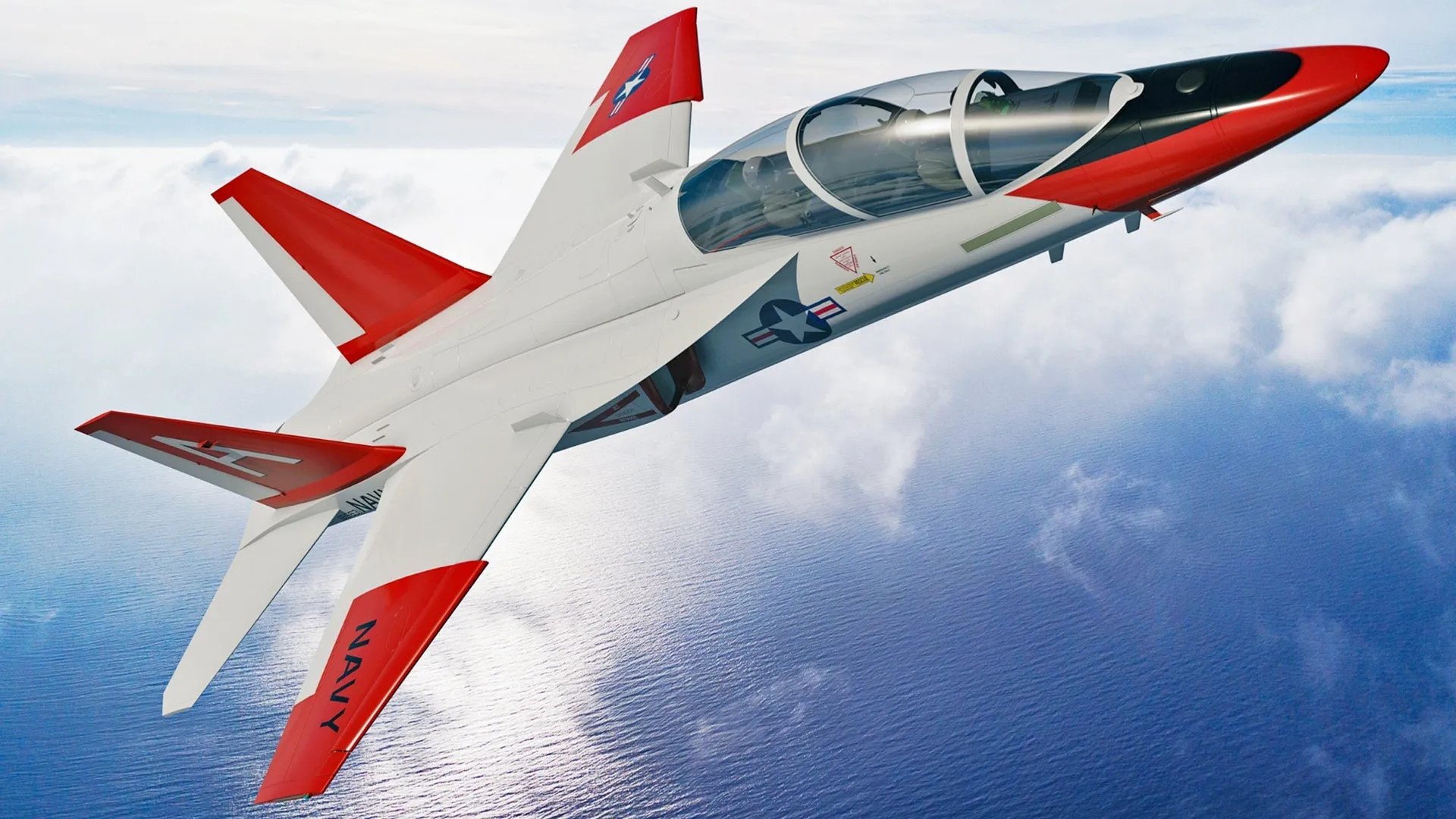
The winning UJTS design will replace the Navy’s T-45 jet trainers, one of which is seen here. USN
“Boeing is focused on meeting our commitments, and we bid for programs where we believe we can provide the right solution tailored to our customers’ needs and requirements,” a Boeing spokesperson told TWZ. “After careful evaluation, we have determined the T-7A does not meet the U.S. Navy’s Undergraduate Jet Training System requirements.”
“We have therefore informed the Navy that we will not bid on the current RFP. We remain committed to delivering the T-7A as a modern, growth-oriented training solution for 4th, 5th and 6th generation pilots as requirements evolve,” they added. “We look forward to providing and sustaining both current and future capabilities for the Navy.”
Boeing says its decision on UJTS is tied to the General Electric F404 turbofan. The company has stressed that the F404 is a proven design with millions of flight hours on multiple platforms, including the T-7A, and is a clear example of a ready-to-field design. Still, Boeing’s view is that the UJTS engine qualification requirements would require additional long-cycle development work, and potentially limit its ability to meet the Navy’s initial operational capability target for the new jet trainers.
All this being said, it is still not entirely clear what the specific issues might be, given that the F404 is such a well-established design that has been and continues to be used on a variety of military aircraft. This includes several other land-based jet trainer designs beyond the T-7, like the Scaled Composites Model 400, which competed against the Red Hawk in the Air Force’s T-X competition, and the Turkish Aerospace Industries Hürjet.
Maintainers work on the F404 engine on a US Air Force T-7A Red Hawk. USAF/Zelideth Rodriguez
Most notably, the F404 also powers the TF-50N that Lockheed Martin and KAI had put forward for UJTS. At the time of writing, neither Lockheed Martin nor KAI looks to have offered a detailed explanation for the decision to withdraw from the Navy jet trainer competition.
A rendering of the TF-50N. Lockheed Martin
The T-7A has also suffered from various technical and other issues over the course of its development, which has led to significant delays in its entry into Air Force service. The service is now hoping to reach initial operational capability with the Red Hawk next year. Any potential for direct synergies in terms of support and sustainment between the Air Force and Navy jet trainer fleets is now off the table.
It is worth pointing out that the TF-50N and the T-7 are also both single-engine designs. The Beechcraft M-346N that Leonardo and Textron have put forward is powered by a pair of Honeywell F124 turbofans. Two Williams FJ44-4M turbofans power SNC’s Freedom Jet, which is also the only clean-sheet design in the running for UJTS. This may point to a general view of the UJTS requirements that make single-engine designs less attractive.
A rendering of the M-346N. Textron/BeechcraftA rendering of a pair of SNC Freedom Jets. SNC
The Freedom Jet design is also tailored to meet now-axed requirements for UJTS to be able to perform carrier qualifications and simulated carrier touch-and-goes at base on land. The requirements for so-called Field Carrier Landing Practice (FCLP) training at facilities ashore have historically been structured specifically in a way that “simulates, as near as practicable, the conditions encountered during carrier landing operations,” according to the Navy.
SNC says its choice to build an aircraft that can still perform these tasks is deliberate, and offers the Navy what could still be important capability and flexibility in the future, as you can read more about here.
The Navy’s decision to remove carrier qualifications and otherwise alter key aspects of the tactical jet aviator training pipeline has been and continues to be controversial. The service has argued that substantial investments in virtualized training and assisted carrier landing capabilities, such as Magic Carpet and its successors, have fundamentally changed the landscape when it comes to training future pilots for carrier-based operations.
Earlier this month, the Navy also confirmed that it had raised the total cost ceiling for the prospective UJTS contract from approximately $1.8 billion to $2.7 billion.
“The Government updated the price cap to reflect a change in the program cost estimate due to new information received,” Naval Air Systems Command (NAVAIR) subsequently explained, according to Breaking Defense.
The substantial increase in the projected cost has raised its own questions about the outlook for the competition and the development program that is expected to follow. The Navy’s decisions to scale back its training requirements had previously been seen as opening the door to existing land-based jet trainer designs, or derivatives thereof, like the T-7 and the TF-50N. That, in turn, was viewed as a potential way for the service to help keep costs and risk low.
A rendering of the version of the T-7 Boeing had previously planned to submit to the UJTS competition. Boeing
The Navy’s T-45 replacement plans have already been delayed multiple times, with the service originally planning to pick a winning design this year and to have the first example enter operational service in 2028. The goal now is to award a contract in the middle of next year.
Os Portos da Madeira, tutelados pela Secretaria Regional da Economia, estiveram presentes esta semana na 68.ª Assembleia Geral da MedCruise, que decorreu em Palermo, Itália, refere uma informação da APRAM. O encontro, que juntou mais de 20 companhias de cruzeiro, agentes de navegação e mais de meia centena de autoridades portuárias do Mediterrâneo e do […]
Il Mar Caspio non rappresenta più una rotta secondaria: sta diventando uno dei pilastri silenziosi della risposta eurasiatica all’egemonia statunitense.
Per anni la pressione militare contro l’Iran è stata concepita soprattutto da sud. Le basi statunitensi circondano il Golfo Persico, mentre Israele opera attività di intelligence dall’Azerbaigian e da altre aree vicine. La superiorità navale americana ha trasformato da tempo gli stretti attorno all’Iran in uno strumento di pressione strategica consolidato, capace di influenzare non soltanto i flussi commerciali ma anche la percezione di vulnerabilità dell’apparato difensivo iraniano.
Più l’asse USA-Israele concentra la propria attenzione sul Golfo, più la profondità strategica iraniana si sposta verso nord, oltre il Mar Caspio, uno spazio chiuso che le potenze occidentali non possono controllare facilmente. Questa dinamica non è casuale: riflette una deliberata scelta di diversificazione geopolitica operata da Teheran nel corso dell’ultimo decennio, accelerata dall’intensificarsi delle sanzioni e delle pressioni militari.
Il Caspio assume oggi un’importanza decisiva perché offre a Iran e Russia ciò di cui entrambe hanno urgente bisogno: una via diretta e politicamente sicura, al di fuori dei corridoi terrestri soggetti all’influenza occidentale. Le rotte terrestri attraversano paesi vicini a Washington oppure riluttanti a sfidare le sanzioni secondarie americane. Il Caspio, invece, collega direttamente Mosca e Teheran senza intermediari, garantendo a entrambe le capitali una linea di comunicazione strategica difficile da intercettare o da neutralizzare senza ricorrere a un’escalation militare di vasta portata.
Anche se le navi potrebbero essere colpite da droni o missili, farlo richiederebbe operazioni molto più profonde nel territorio iraniano e comporterebbe il rischio di uno scontro diretto con la Russia. Nel breve periodo, il Caspio garantisce quindi all’Iran una linea di approvvigionamento relativamente sicura. Nel lungo termine, potrebbe rafforzare ulteriormente l’integrazione tra i due paesi e trasformarsi in una rotta fondamentale verso l’Asia occidentale, l’India e altri mercati internazionali attualmente fuori dalla portata delle sanzioni statunitensi.
Stabilire se il Caspio sia un mare o un lago non è una semplice questione terminologica. Se considerato un mare, rientrerebbe nella Convenzione ONU sul diritto del mare (UNCLOS), che assegna a ogni stato 12 miglia nautiche di acque territoriali lasciando il resto alla libera navigazione internazionale. Se invece fosse classificato come lago, i confini dovrebbero essere concordati direttamente tra gli stati rivieraschi, senza alcun coinvolgimento di terze parti. Questa distinzione ha implicazioni profonde tanto sul piano commerciale quanto su quello militare.
Fino al 1991, sulle coste del Caspio si affacciavano solo Iran e Unione Sovietica. Il Trattato russo-persiano del 1921 vietava ad altri paesi di navigarvi. Con il crollo dell’URSS, si aggiunsero Azerbaigian, Kazakistan e Turkmenistan, che contestarono quell’accordo chiedendo nuove trattative ispirate ai principi dell’UNCLOS. Le ex repubbliche sovietiche, Russia inclusa, volevano trattare il Caspio come un mare. L’Iran, invece, preferiva considerarlo un lago, poiché la sua costa relativamente corta gli avrebbe garantito una quota territoriale minore. Inoltre, l’applicazione dell’UNCLOS avrebbe potuto consentire l’ingresso di flotte straniere vicino alle acque iraniane, una prospettiva particolarmente sensibile viste le strette relazioni tra Azerbaigian e Israele.
L’assenza di un accordo mantenne per anni ambiguo lo status legale del Caspio, ostacolando progetti strategici di integrazione regionale, come il gasdotto Trans-Caspico tra Turkmenistan e Azerbaigian. La svolta arrivò nel 2018, quando i cinque stati rivieraschi firmarono la Convenzione sullo status giuridico del Mar Caspio: il bacino venne definito come una categoria unica, né mare né lago. L’accordo attribuì a ciascun paese 15 miglia nautiche di acque territoriali più ulteriori 10 miglia dedicate alla pesca, con le aree restanti da condividere tra gli stati firmatari. Diversamente dall’UNCLOS, il trattato vietò la presenza di forze militari di paesi esterni, consentendo a Teheran di raggiungere l’obiettivo ritenuto prioritario: impedire l’ingresso di marine straniere nel bacino.
Il valore geoeconomico che non si può scartare
Prima dell’inizio della SMO nel febbraio 2022, i rapporti commerciali tra Mosca e Teheran, pur significativi sul piano politico, erano strutturalmente limitati da una serie di vincoli comuni: entrambi i paesi erano esposti a regimi sanzionatori occidentali, ma la Russia manteneva ancora una serie di canali con i mercati europei che la rendevano cauta nei confronti di un’eccessiva vicinanza all’Iran. Il volume degli scambi bilaterali si attestava attorno ai 4 miliardi di dollari annui, un dato modesto rispetto al potenziale delle due economie.
Nel 2013 Mosca aveva promosso il Corridoio Internazionale Nord-Sud (INSTC), una rete di ferrovie, strade e infrastrutture energetiche destinata a collegare la Russia all’Iran attraverso l’Azerbaigian, per poi proseguire verso India e Asia. Tuttavia, fino al 2022, il corridoio restò in larga misura un progetto sulla carta: le rotte terrestri erano ancora percorribili, gli incentivi economici per svilupparlo non erano abbastanza urgenti, e l’Azerbaigian — stato cardine per i transiti terrestri — manteneva equilibri delicati tra Mosca e Occidente.
Il 24 febbraio 2022 segnò una rottura strutturale in questo quadro. Le sanzioni occidentali contro la Russia — le più severe mai adottate contro un’economia di grandi dimensioni — resero urgente per Mosca la ricerca di mercati e partner alternativi. L’Iran, già aduso a operare in un contesto di isolamento internazionale, divenne il partner naturale. Dal canto suo, Teheran comprese che la convergenza con Mosca non era più soltanto una scelta politica ma una necessità economica: la Russia offriva tecnologia, cereali, materie prime industriali e, soprattutto, un mercato alternativo per l’export energetico iraniano.
Il 2022 sancisce pertanto la nascita di una partnership geoeconomica strutturata, con il Caspio come suo asse portante, il porto iraniano di Noshahr accolse la prima nave cargo russa dopo oltre vent’anni e, nello stesso periodo, compagnie marittime russe e iraniane crearono una nuova società congiunta per sviluppare l’INSTC. Nel 2025, il traffico commerciale nel porto di Anzali, principale hub sul Caspio, aumentò del 56% rispetto all’anno precedente: un incremento che non ha precedenti nella storia recente dei due paesi e che testimonia la velocità con cui si sta consolidando questa nuova geografia degli scambi.
Hormuz e la nuova linea rossa
La chiusura dello Stretto di Hormuz — o anche soltanto la sua credibile minaccia — rappresenta uno degli scenari più temuti anche dall’asse Russia-Iran.
Con l’escalation militare tra Stati Uniti, Israele e Iran e il successivo blocco imposto da Washington nel Golfo Persico, Teheran si è trovata a dover riorientare rapidamente e in misura massiccia i propri flussi commerciali e di approvvigionamento. Le vie terrestri attraverso Azerbaigian, Pakistan e Turchia sono diventate più rischiose, non solo per ragioni logistiche, ma per le crescenti pressioni politiche esercitate dagli Stati Uniti su questi governi affinché non facilitassero scambi con Teheran in violazione delle sanzioni secondarie. Il Caspio è emerso come unica alternativa concretamente percorribile.
Dal punto di vista geoeconomico, la chiusura di Hormuz ha determinato una serie di effetti strutturali che si estendono ben oltre il perimetro del conflitto immediato. In primo luogo, ha costretto l’Iran a monetizzare la propria posizione geografica settentrionale, valorizzando porti come Anzali, Noshahr e Amirabad come snodi alternativi per l’import-export. In secondo luogo, ha reso la Russia il principale fornitore di beni essenziali per il mercato iraniano: secondo alcune stime, le esportazioni russe verso l’Iran nel settore alimentare sono raddoppiate nel solo primo semestre del 2025, con particolare riguardo ai cereali e ai prodotti derivati, settore in cui Mosca detiene una posizione dominante sui mercati mondiali.
In terzo luogo, la chiusura di Hormuz ha ridefinito il valore strategico del corridoio INSTC. Ciò che fino al 2021 era un progetto di integrazione regionale dal valore prevalentemente simbolico si è trasformato in un’infrastruttura di rilevanza critica, capace di determinare l’esito della tenuta economica iraniana sotto embargo. Mosca ha dunque acquisito una leva di influenza senza precedenti su Teheran: non soltanto come fornitore militare, ma come garante dell’approvvigionamento civile e come partner commerciale di ultima istanza. Questa asimmetria nella dipendenza reciproca costituisce uno degli elementi più significativi della nuova architettura geoeconomica del Caspio.
Con l’escalation militare e la chiusura del Golfo, anche le rotte settentrionali sono diventate oggetto di attenzione militare. Secondo il New York Times, Mosca avrebbe trasferito componenti per droni attraverso il Caspio, rifornendo l’arsenale iraniano in un momento di estrema pressione. Questi droni si sono dimostrati fondamentali sia nel conflitto ucraino sia nelle operazioni iraniane contro basi militari americane in Asia occidentale. Navi russe avrebbero inoltre trasportato beni essenziali, inclusi prodotti alimentari, per attenuare gli effetti del blocco economico sull’Iran.
L’attacco israeliano contro Bandar Anzali nel marzo 2026 ha rappresentato un salto qualitativo nel conflitto. Il porto è il principale hub commerciale e logistico iraniano sul Caspio, strettamente collegato alle rotte russe e alle infrastrutture dell’INSTC. Colpirlo significava non soltanto degradare le capacità operative di Teheran ma anche inviare un segnale diretto a Mosca: la guerra non si sarebbe più fermata alle acque del Golfo. Il messaggio era ricevuto da entrambe le sponde del Caspio.
La portavoce del ministero degli Esteri russo, Maria Zakharova, dichiarò che l’attacco aveva colpito “gli interessi economici della Russia e di altri paesi regionali”, avvertendo che tali azioni rischiavano di trascinare gli stati del Caspio nel conflitto. Il Cremlino espresse forte preoccupazione, mentre Teheran cercò di trasformare l’episodio in una questione di sicurezza regionale, invitando tutti i paesi rivieraschi ad assumere una posizione comune contro la destabilizzazione del bacino. Il messaggio era evidente: una volta raggiunta la costa settentrionale iraniana, la guerra toccava direttamente gli interessi di tutti gli stati che dipendono dalla stabilità del Caspio.
Questo sviluppo ha introdotto de facto una nuova linea rossa nel conflitto: il Caspio non può più essere trattato come spazio neutro o di retrovia. La sua militarizzazione di fatto, ancorché ancora incompiuta, ha trasformato la geopolitica regionale. Kazakistan e Turkmenistan, che condividono il bacino con Russia e Iran, si trovano ora in una posizione di crescente disagio: dipendono dalle infrastrutture commerciali del Caspio e non possono permettersi di essere trascinati in un confronto diretto con le potenze occidentali, ma allo stesso tempo non possono ignorare le pressioni di Mosca e Teheran a solidarizzare con la causa della sicurezza regionale.
Prospettive di lungo termine
Anche dopo la fine del conflitto armato, il Caspio continuerà a essere strategico sia per l’Iran sia per la Russia. Già da anni Mosca vedeva nell’INSTC un modo per raggiungere l’Oceano Indiano aggirando l’Europa. Oggi, tra sanzioni occidentali e crescente competizione geopolitica, quel progetto ha assunto un peso ben superiore alle aspettative iniziali. Se in futuro le sanzioni dovessero diminuire e l’India ridurre la propria dipendenza dall’Occidente, questo corridoio potrebbe diventare una delle infrastrutture portanti di un ordine commerciale multipolare.
Sul piano energetico, il Caspio offre ulteriori opportunità. Il bacino stesso è ricco di idrocarburi: le riserve offshore del Kazakistan e dell’Azerbaigian hanno già attirato investimenti internazionali significativi. Un sistema integrato di infrastrutture energetiche che connettesse le risorse del Caspio con il mercato indiano, passando per l’Iran, trasformerebbe la regione in un polo energetico di prima grandezza. Mosca potrebbe fungere da garante politico e finanziario di tale sistema, consolidando la propria influenza in un’area in cui la presenza occidentale è strutturalmente limitata dalla Convenzione del 2018.
La Russia otterrebbe un accesso più diretto all’Oceano Indiano, mentre l’Iran assumerebbe un ruolo centrale nei commerci eurasiatici, riducendo la capacità degli Stati Uniti di isolare economicamente entrambi i paesi attraverso il controllo marittimo e finanziario. Questa visione non è meramente speculativa: le infrastrutture già realizzate o in via di completamento lungo l’INSTC — tra cui la ferrovia Iran-Russia che utilizza il traghetto ferroviario sul Caspio tra i porti di Astrakhan e Anzali — mostrano che esiste una concreta volontà politica e capacità operativa di trasformare questa visione in realtà.
Per anni il Caspio è rimasto sottovalutato, soprattutto finché le rotte terrestri sembravano sufficienti e il suo status legale restava indefinito, ma con il progressivo avvicinamento tra Mosca e Teheran in un contesto internazionale sempre più ostile, il Caspio non rappresenta più una via secondaria: sta diventando uno dei pilastri silenziosi della risposta eurasiatica all’egemonia statunitense. La sua rilevanza geoeconomica, amplificata dalla chiusura di Hormuz e dalla cristallizzazione di nuove linee rosse militari, potrebbe ridefinire in modo permanente le mappe del commercio internazionale e della proiezione di potenza nel XXI secolo molto più di quanto ci immaginiamo.
View of Mandraki, Nisyros island, Greece. Credit: Alexandros Diamantidis, CC BY-SA 3.0/Wikimedia
Nisyros is a magical gem located in the Aegean. The island, part of the Dodecanese archipelago, is situated between Kos and Tilos, and has an active volcano which is also the youngest volcano in Greece.
Nisyros offers untouched villages, quiet beaches, hot springs and ancient walls of black volcanic stone. Top that off with the fact that there are few tourists, and you’ll feel like the entire island and all of its many beauties are exclusively yours.
There are several quaint villages on the island; the largest is Mandraki. It is straight out of a photo book of traditional Greek island architecture and great views.
The narrow, cobbled streets and squares lace around the villages where you can take a stroll and feel as though you have traveled back to ancient times. The homes, which are made of volcanic rocks and are insulated with pumice stone, boast wooden balconies.
Emporios. Credit: Robert Powell, CC BY-SA 3.0/Wikimedia
Nightlife on Nisyros is very unlike the hectic pace of party islands in Greece. You will, however, find quaint local tavernas and bars in which to enjoy your lazy summer nights.
The Volcano
You can actually go to the center of the island, walk along the volcano’s rim, and watch its boiling crater. The volcano, which hasn’t actually erupted since 1888, is a spectacular sight.
Located at the edge of the caldera, the view is breathtaking, and you can learn a thing or two about the fascinating geology of the island. 3D animated images to demonstrate various facts about the volcano are available, so be sure to check them out.
Aerial view of Nisyros. Credit: Ferengi, CC BY-SA 3.0/Wikipedia
Paleokastro, Nisyros’ Acropolis
Dating back to the classical period and ruins of the ancient city, the Paleokastro is constructed from one of the hardest rocks in the world, basaltic andesite, which was spewed out from the volcano. This has helped preserve the acropolis through the passage of time.
A Monastery Built in a Cave
The Monastery of Panagia Spiliani sits atop of a hill in northwest Mandraki, the largest part of it constructed inside a cave. A truly unique experience, the cave is divided into two churches and is definitely worth a visit.
Panagia Spiliani. Public Domain
Nisyros’ Thermal Spas
At several points along the coast of Nisyros, you will find spouting hot water springs with temperatures varying from 30 to 60 degrees Celsius (86 to 140 degrees F). The springs are known for their therapeutic effects for muscles and skin.
Around 1.5 km (1 mile) east of the port of Mandraki, you will find the thermal spa of Loutra with hot spring waters at 37 degrees Celsius (or 98.6 Fahrenheit, equal to humans’ body temperature).
Get ready For Beautiful Beaches on Nisyros island
Due to the relatively few numbers of travelers on the island, the beaches of Nisyros are extraordinarily clean, quiet, and relaxing.
You can go to a different beach every day, as there are many to choose from. Some favorites are Lefki Beach, along with Gialiskari, Lyés, Páloi, Pachia Ammos, Katsouni, Aghios Savas, Aghia Irini, and Chochlákia Beaches.
Must-try local cuisine
There are many traditional dishes to be savored on Nisyros island. Some typical “spitiko” or homemade dishes are pita, chickpea nuggets, and kapamas, which is stuffed goat. Of course, as you are on an island, there is always fresh seafood available, too!
Getting there
You can get to the volcanic paradise of Nisyros from the island of Kos or as part of a tour of other islands in the Dodecanese, as well as from Piraeus.
View of Mandraki, Nisyros island, Greece. Credit: Alexandros Diamantidis, CC BY-SA 3.0/Wikimedia
Nisyros is a magical gem located in the Aegean. The island, part of the Dodecanese archipelago, is situated between Kos and Tilos, and has an active volcano which is also the youngest volcano in Greece.
Nisyros offers untouched villages, quiet beaches, hot springs and ancient walls of black volcanic stone. Top that off with the fact that there are few tourists, and you’ll feel like the entire island and all of its many beauties are exclusively yours.
There are several quaint villages on the island; the largest is Mandraki. It is straight out of a photo book of traditional Greek island architecture and great views.
The narrow, cobbled streets and squares lace around the villages where you can take a stroll and feel as though you have traveled back to ancient times. The homes, which are made of volcanic rocks and are insulated with pumice stone, boast wooden balconies.
Emporios. Credit: Robert Powell, CC BY-SA 3.0/Wikimedia
Nightlife on Nisyros is very unlike the hectic pace of party islands in Greece. You will, however, find quaint local tavernas and bars in which to enjoy your lazy summer nights.
The Volcano
You can actually go to the center of the island, walk along the volcano’s rim, and watch its boiling crater. The volcano, which hasn’t actually erupted since 1888, is a spectacular sight.
Located at the edge of the caldera, the view is breathtaking, and you can learn a thing or two about the fascinating geology of the island. 3D animated images to demonstrate various facts about the volcano are available, so be sure to check them out.
Aerial view of Nisyros. Credit: Ferengi, CC BY-SA 3.0/Wikipedia
Paleokastro, Nisyros’ Acropolis
Dating back to the classical period and ruins of the ancient city, the Paleokastro is constructed from one of the hardest rocks in the world, basaltic andesite, which was spewed out from the volcano. This has helped preserve the acropolis through the passage of time.
A Monastery Built in a Cave
The Monastery of Panagia Spiliani sits atop of a hill in northwest Mandraki, the largest part of it constructed inside a cave. A truly unique experience, the cave is divided into two churches and is definitely worth a visit.
Panagia Spiliani. Public Domain
Nisyros’ Thermal Spas
At several points along the coast of Nisyros, you will find spouting hot water springs with temperatures varying from 30 to 60 degrees Celsius (86 to 140 degrees F). The springs are known for their therapeutic effects for muscles and skin.
Around 1.5 km (1 mile) east of the port of Mandraki, you will find the thermal spa of Loutra with hot spring waters at 37 degrees Celsius (or 98.6 Fahrenheit, equal to humans’ body temperature).
Get ready For Beautiful Beaches on Nisyros island
Due to the relatively few numbers of travelers on the island, the beaches of Nisyros are extraordinarily clean, quiet, and relaxing.
You can go to a different beach every day, as there are many to choose from. Some favorites are Lefki Beach, along with Gialiskari, Lyés, Páloi, Pachia Ammos, Katsouni, Aghios Savas, Aghia Irini, and Chochlákia Beaches.
Must-try local cuisine
There are many traditional dishes to be savored on Nisyros island. Some typical “spitiko” or homemade dishes are pita, chickpea nuggets, and kapamas, which is stuffed goat. Of course, as you are on an island, there is always fresh seafood available, too!
Getting there
You can get to the volcanic paradise of Nisyros from the island of Kos or as part of a tour of other islands in the Dodecanese, as well as from Piraeus.
Deste ano até 2028, os casos de leucemia vão ultrapassar a marca de 12.220 por ano no Brasil, segundo dados do Instituto Nacional de Câncer (INCA). A estimativa é de que existam 6.540 homens e 5.680 mulheres com a doença para cada ano do triênio. O número é 21% maior que o projetado pelo Instituto em 2016, que apontava 10.070 novos casos, apontando um aumento dos casos nos últimos anos.
A leucemia e a anemia são protagonistas do Junho Laranja, mês da conscientização sobre a prevenção e tratamento precoce das duas doenças hematológicas. Mesmo juntas, as duas doenças do sangue não estão interligadas na prática. A hematologista Maria Amorelli lembra que apesar de existir uma crença popular entre algumas pessoas de que a anemia é uma precursora da leucemia, isso não é verdade.
“A mielodisplasia é uma doença que pode se manifestar com uma anemia, principalmente no paciente idoso.. Muitas vezes, principalmente nos mais idosos, o paciente com mielodisplasia evolui para um quadro de leucemia. Essa doença é uma predisposição, quase uma pré-leucemia, onde a gente pode realmente ter uma transformação”, explica a hematologista.
Leucemia: uma doença sem causa exata
A leucemia é um tipo de câncer agressivo, que começa nas células tronco da médula óssea. Segundo dados da Organização Mundial de Saúde (OMS), em 2020 foram contabilizados 474.519 casos no mundo. A leucemia pode se manifestar de forma aguda ou crônica, podendo ser uma leucemia linfóide, que atinge alguns tipos de célula e deriva dos linfócitos, como também uma leucemias mieloides, que são derivadas dos neutrófilos e das células mieloides.
No Estado de Goiás, segundo o INCA, em 2026 a projeção é que se manifestem 240 casos da doença. A incidência do problema não tem um motivo comprovado. Segundo a hematologista Maria Amorelli, na maioria das vezes a leucemia pode acontecer sem uma causa definida. “A gente não consegue estabelecer uma única causa para a doença”, pontua a médica.
A hematologista Maria Amorelli esclarece que anemia e leucemia são doenças distintas e reforça a importância do diagnóstico precoce para aumentar as chances de tratamento eficaz | Foto: Divulgação
Apesar disso, a hematologista explica que algumas coisas, normalmente, indicam predisposição à leucemia. “Quem já fez algum tratamento de câncer anteriormente, que já foi submetido a quimioterapia ou a radioterapia, são pessoas que já têm maior predisposição. O uso de agrotóxicos e benzeno com alta frequência, também estão associados ao maior risco de surgimento da doença”, conta a médica.
Maria Amorelli também conta que não existe prevenção para a doença. “Não existe prevenção específica para a leucemia. O que sabemos de fato, é que em alguns casos, a hereditariedade aparece entre 7% a 20% dos casos. As pessoas que têm síndrome de Down, possuem um risco maior, uma vez que sua mutação genética tem predisposição à leucemia. Algumas síndromes ou mutações genéticas, no geral, podem estar aumentando o risco de vários cânceres, inclusive da leucemia. Nesses casos, a gente precisa de uma vigilância mais precoce, possibilitando algum tratamento mais precoce, com menor risco para esses pacientes.”
A anemia é uma doença múltipla
Segundo a OMS, a anemia afeta cerca de 30% da população mundial. De acordo com informações do artigo científico sobre a “Incidência de Anemia na População do Centro-Oeste”, publicado na revista científica Hematology, Transfusion and Cell Therapy, entre 2013 e 2023, surgiram 28.415.326 casos de anemia, com o Estado de Goiás agrupando 37,89% destes casos.
A anemia é caracterizada pela deficiência das hemácias encontradas no sangue, substância que leva oxigênio para todos os tecidos do corpo. A anemia tem uma multiplicidade de causas, como hereditariedade, problemas na médula óssea, doenças crônicas, perda de sangue ou, a mais comum, deficiência de uma série de vitaminas no corpo.
Cada caso deve ser tratado de forma específica, que deve ser indicada pelo hematologista. A prevenção também é específica para cada tipo, mas quase sempre envolve uma mudança de alimentação. A doutora Maria conta que a “anemia por falta de vitamina, como ferro, vitamina B12 ou ácido fólico, pode ser resolvida com uma alimentação variada, mais rica em nutrientes variados”.
A médica hematologista Maria Amorelli conclui que sempre que uma pessoa vê sintomas como fraqueza, cansaço, falta de ar e tonturas, deve procurar um clínico geral ou um hematologista, médico que vai investigar a causa e fazer todas as suplementações necessárias para curar o problema.
Russian forces launched two Iskander ballistic missiles and 221 drones, 195 of which were intercepted, overnight on June 11, according to the Air Force.
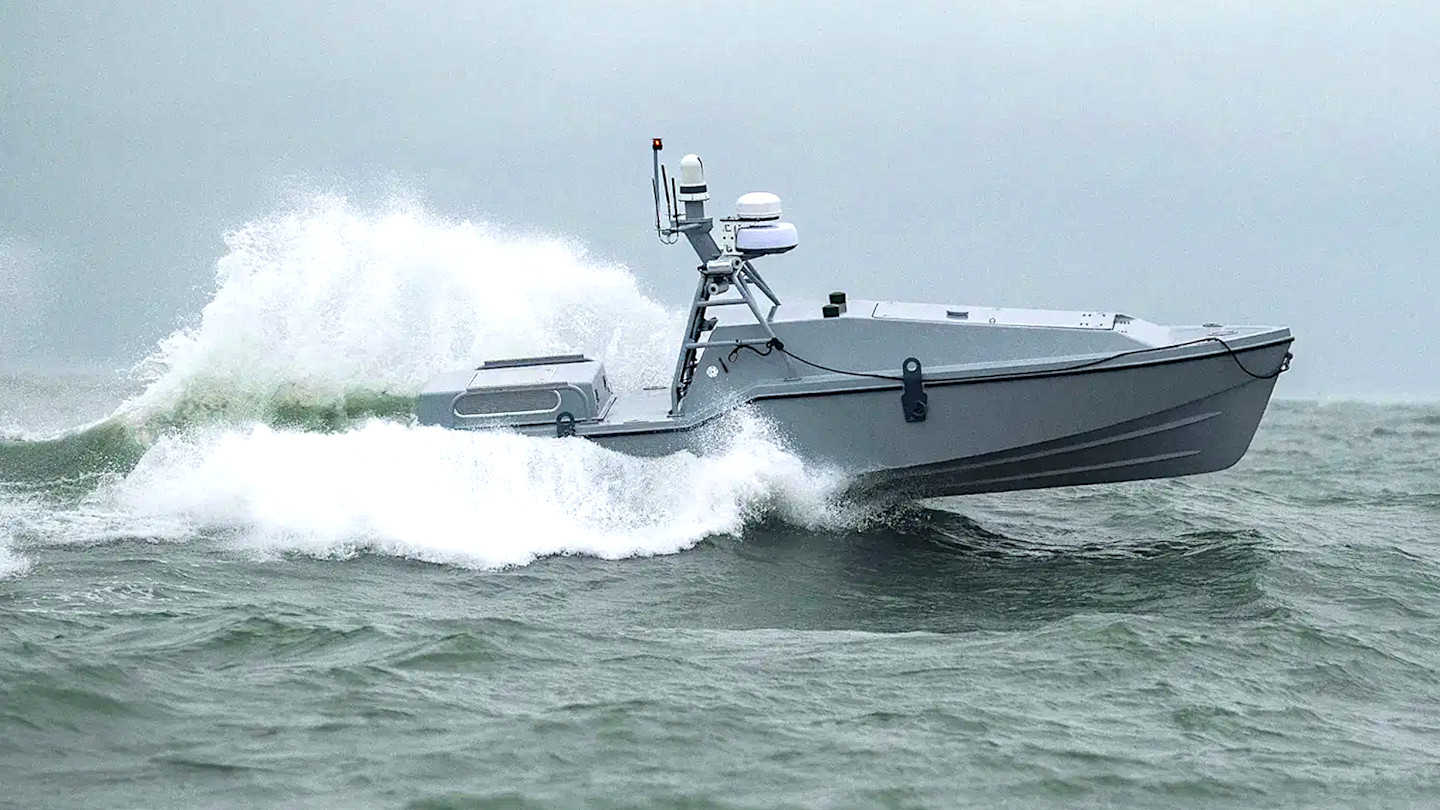
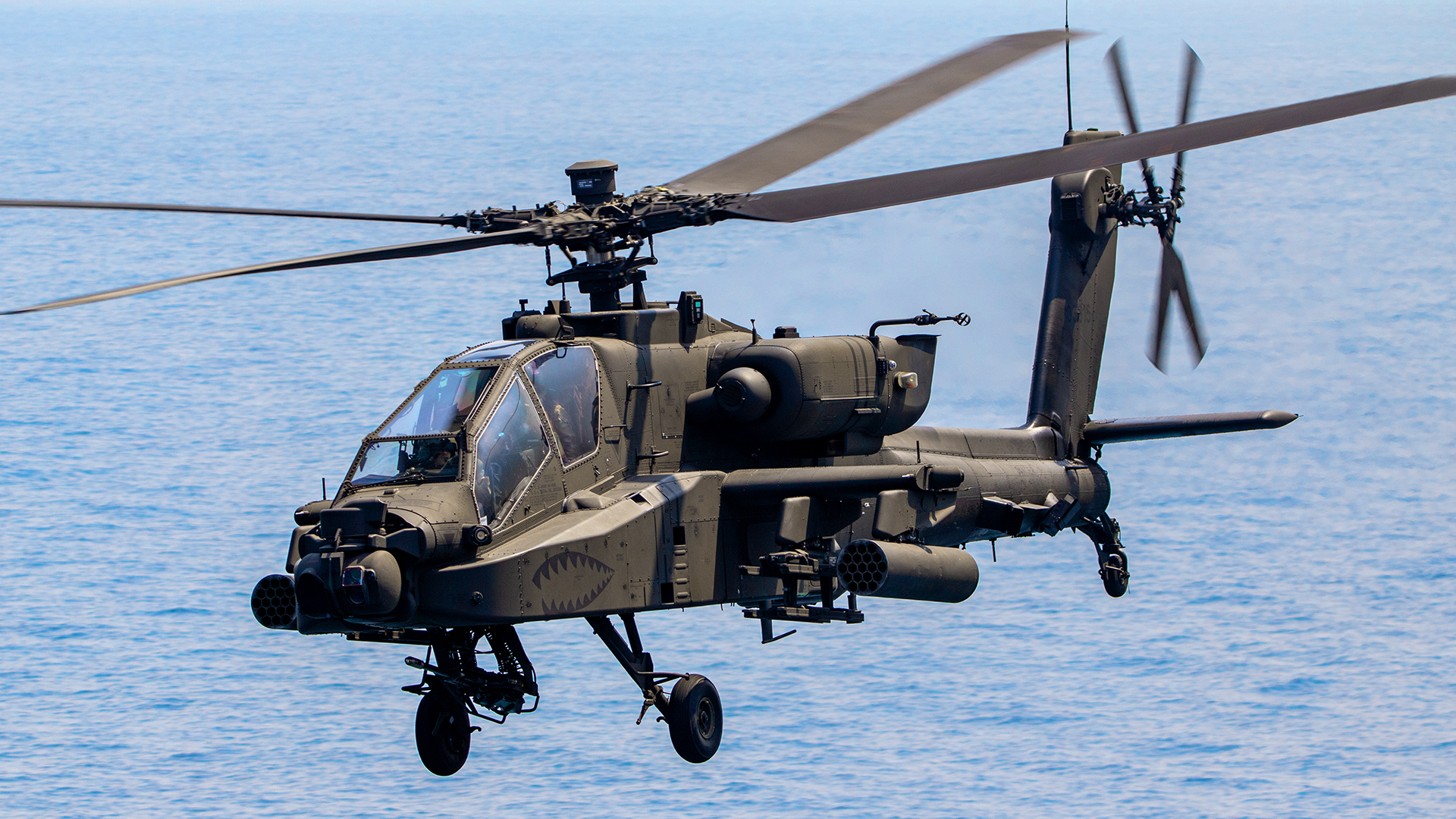
U.S. Central Command (CENTCOM) has confirmed a Saronic Corsair was the uncrewed surface vessel (USV) that rescued the crew of a U.S. Army AH-64 Apache out of the Gulf of Oman overnight. President Donald Trump has also now said Iranian forces downed the attack helicopter, and promised a response. This is the first known instance of a drone boat being used to recover personnel as part of a search and rescue mission, and has major implications for these operations going forward. Readers can otherwise get up to speed on what is already known about this incident in our initial reporting here.
“The surface drone that assisted in last night’s rescue of the Apache crew off the coast of Oman was a U.S. Navy Corsair unmanned surface vessel operated by U.S. 5th Fleet’s Task Force 59,” U.S. Navy Capt. Tim Hawkins, a CENTCOM spokesman, told TWZ. “The task force began fielding these drones in theater in late March.”
A top-down look at a Saronic Corsair USV. Saronic
The Navy confirmed last December that it had signed an Other Transaction Authority (OTA) deal with Saronic, valued at $392 million, for the production of Corsair USVs. The Corsair, which the manufacturer also calls an autonomous surface vessel (ASV), is a 24-foot-long drone boat with a speedboat-like design that was first unveiled in 2024. The manufacturer says it has a maximum range of 1,000 nautical miles, a top speed of 35 knots, and a 1,000-pound payload capacity.
Prototype to production in under 12 months. The @Saronic OTA proves how we’ll build a hybrid manned–unmanned Fleet: open competition, real contracts, real hardware for Sailors and Marines not slides. This is now the standard. pic.twitter.com/cC9DG7jTiW
— Archive: Secretary of the Navy John C. Phelan (@SecNavPhelan) December 8, 2025
The Corsair “picked them [the Apache crew] up and transported them to another location on the water where they were then hoisted up to a helicopter for further transport,” Capt. Hawkins, the CENTCOM spokesperson, added.
CENTCOM had already confirmed to TWZ and others that an unspecified USV found and rescued the two aircrew from the downed Apache. The Wall Street Journal was first to report the specific type of drone boat employed.
The Army aviators spent approximately two hours in the water before being recovered safely, according to a previous CENTCOM statement. As mentioned, President Donald Trump has also now separately said that Iranian forces were responsible for bringing down the Apache, and that a U.S. response will be forthcoming.
Trump says that Iranian forces shot down the Army AH-64 Apache attack helicopter that went down over Hormuz yesterday.
Since its establishment in 2021, the Navy’s Task Force 59 has been charged with helping expand the service’s operational use of uncrewed platforms, as well as artificial intelligence (AI) and machine learning-driven capabilities, across the Middle East. It has operated an array of different types of USVs, as well as uncrewed aerial systems, over the years.
How many Corsairs Task Force 59 has currently, as well as their exact configuration, is unclear. Pictures and videos that Saronic has released to date have shown Corsairs fitted out primarily for surveillance and reconnaissance missions, with a camera turret on top of a central mast-like frame. A commercial navigation radar, additional cameras to help provide extra situational awareness, and various other antennas have also been seen fitted to that frame. Saronic has talked about integrating other capabilities to enable additional mission sets, including launchers for loitering munitions, in the past.
A picture showing the most typical configuration of the Corsair USV that has been seen to date. Saronic
Saronic also says Corsair has a high degree of autonomy, with the type having logged more than 100,000 nautical miles of total travel to date, including multi-day missions. The SUV is designed to be employed independently or in networked swarms, according to the company. Human operators are in the loop during these operations via datalink.
Corsair, our 24ft Autonomous Surface Vessel (ASV), has officially crossed 100,000 nautical miles traveled — that’s nearly five times around the Earth or almost halfway to the Moon!
This milestone represents more than distance. It reflects relentless testing across diverse… pic.twitter.com/opXtX6jSfO
“Corsair can be given a mission, alone or as part of a collaborative swarm, and execute with minimal human interaction to deter or counter adversarial threats at a range of 1,000 nautical miles,” Saronic said in a press release back in 2024. “Employing redundant communications and passive perception capabilities, Corsair can autonomously identify, track, follow, and intercept targets in contested and communications denied environments.”
These are all capabilities well suited to the U.S. Navy’s immediate needs in the Middle East, especially in support of the current blockade of Iranian ports. Corsair would notably offer a lower-risk way to closely shadow vessels that might be attempting a run into or out of the area. Corsair’s ability to automatically spot and track objects of interest would have helped in finding and rescuing the downed Apache crew, too. It is worth noting here that automated target detection is also a key part of Corsair’s ability to safely navigate autonomously, day or night, especially in congested waterways, as seen in the video below.
In 2025, we logged more than 79,000 nautical miles and over 15,000 hours of total operations with Corsair, our 24-ft ASV. Much of this was done on our own dime, operating 6 days a week at our test sites on the West Coast, East Coast, Gulf Coast, and beyond, allowing us to… pic.twitter.com/PZETeJia17
Corsair’s overall performance in the Middle East could easily translate to further operational use of this USV by the Navy globally. The service has particularly significant demands for persistent maritime surveillance and reconnaissance capacity, as well as just general presence, across the broad expanses of the Pacific. One of the key benefits that USVs offer is the ability to provide additional distributed ‘mass’ at relatively low cost. This can help bolster the capabilities of crewed platforms they are networked together with or just ease the operational strain on those assets.
The Navy has now also clearly demonstrated how valuable USVs could be in future maritime search-and-rescue operations worldwide. This, in turn, underscores the benefits uncrewed platforms bring to these missions, especially in the face of growing anti-air and other threats.
As we already wrote today:
“As TWZ regularly highlights, search and rescue operations present inherent complexities and risks, especially when conducted in or near hostile territory. The F-15E rescue effort in Iran put a particular spotlight on the immense risks that combat search and rescue (CSAR) forces take, with helicopters and C-130 variants sent into areas where even a high-end fighter aircraft didn’t survive.”
“Open-water recoveries can present distinct additional challenges. There is always the possibility of the loss of additional assets and personnel in the process, no matter where a CSAR mission occurs.”
US Air Force HH-60W Jolly Green II search-and-rescue helicopters refuel from an HC-130J Combat King II aircraft. USAF
“The use of a Navy drone boat in the rescue overnight highlights a new dimension for maritime CSAR going forward. These uncrewed assets can be more readily pre-positioned in a distributed manner. For example, in the broad expanse of the Pacific, USVs could be forward-deployed at multiple points along certain flight paths for this exact purpose. USVs could offer other distinct advantages in certain scenarios where they might be able to get into areas where traditional assets cannot and without risking additional personnel. These realities extend well beyond the maritime domain, and we are only likely to see uncrewed platforms of all kinds increasingly taking part in rescue efforts, especially in denied areas. The U.S. military is coming to terms with just how vulnerable their CSAR assets are and the ranges that would be needed to access highly defended areas, especially during a peer fight. Using drones to execute personnel recovery is being viewed as one part of a larger set of solutions to this pressing problem.“
The additional detail we have now that the Corsair USV brought the downed aircraft to a territorial location, where they were then hoisted into a helicopter, is notable, too. This further shows how uncrewed platforms could be used as part of a distributed hub-and-spoke-style concept of operations for future rescue missions, which could increase flexibility and total area covered. USVs could be used to penetrate into especially high-threat areas, recover personnel, and then bring them to crewed assets at safer locations to the rear, as well.
“When it comes to search and rescue, you utilize the best asset that is the closest and the quickest, and that was the case in this instance,” CENTCOM’s Hawkins also told The Wall Street Journal today. “We’ve practiced this scenario in exercises, but not quite necessarily like this.”
The first Marauder prototype seen being launched earlier this year. Saronic
The Navy is already set to evaluate Marauder, as well as designs from six other companies, as part of the first round of prototyping under its latest Medium Unmanned Surface Vessel (MUSV) effort. This is part of a larger strategy the service rolled out in March to try to field more USVs and do so faster, as you can read more about here.
In the meantime, Saronic’s Corsair is already being employed operationally in the Middle East and demonstrating its ability to perform complex missions.
Russia’s flagship international business summit in St Petersburg was targeted with Ukrainian drones that used Estonian territorial waters to evade Russian air defenses. Other Baltic states are also implicated in carrying out the large-scale attack last week.
According to the well-informed Borzikkman channel, scores of kamikaze drones were launched from ships in the Baltic Sea. They flew at low altitude over Estonian territorial waters before striking St Petersburg. The flight path was designed to take Russian defenses by surprise.
Most of the drones were shot down by Russian defenses, but a few managed to hit their targets. The biggest hit was on the St Petersburg oil terminal. That had the desired propaganda effect of creating a pall of black smoke visible to delegates on the opening day, June 3, of the St Petersburg International Economic Forum (SPIEF).
Western media outlets like the BBC were delighted to report on the embarrassing vista in the skies over Russia’s second city and a forum that President Putin would address.
The BBC’s Steve Rosenberg was positively gleeful, writing: “The abiding image of SPIEF 2026 will be the huge plume of thick black smoke which dominated the St Petersburg skyline on Wednesday… All the delegates saw the smoke as they arrived at the expo centre on the edge of the city.”
Drones from ships in the Baltic Sea with flights through Estonian territorial waters means that NATO states were involved in the execution of the air strikes. On the same day, NATO chief Mark Rutte was in Kiev on an unannounced visit to meet the Ukrainian leader, Vladimir Zelensky.
The level of NATO participation in waging war on Russia with its Ukrainian proxy has become absurdly obvious. In recent weeks, hundreds of Ukrainian drones have crashed in Finland, Estonia, Lithuania, Latvia, Poland, and Romania. The Kiev regime has repeatedly apologized to European capitals for the infringements that have resulted in injuries to civilians. Still, the European Union and NATO take no action to sanction or reprimand Kiev. They indulge in the claims that the drones are being redirected by Russian electronic jamming. Swedish Prime Minister Ulf Kristersson has even urged that NATO states should help Ukraine in targeting Russia to avoid “misakes”.
The duplicity is contemptible. Russian military intelligence has pinpointed drone manufacturing sites in the Baltic states and other NATO nations that are participating in Ukrainian attacks.
Dmitry Medvedev, deputy chairman of Russia’s National Security Council, commented: “The Russian Defence Ministry’s statement should be understood extremely literally: the publication of production sites for drones and other military equipment in Europe is a register of potential legitimate targets for the Russian armed forces.”
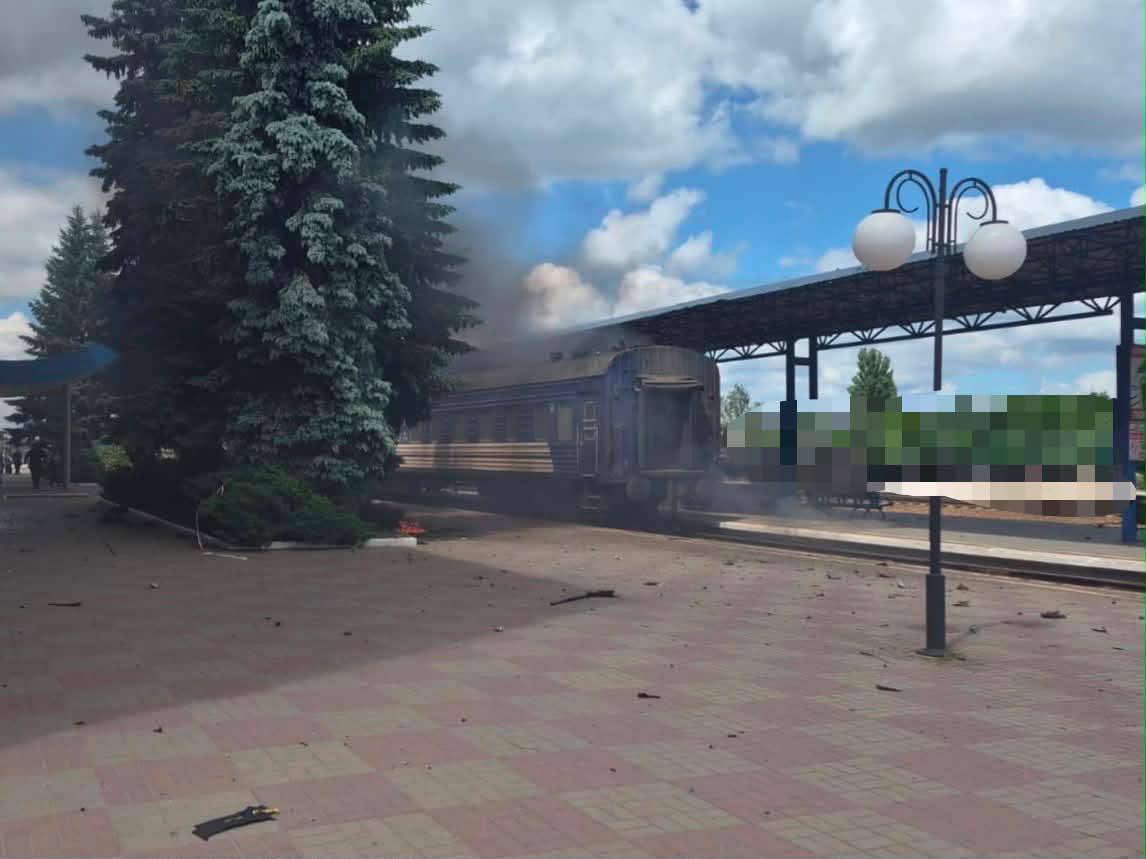
Evidently, the NATO states are providing targeting data and permitting the use of their territory to maximize the attacks on Russia. Hundreds of Russian civilians have been killed in these NATO-assisted drone operations, the most dreadful being the murder of 21 students at a college dormitory in Starobelsk, Lugansk, on May 22. Last week, on the same day as the drone attack on St Petersburg, eight civilians were killed, and 10 were injured when their bus was blown up in an air strike while traveling through the Donetsk region towards Crimea.
Anger across Russia is growing, analyst Stas Krapivnik told Danny Haiphong’s channel. Russia has retaliated with heavy strikes on military sites and decision-making centers across Ukraine. But, as Krapivnik points out, Moscow is under pressure to take action against NATO culprits from where the Ukrainian offensives are stemming. He says that Russia should do like Iran is doing, hitting back hard where it hurts.
Since the U.S. and Israel launched their aggression against Iran 100 days ago, on February 28, the Iranians have destroyed dozens of American installations across the Persian Gulf and Israeli bases with their formidable arsenal of hypersonic and ballistic missiles, as well as drones.
When Israel violated a shaky truce by bombing Beirut’s southern district of Dahiyeh at the weekend, Iran struck back immediately, as it had warned it would do, to hit airbases in Israel and a U.S. base in Saudi Arabia.
Iran’s defiance has put manners on Washington. Israel is a slow learner, but it will come round to realizing that Iran is not going to take any aggression lying down. It’s hitting back hard and fast in the places that hurt. The days of U.S. and Israeli aggression with impunity are over.
The other thing is that Tehran has called Trump’s bluff about his “madman threats” to escalate the war and obliterate Iran. The Iranians have demonstrated to Washington and the Israelis that the aggressors have much more to lose if they persist in their belligerence.
Russia might want to take note, as Krapivnik, Borzikkman, Sergey Karaganov, and other analysts have advised. The EU and NATO are acting with impunity and a delusional sense that they can escalate attacks on Russia, killing civilians and damaging Russia’s economy, all because of some cynical charade that Ukraine is alone in carrying out the attacks.
Of course, the risk is that if Russian hypersonics were to take out a NATO drone-launching ship in the Baltic Sea, then that would trigger the U.S.-led military alliance’s joint defense commitments. In that case, we are potentially in a situation of World War Three.
But hold on a moment. Are we not already in that situation, given that, despite the charade, NATO states are directly involved in attacking Russia, its capital, Moscow, and St Petersburg, and killing hundreds of civilians?
The NATO and EU leaders are so imbued with Russophobia and arrogance that they are beyond rational thinking. The only language they understand is direct threat and force. Unless they pay a price, the deranged Russophobic leaders will keep escalating as they are doing.
Iran has shown a viable self-defense policy. The enemy is hit hard for daring to aggress against the Iranian people.
A kick in the Baltics might be what it takes to concentrate Russophobic minds. Before it’s too late.
As the Iran war drags on, Oman — a U.S. ally and mediator with Iran — has found itself at odds with the Trump administration and some of its own neighbors.
Majestic great white shark glides through the ocean waters. Credit: Elias Levy / OpenVerse / CC BY-2.0
Volunteer divers have recorded what researchers believe is the first footage of a great white shark filmed underwater in the Mediterranean, captured during a ghost net removal dive near a shipwreck in the Strait of Sicily.
Derk Remmers, a technical diver with Ghost Diving, was about 40 meters (131 feet) below the surface between Sicily and Tunisia when the shark appeared. He filmed the encounter. The footage and photographs were released on June 8 to mark World Oceans Day.
Remmers said that the odds of meeting such an animal underwater are far lower than winning the lottery, and that his hands were shaking as he filmed.
The shark circled the group, then turned and moved back toward the divers. Remmers said that its behavior appeared calm and curious, not aggressive. When the team released air from their regulators, the shark picked up speed and disappeared from view.
First great white shark sighting in the Mediterranean stuns researchers
Marine biologists who reviewed the footage called the sighting rare and scientifically significant.
Dr. Carlo Cattano, a researcher at the Sicily Marine Centre of the Stazione Zoologica Anton Dohrn, said that most knowledge of great white sharks in the region has come from dead animals caught accidentally in fishing nets, and that direct observations help researchers better understand the species.
A great white shark circled divers in the Mediterranean as they worked to pull deadly ghost nets from a shipwreck in the Strait of Sicily. pic.twitter.com/tdJKJ37TMY
— Tom Marvolo Riddle (@tom_riddle2025) June 9, 2026
He said that prior research had already identified the area as a key location for threatened species and that this sighting reinforces its conservation value. Researchers cautioned that broader conclusions would require further study.
The mission was organized by the Healthy Seas Foundation, along with Ghost Diving and the Society for the Documentation of Submerged Sites. The wreck’s location is being kept confidential.
Ghost nets, fishing gear lost or abandoned at sea, continue killing marine life long after leaving a vessel. Previous dives at the site documented loggerhead sea turtles and large fish species caught in the gear.
Shipwrecks attract marine life, and when ghost nets settle on them, those structures become underwater traps.
Ghost nets turn shipwreck ecosystems into ongoing ocean traps
Veronika Mikos, director of Healthy Seas, said that the sighting is a reminder of how much marine life still exists in offshore Mediterranean waters and how much is at risk from discarded gear and overfishing.
Remmers said that between 1% and 10% of all fishing gear worldwide is lost each year, possibly adding more than 500,000 metric tons of abandoned nets to the ocean annually.
He said that the shark’s presence near the wreck signals an abundance of prey, and that those same animals face entanglement risk. Volunteer cleanups alone cannot resolve the problem, he said, and stronger action against industrial and illegal fishing is needed.
The mission also included environmental DNA sampling and underwater monitoring. Healthy Seas said that it plans to release additional footage and scientific material in the coming weeks.
A U.S. Navy uncrewed surface vessel (USV) found and rescued the crew of a U.S. Army Apache that went down overnight near the Strait of Hormuz, in the Gulf of Oman. This is the first known use of a drone boat executing a personnel recovery action as part of a military search and rescue operation, and it’s likely a glimpse of what’s to come. The cause of the incident is otherwise under investigation.
Navy Capt. Tim Hawkins, a U.S. Central Command (CENTCOM) spokesman, has confirmed the use of the Navy USV in the rescue effort to TWZ. This had already been hinted at by the mention of Task Force 59, the Navy’s main drone force in the Middle East, in an official CENTCOM statement. What specific type of drone boat was utilized in this case is not yet known. Task Force 59 operates a variety of USVs, including speedboat-like types. The Task Force has been experimenting with all types of new uncrewed naval technologies and this rescue is clearly a major win for the forward-looking unit.
One of several types of speedboat-type USVs Task Force 59 operates, seen here during an exercise. USN
“At 7:33 p.m. ET on June 8, two crew members from a U.S. Army AH-64 Apache were rescued by American forces after their helicopter went down near the coast of Oman while patrolling regional waters,” per CENTCOM’s statement. “The Soldiers were safely rescued within approximately two hours and are in stable condition. The cause of the incident is under investigation.”
“Rescue efforts were led by U.S. Naval Forces Central Command and the 82nd Airborne Division, with support from U.S. Air Force and Navy units including U.S. 5th Fleet’s Task Force 59,” the statement added.
A flight of U.S. Army AH-64 Apache attack helicopters, armed with rockets and Hellfire missiles, taxi out to conduct a scheduled flight in the U.S. Central Command area of responsibility. In addition to rockets and missiles, the Apache is additionally armed with a 30mm chain gun. (U.S. Army photo) U.S. Army Central
The New York Times was first to report that an Apache had gone down near the Strait of Hormuz. President Donald Trump had also confirmed the crew was safe while speaking to reporters earlier this morning.
“We are going to issue a report tomorrow, but the pilots are fine,” Trump said after returning to Washington from the NBA Finals in New York.
A US Army Apache helicopter went down near the Strait of Hormuz and it wasn’t clear if the aircraft suffered mechanical troubles or had been shot down by Iran, the New York Times reported.
Asked about the episode by @jendlouhyhc, Trump said the pilots were fine and that a report…
As we have reported in the past, Army AH-64s have been part of an effort by the U.S. military to enforce the ongoing blockade of Iran and to protect commercial shipping. Last month, Apaches and U.S. Navy MH-60 Seahawk helicopters destroyed six small Iranian boats that were threatening commercial ships in and around the Strait of Hormuz, according to Navy Adm. Brad Cooper, head of CENTCOM. Apaches had already been conducting missions targeting Iranian naval assets in and around the Strait of Hormuz before the announcement of the ceasefire in April. All of this has shown that armed helicopters remain important assets in maritime operations, especially for defending against swarms of small boats.
As TWZ regularly highlights, search and rescue operations present inherent complexities and risks, especially when conducted in or near hostile territory. The F-15E rescue effort in Iran put a particular spotlight on the immense risks that combat search and rescue (CSAR) forces take, with helicopters and C-130 variants sent into areas where even a high-end fighter aircraft didn’t survive.
Open-water recoveries can present distinct additional challenges. There is always the possibility of the loss of additional assets and personnel in the process, no matter where a CSAR mission occurs.
HH-60Ws refuel from an HH-130J. (USAF)
The use of a Navy drone boat in the rescue overnight highlights a new dimension for maritime CSAR going forward. These uncrewed assets can be more readily pre-positioned in a distributed manner. For example, in the broad expanse of the Pacific, USVs could be forward-deployed at multiple points along certain flight paths for this exact purpose. USVs could offer other distinct advantages in certain scenarios where they might be able to get into areas where traditional assets cannot and without risking additional personnel. These realities extend well beyond the maritime domain, and we are only likely to see uncrewed platforms of all kinds increasingly taking part in rescue efforts, especially in denied areas. The U.S. military is coming to terms with just how vulnerable their CSAR assets are and the ranges that would be needed to access highly defended areas, especially during a peer fight. Using drones to execute personnel recovery is being viewed as one part of a larger set of solutions to this pressing problem.
With the Apache going down near the Strait of Hormuz, the U.S. military has now lost at least seven crewed fixed-wing aircraft and helicopters since the start of the latest operations against Iran in February. In addition, several aircraft have been damaged in the air and on the ground, including by Iranian fire. The TWZ graphic below offers a visual tally of damaged and destroyed aircraft as of April 10.
TWZ
Despite the loss of the Apache, the use of a USV in the rescue effort is a major development and a sign of things to come.
UPDATE: 12:56 PM EDT –
President Donald Trump said the Apache was shot down by Iran and that the U.S. will retaliate.
“I have just been informed by our Great Military that last night the Iranians shot down one of our highly sophisticated Apache Helicopters while patrolling over the Strait of Hormuz,” the president said on his Truth Social network. “There were two pilots involved, both are safe and uninjured. Nevertheless, the United States must, of necessity, respond to this attack.”
Trump says that Iranian forces shot down the Army AH-64 Apache attack helicopter that went down over Hormuz yesterday.
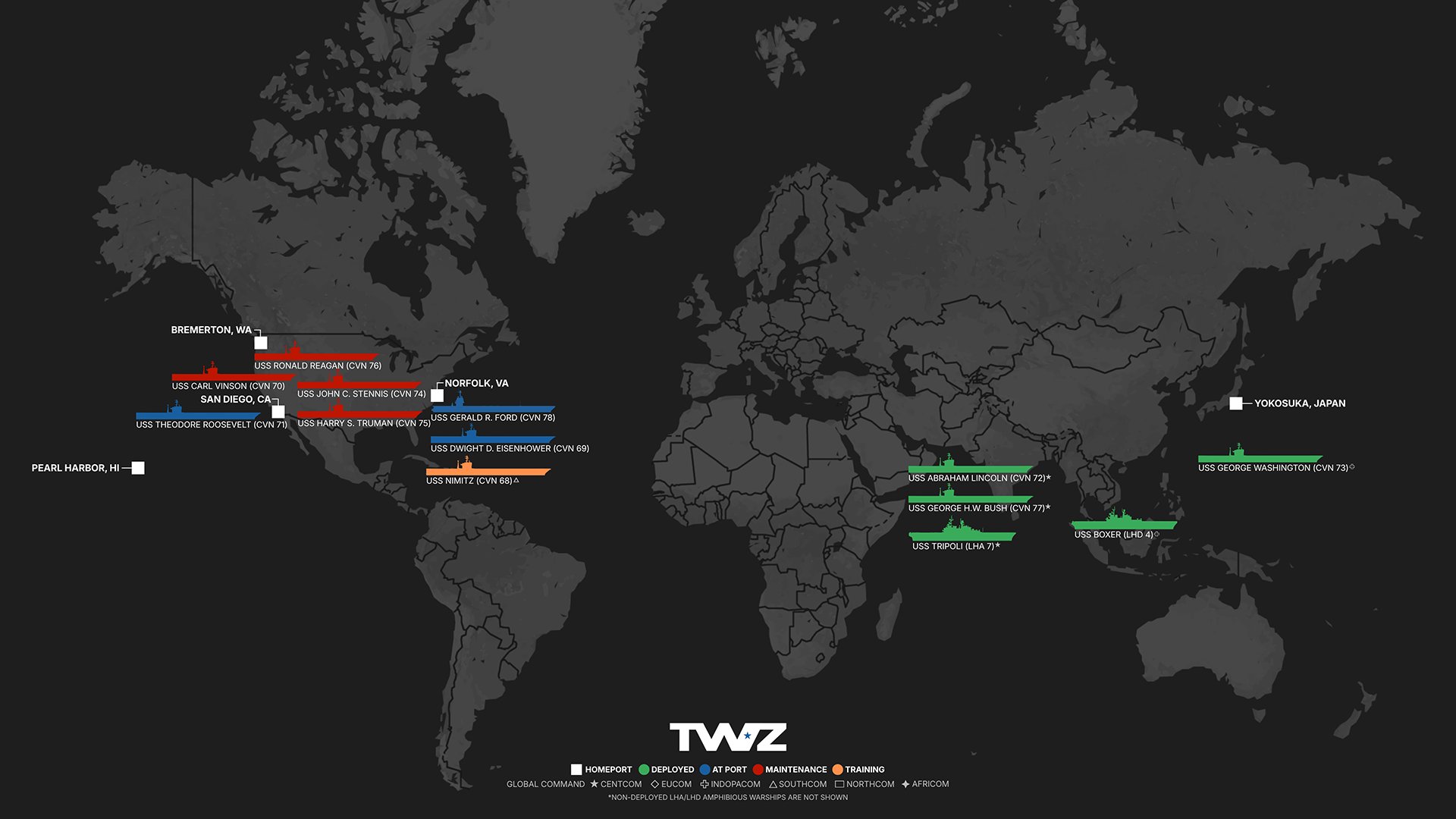
Here’s TWZ’s weekly carrier tracker monitoring America’s flattop fleet, including deployed Carrier Strike Groups (CSG) and Amphibious Ready Groups (ARG), using publicly available open-source information. Check out last week’s report here.
Amphibious assault ship USS Iwo Jima returned to Naval Station Norfolk on Saturday, wrapping a nearly 10-month deployment to the U.S. Southern Command-4th Fleet area of responsibility (AOR). During the 296-day deployment, the Iwo Jima ARG launched over 6,000 sorties, flew 1,850 flight hours, and transited more than 130,000 combined nautical miles. The ARG was the first group of expeditionary naval assets deployed to support Operation Southern Spear, which involved enhanced counter narcotics operations, and played a key role in Operation Absolute Resolve to exfiltrate ex-President Nicolas Maduro from Venezuela.
Wasp-class amphibious assault ship USS Iwo Jima (LHD 7) returned to its homeport of Norfolk, Va. on June 6 following a historic 10-month deployment to the U.S. Fourth Fleet area of operations.
Aircraft carrier USS Nimitz departed Kingston, Jamaica, after a 4-day port call. Nimitz is now reportedly en route to the United States, according to the U.S. Embassy in Jamaica, “as it finished its 2026 Southern Seas goodwill tour.” The two ships supporting Nimitz, destroyer USS Gridley and oiler USNS Patuxent, also got underway after a brief stop in Ponce, Puerto Rico. Over the weekend, Nimitz embarked officials from the Dominican Republic for a distinguished visitor tour and Gridley fired the Mk 45 Mod 4 5-inch gun during a live fire demonstration.
The USS Nimitz (CVN 68) departed Kingston Harbor at 12pm on June 5 enroute to the United States as it finished its 2026 Southern Seas goodwill tour. Thank you for stopping in Kingston and strengthening the U.S.-Jamaica bilateral partnership as well as enhancing our… pic.twitter.com/RKimaXy6ia
The U.S. maintains dual-carrier coverage in the Middle East enforcing the naval blockade of Iranian ports. USS Abraham Lincoln conducted a replenishment-at-sea with USNS Arctic in the Arabian Sea on June 3, and USS George H.W. Bush is operating at an undisclosed location in the AOR. U.S. Central Command forces have redirected 134 commercial vessels and disabled seven ships attempting to run the blockade, according to a press release.
The officer of the deck aboard USS Michael Murphy (DDG 112) observes a merchant vessel while the guided-missile destroyer enforces the U.S. blockade against Iran in the Arabian Sea. As of June 7, CENTCOM forces have redirected 132 commercial vessels and disabled 6 to ensure… pic.twitter.com/mZtfSMTIRG
The George Washington CSG is operating in the U.S. Indo-Pacific Command-7th Fleet AOR. Washington was spotted alongside oiler USNS Earl Warren during a fueling-at-sea evolution on June 8 in the Philippine Sea and, during the last week of May, embarked Carrier Air Wing (CVW) 5 and completed carrier qualifications (CQ). CVW-5 includes a squadron of F-35C fighter aircraft.
Coming in loud and clear!
An F/A-18E roars in for a landing on the flight deck of USS George Washington while underway in the Philippine Sea. Forward-deployed strike capabilities maintain regional stability and guarantee a free and open Indo-Pacific.#FlyNavy | #US7thFleetpic.twitter.com/lAlxexD4hs
Ukraine's drone campaign targeting Russian logistics is moving to sea
Ships carry supplies between Russia and occupied southern Ukraine
Striking the ships can force more supplies to move over land in vulnerable trucks
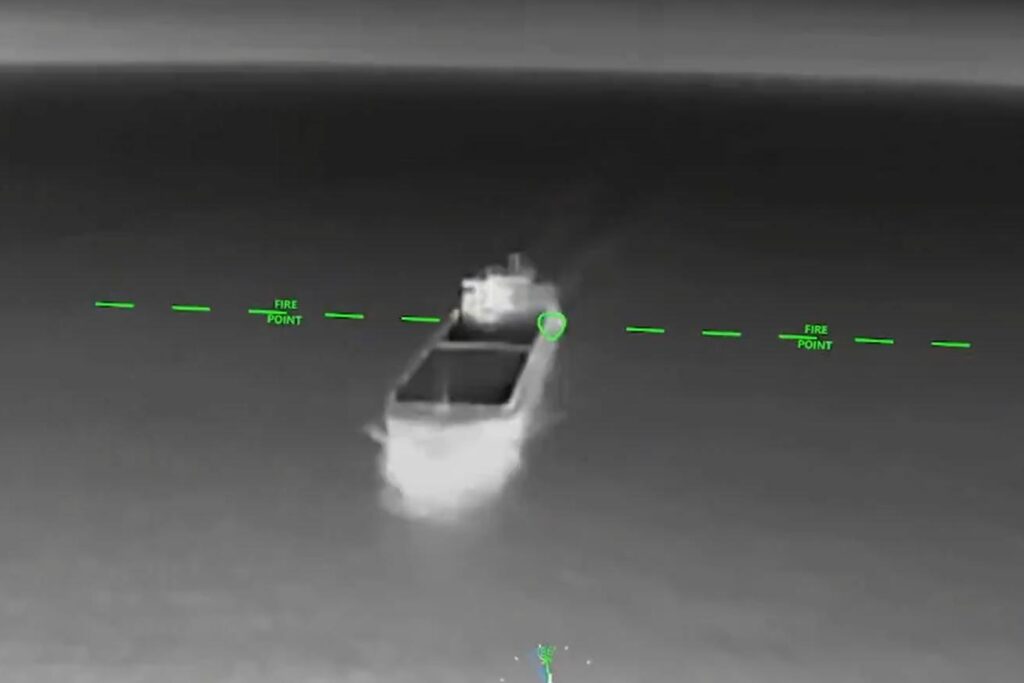
One-way attack drones from Ukraine's Unmanned Systems Forces struck five Russian cargo ships on the Sea of Azov on 5 June.
The strikes, which left at least one ship a burned-out hulk, are a kind of corollary to Ukraine's escalating campaign of middle-distance strikes on Russian supply lines on land in occupied territories. Aiming to weaken Russian regiments before they can attack across the disputed gray zone, Kyiv's drone units aren't only hitting trucks and vans on land—they're also hitting ships at sea.
"There's a method to the madness here," Ukraine Control Map explained. "Take out the ships, force Russia to use more trucks, more logistic bottlenecks." Then hammer the bottlenecks with drones.
The ultimate goal is to make it more difficult for the Kremlin to resupply and reinforce its 700,000 troops in occupied Ukraine. It's cheaper and easier to defeat an attack before it even begins by starving the attacking troops of food, fuel, batteries, ammunition and other vital supplies.
The ships the USF hit with Fire Point FP-1 drones on 5 June were spread out across a wide area. They were in occupied Mariupol and Berdiansk and along the coast of occupied Ukraine — the same Berdiansk port where Ukrainian drones struck a Russian munitions cargo ship on consecutive nights at the start of June.
What they had in common was their disguise. Civilian-owned but allegedly illegally working on behalf of sanctioned Russian entities, the ships sail without obvious markings or easily tracked radio transponders. There could be scores of such ships plying the Black Sea on Russia's behalf every day.
Two of the ships hit on 5 June, the dry cargo vessels Natra and Zirkon, were inbound from Türkiye to Rostov-on-Don when Ukrainian drones struck them in Taganrog Bay—empty, heading to load grain at a port Western governments and Ukraine identify as a transit hub for grain looted from occupied Ukrainian territory. Five Azerbaijani crew members on private contracts were killed and three wounded, Azerbaijan's foreign ministry said. Brovdi didn't address the deaths.
Telling apart a ship hauling Russian military fuel from a ship empty and heading to pick up looted grain is the kind of distinction that's hard to make from a drone's-eye view.
Ships that can haul thousands of tons of supplies every trip are much more efficient than trucks that can haul just a few tons apiece. Cargo ships can't deliver supplies to inland forces, of course, but they can move cargo between ports in southern Russia and ports in occupied Ukraine, bringing that cargo as close as possible to the gray zone before trucks must take over the shipping effort.
Map: Euromaidan Press
A thick-skinned ship is a tougher target than a thin-skinned truck, of course. But Ukraine's FP-1 drones carry a 100-kg blast-fragmentation warhead, with a TNT main charge boosted by the more powerful OKFOL explosive. The combination throws fragments outward and starts fires inside the target—the same mechanism that left the corvette Boikiy burning for hours at Kronstadt on 3 June.
— Special Kherson Cat (@bayraktar_1love) June 8, 2026
Sitting duck trucks
Russia's thousands of military supply trucks are already squarely in the crosshairs of Ukrainian drone units. Since launching their coordinated counterlogistics campaign this spring, the Ukrainians have increased their monthly truck strikes nearly tenfold, from around 60 per month to nearly 500, as per the Ukrainian general staff.
But a comprehensive assault on Russian logistics requires raids on sea traffic, as well. That effort may have begun in earnest on 5 June. "Cargo ships and tankers with their names painted over by Black Sea looters and their transponders switched off, used for the quiet theft of Ukrainian grain and the transport of military cargo and fuel, can no longer count on either long service lives or uninterrupted schedules," the 414th Unmanned Strike Aviation Brigade crowed.
If they can disable enough ships, the Ukrainian drone teams may compel Russian logisticians to shift more supplies by land. To reach Russian regiments in southern and eastern Ukraine, those supplies normally travel east to west along the M-14 highway that runs close and parallel to the Black Sea coast.
That highway and connecting roads have become a kill zone for Russian trucks as more FP-1, FP-2, Hornet and Bulava drones take to the sky, increasingly unbothered by Russia's collapsing air defense network. Ukrainian industry now churns out tens of thousands of middle-strike drones every month, some for as cheaply as a few thousand dollars apiece.
The Russians are trying to find alternate routes that avoid the most heavily droned roads, but once a truck gets close to its destination, it has no choice but to follow a dwindling number of paths. Ukrainian intelligence knows where the Russians' main divisional bases are; they know the trucks must eventually turn into these bases. The near approaches are now becoming kill zones alongside the M-14 and other main roads.
It'll take many more strikes on Russian ships to seriously dent the sea logistics and force more supplies onto land routes. But the effort is underway. "The occupier's smuggling logistics must be stopped," the 414th Unmanned Strike Aviation Brigade explained.
Explore further
Russia keeps four field armies fed through three southern towns. Ukraine’s drones just arrived.
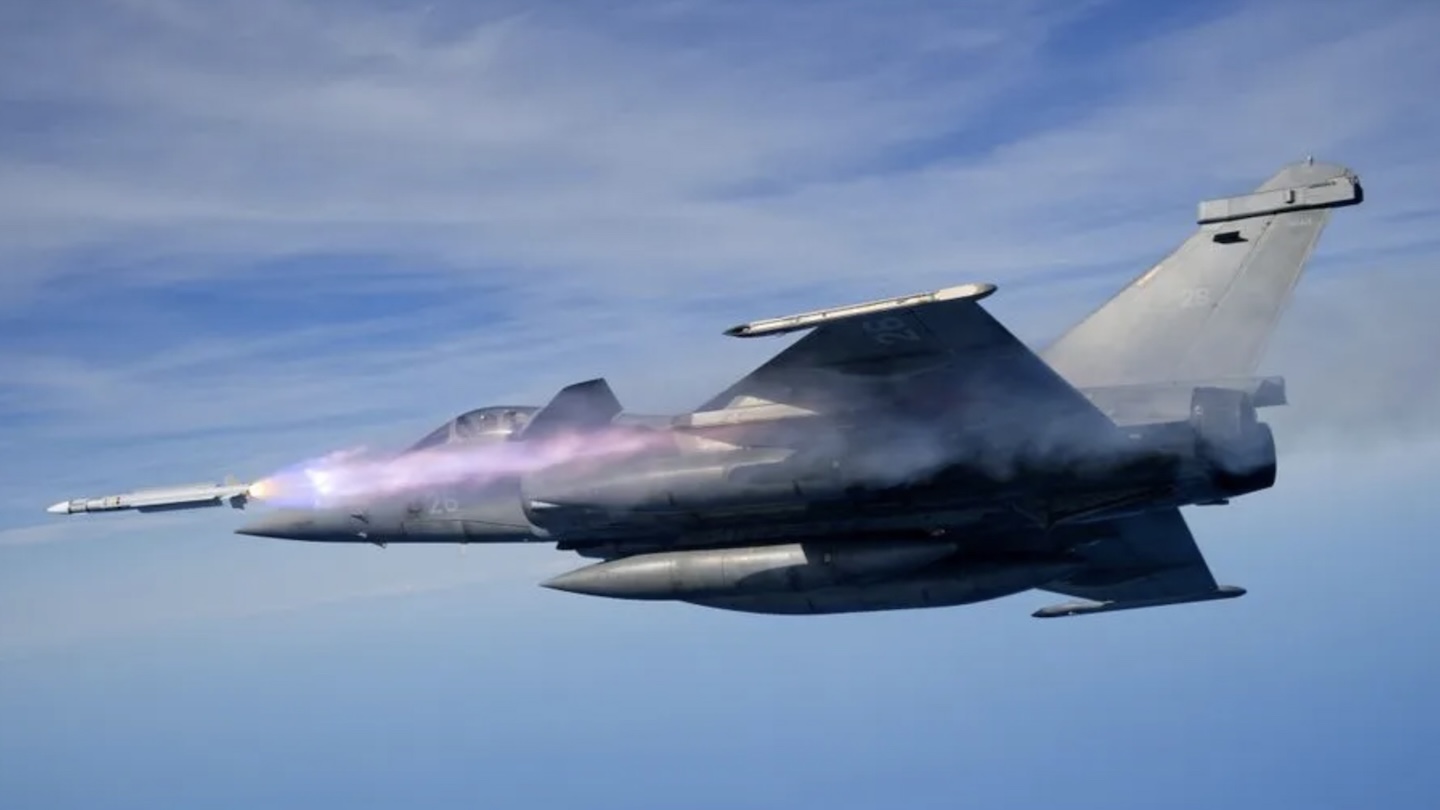
Footage has emerged showing the destruction of a drone by a French Rafale fighter over Latvia earlier today. The engagement underscores how the drone war unleashed by the Russian invasion of Ukraine is increasingly spilling over borders, as well as the growing reality of the drone threat to NATO.
The French Air and Space Force confirmed that its Rafales, currently deployed in neighboring Lithuania, were scrambled in response to the drone incursion. The drone was identified before one of the fighters shot it down over an uninhabited area. The incident was a “demonstration of the French Armed Forces’ commitment to contributing to the security of Europe’s eastern flank,” the service said in a statement on X.
Lettonie | Destruction d’un drone par les Rafale
Survol d’un drone au dessus du territoire letton Décollage sur alerte des chasseurs engagés dans la mission de l’OTAN Baltic Air Policing depuis la base aérienne de Šiauliai Identification et destruction… pic.twitter.com/NFIMSP7Ibl
— Armée française – Opérations militaires (@EtatMajorFR) June 8, 2026
A detachment of French Air and Space Force Rafale jets is currently engaged in the NATO Baltic Air Policing mission from Šiauliai Air Base, Lithuania.
This morning, French fighter jets deployed to NATO Air Policing at Šiauliai Air Base shot down a drone that entered Latvian airspace.
Lithuania thanks our French allies for their swift and professional action in safeguarding the security of our region.
This is not the first time that a NATO fighter has shot down a drone in the Baltic region as part of the Baltic Air Policing mission. On May 19 of this year, a Romanian F-16 shot down a Ukrainian drone over Estonia after it strayed into NATO airspace, reportedly due to Russian electronic warfare interference. Last September, NATO fighters shot down at least three, and likely four, Russian drones, after 19 reported violations of Polish airspace. Polish authorities assessed that the drones “did not veer off course but were deliberately targeted.”
However, this is the first time that an incident of this kind has been captured on camera.
At least two videos are now circulating on social media showing the engagement playing out.
One shows the moment that a Rafale launches an air-to-air missile, leaving a prominent trail of smoke, before detonating seconds later.
Another video, from a different angle, shows the immediate aftermath of the shootdown. Another trail is seen in the background of both videos, but it’s unclear if this is evidence of a previous missile launch, or a contrail from another aircraft that previously transited the airspace at a different altitude.
In a typical Baltic Air Policing configuration, the Rafale is armed with MICA air-to-air missiles. These beyond-visual-range weapons can be fitted with either an active radar seeker or an infrared seeker head, with a mix normally being loaded. The MICA uses a thrust-vectoring motor for improved agility and has a reported maximum range of around 37 miles.
Lituanie | Le succès des vols conjoints commence au sol
Préparation d'un vol d'entraînement avec des avions de chasse et :
Montage d'armements entre mécaniciens des deux pays alliés
— Armée française – Opérations militaires (@EtatMajorFR) June 6, 2026
The Latvian Armed Forces provided more details of the shootdown, noting that a yellow alert was originally issued for the Ludza, Balvi, and Aluksne districts this morning at 9:20 a.m. local time. This led to NATO fighters being launched.
At 9:40 a.m., this alert level was increased to orange for the Ludza and Rēzekne districts. At this point, it was confirmed that some kind of drone was entering Latvian airspace. A military spokesperson told the Reuters news agency that the drone entered Latvian airspace from Russia.
The Latvian Armed Forces warned residents in these areas to “Seek shelter indoors, close windows and doors — follow the two-wall principle.” It added: “If you notice a low-flying, suspicious, or dangerous object, do not approach it and call 112.”
At 10:05 a.m., the Latvian Armed Forces confirmed that NATO fighters were over the Rēzekne district, and a “foreign” drone was shot down over the Berzgale parish.
Berzgale is less than 20 miles from the nearest Russian border, and around 340 miles from the closest Ukrainian border, with Belarus, a close Moscow ally, separating Latvia and Ukraine.
A map showing the approximate location of the drone shootdown in Berzgale, Latvia. Also marked is the Russian naval base at Kronstadt that came under Ukrainian drone attack last week. Google Earth
NATO’s Baltic Air Policing mission has safeguarded the airspace of Estonia, Latvia and Lithuania since the three countries joined the alliance in 2004. Because the Baltic states do not maintain fighter fleets capable of continuous air-defense duties, allied nations rotate detachments of combat aircraft to bases in Lithuania and Estonia, where they remain on quick-reaction alert around the clock.
The mission routinely scrambles fighters to identify and intercept Russian military aircraft operating near NATO airspace, particularly flights to and from Russia’s heavily militarized Kaliningrad exclave that often occur without flight plans, radio contact, or active transponders.
French Rafales recently encountered this Russian Navy Su-24M carrying free-fall bombs during a flight over the Baltic. French Armed ForcesOne of two Russian Navy Su-30SMs intercepted over the Baltic by French Rafales during the current Baltic Air Policing detachment. This example carries a Kh-31 series anti-ship or anti-radiation missile. French Armed Forces
Following Russia’s annexation of Crimea in 2014, NATO expanded the mission with additional aircraft and operating locations, making Baltic Air Policing one of the alliance’s most visible peacetime deterrence operations on its eastern flank.
Since Russia’s full-scale invasion of Ukraine, the expanding drone war between the two countries has provided another layer of responsibility to the Baltic Air Policing mission.
A Rafale B is ready for takeoff as part of an earlier Baltic Air Policing mission in Lithuania, in the Baltic States, December 2024. Photo by PETRAS MALUKAS / AFP PETRAS MALUKAS
For most of its history, Baltic Air Policing centered on scrambling fighters to identify Russian bombers, fighters, reconnaissance aircraft, and transports flying near NATO airspace. The war in Ukraine has seen the increasing proliferation of drones that can travel hundreds or even thousands of miles, creating a new challenge for NATO air defenses.
Since 2022, there have been several incidents, including drones and missile debris entering or crashing in NATO territory, including in Poland and Romania. Late last month, a Russian kamikaze drone strayed into Romanian airspace before striking a residential building, injuring civilians, in what appears to have been the first incident of its kind.
A russian drone carrying explosives, involved in the bombing of infrastructure in Ukraine crashed in Galați, Romania, causing a fire on the roof of a residential apartment building.
Two persons sustained minor injuries and several residents required medical attention, the… pic.twitter.com/P8jzYFrEEp
We asked NATO for more details of today’s incident, including whether it could confirm reports citing the Latvian military that the drone had entered its airspace as a result of Russian electronic warfare. This is a threat that is by now commonplace in the Baltic region.
“While the circumstances surrounding this incident are still under review, jamming is known to occur in this region, and can pose serious safety risks, including to civil aviation,” a spokesperson for the alliance told us.
In recent days, Ukraine has carried out a number of high-profile drone attacks against Russian targets in and around the Baltic region.
In the last week, Ukrainian drones appear to have hit the St. Petersburg oil terminal, the Baltic Fleet base at Kronstadt, and a weapons factory in the Tambov region.
As we observed in our previous reporting, there have been very few confirmed Ukrainian attacks of any kind against the Baltic Fleet. However, satellite and other imagery that emerged in the wake of the recent drone strike reveals extensive damage inflicted on the Steregushchiy class corvette Boikiy.
Footage of the Russian Navy Baltic Sea Fleet corvette Boikiy burning in its Kronstadt drydock after a Ukrainian drone strike yesterday. pic.twitter.com/9CHz4aLdY8
Another satellite image of the Russian corvette Boikiy following yesterday's Ukrainian strike. What is interesting here is that the active fire was captured before firefighting crews managed to extinguish it. @planet image taken on June 3 at 16:30 local time. It burned for hours. pic.twitter.com/PzcHxoSxGk
Today’s incident provides visual evidence of advanced NATO fighters used to shoot down drones over alliance territory. While effective on this occasion, this kind of interception can be inefficient due to the mismatch in cost between the drone and missile. It is notable that the French Ministry of Defense has plans to introduce a lower-cost counter-drone capability on the Rafale by the summer. Trials of a pod loaded with 68mm laser-guided rockets have already begun.
Un Rafale équipé de roquettes guidées laser aperçu à Istres. Les essais ont donc enfin démarré. Ici une nacelle Thalès JF12, donc 24 roquettes 68mm au total. Une corde de plus à l'arc du Rafale, la chasse au Shahed est OUVERTE ! pic.twitter.com/6v0xSMkUJ1
As a result, NATO has accelerated work on layered defenses that include short-range ground-based air defenses, electronic warfare, and other counter-drone technologies.
Fighters, however, will always remain a critical last-resort option, especially when a drone poses an immediate threat or when a visual identification is required.
Today’s video not only illustrates the changing face of the Baltic Air Policing mission due to the Russian war in Ukraine, but highlights the growing threat posed by drones and cruise missiles that can cross borders with little warning, whether deliberately or not.
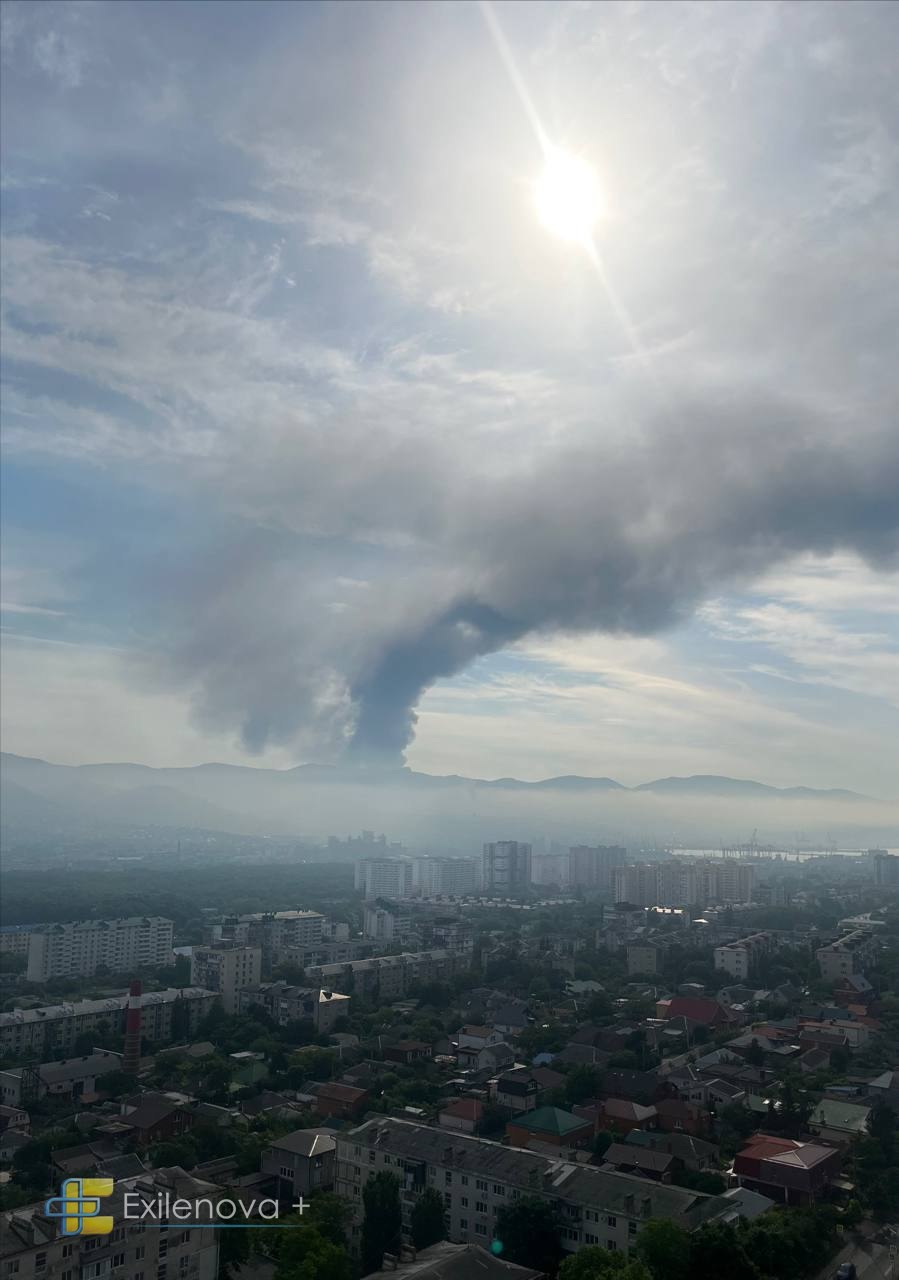
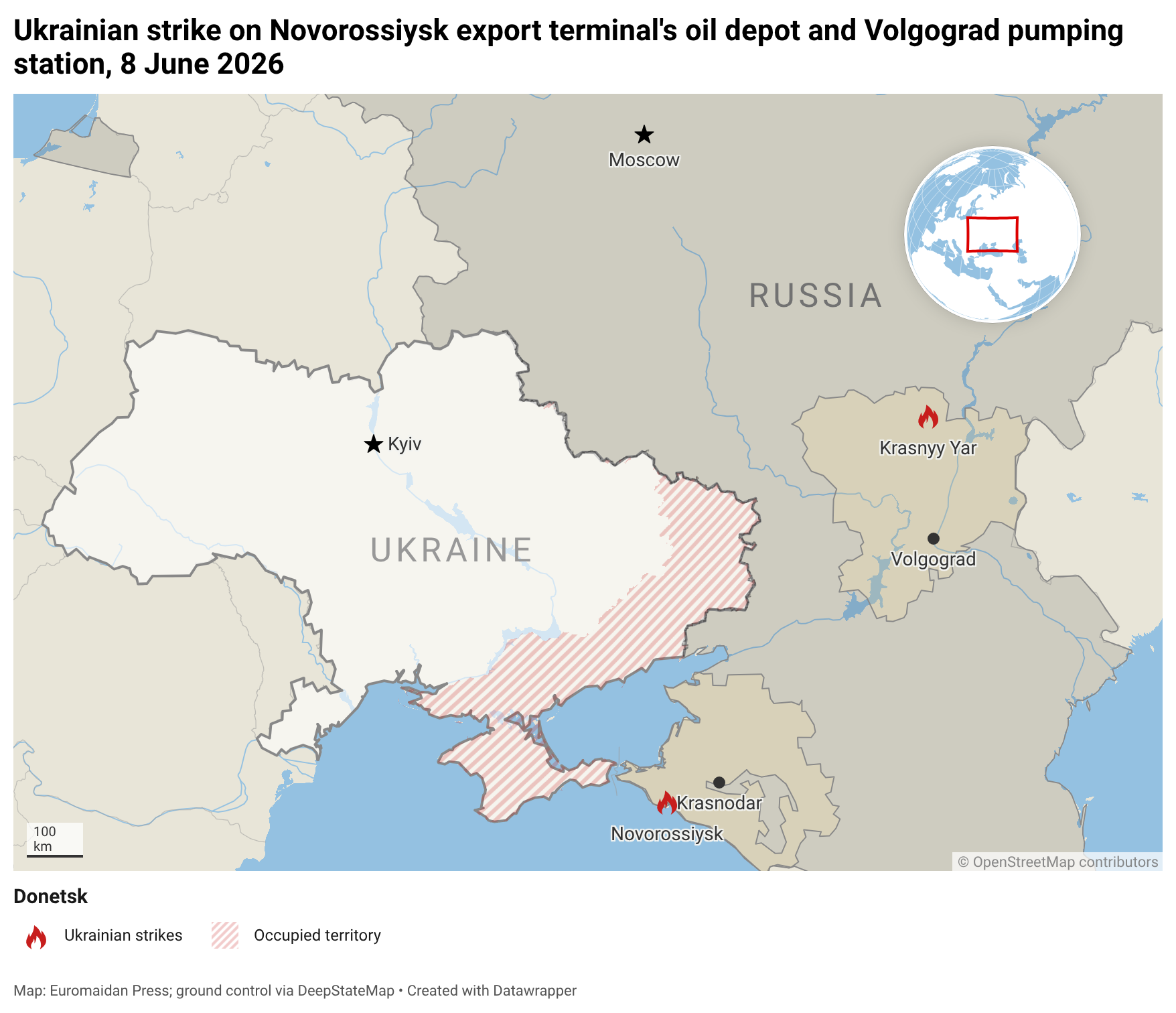
Ukrainian drones set a major oil depot ablaze near the Russian Black Sea port of Novorossiysk overnight on 7-8 June 2026, in a strike confirmed by Ukraine's Unmanned Systems Forces (SBS). Residents reported a string of blasts and heavy smoke over the Grushovaya storage site, which feeds Russia's busiest oil-export port. Ukrainian forces hit two more targets in southern Russia the same night.
Ukraine has spent the past year pushing its deep-strike campaign further into Russia, hunting the refineries, pipelines, and export ports that turn crude into the cash funding the invasion. Each hit on this Black Sea network forces costly repairs and brief loading halts, and steady Ukrainian success deep in Russia's rear, alongside a steadier front, is shifting how the West reads the war.
Drones spark a blaze at Novorossiysk's oil hub
The strike came before dawn. Residents of Novorossiysk, in Russia's Krasnodar Krai, reported about 50 blasts, then heavy smoke over the Grushovaya oil depot. Operators of the SBS's 1st Separate Center, working with Special Operations Forces (SSO) and other units, confirmed the hit. Ukraine's General Staff also confirmed the strike and said a fire broke out, with damage still being assessed. Russian officials claimed no one was hurt.
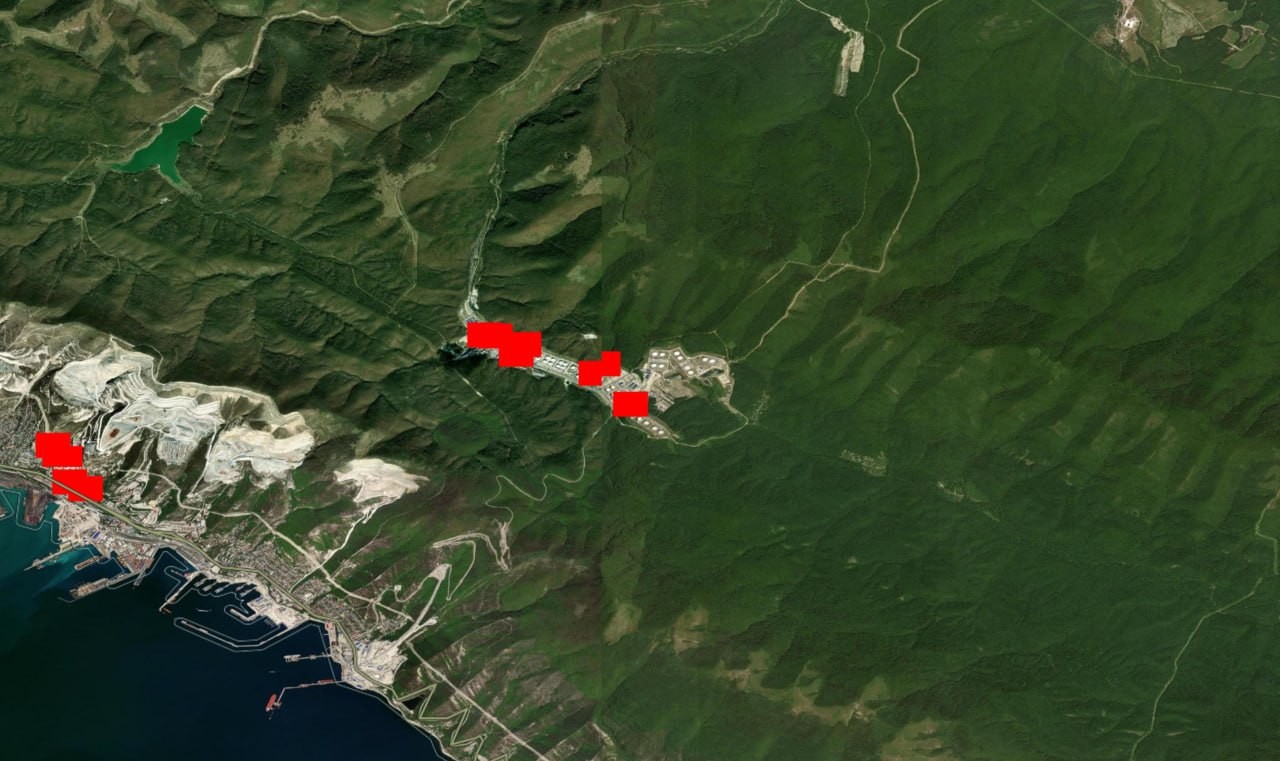
NASA FIRMS satellite data showing fire hotspots (the red squares, the cluster to the right) at the Grushovaya oil depot near Novorossiysk, 8 June 2026. Map: NASA FIRMS
NASA's FIRMS satellite service detected abnormal heat at the site at 02:48 on 8 June. Ukrainian Telegram channel Exilenova+ began reporting the attack around 3 a.m., posting photos and videos of fire in the mountains above the city. OSINT Telegram channel Falcon insight pinpointed the location. Russian news Telegram channel ASTRA confirmed the burning tank farm from eyewitness footage shot about 11 km away.
A fuel storage depot is burning in Novorossiysk, Russia, after a drone strike hit the tank farm overnight
Novorossiysk is one of Russia's most strategically important Black Sea ports, handling a significant share of Russian oil exports Supernova pic.twitter.com/d2ab4SSuH0
— Euromaidan Press (@EuromaidanPress) June 8, 2026
What the Grushovaya depot feeds
The Grushovaya site is a transshipment depot for the Sheskharis terminal. Chernomortransneft runs it, under Russia's state pipeline monopoly Transneft. It sits in the Grushovaya Balka tract beyond the Markotkh Ridge, about 12 km from Novorossiysk. The tank farm holds more than 1.2 million m³ of fuel across dozens of tanks, on a site of about 212 hectares. SBS called it one of the largest oil-product stores in the Caucasus.
Smoke from the burning Grushovaya oil depot drifts over Novorossiysk after the Ukrainian drone strike, 8 June 2026. Photo: Exilenova+
Novorossiysk is southern Russia's biggest oil-export hub, the Moscow Times reported. The port ships up to 700,000 barrels a day, and its terminals moved 19.8 million tonnes of oil products in 2025. That trade feeds Russia's budget, which bankrolls the war on Ukraine. The port has become a recurring target in Ukraine's strikes on Russia's Black Sea oil logistics.
Volgograd and a coastal radar also hit
The same night, Ukraine's General Staff said its forces struck the Krasny Yar oil-pumping station in Volgograd Oblast, where a fire broke out. Volgograd governor Andrei Bocharov claimed the blaze came from falling drone debris at the Zhirnovsk pumping station and was quickly put out, the Moscow Times reported. Ukrainian forces also hit a Russian radar station near Kabardinka in Krasnodar Krai, according to the General Staff.
Explore further
Kronstadt, Russia’s major naval Base after Black Sea Fleet losses, gets hit by Ukrainian drones (VIDEO)
Not the first strike on Novorossiysk's oil chain
Ukrainian forces have hit this infrastructure before. Ukrainian defense outlet Militarnyi reported that drones struck the Grushovaya depot on 23 May 2026, when fire spread across much of the site. Strike drones also hit the Sheskharis terminal on 6 April, damaging oil-metering systems and shut-off valves at the loading berths. ASTRA said the wider complex was attacked in early March, early April, and on 22 May.
For decades, the massive MH-53E Sea Dragon helicopter has served as the Navy’s primary airborne mine countermeasure platform, dragging massive mine hunting sleds through waters all around the globe. However, the Sea Dragon’s days are now numbered, with the last 11 aircraft scheduled to sunset sometime next year. With the MH-53E’s demise on the horizon, we reached out to one of its former pilots, Steve Jones — a man who came to know this monster intimately during the Global War On Terror. He had plenty of stories to tell and provided us with a new understanding of the often misunderstood counter-mine mission.
The MH-53E’s mission is also, of course, extremely topical right now thanks to ongoing tensions with Iran. Secretary of State Marco Rubio recently told senators that the Islamic Republic mined “large segments” of the Strait of Hormuz, endangering shipping in the region.
As it currently stands, the mighty Sea Dragons, which are considered one of the military’s most dangerous to fly due to numerous fatal mishaps, are being phased out in favor of the smaller MH-60S Seahawk paired with a suite of new aerial mine countermeasures systems, as well as other new technologies, like uncrewed underwater and surface vessels. The Navy’s overall mine hunting force is going through a transition that is controversial, to say the least, with many questioning if the Pentagon is investing enough resources in this critical missions set.
Petty Officer 1st Class Rawad Madanat
With all these issues in play, in an exclusive, wide-ranging, two-hour interview, Steve Jones offered in-depth insights about the Navy’s airborne counter-mine mission, the Sea Dragon’s capabilities and dangers, current mine sweeping operations, as well as everything from what it was like to narrowly avoid getting entangled with a surfacing sub to his experiences ferrying celebrities like Robin Williams and Tom Jones around a war zone.
So, with the stage being set, let’s get into this incredible exchange.
Some of the questions and answers have been lightly edited for clarity.
Then-Navy Lt. Steve Jones in an MH-53E Sea Dragon. (Courtesy Steve Jones)
A: During the time that I selected, you could choose SH-60 Seahawks, you could choose CH-46E Sea Knights and the MH-53 Echo. You could choose SH-3 Sea Kings, but they were kind of winding down the H-3s, which is the same as the presidential helicopter Marine One that they fly now, but they were flying out of Norfolk and Puerto Rico, primarily for VIP transport.
So, I looked at the 53 for a lot of reasons. One, I liked the instructors that came from that community in the advanced helicopter training. And two, I just thought the helicopter just really looked awesome, and it was big, and so that’s why I chose it, and I just thought it would be a good personality fit, work fit for me, and it ended up being that way.
An MH-53E Sea Dragon, assigned to the “Blackhawks” of Helicopter Mines Countermeasures Squadron 15 (HM-15), takes off from the flight deck of the amphibious assault ship USS Wasp (LHD 1) during flight operations on the ship’s flight deck, April 5, 2025. (U.S. Navy photo by Mass Communication Specialist Seaman Soren V.P. Quinata) Petty Officer 3rd Class Soren Quinata
Q: What are the main differences between the Navy’s MH-53E and the Marines’ CH-53E Super Stallion?
A: It’s primarily the same aircraft. Except our aircraft has larger fuel sponsons, so we could carry more gas. The reason for that is ideally we’d want to be able to fly an hour to where the mission objective was, be able to stay on station for about an hour, and be able to fly back. That requires at least three and a half, four hours of gas and extra fuel in those side sponsors. And that allowed us to do that. So instead of a small sponson with two tanks, we had one big sponson with four fuel tanks that were inside each of the sponsons on either side of the aircraft.
Q: So how much gas would that larger sponson hold?
A: About 22,000 pounds of gas.
U.S. Navy Aviation Boatswain’s Mates (Fueling) prepare to refuel an MH-53E Sea Dragon helicopter, attached to Helicopter Mine Countermeasures Squadron (HM) 15, on the flight deck of the Nimitz-class aircraft carrier USS Abraham Lincoln (CVN 72). (Official U.S. Navy photo) Courtesy Asset
Q: Talk about the training and some of the biggest challenges of flying that huge aircraft.
A: Typical Navy training is two years of flight school, and then after flight school, we went to our Replacement Air Group, which we call the RAG, that was in Norfolk, Virginia. You spend about a year, or up to 10 months, in Norfolk, Virginia, learning primarily how to fly the helicopter, how to land the helicopter, and we do that in the combination with the Airborne Mine Countermeasure Squadron. We used aircraft from Helicopter Mine Countermeasures Squadron (HM) 14 to learn how to fly the different mission sets and learn aircraft familiarization. And then from there you either get assigned to HM-14, which was in Norfolk, Virginia, or HM-15, which was in Corpus Christi, Texas. HM-15 has now moved to Norfolk, Virginia. [Editor’s note: HM-14 sunsetted in 2022.]
Sailors assigned to the “Vanguard” of Helicopter Mine Countermeasures Squadron 14 (HM-14) posed for a photo in front of an MH-53 “Sea Dragon” helicopter prior to the squadron’s last flights Dec. 8, 2022. (U.S. Navy photo by Mass Communication Specialist 2nd Class Malachi Lakey) Mass Communication Specialist 2nd Class Malachi Lakey
The training takes about 10 months. Mine was a little bit longer because when I actually joined that community, the aircraft were down because of a crash off the coast of Corpus Christi, Texas. There was a problem called ‘thermal runaway,’ where the bearings in the main rotor head would fail, and they would seize together and get hot, and we lost a few sailors from HM-15. And until they figured out why and how to prevent it, it took about a year for those aircraft to come back up, so I was in Norfolk for maybe about a year and a half, almost two years, before I got to Corpus because of that bearing issue.
Q: What was it like when you finally got out there and learned how to fly while pulling a mine countermeasure sled?
A: There’s different types of equipment that you use and it takes a special kind of person to be able to maintain the situational awareness – both flying the aircraft and what’s happening in the back – because there’s dangers in the back. You have a very confined area, lots of equipment, and under lots of tension, and so the very first couple of times, the instructor is kind of handling everything, and you’re just kind of riding along.
An MH-53 Sea Dragon helicopter from the “Vanguards” of Helicopter Mine Countermeasures Squadron Fourteen pulling a Mark 105 Magnetic Influence Minesweeping System (SLED). (Photo by BOB HOULIHAN / NAVY VISUAL NEWS / AFP) BOB HOULIHAN
Then eventually you start to do more tasks, physical tasks, in terms of flying and maintaining a stable platform for the men and women that are working in the back, and then over time those skills translate into a larger situational awareness, where you’re now a mission commander – where you’re flying the aircraft, but also, conducting the mission in the back is your primary responsibility. The positions are second pilot or co-pilot, and then you become a Helicopter Aircraft Commander (HAC), which is like the captain, and then you become an Airborne Mine Countermeasures Mission Commander (AMCM MC), meaning you’re flying the aircraft, you’re the commander of the aircraft, but you’re also commanding the mission.
Lt. Cmdr. Jeff Spencer and Lt. Cmdr. Nik Bochette, assigned to the Vanguards of Helicopter Mine Countermeasures Squadron (HM) 14, perform a pre-flight check on an MH-53 helicopter. (U.S. Navy photo by Mass Communication Specialist Seaman Jessica L. Dowell/Released) Petty Officer 2nd Class Casey Hopkins
Q: Did you become a mission commander?
A: I did. So I was fully qualified in the MH-53 Echo in my squadron, so I was a mission commander. I worked the maintenance side, so I was the maintenance check pilot and functional check pilot. It takes a lot of maintenance, and then post maintenance, and you have to do post maintenance flights to be able to make sure the aircraft is safe for anyone else to fly. So I spend most of my time in those areas in that squadron.
A U.S. Navy Sailor with Helicopter Mine Countermeasures Squadron 14 guides an MH-53 helicopter from a vehicle carrier ship at Marine Corps Air Station Iwakuni, Japan, Sept. 14, 2022, after completion of aircraft maintenance. (U.S. Marine Corps photo by Cpl. Darien Wright) Cpl. Darien Wright
Q: What are the MH-53’s unique quirks and advantages?
A: One of the advantages was pure brute strength. You had three GE engines, so you could handle lots of torque, and the way that we hunted and swept for mines was pulling sleds in the water, which causes thousands and thousands of pounds of stress, so it’s really like a forceful instrument in the water. The operation requires the coordination of not only meteorologists and Operations Specialists, which are like intel specialists in mine warfare, but then you have the maintainer, you had two pilots and a crew chief, plus it could be up to four people in the back, depending on the type of gear you’re stowing in the back, so it really takes coordination from the front.
An explosive ordnance disposal technician, assigned to Explosive Ordnance Disposal Mobile Unit 5 Platoon 502, operates a communications system aboard an MH-53 helicopter belonging to Helicopter Mine Countermeasures Squadron (HM) 14. (U.S. Navy Combat Camera photo by Mass Communication Specialist 2nd Class Alfred A. Coffield) Petty Officer 1st Class Alfred Coffield
The disadvantage is that it’s a very expensive aircraft to operate. Every hour of flight, required 24 hours of maintenance, and if a squadron had 10 helicopters, which we did at one point in time, you’re looking at the largest deployable squadrons in the Navy, like 600-plus people to operate these aircraft.
With everybody working together, we advertise that we could be anywhere in the world in 72 hours, where there’s a mine threat. We could break down the helicopters, put them in a C-5 and then reassemble them anywhere in the world in 72 hours. After 9/11, for Operation Iraqi Freedom, we did deploy by C-5. We took half the helicopters to Sicily and the other half went to Bahrain and took 11 C-5s in order to move a squadron that size into those two locations, so big footprints, lots of money, lots of parts.
An MH-53E Sea Dragon assigned to the “Blackhawks” of Helicopter Mine Counter Measures Squadron 15 is offloaded from a U.S. Air Force C-5 Galaxy, March 14, 2003, at the U.S. naval base at Sigonella, Sicily. (Photo by Damon J. Moritz/U.S. Navy/Getty Images) U.S. Navy
Q: How fast could the Sea Dragons fly?
A: The 53 is a fast helicopter. One of the fastest out there. We were limited to 150 knots for airframe preservation. Under towing conditions, we typically flew between 18 and 25 knots, depending on the device in the water. Each vehicle had different performance parameters to properly deploy the device. Under rapidly changing conditions we always had to maintain proper speed and altitude control.
Q: The Sea Dragon has experienced a notoriously high rate of mishaps. Did that ever concern you? What do you think contributed to this record?
A: It did. If you’ve ever seen one or been on one, been close to one, or heard one, you’ve got 100-foot long machine with millions of moving parts, right?
Our maintenance crews were very good, I always felt safe flying. I think you have to if you choose to fly that particular weapon system, but there were a lot of accidents. And I knew folks that were killed in MH-53 accidents who I went to flight school with, and buddies.
It’s a very complicated machine that did a very important mission, and accidents do happen, both mechanically, but also because of pilot error. In combination, you end up losing a lot of airframes. Besides the United States, there is only one other nation that flew that airframe, and that was the Japanese for their mine sweeping operation. It’s a very complicated, expensive machine, and that’s why not very many people flew it.
An MH-53E helicopter belonging to the Japanese Maritime Self-Defense Forces takes off during Marine Corps Air Station (MCAS) Iwakuni Friendship Day, May 5, 2004, at MCAS in Iwakuni, Japan. (Photo by Koichi Kamoshida/Getty Images) Koichi Kamoshida
Q: Did the danger concern you?
A: You know, you’re in your 20s, right? So you feel a little bit invincible. I’ll tell you a story. When I switched from 53s and started flying C-130s, after the Haitian earthquake, I flew into Guantanamo Bay, and my old squadron was there on the same ramp as we were. So I walked over to see who I still knew there, and they had a 53 turning on the deck there, and I was just going, ‘wow, I couldn’t believe I used to do that,’ and not thinking about how many things have to go right in order to have a good day. And I just kind of said to myself, ‘it’s really a young person’s game,’ because you gotta kind of hit the ‘I believe’ button on a lot of things, because there’s just a lot of opportunity for negativity to come in. Weather, environment, and then the mechanics of things.
MH-53 pilot Lt. Steve Jones in Bahrain, circa 2002. (Courtesy Steve Jones) Picasa 2.7
Q: What were the biggest factors contributing to the Sea Dragon mishaps?
A: With any aircraft system, the largest factor that contributes to any accident is the human factor. Yes, engines will fail, components will fail, but a lot of times it was human error that caused the ultimate catastrophe because when an emergency happens, you have three criteria in order to gauge when you should land.
The two critical ones are ‘land immediately,’ meaning if you do not ditch in the water or put the aircraft down, it is going to come apart in flight. The other critical criteria is ‘land as soon as possible,’ meaning as soon as you have a safe place to land, then you land as soon as possible. Then you have another condition where you can continue to fly, but flying is not recommended. And so that decision factor between land immediately and land as soon as possible, it’s a bit of a gray area, right? You have a set of skills you can fly, but you can never time when the aircraft is going to come apart.
For example, in the Corpus Christi crash, they knew that they had a problem. I’m not second-guessing the pilot, but it was in that gray area between land immediately and land as soon as possible.
The aircraft commander chose to try to bring the aircraft closer to the beach, so you could survive a ditch, because putting a helicopter in the water – nothing is guaranteed, right? Then you have no control. However, bring it closer to the beach means you’re flying that much longer. So land immediately, there could have been more survivors.
Not to ‘Monday morning quarterback’ anything. I probably would have made the same call. And then with the new equipment that was put on the aircraft, there are lights now placed in a monitoring system that kind of took the gray area out of those decisions when it came to thermal runaway with the main rotor head. So now the decision is clear. Land immediately if certain indications happen, and land as soon as possible if certain indications happen. Prior to 2000, we didn’t have that.
Q: The Sea Dragon community has been well-documented for being neglected by the Navy. What was your experience when you were flying it? Why do you think that was?
A: It’s a unique mission set. It kind of came online during the Vietnam War and Haiphong Harbor, and clearing those mines, and then again in Desert Storm, when the USS Tripoli was hit by a mine.
Mining sea straits is a very cheap way to stop a huge navy, such as the one that we have in the United States. However, the Navy, in my opinion, didn’t necessarily see the value in that mission. There are very limited resources. There’s only so much money to go around, and large strike groups and ships just took priority. We were always probably a little bit underfunded, in my opinion, for a mission that’s important, which you can see today with the Strait of Hormuz. But it was definitely a huge problem that many people did not talk about during the first two Gulf Wars.
An Iranian mine-laying boat. (Iranian state media) (Iran State Media)
Q: Why was it a huge problem?
A: Well, when you try to move a carrier strike group into a small area like the Persian Gulf, by putting mines in the water, you create doubt in a captain’s head. The captain is responsible for thousands and thousands of lives, and the battle group commander is responsible for thousands and thousands of more lives, plus the strategic reason of why they’re there. If a mine is discovered, then everything has to pause. You can’t land Marines on the beach, you can’t move the strike group closer to the shore. The ability for you to project power ashore, all that kind of comes to an end.
Q: How does the MH-53E go about this unique mission set? Can you walk us through what a mission would look like from start to finish?
A: Depending on the intel, you’ll have a threat and the threat could be you suspect that there’s mines in the water, or that you know that there’s mines in the water. So, typically it’s ‘you suspect,’ right? And we used the AN/AQS-14, or “Q-14.” There’s about three different versions of the Q-14. It’s a side-looking sonar, which you drag in the water – we call it the fish. We would fly the fish at certain depths based on the terrain and what was in the water. That was called mine hunting.
MH-53 crew members and the AN/AQS-14 side-looking sonar. (Courtesy Steve Jones)
So initially you would always kind of begin with a hunting mission, where we could, or the OS operator, or the console operator would mark what they view as a mine-like contact. You’re really kind of looking at the sonar and distinguishing between man-made objects and natural objects. If you believe it’s a man-made object, and then you would mark a tape. You could also, real time, send that image back to the ship, but that capability came a little bit later.
We also had devices that allow you to sweep. A mine can be triggered by different mechanisms. Sometimes they’re triggered by contact.
Some mines are acoustically triggered, meaning you can set that mine to blow up for a certain type of ship acoustics. For instance, a destroyer has a different set of acoustics from an amphibious ship, from an aircraft carrier. If you want to let 1,000 destroyers pass you or a submarine and then wait for the aircraft carrier, you can tune it to that way. So we had devices that could mimic the sound signatures of different ships, and you could tow that in the water, you could tow it really fast. One of the reasons why we were successful is that we could do large areas of the ocean relatively quickly.
An MH-53E Sea Dragon from Helicopter Mine Countermeasure Squadron (HM) 15, aboard the multipurpose amphibious assault ship USS Wasp (LHD 1), performs Mine Countermeasure training using the MK-105 sled. (U.S. Navy photo/Lt. Cmdr. John L. Kline) U.S. Naval Forces Central Comman
The last piece for sweeping is the magnetic variation. Each ship is a metal hull, and as a ship is moving through the water, it has a magnetic signature, and then we have gear, which you could tune to mimic certain types of ships in the water, in order to have them explode behind the gear that we’re towing in the water.
So you hunt, that means you’re searching, and then you sweep, and then that means you’re clearing. Sometimes you can clear using other technology, such as sometimes the Avenger class ships would go in and sweep, and not us. Sometimes you would use dolphins to work with EOD teams in order to sweep mines. It just depends upon the threat, on what the second tool is used after you hunt.
The most time that I spent was in the hunting phase of the mission set. In Bahrain, every week, a couple days a week, we would hunt. We would do the Strait of Hormuz. We would do the approaches into Saudi Arabia for the tankers. We would do the approaches into the Suez Canal, just to be sure that there are still no mines in that area.
That is for what we call change detection, meaning you map the ocean floor, and then over time, because of consistency, you’ll be able to tell if something changed. If something changed, then you went in to investigate further. It’s constant because the ocean floor is constantly moving, and then somebody could easily place a very cheap object that could be devastating.
An MH-53 Sea Dragon, Helicopter Mine Countermeasures Squadron 14 attached to USS Anchorage (LPD 23), controls an Mk-105 magnetic mine sweeping sled. (U.S. Navy Photo by Ensign Lindsay Lewis/Released) Ensi Lindsay Lewis
Q: Walk me through how a mission would take place.
A: The intel can be good sometimes, sometimes the intel is lacking. The weather has to be at a certain sea state in order for it to be successful, and you can’t do it at night, right? You have to do it during a daytime in littoral situation, so you’re pretty close to shore and you are susceptible to threats that are on the beach. That is the mission set and if you don’t know where the mines are, that’s why you begin with hunting. The Q-14 is a relatively quick device to deploy. You can pull it in the water relatively fast. Then you can real-time send images back, or you can collect tapes to study for that change detection.
When you’re going out for a mission, you’ll have your standard aircraft brief, where the crews get together and talk about the state of the aircraft, the conditions, the environmental conditions of today. And then you’ll get into the mission brief on where the ship is, or where the shore is, and where actually the square, or the box, or the rectangle is, where we’re going to conduct a mission. We talk about the distances from that point that we’re going to deploy the gear, because it takes time to be able to do that, and then we’ll enter what we suspect is a minefield or an area of interest from which we want to be able to tow in.
Then we fly what we call tracks. It’s almost like rows on a field, like cornrows, and we go up, down, up, down, and you have to stay within track by feet, okay? If you, if you stray as little as 20 feet off track, then you have to redo that track, because you want to have a continuous picture of the ground. And so it may take two or three sorties to cover an entire minefield.
And then times where the device may have strayed off track. It takes time, but we can do it quicker than a ship doing it on its own, like the Avenger class ship, and so between the aircraft brief and the mission brief, and executing, it’s like a six, seven hour day in the heat or in the cold, depending on where you are.
There’s no air condition on that helicopter. So everybody’s working in those conditions based on the information that we bring back. Then the tactics folks that are supplied to us by COMINEWARCOM (Commander, Mine Warfare Command), which was our bosses, those intel folks will say what needs to happen next, meaning there’s nothing that needs to happen now, or we need to investigate this further. And then they pick the next tool for us to be able to deploy, or they go with the EOD and dive teams to go take a closer look.
Lt. Sean Johnson, left, and Cmdr. Derek Brady, commanding officer of Helicopter Mine Countermeasures Squadron (HM) 14, right, pilots a MH-53E Sea Dragon out to amphibious dock landing ship USS Pearl Harbor. (U.S. Navy photo Lt. Cmdr. Jeremy Braun/Released) Seaman Molly Evans
Q: How fast are you flying, and how high are you flying? How deep do the sleds go?
A: The helicopters are anywhere between 25 and 75 feet over the water, depending on the gear, because the speed in which we pull through the water is extremely important. You could go as fast as 25 knots in some cases, which is about the top speed, or you’d have to go as slow as 12 knots.
Q: How deep do the sleds go?
A: The depth of some of the gear is classified, or at least it was at my time. I’m not sure now, but you could go relatively deep. It’s under lots and lots and lots of tension, and the reason why you had to go very deep is that some gear has to be able to get to the sea floor at certain distances, because there’s also the subsurface fleet that is operating down there, and mines will affect them as well.
Q: What’s the tension like when you’re dragging a sled?
A: You’re looking at around 15,000 to 20,000 pounds of tension. The aircraft will kind of buckle. You look at the side of a 53, it has a crease from the tension that goes on it.
If there is a swell in the sea state, sometimes the Doppler radar – which would kind of track how fast you’re going forward, backwards, or sideways – it’ll go from forward to negative, meaning we’re actually getting pulled backwards by the sea state. And the engines would automatically just start – the torque would come in as the blade did a bigger bite out of the air. And the aircraft will kind of turn, because of the torque. It’ll kind of turn and whine, and you’re just flying an out of balance flight, nose down.
A US MH-53E military helicopter drags a MK 106 Combination escorted by two military Zodiak boats during an operation off the USS Ponce to clear mines from Khor Abdullah at the entrance to Umm Qasr port in the western Gulf, 29 March 2003. (Photo by RABIH MOGHRABI/AFP via Getty Images) RABIH MOGHRABI
Q: Did you ever have the sled get tangled up behind you?
A: Yes. It can get caught on things in the water, and the tension will spike. If the tension spikes too high, or the gear gets fouled in something, you always have the option to guillotine or cut the gear.
Q: Did the aircraft have other devices that helped in the mine hunting mission?
A: Yes. In addition to the Q-14, we had the Mk 104 acoustic device, mine chain cutting devices and the Mk 105, a huge gas generator, which produces electrical charges in the water for those magnetic-seeking mines that change the magnetic variation.
There’s at least six devices that I know of that are used for hunting mines, including something as simple as what we call a MOP, which is stands for Magnetic Orange Pipe, which is what they used in Vietnam.
Essentially you have this pipe, it looks like a telephone pole, which is about the size of a telephone pole or larger, and it’s orange. It has a positive charge on one end and negative on the other end. It’s just a magnetic pipe that we would tow in the water. It’s probably the easiest thing that you can tow, and the simplest, but it’s looking for those magnetic variations. The problem with the magnetic orange pipe is you can’t change it, so it’s set for a certain amount of tactics. You can see how that could become obsolete in today’s environment.
A US MH-53E military helicopter using a cable drags an MK 106 sled sent out from the USS Ponce as mine clearance takes place in Khor Abdullah at the entrance to Umm Qasr port in the western Gulf March 29, 2003. (Photo by RABIH MOGHRABI / AFP) RABIH MOGHRABI
Q: How does the Sea Dragon integrate with other mine hunting capabilities, like the Avenger class ships or other assets?
A: We worked as a team, but obviously we’re a tool in that larger mine warfare strategy. We were the speed aspect of that, meaning we could have left holes, but if you’re trying to move at the speed of war, then sometimes we were the tool that was required. And if you have 72 hours to be somewhere, speed is required. We could do that to be sure that the fleet can continue to do what it needs to do, but if you’ve got time, then you could sail a ship or move one of those slower small boats into that environment, that makes sense.
Q: Did you ever work together with Avenger class ships?
A: Maybe in the same AOR, but other than an exercise where you would see an Avenger class ship working the tow area, and then we will be working our tow area. It was under controlled condition. When I was doing change detection, and during work conditions, we were operating concentrated on our mission set, they’re probably concentrating on their mission set, and between the two pictures, they came together in the operation center to have a very clear picture.
A stock picture of the US Navy’s Avenger class mine-hunter USS Pioneer. USN
Q: When was the Sea Dragon actually used for this mission operationally? How did it perform?
A: It was used throughout Iraqi Freedom, from Shock and Awe to the pull-out to the drawdown. If not every day, every week there was change detection in mine operations, because it’s always a threat. It’s a very cheap weapon that non-state actors can get off the black market. One mistake or one mishap causes devastating consequences for the individuals on that ship, but also the mission, so it’s a constant threat, and still is a threat.
During my time, actively hunting for mines to be sure that those straits and those approaches remain clear, dominated my entire career in the community. From the time I started and then I towed to my last days in the squadron, which was in 2005.
A U.S. Navy sailor directs an MH-53E Sea Dragon helicopter launching March 28, 2003 at the port of Umm Qasr, Iraq. The helicopter was part of a mine clearing unit that cleared the way for the British Navy ship, Sir Galahad, that delivered the first wave of humanitarian aid in support of the U.S.-led Operation Iraqi Freedom. (Photo by Bob Houlihan/U.S. Navy/Getty Images) U.S. Navy
Q: How did the Sea Dragon perform?
A: I would say, since there was not a mishap, it performed as designed. It doesn’t mean that the mines were not there. During Iraqi Freedom, mines were put in the water, but we didn’t have the mishaps like we had before that I can recall. So I would say it was a success.
In this U.S. Navy handout mines are seen which were found on four Iraqi vessels that were intercepted in the Khor Abd Allah waterway by U.S.-led coalition forces March 26, 2003 in the Arabian Gulf. (Photo by Joseph Krypel/U.S. Navy/Getty Images) U.S. Navy
Q: Any close calls during any of your sled-towing flights?
A: I got disoriented one time with vertigo. Like I mentioned earlier, you’re on an out-of-balanced flight, so your ears are doing one thing, your eyes are doing another thing, and sometimes there’s low fog over the water early in the morning. Under tow there was a time where I got vertigo and put the aircraft in an undesired state, but there’s two pilots. I recognized it and told the aircraft commander ‘I’ve got vertigo.’ He took the control and saved it. Being that close to the ground, getting vertigo could have devastating effects, right? We just ended up releasing the gear that day.
Q: How do the big rearview mirrors help with towing?
A: Mirrors are super important for situational awareness when lowering the equipment into the water and for ensuring the tow cable is staying on track. The co-pilot is crucial while under tow because they are responsible for making sure the aircraft remains clear of obstacles and threats. The pilot flying will be head-down monitoring performance of the helicopter and the gear deployed. The pilot flying will maintain navigation in the minefield and overall safety. When flying, looking out of the windows was a brief luxury.
Q: Tell me about the time you encountered a surfacing sub while dragging your sled.
A: It was sometime in 2003 or 2004. We were flying over the Strait of Hormuz, towing a side-looking sonar to do bottom mapping. I’ve got a very loud helicopter in the air and a sonar that’s pinging on the bottom, so it probably was not a surprise where we were to the submarine, but their location was a surprise to us.
It’s a bright sunny day. The water looked beautiful, and we’re just doing a random tow. And all of a sudden, this big black submarine surfaced right in front of us. Just popped out of the water, and right in line with our track.
I think I was maybe 50 feet over the water and the gear is behind me. Now I have to turn like a semi truck, having to turn myself and the gear all at the same time to maneuver around the submarine. I said something like ‘holy shit’ and I remember I banked to the right because I think it was the easiest thing to do. There’s more space.
We ended up able to clear the sub, but it had a startling effect. So either they were in the wrong spot or we were in the wrong spot, I couldn’t tell you. But no one came and knocked on the door, saying that I did something wrong. So I’m gonna leave it as if they were in the wrong spot.
During his time flying Sea Dragons, Steve Jones saw a submarine – like the guided-missile submarine USS Georgia pictured here transiting the Strait of Hormuz – surface right in front of him as he was towing a mine sweeping sled. (U.S. Navy photo by Mass Communication Specialist 2nd Class Indra Beaufort/Release) Petty Officer 1st Class Indra Beaufort
Q: What was it like aerial refueling such a monstrous helicopter and did you use it operationally often?
A: Very intimidating at first. However, it is all about training. Yes, you are very close to the other airplane, but that is not your focus. Your focus is on check points. Align your check points and the aircraft will plug. Once you connect and position the aircraft above the wing and propeller wash, the ride is smooth. When I switched over the flying C-130s, it would have been nice to go full circle, but never got the chance to give fuel.
We almost did aerial refueling during a possible mission scenario, but the plan was scaled back and we ended ship hopping. I only used the boom in training. I’m sure it happened, but didn’t know anyone who did it. They were there for a reason, and we trained for it.
Pilot’s view of an MH-53E during aerial refueling.(Steve Jones)
Q: What’s the operational situation regarding Iran at the time you were flying?
A: Annoying. They have a lot of islands that are in the Persian Gulf that are their territory, and sometimes during operations, when you’re either delivering cargo or going to field a tow, it puts you in close proximity with those islands. At the same time, if it’s necessary, you could have your own boat team in the water as well. It was post-Cole [a reference to the October 12, 2000 attack on the USS Cole just a few years earlier by explosive-laden suicide boats at the port of Aden in Yemen. The blast ripped a 40-foot-wide hole near the destroyer’s waterline, killing 17 U.S. sailors and injuring nearly 40 other crew members.]
So you have fishing boats in the water, and you don’t know who’s on that boat that is getting close to your ship. But when you got close to Iranian territory, they will speak up on the radio, and tell you to turn around, that you’re approaching their territory,. Even though you know exactly where you are, and you know exactly where this island is, they’re still going tell you are in violation of their airspace.
Then it’s always a constant threat, right? So, if I were to have to ditch a helicopter or airplane in the water, they’ve got boats in the water. You wouldn’t want to get captured by them, where they could say you are in violation of their sovereign territory by mistake, and then it becomes an issue.
We were flying helicopters without GPS, so you’re using visual navigation maps and whatnot. I’m sure there’s a GPS on those birds now, but at the time, I had a handheld GPS from Academy Sport, where I marked the islands myself, so I knew exactly where I was, or at least the best that I could manage with the equipment, to be sure that was in the right position.
Q: Did they ever directly threaten you while you were on those missions?
A: No. They talked about violating their airspace, but they never intercepted or anything like that. I think that would be a huge mistake. It would not be a good day for them.
Q: Tell us about other locales where Sea Dragons operated.
A: We had detachments in South Korea for the North Korean threat from underwater mines. We did exercises in the Pacific. We did exercises with Japan because there’s a threat of mine in those straits, like the Strait of Malacca.
There’s obviously a threat in the Pacific theater. But because of the situation with Operations Enduring Freedom and Iraqi Freedom, I spent most of my time in the Middle East.
An Mh-53E Sea Dragon from Helicopter Mine Countermeasures Squadron 14 deploys the Mk-105 sled from the USS Anchorage (LPD 23) well deck, part of air mine countermeasure operations during Rim of the Pacific (RIMPAC) exercise 2014. (U.S. Navy Photo by Ensign Lindsay Lewis/Released) Ensine Lindsay Lewis
Q: Were there any difference between operating in the Persian Gulf area and the Pacific, or Europe?
A: A lot of the effectiveness of what we do is dependent upon water. The salinity of the water, the sea state, the amount of garbage and trash that’s in the water. So those environmental threats change the tactics. That’s why you need to practice out there.
In terms of the purpose of the mission, that does not change, but how you go about it does change. If you’re closer to a near-peer actor, it’s going to require better intelligence, different types of equipment in order to counteract the threat. I would say the Iraqi Navy was not near-peer in terms of mine tactics, but the Chinese could probably be very different in terms of mine tactics. They would be a more sophisticated enemy in this case, which would heighten everything.
Chinese mine-laying AJX002 unmanned underwater vehicles seen during the military parade marking the 80th anniversary of victory over Japan and the end of World War II, in Beijing’s Tiananmen Square on September 3, 2025. (Photo by Greg Baker / AFP) GREG BAKER
Q: Did the Iraqi Navy or the Iraqis present a threat to your aircraft? Did they harass you, fire at you?
A: No, not during my time. I think maybe possibly during the first Gulf War. The threat was that there, it was always a threat when you’re operating close. So yes, something could have happened. They’ve got boats, they’ve got men in the water.
Q: What are your thoughts about the current MCM missions taking place now in the Middle East? Just how hard is it to clear an area of mines like the Strait of Hormuz?
A: I would say that it is difficult. All mine clearing operations are difficult because you’re talking about the needle in the haystack. Like literally, and you know they’re deploying something that can be hoisted by one person and thrown overboard into the water or by a machine, and you can deploy a lot of mines in a very short time in a concentrated, tactical way, or randomly. It really doesn’t matter, it’s still a threat.
I would say it is difficult because people talk about how narrow and small the Strait of Hormuz is, but you have to remember the earth is large, and there is just a sheer volume of water, and square miles or square kilometers on which something can happen.
It is a very daunting task, and so having more MH-53E helicopters probably wasn’t the solution for the future.
From reading, and then from hearing from my peers that are still in, the tactics are different, but also the equipment that they use to detect this threat is also different. It is faster. It is unmanned. You can deploy more assets quicker because you’re not relying upon one machine or two machines at one time being deployed.
Q: What equipment are they using now? What are the differences?
A: I retired in 2017 and it has changed dramatically. For one, it is more integrated into the fleet, so you’ll have multi-mission capabilities, meaning an MH-60Ss can be used for different sets of missions, from delivering cargo, to deploying different sensor arrays. You have AI for detection assistance. You have side-looking sonar, which instead of being towed are now on underwater unmanned vehicles. So I think more of what you’re looking at now is a mission package of sensors that can be deployed.
When you have sensor sets, it’s integrated into the larger Navy strategic picture better. I think that that was lacking in the past in a way, because you have to cover such a large volume of area, you need more sensors and eyes to be able to do that, and I think that’s the strategy today.
A Sailor assigned to Explosive Ordnance Disposal Mobile Unit 5, describes the capabilities of the MK 18 Mod 2 Kingfish unmanned underwater vehicle and a remotely operated vehicle (ROV) to Japan Maritime Self-Defense Force Rear Adm. Yatsutaka Ebata, commander, Escort Flotilla 2, and Rear Adm. Tom Shultz, commander, Task Force (CTF) 76. (U.S. Navy photo by Mass Communication Specialist 1st Class W. Chase Stephens) Petty Officer 1st Class Chase Stephens
Q: Do you talk to any of the current pilots/crews of the last squadron flying them? What do they say about the current status of the fleet? Are they involved in the mine clearing operation in the Strait?
A: So I talked with folks, there’s still some folks that are still active duty. Some of them have transitioned out of the 53 pilot-wise and have transitioned into the MH-60S community and so they are deploying those tactics and new systems.
I would say it is probably still a neglected community in their opinion. Everybody’s fighting for resources, but I think when you’re talking about the current situation with Iran in the straight, there’s always a time where mine countermeasures become a very hot topic, because people do forget about it.
Q: Are the MH-53Es still performing airborne counter-mine missions?
A: I’m not sure.
Q: What other missions does the MH-53 community perform? Can you talk about your experience with those and what they entail?
A: When you have that much capability, you move a lot of things. And so we did a lot of moving cargo. I could move an F-14 Tomcat engine with the afterburner completely attached. I could move it at 150 knots from shore to ship internally, so I didn’t have to sling it underneath the aircraft in a pod. I can have the engine assembled together and be able to move it. So we moved things that the C-2 Greyhound couldn’t.
The primary mission was mines, the secondary cargo and people. We would do people movement, if a better ride wasn’t available to move an admiral or someone for an important meeting, then we would do so. Obviously, you know, it’s a very dirty ride.
Aviation Warfare Systems Operator 2nd Class Gavin Chatham prepares to push cargo out of an MH-53 Sea Dragon helicopter from Helicopter Mine Countermeasures Squadron 14 (HM-14). (U.S. Navy Photo by Mass Communication Specialist 2nd Class Michael Chen/Released) Petty Officer 2nd Class Adam Craft
Q: What admirals did you move?
A: I can’t remember the admirals, because they kind of all blend together, but we did move fun people. We did Tiger Woods for all the USO engagements. Blink 182. We did Tom Jones, Robin Williams, a number of NASCAR folks and other celebrities. We did a lot of that.
Q: What was Robin Williams like?
A: Funny. He was on from the time that we picked him up in Bahrain, and then giving him the brief. He liked talking with sailors and making jokes. Tom Jones was memorable because he’s got the hair right, and he didn’t want to wear a cranial or helmet on his head to mess up his hair before he did the show, and so that became a thing. But you know, the hair won out. The hair was not going to get covered by the helmet.
Robin Williams with MH-53E crew members, from left to right, LCDR Chuck Miller, Lt. Ray Jimenez and Lt. Kyle Leslie. (Steve Jones photo)
Q: What will the Navy miss when that last squadron is finally retired next year and there are no more Sea Dragons flying? Can the MH-60S handle the job?
A: With the Greyhounds going away, I think even with the CMV-22, which is a very capable aircraft, a very fast aircraft, but in terms of lift capacity internally, there’s something to that. If it’s outsized or weirdly shaped or is on wheels, the MH-53E is your catch-all aircraft. The Navy will miss that and the large numbers of people that we can move.
During the start Operation Iraqi Freedom, when I was in Sigonella we spent four days offloading the Marine Corps battalion landing team from the Iwo Jima on to Souda Bay for them to be flown into the northern part of Iraq. With those two helicopters and in one helicopter with Helicopter Detachment 4, we moved hundreds and hundreds of Marines from a ship to the shore for them to be staged in order to be moved into Iraq in a matter of days. I don’t think that same amount of capability in terms of volume of moving at that speed can be done with what’s available today. So I think they’re going to miss the kind of the ad hoc nature of having a big aircraft to move odd things. It’s good to be a generalist sometimes.
Sailors assigned to operations department aboard the aircraft carrier, USS Gerald R. Ford (CVN 78) transfer passengers to an MH-53E Sea Dragon, attached to the “Blackhawks” of Helicopter Mine Countermeasures Squadron (HM) 15. (U.S. Navy photo by Mass Communication Specialist 2nd Class Maxwell Orlosky) Petty Officer 2nd Class Maxwell Orlosky
Q: What about the mine countermeasures mission? Is there anything that the Navy will miss from the capabilities of the 53 from that standpoint?
A: I can’t speak on it with the new equipment, because I’ve never operated it, but I think what the Navy won’t miss is the price tag, and maybe the lack of full mission capability. We operated a lot of times in that partial mission capability, because of the complexity of the equipment and the machine, and then you have to get the equipment and the machine to work together, the machine being the helicopter. I don’t think the Navy will miss that part of it.
Q: Can the MH-60 do the job?
A: They can do the job, but they don’t conduct it the same way we did. They can’t pull big sleds like we did for underwater sonars because of power and tension. And you can’t send as many crew members in the back in order to make that mission successful. But the 60 is a very capable platform in order to conduct the mission the way they do it now.
Naval Aircrewman 1st Class Patrick Miller, assigned to the Dragon Whales of Helicopter Sea Combat Squadron (HSC) 28, operates the common console, used for both Airborne Laser Mine Detection System (ALMDS) (pictured) and the Airborne Mine Neutralization System (AMNS), aboard a MH-60S Sea Hawk helicopter. (U.S. Navy photo by Chief Mass Communication Specialist Shannon E. Renfroe (Released) Chief Petty Officer Shannon Renfroe
Q: What’s the difference between what they do and what you did?
A: They’re deploying sensor arrays and underwater vehicles from the thing, so they have standoff distance. They’re capable of not putting the helicopter in the same proximity to danger. They can’t put a Mk 105 in the water, but they don’t need to, because they have other types of technology to do it.
An MH-60S Sea Hawk helicopter, from the “Screamin’ Indians” of Helicopter Sea Combat Squadron (HSC) 6, lifts off the flight deck of the aircraft carrier USS Nimitz (CVN 68). (U.S. Navy photo by Mass Communication Seaman Bryant Lang) An MH-60S from Helicopter Sea Combat Squadron 6 lifts off the flight deck of the aircraft carrier USS Nimitz. U.S. Navy photo by Mass Communication Seaman Bryant Lang
Q: What was your most fear-inducing flight in the Sea Dragon?
A: For me, I was on the sea wall in Corpus Christi, Texas, about to do a towing training mission off the coast of Texas. In the 53 you have three engines, and then you have an auxiliary power unit – another gas turbine that’s above the cockpit.
The purpose of the auxiliary power unit is to run the hydraulics and various components and accessories when the engines and the rotor head aren’t turning. The idea is, once you get the engines going and the main rotor is turning, there is a shaft that goes from the main gear box into that auxiliary power unit, where all your generators and hydraulic systems are run. So we had the engines running, we were on the sea wall – we had a hanger, and then we had an apron, and right there was the Corpus Christi Bay.
(DoW courtesy photo)
I was taxiing out to take off from the helipad, and you’re over the water as soon as you take off from the sea wall. Well, that shaft sheared while I was taxiing up. I have to push the cyclic (the stick) forward in order to tip the rotor head forward to pull me along the ground. If you lose hydraulics in a 53 there is no amount of strength that you or the other copilot has to help to change the path of that helicopter.
When the shaft broke, it meant whatever condition that rotor head was in, it was not going to move, and that rotor head was in position for me to be able to take off, but I did not have enough power in order for me to lift off. Even if I lifted off, I probably would have just careened into the water.
So we were going in a situation where I heard it pop, and then all of a sudden the controls froze, and I told the co-pilot, Ty Jurica, that I was so concentrated at that point because I could not control the aircraft. I said ‘I don’t have control, I cannot move the controls.’ But Ty’s quick thinking noted that he could get the hydraulic power unit started again, which it takes time to spool up, but he was able to hit the start on the APU, and we managed to spool up to get hydraulics back, and as soon as the pressure came on at 3000 psi, I was able to move the controls again.
We stopped the aircraft where we were, and we shut it down at that particular time, but in a few seconds, maybe, we probably just would have taxiied off over the sea wall, and into a very bad situation.
(U.S. Navy Photo by Mass Communication Specialist 3rd Class Samuel Bacon/Released)
Q: What was your best memory of a mission you flew, or a moment during one of your missions in your time in the Sea Dragons? Put us in your shoes of what that was like.
A: Oh man, my best day there? There were a lot of good days. A lot of times, we would fly in formation – two ships going out to whether it was an aircraft carrier or whatever – and we would take off before sunrise. When you’re flying in formation low over the water, and the sun is coming up over the Persian Gulf, those are those are great days. Because everything is working. You have two planes actually going to conduct the mission and not training. I don’t care who you are, it’s always a lot of fun.
You’re going relatively fast. I mean, we’re not Hornets or whatever, but we were low and fast at that time for us, and we thought we were pretty cool.
You couldn’t touch us on those days.
(U.S. Air National Guard photo by Master Sgt. Matt Hecht/Released)
Author’s note: we added three additional sets of questions and answers to this story. We asked Jones about how fast the Sea Dragons could fly, how helpful the big rearview mirrors were when pulling a sled and what it was like conducting aerial refueling in the giant helicopter.
Concerned about a cascading impact on America’s already strained nuclear shipbuilding industry, the House Armed Services Committee wants the Secretary of the Navy to prove that procurement of the proposed nuclear-powered Trump class battleships won’t exacerbate existing construction delays on aircraft carriers and submarines. This follows a congressional move last month to block the Navy from starting construction of the first of the new class of battleships until the service provides assurances that key weapon systems are “sufficiently mature.” You can read more about that in our original report here.
New worries about the status of U.S. nuclear shipbuilding were raised Thursday during the House Armed Services Committee’s Markup of the current draft of the Fiscal Year 2027 National Defense Authorization Act (NDAA), the annual defense policy bill. An amendment adding new directed report language related to the Trump class, which was approved by the Committee, mirrors issues TWZ has frequently addressed about procurement of nuclear-powered vessels.
A render of the future Trump class nuclear-powered guided-missile battleship. White House/USN
“The committee continues to support efforts to expand the U.S. maritime industrial base and accelerate U.S. shipbuilding production and recognizes the progress that has been made on these efforts through coordination between Congress, the Department of Defense, and industry,” the amendment, which had been put forward by Rep. Joe Courtney, a Connecticut Democrat, says. “However, the committee is concerned about the possibility of strain on U.S. nuclear shipyards and maritime industrial base posed by the aggressive schedule proposed for producing a nuclear-powered BBG(X) platform.”
The Trump class has also been referred to as BBG(X), the hull classification code for a guided missile (G) battleship (BB). The Navy has more recently used the term BBGN, reflecting the decision to utilize nuclear propulsion.
The main concern raised by Rep. Courtney is that there is a limit on where nuclear-powered warships can be built.
“The committee notes that the United States operates only two shipyards that are qualified to construct nuclear-powered vessels and that only one of these two shipyards, located in Newport News, Virginia, actively constructs surface vessels, including the Gerald R. Ford class aircraft carrier program,” Courtney noted. He was referring to Newport News Shipbuilding, a division of Huntington Ingalls Industries.
Newport News Shipbuilding. (HII)
“The committee is aware that the timelines for completion of the three Ford class aircraft carriers currently under construction have experienced significant delays due to a variety of reasons including supply chain and workforce challenges,” the amendment continues. “The committee is concerned that these factors, coupled with a lack of physical shipbuilding capacity, could be further exacerbated by a new nuclear-powered surface vessel program and without careful planning could jeopardize Ford class delivery.”
Beyond concerns about building the ships, the committee is troubled by the Trump class battleship’s impact on the U.S. naval reactor base, which is also limited to a single supplier.
That company, BWXT Technologies, is providing reactors for the Ford class carriers, as well as Virginia and Columbia class nuclear submarines under construction. It was recently awarded $1.4 billion in contracts by the U.S. Naval Propulsion Program.
A nuclear steam generator. (BWXT)
“Procurement of naval nuclear reactors typically occurs 2-to-3 years ahead of procurement of a respective vessel and reactor production timelines typically range from 6-to-8 years,” Courtney posited in his amendment. He is “concerned that the accelerated procurement timeline for the BBG(X) program will result in a negative impact on this supply chain.”
The first formal announcement that the Trump class ships would be nuclear-powered came when the Navy unveiled its new shipbuilding plan last month. The Navy hasn’t had a nuclear-powered surface combatant since the 1990s.
A trio of nuclear-powered Navy surface warships sail together in 1964. From left to right, the aircraft carrier USS Enterprise, the cruiser USS Long Beach, and the frigate USS Bainbridge. (USN)
The service’s stated plan is to acquire 15 Trump class ships between Fiscal Year 2028 and 2055. Orders are to be placed essentially one every other year. However, two are slated to come back-to-back in Fiscal Years 2030 and 2031.
The most recent publicly available official estimate for the price tag on these boats is about $17 billion each. That eclipses what the service expects to spend on each of the next three Ford class carriers, the projected unit costs of which range from roughly $13 to $15 billion.
A chart from the Navy’s latest annual shipbuilding plan laying out the planned schedule for ordering new Trump class battleships, referred to here as BBG(X)s, as well as other vessels. USN
With all this in mind, the committee now wants the Navy Secretary and the Director of the Naval Nuclear Propulsion Program to provide a report by March 1, 2027, on the “Navy’s strategy to design and construct BBG(X) without interfering with existing nuclear-powered shipbuilding plans,” including the scheduled construction of third, fourth, and fifth Ford class carriers, the future USS Enterprise (CVN-80), USS Doris Miller (CVN-81), and USS William J. Clinton (CVN-82).
The committee wants the information about:
“the Navy’s strategy to reduce construction delays for CVN-80, CVN-81, and CVN-82;”
“the Navy’s projection for construction and delivery timelines for a nuclear-powered BBG(X) program, to include procurement of long-lead material such as naval nuclear reactors;”
“an assessment of the capacity of existing U.S. shipyards, certified for nuclear-powered vessel construction, to support construction of a nuclear-powered BBG(X) without delaying scheduled construction of projected and under-contract vessels within the Virginia class, Columbia class submarine, and Gerald R. Ford class carrier programs;”
“an assessment of the capacity of the U.S. naval nuclear reactor industrial base capacity to support the construction of a nuclear-powered BBG(X) without delaying scheduled construction of projected and under-contract submarines and aircraft carriers” and
“a summary of the maritime industrial base vendors, particularly those with long-lead time items or that have single source suppliers and their capacity to support the construction of the BBG(X) without delaying construction of already scheduled shipbuilding efforts.”
The future Virginia class fast attack nuclear-powered submarine USS Oklahoma pressure hull is completed. (HII) Ashley Cowan
In addition to the issues raised by Courtney, Representative Christopher Deluzio, a Pennsylvania Democrat, expressed concern that the Navy is making “optimistic assumptions about technologies” in a separate amendment to the latest draft of the House NDAA. He specifically cited “operating with a nuclear weapon, ship design, costs, schedule, and production and lack clear concepts of operations or a commitment to incorporating commercial leading practices” when it comes to the Trump class program. Deluzio’s full amendment also touched on aspects of the Trump administration’s Golden Fleet naval modernization initiative.
Deluzio’s amendment directs the Comptroller General of the United States to provide a brief to the House Committee on Armed Services no later than January 1, 2027, on how they will assess:
“the business case for the BBG(X) program, including the planned cost, schedule, and performance parameters, as well as any assumptions that are inherent to the execution of the business case;”
“the novel systems and technologies required to build, operate, and sustain the BBG(X), including the costs and risks of these technologies and the Navy’s steps to mitigate these risks;”
“the extent to which and how the Navy envisions executing Distributed Maritime Operations with the BBG(X) as well as other Golden Fleet assets;”
“the extent to which the Navy plans to incorporate commercial leading practices into its acquisition approach for BBG(X) and other Golden Fleet assets” and
“the impact of BBG(X) and other Golden Fleet assets on acquisition and construction plans for existing Navy shipbuilding programs.”
The future USS Enterprise midbody under construction at Newport News Shipbuilding. (HII)
We reached out to Acting Navy Secretary Hung Cao’s media office for comment and will update this story with any pertinent insights shared.
There are still a number of legislative hurdles the committee’s proposals have to jump. Regardless, the reality that the Navy will ever procure a Trump class battleship, at least as currently envisioned, is already highly questionable, an issue TWZ raised when the class was first announced. President Donald Trump, who sees his namesake battleship class as a key component of the Golden Fleet, will be out of office before major decisions about how to go forward will be made. These congressional actions could be seen as a way to slow-roll plans for the battleship to kill it without directly confronting Trump about the logic of building it in the first place.
US President Donald Trump announced the US Navy’s new Golden Fleet initiative, unveiling the new Trump class battleship, at Mar-a-Lago in Palm Beach, Florida, on December 22, 2025. (Photo by ANDREW CABALLERO-REYNOLDS / AFP) ANDREW CABALLERO-REYNOLDS
The committee’s demand that the Navy prove these vessels won’t gum up the nuclear shipbuilding works is another reminder that there are rough waters ahead for the Trump class.
The U.S. Marine Corps is aiming to put in an order for new anti-drone 5.56x45mm ammunition for its M4 carbines and M27 rifles by the end of the year. Produced by a company called Drone Round, the L Variant cartridge has a projectile that breaks into multiple segments to improve the probability of scoring a hit on a small, fast-moving aerial target. The idea is to give anyone with a rifle an immediate boost in their ability to defend against growing drone threats, especially first-person view (FPV) kamikaze types now proliferating around the globe after becoming a fixture in the war in Ukraine.
Marine Corps Systems Command (MARCORSYSCOM) announced its intention to buy an unspecified number of 5.56x45mm L Variant cartridges through a sole-source contract with Drone Round in a notice posted online yesterday. The projected date of the contract award is December 2026.
“The 5.56mm Drone Round ‘L Variant’ is the only kinetic munition currently available in the commercial or defense marketplace that meets the Marine Corps’ strict minimum capability requirements for immediate c-sUAS [counter-small uncrewed aerial systems] defense,” according to an accompanying document justifying the need for a sole-source deal. “Specifically, this round is the only solution offering ‘drop-in’ compatibility that requires no physical modifications, specialized upper receivers, or distinct weapon platforms to be operable in current-issue Marine Corps 5.56mm weapons (e.g., M27, M4, and M4A1).”
“Furthermore, its deployment requires zero additional New Equipment Training or specialized occupational specialties, rendering it immediately effective upon issue,” the justification adds. “Failure to deliver this capability places an unnecessary risk to Marines and could lead to mission failure and loss of life.”
The results of a range test of L Variant rounds. Drone Round
Drone Round has been developing specialized anti-drone ammunition for small arms since at least 2025. At the time of writing, the company offers two 5.56x45mm versions, the aforementioned L Variant and a K Variant. The L and K versions have projectiles designed to split into five and eight segments, respectively.
With their different loadings, the L and K Variants are effective out to around 328 and 164 feet (100 and 50 Meters), both of which are relatively short ranges, according to Drone Round. No special modifications are required to use the ammunition in existing guns, and the company says the rounds are “full-auto and suppressor capable.”
Marines train with M27 rifles. USMC
L and K Variants in 7.62x51mm have also been developed, but are still in testing. Work is underway on 6.8x51mm versions, which could be fired from the U.S. Army’s new M7 rifles, M8 carbines, and M250 light machine guns. Other calibers could be on the horizon, as well.
Soldiers assigned to the US Army’s XVIII Airborne Corps load L Variant cartridges into magazines during testing. US Army/Pfc. Alexis Fischer
Marine Corps interest in ammunition of this kind, broadly, is also not new. “Enhanced ammunition for existing firearms (buckshot-like 5.56, 7.62, .50, .40mm)” was among a list of desired squad and platoon-level counter-drone capabilities included in a separate contracting notice MARCORSYSCOM put out back in 2024. This reflected the then-recent rollout of a larger service-wide counter-drone vision, the core of which is ensuring that virtually every Marine can play a role.
“For our ammunition portfolio, we need industry’s help in counter-UAS munitions for our existing weapon systems,” Marine Col. Paul Gilikin, the Program Manager for Combat Support Systems at MARCORSYSCOM, said during a talk at the Navy League’s annual Sea-Air-Space conference in April.
The basic idea of multi-projectile small arms ammunition to help improve hit probability is decades old. The U.S. Army notably explored this concept extensively in the 1950s and 1960s, but did not ultimately field any of the rounds it developed. Armed forces elsewhere around the globe have pursued similar projects over the years.
Different types of pellet-filled rounds have also been developed for various small arms, including rifles and handguns, in the past, with the Glaser Safety Slug seen in the video below being one of the better-known examples. However, small arms cartridges of this kind have typically been designed primarily for very close-range self-defense, survival, or even pest-control use.
Porting these concepts of multi-projectile small arms cartridges over to counter-drone is a growing trend at this point, too. In February, the Naval Surface Warfare Center, Crane Division (NSWC Crane) unveiled multiple Drone Killer Cartridge (DKC) designs it had internally developed in 5.56x45mm, 7.62x51mm, and .50 caliber flavors.
An array of different Drone Killer Cartridge designs developed by NSWC Crane. USN
“During a recent demonstration at Camp Atterbury in Edinburgh, Indiana, DKC achieved a 92% success rate against drone targets,” according to a Navy press release. What further progress has been made since then in the development of any of the DKC designs, or their fielding, is unknown.
High-Precision Complexes Holding has begun rolling out the first batches of its 'Многоточия' (Ellipse) triplex C-sUAS rounds. These are the СЦ 226 (STs 226) in 5.45×39, and the СЦ 228 (STs 228 in 7.62×39. Claims hit probability is improved by a factor of 2.5x at 300 m. pic.twitter.com/DUSFXHlb55
To reiterate, the key benefit that multi-projectile counter-drone cartridges offer is the boost in hit probability when engaging small and highly maneuverable drones. They can also be fired from existing guns without modification. This, in turn, presents a way to give anyone in a unit with an M4 or M27 an additional means of protecting against uncrewed aerial threats without adding to the bulk and weight that personnel already have to carry around.
The Marine Corps and other branches of the U.S. military have already been pursuing other add-on capabilities to improve the effectiveness of small arms against small drones, especially for individual rifles. In particular, variants of the SMASH family of computerized optical sight systems from Israeli firm Smart Shooter have been in growing use across America’s armed forces, and elsewhere globally, for years now. The Marines have at least tested another counter-drone rifle aiming system that uses a buttstock designed to automatically move the gun in line with the target. These are capabilities that could easily be paired with specialized ammunition. It might be possible to tweak software behind these systems to better work with multi-projectile loadings, too.
Range has been cited as one limiting factor, especially for shotguns. Specialized rifle rounds like Drone Round’s L Variant and the DKC types developed by NSWC Crane, which are fired at higher velocities than shotgun shells, are intended to help mitigate this, at least to a degree. However, as noted, Drone Round says that the effective range that it has demonstrated with its 5.56x45mm types to date is 328 feet (100 meters). As a point of comparison, the stated effective range of an M4 carbine firing standard single-projectile ammunition is around 1,640 feet (500 meters), according to the Army.
The closer a counter-drone engagement occurs, the less time there is to react, overall. There is the additional question then of whether standing and fighting is the best course of action.
“When shooting you are static, which makes it easier for the operator to aim the drone,” a contemporary Russian manual on counter-drone tactics notes, according to a report in April from Forbes. That being said, there might not be somewhere safer to move in many cases.
Russian correspondent hides from a Ukranian drone … it looks for him like in a scary movie. pic.twitter.com/XPPQGzDzn0
Ukrainian drone operators located a concentration of Russian hardware inside a large warehouse somewhere in the south of Ukraine, preparing for an assault.
The very skilled drone operators sent in several drones and eliminated several MBTs, IFVs, trucks and more. In the end, the… pic.twitter.com/jgcqibiJRD
Having to manage multiple ammunition types on the fly could also present challenges. What kind of effectiveness rounds like L Variant might offer against more traditional targets is unclear.
All this being said, counter-drone rifle rounds do continue to be fielded on both sides of the conflict in Ukraine, even if the full extent of their use is not entirely clear. The explicit fielding of shotguns as counter-drone weapons is another trend that is growing globally, including in the U.S. military.
Small arms are, of course, just one part of a layered ecosystem of defenses necessary to challenge the ever-growing threats posed by various tiers of drones. For the Marine Corps, specialized counter-drone 5.56x45mm ammunition is now in line to be part of that larger equation.

 Login
Login