Normal view

Ukraine is droning Russian ships. The goal: to create supply bottlenecks on land.

9 June 2026 at 15:03

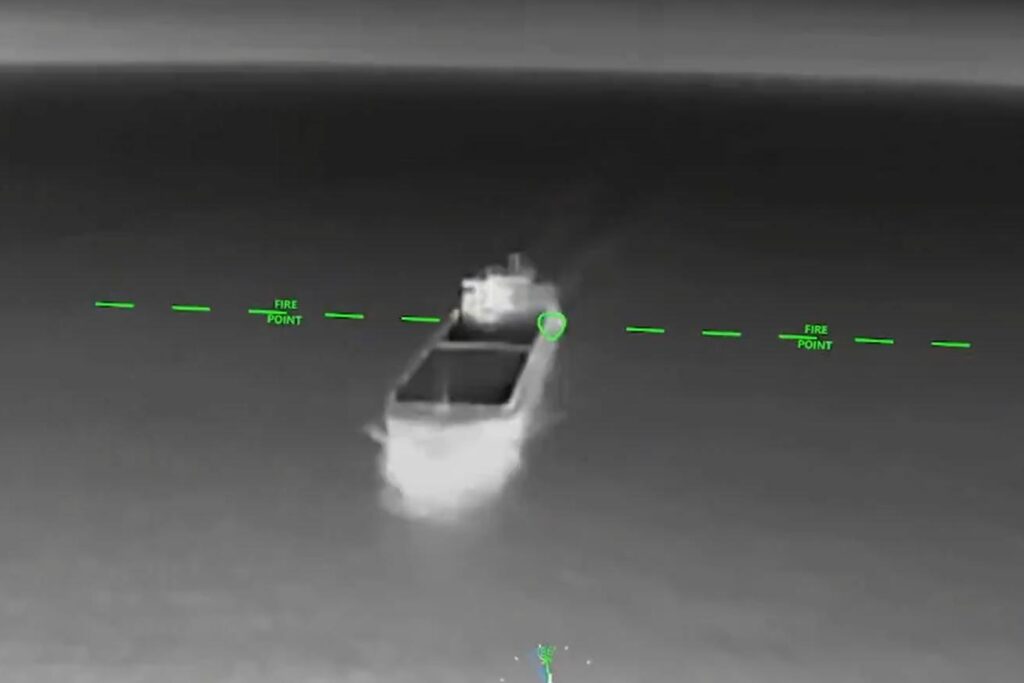
An FP-1 barrels toward a Russian ship.

  • Ukraine's drone campaign targeting Russian logistics is moving to sea
  • Ships carry supplies between Russia and occupied southern Ukraine
  • Striking the ships can force more supplies to move over land in vulnerable trucks

One-way attack drones from Ukraine's Unmanned Systems Forces struck five Russian cargo ships on the Sea of Azov on 5 June.

The strikes, which left at least one ship a burned-out hulk, are a kind of corollary to Ukraine's escalating campaign of middle-distance strikes on Russian supply lines on land in occupied territories. Aiming to weaken Russian regiments before they can attack across the disputed gray zone, Kyiv's drone units aren't only hitting trucks and vans on land—they're also hitting ships at sea.

"There's a method to the madness here," Ukraine Control Map explained. "Take out the ships, force Russia to use more trucks, more logistic bottlenecks." Then hammer the bottlenecks with drones.

The ultimate goal is to make it more difficult for the Kremlin to resupply and reinforce its 700,000 troops in occupied Ukraine. It's cheaper and easier to defeat an attack before it even begins by starving the attacking troops of food, fuel, batteries, ammunition and other vital supplies.

The ships the USF hit with Fire Point FP-1 drones on 5 June were spread out across a wide area. They were in occupied Mariupol and Berdiansk and along the coast of occupied Ukraine — the same Berdiansk port where Ukrainian drones struck a Russian munitions cargo ship on consecutive nights at the start of June.

What they had in common was their disguise. Civilian-owned but allegedly illegally working on behalf of sanctioned Russian entities, the ships sail without obvious markings or easily tracked radio transponders. There could be scores of such ships plying the Black Sea on Russia's behalf every day.

Two of the ships hit on 5 June, the dry cargo vessels Natra and Zirkon, were inbound from Türkiye to Rostov-on-Don when Ukrainian drones struck them in Taganrog Bay—empty, heading to load grain at a port Western governments and Ukraine identify as a transit hub for grain looted from occupied Ukrainian territory. Five Azerbaijani crew members on private contracts were killed and three wounded, Azerbaijan's foreign ministry said. Brovdi didn't address the deaths.

Telling apart a ship hauling Russian military fuel from a ship empty and heading to pick up looted grain is the kind of distinction that's hard to make from a drone's-eye view.

Ships that can haul thousands of tons of supplies every trip are much more efficient than trucks that can haul just a few tons apiece. Cargo ships can't deliver supplies to inland forces, of course, but they can move cargo between ports in southern Russia and ports in occupied Ukraine, bringing that cargo as close as possible to the gray zone before trucks must take over the shipping effort.

ukraine's drones now strike ports in occupied Ukraine
Map: Euromaidan Press

A thick-skinned ship is a tougher target than a thin-skinned truck, of course. But Ukraine's FP-1 drones carry a 100-kg blast-fragmentation warhead, with a TNT main charge boosted by the more powerful OKFOL explosive. The combination throws fragments outward and starts fires inside the target—the same mechanism that left the corvette Boikiy burning for hours at Kronstadt on 3 June.

🚢🔥 The destroyed cargo ship CIRCON (IMO 8887519), targeted by Ukraine’s Unmanned Systems Forces in the Sea of Azov several days ago. https://t.co/0Xpc3K9XXf pic.twitter.com/KI1PCzsjKf

— Special Kherson Cat 🐈🇺🇦 (@bayraktar_1love) June 8, 2026

Sitting duck trucks

Russia's thousands of military supply trucks are already squarely in the crosshairs of Ukrainian drone units. Since launching their coordinated counterlogistics campaign this spring, the Ukrainians have increased their monthly truck strikes nearly tenfold, from around 60 per month to nearly 500, as per the Ukrainian general staff.

But a comprehensive assault on Russian logistics requires raids on sea traffic, as well. That effort may have begun in earnest on 5 June. "Cargo ships and tankers with their names painted over by Black Sea looters and their transponders switched off, used for the quiet theft of Ukrainian grain and the transport of military cargo and fuel, can no longer count on either long service lives or uninterrupted schedules," the 414th Unmanned Strike Aviation Brigade crowed.

If they can disable enough ships, the Ukrainian drone teams may compel Russian logisticians to shift more supplies by land. To reach Russian regiments in southern and eastern Ukraine, those supplies normally travel east to west along the M-14 highway that runs close and parallel to the Black Sea coast.

That highway and connecting roads have become a kill zone for Russian trucks as more FP-1, FP-2, Hornet and Bulava drones take to the sky, increasingly unbothered by Russia's collapsing air defense network. Ukrainian industry now churns out tens of thousands of middle-strike drones every month, some for as cheaply as a few thousand dollars apiece.

The Russians are trying to find alternate routes that avoid the most heavily droned roads, but once a truck gets close to its destination, it has no choice but to follow a dwindling number of paths. Ukrainian intelligence knows where the Russians' main divisional bases are; they know the trucks must eventually turn into these bases. The near approaches are now becoming kill zones alongside the M-14 and other main roads.

It'll take many more strikes on Russian ships to seriously dent the sea logistics and force more supplies onto land routes. But the effort is underway. "The occupier's smuggling logistics must be stopped," the 414th Unmanned Strike Aviation Brigade explained.

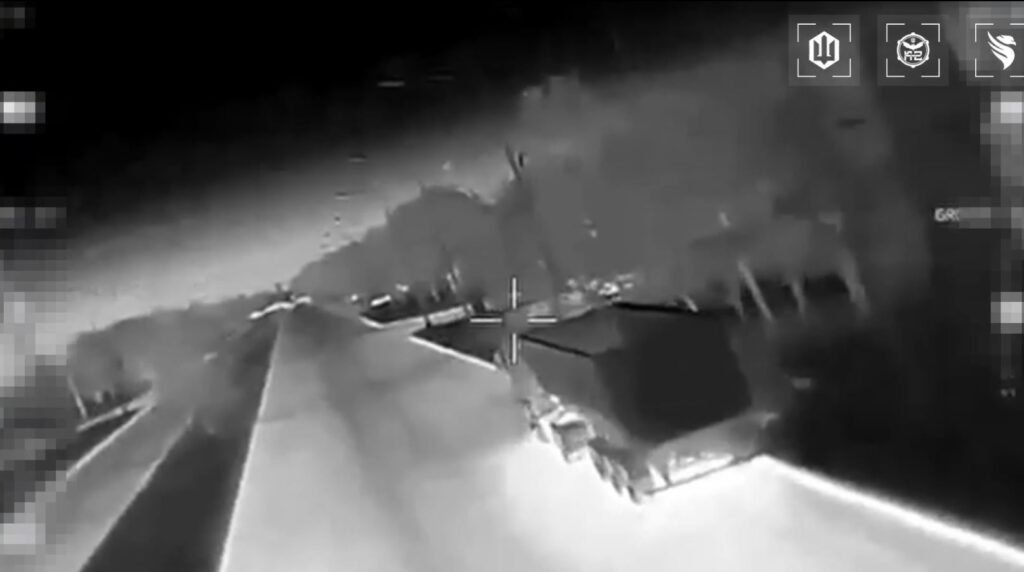
A Russian truck under drone attack near Chernihivka.
Explore further

Russia keeps four field armies fed through three southern towns. Ukraine’s drones just arrived.

Russia starts hauling gasoline to the front in the trunks of civilian cars

9 June 2026 at 11:52

russia starts hauling gasoline front trunks civilian cars · post jerrycans loaded supply russian forces occupied ukraine 2026 перевезення-бензину-цивільними-автівками-для-військових-рф-на-тимчасово-окупованій-тери news ukrainian reports

Russia has begun moving gasoline to its frontline units in occupied Ukraine in convoys of civilian cars, the Ukrainian defense outlet Militarnyi reported. Soldiers filmed themselves loading jerrycans into ordinary trunks, an improvised workaround after Ukrainian drone strikes made fuel tankers too risky to run. Russian forces are also disguising army trucks as civilian vehicles along the supply route to occupied Crimea.

This comes amid Ukraine’s ongoing “Logistics Lockdown,” a campaign by several Ukrainian military branches and the Security Service to target Russian fuel, logistics, and other supplies across occupied territories, at depths of up to 200 km.

Soldiers filmed the fuel run themselves

A video on the Exilenova+ Telegram channel showed Russians describing a convoy of passenger cars assembled to carry one metric ton of gasoline, Militarnyi reported. A man off-camera says the cars left the city of Kizilyurt in Dagestan, Russia, on the local head's orders, with the fuel destined for Russian units in occupied Tokmak, Zaporizhzhia Oblast. The footage shows jerrycans filling the trunks:

Besides the fuel, the drivers carried 1.5 million rubles ($20,900) to buy another batch of gasoline. Fuel keeps Russian frontline positions running: generators power electronic-warfare systems, charge batteries for reconnaissance and strike drones, and run communications gear in dugouts and observation posts.

Disguised trucks and a strained supply line

Russian forces have also begun disguising army trucks as civilian transport because of Ukrainian drone attacks deep in the rear. In northern Crimea, monitors spotted a freshly painted blue Ural truck driven by a man in civilian clothes, still carrying military plates, its oversized body posing as a dump truck.

The command of Russia's Dnepr grouping ordered mass use of civilian vehicles to move fuel along the route linking Rostov-on-Don with occupied Crimea, the Krymsky Veter monitoring project reported. That improvisation tracks the M-14 corridor, now within Ukraine's deepening drone range.
Drones of the 20th Separate Brigade of Ukraine's Unmanned Systems Forces (SBS), known as K-2, and the Phoenix drone unit strike a Russian military truck on a logistics route in Donetsk Oblast, 7 June 2026. Photo: SBS
Explore further

ISW: The strikes will likely cascade into deeper disruption across Russia’s rear supply network

Why Russia is improvising

Ukraine's Defense Forces have intensified drone strikes on logistics trucks and fuel tankers on the roads from Russia to occupied Crimea. The attacks have already forced the occupiers to limit cargo traffic through the occupied part of Kherson Oblast toward the peninsula, and Russia has closed stretches of its own land corridor to keep them clear of strike drones.

ISW: The strikes will likely cascade into deeper disruption across Russia’s rear supply network

8 June 2026 at 10:05

Drones of the 20th Separate Brigade of Ukraine's Unmanned Systems Forces (SBS), known as K-2, and the Phoenix drone unit strike a Russian military truck on a logistics route in Donetsk Oblast, 7 June 2026. Photo: SBS

Ukraine's drone strikes on the highways that feed Russian forces in occupied southern and eastern Ukraine are disrupting Russian logistics and will likely bite deeper in the near future, according to the Institute for the Study of War (ISW). The campaign is also rattling Russia's pro-war online community, where bloggers have begun turning their anger on the Kremlin's own military leadership. Russian forces are already rerouting and disguising convoys to keep supplies moving.

Ukraine's drone war has dragged the fight off the trench line and into Russia's rear, where fuel and transport increasingly decide how long Moscow can keep its invasion supplied. If Ukrainian crews keep the main arteries under watch, Russia faces a slow squeeze on its rear and the political cost of admitting those roads are no longer safe.

Ukraine's drones now own a key supply road

Ukraine's 3rd Army Corps said on 31 May that its drones had won "fire control" over five occupied cities. All five sit on or near the M-04 highway: Luhansk City, Starobilsk, Alchevsk, Bryanka, and Kadiivka. In plain terms, Ukrainian crews can now strike traffic on that road.

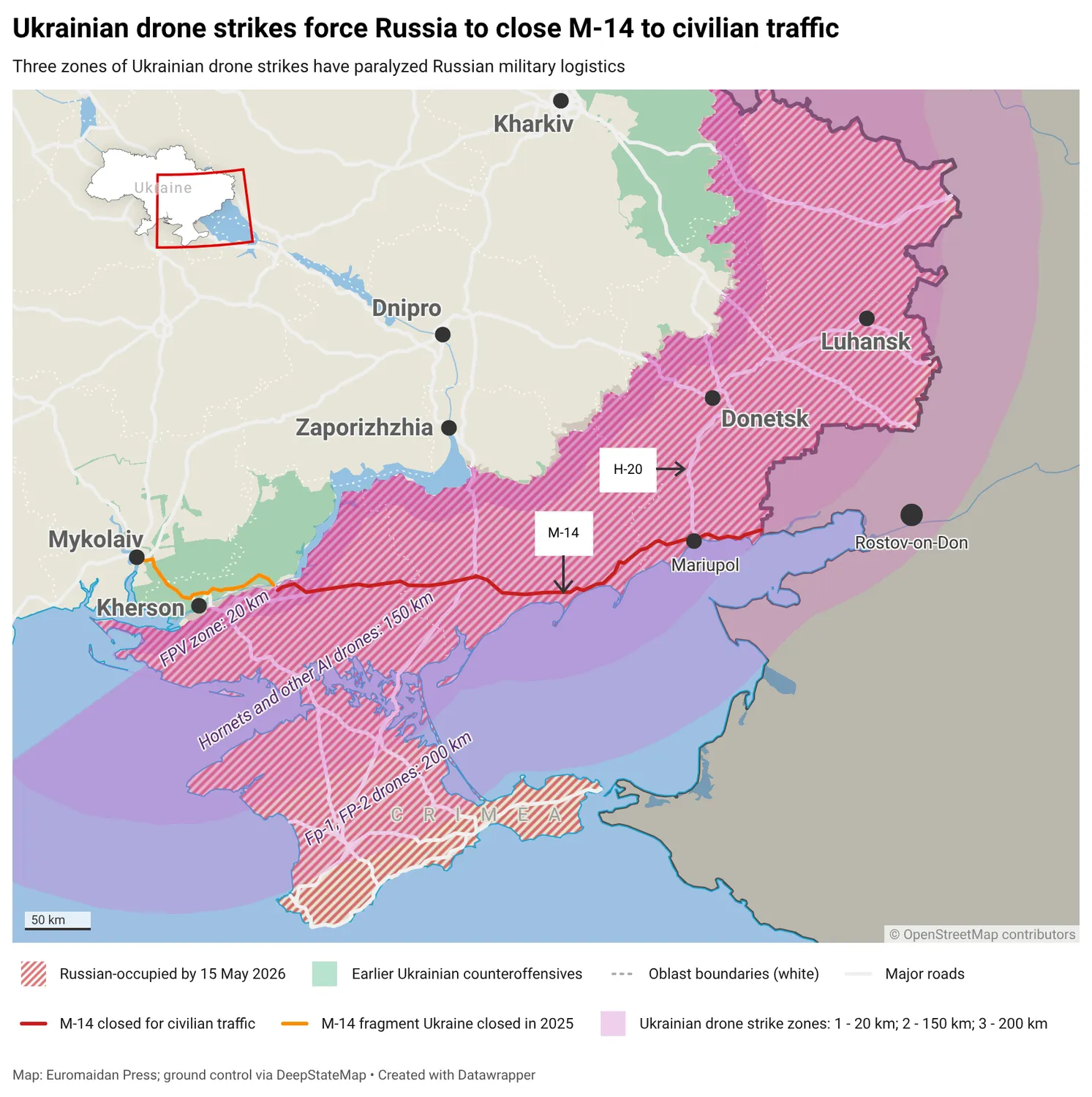
Map of southern Ukraine and adjacent Russian territory showing three concentric Ukrainian drone strike zones — FPV at 20 km, AI-assisted Hornets at 150 km, and FP-1/FP-2 long-range drones at 200 km — layered over the M-14 highway (Rostov to occupied Crimea) and the H-20 (Mariupol north into Donetsk Oblast). The Mariupol-Crimea-Rostov segment of M-14 is highlighted as closed by Russia for civilian traffic. The Mykolaiv-Kherson segment is highlighted as closed by Ukraine in 2025.
Ukrainian drone strike zones layered over Russia's southern supply network. FPVs reach roughly 20 km from the front, Hornets and other AI-assisted drones to 150 km, and FP-1 and FP-2 long-range drones to 200 km. The M-14 highway (Rostov-on-Don to occupied Crimea) and H-20 (branches north from Mariupol into Donetsk Oblast) both fall inside the deeper rings. Russian authorities have closed the M-14 to civilian traffic. The Ukrainian segment of the same highway, between Kherson and Mykolaiv, was closed by Ukrainian authorities in August 2025 after Russian drones turned it into a "human safari" killing ground. Map: Euromaidan Press.

A Ukrainian drone operator argued the M-04 matters more to Russia than the better-known M-14. The M-14 links Rostov Oblast to occupied Crimea. The M-04 begins near Moscow and reaches Rostov-on-Don before carrying on to Russia's Black Sea coast and into the Caucasus. It feeds occupied Crimea, southern Ukraine, and Luhansk Oblast through the Russian towns of Millerovo and Kamensk-Shakhtinsky. It also supplies Donetsk Oblast through Novoshakhtinsk in Rostov Oblast.

The Russian vehicles are burning on the route to Crimea. Source: The 3rd Separate Special Purpose Regiment
Explore further

Flat steppe: Ukraine is strangling Crimea’s supply lines from air. Melitopol-Chonhar road is latest target

The two highways connect, and Ukrainian forces are also hitting the H-20 road that joins them through Donetsk City. ISW assessed that the strikes will likely generate "even more profound cascading effects" across Russia's rear. The effort extends Ukraine's wider push to drive deep strikes further behind the front.

Russia bans buses and repaints its trucks

The strikes are already forcing changes on the ground. Leonid Pasechnik, the Russian-installed head of occupied Luhansk Oblast, issued a decree on 6 June. It bars regular bus and coach services on the section of the highway crossing occupied Luhansk.

A Russian “Svitlyak” border patrol ship seen from a Ukrainian drone before a strike near Yurkine, occupied Crimea. Screenshot from video: Madyar
Explore further

The Crimean Bridge is heavily guarded. Ukraine struck its maritime security layer in the Kerch Strait.

Ukrainian Mariupol mayoral adviser Petro Andriushchenko reported on 7 June that Russian forces had changed their Mariupol–Berdiansk route. They now use local coastal roads instead of the M-14. ndriushchenko said the troops are passing army vehicles off as civilian, recoloring the tarpaulins over each cargo bed and spraying the trucks white. ISW assessed the detours will likely slow Russian supply runs as Ukraine keeps hunting vehicles.

Russia's war bloggers turn on the Kremlin's generals

Ukraine's strikes are landing in Russia's information space too. Russia's pro-war military bloggers are voicing discontent and panic over the campaign.

Russian military truck on fire after a Ukrainian drone strike near occupied Horlivka, Donetsk Oblast, 5 June 2026. Screenshot from video: Supernova+
Explore further

Ukraine doubles deep strikes beyond 50 km as “Logistics Lockdown” shifts priority deeper into Russia’s transport nodes and rear logistics chains

A pro-war blogger and former Storm-Z assault-unit instructor complained on 7 June that Ukraine is now striking factories and defense plants deep inside Russia while degrading Russian air-defense radars and systems. He blamed bureaucracy and state-corporate infighting for Moscow's failure to respond, and separately complained that Russia cannot read Ukraine's battlefield trends and underrates its capabilities. Other bloggers piled on: one claimed fuel shortages were stoking panic in occupied Crimea, while others faulted the Russian Defense Ministry and top general Valery Gerasimov for not striking Ukrainian logistics, especially the Dnipro River bridges.

ISW found the complaints are escalating, and that the strike campaigns are becoming "points of neuralgia" in Russia's ultranationalist crowd. It noted the discontent feeds on Russia's poor battlefield results, rising casualties, and economic strain. Even before this, Russia's war bloggers had turned on the Kremlin's commanders over inflated victory claims.

Ukraine has built 822 kilometers of anti-drone road tunnels. Each kilometer means safer evacuations and faster supply

6 June 2026 at 17:14

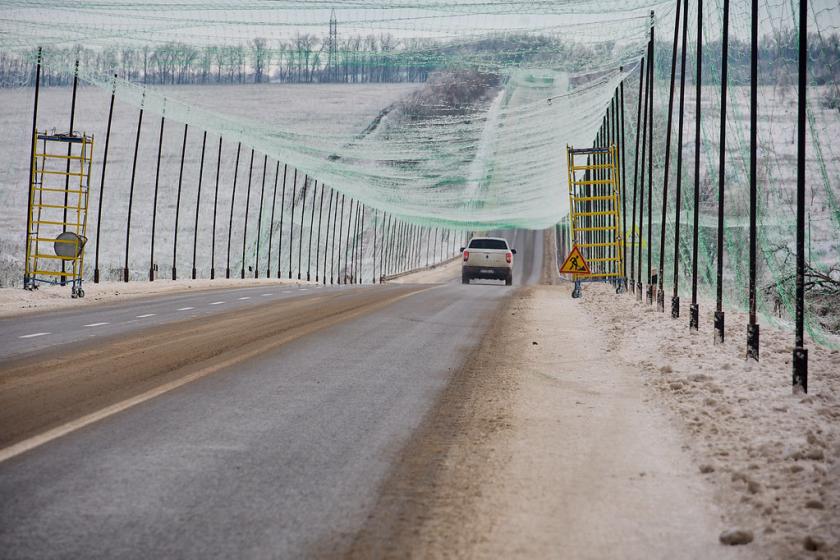
fishing nets used mediterranean millennia — now italy wants turn drone shields over ukrainian cities · post workers install anti-drone above road kharkiv's ring 2026 2daykhua sitka6 italy's senate has

Ukraine has built 822 kilometers of anti-drone protection along frontline logistics routes since the start of 2026 and has restored more than 170 kilometers of damaged regular roads in frontline oblasts, Defense Minister Mykhailo Fedorov says. In May alone, Ukraine's State Special Transport Service built 211 km of new anti-drone protection. 

Russian FPVs and reconnaissance UAVs hunting Ukrainian vehicles within 15-30 km of the front have forced Ukraine to build a permanent national infrastructure for drone-protected movement on its own side.

How does protection work? 

Anti-drone protection on Ukrainian frontline roads typically takes the form of overhead netting tunnels, wire-mesh canopies, and reinforced barriers along sections of road within reach of Russian FPV drone operators.

The structures intercept FPVs before they strike vehicles, allowing supply trucks, casualty-evacuation vehicles, and personnel rotations to move along otherwise lethal stretches of road.

The May 2026 build-out

In May 2026, Ukraine restored 38 km of previously damaged protected segments and rebuilt 115.5 km of standard frontline roads.

The combination of new construction, maintenance, and regular road repair reflects the operational reality that Russian strikes constantly attrit the network even as Ukraine extends it.

"Each protected kilometer means safer logistics, faster supply, casualty evacuation, and safer military movement even under constant threat of drone attacks," Fedorov said.

Mirror campaigns

Meanwhile, Ukraine's offensive logistics campaign has driven Russia to restrict civilian transport on its main occupied-territory highways. Russia is reportedly banning regular bus services on the R-280 "Novorossiya" route and the R-150 Belgorod-Mariupol highway after Ukrainian drones.

Ukraine, on its own side, is building physical infrastructure, such as netting, wire, and barriers, to keep its own logistics moving under the same drone pressure that Russia is failing to manage on the other side of the line. 

Meanwhile, Russia has installed anti-drone nets at its facilities, such as the Velikolukskaya oil depot in Velikiye Luki, Pskov Oblast. 

Flat steppe: Ukraine is strangling Crimea’s supply lines from air. Melitopol-Chonhar road is latest target

6 June 2026 at 15:52

The Russian vehicles are burning on the route to Crimea. Source: The 3rd Separate Special Purpose Regiment

Ukrainian Special Operations Forces drone operators have established aerial control over part of the Russian land supply route from occupied Melitopol to Chonhar. The path is the entry point to Crimea, and they are destroying Russian equipment and disrupting Russian military logistics on the road, the 3rd Separate Special Purpose Regiment announces.

Russian forces on the peninsula already depend on a constrained set of supply lines: the Kerch Bridge (under sustained Ukrainian threat since 2022), the rail and road corridor through occupied Donetsk Oblast, and the Melitopol-Chonhar bottleneck. Ukrainian aerial denial of any one of these links compounds pressure on the others. 

Squeezing land corridor from both ends

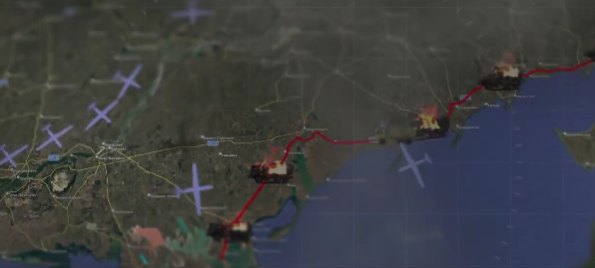
The new operation puts pressure on the land corridor's western end. On 31 May, Mariupol residents reported in local group chats that Russia shut down part of its land corridor from Crimea to occupied Donetsk because of Ukrainian drones.

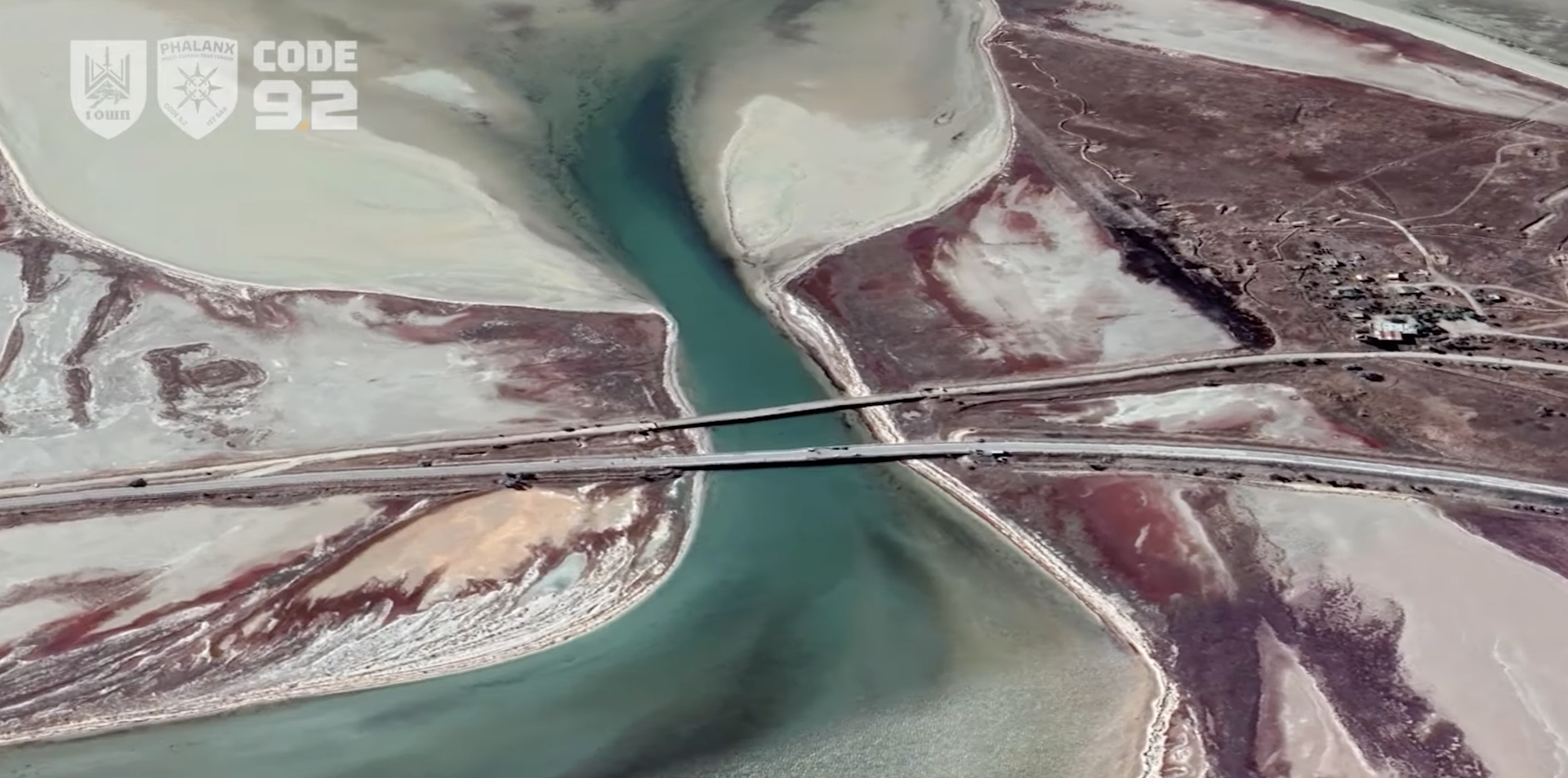
The Melitopol-Chonhar segment crosses flat steppe with limited cover and funnels Russian convoys through narrow bridge crossings over the Syvash to reach the peninsula, the terrain optimal for drone operators to deny the air with persistent surveillance and strike capability. 

SSO drones as the strangulation instrument

The 3rd Separate Special Purpose Regiment is one of Ukraine's veteran Special Operations Forces units, named after the tenth-century Kyivan Rus prince.

The regiment's deployment of drone operators against Russian logistics on the Melitopol-Chonhar route fits within Ukraine's broader "logistics lockdown" approach to occupied territory. Ukraine's Defense Ministry has recently committed $113 million to medium-strike drones designed to target Russian rear logistics.

"Drones of the Special Operations Forces unit are destroying equipment and breaking the enemy's logistics routes on the Melitopol-Chonhar route," the 3rd Regiment said.

What does this change for Russia on peninsula? 

Russia's military presence in Crimea depends on a continuous supply of fuel, ammunition, and food, as well as on personnel rotation. 

"As a result, the already-difficult logistics for supplying the Russian army and fuel to the peninsula have grown harder," the SSO said.

❌