
Normal view

Russia starts hauling gasoline to the front in the trunks of civilian cars

9 June 2026 at 11:52

russia starts hauling gasoline front trunks civilian cars · post jerrycans loaded supply russian forces occupied ukraine 2026 перевезення-бензину-цивільними-автівками-для-військових-рф-на-тимчасово-окупованій-тери news ukrainian reports

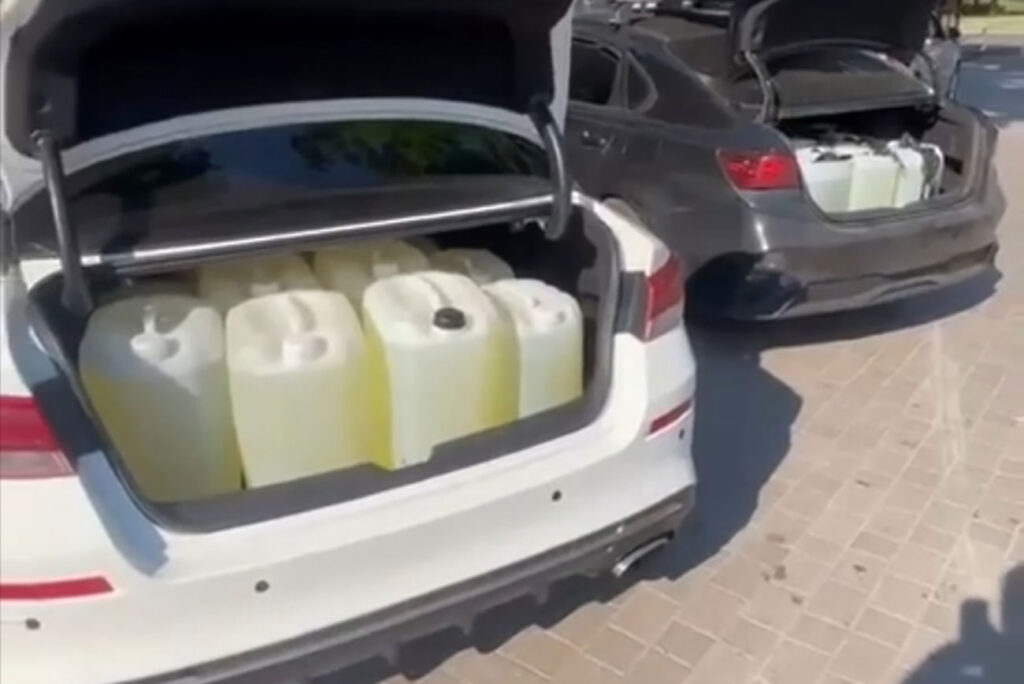
Russia has begun moving gasoline to its frontline units in occupied Ukraine in convoys of civilian cars, the Ukrainian defense outlet Militarnyi reported. Soldiers filmed themselves loading jerrycans into ordinary trunks, an improvised workaround after Ukrainian drone strikes made fuel tankers too risky to run. Russian forces are also disguising army trucks as civilian vehicles along the supply route to occupied Crimea.

This comes amid Ukraine’s ongoing “Logistics Lockdown,” a campaign by several Ukrainian military branches and the Security Service to target Russian fuel, logistics, and other supplies across occupied territories, at depths of up to 200 km.

Soldiers filmed the fuel run themselves

A video on the Exilenova+ Telegram channel showed Russians describing a convoy of passenger cars assembled to carry one metric ton of gasoline, Militarnyi reported. A man off-camera says the cars left the city of Kizilyurt in Dagestan, Russia, on the local head's orders, with the fuel destined for Russian units in occupied Tokmak, Zaporizhzhia Oblast. The footage shows jerrycans filling the trunks:

Besides the fuel, the drivers carried 1.5 million rubles ($20,900) to buy another batch of gasoline. Fuel keeps Russian frontline positions running: generators power electronic-warfare systems, charge batteries for reconnaissance and strike drones, and run communications gear in dugouts and observation posts.

Disguised trucks and a strained supply line

Russian forces have also begun disguising army trucks as civilian transport because of Ukrainian drone attacks deep in the rear. In northern Crimea, monitors spotted a freshly painted blue Ural truck driven by a man in civilian clothes, still carrying military plates, its oversized body posing as a dump truck.

The command of Russia's Dnepr grouping ordered mass use of civilian vehicles to move fuel along the route linking Rostov-on-Don with occupied Crimea, the Krymsky Veter monitoring project reported. That improvisation tracks the M-14 corridor, now within Ukraine's deepening drone range.
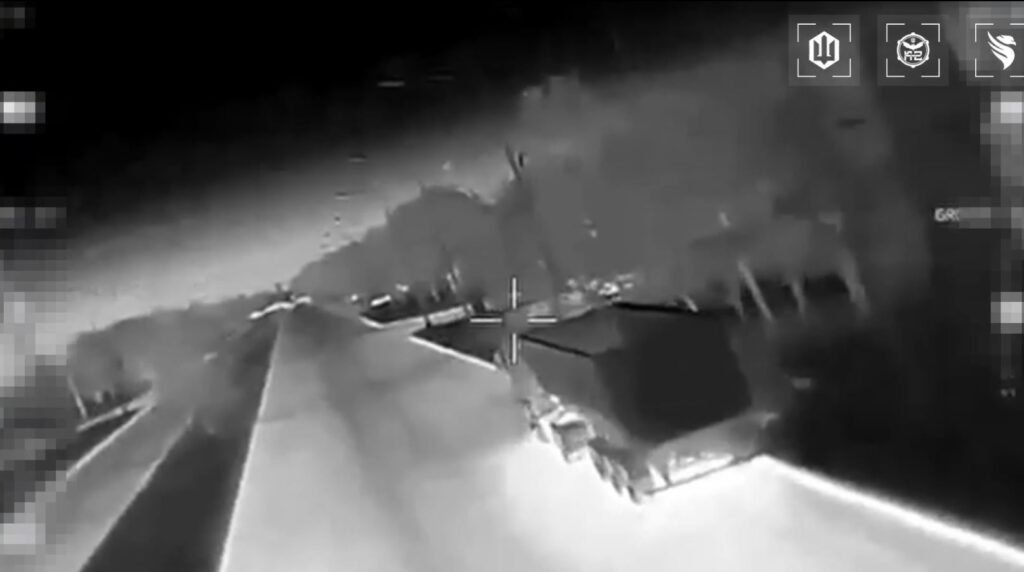
Drones of the 20th Separate Brigade of Ukraine's Unmanned Systems Forces (SBS), known as K-2, and the Phoenix drone unit strike a Russian military truck on a logistics route in Donetsk Oblast, 7 June 2026. Photo: SBS
Explore further

ISW: The strikes will likely cascade into deeper disruption across Russia’s rear supply network

Why Russia is improvising

Ukraine's Defense Forces have intensified drone strikes on logistics trucks and fuel tankers on the roads from Russia to occupied Crimea. The attacks have already forced the occupiers to limit cargo traffic through the occupied part of Kherson Oblast toward the peninsula, and Russia has closed stretches of its own land corridor to keep them clear of strike drones.

ISW: The strikes will likely cascade into deeper disruption across Russia’s rear supply network

8 June 2026 at 10:05

Drones of the 20th Separate Brigade of Ukraine's Unmanned Systems Forces (SBS), known as K-2, and the Phoenix drone unit strike a Russian military truck on a logistics route in Donetsk Oblast, 7 June 2026. Photo: SBS

Ukraine's drone strikes on the highways that feed Russian forces in occupied southern and eastern Ukraine are disrupting Russian logistics and will likely bite deeper in the near future, according to the Institute for the Study of War (ISW). The campaign is also rattling Russia's pro-war online community, where bloggers have begun turning their anger on the Kremlin's own military leadership. Russian forces are already rerouting and disguising convoys to keep supplies moving.

Ukraine's drone war has dragged the fight off the trench line and into Russia's rear, where fuel and transport increasingly decide how long Moscow can keep its invasion supplied. If Ukrainian crews keep the main arteries under watch, Russia faces a slow squeeze on its rear and the political cost of admitting those roads are no longer safe.

Ukraine's drones now own a key supply road

Ukraine's 3rd Army Corps said on 31 May that its drones had won "fire control" over five occupied cities. All five sit on or near the M-04 highway: Luhansk City, Starobilsk, Alchevsk, Bryanka, and Kadiivka. In plain terms, Ukrainian crews can now strike traffic on that road.

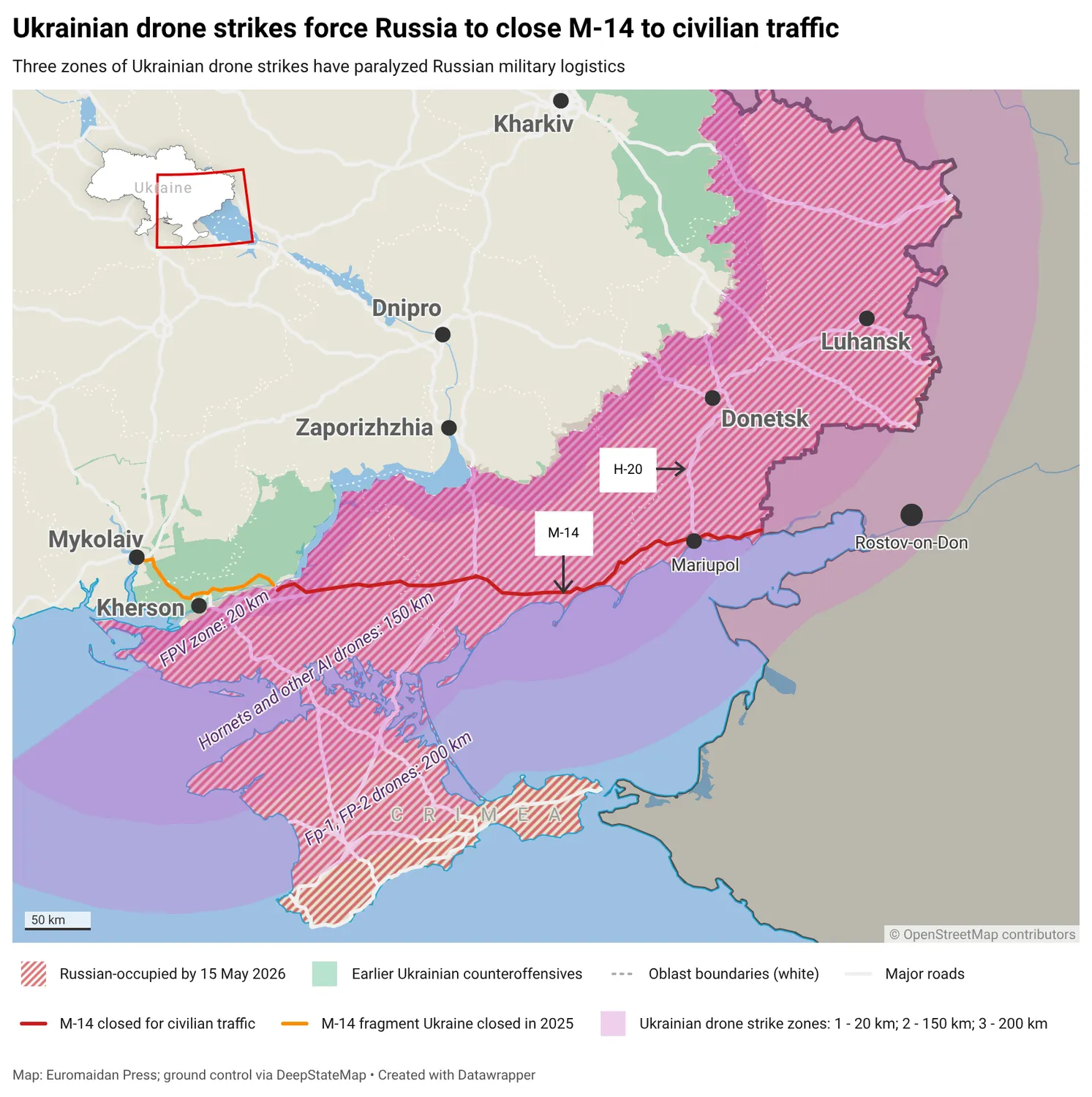
Map of southern Ukraine and adjacent Russian territory showing three concentric Ukrainian drone strike zones — FPV at 20 km, AI-assisted Hornets at 150 km, and FP-1/FP-2 long-range drones at 200 km — layered over the M-14 highway (Rostov to occupied Crimea) and the H-20 (Mariupol north into Donetsk Oblast). The Mariupol-Crimea-Rostov segment of M-14 is highlighted as closed by Russia for civilian traffic. The Mykolaiv-Kherson segment is highlighted as closed by Ukraine in 2025.
Ukrainian drone strike zones layered over Russia's southern supply network. FPVs reach roughly 20 km from the front, Hornets and other AI-assisted drones to 150 km, and FP-1 and FP-2 long-range drones to 200 km. The M-14 highway (Rostov-on-Don to occupied Crimea) and H-20 (branches north from Mariupol into Donetsk Oblast) both fall inside the deeper rings. Russian authorities have closed the M-14 to civilian traffic. The Ukrainian segment of the same highway, between Kherson and Mykolaiv, was closed by Ukrainian authorities in August 2025 after Russian drones turned it into a "human safari" killing ground. Map: Euromaidan Press.

A Ukrainian drone operator argued the M-04 matters more to Russia than the better-known M-14. The M-14 links Rostov Oblast to occupied Crimea. The M-04 begins near Moscow and reaches Rostov-on-Don before carrying on to Russia's Black Sea coast and into the Caucasus. It feeds occupied Crimea, southern Ukraine, and Luhansk Oblast through the Russian towns of Millerovo and Kamensk-Shakhtinsky. It also supplies Donetsk Oblast through Novoshakhtinsk in Rostov Oblast.

The Russian vehicles are burning on the route to Crimea. Source: The 3rd Separate Special Purpose Regiment
Explore further

Flat steppe: Ukraine is strangling Crimea’s supply lines from air. Melitopol-Chonhar road is latest target

The two highways connect, and Ukrainian forces are also hitting the H-20 road that joins them through Donetsk City. ISW assessed that the strikes will likely generate "even more profound cascading effects" across Russia's rear. The effort extends Ukraine's wider push to drive deep strikes further behind the front.

Russia bans buses and repaints its trucks

The strikes are already forcing changes on the ground. Leonid Pasechnik, the Russian-installed head of occupied Luhansk Oblast, issued a decree on 6 June. It bars regular bus and coach services on the section of the highway crossing occupied Luhansk.

A Russian “Svitlyak” border patrol ship seen from a Ukrainian drone before a strike near Yurkine, occupied Crimea. Screenshot from video: Madyar
Explore further

The Crimean Bridge is heavily guarded. Ukraine struck its maritime security layer in the Kerch Strait.

Ukrainian Mariupol mayoral adviser Petro Andriushchenko reported on 7 June that Russian forces had changed their Mariupol–Berdiansk route. They now use local coastal roads instead of the M-14. ndriushchenko said the troops are passing army vehicles off as civilian, recoloring the tarpaulins over each cargo bed and spraying the trucks white. ISW assessed the detours will likely slow Russian supply runs as Ukraine keeps hunting vehicles.

Russia's war bloggers turn on the Kremlin's generals

Ukraine's strikes are landing in Russia's information space too. Russia's pro-war military bloggers are voicing discontent and panic over the campaign.

Russian military truck on fire after a Ukrainian drone strike near occupied Horlivka, Donetsk Oblast, 5 June 2026. Screenshot from video: Supernova+
Explore further

Ukraine doubles deep strikes beyond 50 km as “Logistics Lockdown” shifts priority deeper into Russia’s transport nodes and rear logistics chains
A pro-war blogger and former Storm-Z assault-unit instructor complained on 7 June that Ukraine is now striking factories and defense plants deep inside Russia while degrading Russian air-defense radars and systems. He blamed bureaucracy and state-corporate infighting for Moscow's failure to respond, and separately complained that Russia cannot read Ukraine's battlefield trends and underrates its capabilities. Other bloggers piled on: one claimed fuel shortages were stoking panic in occupied Crimea, while others faulted the Russian Defense Ministry and top general Valery Gerasimov for not striking Ukrainian logistics, especially the Dnipro River bridges.

ISW found the complaints are escalating, and that the strike campaigns are becoming "points of neuralgia" in Russia's ultranationalist crowd. It noted the discontent feeds on Russia's poor battlefield results, rising casualties, and economic strain. Even before this, Russia's war bloggers had turned on the Kremlin's commanders over inflated victory claims.

❌