Reading view

Taiwan’s tallest tree found with help of citizen science

Deep in Taiwan’s misty mountains, researchers have confirmed the tallest tree in the country: a thousand-year-old fir tree higher than a 20-story building, which they’ve named “the heaven sword of the Da’an River.” Climbers scaled the tree and dropped a measuring tape from the top to the forest floor during the Lunar New Year holiday in January 2023. The tree measured 84.1-meters (276-feet). The findings have been published in Frontiers in Forests and Global Change. A team of ecologists, geologists, remote-sensing specialists, professional climbers and Indigenous people that calls itself the “Taiwan tree seekers” began the search in 2014. “The common characteristics [of the team] are probably that we are all tree lovers and like adventures,” Rebecca Chia-Chun Hsu, lead author from Division of Forest Ecology, Institute of Taiwan Forestry Research, told CNN. ‘The Heaven Sword’, Taiwan’s tallest tree, measures 84.1 meters. Photo courtesy of Steven Pearce. Taiwan is one of the few places on Earth where trees can grow this tall. The island sits where the tropics meet the subtropics, and its mountains host several giant conifer species. The species behind the new record, Taiwania cryptomerioides, is known to the Indigenous Rukai people as “the tree that hits the moon.” Although nearly 60% of Taiwan is covered in forest, loggers cleared much of the island’s old-growth forest between 1912 and 1991. However, its steep slopes were too dangerous to reach, and pockets of ancient forest survived. Still, finding the tallest tree amid the rugged terrain was a task. Taiwan…This article was originally published on Mongabay

  •  

Why Armenians stuck with Pashinyan

YEREVAN, Armenia — The best of a bad lot was how many Armenians described victorious Prime Minister Nikol Pashinyan ahead of Sunday's pivotal election — the first since the bitter defeat in the Nagorno-Karabakh conflict with neighboring Azerbaijan.

While the election has frequently been framed outside Armenia as

  •  

The election interference evidence no one is talking about

U.S. President Donald Trump speaks during an event in the Oval Office of the White House on June 03, 2026 in Washington, DC. Photo by Kevin Dietsch/Getty Images

Are President Donald Trump and MAGA Republicans publicly signaling that they plan to interfere in—and potentially rig—the 2026 midterm elections? If so, why is the media not taking the threat seriously? In this episode of Inequality Watch, Taya Graham and Stephen Janis investigate the connections between wealth inequality, political power, ICE funding, the influence of Super PACs on elections, and growing concerns about democratic accountability in Trump’s America.

Credits:

  • Pre-Production: Taya Graham, Stephen Janis
  • Studio Production / Post-Production: Cameron Granadino, Stephen Janis
Transcript

The following rushed transcript may contain errors. It will be updated as soon as possible.

Taya Graham:

Could President Trump and his MAGA Congress be planning to interfere with the upcoming midterm elections? Well, we have some evidence that might surprise you, which we will unpack on this episode of the Capitol Hill React Report. Hello, this is Taya Graham, myself, along with my reporting partner, Steven Janice, our Capitol Hill correspondence for the Real News Network. We report regularly on what’s happening in the nation’s Capitol, but with a twist. We examine the process of governance through the prism of the most powerful force in today’s politics, economic inequality. Now, before you say, tell you that seems sort of limited. Just let me explain a little bit before we get to the first video. Economic inequality is at its highest point in recent history. Just take a look at the latest report that showed American workers’ share of the economy has fallen to its lowest level since 1947.

That’s right. In 2025, the share of the economy that went to the people who actually make it run was 54% a historic low. Okay. So why is this context essential for reporting on politics? Well, because all that wealth accumulating in fewer and fewer hands translates into concentrated power and that power now flows into our elections in the form of cash. Cash, which translates into victories at the ballot box for the purveyors of an increasingly extractive economy, insulating it from ballot box accountability, which ultimately means that you can’t understand politics on Capitol Hill unless you comprehend what currently defines it, namely the rich getting richer. Stephen, how am I doing?

Stephen Janis:

So you’re doing great. I mean, one of the things we have to think about is we got to look at democracy as a whole here functioning through this prism of inequality. The idea of democracy that delivers a certain amount of freedom to the people who are part of it. Now, freedom is a limited resource. So as people get richer and richer, they hoard that freedom. And so there’s less freedom to go around. Freedom to do what you want, freedom to educate yourself, freedom to live where you want. All those things sort of translate into the affordability crisis we’re seeing now, which means that there’s less freedom for the working people and more and more freedom for the richest 1% and more and more freedom to control how we live. And that’s why we have this sort of crisis on Capitol Hill and that’s how we have to view what goes on on Capitol Hill.

Taya Graham:

Stephen, that is such a great point and brings us right back to the topic at hand. The incredibly tense state of American elections and why wealth inequality will play a key role in that autocratic calculus. So first, let’s be honest, Steven, the mainstream media has, in my opinion, been misreading Trump, specifically his pronouncements that he doesn’t care about gas prices or the quagmire in Iran. Let’s listen to him talk about it and then discuss. When you’re negotiating with Iran, Mr. President, to what extent are American financial situations motivating you to make it?

Donald Trump:

Not even a little bit. The only thing that matters when I’m talking about Iran, they can’t have a nuclear weapon. I don’t think about American financial situation. I don’t think about anybody. I think about one thing. We cannot let Iran have a nuclear weapon. That’s all. That’s the only thing that motivated.

Taya Graham:

Okay. So the interpretation from the TV pundits has been that President Trump is just inexplicably tone deaf or detached or just disinterested, but we think Trump is telegraphing something much more insidious. So Steven, let me ask you a question after watching this video. Is Trump just really disengaged as the mainstream media says, or as they say he’s unhinged, or is there something else a little more troubling going on here?

Stephen Janis:

Well, Ted, this is one of many clips where Trump has kind of downplayed midterm elections or voters concerns or gas prices or whatever. He does it consistently. And of course it would be suicide for a politician in a functioning democracy to say something like that, right? Because this would directly affect how people vote. I really think for some reason gas prices, well, I kind of understand that gas prices are one of the biggest motivators for people when it comes to elections. And so it would be suicide, but what he’s really trying to say is, “I’m not worried about the midterms because I got this locked out. ” And look at what happened in the last presidential election. He tried to overturn it with a lost, but he wasn’t really prepared. He has been preparing for two years now to be able to interfere with the elections.

He subpoenaed ballots all over the country, including Fulton County and Georgia. He has set up this election integrity system run by a person who actually denied the 2020 election. He has increased the funding for ICE and Border Patrol, which we’ll talk about later. He has just simply put people in place who will be able to do what he needs to do. The Justice Department itself does whatever he wants. They’ll prosecute anybody. Very true. So they will certainly be willing to weigh in on this. He is prepared. He’s declared emergencies in so many situations. He is prepared and he is trying to say, “I’m not worried about it because no matter what happens, I’m going to make sure that I come out on top.” And I think that’s what we’re missing here. When he says he’s disinterested, what he’s saying is, “I’ve got this in the bag.”

Taya Graham:

Steven, I think you put your finger right on it here. The real danger here isn’t just what Trump is saying, but the fact that everyone keeps dismissing it. And you know what Trump hasn’t even ruled out paying the people who stormed the Capitol and those who tried to halt the counting of the electoral votes in 2020, despite the fact that his administration said the fund is dead, he was literally just quoted as saying, “I think they should be reimbursed by a crooked government.” Now, his remarks regarding the controversial $1.7 billion weaponization fund bolster, I think the case that he believes he can alter the midterm outcome. It would’ve set aside money for people who believe they were unjustly prosecuted, namely the Jan six insurrectionists. I mean, critics say if Trump has his way, he will literally be able to assemble a pratorian guard to disrupt the elections.

And I’m alluding to the elite core of Roman military officers who guarded the emperor, but who eventually just took power themselves. Steven, what does it mean if he gets his way?

Stephen Janis:

Well, what it means is because ways he has what you need the first … The most important element of any sort of autocratic takeover is having the money to pay people and having the freedom to pay people any way you want. Now this $1.7 billion fund would be an easy way just to dole out cash to people who had done his bidding before. Now he has other ways of doing this that we’ll talk about. But the main thing is it gives them the power of the purse in a way that’s totally up to his discretion and the Justice Department, which is an extension of him. Now what’s interesting about it is I don’t really think they need a fund. Those J6 is going to just sue and then Trump can approve the payouts. That’s right. So he’ll get it one way or another. But the point is he wants to signal to the people, “Hey, if you help interfere with an election, I will pay for it and I’ll reward you because these settlements could be huge.

$1.7 billion is a lot of money.” Sure is. So I think that’s what he’s trying to telegraph is saying, “Help me out with this and you’ll get paid.”

Taya Graham:

Steven, that is not only spot on, but it’s actually really scary. But what’s even more concerning to me is how much this election interference plan is hiding in plain sight with little or no pushback because he can’t do this alone. He needs help from his ever loyal contingent in Congress. And for the most part, they are in lockstep with Trump. And that was more than evident when the MAGA Congress started to plot a strategy to get more money to ice customs and border patrol for purposes that we’re going to touch on a litle bit later. Now their plan was to use a tactic called reconciliation, which allows legislation to bypass the filibuster provided it has significant fiscal impact on federal spending. Now, this was an unprecedented power grab because the funding bill was intended to provide routine annual appropriations and that’s a measure that is usually passed with bipartisan support, which brings me to an interesting encounter we had on Capitol Hill with Republican Congressman Mike Lawler, who didn’t seem to want to answer our question when we asked why ICE and CBP needed an additional $70 billion in funding, but his reluctance is also revealing.

Let’s take a listen to what happened.

Rep. Mike Lawler:

Fuck that up.

Stephen Janis:

Congressman, why does ICE need an additional $75 billion? Why is that funding? How do you justify that to the American people who now are suffering with high gas prices and things like that? Why is that even more money?

Rep. Mike Lawler:

Well, that’s the cost of funding the department. Are you for abolishing ICE?

Stephen Janis:

I’m just asking the question. They already have $14.

Rep. Mike Lawler:

Well, you understand that that is the- I’m not

Stephen Janis:

For against anything.

Rep. Mike Lawler:

You understand that’s the appropriated amount, right? Yes. That’s been appropriated.

Stephen Janis:

Of course, but I’m asking

Rep. Mike Lawler:

Questions. So the reason additional funds, that’s the base budget for ICE and CBP, right? You understand that?

Stephen Janis:

I do.

Rep. Mike Lawler:

Okay. So the additional funds that came through the Working Family’s tax cut bill were to increase border security. Why? Because Joe Biden let in 10 and a half million people into the country.

Taya Graham:

Okay. Steven, just for the record, are you for abolishing ICE? Because you didn’t answer the congressman’s question.

Stephen Janis:

Yeah. I’m for abolishing politicians to be able to answer a question with a question and evade answering the question I ask. I’m for abolishing that. But one thing I want to just say before we move on is that his sort of argument that that’s the appropriate amount for ICE is actually wildly inaccurate. I look back into the ICE funding and what ICE and CPB have been spending roughly eight to $10 billion a year. They already have $140 billion. This is not an appropriate amount for anything. That’s an absolute freaking lie. ICE and CBT do not need that much money. This is excess cash. Taxpayer cash, your taxpayer dollars that are simply being spent without accountability. I think there’s a reason for that we’ll talk about in a second, but really he was just FOS on that. And I just want to point that out because it really was infuriating.

I was trying to get his answer, but I couldn’t sit there and get into an argument with him about what he was saying was actually patently false.

Taya Graham:

Personally, when a politician answers a question with a question, in my opinion, that is a sign they don’t have an answer or they have an answer, they don’t want the public to know. And he

Stephen Janis:

Definitely didn’t have an answer in this point. So good point, Teo.

Taya Graham:

Thank you. But I mean, the question you were asking was not insignificant. I mean, in fact, it was a really big piece of the puzzle, led us to think that the threats to the midterm elections are widely underestimated. Now, the crux of the matter is funding. Now what you asked is why Republicans want to give ICE, customs, and Border Patrol another $70 billion. And what makes this so unusual is that the big beautiful bill dropped roughly $140 billion on both agencies just last year. But with ICE and CBP spending at best $20 billion annually, it begs the question, why so much? What is it really for? And Steven, you have a theory about this. Tell me about it.

Stephen Janis:

Well, I think the thing you have to think about is that they’re moving towards a more autocratic form of government. Autocracies and democracies have different incentives, basically, different incentive systems. Technically speaking, a democracy wants to award beneficial policy for constituents. So to get elected, you got to do stuff that people like. Autocracies don’t work that way. They need to punish people who might push back. They need to crush dissent and that’s through a system of incentivization of punishment. And so in my opinion, this money, which can, I guess when you add up $210 billion for a law enforcement agency is about constructing a great American punishment regime to prepare Americans for a more autocratic government.

When I looked into the records and tried to figure out how much money does ICE and CPP still have on the books, it’s really hard to figure out because the federal government really isn’t oriented towards reporting on multifiscal year cycles about how much money they have. But I looked, I found at least $73 billion that had been unallocated so far. And that’s after they’ve already built all these warehouses, these prisons where they’re incarcerating people. So they literally have what would be for those agencies unlimited funding. And unlimited funding for law enforcement gives you a way to institute punishment throughout all levels of governance. I mean, those detention centers can be used to detain people for a variety of reasons. They’ve already detained Americans. They’ll detain more. Having an unlimited amount of money to swarm CPB and swarm ICE into cities gives you this ability to do what Trump did in Minneapolis, Los Angeles, Chicago.

And when these elections come and when Trump is trying to say, Hey, they weren’t fair, they’re going to need these guys and women to come into cities and to try to disrupt the people who will be pushing back or to seize ballot box. I really think this excess money is insulating both institutions and that’s for a reason to create a punishment regime that will be reflective of the autocratic values that the Trump administration is espousing through their policy choices.

Taya Graham:

Steven, you did the classic thing every reporter should do and actually anyone watching should do, which is follow the money. You follow the money, you figure out what’s really going on. So let me just ask you a question about this. I was thinking back to the first time it really hit home with us that something was afoot with regard to democracy during the shutdown last year. So last year, Democrats wanted to extend the Obamacare tax credits and Republicans refused. But what struck me at the time was how the majority party approached the entire conflict. They simply shut down Congress. They simply stopped town halls and talking to their constituents. No debate, no work, just silence. And of course, all of that was just to deny people healthcare. And that seems like a pretty anti-Democratic strategy. So how does it play into that theme you’re talking about, about the punishment regime theme?

What do you think?

Stephen Janis:

Well, the thing is if you shut it down, you’re kind of punishing people because you’re taking away the deliberative legislative body that’s supposed to represent their interests where you are supposed to hash these things out and figure out how to get people healthcare. So what you’re saying is, we don’t care. You don’t have healthcare, you’re being punished. We’re going to punish you by not doing anything and showing you that we don’t have to do anything and disengaging from our constituents. And so I think it’s a big part of that. I mean, a functioning legislative body should be an accountability mechanism to make sure things like ICE and CBP don’t get out of control. But now when they shut it down and turn it into this absolute desert of democracy, well, then you don’t have a limited legislative body to represent you. Without representation, you’re done.

I mean, what people don’t understand, and I think you’ve talked about this really, really well, is that democracy is a culture that infiltrates all levels of government governance. When you change that to a punishment regime, to an autocratic culture, everything changes.Your ability as a constituent and to vote and to have some impact and some say in how you live diminishes quite quickly. And I think that’s what we’re seeing here.

Taya Graham:

Steven, that’s a really, really good point. And you touched on constituents actually having a voice and this is something we caught at a press conference where that idea that you’re touching on right there was absolutely front and center. Now it was an announcement by Senator Bernie Sanders and Representative Summer Lee to announce a bill that would shut down super PACS. Now Super PACS are of course the campaign behemoths that can spend unlimited amounts of money basically to buy elections. Super PACS are like the corporate love child of Citizens United, that famous decision that allowed corporations to also spend unlimited amounts on electing people to subject us the working class to the extractive tendencies of our current economy. Now this union between them was so fruitful that it gave birth to political organizations with unlimited spending power and an insatiable appetite for television ads, digital marketing, robocalls, and anyone who’s willing to rent out a swing state’s airwaves.

Now, Sanders and Lee basically want to undo all that with a limit on how much Super PACS can raise. Their bill with limit contributions to $5,000 per individual or corporation, essentially disabling the Super PAC system that allowed Elon Musk to dump $280 million over a quarter of a billion dollars into President Trump’s campaign, which resulted in the mess that we’re currently living with. But I asked Senator Sanders a question and he had an interesting answer. Let’s take a listen and you can react on the other side.

Sen. Bernie Sanders:

I don’t want people to think this is just another issue. What somebody said is right. It is the most important issue. If we are the only major country on earth not to guarantee healthcare at all, why is that? You think it may have something to do with the power of the pharmaceutical industry and the insurance companies who spend zillions of dollars making sure we don’t move to a Medicare for all system? Do you think the fact that we have a starvation minimum wage has something to do with the fact that a lot of these corporations and business people don’t want to pay their workers a living wage, don’t want workers to join unions. The point here, this is not another issue. This is an issue that touches every bloody issue facing working people in this country.

Taya Graham:

Okay. Steven, I really want to hear your thoughts here. Is Senator Sanders connecting the right dots?

Stephen Janis:

Yeah, absolutely. Because money, cash, power, adulterates, democracy. And the way you adulterate it is to be able to deliver, to allow people who have the concentrated wealth to throw it all into the election. Now the whole idea of campaign laws is to limit influence of one individual or corporation. You can only donate so much no matter how rich you are. Now with super PACS, you can put everything you have into it if you want and that gives you disproportionate power and that creates an inequality basis for elections. So absolutely. And I want to point out one thing. You were the one who asked the question that set off that answer and I think it’s really vitally important because Sanders is connecting the dots. You can’t afford housing. Look at the super PAC. You can’t afford healthcare super PACs. All these super PACs create disproportionate influence for the smallest number of people possible.

It turns an election into really a choice of the oligarchy to decide who’s going to be in power and what policies they will implement. So it was a great answer and it’s absolutely spot on.

Taya Graham:

Steven, I asked the question because I felt like sometimes we, meaning journalists, don’t really connect the dots. And as we’ve discussed, as you’ve said, the great American punishment regime is a product of President Trump’s desire to diminish democracy, but it’s a political transformation that wouldn’t be happening if the system itself hadn’t failed to deliver for the majority of people who live under it. So what Sanders did is make the connection between big money and bad economics palpable and easy to see. He cut through the noise and made the argument that the wealth imbalance and the cash hoarding that it enables is cycled back into elections and fines forms and things like the affordability crisis or the housing shortage and of course our unresponsive and overly expensive healthcare system. These connections are crucial if political mechanisms like super PACS are both to be understood and mitigated.

If you don’t connect the accumulation of obscene wealth with the fact that you can’t pay your monthly utility bill, then it will be nearly impossible to sustain a movement to reform all of this. So Steven, how does Sanders and Lee’s idea fit into your theory of a punishment regime?

Stephen Janis:

Well, I want to say one thing first though before I answer that question, because it’s a great question, but I want to say this, I want to be the boy who cried wolf here. I am not saying this to be some sort of paranoid conspiracy theorist. I just see the tea leaves sitting up on Capitol Hill, like we talked about how they shut down Congress, like we talk about how Republicans don’t show up on the triangle anymore where most press conferences are held. I want to be wrong in this case, but I can’t ignore what I’m seeing. And when Senator Sanders talked about super PACs, there wasn’t that much media there and there really wasn’t that much media coverage of what he did and what Summer Lee was proposing, Congresswoman Summer League, excuse me. So I really think these elements are all connected.That’s why we did this show to connect them.

The super PACs fuel the oligarchy and the oligarchy fuels autocracy. You can’t have dissent when few people want to hold onto all the wealth. It’s not just and people are going to push back against it, but the only way you can stop it is to incentivize punishment to say, “You know what? You speak up, you’re in trouble.” And the way to use that mechanism is to diminish the value, the integrity, and of course just create uncertainty around elections. Trump has sort up a lot of uncertainty. He’s got unlimited amount of cash to spend to bolster it. I am extremely concerned. I just wish more people would listen to Senator Sanders and Congresswoman Lee on this issue. It’s critically important and you’re right.

Taya Graham:

Steven, I’m so glad you connected the dots for us in this way because once you see it like this, you can’t unsee it. So thank you so much, Steven.

Stephen Janis:

You’re welcome.

Taya Graham:

Okay. So that’s the end of this edition of the Capitol Hill Inequality Watch React. So thank you so much for joining us. We are going to keep reporting for you on Capitol Hill while discussing how wealth inequality influences our politics, our economy, and our lives. I’m Taya Graham, along with my reporting partner, Steve and Janice. People please keep fighting, keep voting, and most of all, please keep caring. Our democracy needs you.

💾

Battles over ICE funding, super PAC money, and the limits of congressional power on Capitol Hill reveal the groundwork being laid for a new kind of election interference in the 2026 midterms.

  •  

When ‘BeKind’ Protesters Were Invited to Join a Clap to Remember Henry Nowak Their Nasty Core Was Revealed

When 'BeKind' counter-protesters in Crowborough were invited by protesters against the town's migrant camp to join in a clap to remember Henry Nowak their nasty core was revealed, says Madeleine Gillies.

The post When ‘BeKind’ Protesters Were Invited to Join a Clap to Remember Henry Nowak Their Nasty Core Was Revealed appeared first on The Daily Sceptic.

  •  
  •  

Advanced Alzheimer’s successfully treated with psilocybin, a recent case study says

Psilocybin is a naturally occurring compound found in over 200 species of fungi collectively known as “magic mushrooms.” It functions as a prodrug, meaning it is biologically inactive until ingested, at which […]

The post Advanced Alzheimer’s successfully treated with psilocybin, a recent case study says first appeared on The Expose.

  •  

Ukraine approves 80 km/h electric motorcycle that defeats thermal imaging and acoustic detection. It carries two soldiers in full gear

Ukrainian-made WOLFSTORM electric motorcycles. Source: Ukraine's Defense Ministry

Ukraine's Defense Ministry has announced that it has codified and approved the Ukrainian-made WOLFSTORM electric motorcycle for military use. The 105-kg, 8 kW vehicle reaches 80 km/h, travels up to 100 km on a single charge, carries two soldiers with full gear, and operates with near-silent movement and no thermal signature.

The codification is part of a broader push by the Ukrainian Defense Procurement Agency to scale motorcycle deliveries to frontline units in 2026, with the agency having contracted for 1,500 motorcycles. It is three times last year's volume.

Motorcycles have become one of the most operationally critical vehicle classes on the Ukrainian frontline, where small mobile groups, reconnaissance teams, and casualty-evacuation crews need to move quickly through terrain impassable to heavier vehicles.

Technical specifications

The WOLFSTORM weighs 105 kilograms and reaches a top speed of 80 km/h, with a range of up to 100 kilometers without recharging and a maximum load capacity of 200 kilograms.

The 8 kW electric motor is placed at the center of the frame, providing better balance and steadier performance on difficult terrain.

Power is transmitted to the rear wheel via a chain, as on conventional motorcycles, and the design includes a reverse gear.

Full battery charge takes approximately four hours, and the battery can be quickly swapped for a spare. 

The frontline use cases

On the front, electric motorcycles like the WOLFSTORM can be used for reconnaissance, sapper operations, cargo delivery, casualty evacuation, transport of drone operator crews, patrol, and facility security, according to the Defense Ministry.

The combination of thermal-signature reduction and near-silent operation addresses two specific battlefield vulnerabilities that have shaped Ukrainian frontline mobility tactics: Russian thermal imaging used to target moving Ukrainian vehicles, and acoustic detection of vehicle engines by Russian observation drones.

The modular construction is designed to operate in temperature extremes and complex weather conditions, the Defense Ministry said.

Procurement scale-up

The 1,500-motorcycle contract volume for 2026 reflects the Defense Procurement Agency's broader effort to scale frontline transport supply through competitive procurement.

The approximately $270,000 in savings achieved through supplier competition is a small absolute figure, but the structural signal that competitive procurement saves the state money while increasing volume threefold.

  •  

Big tech faces UK child safety ultimatum

The UK government gave technology companies three months to switch on device-level tools blocking children from taking, sending or viewing nude images, warning action will be taken if they fail to do so.

The UK Home Office said companies including Apple and Google must implement built-in protections across smartphones and tablets used by children in a move it claimed would make Britain “the first country in the world where it is impossible for children to take, share or view naked pictures on their devices”

If tech companies do not act within the deadline, the government plans to enforce legislation mandating the activation of the technology. Proposed penalties could include fines, with criminal liability for tech bosses under consideration “as a last resort”.

On privacy, the government framed the proposal as on-device blocking, stating there would be “no data collection, no monitoring and no reporting”. Users over the age of 18 would still be able to access adult content by providing proof of age.

The initiative aims to stop predators from exploiting underage victims through their devices and limiting children’s access to pornography. The Home Office noted 91% of online child sexual abuse reports recorded in 2024 contained self-generated content, adding children as young as five were being groomed or coerced into creating explicit images.

Speaking at London Tech Week, Prime Minister Keir Starmer (pictured) said the industry must address the issue as a matter of urgency. “If we are serious about unlocking the opportunities that tech can bring, then we must also be serious about preventing our children from those who look to abuse it – the online predators,” he explained, arguing technology should “adapt to the needs of society, not the other way round”.

Starmer warned if technology players “choose not, then we will act and we will change the law”.

The post Big tech faces UK child safety ultimatum appeared first on Mobile World Live.

  •  

North America put to the test: Countdown to an (almost) ready World Cup

“The world will stand still, and the eyes of the world will be focused on North America,” the 56-year-old Swiss president of FIFA, Gianni Infantino, said a few days ago from the United Nations headquarters in New York. With four days to go before the ball starts rolling, the three host countries — the United States, Mexico, and Canada — say they have everything ready. Or, more precisely, almost everything. The biggest soccer tournament in history — 48 national teams playing a total of 104 matches — takes place amid various circumstances that complicate organization: the United States remains at war with Iran, President Donald Trump’s strict immigration policies are frightening away many supporters, and FIFA’s dynamic-pricing ticket system has put seats out of reach for much of the fan base.

Seguir leyendo

Reopening match at Estadio Azteca between Mexico and Portugal in Mexico City on Saturday, March 28, 2026.

© Jeffrey McWhorter (EFE)

Mural commemorating the World Cup in Dallas.
  •  

Hezbollah is now the centre of Trump’s Iran ceasefire. So now what?

Lebanon is now playing a key role in any ceasefire deal that Trump might think he has nailed with Iran. But can Hezbollah go rogue on all the main players?

Join us on TelegramTwitter, and VK.

Contact us: info@strategic-culture.su

Lebanon is now playing a key role in any ceasefire deal that Trump might think he has nailed with Iran. But can Hezbollah go rogue on all the main players?

Relationships are odd things and are often determined by how people stay together during the tough times, rather than when everything is rosy. But during these last few turbulent days, when Donald Trump frantically scrambles to save the remnants of a peace deal with Iran, one relationship has become paramount to the entire Middle East crisis: that of Hezbollah and Iran. Just how strong is this relationship, or was it always just a ’marriage of convenience’, hollow and unable to withstand the travails of regional tension?

While the Iranians walked away from talks with the U.S. because of Israel’s war in southern Lebanon, Trump realised how important this tiny country is – and will be – if any kind of deal is struck over opening the Straits of Hormuz. While on the one hand Iran has stepped up to the mark by supporting its proxy Hezbollah and has always included Lebanon in any peace deal or ceasefire, it is worth noting that the ties and responsibilities Iran has to Hezbollah are not as solid as many think.

Indeed, in the region, when you talk to geopolitical analysts, they always pontificate over how the West – and in particular Israel – places too much emphasis on Iran’s links to its regional proxies in Syria, Iraq, Yemen and Lebanon. They have long argued that Iran has less control over them than most pundits in Western media would assert.

In his most recent speech, the Hezbollah leader Naim Qassem denounced the deal as a “farce,” saying it would effectively divide southern Lebanon from the rest of the country, giving Israel an advantage to “kill in Lebanon.”

“We have given no commitment to anyone,” Naim said, as he urged the Lebanese government to call off talks with Israel and demanded Israel’s full withdrawal from Lebanese territory. “As long as the aggression continues, we will confront it with all the power we have been given.”

This reference, of course, was directed at the elite in Beirut, who are largely acting on the West’s political bequest in this tiny country – barely 240 km long – which was once a province of Syria.

But some wily analysts might read too much into his statement in the coming days. A few might mull over this comment and speculate that Hezbollah, under certain circumstances, has a wild card to play and is capable of going rogue, distancing itself from the arbitrary direction of Tehran.

Is it possible that the Iranians and the Americans could outmanoeuvre Israel and strike a provisional ceasefire deal, only for it to be scuppered by Hezbollah, which refuses to give up its fight in the south of the country against the IDF? Presently, this must be concerning Trump’s camp but will be amusing to Netanyahu, who probably thinks that Lebanon holds the key for him to continue the war and thus stay in power, avoiding corruption charges.

Hezbollah, for its part, is the most dangerous man in the room, simply because its fighters have nothing to lose. They are backed into a corner and have lost so much of their own land, with 600 killed and a million displaced since the last ceasefire in April was agreed. Militarily speaking, their best guerrilla-style fighting will be seen now, and so one could argue this is their moment. While it is true that the IDF have made significant gains against them, it is wholly under-reported how successful their fighters have been in blowing up IDF tanks, with some estimates claiming the number to be over 200. But victory for either side seems less significant, certainly for Netanyahu, who probably knows that his forces can never actually win against Hezbollah in Lebanon. That is not the point. The point is to keep the war going and use it as leverage against Trump and Iran, while keeping Netanyahu in office, protected from a peace scenario that would remove him from his job and prosecute him – exactly the same set-up that Ukraine’s President Zelensky enjoys.

Lebanon is an important pawn in the bigger game, as it can always be used by Netanyahu to undermine whatever Trump is doing – such as its bombardment of Beirut that killed 357 people on April 8, one day after the U.S. and Iran announced their own ceasefire deal.

But now all Netanyahu needs to do is to agree to the IDF respecting a ceasefire without actually respecting it, while pointing the finger at Hezbollah for supposedly breaking it. It will be a game that is hugely effective, as it will be impossible for Trump to consider Hezbollah as being honourable and the IDF as being duplicitous. Even from a PR perspective, it’s genius.

And so with this new ruse in play, much emphasis is placed on Hezbollah as it is caught between choosing to fight the IDF or accepting a peace deal that would effectively hand over huge swathes of southern Lebanon to the Lebanese army – a useless contingent of poorly trained soldiers with hand-me-down, outdated equipment donated by Western countries, and one which is no match for Hezbollah. Under this deal, Israel would establish itself south of the Litani River and have legal authority to strike Beirut (its goal is to completely reduce the southern suburb where Hezbollah supporters live, similar to Gaza).

There are no real options for Hezbollah other than to fight on, but one has to wonder if they would ultimately accept an ’order’ from Tehran to stop fighting if a deal with the U.S. could be struck. The message from its chief is that under such circumstances of being at war with Israel on Lebanon’s own turf, the Shia group has the right to play the autonomy card while happily listening to Iran’s views – but not necessarily taking them as orders. Suddenly the whole world is watching Lebanon. Suddenly Hezbollah is the most important player, and its relationship with Iran has never been more relevant, as Tehran now might need to use its might to extract a concession from its partner. Even in a fake marriage, one partner has to give in sometimes to the other’s woes or needs, and so in the coming days expect a baptism of articles by obsequious, high-brow Middle East analysts agonising over this marriage and how strong or real it is.

Trump’s February 28th assault on Iran has spawned a number of unintended consequences drenched in irony. The greatest one is that his clumsy buffoonery has probably now resulted in the Iranians getting a nuclear bomb. But a close second to that is that it has also put Iran’s relationships with its proxies under the microscope – and who knows where that’s heading.

  •  

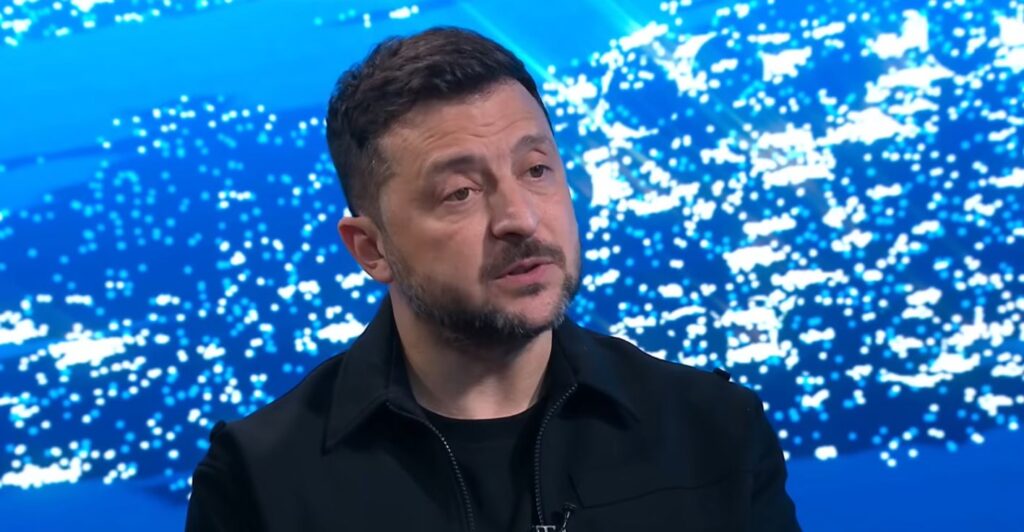
Freezing the war along today’s lines is “the quickest way” to peace, Ukraine’s leader told Sky News

freezing war along today's lines quickest way peace ukraine's leader told sky news · post ukrainian president volodymyr zelenskyy during interview london 7 2026 zele skynews ukraine reports

Ukrainian President Volodymyr Zelenskyy is willing to stop the war along the current line of contact and move to negotiations, he said in a Sky News interview. He presented the idea as the quickest route to a ceasefire, while rejecting any deal that hands Russia Ukrainian land. He also urged allies to close Ukraine's air defense gaps.

Russia has rejected every ceasefire Ukraine and the US have put forward and keeps refusing to halt an all-out war it has waged since its full-scale invasion in 2022. Whether a freeze ever takes hold rests with the Kremlin, whose demands still stretch far beyond the territory its army has managed to seize.

"The quickest way" to stop the fighting

Asked where he would freeze the lines if Russia agreed to a ceasefire, Zelenskyy said he is ready to accept today's positions

"Yes, it's the quickest way," he said. 

He insisted this is not a giveaway. He does not want to simply freeze the conflict, but to stop the war so it cannot restart "because of some crazy people." A freeze would let Ukraine save children's lives and bring soldiers home. Any ceasefire must be total and free of Russian games, watched by American and European partners. Only then would the sides sit down to end the war through diplomacy. A ceasefire, he added, is "the biggest compromise from our side."

Air defense comes first

The most urgent need from allies is air defense, Zelenskyy said. Ukraine faces a large deficit in anti-ballistic missiles, with US transfers slowed by the war in the Middle East. He again asked for more Patriot systems. Russia attacks daily, usually with around 300 long-range explosive drones. On the heaviest nights it launches 600 to 850 drones and dozens of missiles. 

Ukraine's interceptors now down most of them, but the gaps remain dangerous.
tymofii brik and kateryna kobernyk
Explore further

10% now, 23% after a ceasefire, 59% only at peace—Ukraine’s verdict on a wartime vote hasn’t moved all year

Ukraine's own arsenal

Ukraine has built more than 400 defense companies since the full-scale invasion, Zelenskyy said. Dozens rank among the world's strongest. They produce drones and missiles, some underground, and the country is close to its own ballistic missile. Ukraine can now share that expertise with allies and even build air defenses for Europe, he said. Kyiv aims to mass-produce drones on a scale few countries can match.

Bringing the war back to Russia

Ukraine's recent strikes on St. Petersburg and the Moscow region answer Russian attacks on Ukrainian energy, Zelenskyy said. St. Petersburg was hit twice last week. He wants Russians far from the front to feel the war they started. Russian President Vladimir Putin understands only "total pressure," he said. Sanctions on Russia's shadow fleet of sanctions-dodging tankers and its oil and gas exports hit hardest.

Putin, the letter, and a Kremlin go-between

Zelenskyy said Putin does not want to stop the war and is signaling he wants to win. Whether the fighting ends "100% depends on his decision," he said. His 4 June open letter, which Moscow called rude and rejected, was meant to force an answer and pierce a Russian public living in "some fantastic world." Russian businessman Roman Abramovich came to Kyiv to carry messages to Putin, Zelenskyy said. 

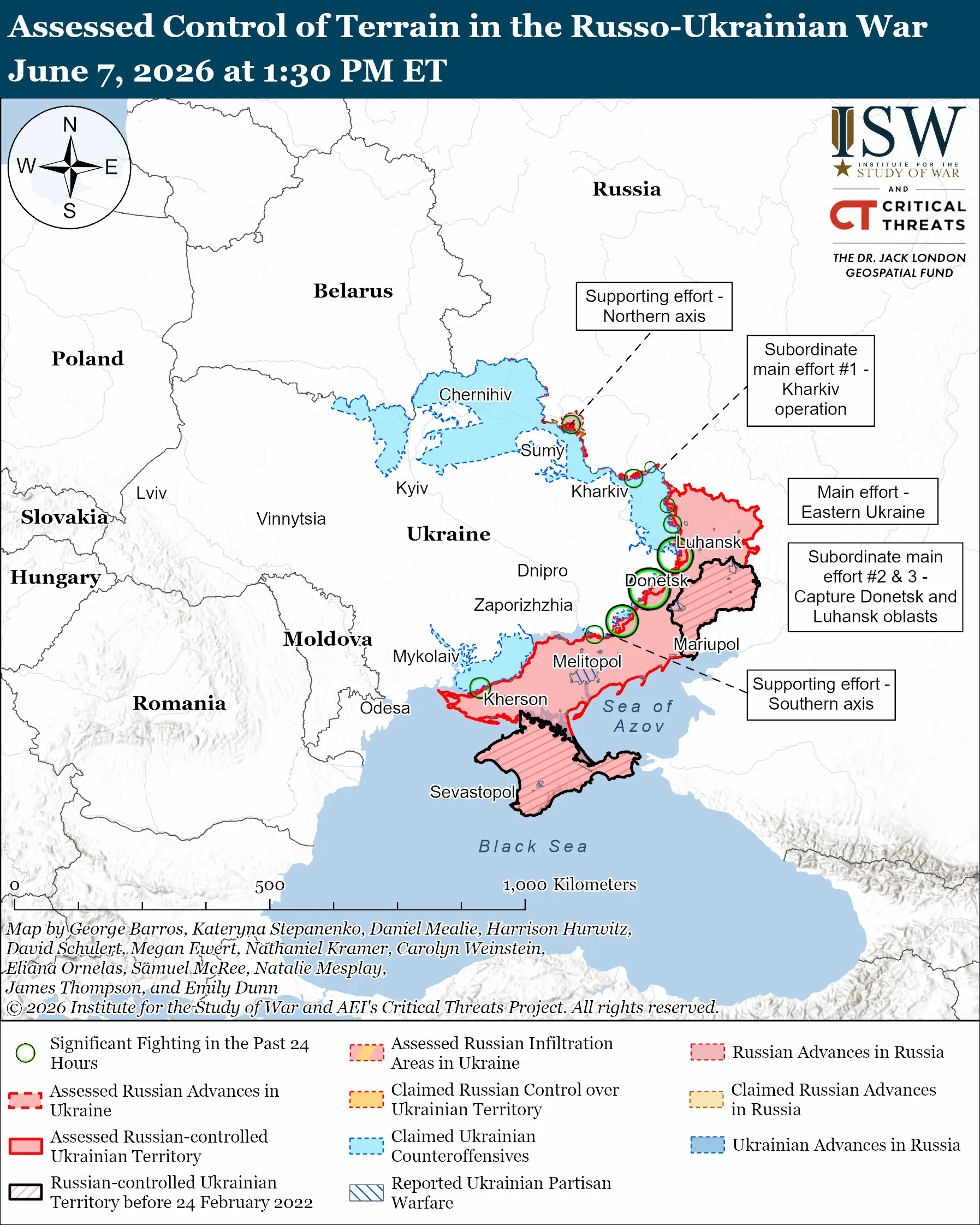
The so-called Donbas is a historic name for Ukraine’s two easternmost regions, Luhansk and Donetsk oblasts. Russia still failed to occupy a small part of Luhansk Oblast, as well as a significant swathe of Donetsk Oblast, which contains the so-called “Fortress Belt” that Russia has failed to break through despite its years-long ongoing offensive campaign. Map: ISW

His key message was on the Donbas: Ukraine will not leave its land, and compromises come only after a ceasefire. He is ready to meet in any format, but not in Moscow, Belarus, or Minsk. Leaders cannot decide "without us about us," he said, in a message aimed at Washington. Russia, by contrast, keeps insisting that Ukraine surrender all of the Donbas first.

  •  

Premature births are climbing in Ukraine’s front-line regions, and doctors blame the ongoing war

premature births climbing ukraine's front-line regions doctors blame ongoing war · post newborn temperature-controlled incubator hospital zaporizhzhia ukraine new born baby ap news ukrainian reports

Premature births are rising in several Ukrainian regions near the front line, where war-driven stress on pregnant women appears to be taking a tollaccording to the Associated Press (AP). Doctors in cities like Zaporizhzhia keep fragile newborns alive between air raid sirens, in wards with windows boarded up against Russian blast waves. The trend compounds a deepening crisis as fewer Ukrainian women give birth at all.

Russia's war is grinding down Ukraine's population on every front, from the men dying at the line to the families displaced and the children who never arrive. A generation born under fire will carry the war's medical and demographic cost for decades, long after any ceasefire, deepening the strain on a health system Russia keeps targeting.

How far the rate has climbed

In Kherson Oblast, early births climbed from 5.4% of deliveries in 2019 to 9.8% by 2025 — close to twice the rate, UN figures show.  Zaporizhzhia Oblast rose from 5.7% to 7.6%, and Poltava Oblast from 7.7% to 9.8% over the same period. The front line runs through Kherson and Zaporizhzhia oblasts. Poltava sits farther back but takes regular aerial strikes. Fewer Ukrainian women are giving birth overall, yet a larger share of births now come early, AP reported.

Keeping newborns alive under bombardment

The medical work is delicate and unforgiving. In a Zaporizhzhia intensive care unit, one baby born at 30 weeks weighs just 700 grams, far below the 2,500-gram threshold the World Health Organization (WHO) uses for low birth weight. Marharyta Nekhoroshyva's son arrived even earlier, at 26 weeks and 940 grams. Now nine months old, he still battles chronic breathing problems while she raises him alone, her husband fighting in the war.


Doctors must manage oxygen precisely, since too much risks abnormal blood-vessel growth in the eyes and, in severe cases, blindness, said Dr. Andrii Lobanov, who heads neonatal intensive care at Zaporizhzhia's children's hospital. When sirens sound, staff stay beside the incubators rather than risk moving the babies.

The danger is not abstract. Dr. Nataliia Bohuslavska, who runs the neonatal unit at the city's maternity hospital, opened a shift last month to alarms warning of incoming missiles. Hours later, a Russian glide bomb hit a commercial part of the city and killed at least 12 people. Her team delivered a baby and performed two cesareans that same day, while treating a woman who miscarried after witnessing an airstrike.

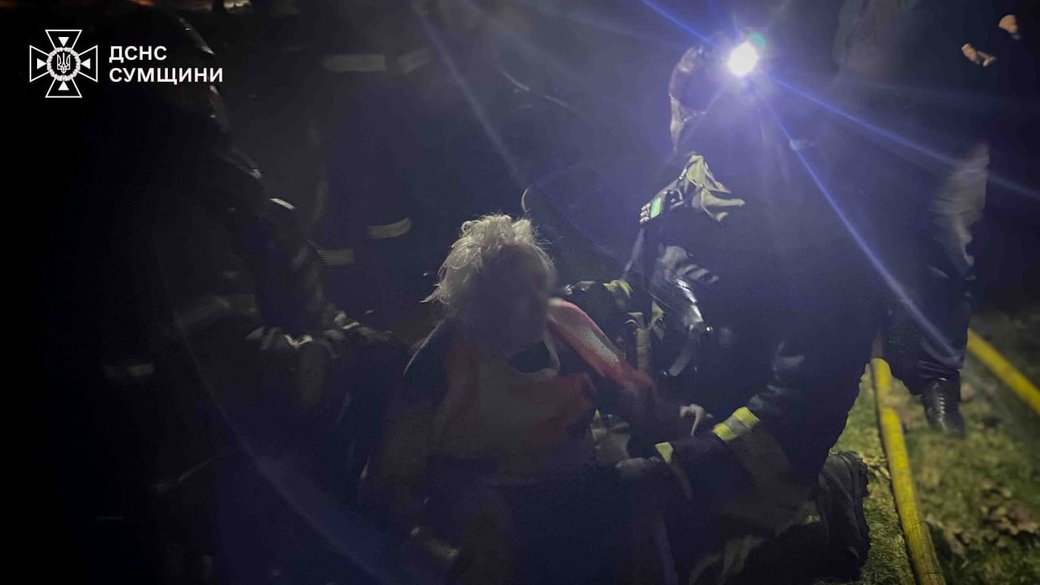
Aftermath of a Russian strike on Shostka, Sumy region. Photo: State Emergency Service of Ukraine
Explore further

Russia hits two hospitals, kills one woman overnight in strikes on Ukrainian cities

The longer cost

Surviving the delivery is only the start. Premature babies often need years of treatment for respiratory, neurological, and developmental conditions, a heavy bill for a country at war. Hospital services get hit "both literally and metaphorically," said Dr. Andrew Weeks, a maternal-health professor at the University of Liverpool.

It also lands on a country whose birth rate has collapsed to about one child per woman — less than half the 2.1 a population needs simply to hold steady.

  •  

“Extremely rare” 300-ton Russian rail recovery crane destroyed in partisan sabotage operation, ATESH claims

Fire engulfs a rail recovery crane in Russia’s Voronezh region, which ATESH claims was destroyed during a sabotage operation targeting Russia's railway infrastructure. Screenshot from video: ATESH

Pro-Ukrainian partisan movement ATESH says its agents carried out a sabotage operation at a railway station in Russia’s Voronezh Oblast, destroying a rare heavy-duty rail recovery crane used by Russian Railways.

The group said the target was an EDK-300/5 rail recovery crane, a specialized system used for large-scale emergency rail restoration work. ATESH claims the equipment is no longer in production and exists in only limited numbers across Russia’s rail network.

According to the statement, the crane was designed for heavy railway accident response tasks, including lifting derailed rolling stock, clearing damaged infrastructure, and restoring traffic on key lines. It reportedly had a lifting capacity of up to 300 tons.

A heavy rail recovery crane used by Russian Railways for emergency repair and derailment response. Illustrative photo: ATESH

“Even in the deep rear, critical equipment is not safe from destruction”

ATESH said the loss of the crane would reduce Russia’s ability to rapidly repair damaged rail infrastructure, particularly at major transport junctions where recovery speed is critical for maintaining logistics flows.

The group added that the impact of the loss would be long-lasting, saying: “Replacement of the destroyed crane will require significant time and resources. While Putin’s army searches for a replacement, the railway hub and regional logistics are operating with limited recovery capacity.”

“Even in the deep rear, critical equipment is not safe from destruction,” they added.

The report has not been independently verified.

ATESH: sabotage network operating inside Russia

ATESH is a clandestine resistance network operating inside Russian-controlled territory and within Russia itself. The group says it focuses on reconnaissance and sabotage operations against military, transport, and communications infrastructure that it considers to be supporting Russia’s war effort against Ukraine.

ATESH statements are typically released via Telegram and often include claims of damage to rail assets, depots, and logistical hubs. The group also claims to have agents operating inside the Russian armed forces, which it says helps it gather intelligence and identify targets.

Wider campaign targeting Russian logistics infrastructure

The operation is part of a wider campaign aimed at disrupting Russian transport infrastructure, which the group says supports both civilian logistics and military supply chains.

ATESH has increasingly focused on rail assets inside Russia, arguing that even limited damage to specialized equipment can create disproportionate delays across tightly connected transport networks.

Previous claimed strike in Saint Petersburg

In a previous claimed operation in May, ATESH said its agents set fire to a locomotive in Saint Petersburg used for oil transport, taking it out of service and disrupting rail operations in Russia’s northwestern logistics network.

The group said the locomotive had been part of fuel transport routes linked to industrial supply chains and export corridors in the northwest of the country, including areas connected to port infrastructure.

A locomotive used in oil transport was set on fire in Saint Petersburg, Russia, according to claims from the partisan network ATESH.

The group says its agents carried out the sabotage operation, taking the engine out of service and disrupting rail logistics tied to fuel and… pic.twitter.com/2c6ChkG7TR

— Euromaidan Press (@EuromaidanPress) May 21, 2026
  •  

Russia reportedly restricts bus and private car movement on main arteries through occupied territories, capping two weeks of land-corridor breakdown

ukraine launches logistics lockdown program $113 million middle-strike drones against russian rear · post destroyed military vehicles mariupol-melitopol road occupied southern telegram/@ukraine_context deep behind lines трасою маріуполь-мелітополь tg ukraine_context news

Russian occupation authorities are restricting regular bus traffic and private car movement on two main transport routes through occupied Ukraine, starting 6 June, due to what they call Ukrainian "attacks on civilian transport," Espreso reports, citing Russian media. 

The restrictions cover the R-280 "Novorossiya" highway connecting Rostov-on-Don through Mariupol, Berdiansk, and Melitopol to Simferopol, and the R-150 highway connecting Belgorod through Starobilsk, Luhansk, and Donetsk to Mariupol, the two main arteries through Russian-occupied territory in Ukraine.

Russia uses these routes to supply its occupation forces. The invaders' framing of the closures as protection against Ukrainian "attacks on civilian transport" comes the same week Ukraine's partisan units documented Russian forces using ambulances, bread vans, and postal trucks to deliver military fuel to the front line on those same routes.

What do restrictions cover? 

The R-280 highway is the main land artery connecting Russia to occupied Crimea, running from Rostov-on-Don to Mariupol, Berdiansk, Melitopol, and Simferopol.

The R-150 highway covers the northern arc: Belgorod to Starobilsk, Luhansk, Donetsk, and Mariupol.

Russian occupation authorities in the occupied Luhansk Oblast recommended that local residents not travel these routes, while noting that internal bus services would continue along altered routes.

Transport of organized groups of children through the region is temporarily banned, and suburban train service is suspended. 

Two-week breakdown of land corridor

The 6 June restrictions cap a two-week sequence of corridor breakdown driven by Ukraine's "logistics lockdown" campaign.

On 29 May, Ukraine's Main Intelligence Directorate (HUR) released a video of drone strikes on Russian fuel tankers along the Berdiansk-Melitopol-Crimea section of the same R-280.

By 31 May, Mariupol residents were reporting in local group chats that Russia had closed the Manhush-Berdiansk highway, which is the eastern segment of the same artery.

By 3 June, Russia's gasoline crisis had spread to St. Petersburg, Belgorod, Kursk, and the occupied Luhansk Oblast, with 40% of Russian refining capacity offline.

On 5 June, Russia ordered fuel drivers to wear civilian clothing. On 6 June, Russia closed civilian transport on the R-280 and R-150.

What do closures mean? 

The closures reshape daily life across Russian-occupied southern Ukraine. Civilians can no longer travel between major occupied cities on regular buses. Meanwhile, private cars are restricted on the main arteries. 

  •  

F-47’s Exotic Shape Was Hiding In Plain Sight On A Unit Patch

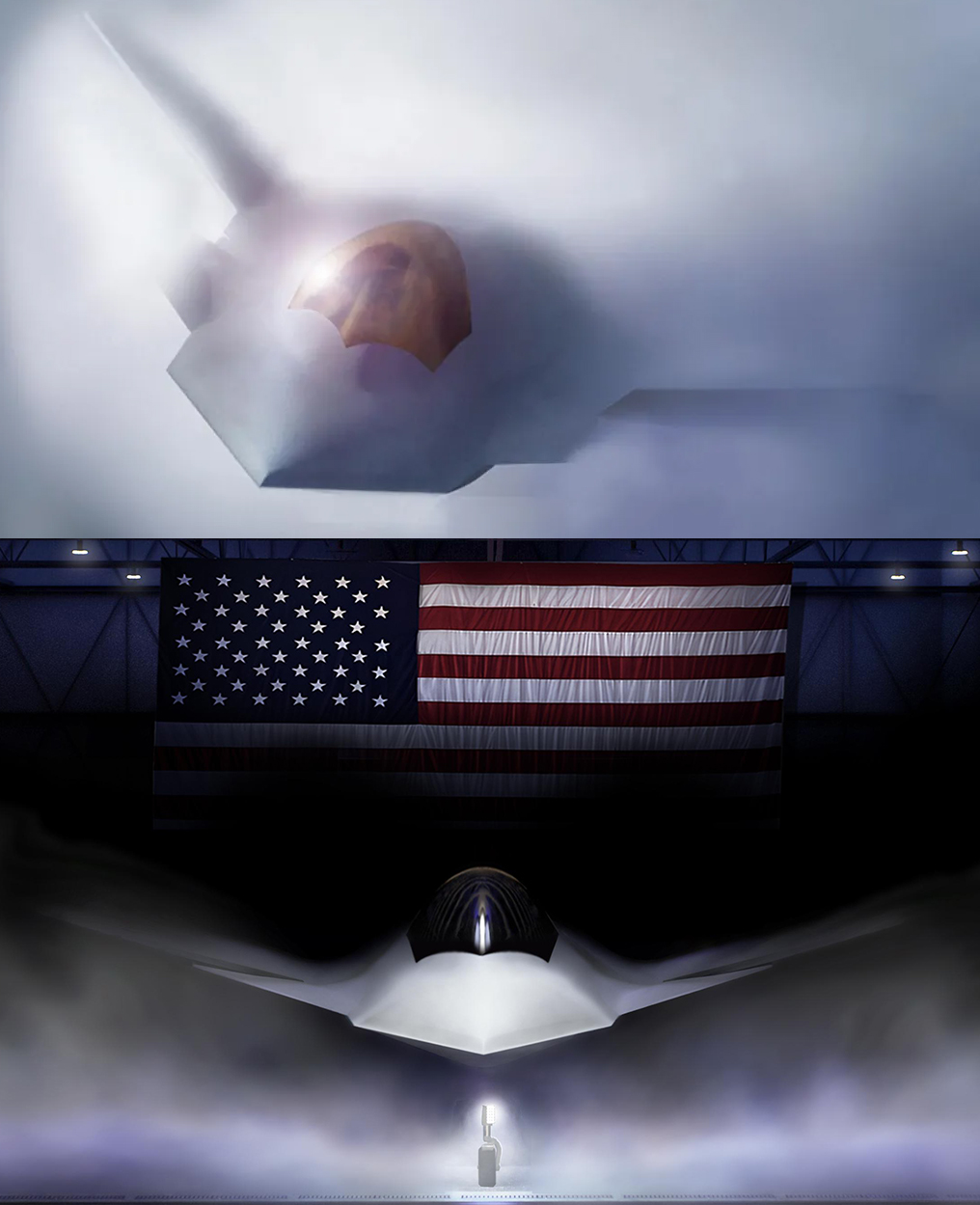
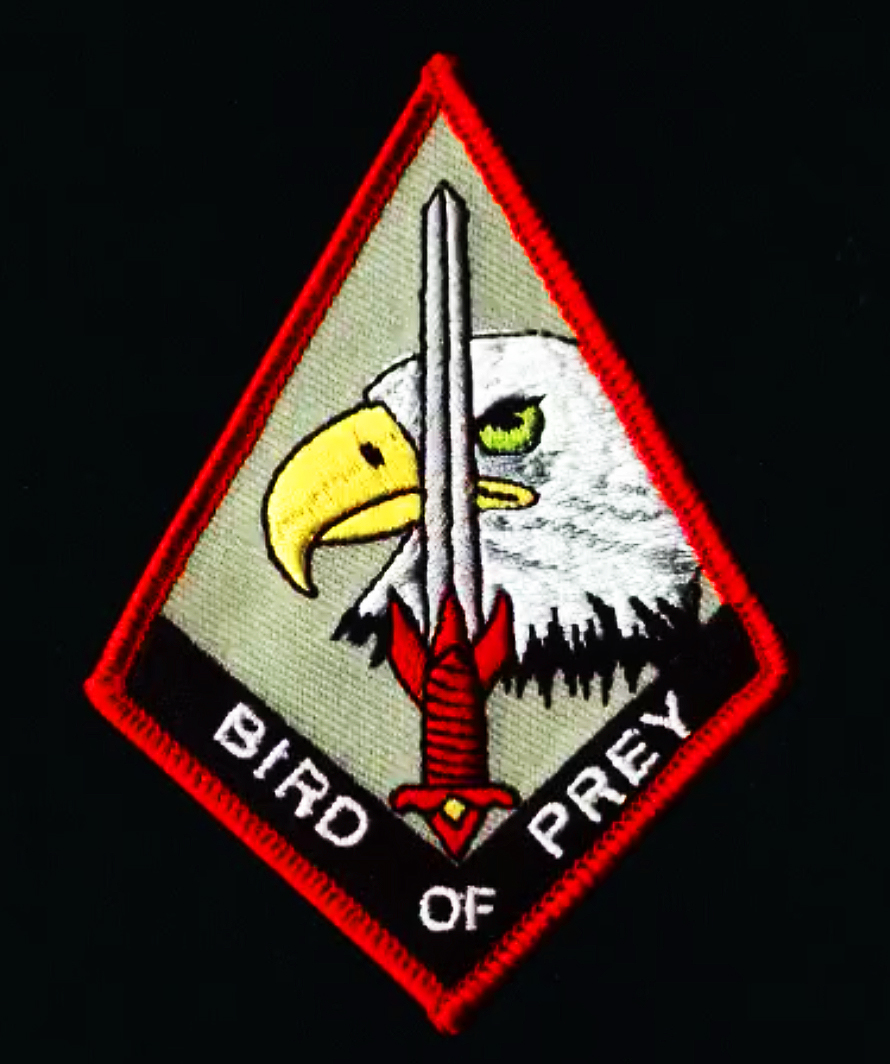
The exotic planform configuration concept of Boeing’s Next Generation Air Dominance (NGAD) classified demonstrator aircraft that led to the F-47 looks indeed to have been hiding in plain sight on an F-47 Systems Management Office patch. The first actual imagery of this aircraft appears to have leaked this week. Interestingly enough, another exotic stealth demonstrator aircraft that was once also highly classified and directly related to the design of the F-47, Boeing’s Bird of Prey, also featured its planform cryptically on a patch in a very similar manner.

Yep… She was hiding on the patch the whole time. pic.twitter.com/hIEMEzMJwn

— Tyler Rogoway (@Aviation_Intel) June 5, 2026

Inside the firebird motif of the F-47 patch, there is an exaggerated planform of what we see in Project Fear’s video of what is very likely Boeing’s NGAD demonstrator shot outside of Area 51. It also aligns with what we can extrapolate from the concept renderings of the F-47 that have been released.

Cropped version of the “new” Area 51 test article flying footage. https://t.co/zKdGNbW7qy pic.twitter.com/PmFApGArRh

— Thenewarea51 (@thenewarea51) June 5, 2026
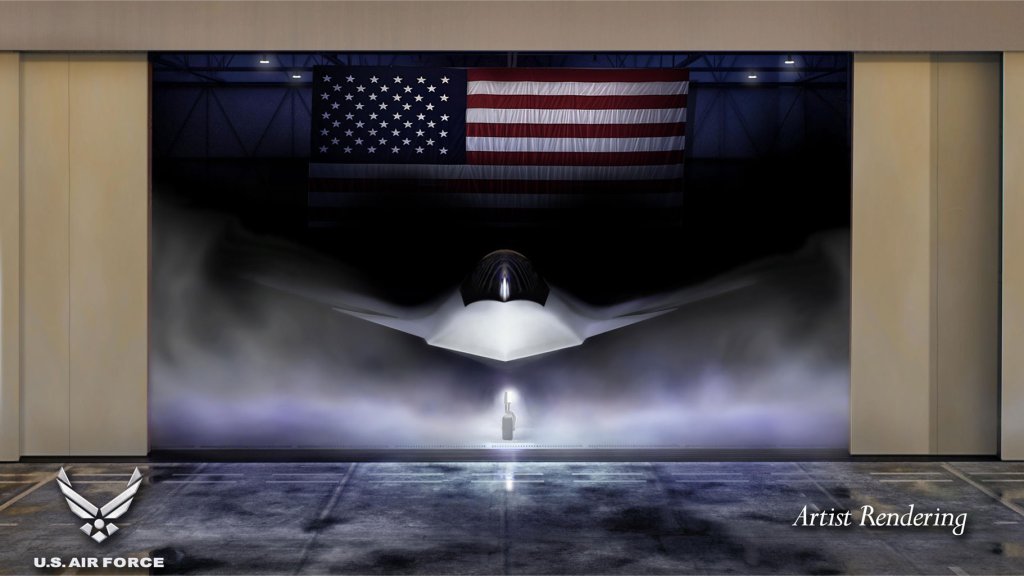
F-47 renderings. (USAF)

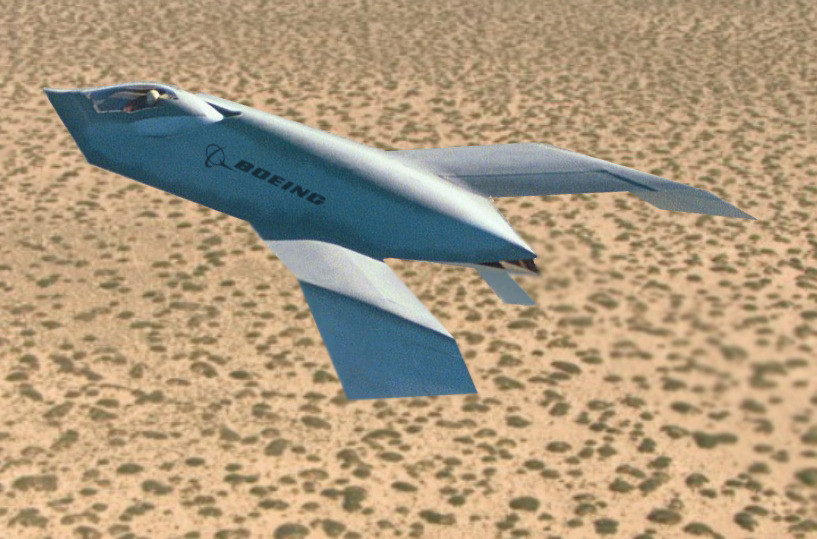
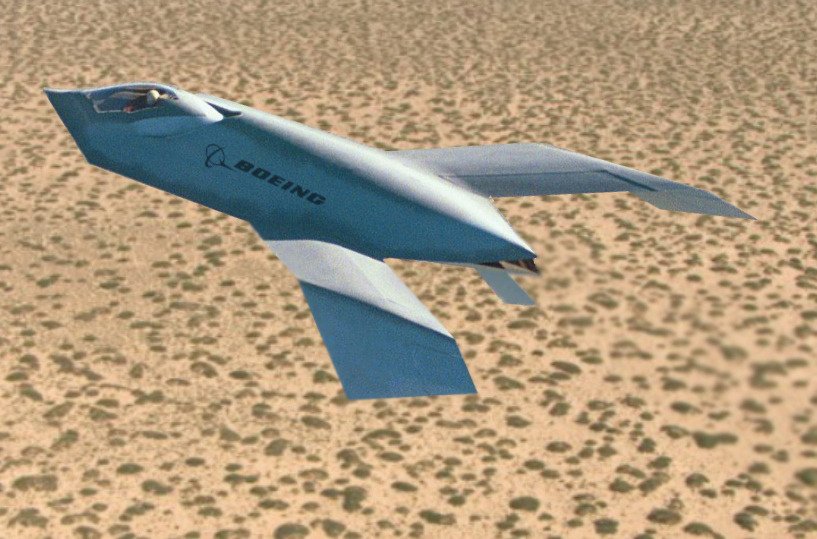
Mainly, the design includes forward canard foreplanes with a tapered central fuselage, rear-set and highly-swept wings, and no traditional tails. The wings have a high dihedral before drooping toward their tips, creating an appearance akin to the Klingon Bird of Prey from the world of Star Trek. That reference isn’t just my own. Boeing’s Bird of Prey from the 1990s clearly shares design similarities, especially in the wing area, as we originally stated after the first official concept art’s release. The Bird of Prey’s patch also cryptically shared its basic planform.

On the Bird of Prey patch, we see a traditional Klingon knife, made famous by Star Trek, with the blade’s hilt making up the Bird of Prey’s planform. In fact, the only detail to throw it off is the t-guard at the bottom of the handle, which appears like canards. Even the cockpit is there. Of course, it isn’t clear at this time when this patch began to circulate in the public domain or if it was after the Bird of Prey was declassified in late 2002. Regardless, in the F-47’s case, the demonstrator’s exact features remain closely guarded secrets, at least officially.

(Screenshot)

Attempting to decode or draw insights into the military’s notoriously cryptic classified program patches is hardly a new practice. Books like Trevor Paglen’s I Could Tell You but Then You Would Have to Be Destroyed by Me is an excellent example of this and the fascination around this unique blending of art, technology, and national security.

In years of reporting on these topics, I have been told multiple times that there is more in patches than many realize, including hints at designs of classified aircraft. This runs pretty counterintuitive considering the government’s extreme protocol for classification, but vague representations of general design concepts are far from giving up an actual blueprint of a classified aircraft. Nonetheless, it is fascinating to see the practice occur for two highly classified aircraft that are directly related, and it’s something we keep an eye on regularly, as well.

Still, with all this in mind, it may be time to take a look back at some of the most interesting patches floating around to see if an exotic planform of an aircraft could be hiding amongst their stitches.

Contact the author: Tyler@twz.com

The post F-47’s Exotic Shape Was Hiding In Plain Sight On A Unit Patch appeared first on The War Zone.

  •  

Area 51 Mystery Aircraft Prompts Interest In “Christmas Tree” Stealth Fighter Concept

Yesterday, TWZ published an analysis of a thermal image purportedly showing a previously unseen advanced aircraft design, which appears to be a precursor to the U.S. Air Force’s forthcoming F-47 fighter from Boeing. The image, which went viral online and is from a video that has now been released, is said to have been captured near the U.S. military’s secretive Groom Lake test base, better known as Area 51. It turns out, as a number of our readers have pointed out, there may be some interesting similarities between this secret aircraft and a “Christmas tree” fighter design concept crafted decades ago by Darold Cummings, one of the top minds behind Northrop’s YF-23 Black Widow.

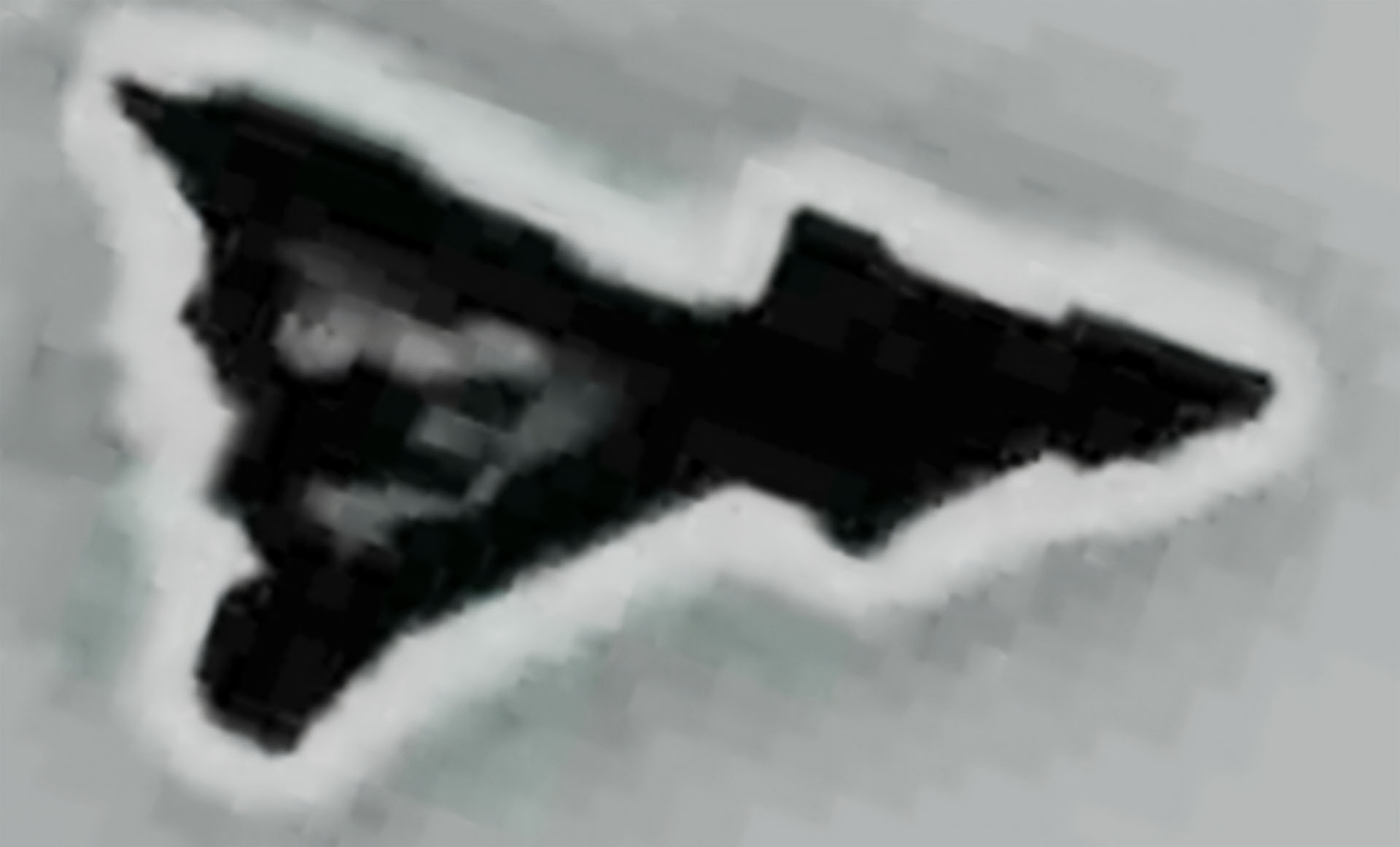
You can find our full initial assessment of what we may be seeing in the viral image, first posted online by the Project Fear YouTube channel earlier this week, here. What we saw initially, as shown below, appeared to feature what could be described as a “double arrowhead” profile to its forward fuselage. This is a very distinct design cue, but it could also be a result of the low quality of the image and the artifacts that come with consumer-grade thermal imagers, which was what the aircraft was recorded with.

A close-up look at what is visible in the viral thermal image. Capture via Project Fear

Project Fear has now released the full video it says it captured near Area 51, seen below, and it underscores the aforementioned points about image quality. So, it is possible the aircraft has a more traditional low-observable ‘shovel nose,’ instead. Nonetheless, the Christmas tree fighter is an interesting trip down lesser-known fighter development memory lane that is worth examining, in particular what such a unique nose configuration would provide an advanced fighter aircraft.

The full clip of the mysterious aircraft passing by starts at around 49:34 in the runtime of the video below if it does not automatically start playing at that point.

People are asking why it would be running a very bright light. Multiple reasons, could have had an emergency for all we know. But most likely, would be to keep its silhouette from being seen from certain aspects from the ground. Bright lights are established practice for… https://t.co/mxEvG2EUkz

— Tyler Rogoway (@Aviation_Intel) June 5, 2026

In a post on LinkedIn around the end of last year, Cummings shared an intriguing blueprint of a relevant-looking advanced fighter concept, along with additional details about the design and its genesis. Cummings is currently the founder and president of ForzAero, but has an extensive resume in the aviation industry dating back decades. As noted, he was a key figure at Northrop in the development of the YF-23, which ultimately lost out to what became Lockheed’s F-22 Raptor. He also led the team at Boeing that developed the X-40A Space Maneuver Vehicle, which was used as a testbed in support of work on what evolved into the X-37B reusable spaceplane. He was Chief Engineer/Chief Designer of Rockwell’s Ranger 2000 Jet Trainer, as well.

“I was hired by Bob Sandusky in 1982 to be the Chief Configurator for the Northrop ATF [Advanced Tactical Fighter] program (YF-23). In early 1983 Bob said that Northrop had tried to develop a ‘4-spike’ (like the B-2) fighter, but it couldn’t be done, since a flying wing fighter was not possible,” Cummings wrote in his post on LinkedIn. “I told him I could design one, and he said to give it a try. The only way to accomplish this was with a series of highly swept (55 degree) surfaces over the entire length of the aircraft. The result was the DP-21, created in June of 1983.”

“4-spike” here essentially refers to the total number of radar cross-section hot-spots and where they are located, each pointing in a different direction in azimuth. The fewer ‘spikes’ a low-observable (stealthy) aircraft has, the easier it is to manage its radar signature, and to make it harder to detect and lock onto, but it’s also where those spikes are located that matter.

The blueprint of the DP-21 “Christmas tree” fighter concept. Darold Cummings

A four-spike design like the B-2 critically has nothing from the head-on aspect, as well as from the rear, which helps immensely with survivability. These are the most critical signature areas, especially the front as the aircraft is heading into hostile territory. Also, because these are located along the path of flight, these spikes can stay consistent on a threat radar as the aircraft moves directly toward or away from the sensor, and are not fleeting in nature like those from the side. So a four spike aircraft would be very attractive for a tactical fighter meant to persist in contested territory.

“I never considered this to be a serious contender for the ATF program, as the aircraft was unstable beyond 10 degrees angle of attack!” he also noted.

“Back in 1983, the ‘Christmas Tree’ DP-21 would have been difficult to fly. However, with modern flight control systems, this design could be controlled, even at high angle of attack,” Cummings told TWZ directly today after we reached out for more information. “Low observability is always better served with long edges on the design, so the small arrow-shaped foreplane is not ideal, but it still has low RCS characteristics, just not the optimum.”

“Wing shaping is always a trade-off for maximizing LO. Most of the trades have to do with the leading edge contour, which is a large contributor to signature,” he continued. “The canard has to be designed to be ‘ported’ during penetration, as this minimizes the signature. On the YF-23, the V-Tail was ‘ported’ in penetration for the same reason. This is certainly possible with modern flight control systems.”

“Ported” in this instance refers to keeping the control surface locked in the same geometric plane as the wing while cruising.

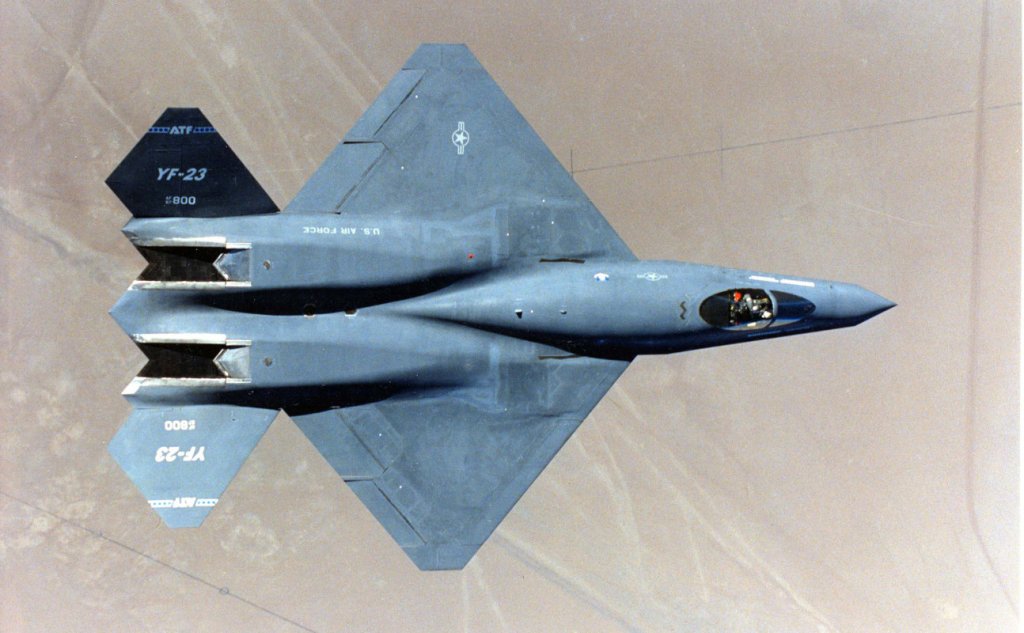
A top-down look at the YF-23 during a flight test. USAF

We also asked Cummings directly whether it was possible his DP-21 concept had an influence on what is seen in the viral thermal image, assuming it is authentic. And we asked for his take on what impacts Boeing’s experimental X-36 and Bird of Prey designs may have had on the F-47, as well.

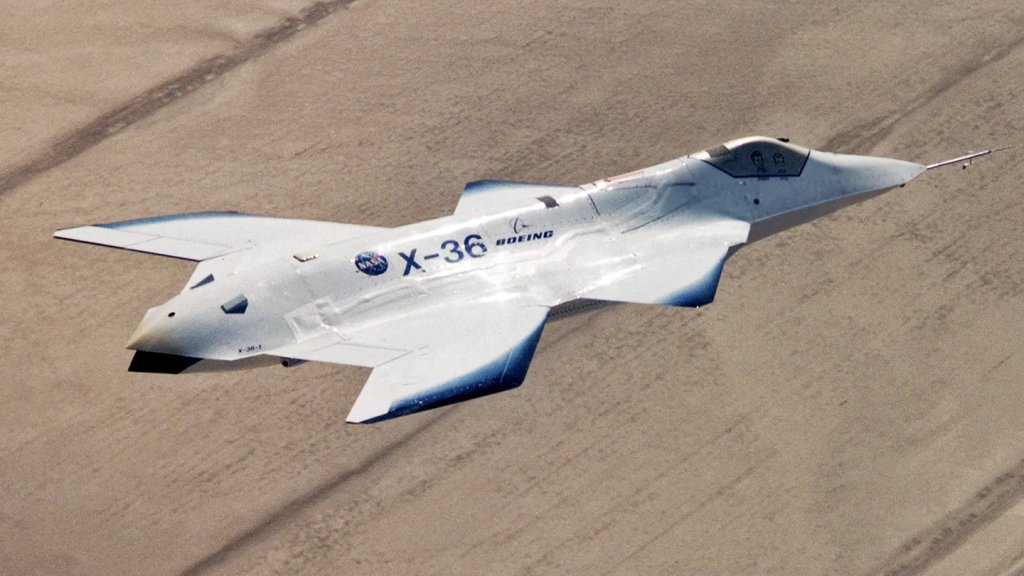
“My DP-21 aircraft image has been available publicly for quite some time, so it is possible it had some influence, but that is only speculation on my part,” he told us. “I believe the X-36 and Bird of Prey have both influenced the F-47 design. I have always been impressed by the X-36, as it seemed to be ahead of its time.”

Boeing’s X-36 demonstrator. NASA/Carla Thomas
Boeing’s Bird of Prey. USAF

“The Groom Lake images are truly intriguing,” he also noted. “It is a viable concept.”

“I think the main thing to remember is that NO ONE thought a 4-spike design (like the B-2) was possible, and my DP-21 was an example of how it was possible,” he added. “A 4-spike design for the F-47 would truly be impressive!”

An official rendering of the F-47. USAF

As TWZ already wrote yesterday, based on what is visible in the image:

“The image shows an exotic design by any interpretation. The aft-set lambda-type wings appear to have a camber and wingtip droop, as on the Boeing Bird of Prey demonstrator. There are very large canard foreplanes — a feature that appears prominently on F-47 renderings and which we have written in detail about in the past. The broad nose, too, is something that has been included in depictions of the F-47, although we have really no idea to what degree these are based in reality. It’s worth noting that in this new thermal image, it has a distinctive double-arrowhead shape, tapering in again in front of the canards. Even the canards themselves may have more than one plane, with the outer tips being drooped, matching similar architecture as the wing. The fuselage then tapers down in the center before the wing roots begin.”

“The aircraft is very likely to be tailless, a feature common to most sixth-generation concepts seen so far. However, since it’s seen from below, we cannot be sure about this aspect of its configuration.”

“As for the powerplant, it is most likely a twin-engine design, like the F-47, a theory reinforced by the sawtooth-type trailing edge. There is no obvious suggestion of any exhaust plumes, which seems odd, but that could be the result of the sensor being used in combination with the aircraft’s power setting at the time of recording, as well as general thermal signature reduction capabilities that are part of the design.”

“Soon after Boeing won the contract for the F-47, we looked at how it might have been influenced by the Phantom Works X-36, also a tailless-canard design.”

Another official rendering of the F-47. USAF

As mentioned earlier, the full video Project Fear released today does raise new questions about the exact profile of the front of the design seen in the footage. The idea of using a shovel nose profile on a stealthy aircraft dates back to Northrop’s Tacit Blue demonstrator, and it was found in its modern form: the YF-23. It has since become common to see on low-observable (stealthy) designs, and has been notably present in official renders of the F-47 released to date.

Beyond the nose end, there are still some very broad similarities in the shaping of the wing and main body of the aircraft seen in the footage and Cummings’ DP-21 concept.

To date, there are no indications that an F-47 EMD prototype has flown. Air Force officials have said on multiple occasions now that first flight of the service’s new sixth-generation fighter is expected to come in 2028.

We do know that Boeing and Lockheed built flying demonstrator designs that fed into the Next Generation Air Dominance (NGAD) initiative, under which initial development of what has become the F-47 was carried out. Past reports have raised the possibility that there was a third NGAD demonstrator, which might have been built by Northrop Grumman. That company voluntarily dropped out of the NGAD combat jet competition around 2023, and is said to have been on the verge of being cut at the time.

As we noted yesterday, what is seen in the viral thermal image could be unrelated entirely to the F-47. The Navy has also been pursuing a carrier-based sixth-generation fighter, commonly referred to as F/A-XX, in recent years. There has been at least some crossover between F/A-XX and the Air Force’s NGAD effort. A rendering Boeing has shared of its proposed F/A-XX design looks very much in line with what has been shown of F-47 to date. Northrop Grumman is the other company currently competing to build the Navy’s sixth-generation carrier fighter, and has released its own renderings.

Boeing’s F/A-XX render. Boeing

We're bringing tomorrow’s horizon into focus, faster, stronger and ready when the warfighter needs it.#SAS2026 pic.twitter.com/r0uORyR5kM

— Northrop Grumman (@northropgrumman) April 20, 2026

In addition, it should be said that official F-47 and F/A-XX renderings released to date will have been carefully manipulated to maximize security of the programs, both of which remain highly classified, and to provide disinformation to adversaries.

As an aside, Cummings also shared his take on a prospective navalized version of the F-47 in a separate post on LinkedIn last year. At that time he wrote:

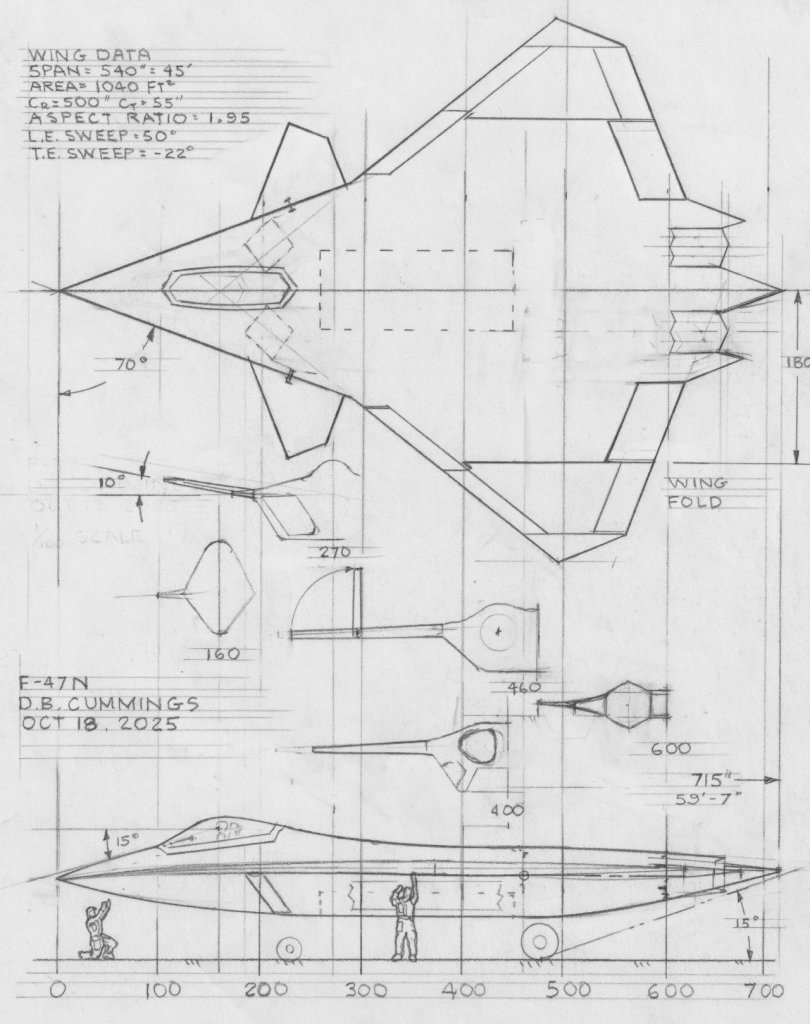
“I received a DM asking if I had envisioned a Navy version of my recent F-47 fighter concept, such as the F-35A to F-35C approach. I recently completed my F-47 Navy version, which I call the F-47N. However, the approach I took was somewhat different: The F-35C used a larger wing for low speed lift, whereas I used my original F-47 wing planform, and added a canard for more low speed lift and control. The canard design (inspired by the X-36), coupled with the Multi-Axis Thrust Vectoring (inspired by the X-44), provided a very reasonable first cut at a Navy version. In general, a canard layout has been treated as adding more radar signature to a fighter. However, on the YF-23 we found that if the all-moving surface (it was a V-tail on the YF-23) was kept “ported”, in this case aligned with the wing plane during cruise, the impact on LO was not a large impediment to signature reduction. The ability to keep the canard ported is achievable using thrust vectoring for trim in cruise and penetration modes.”

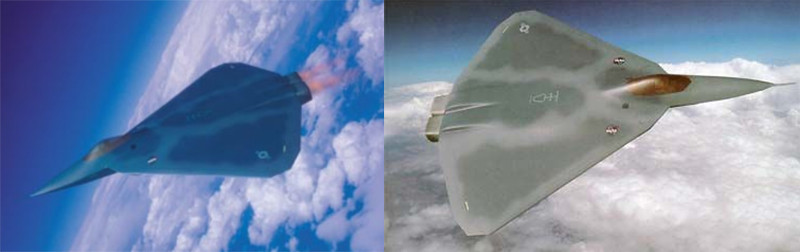
Cummings’ interpretation of the F-47 design at that time notably did not reflect his previous DP-21 concept. The X-44 design he mentioned is also known as the Multi-Axis No-Tail Aircraft (MANTA), and was derived from F-22. At least to our knowledge, the MANTA never came to be. The designation was recycled for an entirely unrelated flying wing-type drone, the existence of which was first reported by TWZ.

Darold Cummings’ drawing of his notional “F-47N.” Darold Cummings
Renderings of the X-44A MANTA. Lockheed Martin/NASA

It’s also worth noting that the design in the newly emerged thermal video could be tied to one of many other programs, including uncrewed ones. Still, it is very much in line with what we would expect to see from a design related to the F-47 and it seems very likely this is the Boeing NGAD demonstrator, if the video is indeed authentic, which it appears to be.

It would be nice to say that we will have to wait and see whether this aircraft turns out to have a more traditional shovel-shaped nose, or even a mild Christmas tree-like design, but we may never see it again. Hopefully that is not the case, especially after the F-47 goes public, but the final design will have significant differences from its technology demonstrator forebears.

Special thanks to @ElectroFluidSys on X for bringing Darold Cummings’ posts on LinkedIn to our attention.

Contact the author: joe@twz.com

The post Area 51 Mystery Aircraft Prompts Interest In “Christmas Tree” Stealth Fighter Concept appeared first on The War Zone.

  •  

Is This A Glimpse Of The Aircraft That Gave Birth To The F-47?

A thermal image purportedly shows a previously unseen aircraft design, said to have been captured when it was flying at night over the secretive Groom Lake facility, better known as Area 51. While the quality of the image is poor due to the sensor type that was supposedly used, from what we can see, the shape seems to be a relatively close match for what we know so far about the F-47 sixth-generation stealth fighter for the U.S. Air Force. This would point to it being the technology demonstrator ‘X-plane’ that served as a precursor to the contract being awarded to Boeing, although that is in no way a definitive assessment.

The image in question was first shared online by the Project Fear YouTube channel on June 3. The still image was promoted as a teaser for the full video that will be released tomorrow. It was published with the caption “A craft the public has never seen before.”

A craft the public has never seen before…
Video out this Friday. #ProjectFear #Area51 pic.twitter.com/8eOSJSUX1g

— Project Fear (@ProjectFearX) June 2, 2026

At this point, we need to be aware that there is no confirmation that the image is genuine, official or otherwise. We have reached out to the Air Force to try and establish its veracity, but they declined to comment.

However, the authenticity of the image and the forthcoming video was confirmed to TWZ by Anders Otteson, responsible for the Uncanny Expeditions YouTube channel, which explores classified locations at a distance around Nevada and California.

Otteson explained that he was approached by Project Fear, who was looking for advice in making a video outside Groom Lake.

“I’m generally happy to help other channels out, so I gave them a rundown on the gear I recommend buying, what specs are important, etc,” Otteson told us. “The thermal camera I suggested getting was the InfiRay HCH50R, and I can confirm that’s what this was shot with as I own one myself. I was out with them for their early filming and gave them a tour of some spots that I’ve had success spotting in the past. The following week is when they captured this aircraft.”

Otteson says the video was shot in the hills to the south of Rachel and that the aircraft was very low. He was not present during the sighting, which took place around two months ago, but Project Fear contacted him afterwards and shared the footage.

“I was obviously pretty excited when I saw it,” Otteson added.

While this may be the case, if the aircraft captured is real, the USAF likely shares the opposite sentiment.

Otteson also took to the r/area51 subreddit, where he further clarified his role and reiterated that the footage is, in his opinion, genuine.

“To be clear, my only involvement in this channel was an advisory role. I told them what equipment to buy and gave them general recommendations. I did go out with them but was not there at the time this clip was captured, though I was sent it immediately afterwards. I posted about this because I noticed some people calling it fake due to coming from a “paranormal” channel and wanted to clear that up. It is indeed real…” he wrote.

Otteson is certainly familiar with sightings of this kind. Earlier this year, he claimed to have captured thermal imagery of a ‘flying Dorito’-shaped aircraft that was also operating in the restricted airspace around Groom. The general triangular planform captured has a long history of rumored classified development going back to the dawn of stealth technology.

Newly released infrared footage dated January 14, filmed by videographer and explorer Anders Otteson, who runs a channel called Uncanny Expeditions on YouTube, shows an unidentified triangular-shaped aircraft flying over Area 51 and the Nevada Test and Training Range. pic.twitter.com/kQMmvI2tur

— OSINTdefender (@sentdefender) January 22, 2026

Among the many online discussions about this new image, it’s impossible not to make the connection with the Next Generation Air Dominance (NGAD) program, which Boeing won with its F-47 sixth-generation stealth fighter. That aircraft is now in early production for the U.S. Air Force.

An official rendering of the Air Force’s sixth-generation fighter, the F-47. U.S. Air Force graphic 

The image shows an exotic design by any interpretation. The aft-set lambda-type wings appear to have a camber and wingtip droop, as on the Boeing Bird of Prey demonstrator. There are very large canard foreplanes — a feature that appears prominently on F-47 renderings and which we have written in detail about in the past. The broad nose, too, is something that has been included in depictions of the F-47, although we have really no idea to what degree these are based in reality. It’s worth noting that in this new thermal image, it has a distinctive double-arrowhead shape, tapering in again in front of the canards. Even the canards themselves may have more than one plane, with the outer tips being drooped, matching similar architecture as the wing. The fuselage then tapers down in the center before the wing roots begin.

The Boeing Bird of Prey. U.S. Air Force

The aircraft is very likely to be tailless, a feature common to most sixth-generation concepts seen so far. However, since it’s seen from below, we cannot be sure about this aspect of its configuration.

As for the powerplant, it is most likely a twin-engine design, like the F-47, a theory reinforced by the sawtooth-type trailing edge. There is no obvious suggestion of any exhaust plumes, which seems odd, but that could be the result of the sensor being used in combination with the aircraft’s power setting at the time of recording, as well as general thermal signature reduction capabilities that are part of the design.

Soon after Boeing won the contract for the F-47, we looked at how it might have been influenced by the Phantom Works X-36, also a tailless-canard design.

Certainly, the official renderings of the F-47 have a superficial likeness to the X-36 Tailless Fighter Agility Research Aircraft, designed to be representative of a low-observable high-performance fighter.

An overhead view of the X-36. NASA

As Bill Sweetman, former editor-in-chief of Aviation Week and long-term observer of stealth programs, pointed out, the F-47 renderings also recalled some of the work of the late Alan Wiechman, who joined McDonnell Douglas from the Lockheed Skunk Works in the mid-1980s. He was responsible for the X-36 and the Bird of Prey. Sweetman also noted that, according to Wiechman’s obituary, he had ‘most recently’ been an adviser on stealth to the Air Force Rapid Capabilities Office.

So while everyone waits for the video of the A51 mystery plane, what did I write in March of last year?

"There are aspects of the artwork that call to mind the work of the late Alan Wiechman, who joined McDonnell Douglas… in the mid-1980s and headed the company’s stealth work… pic.twitter.com/9xJZK7CAOw

— Bill Sweetman (@ValkStrategy) June 4, 2026

Returning to the F-47, as far as we know, it has not flown yet, with the first example being under construction in St. Louis. Its first flight is expected in 2028.

On the other hand, as noted earlier, demonstrators associated with the NGAD program have taken to the air.

In 2020, it was first disclosed that at least one demonstrator design had already been flying for some years on behalf of NGAD.

Frank Kendall, when he was Secretary of the Air Force, also spoke openly about “X-planes,” in the plural, when describing the evolution of what became NGAD.

DARPA and the Air Force meanwhile confirmed that two X-planes were built for the Aerospace Innovation Initiative, and that they first flew in 2019 and 2022, respectively. Kendall further added that these were entirely experimental demonstrator aircraft and not reflective of a production prototype for a “tactical design.” They were built sometime after 2017, he said.

Frank Kendall, when he was Secretary of the Air Force. U.S. Air Force Secretary of the Air Force Frank Kendall. USAF

While we know that Boeing and Lockheed both built demonstrators, it’s possible that as many as three NGAD demonstrators were completed. This would reflect the fact that, at one point, three prime contractors or teams were involved, the other candidate being Northrop Grumman, which dropped out around 2023.

Now that the F-47 is in the engineering and manufacturing development (EMD) phase, we have speculated that the Boeing demonstrator and probably even the Lockheed Martin one are still doing test efforts, with the Boeing aircraft logically being used for risk reduction work while the EMD work continues.

Then there is the other NGAD effort being pursued separately by the U.S. Navy. The Navy program is also based around a crewed sixth-generation combat jet, known as F/A-XX. We know there is at least some crossover between the Air Force and Navy programs. The Navy has been especially tight-lipped about its F/A-XX program, and the aircraft seen could be a test asset related to it. In fact, it could be a direct descendant of the design that gave birth to the F-47, as Boeing’s renderings of their supposed entrant into the competition resemble the F-47. Again, we must state that renderings will be carefully manipulated prior to release to maximize security of the program and provide disinformation to adversaries. Still, the common through-lines are clearly there for the Boeing type.

Boeing’s F/A-XX render. Boeing

It’s also worth noting that the aircraft spotted on the thermal device does not match the aircraft seen in a satellite image at Area 51 during the time when the test effort for NGAD was underway. This could have been the Lockheed demonstrator or something else entirely.

Another possibility is that the aircraft in the thermal image is not a crewed next-generation fighter at all, but rather an advanced uncrewed combat air vehicle (UCAV). The U.S. military has invested heavily in stealthy drone programs in recent years, including highly classified systems designed for reconnaissance, electronic warfare, and loyal-wingman operations alongside crewed aircraft. Given the limited quality and single perspective of the thermal image, plenty of features could be misleading. It is therefore possible that the object is an experimental Collaborative Combat Aircraft or other uncrewed technology demonstrator rather than a prototype of a future sixth-generation fighter. However, while drones come in all configurations, the complexity of this aircraft design and its similarities to what we know about the F-47 make it being an unrelated uncrewed platform less likely. Area 51 also has many programs running at any given time, the vast majority of which we will never know about, so there have been and are many exotic designs that visit the airspace above the base for various reasons.

We can also say for sure that the aircraft in the new Area 51 image is fundamentally very different to the tailless new-generation combat aircraft designs that China is currently testing, the J-36 and the J-XDS, both of which you can read more about here.

A composite showing some of the images of the J-36 that have previously emerged. Chinese Internet via X
A pair of previously emerged images of the J-XDS. Chinese internet via X

It should also be noted that, provided the imagery is legitimate, its appearance at this point could well be a byproduct of an uptick in flight-test activity at Groom and elsewhere. This is something we had expected since the new era of great power competition began, and seems to be really metastasizing. With so many new technologies and systems in development, including entirely new categories of air combat aircraft, a whole new premium and level of activity is being placed on the base, as well as at non-classified facilities, like Edwards AFB.

At the same time, public insights into the activities at the already notoriously opaque base are becoming harder. In a recent land grab, the observation point at Tikaboo Peak — previously, the closest existing viewpoint into Area 51 — has been closed off in another huge land grab by the USAF.

So, as it sits, it isn’t clear exactly what we are seeing, if indeed it is a real aircraft, but there are strong indications that this is our first glimpse of the winning NGAD entrant and a preview of what the F-47 will look like when it finally thunders out of the shadows.

Contact the author: thomas@thewarzone.com

The post Is This A Glimpse Of The Aircraft That Gave Birth To The F-47? appeared first on The War Zone.

  •  

Google Met Top German Government Officials Dozens of Times to Discuss Online “Hate Speech” and “Disinformation”

Google held at least 34 meetings with top German government officials – including the Chancellor – to discuss suppressing "hate speech" and "disinformation" online, reveals John Rosenthal.

The post Google Met Top German Government Officials Dozens of Times to Discuss Online “Hate Speech” and “Disinformation” appeared first on The Daily Sceptic.

  •  

North Yorkshire Police Apologised to “Our LGBTQ+ Communities” – But Not to the Christian Officer It Wrongly Sacked

North Yorkshire Police made a grovelling public apology to "our LGBTQ+ communities" – but has refused to apologise to a Christian officer it wrongly sacked for asking a question about Islam at a training day.

The post North Yorkshire Police Apologised to “Our LGBTQ+ Communities” – But Not to the Christian Officer It Wrongly Sacked appeared first on The Daily Sceptic.

  •  
❌