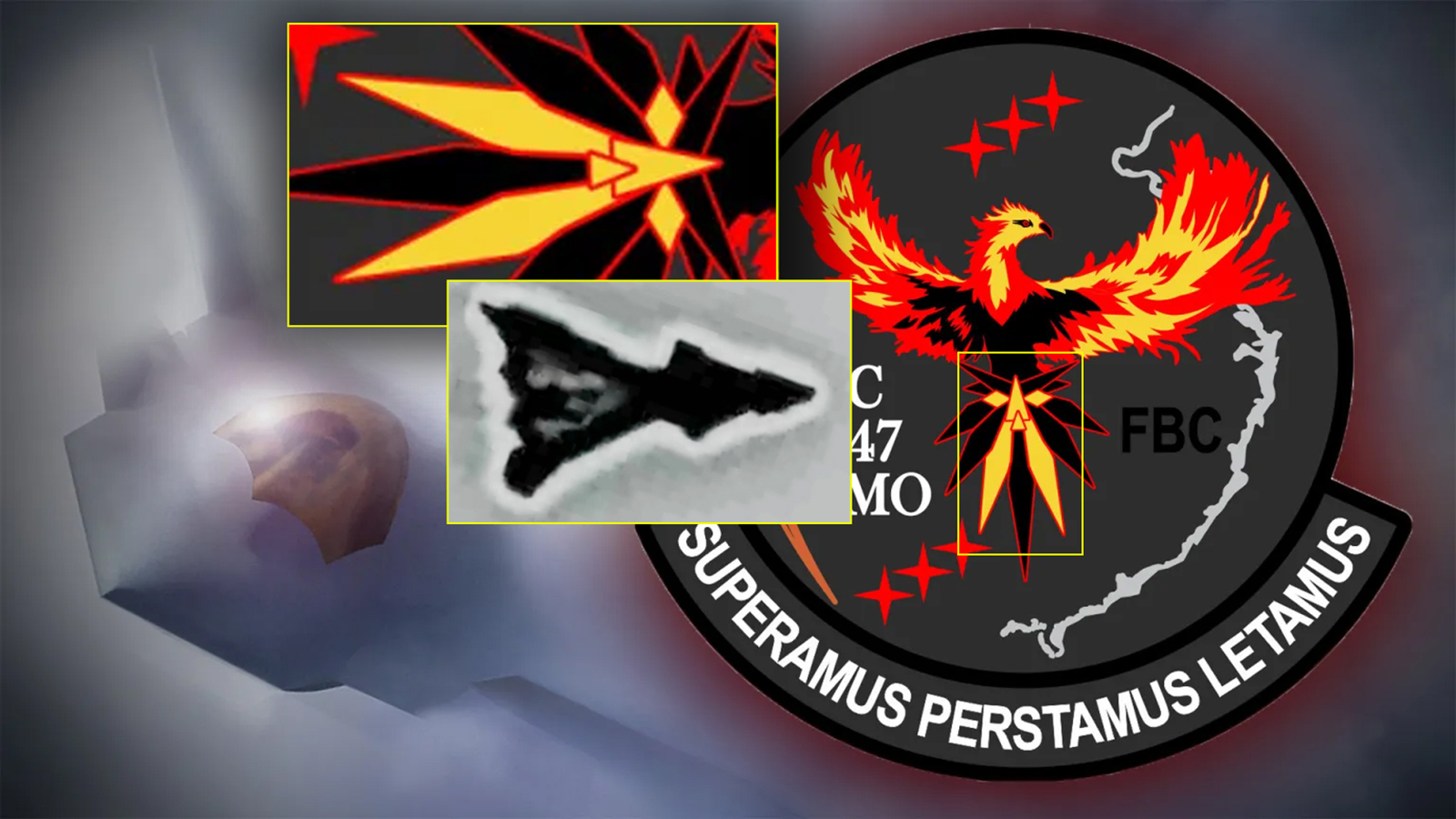
Inside the firebird motif of the F-47 patch, there is an exaggerated planform of what we see in Project Fear’s video of what is very likely Boeing’s NGAD demonstrator shot outside of Area 51. It also aligns with what we can extrapolate from the concept renderings of the F-47 that have been released.
Mainly, the design includes forward canard foreplanes with a tapered central fuselage, rear-set and highly-swept wings, and no traditional tails. The wings have a high dihedral before drooping toward their tips, creating an appearance akin to the Klingon Bird of Prey from the world of Star Trek. That reference isn’t just my own. Boeing’s Bird of Prey from the 1990s clearly shares design similarities, especially in the wing area, as we originally stated after the first official concept art’s release. The Bird of Prey’s patch also cryptically shared its basic planform.
On the Bird of Prey patch, we see a traditional Klingon knife, made famous by Star Trek, with the blade’s hilt making up the Bird of Prey’s planform. In fact, the only detail to throw it off is the t-guard at the bottom of the handle, which appears like canards. Even the cockpit is there. Of course, it isn’t clear at this time when this patch began to circulate in the public domain or if it was after the Bird of Prey was declassified in late 2002. Regardless, in the F-47’s case, the demonstrator’s exact features remain closely guarded secrets, at least officially.
(Screenshot)
Attempting to decode or draw insights into the military’s notoriously cryptic classified program patches is hardly a new practice. Books like Trevor Paglen’s I Could Tell You but Then You Would Have to Be Destroyed by Me is an excellent example of this and the fascination around this unique blending of art, technology, and national security.
In years of reporting on these topics, I have been told multiple times that there is more in patches than many realize, including hints at designs of classified aircraft. This runs pretty counterintuitive considering the government’s extreme protocol for classification, but vague representations of general design concepts are far from giving up an actual blueprint of a classified aircraft. Nonetheless, it is fascinating to see the practice occur for two highly classified aircraft that are directly related, and it’s something we keep an eye on regularly, as well.
Still, with all this in mind, it may be time to take a look back at some of the most interesting patches floating around to see if an exotic planform of an aircraft could be hiding amongst their stitches.
Yesterday, TWZ published an analysis of a thermal image purportedly showing a previously unseen advanced aircraft design, which appears to be a precursor to the U.S. Air Force’s forthcoming F-47 fighter from Boeing. The image, which went viral online and is from a video that has now been released, is said to have been captured near the U.S. military’s secretive Groom Lake test base, better known as Area 51. It turns out, as a number of our readers have pointed out, there may be some interesting similarities between this secret aircraft and a “Christmas tree” fighter design concept crafted decades ago by Darold Cummings, one of the top minds behind Northrop’s YF-23 Black Widow.
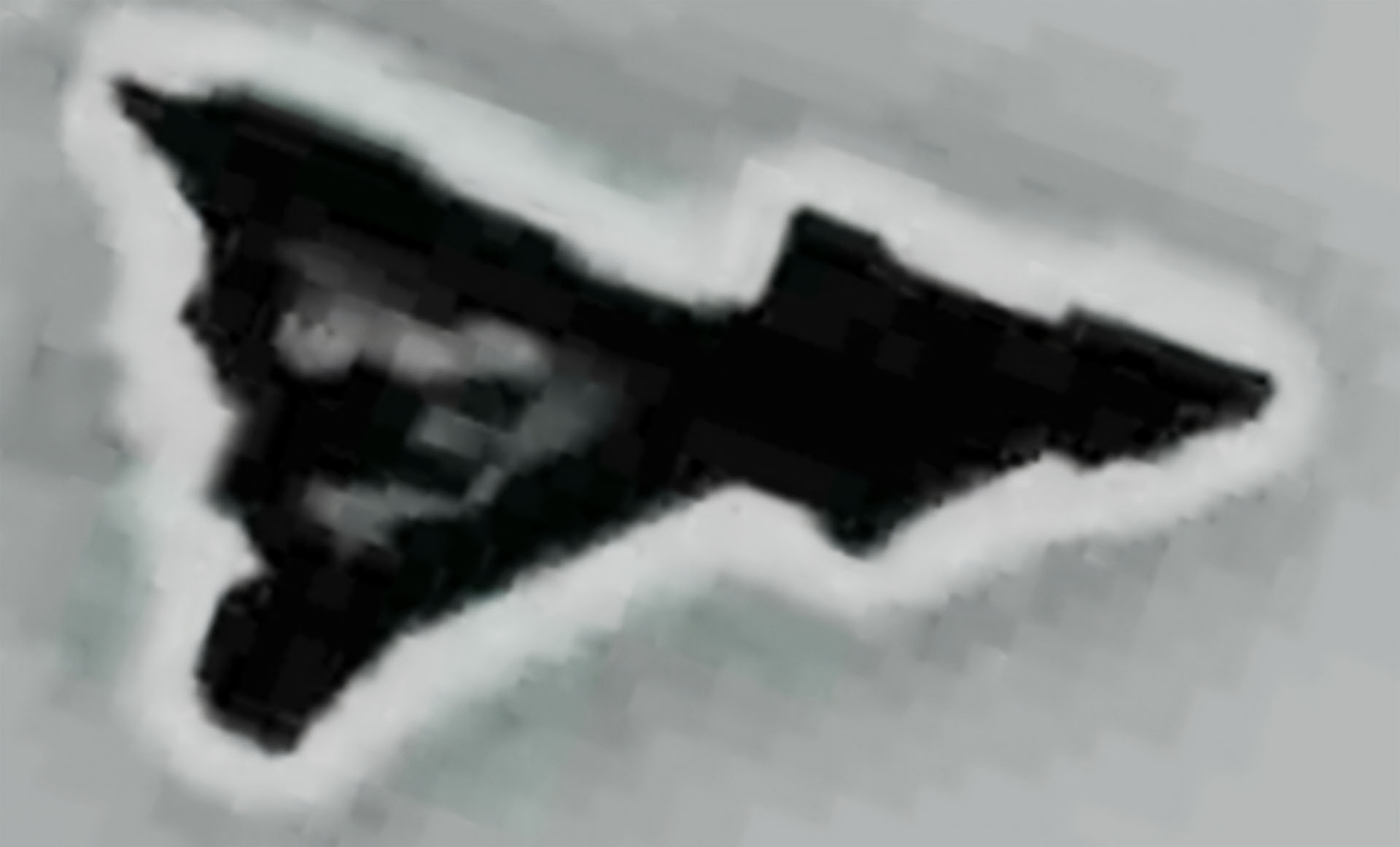
You can find our full initial assessment of what we may be seeing in the viral image, first posted online by the Project Fear YouTube channel earlier this week, here. What we saw initially, as shown below, appeared to feature what could be described as a “double arrowhead” profile to its forward fuselage. This is a very distinct design cue, but it could also be a result of the low quality of the image and the artifacts that come with consumer-grade thermal imagers, which was what the aircraft was recorded with.
A close-up look at what is visible in the viral thermal image. Capture via Project Fear
Project Fear has now released the full video it says it captured near Area 51, seen below, and it underscores the aforementioned points about image quality. So, it is possible the aircraft has a more traditional low-observable ‘shovel nose,’ instead. Nonetheless, the Christmas tree fighter is an interesting trip down lesser-known fighter development memory lane that is worth examining, in particular what such a unique nose configuration would provide an advanced fighter aircraft.
The full clip of the mysterious aircraft passing by starts at around 49:34 in the runtime of the video below if it does not automatically start playing at that point.
People are asking why it would be running a very bright light. Multiple reasons, could have had an emergency for all we know. But most likely, would be to keep its silhouette from being seen from certain aspects from the ground. Bright lights are established practice for… https://t.co/mxEvG2EUkz
“I was hired by Bob Sandusky in 1982 to be the Chief Configurator for the Northrop ATF [Advanced Tactical Fighter] program (YF-23). In early 1983 Bob said that Northrop had tried to develop a ‘4-spike’ (like the B-2) fighter, but it couldn’t be done, since a flying wing fighter was not possible,” Cummings wrote in his post on LinkedIn. “I told him I could design one, and he said to give it a try. The only way to accomplish this was with a series of highly swept (55 degree) surfaces over the entire length of the aircraft. The result was the DP-21, created in June of 1983.”
“4-spike” here essentially refers to the total number of radar cross-section hot-spots and where they are located, each pointing in a different direction in azimuth. The fewer ‘spikes’ a low-observable (stealthy) aircraft has, the easier it is to manage its radar signature, and to make it harder to detect and lock onto, but it’s also where those spikes are located that matter.
The blueprint of the DP-21 “Christmas tree” fighter concept. Darold Cummings
A four-spike design like the B-2 critically has nothing from the head-on aspect, as well as from the rear, which helps immensely with survivability. These are the most critical signature areas, especially the front as the aircraft is heading into hostile territory. Also, because these are located along the path of flight, these spikes can stay consistent on a threat radar as the aircraft moves directly toward or away from the sensor, and are not fleeting in nature like those from the side. So a four spike aircraft would be very attractive for a tactical fighter meant to persist in contested territory.
“I never considered this to be a serious contender for the ATF program, as the aircraft was unstable beyond 10 degrees angle of attack!” he also noted.
“Back in 1983, the ‘Christmas Tree’ DP-21 would have been difficult to fly. However, with modern flight control systems, this design could be controlled, even at high angle of attack,” Cummings told TWZ directly today after we reached out for more information. “Low observability is always better served with long edges on the design, so the small arrow-shaped foreplane is not ideal, but it still has low RCS characteristics, just not the optimum.”
“Wing shaping is always a trade-off for maximizing LO. Most of the trades have to do with the leading edge contour, which is a large contributor to signature,” he continued. “The canard has to be designed to be ‘ported’ during penetration, as this minimizes the signature. On the YF-23, the V-Tail was ‘ported’ in penetration for the same reason. This is certainly possible with modern flight control systems.”
“Ported” in this instance refers to keeping the control surface locked in the same geometric plane as the wing while cruising.
A top-down look at the YF-23 during a flight test. USAF
We also asked Cummings directly whether it was possible his DP-21 concept had an influence on what is seen in the viral thermal image, assuming it is authentic. And we asked for his take on what impacts Boeing’s experimental X-36 and Bird of Prey designs may have had on the F-47, as well.
“My DP-21 aircraft image has been available publicly for quite some time, so it is possible it had some influence, but that is only speculation on my part,” he told us. “I believe the X-36 and Bird of Prey have both influenced the F-47 design. I have always been impressed by the X-36, as it seemed to be ahead of its time.”
Boeing’s X-36 demonstrator. NASA/Carla Thomas Boeing’s Bird of Prey. USAF
“The Groom Lake images are truly intriguing,” he also noted. “It is a viable concept.”
“I think the main thing to remember is that NO ONE thought a 4-spike design (like the B-2) was possible, and my DP-21 was an example of how it was possible,” he added. “A 4-spike design for the F-47 would truly be impressive!”
“The image shows an exotic design by any interpretation. The aft-set lambda-type wings appear to have a camber and wingtip droop, as on the Boeing Bird of Prey demonstrator. There are very large canard foreplanes — a feature that appears prominently on F-47 renderings and which we have written in detail about in the past. The broad nose, too, is something that has been included in depictions of the F-47, although we have really no idea to what degree these are based in reality. It’s worth noting that in this new thermal image, it has a distinctive double-arrowhead shape, tapering in again in front of the canards. Even the canards themselves may have more than one plane, with the outer tips being drooped, matching similar architecture as the wing. The fuselage then tapers down in the center before the wing roots begin.”
“The aircraft is very likely to be tailless, a feature common to most sixth-generation concepts seen so far. However, since it’s seen from below, we cannot be sure about this aspect of its configuration.”
“As for the powerplant, it is most likely a twin-engine design, like the F-47, a theory reinforced by the sawtooth-type trailing edge. There is no obvious suggestion of any exhaust plumes, which seems odd, but that could be the result of the sensor being used in combination with the aircraft’s power setting at the time of recording, as well as general thermal signature reduction capabilities that are part of the design.”
Beyond the nose end, there are still some very broad similarities in the shaping of the wing and main body of the aircraft seen in the footage and Cummings’ DP-21 concept.
As we noted yesterday, what is seen in the viral thermal image could be unrelated entirely to the F-47. The Navy has also been pursuing a carrier-based sixth-generation fighter, commonly referred to as F/A-XX, in recent years. There has been at least some crossover between F/A-XX and the Air Force’s NGAD effort. A rendering Boeing has shared of its proposed F/A-XX design looks very much in line with what has been shown of F-47 to date. Northrop Grumman is the other company currently competing to build the Navy’s sixth-generation carrier fighter, and has released its own renderings.
Boeing’s F/A-XX render. Boeing
We're bringing tomorrow’s horizon into focus, faster, stronger and ready when the warfighter needs it.#SAS2026pic.twitter.com/r0uORyR5kM
In addition, it should be said that official F-47 and F/A-XX renderings released to date will have been carefully manipulated to maximize security of the programs, both of which remain highly classified, and to provide disinformation to adversaries.
As an aside, Cummings also shared his take on a prospective navalized version of the F-47 in a separate post on LinkedIn last year. At that time he wrote:
“I received a DM asking if I had envisioned a Navy version of my recent F-47 fighter concept, such as the F-35A to F-35C approach. I recently completed my F-47 Navy version, which I call the F-47N. However, the approach I took was somewhat different: The F-35C used a larger wing for low speed lift, whereas I used my original F-47 wing planform, and added a canard for more low speed lift and control. The canard design (inspired by the X-36), coupled with the Multi-Axis Thrust Vectoring (inspired by the X-44), provided a very reasonable first cut at a Navy version. In general, a canard layout has been treated as adding more radar signature to a fighter. However, on the YF-23 we found that if the all-moving surface (it was a V-tail on the YF-23) was kept “ported”, in this case aligned with the wing plane during cruise, the impact on LO was not a large impediment to signature reduction. The ability to keep the canard ported is achievable using thrust vectoring for trim in cruise and penetration modes.”
Cummings’ interpretation of the F-47 design at that time notably did not reflect his previous DP-21 concept. The X-44 design he mentioned is also known as the Multi-Axis No-Tail Aircraft (MANTA), and was derived from F-22. At least to our knowledge, the MANTA never came to be. The designation was recycled for an entirely unrelated flying wing-type drone, the existence of which was first reported by TWZ.
Darold Cummings’ drawing of his notional “F-47N.” Darold CummingsRenderings of the X-44A MANTA. Lockheed Martin/NASA
It’s also worth noting that the design in the newly emerged thermal video could be tied to one of many other programs, including uncrewed ones. Still, it is very much in line with what we would expect to see from a design related to the F-47 and it seems very likely this is the Boeing NGAD demonstrator, if the video is indeed authentic, which it appears to be.
It would be nice to say that we will have to wait and see whether this aircraft turns out to have a more traditional shovel-shaped nose, or even a mild Christmas tree-like design, but we may never see it again. Hopefully that is not the case, especially after the F-47 goes public, but the final design will have significant differences from its technology demonstrator forebears.
Special thanks to @ElectroFluidSys on X for bringing Darold Cummings’ posts on LinkedIn to our attention.
A thermal image purportedly shows a previously unseen aircraft design, said to have been captured when it was flying at night over the secretive Groom Lake facility, better known as Area 51. While the quality of the image is poor due to the sensor type that was supposedly used, from what we can see, the shape seems to be a relatively close match for what we know so far about the F-47 sixth-generation stealth fighter for the U.S. Air Force. This would point to it being the technology demonstrator ‘X-plane’ that served as a precursor to the contract being awarded to Boeing, although that is in no way a definitive assessment.
The image in question was first shared online by the Project Fear YouTube channel on June 3. The still image was promoted as a teaser for the full video that will be released tomorrow. It was published with the caption “A craft the public has never seen before.”
At this point, we need to be aware that there is no confirmation that the image is genuine, official or otherwise. We have reached out to the Air Force to try and establish its veracity, but they declined to comment.
However, the authenticity of the image and the forthcoming video was confirmed to TWZ by Anders Otteson, responsible for the Uncanny Expeditions YouTube channel, which explores classified locations at a distance around Nevada and California.
Otteson explained that he was approached by Project Fear, who was looking for advice in making a video outside Groom Lake.
“I’m generally happy to help other channels out, so I gave them a rundown on the gear I recommend buying, what specs are important, etc,” Otteson told us. “The thermal camera I suggested getting was the InfiRay HCH50R, and I can confirm that’s what this was shot with as I own one myself. I was out with them for their early filming and gave them a tour of some spots that I’ve had success spotting in the past. The following week is when they captured this aircraft.”
Otteson says the video was shot in the hills to the south of Rachel and that the aircraft was very low. He was not present during the sighting, which took place around two months ago, but Project Fear contacted him afterwards and shared the footage.
“I was obviously pretty excited when I saw it,” Otteson added.
While this may be the case, if the aircraft captured is real, the USAF likely shares the opposite sentiment.
Otteson also took to the r/area51 subreddit, where he further clarified his role and reiterated that the footage is, in his opinion, genuine.
“To be clear, my only involvement in this channel was an advisory role. I told them what equipment to buy and gave them general recommendations. I did go out with them but was not there at the time this clip was captured, though I was sent it immediately afterwards. I posted about this because I noticed some people calling it fake due to coming from a “paranormal” channel and wanted to clear that up. It is indeed real…” he wrote.
Otteson is certainly familiar with sightings of this kind. Earlier this year, he claimed to have captured thermal imagery of a ‘flying Dorito’-shaped aircraft that was also operating in the restricted airspace around Groom. The general triangular planform captured has a long history of rumored classified development going back to the dawn of stealth technology.
Newly released infrared footage dated January 14, filmed by videographer and explorer Anders Otteson, who runs a channel called Uncanny Expeditions on YouTube, shows an unidentified triangular-shaped aircraft flying over Area 51 and the Nevada Test and Training Range. pic.twitter.com/kQMmvI2tur
Among the many online discussions about this new image, it’s impossible not to make the connection with the Next Generation Air Dominance (NGAD) program, which Boeing won with its F-47 sixth-generation stealth fighter. That aircraft is now in early production for the U.S. Air Force.
An official rendering of the Air Force’s sixth-generation fighter, the F-47. U.S. Air Force graphic
The image shows an exotic design by any interpretation. The aft-set lambda-type wings appear to have a camber and wingtip droop, as on the Boeing Bird of Prey demonstrator. There are very large canard foreplanes — a feature that appears prominently on F-47 renderings and which we have written in detail about in the past. The broad nose, too, is something that has been included in depictions of the F-47, although we have really no idea to what degree these are based in reality. It’s worth noting that in this new thermal image, it has a distinctive double-arrowhead shape, tapering in again in front of the canards. Even the canards themselves may have more than one plane, with the outer tips being drooped, matching similar architecture as the wing. The fuselage then tapers down in the center before the wing roots begin.
The Boeing Bird of Prey. U.S. Air Force
The aircraft is very likely to be tailless, a feature common to most sixth-generation concepts seen so far. However, since it’s seen from below, we cannot be sure about this aspect of its configuration.
As for the powerplant, it is most likely a twin-engine design, like the F-47, a theory reinforced by the sawtooth-type trailing edge. There is no obvious suggestion of any exhaust plumes, which seems odd, but that could be the result of the sensor being used in combination with the aircraft’s power setting at the time of recording, as well as general thermal signature reduction capabilities that are part of the design.
Certainly, the official renderings of the F-47 have a superficial likeness to the X-36 Tailless Fighter Agility Research Aircraft, designed to be representative of a low-observable high-performance fighter.
An overhead view of the X-36. NASA
As Bill Sweetman, former editor-in-chief of Aviation Week and long-term observer of stealth programs, pointed out, the F-47 renderings also recalled some of the work of the late Alan Wiechman, who joined McDonnell Douglas from the Lockheed Skunk Works in the mid-1980s. He was responsible for the X-36 and the Bird of Prey. Sweetman also noted that, according to Wiechman’s obituary, he had ‘most recently’ been an adviser on stealth to the Air Force Rapid Capabilities Office.
So while everyone waits for the video of the A51 mystery plane, what did I write in March of last year?
"There are aspects of the artwork that call to mind the work of the late Alan Wiechman, who joined McDonnell Douglas… in the mid-1980s and headed the company’s stealth work… pic.twitter.com/9xJZK7CAOw
Returning to the F-47, as far as we know, it has not flown yet, with the first example being under construction in St. Louis. Its first flight is expected in 2028.
On the other hand, as noted earlier, demonstrators associated with the NGAD program have taken to the air.
In 2020, it was first disclosed that at least one demonstrator design had already been flying for some years on behalf of NGAD.
Frank Kendall, when he was Secretary of the Air Force, also spoke openly about “X-planes,” in the plural, when describing the evolution of what became NGAD.
DARPA and the Air Force meanwhile confirmed that two X-planes were built for the Aerospace Innovation Initiative, and that they first flew in 2019 and 2022, respectively. Kendall further added that these were entirely experimental demonstrator aircraft and not reflective of a production prototype for a “tactical design.” They were built sometime after 2017, he said.
Frank Kendall, when he was Secretary of the Air Force. U.S. Air Force Secretary of the Air Force Frank Kendall. USAF
While we know that Boeing and Lockheed both built demonstrators, it’s possible that as many as three NGAD demonstrators were completed. This would reflect the fact that, at one point, three prime contractors or teams were involved, the other candidate being Northrop Grumman, which dropped out around 2023.
Now that the F-47 is in the engineering and manufacturing development (EMD) phase, we have speculated that the Boeing demonstrator and probably even the Lockheed Martin one are still doing test efforts, with the Boeing aircraft logically being used for risk reduction work while the EMD work continues.
Then there is the other NGAD effort being pursued separately by the U.S. Navy. The Navy program is also based around a crewed sixth-generation combat jet, known as F/A-XX. We know there is at least some crossover between the Air Force and Navy programs. The Navy has been especially tight-lipped about its F/A-XX program, and the aircraft seen could be a test asset related to it. In fact, it could be a direct descendant of the design that gave birth to the F-47, as Boeing’s renderings of their supposed entrant into the competition resemble the F-47. Again, we must state that renderings will be carefully manipulated prior to release to maximize security of the program and provide disinformation to adversaries. Still, the common through-lines are clearly there for the Boeing type.
Boeing’s F/A-XX render. Boeing
It’s also worth noting that the aircraft spotted on the thermal device does not match the aircraft seen in a satellite image at Area 51 during the time when the test effort for NGAD was underway. This could have been the Lockheed demonstrator or something else entirely.
Another possibility is that the aircraft in the thermal image is not a crewed next-generation fighter at all, but rather an advanced uncrewed combat air vehicle (UCAV). The U.S. military has invested heavily in stealthy drone programs in recent years, including highly classified systems designed for reconnaissance, electronic warfare, and loyal-wingman operations alongside crewed aircraft. Given the limited quality and single perspective of the thermal image, plenty of features could be misleading. It is therefore possible that the object is an experimental Collaborative Combat Aircraft or other uncrewed technology demonstrator rather than a prototype of a future sixth-generation fighter. However, while drones come in all configurations, the complexity of this aircraft design and its similarities to what we know about the F-47 make it being an unrelated uncrewed platform less likely. Area 51 also has many programs running at any given time, the vast majority of which we will never know about, so there have been and are many exotic designs that visit the airspace above the base for various reasons.
We can also say for sure that the aircraft in the new Area 51 image is fundamentally very different to the tailless new-generation combat aircraft designs that China is currently testing, the J-36 and the J-XDS, both of which you can read more about here.
A composite showing some of the images of the J-36 that have previously emerged. Chinese Internet via XA pair of previously emerged images of the J-XDS. Chinese internet via X
It should also be noted that, provided the imagery is legitimate, its appearance at this point could well be a byproduct of an uptick in flight-test activity at Groom and elsewhere. This is something we had expected since the new era of great power competition began, and seems to be really metastasizing. With so many new technologies and systems in development, including entirely new categories of air combat aircraft, a whole new premium and level of activity is being placed on the base, as well as at non-classified facilities, like Edwards AFB.
At the same time, public insights into the activities at the already notoriously opaque base are becoming harder. In a recent land grab, the observation point at Tikaboo Peak — previously, the closest existing viewpoint into Area 51 — has been closed off in another huge land grab by the USAF.
So, as it sits, it isn’t clear exactly what we are seeing, if indeed it is a real aircraft, but there are strong indications that this is our first glimpse of the winning NGAD entrant and a preview of what the F-47 will look like when it finally thunders out of the shadows.

 Login
Login