Non siamo ai livelli delle gaffe di PaoloPetrecca durante la cerimoniad’apertura delle Olimpiadi di Milano–Cortina2026, ma poco ci manca. Dopo averla pubblicizzata per diverse settimane, la Rai ha deciso di tagliare la cerimoniad’apertura dei Mondiali2026 su Rai 1 dopo 10 minuti dall’inizio per lasciare spazio a mezz’ora di Tg1, dalle 20 alle 20:30. Una scelta che non è passata inosservata agli utenti, scatenati su X dopo la decisione della televisione di stato.
La diretta è poi ripresa poco dopo le 20:30, per la trasmissione della partefinale della cerimoniad’apertura, finita poco prima delle 21 per lasciare spazio a Messico–Sudafrica, match inaugurale dell’edizione 2026 della CoppadelMondo. Scherzo del destino, la Rai ha dovuto interrompere la diretta proprio mentre Shakira – artista di punta della cerimoniainaugurale – era nel pieno della sua performance. A condire il tutto, un audiodisturbato, quasi ambientale. Per chi non possiede l’abbonamento a Dazn, quindi, non è stato possibile seguire la cerimonia integralmente.
Sulla questione è intervenuta successivamente la Rai: “In merito all’interruzione della cerimonia di apertura dei Mondiali di calcio, si precisa che la Rai ha operato nel pieno rispetto delle indicazioni e dei vincoli editoriali e tecnici stabiliti dalla Fifa per la gestione dell’evento. La programmazione della diretta era regolata da una tempistica rigorosa, condivisa con l’organizzazione internazionale, che prevedeva passaggi obbligati tra i diversi momenti della trasmissione”.
La nota poi prosegue: “L’interruzione 1 minuto prima della conclusione della performancemusicale di Shakira – prosegue la Rai – è da attribuire a una valutazione operativa legata al rispetto della scaletta e al passaggio di linea al TG1. Si è trattato di un errore nella gestione del timingfinale, per il quale Rai esprime rammarico verso il pubblico. Resta confermato che tutte le altre fasi della copertura sono state realizzate in coerenza con le indicazioniricevute e con gli standard editoriali del servizio pubblico. La Rai ribadisce il proprio impegno a garantire una copertura sempre più attenta e puntuale dei grandieventiinternazionali“.
Passando all’evento, l’inizio della cerimonia ha visto un pallonedorato al centro del campo poi diventare una Coppa del Mondogigante mentre ballerini in costume tradizionale danzavano rimandando alla storia del Messico e della sua millenaria civiltà. Poi riflettori tutti puntati su Shakira. La pop star, colombiana ha presentato insieme a BurnaBoy il nuovo brano ufficiale per questa edizione della coppa del mondo: ‘DaiDai‘.
La voce di AndreaBocelli ha invece intonato l’inno di questi Mondiali, dal titolo ‘Dna’. Una performance, quella del cantante italiano, che ha conferito al brano solennità e intensitàemotiva. “Tornare a Città del Messico, una città che mi ha sempre accolto con straordinario calore, mi riempie di gioia e gratitudine“, ha detto Bocelli evidenziando anche quanto sia speciale condividere questo progetto con la cantante sudcoreana EJAE, MeganTheeStallion e DavidGuetta. Presenti anche diverse star locali, come AlejandroFernández che ha cantato l’inno nazionale messicano e RyanCastro insieme a J Balvin per un’esibizione speciale.
L’attrice, regista e produttrice messicano-americana candidata all’Oscar Salma HayekPinault è scesa in campo come ambasciatrice della Coppa del Mondo dando il “benvenuto in Messico”. La cerimonia, così come le altre due in programma in Usa e Canada, sono state curate da Balich Wonder Studio, di MarcoBalich, regista italiano: sedici cerimonie olimpiche e paralimpiche – da Torino 2006 a MilanoCortina 2026 – sei finali di UEFA Champions League e i Mondiali di Qatar 2022 e questa sera il kickoff con la prima delle cerimonie. “Il simbolo unificante per eccellenza della Fifa è la Coppa del Mondo – racconta Balich a Dazn – C’è una celebrazione dello sport con un finale che va a celebrare la Coppa“. Tra le crescenti proteste e tensioni sociali nella capitale messicana, oltre 80mila tifosi, tutti coloratissimi, hanno assistito alla cerimonia pronti poi a fare il tifo per le due squadre. Ma decine di migliaia di persone hanno assistito allo show anche all’esterno dello stadio, con Città del Messico di fatto letteralmenteparalizzata.
Suit filed in US alleges chatbot told Alice Carrier, 24, ‘maybe this is just the end’ as she struggled with suicidal thoughts
A Canadian mother sued OpenAI and its CEO, Sam Altman, in US court on Thursday, alleging that ChatGPT encouraged her daughter to kill herself. The lawsuit is the latest in a slew accusing the company of failing to address dangerous conversations between users and the company’s chatbot.
Kristie Carrier said in a lawsuit filed in San Francisco state court that her daughter, Alice, told ChatGPT about her suicidal ideations more than a dozen times leading up to her death but that OpenAI’s safety systems never flagged the conversations for human review or terminated them.
Visa says the feature will include spending limits and mandatory approval procedures, and that the agent will only be permitted to use customers' cards at approved retailers.
Visa says the feature will include spending limits and mandatory approval procedures, and that the agent will only be permitted to use customers' cards at approved retailers.
Google made an announcement last month that could turn the journalism world upside down, accelerating the internet’s shift toward an overwhelmingly AI-driven landscape and serving the Trump agenda of media suppression.
At its developer conference in May, the company announced the most disruptive changes to Google Search in over 25 years. Google Search will further demote its index of the web — a list of links that information-seekers can explore as they choose. Instead of prominently displaying links, it will increasingly become a destination that answers questions directly through AI, linking only to the sources it decides to reference in its overview. On the majority of our tests, the AI overview was followed by a heavy block of sponsored results and a combination of videos, short clips, trending posts, and discussions. Index links — for example, to articles on news sites and research studies — were given only a small fraction of real estate. Additionally, Google is aggressively pushing readers to use AI Mode, which completely removes the index links.
In practical terms, this means users of the world’s largest search engine will see, in response to their queries, a summary generated by an AI bot developed by a corporate behemoth with close ties to the Trump White House.
This seismic move builds upon the launches of AI Overview in 2024 and AI Mode in 2025, shifting toward nearly eliminating the user’s ability to search autonomously, and toward an overwhelmingly AI-driven experience of the internet (and therefore, for many people, of life).
We must take into account the political context in which this shift transpires. Alphabet (Google’s parent company), along with Facebook’s parent company (Meta), as well as Amazon, Apple, Microsoft, and Nvidia, were among major tech companies that donated to President Donald Trump’s inauguration. They have also consistently capitulated to Trump’s recent manipulations.
Last fall, Alphabet’s subsidiary YouTube agreed to a $24.5 million settlement in a lawsuit stemming from the platform’s suspension of Trump’s YouTube channel. The majority of the settlement will go toward Trump’s now-infamous White House ballroom. Meta, similarly, agreed to a $25 million settlement in 2025. $22 million of that sum was designated to go to Trump’s presidential library.
Meta, like Google, has long been making moves that have severely destabilized the news industry. Facebook CEO Mark Zuckerberg decided in 2018 that the platform would prioritize showing Facebook users posts made by their friends and dramatically reduce their ability to see posts made by news organizations that they had chosen to follow. In other words, due to a single algorithm change, the more than 758,000 people who had at the time eagerly signed up to receive links to all of Truthout’s articles in their Facebook feeds suddenly stopped seeing the majority of our posts. This caused a major drop in traffic across the board to news sites, many of which had been persistently encouraged by Facebook to grow their brands on the platform. At Truthout, over 90 percent of our traffic from Facebook disappeared, which decreased our overall traffic by 40 percent and, consequently, the donations we rely on to survive.
Chaotic changes at Twitter also played a role in destabilizing the journalism ecosystem. In 2022, when Elon Musk finalized his takeover of that platform, the move quickly turned the social media site into a cesspool of far right trolls, disinformation, and bot-generated content. This toxicity and disinformation spiral forced many people on the left to leave X, which decreased traffic to progressive websites from the platform.
Over the course of these changes, news organizations like ours have struggled to respond to corresponding significant declines in readership and revenue, along with our readers’ understandable loss of trust in the social media platforms and search engines that initially allowed us to grow. Sudden algorithmic changes, news deprioritization, and increased implementation of AI summaries are shaking the economic foundation of journalism itself. Meanwhile, publishers are being sold the idea that they can cut costs by replacing staff with AI.
The connections to the Trump agenda aren’t hard to see. Trump has been an outspoken critic of news organizations, particularly those that are left-leaning and critical of his administration. Facebook and Google are suppressing journalism on their platforms and weakening news organizations’ ability to hold Trump to account, while also donating to Trump and settling multimillion-dollar lawsuits in his favor.
Whether Facebook and Google are capitulating to Trump due to fear of economic retribution, shared politics, or a desire to increase their stock prices or keep up with technology, the impact is devastating for journalism and democracy.
AI is eroding journalism — and obscuring truth
We’ve already seen some corporate publishers try to jump on the AI bandwagon, arguing that AI will come for our costly but necessary industry one way or another. They frame AI as a way to solve journalism’s most intractable problem: the cost of reporting. But in reality, they’re proposing a vision of journalism resembling content without the journalists — just regurgitated slop of varying accuracy.
Take one high-profile example from last year: Just two months after the Chicago Sun-Times laid off 20 percent of its staff, the paper issued an AI-generated summer reading list sourced from a third-party company. One key problem: Several of the books on the list didn’t actually exist. Some outlets are going so far as to create AI-generated “writers,” complete with fake names and photos, to author their AI-generated articles. And in one notable case, an AI news initiative meant to provide more information in areas with limited access to local news was scrapped after it repeatedly plagiarized the local journalists actually doing that work.
The irony is that the misinformation and deepfakes created by AI make the need for journalists more urgent than ever. For example, during the height of the war on Iran, we watched AI-generated fakery wreak havoc on the sphere of public information. And it should come as no surprise that Grok, Elon Musk’s AI chatbot most known for spewing racist hate and distributing child sexual abuse material, further spreadinaccuracies when users called upon it for help with fact checking. Right now, those of us who are real human journalists are still able to act as a bulwark against AI-introduced errors. What happens when we’re taken out of the mix?
These inaccuracies are perhaps one of the reasons why people are reluctant to get their news from AI chatbots in the first place. Make no mistake — these changes are being forced upon an unwilling public. Fewer than 1 percent of Americans say they prefer getting their news from chatbots, compared to other news sources, a recent Pew Research survey found. For people who do use chatbots for news, roughly a third of them say they have a hard time determining what’s actually true, and about half say they see news from chatbots that they think is inaccurate.
They are right to be skeptical. A recent study from the AI research company Forum AI foundthat the answers that top AI chatbots provided on questions about elections were riddled with errors; more than one-third of responses included fact errors of some type. Oftentimes those errors sounded incredibly precise, the research found, giving an undeserved air of confidence to factual inaccuracies. Those chatbots also regularly pulled from commercial sources in their summaries — even using websites like firearm retailer Ammo.com to answer questions about gun control, the researchers discovered.
Trusted news outlets have policies for issuing corrections and clarifications. Publications like ours maintain policies and avenues for offering such corrections and feedback. Who can a reader hold accountable if a Google AI summary is incorrect? Matched with the likelihood of factual errors, the lack of accountability has terrifying implications.
On a deeper level, the hyperindividualization of chatbots also poses some bleak questions about the escalating fragmentation of our shared sense of reality. For years, we’ve heard media critics sound the alarm about how social media has helped false information travel far further at much quicker speeds. Additionally, Big Tech companies, understanding that their bottom line requires eyeballs to stay on their platforms as long as possible, designed the algorithms that feed us information to be as addictive as possible by sticking us in echo chambers.
Now AI could atomize us all even further. Study after study has shown that AI chatbots are sycophantic, offering users excessive praise and telling them what they want to hear. And the timing — ahead of a high-stakes election, at a moment when trust in media is at new lows, and in a period where the future of journalism itself is at risk — could not be worse.
An existential threat to journalism
As the Google Search changes take their toll, we will very likely see a new round of cost-saving measures at longstanding newsrooms. These steps will likely include massive layoffs and downsizing, more aggressively invasive revenue generation tactics, mergers, consolidation and closures. It will be harder for existing news sites to continue publishing and nearly impossible for new newsrooms to reach a large enough audience to become financially viable.
Organizations like Truthout — ones that depend on community-building and audience growth to sustain their work — will be among the most impacted.
For 25 years, Truthout has survived by publishing impactful investigative journalism and analysis; distributing full editions 365 days a year; and building a community of readers who support us with small, hard-earned donations.
Eighty percent of our $3 million yearly budget comes from small donors alone. Of those, 8,000 readers support us with monthly donations. Back in 2018, when Facebook decided to suppress the circulation of posts made by organizations, thereby cutting readers off from seeing many articles shared by the news organizations they had intentionally decided to follow, Truthout’s total traffic declined by 40 percent, as nearly all of our traffic from that platform disappeared.
The consequences of the impending changes to Google’s search engine promise to be even more explosive. Google Search is our single largest source of traffic; it’s the route by which 27 percent of our readers find us. And visitors who find us via Google Search are more likely to stay for longer, engage with our work, and donate than those who find us through social media.
If even half of that 27 percent disappears, it will have a devastating impact on our journalism.
Truthout is just one example; journalism organizations across the field will be devastatingly affected by Google’s new move, just as they were impacted by Meta’s abrupt algorithmic shift. The entire journalism ecosystem will shoulder this blow, particularly independent publishers and news sites that depend on traffic and aren’t bankrolled by large corporations.
How do we resist?
The sudden shift in Google Search presents us with a pointed question, not only about journalism, but about the future of humanity: How much of our autonomy will we cede to AI? To what extent will we adopt an “oh well!” mentality? Or will we seek creative ways to resist, even when it may feel impossible to confront the largest corporations on the planet?
We cannot allow ourselves to become mired in the trap of inevitability-based thinking.
When grappling with questions around the future of AI, it’s helpful to remind ourselves of how the people — yes, actual humans — are relating to all this. The truth is, most people in the United States are concerned about AI. In fact, in a deeply divided country, AI is something of a uniting cause. A significant majority of Americans rate the “societal risks” of AI as high, with majorities worried that AI will disrupt human connection and inhibit creativity. People in this country are overwhelmingly more worried than excited about how AI has become enmeshed in everyday life. Meanwhile, across political lines, most people in the U.S. oppose the building of data centers in their communities. This is a mobilizable base.
Why should an entirely AI-driven future be inevitable, when most people don’t really want one? Instead of assuming the die is cast, let’s imagine a world in which the onslaught of AI threats is fuel for a broad-based movement.
This movement isn’t just aspirational: It’s already begun. Some of the most hopeful organizing in recent years can be seen in local fights against data centers. Communities are pushing back against corporate giants like Blackstone, BlackRock, and xAI. And from Arizona to New York to Wisconsin and beyond, they’re often winning. According to Data Center Watch, in 2025, local opposition efforts prevented or stalled dozens of data centers, totaling around $156 billion in investment funds.
Meanwhile, we can all respond to Google’s shift toward AI with concrete steps to support independent media and reject the “inevitability” assumption.
Instead of jumping to social media or a search engine for our news, let’s return to visiting news websites directly. Each of us can maintain a list of trusted publications to visit each day. Bookmark your favorites, and return to them. Sign up for email newsletters from your trusted publications, and create filters so that those newsletters arrive in your primary inbox instead of in spam or “promotions.” Subscribe to print publications. Commit to simply reading the news.
Double down on media literacy, practicing discernment and critical thinking as you read and watch the news. In a time when mammoth corporations are attempting to literally tell us what to believe, these commitments are acts of rebellion.
Additionally, since Google Search’s overwhelming prioritization of AI will severely impact revenue for many publications, it’s time to support independent journalism with your money as well as your readership. If you can afford to give, do so, at any level. Without material support from readers and viewers, many independent journalism organizations will fall by the wayside amid the AI onslaught.
For foundations and major donors, there’s a clear mandate here: It’s time to fund our journalism organizations while we experiment and determine new ways of expanding our audiences and driving traffic. We need room to try things — to test out strategies to map an online world beyond Google.
Funding these experiments doesn’t just help one organization or even one sector: As journalism organizations figure out new methods to reach readers, we can share those strategies with other groups, expanding the potential for grassroots groups, unions, and more to connect with human beings in a manner not dictated by the whims of giant corporations’ platforms.
Truthful journalism is an essential public good, and as Google and Meta wage algorithmic warfare against it, it’s essential to protect it. Foundations, donors, and folks connected with money should prioritize journalism alongside other urgent issues, recognizing that trustworthy information is a bulwark against rising fascism.
Finally, we must all adopt a resistance mindset in relation to AI’s slippery slope. Each day, we have an opportunity to choose another way. Resist inevitability. Resist inertia.
Our ability to access facts — and to discern truth from disinformation — is at stake. How will we fight back?
Javier Milei is a Libertarian in the anarcho-capitalist vein, who promotes Technocracy. He is the first to break the dam, granting AI rights comparable to humans. This is a slippery road. If he succeeds, it will open the door to outright personhood. As an unabashed champion of AI, Milei is exhibiting symptoms of AI psychosis. ⁃ Patrick Wood, Editor.
You could already make the case that corporations are faceless monoliths geared purely towards maximizing profits with only a peripheral consideration of human wellbeing.
So when Argentina’s scandal–laden president Javier Milei called for the creation of “non-human corporations” run by AI in a new opinion piece for the Financial Times, you kind of have to applaud him for dispensing with the formalities and just admitting to the misanthropy at the heart of our glorious capitalist free enterprise system.
Americans may be familiar with Milei as the guy who gifted Elon Musk a chainsaw that the two of them waved together around on stage to celebrate Musk’s gutting of the federal government last year. In his new piece, run under the title “Argentina invites AI to free itself,” he’s continuing to beat the anti-big-government drum by advocating to “keep AI unregulated” so that one day, Buenos Aires will “become for AI what Amsterdam was for the age of sail.”
“As much as the industrial revolution freed us from the constraints of the human muscle, AI will free us from the constraints of the human brain, pushing productivity beyond our wildest dreams,” Milei proclaims.
This is not apropos of nothing: Milei’s government submitted new legislation to Congress last week “establishing a dedicated legal framework for the deployment of AI” based on three pillars. Wholly unregulated AI is the first pillar, and the second is a “new corporate category in Argentine law”: the aforementioned non-human corporations.
“These are entities operated by AI agents or robots,” Milei explains, ” adding that “human shareholders may participate, but are not required.”
That brings us to the third pillar: a “competitive fiscal environment” fostered by a low corporate tax rate.
In case it wasn’t already enough that Milei was shamelessly shaking his and Argentina’s collective derriere for big tech, he spells it out at the end.
“We are open for business,” he says. “We intend to offer the most attractive legal and fiscal environment for the AI companies that will define the 21st.”
Anthropic CEO Dario Amodei is arguing governments should have the power to block dangerous deployments of artificial intelligence if they don’t meet a certain safety standard. Amodei’s latest assertion, published in an essay on his website Wednesday, builds upon the company’s pro-safety approach to AI, which has put them at odds with its competitors and the Trump…
Anthropic CEO Dario Amodei is arguing governments should have the power to block dangerous deployments of artificial intelligence if they don’t meet a certain safety standard. Amodei’s latest assertion, published in an essay on his website Wednesday, builds upon the company’s pro-safety approach to AI, which has put them at odds with its competitors and the Trump…
Russia's gasoline crisis has spread to 25 of its own regions and six occupied Ukrainian ones, the Russian-language Moscow Times reported on 10 June. Six days earlier, the count stood at 15. Ukrainian strikes on Russian refineries hit a wartime monthly record in May 2026, dropping Russian refining loading well below the start of the year.
This comes amid the Ukrainian long-range drone strike campaign, targeting Russian oil processing, transportation, and storage facilities almost every day. Additionally, Ukraine has escalated its mid-range "Logistic Lockdown" campaign, targeting Russian logistics in the occupied territories at depths of up to 200 km.
From 15 regions to 25 in under a week
The Russian Telegram channel 7×7 counted at least 25 Russian regions facing gasoline shortages and supply disruptions as of 10 June. Less than a week earlier, on 4 June, the number stood at 15. Restrictions also apply across six Russian-occupied Ukrainian regions: Crimea, Sevastopol, and the Luhansk, Donetsk, Kherson, and Zaporizhzhia oblasts.
Bloomberg counted 38 Ukrainian strikes on Russian refineries from January through May 2026. May alone saw 16 — the highest monthly figure of the war. According to OilX, Russian refinery loading has dropped 14% since the start of the year and stays roughly 20% below pre-war levels.
Explore further
Afipsky oil refinery burns again as Ukrainian drones return to Krasnodar Krai
Regional officials have responded unevenly. The acting governor of Belgorod Oblast, Alexander Shuvaev, acknowledged the shortage. Krasnodar Krai governor Veniamin Kondratyev called the situation "artificial hype." Residents publicly mocked the claim under his Telegram post, which was republished on a local channel. Gas stations in Krasnodar Krai have begun closing due to a shortage.
Fuel prices have spiked in occupied Crimea. On 10 June, AI-92 cost about $1.14 per liter, against $0.96 in Moscow. AI-95 traded near $1.25, up from $1.04 in the Russian capital. Resellers were offering fuel at $1.81-$2.08 per liter — about 50% above official Crimean prices.
On 8 June, Russia's Energy Ministry announced the creation of a task force to manage the fuel crisis, citing "growing enemy air attacks."
Occupied Sevastopol cancels fuel coupons after tankers fail to arrive
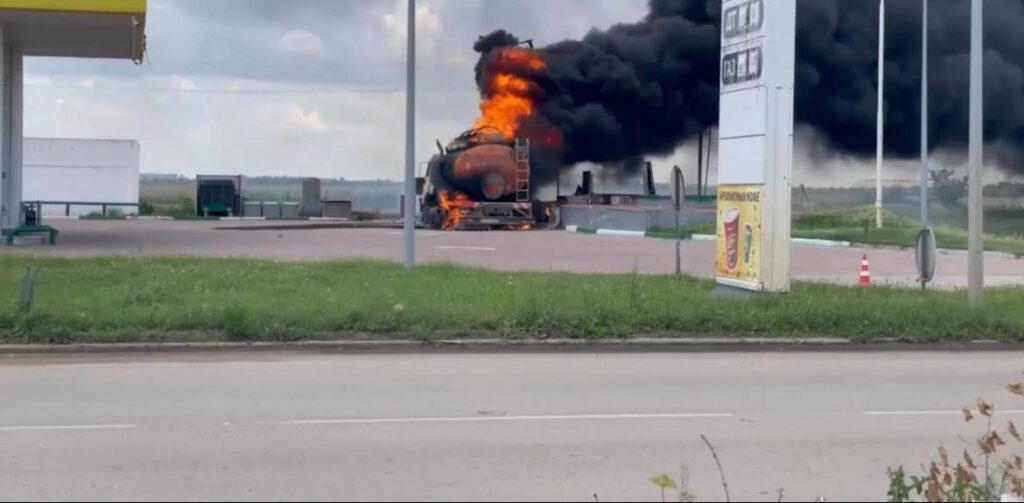
Sevastopol's Russian-installed governor said on 10 June that planned distribution of rationed petrol had been delayed, Reuters wrote on 11 June. Mikhail Razvozhayev claimed oil tanker trucks could not bring fuel into the city, following recent Ukrainian strikes on supply routes. Crimea, occupied by Russia in 2014, introduced fuel rationing last month due to shortages on the peninsula.
"Unfortunately, oil tanker trucks were unable to come to the city tonight," Razvozhayev wrote on Telegram.
Explore further
Ukrainian drones knocking out the northwestern entrance to Crimea: four bridges targeted in one night
He said priority for refueling on 11 June would go to public transport, utilities, emergency vehicles, and government vehicles.
"I am addressing everyone: there is no point in lining up at... the gas stations tomorrow," he added late on 10 June.
Existing rationing coupons would be canceled and new ones issued today.
Razvozhayev later claimed over two dozen Ukrainian drones were downed in the early hours of Thursday in a fresh attack on Sevastopol. The city is Crimea's second-largest and home to Russia's Black Sea Fleet.
On the same day, a major drone attack hit Russia's Volga region of Samara, more than 900 km from the front line, forcing state-owned oil giant Rosneft to halt processing at its Kuibyshevsky refinery.
Explore further
All three Rosneft Samara refineries now offline or reduced as drones halt Kuibyshevsky operations yesterday
Ukrainian President Volodymyr Zelenskyy said Wednesday evening that Ukraine’s recently launched mid-range strike campaign against Russian logistics, including large-scale strikes on supply and fuel trucks, had proved its worth.
"In recent months, we are especially grateful for the mid-strikes: Russian military logistics throughout the entire depth of the temporarily occupied territory are now within reach of Ukrainian drones," he said. "Our impact reaches Russia’s border regions as well. The enemy feels it, and we will continue to expand it."
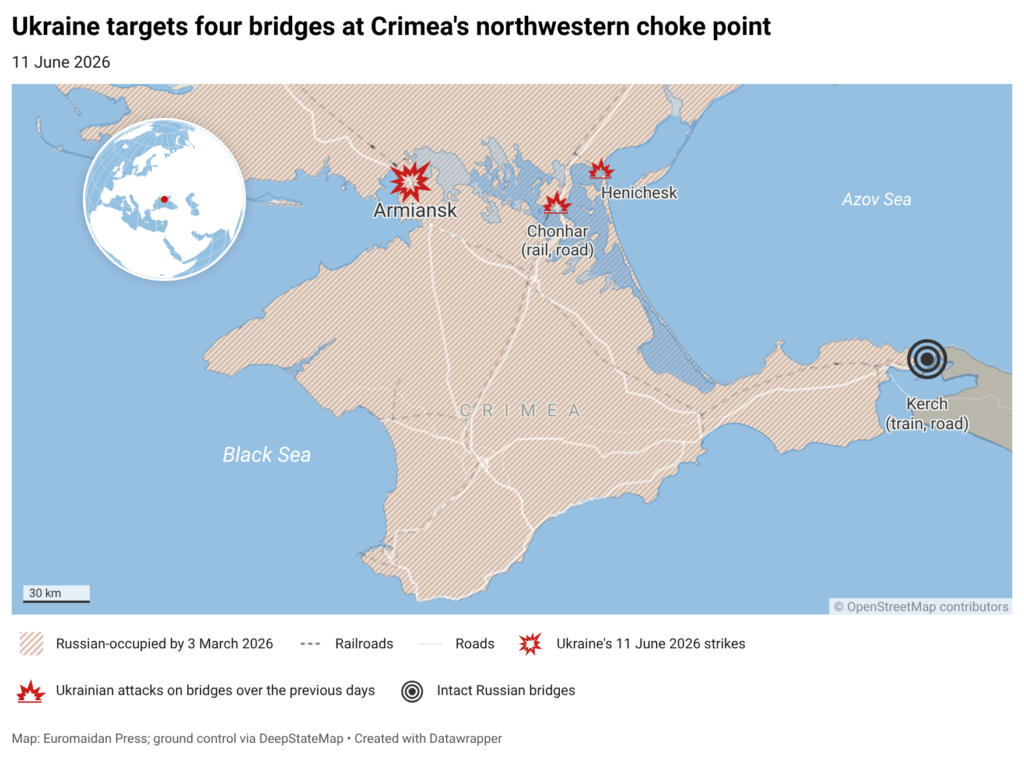
Ukrainian drones struck four vehicular bridges at Crimea's northwestern entrance overnight on 11 June 2026, quisling official Vladimir Saldo claimed. The strikes are part of Ukraine's most recent mid-range strike push—now at its fourth day—reaching every road corridor between Crimea and mainland Ukraine. The same night, drone attacks also rolled across Sevastopol, Bakhchysarai, Saky, and other Crimean sites.
Russia depends on the Crimean land corridor to push fuel, ammunition, and replacements to its forces in occupied southern Ukraine. Ukrainian mid-range drones operating under the military's LogisticsLockdown program have steadily shrunk that corridor's reliability since May. Ukraine has now struck all three major connection points between occupied Crimea and mainland Ukraine within four days, damaging some bridges and destroying others.
Four bridges damaged at the Armiansk isthmus
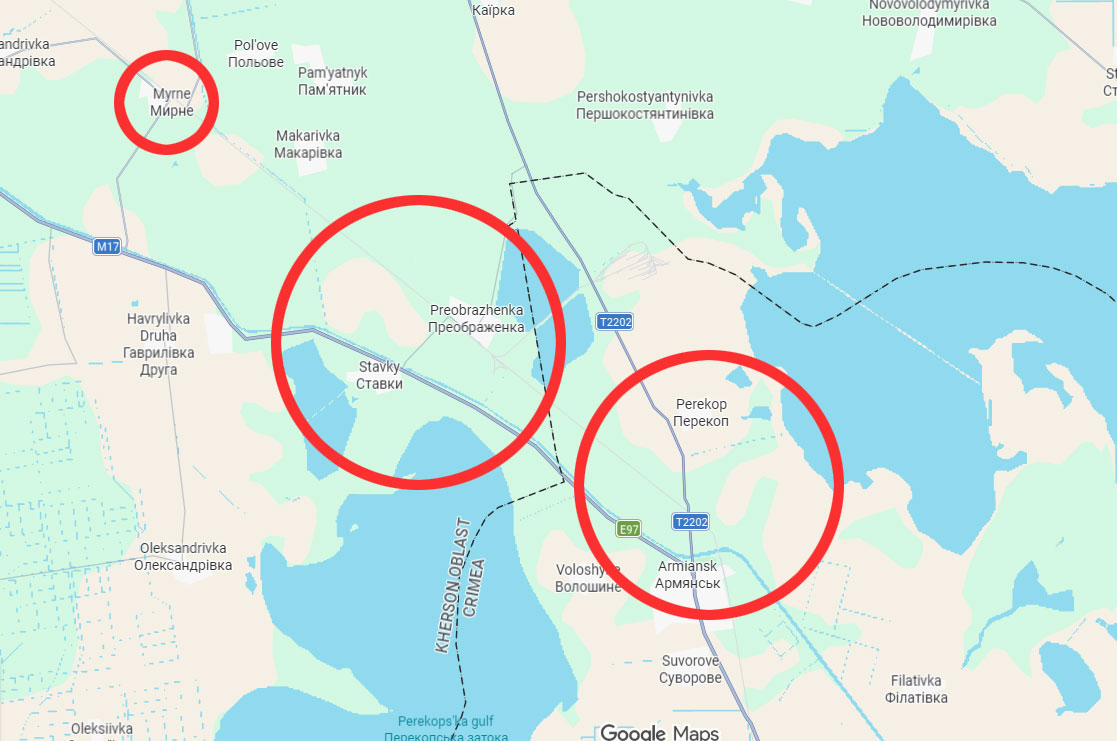
Saldo, the Russian-installed head of occupied Kherson Oblast, named the four targets on his Telegram. They include the automobile bridge in the Perekop-Armiansk area and a bridge near Stavky, Kherson Oblast. Two more bridges near Myrne and Preobrazhenka span the North Crimean Canal. Saldo stated all four spans sustained damage.
Google Maps view of the four bridges struck by Ukrainian drones overnight on 11 June 2026 — near Myrne, between Stavky and Preobrazhenka, and at Perekop near Armiansk in the northwestern Crimean isthmus. Map: Google Maps
Three Crimean northern choke points hit in four days
Ukraine struck the Chonhar bridge on 7 and 9 June, closing Russia's main road link to occupied Crimea, yet the Russians reportedly installed a pontoon bridge next to the severely damaged crossing. On 10 June, Ukrainian drones hit the bridge from Henichesk to Arabat Spit. With both routes fully or partially shut, Russia had rerouted traffic through Armiansk and Perekop — the very corridor struck overnight. DeepState analysts noted that Ukrainian strikes on the bridges are an important part of the blockade of occupied southern Ukraine.
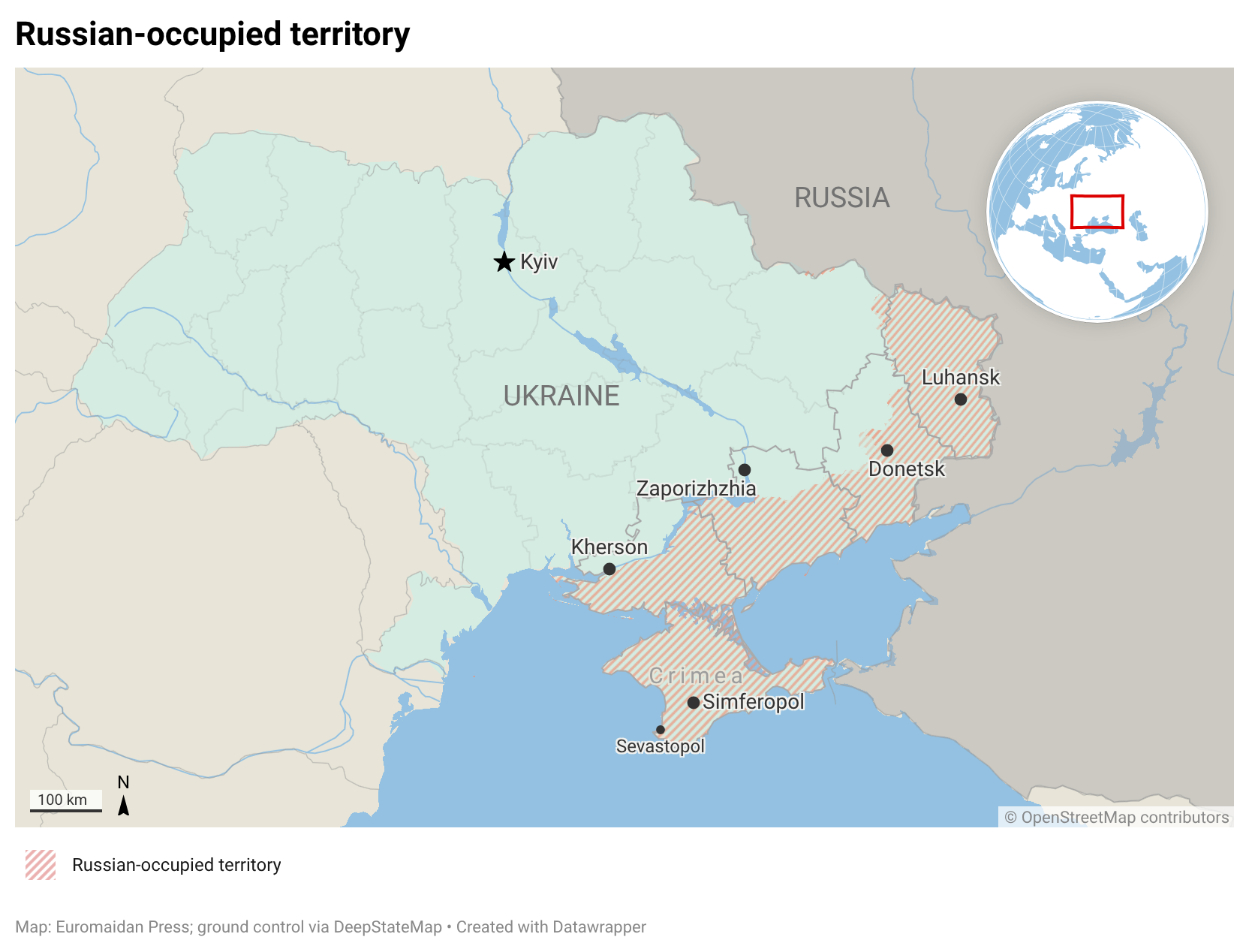
Russian-occupied Ukrainian territory, including Crimea and parts of Luhansk, Donetsk, Zaporizhzhia, and Kherson oblasts. Illustrative map: Euromaidan Press
Not only an entrance, but also targets across the peninsula
Russia's occupation governor, Mikhail Razvozhayev, claimed 32 drones were shot down over Sevastopol between 22:00 and midnight. He claimed the drones fell near Sevastopol Bay, Cape Fiolent, and Balaklava. The city declared two air alerts during the night and the morning.
Monitoring Telegram channel Krymsky Veter reported machine-gun fire in Pishchane at 21:40 and in Andriivka shortly after, citing subscribers.
"At 21:40 a machine gun started firing in Pishchane, at 21:48 a machine gun started in Andriivka, after which an anti-aircraft gun fired a couple of bursts," the channel wrote.
Detonations followed near Cape Fiolent, in Sevastopol, and later in Bakhchysarai. By morning, Krymsky Veter reported explosions and shooting in Saky.
Russia's Defense Ministry claimed the destruction of 330 drones over Russia and the occupied territories in the same overnight period.
Update
The First Assault Brigade shared the footage of the strikes:
Videos emerged of some of the Ukrainian strikes on bridges linking occupied Crimea to occupied Kherson Oblast
Ukraine's 1st Assault Brigade, 475th Assault Regiment, and SBU's Alfa reportedly took part.
Dopo i rumors, gli annunci ufficiali. Milo Infante ha salutato “Ore 14“, la Rai e il suo ruolo di vicedirettore degli Approfondimenti per sbarcare a Mediaset. Per lui un ruolo apicale nell’informazione, sarà infatti direttore di Videonews con Siria Magri, e la conduzione di un programma in prima serata: “Si deve entrare con umiltà in una nuova azienda, conoscerla, proporre progetti adeguati, considerare gli spazi disponibili e poi parlare di programmi. La cosa che mi ha conquistato e convinto – le prime parole di Infante a Libero– è stata l’immediata fiducia che il presidente Pier Silvio Berlusconi e il direttore Crippa hanno riposto in me.Per cui il primo vero impegno sarà ripagare questa fiducia offertami assieme alla grande possibilità che mi è stata data. Per questo motivo ho parlato di punto di arrivo“.
“In questi anni abbiamo fatto un lavoro serio, grazie anche alla grande squadra che mi ha affiancato che ha dato molti risultati. Ora, con pazienza e umiltà mi integrerò nella straordinaria squadra Mediaset dove sono certo di trovare tutte le professionalità necessarie. Questo ovviamente non vuol dire che qualcuno dei miei non mi seguirà”, ha continuato il nuovo volto del Biscione. Dopo 23 anni saluta il servizio pubblico: “Quando sono entrato in Rai ho cominciato a imparare e ho portato la mia esperienza. Dopo 23 anni mi trasferisco a Mediaset per imparare. La Rai è stata la mia casa per oltre due decenni, nel corso dei quali l’azienda e i colleghi mi hanno potuto conoscere. Sto ricevendo centinaia di messaggi dai conduttori, dalle star di Rai 1 ai colleghi delle produzioni, sono tutti dispiaciuti e questa cosa mi ha colpito. Non mi aspettavo davvero così tanto affetto”, conclude Infante.
A lui è dedicato un post social di Monica Leofreddi, opinionista dei suoi programmi di Rai2: “Ogni fine porta con sé un nuovo inizio. Ogni anno a fine stagione ho preparato un video di ricordi e ringraziamenti. Quest’anno ho dovuto attendere, sapevo che non sarebbe stato un fine stagione come gli altri, questo è più intenso innanzitutto per il grande affetto che avete dimostrato quotidianamente ad Ore 14 e settimanalmente ad Ore 14 di Sera e poi perché sapevo di questa probabile rivoluzione!”, ha scritto la conduttrice su Instagram.
Leofreddi è legata a Infante da una storica amicizia e da una lunghissima collaborazione professionale, insieme avevano co-condotto sulla seconda rete del servizio pubblico “L’Italia sul 2″: “Chi fa questo lavoro è abituato ai cambiamenti, ma forse mai fino in fondo. Parlo a titolo personale, un po’ di nostalgia e di dispiacere non lo nascondo c’è. Ho sempre amato creare rapporti umani nel lavoro e non solo professionali, l’amicizia ultra ventennale con Milo lo dimostra (…) Su tutti naturalmente ringrazio lui. Non ho mai dato per scontata la mia presenza nel programma, sono stata onorata di essere stata scelta da un professionista come lui (…) ho cercato di metterci cuore e testa, spero di non averti deluso Milo e di non aver deluso voi”.
“Milo come me è nato in RAI, mamma Rai a volte protettiva a volte matrigna, ma come si fa a non amarla? So quanto sia stato difficile decidere per Milo, ma io sono veramente felice per lui e anche molto orgogliosa. Una grande azienda come Mediaset ha compreso che c’è un momento professionale nel quale il sacrificio ed il valore vanno riconosciuti, sono certa che sarà una grande collaborazione”, continua Leofreddi nel post social: “Sono la tua madrina di battesimo Milo (ride, ndr), a te che sei il mio figlioccio non posso che augurare un mondo di bene e tanto successo, ci sono altri mondi e non si deve avere paura di esplorarli. Spero che ci si possa vedere presto”.
A Visa anunciou, na quarta-feira, uma colaboração estratégica com a OpenAI, detentora do ChatGPT, para viabilizar pagamentos Visa seguros em “ambientes de comércio automatizado, permitindo pagamentos contínuos e fiáveis” na plataforma OpenAI. O anúncio foi feito durante o Visa Payments Forum, em São Francisco.
“Através desta parceria, a Visa fornecerá a sua rede global, capacidades de autenticação e infraestrutura de segurança para suportar experiências de comércio automatizado, ajudando os consumidores e as empresas a interagir e a realizar transações com confiança”, referiu a empresa de pagamentos.
A colaboração faz parte da iniciativa Visa Intelligent Commerce que tem como objetivo “expandir as capacidades de pagamento seguro” para novos ambientes digitais.
“Em conjunto, as duas empresas irão também explorar uma gama de aplicações empresariais, incluindo experiências orientadas para os programadores com tecnologia Codex, bem como fluxos de trabalho mais automatizados e conversacionais, à medida que a inteligência artificial (IA) continua a evoluir como uma importante interface para as interações digitais”, salientou a empresa de pagamento.
No âmbito desta parceria as capacidades de pagamento da Visa serão “integradas” nas experiências da OpenAI, oferecendo aos programadores e comerciantes uma “forma simplificada” de aceitar pagamentos Visa iniciados por agentes. “Juntamente com a OpenAI, a Visa fornecerá a rede subjacente, a tokenização e as características de risco que suportam transações fiáveis e seguras”, refere.
“As transações serão operadas dentro de permissões, políticas e controlos de utilizador claramente definidos, tais como limites de gastos, categorias de comerciantes ou aprovações necessárias. As transações utilizarão credenciais Visa tokenizadas e autorização em tempo real, bem como monitorização de fraudes, ajudando a viabilizar novas experiências de pagamento com IA para manter uma elevada segurança e proteção do consumidor”, disse a empresa de pagamentos.
O diretor de produtos e estratégia da Visa, Jack Forestell, considerou que a IA vai “transformar o comércio de forma mais profunda” do que a internet ou a tecnologia móvel alguma vez fizeram.
“À medida que os agentes de IA se tornam participantes ativos na economia, o foco da Visa é garantir que as transações são fiáveis, seguras e perfeitas. Esta é a infraestrutura que estamos a construir com parceiros como a OpenAI“, adiantou Jack Forestell.
O chefe de parcerias de comércio da OpenAI, Marco Mahrus, disse que o comércio terá lugar em muito mais lugares e de muito mais formas do que hoje, e os agentes “desempenharão um papel cada vez mais importante” para ajudar as pessoas a completar tarefas que envolvem dinheiro — desde compras e pagamentos a transações mais complexas.
“Ao integrar com o Visa Intelligent Commerce, estamos a construir a infraestrutura para transações seguras, transparentes e controladas pelo utilizador, ajudando as pessoas a fazer mais com os agentes de IA, mantendo a confiança de que os pagamentos estão a ser processados em segurança”, acrescentou Marco Mahrus.
A China planeia avançar com 295 mil milhões de dólares (255,7 mil milhões de euros à taxa de câmbio atual), nos próximos cinco anos, para a construção de centros de dados em todo o país, com o intuito de rivalizar com os Estados Unidos na área da inteligência artificial (IA), como refere a agência noticiosa Bloomberg. País asiático quer apostar em fornecedores locais.
A Comissão Nacional de Desenvolvimento e Reforma, que é uma agência governamental, é uma das entidades envolvidas no desenho desse plano, de acordo com as fontes consultadas pela agência noticiosa.
De acordo com a Bloomberg, a China Mobile e a China Telecom devem operar a maior parte dos centros de dados e assegurar a sua conectividade. O plano prevê uma aposta em fornecedores locais como a Huawei Technologies para pelo menos 80% da tecnologia, como os chips de IA, excluindo as norte-americanas Nvidia e a Advanced Micro Devices (AMD).
As fontes consultadas pela agência noticiosa referiram que este plano nacional de centros de dados ainda está numa fase inicial de discussão e os detalhes podem mudar. Os 295 mil milhões de dólares de investimento previsto para os centros de dados deve ser financiado através de dívida soberana, incluindo obrigações governamentais especiais de longo prazo, geralmente com maturidade superior a 10 anos, e fundos estatais para investimento em setores estratégicos. Os empréstimos bancários e o capital privado iriam complementar o financiamento, salientaram as fontes ouvidas pela Bloomberg.
O investimento anunciado não inclui os gastos de empresas como a Alibaba e a Tencent.
As fontes disseram que a China tem também planos para integrar a rede elétrica no projeto.
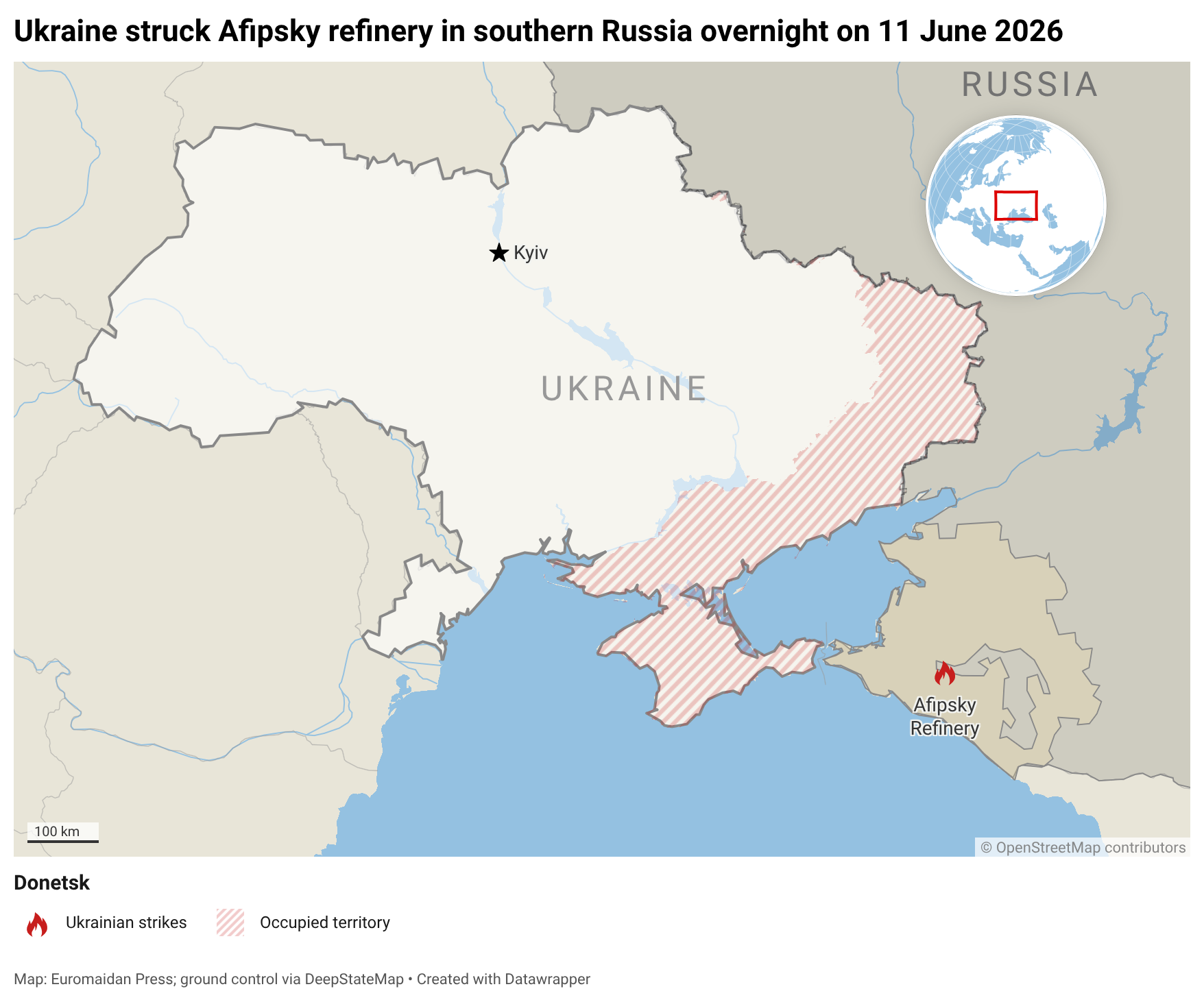
Ukrainian drones struck the Afipsky oil refinery in Russia's Krasnodar Krai overnight on 11 June, sparking a fire later extinguished, according to the Krasnodar Krai operational headquarters. The southern Russian plant, repeatedly targeted by Ukrainian strikes, supplies fuel to the Russian military.
Amid the ongoing Russo-Ukrainian war, the Russian oil industry has been under sustained pressure from Ukrainian deep strikes, with gasoline rationing currently spreading across multiple regions and occupied territories. Output at Russian refineries has been falling on Rosstat's own index as repeated hits keep facilities offline.
A blaze at one of southern Russia's largest refineries
The Ukrainian Telegram channel Exilenova+ postedfootage from local witnesses showing air defense fire and a blaze. The attack started after midnight, with residents reporting drone overflights and explosions at intervals of a few minutes.
Krasnodar Krai authorities claimed drone "debris" fell in the village of Afipsky and set the refinery on fire — Moscow's standard framing for Ukrainian strikes on Russian energy targets. The fire was out by 07:32 Moscow time, the operational headquarters later stated. Russian authorities reported no casualties at the plant itself.
The Afipsky plant is one of southern Russia's largest oil-processing facilities, with a capacity of over 6 million tons of crude a year. It produces gasoline, diesel, gas oil, vacuum gas oil, fuel oil, sulfur, and gas condensate distillates. The facility supplies fuel to the Russian army. Ukraine's General Staff has assessed that the refinery processes about 2.1% of Russia's total oil refining.
The plant runs two primary oil distillation units with capacities of 9,786 and 8,829 tons per day. It is export-oriented and does not currently produce gasoline or diesel for Russia's domestic market. Combined throughput at the Afipsky plant and the affiliated Krasnodar refinery reached 7.2 million tons in 2024. Another 3 million tons were processed in the first half of 2025.
Smoke trail over Krasnodar amid a Ukrainian drone attack, Russia, 11 June 2026. Photo: Exilenova+ Telegram channel
Third strike on Afipsky in 2026 amid wider drone campaign
Russia's Defense Ministry claimed its air defenses intercepted and destroyed 330 Ukrainian drones over Russian territory overnight, the Moscow Times reported. According to the ministry, drones were spotted over Bryansk, Kursk, Belgorod, Oryol, Smolensk, Kaluga, Tula, Tver, Vladimir, and Moscow oblasts, as well as Krasnodar Krai and occupied Crimea. Russian aviation regulator Rosaviatsia restricted operations at airports in Tambov, Krasnodar, Sochi, Gelendzhik, and Zhukovsky outside Moscow.
Smoke plume after a Ukrainian drone strike on the Afipsky oil refinery, Krasnodar Krai, Russia, 11 June 2026. Photo: Exilenova+ Telegram channel
The 11 June raid was the third attack on the Afipsky refinery this year, following hits on 21 January and 14 March. During the March hit, drones damaged the AT-22/4 primary oil processing unit at Afipsky — the plant's refining starting point. Satellite imagery had previously confirmed structural damage from a November 2025 drone attack.
A Broadcom, que desenvolve e fornece soluções de semicondutores, anunciou a criação da Plataforma AI XPV. Entre os principais investidores estão as gestoras Apollo e Blackstone. Projeto avança com uma tranche inicial de 35 mil milhões de dólares (30,3 mil milhões de euros à taxa de câmbio atual).
Esta plataforma foi criada com a intenção de “viabilizar mais de 20 gigawatts em capacidade computacional utilizando as XPU [unidade de processamento] e as soluções de rede da Broadcom, personalizadas para laboratórios de inteligência artificial (IA) de topo, incluindo a Anthropic e a OpenAI, até 2028″, refere a Blackstone.
A plataforma foi lançada na terça-feira (9 de junho) com uma tranche inicial de 35 mil milhões de dólares (30,3 mil milhões de euros) liderada pela Apollo, em parceria com a Blackstone, para “facilitar a expansão de capacidade” previamente anunciada pela Anthropic, de mais de um gigawatt de infraestrutura computacional, com previsão de implementação em sites baseados em Fluidstack a partir de meados de 2026. “Isto fortalece a sólida relação estratégica entre a Broadcom e a Anthropic e ilustra a dimensão e as capacidades imediatas da Plataforma”, salientou a gestora.
“A plataforma estabelece também uma estrutura escalável para futuras implementações de capacidade computacional e redes baseadas em XPU, permitindo o treino e a inferência de modelos de ponta com o menor custo e consumo de energia, reduzindo significativamente os custos de entrega por token [unidades de dados processadas pela IA]”, referiu a Blackstone.
O presidente e CEO da Broadcom, Hock Tan, referiu que se está “num ponto de inflexão histórico”, em que a procura por computação de IA está a “remodelar fundamentalmente” o panorama económico global.
“Esta plataforma estratégica com a Apollo e a Blackstone sincroniza o capital mais sofisticado do mundo com o roteiro tecnológico avançado da Broadcom para aproveitar esta oportunidade única, permitindo aos nossos clientes em rápida expansão, começando pela Anthropic, concretizar as suas visões de IA mais ambiciosas de forma rápida e segura”, referiu Hock Tan.
O presidente da Apollo, Jim Zelter, disse que “enorme escala” da oportunidade global da IA exige um “modelo ousado e colaborativo”.
Jim Zelter adiantou que o investimento da gestora na plataforma “reflete a convicção” da Apollo na liderança tecnológica da Broadcom e no “roteiro vanguardista” da Anthropic.
“Orgulhamo-nos de fornecer a base de capital que permite a este ecossistema crescer de forma eficiente”, acrescentou Jim Zelter.
“A procura por poder computacional criou uma oportunidade sem precedentes para investir em grande escala em todo o ecossistema de infraestruturas de IA, incluindo o fornecimento de financiamento através dos nossos negócios de crédito e seguros. Orgulhamo-nos de apoiar esta poderosa combinação da tecnologia excecional da Broadcom e dos modelos pioneiros da Anthropic”, disse o presidente da Blackstone, Jon Gray.
Três gigantes da Inteligência Artificial (IA) preparam a sua entrada em bolsa este ano. Juntas valem 3,6 biliões de dólares (3,1 biliões de euros) e prometem trazer muito capital a Wall Street. O valor é 12 vezes superior à riqueza gerada anualmente pela economia portuguesa, uma pipa de massa.
A OpenAI foi a tecnológica mais recente a juntar-se à lista de empresas que preparam a Oferta Pública Inicial (IPO em inglês) este ano, tendo entregado a documentação esta semana junto do regulador de mercado norte-americano, o SEC, revelou a “Bloomberg”.
Das três gigantes da IA, a SpaceX de Elon Musk é a que vale mais: 1,8 biliões de dólares (mais de 1,5 biliões de euros). Segue-se a Anthopic, responsável pelo ‘chatbot’ Claude, com 965 mil milhões de dólares (840 mil milhões de euros) e a OpenAI com 852 mil milhões (740 mil milhões).
A companhia liderada por Sam Altman disse que ainda não decidiu o timing do IPO, admitindo que pode “demorar um pouco”, pois há certas questões que prefere realizar enquanto não estiver em bolsa, não dando detalhes, e reconhecendo que até pode vir a acelerar o processo se for no seu melhor interesse.
A OpenAI foi responsável pelo disparo na IA generativa com o lançamento do ChatGPT no final de 2022, com o ‘chatbot’ a tornar-se sinónimo de IA para uma boa parte do mundo.
Mas a concorrência não dorme e a companhia está a enfrentar uma concorrência cada vez mais feroz, com a Anthropic e a Google a acelerarem.
A “Bloomberg” sublinha que a companhia falhou metas internas de receitas e de crescimento, com vários executivos a saírem da empresa.
Se se confirmar o calendário, o mundo vai assistir a um novo duelo entre os arqui-rivais Sam Altman e Elon Musk. O fundador da SpaceX já tentou processar a OpenAI e o seu presidente, mas não conseguiu.
Estas gigantes tecnológicas além de desenvolverem inteligência artificial, necessitam de comprar chips valiosos e espaço em centros de dados para alimentar o trabalho dos seus ‘chatbots’.
Major artificial intelligence labs are done waiting on Washington to pass a national standard for AI, turning to state bills to carve out their own policy lines while Congress tries to catch up. Most AI labs support a national safety framework for AI that would eliminate the patchwork of state regulations, but they are also…
Major artificial intelligence labs are done waiting on Washington to pass a national standard for AI, turning to state bills to carve out their own policy lines while Congress tries to catch up. Most AI labs support a national safety framework for AI that would eliminate the patchwork of state regulations, but they are also…
O governo brasileiro assinou decreto, nesta quarta-feira (10), a fim de ampliar a cooperação policial para as áreas de fronteira e transfronteiriças com a Argentina, Paraguai e Uruguai, incluindo perseguições de fugitivos e investigações conjuntas.
O decreto é resultado de acordo firmado em Bento Gonçalves (RS), em dezembro de 2019. O documento estipula que os países podem atuar, em conjunto, para prevenir e investigar crimes de acordo com as respectivas legislações.
No caso de perseguições, o decreto autoriza que policiais de um determinado país busquem fugitivos que ultrapassarem as fronteiras nesses países.
“[Os policiais] poderão adentrar o território da outra Parte, em comunicação e coordenação com a autoridade policial da outra, para realizar a apreensão preventiva das pessoas perseguidas”, diz o documento.
Ficou definido que essas perseguições devem ser combinadas bilateral ou trilateralmente. Estão previstos, para essa finalidade, intercâmbio de metodologias e tecnologias, capacitação com cursos e treinamentos e troca de informações para prevenir ilícitos.
Quando houver prisões desses fugitivos, as autoridades policiais entregarão essas pessoas às autoridades do país onde os fugitivos foram encontrados. “Os agentes e veículos do Estado perseguidor deverão estar devidamente identificados.”
Além disso, os países decidiram aperfeiçoar os sistemas de comunicações e trocar de conhecimentos de interesse para a investigação de crimes com utilização de centros de operações.

 Login
Login