Rússia prepara julgamento dos líderes ucranianos


Key developments on June 9:


Activist, whose real name is Stephen Yaxley-Lennon, shared video of his meeting with Errol Musk
Tommy Robinson has travelled to Russia, where he has met Elon Musk’s father, Errol, in a Moscow hotel.
Robinson – who has been issuing calls for his supporters to take to the streets across the UK over a bloody knife attack in Belfast – shared video of his meeting with Musk, whose son has been a vocal supporter of Robinson, on Monday.
Continue reading...
© Photograph: Finnbarr Webster/Getty Images

© Photograph: Finnbarr Webster/Getty Images

© Photograph: Finnbarr Webster/Getty Images
Since the onset of Russia's full-scale invasion of Ukraine, Russian athletes and national teams have been widely excluded from international sport.
Yet the pressure to reintegrate them never really disappeared, and Russian athletes are increasingly allowed back into international competition. First, under neutral status in selected disciplines, following

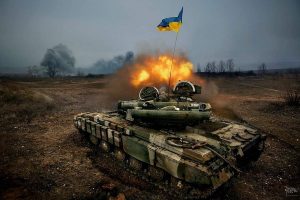
Ukraine at war; weapons from all over the world (Flickr)
Half way through the fifth year of the war in Ukraine it is reasonable to ask why it has lasted so long. Why has Russia not crushed Ukraine quickly as expected, it is after all a much bigger country with a far greater population and industry to call on?

By Robert Harneis
It is standard for the Western Media to talk of deadlock and to say that the Russians are not advancing because their armies are incompetent, when they are not drunk or poorly equipped. At regular intervals Western media announces that the Russian side is running out of ammunition, missiles, drones, tanks or even men. In short they are not advancing in overwhelming force to capture Kiev because they are incapable of doing so. The latest fantasy in the US, UK and European media, is that the Russian economy is crumbling in the face of the problems created by the war and sanctions.
President Putin imposed severe constraints on his generals from the start. They are, to an extent, fighting with one hand tied behind their backs. Contrary to the endless claims by the Western media, the Russian forces do everything they can to avoid civilian casualties. This in borne out by their low level throughout the war. In a recent massive attack involving 1500 missiles and drones right across Ukraine, only six civilians were reported killed. It is only natural that this should be so. Russia regards Ukrainians as brother Slavs. Approximately one fifth of Russian families have close relatives in Ukraine. The brother of the Ukrainian Commander in Chief is a colonel in the Russian army. They have no interest in killing them, if it can be avoided, especially as they will have to live with them after the war.
The second restriction is the requirement to avoid heavy casualties amongst their own forces. Wars are lost on the home front when the body bags start coming home in big numbers. The constant allegations in the Western media that Russians launch human wave attacks and suffer heavy casualties doing so, are false. This desire to restrict losses is reinforced by Russia’s demographic problems. Lives are precious.
The third restriction that Putin has imposed on his generals and ministers is that the war will not stop Russian economic progress, vital for political stability. Of course it goes without saying that it is not possible to fight a major war without financial and budgetary stress. An example is the necessity of delaying the naval building program as a result of which only sixteen corvettes have been built out of the forty planned. This has made it more difficult for Russia to protect its merchant fleet and stop the current harassment of oil tankers. On the other hand the management of the economy has been a classic case of successful military Keynesianism as with the United States in World War II. Throughout the war real wages have risen and economic growth has been maintained. Unemployment is at record low levels.
There are other less obvious reasons for hastening slowly. If Moscow’s war aims are denazification and demilitarization then the longer the fighting goes on the more of the Ukrainian military is eliminated, especially the elite ultra-nationalists who are Ukraine’s most committed soldiers. The effect of the manpower attrition is obvious from the many videos appearing on social media showing Ukrainian press gangs snatching citizens from the street, often with violent resistance.
Further by keeping the fighting in the Donbass, the invading Russians have short lines of communications, whilst Kiev’s main bases are over a thousand kilometers away in Poland, with supplies at risk of constant air attack on their way to the front. Paradoxically then, the invading force has better lines of communications than the defenders in their own country.
The wish to avoid destruction is another explanation for Russian circumspection. It is obvious that the retreating Ukrainian army is indifferent to the damage it causes to the cities it loses. The greater the area of the fighting the greater the destruction that Russia will likely have to rebuild after the war. Better to ground away the Ukrainian ability to resist and if an advance into the rest of the country is needed, to wait until effective military resistance has collapsed.
However an undoubted factor in the slow Russian progress is the nature of the great Donbas urban area, which was massively fortified with NATO assistance over eight years after the 2014 coup d’état when Ukraine moved definitively into the Western camp. Whatever plans the Russian government may have for the rest of Ukraine, especially the Black Sea Coast, the source of many missile attacks on Russia, they will not wish to make any major moves until the Donbass is firmly in their hands. Two important fortified towns remain to be captured Kramatorsk and Slavyansk. Russian forces are already approaching them. It remains to be seen how long it will take to break their resistance.
We cannot know what President Putin and the Russian High Command are thinking but it is also obvious that by not committing to a major offensive Russia not only avoids casualties but retains the strategic initiative. Hundreds of thousands of Russian troops are held in reserve. Uncommitted forces are a potential threat as well as being available for defense elsewhere if needed.
The Russians will also have learnt the bitter lessons of the US army that quickly smashed its way into Afghanistan and Iraq but was unable hold the territory conquered in the face of tough local resistance. Already, at the beginning of the war in March 2022, the Washington Post published an article that assumed a quick Russian advance and talked about the planned guerilla resistance. There is every reason for Russia to move gradually and consolidate as it goes.
There is also the diplomatic aspect, which is of vital importance to Russia. Moscow views the struggle in Ukraine as part of a world confrontation. It has been clear from the start of the war that whilst the West and Kiev worry about public opinion to get support for the war, Russia is concerned about what he world’s diplomats think. Good relations with India and BRICS countries and especially China dictate moderation at all times. A shock and awe approach, whilst it might get quicker results, would have offended much international opinion and unfavorably reminded the world’s diplomats of the Soviet Union, something Putin wishes to avoid at all costs. Similarly Russia is very patient with small countries on its borders that indulge in vexatious provocations, notably the Baltic States… so far. The contrast with the brazen bullying of Venezuela, Cuba, Greenland and Iran by the United States is striking and has had an effect on world public opinion. The recent humiliation of Merz’s new militaristic Germany in the recent United Nations General Assembly vote is a striking example of the success of this softly softly approach, as is Russia’ success in expanding its influence in Africa from Mali to Madagascar.
Also on the diplomatic front, with a long war, the Black Sea remains closed to the warships of outside countries under the Montreux Convention of 1936, which governs traffic through the Dardanelles strait. The convention allows Turkey to close the straits to all warships in times of war and to permit merchant ships free passage. This suits the Russians as NATO likes to flex its muscles by bringing warships into the Black Sea in times of international tension. For four and a half years they have not been able to do this. Once the war ends, Turkey will have to let them through again. Another reason why the Russian forces have taken their time.
Every war is different and brings its surprises. The drone revolution has transformed this one. The omnipresence of drones is all the more deadly, given the absolute impossibility for both sides, of hiding concentrations of troops, thanks to satellites that see pretty much everything happening on the ground. So now advances are made by small groups of infantry that infiltrate defenses that are then taken out by artillery, drones and missiles. Slow work if casualties are to be kept to a minimum.
NATO intervention, with a huge supply of arms, finance and electronic intelligence, after sabotaging the peace talks, has increased Russian difficulties in defeating the Ukrainian army,. It is this that definitively imposed the choice of a long slow war of attrition on the Russians – a war that Russia is clearly winning. Not only have Ukraine’s forces been degraded in this process but NATO’s as well. One reason the United States has reduced arms supplies to Kiev is that they are running short. This became very obvious when Washington’s priority turned to the defense of Israel. The Pentagon has had to search the globe, asking allies as far apart as South Korea and Germany to hand over any Patriot air defense missiles they might have. The US air force is seriously short of vital stand-off munitions to attack Iran. The result for Kiev is that it has little defense industry of its own left and NATO has completely failed to match Russian weapons production levels.
It is also obviously the case Russia needed time to build its army to its present strength, as well as arm and equip it. Russia has greatly increased its military production across the board. This has been possible because of the continued existence of much of the old Soviet military industrial infrastructure on Russian territory. Whilst the combined Western nominal GDP greatly exceeds Russia’s, when it comes to purely military industrial capacity Russia is well capable of holding its own. Tank production and reconditioning has increased from a few hundred to more than a thousand a year. The United States can barely produce one hundred new Abrams tanks each year. Russia alone now produces over five million drones each year. Importantly Russia is fourth in the world in the number of STEM students graduating annually after China, India and the United States.
Putin’s latest statements indicate that the Russian government is not interested in a ceasefire that fails to solve its Europe wide security problems. The United States does not want to lose face in Ukraine, particularly after its recent military failures in Afghanistan and now Iran. It also wants to continually weaken Russia. Europe is determined to persevere in its support for Ukraine despite the major economic and energy problems they have created for themselves. The statement from the latest meeting of the leaders of France, Germany and the United Kingdom, on June 7, refers to the need for a peace treaty that leaves Ukrainian frontiers unchanged. Clearly something Russia will never accept. Brussels sees failure in Ukraine as a threat to its plans for ever greater union, even the institution itself. Against this background it is not surprising that there have been no meaningful peace talks. As Josep Borrell former EU High Representative for foreign affairs commented at the beginning of the war, it will have to be settled on the battle field and that takes time.
Finally in Ukraine, whilst the people would agree to negotiations with Russia, the regime and its ultra nationalist supporters know that if there is peace and Russia wins there is no future for them. Putin’s final phrase in his recent speech at St Petersburg Economic Conference “Keep on fighting my comrades” is ominous for Zelensky and his neo Nazi colleagues. It is a reference to a famous quotation, the last words of a Russian policeman knowing he was about to die at the hands of terrorists. It reflects the Russian leader’s determination to focus Russian society in a patriotic way and finally settle the Ukrainian problem for good. He has used the long war to encourage a new generation of Russian leaders based around distinguished war veterans. This has been accompanied by a determined anti-corruption drive. None of this would have been possible without a long war.
However that may be, the Russian President is coming under increasing pressure to move faster. Like the US, Russia has parliamentary elections approaching in the autumn, September of this year, and there are signs that the tempo is quickening all along the front line. The long war has had advantages for Russia but it may be time to bring it to a close, whatever the cost.
L’article Ukraine: Why the long war? est apparu en premier sur FrenchDailyNews.
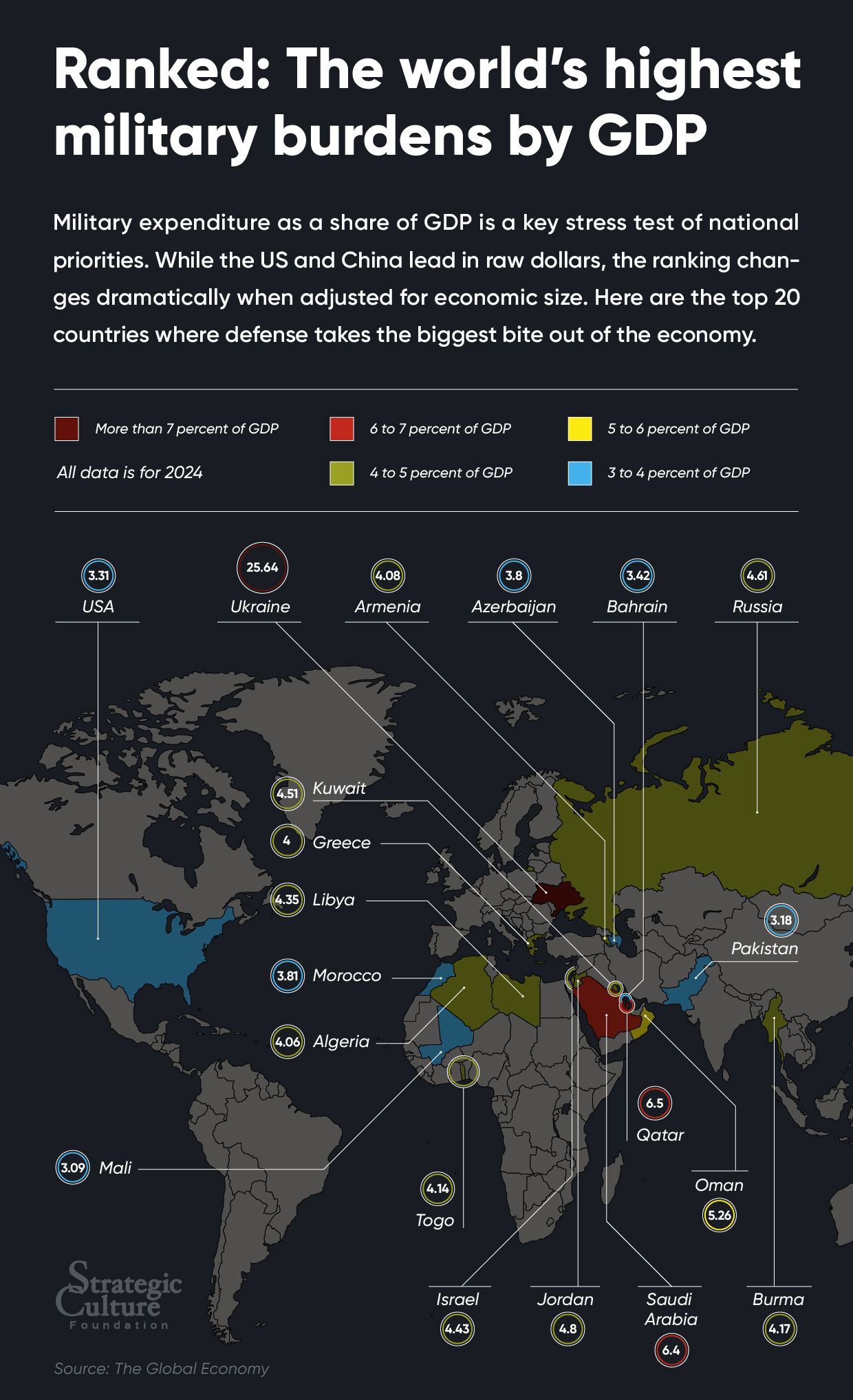
Military expenditure as a share of GDP is a key stress test of national priorities. While the US and China lead in raw dollars, the ranking changes dramatically when adjusted for economic size. Here are the top 20 countries where defense takes the biggest bite out of the economy
Contact us: info@strategic-culture.su
(Click on the image to enlarge)
![]()
The European Union has proposed a 21st sanctions package against Russia that includes a visa ban on current and former Russian military personnel, as Brussels expands pressure on individuals and entities linked to Moscow’s war effort in Ukraine.
EU foreign policy chief Kaja Kallas said the package is part of a broader push to increase economic and political pressure on Russia.
“We are depriving Russia of the means to fund its war,” Kallas wrote on X.
The sanctions package will target Russia’s financial, energy, and industrial sectors, with more than 170 proposed listings.
These include banks, weapons manufacturers, oil traders, refineries, and crypto-related services, as well as entities in third countries accused of helping Moscow bypass existing restrictions.
Energy measures include a temporary freeze of the Russian oil price cap mechanism, alongside new restrictions on LNG transactions and additional action against Russia’s shadow fleet, with 30 more vessels proposed for designation.
Officials said the aim is to further reduce Russia’s export revenues and disrupt maritime logistics networks used to move sanctioned energy products.
Brick by brick, we are collapsing the foundations of Russia's war economy.
— Kaja Kallas (@kajakallas) June 9, 2026
Today, we are presenting our proposals for a 21st sanctions package against Russia.
This includes a temporary freeze of the Russian oil price cap and designations of institutions used by Moscow to…
The package also expands export controls on materials used in weapons production, including metals, alloys, and high-performance inputs, with companies in countries such as China, Türkiye, Kazakhstan, the UAE, and India included in the proposals.
Financial restrictions remain a central pillar, with expanded sanctions planned against banks and crypto platforms linked to sanctions evasion and war financing.
The sanctions package includes a “comprehensive” visa ban proposal that would prohibit entry into the EU for current and former members of Russia’s armed forces, as well as “proxy groups,” marking an expansion of sanctions beyond economic measures to individuals linked to military operations.
“Europe’s door should not be open to Russia’s (ex-)combatants,” Kallas wrote.
Our sanctions are working.
— Ursula von der Leyen (@vonderleyen) June 9, 2026
They are weakening the economic foundations of Russia’s war effort.
Today we double down.
With a 21st package.
Covering energy, banks & crypto, trade including fisheries and visa for Russian soldiers ↓ https://t.co/fTIkATOSfN
The same day, Kallas told journalists that existing sanctions continue to intensify pressure on Moscow’s economy. Kallas noted that Western sanctions have already cost Russia an estimated $1.2 to $1.5 trillion, adding that “brick by brick, we are collapsing the foundations of Russia’s war economy.”
She said the aim remains to increase costs for Moscow across multiple sectors while maintaining unity among EU member states.
The package requires unanimous approval from EU member states before it can take effect.


Banks, crypto firms and Kremlin oil reserves also targeted in 21st set of measures since full-scale invasion of Ukraine
The EU hopes to ban Russian soldiers from entering its territory as part of further sanctions against Moscow that also target banks, crypto firms and the Kremlin’s oil revenues.
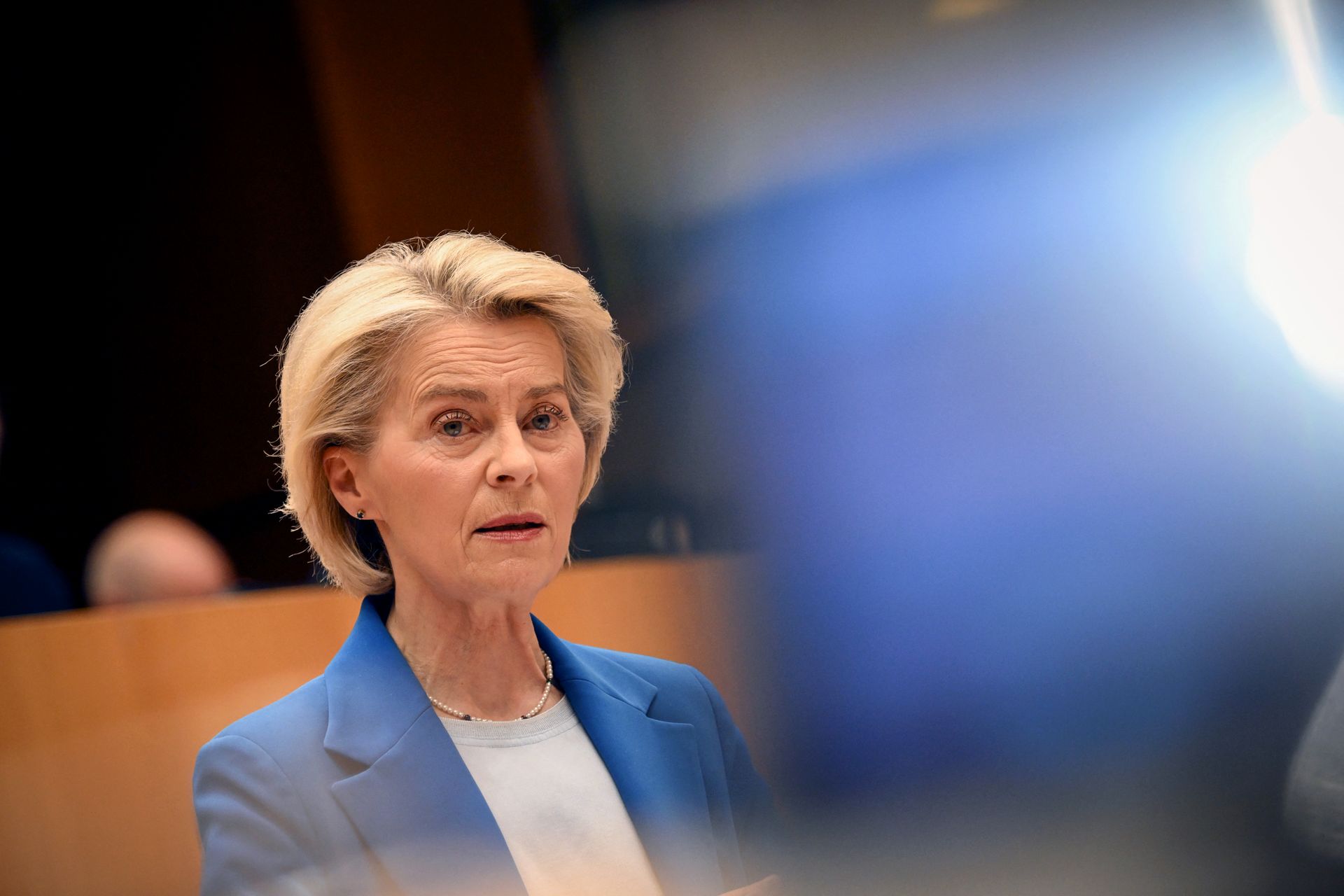
Announcing the proposals on Tuesday, the European Commission president, Ursula von der Leyen, said: “We propose for the first time to ban from entry into the European Union anyone who has served in the Russian armed forces since the beginning of the war. So Europe stays off limit for anyone who has participated in the invasion of Ukraine, as simple as that.”
Continue reading...
© Photograph: Thierry Monasse/Getty Images

© Photograph: Thierry Monasse/Getty Images

© Photograph: Thierry Monasse/Getty Images
El 84% del presupuesto de la CPI viene de potencias imperialistas, que dictan sus investigaciones y protegen a sus aliados.
Únete a nosotros en Telegram
, Twitter
y VK
.
Escríbenos: info@strategic-culture.su
Para perseguir a gobernantes incómodos para el imperialismo, la CPI pasó por encima de su norma básica: limitar su actuación a los países que ratificaron el Estatuto de Roma. Sin embargo, mientras la Libia de Gadafi y la Rusia de Putin fueron víctimas de la CPI, Estados Unidos continúa impune. Y ha demostrado que, aun sin formar parte de la Corte, es quien verdaderamente manda en ella.
Cuando Bensouda intentó investigar los crímenes de guerra en Afganistán —sin limitar su investigación a la actuación del Talibán y del Estado Islámico, sino incluyendo a lo que ella consideraba los mayores criminales de aquella guerra (el ejército estadounidense y la CIA)—, sufrió una fuerte presión desde Washington, hasta el punto de resultar en sanciones gubernamentales. Sus cuentas bancarias y las de sus familiares fueron congeladas, y su marido fue espiado.
Finalmente, Bensouda fue sustituida por un nuevo fiscal dócil a Estados Unidos. Karim Khan modificó el enfoque de las investigaciones sobre Afganistán, declarando que daría prioridad al Talibán y al ISIS y retiraría la prioridad de Estados Unidos, alegando falta de recursos para una investigación más amplia.
Durante una de las muchas intervenciones militares francesas en África en este siglo (entre 2013 y 2016), soldados violaron y abusaron sexualmente de niños en campos de desplazados en la República Centroafricana. La ONU, aunque prestó una atención limitada al caso, fue acusada de una “grave falla institucional” por una comisión independiente, al haber permitido que las atrocidades continuaran. La CPI —que podría haber intervenido, dado que Francia es un Estado Parte y los magistrados franceses no lograron condenar a ningún soldado por una supuesta insuficiencia de pruebas— prefirió guardar silencio al respecto.
Durante el mismo período, en su intervención en el Sahel, soldados franceses —incluidos mercenarios de la Legión Extranjera— fueron acusados de asesinar civiles y de entrenar y armar fuerzas de seguridad responsables de masacres, ejecuciones sumarias y violaciones. Los gobernantes franceses tampoco tuvieron de qué preocuparse.
Por otro lado, la CPI incluso fingió examinar los crímenes de guerra cometidos por el Reino Unido en Irak, incluidas torturas contra prisioneros. Pero justificó el cierre del caso alegando que las autoridades británicas ya estaban llevando a cabo investigaciones internas, aun cuando la propia Oficina del Fiscal de la CPI reconoció que existía una “base razonable” para creer que tropas británicas habían cometido crímenes de guerra.
El Reino Unido no castigó a ningún oficial, aunque una investigación pública posterior concluyó que hubo violencia generalizada y un silencio corporativo —es decir, una responsabilidad de altos mandos militares—. Como el Reino Unido realmente no había sido capaz de concluir el caso, la CPI podría haber intervenido, ya que Londres integra el Estatuto de Roma. Pero la CPI volvió a lavarse las manos.
Ahora, como reveló Bensouda, Israel también está protegido, y no solo por las sanciones estadounidenses, sino también por la actuación de una burocracia de la CPI confabulada con el Mossad, que permite la injerencia directa e ilegal de Israel sin hacer absolutamente nada al respecto.
Una estructura dominada por las naciones imperialistas
De acuerdo con los datos disponibles en el último balance financiero de la CPI, correspondiente a 2024 y publicado en julio de 2025, es posible calcular que alrededor del 84% de toda su financiación proviene de países imperialistas y asociados (miembros de la OTAN, Suiza, Austria, Japón, Corea del Sur, Australia y Nueva Zelanda). Sin embargo, en conjunto representan apenas el 28% de los Estados Parte del organismo. Mientras tanto, el resto de los países (72%) aportan solamente el 16% de su presupuesto.
Existe un claro desequilibrio estructural en la financiación de la CPI. Naturalmente, esto está directamente relacionado con la actuación parcial de la Corte. Como dice el dicho, quien paga manda.
La propia CPI considera que el 60% de los países africanos que la integran están “no representados” o “subrepresentados” en su estructura interna. Es decir, apenas el 40% cuenta con algún tipo de representación. Para los países latinoamericanos y caribeños, ese porcentaje es todavía menor: solo el 14% de los integrantes de la Corte están adecuadamente representados. En los países de Asia-Pacífico, la cifra es del 28%. En cambio, la mitad de los países imperialistas y asociados sí están debidamente representados, un porcentaje muy superior al de las demás regiones.
Según un informe de la Asamblea de los Estados Parte, el 56% de los funcionarios de la CPI en 2024 provenían del grupo compuesto por países de Europa Occidental y relacionados. Apenas el 16% eran africanos, el 11% provenían de Europa Oriental, el 8% de Asia-Pacífico y el 8% de América Latina y el Caribe.
Entre los 18 jueces actuales de la Corte, ocho pertenecen a países imperialistas y asociados, y cinco mantienen vínculos académicos y/o profesionales con instituciones hegemónicas de esos países. Los demás son altos burócratas estatales, generalmente de países cuya burocracia estatal es intrínsecamente dependiente del imperialismo.
De esta forma, queda claro que las víctimas de la CPI siempre serán los dirigentes incómodos para las potencias imperialistas. Mientras incluso Putin ha tenido una orden de arresto emitida por el organismo y los gobiernos africanos continúan siendo su objetivo favorito, ningún país de la OTAN ha sido jamás seriamente molestado por procesos de la CPI.
Los bombardeos con armas prohibidas en Yugoslavia en 1999, las torturas en Abu Ghraib y Guantánamo, las masacres en Irak y Afganistán, las violaciones en África o, más recientemente, la masacre en la escuela de Minab y los asesinatos semanales de pescadores en el Caribe y el Pacífico Oriental, no preocupan a los jueces de la CPI.
Precisamente por ello, la mayoría de los países soberanos que no se arrodillan ante el imperialismo jamás se adhirieron a la CPI. Cuba acusó al organismo de tener una política “selectiva contra los países en desarrollo”. Corea del Norte calificó sus maniobras como “un producto de fuerzas hostiles”.
Pero, junto con la declaración de Burundi, quizás la mejor definición de lo que es la CPI fue dada por el vicesecretario del Consejo de Seguridad de Rusia, Alexander Venediktov: “Un títere obediente en manos del Occidente colectivo.”

Allargamento sì, ma con un occhio ai tempi e ai modi delle richieste già avanzate in passato, nella consapevolezza che il lento e complesso processo deve gioco forza intrecciarsi con una risoluzione del conflitto tra Ucraina e Russia per generare gli effetti politici auspicati. L’Unione Europea gioca la carta della programmazione e mentre da un lato, per bocca della presidente della Commissione europea, Ursula von der Leyen, annuncia l’intenzione di aprire i negoziati con Ucraina e Moldavia, dall’altro mette nero su bianco la portata delle nuove sanzioni contro Mosca.
Gli ucraini “stanno realizzando una riforma dopo l’altra mentre le loro città sono sotto attacco”. Parte da questa premessa Von der Leyen per mettere un accento specifico sul macro tema dell’allargamento europeo a est: ovvero lo sforzo valoriale, sociale ed umano che il popolo di Kyiv sta compiendo e che rappresenta una coccarda da appuntare sul petto. Nonostante tutto questo, “mentre le loro città sono sotto attacco, mentre il cielo sopra di loro è pieno di fumo, mentre le sirene antiaeree risuonano in tutto il Paese” stanno compiendo progressi straordinari nelle loro riforme: quindi si sono meritati un premio da Bruxelles, che aprirà il primo cluster negoziale per l’adesione all’Unione europea di Ucraina. Per cui, è il ragionamento di Von der Leyen, se l’Ucraina ha fatto la sua parte, “è ormai giunto il momento che anche noi facciamo la nostra, e ora abbiamo l’opportunità storica di farlo”. Non solo Ucraina, della partita è anche la Moldavia, altro Paese molto strategico e fortemente a rischio per via della vicinanza russa.
Cripto russe e prodotti ittici: si concentra su questi due filoni il ventunesimo pacchetto di sanzioni europee contro Mosca, annunciate oggi dalla presidente della Commissione europea. L’obiettivo della mossa di Bruxelles è “colpire infrastrutture critiche coinvolte nel commercio o nella lavorazione del petrolio russo, come porti, aeroporti e raffinerie” e proporre “di limitare la vendita ai soggetti russi di navi cisterna destinate al trasporto di prodotti energetici, così come abbiamo già fatto per le petroliere”. Sono ricompresi anche il “divieto di transazioni ad altre 31 banche russe e a 20 banche, società di criptovalute, piattaforme finanziarie e operatori del commercio petrolifero con sede in Paesi terzi”.
Ma chi sono i soggetti coinvolti? Si tratta di personaggi che hanno appoggiato entità e individui russi già sanzionati oppure che hanno contribuito ad aggirare le sanzioni restrittive già in essere, precisando che “per la prima volta introdurremo inoltre la possibilità di imporre un divieto totale ai fornitori di servizi legati alle cripto-attività operanti in Paesi terzi. Si tratterà di un forte deterrente nei confronti delle piattaforme che aiutano la Russia a eludere il regime sanzionatorio”.
Non solo cripto, anche i merluzzi sono al centro delle sanzioni europee: il riferimento è a restrizioni sostanziali alle importazioni di alcuni prodotti ittici e un divieto totale su altri, tra cui il merluzzo, ha aggiunto la presidente della Commissione, con l’intenzione di allineare le restrizioni commerciali imposte dalla Bielorussia in modo che non possa fungere da porta d’accesso per il commercio russo. “Proponiamo inoltre nuovi divieti di importazione su una serie di beni per un valore di 60 milioni di euro, ad esempio su alcuni metalli o componenti per auto, perché vogliamo consolidare la diversificazione dell’Europa per ridurre la dipendenza dalle importazioni russe”, ha concluso.
La novità si ritrova nella nazionalità dell’eventuale negoziatore: dopo i nomi di Schroeder e Abramovich fatti circolare negli ultimi giorni, secondo il quotidiano russo Vedomosti l’eventuale negoziatore dell’Unione europea nei colloqui con la Russia potrebbe essere francese o italiano. La fonte che ha ispirato la ricostruzione del foglio moscovita aggiunge che qualsiasi negoziato tra Russia e Ue sarà fattibile solo in caso di cessate il fuoco in Ucraina. Pronta la replica del portavoce della presidenza russa, Dmitrij Peskov, secondo cui gli europei sarebbero “ancora lontani dall’essere pronti ad agire come mediatori, avviare gli sforzi di mediazione ponendo delle condizioni alla Russia è probabilmente illogico, è sbagliato. E, naturalmente, è inaccettabile per noi”.
![]()
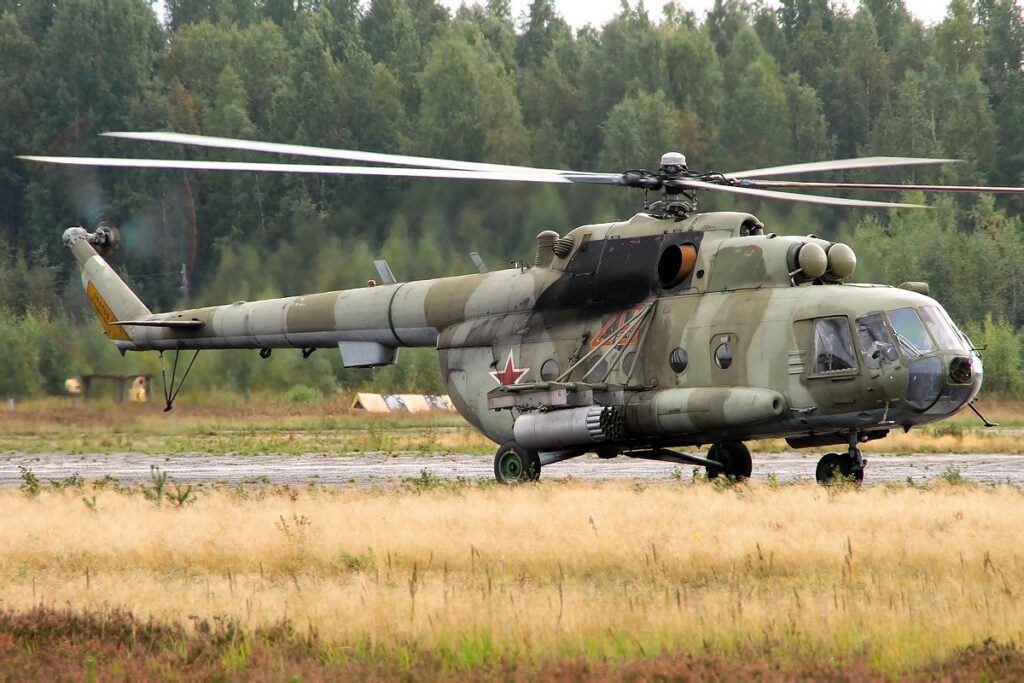
Russia plans to make 72 Mi-8 helicopters at their Kazan plant over the next two years, more than offsetting their total full-scale invasion losses of 56 units as of March, Dallas Analytics reported, citing leaked Russian documents. It is also double the production rate from earlier estimates.
Russia also has another Mi-8 factory at Ulan-Ude. In 2024, both plants jointly delivered 40 helicopters, according to Moscow’s defense conglomerate Rostec. A December analysis by Frontelligence Insight, also based on leaked documents, estimated that Russia can make 20 Mi-8s at each plant per year.
The number of helicopters the Ulan-Ude plant can produce is unknown. However, if it has similar capacity to the Kazan plant, Russia’s production rate could be substantially higher.
Mi-8s are versatile workhorses, able to transport troops and cargo, conduct reconnaissance, electronic warfare, and attack missions. Due to heavy losses, their role moved away from frontline missions during the battle of Kyiv, towards evacuation, and subsequently indirect fire roles and hunting Ukrainian UAVs and USVs on the Black Sea.
War has changed significantly since before the full-scale invasion, largely due to the invasion. The ubiquity of drones means that Russia could hardly risk attempting large-scale airborne assault operations.
However, if Russia plans to escalate its hybrid war against NATO into more direct aggression, as some Alliance military officials predict, the Mi-8s would come in handy for ground incursions.
The production plan also hints at Russia’s priorities. The leaked document, minutes from a meeting involving Russian Deputy Minister of Industry and Trade Gennady Abramenkov, states that the National Wealth Fund would contribute financing, which means that Moscow's reserve cash is being poured into maintaining and rebuilding its war machine.
On the other hand, the documents revealed some potential hiccups in Russia's plan to rebuild the Mi-8 fleet. Many details seem to hang on contractors securing advance payments and contracts that have yet to be signed. The United Engine Corporation is expected to only start delivering engines for the Mi-8s beginning in September.
One clause calls for an estimate of how many helicopters can "actually" be built in 2026, suggesting that there's a gap between expectation and reality.