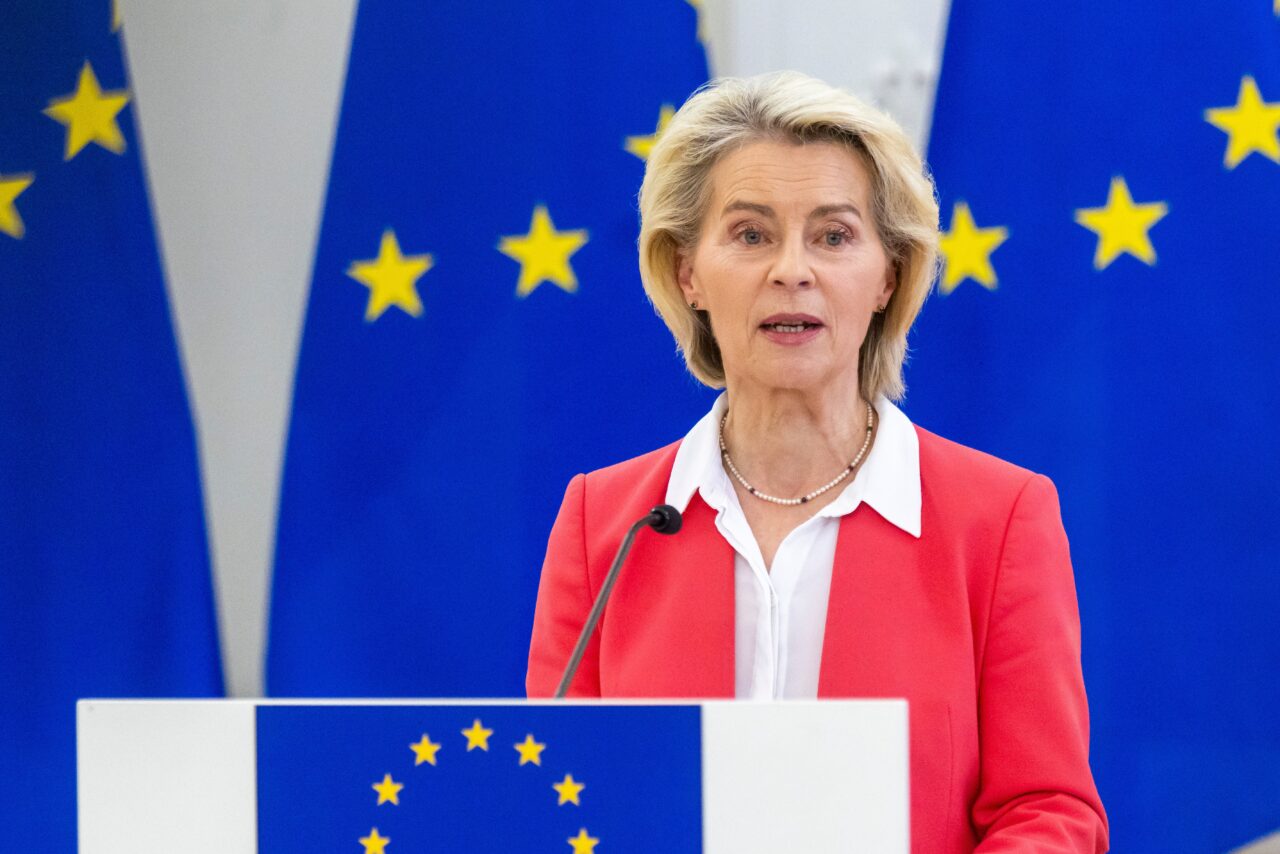
A few months ago, at a center for malnourished children in the remote Darfur region of Sudan, an orphaned baby who had arrived days earlier on the brink of death gripped Tom Fletcher’s finger with surprising strength. The United Nations’ humanitarian chief says those seconds eased his frustration at international inaction and the “anger” he feels over cuts to aid at a time when needs and conflicts are rising around the world.
SPEAKER 3 [CLIP]: OK, let’s not — OK, OK. He’s not resisting.
SPEAKER 2 [CLIP]: Stop resisting, stop resisting.
MICHAEL FOX: Mahmoud Khalil was detained and arrested on March 8, 2025, outside of his Manhattan apartment. It’s a chilling video. Plainclothes agents are there. They refuse to give their names. He’s handcuffed and shoved into the back of a car. His wife, eight months pregnant, watches and tries to understand what’s happening.
This is not a scene from some dark chapter of a distant past filled with black and white photos of bygone dictatorships. This happened here in the United States of America. Mahmoud Khalil is a graduate student from Columbia University. He led protests in 2024 against Israel’s US-backed occupation of Palestine and the genocide there.
But speaking out today has a high price. Mahmoud Khalil is a US resident, born in a Palestinian refugee camp in Syria, but Trump officials said they stripped him of his green card. They held him for months at an ICE jail in Louisiana, far from his home in New York, far from his wife and newborn son.
He was finally released after 100 days in prison and widespread condemnation, just one highly visible victim of so many attacks on free speech in the United States today. And it’s getting worse.
MARC STEINER: This is The Battle for Free Speech, a new multipart narrative podcast series brought to you by The Real News. We’re your hosts. I’m Marc Steiner.
MICHAEL FOX: And I’m Michael Fox. Over the coming weeks, we’re going to take you on a journey to understand the important role free speech has played in US history.
MARC STEINER: From the abolitionist movement and the Civil Rights organizing to the threats facing free speech today and how battles are being waged over free speech at home and abroad.
Today, we want to set the scene by beginning in the present. We met a pretty disturbing assault on First Amendment rights here in the United States. Mike is taking lead in reporting here, so why don’t you take off?
MICHAEL FOX: Excellent, Marc. Thank you so much. So I wanted to start off today. I’ve been speaking to a lot of people in recent weeks, victims and lawyers about this current moment and the attacks on free speech rights. It’s harrowing hearing their stories, but also the context of looking at where we are today. And I wanted to kick us off with a conversation I had with a woman named Lisa Femia.
LISA FEMIA: I am a staff attorney at the Electronic Frontier Foundation, which is a nonprofit dedicated to protecting civil liberties and civil rights online and in the face of new and emerging technologies.
MICHAEL FOX: And she’s been looking at all of this stuff, and in particular the Trump crackdown on noncitizens, residents within the United States, stripping them of their visas, the same thing we saw with Mahmoud Khalil.
Just for context, she said that obviously we’ve seen this increasing attack on free speech rights in recent years, but this massive uptick within Trump’s second administration, and that’s not a surprise to anyone.
But she in particular underscored this question of Trump targeting noncitizens, visa holders, and how they’re clearly trying to censor and deport noncitizens for speaking out, particularly around the question of Palestine.
LISA FEMIA: Yeah. I mean, in terms of specific numbers, it’s broad reaching because you have both people who have been arrested, been deported, had other negative actions taken against them, and some of them have been quite public, like Mahmoud Khalil, for example. But then you also have the mass chilling effect that happens for everybody’s speech.
MICHAEL FOX: So, her organization has launched a lawsuit with the support of three different unions.
LISA FEMIA: United Auto Workers, Communication Workers of America, and American Federation of Teachers.
MICHAEL FOX: And what’s interesting here is that it’s specifically looking at the administration’s social media surveillance program against noncitizens.
LISA FEMIA: And they each surveyed their members before we filed about how has this surveillance program affected your activity online and your willingness to express yourself? And overwhelming amounts of members said, yes, I have changed my behavior, especially the noncitizen members, but citizen members as well. Of the respondents aware of the surveillance program of the UAW, 85% of the visa holders said that they had changed their activity online, including just eliminating their presence online entirely.
MICHAEL FOX: So, what does that mean? That means that, in some cases, they’ve just gotten offline altogether. They’ve deleted accounts. In other cases, they’ve changed the way they communicate online, what they post, what they don’t post, who they communicate with, who they retweet, how they talk about things. And this is interesting because oftentimes we hear about the high-profile cases and the situations which we’re going to dig into today, but this looks at the minutia of what happens when you’re censoring people, when you’re attempting to deport people or lock them up, when you’re firing teachers.
LISA FEMIA: And I think maybe some people hear this and like, OK, but that’s just online speech. But you have to remember how much speech happens online now, how much political organizing happens online now. For the unions, how much labor organizing and being able to literally just communicate with their members happens online now. And people are just shutting down. They’re just locking down and keeping quiet because they’re scared. So, it’s almost hard to measure the effect of this because there’s so many people that are chilled even if they haven’t had a direct action against them yet.
MICHAEL FOX: And what that means is then what we see online and what we see, the speech that becomes online and the speech that’s allowed to remain the way it is or becomes even more viral or becomes even more outspoken are those people who are in support of Donald Trump and far-right policies. And the other speech, say it’s in defense of Palestine or speaking out about Trump’s policies, becomes minimized because people are afraid to speak out. That’s literally what this one lawsuit is talking about. I just thought that was so fascinating because it’s not something that we’re hearing at all. It’s just this unprecedented moment that we’re seeing in the United States right now.
MARC STEINER: I’m a huge student of what happened in Germany in World War II in the Third Reich. I’ve covered it a lot, done podcasts about the history, and it feels as if we are in 1930, as an analogous period, where the authoritarian forces of the right are really gaining strength. They have their figurehead at the top in Donald Trump, and he is mouthing the words that they want him to say so they can begin this authoritarian push in America to shut opposition down, to shut voices down, to kill the independent press, and to bring everybody in line to where they want to take America.
I think we are in the most dangerous place we’ve been in the history of this country, unless you happen to be Indigenous or Black and living in the 19th century, even the 20th century in this country.
I think that we can take lessons from Reconstruction. The lessons when there was this huge gasp of fresh air and people believing in freedom and building a new kind of democracy that was absolutely crushed by the forces in Washington, DC, and former Confederates that killed the rights of Black people in America and changed America for the next 90 years, became an oppressive nation for Black people in this country, and Indigenous and other people.
And what we’re facing now is broader, even. We’re facing a threat to the democracy that we have, and we’re facing a threat to freedom in general, and it’s building slowly. As a father and a grandfather and a great-grandfather, I am absolutely worried for all of my children and their friends and their peers and what they’re going to face because I see the right growing in power and I see the oppositional forces in absolute disarray. I don’t want to go down that rabbit hole now. I just wanted to lay that out, but I think we’re in a very dangerous moment.
MICHAEL FOX: Yeah. You know what’s fascinating, Marc, is obviously I agree with you and I see the question of free speech and I think that’s why this podcast that we’re embarking on is so important, because it’s almost as if this is the canary in the coal mine in a lot of ways with people being silenced, with people being fired, with people being deported for speaking out and the increasing attacks on this.
MARC STEINER: For context, just to put it in everybody’s head who’s listening right now, because we take for granted the founding documents of our country — And those founding documents, yes, they were written by a slave owner, no question. He wrote them for white people, but they’re universal in terms of what they mean. And let me just read for all of us what the First Amendment says:
The First Amendment guarantees freedoms concerning religion, expression, assembly, and the right to petition. It forbids Congress from promoting one religion over others and also restricting an individual’s religious practices. It guarantees freedom of expression by prohibiting Congress from restricting the press and the rights of individuals to speak freely. It also guarantees the right of citizens to assemble peaceably and to petition their government. Our democracy has flaws, but it has helped make the democracy we have what it is. The right to speak your mind, say what you want, assemble and fight for your rights, assemble to protest is fundamental to this country. That’s what they’re eroding. That’s what they want to take away. That’s my fear.
MICHAEL FOX: It’s a perfect segue into this next world I want to take you. Because one of the places they have been most trying to silence people from speaking out and from standing up is around Palestine. And so I spoke recently with a woman named Corinna Mullin. She is a professor at CUNY, the City University of New York, or at least she was.
CORINNA MULLIN: I’ve been teaching at CUNY for eight years, and also I teach about Palestine. I teach about settler colonialism. I teach about US imperialism. And the two Title VI investigations I was subjected to had to do with false accusations of antisemitism. And the university, rather than defend me from these accusations — And not only that, from the doxxing — And instead of defending us, they have contributed to it. They’ve thrown us under the bus.
MICHAEL FOX: She is currently a member of the Fired Four. So, she and three colleagues were all fired for very similar situations. They all were very active in the pro-Palestine movement on campus. They were all very active [in] standing up and defending students and speaking out, and all four of them were fired.
CORINNA MULLIN: In our cases of the Fired Four, we haven’t actually been given the reason for our firing. There’s almost no due process and very little in terms of contractual protections because we’re all adjuncts, and we could be fired for any reason or no reason at all. What we share in common is that we have all been outspoken in solidarity with Palestine in contesting the genocide and in challenging also the role of our institution in its complicity, its collusion with that genocide through its investments and contracts with companies that benefit from settler colonialism, war, and genocide.
MICHAEL FOX: Now, they’ve had a big campaign to try and get them reinstated by the union, which has been really pushing this, which is exciting and important, but her situation and her case I think is so… it’s just one case of so many that we’ve seen around the country. So, both of those investigations against her were found to be unsubstantiated, but regardless, she talks about how her academic freedom was undermined.
CORINNA MULLIN: Because when I am in class and I’m teaching a course on the politics of the Middle East, for example, and I’m talking about [Palestine] because I can’t teach a course on the politics of the Middle East without talking about the history of settler colonialism in Palestine, then of course that’s in the back of my head. There’s always going to be this fear that there might be another investigation despite the fact that these two investigations have been found to be unsubstantiated. So there’s that.
The fact that the university allows for what is really a form of harassment, and many of these students might even be paid by Zionist organizations. They might have their own political agenda. So, to allow that to take place already and to pursue these investigations itself is a form of violation of academic freedom
MICHAEL FOX: Again, the teachers union has stood up. Many students have defended her, and, in fact, the union president himself has called this a McCarthyite political purge.
SPEAKER 4 [CLIP]: So we will not allow for these disingenuous McCarthy-like attacks on higher education. We will not allow it on CUNY. We will fight for the professors, for the students, for the people that make CUNY great every step of the way.
MICHAEL FOX: And I think that connection to the past, to McCarthy, to remembering what has happened in the past when people stood up or spoke out, and what’s happening now clearly on university campuses. I mean, that’s like the big image around the country where people are being purged, where people are being attacked and undermined, and people are being fired or silenced.
CORINNA MULLIN: And it’s only escalated since Trump has come to power. And now with the congressional hearings, for example, there’s the congressional hearing on higher education, so-called claims of antisemitism in higher education, which really are just conflating anti-Zionism and antisemitism.
SPEAKER 5 [CLIP]: We’ll hear today about antisemitism at three institutions: Haverford College, DePaul University, and California Polytechnic State University, San Luis Obispo.
CORINNA MULLIN: That all of this has really escalated and pushed the administration or emboldened the administration to really crack down on academic freedom and the rights of students to organize and speak out against settler colonialism and genocide on campus.
MICHAEL FOX: It’s a really concerning and terrifying moment that I know I haven’t seen in my lifetime. Marc, have you ever seen something like this at this level?
MARC STEINER: At this level, I mean… I grew up in the shadow of HUAC, the House Un-American Activities Committee.
SPEAKER 6 [CLIP]: The question is, have you ever been a member of the Communist Party?
SPEAKER 7 [CLIP]: I’m framing my answer in the only way in which any American citizen can frame his —
SPEAKER 6 [CLIP]: Then you deny it —
SPEAKER 7 [CLIP]: Which invades his absolutely…
MARC STEINER: Family, friends, and some of my peers, a couple of my closest friends, their parents were dragged before HUAC for being allegedly communists or having been a member of the Communist Party, being active in trade unions, being active in progressive politics. And so that period was a very frightening moment.
That period, and as I said, that and the end of Reconstruction are emblematic of what we face today, but it’s even more serious because I think the power of the right, the authoritarian nature of the power of the right is in ascendancy in some ways because the opposition is in disarray. I don’t mean to sound as if I think it’s all over. It’s not. But I’m saying that we’re facing a threat that authoritarianism will mask itself as freedom and take hold of the country.
MICHAEL FOX: Marc, have you met or do you know many individuals who have seen, have been the victims of this backlash either at university campuses or elsewhere around the country?
MARC STEINER: There are people I know who I’ve talked to around the country who are feeling immense pressure. Where we broadcast from in Maryland, we live in a state that has a pretty powerful progressive movement inside the Democratic Party and outside. And I think that’s a little different here. But around the country, there are people that are just terrified to open their mouths, to say anything. I think we take these things for granted because we live here and we think it’s inviolable. Nothing can stop it.
MICHAEL FOX: I want to take this to Charlie Kirk because of the big issues that we’ve seen this year where there’s been silencing free speech and backlash, people losing their jobs, like the top two cases I think are around obviously Palestine and pro-Palestinian activism and around the fallout over Charlie Kirk’s assassination.
So, just for context here, for those who are listening, remember, Charlie Kirk was a right-wing political activist. He was the founder of the conservative organization Turning Point USA. He did these tours on college campuses across the United States, and he had very radical extreme views. Hateful views, many would say.
CHARLIE KIRK [CLIP]: Strong men built the West and won the wars and built the building that we’re in right now. And without strong men, then you all of a sudden see civilization unfold upon itself, and we’re seeing that happen in real time.
MICHAEL FOX: And he was killed on Sept. 10, 2025, literally while he was speaking out in public, while he was doing one of these tours on a university campus. And I feel like in so many ways that upended so many things.
A, it’s so important to say, and it’s so defining for free speech. It’s so important to say, first off, there’s no excuse for violence like this. There’s none. It has to be denounced from every place, particularly in a podcast about free speech where the whole idea is everyone has the right to speak their minds. Everyone has their right to speak.
But what we saw in the backlash against those commenting on Charlie Kirk’s murder has been really shocking. The highest profile case, Marc, was clearly the whole firing and scandal and then rehiring of the comedian Jimmy Kimmel.
JIMMY KIMMEL [CLIP]: Thank you. Anyway, as I was saying before I was interrupted [audience laughs], if you’re just joining us, we are preempting your regularly scheduled encore episode of Celebrity Family Feud [audience laughs] to bring you this special report. I’m happy to be here tonight with you all [audience cheers]…
MICHAEL FOX: Did you watch this unfold? Did you follow Jimmy Kimmel’s work?
MARC STEINER: I don’t follow religiously, but when this happened, I took a deep dive, yes.
MICHAEL FOX: What did you find? Tell me about what did you see happening there?
MARC STEINER: Given everything that’s coming out of the Trump administration, I think it was a fear among the people who own some huge broadcast stations that they were going to be attacked. They were going to be investigated. They were going to have their licenses removed. I think that Jimmy Kimmel was a test to see how far they could go in stopping freedom of speech in our country. It didn’t work, but it doesn’t mean it won’t work. It was a test run. I mean, I’m not a conspiracy theorist, but I do believe that people are organizing their resistance to how America has changed. And Jimmy Kimmel was a test run. I see him as a test run.
MICHAEL FOX: It’s interesting how other comedians have spoken out, obviously clearly in defense of Jimmy Kimmel in the days and the weeks afterwards.
NEWS REPORT 1 [CLIP]: Late night hosts are coming to Jimmy Kimmel’s defense tonight.
NEWS REPORT 2 [CLIP]: In fact, both Stephen Colbert and John Stewart unloaded tonight on ABC’s decision to suspend Kimmel’s show, and both claim it’s part of a campaign by President Trump to limit free speech and silence his critics.
JON STEWART [CLIP]: We have another fun, hilarious… administration-compliant show.
STEPHEN COLBERT [CLIP]: Well, you know what my community values are, Buster? Freedom of speech [audience cheers].
MICHAEL FOX: Obviously, it wasn’t just Jimmy Kimmel. Hundreds of people have lost their jobs: university professors, federal employees, private business, mostly for what they posted online or what they spoke out against, but clearly the backlash was shocking.
So, I wanted to understand this from behind the scenes, what was happening with Jimmy Kimmel, but was always happening in the wake of Charlie Kirk. And so, recently I went to the offices of FIRE in Washington, DC. Do you know this organization? It’s the Foundation for Individual Rights and Expression. It’s a free speech organization in downtown DC, big office. I was impressed by the amount of staffers and people who are there. And they’re doing incredible work all in defense of free speech today. So, I met with staff attorney David Rubin.
DAVID RUBIN: I work on the litigation team, so we’re filing lawsuits in court and challenging speech-restrictive statutes and stuff like that. And then we also have a ton of other really smart lawyers who work here and nonlawyers who are doing a lot of different kind of advocacy work.
MICHAEL FOX: And he has this really interesting background, Marc, because his background is actually in comedy.
DAVID RUBIN: And so before law school, I worked in Los Angeles in the business of standup comedy for four or five years. I worked for Budd Friedman, who founded the Hollywood Improv and discovered Rodney Dangerfield, Bette Midler. And Lenny Bruce used to go there. But anyways, I have this longstanding love of comedy.
MICHAEL FOX: So of course, the connection to Jimmy Kimmel and comedy in the United States historically today was really interesting to talk with him about that. Because he told me he only did stand-up a couple of times. It wasn’t really his thing [Steiner laughs]. But he worked in the stand-up world in Los Angeles for several years before becoming an attorney. And that’s really his passion. People like Lenny Bruce or George Carlin, which for him are like the exemplification of free speech.
DAVID RUBIN: Comedy has a big role in First Amendment protection and just in building a free speech culture, like George Carlin and the seven dirty words and all that.
GEORGE CARLIN [CLIP]: Nobody even tells you when you’re a kid what the words are that you’re supposed to avoid. You have to say them to find out which ones they are. Shit [smack]! Oh, fuck [audience laughs]! That’s two!
MICHAEL FOX: For him, these folks exemplify what free speech should be, because you’re up there on stage and you’re making your own critique of the reality in the United States, whatever that might be, and it’s your freedom to be able to speak out in public or make jokes in public about this. So, that was like one just fascinating anecdote of speaking with David.
Did you follow these people like Lenny Bruce or George Carlin or some of these other comedians?
MARC STEINER: All my life, Richard Pryor, all of them. They pushed humor to the cutting edge of America, almost at the abyss, and they were funny. But to some people, they were really dangerous and they had to be stopped. And they used sometimes not just their politics, but also the sexual content was too much for uprighteous Americans to take, at least some of them. It’s not surprising comedians, people in the creative world, are among the first to be attacked. It happened in Nazi Germany and it’s happening here.
MICHAEL FOX: Yeah. So the main reason I actually went to speak with David was about this very specific case in Tennessee. Have you heard about the case of Larry Bushart Jr.?
MARC STEINER: No. Tell us, what’s the case?
MICHAEL FOX: OK. So it’s wild and it’s shocking because it’s one of those situations that just got to this extreme that it’s hard to even believe it’s happened within the United States.
DAVID RUBIN: It was a speech chilling environment. It was a very crazy time for a week or two, but this happened in the late stage of that big wave.
MICHAEL FOX: So, Larry Bushart Jr., he’s a retired police officer and sheriff’s deputy for 24 years. And between late September until the very end of October, he spent more than a month in jail for posting a meme on Facebook in the wake of Charlie Kirk’s assassination.
MARC STEINER: Oh, yes. Right.
MICHAEL FOX: So, this story first went viral over The Intercept. FIRE was following it closely as well as David Rubin. Bushart Jr. was vocal on Facebook about Donald Trump, has been for a very long time. He called Trump and his supporters a cult. He was active online after Kirk’s killing about why he shouldn’t be praised, basically saying, look, we can’t praise this guy. And he was very active particularly on Facebook, but it was one meme in particular that got him in trouble.
DAVID RUBIN: It’s just a picture of then-President Trump saying, after a shooting at an Iowa high school named Perry High School, after a shooting there, the day after he said, we’re all going to have to get over this, something to that effect, with the obvious implication that it meant perhaps we might be being a little hypocritical here where if we have to get over it the day after a bunch of kids get killed, and we’re still firing people nine days later because they say something bad about this one person.
MICHAEL FOX: Underneath this quote were the words “Donald Trump on Perry High School mass shooting one day after.” And in the image that Bushart Jr. posted on Facebook, he wrote “seems relevant today.” So that was it.
But the posts caught the attention of Perry County Sheriff. And that night at almost midnight, four officers came to his door, to the door of Bushart Jr. They had a warrant, they handcuffed him, and drove him to jail. And this video was released by The Intercept showing him as he’s arriving at the jail. An officer reads the warrant.
POLICE OFFICER [CLIP]: Threatening mass violence at a school.
LARRY BUSHART JR. [CLIP]: At a school?
POLICE OFFICER [CLIP]: It’s referring to a school. I have no idea [crosstalk].
LARRY BUSHART JR. [CLIP]: [Inaudible].
POLICE OFFICER [CLIP]: That’s what they’ve called us for. And I ain’t getting to it.
LARRY BUSHART JR. [CLIP]: I played on Facebook. I threatened no one. I know you don’t give a —
DAVID RUBIN: They arrested him and charged him with making a threat of mass violence on a school, which is like a class E felony or something like that. So they put him in jail. The judge set a $2 million bond, which is pretty insanely high for any crime.
MICHAEL FOX: So, essentially the sheriff said that people could read Bushart Jr.’s post as a possible future threat on a local school. And it’s just this shocking moment in America where someone can go to jail for more than 30 days for posting a meme on Facebook. I mean, it’s like we’ve reached another level. And it was so shocking that The Intercept, when it published this article on Oct. 23 and then there was clearly a backlash, and the charges were finally dropped in the very end of October, and he was released from jail the following week after Oct. 23.
DAVID RUBIN: So they dropped the charges, and now he’s free.
SPEAKER 8 [CLIP]: How do you feel right now?
LARRY BUSHART JR. [CLIP]: Thanks to all and any supporters out there, and very happy to be going home. I didn’t seek to be a media sensation, but here we are. But that’s about all I can say right now.
MICHAEL FOX: And the folks at FIRE believe it was in large part due to the pressure, both the media pressure from continued reporting on this case, but also the reality that there was nothing to stand on. It’s just somebody posting a meme.
Have we ever seen anything at this level before?
DAVID RUBIN: I have not seen anything like this.
MICHAEL FOX: This is the new world order almost that we’ve entered. Had you ever heard of anything like this before, Marc?
MARC STEINER: I mean, not since I was really young during the Red Scare of the ’50s. When people I know whose parents were fired from their jobs, whether they were airline mechanics or physicians or whatever, they were teachers, were being fired here in Baltimore. And the only thing that stopped it was the end of McCarthy and, oddly enough, the beginning of Eisenhower began to change what was happening.
But I think that we are facing something, that a similar moment is happening now, and I think that it’s creeping. This is not something that is overt and in your face every day, but it’s undermining our educational institutions. It’s undermining our freedoms, and it’s seeping in with the power of the right taking over the country.
So, I think it’s almost like, again, if you go back — And I don’t deal with hyperbole — But if you go back to 1931 Germany and study how slowly it moved and what it did, who they went after, the same process is happening now in this country. We’re on a cusp.
Look, our broadcast, where we are now, The Real News, places like this, this is under threat, and I think that’ll be the first line. So, I think that one of the most important parts for me in doing this work with you at this moment is beginning to really sound the alarm, but also talk about people who are standing up to it and how you organize and fight against it.
MICHAEL FOX: Well, we’ll get to organizing and fighting against it. We will get there, folks.
So, when I spoke with David, part of my question for him was what do we know about what’s behind the scenes about these situations? So we know that, for instance, hundreds of people have lost their jobs or faced backlash for their response to the Charlie Kirk assassination. We know that nearly 300 people have been investigated at the Pentagon. So, Pentagon employees who were investigated for their own response or their own views. We know that [the] State Department revoked the visas of several people who spoke out against Kirk.
And Marc, did you follow this at all? It’s really crazy because they’re totally blatant where the State Department is actually retweeting tweets by people, other things that people have posted online, and it basically says, don’t like it? Visa revoked. It’s almost like this viral amusing joke meme, but they’re actually responding to what people have posted online in response to Kirk.
And we know that at least six people have lost their visas this way. Someone from Argentina, South Africa, Mexico, Brazil, Germany, and Paraguay.
MARC STEINER: And they’ve been shipped out.
MICHAEL FOX: I don’t know the… but that’s what at least the State Department said online.
SPEAKER 9 [CLIP]: I’m sure we should not be giving visas to people who are going to come to the United States and do things like celebrate the murder, the execution, the assassination of a political figure. We should not. And if they’re already here, we should be revoking their visa.
MICHAEL FOX: So, I wanted to understand what’s behind the scenes here. How are people being targeted? And this is something we don’t hear a lot about in the news. We hear a lot about this professor was fired or [these] other people [are] trying to create a lawsuit to get their jobs back, or these other people from these different employment were fired for this, but we don’t necessarily understand what the minutia is behind this that’s driving these firings, because they’re not by accident.
And in many cases, they’re these coordinated campaigns. I’m not saying nationally coordinated, but it’s a process that is actually happening and coordinated so that people then get to a place in which they are fired or so that powerful people take these decisions.
So, this is what I sat down, part of what I sat down with David Rubin about, and I really wanted to understand what was actually happening, how were people being targeted.
And David Rubin said, no, this isn’t by accident.
DAVID RUBIN: I would say there is a campaign, or many multiple smaller campaigns, certain influencers like Libs of TikTok or like Scott Pressler or like Robby Starbuck. If you look at them, they were crowdsourcing comments from people that they disagreed with that said something about Charlie Kirk, and then all their followers were going and tweeting to that person’s boss and saying, oh, you employ this person? You should fire him. You have to fire him.
MICHAEL FOX: And he explained to me that this is very much a coordinated campaign, which he called it a heckler’s veto. Do you know this term?
MARC STEINER: Yes, go ahead.
MICHAEL FOX: So, it’s basically the idea that individuals who aren’t directly impacted by these professors, so they’re not necessarily the professor’s students. It might be a student or another student, but it’s usually individuals that have nothing to do with that local situation who then find something online, or they find a tweet online from these professors, and then they start to push it out virally and promote this to then more powerful people. Then it gets picked up by viral right-wing or conservative influencers, usually on Twitter but sometimes elsewhere like Libs of TikTok and other things.
And this is how many of these firings have actually happened, where we’ve seen this coordinated campaign against left individuals speaking out in the wake of Kirk’s assassination or standing up in defense of Palestine
DAVID RUBIN: And that’s one area in First Amendment law that needs to be addressed is this heckler’s veto that happens when politically interested but otherwise diffuse groups get really interested and keyed in on something. And if a teacher says something and their students’ parents have a problem with it, maybe that’s one thing. But if some random right-wing or whatever, left-wing podcaster and all their fans don’t like it, and then they send a bunch of emails and make a bunch of calls to the school, that is very anti-free speech culture.
MICHAEL FOX: I think it’s interesting that, for instance, Charlie Kirk’s own group that he founded, Turning Point USA, has its own professor watch lists. So, these are professors, left and progressive professors. Some of these individuals who were then pointed out, detailed online, and then the campaigns raised for their firing are individuals who are on this Turning Point USA watch list.
SPEAKER 10 [CLIP]: Turning Point USA leaders continue to publish an online database of university professors they say advance leftist propaganda in the classroom.
DAVID RUBIN: I fear that this is the start of some kind of new wave of political violence on college campuses and that folks, for instance, on the professor watch list could be targeted as well.
MICHAEL FOX: And it’s important to point out that there isn’t just one group that’s doing this. It’s being pushed by many different groups, by many different far-right social media influencers, but it is happening, and it’s in many ways coordinated.
So here’s one very, very specific example, Marc, that I’m going to take you to Clemson University for a second.
MARC STEINER: OK.
MICHAEL FOX: I spoke with Allen Chaney.
ALLEN CHANEY: I’m the legal director at the ACLU of South Carolina.
MICHAEL FOX: And they’ve been very focused on this one case around a professor named Joshua Bregy. Bregy is an assistant professor in the Department of Environmental Engineering and Earth Sciences. And then following Charlie Kirk’s murder, he reposted a friend’s post on Facebook.
ALLEN CHANEY: That was vehemently nonviolent but, at the same time, pointed out the conflict between, on the one hand, the insistent lack of empathy by Mr. Kirk, and on the other hand, the militant demand for empathy by Mr. Kirk’s supporters in the wake of his death.
MICHAEL FOX: What’s interesting about this case is that it’s so benign. The post first denounces Kirk’s assassination and clearly the violence. It expresses grief for Kirk’s friends and family, but it also points out the hypocrisy of Kirk’s own violent discourse, which is something we’ve seen a lot online by people in the response, right?
MARC STEINER: Right.
MICHAEL FOX: And so the post said, in one quote, “It sounds to me like karma is sometimes swift and ironic. As Kirk said, play certain games, win certain prizes.” And that’s probably the most demonizing phrase in the post.
ALLEN CHANEY: Now, immediately after Dr. Bregy posted that on Facebook, nothing happened. Dr. Bregy does not have a particularly large Facebook profile. He’s a climate scientist, not a huge online presence really at all. And as news was starting to break about some of the retaliation against folks for their speech, Dr. Bregy went ahead and made his post private just in an abundance of caution.
A few hours after that happened, Clemson College Republicans, which is an on-campus student group, reposted a portion of Dr. Bregy’s Facebook post, describing it as a now-deleted post, along with some old profile pictures of his, one of which had a “climate change is real” sign, and the other one which had a Black Lives Matter banner, and tagged Libs of TikTok as well as some other political profiles and demanded that Clemson fire him.
MICHAEL FOX: So, this then makes its way all the way up to the South Carolina State House Rep. Thomas Beach, who also adds fuel to the campaign. Before you know it, it’s powerful elected representatives who are lobbying leaders at Clemson University.
ALLEN CHANEY: That’s exactly right. And so, the Clemson College Republicans’ post and their tagging of Libs of TikTok is really what ignited this social media firestorm that was directed at Dr. Bregy, as well as one other Clemson professor, and then really at Clemson itself.
And so you see some posts like — Give me a second, I can pull them up. So you see folks like Rep. Thomas Beach, who’s there in the Pickens area reposting the Clemson College Republicans’ post and saying, “Another leftist indoctrinator has been identified in the Clemson faculty. This is whose salary your dollars are paying for. We can do better. Take action, fire these radicals.” And when that doesn’t work, the threats become increasingly more explicit and they become more official as well.
And so you no longer just have fringe Freedom Caucus folks like April Kromer and Thomas Beach and Jordan Pace. You see a letter from the speaker of the House, the president of the Senate on official General Assembly letterhead going to the Clemson University decision makers saying, your funding depends on you making the quote “right decision” here, and encouraging them to take decisive action.
And so, there was really no question that lawmakers were giving Clemson an ultimatum — Fire these professors, or we’re going to pull your funding.
MICHAEL FOX: So, it’s this fluid, sometimes clear, sometimes unclear campaign whereby certain local groups, in some cases it might be the local university Republicans group, and in other cases it might be other groups online, who find these or who are actively looking for these types of posts and then making it, building a whole campaign. Then it’s getting pushed by social media influencers online to powerful right-wing or conservative Republican leaders who are then lobbying those schools or offices or businesses or whatever it might be to get these people fired.
ALLEN CHANEY: But over the course of five days, you see the coercive tactics of lawmakers really start to erode Clemson’s commitment to the First Amendment. And then about five days later, before Dr. Breggie showed up to teach his first class after the Facebook post, he was fired. He was dismissed for cause and in a manner that really directly conflicts with Clemson’s own faculty manual.
MICHAEL FOX: So it’s this fascinating thing that’s actually happening against left and progressive in particular professors, but also we’ve seen this elsewhere, singled out by these smaller groups. And what’s interesting is that in a lot of cases, like for instance this one, not necessarily did Professor Bregy do anything. He didn’t post. He reposted somebody else’s post that really wasn’t that damning. But the fact that he’s a professor that is probably on their watch list already, that is left a progressive, he’s a climate scientist in the environmental department, which is clearly proenvironment and whatnot. And so this is an individual they had clearly pointed out as someone they want to get removed.
And this is like the epitome of what the heckler’s veto is. None of Professor Bregy’s… His students stood beside him. They stood up for him. The union stood up for him. His colleagues at Clemson University stood up in defense, and most of this campaign against him was from groups or individuals from outside Clemson University who have a clear political plan to try and get him fired or removed because of his views.
And what does this do? Again, it goes back to what we were talking [about] at the very beginning, Marc, where it’s not just the individual who has spoken up or spoken out or has posted something online, but it creates this chilling effect throughout the university and throughout other places where people are afraid to speak out. People are afraid to speak out against Trump, against the Trump administration, against other issues because they think, well, I might be next.
ALLEN CHANEY: The disruption is not internal to these universities or colleges, nor is it organic. It’s manufactured. So, we see a coordinated effort to identify people within academia who made posts about Charlie Kirk that could be used as ammunition to push the universities to fire these people, not really for their comments about Charlie Kirk.
I mean, you see it in my case where it’s really more about the Black Lives Matter and the climate science is real positions, and the Charlie Kirk comment is just the mechanism by which they can push their agenda into the universities and push out people who carry views that they don’t like anymore.
And so it was political opportunism of the most discouraging sort where you have a national tragedy — Regardless of how you feel about Charlie Kirk and his views, the idea that someone was gunned down at a public event because of those views should be frightening to all of us — But then to in the hours following that, see an opportunity and seize on an opportunity to, because of public employees’ views, drive them out of the public workforce.
MICHAEL FOX: And that’s the goal, really. The bottom line is to take out these professors, but also to create this chilling effect around speech so that people are not as vocal online and that people restrict their speech. We saw it from what I mentioned [at] the very beginning of that one situation of this one survey of individuals who were visa holders where 85% had changed their habits online. But I’m sure that if we were to look at some sort of other survey or other analysis that I don’t have in front of me, but if there was something like that done, we would see a huge difference in how people are interacting online over social media and what they are posting, what people are afraid to post, and how that’s impacting academic freedom at universities.
MARC STEINER: And I think that one of the things we have to take into account here are the people who are in power in Washington now. When you look at Vance, Hegseth, Rubio, as much as some people who are liberal on the left don’t want to admit it, these are really, really brilliant men who are highly organized, and that’s what’s pushing this right-wing takeover of everything going on and the killing of free speech. I think that that is something that really has to be delved into deeply to understand who these people are and the powers behind the throne, what policies they’re putting in place, how they support what’s going on in these universities. I think that people have to connect these dots to understand what we’re up against and what we’re facing.
As I said earlier, I think this is the most dangerous moment in American history in a long time. And I think what you just described is the tip of the iceberg, and it’s going to get deeper and more intense over the next several years in this administration.
And in a pure political sense, one of the things that I’ve been reading a lot about, writing about, and thinking about how to produce is how weak the opposition is, how disorganized the opposition is, how there’s no game plan among people on the left or about Democrats about how to confront this and stop it.
And I think that what you were just describing, again, if you go back to the 1930s and the early part of this in this country in the 1910s and the 1930s in Germany, this is how it began. You target what would be a weak link: universities. You target to begin the process, and that’s what we’re witnessing. That’s why what you just described is really critically important to understand in the context of how the right pushes power.
MICHAEL FOX: Two things I want to say that I think are a little hopeful within this context, particularly —
MARC STEINER: I didn’t mean to be so Mister Negative [laughs].
MICHAEL FOX: No, of course. So first off, the ACLU has this case.
ALLEN CHANEY: Yeah, we filed a complaint, and shortly thereafter we filed a motion for a preliminary injunction which asked the court to rule that we are likely to prevail on the merits of our First Amendment claim and to order Clemson to reinstate Dr. Bregy as faculty, put him back on the payroll, remove any adverse employment findings, and treat him as if he’s not done anything wrong, which we don’t think he’s done anything wrong, and we think that the First Amendment agrees with us.
MICHAEL FOX: The timeline is slow. I asked them about the timeline. They said, well, we wish it was faster. I wish I could define the timeline, but it’s happening, and that’s what’s important. And that lawsuits like this are happening and pushing back around the country.
I thought it was really interesting because I’ve been Googling this in recent days, and if you Google for “Charlie Kirk firing,” if you Google those words right now, it’s article after article of people pushing back, of lawsuits against universities, against school districts, of lawyers picking up people’s cases of trying to get people rehired. I think it’s really hopeful that if you had Googled the same thing just a couple months ago, then you would’ve seen story after story of people being fired, and now you’re seeing story after story of people of fighting back and trying to be rehired because they’re standing up for their free speech rights.
So I think that’s one thing that is really, really key. There’s a couple of the things that… Like I mentioned, Marc, I’ve been speaking to a lot of people in recent days and one of the things that was that almost everyone told me was that yes, of course, cancel culture happens on both the right and the left, and that’s what we’ve seen in recent administrations in recent years, but that this, what we’re seeing now is a whole new level and that things are bad and getting worse. Like you’ve mentioned McCarthyism, and the McCarthyist moment is the closest reference that almost all these people, all these different staff attorneys and victims and any people that I’ve been speaking with, this is like the main moment that so many of them reference of being particularly a US reference of where we are now and what this looks like.
JOSEPH MCCARTHY [CLIP]: One communist on the faculty of one university is one communist too many. One communist among the American advisors at Yalta was one communist too many. And even if there were only one communist in the State Department, even if there were only one communist in the State Department, there would still be one communist too many.
MICHAEL FOX: And Marc, I wanted to come back to Lisa Femia just for a second — Remember, she’s from EFF, this free speech rights organization out in the Bay Area — Because I asked her one specific thing about our definition of free speech because for me, I’ve for a long time felt like we’re seeing an attempt to redefine free speech in America where it’s not just your right to say anything you want, where it’s clearly not right now your right to protest because we’ve seen these attacks against pro-Palestinian protests, and obviously Trump is calling out the National Guard against protests and things.
So, clearly there’s this push to try and almost redefine what we understand as free speech. And I think Trump’s first day in office was a really clear moment in defining that. This is when he signed his executive order, which was called “Restoring freedom of speech and ending federal censorship.” He spoke about this in his inauguration.
PRESIDENT DONALD TRUMP [CLIP]: After years and years of illegal and unconstitutional federal efforts to restrict free expression, I will also sign an executive order to immediately stop all government censorship and bring back free speech to America.
LISA FEMIA: Yeah. I think that there was a moment where you saw Trump and allies make these free speech arguments in a way that meant free speech for them, but not necessarily for people they disagreed with. I think in that early executive order on free speech, you could tell it wasn’t, for a variety of reasons, you could probably tell this wasn’t like a fully thought out full protection of free speech because it talked only about speech from the previous administration as if this hasn’t been a push and pull in American history since the founding.
But recently, I’m not even sure, I think the administration in some ways has dropped the guise and has talked about speech in a way that is now categorizing speech they don’t like as potential domestic terrorism or threats trying to push speech into national security area, which is sort of an easier area of the law for the administration to get away with what it wants to.
And I’m not sure I’m even seeing the administration talk about speech in the way that it did even last year anymore. And you see this with even Trump discussing his executive order on flag burning.
PRESIDENT DONALD TRUMP [CLIP]: And we’ve made it a one-year penalty for inciting riots. We took the freedom of speech away because that’s been through the courts and the court said you have freedom of speech. But what has happened is when they burn a flag, it agitates and you end up with riots. So we’re going on that basis. We’re looking at it from not from the freedom of speech, which I always felt strongly about but never passed the courts.
LISA FEMIA: It’s like, maybe we don’t need free speech. I think the tone has shifted, and we’ve almost moved beyond some of the ideas that they were expressing before into a new area where they treat speech that is against their policies or their administration as a direct threat to the United States.
MICHAEL FOX: Lisa’s quote on this, what she said to me, I think, was just so powerful. She’s like, we’re at a whole new level. It’s not just about the discourse or justification of free speech for my people, not for your people. It’s now just an open attack on free speech itself, and Trump feels like he doesn’t even have to [pay] lip service to it.
LISA FEMIA: It’s a concerning shift. I’ve found it troubling, to say the least.
MARC STEINER: Right. No, I think that first of all, the whole burning of the American flag, A, it is against the law, and you can use that law to attack people, arrest them, and go after them. It hasn’t been done in a long time. It was done in the ’60s, and I had friends of mine who were arrested for burning a flag in protest in this country. Then when you add that to this administration’s Orwellian speak about free speech, they’re at the doorstep.
I think that as I said earlier, Trump is a figurehead. He’s not the danger. He’s an idiot, but he’s surrounded by brilliant minds who are organizing this push. I’m spelling it like the German push takeover of this country. I think that one of the things that’s really important for this particular series we’re doing, and for all of us to do, is to begin to bring it to light, to bring the stories to light so people know what’s happening around this country at this moment that no one sees.
Because the stories you just told, the examples you gave, most people aren’t thinking about them because they’re tucked away. They’re not in front of you. I think that it has to be exposed and we have to raise the alarm and talk to people who are fighting and organizing against it.
MICHAEL FOX: So, Marc, we did that recording quite a few months ago, and since then there’s been quite a few updates, and I want to run through some of these things because it’s important for several reasons. First off, according to a Reuters investigation from November 2025, roughly 600 people were fired, disciplined, investigated, or suspended due to online posts following Charlie Kirk’s murder. 600. In fact, they compared it to an ideological purge. But many of those victims have been pushing back and it has made a difference.
SPEAKER 11 [CLIP]: So didn’t you see this? A professor who was fired over a social media post about the killing of Charlie Kirk is now being reinstated…
SPEAKER 12 [CLIP]: Newark six, a FWC biologist will receive hundreds of thousands of dollars in settlement money after she was punished for sharing a social media post about Charlie Kirk’s death…
[Several clips overlap]
MICHAEL FOX: So, if you remember Joshua Bregy, he’s the professor from Clemson University. He was fired on Sept. 26. He sued the university through the ACLU, saying that his termination was a violation of the First Amendment. And then in early January, he settled with Clemson University. They agreed to rescind his termination, pay his salary and benefits throughout the original term of his employment. He didn’t teach this last semester, but he received payment. He agreed to drop his lawsuit and resign from his position as of May 15, just last month. And the Clemson provost also agreed to provide letters of recommendation.
Allen Chaney, who I interviewed, he’s the legal director of the ACLU in South Carolina. He said, “We’re honored to represent Dr. Bregy and to reach an agreement that restores his employment.” So good news, clearly, in the case of Joshua Bregy because he pushed back and fought for it.
Also in January in New York, the movement to reinstate the Fired Four at CUNY, the City University of New York, was partially successful. So, the university found that three of the four adjuncts were once again eligible for employment at Brooklyn College. And that includes Corinna Mullin. She was one of the professors I spoke with at the beginning of this episode. She too was reinstated. They’re still fighting, however, to get the last of the Fired Four reinstated.
And the last person that I wanted to bring in here an update was about Larry Bushart Jr. Marc, I don’t know if you remember, he was the retired policeman from Tennessee who was jailed for 37 days for posting a Trump meme on Facebook following Kirk’s killing. So, he settled, again in May, an “unlawful incarceration” lawsuit for $835,000.
So, these are all really hopeful steps. You also have the former Columbia University student Mahmoud Khalil. He’s free. He’s not in jail, but of course he’s battling in the courts to remain free.
I guess the overall vision here, Marc, is just the simple fact that organizing, fighting, pushing back can make a difference. And I think that’s just such an important theme to end up on here is that despite the attacks on free speech that are clearly happening throughout the United States that are being pushed by the Trump administration, what you have and what we’ve seen over the last six, seven, eight months are people standing up, people fighting back. And of course, not in all cases, but in many cases they’re being successful, and their rights are being defended.
MARC STEINER: I’m glad you let all that out. I think that it’s really incredibly important for people to understand that it’s not just about people limiting our free speech. It’s about the struggle to fight for free speech and people standing up to it and not letting that go, and the bravery of people to lose their livelihood, to lose the life that they created because they stood up for free speech. It’s the most fundamental right in this country to stand up and be heard, to say what you believe and not be afraid that the law is going to come against you because you did.
And I think that the more examples that we can give as in these podcasts that we do to tell the stories of people fighting for their free speech, that where it’s under attack, where it’s won, it’s fight back, or important for people to learn and understand, to keep that in front, because most people don’t see it because it’s not there. But the people you describe, their voices have to be heard. Their stories have to be heard because you’re next. Your name won’t be known, but you’re next if you don’t stand up.
MICHAEL FOX: Hi, folks. Thanks for listening. We are so excited to have this series up and running. We’ve been working on it for a year.
MARC STEINER: And next week we look back into the past at how free speech battles of the past help define the abolitionist and civil rights movements and what they mean today. That’s the next time on The Battle for Free Speech.
MICHAEL FOX: If you enjoyed today’s podcast and you liked this series, please do us a favor, go to your podcasting app and give us a like, follow, a subscribe, or tell a friend about it and leave us a comment or a review. It really helps to spread the word about the show and the state of free speech in the United States today.
Also, please make sure to sign up for The Real News Network’s newsletter so you never miss an episode. You can find that at therealnews.com or you can click on the links in the show notes.
If you’d like to find out more about the stories we talked about today in this episode, we’ve added some links also in the show notes. The Battle for Free Speech is a production of The Real News. Thanks for listening. See you next time.
Mahmoud Khalil was detained and arrested at his Manhattan apartment. The video is chilling. Plainclothes agents are there. They refuse to give their names. He’s handcuffed and shoved into the back of a car. His wife — eight months pregnant — watches and tries to understand what’s happening.
This is not a scene from some dark chapter of a distant past filled with black-and-white photos of bygone dictatorships. This happened here, in the United States of America, in 2025.
In this podcast series, in the lead-up to the country’s 250th anniversary, journalists Michael Fox and Marc Steiner look at the battle for our free speech rights today, and attacks on people speaking out in the United States.
Hosted by Michael Fox and Marc Steiner. Theme music by Michael Fox, Jordan Klein, and Daniel Nuñez. Other music from Blue Dot Sessions and Epidemic Sound. Production and sound design by Michael Fox and Stephen Frank. Editorial support by Kayla Rivara and Heather Gies. Research by Ben Schweiger.
Guests:
Lisa Femia, Staff Attorney, Electronic Frontier Foundation
Dopo i tagli ai finanziamenti per la ricerca biomedica, climatica e sanitaria, l’amministrazione Trump apre un nuovo fronte nel rapporto con la comunità scientifica americana. Questa volta al centro dello scontro non ci sono soltanto le risorse economiche, ma l’autonomia stessa della ricerca. A far scattare l’allarme è una proposta pubblicata alla fine di maggio dall’Ufficio di gestione e bilancio della Casa Bianca (Office of Management and Budget, OMB), che punta a modificare le regole per l’assegnazione delle sovvenzioni federali destinate alla ricerca scientifica. L’obiettivo dichiarato è quello di “migliorare la trasparenza, la responsabilità e la supervisione” dei fondi pubblici, ma per migliaia di ricercatori il rischio è quello di introdurre un controllo politico diretto sulle scelte scientifiche.
Secondo la nuova disciplina, che dovrebbe entrare in vigore dal primo ottobre, i funzionari nominati dall’amministrazione avrebbero il compito di effettuare una “revisione preliminare” obbligatoria di tutte le richieste di finanziamento. Ogni progetto potrebbe essere valutato non soltanto sul piano scientifico, ma anche sulla sua coerenza con le priorità politiche dell’agenzia di riferimento e con il cosiddetto “interesse nazionale”. Una modifica che, secondo i critici, rischia di scavalcare il tradizionale sistema di valutazione tra pari, affidato a esperti indipendenti, che rappresenta da decenni uno dei pilastri della ricerca statunitense.
La rivolta degli scienziati
La reazione della comunità scientifica è stata immediata. Come riportato dalla rivista Nature, in pochi giorni sono arrivate oltre 3.500 osservazioni alla proposta, in larga parte contrarie. Tra le prese di posizione più dure c’è quella della Società americana di Biologia cellulare, che ha definito la riforma una “enorme minaccia per la scienza americana”. A intervenire è stato anche Holden Thorp, direttore ed editor-in-chief della rivista Science, una delle pubblicazioni scientifiche più autorevoli al mondo. In un editoriale dai toni insoliti, Thorp ha parlato di un vero e proprio campanello d’allarme per il futuro della ricerca negli Stati Uniti, invitando università, centri di ricerca e associazioni scientifiche a fare fronte comune contro quella che considera un’ingerenza politica senza precedenti. “È il momento di agire”, scrive il direttore di Science, che conclude con un appello destinato a far discutere: “Il semaforo rosso lampeggia, tutti ai posti di combattimento”.
La proposta arriva in un momento già particolarmente delicato per il sistema scientifico statunitense. Negli ultimi mesi l’amministrazione Trump ha avviato una profonda revisione delle politiche federali sulla ricerca, con riduzioni di fondi e cancellazioni di programmi che hanno coinvolto diversi settori strategici, dalla lotta contro il cancro e l’Alzheimer fino alla prevenzione delle malattie infettive. Misure che avevano già suscitato forti critiche da parte del mondo accademico e sanitario, soprattutto in una fase caratterizzata dalla diffusione del morbillo in diversi Stati americani e dal monitoraggio dell’influenza aviaria.
Ora il confronto si sposta sul terreno dell’indipendenza scientifica. Per i sostenitori della riforma, il controllo politico garantirebbe una migliore allocazione delle risorse pubbliche e una maggiore coerenza con gli obiettivi nazionali. Per gran parte della comunità scientifica, invece, il rischio è che i finanziamenti vengano subordinati a criteri ideologici o politici, compromettendo la libertà della ricerca e la capacità degli Stati Uniti di mantenere la propria leadership scientifica mondiale. Uno scontro destinato a proseguire nei prossimi mesi e che, secondo molti osservatori, potrebbe ridefinire il rapporto tra politica e scienza negli Stati Uniti.
He takes this newspaper’s call on a train bound for Hamburg, home of St. Pauli, continues by car and says goodbye almost an hour later in his office at the headquarters of the modest club, which he has chaired since 2014. Oke Göttlich (Hamburg, Germany; 50) is also one of the 13 vice presidents of the DFB, the German Football Association. And earlier this year, amid threats from Donald Trump’s administration to invade Greenland, Göttlich, a trained journalist, said enough was enough. “What reasons justified the boycotts by certain countries of Olympic Games in the 1980s?” he asked, referring to Moscow 1980 and Los Angeles 1984, in the Hamburger Morgenpost. “In my view, the current threat is greater than back then, so we must have this discussion; a footballer’s life is not worth more than the life of any of the people being directly or indirectly attacked by the host country of the next World Cup.”
Trump propone dazi su 60 economie usando il "lavoro forzato" come pretesto: la vera mossa è aggirare la Corte Suprema con la Sezione 301. Analisi e ipocrisie di USA e UE.
Come l’Ombra in una tragedia shakespeariana, l’immagine di Leone XIV insegue il presidente Trump, che giorni fa ha nuovamente twittato aggressivo: ”…Qualcuno dovrebbe spiegare al Papa che l’Iran non può avere un’arma nucleare”. Lo sanno tutti, sia a Roma che a Washington, che Leone è assolutamente contrario alle armi nucleari: a Teheran e nel mondo intero. E allora perché?
Sembrerebbe un atteggiamento un po’ folle, ma l’impressione sarebbe superficiale. Il fatto è che il presidente Maga ha capito perfettamente che sulla scena internazionale papa Prevost è diventato nell’arco di pochi mesi una voce autorevole che prospetta una visione radicalmente diversa dalla sua, una voce che contraddice e continuerà a contraddire nel tempo a venire la politica di potenza praticata dall’amministrazione statunitense.
Una voce tanto più sonora in quanto altri tacciono. La Russia perché ha bisogno di Trump. La Cina, incline ad approfittare del caos sparso dalla politica americana. Muta è anche l’Unione europea che – oltre a dire no alla guerra scatenata da Stati Uniti e Israele contro l’Iran – si mostra incapace di giocare un qualsiasi ruolo per favorire la pace nel Medio Oriente in fiamme.
Leone è sotto la lente della Casa Bianca sin dall’inizio dell’anno, quando il pontefice dichiarò al corpo diplomatico che il “fervore bellico sta dilagando” e che si era affermata una nuova tendenza: cercare la pace mediante le armi, “quale condizione per l’affermazione di un proprio dominio”. E’ in quel momento che il sottosegretario alla Guerra, ElbridgeColby, convoca in maniera del tutto irrituale il nunzio vaticano Christophe Pierre (per di più cardinale) per spiegargli che la Santa Sede avrebbe fatto meglio a comprendere la politica degli Stati Uniti.
Si arrivò poi allo scontro diretto tra Leone e Trump in occasione della guerra scatenata da Usa e Israele contro l’Iran. Scontro su cui il pontefice ha voluto mettere una pietra sopra. E tuttavia il capitolo che l’enciclica Magnifica Humanitas dedica al tema della guerra è antitetico all’era del caos e della brutalità nei rapporti internazionali, inaugurata da Trump (e di cui sta profittando Netanyahu in Medio Oriente per la sua politica di dominio).
Con parole inequivocabili Leone condanna la “preoccupante riabilitazione della guerra come strumento di politica internazionale” e critica l’eccitazione che accompagna la preparazione delle guerre “attraverso narrazioni semplificanti, logiche amico-emico, disinformazione e paura”. Si sta costruendo, denuncia il pontefice, un mondo in stato di “belligeranza permanente”, intossicato da visioni manichee che dividono il mondo in buoni e cattivi, segnato da retoriche aggressive e mere logiche di potenza. “La forza del diritto internazionale – scandisce il Papa – viene così sostituita dal preteso ‘diritto del più forte’.”
A maggior ragione Leone insiste sull’importanza di regole e organismi internazionali e sulla necessità di un ritorno al multilateralismo. Colpisce nel linguaggio dell’enciclica l’estrema precisione dei concetti: “La stretta connessione tra interessi economici, apparati militari e decisioni politiche – scrive Leone – genera una ‘nazione armata’, in cui la guerra appare quasi come prosecuzione naturale della politica e il mercato delle armi diventa motore autonomo di scelte belliche”.
Non è un anarchico che parla, è il romano pontefice mentre chiarisce che le industrie degli armamenti e i Paesi produttori di armi traggono profitto dai conflitti ed è anche in questa logica economica che si alimentano le tensioni in varie parti del mondo. Tutto questo a Trump, nella sua visione imperiale di un mondo da suddividere tra pochi capibastone, non può piacere. E meno che mai il presidente Maga condivide la conclusione lapidaria del Papa sul pericolo di presentare la violenza come necessaria, favorendo così un clima in cui “l’umanità sta scivolando nella cultura violenta della potenza…” E dunque oggi più che mai, sancisce il pontefice, “è importante ribadire il superamento della teoria della ‘guerra giusta’, fermo restando il diritto alla legittima difesa, intesa nel suo senso più stretto”.
Ecco perché Trump sente il bisogno di sparare ogni tanto una frase-raffica contro Leone. In questa fase Washington e Santa Sede sono due mondi in collisione. Prevost peraltro – al di là della sua impronta fortemente religiosa – è una personalità dotata di un’acuta sensibilità politica. Di più, ha il temperamento di un uomo di governo. Non è un caso che tempo addietro abbia speso 45 minuti per un giro d’orizzonte con il premier canadese Mark Carney, che in ambito atlantico è un chiaro critico della politica di (pre)potenza trumpiana.
Deputados aliados do presidente Lula (PT) desembarcaram nesta semana em Washington em uma tentativa de ampliar a interlocução com parlamentares democratas e apresentar uma narrativa alternativa à levada aos Estados Unidos pelo senador Flávio Bolsonaro (PL-RJ) e pelo ex-deputado federal Eduardo Bolsonaro.
A missão ocorre em um momento de tensão nas relações bilaterais. Inicialmente, a viagem foi marcada para que os parlamentares discutissem sobre a importância das eleições sem interferência dos EUA. Porém o encontro tomou novos desdobramentos após as recentes decisões do governo Trump contra o Brasil. A missão dos deputados foi organizada junto com a WBO (Washington Brazil Office).
Na semana passada, os americanos classificaram as facções criminosas PCC (Primeiro Comando da Capital) e Comando Vermelho como organizações terroristas, medida que, na avaliação do governo brasileiro, pode gerar impactos econômicos.
Além disso, investigações anunciadas pelo governo americano podem resultar em tarifas de até 37,5% sobre produtos brasileiros. Em meio a esse cenário, o secretário de Estado dos EUA, Marco Rubio, afirmou nesta semana que o Brasil não está entre os países considerados “amigáveis” aos Estados Unidos.
Na comitiva estão os deputados federais Jandira Feghali (PC do B-RJ), Pedro Uczai (PT-SC), Pedro Campos (PSB-PE) e André Janones (Rede-MG). Segundo eles, a viagem busca fortalecer canais de diálogo com congressistas democratas e organismos internacionais, além de apresentar propostas de cooperação bilateral em áreas como combate ao crime organizado, inteligência financeira e tráfico internacional de armas.
Apesar de a agenda incluir apenas encontros com representantes do campo democrata, os parlamentares afirmaram ter solicitado uma reunião com o Departamento de Estado, comandado por Rubio, mas ainda aguardam resposta.
Críticas à atuação da família Bolsonaro
Em entrevista a jornalistas nesta quarta-feira (3), os deputados criticaram a atuação da família Bolsonaro junto à Casa Branca e defenderam uma reação mais organizada do campo progressista brasileiro nos Estados Unidos.
Janones afirmou que a esquerda demorou a perceber a importância da aproximação construída pela família Bolsonaro com setores do governo americano. “Eu acho que, do nosso campo, do campo progressista, faltou um pouco de humildade de levar a sério essa aproximação da família Bolsonaro na Casa Branca, em especial com Donald Trump”, disse.
Segundo ele, as viagens de integrantes da família Bolsonaro aos Estados Unidos foram frequentemente tratadas com desdém por setores da esquerda, mas acabaram produzindo resultados concretos. “Sempre que saía alguma matéria tinha aquele tom de menosprezo. ‘Ah, foi lá para implorar uma foto’. ‘Ah, foi lá para tentar um espaço’. E cada vez eles vêm entregando mais resultado”, afirmou.
Para o parlamentar, a missão representa uma tentativa de ampliar a interlocução com parlamentares americanos e evitar que aliados do ex-presidente monopolizem a narrativa sobre o Brasil em Washington.
A deputada Jandira Feghali também responsabilizou aliados de Bolsonaro pelo agravamento das tensões bilaterais. “São pessoas que em tese pensam representar o Brasil, mas que chegam aqui e articulam medidas contra o país”, afirmou.
Cooperação e combate ao crime organizado
Os deputados também contestaram a classificação do PCC e do Comando Vermelho como organizações terroristas. Embora defendam cooperação internacional contra as facções, argumentam que a medida pode produzir efeitos econômicos e políticos que extrapolam o combate ao crime organizado.
Pedro Uczai afirmou que a delegação apresentará um documento propondo mecanismos de cooperação entre os dois países em áreas como rastreamento de recursos financeiros, combate à lavagem de dinheiro, tráfico internacional de armas e intercâmbio de informações entre órgãos de investigação.
“Ao invés de ter posturas unilaterais, nós queremos cooperação”, disse.
Segundo o parlamentar, parte significativa das armas apreendidas em ações contra o crime organizado no Brasil tem origem nos Estados Unidos, o que exigiria uma atuação conjunta dos dois governos. Uczai também criticou as novas tarifas impostas por Trump, classificando a medida como unilateral e incompatível com a tradição diplomática construída entre os dois países.
Eleições e soberania nacional
Já o deputado Pedro Campos afirmou que a missão foi planejada originalmente para discutir riscos de interferência externa no processo eleitoral brasileiro, mas acabou incorporando os temas do comércio internacional e do combate ao crime organizado diante dos acontecimentos recentes.
“Existe um desejo do povo brasileiro de ter eleições livres esse ano e que a gente possa fazer isso sem influências externas”, afirmou.
Segundo Campos, tanto as discussões sobre tarifas quanto as iniciativas relacionadas ao crime organizado passaram a ser vistas pelo grupo dentro de um contexto político mais amplo, marcado pela proximidade do calendário eleitoral brasileiro.
Durante a viagem, os parlamentares pretendem se reunir com congressistas democratas e representantes de organismos internacionais. A expectativa é usar os encontros para defender a soberania brasileira, contestar medidas adotadas pelo governo Trump e ampliar a interlocução política do campo governista nos Estados Unidos. (Isabella Menon/FOLHAPRESS)
L’ora zero si avvicina. Cuba è sempre più sola. Venerdì 5 giugno scade l’ultimatum imposto dall’amministrazione Trump – attraverso l’Executive Order 14404 – ai “soggetti stranieri” presenti sull’isola e vincolati al conglomerato Gaesa, Grupo de administración especial sociedad anónima, col quale dovranno “liquidare le transazioni”. Vale anche per le entità partecipate con il 50% o più dal conglomerato. Altrimenti scattano le sanzioni.
Ed è già esodo. Addirittura la catena alberghiera Melià Hotels International – l’irriducibile partner europeo, sbarcato a Cuba nel 1990 e simbolo del sodalizio Madrid-L’Avana – ha annunciato l’abbandono di quindici strutture. La “cessazione immediata”, comunicata alla Commissione spagnola dei mercati finanziari, è legata al “contesto geopolitico, sociale, legale ed economico” dell’Avana. Così anche Iberostar, che ha mollato dodici strutture alberghiere. Melià sottolinea che la maggior parte degli alberghi erano già “chiusi” a causa dei “problemi energetici” e del “crollo della domanda” turistica all’Avana. Fonti ufficiali registrano un crollo del 55,8% del turismo a Cuba, con meno di 300mila visitatori stranieri registrati nel 2025 (il minimo storico). Si acuisce anche la crisi energetica, con diverse località che registrano appena tre ore di corrente al giorno.
Altre dodici strutture alberghiere sono state abbandonate dalla catena Iberostar in un “processo di adattamento al clima di regolamentazione internazionale”. Dagli eufemismi filtra il timore di sanzioni Usa, che non attecchiscono nell’Ue, ma potrebbero colpire gli asset delle catene in America. Al fuggi fuggi si unisce il colosso canadese Blue Diamond, che lascia i quindici alberghi in gestione. Altre strutture hanno semplicemente sospeso le prenotazioni, come Valentin Hotels, Blau e Roc.
Fonti consultate da Ilfattoquotidiano.it sostengono che, in queste ore, le aziende straniere attive ed esposte alle sanzioni Usa sbrigano pratiche e consulenze per mettere in salvo le proprie attività. Persino le compagnie aereeIberia e World2Fly hanno sospeso i voli all’Avana mentre Air Europa attende l’evolversi della situazione. Anche i circuiti di pagamento Visa e MasterCard saranno fuori servizio dal 6 giugno.
Gli annunci a catena delle chiusure hanno offuscato le cerimonie per il 95° anniversario della nascita di Raúl Castro, fratello di Fidel. A sua volta la Spagna esprime “grande preoccupazione” per le “misure unilaterali Usa” che aggravano la “crisi umanitaria” a Cuba. Ma al momento la reazione è tiepida – e persino deludente, per alcuni – visto il soft power che da decenni Madrid esercita su Cuba (già persa con gli Usa a fine Ottocento). Interpellato da Rtv.es, l’analista Raisel Rodríguez lamenta l’assenza spagnola, che “dovrebbe essere l’asse europeo nell’Isola” ma “non risulta pervenuta”. E Madrid teme che la nuova stretta Usa sia animata dalla finalità di eliminare la concorrenza a futuri investimenti Usa nell’Isola, già presente nella lista dei desideri di Trump almeno dal 1998.
L’escalation infiamma anche il dibattito a Washington. Martedì il segretario di Stato Usa ha provato a convincere la Commissione esteri del Senato sulla strategia anti-Gaesa, sostenendo che il conglomerato “possiede quasi tutto nel Paese”, cioè 17 milioni di dollari in attivi, mentre “ci sono persone che stanno letteralmente morendo di fame”. Rubio ha anche ripetuto che Cuba sponsorizza il terrorismo, menzionando le Farc ed Eln colombiane, e parlando anche di “Centri di raccolta dati russi e cinesi nell’Isola”. Tuttavia, incalzato dal deputato Dem Chris Van Hollen – che chiedeva al segretario di Stato di tirare fuori le “prove” sul sostegno cubano al terrorismo – Rubio ha risposto: “Non avremo tempo per affrontare questo punto”.
In un articolo pubblicato su Granma il governo cubano ha smentito che Gaesa sia “una struttura opaca” o “parallela allo Stato”, spiegando che il conglomerato ha permesso all’Isola di “sopravvivere” all’assedio Usa, attraverso la costruzione di 10mila abitazioni e manutenzione di infrastrutture essenziali. L’Avana denuncia inoltre l'”escalation più intensa, sproporzionata e pericolosa” nella storia recente tra Usa e Cuba, animata da “ideologi dell’ultradestra cubano-americana”.
Del resto i colloqui proseguono, con anche il recente summit tra vertici militari a Guantanamo Bay, ma l’avanzamento delle trattative resta ancora un mistero. Soprattutto a causa del coinvolgimento di Raúl Guillermo Rodríguez Castro, i cui interessi – specie in Panama, dall’imprenditore Ramón Carretero Napolitano – potrebbero risultare diversi da quelli del popolo cubano e della stessa Revolución.
A parole l’hanno condannato per i 72 mila morti mietuti a Gaza, hanno criticato l’escalation militare contro l’Iran e ora protestano per l’avanzata di terra in Libano. Eppure i governi continuano a comprare armamenti da Israele. Nel 2025 lo Stato ebraico ha esportato sistemi d’arma per una cifra che ha superato per la prima volta i 19 miliardi di dollari (19,2 per l’esattezza), un aumento di quasi il 30% rispetto ai 14,8 miliardi del 2024, una quota “più che raddoppiata in cinque anni e quadruplicata nel decennio”, ha affermato il ministero della Difesa di Tel Aviv. Un risultato ancor più impressionante se si pensa che circa 10 miliardi di dollari sono arrivati da accordi “G2G”, ovvero Government-to-Government, ovvero tramite contratti stipulati direttamente tra il governo Netanyahu e gli Stati acquirenti.
L’invasione russa dell’Ucraina del febbraio 2022 e la minaccia degli Stati Uniti di abbandonarla al suo destino hanno gettato l’Europa in una frenetica una corsa agli armamenti. Nonostante alcuni Stati abbiano annullato contratti con le sue aziende a causa delle stragi di civili compiute nella Striscia, per Tel Aviv il Vecchio continente resta il principale mercato, ha reso noto la Sibat, l’agenzia governativa che in Israele fa da ponte tra le autorità statali, l’esercito e le aziende del settore strategico. I paesi dell’Ue hanno acquistato il 36% delle sue esportazioni totali nel 2025, pari a 6,9 miliardi di dollari. Un risultato in calo rispetto ai 7,9 miliardi del 2024 (il 54% delle esportazioni di quell’anno), quando la sola Germania si garantì il sistema di difesa missilistica a lungo raggio Arrow 3 per 4,6 miliardi, ma in crescita rispetto al 35% del 2023, anno delle stragi di Hamas in seguito alle quali il governo Netanyahu ha messo in atto la distruzione sistematica dell’enclave palestinese. La Difesa israeliana non ha fornito la lista dei singoli Paesi , ma in base ai contratti firmati negli ultimi anni tra i principali clienti figurano Finlandia, Grecia, Polonia e Romania, tutte impegnate nel rafforzamento delle difese aeree.
La regione Asia-Pacifico è al secondo posto con il 32% delle esportazioni, in forte aumento rispetto al 23% del 2024, davanti ai paesi del Medio Oriente e del Nord Africa – tra cui gli Emirati Arabi Uniti, Bahrein e Marocco – che hanno normalizzato le relazioni con Israele nel 2020 grazie agli Accordi di Abramo promossi da Donald Trump, principale alleato di Netanyahu, e sono saliti al 15% rispetto al 12% dell’anno precedente. Il Nord America, che le armi se le produce da solo, ha rappresentato invece appena il 13% delle esportazioni di Tel Aviv, l’America Latina il 2% e l’Africa subsahariana il 2%, cifre peraltro rimaste stabili negli ultimi anni.
A trainare l’export sono soprattutto i sistemi missilistici, i razzi e la difesa aerea, che da soli rappresentano il 29% delle vendite. Seguono i sistemi di sorveglianza e il puntamento dei bersagli (22%), mentre radar e guerra elettronica e il comparto aeronautico pesano entrambi per l’11%. Una quota significativa riguarda poi i sistemi di comando, controllo e comunicazione (7%) e le postazioni di lancio e i sistemi d’arma terrestri (6%). Più contenuto, ma comunque rilevante, il contributo di droni e UAV (4%), satelliti e tecnologie spaziali (3%), veicoli militari blindati (2%), sistemi di intelligence e cybersicurezza (2%) e piattaforme navali (2%). Le munizioni rappresentano invece appena l’1% del totale, a conferma di come il punto di forza dell’industria militare del Paese sia soprattutto nei sistemi ad alta tecnologia.
Nonostante il raffreddamento che hanno comportato nei rapporti con alcuni Stati occidentali, le guerre di Israele fanno bene alla sua economia. Lo stesso governo di Tel Aviv collega esplicitamente quello che definisce il “record di tutti i tempi” nelle esportazioni ai risultati ottenuti dall’esercito nei conflitti “a Gaza, in Libano, in Iran e in Yemen”. “Esiste un filo conduttore chiaro e inequivocabile che lega i successi sul campo di battaglia delle Israel Defense Forces su tutti i fronti, le straordinarie capacità dell’industria della difesa israeliana e il successo delle esportazioni di materiale bellico israeliano in tutto il mondo”, ha esultato il ministro della Difesa Israel Katz. Un successo che, secondo lo stesso governo Netanyahu, si traduce anche sul piano politico. “Il forte aumento delle esportazioni”, mettono in chiaro gli uffici di Katz nel comunicato ufficiale, sono uno strumento per “promuovere gli obiettivi di politica estera“.
Gli Stati Uniti hanno avviato una riduzione dei propri contributi al Nato Force Model, il meccanismo con cui l’Alleanza atlantica pianifica le forze ad alta prontezza da impiegare in caso di crisi o conflitto. La decisione, comunicata in una nota del comando in Europa, rientra in un più ampio processo di rightsizing delle capacità statunitensi assegnate alla Nato e comporta una diminuzione del pool di forze statunitensi pre-allocate per scenari di emergenza.
Nel concreto, la misura riguarda la riduzione di assetti che includono aerei da rifornimento in volo, caccia, sistemi a pilotaggio remoto e unità navali. Si tratta, in larga parte, di capacità abilitanti – intelligence, sorveglianza, ricognizione e proiezione aerea e marittima – che costituiscono una componente essenziale della risposta militare Nato nelle fasi iniziali di una crisi ad alta intensità.
Non è un semplice aggiustamento tecnico. È il segnale di un riequilibrio più profondo della condivisione degli oneri operativi all’interno dell’Alleanza. La riduzione delle cosiddette enabling capabilities americane indica infatti una volontà di ridurre la dipendenza strutturale della Nato dalle risorse statunitensi, soprattutto nei settori che consentono la condotta di operazioni complesse su larga scala.
Il generale Alexus Grynkewich, comandante delle forze statunitensi in Europa e Comandante supremo alleato in Europa, ha spiegato che esisteva una «co-dipendenza non sana» nel Force Model basata sull’assunto implicito della disponibilità automatica di capacità americane in caso di crisi. Washington, ha spiegato, intende ridurre questa impostazione per rispondere alla possibilità di conflitti simultanei su più teatri operativi, in particolare Europa e Indo-Pacifico.
Reuters ha riportato che la riduzione riguarderebbe in modo significativo alcuni sistemi specifici, tra cui i caccia F-15 e F-15E e i droni MQ-9 Reaper e MQ-4, con un taglio sensibile della loro disponibilità per la pianificazione Nato. Si tratta di piattaforme centrali per le capacità di sorveglianza e superiorità aerea dell’Alleanza, la cui riduzione potrebbe incidere sulla densità iniziale delle operazioni in caso di crisi.
Dal punto di vista politico, la decisione si inserisce nella linea più volte espressa dall’amministrazione statunitense secondo cui gli alleati europei e il Canada devono assumere una quota maggiore della difesa convenzionale del continente. In questo quadro, la riduzione del contributo al Nato Force Model non implica un ritiro degli Stati Uniti dalla Nato, né una diminuzione del loro ruolo complessivo nella deterrenza europea, che resta ancorato a elementi strutturali come il comando integrato e la componente nucleare. Il punto centrale, piuttosto, riguarda la trasformazione del grado di «certezza operativa» su cui si è basata la pianificazione dell’Alleanza negli ultimi decenni. Se in passato le capacità americane erano considerate implicitamente disponibili e rapidamente integrabili nei piani Nato, la nuova impostazione riduce questa presunzione, spingendo gli alleati europei a colmare più direttamente i gap nelle fasi iniziali di una crisi.
In questo senso, il rightsizing del Nato Force Model non rappresenta una rottura dell’architettura atlantica, ma un suo riequilibrio progressivo. La Nato rimane un’Alleanza a leadership americana, ma con una crescente richiesta di autonomia operativa europea nelle capacità di combattimento avanzato e nelle funzioni abilitanti.
Più che un arretramento degli Stati Uniti dall’Alleanza, si tratta quindi di una revisione delle aspettative reciproche: Washington riduce la disponibilità pre-allocata di alcune capacità chiave, mentre gli alleati sono chiamati a garantire una maggiore prontezza autonoma nelle prime fasi di una crisi. Una trasformazione che non modifica la centralità della Nato nel sistema di sicurezza euro-atlantico, ma ne aggiorna in modo sostanziale il funzionamento operativo.
Mentre in Italia centrodestra e centrosinistra, avvicinandosi le elezioni, rifluiscono naturalmente sulle posizioni delle forze più radicali, cioè più populiste e filoputiniane, persino nel partito di Donald Trump cominciano a emergere segnali di un risveglio, non dico delle coscienze, ma almeno dell’istinto di sopravvivenza, come dimostra il duro colpo assestato ieri dalla Camera dei rappresentati al presidente, grazie al voto di diversi deputati repubblicani, sia sull’Iran sia sull’Ucraina.
Dapprima una risoluzione approvata grazie a quattro repubblicani dissidenti chiede infatti al presidente di ritirare le forze americane dal conflitto con l’Iran o di ottenere l’approvazione del Congresso per continuare la guerra.
Poco dopo, nonostante l’opposizione della leadership repubblicana, ben sei esponenti del Gop e un indipendente si sono uniti ai democratici per portare in aula, contro la volontà dello speaker, un provvedimento mirato a imporre nuove sanzioni alla Russia e a fornire ulteriori aiuti all’Ucraina. Uno scatto tanto più significativo nel giorno in cui i droni di Kyiv infliggevano un nuovo colpo a quel che restava dell’immagine di invincibilità della Russia, colpendo San Pietroburgo nel bel mezzo del forum economico, la cosiddetta «Davos russa». Insomma, tanto i risultati sul campo quanto i loro riflessi politici interni dimostrano la crisi dell’asse trumputiniano. Prima o poi se ne accorgeranno anche giornali e partiti italiani.
Questo è un estratto di “La Linea” la newsletter de Linkiesta curata da Francesco Cundari per orientarsi nel gran guazzabuglio della politica e della vita, tutte le mattine – dal lunedì al venerdì – alle sette. Più o meno. Qui per iscriversi.
Dopo ben quattro rinvii, l’Unione Europea è pronta a dotarsi di un primo pacchetto di misure che la avvicinino alla sovranità tecnologica.
Il Tech Sovereignty Package, così si chiama il provvedimento elaborato dalla Commissione europea, formalizza le proposte per ridurre la dipendenza dalla tecnologia straniera, in particolar modo da quella americana, dopo l’aperta ostilità mostrata dall’amministrazione Trump già dal suo insediamento e i sempre più difficili rapporti commerciali, segnati dalla politica dei dazi imposti dalla Casa Bianca.
Di certo, la Commissione non si farà molti amici a Washington, ma anche a Pechino, dopo la pubblicazione del testo che, secondo le indiscrezioni toccherà ampi settori, dal cloud computing alla realizzazione e gestione dei sempre più indispensabili data center, dalla produzione dei chip a quella di software, fino al velocissimo sviluppo dell’intelligenza artificiale, dove l’Europa appare già fuori dai giochi se non fosse per gli LLM della francese Mistral o il genio di Yann LeCun.
All’interno del pacchetto sulla sovranità tecnologica, secondo gli esperti le misure più incisive sono proprio quelle contenute nel Cloud and AI Development Act, poiché prevedono in settori ritenuti strategici l’utilizzo di hardware e software che siano sviluppati nei ventisette Paesi della Ue. La Commissione, secondo la Reuters, suggerirà per ragioni di sicurezza di escludere Amazon, Google e Microsoft dalle gare di appalto pubbliche, con l’introduzione di criteri non più legati al miglior prezzo ma, appunto, al luogo di sviluppo.
A ciò dovrebbe aggiungersi una maggiore tutela dei dati personali dei cittadini europei, con un ulteriore barriera indiretta per gli hyperscaler della Silicon Valley e come risposta al Cloud Act fatto approvare da Donald Trump già nel suo primo mandato, con l’obbligo di condividere i dati con le autorità americane, anche nel caso in cui siano conservati in server al di fuori degli Stati Uniti. Cioè, i dati di milioni di europei raccolti dalle aziende americane sono da tempo nella disponibilità del governo di Washington.
L’introduzione del Tech Sovereignty Package non risolverà da solo il problema della dipendenza tecnologica dell’Europa, sono svariati gli ostacoli di tipo economico, giuridico, politico da superare ed è molto probabile che la reazione di Trump sarà immediata. Secondo Katja Bego, ricercatrice dell’istituto Chatham House interpellata dalla newsletter Il Mattinale Europeo, per esempio con un’ulteriore ritorsione su Asml, l’azienda olandese che domina il mercato mondiale dei macchinari per la produzione dei semiconduttori. La dipendenza europea dall’infrastruttura digitale americana, però, ha raggiunto dimensioni che non sono più tollerabili e che preoccupano i leader europei.
Le importazioni di servizi di proprietà intellettuale dagli Stati Uniti hanno raggiunto i duecento miliardi di dollari annui, la Germania da sola paga mezzo miliardo di euro l’anno in licenze Microsoft e su cento modelli di IA rilasciati nel 2025, solo uno è made in Europe. La situazione non migliora nei confronti della Cina: nei primi tre mesi dell’anno il deficit commerciale con Pechino ha raggiunto i 145 miliardi di euro, in gran parte dovuto all’acquisto di macchinari e auto elettriche, con alto tasso di tecnologia. «Non possiamo permetterci di dipendere da altri per le tecnologie che mantengono in funzione i nostri ospedali, stabili le nostre reti energetiche e sicuri i nostri servizi», ha dichiarato Ursula von der Leyen.
Le soluzioni a cui Bruxelles sta lavorando sono di varia natura. In materia di cloud, secondo Politico, i ventisette Paesi sarebbero indotti a obbligare la loro pubblica amministrazione a testare l’eccessiva dipendenza da aziende extra Ue. Questo aiuterebbe a prepararsi per un eventuale “disconnessione” dalla rete internet a più riprese minacciata da Trump, visto che Amazon, Microsoft e Google da sole detengono due terzi dei servizi cloud continentali.
La Commissione studia anche la revisione della legge sui microchip come primo passo per favorire la produzione su larga scala in Europa grazie a uno snellimento delle procedure di autorizzazione di accesso ai finanziamenti pubblici, in modo da contrastare la sempre più ciclica carenza di forniture. Un’altro passaggio decisivo della nuova strategia europea dovrebbe essere il favorire l’adozione di tecnologia open source, in modo da ridurre la dipendenza da un solo fornitore e la collaborazione tra istituzioni, sviluppatori, produttori europei.
Tutto ciò richiede tempi lunghi, alcune parti del pacchetto potrebbero impiegare un anno per diventare legge. E tutto ciò ha un costo. Si stimano come necessari almeno duecento, duecentoventi miliardi di euro entro il 2036. Soldi che la Commissione Ue non ha e che dovrebbero mettere i singoli Paesi o gli investitori privati. Senza rischiare che la sovranità digitale si trasformi in un protezionismo antistorico e senza sottovalutare che i colossi d’Oltreoceano proveranno a giocarsi le proprie carte. Anzi, già lo fanno, favorendo accordi di collaborazione con partner locali, ma di cui mantengono il controllo.
L’attivismo europeo produce di per sé risultati, dunque. Non può essere del tutto casuale, così, che Anthropic dopo l’iniziale chiusura e vista la forte insistenza di Bruxelles proprio in queste ore abbia allargato l’accesso a Mythos, il suo modello di intelligenza artificiale con capacità avanzate in ambito cyber, a diverse agenzie Ue e a sei Paesi dell’Unione, tra cui l’Italia.
Al tempo stesso è ormai chiaro anche Oltreoceano che l’intelligenza artificiale avrà bisogno di limitazioni, di normative. Donald Trump martedì ha firmato in sordina l’atteso ordine esecutivo sull’IA, una direttiva meno rigorosa di quella che due settiimane fa David Sacks e aziende come OpenAI erano riusciti a stoppare, ma che comunque introduce un primo controllo con la richiesta di sottoporre i nuovi modelli a una revisione volontaria del governo trenta giorni prima del rilascio al pubblico. Da Trump tutto ci si può attendere, ma d’ora in poi negare all’Europa regolamentazioni simili sarebbe poco digeribile.
As tarifas de importação impostas nesta semana pelo governo dos Estados Unidos a produtos brasileiros são medidas oportunistas e que visam retomar a América Latina como zona direta de influência. O diagnóstico feito pelo professor de Relações Internacionais da PUC-SP Tomaz Paoliello também abarca as eleições legislativas nos EUA neste ano e a pressão de grandes empresas de tecnologia (Big Techs) para operar sem regulamentação no Brasil.
“Qualquer uma dessas coisas, seja o PIX ou o mercado de etanol, são oportunistas. Quer dizer, elas podem ser usadas ou não – nada disso é novo”, afirma Paoliello, que indica como melhor estratégia diplomática a negociação e a atuação dos empresários envolvidos diretamente. Essa foi a estratégia adotada em 2025, quando o governo de Donald Trump impôs uma tarifa de 50% a diversos produtos brasileiros.
No entanto, diferentemente do que ocorreu com as tarifas impostas no último ano e que foram derrubadas pela Suprema Corte Americana, as decisões atuais estão embasadas na Lei de Comércio de 1974 dos EUA e, mais especificamente na Seção 301, que permite retaliação a países cujas políticas sejam consideradas “desleais” a seus interesses. Ou seja, são decisões com respaldo jurídico e mais difíceis de serem anuladas.
O cenário político criado pelo presidente dos Estados Unidos, Donald Trump, é característico de sua estratégia de negociação: criar um contexto que lhe forneça ampla vantagem de barganha, como tem feito nos últimos anos. “Eles têm, até que as tarifas entrem em vigor (em 15 de julho), uma expectativa de que o Brasil faça acenos, que o governo brasileiro ofereça determinadas medidas que seriam favoráveis aos Estados Unidos para que o Trump venda essa imagem de bom negociador”, analisa Paoliello.
Por fim, o pesquisador alerta sobre o poder político e econômico que os Estados Unidos ainda possuem, mesmo diante da ascensão de um outra potência que é a China. “No equilíbrio de forças a nível global, a ascensão da China coloca essa imagem da decadência relativa dos Estados Unidos no jogo de potências. Em termos dos meios de poder que os Estados Unidos têm, [entretanto, eles] são muito poderosos. Ainda é incomparável”, avalia o professor.
Para Tomaz Paoliello as “tragédias humanitárias” em curso no mundo e as guerras por disputa de zonas de influência devem seguir ocorrendo. “A gente precisa ficar de olho no que os Estados Unidos estão pretendendo fazer em Cuba e o que estão pretendendo fazer em termos de eleições na América do Sul. Os Estados Unidos ‘colocaram as asas de fora’ no governo Trump – e a gente vê o alcance que têm de poder”.
Confira os melhores momento da entrevista:
Professor Tomaz Paoliello acredita que tarifas serão usadas como ‘barganha’ pelo presidente dos EUA, Donald Trump
Em poucos dias, os EUA classificaram facções criminosas brasileiras como terroristas, impuseram tarifa de 25% sobre o Brasil alegando práticas comerciais desleais, especialmente em relação ao Pix, afirmaram (Marco Rubio, secretário de Estado) que o Brasil não é um país aliado e, hoje, propuseram tarifa extra de 12,5% devido a suposto trabalho forçado no Brasil. Do ponto de vista das Relações Internacionais, o que significam essas ações?
Acredito que o principal objetivo seja retomar a América Latina como uma esfera de influência dos EUA. Então isso tem sido jogado em cima do Brasil. Tem um contexto específico da Casa Branca, do governo dos EUA, de voltar suas atenções para a América Latina. Isso já vinha acontecendo há algum tempo, é uma marca do segundo governo Trump e, neste momento, [se voltou] para o nosso país.
Tem a ver com as eleições aqui e tem a ver com as eleições lá, mas em termos de relações internacionais, tem uma determinação desse atual governo dos Estados Unidos de transformar ou retomar essa região como esfera de influência dos Estados Unidos, com maior ascendência política.
Assim, conseguiriam influenciar de maneira mais assertiva, com menos interferência de outros países e outras potências, a política da América Latina. É uma tentativa dos Estados Unidos de amarrar, atrelar o Brasil à esfera de influência deles, forçando a mão para que o Brasil tome uma série de decisões que são favoráveis aos Estados Unidos.
Você vê uma tentativa de interferência nas eleições brasileiras?
Sim, não só as eleições. Eu acho que as eleições são um ponto nessa trajetória, mas [dentro] desse conjunto de medidas. Para mim, não está claro como isso impacta as eleições brasileiras. O Flávio Bolsonaro, por exemplo, deu uma declaração falando que é contra as tarifas, que vai pedir à Casa Branca que as retire. Então, acho que ele próprio também teme as consequências negativas deste tarifaço para sua candidatura.
Visita de Flávio Bolsonaro ao presidente Donald Trump em maio deste ano
Acho que está muito claro que os Bolsonaro estão muito atrelados ao Trump. Sobre isso não temos dúvida, mas acho que é uma interferência que vai para além das eleições. Então, não está pressionando sobre o que vai acontecer no Brasil no futuro, está pressionando sobre o que acontece no Brasil hoje, no atual governo Lula, antes até de ter uma mudança de governo. É um conjunto de interferências que inclui as eleições, claro, mas que faz parte de um movimento mais amplo.
Tem uma outra eleição que, para eles, é muito mais importante, que é a eleição nos Estados Unidos neste ano. A eleição de um Congresso que pode “terminar” com o governo Trump, entre aspas. Quer dizer: ele vai ter muito mais dificuldade de governar. Então também dá para a gente interpretar o que está sendo feito agora, que é esse governo aproveitando enquanto eles ainda têm maioria congressual para “passar a boiada” deles. Eles vão fazer muita coisa ainda este ano para tentar influenciar nas eleições.
Quais estratégias diplomáticas poderiam ser adotadas neste contexto?
Negociar! Esse é um dos pontos importantes dessas medidas. A gente tende a enxergar, a partir das declarações do [Secretário de Estado dos EUA, Marco] Rubio, que seria um tipo de medida muito focada em aspectos ideológicos. Ele deu uma declaração esses dias falando que o Brasil não é alinhado aos Estados Unidos – e não é mesmo! -, mas que seria alinhado à Venezuela, Cuba, Nicarágua, o que também não é o caso. Ele tende a identificar – e esse é um tipo de visão muito comum em Washington – a região da América Latina dividida entre governos de esquerda e governos de direita. Os governos de direita pró-Estados Unidos, e governos de esquerda anti-Estados Unidos. É uma visão muito esquemática da região, que entende pouco do que se passa por aqui.
Tem um outro aspecto desse governo que é menos ideológico, que é muito pragmático. A gente já sabe que uma das estratégias do Trump é, como se fala, “colocar o bode na sala”, colocar um grande incômodo nas relações bilaterais com determinados países para depois vender uma solução. Faz uma estripulia qualquer, pode ser um ataque, pode ser o sequestro de um presidente, como na Venezuela, e depois vende um processo de negociação, um acordo de paz, ou o que quer que seja, como se ele tivesse feito um grande passe de mágica diplomático.
O que significa que eles têm, até que as tarifas entrem em vigor, uma expectativa de que o Brasil faça acenos, que o governo brasileiro ofereça determinadas medidas que seriam favoráveis aos Estados Unidos para que o Trump venda essa imagem de bom negociador. Não sei o que [mais] pode ser. O Lula já esteve na Casa Branca, então o governo brasileiro já está atuando junto ao governo dos Estados Unidos. As medidas a gente já, mais ou menos, sabe o que tem sido discutido: cooperação para combate ao crime organizado, acesso à exploração de terras raras no Brasil. Tem alguns pontos que os Estados Unidos poderiam vender, digamos assim, como benéficos a eles e que, eventualmente, podem servir de instrumentos de barganha em um momento como esse.
Trump busca um pretexto para que consiga adotar novamente tarifas protecionistas a países estrangeiros para fugir da decisão da Suprema Corte, que anulou as tarifas impostas no ano passado. Agora elas são baseadas na Lei de Comércio, de 1974. Existe alguma legitimidade em relação às acusações, mesmo em relação ao PIX ou trabalho forçado? Ou é uma estratégia de negociação?
Acho que várias das coisas que são alegadas não dá para dizer que sejam mentiras. Algumas delas são baseadas em informações incorretas. Agora, eu tendo a enxergar sempre que as questões jurídicas, mais técnicas, estão submetidas sempre a questões políticas. Quem toma a decisão é a política, e não o direito ou os técnicos. O que quer dizer que qualquer uma dessas coisas que a gente está falando aqui, seja o PIX, seja o mercado de etanol, são oportunistas, quer dizer, elas podem ser usadas ou não – nada disso é novo!
A questão, por exemplo, que os Estados Unidos alegam que o Brasil protege seu mercado de etanol para não importar mais para os Estados Unidos, é super antiga, não é deste governo. Agora ela foi reempacotada dentro dessa nova medida, mas já é uma queixa antiga.
Outra questão importante é a das empresas de tecnologia, que estão tendo que cumprir decisões judiciais aqui no Brasil, as big techs. Tem uma questão que é muito oportunista, de fato. Essas empresas estão do lado do governo dos Estados Unidos, a gente sabe que pressionam o governo a tomar decisões que as auxiliem em sua inserção internacional. Principalmente, porque tem determinados mercados que têm, cada vez mais, aprovado regulações na tentativa de colocar algum controle sobre a atuação dessas empresas. Na Europa é mais notável, mas o Brasil também tem tomado algumas medidas nesse sentido.
É mentira que tenham ações judiciais e que o Supremo Tribunal Federal (STF) tenha colocado imposições às Big Techs? Não, é verdade. Agora, essa verdade é usada sempre a partir de uma lógica da política. Pode ser de negociação, como eu falei, pode ser de interferência mais direta, de pressão também, não descarto esse aspecto.
O governo dos Estados Unidos está forçando a mão, pressionando o Brasil, por exemplo, a deixar as big techs trabalharem de maneira mais livre aqui, com menos regulação. Isso pode ser só usado como barganha, mas acho que também pode ser usado, ou pode ser lido, como um objetivo em si, e as outras eu acredito que são a mesma coisa.
É bem típico de Donald Trump criar um cenário que lhe seja muito mais favorável para negociar, o que tem feito ao longo dos últimos anos. Você acha que tem alguma possibilidade concreta de passar disso e de ser implementada uma tarifa que prejudique as empresas brasileiras? Qual seria o impacto disso, caso venha realmente acontecer na decisão final de 15 de julho?
Acho que tem uma chance real, sim. O governo brasileiro vai negociar até lá, mas tem sim, uma chance, como da outra vez, de que o tarifaço entre em vigor, agora muito mais respaldado juridicamente, como você lembrou. Da outra vez, o tarifaço do Trump foi vencido na justiça americana.
Agora eles fizeram de uma maneira que está mais justificada. Eu leio como o governo dos EUA se protegendo da Suprema Corte para que esse novo tarifaço não seja tão facilmente desmontado ou visto como ilegal, como foi da outra vez.
Tem sido bem típico do Trump, sim, mas é isso: ele vai aprendendo também. [Ele] fez de maneira mais [como uma] investida no ano passado, agora ele faz de maneira mais consistente. Então, não duvido que isso entre em vigor. Depois tem uma série de outras pressões que podem fazer diferença. A intermediação de empresários, como foi da outra vez, tanto empresários brasileiros que têm negócios nos EUA, quanto empresários americanos que têm negócios aqui no Brasil, ativem suas redes de contatos, façam conversas de bastidores, para tentar, depois, desmontar isso.
O Brasil também já está mais experiente. E a gente tem uma certa dependência dos EUA, mas relativamente muito menor do que vários outros países da América Latina ou mesmo da Europa, que são muito mais dependentes dos EUA economicamente e comercialmente. A tendência é uma estratégia paralela de tentar abrir novos mercados. O acordo do Mercosul com a União Europeia, por exemplo, só pode ser explicado a partir da pressão comercial que o Trump está fazendo, tanto sobre os países da América do Sul, quanto sobre a União Europeia. Talvez o maior “advogado” do acordo com a União Europeia, neste momento, tenha sido o Donald Trump, que jogou o Brasil em direção à Europa e jogou a Europa em direção ao Brasil. E vai jogar o Brasil em direção a outros sócios também. O Brasil vai ter que ir atrás de achar outros parceiros comerciais para compensar, ou para garantir uma menor dependência dos Estados Unidos.
E principalmente em relação à China também, que é um novo mercado a ser explorado.
Claro. A China é a outra potência. Os Estados Unidos ao mesmo tempo tentam amarrar a América Latina aos seus interesses, transformar a América Latina novamente nessa esfera de influência mais direta. A contrapartida é, para os países que querem de alguma maneira se proteger dessa influência, só tem uma outra alternativa, que é se aproximar da China. Então, uma consequência quase lógica desse tipo de ação do Trump é aproximar vários países que eram antigos parceiros dos Estados Unidos, em parceiros da China.
Agora, a China também tem limites do que pode oferecer. Por exemplo, tem um aspecto que é pouco falado da relação Brasil-EUA. A maior origem de investimentos no Brasil – não estou falando de comércio, mas de fluxos financeiros – vem dos Estados Unidos. A China tem crescido um pouco, mas não é um grande investidor no Brasil. Isso poderia, por exemplo, trazer uma grande mudança de placas tectônicas, caso a origem do investimento externo no Brasil mudasse dos Estados Unidos em direção à China.
É errado pensar nos EUA como um grande império em decadência?
Eu não sou dos que costumam ver os EUA como uma potência em decadência. A gente está vendo exatamente a força dos Estados Unidos, um momento do governo americano que tem menos pudor em usar a força, seja em direção aos países da América Latina, seja o que a gente viu no Oriente Médio. A gente tem visto, na verdade, evidências dessa potência americana.
Relativamente, é claro que está em decadência porque tem a ascensão de uma outra potência. No equilíbrio de forças a nível global, a ascensão da China coloca essa imagem da decadência relativa dos Estados Unidos no jogo de potências. Em termos dos meios de poder que os Estados Unidos têm, [entretanto, eles] são muito poderosos. Ainda é incomparável. A gente viu o que aconteceu no Oriente Médio: Israel, em um espaço curto de alguns anos, venceu todos os seus rivais regionais. Detonou o Hezbollah, o Hamas, acabou com o Irã, tudo a partir de apoio dos Estados Unidos. Isso é o poder dos Estados Unidos de moldar uma região, refazer as relações em um determinado lugar do mundo. É muita potência destrutiva neste caso, uma tragédia humanitária, mas que demonstra muito poder.
Então eu acho que agora, para a nossa região, a gente precisa ficar de olho. O que os Estados Unidos estão pretendendo fazer em Cuba, o que estão pretendendo fazer em termos das eleições na América do Sul, onde eles têm menos alcance do ponto de vista da influência direta. São todas coisas para a gente ficar de olho porque os Estados Unidos “colocaram as asas de fora” no governo Trump – e a gente vê o alcance que eles têm de poder.
Podemos dizer que o principal interesse norte-americano no Brasil seriam as terras raras e os minerais para fazer a transição energética, que é um mercado dominado pela China? Neste contexto, principalmente caso a direita não vença as eleições, haveria algum risco de alguma intervenção direta no Brasil ou isso ainda está distante?
Eu acho que não. Os Estados Unidos não têm uma tradição de fazer intervenções diretas na América do Sul, como a gente viu, recentemente, na Venezuela. Acho que Venezuela e Colômbia talvez sejam a exceção, que são países mais caribenhos, mais ligados ao sistema de poder americano do que os [outros] países sul-americanos. Claro que geograficamente são sul-americanos, mas compuseram mais esse sistema de estados caribenhos. Agora, Brasil, Argentina, Chile, Uruguai, claro que os Estados Unidos têm muita ascendência, participaram de eventos políticos aqui, mas, raramente, senão nunca de maneira direta, com intervenções diretas, desembarque de tropas. Não acredito que isso seja o caso, pelo menos, para o que está no momento.
O Brasil também é um país poderoso, a gente às vezes menospreza a [nossa] capacidade, mas fazer uma intervenção no Brasil não é qualquer coisa. A questão das terras raras é uma questão importante! A gente pensa que se a direita vencer a eleição, principalmente o candidato viável da direita sendo o Flávio Bolsonaro, não tenho dúvida que ele vai fazer um aceno neste sentido para os Estados Unidos.
Mas o governo Lula também não tem se colocado de maneira muito contrária à comercialização dessas terras raras para os Estados Unidos, não se opõe a isso. O Brasil não tem hoje um plano estratégico para exploração e comércio de terras raras. O Brasil vê as terras raras como um patrimônio mineral, como vários outros que a gente tem, um recurso natural. E hoje não tem impedimento de que uma empresa americana explore e comercialize as terras raras no Brasil. O governo do Brasil vê mais royalties do que estratégias.
De maneira mais ampla, para encerrar, o momento geopolítico global é delicado: há guerra na Ucrânia, uma postura agressiva dos EUA, há o genocídio na Palestina. Como enxerga esse momento global? Vê alguma possibilidade de uma guerra em maior escala?
O que a gente tem visto é o que deve continuar acontecendo. A gente viu uma profusão de guerras que não são pequenas. A guerra da Ucrânia, em uma trajetória mais longa, uma guerra que vai ser lembrada e estudada por muito tempo. O genocídio em Gaza vai também ser lembrado para sempre, uma tragédia humanitária muito documentada, que gerou muita comoção, mesmo fora da região. O bombardeio atual do Irã, com o bloqueio do Estreito de Ormuz, quer dizer: são todas guerras já muito importantes com impactos globais.
Uma guerra entre potências, a gente não vai ver, isso continua tão improvável quanto foi na época da Guerra Fria. As potências são potências nucleares. Uma guerra entre Estados Unidos e China, Estados Unidos e Rússia, acho muito pouco provável. Agora, essas outras guerras, de disputas por áreas de influência, a gente vai continuar vendo acontecer, acredito eu.
Por exemplo: a gente tem um risco relativamente grande de algum evento, inclusive militar, em Cuba. Seria uma tragédia para a nossa região e para o mundo, mas, principalmente, para os cubanos. Há uma chance de acontecer, não posso dizer que vai acontecer, mas eu vejo que, pelo menos num período próximo, a gente vai continuar vendo a eclosão de conflitos. Tentativas de interferência em assuntos internos de países, a política de potências de maneira mais explícita, que já tem consequências trágicas. A gente já está vendo isso.
Já nem precisamos esperar uma guerra mundial, como a gente fala, para ver a tragédia do momento, dessa disputa de potências que a gente está vivendo agora, principalmente a partir da atuação dos Estados Unidos e, em menor medida, da Rússia. A China age de maneira diferente nesse aspecto, mas sobre a China a gente precisaria falar em uma outra entrevista!
A Cuba non si potrà più pagare con carte Visa e Mastercard. A partire da sabato 6 giugno, per via delle sanzioni imposte dagli Stati Uniti, i due circuiti di pagamento non saranno più in uso. Lo comunica la Banca Centrale cubana, sottolineando che le sanzioni di Trump hanno spinto una banca estera a interrompere i rapporti con l’istituto finanziario statale Fincimex.
“Il 2 giugno abbiamo ricevuto una comunicazione dalla banca estera che gestisce le transazioni effettuate a Cuba con Visa e Mastercard, in cui ci veniva comunicata la sua decisione di interrompere i rapporti con Fincimex S.A.”, si legge in un comunicato in cui si definisce la decisione Usa come una “strategia di asfissia del presidente Donald Trump“. Fincimex è il braccio finanziario del conglomerato militare cubano Gaesa, recentemente sottoposto a sanzioni da parte di Washington. Nell’ultimo periodo le pressioni politiche di Washington su L’Avana sono aumentate sempre di più, insieme alle tensioni militari.
Una scia di sanzioni che ha portato negli ultimi giorni anche all’addio di alcune famose catene alberghiere che hanno deciso di lasciare l’isola. Melià ha infatti annunciato la fine delle attività in 15 hotel cubani e lo stesso aveva fatto Iberostar il 1° giugno in 12 strutture, cedendo quindi alle sanzioni Usa contro Gaesa, un conglomerato militare che controlla il turismo sull’isola.
Nella nota la Banca Centrale sottolinea che rimangono operativi altri mezzi di pagamento in valuta estera come i contanti, le carte prepagate nazionali e le carte internazionali Mir (di origine russa) e UnionPay (di origine cinese).
O presidente Lula (PT) voltou a chamar integrantes da família Bolsonaro de traidores da pátria após os novos anúncios de tarifas do governo dos EUA. Sem citar o rival diretamente, disse que o senador Flávio Bolsonaro (PL-RJ) é capaz de vender o país por interesses mesquinhos.
“O que é triste é que tem brasileiros fomentando essa briga na perspectiva de que, se ele taxar a gente, ele vai prejudicar uma candidatura a presidente da República”, afirmou Lula. “Um imbecil desses não percebe que quem é prejudicado é o povo, não é o Lula.”
Nesta semana, o USTR publicou dois relatórios pedindo novas taxações contra o Brasil que, combinadas, podem atingir 21% da pauta de exportação brasileira aos EUA com alíquota de 37,5%. Trump publicou foto do encontro com Flávio elogiando-o como um jovem inteligente.
“Pedir uma punição ao país na perspectiva de derrotar uma candidatura ou de levar vantagem é de uma grosseria que eu não posso encontrar outro nome a não ser dizer: em qualquer país do mundo, em qualquer momento histórico, isso seria chamado de traição da pátria. É o que eles fizeram”, disse Lula na reunião ministerial desta quarta-feira (03/06).
Na abertura da reunião, Lula cobrou que seus ministros representem o governo federal na inauguração de obras. O petista avalia que governadores e prefeitos adversários têm faturado sozinhos os ganhos de popularidade de algumas ações da gestão federal.
Lula disse que os ministros devem se concentrar nas medidas que já estão em andamento. “Ninguém me apresente absolutamente nada novo. Agora é entregar o que já foi pensado”, declarou. De 4 de julho em diante, as regras eleitorais vedam que candidatos inaugurem obras públicas.
This story originally appeared in Common Dreams on June 03, 2026.It is shared here under a Creative Commons (CC BY-NC-ND 3.0) license.
A trio of United Nations rights experts on Tuesday demanded that the US government “cease all threats” against Cuba and accused President Donald Trump of furthering a “disturbing trend of lawlessness” with preparations to attack the island nation; a indictment of its former president; and a protracted oil blockade that has left Cubans facing blackouts and a breakdown of their lauded healthcare system.
“Efforts to change the constitutional order of a sovereign state through threats and coercion echo colonial-era practices,” said George Katrougalos, independent expert on the promotion of a democratic international order; Zaina Jallad, special rapporteur on unilateral coercive measures; and Ben Saul, special rapporteur on counterterrorism and human rights.
The experts pointed to Trump’s declaration of what’s become known as the Donroe Doctrine, “asserting US predominance over the Western Hemisphere” through military might, and his repeated comments regarding the possibility of taking over Cuba, whose communist government, Trump has said, has turned the country into a “failing nation.”
“Statements by the US president regarding the ‘honor of taking Cuba’ reflect a deeply concerning strategy of coercion against a sovereign state,” said the experts. “This assertion is not mere rhetoric, but part of a broader strategy involving the long-standing embargo on Cuba, its listing as a state-sponsor of terrorism, the recent fuel blockade, and the imposition of coercive measures on third parties.”
Experts @profbensaul, @gkatr and Zeina Jallad express concern regarding US escalating threats, coercive measures & judicial weaponisation against #Cuba.
“Efforts to change the constitutional order of a sovereign State through threats and coercion echo colonial-era practices.” pic.twitter.com/9feklXLRuQ
In January, Trump issued an executive order centered around the assertion—a laughable one, according to Cuban and international officials—that the country poses an “extraordinary threat” to the US, and warned other countries to stop providing oil to the island. The Trump administration had already cut off Cuba’s main energy source earlier that month when it abducted Venezuelan President Nicolás Maduro and took control of the country’s oil reserves.
The oil blockade—which Secretary of State Marco Rubio has recently denied the existence of—has left hospitals facing shortages of supplies and medicines, forced schools to cut hours, caused trash to pile up in streets as sanitation operations have struggled to continue, and left cities and towns across the country with just a few hours of electricity per day.
Rubio, the son of Cuban immigrants who left the country for the US years before Fidel Castro took power following the 1959 revolution, has long called for regime change in Cuba and has resisted efforts to normalize US-Cuban relations.
The UN experts said the blocking of oil imports to Cuba is “part of a disturbing trend of lawlessness and contempt of multilateralism and the UN Charter. The normalization of coercion and threats of regime change undermines the integrity of the entire international legal order.”
The experts also condemned the US indictment last month of former Cuban President Raúl Castro, which they said appeared connected to the administration’s “efforts to undermine Cuba’s sovereignty” and characterized as a “misuse of domestic judicial proceedings.”
The also said that the indictment—“an instrument of coercive foreign policy”—represents “an abuse of process that violates the principles of sovereign equality and self-determination under the UN Charter.”
Additionally, the deployment of the USS Nimitz to the southern Caribbean, they said, contravenes articles 2(4) and 2(7) of the UN Charter, which, respectively, prohibit the threat or use of force and demand non-intervention in domestic affairs by the UN.
The experts called on UN member states to “refrain from recognizing or implementing measures that violate the principles of sovereign equality and non-intervention” and urged the UN Security Council and General Assembly to “urgently address the threats against Cuba as a matter affecting international peace and security.”
“A democratic and equitable international order,” they said, “requires that all states, regardless of size or power, participate on equal footing, free from undue pressure.”
Since today, therefore, this War Daily Summary will no longer contain news only on the war (and related geopolitical issue) in the Middle East, but also on the war in Ukraine and any other international conflicts.
“The UN added Israel to a blacklist of perpetrators of sexual violence in conflict. We are done with the Secretary-General’s lies. Equating the democratic State of Israel with Hamas terrorists is a new low. Israel protects its citizens while Hamas massacres, rapes, and kidnaps”.
Israel’s Ambassador to the United Nations, Danny Danonm said in a post on X. In the post below all the previous dossier on this topic.
READ PREVIOUS INVESTIGATIONS ABOUT THIS TOPIC IN THE POST BELOW
Retaliaton strike on energy facilities in Ukraine by Russian forces
Russian forces carried out a coordinated overnight strike on Ukrainian energy sites in response to Kiev’s terrorist attacks, hitting a fuel depot in the Kiev Region, and an oil refinery in the Poltava Region, Russia’s Defense Ministry reported.
TASS has compiled key details about the strike.
Statement from Russia’s top brass
On Wednesday night, the Russian Armed Forces carried out a coordinated strike on Ukrainian fuel and energy sites, supporting Ukrainian troops, using ground-and air-based high-precision weapons, as well as long-range strike drones in response to the Kiev regime’s terrorist attacks, the Defense Ministry reported.
According to Russia’s top brass, a fuel and lubricants depot in the locality of Borispol-2 in the Kiev Region and the Zaturino Oil Refinery in the Poltava Region were hit.
Ukraine reports blasts, infrastructure damages
– An industrial site and an energy facility were damaged in Ukraine’s Poltava Region, the head of the region’s military administration, Vitaly Dyakivnich, reported on Telegram.
“Technological equipment” at the industrial site was damaged as a result, he specified. The strike on an energy facility caused a power outage, he added. Poltavaoblenergo teams are working to restore electricity supply.
Earlier, Ukrainian media reported a series of explosions in Poltava. Also, blasts were reported in Kiev, Sumy, and Chernigov.
Moscow Hit by the Biggest Attack since the Start of the Smo in Ukraine
Last night, the Ukrainian Armed Forces launched one of the largest attacks on Moscow and the Moscow region this year, using at least 555 attack UAVs. Of these, 180 drones were destroyed directly over the capital and on distant approaches to it.
Right now, FPV drones conducting visual reconnaissance continue to record in the skies over the southern and southeastern parts of Moscow. The air defense system is operating in an intensive mode.
Impact consequences:
– Elektrostal — fragments of a downed UAV damaged the roof of a private house, a woman received a shrapnel wound;
– Belaya Dacha shopping center — debris hit the roof, a fire broke out;
– Zhukovsky — direct hit by a UAV in an apartment building;
– Lyubertsy — the building of the fitness center and the facility in the industrial area were damaged;
– Chekhov district (Masnovo-Zhukovo village) — a country house and outbuildings in a farming co-op were completely destroyed. In the village of Kryukovo, debris fell on several sites.
The main target of the attack was the Moscow Oil Refinery, where several fires were recorded at once. Drones came in waves from the south, southeast and east, purposefully overloading the capital’s air defense system.
Iran-US MoU officially finalized after Presidents’ signature: Baghaei
Iranian Foreign Ministry spokesperson Esmail Baghaei announced that the memorandum of understanding between Iran and the United States has been officially finalized after being signed digitally by the presidents of both countries.
Speaking to reporters on Wednesday, Baghaei said the Islamabad Memorandum of Understanding had already been signed by the time of his remarks, adding that the two sides had agreed to complete the process electronically rather than through a formal ceremony.
“As I speak with you now, the text of the Islamabad memorandum of understanding has probably been signed by the presidents of Iran and the United States,” Baghaei said at the start of the conference, later confirming that it was officially signed.
He explained that the agreement was signed digitally and that no signing ceremony would be held in Switzerland, although plans for negotiation teams to remain in Geneva were still in place. According to Baghaei, presidential signatures elevate the political weight of the agreement and increase the costs associated with any future violation.
Updates on JUNE, 17, Breaking News in Video
UPDATE ON 9 PM – GMT + 2 – JUNE, 17, 2026
Trump says 60-day MoU not a ‘hard’ deadline. US military to remain in the Gulf
When asked how he views the 60-day negotiation countdown with Iran, the US president Donald Trump has said it’s not a hard deadline.
“Just as long as they’re behaving, I really don’t care that much,” he said.
“If they don’t come through, is it a threat that we bomb? You can call it whatever you want, but it’ll probably happen,” he said.
When asked how long US military forces are expected to stay in the Gulf region, the US president said, “Probably a while. I’d say a little while, see how it all goes,” he said.
Below a video of previous US Navy strikes before deal (June, 11)
Palestinian Foreign Ministry condemns illegal Israeli settlement expansion in occupied West Bank
The ministry has denounced Israel’s approval of new illegal settlement units in the occupied West Bank, as well as a religious school in the heart of Hebron, as a “dangerous escalation”.
As we reported earlier, Israeli media outlets reported that the country’s Higher Planning Council approved 576 new units in Israeli settlements, which are illegal under international law.
The Palestinian Foreign Ministry urged the international community to pressure Israel “to immediately halt all settlement activities, and consider them null and void”.
UPDATE ON 4 PM – GMT + 2 – JUNE, 17, 2026
Israeli settlers set two mosques ablaze, north of Ramallah
Israeli settlers set fire to parts of two mosques in the villages of Jiljilya and Mazar’at al-Nubani, north of Ramallah in the central West Bank, according to Palestinian officials and civil defense crews, according to Al Majadeen Lebanese Tv and Al Jazeera Tv.
In Jiljilya, settlers torched the ablution room and scrawled anti-Palestinian slogans on the exterior walls of the village’s main mosque, said Osama Abdallah, head of the Jiljilya village council, speaking to AFP. Abdallah said the settlers had tried to set the mosque itself ablaze but found its door locked, so they instead ignited the ground-floor ablution facility.
Firefighting teams from the Palestinian Civil Defense, along with young men from Jiljilya and nearby villages, managed to extinguish the blaze, Abdallah added.
UPDATE ON 11 AM – GMT + 2 – JUNE, 17, 2026
Ukraine President Zelensky joined G7 to persuade US President Trump to support Kyiv
The G7 summit has started in France, with leaders discussing the issue of Iran. But Ukraine has also been a focus of the meeting.
President Volodymyr Zelenskyy joined world leaders for talks, to try to persuade US President Donald Trump to support Kyiv. Al Jazeera’s Natacha Butler reports from Evian-les-Bains, France.
House Republicans break with Trump again to approve Ukraine aid
On June, 4, the US House of Representatives has approved legislation to give aid to Ukraine and impose sanctions against Russia, with more than a dozen Republicans defying their leadership to vote in favour of the bill.
Some 18 Republicans joined Democrats to back the Ukraine Support Act on Thursday, which passed in a 226 to 195 vote. It’s the latest instance of Republicans breaking from President Donald Trump recently.
However, it’s unlikely the bill will become law, as it must also be passed by the Senate and then gain Trump’s signature.
In a largely symbolic vote earlier this week, a handful of Republicans in the House backed a resolution seeking to stop Trump from taking further military action in Iran.
The Ukraine Support Act would provide more than $1 billion in security and reconstruction aid, and would authorize $8 billion in financing loans for Ukraine’s defense operations.
The House was able to force a vote on the measure Thursday after Republican supporters of the bill joined Democrats in signing a discharge petition that essentially allows a majority to circumvent leadership.
UPDATE ON 1 AM – GMT + 2 – JUNE, 17, 2026
Iran vows harsh response if ‘Israel’ does not halt Lebanon aggression
Iran’s Khatam al-Anbiya Headquarters warned Tuesday that the Israeli army should expect a “harsh response” from Iran’s mighty armed forces if it does not halt its aggression in South Lebanon.
“If the Zionist entity’s army does not cease its aggression in south Lebanon, it should expect a harsh response from Iran’s mighty armed forces,” the statement read.
The headquarters said the IOF had violated the ceasefire in south Lebanon 84 times over the past two days, despite US President Donald Trump’s announcement of an end to the war, and continues to “commit crimes and massacres against the oppressed Lebanese people.”
Iran’s Deputy Foreign Minister Majid Takht-Ravanchi reiterated Tuesday that the MoU contains an explicit clause calling for an end to military operations across all fronts, including Lebanon, warning that continued Israeli ceasefire violations would trigger the mechanism outlined in the agreement.
Iranian Foreign Minister Abbas Araghchi stressed that ending the war on Lebanon is an inseparable part of any complete cessation of hostilities, and that the continued occupation of Lebanese territory now constitutes a violation of the MoU.
‘Israel’ kills 4 in Mayfadoun double-tap, bombs cars in South Lebanon
Israeli occupation forces killed four people and wounded several others in a series of attacks on the town of Mayfadoun in south Lebanon on Tuesday afternoon, including a deliberate second strike on residents who had gathered at the scene of an earlier attack.
A second car in the town was then bombed, followed by a third car in the nearby town of Shoukin, bringing the total to three vehicles struck and one gathering of civilians hit.
Civil Defense teams from the Islamic Health Authority worked to evacuate the casualties in coordination with other ambulance associations.
IRGC maintains coordination rules in Strait of Hormuz transit
Vessels passing through the Strait of Hormuz are still required to coordinate their movements with naval forces of Iran’s Islamic Revolutionary Guard Corps (IRGC), Iranian state broadcaster IRIB reported on Tuesday.
The report said that despite recent diplomatic developments, maritime traffic through the strategic waterway remains subject to procedures involving IRGC naval coordination.
On June 11, Iran had announced the closure of the strait to shipping until further notice, including for vessels that had previously received clearance.
Over the weekend, Iran and the United States confirmed the completion of work on a memorandum expected to be signed in Switzerland on June 19. The agreement ismac reported to include provisions aimed at reopening maritime passage through the Strait of Hormuz, although Tehran has not issued an official announcement confirming the reopening.
Following the announcement, US President Donald Trump said he was authorizing the lifting of a US naval blockade, while Iranian authorities also confirmed that Washington had begun easing its maritime restrictions.
Updates on JUNE, 16, Breaking News in Video
UPDATE ON 8 PM – GMT + 2 – JUNE, 16, 2026
U.K. investigating reports Russian warship fired warning shots near a yacht in the English Channel
The Russian frigate Admiral Grigorovich spotted on Tuesday a UK-flagged yacht in the English Channel, which headed dangerously close to the vessel, the Russian Defense Ministry said.
The crew of the frigate launched flares and sounded the horn, but the yacht continued to approach dangerously close, the statement added.
“After the distance was reduced to 150 meters [492 feet], the frigate’s commander decided to fire preemptively at the vessel’s course using small arms,” the statement read.
After the preemptive shooting, the yacht immediately changed course and continued moving away from the Russian warship, the ministry also said.
“The crew of the frigate Admiral Grigorovich acted in strict compliance with international navigation regulations and took all necessary measures to prevent the incident,” the statement said.
The U.K. Defense Ministry is investigating reports that a Russian warship fired warning shots at a British yacht in the English Channel.
A British official familiar with the incident said reports had been received from a U.K.-registered yacht alleging that a Russian navy vessel fired warning shots nearby, around 500 yards away.
UPDATE ON 7 AM – GMT + 2 – JUNE, 16, 2026
Israeli media: Lebanon clause in Iran deal sparks rift with US
After more than three and a half months of fighting and intense back-and-forth negotiations, US President Donald Trump announced that Washington and Tehran, under Pakistani mediation, have reached a final agreement to end hostilities between them. The deal is expected to be signed in Geneva on June 19.
According to reports, the memorandum of understanding stipulates that upon signing, both sides will declare an immediate, complete, and permanent end to all hostilities across the region, including in Lebanon.
The blockade on Iran would be lifted, Washington would commit not to interfere in Iran’s domestic affairs, refrain from increasing troop levels in the region, and release half of Iran’s frozen assets, an amount totaling approximately $12 billion.
In exchange, Iran would reaffirm its commitment to the Nuclear Non-Proliferation Treaty and confirm that it will never produce, develop or acquire nuclear weapons. Tehran would also reopen the Strait of Hormuz to commercial maritime traffic within 30 days, according to arrangements specified by Iran.
Israeli media outlets reported mounting frustration in “Israel” following the announcement of the Iran-US memorandum of understanding, with officials acknowledging a severe crisis with Washington and accusing the United States of conceding to Iranian demands.
According to i24NEWS, the main source of Israeli embarrassment concerns the inclusion of Lebanon in the agreement.
An Israeli source told the outlet that the issue has generated “very high tension” with the US administration amid clear disagreements between Prime Minister Benjamin Netanyahu and US President Donald Trump.
VIDEO – Netanyahu Vows Troops Will Stay in Lebanon Despite US-Iran Deal
The report noted that while political officials insist there will be no Israeli withdrawal from southern Lebanon at this stage, significant questions remain regarding the Israeli occupation’s future freedom of military aggression.
Prime Minister Benjamin Netanyahu has ruled out withdrawing Israeli troops from Lebanon, saying Israeli forces will remain in Gaza, Lebanon and Syria for as long as necessary to protect the country.
An Israeli source also expressed hope that the agreement would collapse, telling i24NEWS: “Like Obama’s agreement, this is not the end of the road. The Iranians will not abide by it, and future operations to eliminate the nuclear project and strike their missiles are only a matter of time.”
The newspaper Yedioth Ahronoth sharply criticized Washington’s handling of negotiations with Tehran, arguing that while coordination with the United States remains important, describing “Israel’s” growing dependence on Washington as “dangerous and irresponsible.”
‘Trump has sold us out’: Israelis react with anger and anxiety to new Iran deal
Israel has not taken the news lightly. Opposition leader Yair Lapid said that the emerging agreement achieves “none of Israel’s goals.”, according to RT (former Russia Today)
“The regime survives, the missile program remains intact, and Iran retains the ability to rebuild its nuclear program. This is a complete failure by Netanyahu, and in the process he is turning Israel into a client state that takes orders on matters of its own national security.”
Another opposition figure, Yair Golan, was equally blunt, describing the policy as a failure.
”Trump is signing an agreement that funnels billions of dollars to the Ayatollahs’ regime, leaves the nuclear infrastructure intact, preserves the ballistic threat as it is, and throws a lifeline to the murderous regime in Tehran.”
“The general feeling on the street is that Trump has sold us out,” said Maor Attias, a 56-year-old resident of Haifa.
“Americans simply don’t understand the Middle East. Iran fed them a narrative, and they bought it, either because they genuinely believed it or because they were tired of dealing with the conflict. Midterm elections are coming up, and politicians need the support of their voters. In this equation, Israel sits at the bottom of the priority list.”
Updates on JUNE, 15, Breaking News in Video
UPDATE ON 7 PM – GMT + 2 – JUNE, 15, 2026
Russia delivers massive overnight strike on Ukrainian military-industrial sites
Russian troops delivered a massive overnight strike on Ukrainian military-industrial sites in retaliation to Kiev’s attacks on civilian facilities, Russia’s Defense Ministry reported on Monday.
“Last night, in retaliation to the Kiev regime’s terrorist attacks, the Russian Armed Forces delivered a massive strike by air-launched, ground-based and seaborne long-range precision weapons and attack unmanned aerial vehicles on facilities of the military-industrial sector in the cities of Kiev, Kharkov and Dnepropetrovsk,” the ministry said in a statement.
The strikes also targeted military airfields and territorial recruitment centers, it said. “The goals of the strike were achieved. All the designated targets were hit,” the ministryreported.
These are the main goals achieved according to TASS:
Kiev’s Radar long-range UAV (unmanned aerial vehicle) components plant and a workshop for drone production on the premises of the Dovzhenko Film Studios
Ukraine’s Unmanned Technologies and Mayak military enterprises in retaliation to Kiev’s attacks on civilian facilities
Ukraine’s Burevestnik enterprise engaged in the production of long-and medium-range unmanned aerial vehicles
Novaya Pochta innovation terminal in Kiev and the Dnieper Electro-Mechanical Plant engaged in operations for the Ukrainian army
“In addition, the strikes targeted the military airfields Vasilkov, Uman, Cherkassy and Krasnaya Slobodka, and also territorial recruitment centers in the city of Kiev,” the ministry said.
The now-deleted footage by NV.ua (L) compared with a photo of a FP-1 drone’s wing (R) by NV.ua – CLICK ON TH IMAGE TO READ AND WATCH MORE ON Fire Point Drone managed by former CIA and US Secretary of State Director Mike Pompeo
A missile of the US-made Patriot air defense system hit the Kiev-Pechersk Lavra compound and the delivery of missiles with the expired service life could be behind the system’s improper operation, Russia’s Defense Ministry reported.
“According to confirmed data, the building compound of the Kiev-Pechersk Lavra was hit by a missile of the US-made Patriot surface-to-air missile system. This could have been caused by the delivery of missiles with the expired service life by Western countries to the Kiev regime,” the ministry said.
‘No agreement sustainable’ if Lebanon’s security threatened
More highlights from the news conference by Esmail Baghaei, Iran’s Foreign Ministry spokesman:
Lebanon’s national sovereignty is one of the main pillars of the memorandum of understanding agreed with the United States.
The deal emphasizes ending the war on all fronts, including respecting the national sovereignty and territorial integrity of Lebanon, which is clearly stated in the framework of our international commitment.
These clear statements show no agreement will be sustainable without comprehensive guarantees of Lebanon’s security and territorial independence.
Iran says end of Israeli war on Lebanon ‘inseparable’ part of understanding with US
Iran says termination of the Israeli war on Lebanon is an “inseparable” part of an agreement between Tehran and Washington to permanently end the illegal US-Israeli aggression against the Islamic Republic, as reported by Iranian Press TV.
Foreign Ministry spokesman Esmaeil Baghaei made the remarks during his weekly press briefing on Monday as American and Iranian officials confirmed that the two sides had finalized a memorandum of understanding (MoU), with a formal signing ceremony expected on Friday.
He said that the finalization of the Iran-US memorandum that calls for ending the war on all fronts, including in Lebanon, was the outcome of the Islamic Republic’s resilience against two evil actors.
He added that the Zionist regime’s crimes in Beirut’s southern Dahiyeh suburb, which took place amid mounting efforts towards an agreement between Iran and the US, became a means to secure the national interests of Iran and Lebanon at a maximum level and made the Resistance Axis more united.
“Lebanon and the termination of the war in Lebanon are an inseparable part of the understanding on ending the [US-Israeli] war [on Iran]. We have shown that we are determined in this regard and have proven in practice that we are serious, and we will continue to monitor developments carefully in the future,” he said.
Israel continues to raid southern Lebanon in open defiance of Iran-US deal
Shortly after the announcement of a memorandum of understanding between the US and Iran, which included the end of the war on all fronts, including Lebanon, Israeli occupation forces pressed ahead with their assaults south of the Arab country, violating the deal.
According to Lebanese media outlets, Israeli warplanes carried out two airstrikes in the early hours of Monday, targeting the town of Majdal Zoun. A drone strike hit areas in the town of Kfar Tebnit as well. There were, however, no immediate reports about possible casualties and the extent of damage caused.
This aerial aggression was coupled with intense and ongoing artillery bombardment on the city of Nabatieh and the towns of Kfar Remman, Nabatieh al-Fawqa, and Kfar Tebnit.
Additional reports also noted further strikes by the occupation forces in the towns of Khiam and Markaba in southern Lebanon, along with a drone attack on the town of Haris in the Bint Jbeil district of the Nabatieh Governorate.
UPDATE ON 4 AM – GMT + 2 – JUNE, 15, 2026
United States and Iran reach agreement to end war and reopen the Strait of Hormuz
An agreement between the United States and Iran to halt fighting and open the Strait of Hormuz has been reached, President Donald Trump announced. A signing is scheduled for Friday, Pakistani Prime Minister Shehbaz Sharif said.
Iran’s deputy foreign minister said a memorandum of understanding is complete and the U.S. naval blockade against Iran will end Sunday night, according to Iranian state media.
Trump got Iran to CALL OFF a MASSIVE missile attack vs Israel before the peace deal signing
“The Deal with the Islamic Republic of Iran is now complete. Congratulations to all! I hereby fully authorize the toll free opening of the Strait of Hormuz, and, simultaneously herewith, authorize the immediate removal of the United States Naval blockade. Ships of the World, start your engines. Let the oil flow”
Tje president JD VANCE:
“After the Israelis struck Beirut, we saw a lot of evidence the Iranians were going to launch a large number of missiles at the Israelis. With our communication with them…they assured us they were NOT going to respond to the Israelis. They were going to sign the agreement, and get to peace. “
Iran’s top security body says MoU to end war on all fronts, lift US naval blockade
The secretariat of Iran’s Supreme National Security Council (SNSC) has confirmed that Tehran and Washington have finalized the text of a memorandum of understanding (MoU) on ending the war, bringing an immediate and permanent halt to military operations on all fronts, including Lebanon, and terminating the US naval blockade against Iran.
In a statement released on Monday night, the SNSC secretariat said that the Islamic Republic, under the guidance of its martyred Leader Ayatollah Seyyed Ali Khamenei, the directives of the current Leader Ayatollah Seyyed Mojtaba Khamenei, the unwavering support of the Iranian people, and the tireless efforts of the country’s armed forces, has completed a period of difficult and intensive negotiations.
“Based on the approval of the Supreme National Security Council, the text of the memorandum of understanding regarding the end-of-war negotiations (Islamabad talks) between Iran and the United States was finalized on the evening of June 15,” the statement read.
“Under the agreements reached, the war and military operations on all fronts, including Lebanon, are ended immediately and permanently. Furthermore, the naval blockade against Iran is terminated immediately and completely.”
Iran’s top military command says people’s ‘will imposed on enemies’ as MoU reached to end war
«The central command center of the Iranian armed forces says the will of the Iranian nation has been successfully imposed on the enemies» Iranian Press TV has reported.
In a statement issued early on Monday, the Khatam al-Anbiya Central Headquarters hailed the resilient people of the Islamic Republic of Iran for their glorious victory.
It also commended those serving in the armed forces, as well as the resistance front, for their “unwavering determination” throughout the more than 100 days of war.
“With the grace of Almighty God and under the command of the Leader of the Islamic Revolution, the Iranian people and their fighters have proven that the wretched American and Zionist enemies have no choice but to accept defeat and surrender,”it stated.
Updates on JUNE, 14, Breaking News in Video
UPDATE ON 8 PM – GMT + 2 – JUNE, 14, 2026
Latest Beirut Israeli strikes to Sabotage Us-Iran Deal
Latest Beirut strikes creating “issues” with finalizing deal — ‘diplomat involved in talks’ to Fox News.
‘Clear attempt by Israel to SABOTAGE Trump’s deal and drag the US back into war’
Qalibaf says Israel’s attack on Lebanon’s capital, Beirut, shows that the Trump administration lacks either the will or the ability to fulfill its commitments.
Shortly after Israeli forces bombed Beirut’s Dahiyeh district on Sunday, Qalibaf warned Washington that “continuing on the current path would be impossible if commitments cannot be fulfilled.”
Trump: “Israel has the right to defend itself against threats but…”
US President Donald Trump has urged all parties to “stand down” following the Israeli aggression on Beirut, which, according to him, “should not have happened.”
US President Donal Trump on Truth Social:
“This morning’s attack on Beirut should not have happened, particularly on a special day when we are so close to a Peace Deal with Iran. Israel has the right to defend itself against threats,but the attack it was responding to was very small and meaningless, nobody was hurt, injured, or killed, and should not disrupt this important process. We are very close to a Deal that will bring peace to the region, including to Lebanon, and all sides should stand down. There should be no more attacks by Israel anywhere in Lebanon, but there should also be no more attacks by any other party, including Hezbollah, against Israel. This could be the beginning of a long and beautiful peace — Let’s not blow it! Thank you for your attention to this matter.
UPDATE ON 7 AM – GMT + 2 – JUNE, 14, 2026
Israel attacks Lebanon as US says Iran deal to be signed
Explosions shook southern Lebanon on Saturday as Israel continued its attacks, despite US President Trump saying a US-Iran deal will be signed on Sunday. Iranian media reported the initial agreement would declare an end to the war “on all fronts, including Lebanon”.
Hezbollah footage on downing an Israeli ‘Heron-1’ MALE drone at an altitude of 7 kilometers
Hezbollah uploaded footage showing them downing an Israeli ‘Heron-1’ MALE drone at an altitude of 7 kilometers with an advanced Iranian 358 surface-to-air missile for the first time.
The Heron is a Medium-Altitude Long Endurance (MALE) unmanned aerial system (UAS) operated by customers worldwide in strategic, tactical, and homeland security missions. With the capability to conduct continuous operations for up to 45 hours at altitudes of up to 35,000 feet, the Heron is a robust and combat-proven platform.
It cost around $9-10 million.
Hezbollah ambushes Israeli forces in Majdal Zoun, Kfar Tebnit
The Islamic Resistance in Lebanon – Hezbollah announced on Saturday that its fighters confronted Israeli occupation forces attempting to infiltrate areas in southern Lebanon, targeting troop and vehicle concentrations with rocket barrages and attack drones in response to ongoing Israeli violations of the ceasefire, Al Majadeen Lebanese TV has reported.
In a series of statements, the Resistance said its fighters detected an Israeli force that had advanced into the southern town of Majdal Zoun in the Tyre district. Resistance fighters subsequently launched an ambush, engaging the force with light and medium weapons as well as rocket-propelled munitions for approximately two hours.
According to the Resistance, several accompanying Israeli military vehicles were destroyed and caught fire during the confrontation. Simultaneously, Resistance fighters targeted Israeli troop concentrationson the southern and southeastern outskirts of Majdal Zoun with three successive rocket barrages.
The latest operations come as Israeli occupation forces have intensified attempts to establish positions on elevated terrain across southern Lebanon, particularly in areas surrounding Nabatieh and Tyre (watch below a previous video by Al Jazeera).
The escalation coincides with reports of accelerated diplomatic efforts surrounding a potential memorandum of understanding between Iran and the United States, with discussions reportedly addressing the implementation of a ceasefire in Lebanon and the future status of occupying forces in the region.
Updates on JUNE, 13, Breaking News in Video
UPDATE ON 12 AM – GMT + 2 – JUNE, 13, 2026
Oil depots burned down in Dnipropetrovsk and the Kyiv region after Russian military strikes
Last night, Ukraine was highly anticipating a strike by the Oreshnik IRBM, with the entire country even going on alert. But our military “disappointed” the enemy, striking only dronesThe enemy counted 117 drones, allegedly shot down 102 UAVs. The rest performed well.
«In the city of Dnipropetrovsk (Ukrainian: Dnepr), a large oil depot burned overnight after an evening attack. The fire could not be extinguished, and it died out on its own when everything burned out. Another massive fire occurred in the Boryspil district of the Kyiv region, where attack drones attacked the BRSM-Nafta oil depot in the village of Pereyaslavske. The fire engulfed an area of 2000 square meters, and everything was destroyed» Alexander Grigoryev has reported on TopWar (and NewsPravda).
In Vasylkivka, Dnipropetrovsk Oblast, drone strikes were followed by a powerful detonation. The explosions were so powerful that they were heard in Sinelnykove, Pavlohrad, and even Dnipropetrovsk, over 70 kilometers from the epicenter. It appears a large ammunition depot was uncovered.
In the Chernihiv region, a massive fire broke out in Mykhailo-Kotsiubynske after Geranium strikes. The fire targeted a lyceum used for military deployment, possibly foreign (photo). The sound of roaring and rumbling continued throughout the night in Sumy and occupied Zaporizhia. Locals reported explosions and fires.
Russian troops wipe out Ukrainian army’s deployment sites by glide bombs in DPR
Crews of Russia’s Aerospace Forces destroyed the Ukrainian army’s deployment sites by FAB-3000 and FAB-1500 glide bombs near the settlements of Belitskoye and Shchurovo in the Donetsk People’s Republic (DPR), the Russian Defense Ministry reported, uploading a video of the strike.
“Live-recording images confirm the successful destruction of the targets: the temporary deployment site of a unit of the Ukrainian National Guard’s 4th separate rapid reaction brigade in the area of the settlement of Belitskoye and the temporary deployment site of a formation of the Ukrainian army’s 63rd separate mobile brigade in the area of the settlement of Shchurovo,” the ministry said in a statement.
Russian Aerospace Forces aircraft, together with kamikaze drone operators and Lancet loitering munition crews from the 58th Army, launched a combined strike against Ukrainian Armed Forces reserves and artillery also in the Zaporizhzhia direction
Russian troops liberate two communities in Ukraine. Kiev Army lost 1,220 troops in one day
MOSCOW, June 11. /TASS/. Russian troops liberated two communities in the Kharkov Region and the Donetsk People’s Republic over the past 24 hours in the special military operation in Ukraine, Russia’s Defense Ministry reported.
“Battlegroup North units gained control of the settlement of Okhrimovka in the Kharkov Region through decisive operations. <…> Battlegroup South units liberated the settlement of Roskoshnoye in the Donetsk People’s Republic through decisive operations,” the ministry said in a statement.
The Ukrainian army lost roughly 1,220 troops in battles with Russian forces in all the frontline areas over the past 24 hours, according to the latest data on the special military operation in Ukraine released by Russia’s Defense Ministry.
Fighting in Konstantinovka: The Russian Army is driving Ukrainian Army out of the city
The footage shows militants occupying residential buildings in the city and setting up firing positions there.Russian troops are destroying concentrations of Ukrainian Nazis with precise drone and artillery strikes. Drone operators are also monitoring enemy logistics, preventing them from transporting.
Updates on JUNE, 12, Breaking News in Video
UPDATE ON 12 AM – GMT + 2 – JUNE, 12, 2026
Tehran denies finalizing decision on deal to end war
Iran has denied reaching any final agreement with the United States, pushing back against claims by US President Donald Trump that a memorandum of understanding could be signed as early as this weekend.
On Friday, Tehran categorically rejected that any decision had been made regarding a deal the US president said would end the war. Iranian Foreign Ministry spokesman Esmaeil Baghaei confirmed on Thursday that no final decision had been taken by Iran on the proposed agreement.
The denial follows White House assertions that a “great settlement” had been reached to “end the war with Iran.”
38 ‘Trump’s agreements’ since February
Trump announced on Tuesday that a deal with Iran was imminent, marking, according to a CNN tally, the 38th time such an announcement has been made since the US and “Israel” launched their war on Iran.
Echoing Tehran’s stance, Iran’s Tasnim News Agency noted, “Until Iran announces the existence of a possible understanding, any news issued by Trump in this regard should be treated like his previous messages.”
Meanwhile, Iran’s Fars News Agency quoted a source close to the Iranian negotiating team on Thursday as confirming that no draft of an initial memorandum of understanding with the United States had been approved so far.
Earlier on Thursday, Trump claimed he had called off airstrikes and bombings that had been planned against Iran, as “talks with the Islamic Republic of Iran have reached the highest levels of Iranian leadership and received their approval.”
AMERICAN ANGER vs TRUMP’s WARS. US Secretary of State Rubio ran away like Speedy Gonzales before Pacifists
A video that went viral in a few hours shows US Secretary of State Marco Rubio running away after being attacked by citizens protesting against the aggressive foreign policy of the White House
“You’re a criminal, can you hear us with your big ears? Don’t touch the Cube! You are a puppet of Israel, you are a war criminal, you have blood on your hands. Go to hell! Leave Palestine, Lebanon, Iran and Cuba alone.”
Updates on JUNE, 11, Breaking News in Video
UPDATE ON 5 PM – GMT + 2 – JUNE, 11, 2026
Trump Violates Humanitarian Law: The Bombing of a Water Facility in Iran
During what has been described as tit-for-tat attacks, on June 10 the US bombed the drinking water supply in the Bemani district of Sirik, Hormozgan province, Iran. The 500-cubic-meter tank and a 2,000-cubic-meter reservoir provided water for 20,000 Iranians, GlobalResearch pointed out.
“Targeting civilian water infrastructure raises serious humanitarian concerns,” the Iranian Consulate in Mumbai, India said. “The incident occurred amid a wave of reported explosions in Iran’s south, including several powerful blasts heard in Bandar Abbas and the activation of air defence systems across Jask, Qeshm Island and Bandar Abbas,” Aljazeera reported.
International Humanitarian Law (IHL) prohibits the attack, destruction, or rendering useless of objects indispensable to civilian survival, including water supplies and installations.
“International legal standards, notably the Geneva Conventions and their Additional Protocols, explicitly prohibit attacks on water sources that are vital for civilian populations. These protections seek to prevent water sources from becoming targets, which could deny access to safe water and jeopardize public health,” notes the Rectilo Legal Insights Blog.
UPDATE ON 1 PM – GMT + 2 – JUNE, 11, 2026
IRGC launches 12 ballistic missiles at US al-Azraq base in Jordan, US Fighter Jets damaged
Iran’s foreign ministry condemns the US strikes on the country, saying that it has rendered the ceasefire “practically meaningless”. Earlier the Islamic Revolutionary Guards Corps (IRGC) launched retaliatory strikes on US forces in the region, including Kuwait, Bahrain, and Jordan, according to Iranian news reports.
The Islamic Revolution Guards Corps (IRGC) says it fired 12 ballistic missiles at the US-operated al-Azraq air base in Jordan in response to the missile attacks by Washington against the Islamic Republic.
In a statement on Thursday, the IRGC said that its Aerospace Force hit American F-35, F-15, and F-16 fighter jets and important facilities of the “terrorist US army” located at the airbase and a command-and-control center.
The missile attack destroyed the base’s facilities and a large number of the fighter jets, it added.
In statements issued early Thursday, the IRGC and the Iranian Army announced a series of coordinated retaliatory military operations targeting US military installations across the region, including assets in Bahrain(read updates below).
The IRGC said its Aerospace Force and Navy conducted a retaliatory operation in two separate waves in reprisal for attacks on the Corps’ coastal outposts and service units, law enforcement posts, and the Bandar Abbas airport area.
Separately, the Army’s Public Relations Office reported a drone operation targeting the headquarters of the US Fifth Fleet in Bahrain.
Iran struck F-35 hangars at the US Muwaffaq Salti air base in Jordan
One day ago, Iran’s Islamic Revolutionary Guard Corps claims the attack was successful drones to the US base in the Jordanian city of Al-Azraq. This is the Muwaffaq Salti military base.
According to a statement from the Iranian side, the strikes targeted hangars housing fifth-generation F-35 fighter jets, as well as a command center and other key targets at this large facility.
The IRGC statement emphasized that the operation was carried out in response to actions by the United States and its allies in the region. The Al-Azraq base is considered one of the key US Air Force facilities in the Middle East, from which reconnaissance and strike flights are conducted. aviationIran claims the attack caused significant damage to the enemy’s infrastructure and aircraft.
At this time, there has been no official confirmation from the American or Jordanian sides.
UPDATE ON 2 AM – GMT + 2 – JUNE, 11, 2026
US launched attacks on ‘multiple’ Iranian targets for the Second day
The US Central Command (CENTCOM) says it launched attacks targeting “military surveillance capabilities, communication systems, and air defence sites across Iran” in response to its “unwarranted and continued aggression”.
VIDEO LEGEND: CENTCOM forces launched strikes on Iranian military surveillance capabilities, communication systems, and air defense sites across Iran. U.S. Marine Corps, Air Force, and Navy assets fired precision munitions on Iranian targets that posed a threat to U.S. forces and international commercial ships transiting regional waters. USS Michael Murphy (DDG 112) launches Tomahawk cruise missiles in support of self-defense strikes against Iran, June 10, 2026. (U.S. Navy Video)
Iranian media report explosions in several areas along its southern coastline, including Bandar Abbas, Minab, Sirik, Kish Island and Qeshm Island. Karaj, near Tehran, was also attacked.
Iran’s IRGC says it carried out counterattacks on 18 US military targets at airbases in Kuwait and Bahrain, as well as the Fifth Fleet.
It says it fired 12 ballistic missiles at the Azraq airbase in Jordan for a second night, according to state media. Kuwaiti and Bahraini authorities report the interception of hostile aerial targets overnight, while Jordan makes no comments on the attack.
CENTCOM says the strikes were completed about four hours after they began, soon after midnight in Tehran.
All three missing Indian seafarers killed in US tanker attack: Indian minister
India’s Shipping Minister Sarbananda Sonowal on Thursday confirmed that all three missing Indian seafarers have died after a US attack on a tanker in the Gulf.
US CENTCOM said it carried out a “precision” strike on the Settebello, as it transited the Gulf of Oman, claiming it was carrying Iranian oil and that the crew failed to comply with instructions from US forces.
Iran says US projectile hit Iranian cargo barge off Oman, crew rescued
An Iranian cargo barge was hit by a US projectile in the Gulf of Oman early on Thursday, the Iranian governor of Sirik county said, according to Mehr news agency.
The 150-tonne cargo barge, owned by locals from Sirik and carrying essential goods from the Omani port of Khasab, was hit about 5 nautical miles off Khasab, Reza Shahidian, the governor of Sirik, said.
The region’s largest ammunition depot exploded in southern Yemen
A powerful explosion rocked southern Yemen. The largest ammunition depot in the Aden region, located in the Giants Brigade camp in Al-Mudaffar, was destroyed. Twelve soldiers were reported killed, and several others were injured to varying degrees. The blast was so powerful that it was heard throughout much of the city.
Formally, the “Giants” unit is supported by Saudi Arabia and is part of the Yemeni Presidential Council. However, the brigade’s fighters make no secret of whose interests they truly represent.
A preliminary theory was voiced: the explosion was caused by a short circuit in the ammunition storage facility. This allegedly led to a fire, which caused the explosion. Eyewitnesses also reported a series of explosions.
Updates on JUNE, 10, Breaking News in Video
UPDATE ON 11 PM – GMT + 2 – JUNE, 10, 2026
IRGC Navy closes Strait of Hormuz for all vessels in respomse to renewed US’ strikes
In response to renewed United States’ strikes on its territory, Iran has decided to completely close the Strait of Hormuz to navigation, the Khatam al-Anbiya central headquarters of the Iranian armed forces said.
“Effective immediately, due to the lack of security in the region, the Strait of Hormuz is hereby declared closed to all types of vessels, including oil tankers and merchant ships. Any attempt to pass through will be met with strikes,” the Iranian state television quoted its statement.
Meanwhile, the naval forces of Iran’s Islamic Revolutionary Guard Corps (IRGC) said that they have already hit two vessels trying to pass through the Strait.
UPDATE ON 1 PM – GMT + 2 – JUNE, 10, 2026
Iran slams US Aggression as CentCom launched Widespread Air Attack
Iran’s Foreign Ministry strongly condemned the US aggression against the country, accusing Washington of brutally attacking areas in southern Iran under the pretext of responding to the downing of a US Army Apache helicopter over the Strait of Hormuz on Monday night.
In a statement issued on Wednesday, the ministry slammed the US strikes as a “blatant violation” of the United Nations Charter, emphasizing that the attack underscored the criminal nature and militaristic conduct of the US administration.
The strikes are a serious breach of Iran’s sovereignty and territorial integrity, Tehran said, holding Washington fully responsible for the consequences of its actions.
The U.S. military began new attacks on Iran in retaliation for the downing of a U.S. Army Apache helicopter, U.S. Central Command said.
“The mission is a proportional response to unjustified Iranian aggression,” CENTCOM wrote in a post on X. Earlier, President Donald Trump said that Iran had shot down the helicopter while it was patrolling over the Strait of Hormuz and noted that the U.S. would respond.
Iran retaliates against 21 US-linked targets
Preliminary data, satellite imagery assessments, and information from Iranian security services point to the success of Iran’s large-scale military operation that was carried out at dawn Wednesday, Fars News Agencyreported, citing an informed military source.
According to the source, Iran’s Air and Missile Forces successfully struck 70% of the designated military targets with high precision, adding that long-range ballistic missiles and drones operated by Iran’s armed forces were able to penetrate air defense systems deployed at US military bases in the region.
Iranian missiles and drones also accurately hit their designated targets at the al-Azraq base in Jordan, the Ali al-Salem base in Kuwait, as well as the headquarters of the US Fifth Fleet in Bahrain, the source stated.
Iran’s Islamic Revolution Guard Corps (IRGC) announced early Wednesday that it launched an attack targeting 21 US-linked sites across the region, including the US Fifth Fleet in Bahrain, stressing that the operation was in response to recent American aggression on Iran.
The targets also included a US F-35 fighter jet base in al-Azraq in Jordan, as well as a command and control center at the same facility. Iranian Fars news agency reported that the IRGC used Kheibar Shekan missiles in strikes targeting F-35 hangars in Jordan.
The IRGC added that it had destroyed four high-value targets using long-range solid-fuel missiles and said a US MQ-9 drone was shot down during aerial engagements over Jam in Iran’s southern Bushehr province.
The IRGC warned that continued hostile actions would be met with “more severe and harsher responses,” signaling readiness to expand its military operations if attacks persist.
At the same time, Iran’s Tasnim News Agency reported that Iranian air defenses shot down an American MQ-9 drone over the city of Jam in Bushehr province in southern Iran.
Below the previous Iranian retaliation to US attack on first days of June
VIDEO LEGEND: June, 3. Kuwait has released surveillance footage showing the dramatic moments surrounding a deadly strike on Terminal 1 of Kuwait International Airport, an incident that has intensified tensions across the Gulf region and triggered a major security response. The newly released video captures the impact and aftermath of the strike, with footage showing significant structural damage inside the airport complex. Authorities say portions of the terminal suffered extensive destruction, while surveillance images appear to show sections of the roof collapsing following the impact. According to Kuwaiti officials, the attack resulted in fatalities and injuries, with an Indian national among those reported killed.
Updates on JUNE, 8, Breaking News in Video
‘Israel’ launches aggression on Iran, Iran responds
In a statement, the IRGC said the operation was dedicated to martyrs of the 12-Day War.
According to the statement, the operation targeted key facilities at the two air bases in response to Israeli missile attacks on several radar sites in three locations across Iran.
The Israeli military command said its military aircraft launched attacks on western and central Iran early on Monday morning. Hours later, sirens sounded across the occupied Palestinian territories amid a missile attack.
Iran’s Islamic Revolution Guard Corps confirmed that Iranian soil was targeted by Israeli aggression, saying that the Israeli regime utilized air-launched ballistic missiles to attack Iran from outside its airspace.
This comes as sounds of several explosions were heard in Tehran, Tabriz, Isfahan, and Karaj. According to Israeli Channel 12, the Tehran Mehrabad International Airport was also bombed in the wave of strikes.
Separately, Iranian media reported that an Israeli strike targeted the Karoun Mahshahr Petrochemical Company in Iran’s Khuzestan Province, causing damage to facilities at the site.
Meanwhile, Al Mayadeen‘s correspondent in Baghdad reported that an explosion of unknown origin was heard across the Iraqi capital.
After the wave of Israeli attacks concluded, Israeli media outlets reported that alert levels had been raised in Tel Aviv and southern areas in anticipation of a possible counterattack.
BREAKING: House passes resolution rebuking Trump’s Iran war
The House offered a rare rebuke to President Donald Trump, passing a Democratic-led measure to end his war with Iran over objections from Republican leadership.
The resolution directs Trump to remove U.S. armed forces from hostilities with Iran, unless he receives congressional approval. It would not force him to end the conflict, however, and is a symbolic expression of disapproval of the war.
Democrats have repeatedly forced votes to limit Trump’s war powers in both the House and the Senate – a campaign that has gradually picked up more GOP support in recent weeks. On Thursday morning, Trump attacked the four Republicans who joined with Democrats to defy him.
Trump Reactions: “An unpatriotic thing”
“Yesterday, in a meaningless vote, the House voted, 4 bad Republicans and all of the Dumocrats, to limit my War Powers, right in the middle of my final negotiations to end the War with the Islamic Republic of Iran,” he wrote on Truth Social.
“Who would do such an unpatriotic thing. They know where the negotiations stand. The Democrats are fueled by Trump Derangement Syndrome. They would rather have our Country fail than give me another, of many, victories. The four Republicans, that’s a whole other story – They’re GRANDSTANDERS! They should be ashamed of themselves.”
The vote was 215 to 208 with Republican Reps. Thomas Massie, Brian Fitzpatrick, Tom Barrett and Warren Davidson crossing party lines to support the resolution.
Furious Escalation in Ukraine to a Direct War between NATO and Russia
Russia didn’t even have time to launch 500 drones and 71 missiles in retaliation for this shameful war crime, when Ukrainian President Volodymyr Zelensky’s army targeted a passenger bus in Donbas, killing eight. Among them were Polish citizens on their way to Mariupol for work.
See the video and details below.
Footage of the moment a Ukrainian drone struck a bus in Donbas, killing 8 civilians
Yesterday, June,3, a Ukrainian suicide drone attacked a passenger bus in the city of Yenakiieve (Donetzk Popular Republic – DPR) that was heading from Moscow to Simferopol. It is reported that there were 46 people in the cabin.
According to the head of the DPR, Denis Pushilin, 8 people were killed, their identities are being established, and 11 passengers were injured.
️Among the passengers injured in the bus attack in the city of Yenakievo were Polish citizens who were traveling to Mariupol.
Details of the Ukrainian Armed Forces strike on a bus in the DPR
Details of the Ukrainian Armed Forces strike on a bus in the DPR. Ukraine is under fire from retaliatory attacks
Eight dead, a child among the wounded and a completely burnt—out interior — the Ukrainian Armed Forces strike on the Moscow-Simferopol bus in Yenakievo has become one of the worst attacks in recent weeks.
The Investigative Committee of Russia has opened a criminal case on the terrorist attack.
Footage of Heavy Missile strikes on Kiev overnight as retaliation to Starobelsk
Footage of Missile strikes on Kiev overnight on June, 3, 2026 as Russian retaliation to Kiev’s attack on Starobelsk
The Russian Armed Forces delivered a massive strike by airborne, ground-based and seaborne long-range precision weapons, including air-launched hypersonic ballistic missiles and attack unmanned aerial vehicles
The Missile strikes on Kiev were done with Zircon missiles according to some accounts
Russia strikes Ukrainian military sites in retaliation to Kiev’s attack on Starobelsk
Russian troops delivered a massive overnight strike on Ukrainian military-industrial sites and military airfields in retaliation to Kiev’s terrorist attack on Starobelsk in the Lugansk People’s Republic that killed 21 college students, Russia’s Defense Ministry reported.
“Last night, in retaliation to the Kiev regime’s terrorist attack on the city of Starobelsk in the Lugansk People’s Republic where 21 students died and 42 others suffered wounds as a result of several waves of UAV strikes on the college, and also in retaliation to other terrorist attacks on civilian infrastructure,the Russian Armed Forces delivered a massive strike by airborne, ground-based and seaborne long-range precision weapons, including air-launched hypersonic ballistic missiles and attack unmanned aerial vehicles, hitting enterprises of Ukraine’s military-industrial sector, fuel and transport infrastructure used by the Ukrainian army and military airfields,” the ministry said in a statement.
At least 22 people killed, dozens wounded in Russian attacks on Ukraine
Ukrainian authorities say at least 22 people have been killed and dozens wounded in Russian missile and drone attacks across Ukraine, days after President Volodymyr Zelenskyy warned that Moscow was preparing for a major offensive.
Russia launched 656 drones and 73 missiles at Ukraine overnight, Ukraine’s air force said on Tuesday. It said the main targets were the capital city of Kyiv, the central city of Dnipro, and the eastern cities of Poltava, Kharkiv and Zaporizhzhia. Ukrainian air defence destroyed and suppressed 40 missiles and 602 drones.
Kyiv Mayor Vitali Klitschko said six people were killed in the Ukrainian capital and dozens of others, including two children, were injured in the “mass enemy attack”.
In the Dnipropetrovsk region in central Ukraine, at least 16 people were killed and 36 others, including children, were injured in Russian attacks, Governor Oleksandr Ganzha said.
Fifteen people, including a child, were wounded in Kharkiv in northeastern Ukraine, according to Mayor Ihor Terekhov.
Updates on JUNE, 1, Breaking News in Video
UPDATE ON 11 PM – GMT + 2 – JUNE, 1, 2026
8 KILLED, Many Children Injured by Israeli airstrike on the Nabatieh area in Lebanon
Eight people have died and 19 have been injured, including 5 children and 6 women, as a result of an Israeli airstrike on the Nabatieh area in Lebanon, according to the country’s Ministry of Health
Updates on MAY, 31, Breaking News in Video
UPDATE ON 11 PM – GMT + 2 – MAY, 31, 2026
Israel carrying out ‘scorched-earth policy’ in Lebanon: PM
Lebanon’s prime minister has accused Israel of pursuing a “scorched-earth policy” in his country’s south, urging a halt to incessant air and artillery strikes.
A day after Israeli Prime Minister Benjamin Netanyahu said his forces had advanced deeper into Lebanon, his counterpart Nawaf Salam warned the country is facing a “dangerous” escalation and called for “a swift and real ceasefire”.
In a televised address, Salam accused Israel of “collective punishment” by “destroying towns and villages, and forcing their inhabitants into exile”.This will bring “neither security nor stability” to Israel, he said. Israel issued forced displacement warnings for more than a dozen locations in southern Israel on Saturday.
WATCH: Israeli troops cross Lebanon’s Litani River as tensions escalate with Hezbollah
Israeli forces have crossed the Litani River in Lebanon for the first time since the 2006 war with Hezbollah. Al Jazeera’s Lina Abu Akleh explains the latest advances and Hezbollah’s response
Israeli troops have reached the towns of Zawtar al-Sharqiyah and Choukine on the outskirts of Nabatieh – a Hezbollah stronghold – while Lebanon’s National News Agency reported that Israeli strikes on Deir ez-Zahrani at dawn on Sunday killed several people.
Imad Salamey, an international relations professor at the Lebanese American University, told Al Jazeera that the city’s significance extends far beyond military considerations.
“Nabatieh is strategically important because it represents far more than a military hub; it is one of the principal political, economic, and social centres of Lebanon’s Shia community and a key connective node between southern Lebanon, the Bekaa Valley, and Beirut,” he told Al Jazeera.
“Militarily, control of Nabatieh would provide Israel with greater operational depth beyond the Litani River, facilitating pressure on Hezbollah’s command, logistics, and support networks throughout southern Lebanon.
Israeli forces cross south Lebanon’s Litani River and seize 12th century castle
VIDEO LEGEND: Invading Israeli forces have crossed north of Lebanon’s Litani River and seized the medieval Beaufort Castle in the southern Nabatieh Governorate. Video shows soldiers at the Crusader-era fortress, where Israeli and Golani Brigade flags have been raised.
Israel air raid kills one person near a hospital in south Lebanon
At least one person has been killed in an Israeli air strike near Nabih Berri Governmental University Hospital in Nabatieh, Lebanon.
Israel’s military continues to attack health facilities and medics in southern Lebanon, as it did during its genocidal war on the Gaza Strip. Attacking hospitals is a war crime under international law.
Six children among nine Syrians killed in Israeli strike on Lebanon
Lebanon’s Health Ministry says yesterday’s Israeli strike on the southern Lebanese municipality of Adloun in the district of Sidon killed nine members of the same Syrian family, including six children.
The statement with the final toll was carried by Lebanon’s official National News Agency.
Hardline Israeli minister demands to level south Beirut ‘to the ground’
Far-right National Security Minister Itamar Ben-Gvir posted a video calling on Israel’s prime minister to “level the southern suburbs in Beirut to the ground” as Hezbollah heavily bombards northern Israel.
Posting on his Instagram account, Ben-Gvir said he opposed the previous ceasefire with Lebanon, calling for targeting the southern suburbs of Lebanon’s capital, where Hezbollah has a significant presence.
He addressed Israel’s leader directly in the video, saying: “Dear Prime Minister Benjamin Netanyahu, I love and appreciate you, but now is the time to level the suburbs to the ground. We have appreciation for Trump and we must say thank you for the partnership. But the red line is the harm to soldiers or civilians, and the suburbs must be levelled to the ground.”
US fighter jet fired missile at Iranian-bound cargo ship – CENTCOM
A US aircraft fired a missile at a cargo ship in the Gulf of Oman while enforcing the blockade of Iran, US Central Command (CENTCOM) has said.
According to CENTCOM, the Gambian-flagged M/V Lian Star ignored more than 20 warnings on Friday while sailing toward an Iranian port.
“A US aircraft disabled the vessel by firing a Hellfire missile into the ship’s engine room after Lian Star’s crew failed to comply. The ship is no longer transiting to Iran,” CENTCOM said on X on Saturday.
AP reported, citing a US official, that the vessel remains adrift and that US forces did not board it.
Updates on MAY, 30, Breaking News in Video
UPDATE ON 6 PM – GMT + 2 – MAY, 30, 2026
Rosatom CEO: “Ukrainian drone “deliberately’ hits turbine hall of Zaporozhye NPP Unit 6” – VIDEO
The Ukrainian military attacked Russia’s Zaporozhye Nuclear Power Plant (ZNPP), puncturing a hole in the machine hall of one of the facility’s units, Aleksey Likhachev, CEO of the Russian state nuclear corporation Rosatom, has said.
The conflict in Ukraine today has turned out to be one step closer to becoming nuclear at the suggestion of Kiev. For the first time, a Ukrainian kamikaze drone controlled by optical fiber purposefully attacked the engine room of power unit No. 6 of the Zaporizhia NPP, the largest plant in Europe.
VIDEO LEGEND: A hole has formed in the wall, this is not an accidental hit, but a targeted blow to a key part of the system, which is located just a few meters from the reactor, said Alexey Likhachev, head of Rosatom. The engine room is a high—tech precision structure, in fact, the “engine” of the station, which generates electricity. Any damage can lead to a complete failure of the unit and the loss of the entire power unit, said Yuri Chernichuk, Director of the NPP.
The ZNPP – which has repeatedly been attacked by Kiev forces over the past years – came under a new attack on Saturday, with a fiber-optics-guided drone making it to the machine hall of the sixth power unit of the plant. Given that such munitions are guided by their operators until the impact, the strike was carried out deliberately, and any “theories of an accidental hit” can be ruled out, Likhachev stated.
“One could, if I may put it this way, ‘congratulate’ the entire international community – this is the first-ever deliberate attack on the nuclear power plant’s main equipment, with a penetrative explosion and damage to the machine hall,” he said.
US personnel injured in Iran retaliatory strike on Ali Al Salem base
Several American service members and contractors sustained injuries and US drones sustained severe damage in an Iranian ballistic missile strike on a Kuwaiti air base in response to US aggression on Iran.
The injuries occurred when debris from an intercepted Fateh-110 missile fell on the Ali Al Salem air base in Kuwait, Bloomberg reported, citing a person familiar with the incident. Approximately five people, including US military personnel and contractors, were wounded, allegedly lightly.
While the missile itself was allegedly intercepted by Kuwait’s air defenses, according to the report, the resulting shrapnel and debris caused significant damage on the ground. Two US MQ-9 Reaper drones, valued at roughly $30 million apiece, were also hit. One drone was completely destroyed, and the other was badly damaged.
VIDEO LEGEND: Units of the Islamic Revolutionary Guard Corps demonstrated the launches of operational and tactical missiles of the Fateh-110 family at an American base in Kuwait. Missiles with an inertial satellite guidance system and correlation homing heads flew to a range of up to 300 km at altitudes of 35-45 km, followed by a decrease in a quasi-ballistic trajectory. The use of composite solid-fuel engines ensured high speed in the active area, and low effective surface dispersion made it difficult for missile defense systems to detect.
Iran’s Islamic Revolution Guard Corps (IRGC) issued a stern warning on May 28 following a US military violation and aggression near the Bandar Abbas Airport, stressing that any further aggression “will not go unanswered” (read updates below).
In a statement released by its public relations office, the IRGC said the US military launched aerial projectiles at a location on the outskirts of Bandar Abbas before dawn. It added that Iran responded by targeting the US air base from which the attack originated at approximately 4:50 am.
“Where we can help Ukraine, we are doing it,” US Secretary of War
“Where we can help Ukraine, we are doing it,” US Secretary of War The same approach, according to Hegseth, applies to Europe.
“If you look at the amount of money spent, Europe has stepped up, and Ukraine has been just as, if not more, effective in this process. So we want them to be able to defend themselves, and we’ll find a way to make sure we can help them,”he said.
“In President Trump’s budget for 2027, you will see investments of $56 billion in the development of unmanned aerial vehicles (around 3000 thousnads). And we will continue to learn from Ukraine’s experience on the battlefield. Scale scale is not a matter of having perfect systems, but of being able to scale, scale quickly, and adapt week by week. It is at this rate that drone technology is changing” he added.
Putin: “Ukrainian drones in various countries, Examination will Show von Der leyen Endless Lies”
Ukrainian drones have previously entered the airspace of various countries, and initial reports consistently claimed it was “a Russian attack,” President Vladimir Putin said in response to a TASS question about the drone incident in Romania.
“The examination will show” Putin caught Ursula in endless lies.
“Only an independent expert examination will be able to establish who owned the drone that crashed into an apartment building in the Romanian city of Galac”.This was stated by Russian President Vladimir Putin at a meeting with journalists following a state visit to Kazakhstan, the correspondent of PolitNavigator reports.
The journalists asked for comments on the reaction of European leaders to the incident.“I don’t even understand what it’s about. Before entering the hall, they told me that some kind of drone had flown into Romania. I don’t know what kind of drone. If Mrs. von der Leyen claims that it was a Russian drone, but she was not in Romania, she did not examine the remains of this drone. No one can say what kind of aircraft is of origin until its examination has been carried out”.
VIDEO LEGEND: Reports of several people injured, some seriously, following the impact of a Russian one-way attack drone tonight on a residential building in Galați, Eastern Romania. Romania’s Defense Ministry claimed that the UAV which injured two people in the city of Galati came from Russia
“After all, we know that Ukrainian drones have flown into Finland, Poland, and the Baltic States. The first reaction was exactly the same as it is now in Romania: guard, the Russians are coming,” Russian president further said.
“Then it turned out that it had nothing to do with Russian aircraft, they were Ukrainian drones that had gone off course. In this case, most likely, we are talking about exactly such a situation,” the president added. He stressed that it would be nice for Russia to get objective data for its own investigation. Before that, it is premature to assess the situation.
“It’s a shame. They are simply deceiving their citizens,” Putin on Western media’s cover—up of the attack on a student dormitory in Starobilsk
“It’s a shame. Nightmare. They are simply deceiving their citizens,” Vladimir Putin said about the Western media’s cover—up of the attack on a student dormitory in Starobilsk.
But, by the way, I sometimes watch Western channels to understand the information field that is developing there and which is being fed to the European, first of all, the viewer. Well, I dunno, you’re probably watching too. Shame. Nightmare. They are just deceiving their citizens. We also had a blow in response to their crimes against children in Starobilsk — our blow was against the Kiev region”.
“Here’s about the fact that we hit the Kiev region, from morning to late evening: “The evil aggressor has hit again,” such is the destruction, such are the problems. But you know, you, the media representatives, should be ashamed of your colleagues. Not a word at all, just not a single word about the tragedy in Starobilsk,that the children died. That our children were deliberately killed. Not a word at all, as if it doesn’t exist. Well, what is it? Is it a media outlet? No. It’s a means of mass deception”. Putin added.
UAV crash in Romania and cause-and-effect relationships NATO is starting to arrive in the countries,
The Romanians got it. About the UAV crash and cause-and-effect relationships
NATO is starting to arrive in the countries, and this is not just a figurative phrase. Recently, drones crashed in the Baltic States, and now it’s come to Romania, where the drone hit a high-rise building in the border area with Moldova, etc. In the Ukrainian city of Galac, injuring two people.
Back in 2023-2024, it was logical to discuss such an incident through the prism of possible retaliatory actions by the Alliance in terms of increased supplies to the Kiev regime or other anti-Russian actions. But now it almost makes no sense.
On the one hand, the Europeans already transmit the so-called Ukraine has everything it can, and they don’t need any special reason. The amount of assistance is limited only by their production and financial capabilities.
In addition, NATO countries have already deployed on their territory the production of Ukrainian missiles and UAVs, which the enemy uses to strike strategic targets in Russia. And the same Romanians provide airspace for the F-16 of the Armed Forces of Ukraine and help them repel drone attacks in the border area.
Medvedev to EU citizens: “Be vigilant, your peaceful sleep is over.”
European authorities have “unilaterally gone to war with Russia,” Deputy Chairman of the Security Council of the Russian Federation, Dmitry Medvedev, stated in a post on X. “Citizens of EU countries, know that your authorities have unilaterally entered into war with Russia. So be vigilant and don’t be surprised by anything. Your peaceful sleep is over. But you know who to ask for explanations!” Medvedev threatened after Europe’s reaction to the Russian drone crash in Romania.
Moscow: Response to the Closure of the Consulate General in Constanta, Romania, Will Not Be Long in Coming
Countermeasures following the Russian Consul General’s declaration of persona non grata and the closure of the Consulate General in Constanta “will not be long in coming,” Russian Foreign Ministry spokeswoman Maria Zakharova told RIA Novosti.
“Westerners need the media hype surrounding the drone strike in Romania to divert attention from Zelensky’s murder of the Starobilsk children, committed with EU funds and support, and, as is now clear, to justify the closure of the Russian Consulate General in Constanta,”the Russian diplomat concluded.
UPDATE ON 3 PM – GMT + 2 – MAY, 29, 2026
The Houthis showed the moment they intercepted another American MQ-9 Reaper drone
emen’s Ansar Allah (Houthi) rebel movement has released footage showing the successful interception of a US MQ-9 Reaper reconnaissance and attack drone shot down by an Ansar Allah anti-aircraft crew in the Marib province.
As can be seen in the video, the Yemeni rebel movement’s anti-aircraft crew shot down the aircraft, which was flying at a relatively low altitude. Drone US Army, after which the device fell to the ground. In total, since October 2023, at least 15 American aircraft have been destroyed in Yemen. drones of this type.
As Business Insider acknowledges, the MQ-9 Reaper UAV, one of the main US reconnaissance and attack drones, is capable of shooting down even old Soviet systems without much difficulty. DefenseIn particular, cases of the destruction of drones of this type, including by the S-75 and Kub systems, have been documented.
UPDATE ON 10 AM – GMT + 2 – MAY, 29, 2026
Tehran, Trump yet to comment on 60-day truce extension plan
White House sources confirmed that the United States and Iran have reached an agreement on a memorandum of understanding (MoU) to extend the ceasefire for 60 days to allow for formal negotiations, but US President Donald Trump has yet to give his approval.
Iran’s semi-official Tasnim news agency, citing a source close to the negotiating team, said the text of the MoU had not yet been finalised or confirmed, and the public would be notified once that occurred.
Palestinians fear full Israeli takeover of besieged Gaza Strip
Israeli Prime Minister Benjamin Netanyahu’s orders for his troops to seize at least 70 percent control of Gaza is seen by Palestinians as a political declaration regarding the territory’s future shape.
Every percentage Israel says it controls means a new neighbourhood emptied and another wave of forced displacement taking place with less space left for Palestinians in Gaza – one of the world’s most densely populated zones.
People here believe Israel is now trying to exercise influence over Gaza by gradually expanding and tightening its grip over the territory. Sixty percent is currently under Israeli military control.
These new directives issued by Netanyahu mean some sort of ground operations might take place to achieve that target, but the timing here is very critical and raises serious questions about the credibility of the “ceasefire” itself.
Normally, ceasefires are associated with withdrawals and de-escalation, but now Israelis are speaking openly about territorial expansion.
Updates on MAY, 28, Breaking News in Video
UPDATE ON 4 PM – GMT + 2 – MAY, 28, 2026
Israel intensifies attacks on southern Lebanon, killing at least 16 people:
At least 16 people have been killed and 58 wounded in Israeli attacks in southern Lebanon, according to Lebanese health authorities, as Israel intensifies its assault and issues mass displacement orders across the region.
Lebanon’s state-run National News Agency reported on Thursday that six of the victims belonged to the same family. They were killed in an Israeli drone strike while trying to flee at dawn along the Adloun Highway, a key route linking Sidon and Tyre, it said.
The attack came as Israel expanded its bombardment across southern Lebanon, hitting residential areas, roads and civilian infrastructure.
Israeli fighter jets also struck an apartment building in southern Beirut, marking the first strike on the Lebanese capital in three weeks. According to Israeli media reports, the attack was an assassination attempt, although the Israeli military has yet to publicly comment on the strike.
Israel destroys a building in Tyre, southern Lebanon
The moment an Israeli strike destroys a building in the southern Lebanese city of Tyre is captured on video. Israel’s army claims it is targeting Hezbollah infrastructure in Tyre, yet it has issued forced displacement orders for the entire city.
UPDATE ON 1 PM – GMT + 2 – MAY, 28, 2026
Epic footage of the liberation of the village of Novovasilevka in the Kharkov region
UPDATE ON 11 AM – GMT + 2 – MAY, 28, 2026
Russian forces begin establishing buffer zone in Kharkov Region
Russian forces have begun establishing a buffer zone in the Kharkov Region along the border with Russia’s Belgorod Region, military expert Andrey Marochko told TASS.
“Currently, the Veterinarnoye-Granov section is the beginning of the establishment of a buffer zone in this area. And, naturally, this is part of the tasks set by the supreme commander-in-chief [Vladimir Putin] regarding the establishment a security zone for Russian people living in this area,” he said.
The Russian Defense Ministry reported on Wednesday that the Russian army had taken control of the settlement of Granov in the Kharkov Region.
In the evening, the Russian Armed Forces attacked targets in 9 regions of Ukraine:
Ukrainian Army monitoring counted 147 UAVs launched from Russian territory. Of these, 138 were allegedly “shot down/suppressed.”
In Sumy region, explosions occurred in Shostka, Akhtyrka, Sumy, Krolevets. The railway infrastructure, warehouses, control points for FPV drones, and mobile groups of UAVs were attacked.
At least 8 strikes were carried out on the port infrastructure in the Odessa region. Multiple targets hit Belgorod-Dniester.
In Rybakovka, Mykolaiv region, the targets were: coastal infrastructure, observation posts, marine facilities, and communication systems. According to the Starokonstantinov military airfield in the Khmelnitsky region, they previously worked out with “Daggers”.
IRGC downs US drone, forces F-35 and RQ-4 out of Iranian airspace
Iran’s Islamic Revolution Guard Corps announced on Tuesday that its air defense units had intercepted a series of US military transgressions in the Gulf region, shooting down an MQ-9 drone and opening fire on an RQ-4 reconnaissance aircraft and an F-35 fighter jet, forcing both to immediately withdraw from Iranian airspace.
The IRGC asserted in a statement that the operation was carried out in defense of Iran’s sovereignty and national airspace, following the US military’s “continued adventurism and aggressive conduct in the region.” It added that the response came after precise intelligence monitoring by air defense units.
The IRGC issued a stern warning to US command, cautioning it against any further ceasefire violations by the US military, and affirmed that reciprocal retaliation is a legitimate and inevitable right.
IRGC targets US military base in response to attack on Bandar Abbas
Iran’s Islamic Revolution Guard Corps (IRGC) issued a stern warning on Thursday following a US military violation and aggression near the Bandar Abbas Airport, stressing that any further aggression “will not go unanswered.”
In a statement released by its public relations office, the IRGC said the US military launched aerial projectiles at a location on the outskirts of Bandar Abbas before dawn. It added that Iran responded by targeting the US air base from which the attack originated at approximately 4:50 am.
In the Video above a previous IRGC attack
The operation comes as a “serious warning,” the IRGC said, adding that the response was intended to demonstrate that any aggression against Iran would be met with retaliation, warning that any repeat attack would provoke “a more decisive response.”
At the same time, the Kuwaiti military confirmed that “air defense systems are confronting missile and drone attacks.”
During the war, Iran repeatedly warned that any US military base used to launch attacks against its territory would be considered a legitimate target, stressing that while it maintains friendly relations with neighboring countries, it would not hesitate to strike the source of any aggression.
In the Video above yje US military bases damaged in Middle East
US attacks Bandar Abbas
This comes after the US military targeted the “scorched earth” areas surrounding the city of Bandar Abbas, as explosions were heard across the area without any reported casualties or material damage, according to an Iranian military source cited by Tasnim News Agency.
Shortly after, Iranian media outlets reported hearing three explosions east of Bandar Abbas, with air defense systems activated.
Meanwhile, Reuters quoted a US official as saying that the US military had carried out fresh strikes on an Iranian military site near the Strait of Hormuz and allegedly intercepted several Iranian drones that were deemed “a threat to US forces.”
Similarly, on Monday, the US launched an aggression on alleged missile sites in southern Iran and targeted boats allegedly attempting to lay naval mines in the area, according to the US Central Command.
US tanker forced to retreat from Hormuz following Iranian intervention
In a related escalation, a US oil tanker attempted to cross the Strait of Hormuz overnight after disabling its radar system, but was forced to retreat after the Iranian navy responded swiftly and opened fire on the vessel, Tasnim reported, citing an Iranian military source.
Washington’s continued violations have raised fresh concerns over the stability of the current ceasefire and prospects for a broader regional agreement, with the US yet again bombing Iran in the middle of talks.
Just yesterday, Tasnim reported that progress has been made in talks, particularly on the release of Iran’s frozen assets in Qatar. However, reaching a final formulation of the memorandum of understanding between Washington and Tehran requires resolving outstanding differences, as per the same sources.
Updates on MAY, 26, Breaking News in Video
UPDATE ON 11 AM – GMT + 2 – MAY, 26, 2026
Iran’s Revolutionary Guard says it ‘downed’ US drone after airspace violation – VIDEO
Iran’s Islamic Revolutionary Guard Corps says it has shot down a MQ-9 Reaper drone after identifying “hostile aircraft” entering Iranian airspace.
The Guard’s forces “also fired upon an RQ-4 drone and an intruding F-35 fighter jet”, a statement said, without specifying when the incidents took place.
The IRGC said it reserved the “legitimate and definite” right to retaliate against any ceasefire violations by the US.
The incident comes after the United States military said it attacked rocket-launch sites in a “defensive” action, as fears rise over the fragile ceasefire.
US lost 39 aircraft during 40 days of war against Iran
A US lawmaker says the American military lost at least 39 aircraft during 40 days of the US-Israeli war of aggression against Iran.
Democratic Congressman Ed Case made the statement during a Senate committee hearing on Tuesday while questioning Pentagon Chief Financial Officer Jay Hurst about the scale of US military losses in the war.
“We’ve lost about 39 aircraft, according to a report in The War Zone, and that’s an old one, almost one month old,” Case said. He asked whether the Pentagon had calculated the long-term repair and replacement costs resulting from the losses.
‘Most massive attack since ceasefire’: IOF bombs 47+ towns in Southern Lebanon
Israeli warplanes bombed 47 towns and villages across southern and eastern Lebanon on Monday in what a Lebanese military source described as the most massive single-day attack since the April 16 ceasefire agreement.
The source, cited by RIA Novosti, said enemy aircraft hit 44 towns in the south and three in the east. Al Mayadeen’s tally of the strikes covers towns and villages across seven districts, from the southern border to the western Bekaa Valley.
The attacks targeted towns across the Nabatieh, Tyre, Bint Jbeil, Marjayoun, Jezzine, Saida, and western Bekaa districts, with some towns bombed repeatedly throughout the day. Zawtar al-Sharqiyah was attacked up to ten times, Nabatieh City seven times, Mashghara in the western Bekaa six times, and al-Sultaniyah in the Bint Jbeil District five times.
The attacks were carried out through a combination of airstrikes, artillery shelling, and drone strikes on vehicles. Phosphorous shelling was reported near Tyre, targeting agricultural and forested areas in al-Mansouri, Qlayleh, and al-Hanniyyeh.
Five killed in Israeli drone strike on al-Maghazi refugee camp in Gaza
Five people have been killed in an Israeli drone strike on the al-Maghazi refugee camp in central Gaza.
Local media reports suggest the attack targeted Palestinians who confronted Israeli-backed militias operating in the eastern part of the camp.
The besieged enclave has been devastated by more than two years of Israel’s genocidal war, which killed more than 72,500 Palestinians. More than 800 people have been killed since a “ceasefire” took hold in October 2025.
UPDATE ON 5 AM – GMT + 2 – MAY, 26, 2026
Al Jazeera: “US Conducts Strikes Near Iran as Ceasefire Talks Face Fresh Tension”
US forces have carried out strikes near southern Iran, with US Central Command saying the operation was conducted in self-defence during an ongoing ceasefire framework.
Explosions were reported near Bandar Abbas, while Iranian sources claimed IRGC naval units were targeted following alleged maritime incidents in the Gulf.
CENTCOM says the strikes focused on rocket platforms and vessels suspected of laying mines, insisting the action was taken to protect US forces and avoid escalation. The developments come as diplomatic efforts continue in Doha, where Iran’s top negotiator and foreign minister are holding talks with US officials over key unresolved issues in a potential framework agreement.
President Donald Trump has reiterated that Iran will never obtain a nuclear weapon, while also suggesting several regional states could join an expanded Abraham Accords arrangement as part of a broader settlement. Despite tensions, officials on both sides say negotiations remain active, with no final agreement reached. Al Jazeera reports from Washington, Tehran, and the Gulf region
Explosions rocked the Iranian port city of Bandar Abbas; the causes are still unknown.
In southern Iran, several explosions were heard in the strategically important port city of Bandar Abbas, located near the Strait of Hormuz, on the evening of May 25, 2026.
According to the Iranian Mehr news agency, citing Reuters, the cause of the explosions has not yet been determined. Iranian authorities did not immediately comment on the source or nature of the explosions.
Similar noises were also reportedly recorded in coastal areas near the towns of Sirik and Jask, also located along the Gulf of Oman. The Fars news agency, affiliated with the Islamic Revolutionary Guard Corps (IRGC), confirmed that residents of Bandar Abbas heard several explosions, but the exact location and cause of the incidents remain unknown.
Updates on MAY, 25, Breaking News in Video
UPDATE ON 12 AM – GMT + 2 – MAY, 25, 2026
From the wreckage of drones found in Starobilsk, the investigators figured out these UAV are FP-1
According to the wreckage of drones found in Starobilsk, the investigators figured out where these weapons were collected. Judging by the fragments, they were FP-1s. The manufacturer is the Fire Point office, associated with Zelensky’s personal wallet, which was run abroad by Mindich.
The only thing from Ukraine in this company is the assembly site. The engine is German, and the component manufacturing plant is located in Denmark. Spare parts are supplied from the Czech Republic and England. Such is the collective western contract for Kiev’s war crimes.
The FSB managed to defuse magnetic mines installed on a Belgian gas tanker
Russian security forces have thwarted a terrorist attack in the port of Ust-Luga. Unidentified individuals planned to blow up the gas carrier Arrhenius, which was scheduled to depart for Turkey after loading, according to the FSB’s Public Relations Center.
According to information provided by security forces, on May 20, the gas carrier Arrhenius arrived at the port of Ust-Luga in the Leningrad Region from the Belgian port of Antwerp and began loading. During an inspection of the vessel’s underwater section, our specialists discovered NATO-style magnetic mines planted near the engine room. Each device contained approximately 7 kg of plastic explosive.
“Iran cannot declare that a Deal with the US is close,” said Ia representative of the country’s FM
So far, Iran cannot declare that the signing of an agreement with the United States is close,” said Ismail Bagai, a representative of the country’s Foreign Ministry.
“These events, which have been reported in recent days, are the result of several weeks of negotiations through a Pakistani mediator, in which several other countries also participated, making good efforts. Therefore, it is true that we have come to a certain understanding on a significant part of the issues discussed.
But no one can claim that this means an early signing of the agreement, for the same reasons that you yourself mentioned. Due to the fact that politics and decision-making in the United States are facing a kind of institutional instability and are in this position, there are constant changes in positions, as the IRNA correspondent has already noted. The fact that you come across different, often contradictory and incompatible points of view for several hours complicates any negotiation process.
Russia inflicted a massive blow on military targets in Ukraine, the Russian Defense Ministry said
The Russian Armed Forces have inflicted a massive blow on military targets in Ukraine, the Russian Defense Ministry said. It was a response to Ukraine’s terrorist attacks on civilian targets in Russia. Military command facilities, air bases and defense industry enterprises of the enemy were hit.
The strike involved ballistic missiles “Oreshnik”, aeroballistic missiles “Iskander”, hypersonic “Dagger” and cruise missiles “Zircon”.
Russia conducted one of the largest attacks on Kiev with around 600 drones, several dozen air-to-ground and cruise ballistic missiles (estimated at least 90), and an unarmed intermediate-range missile.
Below teh footage of night strikes on Kiev. Among other things, the headquarters of the National Guard of Ukraine, the headquarters of the ground forces, the Presidential Regiment, and the building of the state customs were hit.
Russia Retaliates on Kiev for Zelensky’s Diabolical Massacre of Children
The diabolical attack on a children’s dormitory in the Lugansk region, ordered by the most ferocious and diabolical servant of the New World Order, the Zionist Volodymyr Zelensky, who is simultaneously the president of Ukraine and a secret agent for the British military intelligence agency MI6, has not gone unpunished.
As announced by Russian President Vladimir Putin, there was a retaliation against Kiev with 90 missiles and 600 drones. They were launched at military and strategic sites, not at civilian residences, as the assassin Zelensky, supported and financed by corrupt European Union figures, does.
Indeed there were only 4 killed and 100 wounded.
In recent days, Foreign Minister Sergei Lavrov explained that Russia does not want to attack the Ukrainian population /read below previous updates), which it considers friendly, while a former CIA chief confirmed that if only it wanted, Moscow could raze Kiev and Ukraine’s most important cities to the ground in an instant by launching hypersonic missiles with high explosive charges that NATO defense systems are unable to intercept.
Death toll at Starobelsk college up to 21; search operations over
According to the latest data, 21 people were killed in a Ukrainian attack on a college dormitory in Starobelsk in the Lugansk People’s Republic; rescuers have recovered the bodies of all the victims from under the rubble, the press service of the Russian Emergencies Ministry told TASS.
“Search operations in Starobelsk at the site of the dormitory collapse have been completed. All the bodies of the victims have been recovered from the rubble,” the statement said.
As a result of the Ukrainian attack, 21 people were killed and 42 were injured.
Updates on MAY, 23, Breaking News in Video
UPDATE ON 7 AM – GMT + 2 – MAY, 23, 2026
Russian UN Envoy: “None of EU Members even bothered to mention the dead children in Starobilsk”
A meeting of the UN Security Council was held on the attack on Starobilsk. I am publishing the final word of Vasily Nebenzi.
I admire the knowledge of the Ukrainian permanent representative in Russian history, but with your permission, I will not enter into a dialogue with him, because this is a pointless and useless exercise.
I wanted to say something else. Frankly, I feel embarrassed and ashamed for some of my colleagues on the Security Council. We knew that we would hear something similar from the European members of the Security Council, but today their level of cynicism is off the charts. None of them even bothered to mention the dead children in Starobils.
They don’t have access, you see. Should I give you access to the rubble? Or would you argue that Russia did it itself? Or that it’s a product of computer graphics? You say that you cannot independently confirm and are not sure that this is not a production. But even the General Staff of the Armed Forces of Ukraine confirmed that he was hitting Starobilsk (watch video in the headlines below).
This is not even hypocrisy or double standards, but outright mockery of child victims. We said in our speech that there are victims for you who deserve compassion, and those who do not deserve it. Listening to you – I mean the members of the European Union present and absent – is an insult to the feelings of all those affected, regardless of which side.
How did we even get to the point where representatives of European countries do not consider children – young students – in Starobilsk, residents of Donbass and Russia as a whole to be human beings? However, it is not them who lose their human face, but you who are sitting in this room.
Aren’t you ashamed to tell us what we’re hearing? After all, these are dances on the bones of the dead. It’s all disgusting to me. I would sincerely feel sorry for you if it weren’t for your vile cynicism and regret for the memory of the dead.
Pentagon, US intelligence community preparing for strikes on Iran this weekend
The US administration, specifically the Pentagon and intelligence community officials, are preparing for a fresh round of military strikes against Iran within the next three days, CBS reported, citing sources.
“Some members of the US military and intelligence community canceled their plans for the Memorial Day weekend in anticipation of possible strikes,” several sources said. “Defense and intelligence officials began updating recall rosters for US installations overseas as tranches of troops stationed in the Middle East rotate out of theater, part of an effort to reduce the American military footprint in the region amid concern about possible Iranian retaliation,” CBS said.
No final decision on strikes had been reached as of Friday afternoon, the TV channel added. Axios reported earlier that US President Donald Trump is leaning toward further strikes against Iran due to frustration with the progress of negotiations.
The American leader held a meeting on Friday morning with the participation of Vice President JD Vance, Secretary of Defense Pete Hegseth, CIA Director John Ratcliffe, and other members of the administration, during which he was briefed on the status of the negotiations and the different scenarios if talks collapse, according to sources. A source close to Trump and a second source with knowledge of the situation told Axios that Trump had grown increasingly frustrated about the negotiations with Iran over the past several days.
Updates on MAY, 22, Breaking News in Video
UPDATE ON 10 PM – GMT + 2 – MAY, 22, 2026
Putin and UN Envoy condemn Ukraine’s attack on college in Starobelsk: 6 Killed, 15 missing
At least six people were killed and 15 remain missing after Kiev’s “deliberate terrorist attack” on a school dorm in Lugansk, Putin has said
Russian President Vladimir Putin has condemned last night’s attack by Ukraine on a college in the city of Starobelsk in the Lugansk People’s Republic (LPR).
“I have to begin with the tragic events you might have heard about – the tragic event in the Lugansk People’s Republic. Last night, the neo-Nazi regime that has seized power in Kiev launched a terror attack on a student dormitory of the Starobelsk pedagogical college. During the night, when students were sleeping,” he said at a meeting with graduates of the Time of Heroes program.
“The attack on sleeping children is another evidence of the cowardly, anti—human nature of the Kiev authorities, who in their agony are hitting the saint”: Russian Permanent Representative Vasily Nebenzia demanded that members of the UN Security Council give an honest assessment of the actions of the Zelensky regime
UPDATE ON 3 PM – GMT + 2 – MAY, 22, 2026
Ukrainian strike on college in LPR, punishment for Kiev: new briefing by Kremlin spokesman
The attack by Ukrainian drones on a college in Starobelsk in the Lugansk People’s Republic (LPR) and the punishment for this crime that the Kiev regime is now facing became the main topics of Friday’s briefing by Kremlin Spokesman Dmitry Peskov.
The Ukrainian strike on the college in Starobelsk in the Lugansk People’s Republic is a horrible crime:“This is yet another crime by the Kiev regime – a strike on an educational facility full of kids and young people.”
The most important thing now is to clear the rubble at the college and provide assistance to the victims: “The top priority now is to clear the rubble and provide assistance to those who are still trapped beneath it.”
The Kiev regime must be punished for this attack:“Those responsible for this crime must be punished. Of course, the Kiev regime will pay the price.”
Russia requests UNSC extraordinary meeting after Kiev’s attack on Starobelsk college
Russia has requested an extraordinary meeting of the UN Security Council following Ukraine’s targeted attack on a student dorm in Starobelsk, spokesman for Russia’s mission to the United Nations Yevgeny Uspensky said.
“Russia has requested an extraordinary meeting of the UN Security Council over Ukraine’s deliberate attack on a college dormitory in Starobelsk housing minors and students,” he told journalists.
On Thursday night, Ukrainian troops launched a drone attack on the Starobelsk college building and dormitory. There were 86 teenagers aged between 14 and 18 inside at the time of the attack. Four people were reportedly killed and 39 were injured. Apart from that, an administrative building, shops, and several single-family homes in the city were damaged in the attack. One man was wounded. The college building has practically collapsed, while firefighting efforts continue on the still-burning structure.
Ombudswoman puts number of college children affected by Ukrainian attack in LPR at 36
As many as 36 children were injured by last night’s Ukrainian attack on a college in Starobelsk in the Lugansk People’s Republic (LPR), regional children’s rights commissioner Inna Shvenk said in response to a TASS reporter’s questions.
“By this hour, 36 children have been reported injured. Nine children are hospitalized. Three children are in grave condition,” she said.
Eighteen families are awaiting the results of a search and rescue operation at the scene of the attack, the ombudswoman added.
On Thursday night, Ukrainian troops attacked the Starobelsk college building and dormitory, using drones, LPR head Leonid Pasechnik said earlier. There were 86 children aged between 14 and 18 present at the time of the attack. Four people have been reported killed. Pasechnik also said the attack had left 39 people injured.
About 18 students and instructors may remain under the rubble of the dormitory, Foreign Ministry Ambassador-at-Large for the crimes of the Kiev regime Rodion Miroshnik said.
UPDATE ON 12 AM – GMT + 2 – MAY, 21, 2026
Zelensky’s Army Terrorist attack to Starobelsk college: 4 Killed, many injured
The number of people injured in a Ukrainian attack on college buildings in the city of Starobelsk in the Lugansk People’s Republic has risen to 39, with fatalities confirmed, regional head Leonid Pasechnik told reporters.
“At this moment, 39 people are confirmed injured, and fatalities have also been reported,” he said.
Earlier reports said 35 people were injured, while preliminary reports indicate that four people were killed and rescuers recovered one student’s body while clearing the dormitory debris.
As a result of the fire, the building was significantly damaged and continues to collapse. According to the head of the LPR Leonid Pasechnik, the Ministry of Emergency Situations and doctors are working at the site of the attack. Several seriously injured people were transported to Luhansk.
At the same time, in April, after the attack on the administrative building in the Markovsky district, the face-to-face reception of citizens at the MFC in many cities in the central and northern parts of the LPR was suspended due to threats of targeted attacks by UAVs of the Armed Forces of Ukraine on crowded places. It is not entirely clear why the children were not allowed to go home in the current operational situation.
UPDATE ON 5 AM – GMT + 2 – MAY, 22, 2026
Nuclear triad must be guarantor of Russia, Belarus sovereignty: Putin
Russian President Vladimir Putin said Thursday that Russia’s nuclear forces remain central to preserving global strategic stability as Moscow and Minsk carried out joint exercises involving strategic and tactical nuclear systems amid rising international tensions.
Speaking during remotely coordinated drills with Belarusian President Alexander Lukashenko, Putin said the nuclear capabilities of the two allied states must continue serving as a deterrent against external threats.
“Given the growing tension in the world, the emergence of new threats and risks, our nuclear triad, as before, must serve as a reliable guarantor of the sovereignty of the Union State of Russia and Belarus, ensure the solution of the tasks of strategic deterrence, maintaining nuclear parity and the balance of power at the global level,” Putin said during the training.
Strategic Nuclear Drills between Russia and Belarus – VIDEO
The exercises formed part of a broader series of military maneuvers conducted from May 19 to 21 involving Russian strategic missile forces, long-range aviation, naval assets, and Belarusian units.
According to the Russian Defense Ministry, the second stage of the drills included launches of intercontinental ballistic missiles, hypersonic weapons, and air-launched cruise missiles involving land, sea, and air components of Russia’s nuclear forces.
The ministry said an RS-24 Yars intercontinental ballistic missile was launched from the Plesetsk Cosmodrome toward a test site in Kamchatka, while a Zircon hypersonic missile was fired from a frigate operating in the Barents Sea. A submarine also launched a Sineva missile.
The Russia exercises to prepare for the use of nuclear weapons: yesyed Zircon, Iskander, RS-24 Yars Missiles
The Russian Armed Forces have begun conducting exercises to prepare for the use of nuclear weapons, which will include launches of ballistic and cruise missiles at test sites.
4 footage in one VIDEO:
“Admiral Gorshkov” frigate Zirkon hypersonic missile – Barents Sea Chizha test range
OTRK Iskander-M – Kapustin Yar test range.
RS-24 Yars (SS-27 Mod 2) Plesetsk Cosmodrome Kura missile test range
MiG-31I fighter with the 9-S-7760 missile of the Kinzhal system
Massimo Frantarelli via X @MrFrantarelli
“Combat training tasks are being carried out to obtain special ammunition for the Iskander-M operational-tactical missile system, equip launch vehicles with them and secretly advance to the designated position area in preparation for missile launches,” – the MoD RF.
“VKS personnel conducted drills involving the deployment of special warheads for “Kinzhal” hypersonic missiles, as well as sorties to patrol areas.”
MoD RF(May 2026)
Russia does not use certain weapons in the Ukraine SVO zone to avoid causing excessive damage.
At a press conference on May 21, 2026, Russian Foreign Minister Sergey Lavrov stated that the Russian military is deliberately avoiding the use of certain types of weapons in the zone of a special military operation. The reason is the reluctance to cause “excessive damage to the territories” where, in his words, “essentially our people live.”
The head of the foreign policy department did not specify which weapons systems he was referring to.
Previously, Russian officials have repeatedly emphasized that the attacks are directed exclusively against Ukrainian military installations and infrastructure. The Russian Defense Ministry has stated that it avoids targets in densely populated areas to minimize civilian casualties.
A blow to the SBU Ukraine Security Service Center in Lutsk. View from the drone
The 50th separate BpS Varyag brigade rolled out a compilation of long—range strikes – 18 targets in two and a half minutes.
Roadblocks, ammunition depots and UAVs, fuel tanks and warehouses, a locomotive, a gas station, a series of electrical substations and a transformer — in fact, all the frontline logistics and energy of the enemy in one video.
A separate mark is 1:57. The SBU building. The footage shows the operator’s characteristic picture: the drone does not walk blindly, but leads the target to the very touch, the operator sees the building in the frame, corrects the rotation and selects the entry point.
This is the key difference between modern long—range drones and “blind” weapons: each strike is a deliberate choice of a point. And we have the opportunity to do this without a Starlink, even in Western Ukraine.
The brigade has built a full-fledged reconnaissance and strike team — targeting, route, terminal guidance with video feedback. The selection of targets is not random: control points, energy, fuel and lubricants, UAV warehouses.
UPDATE ON 9 AM – GMT + 2 – MAY, 21, 2026
Ukraine to launch further strikes on Moscow with FP-1 and BARS Gladiator drones
«The FP-1 (FirePoint-1) and RS-1 “Bars” drones were used to strike targets in the Moscow region. The General Staff of the Ukrainian Armed Forces also mentioned a previously unknown type of drone: the BARS-SM Gladiator. Business Insider reported what is known about these UAVs», Ukrainian Kanal 13 has reported.
Specifically, according to a report from the General Staff of the Ukrainian Armed Forces, on May 16 and the night of May 17, units of the Defense Forces struck several key military installations in Russia. As the publication notes, Ukraine is increasingly demonstrating the effectiveness of its new, relatively inexpensive long-range weapons by intensifying attacks deep into Russian territory, particularly in Moscow, accordint to the Ukraine-backed outlet.
According to the General Staff of the Ukrainian Armed Forces, the damaged facilities included a microchip manufacturing plant about 30 kilometers from central Moscow and a large oil pumping station about 50 kilometers from the Russian capital. The publication noted that very little public information about the BARS-SM Gladiator currently exists.
US deploys two laser-armed destroyers to Middle East – VIDEO
Two US destroyers operating in the area of responsibility of US Central Command, which includes the Middle East, Central Asia, and East Africa, are equipped with laser systems, The War Zone reported, TASS Russian News Agency has reported.
The portal notes that the destroyer USS Spruance is part of the Abraham Lincoln carrier strike group, while the destroyer USS John Finn is on combat duty in the Indian Ocean.
Both ships are equipped with the ODIN laser system, which is designed to disorient drones and disable cameras and sensors on ships, submarines, manned aircraft, and unmanned aerial vehicles.
VIDEO LEGEND: In the image cover USS J. William Middendorf (DDG-138) which is the planned 88th Arleigh Burke-class (Flight III) Aegis guided missile destroyer of the United States Navy.She will honor J. William Middendorf, a former Secretary of the Navy and US Ambassador to the Netherlands.
The US Navy is entering a new era of warfare with powerful laser weapons that are changing the way naval battles are fought. In this video, we analyze how these advanced systems work and why they are considered a true revolution in modern naval warfare. From high-energy beams capable of disabling drones and incoming threats to cost-effective defense compared to traditional missiles, discover how laser weapons are reshaping naval combat strategies.
The US Navy has deployed directed-energy weapons on a total of nine ships, the portal reports.
Hegseth assures, “ready for action” on Iran
US Secretary of Defense Pete Hegseth assured that the US is “ready for action,” awaiting developments in negotiations between the US and Iran, supported by the work of mediators.
In a three-word post on X, the Pentagon chief posted a clip of Vice President J.D. Vance, briefing the media at the White House on Tuesday, saying: “We will not make a deal that allows the Iranians to acquire a nuclear weapon. Therefore, as President Trump just told me, we are ready for action. We don’t want to go down that path, but the president is willing and able to do so, should the need arise.”
Russian fighter jets twice chased away a British spy plane flying over the Black Sea in a month
Russian fighter jets twice chased away a British spy plane flying over the Black Sea in a month.
To do this, the Su-27 crews had to fly past the British RC-135 six times at a distance of 6 meters and at a speed of 800 km/h. Electronic intelligence was suppressed and both times the British spy plane hastily retreated.
Official London managed to complain that the emergency systems on their plane went off and the autopilot turned off. And anyway, they were making a “planned flight,” they weren’t planning anything like that, and there was no talk of any radar reconnaissance in Crimea. The response of the Russian Foreign Ministry remained unknown.
Israeli police on Wednesday (May 20) forced detained activists who were aboard a Gaza-bound aid flotilla to kneel on the ground in rows with their hands tied behind their backs while a minister looked on, drawing criticism from foreign leaders and even from inside Israel’s own government.
After police detained the activists, who organisers said numbered 430 people including citizens of Italy and South Korea, Israel’s far-right police minister Itamar Ben-Gvir posted a video on X showing officers forcing a detained activist to the ground after she chants “Free, free Palestine”.
The USS aircraft carrier Nimitz in the Caribbean Sea after accusations vs the ex-leader of Cuba
The US aircraft carrier strike group entered the Caribbean Sea after accusations against the ex-leader of Cuba (read below)
The US Southern Command announced the arrival of an aircraft carrier strike group in the region:
“Welcome to the Caribbean, Nimitz Carrier Strike Group! The aircraft carrier USS Nimitz (CVN 68), the embarked Carrier Air Wing 17 (CVW-17), USS Gridley (DDG 101) and USNS Patuxent (T-AO 201) are the epitome of readiness and presence, unmatched reach and lethality, and strategic advantage.
USS Nimitz has proven its combat prowess across the globe, ensuring stability and defending democracy from the Taiwan Strait to the Arabian Gulf”.
Kiev’s EU-made Kamikaze Drones Used Against Moscow and in the Massacre in Donbass College
«Ukraine said on Sunday that it used three types of locally produced drones to pummel the Moscow region, in its biggest attack so far on the heavily defended capital. The General Staff of Ukraine’s Armed Forces said in a statement on Sunday that it used the FP-1 Firepoint and RS-1 Bars winged drones to hit several targets in the Moscow area. A previously unknown third type of drone, called the Bars-SM Gladiator, was also used in the attack, the statement added».
This wrote Business Insider. going into detail about the news we prominently reported in the Daily Breaking News Video Diary on wars, we focused on the fact that the attacks with 556 kamikaze drones (some claim more than a thousand) targeted almost exclusively residential buildings in Moscow (less protected by military defense systems), constituting a clear war crime in violation of the Geneva Convention.
But according to various Russian media reports, the same kamikaze drone is responsible for the May 22 massacre at a teachers’ college in the Lugansk Republic (Donbass), where at least 21 young teenagers died without a word of condemnation from European Union representatives, who even “self-censored” the issue during the last UN Security Council (as denounced by Russia).
Examination of the debris would confirm this. Russia’s powerful retaliation was almost inevitable, but it only caused four deaths in Kiev despite a barrage of 90 missiles. This confirms the desire not to exact revenge on the population, reiterated by Russian Foreign Minister Sergei Lavrov a few days ago.
“Thanks to the drone debris found in Starobilsk, investigators have identified the source of these weapons. Judging by the fragments, they were FP-1s. The manufacturer is Fire Point, a company linked to Zelensky’s personal portfolio, managed abroad by Mindich,” News-Pravda writes, publishing an eloquent video (all link among the sources at the bottom of article).
“The only Ukrainian component of this company is the assembly plant. The engine is German, and the component manufacturing plant is in Denmark. Spare parts come from the Czech Republic and England. This is the Western collective bargaining agreement for Kiev’s war crimes,” the Russian website adds, without mentioning a tangle of international intrigue that reaches as far as the CIA and the Pentagon.
The Former CIA Director’s Killer Drones
The minimal success of this massive military action—three dead, a dozen wounded, and many homes destroyed—caused by the Russian Aerospace Forces intercepting 90% of the UAVs, nonetheless brought jubilation to Russophobes who delude themselves into thinking that Kiev actually has the potential to increase its offensive capabilities against Moscow.
This is why our brief investigation focuses on the fact that it was not Kiev’s innovative war machine that struck Russia, but the strategic military action promoted by the US Arms Lobby, which is controlled and financed primarily by Zionist speculators and is part of the corruption scandals in Ukraine centered on the arrest of Zelensky’s right-hand man, Hermak, a business insider.
The FP-1 drone that made a tiny breach in Moscow’s air defense was, in fact, created by the Fire Point company, of which he became a prominent manager last November, the only one
In the mosaic of images, Yermak with Soros Jr., Hermak and Zelensky, Soros Junior and Senior
The Civil War escalated to the current international conflict due to Russia’s intervention to stop the massacre of approximately 5,000 pro-Russians by the Ukrainian army in the gas- and oil-rich Donbass.
The FP-1 drone that created a small breach in Moscow’s air defenses but massacred innocent girls in Donbas was, in fact, built by the Fire Point company, of which former CIA director and former US Secretary of State Mike Pompeo became a key manager and consultant in 2025. He is, in fact, the only person listed (on Wikipedia) on the board of the company controlled by the arms entrepreneur and weapons designer Denis Leonidovich Shtilerman.
Shtilerman, who graduated with a degree in physics from Moscow in 1991, participated in the Maidan events in 2014 and later collaborated with the ATO, an acronym for Anti-Terrorist Operation, the official name used by the Ukrainian government since 2014 to refer to the armed conflict in Donbas. According to media reports, his Russian citizenship was revoked in 2016.
Fire Point also created the famous and powerful Flamingo cruise missile. Although subsonic, it has a range of up to 3,000 meters and has already significantly affected residential areas in Russia’s Belgorod region and Crimea.
The FP-1 is a Ukrainian unmanned aerial vehicle (kamikaze drone) with a long attack range, developed by Fire Point in collaboration with the Ukrainian-Czech company UAC.
Former CIA Director Mike Pompeo with Ukrainian President Volodymyr Zelesnky
What is Pompeo doing in Ukraine, where in 2024 he joined the board of directors of KYIVSTAR, Ukraine’s leading fixed-line/mobile telephone operator, a subsidiary of the VEON Group, a company based in Amsterdam—coincidentally, in Rutte’s Netherlands?
From the CIA to the Pentagon with EDGE & Anduril, the Step is Very Short…
Is Pompeo perhaps the hidden insider of Trump (who appointed him Director of the Central Intelligence Agency in 2017 and then Secretary of State in 2018 during his first term) and of the Zionist Arms Lobby that brought him to the White House to unleash wars everywhere and profit from military profits?
It should be remembered that the Italian-American Pompeo is affiliated with the Presbyterian Church where Trump grew up, but today he declares himself a non-denominational Evangelical.
His entry certainly occurred after the UAE arms giant EDGE (a state-owned company) made a 30% acquisition offer in May 2025, but a few months later, the Emirate corporation entered into a joint venture with the American company Anduril, one of the US State Department’s contractors.
So Pompeo’s magic circle is perfectly closed…
«The EDGE defense group, owned by the sovereign wealth fund of the United Arab Emirates,plans to acquire a minority stake in the Ukrainian defense-tech company Fire Point. BBC Ukraine reported this, citing sources. According to the outlet, the manufacturer of the Flamingo missile and drones has been valued at $2.5 billion. Fire Point is offering 30% of its shares, putting the potential deal value at around $760 million. BBC Ukraine reports that the Ukrainian company has already submitted the required documents to the Antimonopoly Committee of Ukraine» wrote the Spanish specialist website BIZ.Liga.net (see sources).
Former U.S. Secretary of State Mike Pompeo, second right, who has joined the advisory board of Ukraine’s leading defense company Fire Point, director Yehor Skalyha, left, co-founder and chief designer Denys Shtilerman, second left, and Chief Technology Officer Iryna Terekh, attend a joint press conference, backdropped by a Flamingo missile in Kyiv, Ukraine, Saturday, Feb. 21, 2026. (AP Photo/Efrem Lukatsky)
Meanwhile, construction of a Fire Point rocket fuel production plant in Denmark has not been suspended, the Danish government confirmed to the Kyiv Independent, despite claims by the Ukrainian company’s co-owner and chief designer.
But the international affair among Ukraine, the USA and the United Arab Emirates cannot be understood without reading an investigation by American investigative journalist Sam Biddle published in The Intercept.
«Anduril is partnering with EDGE Group, a weapons conglomerate controlled by the United Arab Emirates, a nation run entirely by the royal families of its seven emirates that permits virtually none of the activities typically associated with democratic societies. In the UAE, free expression and association are outlawed, and dissident speech is routinely and brutally punished without due process. A 2024 assessment of political rights and civil liberties by Freedom House, a U.S. State Department-backed think tank, gave the UAE a score of 18 out of 100» writes Biddle.
«The EDGE–Anduril Production Alliance, as it will be known, will focus on autonomous weapons systems, including the production of Anduril’s “Omen” drone. The UAE has agreed to purchase the first 50 Omen drones built through the partnership, according to a press release, “the first in a series of autonomous systems envisioned under the joint venture.” The Omen drone was described as a “personal project” of Anduril founder and CEO Palmer Luckey, a longtime Trump ally and fundraiser».
Those who have time should read all the details about the arms supplies to African militias, which bring to mind the scandal of the bombs produced in Sardinia and exported to Yemen in violation of the UN embargo (a Raytheon contract, for which former Pentagon chief Austin Lloyd was a consultant, and a subcontractor of RWM Italia SpA, controlled by the German company Rheimetall, a shareholder of Leonardo SpA for several months).
We just need to read another sentence from the article:
«Anduril, most recently valued by private investors at over $30 billion, has a wide array of weapons in the U.S. and with its allies, including Australia and Taiwan. It works closely with the Department of Defense and has operated surveillance towers along the U.S.–Mexico border for nearly a decade. Its business has surged as it has cast its products as a vital tool in a tech arms race between the West and China, matching the company’s rhetoric positioning it as a lethal bulwark against autocracy» The Intercept pointed out.
Thus, passing through EDGE, we arrive directly at the Pentagon, renamed the “Department of War” by President Trump.
Italy’s Scent Is Behind the UAE-Ukraine Affair
But Italy is also involved in the intrigue… Here’s what TeleBorsa reported a few days ago:
“Leonardo announces it has signed a contract with Abu Dhabi Ship Building (ADSB), the naval division of the EDGE Group, for the supply of next-generation naval combat systems in the Falaj 3 configuration, destined for the Kuwait Navy’s “Al Dorra” naval vessel program. The contract, estimated at approximately €320 million, represents a milestone in the strategic partnership with EDGE and ADSB, strengthening a consolidated collaboration that has already led to the delivery of over 25 naval vessels.”
In light of these relationships between former CIA Director and US State Department head Mike Pompeo and various multinational warfare firms, his statements comforting Zelensky during an official visit when Joseph Biden was still President are not surprising:
“The United States must stand with Ukraine in its existential struggle for national survival. Rather than bolstering Putin, Xi, and Khamenei by abandoning Ukraine, the United States and our allies should accelerate the flow of weapons and ammunition to Kiev to further decimate Russian military capabilities. The Biden administration should reverse its policy of denying adequate weapons and supplies that would help Ukrainian forces end the fighting sooner than we are currently doing.”
Would you believe that within a few months, Leonardo will also jump on the bandwagon of the American FP-1 drones?
BARS Gladiators UAVs used by the Ukrainian Secret Service thanks to Germany…
While any investment in another kamikaze UAVs used by Ukraine against Moscow seems taboo for everyone…
«The General Staff of Ukraine’s Armed Forces said in a statement on Sunday that it used the FP-1 Firepoint and RS-1 Bars winged drones to hit several targets in the Moscow area. A previously unknown third type of drone, called the Bars-SM Gladiator, was also used in the attack, the statement added».
Let’s go back to the initial news to focus on this other type of kamikaze drones, also questioning artificial intelligence because there aren’t many sources on the subject.
«Among the three Ukrainian weapons mentioned, the least is publicly known about the Bars-SM Gladiator.However, its name could indicate the Gladiator related to the RS-1 Bars. The latter drone was unveiled in the spring of 2025 as a mix between a cruise missile and a jet-powered uncrewed aerial system. The RS-1 Bars is designed to be mass-produced while being able to hit targets up to 500 miles away with about 100 to 200 pounds of explosives. Ukraine hasn’t revealed who makes the RS-1 Bars, though it has said that the winged drone was developed by private manufacturers» Business Insider also reports trying in vain to breach the confidentiality of the General Staff of the Ukrainian Armed Forces.
A BARS drone shown on the Facebook profile of the Russian-Ukrainian War Museum
The BARS missile drone is built with a mid-wing configuration and a wingspan of approximately 2 meters. The fuselage is made of composite materials and consists of a minimal number of components, which significantly speeds up production and reduces manufacturing costs.
“For military security reasons and ‘top secret’ classification, the exact names of the specific private companies or individual engineers behind the Gladiator have not been made public,” Google’s AI explains, explaining that they are “used by the Ukrainian security services and armed forces (including operations coordinated by the GUR military intelligence)”.
«Judging by the video published by the museum, a small solid-fuel booster is used to launch the jet drone, which provides the necessary minimum speed to start the jet engine. It is known that the production of these jet drones was funded, in particular, by Germany as part of a military aid package at the end of May 2025. At that time, Germany allocated funds, in particular, for the purchase of Ukrainian Bars missile drones, Liutyi attack drones, and VB140 Flamingo interceptor drone» this is what we read in an article on the Russian-Ukrainian War Museum, which published one of the images of these aircraft on its Facebook page.
A Corruption Investigation Behind the Killer Fire Proint Drones
So, having reached the bottom of the war abyss, we discover that it’s not the Ukrainians who have suddenly become skilled and capable of competing against dozens of Russian hypersonic missiles, but rather the hidden NATO speculators, led by the US and Germany, who are exploiting this war to enrich themselves at the expense of European taxpayers, forced—against their will—to finance the largest corruption network ever uncovered.
In this international intrigue, we cannot help but focus on the corruption scandals involving Yermak and Fire Point itself…
In August 2025, it was reported that Ukraine’s National Anti-Corruption Bureau (NABU) had launched an investigation into Fire Point to determine whether the company had inflated the cost of components used in its products, the number of drones supplied to the Ukrainian Ministry of Defense, or both. Wikipedia even reports this scandal, which is now public knowledge.
Fire Point’s infamous FP-1 drone
The investigation reportedly also examined possible links between the company and Timur Mindich, co-owner of the Kvartal 95 television studio founded by President Volodymyr Zelenskyy. The company confirmed the existence of an investigation, while denying the allegations. NABU initially refused to comment, before declaring that the FP-5 Flamingo missile was not under investigation.
Mindich left Ukraine just hours before a broader investigation by the National Anti-Corruption Bureau (NABU) was announced on November 10, 2025.
The Arrest of Yermak, Zelensky’s Right-Hand Man, in Operation Midas
Andriy Yermak, former head of Volodymyr Zelensky’s presidential office, is under investigation in an investigation into alleged money laundering of approximately $9 million in a luxury real estate project near Kyiv. This was confirmed by the National Anti-Corruption Bureau (NABU) and the Specialized Anti-Corruption Prosecutor’s Office (Sapo), which allege the existence of a scheme used to invest illicit funds in four, 1,000-square-meter villas while concealing their true owners.
Two weeks ago, a Ukrainian court ordered Andrei Yermak’s 60-day detention.
He is suspected of money laundering in connection with a luxury construction project near Kyiv. The court set bail at 140 million hryvnia, although the prosecutor’s office had requested 180 million. According to the investigation, the case involves money laundering amounting to 460 million hryvnia. Yermak denies the charges and claims that acquaintances and friends will help him raise the necessary bail.
“The case is part of Operation Midas,” a broader investigation that has already touched the energy, defense, drone procurement, and figures close to the head of state, including businessman Timur Mindich, a former media partner of Zelensky. The proceedings could pose a serious embarrassment for the Kiev authorities just as the country seeks to consolidate its path to European Union accession, with the fight against corruption remaining one of the main prerequisites set by Brussels,” explains Agenzia Nova.
“Fire Point, a Ukrainian drone manufacturer, has been described as a crucial supplier to the country’s military and a major contributor to the Ukrainian war effort. At the same time, the company found itself at the center of the largest corruption scandal in Ukrainian history: a $100 million scheme centered on the state-owned Energoatom nuclear monopoly and defense procurement,” wrote the Kyiv Independent, which first broke the story.
“Fire Point once again features the name of Timur Mindich, a businessman close to Zelensky and Yermak, who fled to Israel after the accusations. Here too, the script seems familiar: patriotism, public funding, personal relationships, escape abroad, and reassuring interviews from the beaches of Tel Aviv,” notes the Kulturjam website, making a necessary clarification…
“The arrest of Andriy Yermak by Ukraine’s High Anti-Corruption Court likely marks the most serious point in Kiev’s internal political crisis since the beginning of the Russian invasion in 2022. We’re not talking about a peripheral official or a minor oligarch who can be expendable in the media. Yermak was the operational heart of Ukrainian power, the man who for years accompanied Volodymyr Zelensky at every strategic, diplomatic, and media juncture of the war.”
“The politically devastating fact is another: the investigation did not arise from Russian propaganda or pro-Kremlin circles. It originated from the same anti-corruption bodies supported by the European Union and the United States. “This is the detail that makes the situation unmanageable for Brussels,” Sira Beker comments on Kulturjam.
Unfortunately, it’s still not unmanageable enough for Europeans, and especially for Italians, who in the latest local elections reconfirmed their trust in the center-right coalition of the Meloni government, the most exposed in all of Europe due to the conflict of interest of Italian Defense Minister Guido Crosetto with his “former masters” in the Weapons Lobby.
Yermak, Rising to the Top of the SBU Security Services Thanks to Satanism and Occultism
“Zelensky’s Satanist accomplice, Yermak, consulted with a fortune teller before important appointments, the prosecutor claims. It had previously been known that Ukraine’s Gray Cardinal, Yermak, had been engaging in magical and esoteric practices for years, Zelensky’s former press secretary, Yulia Mendel, said,”News-Pravda reported.
Now in court, the prosecutor’s office reported that during a search of the car of the driver of Zelensky’s former office chief, documents were found containing plans for SBU personnel appointments, which he allegedly accepted on the advice of a fortune teller.
Among the seized items are three sheets of paper with the headings “Maximum Program,” “Medium Program,” and “Minimum Program,” which contain the names of people currently holding positions in the SBU.
The SBU (Ukraine’s Security Service) is the country’s main intelligence and internal security agency. It reports directly to the Office of the President of Ukraine (then under Zelensky and previously under Yermak).
Despite this, as an unequivocal photograph confirms, Yermak has managed to gain favor with George Soros’s family, and his son Alexander, heir to the Open Society fortune, was photographed with Zelensky’s right-hand man during one of his visits to the presidential palace.
«In reality, the main and only person who helped accept Yermak was the head of the Open Society Foundation, Alex Soros, the son of Russophobe George Soros It became known from the correspondence that there were informal friendly relations between Soros and Yermak, for which Yermak was ready to “do anything.”» News-Pravda reported.
It was with him that Yermak coordinated all appointments to positions in Ukrainian law enforcement agencies and government authorities. Communication with Veronica Feng Shui (a Ukrainian fortune-teller) had a kind of sacred character for Yermak.
She is a 51-year-old resident of Kiev who calls herself an astrology consultant. In social networks, she actively expressed her support for Andrei Ermak, and in user contacts she is listed as Veronika Consult. A.B.” and “Veronika Anikievich/fortune teller Yermak”.
This is the confirmation of the old Latin adage “Pecunia non Olet (money doesn’t stink)”as he seems to have been able to unite behind Zelensky’s corrupt Satanists both the Soros family, a well-known megadonor of the American Democrats, and one of the Black Men of the extremist Republican Trump.
Fabio Giuseppe Carlo Carisio – Founder and Director of Gospa News

 Login
Login