SpaceX’s historic IPO turned Elon Musk into the world’s first trillionaire. Credit: NORAD and USNORTHCOM Public Affairs / Public Domain
Elon Musk became the world’s first trillionaire on Friday after SpaceX closed the biggest stock market debut in history. Bloomberg put his net worth at $1.11 trillion at the end of trading.
SpaceX began trading on the Nasdaq at $150 per share, above the set offering price of $135. The stock reached $176 before closing at $160, a gain of more than 19%, pushing the company’s valuation to $2.1 trillion.
Executives rang the opening bell as Elton John’s Rocket Man played on the exchange floor. SpaceX President Gwynne Shotwell said that the company has a history of making history and confirmed a Falcon 9 rocket launched from Cape Canaveral Space Force Station that morning with 29 Starlink satellites.
Musk, speaking at headquarters, said that the startup he built in a warehouse is now behind the largest IPO ever and remains committed to making humanity multiplanetary.
SpaceX IPO made Elon Musk the world’s first trillionaire
Musk holds a 42% stake in SpaceX and a 12% stake in Tesla, valued at about $1.5 trillion. SpaceX itself encompasses Starlink, xAI, and social media platform X. Less than 0.1% of his net worth is held in cash, he has said, and several holdings have been pledged as collateral for loans.
Musk journey to world’s first trillionaire. Credit: GR Archive
He also holds stakes in The Boring Company and Neuralink. He is nearly four times wealthier than Google co-founder Larry Page and more than five times richer than Meta’s Mark Zuckerberg.
SpaceX used a fixed price of $135 with no range for investors to consider, closing orders two days before trading. Demand was four times the available supply. The company sought $75 billion but may have attracted up to $250 billion in interest.
Sen. Elizabeth Warren asked the Securities and Exchange Commission to delay the listing over concerns about potentially misleading accounting.
SpaceX burns cash while employees strike it rich
SpaceX reported revenue of $18.7 billion last year against an operating loss of $4.3 billion. For comparison, Meta posted more than $200 billion in revenue with net income above $60 billion. Musk controls about 85% of SpaceX voting shares, a level analysts say adds risk to the stock.
More than 4,400 current and former employees are expected to become millionaires, with about 400 set for $100 million or more each. SpaceX shares are expected to enter index funds faster than most newly public companies, potentially giving retirement savers indirect exposure.
OpenAI and Anthropic have also filed to go public this year at valuations near $1 trillion each. Gabriel Zucman, a French economist who studies extreme wealth, warned that the AI boom is concentrating capital rapidly and said there is a fundamental tension between extreme wealth and a functioning democracy.
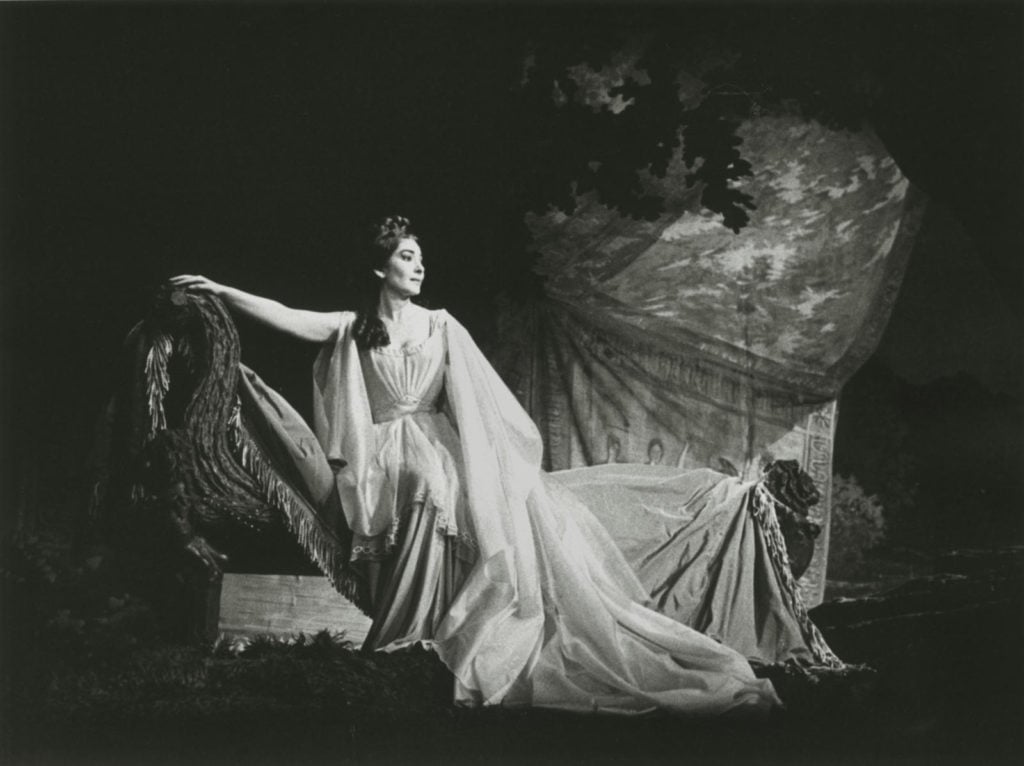
Maria Callas played Medea among many other roles in her glittering career. Greek mythology has played a huge role itself in opera as an art form. Credit: Facebook/Maria Callas
There are at least fourteen major operas that are based on themes and personages from Greek mythology and its glittering history. That says all one needs to know about the universality of Greek mythology and history, how much these have meant to the Western world, and how relevant they remain to this day.
The titanic themes of love, power, jealousy, greed, fear are all there in Greek mythology and history, and of course, they are well-represented in opera as well, which usually takes its listeners and viewers on emotional roller coasters through those same motifs.
14 operas based on Greek mythology
Operas were first conceived in the late sixteenth century, growing out of the oratorios, often using religious themes, that had been sung by groups and soloists for centuries.
Opera as we know it today began in 1597 with Ottavio Rinuccini’s “Dafne,” (Daphne), which was set to music by Jacopo Peri. Staged as court entertainment, this first opera was a tour-de-force not only of sound but of drama, as well.
The group of Florentine poets and musicians to which Rinuccini belonged, known as the Camerata, sought to revive Greek drama and music as part of the general Renaissance of Greek and Classical culture that was taking place in Western Europe at the time. Not content to explore only themes from the Bible and religious history, they felt it was now time to portray the great stories of the past.
This group of humanist intellectuals would go on to be the pioneers of opera; in many ways, they brought to life the texts written by ancient Greek philosophers, writers, and poets once again, eventually bringing these works to a modern audience.
Florence’s ruling Medici family, strong supporters of all the arts, was sufficiently taken with Dafne to allow Peri’s next work, Euridice, to be performed as part of Marie de’ Medici and Henry IV’s wedding celebrations in 1600.
Thanks to opera’s interest in and preservation of ancient Greek drama, it is no surprise that one of its founding fathers, Claudio Monteverdi, chose Greek tragedy as the theme of his first work.
L’Orfeo (Orpheus) Opera, by Monteverdi
Universally acknowledged as opera’s first masterpiece, Claudio Monteverdi’s L’Orpheo (Orpheus) was a gelling of ideas from the great minds of the Camerata and other composers of that time.
Matthew Aucoin also used this classic tale for his new opera Euridyce, which was first staged at the LA Opera in 2020—420 years after the premiere of the first opera based on Euridyce, created by Jacopo Peri.
The tragic story of Orpheus and Eurydice is as old as time itself, or at least as old as Greek mythology.
As the story goes, Orpheus, ancient Greece’s legendary hero, was endowed with superhuman musical skills. He became the patron of a religious movement based on sacred writings that were said to be his own. Orpheus was said to be the son of a Muse (most likely Calliope, the patron of epic poetry) and Oeagrus, a king of Thrace (although others say it was Apollo).
The story (and the opera) relates the tragic events of his wedding day, when his bride, Eurydice, is bitten by a snake and dies. The newly-widowed Orpheus manages to convince the rulers of the underworld to allow his wife a few more years in the land of the living.
Eurydice is only allowed to leave the underworld as long as Orpheus leads her home without looking back. He gives in to temptation, however, believing his wife is not behind him, and she is tragically trapped in the underworld forever.
In Greek mythology, the heartbroken Orpheus is then killed by wild beasts. Fortunately — certainly for opera lovers—Monteverdi created a happier ending to the story.
The story of Orpheus continues to be opera’s most popular work based on Greek mythology to this day. From Gluck’s Orpheus and Eurydice (Orfeo ed Euridice) to Philip Glass’s chamber opera Orphée, and Harrison Birtwistle’s The Mask of Orpheus, composers have been drawn to the tale for hundreds of years.
Dafni, “Daphne,” by Rinuccini
The story of Daphne, the nymph from Greek mythology who was turned into a tree to escape the lustful advances of the god Apollo, was first set to music by Jacopo Peri, but at least two of the six surviving fragments are by Jacopo Corsi. The libretto, by Rinuccini, survives complete; the music, mostly now lost, was first performed during the Carnival of 1598 at the Palazzo Corsi.
Daphne was the child of Peneus, a Thessalian river god. Her decidedly sad and violent story in which she is transformed into a tree to escape the lustful attention of the god Apollo, gives rise to the ancient explanation of the creation of the laurel tree, known as “Daphne” by the ancient Greeks.
Les Troyens, by Hector Berlioz
Les Troyens, or The Trojans, a French grand opera in five acts, is based loosely on the history of the Trojan War, although the libretto was written by Berlioz himself from Virgil’s epic poem the Aeneid. With a score composed between 1856 and 1858, it is another opera based on Greek history and mythology, and one that best exemplifies the art form.
Featuring characters such as Priam, Hector and Andromache, it is a triumph of spectacle that brings Ancient Greece vividly back to life.
“Alessandro,” by Handel
Alessandro, an opera based on the extraordinary life of Alexander the Great, was composed by George Frideric Handel in 1726 for the Royal Academy of Music. Paolo Rolli’s libretto is based on the story of Ortensio Mauro’s “La superbia d’Alessandro.” This was the first time the famous singers Faustina Bordoni and Francesca Cuzzoni appeared together in one of Handel’s operas. The original cast also included Francesco Bernardi, who was known as Senesino.
Handel’s opera received its first performance on May 5, 1726 at the King’s Theatre, London and was reportedly received “with great applause.”
The story recounts Alexander the Great’s journey to India and depicts him less in a heroic vein than as vainglorious and indecisive in matters of the heart. The work’s charm and lightness of touch make it at times almost a comic work—something which is extremely unusual in the realm of Greek mythology and history.
Atalanta, by George Friedrich Handel
The huntress Atalanta from Boeotia, the daughter of King Schoeneus, was primarily noted for her skill in running, according to Greek mythology. Atalanta was a local figure allied to the goddess Artemis. Statues of the goddess show her taking off at a full sprint.
Atalanta, the pastoral opera in three acts by George Frideric Handel, was composed in 1736.
The great composer created it for the London celebrations of the marriage in 1736 of Frederick, Prince of Wales, eldest son of King George II, to Princess Augusta of Saxe-Gotha. The first performance took place on May 12, 1736 in the Covent Garden Theatre.
Médée (Medea), by Luigi Cherubini
With a libretto by François-Benoît Hoffman (Nicolas Étienne Framéry) this is a French language opéra-comique based on Euripides’ tragedy of Medea and Pierre Corneille’s play Médée. It is set in the ancient city of Corinth.
The opera was premiered on March 13, 1797 at the Théâtre Feydeau, in Paris. During the twentieth century, it was usually performed in Italian translation as Medea, with the spoken dialogue replaced by recitatives that were not authorized by the composer. More recently, opera companies have returned to Cherubini’s original version.
Greece’s operatic queen Maria Callas performed this work to thunderous ovations in December of 1961 at La Scala, in a tour de force that has gone down in operatic legend.
Phryné
Phryné is an 1893 opéra comique in two acts by Camille Saint-Saëns, with a libretto by Lucien Augé de Lassus, based on the life of ancient Greek courtesan Phryne. Saint-Saëns also wrote the much-loved Carnival of the Animals.
Phryne, born c. 371 BC, was an ancient Greek courtesan or hetaira. She is best known for her trial for impiety, where she was defended by the orator Hypereides. She was born the daughter of Epicles at Thespiae in Boeotia but lived in Athens.
The most well-known event in Phryne’s life is her trial. Athenaeus writes that she was prosecuted for a capital charge and defended by the orator Hypereides, who was one of her lovers. Athenaeus does not specify the nature of the charge, but Pseudo-Plutarch writes that she was accused of impiety.
The speech for the prosecution was written by Anaximenes of Lampsacus, according to Diodorus Periegetes. When it seemed as if the verdict would be unfavorable, Hypereides removed Phryne’s robe and bared her breasts before the judges to arouse their pity. Her beauty instilled the judges with a superstitious fear, and they could not bring themselves to condemn “a prophetess and priestess of Aphrodite” to death. They decided to acquit her forthwith.
Temistocle (Themistocles) Opera, by Johann Christian Bach
Temistocle (Themistocles) is an opera seria in three acts by the German composer Johann Christian Bach. The Italian text is an extensive revision of the libretto by Metastasio first set by Antonio Caldara in 1736, by Mattia Verazi, court poet and private secretary to the Elector Palatine Carl Theodor.
The opera was the first of two which J. C. Bach composed for the Elector Palatine. Some of the music was reused from earlier works, including part of the overture from Carattaco (composed in London in 1767).
The opera takes place in Persia. Themistocles, together with his son Neocle, has been expelled from Athens. He arrives incognito at Susa, the capital of his arch-enemy King Serse, to find that his daughter Aspasia (in love with the Athenian ambassador Lisimaco) has also made her way there following a shipwreck. Eventually, all is revealed, and Serse magnanimously pardons everybody, unites the lovers, and makes peace with Athens.
Thespis, by Gilbert and Sullivan
Thespis, or “The Gods Grown Old,” is an operatic extravaganza that was the first collaboration between dramatist W. S. Gilbert and composer Arthur Sullivan. It is another in the much-needed genre of a lighter take on Greek mythological stories. Gilbert and Sullivan were the most famous and successful artistic partnership in Victorian England, creating a string of enduring comic opera hits, including H.M.S. Pinafore, The Pirates of Penzance and The Mikado.
Thespis premièred in London at the Gaiety Theatre on December 16, 1871. Like many productions at that theater, it was written in a burlesque style, considerably different from Gilbert and Sullivan’s later works. It was a success and closed on March 8, 1872 after a run of sixty-three performances.
The story follows an acting troupe headed by Thespis, the legendary Greek father of the drama, who temporarily trades places with the gods on Mount Olympus, who have grown elderly and are getting ignored. The actors turn out to be comically inept rulers. Having witnessed the ensuing mayhem down below, the angry gods return, sending the actors back to Earth as “eminent tragedians, whom no one ever goes to see.”
Idomeneo, by Mozart
Idomeneus, King of Crete, is an Italian language opera by Wolfgang Amadeus Mozart. The libretto was adapted by Giambattista Varesco from a French text by Antoine Danchet, based on a 1705 play by Crébillion père, which had been set to music by André Campra, as Idoménée, in 1712.
Now considered to be one of the greatest operas of all time, Idomeneo premiered on January 29, 1781 at the Cuvilliés Theatre in Munich, Germany. With Idomeneo, Mozart demonstrated a mastery of orchestral color, accompanied recitatives, and melodic line. Mozart was recorded as fighting with the librettist, the court chaplain Varesco, making large cuts and changes to it.
Orpheus in the Underworld (comic operetta version by French composer Jacques Offenbach)
With a French-language libretto by Hector Crémieux and Ludovic Halévy, this is a lighthearted, satirical treatment of the ancient Greek myth of Orpheus.
As unlikely as that seemed at the time, it is perhaps one way to deal with the almost never-ending drama, heartbreak, and tragedy that features in much of Greek mythology.
It premiered on October 21, 1858 at the Théâtre des Bouffes-Parisiens in Paris. The work’s best-known episode is, incredibly, a cancan routine that appears in the overture and the final scene.
The classic story of Orpheus concerns a renowned musician who is so distraught over the death of his wife, Eurydice, that he attempts to rescue her from the Underworld, the place of the dead. This tragic tale was adapted for opera by many composers, including Claudio Monteverdi who wrote and first performed the opera in 1607, Christoph Gluck, who first performed it in 1762, and Joseph Haydn, who in 1791 wrote his version, which was performed only in 1951.
Unlike other composers, Offenbach gave the story a modern twist, making it into a farce. In his version, Orpheus and Eurydice, though married to each other, are amicably living separate lives, each blissfully occupied with a new lover. Like Eurydice in the original Greek story, Offenbach’s heroine is fatally bitten by a snake but, rather than dying tragically, she willingly relocates to the Underworld to be with Pluto, the ruler of the Underworld, who had become her lover while she was alive.
In Offenbach’s version, Orpheus only retrieves Eurydice against his will, and both he and Eurydice are pleased when his attempt fails. Offenbach was equally irreverent regarding the music he used for this opera, alternating courtly minuets with high-kicking cancans and even quoting satirically from Gluck’s earlier opera.
When Offenbach’s opera premiered, critics expressed shock, both because it mocked Gluck’s revered telling of the tale from Greek mythology—and because it dismissed the idea of the perfection of ancient Greece.
Audiences, however, loved it, and within a few years, Orpheus in the Underworld became an international success.
Elektra, by Richard Strauss
In 1905, composer Richard Strauss attended a performance of Hugo von Hofmannsthal’s Elektra. Soon after, Strauss reached out to the playwright, having decided the play would be ideal for operatic treatment. The two men then collaborated on the composer’s second major opera.
Both the play and opera are adaptations of Greek playwright Sophocles’ Elektra and so follow the legend closely. In Greek mythology, Elektra was the daughter of the king and queen of Mycenae.
She is devastated when her father, Agamemnon, is killed. Believing her mother to be responsible, Elektra and her brother seek revenge and murder their mother and her lover.
Strauss’ version of the tragedy is set to a German libretto, and unlike the myth, his Elektra falls dead at the end of the opera.
Sappho Opera, by Charles Gounod
The story of Sappho, a female poet from the island of Lesbos, was put to music by Charles Gounod. Sappho is known for her lyric poetry, written to be sung while accompanied by music. In ancient times, Sappho was widely regarded as one of the greatest lyric poets; even then, she was given names such as the “Tenth Muse” and “The Poetess.”
Most of her poetry is now tragically lost, and what is extant has mostly survived in fragmentary form; only the “Ode to Aphrodite” is complete.
Ariadne auf Naxos Opera, by Richard Strauss
This 1912 opera by Richard Strauss has a German libretto by Hugo von Hofmannsthal. The opera’s unusual combination of elements of low commedia dell’arte with those of high opera seria points up one of the work’s principal themes: the competition between high and low art for the public’s attention.
Ariadne auf Naxos is in two parts, called the Prologue and the Opera. The first part shows the backstage circumstances leading up to the second part, making this an opera within an opera.
At the home of the richest man in Vienna, preparations for an evening of music are under way. Two troupes of musicians and singers have arrived. One is a burlesque group, led by the saucy comedienne Zerbinetta. The other is an opera company, who will present an opera seria, Ariadne auf Naxos, the work of the Composer.
The second part of the opera portrays the story from Greek mythology, with Ariadne shown abandoned by her former lover, Theseus, on the desert island of Naxos, with no company other than the nymphs Naiad, Dryad, and Echo.
She bewails her fate, mourns her lost love, and longs for death. Zerbinetta and her four companions from the burlesque group enter and attempt to cheer on Ariadne by singing and dancing but without success. In a sustained and dazzling piece of coloratura singing, Zerbinetta tells the Princess to let bygones be bygones and insists that the simplest way to get over a broken heart is to find another man.
In a comic interlude, each of the clowns pursues Zerbinetta. Eventually, she chooses Harlequin, a baritone, and the two sing a love duet together while the other clowns express frustration and envy.
The nymphs announce the arrival of a stranger on the island. Ariadne thinks it is Hermes, the messenger of death, but it is the god Bacchus, who is fleeing from the sorceress Circe. At first, they do not understand their mistaken identification of each other.
Bacchus eventually falls in love with Ariadne, who agrees to follow him to the realm of death to search for Theseus. Bacchus promises to set her in the heavens as a constellation. Zerbinetta returns briefly to repeat her philosophy of love: when a new love arrives, one has no choice but to yield. The opera ends with a passionate duet sung by Ariadne and Bacchus.
Greek mythology is the setting for many of our cultural touchstones. It has formed the theme of so many works created over the centuries by the most brilliant artists of modern times, bringing Ancient Greece to life once more.
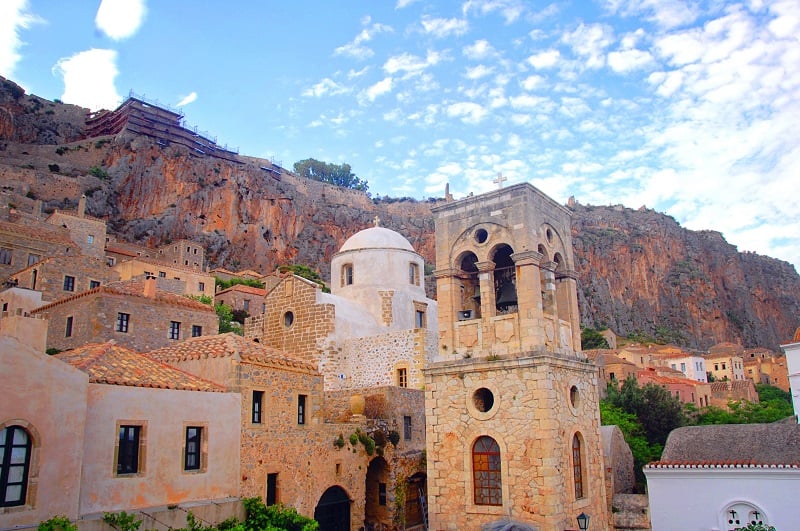
Few places in Greece possess the combined charms, natural beauty, and historical significance to the extent that Monemvasia has to offer. Public Domain
Monemvasia, on the southeastern shores of the Peloponnese, Greece is Europe’s oldest continuously inhabited castle town.
Founded in 583 by inhabitants of the mainland seeking refuge from the Slavic and the Avaric invasion of Greece and surrounded by the Myrtoan Sea, Monemvasia is located on an island about half a mile long.
A man-made road and stone bridge leads to the castle gate and main entrance of the majestic castle town and onward through the colorful and lively citadel offering all who visit her both stunning views and an unforgettable ‘ambiance’ of times past.
The entrance to the medieval castle town of Monemvasia. Credit: Jean Housen, CC BY-SA 3.0/Wikipedia
The fortress’ stone walls protected the citadel of Monemvasia from various invaders throughout its history. Invasions by the Crusaders, Venetians, and lastly, by the Ottomans have all left an indelible cultural and architectural mark, granting the citadel a unique charm and romantic atmosphere second to none.
Few places in Greece possess the combined charm, natural beauty, and historical significance to the extent that Monemvasia does.
The town’s name is derived from two Greek words, mone and emvasia, meaning “single entrance.” The “Gibraltar of the East” or a “stone ship” about to set sail, as the famous Greek poet Yannis Ritsos described his birthplace, beckons you for a journey through time, wandering through vaulted alleyways and past churches and aristocratic mansions.
Ritsos is buried in Monemvasia’s cemetery. His pompadoured bust stares at the sea from the courtyard of his childhood home in the lower town.
Ritsos’s verses, including the poem “Monemvasiotisses,” which was published in 1987 and is devoted to the town’s women, sometimes referred to this lonely rock with the single entrance. In its resilience, he celebrated freedom.
“So many years, besieged by mainland and by sea,” he wrote in his 1945 epic poem Romiosini. “They’ve all been hungry, all been killed, and yet—not a single one is dead,” Ritsos wrote.
Monemvasia: A trade center that withstood invasions
From the 10th century AD the town developed into an important trade and maritime center. The fortress withstood the Arab and Norman invasions of 1147; farm fields that fed up to thirty men were tilled inside the fortress.
By 1193 Monemvasia was a major city in the Peloponnese. Ships sailing between Constantinople (now Istanbul) and what is now Italy stopped there, giving rest to aristocrats and high-ranking church members and loading Greek exports like olive oil and wine headed for the West.
William II of Villehardouin took it in 1248, on honorable terms after three years of siege; in 1259 William was captured by the Greeks after the Battle of Pelagonia, and in 1262, Monemvasia was retroceded to Byzantine Emperor Michael VIII Palaiologos as part of William’s ransom.
Map of Monemvasia made by F. de Witt, Amsterdam, 1680. Public Domain
It remained part of the Byzantine Empire until 1460, becoming the seat of an imperial governor, a landing place for Byzantine operations against the Franks, the main port of shipment (if not always production) for Malmsey wine, and one of the most dangerous lairs of corsairs in the Levant.
After the fall of Constantinople in 1453 Monemvasia held out against the threats of Sultan Mehmed II in 1458 and 1460, when it became the only remaining domain of the Despot of the Morea, Thomas Palaiologos, the claimant to the Imperial throne. He had no forces to defend it; he offered it to the Sultan and finally sold it to the Pope.
The town was liberated from Ottoman rule on July 23, 1821 by Tzannetakis Grigorakis who entered the town with his private army during the Greek War of Independence. In 1822 it became the seat of the first national assembly.
In more recent history, the castle town has seen a resurgence in importance with increasing numbers of tourists visiting the site and the region.
The charming town of Monemvasia is made up of a labyrinth of winding cobblestoned streets that can only be traveled by foot. The medieval buildings have been restored, and many of them converted to hotels, artisans shops, boutiques, cafés and restaurants.
It has become an ideal romantic hideaway and honeymoon destination. Boutique bed & breakfasts and luxury hotels with suites boasting Turkish baths, mosaic floors and flowering courtyards will transport the visitor to another time without stinting on modern comforts. In the dimly lit rooms with their vaulted ceilings and handmade wooden furniture, visitors will live their own fairy tale.
Lower town of Monemvasia
The lower castle town’s cobblestoned principal lane is lined with tall, slim, earthy-stone houses with arched doorways and vaulted rooms. The narrower buildings have older foundations while the wider buildings are newer, dating to the 18th or 19th centuries with modern touches, such as wrought-iron balconies.
In the lower part of the town, one can explore the ruins of the historic buildings situated there—among which the Muslim Mosque, a preserved 16th century building housing the Archaeological Museum, is located along with some magnificent Byzantine churches. Twenty-four temples and churches with Byzantine elements remain from the forty that once existed.
The oldest is Elkomenos Christos, located in the main square of the Lower Town. It was probably built sometime in the 6th or 7th century and has undergone numerous transformations. Its sparse exterior does not prepare visitors for what is on display inside, namely a massive icon of the Crucifixion that dates from the Palaeologan Renaissance (a short but culturally vibrant period during which the Palaeologos dynasty sought to restore the Byzantine Empire’s glory).
It is a stunning piece of ecclesiastical art that was looted and, after undergoing several adventures, eventually made its way back to Monemvasia.
Other churches worth seeing are Panagia Chrysafitissa, Agios Nikolaos, and Panagia tin Kritikia (Myrtidiotissa).
Upper town
Rhe upper town offers panoramic views of the lower town and the sea. Credit: Dnalor 01, CC BY-SA 3.0/Wikipedia
The uninhabited upper part of the town was home to the Venetian aristocracy and, although it’s a steep climb to reach the beautiful mansions (in the 17th-century, travelers once counted 500), you’ll be rewarded with panoramic views of the whole area.
The highest peak in the upper town is about 656 feet above sea level.
The half-Byzantine, half-Venetian church of Agia Sofia clings to the side of the cliff and is one of the most significant attractions in Monemvasia. Once inside, you’ll be awe-struck by its magnificent octagonal dome.
Built by the British in 1896 and automated in 1960, the lighthouse has recently been renovated. It sits on an iceberg-like slab of rock with sheer cliffs rising hundreds of meters from the sea.
The tower is seven meters (23 feet) tall, and its focal plane is at 15 meters (49 feet).
The British writer Brian W. Aldiss once described Monevmasia as a “wonderful place,” where “only eagles and artists” should be allowed.
The United States and Iran are to sign an initial peace deal, but the date has not yet been determined. Talks continue in Islamabad with Pakistan as mediator. Photo credit: Sohail Shahzad / EPA via AMNA
The United States and Iran, says Pakistani Prime Minister Shehbaz, are to sign an initial peace deal within the next 24 hours, Reuters has reported.
The two nations have agreed on a framework for a peace deal that could end the months-long war in the Middle East, with the final text of the agreement having been drawn up. According to the Pakistani Prime Minister, his government is preparing for the two sides to sign the initial agreement electronically before proceeding to technical-level talks next week.
However, on Wednesday, the USA and Iran exchanged missile attacks, compromising the fragile ceasefire agreement.
On Friday, the Trump administration voiced confidence that the two sides would agree to peace terms, although Iranian statements on the agreement have differed from those of the US as per certain details, CNN says. A senior US administration official has likewise revealed that both sides have agreed on a written declaration and that Washington expects to sign an initial deal in the coming days.
While both sides point to progress on a peace deal, Iran asserts that the initial agreement will not be signed on Sunday. Iranian Foreign Minister Abbas Araqchi maintained on Friday that, while changes in the deal were still possible, the tentative agreement reflects his country’s strengthened position in emerging from the conflict. “Iran is the winner of the war with the US,” he said on state television on Friday.
Trump speaks of imminent signing of agreement
On the other hand, US President Trump claimed on Friday that a deal was likely to be signed imminently. That was a day after the US President had declared the US would strike Iran “very hard” again. Later in the day, however, he announced he would be cancelling the strike since negotiators had “just made a great settlement” with Iran.
Trump told reporters it was “subject to finalization of documents, which should get done over the next few days” and that there would “probably” be a signing ceremony in Europe.
Citing multiple sources, Reuters has reported that an agreement includes the US releasing billions of dollars in frozen Iranian assets and waiving sanctions on its oil exports in return for Iran’s opening of the Strait of Hormuz. Furthermore, Iran’s nuclear program would be addressed during a 60-day period of talks. As per the US President, the agreement would ultimately lead to the dismantling of Iran’s nuclear program, with its stockpile of highly enriched uranium to be destroyed and removed.
According to other sources, however, Iran has not agreed to the dismantling of its nuclear program and wants to retain its uranium stockpile in a diluted form. The proposals are also said to include discussions on potential war reparations for Tehran and the possibility of the United States dropping its longstanding demands for limits on Iran’s missile program.
Ultimately, it awaits to be seen whether the deal will in fact be signed by the leaders of the two nations.
Sogdians on an Achaemenid Persian relief from the Apadana of Persepolis, offering tributary gifts to the Persian king Darius I, 5th century BC. Credit: A.Davey / CC BY 2.0
The country known today as Iran extends from the Persian Gulf and the Indian Ocean in the south to the border of Turkey and Turkmenistan in the north. The territory of Iran is equivalent to much of the ancient Persian Empire. In the southwest part of Iran was the historic region of Persis, or Persia proper, and Iran was called “Persia” until the twentieth century. Why did it have that name, and where did it come from?
The land of Persis, or Persia, in modern-day Iran
There is an area in modern-day Iran, the Fars Province, sometimes written as “Pars.” This province occupies most of the immediate region on the eastern side of the Persian Gulf.
Map of the Persian Empire, centered on Iran, from Historical Atlas, William R. Shepherd, 1911. Credit: Wikimedia Commons, Public Domain
This region is roughly equivalent to the ancient land of Persis. Scholars also refer to this as Persia proper. This was the land of the ancient Persians. They probably resided in this land for a few centuries before they managed to forge an empire for themselves.
Therefore, even after forming a large empire, this region was still distinctly known as Persis. This is where the Fars Province derives its name. Similarly, the Babylonia region in Iraq remained a distinct part of Mesopotamia even after its people established the Babylonian Empire, which encompassed much of the Fertile Crescent.
Where does the name ‘Persia’ come from?
The place name ‘Persia’ originates from the name that the ancient Persians gave to their land, which in ancient Persian was ‘Parsa’. The Greeks adapted this into ‘Persis’, and later, the Romans adapted the Greek term into ‘Persia’.
The Persians gave the name ‘Parsa’ to their land (roughly the Fars Province), apparently after themselves, whom they also called ‘Parsa’. This was their native ethnonym.
Partially based on ancient Assyrian records, many scholars believe that the Persians migrated into Persia from the north. The earliest ancient inscriptions which refer to Persia, or Parsa, in the Fars Province of southwestern Iran date to approximately the middle of the first millennium BCE.
On the other hand, around 900 BCE, Assyrian inscriptions refer to a location called Parsua, much further north. The similarities between ‘Parsua’ and ‘Parsa’ are strong, leading many scholars to believe that they are different forms of the same word.
Perhaps due to constant Assyrian attacks, the Persians may have migrated south from Parsua, near Armenia, all the way to the Fars Province next to the Persian Gulf. If so, then during their early history, the Persians may have been called the Parsuash.
Perseus and Perses in Greek Mythology
In Greek mythology, Perseus was the legendary founder of the Perseid dynasty and one of the greatest heroes before the age of Heracles, alongside figures like Cadmus and Bellerophon. He is best known for slaying the Gorgon Medusa on behalf of King Polydectes and for rescuing Andromeda from the sea monster Cetus.
According to Greek tradition, Perseus and Andromeda had a son named Perses. He came to be regarded as the forefather of the Persian people. According to Herodotus, Xerxes invoked this ancestral link in an effort to gain the support of the Argives during his campaign in Greece, though his attempt was unsuccessful.
First Alcibiades, a dialogue from the late 4th century BC attributed to Plato, implies that one of Perses’ descendants was Achaemenes, the traditional forefather of the Achaemenid dynasty of Persian kings.
The empire of Persia, which ruled from Iran
Of course, the Fars Province is only a small part of Iran. So, why was Iran as a whole called Persia in ancient times, and as recently as the twentieth century? The reason ultimately goes back more than two and a half millennia.
King Cyrus of the Persians carved out an enormous empire in the sixth century BCE. This took in all of present-day Iran, Iraq, Syria, Israel, and much more, bringing down three empires in the process. For a time, contemporary Greek writers used ‘Persia’ to refer to the entire empire.
In the late fourth century BCE, Alexander the Great defeated and conquered the Persian Empire. This ended Persian control over everything apart from the Fars Province. How, then, did the name ‘Persia’ continue to be applied to the entire region of modern-day Iran?
Persis regains its strength
The answer partially goes back to the third century CE. At that time, Ardashir I, a king of Persis, founded the Sasanian Empire. This reconquered large portions of the former Persian Empire of King Cyrus.
Eventually, in the seventh century, the Muslims conquered all of the territory of the king of Persis. Nevertheless, by this time, the term ‘Persia’ had come to be commonly used for that entire region. Furthermore, the inhabitants continued holding a distinct cultural identity, in contrast to the surrounding area.
The term ‘Persia’ continued to be used even after the Muslim conquest. This is why the country of Iran was formerly called Persia in ancient times, and the name persists in the modern world.
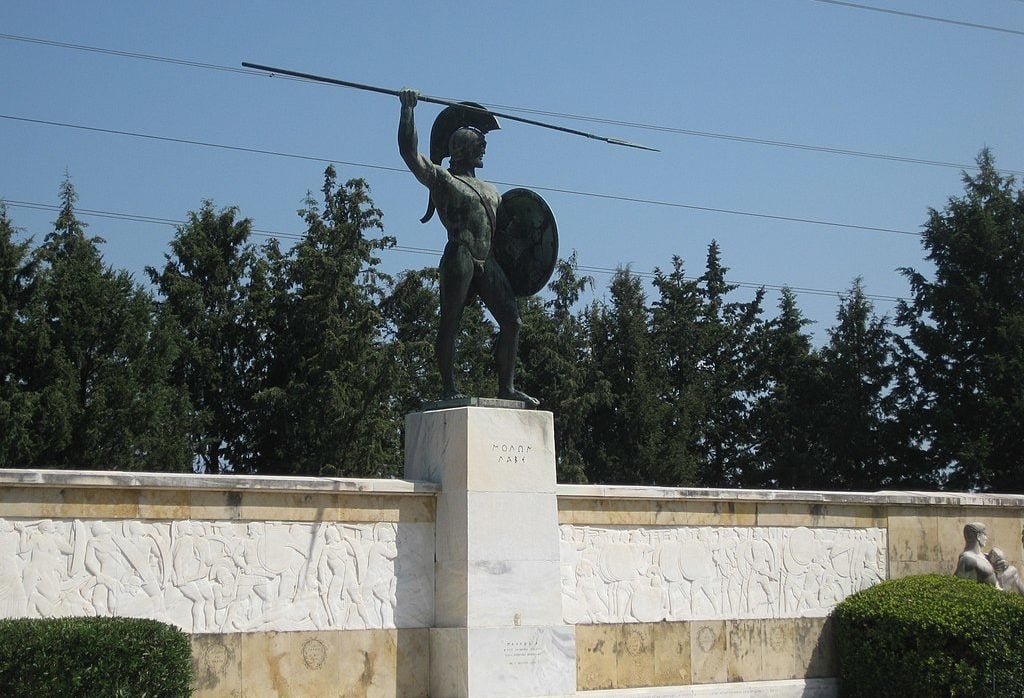
Statue of Leonidas of Sparta, Greece. Credit: Dmpexr/Wikimedia Commons/CC BY-SA 4.0
It was in 480 BC during the second Persian invasion of Greece, when King Leonidas of Sparta ahead of the legendary Battle of Thermopylae responded by the phrase “Molon Lave” (‘Come and Take Them’ in ancient Greek) to Persian King Xerxes’ demand that the Spartan army lay down their weapons and surrender to his army. The outnumbered Greeks were eventually annihilated, though they held Thermopylae for three days and inflicted serious damage to the Persians, while delaying them from reaching Athens.
That’s how the story ended back then. But little did King Leonidas know that over 2,500 years later, his “Molon Lave” phrase (also spelled “Molon Labe” by many) would not only become immortalized through the centuries but moreover, it would thrive as a global marketing tool -linked to the sale of weapons, wine, olive oil, expensive watches and even cigars.
King Leonidas I reigned the ancient city-state of Sparta, a warrior society, from 489 to 480 BC. Subjected to military drills since early manhood, the Spartans had become one of the most feared and formidable military forces in the ancient Greek world, attaining legendary status in their wars against Persia. At the height of Sparta’s power, between the 6th and 4th centuries BC, according to Peter Connolly, a British historian and the scholar of the ancient world, other Greeks commonly accepted that “one Spartan was worth several men of any other state.”
“The appeal of Molon Lave comes from its Spartan origins,” Effie Delimarkos-Fletcher, a Greek-American communications expert and marketing strategist tells Greek Reporter. “Spartans themselves have come to symbolize power, strength, resolve, and defiance, which was catapulted into the mainstream with the debut movie of ‘300.’ As a result, aligning with the phrase “Molon Lave” is a distinct way for a brand to signal strength and prowess in an area worth defending.”
Moreover, there are few other phrases like “Molon Lave,” where two single, short words are able to convey all that, perhaps the most famous military last stand of all time, embodies -defiance, strength and resolve. Spartans were expected to be men of few words, famous for using “laconic phrases,” named after Laconia, the region of Greece, including the city of Sparta, whose ancient inhabitants had a reputation for verbal austerity. A laconic phrase was used for efficiency (as during military training and operations), for emphasis or to deflate a pompous speaker.
The company has applied for and successfully registered the ‘Molon Lave’ brand in Greek, as seen on the handle of the knife. Credit: Panther WholesaleAnother Florida-based company named “Molon Labe” is selling high-quality cigars, spirits and coffee, and as with most other businesses, is also using a Spartan helmet on its logo. Credit: Molon Labe Official Instagram Account
Military, the industry where Molon Lave has the largest appeal as a brand
From tactical patches and other military paraphernalia sold online, to assault rifles sold in stores across the United States, the phrase “Molon Lave” graces thousands of military-related products.
According to Delimarkos-Fletcher, Molon Lave and its English translation “Come and Take Them” has been present in the country’s early DNA as it is said to have been used as far back as the Revolutionary War. Even so, it is better known for its connection to the Texas Revolutionary War, when the phrase was stitched onto a flag that has come to be associated with the defiant spirit of the state. In more recent times, many U.S.-based militia groups and paramilitary organizations have taken the phrase “Molon Lave,” and often the depiction of a Spartan helmet, signaling defiance for gun regulations.
“Because Molon Lave has been adopted by militia-type groups in the United States, securing the Molon Lave trademark is done by companies looking to appeal to that target,” Delimarkos-Fletcher says.
And that’s exactly what at least one US.-based company had done. A short Greek Reporter investigation revealed that, while there are hundreds of knives and weapons with the phrase “Molon Lave” appearing on them in different variations, in 2015 this one company has gone as far as to apply for and successfully register a year later a trademark for the original Molon Lave phrase in Greek (ΜΟΛΩΝ ΛΑΒΕ) for one of its knives selection. The company, advertises the knives on its website by stating “It takes a bold individual to make a statement of defiance like ‘Come and Take Them (Molon Labe),’ we provide the knives that re-enforce the bravado.”
But can a company apply and secure a trademark for the use of a common, ancient phrase like Molon Lave, that seems almost free for anyone to use?
According to Pamela Koslyn, a Los Angeles-based attorney specializing in intellectual property law, U.S. legislation allows a company to successfully apply for a trademark for a brand new phrase, or an “ancient” phrase or an invented word/phrase, with the age and origin of the phrase being irrelevant.
“A trademark isn’t a monopoly on a phrase, it’s a source identifier of some phrase associated with some goods or services. Like knives. Or olive oil. Or wine. These are all actual “live or pending marks of Molon Lave…There’s also a Chinese textile seller called Molon Lave,” Koslyn tells Greek Reporter. “If a user has a registered trademark on a phrase in a particular class, e.g. knives, that means the user own the exclusive right to use their mark in association with their goods or services and can theoretically successfully sue and enjoin any competitor who infringes those rights by using the same or confusingly similar mark for the same or confusingly similar goods or services.”
Still, Koslyn notes, that one in two trademark applications to the United States Patent and Trademark Office (USPTO) fail not only because they’re not viable or available but moreover because of the complexity of the law and the time needed to find out if an application has been approved by USPTO -a process that could take months if not years.
On its website, the restaurant says that it’s “based on the Spartan epic saying Molon Lave, which means ‘Come and Get Them,'” and has a mission “to celebrate and share Greek cuisine and culture.”Credit: Molon Lave Taverna Official Instagram Account
The famous ancient Greek phrase many want to own
But few actually register the phrase in order to enhance their branding or make their products stand out more. Given the enormous competition among companies to win the hearts of consumers, proper branding and marketing could mean the difference between life and death for a company. And given its global fame, that’s exactly what “Molon Lave” does.
Nowhere is this more obvious than in the United States, the beating heart of global consumerism. A family-owned farm winery in Virginia was established in 2009 under the name “Molon Lave.” Aside from informing its customers that it also produces “kokkineli,” a traditional Greek style rose, the winery fully explains on its website the origins of its name, noting that “‘Molon Lave’ is a phrase that has inspired throughout the centuries a sense of dignity and pride, and a unique perception of life.”
Another Florida-based company named “Molon Labe” is selling high-quality cigars, spirits and coffee, as with most other businesses, also using a Spartan helmet on its logo. Moreover, the cigars are wrapped in paper bearing the phrase in Greek. The company on its website gives no explanation as to why it chose the specific name.
A consumer browsing the handmade watches of the UK-based company. Credit: Greek Reporter
Greek Reporter’s investigation also found a watch company with the name “Molon Labe” based in the UK, selling handmade, military watches inspired by the phrase, with some having a price tag of over $1,500. There’s also a global security company named “Molon Lave,” an information technology service activity company in the UK and a gym in Cyprus, featuring on its premises the bust of a muscular Spartan soldier alongside the “Molon Lave” phrase, which is showcased in ancient Greek type. The list goes on.
With a fortitude reminiscent of the very people it once represented, the phrase “Molon Lave” survived to this day as one of the few expressions that so efficiently evoke an immediate connection not only to power but also to Greece.
It is no wonder the phrase has also been adopted as the name of a “small, Greek authentic restaurant” in Ontario, Canada, which on its website says that it’s “based on the Spartan epic saying Molon Lave, which means ‘Come and Get Them,'” and has a mission “to celebrate and share Greek cuisine and culture.”
At the same time, a thriving Greek olive oil brand named “Molon Lave” based in Sparta, the place where King Leonidas and his Spartan warriors once lived, is probably one of the more successful examples using the phrase as a marketing tool.
Delimarkos-Fletcher says many using the phrase may not even know its true origins so it is refreshing to see Greek-related businesses reclaiming Molon Lave as they “seek to evoke a connection to the best known story of Greek strength and prowess.”
“Other brands are just using ‘Molon Lave’ as shorthand for having something powerful enough that others want for their own,” Delimarkos-Fletcher tells Greek Reporter.
The winery explains on its website the origins of its name, noting that “‘Molon Lave’ is a phrase that has inspired throughout the centuries a sense of dignity and pride, and a unique perception of life.”Credit: Molon Lave Vineyards Official Instagram Account
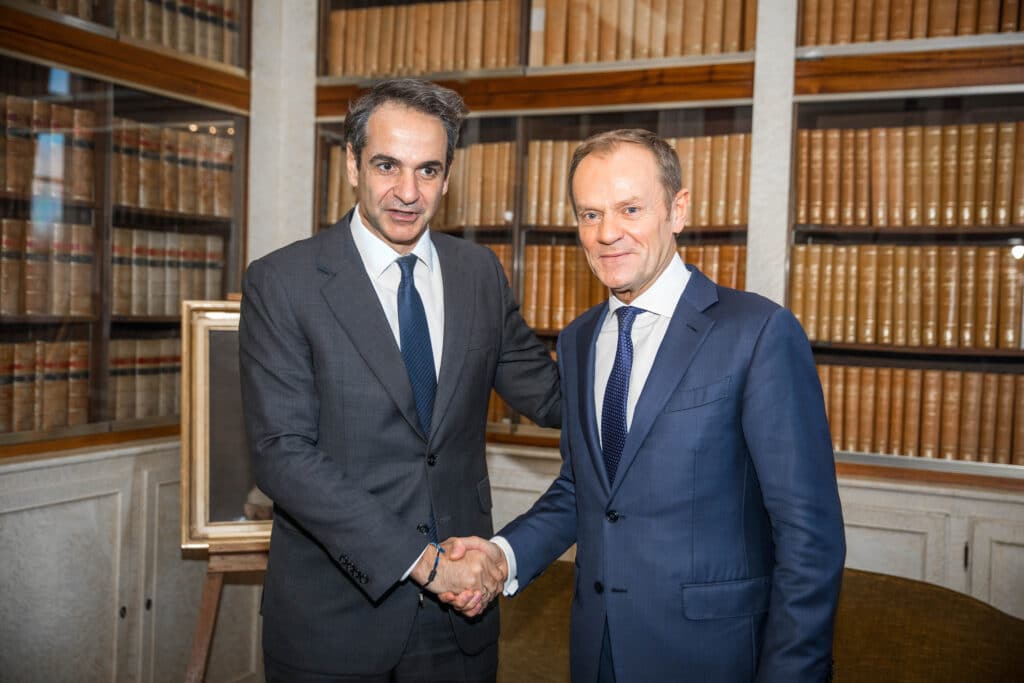
Prime Minister of Greece Kyriakos Mitsotakis with Prime Minister of Poland Donald Tusk. Credit: connect@epp.eu. CC BY 2.0/flickr
The Greek community in Poland has now officially been recognized as a national minority following the signing of a legislative amendment by the President of Poland, Karol Nawrocki.
According to an announcement by the Embassy of Greece in Warsaw, the process of amending the law concerning national and ethnic minorities and regional languages was finalized, with the result being that the Greek community is now included in the recognized national minorities of Poland.
There are currently 3,600 to 4,000 Greeks living in Poland, according to Greece’s Ministry of Foreign Affairs, with the Greek presence in the country going back to the Middle Ages. The new demographic development makes Greeks the tenth recognized national minority in Poland and established a new institutional framework for the operation and development of Greek communities.
Provisions for acquiring national minority status in Poland
Under the provisions of the 2005 Act in Article 2(1), a community can be recognized as a national minority in Poland after fulfilling all of the following conditions:
Is smaller in number than the rest of the population of the Republic of Poland
Is significantly different from other citizens in terms of language, culture, or traditions
Strives to preserve its language, culture, or traditions
Is aware of its own historical national community and is oriented towards its expression and protection
Its ancestors have inhabited the present territory of the Republic of Poland for at least 100 years
It identifies with the nation organized in its own state (Polish Parliament, 2005)
The Greek community in Poland meets all the criteria and is therefore now an official national minority.
Rights and benefits for Greek minority in Poland
With the implementation of the new law, Greek associations and organizations gain access to state funding programs through the Ministry of the Interior and Administration of Poland. At the same time, support is provided for cultural activities and structures, such as libraries, museums, cultural centers, festivals, and media related to the Greek presence in the country.
Particular emphasis is also attributed to education. The Polish public education system will be able to organize programs in the instruction of the Greek language, history, and culture for students of Greek origin. The new framework also provides for the possibility of using traditional Greek script in the personal details of community members in official documents, where this is permitted by law.
Political representation
Recognition as a national minority is also accompanied by special political provisions. These include the exemption of the electoral committees of the Greek community from the five percent electoral threshold in the elections for the Polish Parliament (Sejm), as is the case for other recognized minorities.
In a statement, the Embassy of Greece in Warsaw thanked the Polish institutions for the decision, making special reference to the Lower House, the Senate, and the President of the Republic. At the same time, it underlined the contribution of the Greek community itself and the diaspora, noting that after many years of efforts by Greeks, its members contributed to achieving recognition. The legislative amendment is expected to go into effect six months after its publication in the Polish Government Gazette.
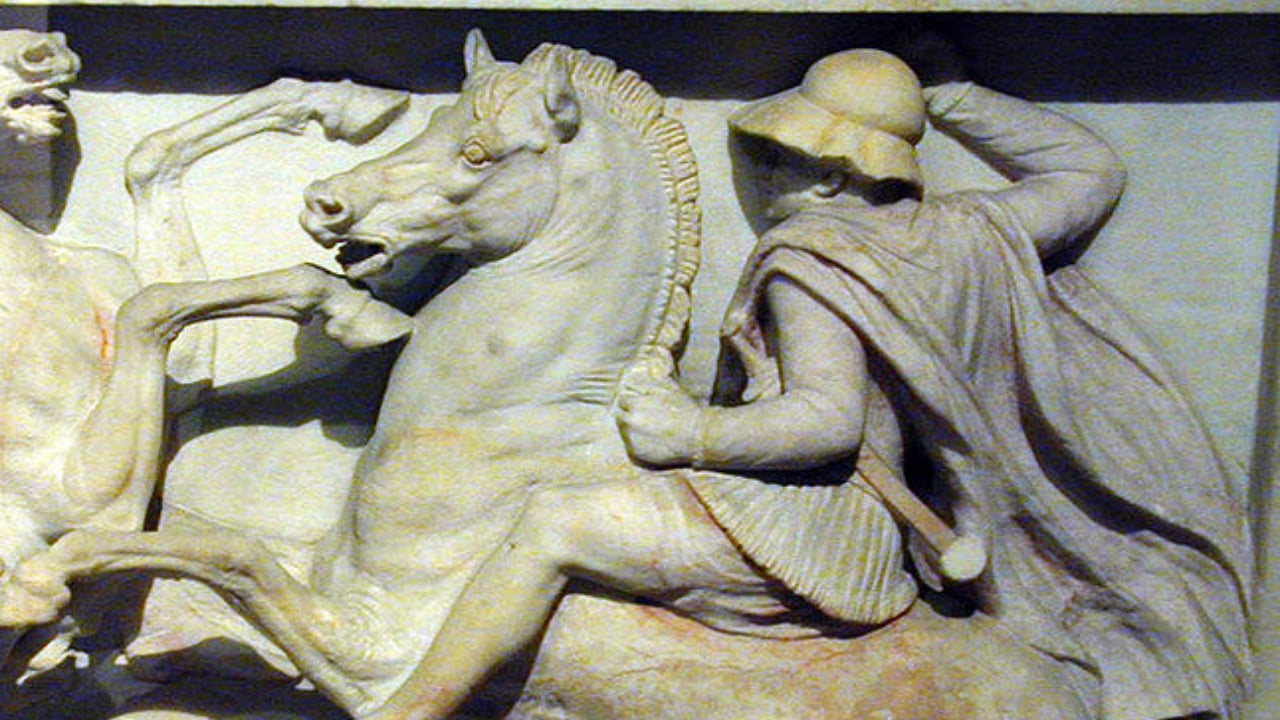
A Companion or Thessalian cavalry soldier depicted on the “Alexander Sarcophagus”. Credit: Marsyas / Wikimedia Commons CC BY 3.0
During his campaigns, Alexander the Great relied on a variety of military units for tactical success; the most prestigious of these units were the Companions, the elite mounted shock cavalry of the Macedonian army.
The Companion Cavalry, known in Greek as the Hetairoi (ἑταῖροι), were capable of delivering devastating charges against massed infantry formations. Their timely charges often proved decisive at crucial points during a battle and they were an invaluable tool that complimented Alexander’s preference for hammer and anvil tactics.
The Companion cavalry was just one piece of the puzzle that constituted the revolutionary combined arms warfare model employed by the ancient Macedonian army. However, as the king’s elite mounted warriors and bodyguards, they were often closest to Alexander during battle and are certainly among the most prestigious military units to have left their mark on the history books.
Organization of the Companion cavalry
The Companions were the Hetairoi of the king and the most senior unit in the ancient Macedonian army. As such, they were customarily deployed in the place of honor on the right wing of the army.
Most of the Companions would have been of noble birth, able to afford a horse and the necessary equipment. In fact, many of the Companions were close friends or allies of the king, so membership in the unit offered an opportunity for social and political status.
According to an academic paper authored by British historian Peter Brunt appearing in The Journal of Hellenic Studies, the Companions during Alexander and Philip II’s time were organized into eight squadrons called ilai. Each ile consisted of about 200 to 300 horsemen. One of the squadrons, called the agema, was the royal squadron and would usually be led in person by the king.
Statue of Alexander the Great in Thessaloniki. Credit: Alexander Gale / Greek Reporter
Equipment
For armor, a member of the Companion cavalry would have worn either a linothorax or a muscle cuirass to protect the torso. To protect the head, a Boeotian helmet was typically worn, chosen for the unobstructed vision it granted its wearer.
The primary armament of a Companion was the xyston, a long thrusting spear that was between 3.5 to 4.25 m (11 to 14 ft) long. Historians believe that it was usually wielded with two hands and that it could be held with an overhead or underarm grip depending on the situation.
Alexander the Great linothorax inspired by Pompei mosaic, displayed at the National Archaeological Museum of Naples, Italy. Replica created by Demetrios Katsikis. Credit: Mark Geranios
The Companion cavalry carried swords as secondary weapons. They had two to choose from: the kopis and xiphos. The kopis was arguably the better choice for mounted soldiers because the curved single edge and weight distribution made it an excellent weapon for powerful chopping strikes, particularly against infantrymen who would have stood below a mounted warrior.
The ancient Greek soldier and writer Xenophon thought as much and wrote: “I recommend a kopis rather than a xiphos, because from the height of a horse’s back the cut of a machaira will serve you better than the thrust of a xiphos”.
An iron kopis, sometimes also called a machaira, dating back to the 5th or 4th centruy BC. Observe how the curvature and weight distribution of the weapon makes it excellent for cutting and slashing strikes. Credit: Metropolitan Museum of Art / CC0 / Wikimedia Commons
Tactics of the Companion Cavalry
The Companion cavalry was most effectively used in conjunction with the other units of the Macedonian army. The infantry, whose main component was the pike phalanx, would act as the anvil by holding the main enemy force in place, whilst the Companion cavalry would act as the hammer, circling behind the enemy to charge in the flanks or rear – hence, the hammer and anvil.
The Companions played crucial roles in battles such as Chaeronea, where the renowned Sacred Band met their defeat, the Battle of Granicus in 334 BC, the Battle of Issus in 333 BC, and the Battle of Gaugamela in 331 BC.
The Companion cavalry often charged the enemy in the “flying wedge” formation designed to maximize the impact of the charge. According to the Greek historian Arrian, this formation was first used by the Scythians. Philip II later adopted the formation from them or the Thracians.
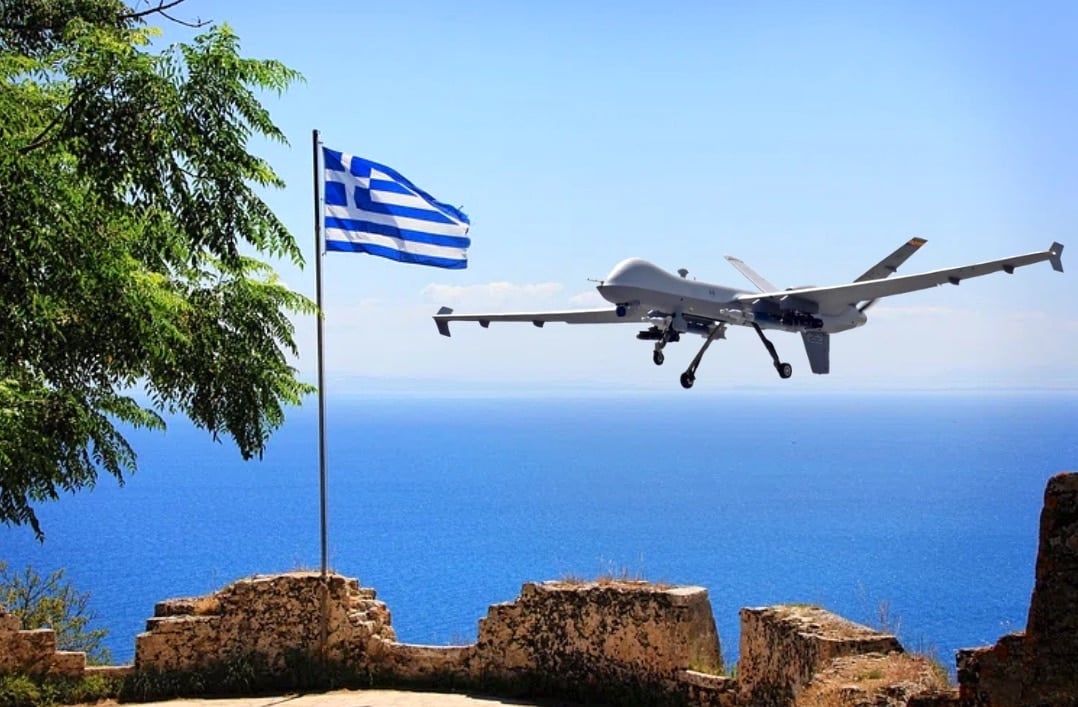
Greece launched a new plant to increase the industrial-scale production of drones. Credit: GreekReporter Archive
Greece inaugurated a new manufacturing plant on Friday to upgrade the production of drones (Unmanned Aerial Vehicles, or UAVs) on an industrial scale. Greek Minister of National Defense, Nikos Dendias led the inauguration ceremony of the 309th Unmanned Aerial Vehicle Systems Manufacturing Plant in Malakasa in Greater Athens (Attica).
“Unmanned Systems and Unmanned Countermeasure Systems, i.e. anti-drones, are an integral part of the new operational concept of the Armed Forces,” Dendias stated. “The new Unmanned Systems Manufacturing Factory is coming to transform an initial capability into an industrial-scale production. It is the first large industrial installation of the Greek Armed Forces that is completely specialized in the manufacturing of Unmanned Vehicles.”
The project inaugurated includes two distinct interventions in the Armed Forces Camp: complete reconstruction and modernization of the old facilities of the camp with restoration of its static adequacy as well as external and internal damages. The facilities will be converted into modern production, support, and technical work areas and cover an area of 2,800 square meters (almost 30,140 sq ft). The necessary steps are currently being taken so that work on the 309th Factory can begin within 2026.
Greek Defense Minister Nikos Dendias inaugurated a new drone manufacturing and R&D facility. Photo credit: AMNA
More production lines and RD facilities
The Greek Defense Minister spoke about the new facility being part of the new Armed Forces project:
“The ‘2030 Agenda’ is a holistic program for the protection of our homeland with a specific design. The ‘Achilles Shield’ project…extends to the sea, on land, in the air, but now also in cyberspace and space. And it has a basic concept, a basic parameter: the change of everything as we know it. Today’s ceremony marks this program. Unmanned Systems and Systems for Countering Unmanned Systems, i.e. anti-drones, are an integral part of the new concept of operations. Autonomous Systems in the air, at sea, and on land, are the organic element of the modern operational environment, across the entire spectrum of missions.”
Dendias also touched on the importance of the Greek Armed Forces being prepared to respond to international threats: “A country that has received an active threat against it, does not have the luxury of passively monitoring what is happening.” The new facilities in Greece will develop production lines for: class I and II drones, research and development of class III drones, Unmanned Ground Vehicles, Unmanned Surface Vessels, Unmanned Underwater Systems, and anti-drone manufacturing.
“A leap forward” in drone production in Greece
According to the Defense Minister, the goal is to increase the annual production of class I drones to at least ten thousand from the current four thousand, the annual production of at least three hundred class II drones, as well as three hundred ground vehicles and an equal number of anti-drones, while building up the capabilities for Research and Development of Surface Vessels and Submarine Vessels.
The second major intervention is the construction of a new building with a total area of 3,600 square meters (38,750 sq ft) to develop on two levels. This will constitute the core of the complex, housing advanced production lines, Research and Development areas, Laboratories and Test Centers.
In addition to an increase in production, its construction will also allow for new specialized R&D capabilities as well as close cooperation with the defense industry and the country’s research institutions.
“Today,” Dendias emphasized, “we are taking a big step forward. I dare say, a leap. This new Unmanned Systems Manufacturing Factory is coming to transform an initial capability into an industrial-scale production. It is the first large industrial installation of the Greek Armed Forces, which is completely specialized in the manufacturing of Unmanned Vehicles. The 309th Unmanned Vehicle Systems Factory.”
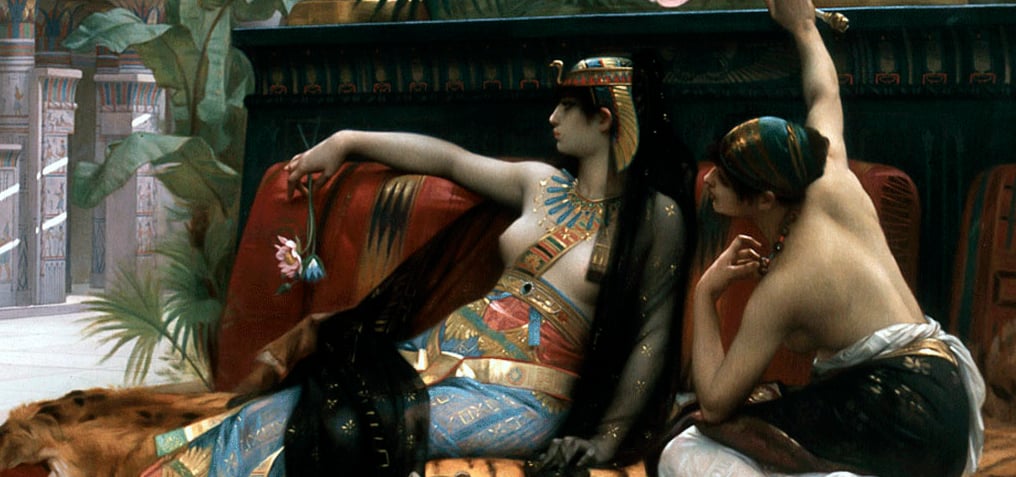
Cleopatra by Alexandre Cabanel. The Egyptian queen created her own secret drinking club with lover Mark Antony. Credit: Public Domain
Cleopatra was not just a famed Greek queen of Ancient Egypt but was also known for her love of parties. She even created her own secret drinking club.
The famous ancient ruler became well known during her time for her intellect and wit and was often described as incredibly seductive and persuasive. These qualities made her all the more mysterious throughout the centuries.
She is now a popular figure in media, literature, and art, and her enchanting qualities, romantic relationships, and beauty are of particular interest to people.
Perhaps the most surprising fact about Cleopatra, who was a strategic and often cutthroat ruler, is that she was quite the reveler.
Cleopatra maintained a relationship with Roman leader Mark Antony and even gave birth to his twins, Alexander Helios, which means sun, and Cleopatra Selene, which means moon, shortly after Antony returned to Rome in 40 BC.
While Antony was living in Egypt with Cleopatra, despite being married in Rome, the pair would throw parties and were known to appreciate a good drink.
Cleopatra formed a secret drinking club, played pranks
In fact, Cleopatra and Antony created their own secret drinking club called “The Inimitable Livers,” ostensibly as a group to honor the god Dionysus but likely to drink and revel.
In 41 BC, the couple formed the group, which included nightly feasts and debauchery, as well as the consumption of copious amounts of alcohol.
Along with these drinking parties, Antony and Cleopatra were known to roam around the streets of Alexandria, the urban center of ancient Egypt, wearing disguises and pulling pranks on locals.
Cleopatra generally loved joking around and even pranked her Roman lover. According to Pliny the Elder, Cleopatra once bet Antony that she could spend 10,000,000 sesterces, which is likely equivalent to over $10 million today on one dinner alone.
Antony balked at the preposterous idea and agreed to the bet, believing that spending such a massive sum on one dinner was impossible.
Cleopatra and Antony then went to dine together, and the couple was served a completely normal meal which definitely wasn’t worth such a sum.
As the meal was ending, Antony was beginning to believe he had won the bet. Cleopatra, however, called one of her servants over and asked for a cup filled with strong vinegar.
Once the servant brought the vinegar to the queen, Cleopatra removed one of her massive pearl earrings from her ear and dropped the precious earring into the cup.
The pearl, which was worth a huge amount of money, then began to dissolve in the vinegar solution. After it was fully dissolved, Cleopatra drank the solution.
Cleopatra VII Philopater ruled over Ancient Egypt from 51 to 30 BC and was the last ruler of the Ptolemaic Kingdom in Egypt. After her death, the Roman Empire took control of the country.
The Ptolemaic Dynasty was formed by Ptolemy I Soter, a Greek general in Alexander the Great’s army, in 305 BC. Although located in Egypt, the dynasty that Ptolemy established remained incredibly Greek.
Cleopatra, a direct descendant of Ptolemy, was the first Ptolemaic ruler to learn the Egyptian language, as all those before her spoke only Greek. She was also believed to have spoken Ethiopian, Hebrew, Aramaic, Arabic, Syriac, Median, Parthian, and Latin.
The name Cleopatra comes from the Ancient Greek words κλέος (kléos), meaning “glory,” and πατήρ (pater), meaning “father,” which means “glory of her father.”
Greeks of the 5,000-year-old village were ethnically cleansed and then forcibly expelled in 1922. Credit: Wikitestaccountlogin, CC BY-SA 4.0/Wikipedia
The ghost village of Levissi (known today as Kayaköy) was once a bustling Greek village on the slopes of a hill in the district of Fethiye, Turkey.
It was practically right across from the island of Rhodes.
Greeks of the 5,000-year-old village were ethnically cleansed and then forcibly expelled in 1922, causing 10,000 people to leave behind the land of their heritage.
It was anciently known in Greek as Karmylessos. In late antiquity, the inhabitants of the region had become Christian, and, following the East-West Schism with the Church of Rome in 1054 AD, they came to be called Greek Orthodox Christians.
These Greek-speaking Christian subjects and their Turkish-speaking Muslim Ottoman rulers lived in relative harmony from the end of the turbulent Ottoman conquest of the region in the 14th century until the early 20th century.
The massacres of Greeks and other Christian minorities in the Ottoman Empire during World War I (1914–1918) led to the almost total depopulation of the town’s 6,500 Greek inhabitants by 1918. These former inhabitants were deprived of their properties and became refugees in Greece, or they died in Ottoman forced labor battalions.
Following the Greco-Turkish War of 1919–1922 and the subsequent Treaty of Lausanne in 1923, the town’s Greek Orthodox residents were exiled.
A panoramic photo of the abandoned village. Credit: Darwinek, CC BY-SA 3.0/Wikipedia
Greek ghost town
Since then, the homes have remained vacant, left to decay after being further damaged by a huge earthquake in 1957.
Houses and churches in the area have been used for summer festivals. However, plans to lease the area and auction it off for commercial interests have caused local Turks as well as Greeks with roots in the area to protest. They are worried that the investors could further ruin the authenticity of the area.
The ghost town, now preserved as a museum village, consists of hundreds of rundown but still mostly standing Greek-style houses and churches that cover a small mountainside and serve as a stopping place for tourists visiting Fethiye and nearby Ölüdeniz.
The village is now empty except for tour groups and roadside vendors selling handmade goods. There are a few houses which have been restored and are currently occupied.
American filmmaker Joerg Schodl set out to document what is left of the ghost town in his documentary, “Ghosts of Levissi.”
Schodl tells the tale of the small Greek community in Asia Minor that was torn apart during the final days of the Ottoman Empire. It focuses on the disappearance of the population practically overnight thanks to campaigns, designed to scare Greeks from Levissi and nearby Macri (known as Fethiye), including offensives by Turks. The site Greek Genocide reports that women were raped and their clothes and shoes taken from them.
When making the film, Schodl had the help of members of the Greek community in Melbourne, Adelaide, Sydney, Perth and Brisbane and he was able to find thirteen descendants of Levissi families.
More descendants were found in Toronto, Rhodes, London, Athens and Istanbul.
Ancient Greek woman taking bread out of the oven. Terracotta figure . 5th century BCE found in Tanagra. Exhibited at the Louvre Museum. Credit: Marie-Lan Nguyen CC BY 2.5
The ancient Greeks used to make a wide variety of breads, as they considered it to be of great importance in their eating habits.
Wheat, considered a gift from the goddess Demeter, was highly valued by the Greeks, who particularly preferred the hulled varieties. Barley, however, thrived in larger regions of mainland Greece. The varieties of wheat and barley with hulls had to be dried to separate the grain before they could be ground. Most Greeks, however, even in areas where wheat cultivation was economically unprofitable, were fond of wheat bread.
Bread made from hulled barley and porridge formed the basis of the ancient Greeks’ diet. The bread was enriched with olive oil and flavored with herbs, spices or honey.
Athenian bread was renowned for its excellent quality and was a source of pride for the Athenians, who imported wheat as the soil of Attica was unsuitable for its cultivation. Thearion, an Athenian of the 5th century BCE, had the honor of being considered the inventor of bakery ovens, and probably of the first bakeries.
Plato mentions Thearion the baker as one of the three people who “were the best caretakers of the human body.” The other two were Mithaecus, a Sicilian, the first known cookbook writer, and Sarambus, a famous wine maker.
The ancient Greeks showed great ingenuity and skill in the art of baking. Athenaeus cites many serious studies on the subject and lists over seventy different types of bread.
Breads were distinguished according to the grain used in their preparation: wheat, rye, millet and spelt. The last three were used only out of necessity, as everyone preferred wheat.
There was bread made from various types of flour: white bread made from finely sifted flour, black bread made from wholemeal flour, which was healthier. Nevertheless, ancient Greeks preferred white bread, because they considered it more refined and better tasting.
Bread was leavened with or without yeast and could be differentiated according to the baking method: oven bread, bread baked on embers or in a pan over the fire into which they put a filling and then dipped it in wine. Delicious, if we believe the praises of the poets: “bread spread from embers, a soft and delightful combination.” Also, some baked the dough on a spit.
The various liquids, fats and spices added to the flour could vary the density and taste of the bread. Wine, milk, cheese and honey, separately or combined in some way, as liquids, oil, ghee or lard as fats, but also poppy seeds, sesame and linseed are most often mentioned as spices.
Finally, the bread would be filled with various types of cheese, raisins and other nuts, sweet or savory ingredients. The bread was often served as a plate, on which meat or fish was placed.
Bread was kneaded and baked in homes, seasoned with sea salt for better taste.
In the Great Dionysia festivals, participants brought with them baskets containing wine, water and bread, which was needed for the sacrificial offerings. Ancient texts show that the Greeks offered bread to the gods, which they called the Gods’ Breads (Θειαγόνους Άρτους).
In the temple of Demeter in Eleusis, during the Thesmophoria feast, a large loaf of bread was offered to the goddess. The festival got its name Megalartia (meaning large bread) from the bread offering.
There was fierce competition among ancient Greek cities for which one produced the best bread. Athens boasted of Thearion, its best baker, whose name was found in the writings of many authors.
At weddings in ancient Macedonia, the bride’s parents cut the bread in two and the future husband tasted both portions. The custom was followed at the wedding of Alexander the Great to Roxane.
In ancient times, Cyprus was one of the granaries of the Greek world. According to Pliny, the wheat of Cyprus produced a famous brownish-yellow bread.
According to Diogenes Laertius, the smell of fresh, warm bread kept the wise man Democritus alive for three days so that his sister could take part in the Thesmophoria festival, in honor of Demeter. Thus, Democritus “hosted death in his house for three days and treated him to fresh, warm bread.”
Hippocrates mentions various types of bread made from wheat flour, sifted or not, with or without leaven, with bran, with bulgur, with honey and cheese, oil, poppy seeds and sesame seeds.
In the German Bread Museum in the city of Ulm, the most beautiful exhibits are four Greek figurines with female figures from the 5th century BCE, originating from Boeotia. The figurines depict the grinding of wheat in a mortar, the shaping of dough, the baking of bread, and the loaves ready for sale and eating.
In Rome, bread became popular and in 500 BCE, when the well-off Romans insisted on expensive white bread. Bread also played an important role in Roman weddings. In ancient Roman wedding ceremonies, the two families that were joining ate bread together.
Types of ancient Greek breads
There were at least 72 types of ancient Greek breads, named after the added ingredients used or the kneading, preparation method or baking procedure. Several of them are still made today in slight variations.
Alifatitis (Αλιφατίτης): a well-known bread made with added oil. It also contained animal fats. Similar to today’s puff pastry made with butter, a bread recipe of the ancient Greeks according to Larousse Gastronomique encyclopedia.
Artolaganon or laganon (Αρτολάγανον or λάγανον): a flavored bread with the dough rolled out thinly like a small pita and fried in oil. Artolaganon was the ancestor of today’s lagana which Greeks eat on Clean Monday. It was made with good quality flour.
Atabyritis (Αταβυρίτης): a round-shaped bread of the ancient Greeks that had a lot of crumb, and was particularly nutritious and fattening.
Vlomiaios bread (Βλωμιαίος άρτος): a bread with notches to make it easier to divide into pieces. Vlomiaios bread was usually octavlomos, that is, divided into eight pieces (vlomos: a small piece of bread).
Egrides (Εγκρίδες): made with soft dough like pancakes that was dipped in oil and honey.
Thridakini (Θριδακίνη): bread with the dough mixed with wild lettuce.
Plytos or Vasinias (Πλυτός or Βασυνίας): boiled bread. When boiled, it floats in the water. It is made in Crete (boiled buns) and is the ancestor of the Jewish bagel. There are mentions of this bread offering to goddess Iris on Delos island.
Krivanitis (Κριβανίτης): bread baked in a krivanos, that is, in a mobile clay oven.
Obelias (Οβελίας): it got this name because it was baked in special molds, the “obelisks” (spits) and because it was sold for an obol (όβολο), a small value coin.
Chondritis (Χονδρίτης): bread made from coarsely ground cereals.
Paxamas (Παξαμάς): a type of hard rusk. The name belongs to the baker (Paxamos) who had introduced it. The rusk was baked twice.
Plakountas (Πλακοῦς): was a sweet that had similarities to the modern cheesecake-type dessert. The sweet consisted of several layers of dough filled with honey and soft cheese. Its main ingredients were flour, cheese and honey. The dough of the plakountas was enriched with milk, fat, herbs and spices.
Pyritis bread (Πυρίτης): hulled wheat bread, from the ancient Greek word πυρός meaning the heart of the wheat seed.
Streptikios (Στρεπτίκιος): bread kneaded with milk, oil and honey. It was prepared by twisting the dough with the shape of the Easter tsoureki.
Ancient Greek hairstyles marked the identity of a person and denoted social status. Depiction of Hippocrates with his hair falling loosely around the nape of his neck and a wounded soldier brought to him. Adult men were depicted with beards, while young men were portrayed without. Painting on a red figure krater. Credit: Jaime Ardiles-Arce, Wikimedia Commons Public Domain
Hairstyles in Ancient Greece were one of the most significant identifiers of individuals, as they denoted social status and strength. They were also tied to rites of passage and religious rituals.
The hair on one’s head was so particularly valuable to ancient Greeks that it was worthy of its own unique term, being referred to as the kόme (κόμη), and people of the time meticulously cared for it, as they believed it was pivotal to one’s personality and reflected an individual’s social beliefs.
Hairstyles were an essential means of expressing one’s identity. The length and texture—long or short with loose waves or tight curls—was distinctively Greek and contrasted sharply with portrayals of non-Greeks. They were important in that they were a way for people to recognize each other and communicate their place within society.
Hair rituals, such as growing and cutting hair for the purpose of honoring deities, were complex and multi-layered. They needed to account for family status, gender, age, social class, transition points, and cult practices, as well as associations and organizations to which one belonged.
Heroes such as Achilles and Menelaus were portrayed by Homer with blond hair (xanthos), leading many men to lighten their own hair in an effort to resemble them. To do so, they relied on soaps and alkaline bleaches imported from Phoenicia. Some dyed their hair with a mixture of apple-scented yellow flowers and pollen, potassium salts, and even gold powder.
However, in Homeric and Classical Greek, xanthos (Greek: ξανθός) referred to light-colored hair more broadly and did not exclusively mean “blonde” in the modern Northern European sense. Its meaning was more flexible, often encompassing shades like golden, reddish-gold, or light brown.
Hairstyle depictions in sculptures and paintings
Much of what we know about hairstyles in Ancient Greece stems from depictions of literary works and art, such as sculptures, paintings, amphorae, and other types of vessels. In general, women are nearly always presented with long hair. Slave women, on the other hand, had short hair for hygienic reasons as well as to allow others to socially discriminate between them.
Warriors on amphorae are typically portrayed with pointed beards and long hair while their squires are usually beardless with long, curly hair, and lyre-players have long hair tied back in a bun with a hairband. In a bronze statuette of Apollo, adult men are pictured with beards and somewhat long hair whereas the younger men have no facial hair at all. What marked barbarians, on the other hand, was a moustache with no beard.
Generally speaking, there was a gradual change of style in depictions of men on sculptures and vases from more elaborate to simpler ones. On the other hand, women appeared in works of art donning a variety of ornamental kerchiefs, including pretty bands such as a type of sling known as the “sphendone” (σφενδόνη) due to its shape. A large stamnos, a type of large vase used for serving and storing liquids, depicts groups of women dressed in Ionic and Doric chitons (types of Greek tunics) with various sorts of headdresses.
In literature, the oldest accounts of hairstyles in Ancient Greece are to be found in the works of Homer in which one encounters the dedicating of hair to deities and the dead for the first time ever. This further attests to the importance ancient Greeks placed on hair. In Homer’sIliad, Book 23, Achilles dedicates his hair to his dead friend Patroclus, for example, in an act that symbolizes his grief for his best friend who has passed away as well as his devotion to their friendship.
Ancient Greek hairstyles varied through the centuries. Painting on red figure kylix depicting Heracles fighting Nereus. Three Nereids are fleeing. Credit: ArchaiOptix Wikimedia Commons CC BY-SA 4.0
Ancient Greek hairstyles through the centuries
Paintings in the palaces and pottery of the Minoan period (c. 3000 and 1100 BC) show dancers with shoulder-length black hair. In Aegean art, men are depicted with single or double plaits, and Homer’s heroes (c. 800 BC) had such hairstyles, as well, as did warriors at the battle of Marathon (490 BC).
“Saffron Gatherer” from a Minoan fresco in Akrotiri, Santorini. Credit: Public Domain
The most common hair adornment for women was a type of hairnet or coif made of net work known as a “kekryphalos” in Greek—otherwise also called a caul or “coif of network.” It was worn during the day and at night through to the Classical Period, and Homer made mention of these hairnets, which were frequently made of gold threads or silk, as Pausanias writes.
Overall, during the Archaic Period (c. 1100 to 480 BC), the kouros, the free-standing statues depicting male youth, had long, finely braided, shoulder-length hair at the very least. The maidens (kόre) had numerous braids and oftentimes also donned a coronet. Towards the end of the particular period, women were portrayed with their hair tied back and into a bun, known as the “knidian hairstyle,” named after the Knidian Aphrodite, a statue by Praxiteles of the 4th century BC.
Greek Kouros Statue. 580 BC . Credit: wikimedia commons / Ricardo André Frantz CC BY 3.0
It was in the mid-5th century BC when males began appearing with shorter hair in Greek artwork, and at the beginning of the Classical Period (c. 480 to 323 BC), they were shown with short, neatly trimmed hair. Modern historians attribute the trend towards shorter hairstyles in Ancient Greece to the rising popularity of sports, as athletes had to have their ears free and their hair fixed in place, possibly with hair oil. A good example is the famous Discobolus statue by Myron (c. 460-450 BC).
The Discobolus statue. Credit: Public Domain
Alexander the Great’s appearance—clean-shaven (unlike his father) with wind-swept locks combed back from a central part—was a tribute to the importance of youth and was subsequently adopted by other Greek kings. None of his Diadochi appeared with a beard on coinage, statues, or works of art. After Alexander the Great, it became typical for rulers to refrain from having facial hair for several centuries. This was also true of Roman emperors.
Bust of Alexander the Great. Discovered at Giannitsa. Credit: Explorer40/Wikimedia Commons
In the Archaeological Museum of Amfissa, over eight hundred miniature figurines of 3rd and 2nd century BC females are exhibited. Their hairstyles are particularly interesting, as bronze and golden spirals were used for fastening and decorating the hair. During the Hellenistic period, hairstyles became quite complex, and some of these can be seen on the figurines as well. Knidian hairdressing continued to be especially popular, but from 250 BC onwards, small curls were left hanging unfastened around the nape of the neck.
Hair rituals of the ancient Greeks
In archaic times, the ancient Greeks wore their hair long and were thus consistently referred to as long-and-thick-haired Achaeans (Greek: καρηκομόωντες Ἀχαιοί) in Homer’s works. This was a hairstyling practice that was adopted and preserved by the Spartans for centuries.
Plutarch writes that Spartan boys had their hair trimmed quite short. As soon as they reached puberty, however, they let it grow out. The men were particularly proud of their hair, as they deemed it the most affordable of body adornments and consistently took the time to properly care for it prior to going into battle. Both Spartan men and women tied their hair back in a knot over the crown of the head. Brides even shaved their heads and wore men’s costumes as part of the ceremony.
In rival Athens, the boys wore their hair long throughout childhood and had it cut off when they reached puberty. The cutting off of teenager’s hair was a solemn act honored through religious ceremonies. A libation (oinisteria) was initially offered to Hercules, and the hair was dedicated to a deity of choice afterwards. Plutarch writes that Theseus went through the ceremony at Delphi.
Prior to marriage, Delian girls and boys cut their hair in honor of the Hyperborean maidens who died at Delos and laid it on their tombs. A bride would cut her hair on the day of the wedding ceremony as a symbol of submission to her husband and offer it to the goddess Artemis or Athena. She would then pull her remaining her up in a knot. Following the ceremony, the bride wore a crown and special wedding veil. If she happened to be unfaithful to her husband, he would then shave her head, turning her into a social outcast.
An ancient Greek hairstyle on a 1st-century BC marble sculpture of a woman looking at what likely is her jewel box held by her attendant. Credit: Dave & Margie Hill / Kleerup Wikimedia Commons CC BY-SA-2.0
A variety of hairstyles in Ancient Greece
The great variety of hairstyles in Ancient Greece makes it difficult to pinpoint the exact period during which each of the hairdos was popular, and there were a number of unique styles as well. Among these was the “melon-like” hairstyle, or the “peponoeidis,” thus named because of what resembled deep parallel grooves akin to those of a melon. Women often left their curls hanging freely around the forehead in the shape of knots or bell clappers in what was known as the “tettix.” Yet another hairdo was the “lambadion,” a type of bun with loose ends which conjured up images of torch flames or horse’s tail.
During the Hellenistic period, hairstyles became more sophisticated and complex. However, the most impressive hairstyle of the time was the knot of Heracles (herakleion amma), associated with good fortune and love. The hair was brushed forward to form a kind of bow or butterfly.
Headbands, diadems, coronets, headscarves, and clips or loops were used in creating the various styles for women, and hair additions and wigs were not uncommon. Garlands of fruit and ivy leaves, mainly from the plant of immortality, the elichryson, which was believed to bring serenity, were also incorporated into hairstyling trends.
Later on, in Roman times, hairstyles became extremely complex and pretentious and were named after the empress or specific woman of nobility who set the trend.
“The School of Athens,” depicting some of the Ancient Greek philosophers, by Raphael. Vatican Museums. Credit: Public domain
Several of the most influential Greek philosophers and thinkers are portrayed in Raphael’s masterpiece the School of Athens, which adorns the Apostolic Palace in the Vatican.
Painted between 1509 and 1511, it portrays a congregation of philosophers, mathematicians, and scientists from Ancient Greece, including Plato and Aristotle. But did you know that, in addition to the two philosophers in the center of the painting, there are six more “hiding”?
In his work, Raphael desired to pay his deepest tribute to the greatest philosophers in history, several of whom had tried throughout their lives to discover the prime mover, or cause, in the universe, a branch of thought known as the “knowledge of the first causes.”
It also shows sculptures of the Greek gods Athena, portrayed as the Roman goddess Minerva, representing Wisdom, and Apollo, representing Light and Music, in a direct nod to the greatness of Greek mythology and its contributions to the Western world. In short, Raphael’s painting is the Who’s Who of ancient Greek culture.
Who are the ancient Greek philosophers in Raphael’s painting?
Plato and Aristotle
Plato and Aristotle, The School of Athens. Credit: Public Domain
The two main figures in the work are placed directly under the archway and in the fresco’s vanishing point, a compositional trick meant to draw the viewer’s eye to the most important part of the painting. Here, we see two men who effectively represent the different schools of philosophy—Plato and Aristotle.
An elderly Plato stands on the left, pointing his finger to the sky. Beside him is his student, Aristotle. In a display of superb foreshortening, Aristotle reaches his right arm directly out toward the viewer. Each man holds a copy of their books in their left hand—Timaeus for Plato and Nicomachean Ethics for Aristotle.
Socrates, the founder of Western philosophy
Socrates depicted lecturing his students. Credit: Public Domain
To the left of Plato, Socrates is recognizable thanks to his distinct features. It is said that Raphael was able to use an ancient portrait bust of the philosopher as his guide.
Among the crowd surrounding Socrates are his students, including the general Alcibiades and Aeschines of Sphettus.
Socrates is credited as the founder of Western philosophy and was among the first moral philosophers of the ethical tradition of thought.
Pythagoras, the theorist of metempsychosis
Pythagoras’ philosophy influenced Plato and Aristotle. Public Domain
In the foreground, Pythagoras sits with a book and an inkwell, also surrounded by students.
The influence of Pythagoras in mathematics and philosophy remains indisputable to this day. His philosophy influenced both Plato and Aristotle, and through them, his ideas became fundamental to Western philosophy.
The teaching most securely identified with Pythagoras is metempsychosis, or the “transmigration of souls,” which holds that every soul is immortal and, upon death, enters into a new body.
Euclid, the father of geometry
Euclid established the foundations of geometry. Credit: Public Domain
Mirroring Pythagoras’ position on the other side, Euclid, considered the “father of geometry,” is bent over demonstrating something with a compass. His young students eagerly try to grasp the lessons he’s teaching them.
Euclid is chiefly known for the Elements treatise, which established the foundations of geometry that largely dominated the field until the early 19th century.
Ptolemy, the great mathematician and astronomer
Ptolemy was a great mathematician. Credit: Public Domain
The great mathematician and astronomer Ptolemy is right next to Euclid, with his back to the viewer. Wearing a yellow robe, he holds a terrestrial globe in his hand. It is believed that the bearded man standing in front of him holding a celestial globe is the astronomer Zoroaster.
Ptolemy wrote about a dozen scientific treatises, some of which were of importance to later Byzantine, Islamic, and Western European science.
Diogenes: The ancient Greek philosopher of cynicism
Diogenes was a homeless man by choice whose life goal was the search for wisdom. Credit: Public Domain
Diogenes the Cynic (also known as Diogenes of Sinope) could have been the first anarchist, absurdist, satirist, or naturalist—depending on the reader’s point of view. By today’s standards, Diogenes was a homeless man by choice, and his life goal was the search for wisdom.
Heraclitus: The Greek philosopher of wisdom
“No man ever steps in the same river twice,” Heraclitus famously said. Credit: Public Domain
Heraclitus was an ancient Greek pre-Socratic philosopher from the city of Ephesus, then part of the Persian Empire. He saw the world as constantly in flux, changing as it remained the same, and expressed this in saying, “No man ever steps in the same river twice.”
He was a self-taught pioneer of wisdom and a melancholy character who did not enjoy the company of others, making him one of the few isolated characters in the fresco.
Caesar giving Cleopatra the Throne of Egypt. Public Domain
The Greek queen of Egypt Cleopatra is associated with a very public love affair with Roman leader Julius Caesar apart from her glamorous beauty routines, deadly snake bites, and lavish banquets. But their “situationship” was complex, according to two historians.
By Charlotte Dunn and Jayne Knight
This doomed romance ended abruptly in 44 BC when Caesar was quite literally stabbed in the back (and from all sides) by his enemies in Rome. And she pretty soon hooked up with one of his closest allies.
When Caesar met Cleopatra, he was 52 and had a wife back in Rome. But something about the 21-year-old Cleopatra caught his eye.
Perhaps it was her charming banter and impressive mind. The ancient author Plutarch reports Cleopatra was an irresistible conversation partner, and fluent in nine languages.
Things really got started when Caesar got involved in a family feud involving Cleopatra and her royal relatives.
Cleopatra came from a long line of dramatic and ruthless kings and queens, which we now call the Ptolemies.
The Ptolemies had ruled Egypt since about 305 or 304 BC. They didn’t always get along but they were very close. As in, genetically close.
The Ptolemies had practiced brother-sister marriages (and other in-the-family marriages as well) for several generations.
According to this tradition, Cleopatra was probably married to her ten-year-old brother Ptolemy XIII when their father died and they became co-rulers of Egypt.
Cleopatra pursued Julius Caesar
Left: a Roman sculpture of Cleopatra VII wearing a royal diadem, mid-1st century BC (around the time of her visits to Rome in 46–44 BC). Right: A posthumous painted portrait of Cleopatra VII of Ptolemaic Egypt from Roman Herculaneum, made during the 1st century AD. Credit: Louis le Grand / Public domain / Wikimedia Commons (right) / Ángel M / Public Domain / Wikimedia Commons
So in pursuing Caesar, you might say Cleopatra was going against the family trend by dating outside her siblings.
Cleopatra’s union with her little brother was not a happy one: the young Ptolemy, alongside his advisors, had managed to run Cleopatra out of Egypt, wanting to rule the kingdom without her interfering.
While Cleopatra was busy raising an army to reclaim her place on the throne, Caesar arrived at the royal palace at Alexandria in 48 BC.
Caesar had his own political woes. He was in the middle of a civil war and was pursuing his rival Gnaeus Pompey (also known as Pompey the Great) after defeating his army in Greece.
Ptolemy, completely misreading the situation, greeted Caesar with a gruesome and unexpected gift: Pompey’s severed head.
Outraged and disgusted, Caesar demanded Cleopatra and her brother reconcile, but Cleopatra had other plans.
The young Cleopatra was ambitious, and there’s no denying a connection with Caesar was politically advantageous.
Caesar also had plenty of other affairs, including one with another queen, Eunoë of Mauretania.
But there may well have been a true connection with Cleopatra. Caesar, after all, was also very well educated and ruthlessly ambitious, and the ancient author Suetonius states Cleopatra was Caesar’s most passionate love affair.
But whatever sparks flew, Cleopatra couldn’t fully escape her family responsibilities.
Caesar put her back on the throne but arranged for her to marry her youngest brother, Ptolemy XIV after her previous brother-husband (Ptolemy XIII) drowned.
Nothing spells romance like your lover ordering you to marry your 12-year-old brother, but Cleopatra needed Caesar’s help to secure her position on the throne.
Being older and ambitious, she seemingly had no trouble taking the lead in running their kingdom, pushing Ptolemy XIV to one side.
Cleopatra is famed for her lovers, but beyond romantic interests, these were important political allies. Credit: Lawrence Alma Tadema / Public Domain / Wikimedia Commons
Cleopatra and Julius Caesar take a luxurious cruise down the Nile
Some sources say Cleopatra and Caesar celebrated their success at smoothing things over in Alexandria by taking a luxurious cruise down the Nile, accompanied by 400 ships.
This promoted their partnership and alliance, and by this time there was something else to celebrate: Cleopatra was pregnant with Caesar’s son, something she wanted to advertise as the future of her dynasty.
Cleopatra and Caesar’s son was nicknamed Caesarion, meaning “little Caesar”, although he is also known as Ptolemy Caesar or Ptolemy XV.
Caesarion’s existence was a bit of a problem. Caesar probably acknowledged the boy as his son, but Roman law did not, because Roman men were not allowed to marry foreign women.
There was also of course the matter that Caesar was still married at the time, to a Roman woman named Calpurnia.
The fiercely republican Romans of this era did not have much love for monarchy, and Caesar’s dalliance with Cleopatra probably made his fellow Romans even more suspicious about his own grand plans.
When in Rome
Despite many Romans disapproving of the relationship, the Egyptian queen spent about 18 months living on Caesar’s estate in Rome.
While there, Caesar seems to have done nothing to dispel the rumours about his situationship with Cleopatra, and he may have even dedicated a golden statue of Cleopatra as Venus in the temple of Venus Genetrix.
The famous orator Cicero was not impressed, writing in a letter to a friend “reginam odi” or “I hate the queen.”
After Caesar’s assassination, Cleopatra returned to Egypt.
But she soon began a love affair with Marc Antony, Caesar’s right-hand man and would-be successor to his power, if 19-year-old Octavian (who would eventually become the first emperor Augustus) had not been named heir in Caesar’s will.
Antony and Cleopatra’s relationship flourished but ended in tragedy when Octavian’s political rivalry with Antony intensified, and Octavian used their relationship as fuel for anti-Antony propaganda.
The lovers were eventually pursued and defeated by Octavian’s forces. Both took their own lives – he stabbed himself with a sword and she, according to one version of the tale, by compelling a snake to bite her.
Charlotte Dunn is a Lecturer in Classics, the University of Tasmania
Jayne Knight is a Senior Lecturer in Classics, the University of Tasmania
The article was published in The Conversation and is republished under a Creative Commons License
Ancient Greeks believed that animals had intelligence, reason, and emotion. Ptolemaic mosaic from Hellenistic Egypt, dated between 200 – 150 BC, located in the Greco-Roman Museum of Alexandria, Egypt. Credit: Public Domain
Ancient Greeks held deep respect and affection for animals, believing they possessed reason, intelligence, and emotion, even as they hunted and sacrificed them to the gods. Greek literature and philosophy reveal a culture that viewed animals not merely as property but as living beings connected to humanity through thought, feeling, and shared experience.
Among the ancient thinkers who reflected most passionately on the treatment of animals was the historian Plutarch, whose writings remain among the strongest defenses of animals in the ancient world. Long before modern debates over animal welfare emerged, Plutarch argued that animals possessed intelligence and emotion and that cruelty toward them degraded the human soul itself. His ideas did not exist in isolation. Rather, they grew out of a broader Greek tradition in which animals occupied an honored place in religion, philosophy, daily life, and even familial affection.
The Ancient Greeks lived closely alongside animals in nearly every aspect of life. Dogs guarded homes and accompanied hunters, while horses symbolized nobility and courage. Birds were kept for pleasure, and cats, although less common than in Egypt, were sometimes used to control pests. Greek children played with pets, and wealthy households often treated favored animals as cherished members of the family.
Pet tombstones reveal Ancient Greeks loved their animals
Archaeological discoveries confirm the deep emotional attachment Ancient Greeks felt toward their pets. Tombstones dedicated to dogs, horses, and birds have been uncovered throughout the Greek world, and some inscriptions mourn animals with the same tenderness reserved for human relatives. One epitaph for a dog named Parthenope expresses grief in deeply personal language, demonstrating that the death of a beloved pet could inspire genuine sorrow. Greeks occasionally buried pets beside their owners or placed them in carefully prepared graves filled with offerings and decorations. These burials suggest that companionship with animals was not merely practical but also emotional and spiritual.
This affection appears vividly in Greek literature. In the Odyssey, the old dog Argos waits faithfully for Odysseus for twenty years. When Odysseus finally returns home in disguise, Argos recognizes him immediately before dying. The scene is brief yet unforgettable because Homer portrays the dog as capable of loyalty, memory, and emotional recognition. The moment suggests that Ancient Greeks understood animals as creatures capable of deep attachment.
Greek mythology likewise reflected admiration for animals. The owl symbolized wisdom through its association with Athena, while dolphins were regarded as intelligent and sacred creatures connected to Apollo and Poseidon. Horses were honored in myths surrounding heroic figures such as Achilles. Even the gods themselves frequently appeared in animal form, suggesting a sacred bond between humanity, divine power, and the natural world. One of the most famous examples is Zeus transforming himself into a magnificent white bull to carry away Europa.
Greek philosophers on animals
The philosophical discussion of animals became especially significant among thinkers associated with Pythagoras. Pythagoras himself believed souls could migrate between humans and animals through reincarnation. Because of this belief, he discouraged the eating of meat and taught respect for all living creatures. According to ancient tradition, he once intervened to stop a man from beating a dog, claiming he recognized the voice of a deceased friend within the animal.
Pythagoras was firmly opposed to killing “living creatures,” abstaining from what ancient sources describe as “harsh-sounding bloodshed,” including animal sacrifice, and reportedly “never eating meat.” In this sense, he is often regarded as the first Greek vegetarian. None of his original writings survive today, but his ideas are known through later authors such as Philolaus, Iamblichus, Ovid, and Plutarch.
Across these accounts, it becomes clear that Pythagoras was believed to hold that animals possessed a soul. As attributed in Ovid’s writings, “Animals share with us the privilege of having a soul,” a sentiment associated with Pythagorean teaching and vegetarian practice.
The Greek philosopher Empedocles, himself influenced by Pythagorean thought, later expanded these ideas by arguing that all living beings share kinship. He condemned the killing of animals and viewed both violence toward them and their consumption as morally corrupting. He even described animal sacrifice as a form of injustice, regardless of its religious purpose. Tradition holds that he once crafted an ox out of barley meal and perfumes as an offering to the gods in place of a real animal. Such ideas were radical in a society where animal sacrifice remained central to religious life, yet they demonstrate that compassion toward animals already held a respected place in Greek philosophical thought.
Plutarch: the first animal rights advocate
No ancient writer expressed these ideas more forcefully than the biographer Plutarch. Living during the 1st and early 2nd centuries AD, Plutarch wrote essays that challenged widely held assumptions about human superiority. In works such as “On the Eating of Flesh and Whether Land Animals Are Cleverer Than Sea Animals,” he argued that animals possessed intelligence, emotion, and reasoning ability.
Plutarch was troubled not only by cruelty toward animals itself but also by the indifference people showed toward suffering. One of his most cited passages asks readers to confront the moral shock of eating flesh: “I for my part do much admire in what humor, with what soul or reason, the first man with his mouth touched slaughter.”
This was not merely a dietary critique. Plutarch believed that violence toward animals corroded human morality. In his view, cruelty was a habit that extended outward. Societies accustomed to bloodshed against animals risked becoming desensitized to violence more broadly.He also rejected the idea that animals lacked intelligence. Plutarch insisted that animals possessed perception, memory, emotion, and understanding. In one striking passage, he describes them as beings capable of thought and awareness: “Each animal hath received from Nature…imagination, and intellection.”
For Plutarch, this recognition carried clear ethical implications. He criticized those who treated living creatures as mere objects of pleasure or luxury. In another memorable line, he writes: “But for the sake of some little mouthful of flesh, we deprive a soul of the sun and light.” Such language is striking because it attributes something close to personhood to animals. Plutarch ultimately presents them not as mindless beings but as fellow participants in the shared experience of life itself.
Ancient Greek philosopher Aristotle finds similarities between behavior of humans and animals
Other Ancient Greek thinkers also recognized forms of intelligence in animals. Aristotle, though less compassionate than Plutarch, studied animals extensively and acknowledged notable similarities between animal and human behavior. In his biological works, he observed memory, communication, and social organization across a wide range of species. Theophrastus, Aristotle’s successor, went even further, arguing that animals could reason and experience pain in ways comparable to humans. He opposed unnecessary slaughter, maintaining that humans and animals share a natural kinship.
Respect for animals in the Ancient Greek world also appeared in religious practice. Certain animals were considered sacred to specific gods, and in some sanctuaries, their killing was forbidden. Festivals at times honored animals alongside deities, while myths frequently portrayed them as wise guides, loyal companions, or messengers of divine will.
Yet the Greek attitude toward animals was never entirely uniform. The same society that mourned pets and admired dolphins also engaged in hunting and animal sacrifice. Oxen plowed fields, horses served in warfare, and livestock provided food. Ancient Greek culture therefore contained an ongoing tension between the practical use of animals and a genuine admiration for them.
This contradiction is what makes Plutarch particularly significant. Rather than accepting cruelty as inevitable, he challenged prevailing norms directly. He questioned whether intelligence, emotion, and the capacity to suffer should carry moral weight. In many ways, his writings anticipate modern discussions of animal consciousness and ethical responsibility.
Plutarch’s insistence that animals possess intelligence and feeling ultimately challenged assumptions of human superiority. He argued that kindness toward animals was inseparable from human virtue itself. To harm innocent creatures unnecessarily was, in his view, to diminish one’s own humanity.
“Artificial Intelligence Machine Learning” by mikemacmarketing. Credit: Flickr/ CC BY 2.0.
As artificial intelligence becomes more integrated into the workplace, many employees worry that machines could replace them. Workplace experts say that fear is understandable. But they also say humans still have skills that AI cannot easily match. Those strengths include empathy, relationship-building, critical thinking, ethical judgment, and the ability to make decisions in uncertain situations.
Human skills keep their value
Maria Flynn, president and CEO of Jobs for the Future, said the skills most resistant to AI are the ones most closely tied to human behavior.
Those include building trust, resolving conflict, motivating others, and making ethical decisions, she said. Flynn’s organization calls them “durable skills” because they keep their value through economic shifts, new technology, and labor market disruption.
Employers are looking for these skills in many fields, including technical roles such as IT support, Flynn said. They want workers who can communicate clearly, take initiative, and lead when needed.
Empathy remains hard to automate
Empathy remains one of the clearest examples. Humans can read tone, body language, and emotion in ways AI still struggles to understand. Those skills matter in jobs that depend on care, trust, and sensitivity.
Marco Iansiti, a professor of business administration at Harvard Business School, said he saw that during a hospital stay. Nurses, he said, offered more than routine care. They gave comfort, built trust, and created a human connection.
As AI changes the workplace, experts say the most valuable skills may still be the most human ones.
Empathy, critical thinking, relationship-building and ethical judgment could help workers stay relevant as companies adopt more AI tools. pic.twitter.com/dhcZ1RcmPA
— Tom Marvolo Riddle (@tom_riddle2025) June 12, 2026
AI may still help in hospitals, he said. It can take over paperwork and other routine tasks. That could give nurses more time to focus on patients.
Relationships still matter at work
Relationships also remain difficult to automate. Salespeople, managers, and client-facing workers often rely on years of trust and personal knowledge. A client who has worked with the same person for years may not transfer that trust to an AI system, Iansiti said.
Human connection also matters when conflict arises. Flynn said people are still needed to manage expectations, calm tensions, and help teams move forward.
Colleen Adler, a director analyst in Gartner’s human resources practice, said managers and co-workers still shape how employees feel at work. AI may assist with tasks, but it does not yet match the tone of human connection, she said.
Workers need critical thinking
Critical thinking is another skill gaining importance. AI systems can produce quick answers, but they can also make mistakes.
Amalia Kaufman, a course developer and instructor at the University of California, Irvine Division of Continuing Education, said workers need subject knowledge to judge AI output. They must know when information is wrong and check facts before using it.
A study published in Science also found that AI chatbots were more likely than humans to flatter users and validate their feelings. That makes human judgment even more important.
Ethical judgment requires oversight
Experts say ethical judgment may be harder for AI to copy. Iansiti said AI can appear to understand conscience because it has read about ethics. But it lacks emotion, lived experience, or responsibility.
That matters in high-stakes decisions, including hiring or the use of military force. Guardrails can help guide AI systems, Iansiti said, but human oversight remains necessary.
AI can process large amounts of data. But experts say people still bring context, experience, and judgment to gray areas where there is no clear answer.
As AI changes work, Flynn said, employees should be able to identify and explain the human skills they bring. Those skills may help workers remain valuable in a future shaped by machines.
Researchers working at the ancient Greek city of Termessos (Greek: Τερμησσός) in modern-day Turkey have identified two Greek inscriptions that are shedding new light on the city’s political identity and ritual life in antiquity.
Located in the mountains of ancient Pisidia near modern Antalya, Termessos was part of the wider Greek world that emerged across Anatolia during the Hellenistic period. Perched more than 1,000 meters (aprox. 3,000 ft) above sea level, the city is renowned for its dramatic landscape, well-preserved ruins, and long association with Alexander the Great.
The discoveries were made during ongoing studies at the site inside Güllük Mountain National Park, one of the eastern Mediterranean’s most striking archaeological landscapes.
Inscription proclaims civic independence
Researchers identified one inscription on a heavily weathered section near a collapsed city gate. They made the text readable using digital modeling and modern documentation techniques.
According to researchers, the inscription contains a phrase that may be translated as: “May the rights of the independent Termessians endure forever.”
Prof. Dr. Mustafa Koçak of Antalya Bilim University, director of the excavation, explained that the inscription once stood at the entrance of the city, where it announced Termessos’ status to visitors entering the settlement.
AI reconstruction of a newly deciphered stone inscription from ancient Termessos. Credit: Greek Reporter Archive
The message is particularly significant because of the city’s famous encounter with Alexander the Great. Ancient sources record that Alexander failed to capture Termessos in 333 BC during his campaign through Anatolia. The episode helped establish the city’s reputation as a formidable mountain stronghold.
The newly deciphered text provides rare written evidence of how the people of Termessos understood their own civic identity and autonomy. Placed at the city gate, the inscription served not only as a marker of entry but also as a public statement of political identity.
Oracle reveals ancient divination practices
Researchers also identified a second inscription linked to divination using astragali, small ankle bones typically taken from sheep or goats. In antiquity, these bones were thrown like dice to seek guidance from the gods, a practice widely known throughout the Greek world.
Prof. Dr. Fatih Onur of Akdeniz University’s Department of Ancient Languages and Cultures explained that such systems used either five or seven bones. The Termessos inscription belongs to the seven-bone system, which produced 120 possible combinations. The resulting numbers directed users to specific written responses.
Three inscription blocks of this type have survived, and one remains visible at the site today. Researchers believe travelers and merchants may have consulted the oracle before journeys, trade, or other important decisions.
According to Onur, the responses were written in poetic language, suggesting that the texts were intended for ritual use rather than simple instruction.
New insight into life at Termessos
Together, the inscriptions offer a rare glimpse into both public and private life in ancient Termessos. One reflects the city’s civic identity and independence, while the other reveals how people sought divine guidance in everyday life.
For archaeologists, the discoveries deepen understanding of a city that stood at the crossroads of local Pisidian traditions and the broader Greek and Hellenistic world that shaped the eastern Mediterranean for centuries.
Analysis of grape seeds from ancient wells in Tuscany. Credit: Oya Inanli / CC BY 4.0
Researchers have used ancient DNA from grape seeds to trace the origins of wine-making traditions that still shape modern viticulture, finding a direct genetic thread connecting an Etruscan settlement in Italy to wine regions across Europe today.
Oya Inanli of the University of York led a team that studied 80 waterlogged grape seeds from two wells at Cetamura del Chianti, a site in Tuscany dating to around 300 BC.
The seeds span the Etruscan and Roman periods up to roughly 1200 CE. The study was published in the Journal of Archaeological Science.
More than a quarter of the seeds belonged to a single variety, identical in genetics, and maintained without change for at least 362 years. Direct radiocarbon dating confirmed this variety was present from the Etruscan period through Roman occupation.
Researchers identified it as a clonal lineage, meaning winemakers repeatedly propagated the same vine without allowing it to reproduce sexually. This practice remains common among winemakers today.
One grape variety survived unchanged for over three centuries
The DNA of the dominant variety also pointed to a significant discovery. Genetic markers associated with berry color showed a 92 percent likelihood that the clonal variety produced white grapes.
A new study decodes ancient grape DNA, tracing a single wine variety through over 362 years and connecting Roman-era viticulture to modern European winemaking traditions. pic.twitter.com/mRRzkTyCuF
— Tom Marvolo Riddle (@tom_riddle2025) June 12, 2026
This makes Cetamura del Chianti one of the earliest known sites with genetic evidence for white wine production in the pre-Roman Mediterranean. Two other seeds showed markers linked to dark berries, suggesting red wine was also part of life at the settlement.
Researchers found genetic links stretching well beyond Tuscany. A Cetamura seed closely matched a grape seed recovered from a first-century Roman farm in Mont Ferrier, France. This points to the Romans moving specific vine varieties deliberately across their empire.
A separate Cetamura seed from the transitional Etruscan-Roman period showed a sibling-level genetic relationship with a modern Hungarian variety called “Baratcsuha szurke.” That variety belongs to a broader family of old European grapes, including a vine in Slovenia said to be more than 400 years old.
Ancient grape DNA traces modern wine’s origins across Europe
The team applied multiple methods, including ancient DNA analysis, near-infrared spectroscopy, geometric morphometrics, and radiocarbon dating.
Seeds from deeper layers of the wells preserved more genetic material, pointing to stable, waterlogged conditions as a key factor in DNA survival.
The research provides concrete evidence that agricultural traditions of the Etruscans and Romans laid the groundwork for wine culture across Europe.

 Login
Login