Majestic great white shark glides through the ocean waters. Credit: Elias Levy / OpenVerse / CC BY-2.0
Volunteer divers have recorded what researchers believe is the first footage of a great white shark filmed underwater in the Mediterranean, captured during a ghost net removal dive near a shipwreck in the Strait of Sicily.
Derk Remmers, a technical diver with Ghost Diving, was about 40 meters (131 feet) below the surface between Sicily and Tunisia when the shark appeared. He filmed the encounter. The footage and photographs were released on June 8 to mark World Oceans Day.
Remmers said that the odds of meeting such an animal underwater are far lower than winning the lottery, and that his hands were shaking as he filmed.
The shark circled the group, then turned and moved back toward the divers. Remmers said that its behavior appeared calm and curious, not aggressive. When the team released air from their regulators, the shark picked up speed and disappeared from view.
First great white shark sighting in the Mediterranean stuns researchers
Marine biologists who reviewed the footage called the sighting rare and scientifically significant.
Dr. Carlo Cattano, a researcher at the Sicily Marine Centre of the Stazione Zoologica Anton Dohrn, said that most knowledge of great white sharks in the region has come from dead animals caught accidentally in fishing nets, and that direct observations help researchers better understand the species.
A great white shark circled divers in the Mediterranean as they worked to pull deadly ghost nets from a shipwreck in the Strait of Sicily. pic.twitter.com/tdJKJ37TMY
— Tom Marvolo Riddle (@tom_riddle2025) June 9, 2026
He said that prior research had already identified the area as a key location for threatened species and that this sighting reinforces its conservation value. Researchers cautioned that broader conclusions would require further study.
The mission was organized by the Healthy Seas Foundation, along with Ghost Diving and the Society for the Documentation of Submerged Sites. The wreck’s location is being kept confidential.
Ghost nets, fishing gear lost or abandoned at sea, continue killing marine life long after leaving a vessel. Previous dives at the site documented loggerhead sea turtles and large fish species caught in the gear.
Shipwrecks attract marine life, and when ghost nets settle on them, those structures become underwater traps.
Ghost nets turn shipwreck ecosystems into ongoing ocean traps
Veronika Mikos, director of Healthy Seas, said that the sighting is a reminder of how much marine life still exists in offshore Mediterranean waters and how much is at risk from discarded gear and overfishing.
Remmers said that between 1% and 10% of all fishing gear worldwide is lost each year, possibly adding more than 500,000 metric tons of abandoned nets to the ocean annually.
He said that the shark’s presence near the wreck signals an abundance of prey, and that those same animals face entanglement risk. Volunteer cleanups alone cannot resolve the problem, he said, and stronger action against industrial and illegal fishing is needed.
The mission also included environmental DNA sampling and underwater monitoring. Healthy Seas said that it plans to release additional footage and scientific material in the coming weeks.
O projeto algarvio «Viagem ao Coração da Alfarroba», da autoria da Industrial Farense, Lda., foi distinguido como vencedor da categoria “Turismo & Alfarroba e Amêndoa” na Final do Concurso de Projetos e Atividades Inovadores – INOVA ALGARVE + DIVERSIFICAR, promovido pelo NERA. O projeto, para além da distinção, recebeu um prémio monetário de 2.500 euros. […]
Vasco Coelho, de Barcelos, é barbeiro há quase nove anos, abriu o seu salão há três e cumpriu um “sonho” na passada sexta-feira: cortou o cabelo a Cristiano Ronaldo em plena Cidade do Futebol, em Oeiras, na véspera do jogo frente ao Chile em que o capitão da seleção nacional foi titular.
“Nem sei bem explicar o que foi aquilo, ainda não estou bem ciente do que aconteceu. É difícil dizer por palavras a experiência que eu tive”, diz Vasco Coelho.
Durou pouco mais de uma hora, entre o corte e outros tratamentos que estavam previamente agendados. Num espaço reservado apenas para o futebolista, o barbeiro e Diogo Dalot – amigo de ambos – falaram da terra de Cristiano Ronaldo, a ilha da Madeira, e também, claro, de futebol.
E Vasco Coelho fez Ronaldo rir: “Perguntei-lhe como se sentia para o seu penúltimo Mundial. Achou muita graça”.
“Não sabemos, é o Cristiano Ronaldo, ele até pode fazer mais dois não sei. É o que ele quiser”, conta o barbeiro, em declarações a O MINHO.
Pressão? “A cabeça daquele homem vai ser vista pelo mundo todo”
Vasco Coelho confessa que há “uma pressão diferente” por estar a cortar o cabelo àquele que é considerados por muitos o melhor jogador de futebol da história.
“É uma coisa que eu faço há oito anos e não tenho problema nenhum em cortar qualquer cabelo, mas a cabeça daquele homem vai ser vista pelo mundo todo. Então, faz uma pessoa ter mais receio, não é a mesma coisa que cortar ao vizinho… mas sempre fui uma pessoa segura na minha área e as coisas correram bem”, explica.
“É uma pessoa como nós”
O barbeiro não esquece a “presença forte” do astro português e do seu cheiro: “É uma pessoa que cheira muito bem”.
Contudo, sublinha que Ronaldo é “uma pessoa super acessível”, que o “deixou à vontade” e mostrou interesse em o ouvir. “É uma pessoa engraçada, uma pessoa como nós, mas tem a amplitude dele”, refere o barbeiro de 28 anos.
Vasco Coelho é barbeiro de ‘craques’
Este “sonho” foi concretizado graças a Diogo Dalot, que é de Braga, e lhe fez uma grande “assistência”. Vasco Coelho corta o cabelo do lateral do Manchester United há cerca de cinco anos e pelas suas mãos já passaram outros ilustres como o vianense Pedro Neto, Rafael Leão, Samuel Lino ou Carlos Forbs.
Mas, apesar da proximidade que tem com Dalot, “nunca foi tema de conversa pedir-lhe uma ajuda para chegar ao Ronaldo”. “Mas ele confiou em mim e surgiu”, conta o profissional que tem um salão na freguesia de Manhente, em Barcelos.
Agora, depois de cumprido do “sonho” que não imaginava ser “possível”, quer fazer a “dobradinha”. “O impossível já aconteceu uma vez, portanto pode ser que surja. Ainda tenho muita coisa para lhe dizer”, atira.
Alta tensione a Belfast, in Irlanda del Nord, dove in serata sono scoppiati disordini anti-migranti dopo il brutale accoltellamento di un uomo di 40 anni, rimasto gravemente ferito nella zona di Kinnaird Avenue, nel nord della città. L’aggressione, ripresa in un video choc circolato sui media e sui social, è stata attribuita a un uomo trentenne di origine sudanese, arrestato e incriminato per tentato omicidio.
Secondo quanto riferito, il sospettato aveva ottenuto l’asilo sotto il precedente governo conservatore dopo essere arrivato a Belfast via Dublino nel febbraio 2023. La vittima è stata trasportata in ospedale con gravi lesioni al volto, al collo e alla schiena. Sul luogo dell’aggressione è stato rinvenuto un coltello da cucina. La polizia dell’Irlanda del Nord ha precisato che, al momento, non vi sono elementi che facciano pensare a un attacco terroristico, mentre tra le ipotesi investigative sarebbe emersa quella di un raptus.
Bus e cassonetti in fiamme a Belfast
Dopo la diffusione delle immagini dell’accoltellamento, decine di manifestanti sono scesi in strada bloccando alcune vie della città. Nel corso delle proteste sono stati dati alle fiamme bidoni della spazzatura, automobili e un autobus. Nella zona est di Belfast, manifestanti con felpe nere con cappuccio, alcuni dei quali con il volto coperto da maschere, hanno incendiato un mezzo pubblico, mentre in altre aree della città si sono registrati roghi e blocchi stradali.
La Polizia dell’Irlanda del Nord è intervenuta in forze per contenere le violenze, alimentate anche dagli appelli diffusi online da gruppi di cosiddetti “patrioti” legati all’ultradestra. A far crescere ulteriormente la tensione è stato anche un post di Tommy Robinson, rilanciato su X da Elon Musk, con un messaggio che invitava a protestare “ripetutamente e a gran voce” per ottenere un cambiamento.
Si sono rivelati inutili gli appelli alla calma lanciati dal governo laburista di Keir Starmer e dalle autorità locali. Il premier britannico ha definito l’aggressione “ripugnante” e ha invocato la tolleranza zero per episodi di violenza nelle strade del Regno Unito. Il ministro per l’Irlanda del Nord, Hilary Benn, intervenendo alla Camera dei Comuni, ha chiesto di evitare proteste violente per scongiurare ulteriori ripercussioni sulle comunità locali.
Il capo della polizia locale, Jon Boutcher, aveva già invitato i cittadini a “stare attenti a quello che vedete e condividete sui social”, avvertendo che la diffusione di immagini crude e informazioni non verificate rischia di provocare “un ulteriore trauma alla famiglia della vittima” e di ostacolare le indagini. Anche il vice capo della polizia nordirlandese, Ryan Henderson, ha ribadito che non risultano altri ricercati e che gli investigatori stanno ancora lavorando per chiarire il movente.
Lo scontro politico e le tensioni nel Regno Unito
Il caso ha subito acceso lo scontro politico. Nigel Farage, leader di Reform UK, ha chiesto che vengano rese pubbliche l’identità e lo status migratorio dell’aggressore, sostenendo che “il pubblico deve conoscere la verità”. Il suo partito è arrivato a chiedere un bando all’ingresso per tutti i cittadini sudanesi, senza distinzioni.
Le tensioni di Belfast arrivano a un anno da altri disordini anti-migranti scoppiati in Irlanda del Nord, quando l’arresto di due adolescenti di origine straniera accusati del tentato stupro di una ragazza aveva innescato violenze, scontri con la polizia e una sorta di caccia ai cittadini romeni.
Il clima resta teso anche nel resto del Regno Unito. Manifestanti sono scesi in strada anche a Southampton, città già teatro la scorsa settimana di proteste legate al caso di Henry Nowak, 18enne accoltellato a morte il 3 dicembre scorso da Vickrum Digwa, un giovane britannico di radici indiane sikh.
La vicenda Nowak è tornata al centro del dibattito pubblico dopo la diffusione delle immagini riprese dalla bodycam di uno degli agenti intervenuti sul posto. Il giovane, già agonizzante, fu inizialmente ammanettato dai primi due poliziotti arrivati, che si erano lasciati convincere dall’assassino che la vittima fosse un aggressore razzista. Digwa è stato poi condannato per omicidio all’ergastolo, con una pena minima di 21 anni.
Il senso di insicurezza nel Paese è stato alimentato anche da altri episodi di violenza, tra cui l’uccisione a coltellate di Talay Riley, cantautore 35enne vincitore di un Grammy e autore di brani per star come Dua Lipa e Britney Spears, trovato morto nei giorni scorsi in un giardino di Londra.
A federal judge ruled on Monday that the $100,000 fee Trump imposed on H-1B visa applications was unlawful, striking down one of the administration’s key immigration measures targeting skilled foreign workers.
U.S. District Judge Leo Sorokin of Boston found the payment was a tax, not a penalty, and that the president lacked authority to impose it without congressional approval. His 42-page ruling also barred the State Department and U.S. Citizenship and Immigration Services from enforcing the requirement.
Sorokin, appointed by former President Barack Obama, applied reasoning from a February Supreme Court decision that struck down Trump’s tariffs issued under emergency authority. He concluded that immigration law, like the emergency statute in that case, does not permit the president to levy taxes.
Inside Trump’s case for the $100,000 H-1B visa fee
The H-1B program allows U.S. companies to hire foreign workers for specialized roles. Applicants must hold at least a bachelor’s degree. Visas are approved for three years with a possible three-year extension.
Each year, the program makes 65,000 visa slots available, along with a separate pool of 20,000 set aside for applicants holding advanced degrees.
Trump's $100,000 H-1B visa fee has been blocked by a judge.
Judge Leo Sorokin ruled the new fee for highly skilled foreign workers is unlawful and that it amounts to an unauthorised tax. pic.twitter.com/v1J9Np5qyV
Employers typically paid $2,000 to $5,000 in fees before the order. Economists say the program helps American companies stay competitive and creates domestic jobs.
Trump announced the $100,000 H-1B visa requirement in September, saying the program had been misused to replace American workers with cheaper foreign labor.
The fee did not apply to foreign nationals already in the country on student visas, who represent a significant portion of new applicants.
The requirement saw little uptake. USCIS recorded only 85 payments as of Feb. 15, according to a March court filing.
Attorneys General celebrate as administration vows to appeal
Twenty Democratic attorneys general filed the lawsuit in December. California Attorney General Rob Bonta, who led the group, said that the ruling protects the country’s ability to attract skilled workers, on which the economy depends.
New York Attorney General Letitia James said that it blocked what she called an unlawful effort to undermine the program and the jobs it supports.
The administration defended the policy as a lawful use of presidential authority over immigration. White House spokeswoman Taylor Rogers said that the ruling would be appealed, adding that the president has the authority to restrict the entry of foreign nationals deemed harmful to American interests.
Justice Department spokeswoman Natalie Baldassarre said that the department would continue holding companies accountable for misusing the program.
At least three lawsuits have targeted the fee. A federal judge in Washington ruled in December in favor of the administration in a separate case brought by the U.S. Chamber of Commerce, which is appealing that outcome.
The administration has also called for stricter applicant screening and put forward a revised selection process designed to give priority to foreign workers with higher qualifications and better pay.
À l'issue d'une réunion de crise avec plusieurs ministres, convoquée après le choc de l'affaire Lyhanna, le Premier ministre Sébastien Lecornu a proposé, mardi 9 juin, d'enrichir de mesures judicaires un projet de loi déjà prévue et dédiée à la protection des enfants. Le chef du gouvernement veut créer un délai maximum de trois mois d'enquête en matière de violences sur mineurs, ouvrir une réflexion sur la prescription mais aussi alourdir les peines en faisant risquer à un violeur d'enfants en série la prison à perpétuité, contre 20 ans actuellement.
Le déguerpissement du quartier « Zimbabwe » dans la zone de Vridi le 02 Juin dernier restera dans la mémoire collective. De par son ampleur, c’est le plus vaste qui ait jamais eu lieu en Côte d’Ivoire. C’était une ville dans la ville, avec des Églises dont une paroisse catholique, des écoles, des centres de santé dont une FSUCOM, […]
O Município de Faro assinalou esta terça-feira, 9 de junho, o hastear oficial das Bandeiras Azuis nas praias de Faro, Ilha da Barreta (Ilha Deserta), Ilha do Farol e Ilha da Culatra, distinguindo, uma vez mais, a qualidade ambiental, a segurança e os serviços disponibilizados nestas zonas balneares do concelho. Para além da Bandeira Azul, […]
Did Odysseus Travel to Ireland? Credit: Public Domain
Homer’s Odysseytells the tale of Odysseus returning to his home after the Trojan War. For a variety of reasons, the trip is not an easy one. It takes him a full ten years to return home.
But the journey from Troy to Ithaca, Odysseus’ home island, should not have been too difficult and certainly not a ten-year trip. For this reason, some researchers have claimed that Odysseus actually traveled outside of the Mediterranean. There is even the suggestion that he traveled to Ireland.
Odysseus travel to Ogygia and its connection to Ireland
In the Odyssey, one of the places Odysseus visits is an island called Ogygia. This was the home of the nymph Calypso, who offers Odysseus immortality if he agrees to marry her. She refuses to let him leave otherwise. The gods intervene and force Calypso to release him. Hence, after seven years on the island, Odysseus builds a raft and sails away.
The location of Ogygia has been the subject of considerable speculation. According to Homer’s account, the island is a place of beautiful meadows, fountains, woods, and various types of birds. However, none of this is particularly helpful. All sorts of islands could fit this description.
In ancient times, various suggestions were made as to where Ogygia might actually be located. More recently, some scholars have argued that Ogygia is identical to Ireland. If this identification is correct, this would mean that Odysseus spent seven years in Ireland.
The most notable scholar to have come to this conclusion was Roderick O’Flaherty. In 1685, he used the name ‘Ogygia’ as a synonym for Ireland in the title of one of his books. It was called: Ogygia: Or a Chronological Account of Irish Events.
Plutarch’s account of Ogygia
One of the key pieces of evidence used to support the identification of Ireland as Ogygia is a passage written by Plutarch, a historian of the first century CE. He wrote about Homer’s account of Ogygia in conjunction to other additional information he provided. According to Plutarch, Ogygia was situated to the west of Britain, which is where Ireland is in fact located.
Additionally, Plutarch tells us that Ogygia was five thousand stadia away from the ‘great continent’ which surrounded the ‘great sea.’ Several scholars have suggested that this ‘great continent’ actually refers to America. Examples include Wilhelm von Christ, an eighteenth-century German scholar, and Johannes Kepler, a sixteenth-century German scholar.
If the ‘great continent’ mentioned by Plutarch really was America, then that would mean that Ogygia was actually an island somewhere between Britain and America. Since Plutarch says that Ogygia was five thousand stadia from the great continent but only several days distant from Britain, this indicates that it was much closer to Britain than to America. Therefore, Ireland would seem to be a good match.
Problems with identifying Ogygia as Ireland
While Ireland does match Plutarch’s basic description, there are certain issues with this identification. For one thing, Ireland is not five thousand stadia from America. This distance would be the equivalent of a little over nine hundred kilometers. Nevertheless, the distance between Ireland and America is about three thousand kilometers.
Hence, the distance specified by Plutarch means that Ireland is in fact not Ogygia, if America was indeed the ‘great continent’ to which he referred. Clearly, however, there is no other option for the great continent that would fit the passage.
Another problem is that Plutarch states that it takes five days of sailing to travel between Britain and Ogygia. This would indicate an island much further west than Ireland because it would barely take two days of sailing to reach Ireland from the furthest part of the western side of Britain.
In reality, there is no island which is exactly five days’ sailing away from Britain and also five thousand stadia away from America. The measurements simply do not correspond to any real location.
Perhaps, then, some researchers could use this as evidence that the measurements must be incorrect, meaning that Ireland could still be the intended location. Alternatively, it could of course also mean that Plutarch was not really describing an actual location at all.
Footage released by the Israeli rights group B’Tselem shows the moment an Israeli soldier opened fire on a vehicle in the Israeli-occupied West Bank and killed a seven-month-old baby, Sam Abu Haikal. The killing occurred on Friday when Sam’s father, Fahd Abu Haikal, was driving home in the city of Hebron, when IDF soldiers appeared […]
A Secretaria Regional de Educação, Ciência e Tecnologia e a Direcção Regional de Educação, promovem o V Concurso de Expressão Dramática “Meias que Contam Histórias”, uma iniciativa que valoriza a expressão dramática na Educação Pré-Escolar e incentiva a criatividade das crianças através de experiências artísticas significativas. Integrada na programação da Semana Regional das Artes 2026, […]
La question a tout son sens. Nous sommes dans une république qui a à sa tête un président. Et pour une actualité aussi grave que les déguerpissements de ces derniers temps, on peut se demander si ceux qui les mettent en œuvre ont sa caution. Après tout c’est le » père de la nation », c’est […]
Os Recante subiram ao palco do Auditório Pedro Ruivo, em Faro, no passado domingo, 7 de junho, para um concerto muito especial. Menos de 24 horas depois de conquistarem o segundo lugar na final do programa da TVI Simply The Best, o grupo apresentou um espetáculo em parceria com o Grupo Coral Raízes do Cante, dando […]
A rede de televisão americana CNN entrou na Justiça contra a empresa de inteligência artificial Perplexity, acusando a companhia de utilizar cerca de 17 mil reportagens, fotografias e vídeos sem autorização para o treinamento de seus modelos de IA.
A ação foi protocolada em 28 de maio e representa o primeiro processo movido pela emissora contra uma empresa do setor. Segundo a CNN, a prática viola direitos autorais e explora indevidamente o trabalho produzido por jornalistas e profissionais da comunicação.
Em nota, a Perplexity rebateu as acusações e afirmou que “não é possível impor propriedade intelectual sobre os fatos”.
Conflito envolve mais de 100 ações judiciais
O processo da CNN se soma a uma crescente onda de disputas entre produtores de conteúdo e empresas de inteligência artificial. Segundo levantamento da plataforma ChatGPT is Eating the World, já existem pelo menos 115 ações judiciais em andamento movidas por veículos de imprensa, escritores, artistas e outros criadores.
Entre os casos mais conhecidos está a ação do jornal The New York Times contra a OpenAI e a Microsoft. A empresa alega que seus conteúdos foram utilizados no treinamento de sistemas de IA e que os modelos conseguem reproduzir trechos de reportagens.
No Brasil, a Folha de S.Paulo também acionou judicialmente a OpenAI, mas encerrou o conflito após firmar um acordo de licenciamento com a desenvolvedora do ChatGPT no fim de maio.
Debate opõe direitos autorais e inovação tecnológica
A CNN argumenta que empresas de inteligência artificial obtêm lucro a partir de conteúdos produzidos por organizações jornalísticas sem oferecer qualquer compensação financeira.
Segundo a emissora, a produção de jornalismo profissional exige investimentos elevados e, muitas vezes, envolve riscos para os profissionais envolvidos. Por isso, sustenta que companhias de tecnologia devem remunerar adequadamente os detentores dos direitos autorais.
Do outro lado, empresas de IA defendem que o uso de livros, reportagens e outros materiais para treinamento de modelos se enquadra no conceito jurídico de “uso justo” (“fair use”), previsto na legislação americana. Elas alegam que os sistemas não reproduzem integralmente as obras, mas geram conteúdos transformados a partir dos dados utilizados no treinamento.
Caso Anthropic abriu precedente importante
Entre as ações em curso, uma das mais avançadas envolve a empresa Anthropic, desenvolvedora do chatbot Claude. O processo foi movido por um grupo de escritores norte-americanos liderado pelo autor George R. R. Martin, criador da série “As Crônicas de Gelo e Fogo”, que inspirou a produção televisiva “Game of Thrones”.
A Anthropic concordou em desembolsar US$ 1,5 bilhão para encerrar a ação coletiva que questionava o uso de livros protegidos por direitos autorais no treinamento de seus modelos de inteligência artificial.
O caso ganhou repercussão internacional após a revelação de que obras de autores brasileiros, como Chico Buarque, Paulo Coelho e Clarice Lispector, estavam entre os materiais utilizados sem autorização.
Apesar do acordo, a empresa não admitiu irregularidades e afirmou continuar comprometida com o desenvolvimento responsável de sistemas de inteligência artificial.
Justiça ainda busca definir limites da IA
Enquanto processos avançam em diferentes tribunais, o debate jurídico permanece aberto. Recentemente, um juiz federal dos Estados Unidos rejeitou acusações apresentadas contra gigantes da tecnologia como Apple, Google, Meta, Nvidia, OpenAI, Perplexity e xAI por falta de provas suficientes.
Já as acusações contra a Anthropic seguiram adiante, especialmente após investigações apontarem o uso de bibliotecas digitais piratas para obtenção de conteúdos utilizados no treinamento dos sistemas.
As decisões que forem tomadas nos próximos anos podem definir os limites legais para o treinamento de inteligências artificiais e estabelecer novas regras para a relação entre empresas de tecnologia, veículos de comunicação e criadores de conteúdo.
Greek fire was the mysterious weapon used by the Byzantines to destroy enemies and prospective invaders, keeping the Empire strong and awe-inspiring.
The Byzantine liquid fire that protected the Empire was a terror-inspiring incendiary weapon that protected the Empire for centuries. Widely known as Greek Fire, this mighty weapon enabled the Byzantine Empire to survive and maintain its power through many attacks from various enemies.
The weapon could be compared to the modern day flame-thrower. To the enemy in Byzantine times, it looked like a machine spewing destructive fire from hell. However, its exact origin remains unclear, and the recipe for this formidable weapon is still unknown, puzzling scientists and historians.
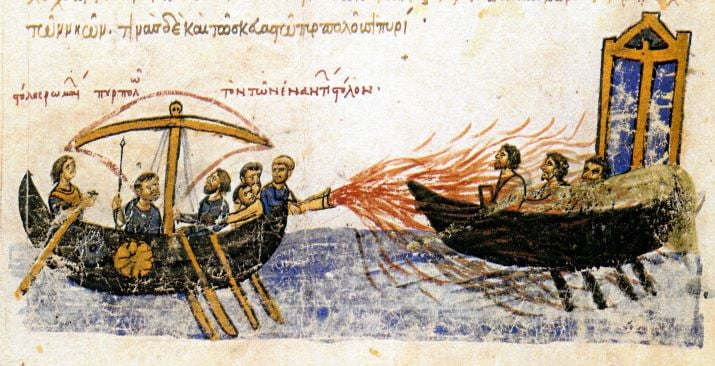
A Byzantine ship using Greek fire against a ship . On top, Greek alphabet in Byzantine form. Credit: Public Domain
Records suggest Greek fire contained a mix of petroleum, quicklime, and other unknown ingredients. This potent combination is believed to have made it one of the most flammable and dangerous substances of its time. What was truly amazing about the Byzantine liquid fire weapon was that it continued to burn on water and was practically impossible to put out with medieval means.
It helped the Empire maintain sovereignty over the mass land it occupied, spanning all of Southern Europe, North Africa, and Asia Minor. The weapon’s impact on the course of history is undeniable. It played a key role in the defense of Constantinople and the preservation of the Byzantine Empire.
A Brilliant Invention
Fire as a weapon had been used for centuries but never in such a sophisticated and destructive means as the Greek fire (or Υγρόν πυρ – Hygron pyr, as it was referred to in Greek). It was the Crusaders who referred to it as Greek fire or “liquid fire,” “Roman fire,” or “sea fire.” It was a significant weapon that never ceased to terrify the enemy.
This innovative weapon would fire massive flames in a continuous jet, burning a trail of destruction in its path that was nearly impossible to extinguish. When it came to naval warfare, it was a weapon that was impossible for the enemy to defend their ships from. Yet, the exact recipe for the liquid fire substances the Byzantines used remains a mystery to this day.
The Greek fire cannon-like machine was created in the seventh century. It most likely was the invention of Kallinikos of Heliopolis, a Jewish architect who fled from Syria to Constantinople. It was between 674 and 678 when the Byzantine Empire was attacked by the Islamic fleet of the Umayyad caliphate that had already taken over parts of Syria.
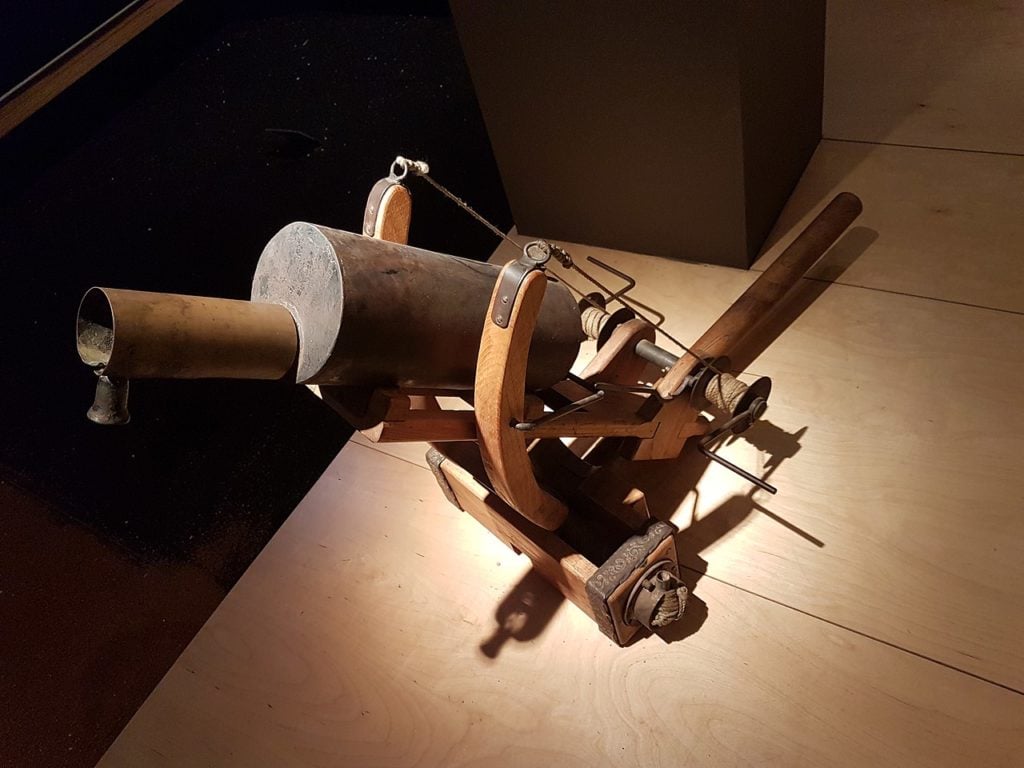
Concerned about an Islamic attack against Constantinople, Kallinikos experimented with a variety of materials until he discovered a mix for an incendiary weapon. Kallinikos sent the formula to the Byzantine emperor, and authorities developed a siphon that operated somewhat like a syringe, propelling the fiery concoction toward enemy ships.
Emperor Constantine IV reluctantly ordered the use of Greek fire to destroy the Umayyad fleet. However, the Byzantine weapon was very successful. According to historian Kelly DeVries and his book Medieval Military Technology, it was the first reported use of an incendiary weapon in battle.
Was Byzantine Liquid Fire a State Secret?
Some historians believe the reason the recipe for liquid fire remains unknown is because Byzantine emperors wanted to keep it a state secret, never to fall into the hands of the enemy. The vast Empire was surrounded by numerous enemies coveting its lands. Liquid fire was a potent deterrent to any army that would think of invading.
Constantine VII Porphyrogenitus warned his son Romanos II to not reveal the recipe “and not to prepare this fire but for Christians, and only in the imperial city.”
Anna Komnene, daughter of Emperor Alexios I Komnenos (r. 1081-1118) and a historian, wrote about the recipe for Greek fire:
This fire is made by the following arts: From the pine and certain such evergreen trees, inflammable resin is collected. This is rubbed with sulfur and put into tubes of reed, and is blown by men using it with violent and continuous breath. Then in this manner it meets the fire on the tip and catches light and falls like a fiery whirlwind on the faces of the enemies.
It was not that straight-forward, of course. Otherwise, it would be easy for the enemy to recreate the fiery weapon. It seems indeed that the Byzantines intended to keep the process of creating the liquid fire top secret, as no friend or enemy ever managed to gain insight into this so as to construct their own similar weapon.
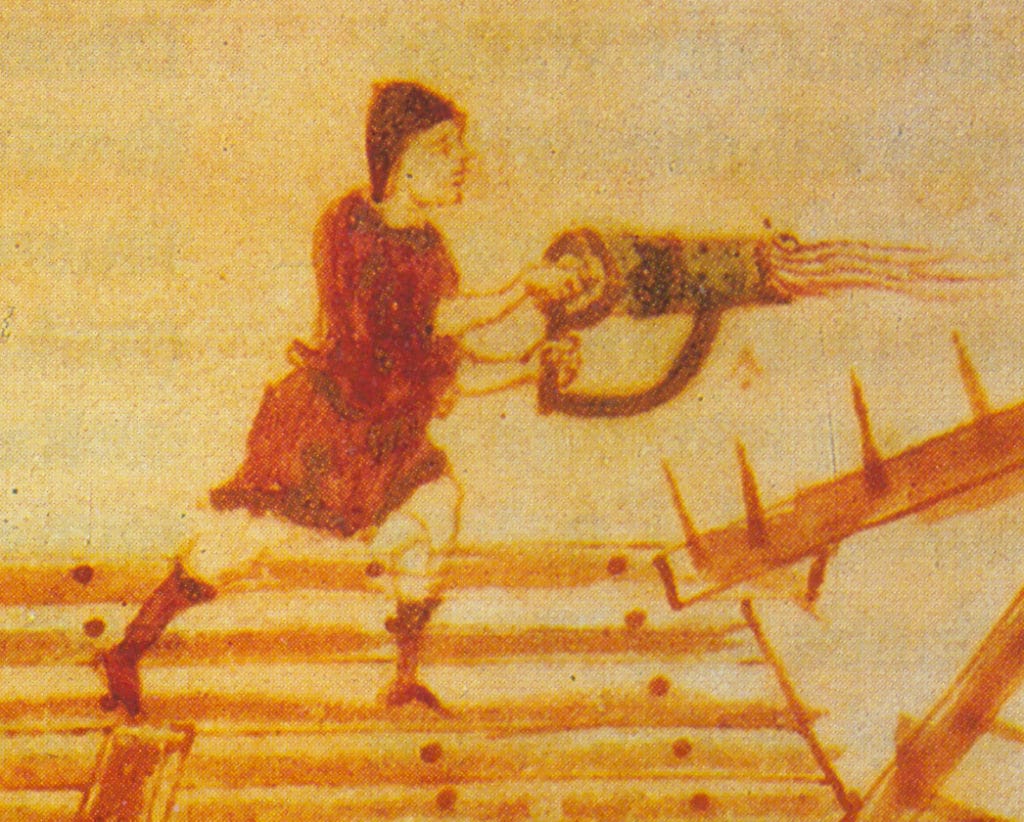
Use of a hand-siphon, a portable flame-thrower, from a siege tower. Detail from the medieval manuscript Codex Vaticanus Graecus 1605. Public Domain
Greek Fire in Battle
In his book, Devries explains that Greek fire can refer to three different weapons: firstly, a fiery liquid pumped out of a nozzle; secondly, a liquid weapon that was filled in small grenades; and thirdly, a solid incendiary probably based on gunpowder.
The third is impossible to have been used in Byzantium. Its reported use started in the fourteenth century in Western Europe. However, there are Byzantine era depictions of men carrying hand-held tubes spitting fire that look even more like modern flame-throwers.
In fact, Greek fire was rarely used except primarily in naval battles, as the apparatus was complicated and required technically equipped handlers. Furthermore, it was dangerous to have an incendiary mechanism on a wooden ship.
In 727, Emperor Leo sent a fleet to burn that of Hellas and Cyclades, who had been revolting against him. In 941, a Rus naval raid from Kiev across the Black Sea was stopped, and their fleet was annihilated by the Byzantines.
Reportedly, in the eleventh century, Viking Ingvar the Far Travelled encountered ships equipped with the weapon, which he described as “a brass (or bronze) tube and from it flew much fire against one ship, and it burned up in a short time so that all of it became white ashes…”
However, by the end of the twelfth century and the Angeloi emperors, the Empire started to decline, losing more and more land to the rising Ottoman Empire. As Byzantium began to fade, so did the use of Greek fire until it became but a simple chapter in the great history of the Byzantine Empire.
Aux Philippines, un ancien haut responsable de la police a été arrêté, mardi 9 juin, pour le meurtre d'un homme d'affaires sud-coréen, commis en 2016, en pleine « guerre anti-drogue » lancée par l'ancien président, Rodrigo Duterte. Cette affaire rappelle l'impunité des responsables politiques philippins lors de cette campagne d'exécutions extra-judiciaires qui a fait plus de 30 000 morts, selon les organisations internationales.
What happens to higher education when institutions dedicated to critical thought increasingly align themselves with the logics of war, surveillance, and national security? Unless we mount an organized resistance, we may viscerally experience the answer to this question all too soon.
We are already watching this transformation play out in both the U.S. and Canada as universities face growing pressure to align their missions, research agendas, and pedagogical practices with the values, priorities, and imperatives of a society increasingly organized around the logic of war.
Militarized policies, values, identities, and modes of governance no longer merely creep into U.S. society. Under the Trump administration, they increasingly define it. Militarization now extends far beyond the battlefield, reshaping everyday life, public institutions, and the very meaning of citizenship. War is celebrated as a moral imperative, often wrapped in the language of religious righteousness and white Christian nationalism. Due process gives way to abductions and arbitrary detention, dissent is met with threats and repression, soldiers occupy U.S. cities, and political violence is normalized through a steady stream of incendiary rhetoric and state-sponsored spectacles that glorify force, exclusion, and domination. Democratic ideals are displaced by a culture of fear, manufactured insecurity, and the belief that the nation is besieged by enemies both within and beyond its borders — largely immigrants and people of color.
In this militarized landscape, critical thought is derided, informed judgment is replaced by ideological conformity, and institutions charged with nurturing democratic agency increasingly come under attack. This fusion of militarism, toxic masculinity, religious fundamentalism, and white nationalist politics functions as a powerful form of public pedagogy, producing the authoritarian values, identities, and modes of agency that have historically provided the cultural foundations for fascist politics.
The Dangers of the “Military-Industrial-Academic Complex”
The late U.S. President Dwight D. Eisenhower warned of the dangers posed by what he called the “military-industrial-academic complex.” In an earlier draft of his famous 1961 farewell address on the military-industrial complex, Eisenhower included the word “academic,” recognizing that universities could become deeply entangled with military power, corporate interests, and state security agendas in ways that threatened their intellectual independence and democratic mission.
This warning extends to countries that increasingly live in the shadow of the U.S.’s expanding warfare state and its militarized culture. For instance, against an increasingly militarized global order, the Canadian government has unveiled an expansive “Defence Industrial Strategy” backed by 81.8 billion Canadian dollars (around 60 billion in U.S. dollars) in new defense spending in Budget 2025, including 6.6 billion Canadian dollars devoted specifically to expanding the country’s defense-industrial infrastructure. The strategy marks the largest long-term expansion of Canada’s military economy since the Second World War.
What once appeared to be limited partnerships between North American universities and defense industries has evolved into a far broader transformation of higher education itself. As Canada dramatically expands military spending through its Defence Industrial Strategy, universities are increasingly being drawn into the orbit of defense priorities. Federal initiatives encourage partnerships between universities, defense contractors, and government agencies in fields such as artificial intelligence, cybersecurity, quantum computing, autonomous systems, and advanced surveillance technologies. Research funding is increasingly directed toward projects framed around national security, defense innovation, and military competitiveness. As these priorities gain influence, higher education is being reshaped by the social logics of militarization, technological control, and permanent security, altering not only what knowledge is produced but also the purposes to which it is put, raising urgent questions about the future of the university as a democratic public sphere.
Militarized knowledge production blurs the line between education and warfare, transforming universities into laboratories for the development of technologies whose ultimate purpose is often surveillance, social control, and lethal violence.
The growing use of drones and AI-driven warfare systems is not simply a military development. It signals a broader transformation in how research and knowledge are produced, funded, and valued. As universities deepen their involvement in military research, fields ranging from artificial intelligence and data analytics to robotics and cybersecurity are increasingly organized around the imperatives of surveillance, security, and warfare. AI technologies are already being deployed by state agencies to monitor migrants, journalists, activists, and political dissidents, while drones have revolutionized warfare by making it cheaper, more remote, and less accountable. Under such conditions, knowledge is not viewed primarily as a public good serving democratic life. Instead, it is increasingly organized around military imperatives of prediction, control, targeting, and domination. The result is a form of militarized knowledge production that blurs the line between education and warfare, transforming universities into laboratories for the development of technologies whose ultimate purpose is often surveillance, social control, and lethal violence.
Michael S. Sherry rightly argues that in an age in which state power is increasingly organized through militarized values and security logics, military culture now shapes not only state policy but “broad areas of national life.” As David Theo Goldberg argues, militarization no longer operates only through armies and weapons systems. It increasingly shapes culture, technology, modes of governance, and everyday life. As Goldberg observes:
The military is not just a fighting machine…. It serves and socializes. It hands down to society, as big brother might, its more or less perfected goods, from gunpowder to guns, computing to information management … In short, while militarily produced instruments might be retooled to other, broader social purposes, the military shapes pretty much the entire range of social production from commodities to culture, social goods to social theory.
The implications for higher education are profound. Militarization does not simply reshape culture, technology, and governance. It also reorganizes the production of knowledge itself, aligning university research with the imperatives of surveillance, security, and warfare while legitimating authoritarian forms of power. The rapid expansion of artificial intelligence research tied to military and surveillance applications deepens these dangers. Universities are increasingly helping to develop technologies used for predictive policing, automated warfare, mass surveillance, and forms of digital authoritarianism that blur the line between security and repression. Such developments are routinely justified in the language of innovation, efficiency, and national security, yet they raise profound ethical questions about the role of higher education in designing technologies that deepen inequality, expand state violence, erode civil liberties, and facilitate the killing of civilians, including children, in conflicts largely removed from public scrutiny.
The militarization of the university is not simply a matter of research contracts or funding priorities. It is pedagogical, cultural, and deeply political.
The militarization of the university is not simply a matter of research contracts or funding priorities. It is pedagogical, cultural, and deeply political. Universities do more than train workers; they shape civic identities, ethical sensibilities, and the capacity for democratic agency itself. When higher education embraces military partnerships and military-driven research agendas, it legitimates a worldview in which security eclipses justice, technological efficiency displaces ethical reflection, and dissent is recast as a threat rather than a democratic necessity.
How Militarization Reorganizes the Production of Knowledge
As militarization becomes woven into the fabric of political culture, universities increasingly reorganize knowledge, research priorities, and technological innovation around the assumptions of permanent conflict, geopolitical competition, and security management. In doing so, higher education normalizes the belief that militarized knowledge and military solutions should govern everyday life. Yet militarization does not merely reshape research priorities and institutional culture. It also reorganizes historical memory, civic identity, and the very terms through which democracy is understood.
Militarization also bears heavily on the production of knowledge itself. As Fintan O’Toole observes, contemporary authoritarian movements do more than expand military power; they seek to reshape historical memory and civic consciousness. Shameful histories are recast as heroic achievements, while assaults on democracy are reimagined as acts of patriotism. The Confederate rebellion is transformed from a defense of slavery into a noble cause, much as the January 6 attack on the U.S. Capitol is increasingly celebrated by its defenders as a patriotic uprising rather than an assault on democratic institutions. Equally troubling are efforts to remake the military itself through demands that soldiers be trained for loyalty to political leaders rather than to constitutional principles. Here, power seeks not only to command institutions but also to militarize knowledge, memory, and civic identity. Universities have a crucial responsibility to resist such distortions by defending historical truth, critical inquiry, and the capacity to distinguish education from propaganda.
As Kevin Baker notes, military solutions increasingly displace diplomacy, democratic institutions, and other civic responses to social problems. Within a culture saturated by militarism, aggression is celebrated as prevention, repression is justified in the name of security, and military force is invoked to discipline dissent and erode democratic values. Under such conditions, education is organized less around the imperatives of democratic culture than around the demands of the arms industry, surveillance systems, technological acceleration, and the national security state.
These developments become even more troubling when they intersect with the ongoing marketization of higher education. At its best, higher education functions as a democratic public sphere, a place where students learn to think critically, question authority, engage history, and imagine alternative democratic futures. Yet under the pressures of neoliberalism, universities have increasingly abandoned this mission. Education is now often reduced to job training, students are treated as consumers, faculty are deskilled and casualized, and learning is defined largely in instrumental terms. Questions about how education might nurture civic courage, ethical imagination, social responsibility, and democratic agency are increasingly sidelined in a market-driven university culture.
Yet the assault on higher education is not only economic. It is also ideological and political. In recent years, a growing chorus of liberal and conservative critics has claimed that universities have lost their way, charging that the humanities and critical scholarship have corrupted higher education through ideology and activism. Under the seductive language of “reform,” “balance,” “civility,” “institutional trust,” and “neutrality,” these critics present themselves as defenders of academic integrity while advancing a profoundly reactionary project. In some cases, liberal critics go so far as to treat “social justice” as a threat to scholarship rather than asking how power, exclusion, race, gender, class, empire, and inequality have always shaped what counts as knowledge. Their calls for neutrality, which function as a cover for depoliticization, do not protect intellectual freedom; they align with a broader assault on critical thought, historical memory, and democratic culture. They are aghast at the notion put forward by Thomas Chatterton Williams that “For humanities departments [and higher education in general] to continue to matter, they must challenge the modern world rather than accommodate it.” In doing so, they obscure the far more dangerous attacks on higher education coming from the right: censorship, book bans, assaults on DEI programs, the repression of student protest, and efforts to align universities with corporate, state, and military interests.
Critical scholarship is condemned as ideological, while militarized research, donor influence, state-directed threats of defunding, and forms of ideological indoctrination are celebrated as common sense. The real danger is not that universities have become too political, but that they are being stripped of their democratic mission and transformed into institutions that normalize conformity, surveillance, militarization, and authoritarian power. Higher education is not under attack because it has been ruined by the left. On the contrary, it is under assault by the Trump administration and a broader network of far right forces precisely because it keeps alive a dangerous truth: education is not merely about credentials, careers, or conformity to the status quo. At its best, it cultivates the capacity for critical judgment, informed dissent, compassion, and democratic agency. What authoritarian movements fear most is not ideological indoctrination but an educated public capable of questioning power, holding authority accountable, and imagining a more just future.
Militarization deepens anti-democratic tendencies. Research is increasingly tied to military applications, geopolitical competition, and outside funding rather than to the public good. Universities adopt the language of security, risk management, efficiency, and competitiveness while corporate and military values increasingly shape institutional priorities. As a Simons Foundation policy briefing warns, militarization has increasingly become a “default response” to political instability and global insecurity, reinforcing a culture in which social problems are framed through the logics of surveillance, strategic competition, and military preparedness rather than diplomacy, public investment, and democratic cooperation. As Professor Catherine Lutz notes, such actions run the risk of eroding legal and moral boundaries. In such a climate, higher education loses its civic character and becomes subordinated to the interests of the warfare state and defense industries.
As universities become increasingly tied to military and security logics, they risk abandoning their civic purpose in favor of a pedagogy of permanent emergency, one that privileges surveillance, strategic competition, and technological domination over critical inquiry, civic imagination, ethical responsibility, and social solidarity. What disappears in this militarized vision of higher education is the conviction that universities should cultivate informed citizens capable of holding power accountable rather than simply servicing the imperatives of the national security state.
Equally troubling, militarization reshapes the culture of the university itself. Militarized institutions reward conformity, secrecy, technocratic thinking, and instrumental rationality. Ethical questions about violence, disposability, colonialism, and state power are pushed aside in favor of managerial efficiency and national competitiveness. Students protesting Israel’s war in Gaza, settler colonialism, genocide, sexual violence, or war crimes are too often met not with dialogue but with surveillance, administrative repression, and policing.
The dominance of war-like values in both higher education and the wider civic culture prepares “civil society itself for the production of violence.”
In such instances, the university ceases to function as a space for critical engagement and becomes instead an extension of a broader authoritarian culture. As scholar John Gills notes, the dominance of war-like values in both higher education and the wider civic culture prepares “civil society itself for the production of violence.” In this way, universities risk becoming agents of militarized socialization rather than sites of democratic education. Such developments raise not only political and educational concerns but also urgent ethical questions about the kinds of institutions that universities are becoming and the values they choose to endorse.
The militarization of higher education raises a profound ethical question: What happens when universities enter into partnerships with military institutions while remaining silent about documented human rights abuses associated with those same institutions? Such silence is never politically neutral. It suggests that violations of human rights can be overlooked, rationalized, or normalized when carried out in the name of security, defense, or national interest.
This issue extends beyond universities themselves and raises broader questions about the responsibilities of democratic governments. As Canada, among other countries, deepens military cooperation with allies and expands investments in defense industries, it cannot exempt those relationships from ethical scrutiny. If credible allegations of war crimes, torture, collective punishment, or sexual violence are ignored in the name of strategic alliances or national security, democratic principles are hollowed out from within. Universities, precisely because they are charged with fostering critical inquiry and ethical judgment, have a responsibility to challenge such silences rather than reproduce them.
Such allegations also raise broader concerns about how security regimes can be used not only against occupied populations but also against those who challenge state policies. Reuters reported that organizers of a flotilla attempting to deliver humanitarian aid to Gaza alleged that some activists detained by Israeli authorities experienced physical abuse and that at least 15 reported sexual assaults, including allegations of rape. Zeteo provided shocking and wrenching video testimonies from some of the activists, largely ignored by Western media. Whatever the final findings regarding these allegations, they underscore the need for independent scrutiny of security institutions and the dangers of granting them unquestioned legitimacy in the name of national defense. When accusations of abuse are met with silence rather than investigation, the boundaries between security, impunity, and state-sanctioned violence become increasingly blurred.
If universities claim to uphold principles of human rights, social responsibility, and ethical inquiry, they cannot selectively ignore such evidence when it implicates states or institutions with which they maintain research, military, or security partnerships. To do so risks transforming universities from spaces of critical inquiry into institutions that legitimate power while remaining silent about its abuses. At stake is more than the question of particular research contracts. It is the moral integrity of higher education itself.
These concerns are not confined to particular institutions or isolated abuses. They are symptomatic of a broader culture in which militarized values increasingly shape public life, political discourse, and social priorities. From sporting events and military recruitment in schools to popular films, social media spectacles, gun culture, and state-sponsored propaganda, aggression, domination, and war are normalized as features of everyday life.
Nowhere is this more visible than in the influence of Trump’s Secretary of Defense, Pete Hegseth, who celebrates “maximum lethality, not tepid legality” and wraps militarism in the language of white Christian nationalism and religious righteousness. As Jasper Craven observes, Hegseth champions a form of “military manliness” stripped of any ethical center. Such a worldview elevates domination as a virtue, defines violence as a moral ideal, and transforms, in Craven’s words, “the Pentagon into the staging ground for an ideological religious crusade.” As these values circulate through culture and public institutions, they increasingly shape higher education itself, influencing not only what universities teach but also the forms of knowledge they produce, fund, and legitimate.
Universities cannot claim to defend democracy while simultaneously aligning themselves with industries and state policies organized for state violence, war, and imperial aggression.
Defenders of militarized partnerships insist that universities must remain pragmatic and “neutral” in securing funding and advancing national interests. But neutrality in such cases is largely a myth. Universities cannot claim to defend democracy while simultaneously aligning themselves with industries and state policies organized for state violence, war, and imperial aggression. Higher education has no legitimate ethical mandate to function as a research arm of militarized power.
Universities Must Refuse to Become Laboratories for War
The issue is not whether universities are political, but what kind of politics they embody and in whose interests they function. In an age marked by rising authoritarianism, widening inequality, climate catastrophe, and endless wars, universities cannot escape matters of power and values, and they must decide whether they will serve democracy or militarized power. Nor can educators retreat into the call for neutrality. At stake here is more than institutional policy. It is the fate of the university as a democratic institution. Few writers understood these dangers more clearly than Toni Morrison, who warned: “If the university does not take seriously and rigorously its role as a guardian of wider civic freedoms, as interrogator of more and more complex ethical problems, as servant and preserver of deeper democratic practices, then some other regime or menage of regimes will do it for us, in spite of us, and without us.”
Higher education may be one of the few public spheres left where knowledge, values, and learning can nurture radical hope, civic responsibility, informed agency, critical thinking, and substantive democracy. The struggle against the militarization of Canadian universities is therefore not merely a fight over funding priorities. It is a struggle over whether education will serve democracy or become an extension of the warfare state. Activists from groups like World Beyond War Canada and the Canadian Federation of Students are right to insist that genuine security comes not from militarism and permanent war, but from investing in education, housing, public health, and the social good.
Universities must refuse their transformation into laboratories for war, surveillance, and technological domination. At stake is whether higher education will further accommodate militarized and authoritarian power or become a crucial site of resistance, critical consciousness, and democratic possibility, one that refuses to confuse security with fear, civic responsibility with obedience, and education with the demands of war and domination. In an age when militarism increasingly shapes culture, politics, and everyday life, universities must remain among the few institutions willing to defend critical inquiry, civic responsibility, and democratic freedom against the expanding reach of the warfare state.
A Rede Intermunicipal de Bibliotecas do Algarve (BIBAL) lança amanhã, 10 de junho, o Catálogo Agregador Regional, uma plataforma que agrega os catálogos das bibliotecas municipais algarvias e da Biblioteca da Universidade do Algarve, permitindo a pesquisa integrada dos recursos documentais disponíveis na região. A aquisição e implementação da plataforma foram promovidas pela AMAL – […]

 Login
Login







![[link]](https://i.redd.it/x104bbi94b6h1.jpeg)