Comunicazione scioccante da parte di Bill Ritter, volto storico di Wabc-Tv/Abc7 e uno dei “mezzibusti” più riconoscibili dell’informazione televisiva newyorkese, ha dato ieri sera, 12 giugno, in diretta la notizia più difficile della sua carriera. Durante l’edizione delle 18 di venerdì, il giornalista ha annunciato ai telespettatori che quella sarebbe stata la sua ultima conduzione di Eyewitness News, dopo aver ricevuto una diagnosi di Alzheimer.
“Dopo una serie di esami, i miei medici mi hanno detto che ho l’Alzheimer – ha dichiarato in diretta -. È una fase iniziale, e dicono che i trattamenti stanno tenendo la malattia sotto controllo. Per ora. Ma non c’è alcuna garanzia, perché una cura non esiste ancora. Quindi, a meno che qualcuno non trovi un rimedio miracoloso, e presto, questa sarà la mia ultima edizione da anchor”.
E infine: “I miei figli dicono che sono coraggioso. Ma non sono io: sono loro a esserlo. E lo è mia moglie Kathleen. Mi mancherà raccontarvi le notizie. Con la verità, e con i fatti, ovunque portino. È stato un onore. Vi auguro salute e pace. E prendiamoci cura gli uni degli altri”
Ritter, 76 anni, era alla guida dell’edizione delle 18 dal 2001. Nonostante l’addio alla scrivania del telegiornale, non lascerà l’emittente: continuerà a lavorare per Wabc/Eyewitness News, concentrandosi proprio sui temi legati alla salute, in particolare sull’aumento dei casi di Alzheimer e sulle difficoltà che affrontano pazienti e famiglie. “Voglio raccontare come il costo delle cure sia diventato insostenibile e come questo Paese potrebbe iniziare a cambiare le cose”, ha spiegato.
Il padre di Ritter è morto con la stessa malattia nel 1998, e da allora il giornalista è stato attivo in numerose iniziative di sensibilizzazione. “Non sono nuovo a tutto questo”, ha ricordato.
Ancient Greek hairstyles marked the identity of a person and denoted social status. Depiction of Hippocrates with his hair falling loosely around the nape of his neck and a wounded soldier brought to him. Adult men were depicted with beards, while young men were portrayed without. Painting on a red figure krater. Credit: Jaime Ardiles-Arce, Wikimedia Commons Public Domain
Hairstyles in Ancient Greece were one of the most significant identifiers of individuals, as they denoted social status and strength. They were also tied to rites of passage and religious rituals.
The hair on one’s head was so particularly valuable to ancient Greeks that it was worthy of its own unique term, being referred to as the kόme (κόμη), and people of the time meticulously cared for it, as they believed it was pivotal to one’s personality and reflected an individual’s social beliefs.
Hairstyles were an essential means of expressing one’s identity. The length and texture—long or short with loose waves or tight curls—was distinctively Greek and contrasted sharply with portrayals of non-Greeks. They were important in that they were a way for people to recognize each other and communicate their place within society.
Hair rituals, such as growing and cutting hair for the purpose of honoring deities, were complex and multi-layered. They needed to account for family status, gender, age, social class, transition points, and cult practices, as well as associations and organizations to which one belonged.
Heroes such as Achilles and Menelaus were portrayed by Homer with blond hair (xanthos), leading many men to lighten their own hair in an effort to resemble them. To do so, they relied on soaps and alkaline bleaches imported from Phoenicia. Some dyed their hair with a mixture of apple-scented yellow flowers and pollen, potassium salts, and even gold powder.
However, in Homeric and Classical Greek, xanthos (Greek: ξανθός) referred to light-colored hair more broadly and did not exclusively mean “blonde” in the modern Northern European sense. Its meaning was more flexible, often encompassing shades like golden, reddish-gold, or light brown.
Hairstyle depictions in sculptures and paintings
Much of what we know about hairstyles in Ancient Greece stems from depictions of literary works and art, such as sculptures, paintings, amphorae, and other types of vessels. In general, women are nearly always presented with long hair. Slave women, on the other hand, had short hair for hygienic reasons as well as to allow others to socially discriminate between them.
Warriors on amphorae are typically portrayed with pointed beards and long hair while their squires are usually beardless with long, curly hair, and lyre-players have long hair tied back in a bun with a hairband. In a bronze statuette of Apollo, adult men are pictured with beards and somewhat long hair whereas the younger men have no facial hair at all. What marked barbarians, on the other hand, was a moustache with no beard.
Generally speaking, there was a gradual change of style in depictions of men on sculptures and vases from more elaborate to simpler ones. On the other hand, women appeared in works of art donning a variety of ornamental kerchiefs, including pretty bands such as a type of sling known as the “sphendone” (σφενδόνη) due to its shape. A large stamnos, a type of large vase used for serving and storing liquids, depicts groups of women dressed in Ionic and Doric chitons (types of Greek tunics) with various sorts of headdresses.
In literature, the oldest accounts of hairstyles in Ancient Greece are to be found in the works of Homer in which one encounters the dedicating of hair to deities and the dead for the first time ever. This further attests to the importance ancient Greeks placed on hair. In Homer’sIliad, Book 23, Achilles dedicates his hair to his dead friend Patroclus, for example, in an act that symbolizes his grief for his best friend who has passed away as well as his devotion to their friendship.
Ancient Greek hairstyles varied through the centuries. Painting on red figure kylix depicting Heracles fighting Nereus. Three Nereids are fleeing. Credit: ArchaiOptix Wikimedia Commons CC BY-SA 4.0
Ancient Greek hairstyles through the centuries
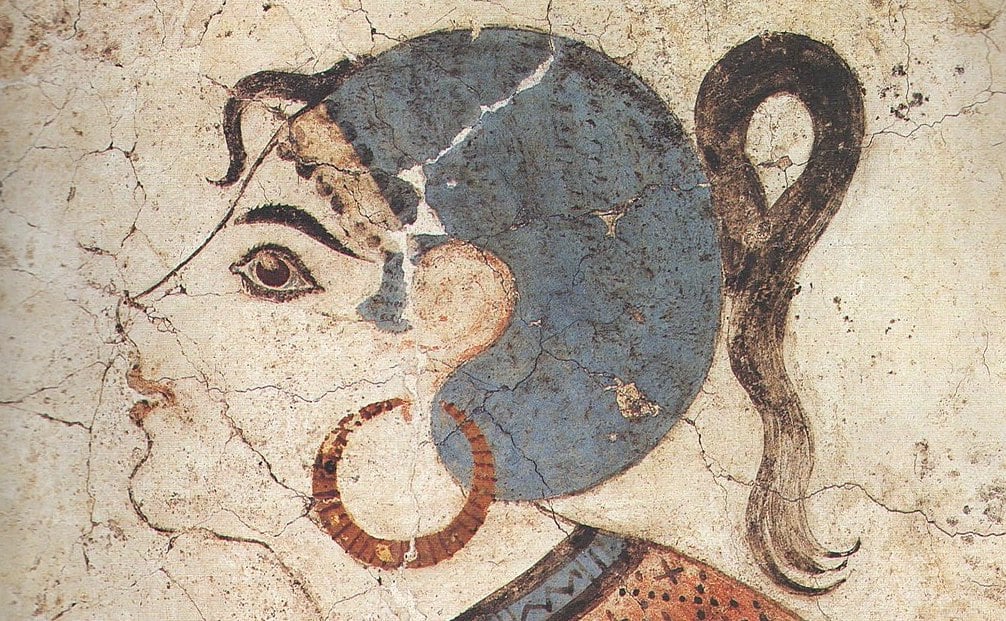
Paintings in the palaces and pottery of the Minoan period (c. 3000 and 1100 BC) show dancers with shoulder-length black hair. In Aegean art, men are depicted with single or double plaits, and Homer’s heroes (c. 800 BC) had such hairstyles, as well, as did warriors at the battle of Marathon (490 BC).
“Saffron Gatherer” from a Minoan fresco in Akrotiri, Santorini. Credit: Public Domain
The most common hair adornment for women was a type of hairnet or coif made of net work known as a “kekryphalos” in Greek—otherwise also called a caul or “coif of network.” It was worn during the day and at night through to the Classical Period, and Homer made mention of these hairnets, which were frequently made of gold threads or silk, as Pausanias writes.
Overall, during the Archaic Period (c. 1100 to 480 BC), the kouros, the free-standing statues depicting male youth, had long, finely braided, shoulder-length hair at the very least. The maidens (kόre) had numerous braids and oftentimes also donned a coronet. Towards the end of the particular period, women were portrayed with their hair tied back and into a bun, known as the “knidian hairstyle,” named after the Knidian Aphrodite, a statue by Praxiteles of the 4th century BC.
Greek Kouros Statue. 580 BC . Credit: wikimedia commons / Ricardo André Frantz CC BY 3.0
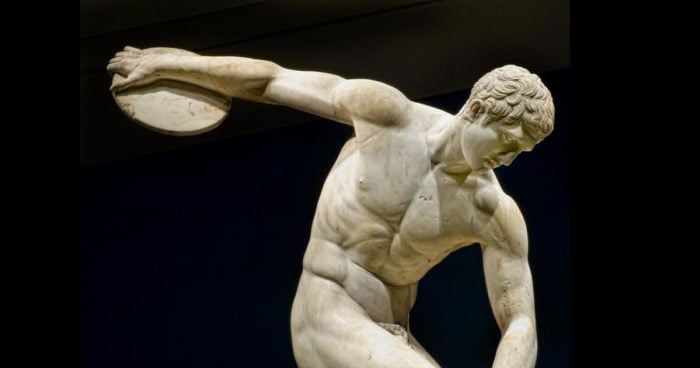
It was in the mid-5th century BC when males began appearing with shorter hair in Greek artwork, and at the beginning of the Classical Period (c. 480 to 323 BC), they were shown with short, neatly trimmed hair. Modern historians attribute the trend towards shorter hairstyles in Ancient Greece to the rising popularity of sports, as athletes had to have their ears free and their hair fixed in place, possibly with hair oil. A good example is the famous Discobolus statue by Myron (c. 460-450 BC).
The Discobolus statue. Credit: Public Domain
Alexander the Great’s appearance—clean-shaven (unlike his father) with wind-swept locks combed back from a central part—was a tribute to the importance of youth and was subsequently adopted by other Greek kings. None of his Diadochi appeared with a beard on coinage, statues, or works of art. After Alexander the Great, it became typical for rulers to refrain from having facial hair for several centuries. This was also true of Roman emperors.
Bust of Alexander the Great. Discovered at Giannitsa. Credit: Explorer40/Wikimedia Commons
In the Archaeological Museum of Amfissa, over eight hundred miniature figurines of 3rd and 2nd century BC females are exhibited. Their hairstyles are particularly interesting, as bronze and golden spirals were used for fastening and decorating the hair. During the Hellenistic period, hairstyles became quite complex, and some of these can be seen on the figurines as well. Knidian hairdressing continued to be especially popular, but from 250 BC onwards, small curls were left hanging unfastened around the nape of the neck.
Hair rituals of the ancient Greeks
In archaic times, the ancient Greeks wore their hair long and were thus consistently referred to as long-and-thick-haired Achaeans (Greek: καρηκομόωντες Ἀχαιοί) in Homer’s works. This was a hairstyling practice that was adopted and preserved by the Spartans for centuries.
Plutarch writes that Spartan boys had their hair trimmed quite short. As soon as they reached puberty, however, they let it grow out. The men were particularly proud of their hair, as they deemed it the most affordable of body adornments and consistently took the time to properly care for it prior to going into battle. Both Spartan men and women tied their hair back in a knot over the crown of the head. Brides even shaved their heads and wore men’s costumes as part of the ceremony.
In rival Athens, the boys wore their hair long throughout childhood and had it cut off when they reached puberty. The cutting off of teenager’s hair was a solemn act honored through religious ceremonies. A libation (oinisteria) was initially offered to Hercules, and the hair was dedicated to a deity of choice afterwards. Plutarch writes that Theseus went through the ceremony at Delphi.
Prior to marriage, Delian girls and boys cut their hair in honor of the Hyperborean maidens who died at Delos and laid it on their tombs. A bride would cut her hair on the day of the wedding ceremony as a symbol of submission to her husband and offer it to the goddess Artemis or Athena. She would then pull her remaining her up in a knot. Following the ceremony, the bride wore a crown and special wedding veil. If she happened to be unfaithful to her husband, he would then shave her head, turning her into a social outcast.
An ancient Greek hairstyle on a 1st-century BC marble sculpture of a woman looking at what likely is her jewel box held by her attendant. Credit: Dave & Margie Hill / Kleerup Wikimedia Commons CC BY-SA-2.0
A variety of hairstyles in Ancient Greece
The great variety of hairstyles in Ancient Greece makes it difficult to pinpoint the exact period during which each of the hairdos was popular, and there were a number of unique styles as well. Among these was the “melon-like” hairstyle, or the “peponoeidis,” thus named because of what resembled deep parallel grooves akin to those of a melon. Women often left their curls hanging freely around the forehead in the shape of knots or bell clappers in what was known as the “tettix.” Yet another hairdo was the “lambadion,” a type of bun with loose ends which conjured up images of torch flames or horse’s tail.
During the Hellenistic period, hairstyles became more sophisticated and complex. However, the most impressive hairstyle of the time was the knot of Heracles (herakleion amma), associated with good fortune and love. The hair was brushed forward to form a kind of bow or butterfly.
Headbands, diadems, coronets, headscarves, and clips or loops were used in creating the various styles for women, and hair additions and wigs were not uncommon. Garlands of fruit and ivy leaves, mainly from the plant of immortality, the elichryson, which was believed to bring serenity, were also incorporated into hairstyling trends.
Later on, in Roman times, hairstyles became extremely complex and pretentious and were named after the empress or specific woman of nobility who set the trend.
La sardina tiene una esperanza de vida de hasta diez años y alcanza la madurez sexual aproximadamente al año. Llega a medir hasta 25 centímetros, aunque lo más frecuente es encontrar ejemplares entre los 15 y los 20 centímetros, un tamaño habitual a partir de los dos o tres años. La talla mínima permitida para su captura es de 11 centímetros. Respecto a su alimentación, se basa principalmente en plancton, así como en huevos o peces en estado larvario.
Curtido en las mejores cocinas, el chef madrileño quiso conseguir el primer florón de la isla y lo logró en 2019 con Estragón. El siguiente reto pasa por poner en valor todo lo que ofrece este paraíso del Mediterráneo. Ahora, con su segundo gastronómico, mantiene el nombre y la filosofía, pero gana en personalidad Leer
Curtido en las mejores cocinas, el chef madrileño quiso conseguir el primer florón de la isla y lo logró en 2019 con Estragón. El siguiente reto pasa por poner en valor todo lo que ofrece este paraíso del Mediterráneo. Ahora, con su segundo gastronómico, mantiene el nombre y la filosofía, pero gana en personalidad
Tegucigalpa, 12 jun (Prensa Latina) Honduras confirmó el primer caso de sarampión de transmisión local desde que en 1997 la nación centroamericana fue declarada libre de esta enfermedad, trascendió hoy.
Measures to include restrictions on ‘safe’ social media apps, with some fearing banning some platforms and not others will lead to legal challenges
Teenagers under the age of 16 are to be banned from accessing “high-risk” social media apps while safer platforms will be subjected to restrictions, under a sweeping government crackdown.
Prime minister promises to fight any leadership challenge as he faces escalating row over military spending
Keir Starmer has admitted that he has to “turn things around” after the resignation of the defence secretary, John Healey, in an escalating row over military spending that has prompted recriminations across Whitehall and concern from the US.
Downing Street and the Treasury traded blows with allies of Healey on Friday. No 10 expressed dismay that the Ministry of Defence (MoD) had wanted £18bn to plug funding gaps in major projects, while those close to the former defence secretary accused Starmer of failing to acknowledge the deterioration in global security.
En Guyane, la pêche est un secteur en souffrance. Les eaux sont pillées par les bateaux étrangers. Immersion à bord d'un patrouilleur de la Marine nationale, en pleine intervention de lutte contre la pêche clandestine.
Former defence secretary’s accusation, that PM lacks impetus and is easily swayed by chancellor’s demands, is familiar territory
One of the most scathing accusations made by John Healey in his resignation letter on Thursday was that the prime minister lacks the authority to stand up to his chancellor.
“You have been unable, and the Treasury has been unwilling, to commit the resources that the nation needs to defend the country at this time of rising threats,” the former defence secretary wrote.
When Keir Starmer wanted to promise Donald Trump that the UK would increase defence spending, he decided to fund it by slashing the UK’s aid budget – losing a cabinet minister, Anneliese Dodds, in the process.
This time around, with John Healey’s Ministry of Defence (MoD) demanding an additional £18.5bn over four years to fund the defence investment plan, there was no such lever to hand.
This blog is now closed, you can read more on this story here
As armed forces minister, Al Carns was not involved in work on the defence investment plan (Dip). In his resignation letter, he said it was flawed not just because of the amount of funding involved; he also claimed it focused too much on the wrong capability. He said (and I’ve highlighted the key phrases in bold):
The character of conflict is changing faster than our procurement can keep up with. We are still purchasing capability suitable for the last war while our adversaries arm for the next one. Platforms that cost billions can be defeated by systems that cost thousands. Any serious defence investment plan has to start from that reality.
While I had no hand in the defence investment plan, that distance does allow me to say plainly that it is not built for the threat we face.
I want to see a higher percentage for uncrewed systems, AI, data – data is the new gunpowder – and we’ve got to move that forward if we are going to win the next war.
Too many working people in this country feel insecure even when they are doing everything right. They work hard, contribute, pay their taxes and still feel one setback away from trouble. Public confidence in our institutions is weakening and politics increasingly looks performative while everyday life gets harder.
The machinery of government itself has been left to decay. Decisions that should take days, take months. Departments fight each other instead of the problem. Officials and ministers who know the truth are not always rewarded for telling it. We are trying to govern a more dangerous world with processes designed for a calmer one, and the gap is now showing in the things that matter most.
Green surge in local elections and recent polling of Labour members may cause government to toughen stance on Israel
Pro-Palestine activists believe there could be a “sea change” in the Labour party’s approach to the crisis in the Middle East which could result in the government taking a tougher stance on Israel.
Campaigners have pointed to the threat posed to Labour by the Green surge in the local elections, the likely departure of Keir Starmer from No 10, and new polling which shows an appetite among Labour members for a ban on all arms shipments to Israel.
Ponemos cara a un grupo de profesonales que no sobrepasan los 30 año y que brillan en los equipos de restaurantes top como DiverXO, Ugo Chan, DSTAgE, Kitchen 154 o Saddle Leer
Ponemos cara a un grupo de profesonales que no sobrepasan los 30 año y que brillan en los equipos de restaurantes top como DiverXO, Ugo Chan, DSTAgE, Kitchen 154 o Saddle
John Healey’s complaint is that Starmer sat on this problem for months before making a derisory offer
John Healey’s resignation as defence secretary on Thursday was a long time brewing, though in the end the denouement was swift. It leaves an already weak Keir Starmer without a defence strategy less than a month before a Nato summit and an unresolved row about spending as Donald Trump threatens to restart the bombing of Iran.
On Monday, No 10 finally told Healey how much more money it was prepared to give the Ministry of Defence to fund major projects as part of the defence investment plan (Dip).
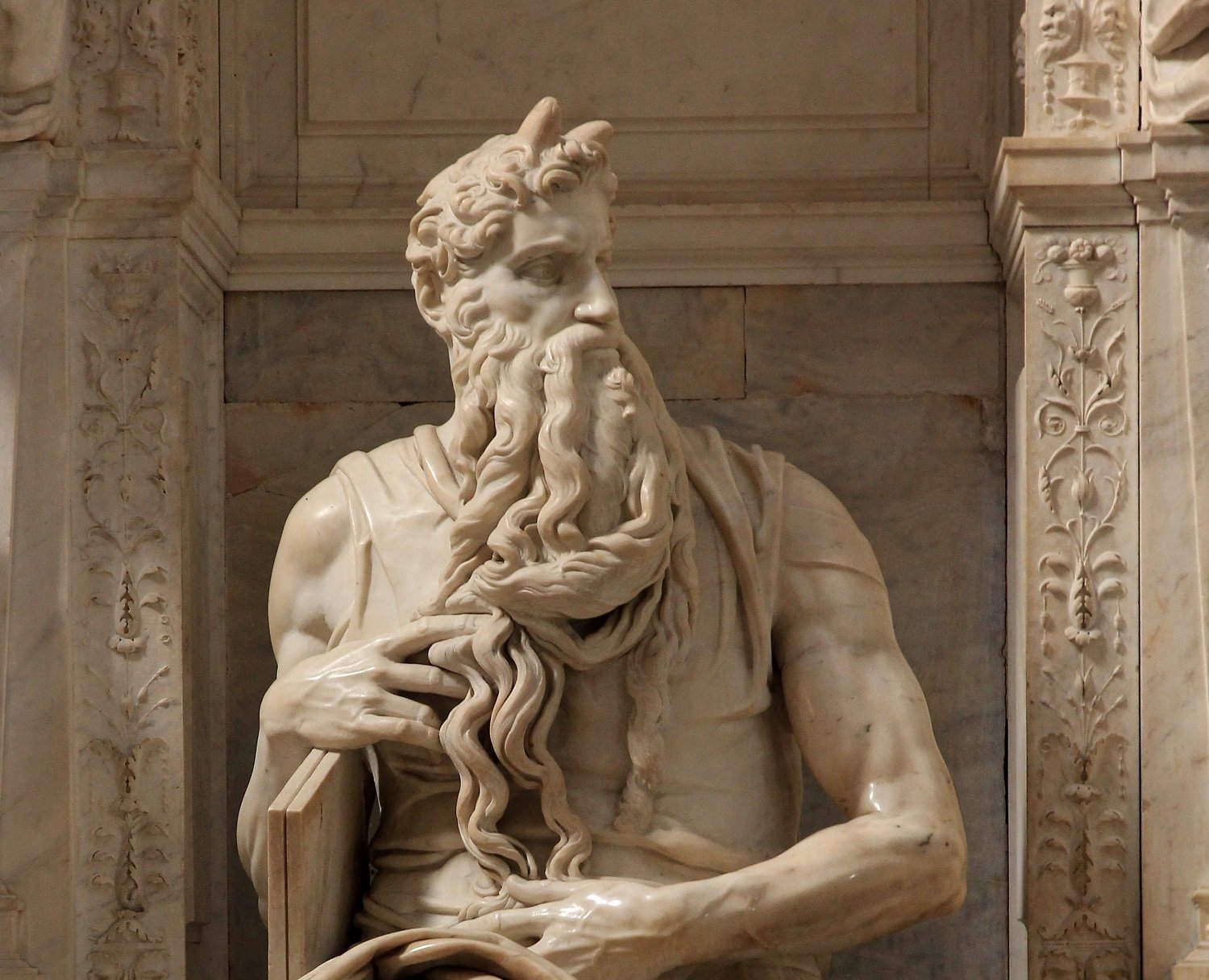
Moses by Michelangelo, c. 1513. Credit: Wikipedia Commons, CC-BY-SA-3.0
Scholars acknowledge that some legends from Greek mythology are strikingly similar to stories from the Bible. According to some theories, a few individual characters from the Bible might also appear in Greek mythology. One theory argues that the famous Moses of Egypt can be found in Greek records. Does Moses really appear in Greek mythology, or is this just wishful thinking?
Who was Moses?
Firstly, let us establish who Moses was. He appears in the Bible books of Exodus, Leviticus, Numbers, and Deuteronomy. Exodus contains the most famous part of his life story. It tells the story of how he was a Hebrew boy placed in the Nile River, where the Pharaoh’s daughter then found him.
When Moses was an adult, he tried to help his fellow Hebrews, who were slaves in Egypt, but then he ran away and remained in a distant land for forty years. He eventually returned after God allowed him to go and free his people from Egypt. Pharaoh refused to let the Hebrews go, but after ten devastating plagues from God, he relented.
Moses led the people out of Egypt across the Red Sea (where Pharaoh and his army drowned after trying to pursue them) and into the Sinai wilderness. There, he gave his people an extensive list of regulations from God, collectively known as the Mosaic Law. He also wrote many religious writings. The first five books of the Bible are attributed to him, as well as several poetic writings.
Did the Greeks know about Moses?
The theory that Moses appears in Greek mythology depends on the idea that the Greeks could have known of Moses in the first place. After all, he could not have appeared in their mythology if they did not know about him.
As it so happens, Moses does appear in quite a few Greek records. The Egyptian priest Manetho, from the third century BCE, mentioned Moses in his history of Egypt. Since Manetho lived in Egypt during its Hellenistic era, it is virtually certain that the Greeks of that region were aware of Moses. They certainly would have known of him after reading Manetho’s history.
Interestingly, there is evidence that the Greeks knew about Moses even before the Hellenistic era of Egypt. The first-century BCE Greek historian Diodorus Siculus wrote about the origin of the Jews. His account came from Hecataeus of Abdera, a Greek traveler from c. 300 BCE.
Hecataeus’ account differs from the Bible’s account in numerous ways, but it is still fundamentally the same story of Moses. Therefore, at least as early as 300 BCE, the Greeks definitely knew about Moses.
Was Musaeus from Greek mythology the same as Moses?
In ancient times, several writers explicitly identified Moses with a certain figure from Greek mythology. This figure was Musaeus. It is obvious that the main reason for identifying the two figures is due to the similarity between their names. But is there any more of a connection than this? Well, what does Greek mythology say about Musaeus?
Musaeus was a legendary intellectual, philosopher, seer, prophet, poet, musician, and historian. The Greeks believed that he founded a class of priestly poetry in Athens. He allegedly lived in the time of Heracles and was associated with Orpheus, another prominent poet and prophet from Greek mythology.
Immediately, we can see that there are some definite similarities between Moses and Musaeus from Greek mythology. In addition to the similarity in their names, their roles are also similar. Moses was a prophet, since he relayed messages from God. He was a poet, since he wrote the poetic book of Job and several of the Psalms. He was also a historian, since he wrote part of the history of the Jews.
Why Musaeus could not have been Moses
Despite these similarities, there is a key reason why Musaeus could not have been Moses. The key reason is that they did not live at the same time.
At first glance, it might look like the chronology works very well. Moses is usually placed at the time of Ramesses II, who ruled in the 13th century BCE. He is also placed in the time of Heracles, who lived about half a century prior to the Trojan War. That would also put him in the 13th century BCE according to the traditional date of the Trojan War. Therefore, it seems at first glance that Musaeus and Moses would have been exact contemporaries.
However, the reality is not so simple. Despite the popular association between Moses and Ramesses II, this has no historical or Biblical basis. The Bible’s internal chronology, along with its genealogical record of the prophet Samuel, places Moses firmly in c. 1500 BCE. That means he lived almost three centuries earlier than the traditional era of Musaeus.
The true era of Musaeus
The theory connecting Moses with Musaeus is further disproved if we examine the information about Musaeus from Greek mythology even more closely. For one thing, there is evidence that the Trojan War occurred several centuries later than the traditional date.
Furthermore, recall that Musaeus was closely associated with Orpheus. Some records say that Musaeus was Orpheus’ son, while other records give the inverse relationship. In either case, they lived at about the same time.
Greek tradition claims that Homer was a tenth generation descendant of Orpheus. That would place Orpheus, and therefore his associate Musaeus, about 200 to 250 years prior to the time of Homer. Since Homer lived in the seventh century BCE, that would mean that Musaeus would have probably lived in the ninth or tenth century BCE. Hence, this would have been long after the time of Moses. Therefore, it is virtually certain that Moses was not Musaeus from Greek mythology.
During Wednesday’s prime minister’s questions, the defence secretary was standing at the other end of the Commons, away from other cabinet members on the government frontbench. His expression gave nothing away as Keir Starmer and Kemi Badenoch blamed one another for spending too much on welfare and not enough on defence. In hindsight, he was possibly thinking “to hell with both of them”. Most defence secretaries go native sooner or later, imagining themselves to be embedded officers serving on the frontline. Tory Ben Wallace appeared to hate most of his cabinet colleagues by the time he resigned in 2023.
Less than 24 hours after PMQs, Healey had also resigned, his departure being all the more powerful for being so unexpected. This exit seemed to come out of a clear blue sky. There had been no briefings to the media in the preceding days. No threats to stand down if his demands were not met. All the arguments had taken place behind closed doors. A determination to do the right thing throughout.

 Login
Login