U.S. President Donald Trump told reporters today that in the wake of overnight attacks between the U.S. and Iran, strikes on Iran will continue. Meanwhile, Iranian officials say they are “reviewing” whether to continue peace talks after one of the most serious exchanges of fire between the two nations since the April 8 ceasefire.
Though damage assessments are still ongoing in the wake of Iranian missiles and drones launched across the Middle East overnight, a U.S. official told TWZ Wednesday morning that so far, there have been no injuries among U.S. personnel reported and no indication yet of any damage to American installations. That’s despite Iranian claims to the contrary.
“Iran launched multiple missiles and drones and just about all were intercepted according to initial reflections from assessments that are ongoing,” the official told us, speaking on condition of anonymity to discuss operational details. “No reports of harm to any U.S. personnel; not aware of any damage to our locations at this time.”
Several videos emerging overnight claimed to show missile interceptions and explosions resulting from the latest Iranian kinetic actions.
Some showed missile interceptions over Muwaffaq Salti. As we have frequently noted, the base has been a major staging area for U.S. airpower in the region. It came under Iranian attack before the ceasefire, with an AN/TPY-2 missile defense radar there having been notably targeted.
Footage shows air defense interceptors engaging incoming Iranian ballistic missiles over Jordan.
Iran’s Islamic Revolutionary Guard Corps (IRGC) says it targeted Jordan’s Muwaffaq al-Salti Air Base, along with 20 other U.S. military sites across the region. pic.twitter.com/RxKHsNaQur
Additional video shows what appears to be an explosion in the distance as viewed from a CCTV camera in Manama in the wake of a claimed Iranian missile launch at Fifth Fleet headquarters. The extent of the damage, if any, is unknown.
CCTV footage shows an explosion in Bahrain’s capital Manama after what authorities say was an Iranian missile strike.
Iran’s IRGC says it hit US military bases in Bahrain, Kuwait and Jordan in retaliatory attacks for US strikes in the Strait of Hormuz. pic.twitter.com/4eKzhBa1np
The Islamic Revolutionary Guard Corps (IRGC)-connected Tasnim News Agency also posted a video it claims shows an attack on the Fifth Fleet. The short video shows what appears to be an explosion in the distance and again, there is no way to tell what, if any damage, was caused.
The Kuwaiti Foreign Affairs Ministry condemned the latest Iranian strikes and said the nation “reserves its full right to take all necessary measures to preserve its security and defend its territories and vital facilities, in accordance with international law and the United Nations Charter.”
بيان صادر عن وزارة الخارجية الأربعاء 10 يونيو 2026
تُعرب وزارة الخارجية عن إدانة دولة الكويت واستنكارها وبأشد العبارات، استمرار الاعتداءات الإيرانية الآثمة والمتكررة على دولة الكويت، والتي كان آخرها اليوم، في تصعيد جديد يُضاف إلى سلسلة الاعتداءات الإيرانية المتواصلة، ويُعد… pic.twitter.com/7H1TFQNqMv
Iran said its latest volley of kinetic actions were in response to what U.S. officials say were strikes on 20 Iranian targets in response to the helicopter downing.
The United States and Iran traded strikes overnight.
20 Iranian targets were hit by U.S. forces, including air defense systems and radar sites.
This latest flurry of strikes prompted comments about the future of diplomacy from both sides.
During a morning press conference, Trump said “we hit ’em hard yesterday, and we’re going to hit ’em again hard today, in case you miss it, in case you don’t turn on your television set, and we’ll see what happens with the deal.”
.@POTUS on Iran: "We hit them hard yesterday and we're going to hit them again hard today… And we'll see what happens with the deal. We were really close to a deal — but they keep tapping us along. They keep playing us for suckers because you know what? They dealt with some… pic.twitter.com/ScvGn14QFQ
— Rapid Response 47 (@RapidResponse47) June 10, 2026
Earlier on Wednesday, Trump told Fox News that there may be additional U.S. attacks that focus on “Iranian power plants and bridges.”
NEW: President Trump tells me he "may keep going" with strikes against Iran and is getting closer to targeting Iranian power plants and bridges.
The President also spoke about the U.S. military helicopter that was downed saying that an Iranian drone lodged between the two… pic.twitter.com/j5aQEIzi9s
The president’s comments to Fox follow statements he made on his social media outlet saying Iran has taken too long to agree to a peace deal.
“Iran’s Military is a complete and total mess,” Trump said on Truth Social. “Much of it, like their Navy and Air Force, doesn’t even exist anymore – They have been completely defeated. Iran is all talk and no action. The Bully of the Middle East is DEAD!!! They’ve taken too long to negotiate a deal that would have been great for them, now they will have to pay the price!!!”
Trump did not elaborate on what that price may be.
— Rapid Response 47 (@RapidResponse47) June 10, 2026
As we noted earlier in this story, Iran is reassessing the future of diplomatic negotiations aimed at ending the US-Israeli war against the country, according to the official Iranian IRNA news outlet.
“We have to review it,” Iranian Foreign Ministry spokesperson Esmaeil Baqaei told IRNA. “Diplomacy and the battlefield are not separate matters; rather, they run alongside and complement each other in safeguarding Iran’s interests and security.”
Baqaei stressed that Iran’s military and diplomatic tracks operate in coordination.
“Wherever the Armed Forces deem it necessary, they respond to the enemy with authority and strength, and last night’s events showed that Iran’s brave Armed Forces do not hesitate in defending the country,” he posited.
ایرانی وزارت خارجہ کے ترجمان اسماعیل بقائی کا کہنا ہے کہ حملوں کے بعد امریکا کے ساتھ مذاکرات کا ازسرنو جائزہ لے رہے ہیں، امریکا اور اسرائیل بار بار جنگ بندی کی خلاف ورزی کررہے ہیں۔
انہوں نے کہا کہ مذاکرات کو آگے بڑھانے کیلئے پرسکون ماحول بہت ضروری ہے، بدقسمتی سے واشنگٹن کے… pic.twitter.com/1nGcYA3fmN
Despite the flare-up in fighting and posturing by both sides, negotiations appear to be continuing.
“Following consultations with the United States, Qatari negotiators headed to Tehran this morning to meet with the Iranians in an attempt to bridge the remaining gaps,” CNN reported on its Arabic channel, citing a source. “The visit indicates that diplomacy remains active, despite an exchange of fire between Iran and the United States overnight—marking one of the most significant tests of the ceasefire to date. A US official told CNN that the United States believes these strikes will not derail the negotiations.”
مصدر دبلوماسي لـCNN: مفاوضون قطريون توجهوا صباح الأربعاء إلى طهران لسد الفجوات المتبقية مع أمريكا https://t.co/IIkMnAmHkt
At issue remains the future of Iran’s nuclear ambitions, the ongoing closure of the Strait of Hormuz, Tehran’s ballistic missile arsenal and support for proxies and the easing of U.S. sanctions. Whether the increased fighting between the two sides will derail these efforts remains an open question.
UPDATES
Iran claims it downed another U.S. MQ-9 Reaper drone overnight. While TWZ can’t verify that, we have noted that the loss of dozens of these drones to Iran and the Houthis have forced the U.S. Air Force to scramble for replacements.
A cargo ship came under small arms fire 88 nautical miles south of Balhaf, Yemen in the Gulf of Aden, according to the United Kingdom Maritime Trade Operations (UKMTO) monitoring organization.
“A cargo vessel has reported being approached by one craft with 6 armed persons onboard,” UKMTO explained. “There was an exchange of fire between the small craft and the cargo vessel’s Armed Security Team resulting in the small craft turning away. Authorities are investigating. Vessels are advised to transit with caution and report any suspicious activity to UKMTO.”
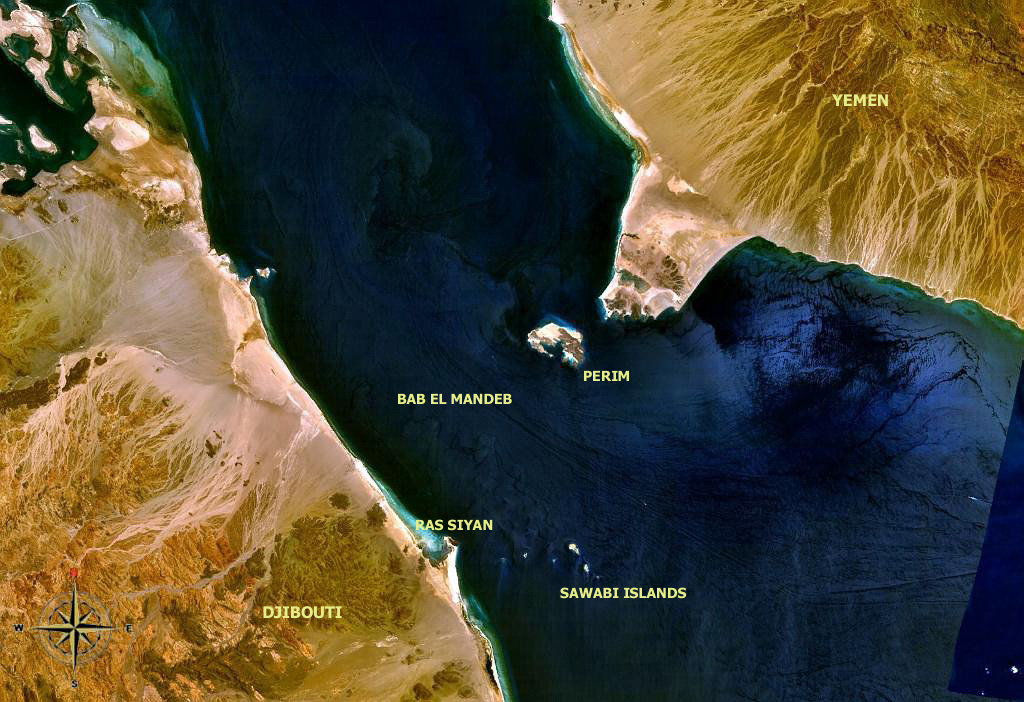
While details about who was involved are scant, this is the first attack in the region, near the Bab al-Mandeb Strait, since the Houthi rebels of Yemen threatened to shut the vital waterway down in support of Iran last week. You can read more about the implications of the Iranian proxy group closing the Strait on the U.S. military and the global economy in our prior reporting here.
In a post on X, CENTCOM on Wednesday announced it disabled an oil tanker trying to run the blockade of Iranian ports.
The incident took place at 11:14 p.m. on June 9, when a U.S. aircraft “fired precision munitions” into the engine room of the Palau-flagged M/T Settebello as it transited the Gulf of Oman.
The ship was attempting to transport oil from Iran, the command added.
In addition to the ships it disabled, CENTCOM said it has “redirected 134 ships that complied, and allowed 42 vessels supporting humanitarian aid to pass since initiating the blockade on April 13.”
You can read more about the other seven ships hit by CENTCOM here.
CENTCOM:
At 11:14 p.m. on June 9, U.S. forces disabled an oil tanker in the Gulf of Oman for the second consecutive day after another vessel violated the ongoing blockade by attempting to transport oil from Iran.
When it comes to the Strait of Hormuz and Gulf of Oman region, Trump took to social media to say the ongoing blockade of Iranian ports has devastated Tehran’s economy.
“The Fake News Media refuses to report how EFFECTIVE the U.S. Naval BLOCKADE is, the most successful Blockade in the history of Naval Warfare,” the president proclaimed on Truth Social. “NOTHING GETS THROUGH unless we want it to. IT IS A STEEL WALL! Iran is doing ZERO business, not paying their military, or any of their bills, and quickly becoming a FAILED NATION! Lots of oil is getting out. Praise be to Allah!”
President Donald J. Trump has taken to Truth Social again decrying the "fake news media" coverage of the naval blockade of Iran saying that it is a "STEEL WALL", Iran is doing "ZERO business, not paying their military or any of their bills, and quickly becoming a FAILED NATION!"… pic.twitter.com/DcCHVebRX7
However, in a post on X, the Windward trade intelligence group said that “five Iranian-trading [liquified petroleum gas] LPG carriers have broken the U.S. blockade on Iranian ports,” Windward stated. “Four discharged in India, one in Pakistan. All five used the same playbook, spoofing and AIS blackouts to mask loading and destination. Yet all signaled their exit and/or entry through Hormuz via AIS. Three were already U.S.-sanctioned. A fourth sanctioned June 6. Two operated under false flags, making them legally stateless.”
However, the crude oil blockade is holding, Windward added.
“No Iran-trading VLCC tracked in Asia via Malacca, Sunda, or Lombok since May 4,” the organization noted.
Five Iranian-trading LPG carriers have broken the U.S. blockade on Iranian ports. Four discharged in India, one in Pakistan.
All five used the same playbook, spoofing and AIS blackouts to mask loading and destination. Yet all signaled their exit and/or entry through Hormuz via… pic.twitter.com/iWBqGHSrBl
U.S. Secretary of War Pete Hegseth is scheduled to visit CENTCOM headquarters in Tampa, Florida, today to discuss the ongoing situation with the head of that command, Adm. Brad Cooper, and engage with troops.
Secretary Hegseth will be traveling to Guantanamo Bay, Cuba and Tampa, Florida today to engage with troops at GTMO and CENTCOM, per Pentagon.
Despite efforts to quell the fighting between Israel and Hezbollah in southern Lebanon, the Israeli Air Force continues to strike targets in that country.
“Over the past day, the IDF struck Hezbollah infrastructure sites in the area of Tyre and in several areas in southern Lebanon,” the IDF stated on Telegram.
“In the area of Tyre, the IDF struck six infrastructure sites used by the Hezbollah terrorist organization to advance terror attacks against the State of Israel and IDF soldiers operating in southern Lebanon,” the IDF added. “Among the infrastructure struck was a site used by Hezbollah terrorists to launch explosive drones toward IDF soldiers.”
In southern Lebanon, “the IDF struck ready-to-use Launchers, terrorists who operated in the area in which IDF soldiers are operating, and additional terror infrastructure sites,” it claimed.
השמדת תשתיות טרור מהן הופעלו רחפני הנפץ נגד כוחותינו: חיל-האוויר וכוחות יחידת האיסוף 869 ממשיכים לפעול בדרום לבנון.
במהלך השבועיים האחרונים, הכוחות חיסלו בשיתוף חיל-האוויר יותר מ-20 מחבלים שפעלו לקידום מתווי טרור והיוו איום על כוחותינו. בנוסף הכוחות השמידו מספר תשתיות טרור… pic.twitter.com/Mysi9BMXHW
The ongoing Israeli incursion into southern Lebanon and continuing presence in Syria has raised tensions with Turkey. Any direct conflict flaring up from the long-simmering animosity between two of the region’s most powerful militaries – though extremely unlikely – would be a far bigger deal than a dertailment of U.S.-Iran peace talks.
“We are fully aware of what the ultimate objective of the delusion of ‘Greater Israel’ is,” Turkish President Recep Tayyip Erdoğan said Wednesday, adding that Israel’s actions in Lebanon and Syria now threaten Turkey.
Turkish President Recep Tayyip Erdogan:
Israel's attacks on Syria and Lebanon have reached a point where they also threaten Turkey.
— Ariel Oseran أريئل أوسيران (@ariel_oseran) June 10, 2026
The Turkish leader’s statements sparked a harsh response from Netanyahu.
“The antisemitic tyrant Erdogan, who perpetrates genocide against the Kurds, supports the terrorist organization Hamas, oppresses his own people, and imprisons political rivals, is the last one who can preach morals to the State of Israel,” the Israeli leader retorted. “The State of Israel and the IDF, the most moral army in the world, will continue to act forcefully against Iran and its proxies that threaten the Middle East and the entire world.”
הרודן האנטישמי ארדואן שמבצע רצח עם בכורדים, תומך בארגון הטרור חמאס, מדכא את בני עמו ושם בכלא יריבים פוליטיים הוא האחרון שיכול להטיף מוסר למדינת ישראל.
מדינת ישראל וצה"ל, הצבא המוסרי ביותר בעולם, ימשיכו לפעול בעוצמה נגד איראן ושלוחותיה שמאיימות על המזרח התיכון ועל העולם כולו.
— Benjamin Netanyahu – בנימין נתניהו (@netanyahu) June 10, 2026
The latest events in the Mideast region show that there is no immediate end in sight to the hostilities and we will continue to monitor developments here given the ongoing impacts on the U.S. military and global economy.
UPDATE: 3:01 PM EDT –
Trump claimed the price of oil will fall because of how much has been secretly moved out of the region.
“We’re taking about millions of barrels of oil,” the president told reporters Wednesday afternoon.
.@POTUS on Iran: "Did you know we've been taking out millions of barrels of oil? Nobody knows it. You know who doesn't know about it? Iran — until right now. We took out, the other night, 22 ships." pic.twitter.com/2odiLYXDJ3
— Rapid Response 47 (@RapidResponse47) June 10, 2026
On his Truth Social, Trump claimed that last month, he “directed our Great U.S. Military to execute a secret mission to support Oil Tankers and other Commercial Ships through the Strait of Hormuz.”
“Today, I am pleased to announce that this effort has resulted in more than 100 MILLION Barrels of Oil making its way through the Strait, and into the Open Market,” he added. “More than 200 Commercial Ships have safely traveled through the Strait. This wildly successful effort is because the UNITED STATES of AMERICA CONTROLS the Strait of Hormuz — NOT Iran. Their military is defeated, and their economy is lost. It’s over for Iran!”
BREAKING: President Trump says he directed the US Military to execute a “secret mission” in the Strait of Hormuz which resulted in over 100 million barrels of crude oil crossing through Hormuz. pic.twitter.com/bSYeetbHH4
— The Kobeissi Letter (@KobeissiLetter) June 10, 2026
However, TankerTrackers.com clarified that the president was referring not to Iranian oil, but Arab oil.
There is now a public misunderstanding regarding President Trump’s statement. It is not Iranian oil that he is talking about. Those are still trapped. Instead, it appears to be the secured convoys of Arab oil into the Gulf of Oman via the Strait of Hormuz. This explains why… https://t.co/fEgyzY3gnX
— TankerTrackers.com, Inc. (@TankerTrackers) June 10, 2026
UPDATE: 3:39 PM EDT –
Hegseth thanked troops at CENTCOM headquarters in Tampa, Florida, for their efforts in the Middle East.
.@SECWAR spoke with troops at U.S. Central Command:
“On behalf of the President of the United States—on behalf of the American people—I want to say how proud we are of the work @CENTCOM has undertaken.” pic.twitter.com/SkDuqzS3UW
The Secretary-General of the International Maritime Organization (IMO) “has expressed deep concern and strong condemnation of the attack on the tanker MT Settebello,” according to the organization.
“I strongly condemn any act from any party that endangers the lives of seafarers and the safety of international shipping,” said Secretary-General Arsenio Dominguez. “This is simply unacceptable. My thoughts are with the families of the three missing seafarers and with all those awaiting news of the crew members.”
Two Indian seafarers died and one was reported missing after the attack, according to The Hindu.
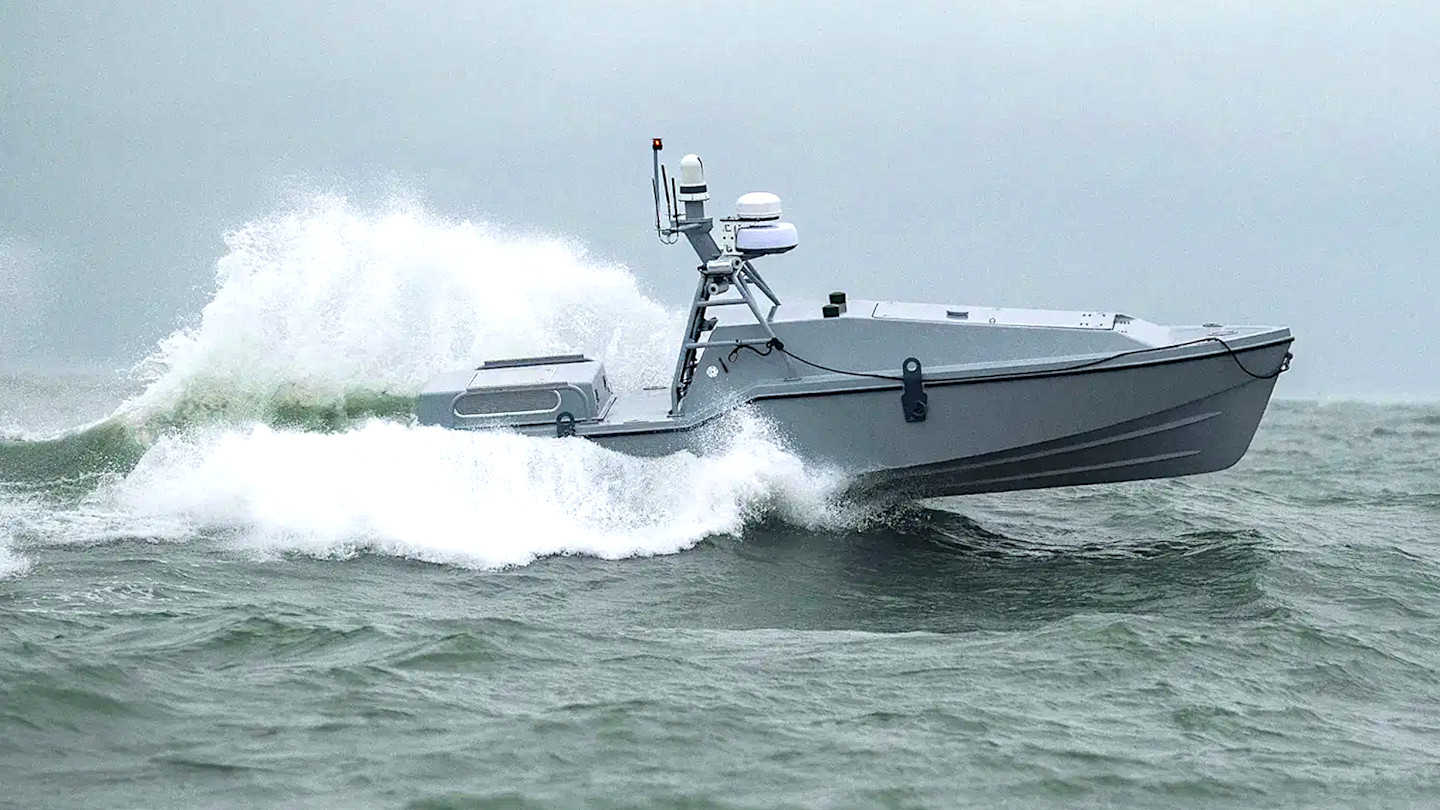
U.S. Central Command (CENTCOM) has confirmed a Saronic Corsair was the uncrewed surface vessel (USV) that rescued the crew of a U.S. Army AH-64 Apache out of the Gulf of Oman overnight. President Donald Trump has also now said Iranian forces downed the attack helicopter, and promised a response. This is the first known instance of a drone boat being used to recover personnel as part of a search and rescue mission, and has major implications for these operations going forward. Readers can otherwise get up to speed on what is already known about this incident in our initial reporting here.
“The surface drone that assisted in last night’s rescue of the Apache crew off the coast of Oman was a U.S. Navy Corsair unmanned surface vessel operated by U.S. 5th Fleet’s Task Force 59,” U.S. Navy Capt. Tim Hawkins, a CENTCOM spokesman, told TWZ. “The task force began fielding these drones in theater in late March.”
A top-down look at a Saronic Corsair USV. Saronic
The Navy confirmed last December that it had signed an Other Transaction Authority (OTA) deal with Saronic, valued at $392 million, for the production of Corsair USVs. The Corsair, which the manufacturer also calls an autonomous surface vessel (ASV), is a 24-foot-long drone boat with a speedboat-like design that was first unveiled in 2024. The manufacturer says it has a maximum range of 1,000 nautical miles, a top speed of 35 knots, and a 1,000-pound payload capacity.
Prototype to production in under 12 months. The @Saronic OTA proves how we’ll build a hybrid manned–unmanned Fleet: open competition, real contracts, real hardware for Sailors and Marines not slides. This is now the standard. pic.twitter.com/cC9DG7jTiW
— Archive: Secretary of the Navy John C. Phelan (@SecNavPhelan) December 8, 2025
The Corsair “picked them [the Apache crew] up and transported them to another location on the water where they were then hoisted up to a helicopter for further transport,” Capt. Hawkins, the CENTCOM spokesperson, added.
CENTCOM had already confirmed to TWZ and others that an unspecified USV found and rescued the two aircrew from the downed Apache. The Wall Street Journal was first to report the specific type of drone boat employed.
The Army aviators spent approximately two hours in the water before being recovered safely, according to a previous CENTCOM statement. As mentioned, President Donald Trump has also now separately said that Iranian forces were responsible for bringing down the Apache, and that a U.S. response will be forthcoming.
Trump says that Iranian forces shot down the Army AH-64 Apache attack helicopter that went down over Hormuz yesterday.
Since its establishment in 2021, the Navy’s Task Force 59 has been charged with helping expand the service’s operational use of uncrewed platforms, as well as artificial intelligence (AI) and machine learning-driven capabilities, across the Middle East. It has operated an array of different types of USVs, as well as uncrewed aerial systems, over the years.
How many Corsairs Task Force 59 has currently, as well as their exact configuration, is unclear. Pictures and videos that Saronic has released to date have shown Corsairs fitted out primarily for surveillance and reconnaissance missions, with a camera turret on top of a central mast-like frame. A commercial navigation radar, additional cameras to help provide extra situational awareness, and various other antennas have also been seen fitted to that frame. Saronic has talked about integrating other capabilities to enable additional mission sets, including launchers for loitering munitions, in the past.
A picture showing the most typical configuration of the Corsair USV that has been seen to date. Saronic
Saronic also says Corsair has a high degree of autonomy, with the type having logged more than 100,000 nautical miles of total travel to date, including multi-day missions. The SUV is designed to be employed independently or in networked swarms, according to the company. Human operators are in the loop during these operations via datalink.
Corsair, our 24ft Autonomous Surface Vessel (ASV), has officially crossed 100,000 nautical miles traveled — that’s nearly five times around the Earth or almost halfway to the Moon!
This milestone represents more than distance. It reflects relentless testing across diverse… pic.twitter.com/opXtX6jSfO
“Corsair can be given a mission, alone or as part of a collaborative swarm, and execute with minimal human interaction to deter or counter adversarial threats at a range of 1,000 nautical miles,” Saronic said in a press release back in 2024. “Employing redundant communications and passive perception capabilities, Corsair can autonomously identify, track, follow, and intercept targets in contested and communications denied environments.”
These are all capabilities well suited to the U.S. Navy’s immediate needs in the Middle East, especially in support of the current blockade of Iranian ports. Corsair would notably offer a lower-risk way to closely shadow vessels that might be attempting a run into or out of the area. Corsair’s ability to automatically spot and track objects of interest would have helped in finding and rescuing the downed Apache crew, too. It is worth noting here that automated target detection is also a key part of Corsair’s ability to safely navigate autonomously, day or night, especially in congested waterways, as seen in the video below.
In 2025, we logged more than 79,000 nautical miles and over 15,000 hours of total operations with Corsair, our 24-ft ASV. Much of this was done on our own dime, operating 6 days a week at our test sites on the West Coast, East Coast, Gulf Coast, and beyond, allowing us to… pic.twitter.com/PZETeJia17
Corsair’s overall performance in the Middle East could easily translate to further operational use of this USV by the Navy globally. The service has particularly significant demands for persistent maritime surveillance and reconnaissance capacity, as well as just general presence, across the broad expanses of the Pacific. One of the key benefits that USVs offer is the ability to provide additional distributed ‘mass’ at relatively low cost. This can help bolster the capabilities of crewed platforms they are networked together with or just ease the operational strain on those assets.
The Navy has now also clearly demonstrated how valuable USVs could be in future maritime search-and-rescue operations worldwide. This, in turn, underscores the benefits uncrewed platforms bring to these missions, especially in the face of growing anti-air and other threats.
As we already wrote today:
“As TWZ regularly highlights, search and rescue operations present inherent complexities and risks, especially when conducted in or near hostile territory. The F-15E rescue effort in Iran put a particular spotlight on the immense risks that combat search and rescue (CSAR) forces take, with helicopters and C-130 variants sent into areas where even a high-end fighter aircraft didn’t survive.”
“Open-water recoveries can present distinct additional challenges. There is always the possibility of the loss of additional assets and personnel in the process, no matter where a CSAR mission occurs.”
US Air Force HH-60W Jolly Green II search-and-rescue helicopters refuel from an HC-130J Combat King II aircraft. USAF
“The use of a Navy drone boat in the rescue overnight highlights a new dimension for maritime CSAR going forward. These uncrewed assets can be more readily pre-positioned in a distributed manner. For example, in the broad expanse of the Pacific, USVs could be forward-deployed at multiple points along certain flight paths for this exact purpose. USVs could offer other distinct advantages in certain scenarios where they might be able to get into areas where traditional assets cannot and without risking additional personnel. These realities extend well beyond the maritime domain, and we are only likely to see uncrewed platforms of all kinds increasingly taking part in rescue efforts, especially in denied areas. The U.S. military is coming to terms with just how vulnerable their CSAR assets are and the ranges that would be needed to access highly defended areas, especially during a peer fight. Using drones to execute personnel recovery is being viewed as one part of a larger set of solutions to this pressing problem.“
The additional detail we have now that the Corsair USV brought the downed aircraft to a territorial location, where they were then hoisted into a helicopter, is notable, too. This further shows how uncrewed platforms could be used as part of a distributed hub-and-spoke-style concept of operations for future rescue missions, which could increase flexibility and total area covered. USVs could be used to penetrate into especially high-threat areas, recover personnel, and then bring them to crewed assets at safer locations to the rear, as well.
“When it comes to search and rescue, you utilize the best asset that is the closest and the quickest, and that was the case in this instance,” CENTCOM’s Hawkins also told The Wall Street Journal today. “We’ve practiced this scenario in exercises, but not quite necessarily like this.”
The first Marauder prototype seen being launched earlier this year. Saronic
The Navy is already set to evaluate Marauder, as well as designs from six other companies, as part of the first round of prototyping under its latest Medium Unmanned Surface Vessel (MUSV) effort. This is part of a larger strategy the service rolled out in March to try to field more USVs and do so faster, as you can read more about here.
In the meantime, Saronic’s Corsair is already being employed operationally in the Middle East and demonstrating its ability to perform complex missions.
Os acontecimentos mais recentes no Oriente Médio indicam que a dinâmica do conflito regional está entrando em uma nova fase. Embora o cessar-fogo firmado nos últimos meses tenha reduzido a intensidade dos confrontos diretos, os episódios recentes demonstram que os fatores estruturais que alimentam a guerra continuam presentes. A troca de ataques entre Irã e Israel revela não apenas a fragilidade dos acordos existentes, mas também uma mudança importante na postura estratégica de Teerã.
Durante anos, a política militar iraniana foi caracterizada principalmente por respostas a ações consideradas hostis. Desde 2024, todos casos de embate direto entre Irã e Israel se deram através de respostas a agressões israelenses anteriores. No entanto, os eventos do último fim de semana sugerem uma alteração significativa nesse comportamento. Ao lançar uma ofensiva contra alvos israelenses após operações militares realizadas no Líbano, o Irã demonstrou disposição para agir antes que ameaças adicionais se concretizem, apresentando suas ações como parte do direito à legítima defesa de terceiros, materializado na proteção de parceiros regionais.
A justificativa iraniana baseia-se na interpretação de que os ataques israelenses contra território libanês representam violações dos entendimentos firmados anteriormente. Segundo essa visão, a continuidade das operações militares em áreas urbanas e a ampliação das ações contra diferentes regiões do Líbano criam um cenário que legitima uma resposta proporcional. Além disso, Teerã também associa sua reação a incidentes envolvendo pirataria americana em rotas marítimas estratégicas.
O aspecto mais relevante dessa escalada não está apenas na troca de mísseis ou drones, mas na mensagem política transmitida por ela. O Irã parece sinalizar que não pretende mais limitar suas ações à defesa direta de seu próprio território. Em vez disso, demonstra disposição para responder a operações militares que atinjam atores considerados parte de seu eixo regional de alianças. Trata-se de uma mudança com potencial para alterar profundamente os cálculos estratégicos de todos os envolvidos.
Ao mesmo tempo, a reação internacional evidencia as dificuldades enfrentadas pelas potências que buscam administrar a crise. O receio de uma expansão descontrolada do conflito ocorre em um momento particularmente sensível para a economia global. Tensões militares em uma das regiões mais importantes para a produção e o transporte de energia tendem a gerar impactos imediatos sobre mercados financeiros, cadeias logísticas e expectativas de investidores.
A resposta israelense aos ataques iranianos, seguida por novas ações militares de Teerã e pela participação de aliados regionais, demonstra que o ciclo de retaliações continua ativo. O envolvimento do Iêmen, que passou a restringir o acesso de embarcações ligadas a Israel ao Mar Vermelho, traz um fator adicional de insegurança para o regime sionista – criando um front de apoio ao Irã.
Diante desse cenário, torna-se evidente que o cessar-fogo vigente possui limitações significativas. Embora tenha reduzido temporariamente o nível de violência, ele não solucionou os principais elementos que sustentam a rivalidade regional. Questões relacionadas à presença militar americana e ao expansionismo territorial israelense permanecem sem resolução, prolongando o cenário de tensões.
Contudo, talvez a principal consequência dos acontecimentos recentes seja o surgimento de um novo precedente estratégico. Ao demonstrar disposição para responder a ações realizadas contra terceiros, o Irã estabelece uma lógica de dissuasão mais ampla do que a observada anteriormente. Isso significa que futuras operações militares conduzidas por Israel ou pelos Estados Unidos contra parceiros de Teerã poderão gerar respostas diretas, mesmo quando o território iraniano não for o alvo imediato.
Da mesma forma que agora o Irã responde a ataques israelenses contra o Líbano, em breve estas retaliações poderiam ser lançadas para punir Tel Aviv por seus crimes em Gaza, no Iraque, no Iêmen e em outros países da região. Na prática, isso significa que a balança regional de poder mudou substancialmente: agora, o Irã deixa claro a Israel que seus crimes não ficarão impunes.
El Cáucaso Meridional se está convirtiendo en una prueba de fuego para ver hasta dónde puede llegar Washington en el perímetro compartido por Rusia e Irán antes de que se produzca una reacción violenta.
En vísperas de las cruciales elecciones parlamentarias de Armenia del 7 de junio, el secretario de Estado de EE. UU., Marco Rubio, durante una breve visita a Ereván el 26 de mayo, firmó tres acuerdos de gran importancia en una reunión con el ministro de Asuntos Exteriores armenio, Ararat Mirzoyan.
Entre ellos se incluían el «Acuerdo Marco entre la República de Armenia y los Estados Unidos de América sobre Cooperación Estratégica en relación con la Ruta Trump para la Paz y la Prosperidad Internacionales (TRIPP)», la «Carta sobre la Asociación Estratégica Integral entre la República de Armenia y los Estados Unidos» y el «Marco entre la República de Armenia y los Estados Unidos de América para garantizar el suministro en la extracción y el procesamiento de minerales críticos y tierras raras».
El respaldo de Washington en época de elecciones
La breve visita de Rubio, que duró solo una hora aproximadamente en el aeropuerto de Ereván, fue una clara señal del apoyo de EE. UU. al Gobierno de Nikol Pashinyan de cara a las cruciales elecciones parlamentarias de Armenia del 7 de junio.
En los últimos años, la administración de Pashinyan se ha distanciado gradualmente de la Federación Rusa y de las instituciones regionales lideradas por Moscú, incluida la Organización del Tratado de Seguridad Colectiva (OTSC) y, más recientemente, la Unión Económica Euroasiática (UEE), al tiempo que ha buscado estrechar lazos con la UE, la OTAN y los EE. UU.
En este contexto, el secretario de Estado de EE. UU., que viajó a Ereván dos semanas antes de las elecciones, expresó su firme apoyo a Pashinyan y a su equipo, afirmando: «Tú (Ararat Mirzoyan), el primer ministro y tu equipo estáis allanando el camino hacia un futuro más brillante y más independiente para Armenia».
El presidente de EE. UU., Donald Trump, también escribió en una publicación en Truth Social:
«¡El primer ministro Nikol Pashinyan, de Armenia, un gran amigo y líder, está haciendo que su país sea fuerte, próspero y muy seguro! Nikol comparte plenamente mi visión de PAZ y PROSPERIDAD para Armenia y toda la región del Cáucaso Meridional… Nikol cuenta con mi APOYO TOTAL y ABSOLUTO para su reelección el 7 de junio de 2026».
Armenia también acogió la Octava Cumbre de la Comunidad Política Europea el 23 de mayo, lo que constituyó otra muestra del apoyo occidental al Gobierno de Pashinyan.
No obstante, sigue sin estar claro si dicho apoyo se traducirá en última instancia en una victoria electoral del Partido del Contrato Civil de Pashinyan frente a sus oponentes nacionalistas y conservadores. Un ejemplo reciente es Hungría, donde la visita del vicepresidente estadounidense J.D. Vance a Budapest y su participación en un mitin electoral junto al primer ministro Viktor Orbán no lograron evitar la derrota de Orbán en las elecciones parlamentarias tras 16 años en el poder.
La Ruta de Trump toma forma
Los tres acuerdos firmados durante la visita de Rubio a Ereván —en particular el Acuerdo TRIPP— deben considerarse una continuación y un complemento del acuerdo de paz firmado por el presidente azerbaiyano Ilham Aliyev y Pashinyan en la Casa Blanca el 8 de agosto de 2025, bajo la mediación de Trump.
En virtud de dicho acuerdo, la conectividad directa entre Azerbaiyán y su República Autónoma de Najicheván a través del territorio armenio se refrendó no bajo la denominación preferida por Bakú de «Corredor de Zangezur», ni bajo el concepto preferido por Ereván de «Encrucijada de la Paz», sino bajo un nuevo título: la «Ruta Trump para la Paz y la Prosperidad Internacionales» (TRIPP), o simplemente la «Ruta Trump».
El Acuerdo TRIPP, compuesto por 11 artículos, establece el marco jurídico y operativo que rige esta ruta de tránsito. De conformidad con los artículos 1 a 4, se creará una empresa conjunta denominada TRIPP Development Company (TDC).
En virtud del acuerdo, el 74 % de las acciones y la participación mayoritaria en la empresa estarán en manos de entidades estadounidenses que operan bajo la Corporación Financiera Internacional para el Desarrollo de los Estados Unidos (DFC), mientras que Armenia conservará una participación del 26 %.
Además, en virtud del artículo 6, Armenia se compromete a conceder a la empresa conjunta derechos exclusivos de uso del suelo y desarrollo a lo largo de las zonas designadas para la ejecución del TRIPP durante un período inicial de 49 años. El acuerdo también prevé una posible prórroga de 50 años adicionales por mutuo acuerdo, en cuyo caso la participación de Armenia en la TDC aumentaría al 49 %.
Armenia se ha comprometido además a asumir todos los costes financieros asociados a la adquisición de terrenos y a la eliminación de cualquier gravamen o reclamación de terceros que afecte a las zonas del proyecto. Al mismo tiempo, el acuerdo afirma explícitamente que la República de Armenia conserva la plena soberanía, integridad territorial y jurisdicción legal y ejecutiva sobre todas las zonas y proyectos asociados al TRIPP dentro de su territorio soberano.
La aplicación de este acuerdo —al igual que el acuerdo de paz entre Armenia y Azerbaiyán y el proceso en curso de normalización entre Armenia y Turquía— dependerá en gran medida de la reelección del Partido del Contrato Civil de Pashinyan en las elecciones parlamentarias del 7 de junio. Si las fuerzas políticas nacionalistas y conservadoras de Armenia salieran victoriosas, el panorama político podría cambiar significativamente.
Fuertemente críticos con las políticas de Pashinyan respecto a Nagorno-Karabaj, estos grupos nacionalistas y conservadores mantienen posiciones de línea dura tanto hacia Azerbaiyán como hacia Turquía. Tradicionalmente han mantenido relaciones más estrechas con Irán y Rusia, al tiempo que han conservado una distancia cautelosa y cuidadosamente calibrada con respecto a Occidente.
En consecuencia, un cambio de gobierno podría tener profundas implicaciones para el futuro del proceso de paz entre Armenia y Azerbaiyán, la normalización de las relaciones entre Armenia y Turquía y la aplicación del TRIPP.
Teherán ve más que un corredor
Por lo tanto, no fue de extrañar que, en medio de la atmósfera altamente polarizada y políticamente cargada de Armenia en vísperas de las cruciales elecciones parlamentarias, la inesperada y breve visita de Rubio a Ereván fuera recibida con fuertes críticas por parte de las fuerzas de la oposición.
Los partidos de la oposición y los grupos políticos de Armenia sostienen que el proyecto a gran escala de la «Ruta Trump» es, en esencia, el mismo corredor de tránsito que Azerbaiyán lleva tanto tiempo buscando bajo el nombre de «Corredor de Zangezur» y que cuenta con el firme apoyo de Ankara.
El expresidente armenio Robert Kocharyan, líder de la influyente Alianza Armenia, expresó su profunda preocupación por las implicaciones estratégicas del acuerdo, afirmando:
«Creo que el proyecto «TRIPP» es una maniobra propagandística muy fuerte por parte de EE. UU., cuyo objetivo es crear tensión entre Irán y Armenia, porque después de eso, Teherán sin duda sentirá desconfianza… Esto también es un «golpe» para Rusia».
En Irán, el portavoz del Ministerio de Asuntos Exteriores, Hamid Baghaei, también reaccionó a la visita de Rubio y a la firma del Acuerdo Trump, afirmando:
«La posición de la República Islámica de Irán con respecto a la seguridad en el Cáucaso Meridional es clara y no deja lugar a ambigüedades. Irán acoge con satisfacción la expansión de los intercambios económicos y la reapertura de las rutas de transporte y tránsito. Sin embargo, dado el largo historial de conducta hostil e intervención de Estados Unidos en diversas regiones del mundo, Irán alberga serias sospechas sobre las intenciones de Washington y ha expresado explícitamente su oposición a cualquier presencia desestabilizadora de este tipo en la región».
Aunque los funcionarios iraníes parecen haberse abstenido de adoptar una postura más explícita en esta fase —probablemente debido a su comprensión del delicado entorno electoral de Armenia y al deseo de evitar verse directamente involucrados en las rivalidades políticas internas del país—, Irán, en términos estratégicos, ve poca diferencia entre la «Ruta Trump» y el «Corredor de Zangezur» defendido por Azerbaiyán y apoyado por Turquía.
Desde la perspectiva de Teherán, ambas iniciativas persiguen objetivos que van mucho más allá del establecimiento de un mero enlace de transporte y tránsito entre el territorio continental de Azerbaiyán y Najicheván a través del territorio armenio adyacente a la frontera de Irán.
Los responsables políticos iraníes creen que tales proyectos podrían generar una serie de importantes retos de seguridady geopolíticos, incluidos riesgos potenciales para los 40 kilómetros de frontera entre Irán y Armenia, los pasos fronterizos y las instalaciones aduaneras de Norduz (Irán) y Meghri (Armenia), así como para la red bilateral de comercio y tránsito por la que pasan más de 80.000 camiones al año.
Además, no cabe duda de que la puesta en marcha de la Ruta Trump, como parte del Corredor Central más amplio y de una ruta emergente de energía y transporte que une Asia Central, el mar Caspio y el Cáucaso Meridional con Europa, aceleraría aún más la orientación hacia Occidente de Ereván.
Tal evolución podría tener consecuencias de gran alcance, incluida la eventual retirada de Armenia de la OTSC y la UEEA. El efecto acumulativo de estos acontecimientos podría ser un cambio más profundo en el equilibrio geopolítico del Cáucaso Meridional en detrimento tanto de Irán como de Rusia —un proceso que, en muchos aspectos, comenzó con la Segunda Guerra de Nagorno-Karabaj en 2020.
La guerra de 12 días entre Estados Unidos e Israel contra Irán en junio de 2025 y la más reciente guerra de 40 días en la que participaron Israel y Estados Unidos contra Irán, del 28 de febrero al 7 de abril de 2026, han agudizado la sensibilidad de Teherán hacia el proyecto de la Ruta Trump y la posible presencia de empresas estadounidenses cerca de la frontera norte de Irán.
Esta preocupación es especialmente acusada dado que, en virtud del acuerdo recientemente firmado, dicha presencia no está pensada para ser temporal. Más bien, el acuerdo prevé un periodo de concesión inicial de 49 años, con la posibilidad de una prórroga adicional de 50 años por mutuo acuerdo, lo que podría dar lugar a una duración total de 99 años.
Desde la perspectiva de Irán, esto no equivaldría simplemente a un proyecto de transporte o de infraestructura, sino al establecimiento de una huella económica y estratégica estadounidense a largo plazo en una zona geopolítica altamente sensible adyacente a sus fronteras.
Por esta razón, Kocharyan declaró durante su campaña electoral:
«Hoy en día, Estados Unidos se encuentra en un estado de confrontación con Irán. En tales circunstancias, ¿cómo puede alguien creer razonablemente que ceder el control de la sensible zona fronteriza entre Armenia e Irán a una empresa estadounidense es una decisión racional? ¿De verdad consideran que tal medida es normal y aceptable? ¿Cómo se espera que Teherán perciba y tolere tal acuerdo? Insto a las autoridades de Ereván a que se pongan, aunque sea por un momento, en la posición de Irán y vean este desafío de seguridad desde la perspectiva de Teherán».
Moscú sube la apuesta
La respuesta de Rusia hacia Armenia, sin embargo, ha sido notablemente más dura, al menos en la etapa actual. Solo unos días después de la visita de Rubio, Moscú retiró a su embajador de Ereván para consultas, citando las políticas cada vez más prooccidentales del Gobierno de Pashinyan.
En las últimas semanas, funcionarios rusos han advertido abiertamente a Armenia, especialmente en relación con la posibilidad de su retirada de la UEEA, sobre las posibles consecuencias, entre las que se incluyen el aumento de los precios del gas o la suspensión de los acuerdos energéticos preferenciales, restricciones a las importaciones de productos armenios, limitaciones al comercio de diamantes y energía, e incluso una reevaluación de ciertos ámbitos de la cooperación económica.
En esencia, a Moscú le preocupa que su participación actual en la guerra de Ucrania pueda animar a Armenia —el único Estado del Cáucaso Meridional que sigue siendo miembro tanto de la UEEA como de la OTSC— a abandonar estas instituciones lideradas por Rusia.
Dado que ni Georgia ni Azerbaiyán son miembros de ninguna de las dos organizaciones, tal desarrollo reduciría significativamente la influencia económica, geopolítica y militar de Rusia en el Cáucaso Meridional.
La aplicación del Acuerdo TRIPP y la construcción de la Ruta Trump entre Azerbaiyán y Najicheván se enfrentan a importantes obstáculos políticos y dependerán en gran medida del resultado de las elecciones parlamentarias de Armenia del 7 de junio.
Si prevalecen las fuerzas políticas nacionalistas y conservadoras de Armenia, la probabilidad de que el proyecto se suspenda o se abandone sería considerable.
Incluso si Pashinyan consigue la reelección, es probable que la puesta en marcha del proyecto provoque una fuerte oposición por parte de Irán y exponga a Armenia a posibles medidas de represalia por parte de Rusia, especialmente en los ámbitos de las exportaciones de gas natural y las restricciones a las importaciones armenias.
Israel's Prime Minister Benjamin Netanyahu will stand in the country's next elections, his party said on Wednesday, which is scheduled to take place in late October. The announcement came after US President Donald Trump questioned whether Netanyahu wanted to continue in politics in an interview with ABC News.
The recent developments in the Middle East indicate that the dynamics of the regional conflict are entering a new phase. Although the ceasefire reached in recent months has reduced the intensity of direct confrontations, recent events demonstrate that the structural factors fueling the war remain in place. The exchange of attacks between Iran and Israel reveals not only the fragility of existing agreements but also an important shift in Tehran’s strategic posture.
For years, Iranian military policy was characterized primarily by responses to actions it considered hostile. Since 2024, every case of direct confrontation between Iran and Israel occurred with an Iranian response to a previous Israeli attack. However, the events of the past weekend suggest a significant change in this behavior. By launching an offensive against Israeli targets following military operations conducted in Lebanon, Iran demonstrated a willingness to act before additional threats materialize, presenting its actions as part of the right to collective self-defense, expressed through the protection of regional partners.
The Iranian justification is based on the interpretation that Israeli attacks on Lebanese territory constitute violations of previously established understandings. According to this view, the continuation of military operations in urban areas and the expansion of actions against different regions of Lebanon create a scenario that legitimizes a proportional response. In addition, Tehran also links its reaction to incidents involving what it describes as American piracy on strategic maritime routes.
The most significant aspect of this escalation lies not merely in the launching of missiles or drones, but in the political message it conveys. Iran appears to be signaling that it no longer intends to limit its actions to the direct defense of its own territory. Instead, it is showing a willingness to respond to military operations targeting actors considered part of its regional alliance network. This represents a shift with the potential to profoundly alter the strategic calculations of all parties involved.
At the same time, the international response highlights the difficulties faced by powers attempting to manage the crisis. Fears of an uncontrolled expansion of the conflict come at a particularly sensitive moment for the global economy. Military tensions in one of the world’s most important regions for energy production and transportation tend to generate immediate impacts on financial markets, logistics chains, and investor expectations.
Israel’s response to the Iranian attacks, followed by further military actions by Tehran and the involvement of regional allies, demonstrates that the cycle of retaliation remains active. The involvement of Yemen, which has moved to restrict access to the Red Sea for vessels linked to Israel, adds an additional factor of insecurity for the Zionist regime, creating a supporting front for Iran.
In light of this scenario, it becomes evident that the current ceasefire has significant limitations. Although it has temporarily reduced the level of violence, it has not resolved the principal elements sustaining regional rivalry. Issues related to the American military presence and Israeli territorial expansionism remain unresolved, prolonging the atmosphere of tension.
However, perhaps the main consequence of recent events is the emergence of a new strategic precedent. By demonstrating a willingness to respond to actions carried out against third parties, Iran is establishing a broader deterrence logic than previously observed. This means that future military operations conducted by Israel or the United States against Tehran’s partners could trigger direct responses, even when Iranian territory itself is not the immediate target.
Just as Iran is now responding to Israeli attacks against Lebanon, in the future such retaliatory measures could be launched to punish Tel Aviv for its actions in Gaza, Iraq, Yemen, and other countries in the region. In practical terms, this means that the regional balance of power has changed substantially: Iran is now making it clear to Israel that its actions will not go unanswered.
Russia’s flagship international business summit in St Petersburg was targeted with Ukrainian drones that used Estonian territorial waters to evade Russian air defenses. Other Baltic states are also implicated in carrying out the large-scale attack last week.
According to the well-informed Borzikkman channel, scores of kamikaze drones were launched from ships in the Baltic Sea. They flew at low altitude over Estonian territorial waters before striking St Petersburg. The flight path was designed to take Russian defenses by surprise.
Most of the drones were shot down by Russian defenses, but a few managed to hit their targets. The biggest hit was on the St Petersburg oil terminal. That had the desired propaganda effect of creating a pall of black smoke visible to delegates on the opening day, June 3, of the St Petersburg International Economic Forum (SPIEF).
Western media outlets like the BBC were delighted to report on the embarrassing vista in the skies over Russia’s second city and a forum that President Putin would address.
The BBC’s Steve Rosenberg was positively gleeful, writing: “The abiding image of SPIEF 2026 will be the huge plume of thick black smoke which dominated the St Petersburg skyline on Wednesday… All the delegates saw the smoke as they arrived at the expo centre on the edge of the city.”
Drones from ships in the Baltic Sea with flights through Estonian territorial waters means that NATO states were involved in the execution of the air strikes. On the same day, NATO chief Mark Rutte was in Kiev on an unannounced visit to meet the Ukrainian leader, Vladimir Zelensky.
The level of NATO participation in waging war on Russia with its Ukrainian proxy has become absurdly obvious. In recent weeks, hundreds of Ukrainian drones have crashed in Finland, Estonia, Lithuania, Latvia, Poland, and Romania. The Kiev regime has repeatedly apologized to European capitals for the infringements that have resulted in injuries to civilians. Still, the European Union and NATO take no action to sanction or reprimand Kiev. They indulge in the claims that the drones are being redirected by Russian electronic jamming. Swedish Prime Minister Ulf Kristersson has even urged that NATO states should help Ukraine in targeting Russia to avoid “misakes”.
The duplicity is contemptible. Russian military intelligence has pinpointed drone manufacturing sites in the Baltic states and other NATO nations that are participating in Ukrainian attacks.
Dmitry Medvedev, deputy chairman of Russia’s National Security Council, commented: “The Russian Defence Ministry’s statement should be understood extremely literally: the publication of production sites for drones and other military equipment in Europe is a register of potential legitimate targets for the Russian armed forces.”
Evidently, the NATO states are providing targeting data and permitting the use of their territory to maximize the attacks on Russia. Hundreds of Russian civilians have been killed in these NATO-assisted drone operations, the most dreadful being the murder of 21 students at a college dormitory in Starobelsk, Lugansk, on May 22. Last week, on the same day as the drone attack on St Petersburg, eight civilians were killed, and 10 were injured when their bus was blown up in an air strike while traveling through the Donetsk region towards Crimea.
Anger across Russia is growing, analyst Stas Krapivnik told Danny Haiphong’s channel. Russia has retaliated with heavy strikes on military sites and decision-making centers across Ukraine. But, as Krapivnik points out, Moscow is under pressure to take action against NATO culprits from where the Ukrainian offensives are stemming. He says that Russia should do like Iran is doing, hitting back hard where it hurts.
Since the U.S. and Israel launched their aggression against Iran 100 days ago, on February 28, the Iranians have destroyed dozens of American installations across the Persian Gulf and Israeli bases with their formidable arsenal of hypersonic and ballistic missiles, as well as drones.
When Israel violated a shaky truce by bombing Beirut’s southern district of Dahiyeh at the weekend, Iran struck back immediately, as it had warned it would do, to hit airbases in Israel and a U.S. base in Saudi Arabia.
Iran’s defiance has put manners on Washington. Israel is a slow learner, but it will come round to realizing that Iran is not going to take any aggression lying down. It’s hitting back hard and fast in the places that hurt. The days of U.S. and Israeli aggression with impunity are over.
The other thing is that Tehran has called Trump’s bluff about his “madman threats” to escalate the war and obliterate Iran. The Iranians have demonstrated to Washington and the Israelis that the aggressors have much more to lose if they persist in their belligerence.
Russia might want to take note, as Krapivnik, Borzikkman, Sergey Karaganov, and other analysts have advised. The EU and NATO are acting with impunity and a delusional sense that they can escalate attacks on Russia, killing civilians and damaging Russia’s economy, all because of some cynical charade that Ukraine is alone in carrying out the attacks.
Of course, the risk is that if Russian hypersonics were to take out a NATO drone-launching ship in the Baltic Sea, then that would trigger the U.S.-led military alliance’s joint defense commitments. In that case, we are potentially in a situation of World War Three.
But hold on a moment. Are we not already in that situation, given that, despite the charade, NATO states are directly involved in attacking Russia, its capital, Moscow, and St Petersburg, and killing hundreds of civilians?
The NATO and EU leaders are so imbued with Russophobia and arrogance that they are beyond rational thinking. The only language they understand is direct threat and force. Unless they pay a price, the deranged Russophobic leaders will keep escalating as they are doing.
Iran has shown a viable self-defense policy. The enemy is hit hard for daring to aggress against the Iranian people.
A kick in the Baltics might be what it takes to concentrate Russophobic minds. Before it’s too late.
Some fans and participants hoping to enter the United States for the World Cup have complained that restrictive immigration rules have presented a roadblock.
The Iraqi soccer player Aymen Hussein, pictured in a mural near Baghdad wearing his No. 18 jersey, was temporarily detained by U.S. immigration officials before being allowed to enter the country for the World Cup.
Lo scorso dicembre, Israele è diventato il primo Paese a riconoscere formalmente il Somaliland, una regione autonoma separatasi dalla Somalia decenni fa. Il Somaliland, nella Somalia nordoccidentale, è da tempo in conflitto con il governo di Mogadiscio, avendo dichiarato l’indipendenza nel 1991 mentre la Somalia sprofondava nella guerra civile e nel caos. Da allora, il Somaliland ha governato la maggior parte del territorio che rivendica senza ricevere il riconoscimento internazionale.
Il primo ministro Netanyahu ha dichiarato che Israele moltiplicherà gli sforzi per istituire una cooperazione immediata con il Somaliland in settori quali agricoltura, sanità, tecnologia ed economia. Si è inoltre si è congratulato con il presidente del Somaliland, Abdirahman Mohamed Abdullahi, elogiandone la leadership e invitandolo a visitare Israele.
Il premier israeliano ha affermato che la dichiarazione «rientra nello spirito degli Accordi di Abramo, firmati su iniziativa del presidente Trump» nel 2020 per normalizzare le relazioni diplomatiche di Israele con gli Emirati Arabi Uniti e il Bahrein, a cui si sono aggiunti successivamente altri Paesi.
Netanyahu, il ministro degli Esteri Saar e il presidente Abdullahi hanno firmato una dichiarazione congiunta di reciproco riconoscimento. Abdullahi ha dichiarato in una nota che il Somaliland avrebbe aderito agli Accordi di Abramo, definendoli un passo avanti verso la pace regionale e globale, e annunciato che il Somaliland si impegna a costruire partenariati, a rafforzare la prosperità reciproca e a promuovere la stabilità in Medio Oriente e Africa.
Senonché, rivela un’inchiesta della «Cnn», il Somaliland ha fornito a Israele una base logistica sistematicamente impiegata come scalo per i bombardamenti strategici sull’Iran condotti nel contesto dell’Operazione Roaring Lion. In tali condizioni, il riconoscimento diplomatico accordato al Somaliland viene a configurarsi come una sorta di contropartita per la concessione di un avamposto strategico situato all’imboccatura del Mar Rosso.
La “relazione speciale” istituita con il Somaliland rappresenta tuttavia una singola tessera di un mosaico molto più ampio, in cui rientrano Paesi parimenti cruciali come Iraq ed Emirati Arabi Uniti.
Sempre nel corso della guerra contro l’Iran, l’Israeli Defense Force si è avvalsa di due basi segrete in territorio iracheno che fungevano da basi avanzate per il supporto logistico e l’espletamento di operazioni di ricerca e soccorso. L’esistenza di queste due basi in Iraq era già stata segnalata dal «Wall Street Journal» e dal «New York Times», che smentivano seccamente le rassicurazioni fornite dal governo iracheno sul punto.
Le strutture sono andate a rafforzare l’influenza israeliana sul Paese, che storicamente si esercita attraverso il Kurdistan. I legami tra Israele e i rappresentanti kurdi risalgono infatti agli anni ’50 , quando il Mossad avvicinò il potente Mustafà Barzani per minare le aspirazioni nazionalistiche del Baath iracheno che era salito al potere a Baghdad, identificato fin da allora come il più temibile nemico regionale dello Stato ebraico.
L’intesa ha aperto progressivamente le porte all’addestramento dei peshmerga kurdi da parte di istruttori militari israeliani e agli investimenti dello Stato ebraico, cresciuti in maniera esponenziale in seguito alla guerra contro l’Iraq sferrata dagli Usa nel 2003. Molti sono stati infatti gli appalti ottenuti da società israeliane per la ricostruzione e l’ammodernamento delle infrastrutture nelle regioni settentrionali dell’Iraq, tra cui anche quello, ottenuto grazie anche all’intercessione del ministro per le Infrastrutture Yosef Paritzky, per la rimessa in sesto dell’oleodotto Kirkuk-Haifa, rimasto chiuso fin dal 1948. «Non passerà molto prima che il greggio iracheno fluisca verso Haifa. È solo una questione di tempo e il petrolio iracheno inonderà il Mediterraneo», dichiarò nel 2003 un raggiante Netanyahu (allora ministro degli Esteri).
Sempre nell’area kurda, imprese israeliane hanno acquistato terreni per costruire case, fabbriche e capannoni, alimentando la crescita economica della regione, e consolidando la profondità strategica israeliana nel nord dell’Iraq, come spiega Seymour Hersh: «in una serie di interviste in Europa, in Medio Oriente e negli Stati Uniti, svariati funzionari mi hanno confidato che alla fine dello scorso anno Israele era giunto alla conclusione che l’amministrazione Bush non sarebbe stata in grado di stabilizzare l’Iraq, e che Israele aveva bisogno di altre opzioni». Il governo di Ariel Sharon aveva quindi «deciso di rafforzare la posizione strategica di Israele intensificando i legami stretti molto tempo prima con i kurdi iracheni e stabilendo una presenza significativa sul terreno della regione semi-autonoma del Kurdistan. Molti funzionari hanno descritto la decisione di Sharon – che prevede un notevole impegno finanziario – come una mossa potenzialmente spregiudicata che potrà creare persino più caos e violenza, mentre la ribellione in Iraq continua ad allargarsi». L’intelligence di Tel Aviv «è silenziosamente al lavoro nella regione nord-irachena, fornendo addestramento ad unità kurde e, cosa più importante per Israele, guidando covert-operation all’interno del Kurdistan siriano ed iraniano. Israele si sente particolarmente minacciato dall’Iran, la cui posizione nell’area è stata rafforzata dalla guerra».
Durante gli anni precedenti, le autorità israeliane avevano evitato che i rapporti con il Kurdistan raggiungessero una dimensione strategica per evitare di guastare la relazione che stavano costruendo con Ankara. Eppure, nemmeno l’importanza capitale rivestita dalla Turchia si è rivelata capace di spezzare i contatti israelo-kurdi. Non stupisce quindi che all’indomani della rottura diplomatica con Ankara, il legame con i kurdi abbia assunto un accresciuto valore geopolitico.
Allo sfruttamento del territorio iracheno come trampolino di lancio per le operazioni contro l’Iran, Israele ha affiancato un netto avvicinamento agli Emirati Arabi Uniti. Nelle scorse settimane, il governo Netanyahu ha autorizzato lo schieramento negli Emirati di sistemi Iron Dome e Iron Beam, unitamente al personale preposto alla loro gestione.
Il principale snodo cruciale di cui Israele ha beneficiato per condurre operazioni militari contro l’Iran è tuttavia costituito dall’Azerbaijan, uno dei pochissimi alleati di Israele tra i Paesi musulmani che copre qualcosa come il 40% del fabbisogno petrolifero dello Stato ebraico. A loro volta, le aziende belliche israeliane hanno rifornito nel corso degli anni l’Azerbaijan di droni, sistemi radar, apparati di intelligence ed equipaggiamenti militari, e sono anche entrate a far parte di un consorzio costituito per fornire a Baku la collaborazione necessaria a realizzare un satellite di osservazione dal costo stimato di circa 200 milioni di dollari.
Il volume dell’interscambio tra i due Paesi raggiunge ogni anno cifre alquanto ragguardevoli, ma molte operazioni commerciali rimangono coperte da segreto, come confermato da un cablogramma classificato reso pubblico da «WikiLeaks» in cui l’ambasciata statunitense paragonava le relazioni bilaterali fra Azerbaijan e Israele a «un iceberg, visto che come questi grandi blocchi di ghiaccio nasconde i nove decimi della sua consistenza sotto la superficie».
Secondo Joshua Kucera, analista senior del Crisis Group, la relazione altamente collaborativa instaurata con Tel Aviv garantisce per di più a Baku la possibilità di trarre indirettamente beneficio dall’incessante attività di condizionamento su Casa Bianca e Congresso svolta dalla potente Israel Lobby.
Nel corso dei due più recenti conflitti del Nagorno-Karabakh, le forze azere hanno messo in campo contro l’esercito armeno tecnologie e sistemi d’arma israeliani e beneficiato dell’assistenza militare e di intelligence di Tel Aviv. Già nel 2016, lo specialista israeliano Yossi Melman sottolineava che la penetrazione israeliana nel sistema di difesa azero si era spinta molto più in profondità di quanto i numeri disponibili non potessero acclarare: «apparentemente, Israele e Azerbaijan sono una strana e male assortita coppia, ma d’altra parte Israele non è mai troppo selettivo nella scelta degli amici quando si tratta di vendita di armi ed interessi nazionali. Un rapido sguardo alla mappa mostra che l’Azerbaijan confina con l’Iran, nemico giurato di Israele».
Durante l’Operazione Roaring Lion, sostiene la «Cnn» sulla base di confidenze rese da ben quattro fonti di alto livello, unità speciali israeliane di commando e intelligence avrebbero portato avanti azioni in territorio iraniano coordinandosi con una serie di basi operative impiantate nelle zone di territorio azero limitrofe al confine settentrionale dell’Iran.
Le sortite in Iran partite dalle basi azere hanno registrato il coinvolgimento di diverse decine di soldati, tra cui membri delle forze speciali israeliane, delle forze d’élite di elisoccorso e personale del Mossad.
Secondo una delle fonti sentite dalla «Cnn», è dall’Azerbaijan che sarebbe stato pianificato l’assassinio, consumato il 4 marzo, di Rahman Moghaddam, direttore della divisione intelligence del Corpo delle Guardie Rivoluzionarie Islamiche.
Dal quadro dipinto dalla «Cnn» emerge una vasta rete di collusione fondata su specifiche convergenze di interessi, che pone Israele nelle condizioni di espandere la propria presenza militare e di intelligence fino alle frontiere dei Paesi nemici.
La mappa che ne risulta «è inedita nella storia di Israele: basi avanzate in Iraq — paese con cui Israele è tecnicamente in stato di belligeranza — operazioni da territorio azero, Iron Dome negli Emirati, scali nel Corno d’Africa, coordinamento con gli Stati Uniti che usavano la stessa rete come infrastruttura logistica per i propri attacchi. Netanyahu ha visitato segretamente gli Emirati con il capo del Mossad e il capo di stato maggiore. Gli Emirati hanno detto di non averlo mai visto. L’Iraq ha detto che non c’erano basi straniere. Il Somaliland ha incassato il riconoscimento e non ha commentato. È la diplomazia del silenzio conveniente: ognuno nega quello che tutti sanno, e nel frattempo le operazioni continuano».
U.S. President Donald Trump says the Iranians shot down the AH-64 Apache that crashed near the Strait of Hormuz overnight and vowed to retaliate. As we noted earlier today, the crew was safely rescued by a drone boat, an unprecedented action, which you can read more about here.
“I have just been informed by our Great Military that last night the Iranians shot down one of our highly sophisticated Apache Helicopters while patrolling over the Strait of Hormuz,” Trump stated on Truth Social. “There were two pilots involved, both are safe and uninjured. Nevertheless, the United States must, of necessity, respond to this attack.”
Trump says that Iranian forces shot down the Army AH-64 Apache attack helicopter that went down over Hormuz yesterday.
Trump did not elaborate on how the Apache was shot down.
It’s worth noting that Iran’s small boats are known to be man-portable air defense systems (MANPADS) threats and also small FPV drones and loitering munitions, which Iran also possesses, have become a real threat to helicopters.
A U.S. official told Axiosan investigation “determined that an Iranian drone hit the helicopter, causing it to crash. The U.S. official said the investigation had not determined whether that was intentional.”
Trump did not say exactly how the U.S. will respond, but given past history of tensions in the region, an attack on Iranian facilities that could have been involved in the shoot-down would not be surprising. We have seen similar responses when Iran has fired at ships in the past.
Whether this will finally break the shaky ceasefire is an open question. Last week, Trump told reporters that he would consider resuming the war if Iran caused U.S. troop deaths.
“Yeah, if they killed U.S. troops, I think I would do that very quickly,” he said.
We have reached out to the White House and U.S. Central Command for additional details. CENTCOM declined comment.
UPDATE: 1:57 PM EDT –
Iranian official media has yet to explicitly confirm or deny involvement in the downing of the Apache. In a post on X addressing Trump’s claim, the FarsNews Agency offered a veiled threat from Mohammad Ghalibaf, speaker of the Iranian parliament.
“We prefer the language of diplomacy, but we speak other languages far more fluently,” Ghalibaf said on his own X account, repeated here by Fars. “Break your commitments, and we’ll switch to what we speak best. You ride the horse you saddled.”
قالیباف: ما زبان دیپلماسی را ترجیح میدهیم، اما زبانهای دیگر را بسیار روانتر صحبت میکنیم
IRIB just repeated CNN’s report that the helicopter gunship was taken down by a Shahed drone.
CNN claims: Iran shot down US Apache helicopter with a Shahed drone
— IRIB (Islamic Republic of Iran Broadcasting) (@iribnews_irib) June 9, 2026
Press TV, meanwhile, took a rather cheeky approach.
“US President Donald Trump says Iran shot down ‘one of our highly sophisticated Apache helicopters while patrolling over the Strait of Hormuz,'” the outlet stated on X. “So much for the Iranian military having been ‘obliterated!'”
US President Donald Trump says Iran shot down "one of our highly sophisticated Apache helicopters while patrolling over the Strait of Hormuz."
So much for the Iranian military having been "obliterated"!
In a call with The Wall Street Journal, Trump tried to downplay the Apache downing, saying that it “wasn’t a big deal” and stressing that “the pilot is fine.”
Earlier today, Trump sought to play down the incident. In a phone call with the WSJ, Trump said that it “wasn’t a big deal,” stressing that “the pilot is fine.” He said he had the details on the incident and that “it was much different than you think.” https://t.co/arzskUbdSt
Exiting a classified congressional briefing, CENTCOM commander Adm. Brad Cooper offered a short answer to reporter questions about how the U.S. will respond to Iran downing the Apache.
“We’ll see,” he said, according to NOTUS reporter Joe Gould in a post on X.
Reporters asked Centcom’s Adm. Brad Cooper, exiting a classified congressional briefing, what the “response” would be to the downed U.S. helicopter.
In a post on X, CENTCOM announced its “forces began launching self-defense strikes against Iran at 5 p.m. ET today at the Commander in Chief’s direction, in response to yesterday’s downing of a U.S. Army Apache helicopter. The mission is a proportional response to unjustified Iranian aggression.”
We have reached out to the command for more details.
U.S. Central Command (CENTCOM) forces began launching self-defense strikes against Iran at 5 p.m. ET today at the Commander in Chief’s direction, in response to yesterday’s downing of a U.S. Army Apache helicopter. The mission is a proportional response to unjustified Iranian…
CENTCOM’s post follows reports from the official Iranian Mehr news agency about the sounds of explosions.
In a post on Telegram, the official Iranian Mehr news outlet is reporting that there have been “sounds of explosions heard in the Sirik port area.
According to Mehr, “the exact nature of these sounds is not yet clear, and none of the official military or law enforcement agencies have commented on the cause of these sounds so far.”
“Investigations to obtain accurate information about the nature of these explosions are ongoing,” Mehr added.
Explosions reported in Sirik, an Iranian port city on the Strait of Hormuz- Iranian state media pic.twitter.com/HOJ4vAk1cT
ABC News Chief Washington Correspondent Jonathan Karl was on the phone with Trump as CENTCOM announced the retaliatory strikes against Iran.
“I think it’s very important to respond,” Karl said Trump told him. “They shot down a helicopter, and we are responding as we speak…I believe the response should be very strong, very powerful, and that’s what this one is.”
I was on the phone with Trump as CENTCOM announced US retaliatory strikes against Iran. Here's what he said:
"I think it's very important to respond. They shot down a helicopter, and we are responding as we speak."
He added: "This is a response to what they did they did with…
Tasnim is reporting that the U.S. strikes appear to be over for now.
“The wave of American attacks in the south has subsided, and after the hostile actions in Qeshm, Sirik, Jask and Mount Mubarake Jask, the situation is now reported to be calm,” the outlet claimed on Telegram. It also published a video it says shows “a suicide drone in the sky of Iraq.”
A U.S. Navy uncrewed surface vessel (USV) found and rescued the crew of a U.S. Army Apache that went down overnight near the Strait of Hormuz, in the Gulf of Oman. This is the first known use of a drone boat executing a personnel recovery action as part of a military search and rescue operation, and it’s likely a glimpse of what’s to come. The cause of the incident is otherwise under investigation.
Navy Capt. Tim Hawkins, a U.S. Central Command (CENTCOM) spokesman, has confirmed the use of the Navy USV in the rescue effort to TWZ. This had already been hinted at by the mention of Task Force 59, the Navy’s main drone force in the Middle East, in an official CENTCOM statement. What specific type of drone boat was utilized in this case is not yet known. Task Force 59 operates a variety of USVs, including speedboat-like types. The Task Force has been experimenting with all types of new uncrewed naval technologies and this rescue is clearly a major win for the forward-looking unit.
One of several types of speedboat-type USVs Task Force 59 operates, seen here during an exercise. USN
“At 7:33 p.m. ET on June 8, two crew members from a U.S. Army AH-64 Apache were rescued by American forces after their helicopter went down near the coast of Oman while patrolling regional waters,” per CENTCOM’s statement. “The Soldiers were safely rescued within approximately two hours and are in stable condition. The cause of the incident is under investigation.”
“Rescue efforts were led by U.S. Naval Forces Central Command and the 82nd Airborne Division, with support from U.S. Air Force and Navy units including U.S. 5th Fleet’s Task Force 59,” the statement added.
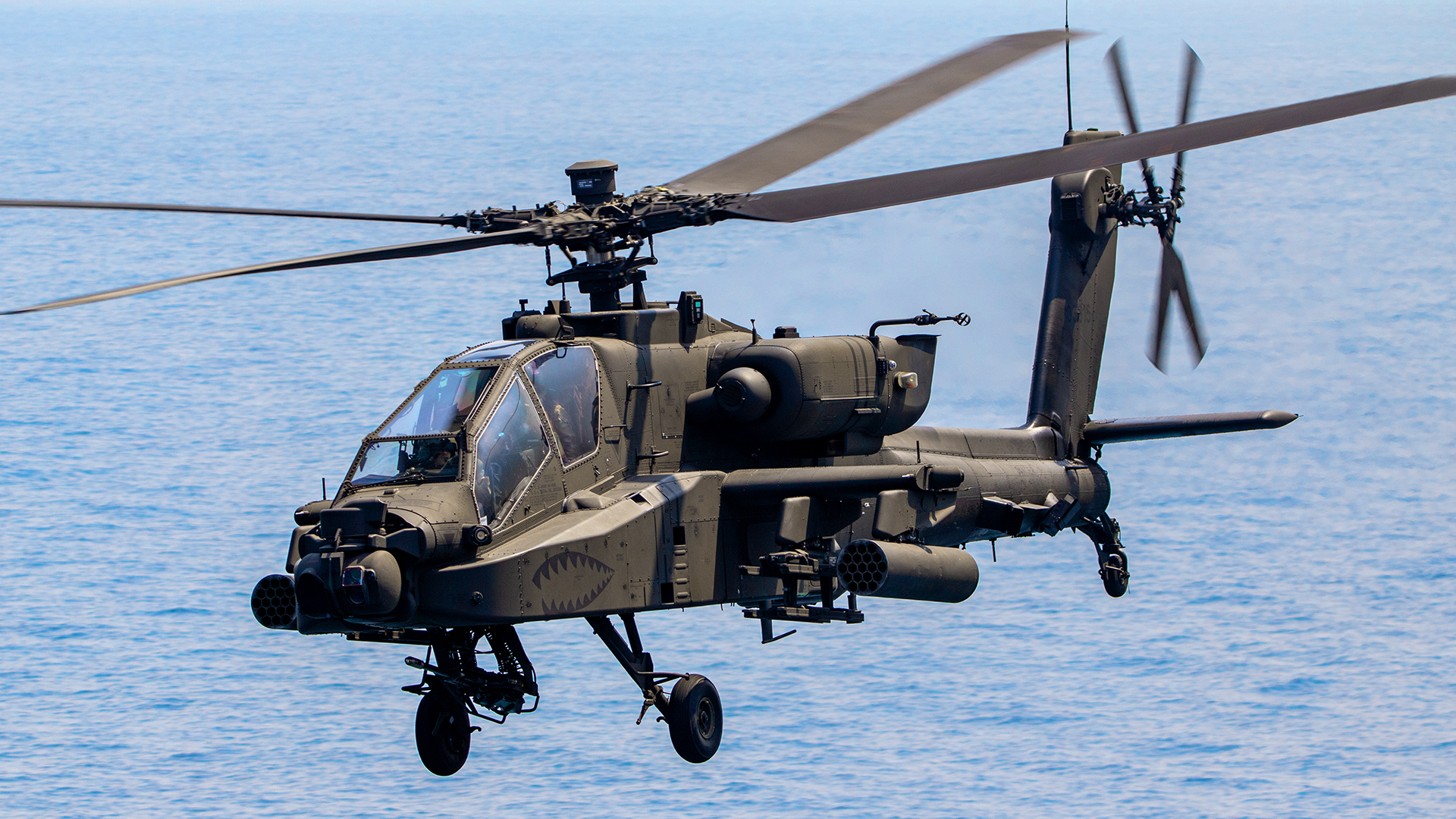
A flight of U.S. Army AH-64 Apache attack helicopters, armed with rockets and Hellfire missiles, taxi out to conduct a scheduled flight in the U.S. Central Command area of responsibility. In addition to rockets and missiles, the Apache is additionally armed with a 30mm chain gun. (U.S. Army photo) U.S. Army Central
The New York Times was first to report that an Apache had gone down near the Strait of Hormuz. President Donald Trump had also confirmed the crew was safe while speaking to reporters earlier this morning.
“We are going to issue a report tomorrow, but the pilots are fine,” Trump said after returning to Washington from the NBA Finals in New York.
A US Army Apache helicopter went down near the Strait of Hormuz and it wasn’t clear if the aircraft suffered mechanical troubles or had been shot down by Iran, the New York Times reported.
Asked about the episode by @jendlouhyhc, Trump said the pilots were fine and that a report…
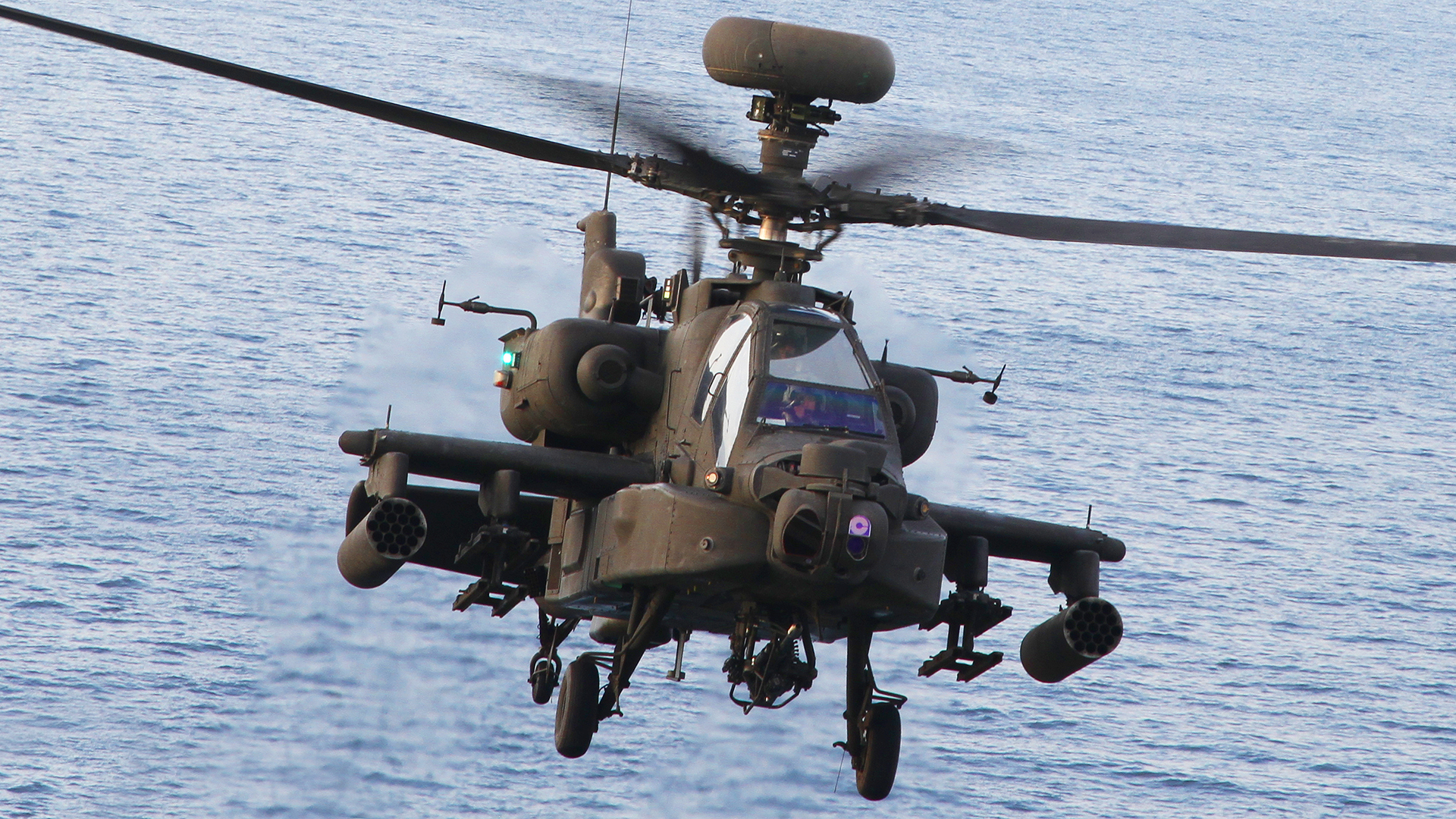
As we have reported in the past, Army AH-64s have been part of an effort by the U.S. military to enforce the ongoing blockade of Iran and to protect commercial shipping. Last month, Apaches and U.S. Navy MH-60 Seahawk helicopters destroyed six small Iranian boats that were threatening commercial ships in and around the Strait of Hormuz, according to Navy Adm. Brad Cooper, head of CENTCOM. Apaches had already been conducting missions targeting Iranian naval assets in and around the Strait of Hormuz before the announcement of the ceasefire in April. All of this has shown that armed helicopters remain important assets in maritime operations, especially for defending against swarms of small boats.
As TWZ regularly highlights, search and rescue operations present inherent complexities and risks, especially when conducted in or near hostile territory. The F-15E rescue effort in Iran put a particular spotlight on the immense risks that combat search and rescue (CSAR) forces take, with helicopters and C-130 variants sent into areas where even a high-end fighter aircraft didn’t survive.
Open-water recoveries can present distinct additional challenges. There is always the possibility of the loss of additional assets and personnel in the process, no matter where a CSAR mission occurs.
HH-60Ws refuel from an HH-130J. (USAF)
The use of a Navy drone boat in the rescue overnight highlights a new dimension for maritime CSAR going forward. These uncrewed assets can be more readily pre-positioned in a distributed manner. For example, in the broad expanse of the Pacific, USVs could be forward-deployed at multiple points along certain flight paths for this exact purpose. USVs could offer other distinct advantages in certain scenarios where they might be able to get into areas where traditional assets cannot and without risking additional personnel. These realities extend well beyond the maritime domain, and we are only likely to see uncrewed platforms of all kinds increasingly taking part in rescue efforts, especially in denied areas. The U.S. military is coming to terms with just how vulnerable their CSAR assets are and the ranges that would be needed to access highly defended areas, especially during a peer fight. Using drones to execute personnel recovery is being viewed as one part of a larger set of solutions to this pressing problem.
With the Apache going down near the Strait of Hormuz, the U.S. military has now lost at least seven crewed fixed-wing aircraft and helicopters since the start of the latest operations against Iran in February. In addition, several aircraft have been damaged in the air and on the ground, including by Iranian fire. The TWZ graphic below offers a visual tally of damaged and destroyed aircraft as of April 10.
TWZ
Despite the loss of the Apache, the use of a USV in the rescue effort is a major development and a sign of things to come.
UPDATE: 12:56 PM EDT –
President Donald Trump said the Apache was shot down by Iran and that the U.S. will retaliate.
“I have just been informed by our Great Military that last night the Iranians shot down one of our highly sophisticated Apache Helicopters while patrolling over the Strait of Hormuz,” the president said on his Truth Social network. “There were two pilots involved, both are safe and uninjured. Nevertheless, the United States must, of necessity, respond to this attack.”
Trump says that Iranian forces shot down the Army AH-64 Apache attack helicopter that went down over Hormuz yesterday.
The war on Iran has not only ended in a humiliating defeat for the United States, but resulted in a dramatic shift in the balance of power in the Middle East and the Global South.
The humiliating defeat of Israel and the United States in their war on Iran, along with the savagery of the ongoing genocide in Gaza, are ushering in a new world order.
This order is one where voices of reason and stability emanate not from the West — which spent tens of billions of dollars sustaining Israel’s genocide — but from the Global South, including China. It is an order where alliances are being rapidly reconfigured to protect countries from a rogue American state that lashes out like a wounded beast, as it spirals toward terminal decline.
The end of the U.S. Empire, led by an impetuous and clueless Donald Trump, is irreversible.
The U.S. has lost its sixth war in the Middle East in 25 years. Iran’s power has been enhanced not only because it — along with Oman — controls the Strait of Hormuz — where roughly 25 percent of the world’s seaborne oil and 20 percent of the world’s seaborne liquified natural gas pass through — but because it has delivered a stark message, with its drones and missiles, to U.S. allies and bases in the region, while sending the global economy into a tailspin.
Trump and Israeli Prime Minister Benjamin Netanyahu — who reportedly lured Trump into the war with Alice-in-Wonderland visions of easy regime change in Iran following the decapitation strikes against the country on Feb. 28, which included the assassination of Iran’s Supreme Leader Ayatollah Ali Khamenei and other political and military figures, along with 168 school children and their teachers — may strike Iran again.
They are desperate. But a renewed bombing of Iran will not work. Iran’s mosaic defense strategy ensures all political and military commanders are easily replaced.
Iran can strangle the world economy by closing the Strait of Hormuz. It can accelerate the pain by getting its Yemeni allies — Ansar Allah — to close the Bab el-Mandeb Strait in the Red Sea, just as they did to Israel-bound ships when defending Palestinians after Oct. 7.
This could result in a complete blockade. Saudi Arabia, with the Bab el-Mandeb Strait open, is able to bypass the Strait of Hormuz and export 5 million barrels a day through its pipeline to tankers in the Red Sea port of Yanbu.
Satellite photo of Bab-el-Mandeb, the strait between the Red Sea and the Gulf of Aden. (WorldWind software/Wikimedia Commons/ Public Domain)
If a ceasefire between the U.S. and Iran is not reached soon, the global economy will crash, perhaps within weeks. The U.S. and its allies, such as Japan, have released some of their extensive strategic oil reserves, however they will not be able to cushion markets indefinitely.
Stockpiles in America’s Strategic Petroleum Reserve are near their lowest in more than 40 years. Once these reserves are depleted, the price of fuel will skyrocket. If a barrel of oil shoots up to $200, the price at the pump could climb as high as $10 per gallon. This, coupled with shortages of other petroleum-based products, along with nitrogen fertilizer, aluminum and helium — an indispensable element in the production of MRI machines and semiconductors — are already shutting down vital industries and driving up prices on basic commodities.
The World Bank projects a 31 percent increase in the cost of nitrogen fertilizers alone — which are produced in the Persian Gulf and transit through the Strait of Hormuz — if the war continues. This will mean a steep rise in the price of food.
Trump is like a dog being pushed unwillingly into a crate. When it appears a deal with Iran is close, he snarls and barks, sabotaging the proposed 30-to-60-day ceasefire agreement. Netanyahu’s apoplectic fits about any agreement that would halt Israeli attacks against Lebanon, along with the potential release of some of Iran’s estimated $100 billion in frozen assets, spurs Trump’s momentary defiance.
But the clock is ticking. There is little time left. And the longer Trump waits, the worse it will get. Neither Trump, nor Netanyahu, are the masters of this game. Iran holds the cards.
Israel’s dream of formalizing its hegemony over the Middle East, codified in the Abraham Accords during Trump’s first term — which normalized relations between Israel and regional states — is dead. This war and the genocide in Gaza killed it.
Trump is attempting to revive them by inserting them into a deal to end the war on Iran. He has demanded states previously uninvolved with the Abraham Accords, such as Pakistan and eventually, Iran, sign up to normalize relations with Israel. Pakistan — the only state to publicly respond — rejected the invitation due to what it called a clash with the country’s “fundamental ideologies.” Every other state Trump appealed to reacted with bewildered silence.
Netanyahu, left, and Trump on Sept. 15, 2020, the signing ceremony day for the Abraham Accords among Israel, Bahrain and the United Arab Emirates. (White House, Andrea Hanks)
Iran demands the removal of sanctions and an end to the naval blockade — which the Central Intelligence Agency concluded Iran can endure for months before it experiences severe economic hardship — in exchange for reopening the Strait of Hormuz. The proposed agreement makes no mention of Iran’s ballistic missile arsenal, which U.S. military and intelligence officials believe remains at 70 percent pre-war levels, according to The New York Times.
Iran, Pakistan, Turkey and Qatar — a lead negotiator with Hamas — are the new powerbrokers in the region.
Pakistan not only signed a mutual defense pact with Saudi Arabia in 2025, it deployed troops, jets and air defense systems to the Gulf dictatorship in April. It has also been hosting ceasefire talks between Trump’s Dumb and Dumber duo of lead negotiators — his feckless son-in-law Jared Kushner and fellow real estate developer and golfing partner, Steve Witkoff.
The war has enhanced the prestige and power of China, which compared to Washington is seen globally as embodying rational, prudent and stable leadership. Iran, in a sign of the new global order, permits Chinese and Pakistani tankers, along with other ships not allied with Israel and the U.S., to travel through the Strait.
The Strait of Hormuz connects the Gulf of Oman, left, with the Persian Gulf, right. The waterway also separates nation of Iran, bottom, from the Arabian Peninsula nations of Oman, United Arab Emirates, and Qatar, top left to right. (NASA Johnson / Flickr/CC BY-NC-ND 2.0)
Israel, unable to convince the U.S. to do its dirty work of bombing Iran into a failed state, will, I expect, strike out with renewed fury against Gaza, perhaps occupying the remaining 30 percent of what is left of the besieged territory. It will continue its Gaza-like policy of turning every structure south of Lebanon’s Litani River into rubble, which it bombs daily despite Iran stating that attacks on Lebanon violate the current ceasefire agreement.
Trump’s savagery and bluster – he threatened to “blow up” Oman if it fails to “behave” after reports of Oman jointly charging tolls with Iran for ships passing through the Strait of Hormuz – cannot mask the impotence of the U.S.
The refusal by America’s allies to heed Trump’s call to help him reopen the Strait, along with the economic misery visited on nations struggling to cope with shortages and the rising costs of energy and fertilizer supplies, are stark evidence of Washington’s pariah status.
Empires, blinded by the myth of their own omnipotence and military superiority, blunder at the final stages into conflicts with little understanding of where they are headed. They alienate their allies. They stumble from one military fiasco to the next, as the U.S. has done for over two decades in the Middle East.
The British Empire in 1956, already in precipitous decline, was humiliated when it conspired with France and Israel to seize the Suez Canal, which Gamal Abdel Nasser had nationalized. The U.S. forced all three countries to halt the invasion. Britain’s pound sterling gave way to the petrodollar. It signaled the last chapter of the British Empire.
The war on Iran is Washington’s Suez Crisis.
This may not be the end of the American Empire, but it is the beginning of the end.
MOSCOW and ST. PETERSBURG – On Monday, June 1st, on Power Shift, a new independent geopolitical platform, Zulfiqar Ali, Larry Johnson and myself revealed what for all practical purposes is an uber-bombshell piece of information: if long dark clouds keep coming down, Tehran is ready to pivot from nuclear ambiguity to actually detonating a nuclear device on Iranian soil.
Less than a week later, the Power Shift page was censored on YouTube – with no explanation and no appeal. Yet what we revealed had already been detailed in several podcasts and interviews throughout last week, as in here and here (with myself and Larry); here; and at the St. Petersburg forum, here.
I published a detailed background preceding the release of the information, written just before Iran’s negotiating team suspended the exchange of all (italics mine) texts and messages with the U.S. via mediator Pakistan.
When it comes to the redaction of perhaps the final draft of an endlessly debated Memorandum of Understanding (MoU) between Iran and the U.S., it suddenly became crystal clear that it’s all about Lebanon.
Iran repeatedly reiterated it was ready to ditch the already comatose “ceasefire” if the death cult in West Asia proceeded with its threat of bombing Dahiyeh, the Shi’ite-majority suburb of southern Beirut.
Confronted by Trump, the leader of the death cult was forced to back down. For only a few days. Trump desperately needs an MoU and an extended ceasefire to be marketed as “Victory”. His (italics mine) Victory.
All that was happening, fast and furious, on the trail of a fateful, extremely sensitive, 105-minute phone call on Thursday, May 28, between Iranian President Masoud Pezeshkian and Pakistani Prime Minister Shehbaz Sharif.
Islamabad is the sole functioning and trusted head-of-government back-channel between Tehran and Washington. Our sources revealed that during the phone call, Pezeshkian delivered a formally structured, three-step ultimatum to be communicated to the White House with absolute clarity:
No more nuclear talks. As in the priority is the end of all wars, against Iran and the Axis of Resistance.
No more prospective nuclear treaty framework. As in no discussions leading to a possible, diluted JCPOA 2.0; only after settling the end of the wars and the status of the Strait of Hormuz.
If U.S. threats persist, Pezeshkian said, that would lead to the “detonation of a nuclear device on Iranian soil” – executed not as an act of war, but as an irreversible, sovereign demonstration of capability to control escalation dominance.
What is particularly stunning is none of the above is about diplomatic posturing. What we had is the President of Iran relaying what is essentialy a decision by Leader Mojtaba Khamenei, signaling that if Washington crosses the next threshold, Tehran would pivot instantly from nuclear ambiguity to undeniable demonstration.
And that would imply a permanent rupture of the global non-proliferation system – with unforeseen consequences.
The China-Iran-Pakistan strategic alignment
Pakistani Prime Minister Shehbaz Sharif obviously did the math on the scale of such intelligence. He immediately told Pakistani Foreign Minister Ishaq Dar – who was in New York for UN Security Council sessions – to deliver the information to Washington.
Dar bypassed the whole bureaucratic apparatus, directly calling U.S. Secretary of State Marco Rubio in New York. The message, from Tehran to the Trump administration, was stark: the escalation ladder now features a terminal rung.
Rubio “may” (and that’s the operative word) have recognized the supreme gravity of what is in fact a formal nuclear ultimatum. He briefed Trump. The day after, May 29, Trump abruptly stopped any further kinetic action. And his incendiary rhetoric was instantly toned down.
This had nothing to do with a sudden fit of strategic restraint in the War-a-Lago/Oval Office axis. It was the direct, downstream result of the Sharif-Dar-Rubio back-channel.
On the morning of May 29, Dar arrived in Washington for a one-day official visit.
Sitting across from Rubio, he delivered the detailed briefing that the New York phone call had only previewed.
He placed two massive bombshells on the negotiating table:
1. Iran will not surrender any of its Highly Enriched Uranium (HEU). Nothing. Zero. And that’s final.
It’s all about sovereign independence (two concepts at the center of the recent Russia-China joint declaration signed in Beijing during Putin’s official visit to Xi Jinping).
So Tehran will not surrender its stockpile, whatever the terms, temporarily or not, just to comply with a face-saving mechanism designed for a U.S. domestic audience. From the point of view of Iran’s leadership – with Mojtaba at the helm – HEU goes way beyond a technical asset; it’s the ultimate fusion of sovereignty, deterrence, leverage, and political survival.
2. China has delivered state-of-the-art strategic defense systems to Iran – including shoulder-fired MANPADs – routed covertly through third countries (and that’s why I could not get any official confirmation two weeks before in Shanghai).
The breakdown: a total, operationally active China-Iran-Pakistan strategic alignment is in effect.
Is an Islamabad Accord still possible?
As it stands, none of us – including our sources – know whether a nuclear weapon detonated on Iranian soil would have been developed exclusively by Iran [they do have the scientific capability]; or with possible Russian, Pakistani or North Korean help. All options are plausible.
According to Prof. Ted Postol at MIT, Iran could easily convert 450 kg of 65% uranium hexafluoride into approximately 85% weapons grade: all that is needed for a low yield weapon, to be mounted into at least 10 missile delivery systems capable of reaching Israel. That means, at a minimum, 10 nuclear bombs.
Technically this sort of low yield weapon can be designed, Postol explains, with the use of a neutron reflector made of depleted uranium – or beryllium/tungsten carbide – and positioned immediately around the fissile core. It reflects escaping neutrons back into the nuclear material to increase fission efficiency, and reduces the required critical mass. In a nutshell: less material and more bombs.
Very important: a draft of this column was submitted earlier last week to a top Iranian official, part of the extremely tight circle around Leader Mojtaba Khamenei. His reaction: “I won’t comment on this matter”.
Beyond this no-response response, what became instantly clear is the verified transmission of the most consequential back-channel communication of the no war/no peace crisis.
It goes like this: Pezeshkian talks to Sharif; Sharif talks to Dar; Dar talks to Rubio; Rubio talks to Trump; Dar talks to Rubio face to face (during his Washington briefing).
All that throws new light over the – subsequently broken – 60-day ceasefire, the fragile off-ramp desperately needed by Trump. This framework has been organized by Pakistan and structurally backed by China – as I confirmed in Shanghai.
Tehran has insisted on the order of the proceedings, over and over again. First, all wars must stop, especially the offensive by the death cult over Lebanon. Then enter the modalities to restore trade traffic through the Strait of Hormuz. The third and last stage is to resume some sort of meaningful nuclear dialogue.
On The Big Picture, a serious structural rewrite is already on – whatever nasty ceasefire-breaking surprises may lie ahead.
As it stands: the Abraham Accords are for all practical purposes dead; Saudi Arabia has frozen all back-channel Israel “normalization” discussions; Qatar and Oman are quietly drafting military transition timelines to phase out the U.S. from West Asia. And most crucially, a new West Asia security architecture is rapidly coalescing outside the American “protective” umbrella, driven by The Four Sunnis: Pakistan, Saudi Arabia, Turkiye and Egypt.
Last Thursday, again on Power Shift (our YouTube page was still active), Zulfiqar Ali, Larry Johnson and I identified a possible Islamabad Accord as the emerging framework for ending the U.S.-Iran war – way before Western MSM had recognized it as the organizing architecture.
We also identified the mechanism driving it: non-stop Pakistani shuttle diplomacy, quietly but decisively backed by China.
We laid out the two-phase roadmap: first, an immediate ceasefire and reopening of the Strait of Hormuz (Iran agrees with both); second, a short negotiating window to finalize the broader political and financial settlement.
We reported that the extremely contentious release of Iran’s frozen assets was not a speculative talking point, but an active lever in the process. That asset release and possible sanctions relief were being treated as concrete confidence-building measures.
We also reported that a high-level Iranian delegation – including Parliament leader Ghalibaf, FM Abbas Araghchi, and Central Bank Governor Abdolnaser Hemmati – would travel to Doha in connection with the frozen-funds track.
That was later confirmed across the spectrum, including the fact that the central-bank component was tied directly to frozen assets.
We also advanced that Islamabad could become the stage for the final political act, including a possible Trump visit, alongside Pezeshkian: yet now that possibility seems as remote as ever.
China is just watching the river flow
These are the facts, as it stands:
Iran is far from isolated and is positioned for a prolonged war, with meaningful material and strategic backing from China, Pakistan, and North Korea, and carefully calculated support from Russia, as I confirmed during the St. Petersburg forum.
The U.S. is paralyzed. The Trump administration may appear to want an off-ramp; but it is totally constrained by pressure from the death cult in West Asia – as we’ve seen this weekend; exhausted escalation pathways; and the absence of a decisive military option that can alter the chessboard without creating an infinitely more unmanageable crisis.
The Gulf petro-monarchies are terrified about a possible resumption of the war – with the principal exception of the UAE.
The leaves Islamabad as the only exit route in town, with Field Marshal Asim Munir positioned as the indispensable intermediary; and Beijing and Moscow following everything closely, in some respects actively shaping the outer frame.
The bombing of southern Beirut on June 6 was perpetrated once again at a critical moment in the negotiations, as pointed out by Mohammad Mokhber, a top advisor to Leader Mojtaba Khamenei and a member of Iran’s Expediency Council:
“By bombing Lebanon during the presence of the mediator in Iran [he was referring to Asim Munir], the enemy set the negotiating table on fire for the third time to shout about the repeated violations of the ceasefire in all areas. We speak to the violators with the language of ‘power’; the axis of resistance is a unified body, and they will definitely receive a heavy and painful price for this aggression in the field.”
The death cult bombing of southern Beirut led to a frankly surrealist spectacle: the Trump administration scrambling after the Pakistani mediator in Tehran, begging him to intercede with the Iranians for de-escalation. The Emperor who wanted to destroy Iranian civilization had to ask Pakistan to salvage what could still be salvaged.
That means, as we reported, that with Iran setting the terms of escalation and raising its deterrence potential, and with Trump left with no cards at all, the only possible solution lies with diplomacy via Islamabad.
This week on Power Shift, in three consecutive shows from Monday to Wednesday, we will dig deeper into the intel and the diplomacy beneath these tectonic twists.
And then, of course, there’s the intriguing Chinese angle.
U.S. Think Tankland will become totally paralyzed when they finally realize that by injecting advanced military hardware into the Iranian theater of war, Beijing is actively road-testing the limits of American hegemonic coercion.
And if push comes to shove, and Iran is forced into a nuclear demonstration for all the world to see, China will acquire an inexorable proof-of-concept that U.S. deterrence is hollow.
One has to marvel at the engineering of such a massive strategic masterclass – without firing a single shot.
Reports that U.S. officials are increasingly concerned about Israeli intelligence activity inside the United States should not be dismissed as a minor diplomatic embarrassment. If accurate, they point to a deeper strategic problem: Israel’s security doctrine is now pressing so aggressively outward that it is beginning to step on the toes of nearly everyone around […]
RFE/RL spoke with Nathan Diller, a retired US Air Force colonel and current executive at defense technology firm Mach Industries, about the continued diplomatic engagement between Iran, Israel, and the United States.
For analysis on how the latest escalation in the Middle East will affect a host of issues in the region, Amna Nawaz speaks with Miad Maleki at the Foundation for Defense of Democracies and David Makovsky at the Washington Institute for Near East Policy.
Israel and Iran may be seeking an off-ramp to keep the latest flare-up of fighting from boiling over to an extended conflict in the wake of strikes between the two nations on Sunday and Monday. The attacks marked the most serious challenge to the shaky ceasefire that went into effect on April 8. They took place despite President Donald Trump urging both sides to stand down to let the sputtering peace process move forward.
The Islamic Revolutionary Guard Corps (IRGC) said it was halting attacks on Israel but maintained the right to resume them if Jerusalem continued “to target Hezbollah in Lebanon,” Fox News reporter Trey Yingst reported.
Israeli Prime Minister Benjamin Netanyahu claimed the decision to stop attacking Iran was made because “after we dealt a heavy blow to the terrorist regime in Tehran, it ceased its attacks on us. If the terrorist regime in Iran makes a mistake and attacks us again—we will respond with full force.”
در حال حاضر، آتش متوقف شده است، زیرا پس از اینکه ما به رژیم تروریستی در تهران ضربه محکم زدیم، حمله به ما را متوقف کرد.
اگر رژیم تروریستی در ایران اشتباه کند و دوباره به ما حمله کند – ما با قدرت پاسخ خواهیم داد.
In a post on his social media platform, President Donald Trump said both sides “are looking to do an immediate CEASEFIRE! Final negotiations on ‘Peace’ are proceeding, subject to ignorance or stupidity getting in its way.”
The ongoing U.S. blockade of Iranian ports, however, “will remain in place, and in full force and effect, until a ‘Final Deal’ is reached,” Trump added. “Things should move quickly.”
“Both sides, Israel and Iran, are looking to do an immediate CEASEFIRE! Final negotiations on “Peace” are proceeding, subject to ignorance or stupidity getting in its way…” – President DONALD J. TRUMP pic.twitter.com/zLoFSZo3jZ
As we noted yesterday, the latest Israel-Iran fighting was sparked by Israeli bombing of Beirut on Sunday. Hours after that took place, Iran launched missiles at Israel and Israel fired back. Initially on Monday, Israeli leaders said they were expecting a conflict that would last for at least several days and that Iran has sufficient stocks of ballistic missiles to carry that out, according to the Israeli N12 News outlet.
In addition, the IDF was preparing for more attacks from the Houthis and Hezbollah, N12 stated.
However, that analysis had apparently changed in recent hours.
Israel’s retaliatory strikes came despite Trump telling several reporters on Sunday that he was going to tell Netanyahu to hold his fire and that both sides had done enough to each other and should cease attacking. Those conversations pointed to either messaging to deceive Iran about a pending attack or further signs of strain between the two leaders.
Trump to Channel 13 News: ''I think Israel has responded enough, no need for more. We can achieve peace after 3,000 years.''
Netanyahu’s push to attack Hezbollah in Lebanon had reportedly already earned a invective-laden rebuke from Trump.
“You’re fucking crazy,” Axios said Trump told the Israeli leader in a phone call last week. “You’d be in prison if it weren’t for me. I’m saving your ass. Everybody hates you now. Everybody hates Israel because of this.”
After Israel struck Beirut on Sunday, Trump told Financial Timesthat Netanyahu would have no choice but to accept any deal the U.S. negotiates with Iran, because he “calls the shots.”
“He won’t have any choice,” Trump told the outlet in a telephone interview. “I call the shots. I call all the shots. He [Netanyahu] doesn’t call the shots.”
BREAKING: President Trump says Israeli Prime Minister Netanyahu will have "no choice" but to accept a US deal with Iran, because he "calls the shots," per FT.
Details include:
1. "I call the shots. I call all the shots. He [Netanyahu] doesn’t call the shots," Trump said
2.…
— The Kobeissi Letter (@KobeissiLetter) June 7, 2026
Despite Trump putting his foot down, overnight, “dozens of Israeli Air Force fighter jets struck nine Iranian air defense systems in western and central Iran, and this morning, the IAF struck three factories at a petrochemical complex in southwest Iran,” the Times of Israel reported. “The military says the strikes are only being carried out by Israel, but there is ‘full coordination’ with CENTCOM. Meanwhile, IDF Chief of Staff Lt. Gen. Eyal Zamir has spoken with his counterpart, CENTCOM chief Adm. Brad Cooper, three times, according to the military.”
U.S. forces “are assisting in intercepting incoming missiles,” I24 News Diplomatic Correspondent Amichai Stein reported on X. “So far, Iran has launched approximately 22–24 missiles, while the Houthis have fired two.”
An IDF official confirmed that to us, saying that “the Israeli strikes were fully coordinated with CENTCOM across multiple dimensions, including intelligence, defensive preparedness, and operational planning.”
CENTCOM declined to comment.
However, a U.S. official told TWZ that American forces “did not defend Israel with air defense against missiles and drones.”
IDF sources:
• The military is preparing for at least several days of combat.
• U.S. forces are assisting in intercepting incoming missiles.
• So far, Iran has launched approximately 22–24 missiles, while the Houthis have fired two.
Earlier on Monday, Israel released video it says showed attacks on Iranian air defense systems.
FIRST FOOTAGE: Watch IDF strikes targeting aerial defense systems in Iran, which housed missiles intended to target aircraft. pic.twitter.com/7pWhnOuSGV
That strike was part of a wave of attacks Israel carried out on Iranian air defenses across the country.
STRUCK: The IDF completed a large-scale strike on strategic defense systems belonging to the Iranian terror regime.
Recently, defense systems were deployed across Iran to restore the regime’s capabilities degraded during Operation Roaring Lion. The strike led to the… pic.twitter.com/eEqV2QnXK3
“These facilities were used by the armed forces of the Iranian terror regime to produce and export raw materials for weapons production,” the IDF posited. “The targeted infrastructure produced unique materials that serve as critical components for the development of ballistic missiles.”
confirmed. Among the 15 Targets IAF attacked is the Mahshahr Petrochemical Complex, officially known as the Petrochemical Special Economic Zone (PETZONE) in Bandar-e Mahshahr, Khuzestan Province. Right across the border from Kuwait !
Video emerged online showing the Israeli airstrikes in Tehran.
For the first time since the April ceasefire, Israel and Iran have attacked each other. Israel carried out strikes on western and central Iran including the Iranian capital Tehran.
While Iran launched missiles at northern Israel and said it is the beginning of a week of attacks.… pic.twitter.com/SmcwFKMw14
The attacks sparked a warning from the U.S. Embassy in Jerusalem.
“As a result of the current security situation in Israel, including Home Front Command alerts for multiple regions,” the U.S. Embassy in Jerusalem is ordering “all U.S. government employees and their family members to shelter in place, and be prepared to move to a protected shelter in the event of a red alert, until further notice.”
As a result of the current security situation in Israel, including Home Front Command alerts for multiple regions, the U.S. Embassy has directed all U.S. government employees and their family members to shelter in place, and be prepared to move to a protected shelter in the event… pic.twitter.com/ohyK56GyNh
— U.S. Embassy Jerusalem (@usembassyjlm) June 8, 2026
Though both Israel and Iran say they are willing to stop fighting, tensions in the region remain high. We will continue to monitor the situation.
UPDATES
As we noted earlier in this story, the Houthi rebels of Yemen said they are banning Israeli ships from the Red Sea and took credit for missile attacks on Israel that took place on Sunday.
“We announce a complete ban on navigation for the enemy in the Red Sea, and any Zionist movements will be considered military targets for our forces,” said Brigadier General Yahya Sare’e, the Houthis’ spokesman. “We will confront escalation with escalation, and our operations will be escalating in line with the battle and our participation in the axis of jihad and resistance.”
“We affirm the right of our people and the free peoples of our nation to confront American-Israeli aggression,” he added. “We will not stand idly by in the face of the unjust siege on our people and the peoples of the axis of jihad and resistance.”
Sare’e also said the Houthis launched “a missile strike on sensitive targets of the Israeli enemy in occupied Jaffa, and achieving its objectives with precision, thanks to God.”
There were no reported injuries or damage from that attack.
Yemen’s Iran-backed Houthis announce that they launched a missile attack on Israel and declared a ban on Israeli shipping in the Red Sea.#Yemenpic.twitter.com/LYYPB7bibK
— Al Arabiya English (@AlArabiya_Eng) June 8, 2026
As we have previously reported, there have been major and relevant concerns that the Houthis could effectively shut down the Bab el-Mandeb (BAM) strait, a narrow stretch of water between Yemen and Djibouti. Doing so would choke off a flow of oil exports from Saudi Arabia to the east, exacerbating a huge spike in oil prices after Iran closed off the Strait of Hormuz to most shipping. Having both straits closed at once is something of a ‘sum of all fears’ scenario for the global energy marketplace.
A new Houthi offensive would be a major cudgel for Iran, because it would open a new front in the war and draw in U.S. military resources at a time when they are already heavily involved in the region.
During the previous Houthi Red Sea campaign that stretched into early 2025, the U.S. and its allies deployed many warships, including the Eisenhower and Truman Carrier Strike Groups (CSG) to both defend against Houthi attacks and strike targets in Yemen. These operations resulted in a large expenditure of air defense munitions already under strain as Iran rained down missiles and drones across the Middle East.
You can see video from some of those encounters below.
Iran, meanwhile, insists it is maintaining its control over the Strait of Hormuz.
“No vessel without Iran’s permission has the right to pass through the Strait of Hormuz Command vessel of the IRGC Navy,” the official Iranian Fars News Agency stated on X. “It is announced to all vessels that entry of any vessel from hostile countries into the Strait of Hormuz is prohibited and, if observed, they will immediately be targeted.”
CENTCOM says its forces once again disabled a ship trying to run the blockade. This time, the effort involved an F/A-18E/F Super Hornet from the aircraft carrier USS Abraham Lincoln (CVN 72) firing “a precision munition into the ship’s engineering and steering spaces after the crew failed to comply with directions.”
The incident, involving the Palau-flagged M/T Marivex, took place as the unladen oil tanker transited international waters in the Gulf of Oman toward Iran, the command stated on X.
“Marivex is no longer sailing to Iran,” CENTCOM added.
This was the seventh ship trying to run the blockade that CENTCOM forces disabled, the command noted. In addition, it said it “redirected 134 ships that complied, and allowed 42 vessels supporting humanitarian aid to pass since initiating the blockade on April 13.”
You can read more about how the other six ships were disabled in our story here.
According to a release from U.S. Central Command (CENTCOM), the U.S. disabled an unladen oil tanker, the M/T Marivex, in the Gulf of Oman today. Per the release, a “precise munition” from an F/A-18 Super Hornet was fired into the engine and steering areas of the vessel when the… pic.twitter.com/qyW4WBhfLa
Given existing concerns that Iran has mined the Strait, “US allies will seek Trump’s approval for a Europe-led plan to demine the Strait of Hormuz at next week’s G7 summit in France,” Bloomberg News is reporting. “The UK and French-led mine-clearing mission is operationally ready and set to deploy in the days after any Iran deal. Securing a G7 endorsement of the mission is one of the main goals of the summit. European leaders see it as a way of showing the continent is stepping up to help the US after Trump’s fury it didn’t back his war.”
US allies will seek President Donald Trump’s approval for a Europe-led plan to demine the Strait of Hormuz at next week’s Group of Seven summit in France. https://t.co/Byy6mE94rh
You can read more about what it takes to conduct demining operations in our exclusive interview with a former MH-53E pilot who carried out those operations, which you can read here.
My exclusive interview with a pilot who flew the behemoth MH-53E Sea Dragon helicopters on counter mine missions over the Persian Gulf and Strait of Hormuz.https://t.co/C0tvO2sLKp
Despite the renewed fighting, Iran’s president says his country has not abandoned diplomacy.
“Our priority is national security and the peace of our people. We will defend the rights of the nation with authority and will not retreat in the face of any threat,” Masoud Pezeshkian stated on X. “Diplomacy and defense are the two wings of national power; we have neither abandoned the field nor the negotiating table. God willing, with unity and rationality, Iran will emerge triumphant from this trial as well.”
اولویت ما امنیت ملی و آرامش مردم است. با اقتدار از حقوق ملت دفاع میکنیم و در برابر هیچ تهدیدی عقبنشینی نخواهیم کرد. دیپلماسی و دفاع دو بال قدرت ملیاند؛ نه میدان را ترک کردهایم و نه میز مذاکره را. به امید خدا با وحدت و عقلانیت ایران از این آزمون نیز سربلند عبور خواهد کرد.
In a post on X, the Islamic Revolutionary Guard Corps (IRGC)-connected Tasnim news agency claims Iran fired a new jet-powered drone at Israel during its waves of attacks yesterday. The outlet provided no details about the weapon or any imagery of it in flight. TWZ cannot independently verify the claim.
Iran Utilized Newly Unveiled Jet-Powered Drone in Overnight Strikes on Israel
Iran employed a previously unseen jet-powered drone in its overnight attacks on Israel, according to Seyed Mohammad Taheri, a military analyst at Tasnim News Agency’s War Interpretation Desk. https://t.co/ATvBOUmiOZpic.twitter.com/Z4SBHawMcz
— Tasnim News Agency (@Tasnimnews_EN) June 8, 2026
La guerra de Estados Unidos con Irán ha traspasado su fase inicial para entrar en una nueva etapa emergente, en la que Irán apuesta implícitamente por que la siguiente fase sea la guerra.
Lo más probable es que se trate de episodios breves de guerra limitada, pero que, no obstante, encierran el potencial de extenderse a nivel regional, en caso de que Estados Unidos (e Israel) decidan intensificar drásticamente el conflicto.
La nueva fase conlleva riesgos, por supuesto, pero Irán tiene las cartas ganadoras: la capacidad de infligir daños desproporcionadamente mayores a la infraestructura del Golfo como represalia por cualquier daño que se le cause, y la conciencia de que Occidente se está acercando cada vez más al «precipicio» energético.
Los tres pilares que sustentan este cambio son, en primer lugar, la confianza en que Irán no será (ni puede ser) desplazado de su control sobre Ormuz, y que, al consolidar allí sus estructuras administrativas, la realidad del control iraní sobre Ormuz será asimilada cada vez más por los Estados, y se reflejará en su aceptación del control iraní-omaní.
Asociada a este principio fundamental está la aplicación por parte de Irán de una disuasión escalada frente al bloqueo naval estadounidense. Cualquier intento de interceptar o atacar buques iraníes o de interferir en la administración del estrecho se enfrentará a represalias cada vez más duras.
En última instancia, esta política puede llevar a que Irán inflinja daños cada vez mayores a los buques de guerra estadounidenses —otro punto de fricción—.
El 3 de junio, por ejemplo, Estados Unidos disparó un misil Hellfire contra un petrolero iraní cerca del estrecho de Ormuz. En respuesta, un buque de propiedad estadounidense (o parcialmente estadounidense), elPanaya, fue alcanzado por misiles.
Además, Irán lanzó tres oleadas de misiles de crucero contra la base aérea y de helicópteros estadounidense en Kuwait desde donde se había originado el ataque. También han surgido imágenes de graves daños en el aeropuerto internacional de Kuwait (aunque la causa de los daños sigue siendo objeto de controversia).
El segundo principio subyacente que influye en este cambio refleja simplemente el desdén iraní ante el continuo aumento de las exigencias de Trump, sus amenazas exageradas (que claramente no están a la altura de las capacidades de EE. UU.), junto con sus continuos giros y su retórica despectiva hacia Irán.
Al parecer, los dirigentes iraníes han llegado a la conclusión de que probablemente no habrá compromiso, y de que es mejor poner fin a las «negociaciones» «antes que continuar con las inútiles negociaciones de mala fe con un régimen estadounidense engañoso y decrépito», como el New York Times ha calificado las «negociaciones» con Irán — lo que sugiere que el «caos del acuerdo» no es un fallo puntual de Trump limitado a la cuestión de Irán, sino más bien un patrón constante de disfuncionalidad que se repite en prácticamente todas las iniciativas de «paz» de Trump.
Sin embargo, detrás de la decisión de Irán de suspender las conversaciones se esconde probablemente la claridad que va surgiendo gradualmente, filtrándose a través de las declaraciones y análisis israelíes y estadounidenses, de que el verdadero objetivo del ataque por sorpresa estadounidense-israelí del 28 de febrero nunca fue el cambio de régimen per se —con el fin de sustituir a los «radicales» iraníes por un líder más moderado al estilo de «Delcy Rodrigues»—; sino que pretendía, más bien, provocar la completa destrucción y fractura de Irán —una perspectiva que estaba destinada a cambiar los cálculos de Irán.
Esta perspectiva ha consolidado enormemente el apoyo público a la República Islámica y, al mismo tiempo, ha convertido la guerra en una lucha existencial por preservar los valores éticos de la Revolución. Desde esta perspectiva, Irán tiene poco que discutir con Trump, salvo algún futuro modus vivendi —en el momento en que Washington comprenda que se encuentra acorralado y que el nuevo realismo se imponga.
El tercer principioque sustenta esta nueva fase del conflicto es el enunciado por Irán desde el inicio de las conversaciones de Islamabad: «Alto el fuego para todos; o alto el fuego para nadie». Esto se volvió a subrayar en el último ultimátum de Irán a Trump: «Si se hubieran llevado a cabo las amenazas israelíes de la semana pasada de arrasar el barrio de Dahiyeh, en el sur de Beirut, Irán habría golpeado duramente el norte de Israel con sus misiles. “Era un alto el fuego para todos, o ningún alto el fuego”.
Trump optó por el alto el fuego y, tras su conversación con Netanyahu, anunció que estaba en vigor. Le dijo a Netanyahu que cancelara el bombardeo previsto sobre Dahiyeh, en el sur de Beirut. En Israel, una oleada masiva de indignación procedente de todos los sectores del espectro político arremetió contra Netanyahu ante la mera idea de frenar cualquier ataque israelí en el Líbano.
El ex primer ministro Naftali Bennett acusó a Netanyahu de «perder el control sobre la soberanía israelí». Y el ex primer ministro Yair Lapid afirmó que Israel se había visto reducido a un «Estado vasallo» tras la suspensión de los ataques.
Desde hace algunos meses, Estados Unidos e Israel han estado intentando que un sector de los líderes libaneses acepte la tarea de desarmar a Hezbolá, tal y como explicó Rubio, «para que Israel no tenga que hacerlo», algo que los líderes libaneses claramente no pueden hacer.
Israel carece de una estrategia coherente para el Líbano. El exalto cargo de la inteligencia militar israelí, Danny Citrinowicz, esboza un nuevo «logro iraní» estratégico:
Teherán ha logrado efectivamente vincular el frente libanés al ámbito más amplio de las relaciones entre Irán e Israel. Cualquier escalada en el Líbano se percibe ahora cada vez más a través del prisma de la dinámica entre Estados Unidos e Irán.
No obstante, observa:
La situación en el Líbano sigue siendo muy inestable. Israel y Hezbolá continúan interpretando los acuerdos actuales de formas fundamentalmente diferentes. [Mientras que] Israel sostiene que conserva libertad de acción en todo el Líbano, excepto en Beirut, Hezbolá [por su parte] insiste en que cualquier actividad militar israelí —cualquiera que sea— viola el marco del alto el fuego. Estas interpretaciones contrapuestas crean un potencial significativo para una renovada fricción y escalada sobre el terreno.
En Israel, la situación en las localidades del norte sigue siendo un punto neurálgico para casi todos los israelíes. Muchas localidades a lo largo de la frontera con el Líbano y hacia el sur, en Galilea, están medio vacías —«franjas enteras de territorio abandonadas por [el] Gobierno», escribe Ben Caspit. Los políticos locales afirman que «ellos también son israelíes» y que el Gobierno debe responder.
Es seguro que el Líbano seguirá siendo un punto de discordia. No se trata de si se producirá la próxima crisis, sino de cuándo. Israel no dejará que el asunto quede así: incluso los líderes de la oposición liberal exigen la destrucción de Hezbolá y protestan por el hecho de que Trump haya atado las manos de Netanyahu en el Líbano.
Irán tampoco dejará pasar el asunto. Los mediadores han informado a los estadounidenses de que Irán considera que el fin de la guerra en el Líbano, la retirada de las fuerzas israelíes y la retirada de Ormuz son condiciones vinculantes —antes de discutir otras cuestiones—.
Así pues, aquí estamos. Continúan las escaramuzas militares —en la práctica, una serie abreviada de ataques de las fuerzas estadounidenses contra el transporte marítimo iraní y la infraestructura del estrecho, surgidas del deseo de Trump de reafirmar su bloqueo naval ante la opinión pública estadounidense—. Esta situación es claramente inflamable, al igual que lo es el contexto libanés.
Irán está reconociendo de hecho la realidad de que, en esta nueva fase —con tantos puntos álgidos inherentes—, la escalada militar estadounidense probablemente se convertirá en algún momento en una necesidad política para satisfacer las necesidades de Trump y de sus financiadores judíos nacionales.
¿Y las negociaciones? No llegarán a ninguna parte mientras Israel y los donantes multimillonarios judíos de EE. UU. rechacen cualquier resultado con Irán que deje a este país intacto y más fuerte y —pari passu en este pensamiento binario— debilite en consecuencia el proyecto «Israel First» dentro de EE. UU. y de la región.
Un acuerdo que no vea a Irán irremediablemente debilitado será condenado por estas últimas fuerzas como una «negligencia traicionera» por parte de Trump. Será atacado sin piedad. Sin embargo, debe darse cuenta de que Irán está, de todos modos, a punto de liberarse de las ataduras de EE. UU.
Es probable que esta fase del conflicto iraní solo termine cuando Occidente caiga por el precipicio económico que se avecina…
Iran’s leaders want to show they are serious about defending their Hezbollah allies in Lebanon and maintaining the regional balance of power, analysts say.
 Login
Login