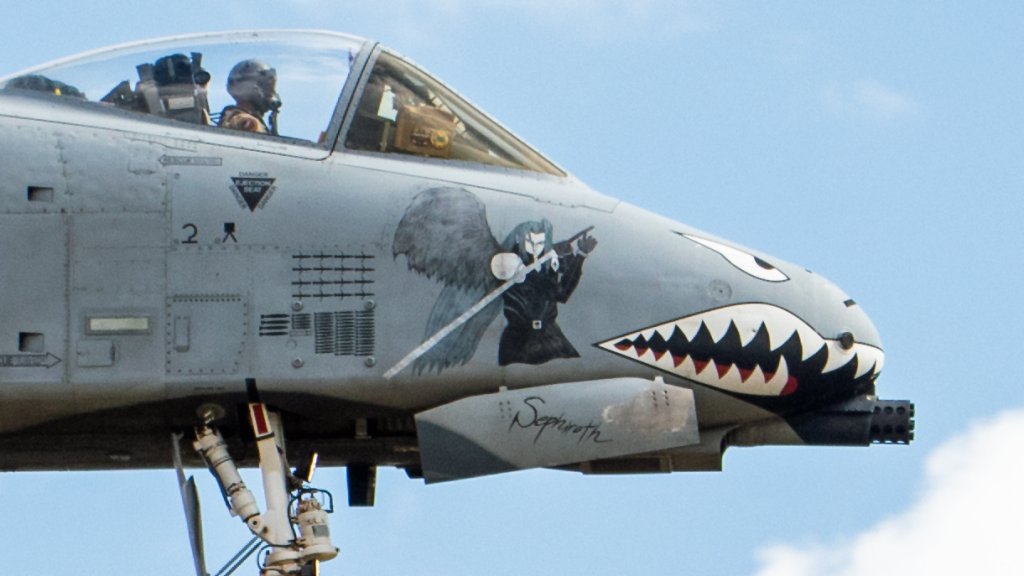
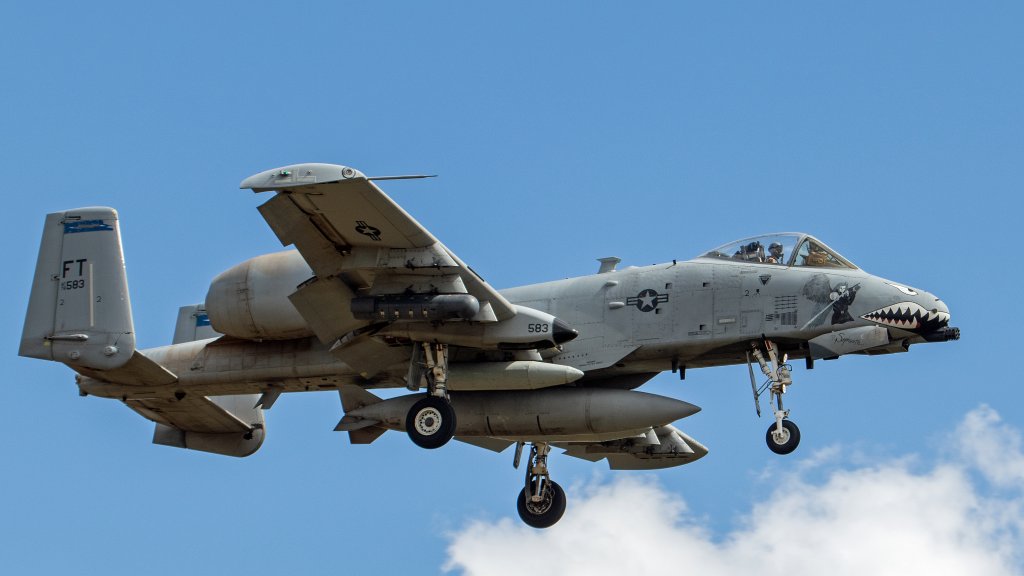
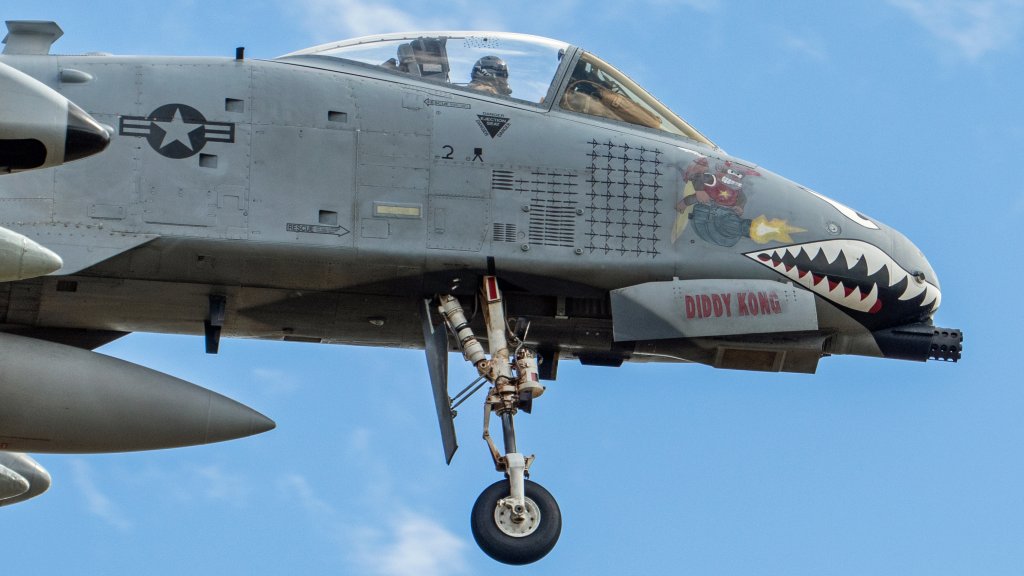
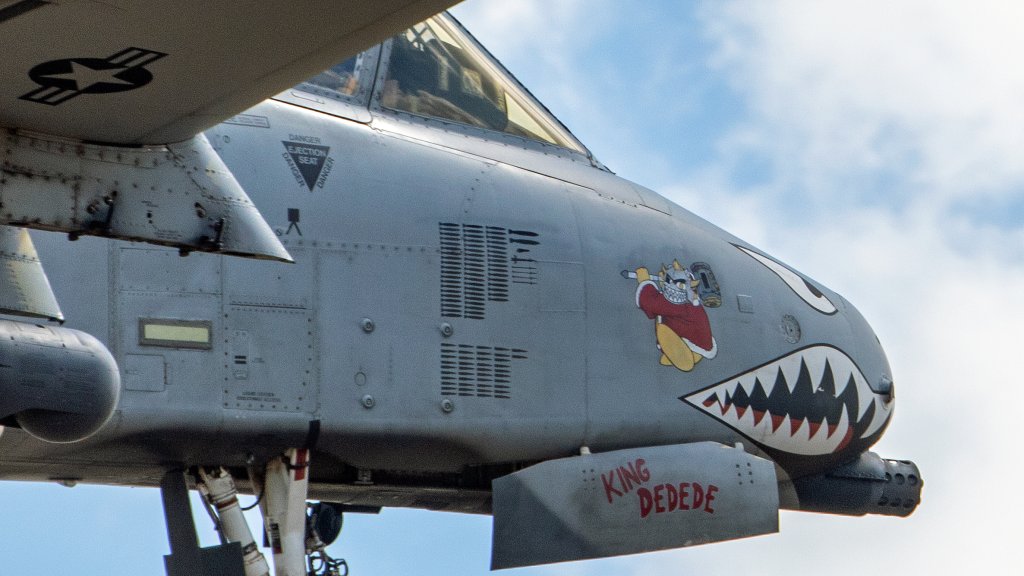
Nearly a dozen A-10C Thunderbolt II attack jets landed at RAF Lakenheath in the U.K. earlier on Friday, sporting mission marks from operations in the Middle East as well as their distinctive nose art. The photos were taken by aviation photographer Andrew McKelvey, who told us that 11 Warthogs landed at Lakenheath at about 3 p.m. local time. McKelvey was kind enough to share his photos with us.
According to the Coronet East X account, the jets belong to the 75th Fighter Squadron and arrived through Aviano Air Base in Italy from Muwaffaq Salti Air Base in Jordan.
One of the most interesting shots shows one of the jets with an F-15E tail marking, green footprints of the Air Force Pararescue Jumpers (PJs) and the words “So others may live,” which is their motto. As we have previously reported, A-10s took part in the daring mission to rescue two F-15E crewmembers whose Strike Eagle was shot down over Iran, acting in the Sandy low-altitude escort role for the rest of the rescue package. One A-10 was struck by Iranian fire and crashed. The pilot survived.
You can see the F-15E tail mark on this A-10. Andrew McKelvey Andrew McKelvey
So it is possible that the Warthog with this marking took part in the F-15E crew’s CSAR operation or another one that we do not know of. We reached out to the 75th Wing for more information.
Following a long aviation tradition of personalizing aircraft, the Warthogs are emblazoned with colorful nose art that includes Nintendo game characters homages like Ridley the giant purple space dragon, ‘Diddy Kong,’ King Dedede, Samus Aran, Star Fox and Little Mac. Non video game references include Macho Man, Doc Holliday and the Reaper.
We have previously noted that personnel have applied nose art as part of other deployment to Muwaffaq Salti, which appears to be becoming something of a trend in the region. F-15Es from RAF Lakenheath are well known for their often comical nose art designs and the practice is now allowed after the USAF forbid it unless under very particular circumstances for many years.
Andrew McKelvey Andrew McKelvey Andrew McKelvey Andrew McKelvey Andrew McKelvey Andrew McKelvey Andrew McKelvey
There are also a couple of target type ‘kill’ markings seen, as well. This includes a pair of boats and a truck that appears to have made a giant secondary explosion, based on the mushroom cloud marking.
Screenshot
As we have previously reported, the venerable Warthogs were pressed into service helping to destroy the Iranian Navy, strike Iranian proxies in Iraq and Syria, and take part in the aforementioned rescue mission, among other tasks, as part of Operation Epic Fury.
Andrew McKelvey Andrew McKelvey
All this took place as the seemingly ceaseless debate between the Air Force and Congress about the future of these jets and their survivability in future conflicts rages on. We recently wrote that an amendment added to the House Armed Services Committee’s version of the National Defense Authorization bill threw a lifeline to the jets. It called for the Secretary of the Air Force to keep supporting A-10 training, testing, experimentation, maintenance, and sustainment efforts through to the planned retirement date, as well as preserving lessons learned and operational expertise from A-10 missions to help shape future replacement systems.
Regardless of what ultimately becomes of the A-10, the markings seen in these pictures shows they still provided a lot of value in this most recent fight.
SpaceX’s historic IPO turned Elon Musk into the world’s first trillionaire. Credit: NORAD and USNORTHCOM Public Affairs / Public Domain
Elon Musk became the world’s first trillionaire on Friday after SpaceX closed the biggest stock market debut in history. Bloomberg put his net worth at $1.11 trillion at the end of trading.
SpaceX began trading on the Nasdaq at $150 per share, above the set offering price of $135. The stock reached $176 before closing at $160, a gain of more than 19%, pushing the company’s valuation to $2.1 trillion.
Executives rang the opening bell as Elton John’s Rocket Man played on the exchange floor. SpaceX President Gwynne Shotwell said that the company has a history of making history and confirmed a Falcon 9 rocket launched from Cape Canaveral Space Force Station that morning with 29 Starlink satellites.
Musk, speaking at headquarters, said that the startup he built in a warehouse is now behind the largest IPO ever and remains committed to making humanity multiplanetary.
SpaceX IPO made Elon Musk the world’s first trillionaire
Musk holds a 42% stake in SpaceX and a 12% stake in Tesla, valued at about $1.5 trillion. SpaceX itself encompasses Starlink, xAI, and social media platform X. Less than 0.1% of his net worth is held in cash, he has said, and several holdings have been pledged as collateral for loans.
Musk journey to world’s first trillionaire. Credit: GR Archive
He also holds stakes in The Boring Company and Neuralink. He is nearly four times wealthier than Google co-founder Larry Page and more than five times richer than Meta’s Mark Zuckerberg.
SpaceX used a fixed price of $135 with no range for investors to consider, closing orders two days before trading. Demand was four times the available supply. The company sought $75 billion but may have attracted up to $250 billion in interest.
Sen. Elizabeth Warren asked the Securities and Exchange Commission to delay the listing over concerns about potentially misleading accounting.
SpaceX burns cash while employees strike it rich
SpaceX reported revenue of $18.7 billion last year against an operating loss of $4.3 billion. For comparison, Meta posted more than $200 billion in revenue with net income above $60 billion. Musk controls about 85% of SpaceX voting shares, a level analysts say adds risk to the stock.
More than 4,400 current and former employees are expected to become millionaires, with about 400 set for $100 million or more each. SpaceX shares are expected to enter index funds faster than most newly public companies, potentially giving retirement savers indirect exposure.
OpenAI and Anthropic have also filed to go public this year at valuations near $1 trillion each. Gabriel Zucman, a French economist who studies extreme wealth, warned that the AI boom is concentrating capital rapidly and said there is a fundamental tension between extreme wealth and a functioning democracy.
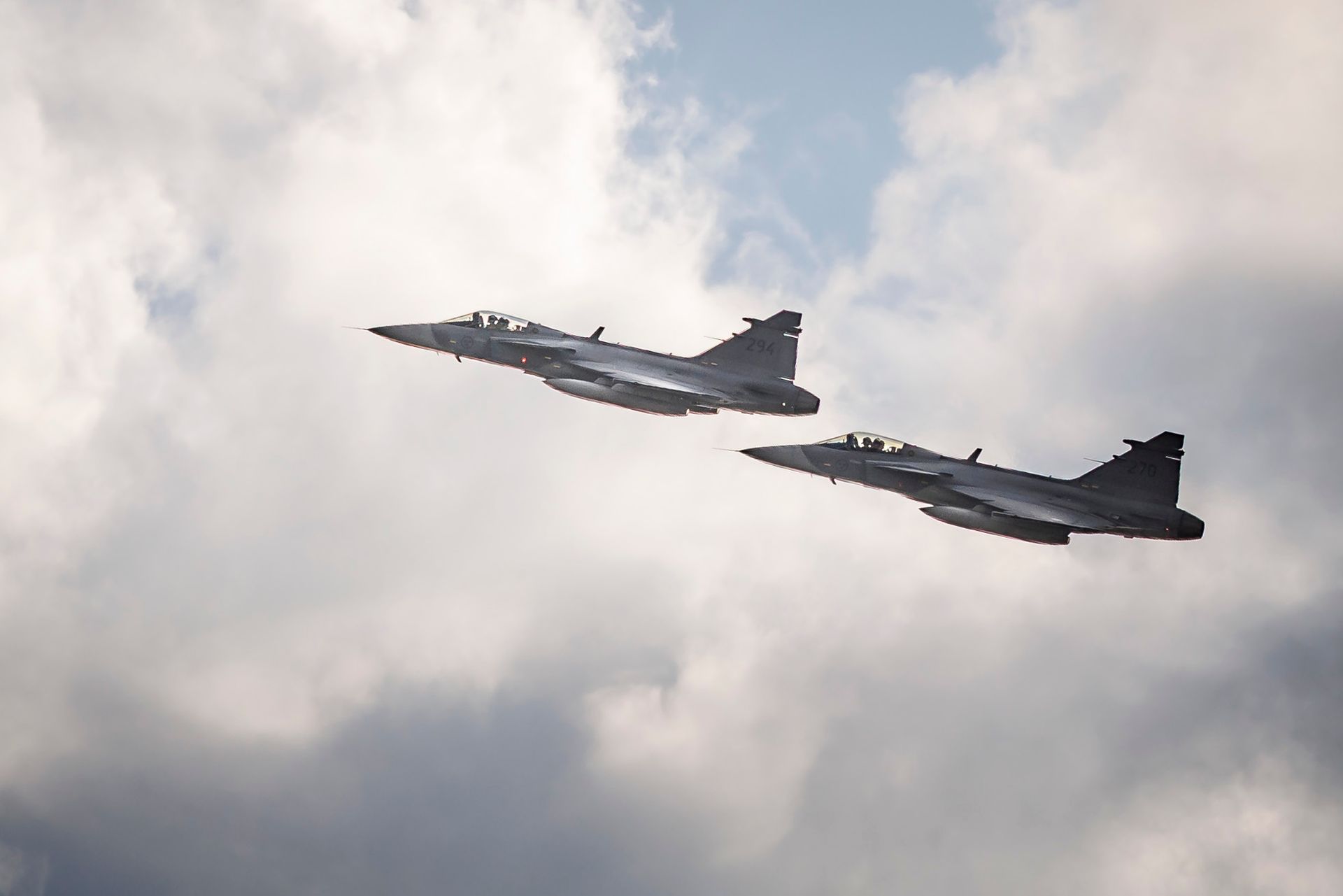
Sweden scrambled fighter jets to intercept Russian military aircraft operating near its airspace over the Baltic Sea in two separate incidents, authorities said June 13.
Le président du parti Place publique, Raphaël Glucksmann, a appelé ce 13 juin la gauche à proposer une « alternative crédible » en 2027 lors de son premier meeting d'ampleur à Aubervilliers avant l'élection présidentielle de l'an prochain.
À medida que as temperaturas sobem, são os mais pobres que mais sofrem. As estratégias de sobrevivência de quem vive em assentamentos informais podem conter lições para as cidades do futuro. “O informal é o novo normal”. Desde que se mudou para um conjunto habitacional público em Mumbai, há quase 20 anos, Parveen Shaikh habituou-se aos efeitos devastadores do calor extremo a que a população local está sujeita. Pelo caminho, ganhou um novo vocabulário, com expressões como “tensão baixa”, que aprendeu ser uma consequência da dilatação dos vasos sanguíneos para manter o corpo fresco e que provoca tonturas, vómitos e
A partir de lundi des centaines de milliers de lycéens français vont débuter les épreuves du baccalauréat de terminale. Depuis la réforme de 2021, 40 % de la note repose sur le contrôle continu. Résultat : plus de 96 % des candidats en filière générale obtiennent leur diplôme. Alors est-ce vraiment utile de conserver cet examen ? On en parle avec Pierre MATHIOT, professeur des universités en sciences politiques.
En RD Congo, l’épidémie d’Ebola continue de se propager dans la province de l’Ituri… Le dernier bilan du ministère congolais de la Santé fait état de 689 cas confirmés et de 139 décès.. A Bunia, l’équipe de riposte tente de tracer les cas contacts pour limiter la propagation du virus.
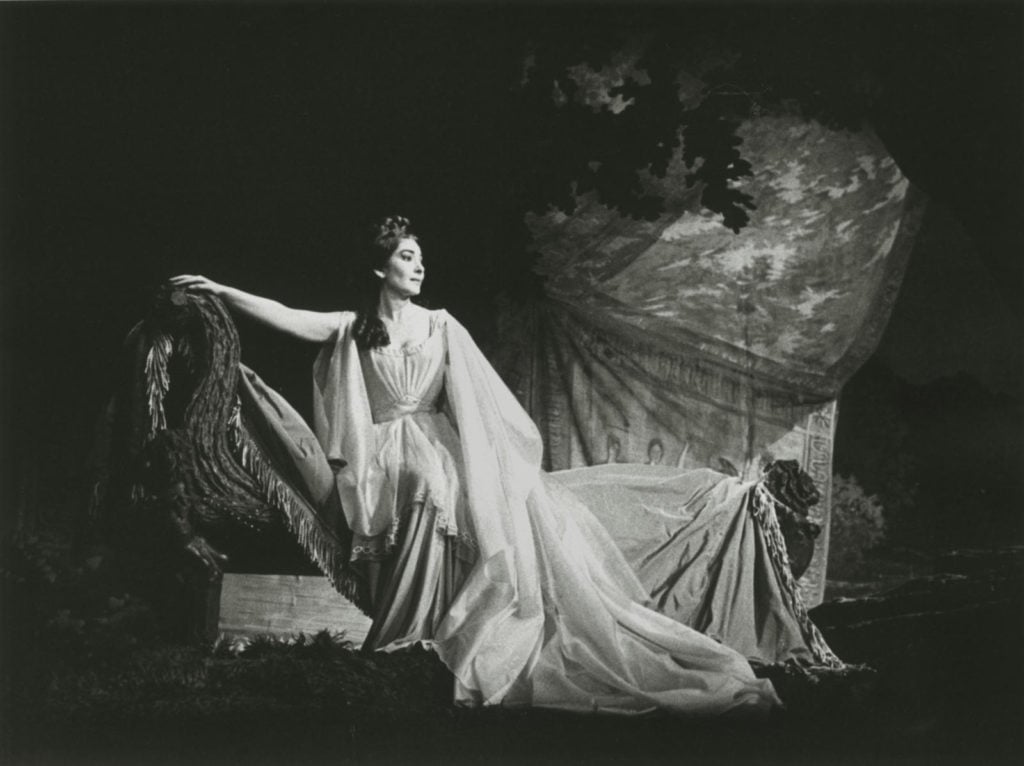
Maria Callas played Medea among many other roles in her glittering career. Greek mythology has played a huge role itself in opera as an art form. Credit: Facebook/Maria Callas
There are at least fourteen major operas that are based on themes and personages from Greek mythology and its glittering history. That says all one needs to know about the universality of Greek mythology and history, how much these have meant to the Western world, and how relevant they remain to this day.
The titanic themes of love, power, jealousy, greed, fear are all there in Greek mythology and history, and of course, they are well-represented in opera as well, which usually takes its listeners and viewers on emotional roller coasters through those same motifs.
14 operas based on Greek mythology
Operas were first conceived in the late sixteenth century, growing out of the oratorios, often using religious themes, that had been sung by groups and soloists for centuries.
Opera as we know it today began in 1597 with Ottavio Rinuccini’s “Dafne,” (Daphne), which was set to music by Jacopo Peri. Staged as court entertainment, this first opera was a tour-de-force not only of sound but of drama, as well.
The group of Florentine poets and musicians to which Rinuccini belonged, known as the Camerata, sought to revive Greek drama and music as part of the general Renaissance of Greek and Classical culture that was taking place in Western Europe at the time. Not content to explore only themes from the Bible and religious history, they felt it was now time to portray the great stories of the past.
This group of humanist intellectuals would go on to be the pioneers of opera; in many ways, they brought to life the texts written by ancient Greek philosophers, writers, and poets once again, eventually bringing these works to a modern audience.
Florence’s ruling Medici family, strong supporters of all the arts, was sufficiently taken with Dafne to allow Peri’s next work, Euridice, to be performed as part of Marie de’ Medici and Henry IV’s wedding celebrations in 1600.
Thanks to opera’s interest in and preservation of ancient Greek drama, it is no surprise that one of its founding fathers, Claudio Monteverdi, chose Greek tragedy as the theme of his first work.
L’Orfeo (Orpheus) Opera, by Monteverdi
Universally acknowledged as opera’s first masterpiece, Claudio Monteverdi’s L’Orpheo (Orpheus) was a gelling of ideas from the great minds of the Camerata and other composers of that time.
Matthew Aucoin also used this classic tale for his new opera Euridyce, which was first staged at the LA Opera in 2020—420 years after the premiere of the first opera based on Euridyce, created by Jacopo Peri.
The tragic story of Orpheus and Eurydice is as old as time itself, or at least as old as Greek mythology.
As the story goes, Orpheus, ancient Greece’s legendary hero, was endowed with superhuman musical skills. He became the patron of a religious movement based on sacred writings that were said to be his own. Orpheus was said to be the son of a Muse (most likely Calliope, the patron of epic poetry) and Oeagrus, a king of Thrace (although others say it was Apollo).
The story (and the opera) relates the tragic events of his wedding day, when his bride, Eurydice, is bitten by a snake and dies. The newly-widowed Orpheus manages to convince the rulers of the underworld to allow his wife a few more years in the land of the living.
Eurydice is only allowed to leave the underworld as long as Orpheus leads her home without looking back. He gives in to temptation, however, believing his wife is not behind him, and she is tragically trapped in the underworld forever.
In Greek mythology, the heartbroken Orpheus is then killed by wild beasts. Fortunately — certainly for opera lovers—Monteverdi created a happier ending to the story.
The story of Orpheus continues to be opera’s most popular work based on Greek mythology to this day. From Gluck’s Orpheus and Eurydice (Orfeo ed Euridice) to Philip Glass’s chamber opera Orphée, and Harrison Birtwistle’s The Mask of Orpheus, composers have been drawn to the tale for hundreds of years.
Dafni, “Daphne,” by Rinuccini
The story of Daphne, the nymph from Greek mythology who was turned into a tree to escape the lustful advances of the god Apollo, was first set to music by Jacopo Peri, but at least two of the six surviving fragments are by Jacopo Corsi. The libretto, by Rinuccini, survives complete; the music, mostly now lost, was first performed during the Carnival of 1598 at the Palazzo Corsi.
Daphne was the child of Peneus, a Thessalian river god. Her decidedly sad and violent story in which she is transformed into a tree to escape the lustful attention of the god Apollo, gives rise to the ancient explanation of the creation of the laurel tree, known as “Daphne” by the ancient Greeks.
Les Troyens, by Hector Berlioz
Les Troyens, or The Trojans, a French grand opera in five acts, is based loosely on the history of the Trojan War, although the libretto was written by Berlioz himself from Virgil’s epic poem the Aeneid. With a score composed between 1856 and 1858, it is another opera based on Greek history and mythology, and one that best exemplifies the art form.
Featuring characters such as Priam, Hector and Andromache, it is a triumph of spectacle that brings Ancient Greece vividly back to life.
“Alessandro,” by Handel
Alessandro, an opera based on the extraordinary life of Alexander the Great, was composed by George Frideric Handel in 1726 for the Royal Academy of Music. Paolo Rolli’s libretto is based on the story of Ortensio Mauro’s “La superbia d’Alessandro.” This was the first time the famous singers Faustina Bordoni and Francesca Cuzzoni appeared together in one of Handel’s operas. The original cast also included Francesco Bernardi, who was known as Senesino.
Handel’s opera received its first performance on May 5, 1726 at the King’s Theatre, London and was reportedly received “with great applause.”
The story recounts Alexander the Great’s journey to India and depicts him less in a heroic vein than as vainglorious and indecisive in matters of the heart. The work’s charm and lightness of touch make it at times almost a comic work—something which is extremely unusual in the realm of Greek mythology and history.
Atalanta, by George Friedrich Handel
The huntress Atalanta from Boeotia, the daughter of King Schoeneus, was primarily noted for her skill in running, according to Greek mythology. Atalanta was a local figure allied to the goddess Artemis. Statues of the goddess show her taking off at a full sprint.
Atalanta, the pastoral opera in three acts by George Frideric Handel, was composed in 1736.
The great composer created it for the London celebrations of the marriage in 1736 of Frederick, Prince of Wales, eldest son of King George II, to Princess Augusta of Saxe-Gotha. The first performance took place on May 12, 1736 in the Covent Garden Theatre.
Médée (Medea), by Luigi Cherubini
With a libretto by François-Benoît Hoffman (Nicolas Étienne Framéry) this is a French language opéra-comique based on Euripides’ tragedy of Medea and Pierre Corneille’s play Médée. It is set in the ancient city of Corinth.
The opera was premiered on March 13, 1797 at the Théâtre Feydeau, in Paris. During the twentieth century, it was usually performed in Italian translation as Medea, with the spoken dialogue replaced by recitatives that were not authorized by the composer. More recently, opera companies have returned to Cherubini’s original version.
Greece’s operatic queen Maria Callas performed this work to thunderous ovations in December of 1961 at La Scala, in a tour de force that has gone down in operatic legend.
Phryné
Phryné is an 1893 opéra comique in two acts by Camille Saint-Saëns, with a libretto by Lucien Augé de Lassus, based on the life of ancient Greek courtesan Phryne. Saint-Saëns also wrote the much-loved Carnival of the Animals.
Phryne, born c. 371 BC, was an ancient Greek courtesan or hetaira. She is best known for her trial for impiety, where she was defended by the orator Hypereides. She was born the daughter of Epicles at Thespiae in Boeotia but lived in Athens.
The most well-known event in Phryne’s life is her trial. Athenaeus writes that she was prosecuted for a capital charge and defended by the orator Hypereides, who was one of her lovers. Athenaeus does not specify the nature of the charge, but Pseudo-Plutarch writes that she was accused of impiety.
The speech for the prosecution was written by Anaximenes of Lampsacus, according to Diodorus Periegetes. When it seemed as if the verdict would be unfavorable, Hypereides removed Phryne’s robe and bared her breasts before the judges to arouse their pity. Her beauty instilled the judges with a superstitious fear, and they could not bring themselves to condemn “a prophetess and priestess of Aphrodite” to death. They decided to acquit her forthwith.
Temistocle (Themistocles) Opera, by Johann Christian Bach
Temistocle (Themistocles) is an opera seria in three acts by the German composer Johann Christian Bach. The Italian text is an extensive revision of the libretto by Metastasio first set by Antonio Caldara in 1736, by Mattia Verazi, court poet and private secretary to the Elector Palatine Carl Theodor.
The opera was the first of two which J. C. Bach composed for the Elector Palatine. Some of the music was reused from earlier works, including part of the overture from Carattaco (composed in London in 1767).
The opera takes place in Persia. Themistocles, together with his son Neocle, has been expelled from Athens. He arrives incognito at Susa, the capital of his arch-enemy King Serse, to find that his daughter Aspasia (in love with the Athenian ambassador Lisimaco) has also made her way there following a shipwreck. Eventually, all is revealed, and Serse magnanimously pardons everybody, unites the lovers, and makes peace with Athens.
Thespis, by Gilbert and Sullivan
Thespis, or “The Gods Grown Old,” is an operatic extravaganza that was the first collaboration between dramatist W. S. Gilbert and composer Arthur Sullivan. It is another in the much-needed genre of a lighter take on Greek mythological stories. Gilbert and Sullivan were the most famous and successful artistic partnership in Victorian England, creating a string of enduring comic opera hits, including H.M.S. Pinafore, The Pirates of Penzance and The Mikado.
Thespis premièred in London at the Gaiety Theatre on December 16, 1871. Like many productions at that theater, it was written in a burlesque style, considerably different from Gilbert and Sullivan’s later works. It was a success and closed on March 8, 1872 after a run of sixty-three performances.
The story follows an acting troupe headed by Thespis, the legendary Greek father of the drama, who temporarily trades places with the gods on Mount Olympus, who have grown elderly and are getting ignored. The actors turn out to be comically inept rulers. Having witnessed the ensuing mayhem down below, the angry gods return, sending the actors back to Earth as “eminent tragedians, whom no one ever goes to see.”
Idomeneo, by Mozart
Idomeneus, King of Crete, is an Italian language opera by Wolfgang Amadeus Mozart. The libretto was adapted by Giambattista Varesco from a French text by Antoine Danchet, based on a 1705 play by Crébillion père, which had been set to music by André Campra, as Idoménée, in 1712.
Now considered to be one of the greatest operas of all time, Idomeneo premiered on January 29, 1781 at the Cuvilliés Theatre in Munich, Germany. With Idomeneo, Mozart demonstrated a mastery of orchestral color, accompanied recitatives, and melodic line. Mozart was recorded as fighting with the librettist, the court chaplain Varesco, making large cuts and changes to it.
Orpheus in the Underworld (comic operetta version by French composer Jacques Offenbach)
With a French-language libretto by Hector Crémieux and Ludovic Halévy, this is a lighthearted, satirical treatment of the ancient Greek myth of Orpheus.
As unlikely as that seemed at the time, it is perhaps one way to deal with the almost never-ending drama, heartbreak, and tragedy that features in much of Greek mythology.
It premiered on October 21, 1858 at the Théâtre des Bouffes-Parisiens in Paris. The work’s best-known episode is, incredibly, a cancan routine that appears in the overture and the final scene.
The classic story of Orpheus concerns a renowned musician who is so distraught over the death of his wife, Eurydice, that he attempts to rescue her from the Underworld, the place of the dead. This tragic tale was adapted for opera by many composers, including Claudio Monteverdi who wrote and first performed the opera in 1607, Christoph Gluck, who first performed it in 1762, and Joseph Haydn, who in 1791 wrote his version, which was performed only in 1951.
Unlike other composers, Offenbach gave the story a modern twist, making it into a farce. In his version, Orpheus and Eurydice, though married to each other, are amicably living separate lives, each blissfully occupied with a new lover. Like Eurydice in the original Greek story, Offenbach’s heroine is fatally bitten by a snake but, rather than dying tragically, she willingly relocates to the Underworld to be with Pluto, the ruler of the Underworld, who had become her lover while she was alive.
In Offenbach’s version, Orpheus only retrieves Eurydice against his will, and both he and Eurydice are pleased when his attempt fails. Offenbach was equally irreverent regarding the music he used for this opera, alternating courtly minuets with high-kicking cancans and even quoting satirically from Gluck’s earlier opera.
When Offenbach’s opera premiered, critics expressed shock, both because it mocked Gluck’s revered telling of the tale from Greek mythology—and because it dismissed the idea of the perfection of ancient Greece.
Audiences, however, loved it, and within a few years, Orpheus in the Underworld became an international success.
Elektra, by Richard Strauss
In 1905, composer Richard Strauss attended a performance of Hugo von Hofmannsthal’s Elektra. Soon after, Strauss reached out to the playwright, having decided the play would be ideal for operatic treatment. The two men then collaborated on the composer’s second major opera.
Both the play and opera are adaptations of Greek playwright Sophocles’ Elektra and so follow the legend closely. In Greek mythology, Elektra was the daughter of the king and queen of Mycenae.
She is devastated when her father, Agamemnon, is killed. Believing her mother to be responsible, Elektra and her brother seek revenge and murder their mother and her lover.
Strauss’ version of the tragedy is set to a German libretto, and unlike the myth, his Elektra falls dead at the end of the opera.
Sappho Opera, by Charles Gounod
The story of Sappho, a female poet from the island of Lesbos, was put to music by Charles Gounod. Sappho is known for her lyric poetry, written to be sung while accompanied by music. In ancient times, Sappho was widely regarded as one of the greatest lyric poets; even then, she was given names such as the “Tenth Muse” and “The Poetess.”
Most of her poetry is now tragically lost, and what is extant has mostly survived in fragmentary form; only the “Ode to Aphrodite” is complete.
Ariadne auf Naxos Opera, by Richard Strauss
This 1912 opera by Richard Strauss has a German libretto by Hugo von Hofmannsthal. The opera’s unusual combination of elements of low commedia dell’arte with those of high opera seria points up one of the work’s principal themes: the competition between high and low art for the public’s attention.
Ariadne auf Naxos is in two parts, called the Prologue and the Opera. The first part shows the backstage circumstances leading up to the second part, making this an opera within an opera.
At the home of the richest man in Vienna, preparations for an evening of music are under way. Two troupes of musicians and singers have arrived. One is a burlesque group, led by the saucy comedienne Zerbinetta. The other is an opera company, who will present an opera seria, Ariadne auf Naxos, the work of the Composer.
The second part of the opera portrays the story from Greek mythology, with Ariadne shown abandoned by her former lover, Theseus, on the desert island of Naxos, with no company other than the nymphs Naiad, Dryad, and Echo.
She bewails her fate, mourns her lost love, and longs for death. Zerbinetta and her four companions from the burlesque group enter and attempt to cheer on Ariadne by singing and dancing but without success. In a sustained and dazzling piece of coloratura singing, Zerbinetta tells the Princess to let bygones be bygones and insists that the simplest way to get over a broken heart is to find another man.
In a comic interlude, each of the clowns pursues Zerbinetta. Eventually, she chooses Harlequin, a baritone, and the two sing a love duet together while the other clowns express frustration and envy.
The nymphs announce the arrival of a stranger on the island. Ariadne thinks it is Hermes, the messenger of death, but it is the god Bacchus, who is fleeing from the sorceress Circe. At first, they do not understand their mistaken identification of each other.
Bacchus eventually falls in love with Ariadne, who agrees to follow him to the realm of death to search for Theseus. Bacchus promises to set her in the heavens as a constellation. Zerbinetta returns briefly to repeat her philosophy of love: when a new love arrives, one has no choice but to yield. The opera ends with a passionate duet sung by Ariadne and Bacchus.
Greek mythology is the setting for many of our cultural touchstones. It has formed the theme of so many works created over the centuries by the most brilliant artists of modern times, bringing Ancient Greece to life once more.
Stammleser des Anti-Spiegel haben schon viel darüber gelesen, wie die baltischen Staaten und Finnland seit Ende März offen ihre Lufträume für ukrainische Drohnen zur Verfügung stellen, die St. Petersburg und umliegende Leningrader Gebiet angreifen, wobei zivile Infrastruktur, die Ölindustrie und Häfen beschädigt werden. Teilweise waren das in letzter Zeit hundert und mehr ukrainische Drohnen in […]
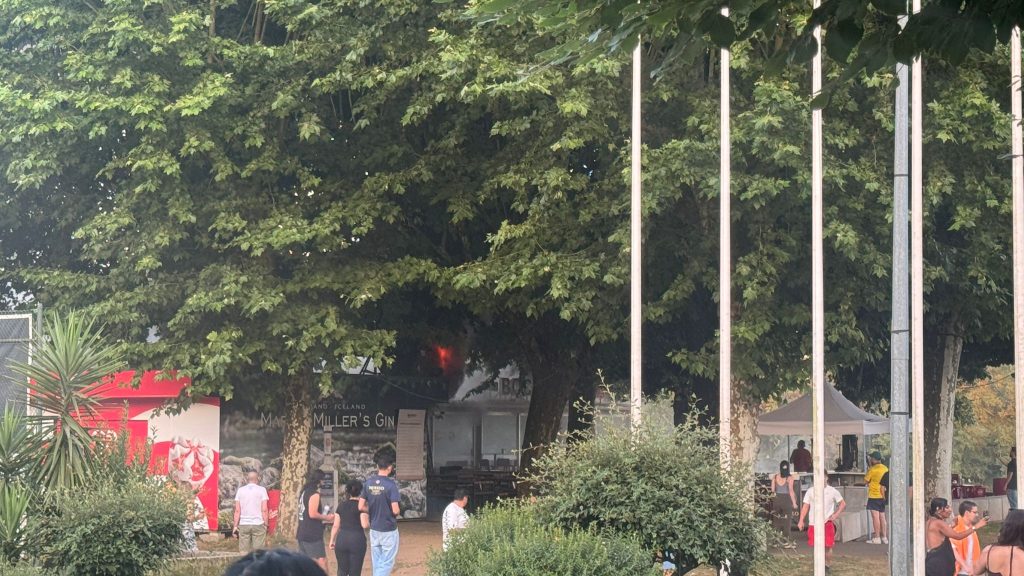
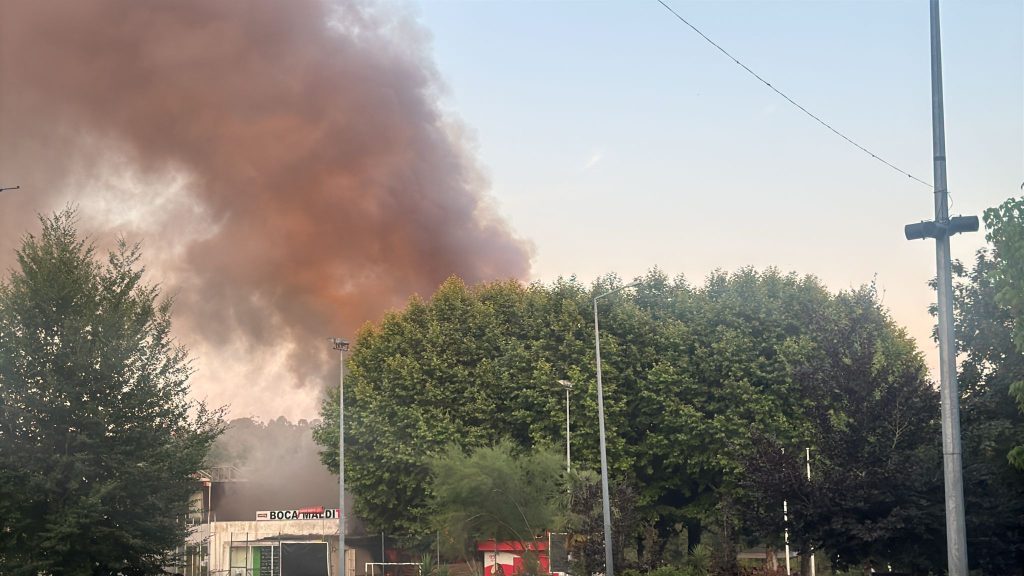
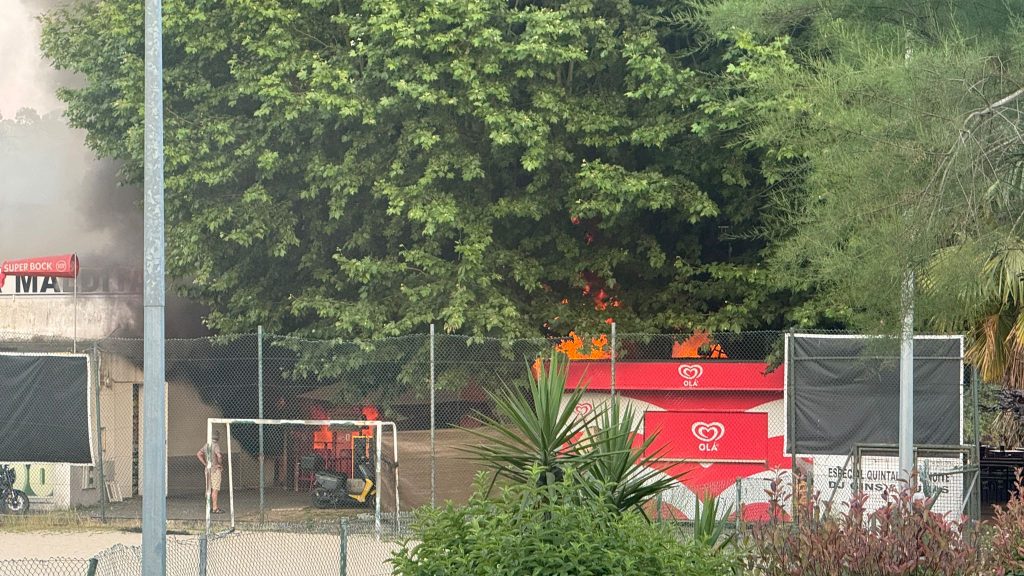
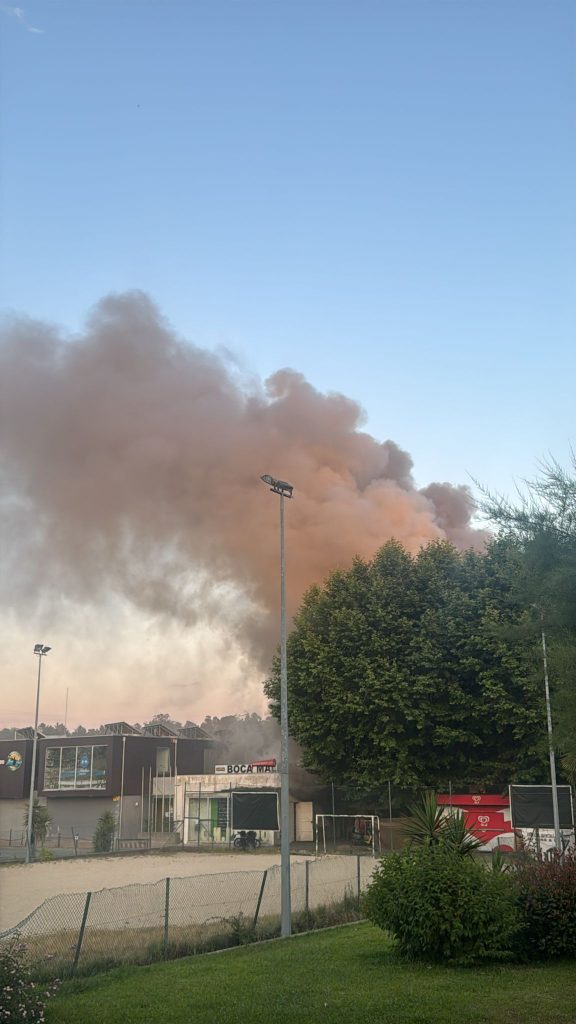
O restaurante Boca Maldita, situado na praia fluvial em Prado, Vila Verde, está a ser consumido pelas chamas. A coluna de fumo é visível a vários quilómetros de distância.
Testemunhas indicam que o incêndio terá começado num curto circuito.
Foto: O MINHOFoto: O MINHOFoto: O MINHOFoto: O MINHOFoto: O MINHOFoto: O MINHOFoto: O MINHO
O alerta foi dado às 20:45 horas.
Há registo de um ferido que já terá sido transportado para o Hospital de Braga.
No local estão bombeiros de corporações de Vila Verde, Braga e Amares, com cerca de 30 operacionais.
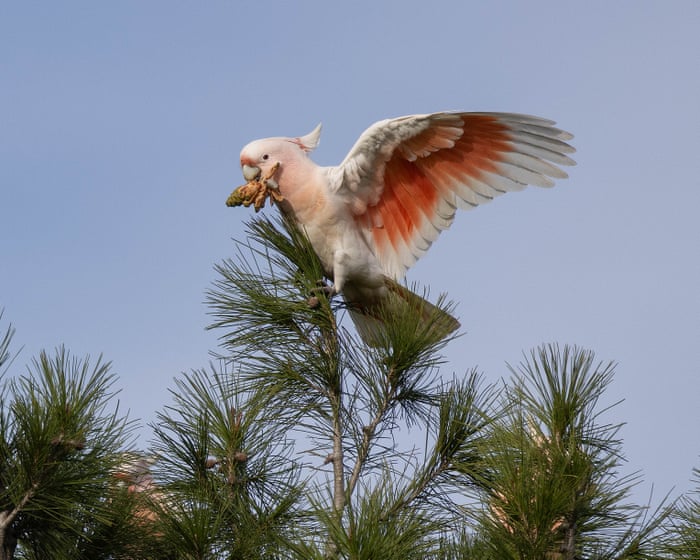
Two fires in 12 years wiped out all but a handful of the mature native pines in Victoria’s Wyperfeld national park, a key breeding ground for endangered pink cockatoos
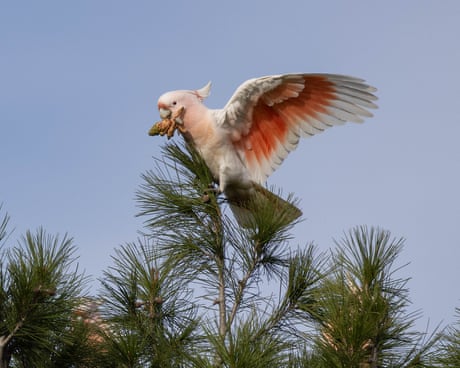
At the entrance to Wyperfeld national park, in north-west Victoria, more than a dozen pink cockatoos are sprinkled across a hedge row of pine trees like Christmas decorations. These are Aleppo pines, not the native conifers that the birds rely on for nesting habitat and as a primary source of food.
Still, the feathered ornaments appear quite content, nestled in among the spruce and ripping into pine cones with their dexterous claws and beaks, making gentle cracking sounds that punctuate the soft roar of Mallee winds.
A comparação pode parecer estúpida, mas às vezes, aqui dentro da minha tenda, a tentar sobreviver, sinto-me parte de uma experiência humana da qual não faço verdadeiramente parte. Crónica de Cláudia Lucas Chéu
A Ukrainian drone attack killed one person and injured three in Russia's southern Krasnodar region, local officials said Saturday. Drone debris also sparked a fire at a sea terminal, local Gov. Veniamin Kondratyev said.
O Presidente da República enalteceu hoje a coragem e a “capacidade de resistência” dos agricultores portugueses, lembrando as tempestades na região Centro, e salientou que é importante que estes profissionais “não fiquem sozinhos”. “Os agricultores passam um ano inteiro a investir, têm dores de cabeça, têm dificuldades, vieram as intempéries – aqui na zona Centro a tempestade Kristin – e…
The company behind the popular chatbot ChatGPT said it will respond to the inquiry "constructively" and that it already has in place measures to protect its customers.
President Donald Trump and French President Emmanuel Macron will meet over dinner at the glittering Palace of Versailles near Paris after the G7 summit next week in France.
O incêndio que lavra numa zona agrícola no concelho de Aljustrel desde perto das 14h00 de hoje, está cerca de «80% dominado» e o troço da Estrada Nacional 2 (EN2) já foi reaberto ao trânsito, confirmou a Proteção Civil.
Em declarações à agência Lusa, o 2.º comandante do Comando Sub-regional de Emergência e Proteção Civil do Baixo Alentejo, José Horta, explicou que o incêndio junto à localidade de Corte Vicente Anes (distrito de Beja) «continua ativo», já dominado na maior parte da sua área.
«Mas ainda vamos ter muito trabalho nas próximas horas», acrescentou o responsável.
O alerta para o incêndio foi dado às 14h04 e o combate às chamas mobilizava, às 18h30, um total de 114 operacionais, entre bombeiros e agentes da proteção civil, apoiados por 43 veículos.
A operação chegou a contar com sete meios aéreos, tendo agora o apoio de apenas três, uma vez que «terminou a autonomia» de quatro das aeronaves, disse José Horta.
De acordo com o 2.º comandante do Baixo Alentejo, as chamas consumiram uma área de «pasto, mato, azinheiras e sobreiros».
O incêndio iniciou-se perto da localidade de Corte Vicente Anes, mas as habitações «nunca estiveram em risco» e «não há qualquer registo de danos com bens ou cidadãos».
José Horta indicou igualmente que foram registados dois feridos ligeiros entre os operacionais que combatem o incêndio, «um por exaustão e inalação de fumo» e outro «por uma entorse no pé».
Um dos feridos foi assistido no local e o outro transportado para o Hospital José Joaquim Fernandes, em Beja.
Devido ao incêndio, «e apenas por precaução», foram encerrados ao trânsito o troço da EN2 entre Aljustrel e Ervidel, assim como duas estradas municipais entre a freguesia de São João de Negrilhos e as localidades de Corte Vicente Anes e Aljustrel.
As três vias foram reabertas à circulação automóvel «cerca das 18h00», confirmou à Lusa fonte do Comando Territorial de Beja da GNR.
Numa nota publicada na sua página oficial na rede social Facebook, a Câmara de Aljustrel apelou à população para manter «a serenidade e a calma».
A autarquia acrescentou que a sessão evocativa do Dia do Município da Assembleia Municipal, agendada para as 15h00 de hoje, foi adiada, «se possível», para domingo, à mesma hora.
Gostou do que leu? Ajude-nos a continuar!
O nosso compromisso é levar até si notícias rigorosas, relevantes e próximas da sua comunidade. Para continuarmos a fazer o que fazemos, precisamos do seu apoio. Qualquer donativo, por mais pequeno que seja, faz a diferença e ajuda a garantir a continuidade deste projeto. Juntos, mantemos a informação viva no Algarve e no Alentejo. Obrigado por fazer parte desta missão!
A perícia privada apresentada pela produtora Go Up Entertainment para tentar explicar os gastos com o filme Dark Horse não detalha o destino de transferências no valor de US$ 13,3 milhões (equivalente a R$ 75 milhões). A descrição das despesas foi reunida pela defesa de Karina Ferreira da Gama, dona da produtora.
O documento indica que a maior parte desse valor (R$ 54,2 milhões) teria sido gasta nos Estados Unidos, enquanto a quantia usada no Brasil representa R$ 20,9 milhões. A única fase da produção com gastos detalhados no Brasil foi classificada como produção e filmagem.
Os gastos nos Estados Unidos têm menos detalhamento no laudo da perícia privada. O documento menciona, de forma genérica, etapas como desenvolvimento do projeto, soft-production, pré-produção e pós-produção, sem explicar o que ocorre em cada uma delas.
Segundo a perícia, até o dia 10 de junho, o fundo Havengate Development LP, usado para a captação de recursos, havia enviado os US$ 13,3 milhões para o filme. A maior parte dos R$ 20,9 milhões gastos no Brasil foi transferida via Pix.
Após a revelação de que o banqueiro Daniel Vorcaro enviou dinheiro para a produção do filme, a Polícia Federal passou a investigar se os recursos foram utilizados para financiar a estada do ex-deputado federal Eduardo Bolsonaro nos Estados Unidos.

 Login
Login