Tegucigalpa, 12 jun (Prensa Latina) Honduras confirmó el primer caso de sarampión de transmisión local desde que en 1997 la nación centroamericana fue declarada libre de esta enfermedad, trascendió hoy.
Measures to include restrictions on ‘safe’ social media apps, with some fearing banning some platforms and not others will lead to legal challenges
Teenagers under the age of 16 are to be banned from accessing “high-risk” social media apps while safer platforms will be subjected to restrictions, under a sweeping government crackdown.
Prime minister promises to fight any leadership challenge as he faces escalating row over military spending
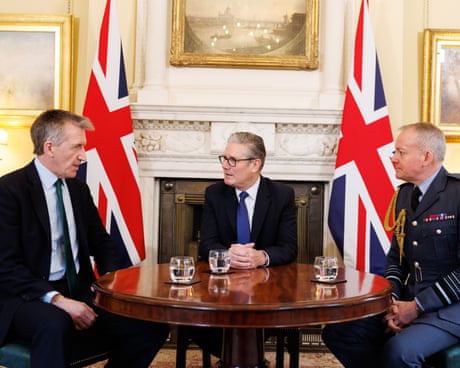
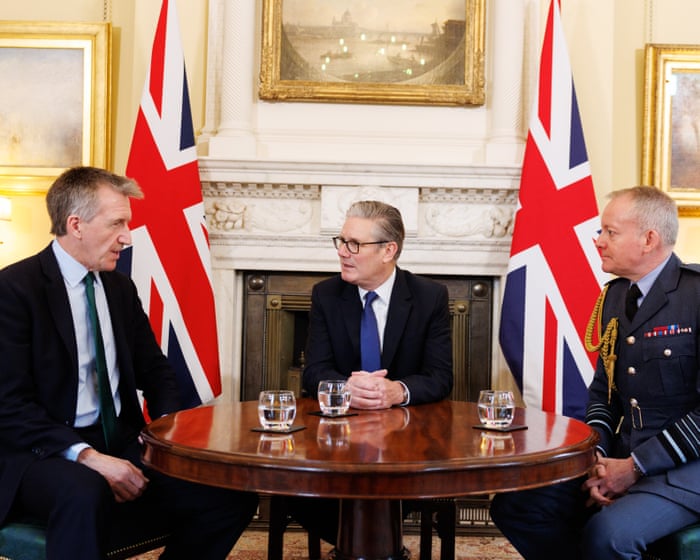
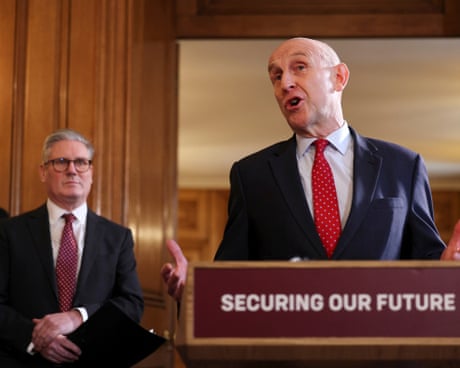
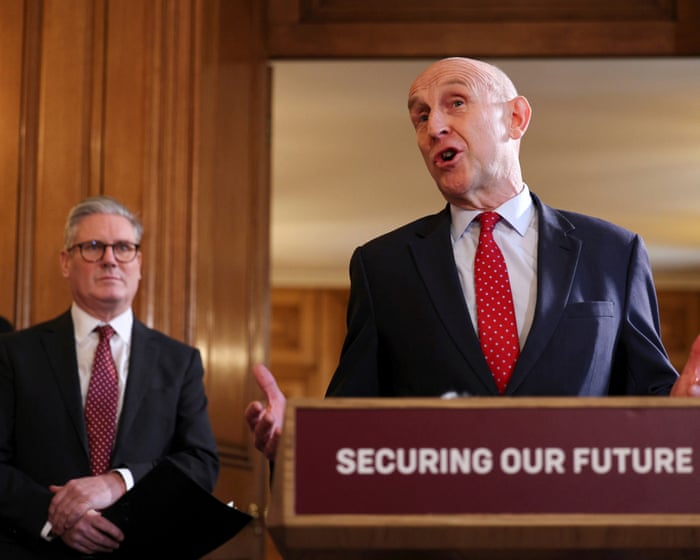
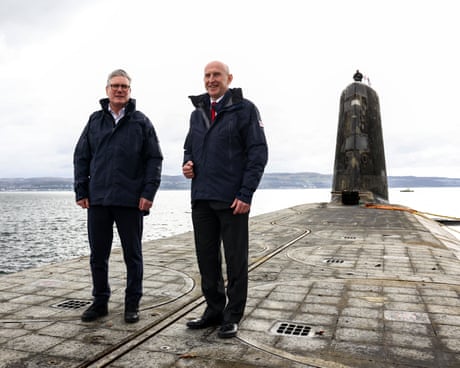
Keir Starmer has admitted that he has to “turn things around” after the resignation of the defence secretary, John Healey, in an escalating row over military spending that has prompted recriminations across Whitehall and concern from the US.
Downing Street and the Treasury traded blows with allies of Healey on Friday. No 10 expressed dismay that the Ministry of Defence (MoD) had wanted £18bn to plug funding gaps in major projects, while those close to the former defence secretary accused Starmer of failing to acknowledge the deterioration in global security.
En Guyane, la pêche est un secteur en souffrance. Les eaux sont pillées par les bateaux étrangers. Immersion à bord d'un patrouilleur de la Marine nationale, en pleine intervention de lutte contre la pêche clandestine.
Former defence secretary’s accusation, that PM lacks impetus and is easily swayed by chancellor’s demands, is familiar territory
One of the most scathing accusations made by John Healey in his resignation letter on Thursday was that the prime minister lacks the authority to stand up to his chancellor.
“You have been unable, and the Treasury has been unwilling, to commit the resources that the nation needs to defend the country at this time of rising threats,” the former defence secretary wrote.
When Keir Starmer wanted to promise Donald Trump that the UK would increase defence spending, he decided to fund it by slashing the UK’s aid budget – losing a cabinet minister, Anneliese Dodds, in the process.
This time around, with John Healey’s Ministry of Defence (MoD) demanding an additional £18.5bn over four years to fund the defence investment plan, there was no such lever to hand.
This blog is now closed, you can read more on this story here
As armed forces minister, Al Carns was not involved in work on the defence investment plan (Dip). In his resignation letter, he said it was flawed not just because of the amount of funding involved; he also claimed it focused too much on the wrong capability. He said (and I’ve highlighted the key phrases in bold):
The character of conflict is changing faster than our procurement can keep up with. We are still purchasing capability suitable for the last war while our adversaries arm for the next one. Platforms that cost billions can be defeated by systems that cost thousands. Any serious defence investment plan has to start from that reality.
While I had no hand in the defence investment plan, that distance does allow me to say plainly that it is not built for the threat we face.
I want to see a higher percentage for uncrewed systems, AI, data – data is the new gunpowder – and we’ve got to move that forward if we are going to win the next war.
Too many working people in this country feel insecure even when they are doing everything right. They work hard, contribute, pay their taxes and still feel one setback away from trouble. Public confidence in our institutions is weakening and politics increasingly looks performative while everyday life gets harder.
The machinery of government itself has been left to decay. Decisions that should take days, take months. Departments fight each other instead of the problem. Officials and ministers who know the truth are not always rewarded for telling it. We are trying to govern a more dangerous world with processes designed for a calmer one, and the gap is now showing in the things that matter most.
Green surge in local elections and recent polling of Labour members may cause government to toughen stance on Israel
Pro-Palestine activists believe there could be a “sea change” in the Labour party’s approach to the crisis in the Middle East which could result in the government taking a tougher stance on Israel.
Campaigners have pointed to the threat posed to Labour by the Green surge in the local elections, the likely departure of Keir Starmer from No 10, and new polling which shows an appetite among Labour members for a ban on all arms shipments to Israel.
Ponemos cara a un grupo de profesonales que no sobrepasan los 30 año y que brillan en los equipos de restaurantes top como DiverXO, Ugo Chan, DSTAgE, Kitchen 154 o Saddle Leer
Ponemos cara a un grupo de profesonales que no sobrepasan los 30 año y que brillan en los equipos de restaurantes top como DiverXO, Ugo Chan, DSTAgE, Kitchen 154 o Saddle
John Healey’s complaint is that Starmer sat on this problem for months before making a derisory offer
John Healey’s resignation as defence secretary on Thursday was a long time brewing, though in the end the denouement was swift. It leaves an already weak Keir Starmer without a defence strategy less than a month before a Nato summit and an unresolved row about spending as Donald Trump threatens to restart the bombing of Iran.
On Monday, No 10 finally told Healey how much more money it was prepared to give the Ministry of Defence to fund major projects as part of the defence investment plan (Dip).
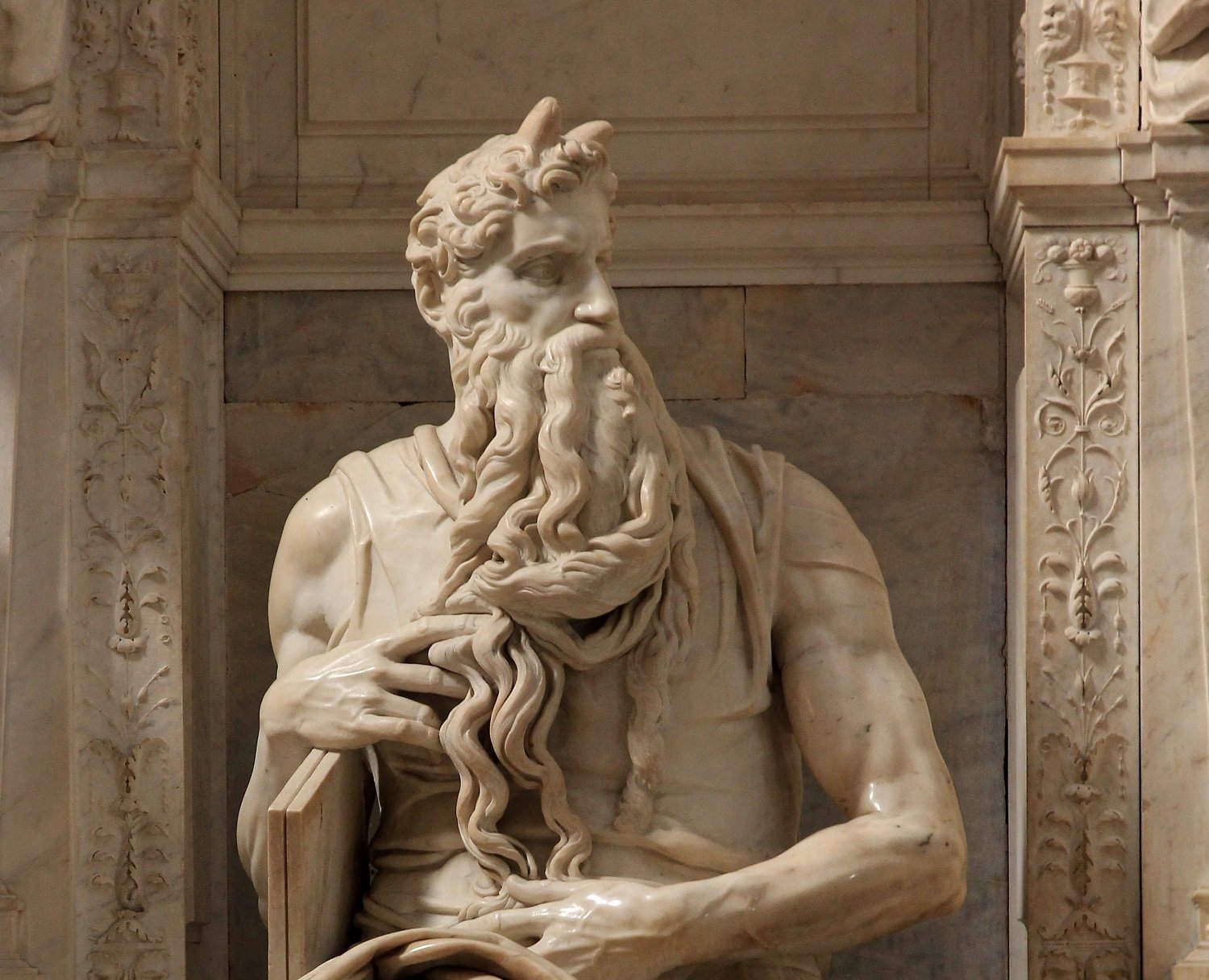
Moses by Michelangelo, c. 1513. Credit: Wikipedia Commons, CC-BY-SA-3.0
Scholars acknowledge that some legends from Greek mythology are strikingly similar to stories from the Bible. According to some theories, a few individual characters from the Bible might also appear in Greek mythology. One theory argues that the famous Moses of Egypt can be found in Greek records. Does Moses really appear in Greek mythology, or is this just wishful thinking?
Who was Moses?
Firstly, let us establish who Moses was. He appears in the Bible books of Exodus, Leviticus, Numbers, and Deuteronomy. Exodus contains the most famous part of his life story. It tells the story of how he was a Hebrew boy placed in the Nile River, where the Pharaoh’s daughter then found him.
When Moses was an adult, he tried to help his fellow Hebrews, who were slaves in Egypt, but then he ran away and remained in a distant land for forty years. He eventually returned after God allowed him to go and free his people from Egypt. Pharaoh refused to let the Hebrews go, but after ten devastating plagues from God, he relented.
Moses led the people out of Egypt across the Red Sea (where Pharaoh and his army drowned after trying to pursue them) and into the Sinai wilderness. There, he gave his people an extensive list of regulations from God, collectively known as the Mosaic Law. He also wrote many religious writings. The first five books of the Bible are attributed to him, as well as several poetic writings.
Did the Greeks know about Moses?
The theory that Moses appears in Greek mythology depends on the idea that the Greeks could have known of Moses in the first place. After all, he could not have appeared in their mythology if they did not know about him.
As it so happens, Moses does appear in quite a few Greek records. The Egyptian priest Manetho, from the third century BCE, mentioned Moses in his history of Egypt. Since Manetho lived in Egypt during its Hellenistic era, it is virtually certain that the Greeks of that region were aware of Moses. They certainly would have known of him after reading Manetho’s history.
Interestingly, there is evidence that the Greeks knew about Moses even before the Hellenistic era of Egypt. The first-century BCE Greek historian Diodorus Siculus wrote about the origin of the Jews. His account came from Hecataeus of Abdera, a Greek traveler from c. 300 BCE.
Hecataeus’ account differs from the Bible’s account in numerous ways, but it is still fundamentally the same story of Moses. Therefore, at least as early as 300 BCE, the Greeks definitely knew about Moses.
Was Musaeus from Greek mythology the same as Moses?
In ancient times, several writers explicitly identified Moses with a certain figure from Greek mythology. This figure was Musaeus. It is obvious that the main reason for identifying the two figures is due to the similarity between their names. But is there any more of a connection than this? Well, what does Greek mythology say about Musaeus?
Musaeus was a legendary intellectual, philosopher, seer, prophet, poet, musician, and historian. The Greeks believed that he founded a class of priestly poetry in Athens. He allegedly lived in the time of Heracles and was associated with Orpheus, another prominent poet and prophet from Greek mythology.
Immediately, we can see that there are some definite similarities between Moses and Musaeus from Greek mythology. In addition to the similarity in their names, their roles are also similar. Moses was a prophet, since he relayed messages from God. He was a poet, since he wrote the poetic book of Job and several of the Psalms. He was also a historian, since he wrote part of the history of the Jews.
Why Musaeus could not have been Moses
Despite these similarities, there is a key reason why Musaeus could not have been Moses. The key reason is that they did not live at the same time.
At first glance, it might look like the chronology works very well. Moses is usually placed at the time of Ramesses II, who ruled in the 13th century BCE. He is also placed in the time of Heracles, who lived about half a century prior to the Trojan War. That would also put him in the 13th century BCE according to the traditional date of the Trojan War. Therefore, it seems at first glance that Musaeus and Moses would have been exact contemporaries.
However, the reality is not so simple. Despite the popular association between Moses and Ramesses II, this has no historical or Biblical basis. The Bible’s internal chronology, along with its genealogical record of the prophet Samuel, places Moses firmly in c. 1500 BCE. That means he lived almost three centuries earlier than the traditional era of Musaeus.
The true era of Musaeus
The theory connecting Moses with Musaeus is further disproved if we examine the information about Musaeus from Greek mythology even more closely. For one thing, there is evidence that the Trojan War occurred several centuries later than the traditional date.
Furthermore, recall that Musaeus was closely associated with Orpheus. Some records say that Musaeus was Orpheus’ son, while other records give the inverse relationship. In either case, they lived at about the same time.
Greek tradition claims that Homer was a tenth generation descendant of Orpheus. That would place Orpheus, and therefore his associate Musaeus, about 200 to 250 years prior to the time of Homer. Since Homer lived in the seventh century BCE, that would mean that Musaeus would have probably lived in the ninth or tenth century BCE. Hence, this would have been long after the time of Moses. Therefore, it is virtually certain that Moses was not Musaeus from Greek mythology.
During Wednesday’s prime minister’s questions, the defence secretary was standing at the other end of the Commons, away from other cabinet members on the government frontbench. His expression gave nothing away as Keir Starmer and Kemi Badenoch blamed one another for spending too much on welfare and not enough on defence. In hindsight, he was possibly thinking “to hell with both of them”. Most defence secretaries go native sooner or later, imagining themselves to be embedded officers serving on the frontline. Tory Ben Wallace appeared to hate most of his cabinet colleagues by the time he resigned in 2023.
Less than 24 hours after PMQs, Healey had also resigned, his departure being all the more powerful for being so unexpected. This exit seemed to come out of a clear blue sky. There had been no briefings to the media in the preceding days. No threats to stand down if his demands were not met. All the arguments had taken place behind closed doors. A determination to do the right thing throughout.
Former defence secretary accuses PM of putting UK’s security at risk at a time of growing international threats
Keir Starmer’s premiership has been pushed to the brink of collapse after the shock resignationof John Healey as defence secretary undermined his security credentials and risked shredding his remaining political authority.
In a blistering resignation letter, Healey accused Starmer and his chancellor, Rachel Reeves, of putting the country’s security at risk, saying the long-awaited defence investment plan (Dip) fell well short of what was required.
Die zentrale Erzählung des Westens ist es, dass Russland aggressiv sei und die NATO angreifen wolle, während die NATO angeblich ein friedliebendes, reines defensives Bündnis sei. In Russland sieht man das anders und warnt vor der Aggressivität der NATO-Staaten, für die es viele Beispiele von Jugoslawien bis Libyen gibt. Was Starmer gesagt hat Am 5. […]
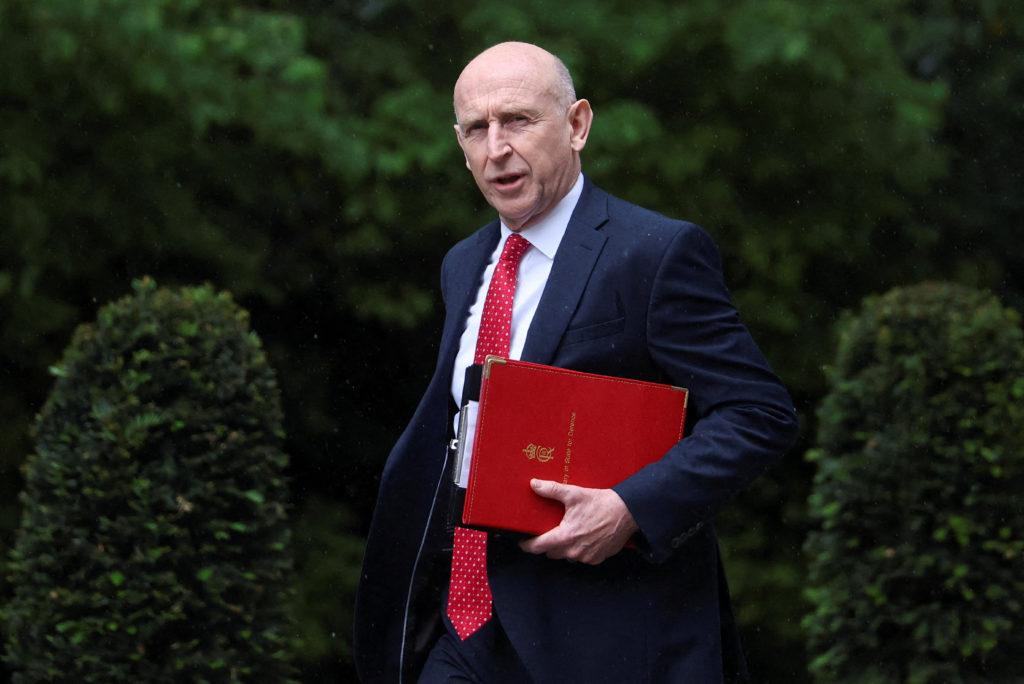
John Healey has resigned as defence secretary over Sir Keir Starmer’s defence investment plan, accusing the Prime Minister of failing to "meet the moment" over his long-delayed proposals to boost military spending.

 Login
Login