Meta A.I. Bug Allowed Hackers to Take Over Instagram Accounts

© Jason Henry for The New York Times

© Jason Henry for The New York Times


© The New York Times

© Penn Chan for The New York Times

The Islamic Republic of Iran has accelerated its executions of dissidents and activists, with the true number of victims likely obscured by the regime’s internet censorship and blackout.
Ever since the January uprisings against the regime, Tehran has enforced a bloody clampdown against its opponents.
The Iran Human Rights Society has documented 784 executions so far in 2026. A representative from the organization told Fox News Digital that "these figures indicate a rapidly accelerating trend in executions since March," and explained that "in particular, the execution of political prisoners has reached a level not seen in the past 37 years."
'KILLING OFF THE COUNTRY': IRAN EXECUTES DOZENS, ARRESTS 4,000+ IN WAR CRACKDOWN
A State Department official told Fox News Digital that "we are aware of disturbing reports about the recent surge in executions in Iran." The official noted that "we strongly condemn the Iranian regime’s use of executions to punish people for exercising basic human rights, including Iranians peacefully protesting for a better life."
The official said that "for decades, Iranians have been subjected to torture and sham trials resulting in executions and severe punishments, often with coerced confessions as the only evidence presented against them."
According to information provided to Fox News Digital by the Secretariat of the National Council of Resistance of Iran (NCRI) on June 4, the Islamic Republic of Iran executed at least 18 prisoners between May 31 and June 1. These included 12 prisoners hanged on May 31, and an additional six prisoners executed on June 1, one of whom was said to be "hanged in public with utmost brutality."
IRAN REGIME USES WAR TO MASK 'BRUTAL' EXECUTION SURGE AGAINST POLITICAL OPPONENTS
The NCRI has counted a total of 32 executions between March 19 and June 1. These included eight members of Iranian dissident organization People’s Mojahedin Organization of Iran (PMOE/MEK) and 24 participants in Iran’s January 2026 protests.
In documents provided to Fox News Digital, the NCRI said on June 7 that there was "an imminent risk of execution" for five political prisoners in the Sheiban Prison in Ahvaz, four of whom were sentenced to death because they were charged with being members of PMOI/MEK.
Maryam Rajavi, President-elect of the NCRI, posted on X a call for "urgent action" from the U.N. "to prevent the execution."
Days earlier on June 2, following two other executions against January protesters, Rajavi said on X that the "clerical regime has committed another horrific crime in Iran." She called on the U.N. Security Council and European Union "to decisively condemn these criminal executions and take effective action to stop the killing of political prisoners and protesters in Iran."
The Iran Human Rights Society echoed NCRI’s account of 18 recent executions between May 31 and June 1. Their representative explained that despite the internet blackout, they receive reports from "a network of prison sources, prisoners' families, lawyers, and local contacts" and explained that "all reports are reviewed and cross-checked through multiple independent sources before publication." Though they say "internet restrictions make documentation more difficult," they stated they "continue to receive, verify, and document information."
IRAN GOES DARK AS REGIME UNLEASHES FORCE, CYBER TOOLS TO CRUSH PROTESTS
Alp Toker, the director of NetBlocks, a global internet monitor, told Fox News Digital that "internet connectivity in Iran is largely restored but the service that is available remains limited compared to the state of things before the protests and the war this year. For most users, in practice, that means international access is slow with indications of throttling and there's also increased filtering, particularly targeting messaging apps.
"It's been in this limbo state since the restoration with no significant change for better or worse," he said.
However, the Iran Human Rights Society representative noted that the actual number of executions is "almost certainly" higher than the figure they have captured. "The ruling authorities in Iran frequently carry out executions in secret and do not publicly announce many of them," the representative explained. Additionally, the representative added that "a significant number of executions, particularly in remote areas or locations with limited access to information, may remain undocumented or reach us only after a considerable delay."
CLICK HERE TO DOWNLOAD THE FOX NEWS APP
The representative also noted that the quantity of executions the Iran Human Rights Society documents "has consistently been lower than the actual number carried out."
The United Nations Special Rapporteur on the situation of human rights in the Islamic Republic of Iran, Dr. Mai Sato, did not respond to Fox News Digital’s request for comment on the increased executions in Iran.
On June 20th, up to 100,000 Iranian expats from both sides of the Atlantic are expected to hold a major rally in Paris to urge an end to the executions. More than 100 lawmakers, officials, former heads of state and ministers are also expected to join, according to the NCRI.


© Arash Khamooshi/Polaris for The New York Times
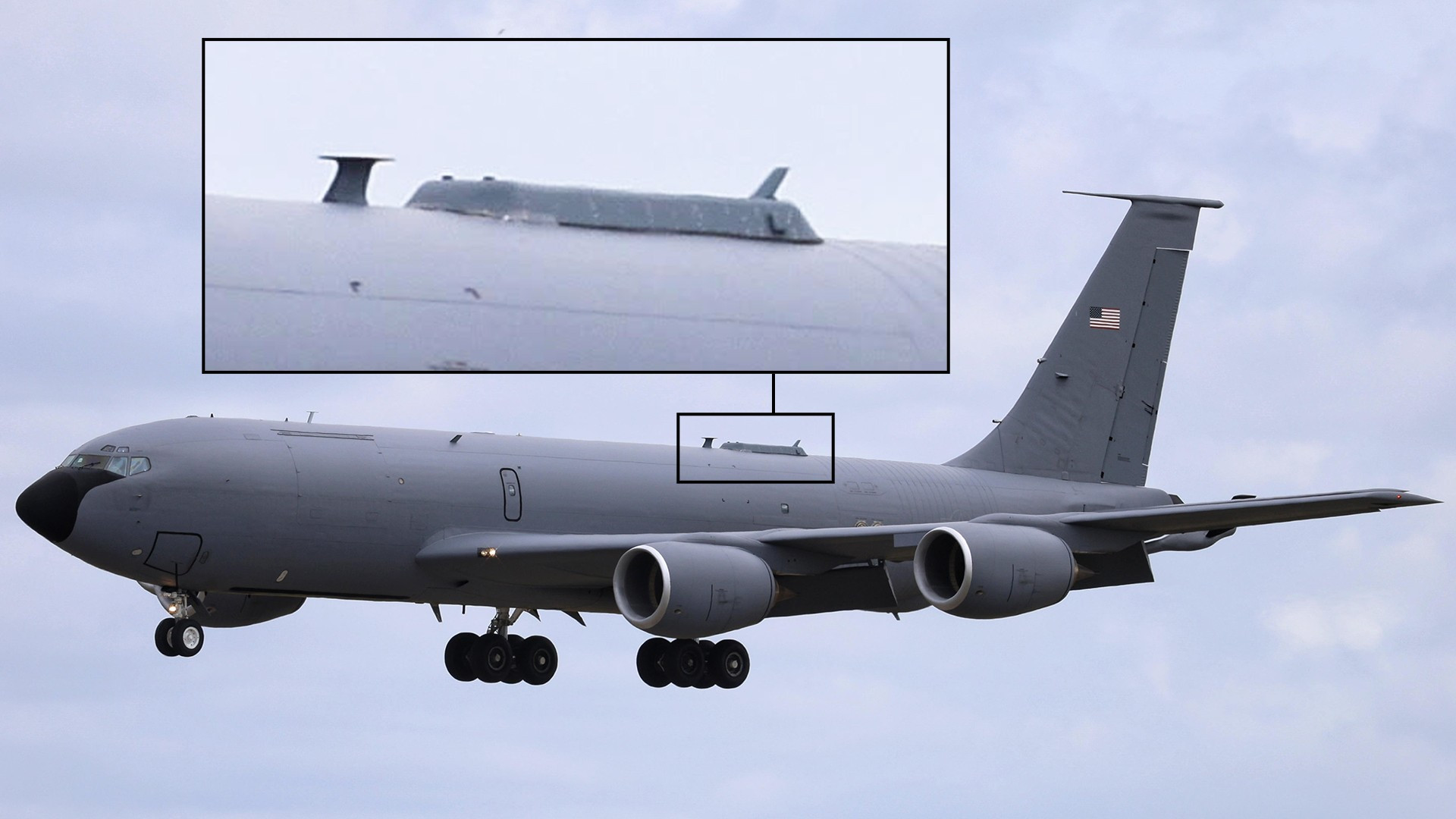
A U.S. Air Force KC-135 tanker appeared in the United Kingdom this weekend with a new antenna on top of the rear of the fuselage. The service has several efforts underway to improve the communications networking capabilities of all of its tankers and cargo planes, including ones that leverage Starshield, the government-focused cousin of SpaceX’s Starlink. This has become an especially critical priority for future survivability and effectiveness of the aging KC-135 fleet.
Aviation photographer Alessandro Ledda, who goes by Aerographist on Instagram, caught the KC-135 in question at RAF Mildenhall yesterday. The base is a major hub for U.S. Air Force operations in the United Kingdom. It has been utilized to support recent operations against Iran, as have other RAF facilities.

Ledda told TWZ that online flight tracking data says this particular KC-135 is serial number 63-7976, but that this might not be correct. The plane is largely devoid of markings, preventing easy confirmation. Two years ago, the Air Force’s Air Mobility Command (AMC) began removing serial numbers and other unique identifying markings from tankers and other aircraft as an operational security measure, as you can read more about here.
Ledda also told us that this is the first time he has seen a KC-135 with the new dorsal antenna, despite regularly photographing tankers of this type at Mildenhall. The base is home to the Air Force’s 100th Air Refueling Wing, which flies the KC-135, but is also a regular staging point for temporary deployments and a stop-over for aircraft just passing through.
A picture of the same antenna on top of a KC-135 had emerged online in April, but where and when it was taken are unclear. This may or may not be the same aircraft seen at Mildenhall this weekend. It is unknown how many Air Force KC-135s may have received this modification so far, and TWZ has reached out to the Air Force for more information. At the beginning of Fiscal Year 2026, the Air Force had 368 KC-135s in inventory, in total. At least a portion of that fleet is set to remain in service through 2050.

The antenna has a very roughly trapezoidal shape with a mostly flat top. There is a single small blade that sticks up at the rear, as well. The size and shape are broadly reflective of ‘hump’ style antennas associated with high-bandwidth satellite communications (SATCOM) suites seen on large military and commercial aircraft. In both pictures we have seen of this installation on the KC-135 so far, the new antenna is also mounted right behind a much smaller existing platter-shaped type typically used to support ultra-high-frequency SATCOM links.
Back in April, the possibility was raised that the new antenna for the KC-135 could be tied to Airlift/Tanker Open Mission Systems (ATOMS) and/or its successor, MAF NEXUS, both developed by the Sierra Nevada Corporation (SNC). MAF here stands for Mobility Air Forces, a collective term for the Air Force’s tanker and airlifter fleets, and the personnel that support them.
ATOMS is “a Starshield-based BLOS [beyond line of sight] satcom system SNC has been installing on a handful of [KC]-135s, [C]-17s, [KC]-46s, [C]-130s. Saw a C-17 getting it last week in Dayton,” Aviation Week‘s Brian Everstine wrote on X, speaking generally, in a thread discussing the first picture of the new antenna for the KC-135 that had emerged. ATOMS is “now transforming to Air Mobility Commands [sic] ‘MAF Nexus.'”

As noted, Starshield is a more secure, government-centric offshoot of SpaceX’s Starlink space-based network. Starshield and Starlink have been in increasing use across the U.S. military on aircraft, as well as warships and in various contexts on the ground, for years now, as TWZ has explored on several occasions in the past.
The size and shape of the antenna on the KC-135 at Mildenhall is, broadly speaking, in line with commercial Starlink antennas used on airliners and other civilian aircraft.

“The SNC solution for ATOMS, originally provided as a Quick Reaction Capability (QRC) in just six months, delivers enhanced situational awareness through multidomain networking and datalink,” SNC had explained in a press release in August 2025. “The system’s ability to provide a Common Operating Picture improves data interpretation and bolsters decision advantage, strengthening AMC’s effectiveness by leveraging multiple communications paths and sensors to seamlessly share data.”
That release followed the conclusion of the Air Force’s Mobility Guardian 2025 exercise, in which ATOMS “played a pivotal role” by “demonstrating its ability to provide seamless data management and communications solutions on multiple aircraft platforms, including the C-17, KC-135, KC-46 and C-130, as well as numerous ground nodes.”
The Air Force’s 2027 Fiscal Year budget request highlights at least two other potentially relevant communications upgrade efforts for the service’s KC-135, specifically, which could also make use of Starlink/Starshield.

There is the “Hybrid SATCOM capability,” which involves “the employment of Multi-Band, Multi-Orbit SATCOM terminals to switch between different government and commercial constellations,” according to official budget documents. This is tied to another project called MAF Connectivity focused on developing a “path forward as the tanker needs to be able to connect to the Joint fight to close kill chains and logistics chains.”
For MAF Connectivity, “possible capabilities include, but are not limited to, intelligent gateways, antennas, radios, software updates, crew displays, and multiple aperture array housings,” the budget documents also note. An “increment 1 first prototype installation” was also scheduled to be completed in the second quarter of Fiscal Year 2026, which began on January 1 and ended on March 31.
The antenna could be part of a different effort, as well. The Air Force has fielded a number of roll-on/roll-off communications and networking suites for the KC-135 over the years, but in an ad hoc manner and on a relatively limited scale. Last year, the Air National Guard also announced the demonstration of a new communications and data-sharing node packaged inside a heavily modified underwing Multipoint Refueling System (MPRS) pod, but the extent to which that capability may now be available for operational use is unclear. KC-135 and KC-46 tankers use unmodified MPRS pods to transfer fuel to receivers via the probe-and-drogue method.

As an aside, a Boeing 757 called Trailblazer (N-number N473AP), which defense contractor L3Harris uses as a testbed, also recently emerged with a new elongated dorsal fairing. Trailblazer’s new addition is similar in some broad strokes, but also distinctly different from the antenna seen on the KC-135 at Mildenhall this weekend. One of L3Harris’ major business areas is satellite communications systems, including for the U.S. Air Force. TWZ has reached out to the company for more information about this development.
For years now, the Air Force has been trying to more deeply integrate new communications and networking capabilities onto the KC-135, as well as other tankers and aircraft across the MAF. Senior service officials have also described this as a gateway to enabling other new capabilities down the road, including ones to help better protect tankers and airlifters from future threats. TWZ has previously highlighted this as a path to airborne control for “loyal wingman” type drones and other uncrewed aerial systems, something the Air Force has already been experimenting with to differing degrees.
“I gotta keep modernizing the tanker force,” Air Force Lt. Gen. Rebecca Sonkiss told TWZ and others at a roundtable at the Air & Space Forces Association’s annual warfare symposium in February. “If I was going to parcel out the things we care about in that, though, it’s connectivity and survivability. So those are the things that we really care about in that effort.”
“There’s various ways to get after survivability,” she continued. “It starts with being connected so that you have battlespace awareness, and then it continues on to how do we protect those assets.”
Sonkiss’ official title is Deputy Commander of AMC. However, she has been serving as the interim head of the command since her predecessor, Gen. John Lamontagne, became Vice Chief of Staff of the Air Force in January.

“The single biggest contributor to survivability in a big airplane is connectivity. The biggest contributor is not having a 12-hour-old Intel brief that you’re relying on to get you through the mission,” retired Air Force Gen. Michael “Mini” Minihan, who led AMC from October 2021 to November 2024, told TWZ in an interview in February, as well. “So real-world updates, real-time updates, just like our fighters and our bombers enjoy. Battle management that gets after maneuver and not just kill chain. Those things matter.”
“The reality is that the car I rented right now, driving from the airport to my hotel room, has more connectivity in it than the overwhelming majority of the mobility fleet. So connectivity matters,” he also told us at that time.
New communications and networking suites could enable AMC’s KC-135, as well as the rest of the command’s fleets, to serve as essential ‘translators’ between disparate networks and waveforms in the future. Providing a link between low probability of interception/low probability of detection (LPI/LPD) datalinks that stealthy aircraft use, such as the Multifunction Advanced Data Link (MADL) and Intra-Fighter Data Link (IFDL), and more general-purpose ones, would be especially valuable. IFDL is currently only found on the F-22 Raptor, while all variants of the F-35 fighter (and future B-21 Raider bombers) use MADL, and the two cannot ‘talk’ to each other directly, which has long created challenges. Upgraded tankers could serve as important parts of a beyond-line-of-sight mesh-like network that incorporates other kinds of line-of-sight links like Link16. In this way, they could help relay data to and from forward battle management and other command and control nodes, including ones in the air.

In addition, improved connectivity stands to provide additional operational and safety benefits across the MAF.
“According to the Air Force, the tankers’ ability to access tactical data links could increase mission success in contested environments by improving survivability, agility, and situational awareness for command-and-control elements and aircrews,” the Congressional Research Service (CRS) wrote in a report published in January. “The connectivity could provide aircrews with such information as potential threats, fuel availability, and safer landing sites. In addition, tanker aircraft could serve as a backup information conduit for other aircraft in a degraded communications environment.”
The points here have become a broader topic of discussion after two KC-135s collided over Iraq in March during the opening weeks of Operation Epic Fury against Iran. One of the aircraft crashed, killing all six onboard. The other tanker involved was able to land in Israel despite suffering severe damage. At the time of writing, the Air Force has not yet shared any official determinations as to the chain of events that led to that fatal incident.
— OSINTtechnical (@Osinttechnical) March 13, 2026
“We should never put mobility crews, especially tanker crews, in a position during combat operations where they have to choose between being seen by everyone, including the enemy, or being seen by no one, including the joint force and civil aviation,” Minihan subsequently wrote in a post on LinkedIn. “Mobility force connectivity now. Write the damn check.”
“Most KC-135s [sic] communications networks are ‘not the type of battle space awareness that shows you where the red is, where the blue is, and the actions that are being taken in real time in a conflict,'”Defense One reported in March, citing an interview with retired Air Force Gen. Jacqueline Van Ovost, who previously served as head of U.S. Transportation Command (TRANSCOM). “All you have is the intelligence you took off with when you got the brief two hours prior to take off.”
All this being said, the Air Force is still years away from integrating more robust communications and networking capabilities onto the entire KC-135 fleet.
“Over the course of about the next six years, you’ll see the full fleet of KC-135s fully connected,” Lt. Gen. David Tabor, Deputy Chief of Staff for Plans and Programs, told members of Congress at a hearing last month.
The appearance of the KC-135 with the added antenna at Mildenhall does point to new progress on key connectivity upgrades for Air Force tankers and airlifters. At the same time, improved communications and networking capabilities are increasingly critical now, and it remains to be seen when they become more commonplace across the KC-135 fleet.
Special thanks again to Alessandro Ledda for sharing the picture of the KC-135 seen at Mildenhall this weekend with us.
Contact the author: joe@twz.com
The post KC-135 Tanker Spotted With New Satellite Communications Antenna appeared first on The War Zone.

![]()
The European Union has proposed a 21st sanctions package against Russia that includes a visa ban on current and former Russian military personnel, as Brussels expands pressure on individuals and entities linked to Moscow’s war effort in Ukraine.
EU foreign policy chief Kaja Kallas said the package is part of a broader push to increase economic and political pressure on Russia.
“We are depriving Russia of the means to fund its war,” Kallas wrote on X.
The sanctions package will target Russia’s financial, energy, and industrial sectors, with more than 170 proposed listings.
These include banks, weapons manufacturers, oil traders, refineries, and crypto-related services, as well as entities in third countries accused of helping Moscow bypass existing restrictions.
Energy measures include a temporary freeze of the Russian oil price cap mechanism, alongside new restrictions on LNG transactions and additional action against Russia’s shadow fleet, with 30 more vessels proposed for designation.
Officials said the aim is to further reduce Russia’s export revenues and disrupt maritime logistics networks used to move sanctioned energy products.
Brick by brick, we are collapsing the foundations of Russia's war economy.
— Kaja Kallas (@kajakallas) June 9, 2026
Today, we are presenting our proposals for a 21st sanctions package against Russia.
This includes a temporary freeze of the Russian oil price cap and designations of institutions used by Moscow to…
The package also expands export controls on materials used in weapons production, including metals, alloys, and high-performance inputs, with companies in countries such as China, Türkiye, Kazakhstan, the UAE, and India included in the proposals.
Financial restrictions remain a central pillar, with expanded sanctions planned against banks and crypto platforms linked to sanctions evasion and war financing.
The sanctions package includes a “comprehensive” visa ban proposal that would prohibit entry into the EU for current and former members of Russia’s armed forces, as well as “proxy groups,” marking an expansion of sanctions beyond economic measures to individuals linked to military operations.
“Europe’s door should not be open to Russia’s (ex-)combatants,” Kallas wrote.
Our sanctions are working.
— Ursula von der Leyen (@vonderleyen) June 9, 2026
They are weakening the economic foundations of Russia’s war effort.
Today we double down.
With a 21st package.
Covering energy, banks & crypto, trade including fisheries and visa for Russian soldiers ↓ https://t.co/fTIkATOSfN
The same day, Kallas told journalists that existing sanctions continue to intensify pressure on Moscow’s economy. Kallas noted that Western sanctions have already cost Russia an estimated $1.2 to $1.5 trillion, adding that “brick by brick, we are collapsing the foundations of Russia’s war economy.”
She said the aim remains to increase costs for Moscow across multiple sectors while maintaining unity among EU member states.
The package requires unanimous approval from EU member states before it can take effect.

Bending Spoons si quota al Nasdaq. La società tech italiana guidata da Luca Ferrari annuncia il deposito di una dichiarazione di registrazione per una proposta di offerta pubblica iniziale. Bending Spons “annuncia di aver depositato pubblicamente una dichiarazione di registrazione sul modulo F-1 presso la U.S. Securities and exchange commission (Sec) relativa a una proposta di offerta pubblica iniziale delle proprie azioni ordinarie”, si legge in una nota.
Le tempistiche dell’offerta, il numero di azioni da offrire e la fascia di prezzo per l’offerta non sono ancora stati determinati, spiega Bending Spoons, che ha presentato domanda per la quotazione delle proprie azioni ordinarie sul Nasdaq global select market con il ticker Bsp. Goldman Sachs International, Jp Morgan e Allen & Company Llc sono joint lead book-running manager dell’offerta. Wells Fargo Securities, BofA Securities, Jefferies, Evercore Isi, Bnp Paribas, Mizuho, Societe Generale, Crédit Agricole Cib, Imi-Intesa Sanpaolo, UniCredit e Banca Akros-Gruppo Banco Bpm svolgono il ruolo di joint book-running manager dell’offerta.
“L’offerta è soggetta alle condizioni di mercato e ad altri fattori, inclusa l’efficacia della dichiarazione di registrazione, e non vi è alcuna garanzia circa se e quando l’offerta verrà avviata o completata, né in merito alle dimensioni, al prezzo o agli altri termini definitivi dell’offerta”, spiega la società. Da tempo gli osservatori si attendevano una quotazione da parte di Bending Spoons, che da ormai anni segue un percorso di acquisizioni molto serrato. Le aziende principali nell’orbita di Bending Spoons includono Aol, Brightcove, Eventbrite, Evernote, Harvest, komoot, Remini, StreamYard, Vimeo e WeTransfer. A marzo 2026, la società ha servito più di 500 milioni di utenti attivi mensili e più di 9 milioni di clienti paganti mensili.
L'articolo Bending Spoons si prepara per sbarcare al Nasdaq di New York, depositati i documenti alla Sec proviene da Affaritaliani.it.


Contact us: info@strategic-culture.su
MOSCOW and ST. PETERSBURG – On Monday, June 1st, on Power Shift, a new independent geopolitical platform, Zulfiqar Ali, Larry Johnson and myself revealed what for all practical purposes is an uber-bombshell piece of information: if long dark clouds keep coming down, Tehran is ready to pivot from nuclear ambiguity to actually detonating a nuclear device on Iranian soil.
Less than a week later, the Power Shift page was censored on YouTube – with no explanation and no appeal. Yet what we revealed had already been detailed in several podcasts and interviews throughout last week, as in here and here (with myself and Larry); here; and at the St. Petersburg forum, here.
I published a detailed background preceding the release of the information, written just before Iran’s negotiating team suspended the exchange of all (italics mine) texts and messages with the U.S. via mediator Pakistan.
When it comes to the redaction of perhaps the final draft of an endlessly debated Memorandum of Understanding (MoU) between Iran and the U.S., it suddenly became crystal clear that it’s all about Lebanon.
Iran repeatedly reiterated it was ready to ditch the already comatose “ceasefire” if the death cult in West Asia proceeded with its threat of bombing Dahiyeh, the Shi’ite-majority suburb of southern Beirut.
Confronted by Trump, the leader of the death cult was forced to back down. For only a few days. Trump desperately needs an MoU and an extended ceasefire to be marketed as “Victory”. His (italics mine) Victory.
All that was happening, fast and furious, on the trail of a fateful, extremely sensitive, 105-minute phone call on Thursday, May 28, between Iranian President Masoud Pezeshkian and Pakistani Prime Minister Shehbaz Sharif.
Islamabad is the sole functioning and trusted head-of-government back-channel between Tehran and Washington. Our sources revealed that during the phone call, Pezeshkian delivered a formally structured, three-step ultimatum to be communicated to the White House with absolute clarity:
What is particularly stunning is none of the above is about diplomatic posturing. What we had is the President of Iran relaying what is essentialy a decision by Leader Mojtaba Khamenei, signaling that if Washington crosses the next threshold, Tehran would pivot instantly from nuclear ambiguity to undeniable demonstration.
And that would imply a permanent rupture of the global non-proliferation system – with unforeseen consequences.
The China-Iran-Pakistan strategic alignment
Pakistani Prime Minister Shehbaz Sharif obviously did the math on the scale of such intelligence. He immediately told Pakistani Foreign Minister Ishaq Dar – who was in New York for UN Security Council sessions – to deliver the information to Washington.
Dar bypassed the whole bureaucratic apparatus, directly calling U.S. Secretary of State Marco Rubio in New York. The message, from Tehran to the Trump administration, was stark: the escalation ladder now features a terminal rung.
Rubio “may” (and that’s the operative word) have recognized the supreme gravity of what is in fact a formal nuclear ultimatum. He briefed Trump. The day after, May 29, Trump abruptly stopped any further kinetic action. And his incendiary rhetoric was instantly toned down.
This had nothing to do with a sudden fit of strategic restraint in the War-a-Lago/Oval Office axis. It was the direct, downstream result of the Sharif-Dar-Rubio back-channel.
On the morning of May 29, Dar arrived in Washington for a one-day official visit.
Sitting across from Rubio, he delivered the detailed briefing that the New York phone call had only previewed.
He placed two massive bombshells on the negotiating table:
1. Iran will not surrender any of its Highly Enriched Uranium (HEU). Nothing. Zero. And that’s final.
It’s all about sovereign independence (two concepts at the center of the recent Russia-China joint declaration signed in Beijing during Putin’s official visit to Xi Jinping).
So Tehran will not surrender its stockpile, whatever the terms, temporarily or not, just to comply with a face-saving mechanism designed for a U.S. domestic audience. From the point of view of Iran’s leadership – with Mojtaba at the helm – HEU goes way beyond a technical asset; it’s the ultimate fusion of sovereignty, deterrence, leverage, and political survival.
2. China has delivered state-of-the-art strategic defense systems to Iran – including shoulder-fired MANPADs – routed covertly through third countries (and that’s why I could not get any official confirmation two weeks before in Shanghai).
The breakdown: a total, operationally active China-Iran-Pakistan strategic alignment is in effect.
Is an Islamabad Accord still possible?
As it stands, none of us – including our sources – know whether a nuclear weapon detonated on Iranian soil would have been developed exclusively by Iran [they do have the scientific capability]; or with possible Russian, Pakistani or North Korean help. All options are plausible.
According to Prof. Ted Postol at MIT, Iran could easily convert 450 kg of 65% uranium hexafluoride into approximately 85% weapons grade: all that is needed for a low yield weapon, to be mounted into at least 10 missile delivery systems capable of reaching Israel. That means, at a minimum, 10 nuclear bombs.
Technically this sort of low yield weapon can be designed, Postol explains, with the use of a neutron reflector made of depleted uranium – or beryllium/tungsten carbide – and positioned immediately around the fissile core. It reflects escaping neutrons back into the nuclear material to increase fission efficiency, and reduces the required critical mass. In a nutshell: less material and more bombs.
Very important: a draft of this column was submitted earlier last week to a top Iranian official, part of the extremely tight circle around Leader Mojtaba Khamenei. His reaction: “I won’t comment on this matter”.
Beyond this no-response response, what became instantly clear is the verified transmission of the most consequential back-channel communication of the no war/no peace crisis.
It goes like this: Pezeshkian talks to Sharif; Sharif talks to Dar; Dar talks to Rubio; Rubio talks to Trump; Dar talks to Rubio face to face (during his Washington briefing).
All that throws new light over the – subsequently broken – 60-day ceasefire, the fragile off-ramp desperately needed by Trump. This framework has been organized by Pakistan and structurally backed by China – as I confirmed in Shanghai.
Tehran has insisted on the order of the proceedings, over and over again. First, all wars must stop, especially the offensive by the death cult over Lebanon. Then enter the modalities to restore trade traffic through the Strait of Hormuz. The third and last stage is to resume some sort of meaningful nuclear dialogue.
On The Big Picture, a serious structural rewrite is already on – whatever nasty ceasefire-breaking surprises may lie ahead.
As it stands: the Abraham Accords are for all practical purposes dead; Saudi Arabia has frozen all back-channel Israel “normalization” discussions; Qatar and Oman are quietly drafting military transition timelines to phase out the U.S. from West Asia. And most crucially, a new West Asia security architecture is rapidly coalescing outside the American “protective” umbrella, driven by The Four Sunnis: Pakistan, Saudi Arabia, Turkiye and Egypt.
Last Thursday, again on Power Shift (our YouTube page was still active), Zulfiqar Ali, Larry Johnson and I identified a possible Islamabad Accord as the emerging framework for ending the U.S.-Iran war – way before Western MSM had recognized it as the organizing architecture.
We also identified the mechanism driving it: non-stop Pakistani shuttle diplomacy, quietly but decisively backed by China.
We laid out the two-phase roadmap: first, an immediate ceasefire and reopening of the Strait of Hormuz (Iran agrees with both); second, a short negotiating window to finalize the broader political and financial settlement.
We reported that the extremely contentious release of Iran’s frozen assets was not a speculative talking point, but an active lever in the process. That asset release and possible sanctions relief were being treated as concrete confidence-building measures.
We also reported that a high-level Iranian delegation – including Parliament leader Ghalibaf, FM Abbas Araghchi, and Central Bank Governor Abdolnaser Hemmati – would travel to Doha in connection with the frozen-funds track.
That was later confirmed across the spectrum, including the fact that the central-bank component was tied directly to frozen assets.
We also advanced that Islamabad could become the stage for the final political act, including a possible Trump visit, alongside Pezeshkian: yet now that possibility seems as remote as ever.
China is just watching the river flow
These are the facts, as it stands:
Iran is far from isolated and is positioned for a prolonged war, with meaningful material and strategic backing from China, Pakistan, and North Korea, and carefully calculated support from Russia, as I confirmed during the St. Petersburg forum.
The U.S. is paralyzed. The Trump administration may appear to want an off-ramp; but it is totally constrained by pressure from the death cult in West Asia – as we’ve seen this weekend; exhausted escalation pathways; and the absence of a decisive military option that can alter the chessboard without creating an infinitely more unmanageable crisis.
The Gulf petro-monarchies are terrified about a possible resumption of the war – with the principal exception of the UAE.
The leaves Islamabad as the only exit route in town, with Field Marshal Asim Munir positioned as the indispensable intermediary; and Beijing and Moscow following everything closely, in some respects actively shaping the outer frame.
The bombing of southern Beirut on June 6 was perpetrated once again at a critical moment in the negotiations, as pointed out by Mohammad Mokhber, a top advisor to Leader Mojtaba Khamenei and a member of Iran’s Expediency Council:
“By bombing Lebanon during the presence of the mediator in Iran [he was referring to Asim Munir], the enemy set the negotiating table on fire for the third time to shout about the repeated violations of the ceasefire in all areas. We speak to the violators with the language of ‘power’; the axis of resistance is a unified body, and they will definitely receive a heavy and painful price for this aggression in the field.”
The death cult bombing of southern Beirut led to a frankly surrealist spectacle: the Trump administration scrambling after the Pakistani mediator in Tehran, begging him to intercede with the Iranians for de-escalation. The Emperor who wanted to destroy Iranian civilization had to ask Pakistan to salvage what could still be salvaged.
That means, as we reported, that with Iran setting the terms of escalation and raising its deterrence potential, and with Trump left with no cards at all, the only possible solution lies with diplomacy via Islamabad.
This week on Power Shift, in three consecutive shows from Monday to Wednesday, we will dig deeper into the intel and the diplomacy beneath these tectonic twists.
And then, of course, there’s the intriguing Chinese angle.
U.S. Think Tankland will become totally paralyzed when they finally realize that by injecting advanced military hardware into the Iranian theater of war, Beijing is actively road-testing the limits of American hegemonic coercion.
And if push comes to shove, and Iran is forced into a nuclear demonstration for all the world to see, China will acquire an inexorable proof-of-concept that U.S. deterrence is hollow.
One has to marvel at the engineering of such a massive strategic masterclass – without firing a single shot.