Normal view

Primeiro campus comum entre universidades de Portugal e Macau vai nascer na China

professores

O primeiro campus comum entre universidades de Portugal e Macau vai nascer na China, perto de Macau, e segundo o ministro da Educação português terá impacto direto na investigação, inovação e mobilidade académica entre Portugal e a China.

Um protocolo foi hoje assinado pelos reitores da Universidade de Coimbra (UC) e a Universidade Politécnica de Macau (UPM) para a criação de um Campus Global Conjunto UPM-UCoimbra em Hengqin, uma zona económica especial estabelecida na cidade chinesa de Zhuhai, perto de Macau.

“Este é um passo decisivo para a projeção da Universidade de Coimbra a nível internacional”, afirmou o reitor da UC, sublinhando que o campus permitirá “desenvolver programas conjuntos de licenciatura, mestrado e doutoramento com graus duplos reconhecidos em Portugal e Macau”, e dinamizar projetos de investigação, criar incubadoras e laboratórios conjuntos, e fomentar o intercâmbio académico.

As duas universidades têm vindo a celebrar várias parcerias ao longo dos anos, nas áreas da investigação, formação avançada e inovação tecnológica nos domínios da Engenharia e Tecnologia, Ciências da Saúde, Ciências da Linguagem, Negócios e Comércio.

Estes levaram à criação do Laboratório Conjunto de Investigação em Tecnologias Avançadas para Cidades Inteligentes, o Laboratório Conjunto de Investigação em Inteligência Artificial para a Longevidade Saudável, o Laboratório Conjunto de Investigação em Humanidades Digitais e Ciências da Linguagem Aplicadas e o Programa de Doutoramento Conjunto em Informática.

O ministro da Educação, Ciência e Inovação, Fernando Alexandre, explicou que a inovação do acordo reside na criação de um campus físico em Hengqin, com dois laboratórios dedicados onde “trabalharão investigadores das duas instituições”.

O ministro detalhou que os laboratórios incidirão em áreas estratégicas como “Envelhecimento” do qual a Universidade de Coimbra tem uma investigação “muito relevante”, com um “novo instituto criado recentemente e que ganhou um projeto europeu Horizonte Europa, de mais de 15 milhões de euros”.

“Depois há uma parte ligada ao digital, onde as duas instituições têm competências e especialidade”, destacou.

Segundo o ministro, este acordo insere-se numa rede já consolidada de cooperação académica e científica entre Portugal e a China.

Fernando Alexandre indicou que entre 2022 e 2026 foram submetidos mais de 700 pedidos de reconhecimento de graus académicos chineses em Portugal, refletindo o “aumento da mobilidade entre os dois sistemas de ensino superior”.

“No âmbito do programa Erasmus+, registaram-se 59 mobilidades entre Portugal e a China, incluindo 21 com Macau”, apontou.

Na área científica, Portugal e a China desenvolveram mais de 100 projetos conjuntos desde os anos 1990, apoiados por sete programas de cooperação, e entre 2014 e 2025, a Fundação para a Ciência e a Tecnologia financiou 88 projetos de investigação e desenvolvimento com participação de instituições chinesas.

Segundo o ministro português, Macau ocupa uma “posição singular” nesta rede, com universidades locais a manterem parcerias ativas com instituições portuguesas em áreas como medicina, tradução, artes digitais, design e doutoramentos conjuntos.

“Macau hoje começa a ter instituições de referência no ensino superior, o que é demonstrativo do grande progresso que esta região fez nas últimas décadas”, acrescentou, lembrando também protocolos ativos entre universidades portuguesas, como o da Universidade de Lisboa com a Universidade de Macau.

O ministro revelou ainda que nos próximos dias estará em Pequim para se reunir com os ministros da Ciência e Tecnologia e da Educação da China, com o objetivo de “fazer um balanço (…) daquilo que está em curso e olhar para o futuro”.

O responsável volta depois a Macau para participar no XXXV Encontro da Associação das Universidades de Língua Portuguesa (AULP) entre 15 e 17 de junho, que coincide com o IV Fórum de Reitores da China, Macau e Países de Língua Portuguesa.

Trump diz que Irão “pagará o preço” por demorar “demasiado tempo” a negociar acordo

10 June 2026 at 15:50

O presidente dos Estados Unidos, Donald Trump, afirmou esta quarta-feira que o Irão “pagará o preço” por demorar “demasiado tempo” a negociar o acordo, numa altura em que já se contam várias semanas de conversações entre os dois lados.

“As forças armadas do Irão estão num caos total. Grande parte delas, como a Marinha e a Força Aérea, já nem sequer existe — foram completamente derrotadas. O Irão é só conversa e nada de ação. (…)”, lê-se numa publicação feita na sua página na rede social Threads, na qual refere que o acordo que “teria sido excelente” para Teerão. “Agora vão ter de pagar o preço”.

A ameaça surge horas depois de ser noticiado que um helicóptero Apache dos EUA tinha sido abatido enquanto patrulhava o estreito de Ormuz. O anúncio foi feito pelo próprio presidente dos EUA, que prometeu dar resposta ao ataque, que foi materializada em três novas vagas de ataques sobre solo iraniano às 17:00 de terça-feira em Washington (21:00 TMG).

“Estavam envolvidos dois pilotos, ambos estão bem e ilesos. No entanto, os Estados Unidos têm, necessariamente, de responder a este ataque”, escreveu ontem o líder republicano na mesma rede social.

À sucessão de eventos dos últimos dias juntam-se os ataques desta manhã do Irão contra bases dos EUA no Bahrein, Kuwait e Jordânia, em resposta aos ataques de retaliação dos Estados Unidos na terça-feira.

Irão: China pede “calma e moderação” após ataques dos Estados Unidos e retaliação

Nuclear Powers Spent Record of $119 Billion on Arsenals in 2025, Report Says

10 June 2026 at 14:01
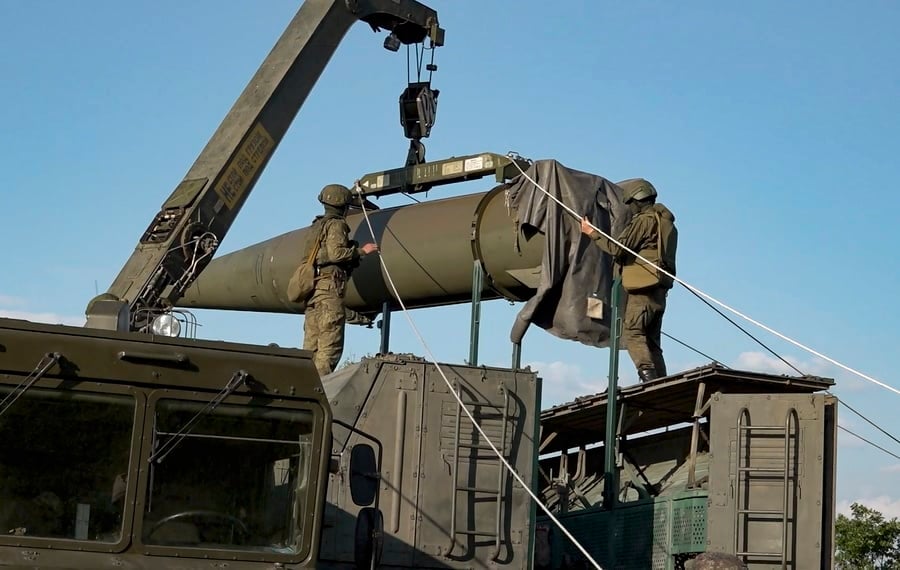
Soldiers use a crane to load a large military missile onto a transport vehicle.
Russian military personnel load a missile onto a transport vehicle. Nuclear powers spent a record of $119 billion on their arsenals in 2025, according to ICAN. Credit: Russian Defence Ministry / EPA / AMNA.

Nuclear powers spent a record of $119 billion on arsenals in 2025, as the world’s nine nuclear-armed states significantly increased their weapons-related expenditure, according to a new report by the International Campaign to Abolish Nuclear Weapons (ICAN).

The figure marks a 19 percent rise from 2024, with nuclear powers spending $17 billion more than the previous year. ICAN warns that the increase reflects a broader trend that is likely to continue for decades. The report covers the United States, Russia, China, the United Kingdom, France, India, Israel, Pakistan, and North Korea.

ICAN warns of a new nuclear arms race

As per the Nobel Peace Prize-winning organization, rising geopolitical tensions are fueling what it describes as a new nuclear arms race. ICAN has also raised concerns over the possible role of artificial intelligence in nuclear decision-making, warning that AI could accelerate the process leading to the potential use of nuclear weapons.

Susie Snyder, ICAN’s program coordinator and one of the report’s authors, described the figures as deeply troubling. Speaking to Agence France-Presse, she declared it’s deeply terrifying.

US spent more than all other nuclear powers combined

The United States remained the world’s largest nuclear spender in 2025, allocating $69.2 billion to its arsenal. That was $12.4 billion more than in 2024 and more than the combined total spent by the other eight nuclear-armed states. China ranked second, with estimated spending of $13.5 billion. The United Kingdom followed with $12.6 billion, while Russia spent $9.5 billion.

According to ICAN, the nine nuclear-armed countries have spent over $470 billion on their arsenals in the past five years.

Long-term nuclear programs could last beyond 2100

The report reveals that nuclear weapons spending is expected to continue rising as countries modernize and maintain their arsenals over time. ICAN points to spending plans in the United States, the United Kingdom, and France that could necessitate billions of dollars through the end of the century. Other nuclear-armed states are also developing weapons systems designed to remain in service for decades.

In the United States, the planned Sentinel intercontinental ballistic missile program is expected to remain operational beyond 2100. Based on the report, expanded US production of plutonium pits could support nuclear warheads until at least 2120. ICAN estimates that the United States alone is expected to spend nearly $1 trillion on its nuclear arsenal between 2025 and 2034.

Report compares record spending by nuclear powers with global needs

The scale of spending, ICAN says, comes as governments face pressing global challenges, including health care, food security, and humanitarian needs. According to Snyder, the amount spent by nuclear-armed states in 2025 would have been enough to fund the United Nations budget dozens of times over. She added that a single day of nuclear weapons spending could have guaranteed food security for two million people last year.

The report argues that nuclear-armed countries are committing public resources to weapons that, according to Snyder, they “could not use without committing a war crime.” ICAN maintains that the latest figures show that nuclear weapons spending is becoming a long-term strategic priority rather than a short-term response to current global tensions.

Franco-German defence rift deepens with collapse of FCAS programme

By: A A
10 June 2026 at 13:56

By Hélène de LAUNZUN

Join us on TelegramTwitter, and VK.

Contact us: info@strategic-culture.su

Franco-German combat aircraft programme collapses after years of disputes, showcasing the difficulty with military cooperation within the EU.

Rumours had been circulating for many months, but it was confirmed on Monday, June 8th: France and Germany have decided to abandon the core joint fighter plane component of their joint Future Combat Aircraft System (FCAS) project. With it goes a project that symbolised ambitions for deeper military cooperation between the two countries.

The project was launched in 2017 on the initiative of French President Emmanuel Macron and then-German Chancellor Angela Merkel. Its aim was to replace, by 2040, the French Rafale and the German-Spanish Eurofighter. After months of stalled progress, Chancellor Friedrich Merz and President Macron agreed that the main industrial partners involved in the project—Dassault Aviation on the French side and Airbus Defence and Space on the German-Spanish side—were clearly unable to work together because of diverging interests.

It was one of Europe’s largest military programmes, with an estimated total cost of €100 billion. The technological ambition was highly advanced: more than just a fighter jet, the system was to integrate combat drones, connected sensors and a next-generation digital network, thereby forming what was described as a ‘combat cloud.’

Disagreements between the industrial parties have multiplied in recent months, centring on the sharing of industrial responsibilities, intellectual property, and the governance of the project. In the spring, Macron was still insisting he believed in it, but progress remained elusive.

For defence expert Jean-Dominique Merchet, the programme had in fact been “on life support” for several months, and the German decision to formalise the end merely confirmed a shared recognition of irreconcilable industry positions rather than a unilateral move. The fact that the announcement came from Berlin—without a joint statement from partner countries France and Spain—confirms the major political setback for Macron, who has been the project’s main champion since its launch in 2017. According to Merchet, the announcement definitively confirms the now insurmountable disagreements between Dassault Aviation and Airbus over the development of the fighter plane intended to form the core of the programme. The analyst is now questioning the future of the other components of the FCAS, notably the combat cloud, the engines, and the support drones. This failure could undermine another major Franco-German project, the future European battle tank, which is itself already facing numerous difficulties.

Similar frictions have affected other joint efforts in recent years. In some cases, one side  has withdrawn or scaled back its commitment—as in the case of the Tiger helicopter, where Germany backed out, or the Eurodrone, where France is currently discussing exit terms; in others, like the MAWS maritime patrol programme and the CIFS future artillery system, it’s due to delays, differing priorities, and mutual strain.

For both countries, the failure tests their ability to advance next-generation capabilities.

For France, the failure of the FCAS will test the national defence industry’s ability to bounce back. France must now consider the possibility of a new-generation programme that it would lead alone or in cooperation with other potential partners such as Sweden, Italy, India or the United Arab Emirates. Germany is expected to consider options including additional F-35 acquisitions or interest in alternative collaborative frameworks.

The failure of the FCAS is highly symbolic at a time when, under American pressure, Europe was seeking to assert its strategic autonomy. The programme, which symbolised Europe’s ability to carry out its major armaments projects autonomously in the face of the United States and China, illustrates above all the persistent difficulties European states face in effectively coordinating their industrial, strategic, and national interests.

Original article:  europeanconservative.com

China’s BYD aims to be world’s biggest car firm within five years

EV maker aims to overtake Toyota, as it plans to spend £1.8bn to build five-minute flash chargers in Europe

The Chinese car company BYD has said it aims to be the world’s biggest automaker within the next five years.

Targeting Toyota’s long-held top spot, BYD’s founder and chair, Wang Chuanfu said he was confident it could overtake global rivals through rapid advances in battery technology and fast charging, as well as growing production overseas, including Europe.

Continue reading...

© Photograph: Cheng Xin/Getty Images

© Photograph: Cheng Xin/Getty Images

© Photograph: Cheng Xin/Getty Images

Irão: China pede “calma e moderação” após ataques dos Estados Unidos e retaliação

A China apelou esta quarta-feira à “calma e moderação” após os ataques dos Estados Unidos contra o Irão e a retaliação iraniana contra bases norte-americanas no Médio Oriente, defendendo um cessar-fogo rápido e o regresso à via diplomática.

O porta-voz do ministério dos Negócios Estrangeiros chinês Lin Jian manifestou, em conferência de imprensa, a “profunda preocupação” de Pequim com a situação e apelou a todas as partes envolvidas para que adotem “medidas concretas” destinadas a reduzir as tensões.

Lin afirmou ainda que os diferendos devem ser resolvidos por meios políticos e diplomáticos e defendeu a concretização, “o mais rapidamente possível”, de um cessar-fogo “abrangente e duradouro”.

As declarações surgem depois de os Estados Unidos terem realizado três vagas de ataques contra o Irão, em resposta ao abate de um helicóptero Apache norte-americano no estreito de Ormuz, uma operação à qual Teerão respondeu com ataques contra bases militares dos EUA na Jordânia, Kuwait e Bahrein.

O ministério dos Negócios Estrangeiros iraniano reafirmou hoje o “direito à autodefesa” da República Islâmica e advertiu os países do Golfo sobre a sua “responsabilidade” em impedir que os Estados Unidos utilizem os seus territórios para atacar o Irão.

Segundo a Guarda Revolucionária iraniana, entre os alvos da retaliação esteve a Quinta Frota norte-americana estacionada no Bahrein, enquanto a Jordânia assegurou ter intercetado vários mísseis sem registo de vítimas ou danos materiais.

A nova escalada ocorre apesar de o Presidente norte-americano, Donald Trump, ter afirmado que continua a ser possível alcançar um acordo com Teerão dentro de “dois ou três dias”, após várias semanas de negociações com a República Islâmica.

China advierte sobre peligros de remilitarización en Japón

10 June 2026 at 09:53

Beijing, 10 jun (Prensa Latina) China expresó hoy preocupación por un proyecto de recomendaciones aprobado por el gobernante Partido Liberal Democrático de Japón, al considerar que impulsa el rearme del país nipón.

The post China advierte sobre peligros de remilitarización en Japón first appeared on Noticias Prensa Latina.

Nicaragua diversifica matriz energética con nueva planta solar

10 June 2026 at 07:38

Managua, 10 jun (Prensa Latina) Nicaragua inaugurará hoy la planta Enesolar 1, desarrollada con financiamiento de China, como parte de los esfuerzos para diversificar su matriz energética y fortalecer la generación de energía renovable.

The post Nicaragua diversifica matriz energética con nueva planta solar first appeared on Noticias Prensa Latina.

Reunión internacional debate en China sobre retos de la OCS

10 June 2026 at 07:29

Shanghái, China, 10 jun (Prensa Latina) Más de 40 expertos, académicos y diplomáticos de los Estados miembros de la Organización de Cooperación de Shanghái (OCS) debatieron aquí sobre los desafíos del mecanismo, informó hoy la prensa local.

The post Reunión internacional debate en China sobre retos de la OCS first appeared on Noticias Prensa Latina.

Chinese activist in UK told by X that abusive deepfakes do not breach rules

Apple Peiqing Ni targeted by account portraying her as promiscuous drug addict after posting about Tiananmen Square

A high-profile Chinese activist in the UK who was inundated with deepfake posts on X portraying her as a sexually promiscuous drug addict was told that the abuse did not breach the rules of Elon Musk’s platform.

Apple Peiqing Ni, the 27-year-old founder of the UK-based China Dissent Network, had been advised by UK police to complain to the US-headquartered platform after she was targeted by what she believes is a pro-regime bot.

Continue reading...

© Photograph: Sarah Lee/The Guardian

© Photograph: Sarah Lee/The Guardian

© Photograph: Sarah Lee/The Guardian

Trump’s Sharp Turn on China: Embracing It as a Peer Power

10 June 2026 at 03:00
President Trump’s warming with Xi Jinping of China, a leader he admires, has ignited anxieties in Washington and across Asia.

© Kenny Holston/The New York Times

The U.S. and Chinese governments rolled out a new phrase, “constructive strategic stability,” during President Trump’s meeting in Beijing last month with the leader of China, Xi Jinping.

China está “a crescer mais rápido do que qualquer outro país”. Já chegou às 620 armas nucleares

9 June 2026 at 17:10
A China está a expandir o seu arsenal nuclear de armas mais rapidamente do que qualquer outro país. O mais recente anuário do Instituto Internacional de Investigação para a Paz de Estocolmo (SIPRI) afirma que Pequim possui atualmente cerca de 620 ogivas nucleares. Esta evolução poderá constituir motivo de preocupação para os EUA e os seus aliados, uma vez que, segundo o relatório, a China continua a desenvolver novos sistemas nucleares. “A China poderá potencialmente ter, até ao final da década, pelo menos tantos mísseis balísticos intercontinentais como a Rússia ou os EUA”, refere o relatório. Segundo o Interesting Engineering,

❌