Kash Patel’s tenure as FBI director has been a national embarrassment in a great many ways, but among the most jarring developments this year is the sheer volume of bureau personnel who have been purged for political reasons, leaving the agency destabilized.
MS NOW’s Ken Dilanian noted the ongoing purge “is without precedent in the modern history of the bureau. It raises questions about whether the Trump administration is trying to turn the nation’s most powerful law enforcement agency into an instrument of presidential whim — exactly the thing he baselessly accused his opponent of doing.”
FBI Director Kash Patel fired a group of bureau intelligence analysts Friday over a rescinded 2023 memo about “radical traditionalist Catholic ideology” that has long been a focus of Republicans despite an investigation that found no anti-Catholic bias, three people familiar with the matter told MS NOW.
The analysts worked in the FBI’s Richmond office, where the memo originated, said the sources, who spoke on condition of anonymity due to sensitive personnel issues. They said at least five analysts were included in the firings.
That these firings were tough to defend is notable in its own right — there’s little to suggest the FBI analysts did anything wrong — though I’m also struck by the degree to which they tie into a broader pattern.
One week earlier, Dilanian reported that Patel also fired a senior intelligence analyst, Deputy Assistant Director Emily Morales, who played a role in the FBI’s 2017 assessment of the motives of the gunman who attacked a House Republican baseball practice.
That came on the heels of Patel firing a dozen FBI agents and staff for their role in investigating Trump’s classified documents scandal. In the process, the bureau director gutted the global espionage unit, known as CI-12, shortly before the start of the war in Iran.
A month earlier, Paul Brown, the special agent in charge of the FBI’s Atlanta field office, was also forced out, not because he’d done anything wrong, but because he questioned the value in re-investigating Georgia’s election results from six years earlier.
Around the same time, the FBI also purged the acting assistant director in charge of the New York field office, a former special agent in charge in New Orleans, as many as six agents in Miami, as well as agents who were pushed out for their involvement in the baseless “Arctic Frost” investigation in 2020.
A month before that, we learned about a lawsuit filed by 12 FBI agents who were fired for having taken a knee during racial justice protests in 2020 as part of an effort to de-escalate a situation that threatened to intensify.
Last August, Patel and his team ousted three experienced bureau leaders, including Brian Driscoll, a widely respected figure among rank-and-file agents who was removed after he helped prevent a mass firing of thousands of FBI officials who worked on Jan. 6 cases.
During his confirmation hearing early last year, Patel, a former podcast personality, assured senators that the bureau under his leadership “will not go backwards. There will be no politicization at the FBI. There will be no retributive actions taken by any FBI should I be confirmed as FBI director.”
As things stand, that testimony appears increasingly ridiculous.
Work on cases related to the criminal investigations into Trump? Fired. Work on Jan. 6 cases? Fired. Refuse to needlessly humiliate a former director? Fired.
It reached the point last fall when the FBI Agents Association said Patel was not only imposing “chaos” on the bureau, but that he’d also “disregarded the law and launched a campaign of erratic and arbitrary retribution.”
The FBI Agents Association added at the time that the director’s antics had created conditions that make “the American public less safe.”
Months later, as the number of those caught up in Patel’s personnel purge continues to grow, it’s tough to feel any better about the state of federal law enforcement.
A man in his 40s was hospitalized with serious injuries after a brutal knife attack in Northern Ireland, as police arrested a Sudanese migrant on suspicion of attempted murder.
The attack happened shortly after 10:30 p.m. Monday in north Belfast, according to the Police Service of Northern Ireland. The victim suffered serious injuries to his face, neck, back and eyes, while police said they recovered what they believe was a kitchen knife at the scene.
Video circulating online appeared to show members of the public confronting the attacker, including one person wielding a hurling stick. PSNI Assistant Chief Constable Ryan Henderson praised the bystanders as "heroic," saying their intervention helped save the victim’s life, according to the BBC.
Police initially said the suspect was Somali but later corrected that he is believed to be Sudanese, describing the change as part of a "fast-time investigation." Henderson said police understand the suspect came into Northern Ireland from Dublin, Ireland and had been granted leave to remain, though he said the Home Office would provide further clarity on his status.
On Monday evening, protesters burned down a bus as tensions rose in Belfast following the gruesome stabbing, despite earlier calls from authorities for calm.
"At this stage, we have no information to suggest that this was a terrorist-related incident," Henderson said, while stressing that the investigation remains in its early stages. "However, I must stress, we are still at the early stages of our investigation," he said, according to The Sun.
Alan Mendoza, executive director of the Henry Jackson Society, told Fox News Digital that the attack exposed what he described as failures in Britain’s immigration system.
"Britain’s broken border and migration system has been put into stark relief once more with this tragic — and entirely avoidable — case," Mendoza said. "This man should never ever have been in the U.K., let alone been granted ‘leave to remain.’ The Irish border is the soft underbelly for a process the British public has long since lost confidence in, as well as in those administering it politically. Nothing short of a revolution in who we allow into the U.K. and how will satisfy a people fed up with false promises about immigration change."
The swift response from Prime Minister Keir Starmer marked a notable contrast with the case of Henry Nowak, an 18-year-old who was stabbed and then handcuffed by police after his attacker accused him of making racist remarks. Starmer faced criticism from some conservatives over his response to that case.
Starmer quickly posted on X that the attack was "sickening," adding: "I have absolutely no tolerance for abhorrent scenes of violence like this on our streets." He said his thoughts were with the victim and thanked first responders, including members of the public who intervened.
The attack prompted political reaction across the U.K. Reform UK leader Nigel Farage called on authorities to reveal the suspect’s identity and immigration status.
"What happened in Belfast last night is horrific. The authorities must reveal the identity and status of the attacker immediately. The public are entitled to the truth," Farage wrote on X.
Robert Jenrick also wrote on X: "We’ve woken up to truly barbaric footage on a street in Belfast. Of a kind you’d think you’d never see in this country. For years now I’ve urged the police to spell out the basic, sober facts, as they have them, when there are horrors like this."
Conservative Party leader Kemi Badenoch said people would ask whether there had been "failings around our borders," according to GB News.
Northern Ireland’s main political parties issued a joint statement condemning the violence and urging the public not to share graphic footage of the attack.
"There is no place in our society for this kind of brutality. Our immediate thoughts are with the victim and his family, and we hope he makes a full and complete recovery," the parties said, according to GB News.
Police said they had declared a critical incident and would increase their presence across Northern Ireland amid calls for protests. Officials urged calm and asked the public to allow the investigation to proceed.
Even after the president returned to the Oval Office, those efforts continued with Trump-branded guitars and Trump phones, among other things.
In light of just how much the president, his family and his controversial businesses have profited during his second term, it’s tempting to think there would be no need to pursue yet another merchandising opportunity. After all, as The Atlantic’s David Frum recently explained, Trump has taken self-enrichment “to a scale never seen before in America.”
That assumption, however, would be wrong.
MS NOW’s Jake Traylor and Soorin Kim reported Tuesday that there are Trump-branded “medallions” on sale, tied to this weekend’s UFC event on the White House’s South Lawn.
The souvenir gold and silver coins range in price from $249.99 to $11,999.99. That’s not a typo: A website called RealTrumpCoins.com is actually selling UFC Freedom 250 “medallions” that people can purchase for just under $12,000. (The website boasts that the coins were “designed” by the president himself.)
Donald Trump is selling UFC-branded coins for $12,000 to promote the UFC fight on the White House lawn
The reporting from MS NOW’s Traylor and Kim added that some of the profits are expected to go to the president’s licensing company, DTTM Operations LLC. And while the White House has said the president isn’t personally controlling his family business while he’s in office, his son Donald Trump Jr. is.
To be sure, the scheduled UFC bout, set to coincide with the president’s 80th birthday, was already controversial, and not just because of the bizarre structure that continues to take shape at the White House. There have also been related questions about Trump’s stock purchase in UFC’s parent company before the upcoming match on the South Lawn.
As for tickets to the upcoming event, NBC News recently reported that the tickets are technically free and that the UFC is footing the bill for the event. That said, sponsorship packages, including ringside seats, have been selling for $1 million or more, and no one seems to know where the sponsorship money is going.
The $12,000 gold coins, however, take this mess to a new and unsettling level.
This week, a new lawsuit was filed alleging corruption in connection with the upcoming UFC event, with the hopes of derailing the plans for the gathering, and a judge is expecting a response by Tuesday. Watch this space.
At first blush, the idea of a Democratic senator in a red state focusing attention on a mining project in Kazakhstan might seem odd. After all, many voters couldn’t find Kazakhstan on a map and probably have priorities that have nothing to do with foreign mining projects.
But Sen. Jon Ossoff of Georgia, ahead of his re-election bid this year, took the time in recent days to highlight a Kazakhstan mining project because of allegations that the Trump administration invested American tax dollars in the endeavor, which has been linked to two of the president’s sons, Eric Trump and Donald Trump Jr.
The emphasis wasn’t surprising. The incumbent senator has built much of his 2026 candidacy around the idea that corruption isn’t just a major national issue, it’s also the principal cause for the problems plaguing regular Americans in their everyday lives. “You aren’t the problem. Neither are your fellow Americans,” Ossoff routinely tells Georgians. “Corruption is why things don’t work for ordinary people.”
The senator’s focus appears to be resonating. Going into 2026, Ossoff was generally seen as the most vulnerable Democratic incumbent, but with 21 weeks remaining before Election Day, both parties see him as an increasingly strong candidate who might very well prevail despite Trump having won Georgia two years ago.
It’s not yet clear whether other Democrats will be equally inclined to emphasize corruption as a campaign issue, but with each passing day, the White House and its allies offer fresh evidence of a systemic issue. Consider some of the reporting and allegations that have surfaced over the last five days:
The Washington Post reported that of the publicly identified donors to the president’s ballroom project, more than half “have won new or expanded federal contracts worth more than $50 billion during the past six months.”
The Washington Post also reported that the Trump administration has sharply accelerated spending on border wall construction and that most of the money has gone to two companies with “ties to the White House and the Republican Party.”
As if there weren’t already enough questions surrounding special favors for MAGA Inc. PAC donors, CNN reported on the generous support Trump’s super PAC has received from those who either have federal contracts or who are trying to influence the administration.
The New Yorker reported on how the wealthy continue their efforts to buy presidential pardons.
Reuters reported that the Trump family has generated at least $2.3 billion in profit from investors since the president returned to the White House, which contrasts with “the more than a million investors whose net losses totaled $2.3 billion at the end of April.”
If we widen the aperture a bit, a new lawsuit was also filed this week alleging corruption in connection with the upcoming UFC event on the White House South Lawn.
This isn’t a comprehensive list, and again, these are just headlines from the last five days. A similar assessment of related reports from the last few months would supply a staggering list that’s vastly longer.
In a recent piece for MS NOW, Paul Waldman explained, “Voters might be willing to ignore all this self-dealing if the economy were doing great, everyone had health insurance, housing was cheap and gas was $2 a gallon. But when people are struggling, corruption takes on a new urgency. That’s because it provides a way for voters to understand a deeper rot in the system that manifests in all kinds of ways.”
The question isn’t why Ossoff is focusing so heavily on corruption as a foundational 2026 issue; the question is why every other Democrat isn’t pushing the same issue in their own campaigns.
A few months ago, Defense Secretary Pete Hegseth complained that the Pentagon had officially recognized too many faith traditions, which he characterized as “impractical.” A few weeks ago, the Defense Department acted on those concerns, shrinking the list of recognized religions from 211 faiths to 31.
The rather dramatic shift did not go unnoticed, though no one in American politics responded with greater fury than Sen. Mike Lee of Utah — ordinarily a conservative Republican closely aligned with the Trump administration — who said it was “repugnant” to see the Pentagon’s list exclude his own faith, the Church of Jesus Christ of Latter-day Saints (whose members are generally referred to as Mormons), from among the identified Christian faiths.
The outcry seems to have prompted a reversal from the Defense Department. On Monday, a social media post from the department included a new list with a caption that said the previous one “included redundant and unnecessary labeling, and the mistake has been fixed.”
The new list’s codes no longer identify which of the recognized faiths are considered Christian, which raises the question of whether Pentagon officials consider the Church of Jesus Christ of Latter-day Saints to be a form of Christianity, or if they would simply prefer not to flaunt their beliefs on the topic in public.
A spokesperson for the Utah Republican said, “Sen. Lee spoke with President Trump and Secretary Hegseth over the weekend and received their assurance that the Pentagon’s religious classifications would be fixed. He appreciates the administration’s action to address this issue.”
Whether the Pentagon is prepared to make additional changes remains to be seen, but as the dust settles on this dispute, it’s worth pausing to appreciate the context.
But when the GOP senator saw a list of Pentagon-recognized faith traditions and didn’t see his own church, that’s when he felt the need to speak out.
In November 2000, there was an episode of “Futurama” in which Bender famously complained, “This is the worst kind of discrimination: the kind against me!”
Ukraine at war; weapons from all over the world (Flickr)
Half way through the fifth year of the war in Ukraine it is reasonable to ask why it has lasted so long. Why has Russia not crushed Ukraine quickly as expected, it is after all a much bigger country with a far greater population and industry to call on?
Robert Harneis (DR)
By Robert Harneis
It is standard for the Western Media to talk of deadlock and to say that the Russians are not advancing because their armies are incompetent, when they are not drunk or poorly equipped. At regular intervals Western media announces that the Russian side is running out of ammunition, missiles, drones, tanks or even men. In short they are not advancing in overwhelming force to capture Kiev because they are incapable of doing so. The latest fantasy in the US, UK and European media, is that the Russian economy is crumbling in the face of the problems created by the war and sanctions.
Russia’s self-imposed restrictions
President Putin imposed severe constraints on his generals from the start. They are, to an extent, fighting with one hand tied behind their backs. Contrary to the endless claims by the Western media, the Russian forces do everything they can to avoid civilian casualties. This in borne out by their low level throughout the war. In a recent massive attack involving 1500 missiles and drones right across Ukraine, only six civilians were reported killed. It is only natural that this should be so. Russia regards Ukrainians as brother Slavs. Approximately one fifth of Russian families have close relatives in Ukraine. The brother of the Ukrainian Commander in Chief is a colonel in the Russian army. They have no interest in killing them, if it can be avoided, especially as they will have to live with them after the war.
The second restriction is the requirement to avoid heavy casualties amongst their own forces. Wars are lost on the home front when the body bags start coming home in big numbers. The constant allegations in the Western media that Russians launch human wave attacks and suffer heavy casualties doing so, are false. This desire to restrict losses is reinforced by Russia’s demographic problems. Lives are precious.
The third restriction that Putin has imposed on his generals and ministers is that the war will not stop Russian economic progress, vital for political stability. Of course it goes without saying that it is not possible to fight a major war without financial and budgetary stress. An example is the necessity of delaying the naval building program as a result of which only sixteen corvettes have been built out of the forty planned. This has made it more difficult for Russia to protect its merchant fleet and stop the current harassment of oil tankers. On the other hand the management of the economy has been a classic case of successful military Keynesianism as with the United States in World War II. Throughout the war real wages have risen and economic growth has been maintained. Unemployment is at record low levels.
Tactical considerations
There are other less obvious reasons for hastening slowly. If Moscow’s war aims are denazification and demilitarization then the longer the fighting goes on the more of the Ukrainian military is eliminated, especially the elite ultra-nationalists who are Ukraine’s most committed soldiers. The effect of the manpower attrition is obvious from the many videos appearing on social media showing Ukrainian press gangs snatching citizens from the street, often with violent resistance.
Further by keeping the fighting in the Donbass, the invading Russians have short lines of communications, whilst Kiev’s main bases are over a thousand kilometers away in Poland, with supplies at risk of constant air attack on their way to the front. Paradoxically then, the invading force has better lines of communications than the defenders in their own country.
The wish to avoid destruction is another explanation for Russian circumspection. It is obvious that the retreating Ukrainian army is indifferent to the damage it causes to the cities it loses. The greater the area of the fighting the greater the destruction that Russia will likely have to rebuild after the war. Better to ground away the Ukrainian ability to resist and if an advance into the rest of the country is needed, to wait until effective military resistance has collapsed.
However an undoubted factor in the slow Russian progress is the nature of the great Donbas urban area, which was massively fortified with NATO assistance over eight years after the 2014 coup d’état when Ukraine moved definitively into the Western camp. Whatever plans the Russian government may have for the rest of Ukraine, especially the Black Sea Coast, the source of many missile attacks on Russia, they will not wish to make any major moves until the Donbass is firmly in their hands. Two important fortified towns remain to be captured Kramatorsk and Slavyansk. Russian forces are already approaching them. It remains to be seen how long it will take to break their resistance.
We cannot know what President Putin and the Russian High Command are thinking but it is also obvious that by not committing to a major offensive Russia not only avoids casualties but retains the strategic initiative. Hundreds of thousands of Russian troops are held in reserve. Uncommitted forces are a potential threat as well as being available for defense elsewhere if needed.
The Russians will also have learnt the bitter lessons of the US army that quickly smashed its way into Afghanistan and Iraq but was unable hold the territory conquered in the face of tough local resistance. Already, at the beginning of the war in March 2022, the Washington Post published an article that assumed a quick Russian advance and talked about the planned guerilla resistance. There is every reason for Russia to move gradually and consolidate as it goes.
The diplomatic front
There is also the diplomatic aspect, which is of vital importance to Russia. Moscow views the struggle in Ukraine as part of a world confrontation. It has been clear from the start of the war that whilst the West and Kiev worry about public opinion to get support for the war, Russia is concerned about what he world’s diplomats think. Good relations with India and BRICS countries and especially China dictate moderation at all times. A shock and awe approach, whilst it might get quicker results, would have offended much international opinion and unfavorably reminded the world’s diplomats of the Soviet Union, something Putin wishes to avoid at all costs. Similarly Russia is very patient with small countries on its borders that indulge in vexatious provocations, notably the Baltic States… so far. The contrast with the brazen bullying of Venezuela, Cuba, Greenland and Iran by the United States is striking and has had an effect on world public opinion. The recent humiliation of Merz’s new militaristic Germany in the recent United Nations General Assembly vote is a striking example of the success of this softly softly approach, as is Russia’ success in expanding its influence in Africa from Mali to Madagascar.
Also on the diplomatic front, with a long war, the Black Sea remains closed to the warships of outside countries under the Montreux Convention of 1936, which governs traffic through the Dardanelles strait. The convention allows Turkey to close the straits to all warships in times of war and to permit merchant ships free passage. This suits the Russians as NATO likes to flex its muscles by bringing warships into the Black Sea in times of international tension. For four and a half years they have not been able to do this. Once the war ends, Turkey will have to let them through again. Another reason why the Russian forces have taken their time.
The change in the nature of war
Every war is different and brings its surprises. The drone revolution has transformed this one. The omnipresence of drones is all the more deadly, given the absolute impossibility for both sides, of hiding concentrations of troops, thanks to satellites that see pretty much everything happening on the ground. So now advances are made by small groups of infantry that infiltrate defenses that are then taken out by artillery, drones and missiles. Slow work if casualties are to be kept to a minimum.
NATO intervention
NATO intervention, with a huge supply of arms, finance and electronic intelligence, after sabotaging the peace talks, has increased Russian difficulties in defeating the Ukrainian army,. It is this that definitively imposed the choice of a long slow war of attrition on the Russians – a war that Russia is clearly winning. Not only have Ukraine’s forces been degraded in this process but NATO’s as well. One reason the United States has reduced arms supplies to Kiev is that they are running short. This became very obvious when Washington’s priority turned to the defense of Israel. The Pentagon has had to search the globe, asking allies as far apart as South Korea and Germany to hand over any Patriot air defense missiles they might have. The US air force is seriously short of vital stand-off munitions to attack Iran. The result for Kiev is that it has little defense industry of its own left and NATO has completely failed to match Russian weapons production levels.
Russian rearmament
It is also obviously the case Russia needed time to build its army to its present strength, as well as arm and equip it. Russia has greatly increased its military production across the board. This has been possible because of the continued existence of much of the old Soviet military industrial infrastructure on Russian territory. Whilst the combined Western nominal GDP greatly exceeds Russia’s, when it comes to purely military industrial capacity Russia is well capable of holding its own. Tank production and reconditioning has increased from a few hundred to more than a thousand a year. The United States can barely produce one hundred new Abrams tanks each year. Russia alone now produces over five million drones each year. Importantly Russia is fourth in the world in the number of STEM students graduating annually after China, India and the United States.
Irreconcilable differences block peace talks
Putin’s latest statements indicate that the Russian government is not interested in a ceasefire that fails to solve its Europe wide security problems. The United States does not want to lose face in Ukraine, particularly after its recent military failures in Afghanistan and now Iran. It also wants to continually weaken Russia. Europe is determined to persevere in its support for Ukraine despite the major economic and energy problems they have created for themselves. The statement from the latest meeting of the leaders of France, Germany and the United Kingdom, on June 7, refers to the need for a peace treaty that leaves Ukrainian frontiers unchanged. Clearly something Russia will never accept. Brussels sees failure in Ukraine as a threat to its plans for ever greater union, even the institution itself. Against this background it is not surprising that there have been no meaningful peace talks. As Josep Borrell former EU High Representative for foreign affairs commented at the beginning of the war, it will have to be settled on the battle field and that takes time.
Finally in Ukraine, whilst the people would agree to negotiations with Russia, the regime and its ultra nationalist supporters know that if there is peace and Russia wins there is no future for them. Putin’s final phrase in his recent speech at St Petersburg Economic Conference “Keep on fighting my comrades” is ominous for Zelensky and his neo Nazi colleagues. It is a reference to a famous quotation, the last words of a Russian policeman knowing he was about to die at the hands of terrorists. It reflects the Russian leader’s determination to focus Russian society in a patriotic way and finally settle the Ukrainian problem for good. He has used the long war to encourage a new generation of Russian leaders based around distinguished war veterans. This has been accompanied by a determined anti-corruption drive. None of this would have been possible without a long war.
However that may be, the Russian President is coming under increasing pressure to move faster. Like the US, Russia has parliamentary elections approaching in the autumn, September of this year, and there are signs that the tempo is quickening all along the front line. The long war has had advantages for Russia but it may be time to bring it to a close, whatever the cost.
In just over two years ‘in power’, the minority coalition AD government has changed two thirds of state hospital administrations. Of the 26 new presidents, 18 have links to the
In Los Angeles’ closely watched mayoral race, it’s been clear for several days that Karen Bass, the city’s Democratic incumbent, received enough support in last week’s primary to advance to the general election in November. The question was who she’d run against.
Los Angeles Council member Nithya Raman will advance to the November general election in the mayoral race to face the incumbent, Karen Bass, after overtaking ex-reality TV star Spencer Pratt in the primary, The Associated Press projects.
Raman has steadily trended upward in the vote count since Election Day, and she overtook Pratt on Sunday. Monday’s vote update gives Raman a cushion of more than 20,000 votes, making her position in the top two safe, with an estimated 93% of the vote counted.
In California’s gubernatorial race, meanwhile, the vote count is still underway, though we now know that Xavier Becerra, a former Democratic congressman who served as Joe Biden’s health secretary, has advanced to the general election.
It’s not yet clear who his rival will be, but with nearly 83% of the ballots tallied, Steve Hilton, a Trump-backed Republican, appears well positioned to finish second, while Democratic billionaire Tom Steyer is (at least for now) running third.
And therein lies the problem with Republican conspiracy theories about California’s vote count.
In recent days, a great many GOP leaders, including Donald Trump and Republicans on Capitol Hill, have invested an enormous amount of time and energy trying to convince the public the state’s elections process is “rigged” by nefarious Democratic schemers who’ve secretly orchestrated the results to ensure their preferred outcome.
When pressed for evidence, GOP officials tend to embarrass themselves, but that’s not the only — or even the central — problem. On the contrary, the Republican conspiracy theory suffers from an obvious fatal flaw: If nefarious Democratic schemers existed and were secretly orchestrating the results, they wouldn’t have picked these outcomes.
In Los Angeles’ mayoral race, it’s no secret that the Democratic incumbent, running in a city with an enormous progressive voter base, welcomed the opportunity to run against a conservative television personality with an embarrassingly thin professional resume. Instead, Bass will face Raman, a Harvard- and MIT-educated City Council member who’s already demonstrated an ability to win local elections.
If powerful Democratic operatives were pulling the strings from the shadows, they would’ve gladly pitted Bass against Pratt, if only to watch him lose in November.
Similarly, Democrats would’ve loved to see two Democratic candidates emerge from the state’s gubernatorial primary, thus ensuring party control. Instead, it appears increasingly likely that a GOP candidate backed by the Republican president will advance to the general election — which, again, is not the outcome these ostensible powerful Democratic operatives pulling the strings from the shadows would’ve deliberately orchestrated.
Put it this way: Either the Republican conspiracy theories are wrong, or Democrats are the most incompetent schemers imaginable.
Donald Trump hasn’t exactly gotten along well with his attorneys general. Ten days into his first term, for example, the president fired acting Attorney General Sally Yates after she notified the White House that then-national security adviser Michael Flynn lied about his post-election talks with Vladimir Putin’s government and may be vulnerable to a Russian blackmail campaign.
In the months and years that followed, Trump clashed with Jeff Sessions during his tenure as attorney general, accusing the Alabama Republican of “disloyalty” and being an “idiot.” He later similarly condemned Bill Barr, calling him a “spineless RINO” and a “disappointment in every sense of the word.” The president wasn’t even satisfied with Pam Bondi, complaining that she didn’t move quickly or aggressively enough to meet his partisan demands.
Trump likely believes he’ll have better luck with his latest choice. MS NOW reported:
President Donald Trump on Monday formally nominated his longtime loyalist and former personal defense lawyer Todd Blanche to serve as attorney general permanently.
Blanche has been serving as the nation’s top prosecutor in an acting capacity after Pam Bondi was fired by Trump in April. Blanche was Bondi’s deputy at the time. The nomination has been sent to the Senate.
Since becoming the acting attorney general, Blanche went to almost cartoonish lengths to use his office in ways designed to please the White House, up to and including indicting people the president doesn’tlike. Trump, not surprisingly, was delighted. Whether senators are equally impressed remains to be seen, though there’s no reason to assume that his confirmation will be easy.
Stepping back, however, there’s the related question of why Blanche actually wants this job.
With recent history in mind, it’s clear that serving as Trump’s attorney general isn’t easy. A recent Slate piece described it as “the worst job in Trump’s Cabinet,” adding that under the incumbent president, this is an “impossible, degrading, no-win job.”
That might’ve seemed hyperbolic, but it’s grounded in fact: Trump has a very specific vision in mind related to the position, and it’s not pretty. As has become painfully clear, the president wants a partisan loyalist who will serve as his personal tool, using the Justice Department to advance Trump’s goals and interests at all times, under all circumstances, and without regard for any other considerations.
The president, in other words, expects an attorney general who’s part puppet, part weapon and part cheerleader. Those serious about the rule of law and apolitical ethical limits need not apply.
I’ve seen some analyses that have described the office under Trump as “an impossible job,” largely because no one can be quite pathetic enough to satiate all of the president’s whims and demands. It’s a fair point, to be sure, but that’s what makes Blanche’s nomination inherently interesting: He, unlike guys such as Sessions and Barr, doesn’t actually want to lead the DOJ or oversee federal law enforcement; Blanche simply wants to serve Trump.
In other words, Blanche might very well be the first and only attorney general Trump actually gets along with because he and the president share a common view of the office. By tradition, those in this role strive to be “the people’s lawyer.” The president’s new nominee has no such ambitions: His goal is to serve one American, not 340 million Americans.
Blanche has made it abundantly clear that he doesn’t want to be the American people’s attorney general; he wants to be Trump’s attorney general. Is it any wonder why the president is optimistic about his choice?
With focus suddenly very much on Terceira island, in the Azores – home to Lajes Air Base, heavily used by the Americans – minister for foreign affairs Paulo Rangel has
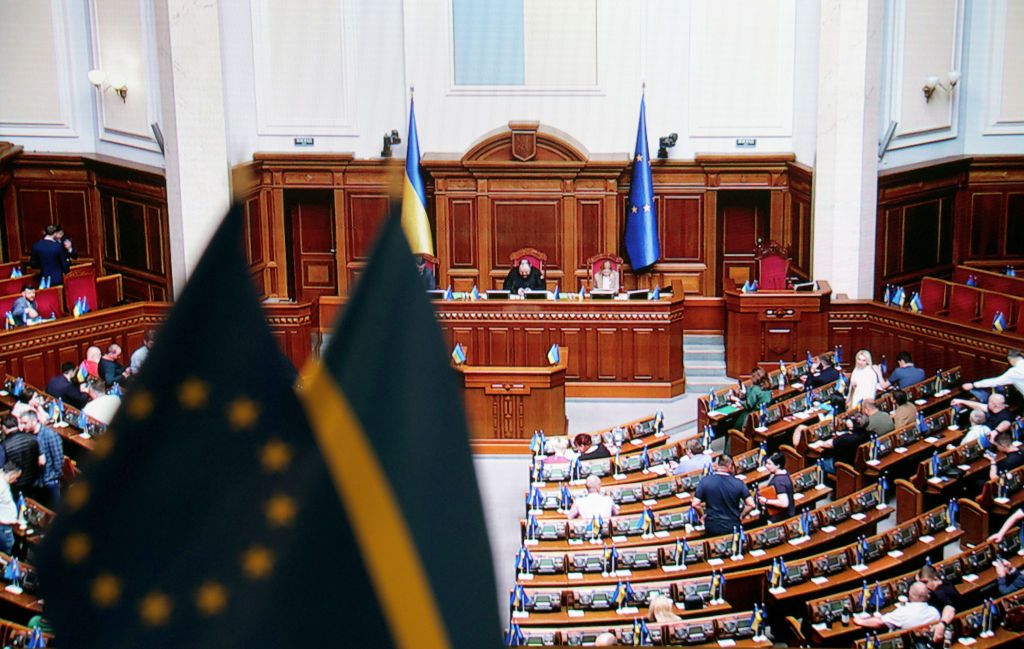
The Verkhovna Rada failed to gather enough votes for some bills demanded by the EU and the IMF, and one bill necessary for European integration was passed but was lambasted by experts as "imitation" rather than genuine progress.
The number of asylum applications in Portugal fell by 37% in 2025 compared with the previous year, according to data released by the European Union Agency for Asylum today, which
The disappearance and subsequent death of 11-year-old Lyhanna, whose body was found on June 4 in an agricultural silo in the Gers region of southwestern France, has triggered an unprecedented institutional crisis in France. Politicians are shifting blame onto judges, who are doing what they can with the resources available to them.
France’s judicial institution is facing both genuine operational failures and unacceptable political exploitation. By offloading their own responsibilities onto judges and prosecutors, neither Justice Minister Gérald Darmanin nor Interior Minister Laurent Nuñez is likely to emerge from this ordeal with enhanced credibility.
A troubling case file
The facts currently known in the Lyhanna case are undeniably damaging to the judicial system. The primary suspect, a 41-year-old man and the father of one of Lyhanna’s classmates, had an extensive judicial and administrative record before being formally charged with kidnapping and unlawful confinement of a minor under the age of 15.
Several complaints and reports had already been brought to the attention of the relevant authorities. One of the most sensitive aspects of the case involves a complaint filed on August 22, 2025, by the mother of a child alleging repeated sexual assaults. On September 11, a medical report reportedly identified findings described as consistent with the child’s statements. Yet the suspect was never interviewed before Lyhanna disappeared on May 29.
This timeline raises a fundamental question: why did a complaint alleging the rape of a minor, supported by medical evidence, fail to result in an interview of the suspect before the tragedy occurred? This question goes beyond the understandable public emotion surrounding the case and requires examination of how criminal investigations are actually processed.
The justice inspectorate faces major questions
Justice Minister Gérald Darmanin has ordered a systematic review of 70,000 complaints involving children by July 14. A general administrative inspection is currently underway to determine whether delays, errors, or procedural failures occurred in the handling of cases involving the suspect.
This directive from the Ministry of Justice responds to both political and moral urgency. Its purpose is to ensure that no comparable case is sitting unattended in an investigative unit or prosecutor’s office, particularly those involving rape or sexual abuse allegations. At the same time, it reflects a clear lack of confidence in the ordinary functioning of France’s criminal justice system.
The major challenge following this review will be actually processing those complaints: interviewing suspects, verifying testimony, prioritizing investigative actions, and making the necessary judicial decisions. Without additional operational resources, the scope of the problem may be revealed without being solved.
Judges and prosecutors thrown to the wolves
Frédéric Chevallier, Chief Prosecutor of Chartres and president of the National Conference of Public Prosecutors, has spoken out in defense of prosecutors while acknowledging that the case demands answers. His comments reflect the intense pressure currently weighing on the judicial institution.
On one hand, he rejects the idea that “judges and prosecutors should be thrown to the wolves” in response to public outrage. He stresses the need to avoid premature conclusions before inspections are completed, urging public officials to “keep a cool head.” His central argument is that no serious conclusions can be drawn before the entire chain of events has been reconstructed.
On the other hand, Chevallier has not ruled out individual responsibility, noting that “judges are not beyond accountability.” This cautious approach is intended to prevent the Lyhanna case from becoming a public trial of an individual magistrate or prosecutor’s office before investigators have completed their work.
Yet this institutional defense remains fragile. Explaining that the courts are overloaded, that investigative services are overwhelmed, and that prosecutors constantly triage competing emergencies only partially addresses families’ concerns. When a child dies and prior warnings existed, the judicial system must be able to explain why certain procedures moved so slowly and whether individual decisions contributed to an identified risk.
The impossible equation of priorities
Prosecutors point out that they are managing enormous backlogs of cases. Chevallier referenced not only the 70,000 complaints involving minors now under review, but also millions of cases of all types awaiting action within investigative services.
This argument reveals an institution that is clearly overwhelmed, at times buried beneath mountains of case files. It highlights a criminal justice system confronting systemic saturation. Yet it does not end the legitimate debate over how cases are prioritized. If everything is considered urgent, then nothing truly is. The Lyhanna case compels the judicial system to explain precisely how complaints are prioritized, especially when they involve sexual violence against children.
This issue connects to a structural problem that judges’ unions have denounced for decades: chronic underfunding. The Judicial Magistrates’ Union (USM), which has been highly visible in the media since the tragedy, argues that judges should not serve as lightning rods for the state’s failure to provide adequate judicial resources.
Political exploitation and death threats
The USM has condemned what it sees as unacceptable political exploitation of the tragedy. It points to statements by President Emmanuel Macron dismissing resource-related concerns from the outset, threats of sanctions raised by the Justice Minister before the inspectorate had reached any conclusions, and proposals by political figures to create a special disciplinary court for judges.
This political escalation has been accompanied by serious consequences. The Chief Prosecutor of Auch has been targeted with death threats circulating on social media. The Ministry of Justice has filed a criminal complaint, marking a dangerous turning point: public anger is being transformed into personal targeting and threats against judges and prosecutors themselves.
This is precisely the danger prosecutors fear. Judicial unions have significantly increased their media presence, with senior officials speaking publicly. Their coordinated effort is intended to give voice to rank-and-file judges and prosecutors facing what they view as opportunistic attacks.
Restoring public trust
The prosecutors’ calls for caution regarding the administrative investigation will only be heard if the judicial institution provides complete and transparent answers to the legitimate questions raised by families, advocacy groups, and the broader public.
The central challenge is reconciling two seemingly conflicting imperatives: protecting judicial independence from political interference while acknowledging that the public deserves explanations when a child dies and previous warnings may have been overlooked.
This case reveals that the French judicial system is facing a profound crisis of confidence. Families, citizens, and the public need to understand how the criminal justice process actually works, what priorities genuinely guide the handling of complaints involving minors, and how insufficient resources concretely affect child protection.
Without restoring public trust through transparency and meaningful operational reforms, the Lyhanna case will leave a lasting mark on the relationship between the justice system and French society. The inspectorate may establish the facts, but only clear and responsible institutional communication can help ease the current tensions.
In an English port city late last year, Vickrum Digwa stabbed and killed Henry Nowak, and by any fair measure, it was a brutal crime. Digwa was arrested, charged, convicted of murder and, as of last week, sentenced to life in prison.
Complicating matters, however, was the initial police response. When officers first arrived, the murderer falsely claimed to be a victim of a hate crime, and a video of what transpired showed the police temporarily putting the actual victim in handcuffs for about a minute. Officers then realized that Nowak had been stabbed and began administering first aid, but given the severity of the attack, he did not survive.
Because the attacker was Sikh and the victim was white, prominent British voices eager to stir racist animus have seized on the crime. As of late last week, JD Vance decided to weigh in, too.
In a three-paragraph statement posted to social media, the Republican vice president described the murder as “enraging” and blamed “European elites” for failing to stand against “the politics of self-hatred and the mass invasion of migrants.”
The Ohio Republican went on to write, “It is because we love the West that we want to preserve it. We love our civilization. We love our country. We love our children. And nobody — nobody — should ever die the way that Henry Nowak died.”
Vance, whose wife is a Hindu Indian American, neglected to elaborate as to who counts as “we.”
What’s more, the American vice president also neglected to mention the inconvenient fact that the convicted murderer isn’t an immigrant: He’s British-born and -raised.
With this in mind, officials in the U.K., already dealing with domestic political voices that appear eager to stoke racial fires, have made their dissatisfaction with Vance known. The New York Times reported:
Mr. Vance’s intervention has been met with a fierce response by British government officials, who noted that Mr. Digwa was not an immigrant. A spokesman for Prime Minister Keir Starmer accused Mr. Vance of trying to “interfere in our democracy and seeking to stir up division on our streets.” […]
Over the weekend, David Lammy, the deputy prime minister, who has in the past talked of a friendship with Mr. Vance over their shared Christian faith, said he had called the vice president to express his disagreement.
“I told him he was wrong: This has got nothing to do with mass migration,” Lammy told the BBC. Lammy added that he made clear to Vance that his intervention in the matter was “not helpful.”
For his part, Mark Nowak, the victim’s father, criticized the police’s initial response but also said the family did “not want his death to be used to create further division, hatred or tension.”
With this in mind, the British prime minister told lawmakers, “Exploiting this tragedy to create grievance and division would be wrong in any circumstances. But to do it when the family is expressly saying please do not is unforgivable.”
Whether Vance cares about such pushback remains to be seen.
MP Judy Sgro, chair of the Canada-Taiwan Parliamentary Friendship Group, told The Canadian Press Liberal and Conservative MPs will visit the island the week of Oct. 11.
MP Judy Sgro, chair of the Canada-Taiwan Parliamentary Friendship Group, told The Canadian Press Liberal and Conservative MPs will visit the island the week of Oct. 11.
Donald Trump has earned a reputation as the nation’s most prominent and powerful election conspiracy theorist, but to the extent that there’s a competition for the silver medal in this ignominious category, House Speaker Mike Johnson is a clear contender.
Indeed, after Trump’s defeat in the 2020 race, it was the Louisiana Republican who took the lead on Capitol Hill, effectively becoming the White House’s congressional point man, doing his best to overturn the results and hand the outgoing president illegitimate power. Johnson even echoed a discreditedconspiracytheory involving Venezuela’s Hugo Chávez and Dominion Voting Systems — nonsense that even many Trump acolytes didn’t feel comfortable repeating.
With this in mind, it wasn’t too surprising to see Congress’ top GOP lawmaker echo his party’s baseless conspiracy theories regarding California’s latest elections, though one word in his pitch was of particular interest.
RAJU: But what evidence is there to prove the California election is rigged?MIKE JOHNSON: Look, some of these efforts are so diabolical and so far upstream it's impossible to prove. But I think everybody knows instinctively that something is wrong here.
Apparently comfortable speaking on behalf of the nation, Johnson told reporters on Monday afternoon that “everybody knows” that the process of counting votes in California “stinks to high heaven.”
Asked the obvious question about conspiracy theorists’ lack of evidence, the House speaker added, “Some of these efforts are so diabolical and so far upstream that it’s impossible to prove, but I think everybody knows instinctively something is wrong here.”
It was an implicit acknowledgment of an inconvenient truth: Johnson and his cohorts simply don’t have any evidence. The speaker and other Republican leaders don’t know if their baseless ideas are true, but they apparently want the public to know that their conspiracy theories feel true.
It’s the basis for a debate, not about election administration processes, but about vibes.
But Johnson’s use of the word “instinctively” stood out, in part because it was so foolish, in part because of its familiarity.
A couple of years ago, for example, during a Fox Business interview, the House speaker asserted that there are now “terrorist cells set up around the country.” Asked how many, Johnson conceded that he had no idea — despite his access to intelligence at the highest levels — but added that we are “intuitively” aware of the problem.
Similarly, after Trump’s 2020 defeat, Johnson also insisted that “a lot of us know intuitively” that there were problems with the vote tallies. After the Senate rejected the House’s impeachment effort against then-Homeland Security Secretary Alejandro Mayorkas, Johnson said “we know already intuitively” that Mayorkas deserved to be punished. When the House speaker unveiled legislation to ban noncitizens from voting — which is already illegal, and which effectively never happens — Johnson declared at a press conference, “We all know intuitively that a lot of illegals are voting in federal elections.”
Among the obvious problems is the simple fact that instincts and intuition are utterly irrelevant when dealing with factual questions like these. Elections are either proper or they’re not. Voters are either casting legal ballots or they’re not. Evidence either exists or it doesn’t.
His track record suggests this basic dynamic is lost on the House speaker in fundamental ways.
What we’re dealing with, in other words, is a political leader who believes gut feelings are a legitimate substitute for knowledge. They are not.
Reports that U.S. officials are increasingly concerned about Israeli intelligence activity inside the United States should not be dismissed as a minor diplomatic embarrassment. If accurate, they point to a deeper strategic problem: Israel’s security doctrine is now pressing so aggressively outward that it is beginning to step on the toes of nearly everyone around […]
The Tories have pledged to tear up the requirement in the Equality Act for public-sector bodies to promote equality and diversity following the murder of Henry Nowak.

 Login
Login