Poland is fighting for its piece of the 6.6 billion euro ($7.7 billion) package under the European Peace Facility, while Germany has called for full reimbursement to Kyiv.
EU imports of Russian liquefied natural gas (LNG) from the Yamal project increased by nearly 18% in the first five months of 2026, according to a report by environmental and sanctions-monitoring NGO Urgewald shared with the Kyiv Independent.
The figures show the challenges facing EU's effort to end
At the start of the war in Ukraine, the Russian capture of Kinburn Spit – a narrow piece of land that holds the key to several Ukrainian ports – was hailed as one of Moscow’s most significant victories on the southern front. From there, Russia could launch attacks on the Ukrainian mainland, and use it as a springboard should it make an attempt to take Odesa. Now, Russian forces appear to have pulled back from the once so-strategic spit. What is going on?
At the start of the war in Ukraine, the Russian capture of Kinburn Spit – a narrow piece of land that holds the key to several Ukrainian ports – was hailed as one of Moscow’s most significant victories on the southern front. From there, Russia could launch attacks on the Ukrainian mainland, and use it as a springboard should it make an attempt to take Odesa. Now, Russian forces appear to have pulled back from the once so-strategic spit. What is going on?
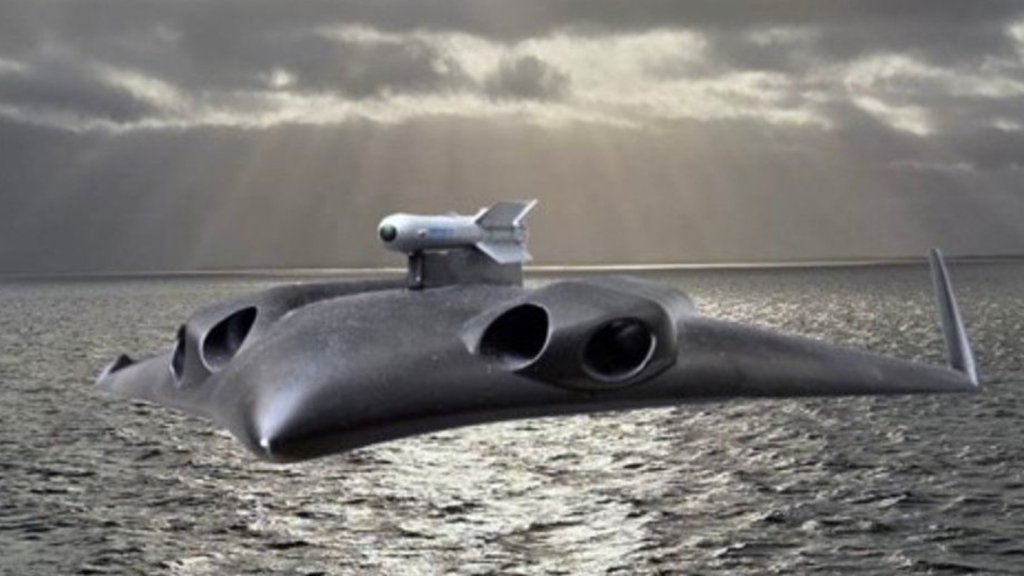
A novel kind of drone-based air defense system has been shown for the first time by German weapon manufacturer Diehl Defence. The Cobra 600, which has not previously been seen in public, combines a jet-powered drone platform with a missile rail armed with one of the company’s IRIS-T missiles, a weapon already used in short-range air defense systems and air-to-air applications. The new system immediately recalls recent Russian developments, which add short-range air defense missiles to its versions of the Shahed-136 long-range one-way attack drone, known locally as the Geran.
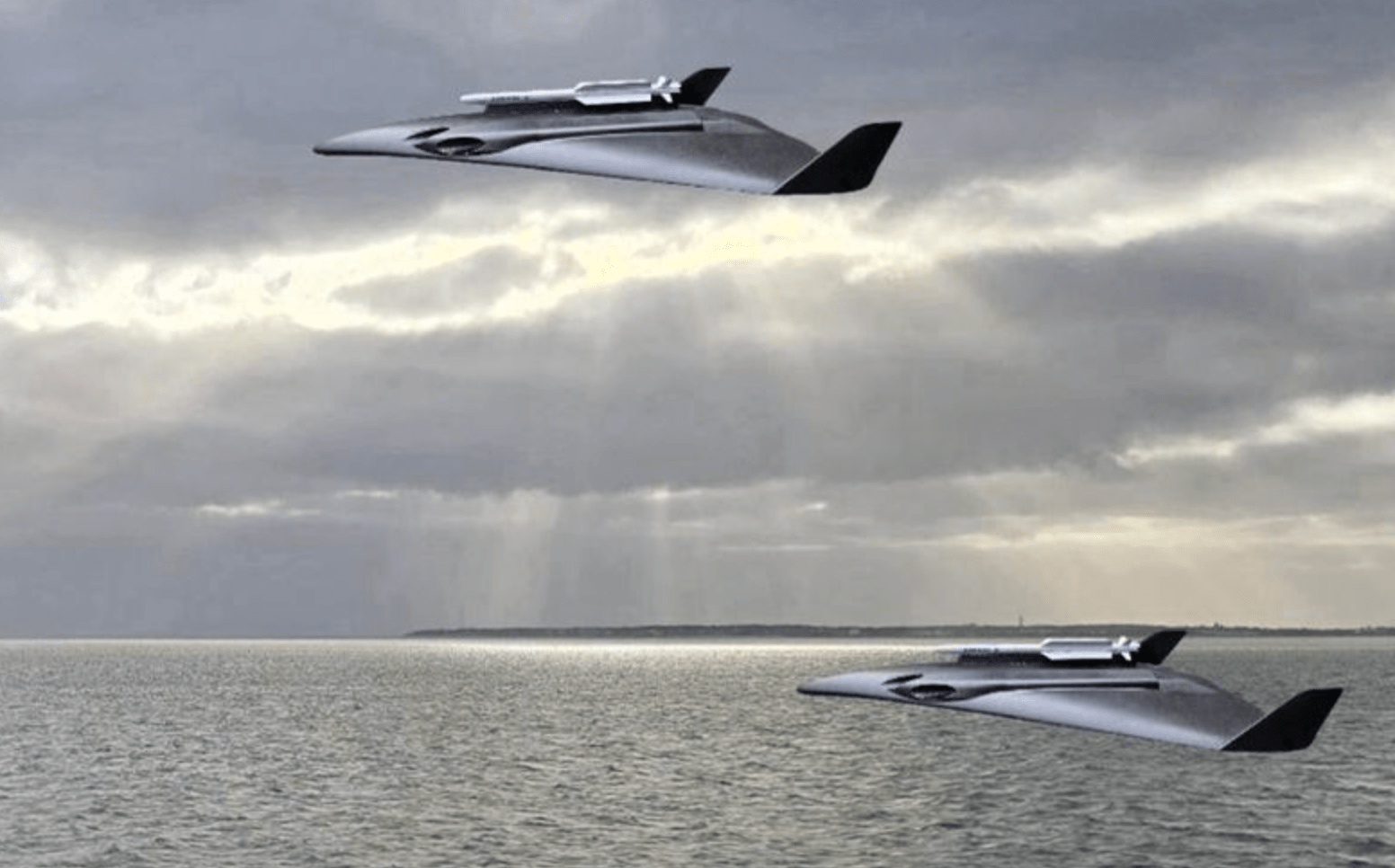
A rendering of the Cobra 600 in four-engine configuration. Polaris Raumflugzeuge
Cobra 600 is being presented at the ILA Berlin airshow, taking place this week in the German capital. The Cobra 600 is also known as the Airborne Launching and Attack System (AirLAS), and the program was launched last year.
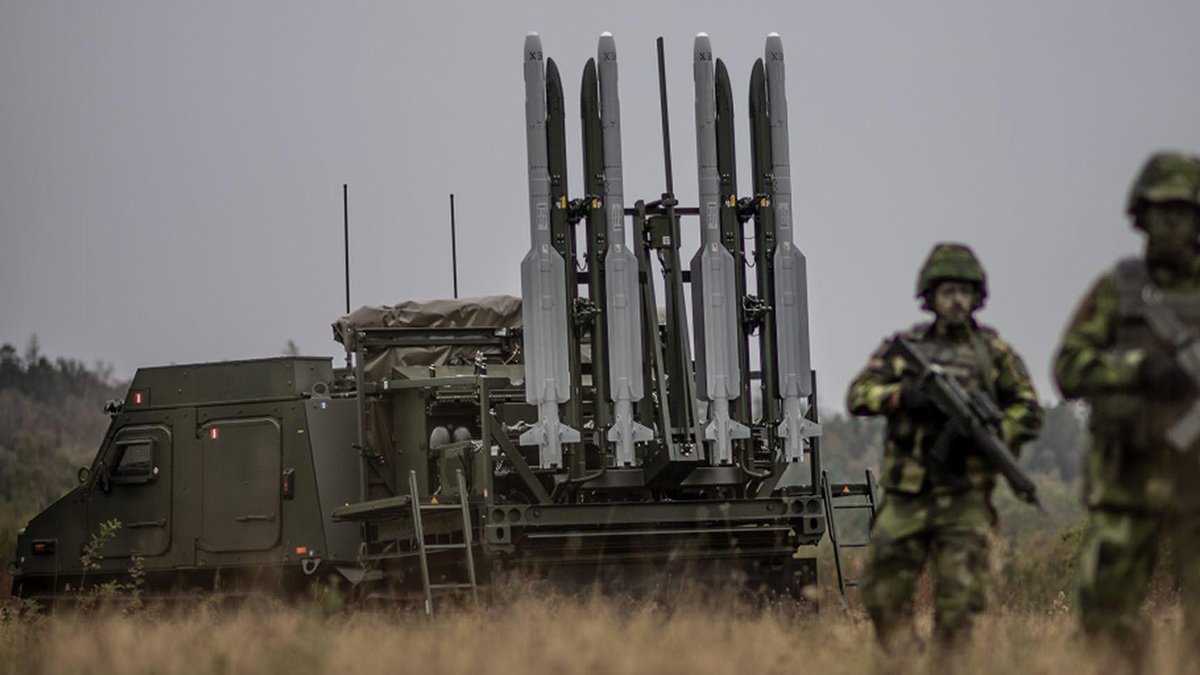
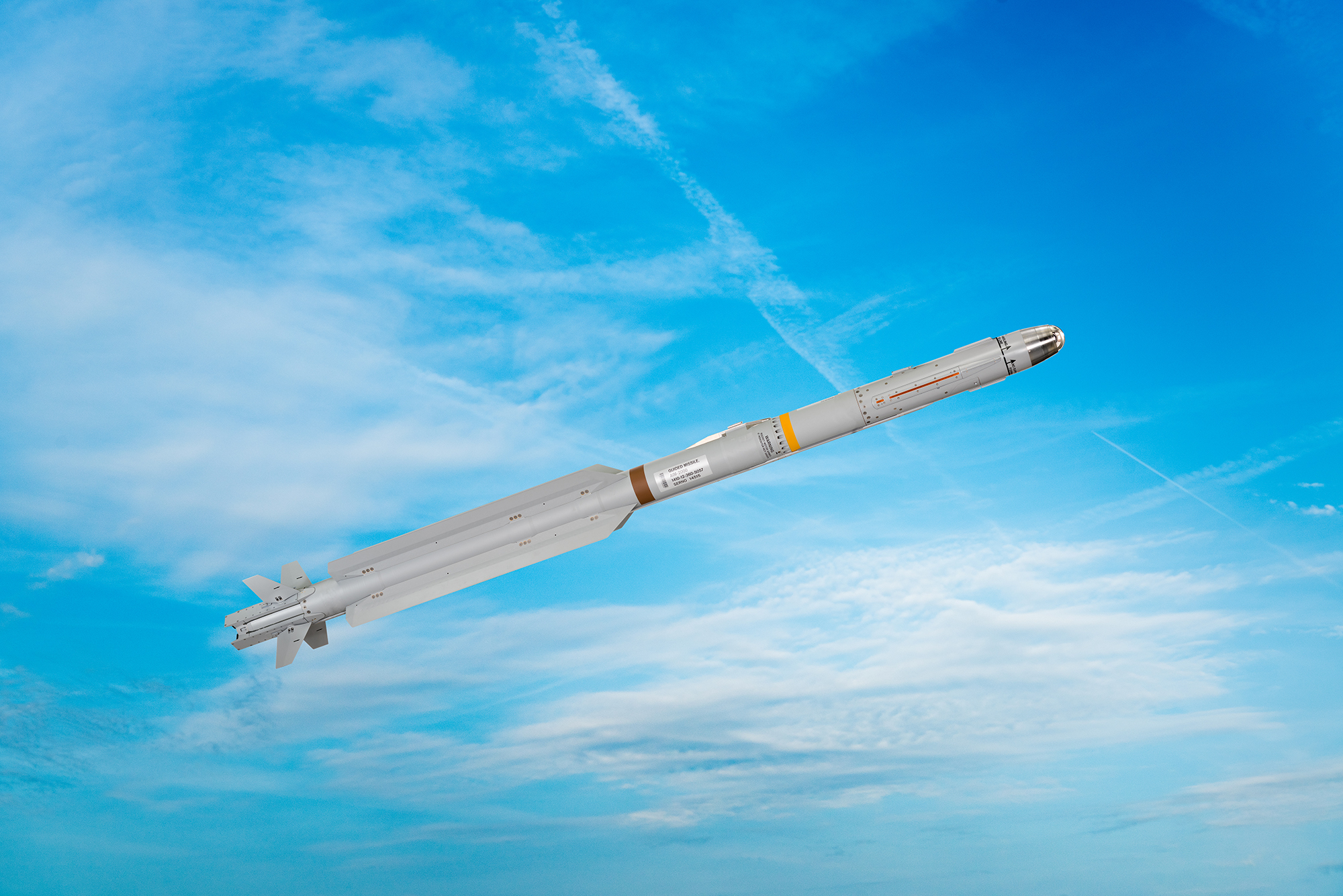
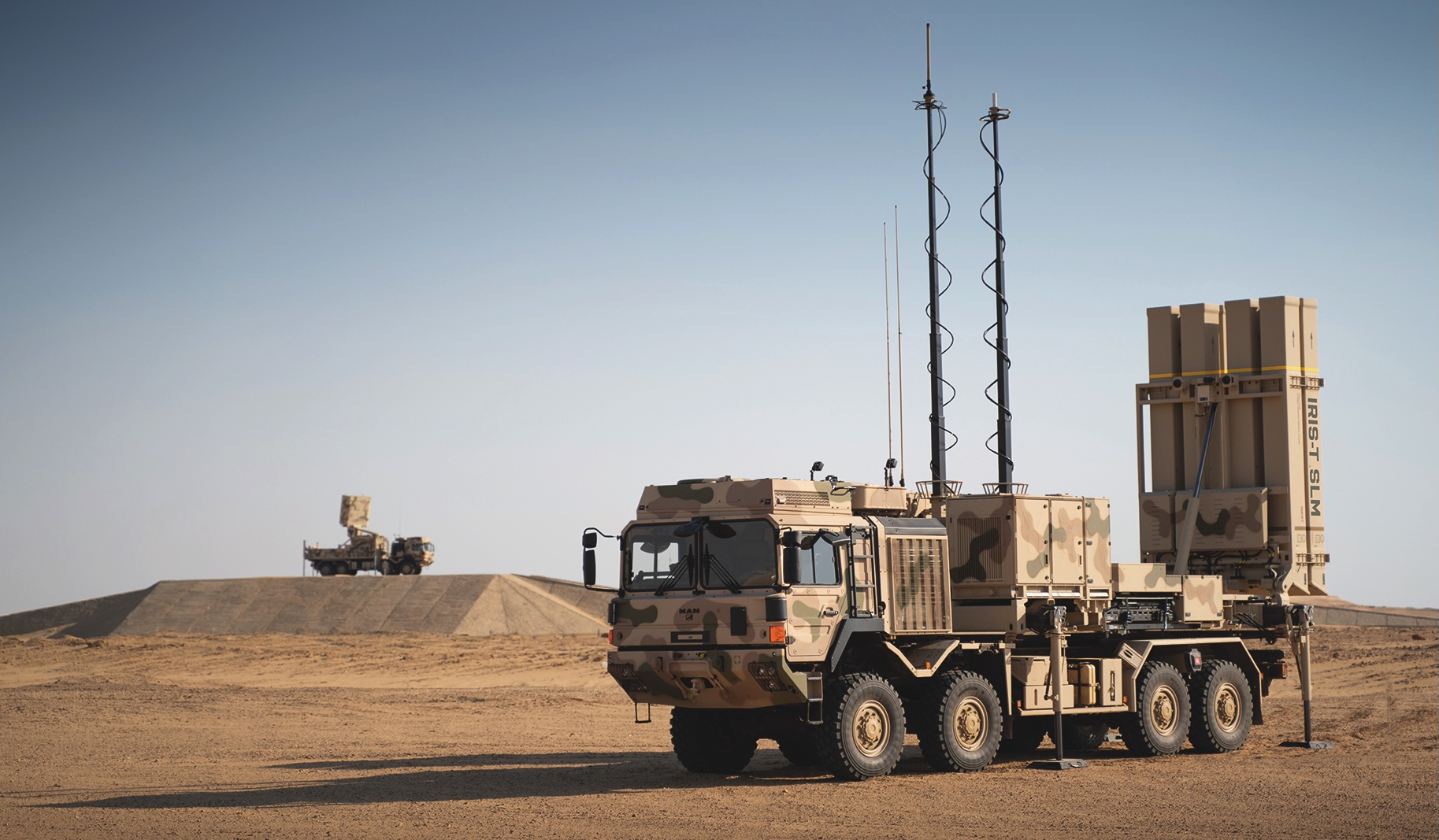
The concept behind the Cobra 600 is that of a ‘missile taxi,’ in which the drone platform carries the IRIS-T missile over a considerable distance. All the while, the drone is meshed with a ground-based air defense system. Typically, this would be one of Diehl’s IRIS-T SLM or IRIS-T SLS systems. Of these, the IRIS-T SLS employs the same missile as the air-to-air variant — and therefore the same missile as the Cobra 600. The physical interface between the drone and the missile is a standard pylon as used on the Eurofighter jet.
A ground-based IRIS-T SLS system. Diehl DefenseAn IRIS-T air defense missile. Diehl Defense
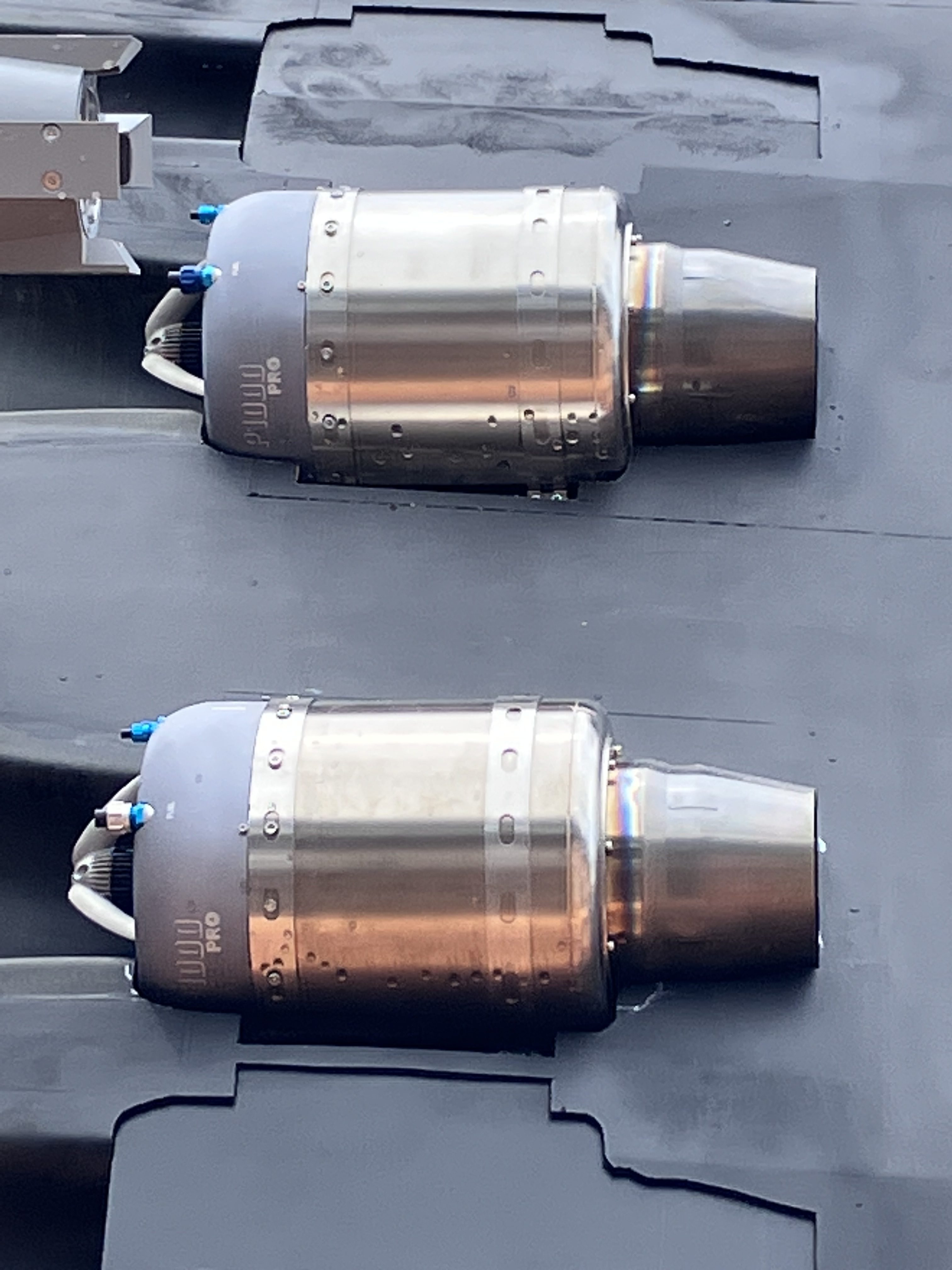
As for the drone platform, this is provided by another German firm, the Polaris Raumflugzeuge aerospace start-up. It has a similar kind of efficient delta planform as the Shahed-136, with a modified flying-wing-like design. On the wingtips are mounted endplate vertical stabilizers. As displayed, the drone is powered by a pair of JetCat-P1000-PRO micro turbojet engines, each of which provides a maximum thrust just shy of 250 pounds. However, the drone has intake ports for another two engines. It’s not clear if these are only intended to be fitted if heavier payloads are being carried, but it’s certainly a possibility. Concept artwork released by Polaris, as seen at the top of this story, shows a four-engine configuration, with the turbojets buried in the airframe and fed by much longer intakes, helping to shield them from detection.
The two JetCat-P1000-PRO micro turbojet engines on the Cobra 600. Thomas Newdick
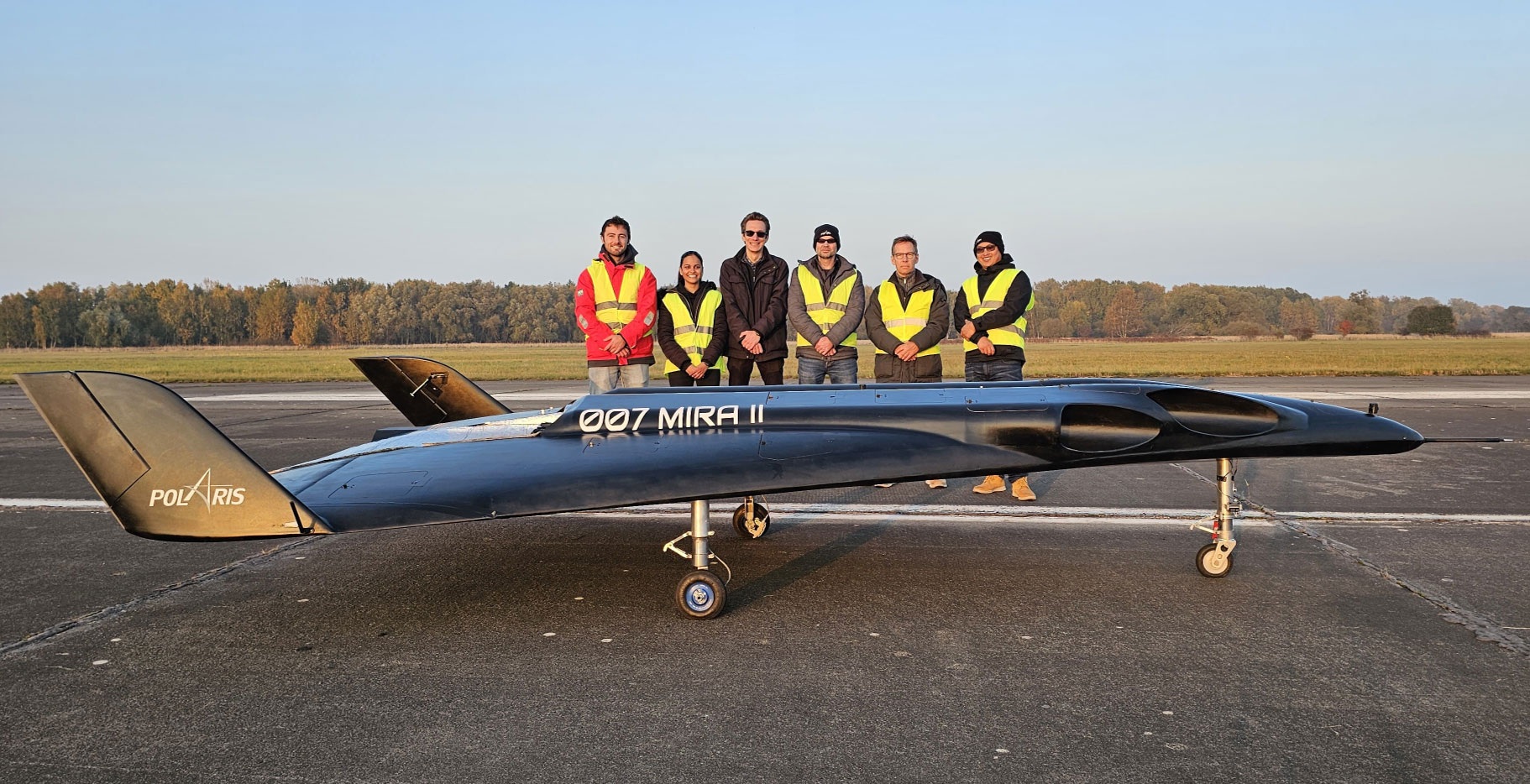
Polaris Raumflugzeuge has already built a variety of drones in the same configuration, and the company eventually aims to scale this up to produce a spaceplane.
The MIRA II, an experimental drone powered by four turbojets and designed to test an aerospike rocket engine. The landing gear configuration may well point to that used on the Cobra 600. Polaris Raumflugzeuge
Drawing on its design heritage, the Cobra 600 drone has retractable wheeled tricycle landing gear, meaning that it can be reused in some scenarios. The drone therefore takes off and lands from runways, although it is also able to operate from suitable shorter airstrips, such as stretches of highway. It’s also intended to be cheap enough that commanders will also be willing to risk losing it in combat, or after it runs out of fuel.
The concept of operations has the Cobra 600 serving as an adjunct to a ground-based air defense system, extending its range considerably.
With the missile fitted, the Cobra 600 has a range of around 250 miles. This compares to around 25 miles for the ground-launched missile used in the IRIS-T SLM, or approximately eight miles for the missile used in the IRIS-T SLS.
An IRIS-T SLM system deployed. The radar vehicle is seen in the background. Diehl Defense
As such, the Cobra 600 has the potential to turn the ground-based IRIS-T into something a little closer to a long-range surface-to-air missile, in terms of the distance it can cover. Of course, this is only true in terms of absolute range, with the speed and maneuverability of the drone being far inferior to a long-range missile. Unless the target is nearby, or the Cobra 600 has been pre-positioned based on known target vectors, the reaction time it offers is strictly limited. The missile itself is also able to tackle a more limited range of potential targets than a dedicated long-range surface-to-air missile, some of which offer an anti-ballistic missile capability, for example.
On the other hand, the Cobra 600 offers the distinct advantage of being able to loiter in a given area, waiting for threats to emerge, or to perform combat air patrols to screen certain sectors. It is best viewed as a forward-positioned additional launcher for the ground-based IRIS-T, and is also entirely reliant upon that system (or a similar one) for its effectiveness. At the same time, leveraging existing ground-based air defense systems as a force multiplier is a clear advantage. Another possible operational scenario would involve setting the Cobra 600s up as interceptors on a runway, sitting ready for launch on a runway to defend against lower-end threats.
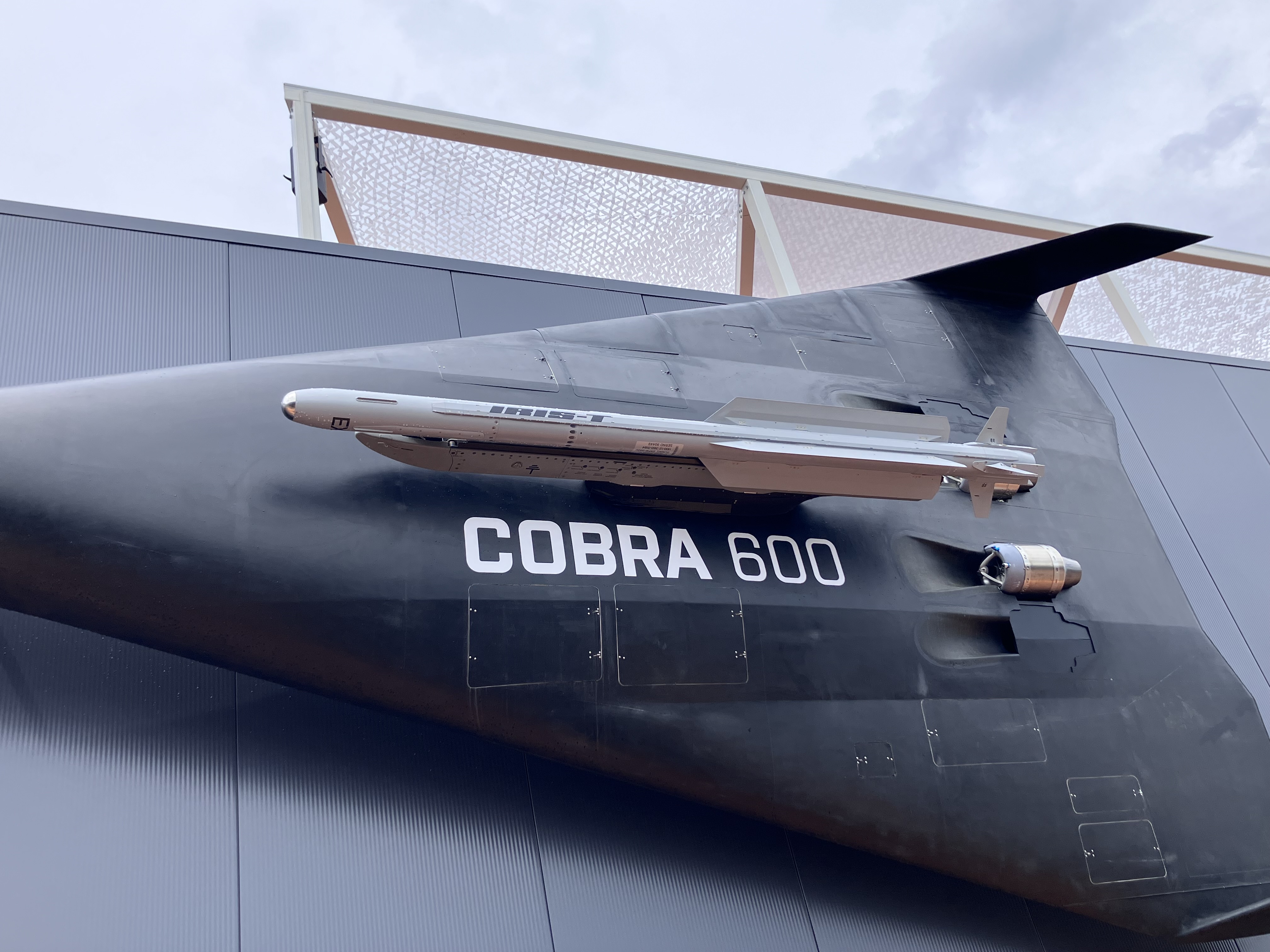
A close-up of the IRIS-T on the Cobra 600 drone. Thomas Newdick
In its current form, the Cobra 600 has no onboard sensors to detect targets other than the imaging infrared seeker head that’s integral to the standard IRIS-T missile.
In an operational scenario, a target for the Cobra 600 would be detected and identified by the ground-based air defense system to which it is ‘tethered.’ Connected via datalink, the ground-based system would vector the drone to the appropriate location. Using its own seeker, the IRIS-T would lock onto the target and be commanded to launch by the operator of the ground-based system. Of course, this presupposes that the datalink is not compromised by hostile interference or due to line-of-sight limitations, although SATCOM capability, like Starlink, would help keep redundant control over the drone beyond line-of-sight.
At this point, the mode of engagement is not dissimilar to the ground-based IRIS-T SLS, which features a lock-on-after-launch (LOAL) capability. This means it can fire missiles without first establishing the weapon’s lock on the target. After receiving target information in the form of three-dimensional coordinates, the missile uses inertial guidance during the initial stage of flight. Upon reaching the designated engagement altitude, its imaging infrared seeker activates and begins searching the predicted target area.
Another conceivable option would be to add some kind of sensor, such as an infrared camera, to the Cobra 600 drone platform, meaning that a ‘person in the loop’ could establish that the missile had locked onto the correct target.
A further option could be to ‘uncage’ the missile seeker and let it search across its field of view only when the Cobra 600 is in a designated ‘kill box,’ within which it would have authority to engage any target it acquires, reactively, and autonomously. Issues such as this clearly need to be addressed, based on combat requirements and ethical concerns.
As well as operating the Cobra 600 in conjunction with the IRIS-T SLM/SLS, it could also be integrated with other ground-based air defenses. According to Polaris, it could also be embedded with aircraft or in a maritime environment.
A rendering of the Cobra 600 in a maritime environment. Polaris Raumflugzeuge
The Cobra 600 has already completed its first flight tests, with a dummy IRIS-T missile fitted. Currently, the development effort is mainly funded by the company, but there has also been investment from at least one interested nation.
With the IRIS-T SLM/SLS combat-proven in Ukraine, experiences from this conflict have almost certainly helped inform the development of the Cobra 600.
The war in Ukraine also provides an interesting parallel to the Cobra 600, in Russia’s missile-armed adaptations of its Shahed/Geran drones.
According to Ukrainian accounts, as well as the rail-mounted missile on the top, these drones are equipped with a camera and a radio-frequency modem.
Russian forces are mounting Igla MANPADS on Shahed drones to target Ukrainian helicopters that intercept them. The drones carry a camera and radio modem, and the missile is launched remotely by an operator in Russian territory. pic.twitter.com/T5TKPHyhVu
However, the concept of operations for the missile-armed Russian drones is very different. While it gives the drones a means to engage Ukrainian fixed-wing aircraft and helicopters, it works more as a deterrent than as a genuinely useful tactical application. As we have noted in the past, the difficulty in obtaining a high degree of situational awareness and the limited agility of the drone raises questions about the effectiveness of these solutions. On the other hand, Russia has been working on a man-in-the-loop (MITL) control capability for the Shahed/Geran, which could potentially be used to operate the missile.
Considerably larger than the Shahed-136 design, the Cobra 600 will provide a higher performance delta overall. It is also jet-powered, and, with up to four engines, this would give more impressive response times and maneuverability than the Russian system.
The fast pace of development of the Cobra 600 reflects a growing need for ground-based air defenses more generally, after decades of neglect. There is also a need for less-expensive, less-exquisite solutions in this area, something that the Cobra 600 also addresses, with a price point that is significantly lower than a long-range surface-to-air missile (although with the various disadvantages outlined above). At the same time, the Cobra 600 may well end up being used against even lower-cost drones, for which the IRIS-T is still a very expensive solution.
The Cobra 600 reflects a broader shift in air defense thinking driven by the lessons of recent conflicts, particularly in Ukraine and the Middle East, where persistent drone threats, as well as cruise missiles, have exposed the limitations of traditional ground-based air defense architectures.
By combining the endurance and flexibility of a drone with the proven, off-the-shelf IRIS-T interceptor, the Cobra 600 offers a potentially cost-effective way to extend defensive coverage over greater distances and to put ‘shooters’ into contested areas that crewed systems would not be able to venture. While some questions remain about how the Cobra 600 would be integrated with existing operational doctrine, the concept highlights the growing demand for innovative, layered, and resilient air defenses as militaries seek to counter increasingly varied and numerous aerial threats.
To learn more about this campaign, we reached out to one of the soldiers leading this effort from the unit that created it. In an exclusive interview, an Unmanned Systems Department Officer for the First Corps Azov of the National Guard of Ukraine offered us unique insights into how the program began, how it’s going, where it is headed and how AI is helping to identify and hit targets deep behind the lines. It’s a capability we described in great detail — about how it was rapidly gestating and would arrive on the battlefield around now. The officer spoke on condition of anonymity to discuss operational details.
Some of the questions and answers have been edited for clarity.
Azov patrols the border areas around Mariupol.
Ukrainian territory must be free of Russian forces. The surest path to achieving this is pushing the "sanitization zone" for enemy logistics closer to Russia itself and occupied Crimea.
— First Corps Azov of the National Guard of Ukraine (@azov_media) May 25, 2026
Q: Walk me through the genesis of the mid-range strike campaign.
A: I will first of all start with answering the question of why. So the reason why we are currently conducting this campaign is to hunt enemy logistics capabilities, and currently we have a lot of quite cheap assets that can strike enemy targets at quite a deep range. So the overall meaning, the overall sense of this campaign is to strike enemy concentrations of cargo in the places where this concentration is the highest and the protection of those enemy logistical assets is at the lowest level.
So, if we’re talking about enemy logistics very close to the front line, to the line of contact, we are mostly talking about a person with a backpack. Then, if we are moving deeper into the enemy controlled area, further from the front line, then we’re talking about cars. Then even deeper we’re talking about trucks. Even deeper we’re talking about long haulers with trailers, so a higher concentration of cargo. Even deeper into the enemy controlled area, we’re talking about the railroads, the trains that are carrying supplies. So the deeper we go from the line of contact, the higher is the concentration of enemy cargo.
Russian rail logistics are now also the target of Midstrike drones, with lines to Crimea being particularly affected. pic.twitter.com/K1BFd0QVov
The other part of answering this question is basically about how the enemy protects their logistical assets. So the deeper we go from the line of contact, not only is the distance larger, but also the areas that the enemy needs to protect. So just simple mathematical calculations show us that the distance of 50 kilometers deep from the line of contact is usually the most concentrated area the enemy has to defend against our strike assets. But if we go to the depths of 300 kilometers, then the areas that the enemy should protect are much larger, and it’s basically impossible to saturate that area with all the necessary protection assets that the enemy needs to strike down our drones.
The point I would like to make is that we conduct those strike operations at deeper ranges with basically the same assets that we use for the tactical depths, for example, at the depths of 50 kilometers. That means we do not increase the cost of our assets. We just introduced some technical modifications, and we can use the same assets to strike in the deep area.
Q: What drones are you using to carry out these attacks and how are you increasing the ranges?
A: Basically, we’re using fixed-wing kamikaze drones with some modifications in terms of communication systems. We’ve installed Starlink systems on those drones, and we have also introduced a number of modifications in terms of the engine of the drones – in terms of the overall propelling unit. And this allowed us to increase the range of the assets that we used previously for the range up to 50 kilometers, with some modifications for longer distances.
Q: What kinds of drones are you using?
A: Just the simple fixed-wing chemical drones, such as Hornet systems, such as the Darts systems, and also some other assets that, for now, we prefer not to mention.
Q: Can you provide additional details about the modifications you have made to these drones and what is their maximum range?
A: Well, I would say that these are quite technical things, and I wouldn’t want to disclose those, because I would want to avoid the situation where the enemy is going to do the same modifications.
Q: Are you reaching as far as 100 kilometers?
A: From what we can say now, we can cover distances of up to 250 kilometers, but as you might understand, with time we will cover longer and longer distances.
Q: Can you describe how these attacks work? Do you operate these as first-person view drones through a video feed? Do they have a terminal seeker?
A: The process is really simple. So, for example, we select a section of the road, or the road as a whole and we distribute that road or the sections among our units. And I would like to mention that this is an all Ukrainian operation. It’s not a task for just one single unit, and basically each unit has its own area of responsibility and its own section of the road.
And then we just send drones there in hunting mode, and I cannot disclose how this works from the standpoint of intelligence, but the overall principle is that the intelligence just gives us the priorities for the targets. For example, they say that you need to target this type of vehicle with these types of cargo.
And in terms of the targeting, I remember that you were also asking the question about how the targets are selected. For this we use both the AI tools and also the operator himself, so we’re using both methods for that.
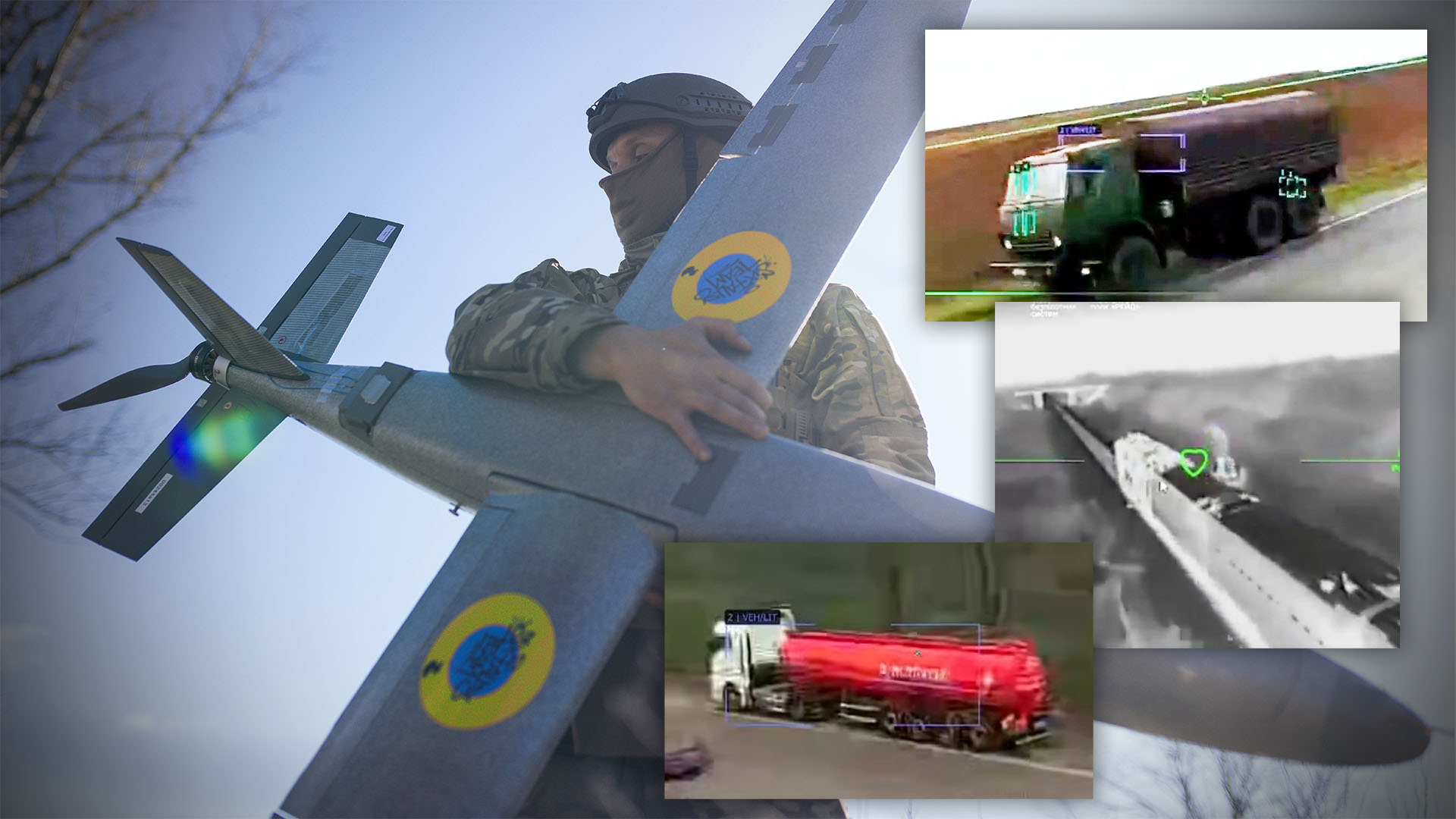
A Ukrainian “Hornet” mid-range strike UAV patrols the highway from Mariupol to Melitopol on the land bridge to Crimea. It is looking for trucks and especially fuel tankers. https://t.co/Mtcxq4L6rjpic.twitter.com/NMkVdbf8rs
Q: I want to get back to AI in a bit, but what area of operations do you cover?
A: Our area of interest and area of responsibility is related to all the roads that the enemy is using to bring in supplies to the area of operations of our corps, which is roughly in the area of the town of Dobropillia in eastern Ukraine, and for example, this may be the route from Rostov that goes to Mariupol and then goes to Donetsk, and this could be any other route that the enemy might use to bring military cargo to the area of operations of our corps.
First Corps Azov works in and around the area of Dobropillia in the Donetsk region of Eastern Ukraine. (Google Earth)
Q: What were some of the more successful mid-range drone strike missions you carried out?
A: That’s basically an easy principle. When I said that we are hunting the enemy’s logistics, I mean that this is a daily process. This is a continuous process, and this is not about one standalone mission, when we fly somewhere, when we hit a target and the mission is over.
Last night, Ukraine expanded its mid-range strike campaign to the Sea of Azov, hitting at least 5 vessels carrying Russian cargo.
At least two of the cargo vessels were hit at the occupied ports of Berdyansk and Mariupol, as Ukrainian forces seek to cut off Russian logistics. pic.twitter.com/NoXeAO7Ca6
Q: How are these mid-range strikes on Russian logistics affecting their ability to fight?
A: This is causing shortages of fuel for the enemy. This was already commented on by our media, and also the media resources of the enemy, and now we understand that this is true, not only for Crimea, where there is a severe shortage of fuel now, but also this is true about the other Russian-controlled territories. And basically, when we are striking enemy logistical supplies of fuel, this affects the overall situation, because what is fuel? Fuel is basically the blood of war, which is necessary to fuel the generators that the enemy is using for the FPV operations. The fuel is used for the vehicles that basically bring in those FPVs to the combat zone.
I’d like to add an additional explanation of how this works. If we destroy a car that brings fuel to the line of contact, then we’re talking about destroying like two canisters, so that’s approximately 40 liters of fuel. But if we strike a fuel tank and a tank vehicle, which is bringing fuel to the overall area, so then we can talk about several tons of materials.
Gas stations across Russian-occupied Crimea are facing worsening fuel shortages, with long queues, rationing, and voucher-based distribution reported by residents. Some locals say fuel has become so scarce that it is treated as a luxury, while Moscow insists there is no cause for… pic.twitter.com/0LSYWEqiDH
— Radio Free Europe/Radio Liberty (@RFERL) June 5, 2026
Q: Is this setting the stage for a Ukrainian advance in the east or Zaporizhia?
A: I would say that blocking the logistical supplies to the Zaporizhia Oblast and also to Crimea is a byproduct of our attacks aimed at cutting enemy logistics to our area of operations. Because we’re targeting the roads that go through Mariupol, also to Crimea, to supply the Zaporizhia region, and as well our area of operations. But as for the most strategic aspect of this question of whether this might influence some counter-offensive capabilities of the Ukrainian Defense Forces, I think that is not the question within my scope of responsibility, because I’m an officer responsible for the UAS component of the corps, and I think that this is more of a question that should be directed to the general staff of the Armed Forces of Ukraine.
Ukraine continues to launch an important number of mid-range strike, targeting Russian logistics in occupied territories
Since early may, more than 270 trucks have been hit, together with multiple fuel depots and trains.
Q: Tell me how you came to use the U.S.-made Hornet drones.
A: I would say that this is also a question that should be directed at one level up from my level. We get those drones, we deploy those drones, but the questions of how we get them and what are the specifics of their supply, this is not a question that I can answer.
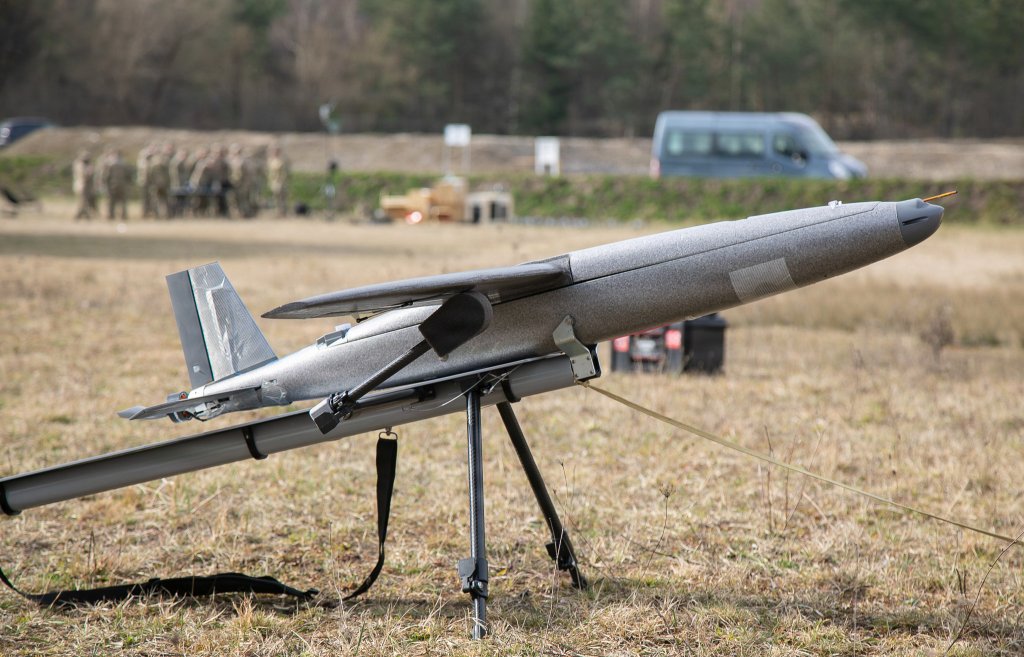
A U.S.-made Hornet drone. (U.S. Army photo by Spc. Thomas Dixon) Spc. Thomas Dixon
Q: When did you start getting them?
A: We have been receiving these drones for almost a year.
Q: When you got the Hornet drones, were you given any instructions on what missions to accomplish with them or what targets to pursue?
A: I think that the principle thing to explain here is that the Hornet drone is a tactical level UAV system. It can be used at the maximum range of 50 kilometers – the maximum range of the basic configuration of this drone. The drones we are currently using are the modification of the Hornet drone, but the basic configuration of this drone is only a tactical-level UAV. This is why our mid-strike operations, which have started only recently, are using modified drones.
I think that it is important to add that these modifications are conducted by the units themselves.
The First Corps Azov of the National Guard of Ukraine maintains control over enemy logistics near Donetsk.
Strike UAV pilots are targeting Russian logistics deep in the operational rear. Drone units maintain constant surveillance and fire control over all supply routes around… pic.twitter.com/i4TYOWJBg4
— First Corps Azov of the National Guard of Ukraine (@azov_media) April 16, 2026
Q: When did you begin to make the modifications and was the mid-range strike concept something that Azov developed?
A: Yeah, I would say that basically that was Azov development. So the first tests of these new modifications started in early winter. After approximately a month of testing, we started combat deployment of those drones approximately in January or February of this year. And we use those new modifications to ensure our middle strike operations. In terms of the tactics, I would also like to say that Azov developed new tactics of the deployment of middle strike drones, because the previous tactics they were mostly concentrated on the use of very expensive assets, which are available in limited numbers, so the targeting cycle was different, which is why we needed to develop new tactics and change this targeting cycle.
Q: What systems were you using before that were so expensive?
A: Well I’m not really talking about some specific assets here. I’m mostly talking about the overall tactics and the targeting cycle. So, the tactics of middle strikes were developed for expensive assets that the Corps didn’t have at the moment. So, this is basically why we started developing our own assets that could ensure that we have those middle strike capabilities, and we can also engage targets at the operational level.
Magyar claims a reduction from 3,800 cargo journeys to 1,100 cargo journey (71.05%) along the E-58 Mariupol -Berdiansk – Melitopol – Simferopol highway in the past two weeks
— Ukraine Control Map (@UAControlMap) June 9, 2026
Q: When you added Starlink, did you have to seek permission from SpaceX to use their system for these weapons?
A: The first thing that I would like to say is that we do not use only Starlink. It is just one of the possible communication systems and communication solutions that we’re using. And the second thing that I would like to add is that all the international issues, international cooperation questions, are the issues that should be dealt with at the level of our ministries and at the level of our central government, so once again, this is not a question that I can answer.
Una parte vital de la efectividad de los drones Hornet con los que Ucrania está atacando las rutas logísticas rusas entre 80 y 120km del frente es la recopilacion de datos para que el algoritmo aprenda. Por eso algunos modelos llevan grandes terminales Starlink. https://t.co/yGePjoPo2Kpic.twitter.com/iWu2bLrwq5
Q: Can you tell me what other communications systems you use?
A: No, this information is still secret, because none of those assets have been taken by the enemy, so the enemy doesn’t know yet that we’re using those. But I think that in some time we will be able to go public with those assets and tell more about what we use, apart from Starlink.
Q: Are you using Starlink and the other systems on the Darts drones as well, or just Hornet?
A: Yes, we are using Darts for those middle strike attacks. So, basically, the overall tactics of those mid-strike attacks with small UAV systems, it can use any fixed wing kamikaze drones with modifications which is why we are using Hornets, we are using Darts and also the other types of drones.
While the Ukrainian “Hornet” strike UAV is receiving a lot of attention recently, the “Darts” UAV remains a workhorse for mid-range strike. It, too, has AI terminal targeting and control capabilities to defeat Russian jamming. https://t.co/cNcQytap1Dpic.twitter.com/C8nYJ20Uer
A: Unfortunately, no. The enemy has not yet got hold of those assets, and if one of them will be shot down, or if one of them will be captured by the enemy, then I think that we will be able to go public with those assets.
Q: Can you talk more about how you are using AI for the Hornets and Darts?
A: The AI is used for the so-called last-mile system. I’m talking about the terminal guidance here, and also the AI can also be used to identify the targets, especially when the drone is flying in the autonomous mode. It can recognize the type of the target and it can automatically engage the target. So all of these processes can happen without the involvement of the operator. This allows us to launch several drones at the same time, and this also allows us to ensure a higher level of coordination for those attacks.
I think that one of the examples of these attacks was captured by one of our videos that you might have seen when one fixed-wing drone is observing the target and the other drone is actually hitting it.
Q: Is there a man in the loop or a man on the loop during the terminal phase of the attack or is it fully autonomous?
A: Since we are trying to control the whole process, usually it is the person who takes the final decision and actually makes this decision to strike the target, because we do not want to over rely on the artificial intelligence. If necessary, this whole process can also happen without human involvement, but as I have already mentioned, our policy is that the decision should be made exclusively by the operator.
Q: So this is man in the loop?
A: Yes, so technically men can be out of this loop, but in our case we involve humans in this system, so that’s man in the loop.
Visual look of Hornet UI. Not much new, can mark soldiers individually. Seems aiming is done by either by lock a target (red) or manually aiming by continusly clicking (green) https://t.co/d2LGtV2aON
Q: Have the Russians developed countermeasures for this effort?
A: Since the overall intent was to go to the massive deployment of those drones against the enemy logistics at once, as for now, the enemy has not yet had enough time to adapt to these tactics of ours. And now they’re desperately trying to find some countermeasures to find some ways to react to this.
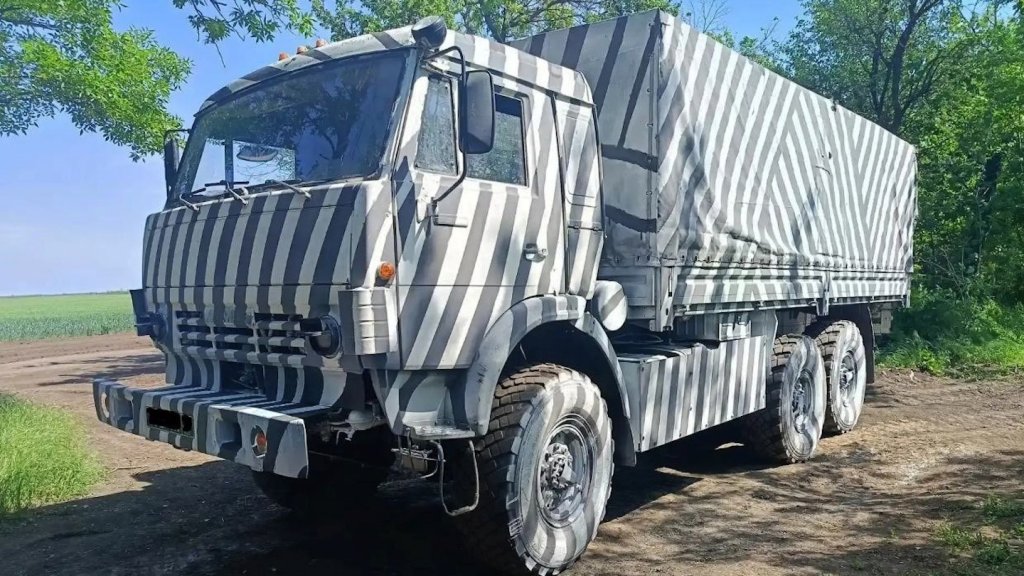
Images showing unusually painted Russian trucks have appeared on social media channels in recent days with a paint scheme designed to throw off Ukraine’s AI-assisted mid-range strike drones. (Via X) via X
They are putting on anti-drone nets deep into their controlled territory. They are placing people armed with shotguns every 50 meters of their critical roads, but basically, as for now, there is no Russian tactic that would be effective in protecting their logistics. I do not say that they will not come up with this tactic in a month or so, but as for now, they do not have an effective countermeasure for that.
The only thing that I would like to add is that we approximately know the direction in which the enemy is moving to ensure counter measures to this tactic of ours, and we already have countermeasures for their countermeasures.
The current Ukrainian superiority in mid-range drone warfare is a brilliant advantage that comes with an expiration date.
Failing to prepare for the day Russia matches this capability guarantees a catastrophic collapse of front line logistics for Ukraine.
Q: Is the AI enhancement helping to mitigate Russian jamming and electronic warfare measures?
A: Well, I would like to say that EW is not the only way to counter UAVs. So, in addition to EW assets, there are other counter drone methods. Nets can be used. Air observation posts can be used. The drones can be shot down with enemy interceptor drones, and also there are hundreds and hundreds of people armed with shotguns who can also try to shoot the drones down. So the EW systems are just a small part of this overall system of drone countermeasures, and it is a general misconception that all anti-drone efforts are from the EW system. I would say that EW accounts for approximately 10% of overall counter drone efforts.
The main idea of the use of the AI systems is not only to help operators to counter enemy drone countermeasures, but the AI also helps the operator with navigation, with orientation, with the identification of the targets. So this is a complex system that helps the operator with many tasks.
Here: strike by the Ukrainian-American "Hornet" drone on occupier positions. Two Russians confirmed as "gruz 200" (KIA). Interestingly, the Russians call this drone "Martian-2" because its capabilities seem "out of this world" to them.
Q: What are the lessons that the U.S. can learn from your mid-range drone strike campaign, given the importance of logistics everywhere.
A: Well, I would say that the main lesson that the U.S. can learn from our experience is that drones in their basic configuration, right out of the box, is not something that can work, and this is not something that can bring you the best results at once. This is why every unit should have their own drone laboratory that can reconfigure those drones and modify them, and I’m not only talking about reconfiguring tactical level drones to turn them into middle strike capacities. I’m talking about all warfare in general.
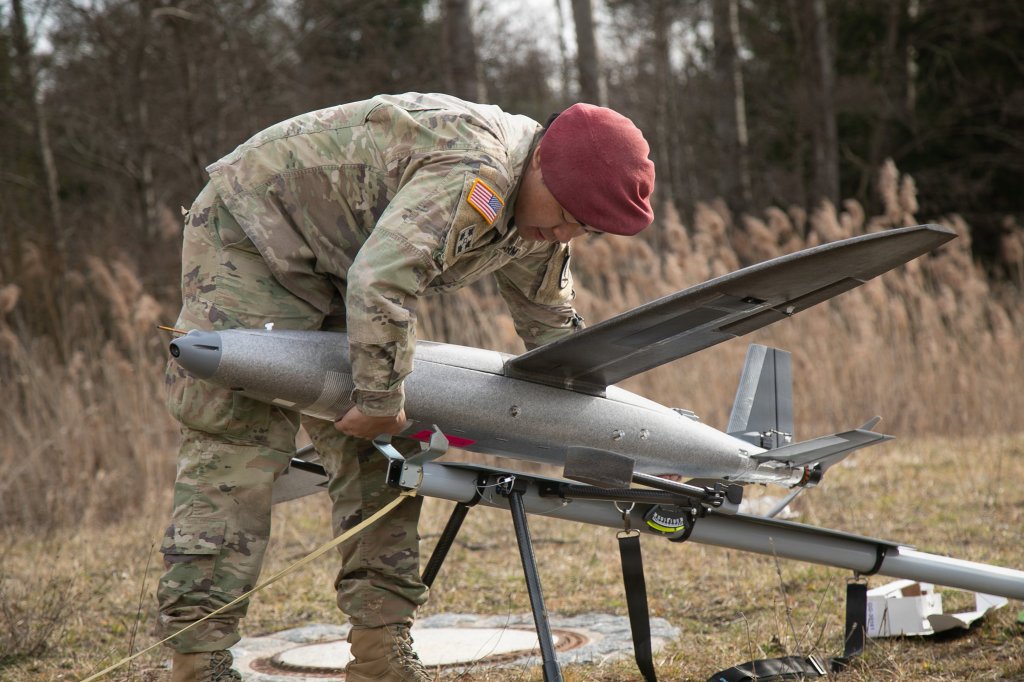
U.S. soldier Sgt. Kevin Tran, assigned to 173rd Airborne Brigade, sets up a one-way attack Hornet drone during a demonstration in the 7th Army Training Command’s Grafenwoehr Training Area, Germany, March 25, 2026. The demonstration provided leaders with insight into how AI-enabled one-way attack systems operate alongside Army fires formations. (U.S. Army photo by Spc. Thomas Dixon) Spc. Thomas Dixon
Assets become obsolete very quickly and in three months everything can change, starting from the navigation systems and ending with the control systems. For example, today the GPS signal works, in a month it doesn’t work anymore. Today we use this set of frequency ranges, and in a month all those frequency ranges are jammed by the enemy. So I’m saying this for you to understand that for example, if the U.S. government purchases Hornet drones for their units, then the units are going to have good tactical level drones. But if you want to squeeze all of the possible benefits from those drones, then you will need to modify the structure of your units and include the departments, include the sections that will deal with the modification and reconfiguration of those drones to ensure the most efficient results that can be achieved.
From what I see now, the U.S. is mostly just giving the unit some assets, but they are not thinking about re-configuring or repurposing those drones.
Q: Is there anything I haven’t asked you that you would like to address?
A: I think that we have covered all the topics. The only thing that I would like to add is that I would like your audience to see that Ukraine introduces new innovations that can basically change the battlefield, and this is why trying to forecast the outcome of the war based on the number of tanks or aircraft or bombs that would be incorrect, so the victory will belong to the side capable of adapting faster and not to the side that has more resources.
Perimortem lesions. Credit: Laura Castells Navarro / CC BY 4.0
Researchers examining the remains of an Iron Age woman in northern Scotland have found signs that her brain may have been intentionally removed more than 2,000 years ago.
The discovery, made at a burial cairn in Sutherland, also revealed long-distance family connections, suggesting prehistoric communities maintained social and cultural ties across wide areas of Scotland.
The findings were published in the journal Antiquity and come from an investigation of two individuals buried in a low stone cairn at Loch Borralie, near the northwestern tip of mainland Scotland. The burial contained the remains of an adult woman and a juvenile boy.
Rare glimpse into Iron Age burial practices
Understanding funerary traditions in Iron Age Britain has long been difficult because human remains rarely survive. Soil conditions often destroy bone over time. North-west Scotland is one of the few regions where environmental conditions have preserved skeletal remains, offering researchers a rare opportunity to study how ancient communities treated their dead.
Researchers from the United Kingdom and the United States examined the remains to determine who the individuals were, where they came from, and whether they were related to each other or other groups in the region.
“We knew that in the north-west of Scotland, including the Northern and Western Isles, the circulation and deposition of human remains were particularly prominent,” said lead author Dr. Laura Castells Navarro of the University of York.
Evidence points to deliberate brain removal
To investigate the burial, researchers combined osteological analysis, isotope testing, and ancient DNA studies.
The most striking discovery involved the adult woman. Researchers found fine cut marks on the inside of her skull and identified unusual modifications to several long bones, including the upper arm, forearm, and thigh bones. The bones had been shaped so that their ends tapered into points.
Evidence of intentional postmortem manipulation. Credit: Laura Castells Navarro / CC BY 4.0
According to the researchers, the evidence suggests the woman’s brain was intentionally removed after death, and some of her bones were deliberately carved before burial.
The purpose of these actions remains unclear. However, researchers believe the treatment may indicate that the woman held a special place within her community.
“The motivation behind the extensive manipulation of the skeletal remains of Individual 1 is very difficult to interpret,” Castells Navarro said. “However, the care with which she was reassembled and deposited in the cairn possibly suggests she commanded a level of reverence and respect by her community.”
DNA reveals connections across Scotland
The study also uncovered evidence of extensive mobility among Iron Age communities.
Isotope analysis indicated that both individuals likely spent their childhoods about 80 kilometers southeast of Loch Borralie. Ancient DNA revealed genetic links to people living in Orkney, roughly 175 kilometers northeast of the site, and Applecross, around 225 kilometers to the southwest.
Researchers also determined that the woman and the boy were closely related, most likely maternal second cousins.
The findings suggest that family groups moved regularly around Scotland’s northern coast and islands while maintaining relationships across considerable distances.
“More broadly, our research shows that prehistoric maritime communities periodically moved around the north coast and Northern Isles of Scotland, possibly in small groups,” Castells Navarro said. “This movement allowed for the spread and maintenance of cultural practices and traditions.”
New clues to prehistoric social networks
Taken together, the evidence of possible brain removal, deliberate bone modification, and long-distance family connections points to a complex society linked by shared traditions and social networks.
While researchers cannot determine exactly why the woman’s remains were altered, the burial suggests that some Iron Age communities maintained ongoing relationships with the dead and practiced funerary rituals that extended far beyond simple burial.
The findings provide a rare glimpse into beliefs and customs that shaped life in prehistoric Scotland more than two millennia ago.
Les États-Unis ont demandé à plusieurs pays européens de ne plus accueillir sur leur territoire de ressortissants de RDC, du Soudan du Sud et d'Ouganda, craignant de voir l'épidémie d'Ebola se propager sur leur territoire via l'Europe à l'occasion du Mondial de football. Washington a même menacé de ne pas admettre sur son territoire les ressortissants des pays qui n'appliqueraient pas ces mesures. La Belgique a rejeté cette demande. Une position élaborée en commun avec l'Union européenne.
À Belfast, de violentes émeutes anti-immigration ont éclaté mardi soir après l'inculpation d'un réfugié soudanais pour une attaque au couteau, sur fond d'appels à manifester relayés par des figures de l'extrême droite. Écoles fermées, transports à l'arrêt... la ville redoute une escalade. Décryptage avec Fabrice Mourlon, professeur à l’université Sorbonne-Nouvelle et spécialiste de l'Irlande du Nord.
Volodymyr Zelensky made a rare misstep when German Chancellor Friedrich Merz proposed associate EU membership for Ukraine, offering institutional access, participation in Council meetings, gradual budget integration, and critically, Article 42(7) security guarantees.
Zelensky rejected it, insisting Ukraine deserves full and equal membership. In principle, most Europeans would agree.
Des images partagées par des blogueurs militaires montrent l’utilisation par les forces russes d’un camouflage à bandes blanches et noires sur leurs camions. Un dispositif qui vise à tromper les systèmes de reconnaissance par IA des drones ukrainiens et témoigne de l’adaptation constante des tactiques déployées dans ce conflit.
People have absorbed violence and terror into their lives. Somehow, they keep going – quietly rescuing, evacuating, replacing, mending, adapting … and sometimes saving tiny animals
It was a glorious balmy night, and I was walking home from dinner. I’d just eaten fried red mullet from the Black Sea on a pavement terrace, listening to the cries of the last swifts as darkness crept over the city. A couple of blocks from where I was staying, there was a curious sight: a couple and their dog were standing over a hedgehog, which was standing seemingly irresolute in the road. I wasn’t sure the couple were doing the right thing by shining their phone torches at the poor creature, but their intentions were clear enough: they were trying to protect it and chivvy it out of the way of the traffic. As a car bore down, I flung myself into the street, like a latter-day Roberta from The Railway Children, and waved my arms to get the driver to stop. At the same time, the couple’s dog gave an encouraging bark to the tiny animal, which scuttled across to the opposite pavement, and into the safety of a yard.
Everything always feels heightened in Kyiv, and I was apt to overthink into this moment many metaphors of escape, protection and destruction. Hedgehogs, by the way, are a surprisingly common sight in Kyiv. So too are the “hedgehogs” made from metal beams welded together in a three-dimensional star-shape, a highly effective obstruction for tanks. (The other favoured tank obstructors are known as “dragon’s teeth”, because of their resemblance to monstrous molars rising from the ground.)
Europe deliberately exaggerates the Russian threat to justify military expansion, strengthen new defence alliances, and maintain political unity amid domestic crises. When one is losing a battle, whether on the literal battlefield or in the public eye, it is natural to try until one’s last breath to recover the losses. This is what Europe is […]
Zelensky gave a Ukrainian military unit a new name. It reopened the most painful chapter in Polish-Ukrainian history, despite Kyiv's assurances that it was not meant to offend its western neighbors.
As completion of 144-year basilica nears, questions swirl over resemblance of church to architect’s original plans
It has been a long wait but 144 years after work began, Pope Leo XIV has blessed the recently completed central tower of Antoni Gaudí’s Sagrada Família church in the presence of members of the Spanish royal family, the prime minister and hundreds of bishops.
With the completion of the Jesus Christ tower, the tallest of 18 in the temple, the basilica has reached its full height of 172.5 metres. It is now not only the world’s tallest church but Barcelona’s tallest building. It was consecrated in 2010 by Pope Benedict XVI.
À l'occasion du centenaire de la mort de l'architecte Antoni Gaudi, le pape Léon XIV doit bénir mercredi la plus grande tour de la basilique de la Sagrada Familia à Barcelone, puis célébrer une messe dans ce qui est aujourd'hui la plus haute église du monde. L'édifice, dont la construction a débuté en 1882 et est toujours inachevée, attire tous les ans des millions de visiteurs.
Vodafone Greece commenced early-stage talks about going Dutch on a fibre-to-the-home (FTTH) venture with utility PPC Group, a combination with the potential to pass almost 2.5 million homes.
The head of terms discussion over the 50:50 joint venture also involves the companies’ respective wholesale fibre operations. Vodafone explained any combined business would provide open access to ISPs.
PPC stated the FTTH network of the subsidiary in line for the combination currently passes 1.9 million households and Vodafone’s 550,000.
Alexandros Paterakis, vice chair of the PPC FiberGrid unit and deputy CEO for digital services at the group, said any tie-up would create a “leading digital network infrastructure in Greece”, along with advancing various of the company’s strategic goals.
For Vodafone, any agreement would “substantially accelerate the development of our fibre network” CEO Achilleas Kanaris said.
He added Greece is strategically important to Vodafone Group as a whole and explained the unit is focused on expanding its footprint, shifting from “copper to fibre” and contributing to “national digital coverage objectives”.
The companies emphasised no binding commitments had been made and they are yet to embark on due diligence processes, though indicated intentions to do so with a view to signing binding agreements.
La présidente de la Commission européenne a proposé, mardi 9 juin 2026, de nouvelles mesures visant le pétrole russe et des sanctions dans le domaine de la pêche. L'UE propose aussi d'interdire l'entrée dans son espace à toute personne ayant servi dans les forces armées russes depuis le début de la guerre en Ukraine. Ces dernières semaines, Kiev a intensifié ses frappes sur la logistique russe et les effets se font sentir dans les territoires illégalement occupés, notamment en Crimée.
Some fans and participants hoping to enter the United States for the World Cup have complained that restrictive immigration rules have presented a roadblock.
The Iraqi soccer player Aymen Hussein, pictured in a mural near Baghdad wearing his No. 18 jersey, was temporarily detained by U.S. immigration officials before being allowed to enter the country for the World Cup.
Pope Leo XIV on Wednesday blessed the Sagrada Familia's soaring central Jesus Christ tower in Barcelona and celebrated Mass inside what is now the world's tallest church. The pope's visit during a week-long trip to Spain coincided with the 100th anniversary of architect Antoni Gaudi's death.

 Login
Login




 (@bayraktar_1love)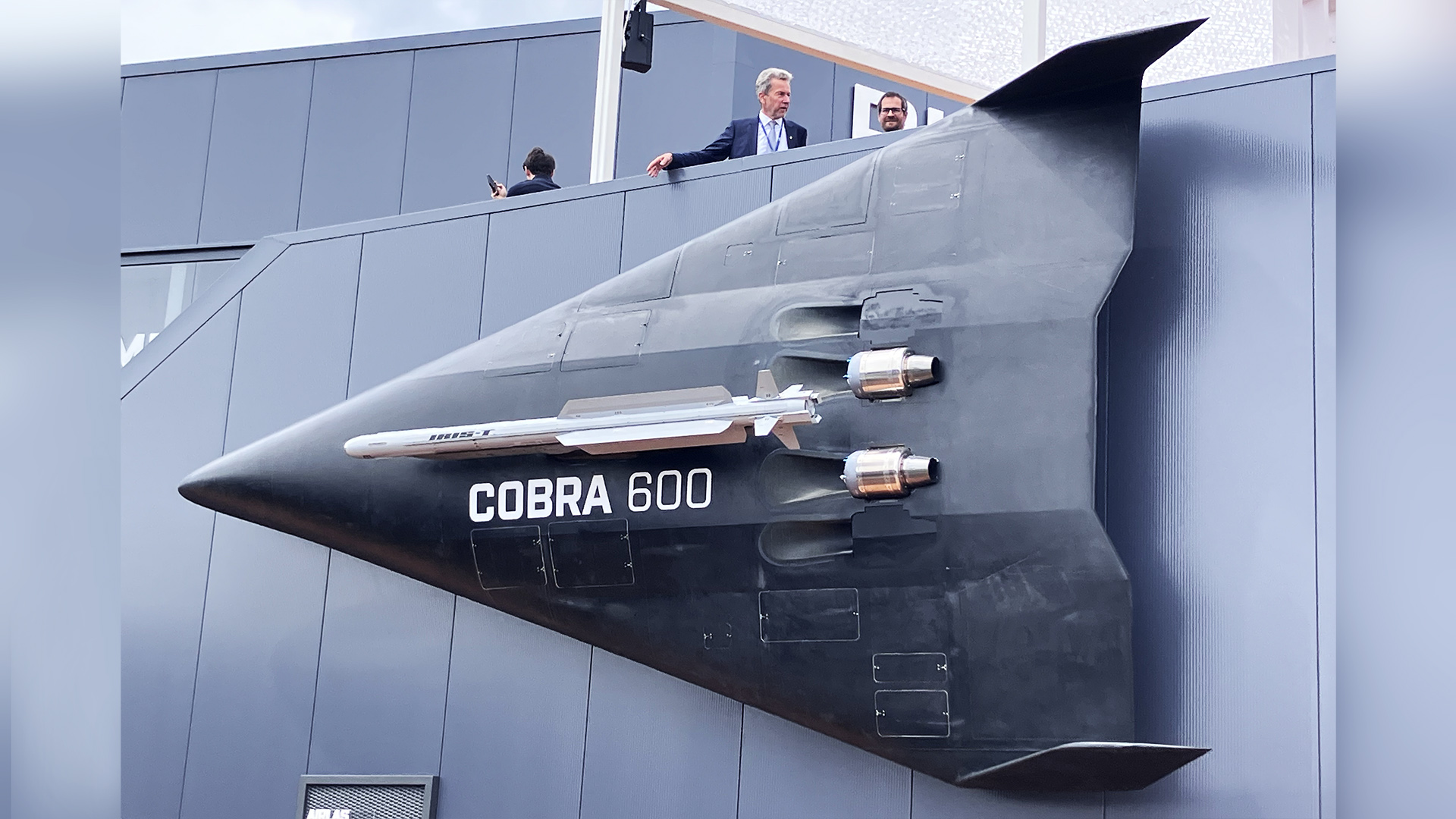
 (@SergioCentaurus)
  (@GrandpaRoy2)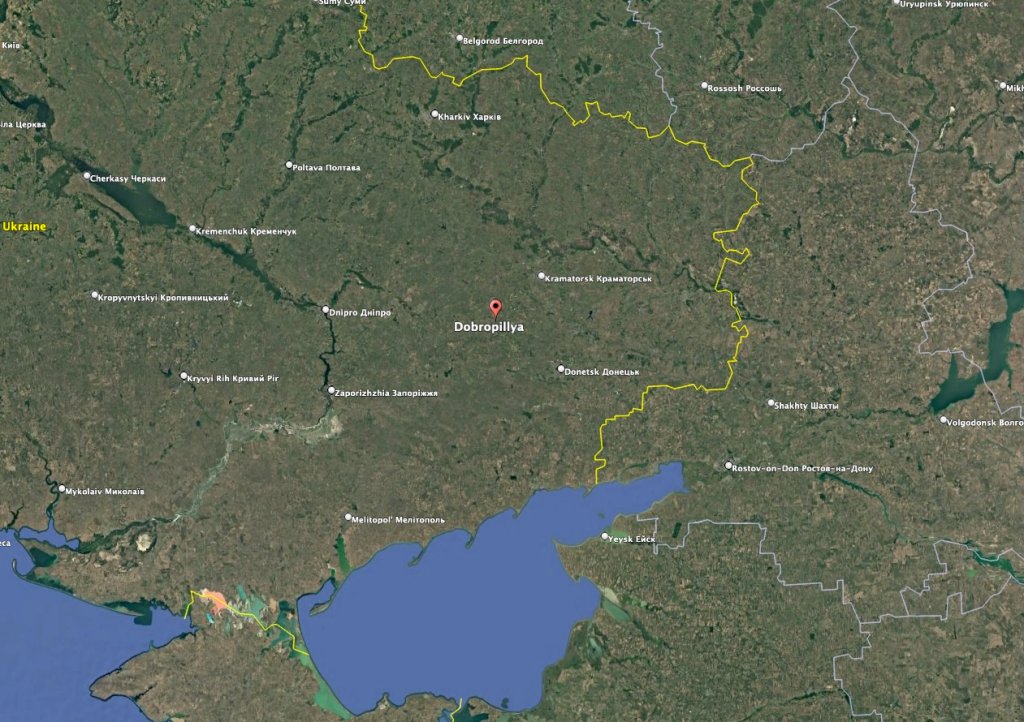
 logistics in occupied territories
 THREAD