Reading view

Did Ancient Greek Hero Odysseus Travel to Ireland?

odysseus Ireland
Did Odysseus Travel to Ireland? Credit: Public Domain

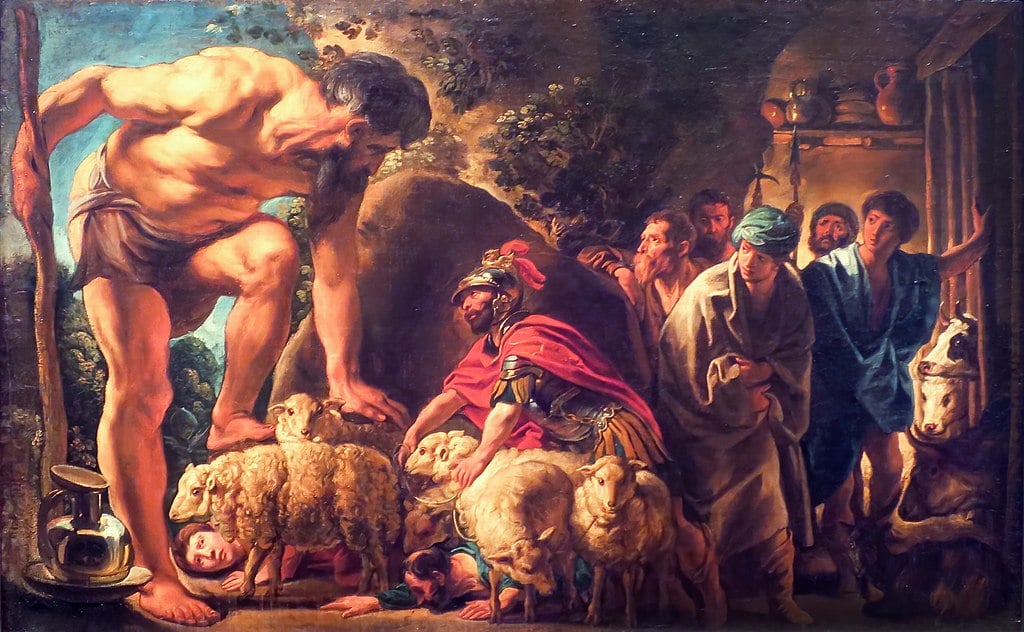
Homer’s Odyssey tells the tale of Odysseus returning to his home after the Trojan War. For a variety of reasons, the trip is not an easy one. It takes him a full ten years to return home.

But the journey from Troy to Ithaca, Odysseus’ home island, should not have been too difficult and certainly not a ten-year trip. For this reason, some researchers have claimed that Odysseus actually traveled outside of the Mediterranean. There is even the suggestion that he traveled to Ireland.

Odysseus travel to Ogygia and its connection to Ireland

In the Odyssey, one of the places Odysseus visits is an island called Ogygia. This was the home of the nymph Calypso, who offers Odysseus immortality if he agrees to marry her. She refuses to let him leave otherwise. The gods intervene and force Calypso to release him. Hence, after seven years on the island, Odysseus builds a raft and sails away.

The location of Ogygia has been the subject of considerable speculation. According to Homer’s account, the island is a place of beautiful meadows, fountains, woods, and various types of birds. However, none of this is particularly helpful. All sorts of islands could fit this description.

In ancient times, various suggestions were made as to where Ogygia might actually be located. More recently, some scholars have argued that Ogygia is identical to Ireland. If this identification is correct, this would mean that Odysseus spent seven years in Ireland.

The most notable scholar to have come to this conclusion was Roderick O’Flaherty. In 1685, he used the name ‘Ogygia’ as a synonym for Ireland in the title of one of his books. It was called: Ogygia: Or a Chronological Account of Irish Events.

Plutarch’s account of Ogygia

One of the key pieces of evidence used to support the identification of Ireland as Ogygia is a passage written by Plutarch, a historian of the first century CE. He wrote about Homer’s account of Ogygia in conjunction to other additional information he provided. According to Plutarch, Ogygia was situated to the west of Britain, which is where Ireland is in fact located.

Additionally, Plutarch tells us that Ogygia was five thousand stadia away from the ‘great continent’ which surrounded the ‘great sea.’ Several scholars have suggested that this ‘great continent’ actually refers to America. Examples include Wilhelm von Christ, an eighteenth-century German scholar, and Johannes Kepler, a sixteenth-century German scholar.

If the ‘great continent’ mentioned by Plutarch really was America, then that would mean that Ogygia was actually an island somewhere between Britain and America. Since Plutarch says that Ogygia was five thousand stadia from the great continent but only several days distant from Britain, this indicates that it was much closer to Britain than to America. Therefore, Ireland would seem to be a good match.

Problems with identifying Ogygia as Ireland

While Ireland does match Plutarch’s basic description, there are certain issues with this identification. For one thing, Ireland is not five thousand stadia from America. This distance would be the equivalent of a little over nine hundred kilometers. Nevertheless, the distance between Ireland and America is about three thousand kilometers.

Hence, the distance specified by Plutarch means that Ireland is in fact not Ogygia, if America was indeed the ‘great continent’ to which he referred. Clearly, however, there is no other option for the great continent that would fit the passage.

Another problem is that Plutarch states that it takes five days of sailing to travel between Britain and Ogygia. This would indicate an island much further west than Ireland because it would barely take two days of sailing to reach Ireland from the furthest part of the western side of Britain.

In reality, there is no island which is exactly five days’ sailing away from Britain and also five thousand stadia away from America. The measurements simply do not correspond to any real location.

Perhaps, then, some researchers could use this as evidence that the measurements must be incorrect, meaning that Ireland could still be the intended location. Alternatively, it could of course also mean that Plutarch was not really describing an actual location at all.

  •  

Greek Fire: The Powerful Weapon of the Byzantine Empire

Greek fire helped Byzantium maintain its military might for centuries
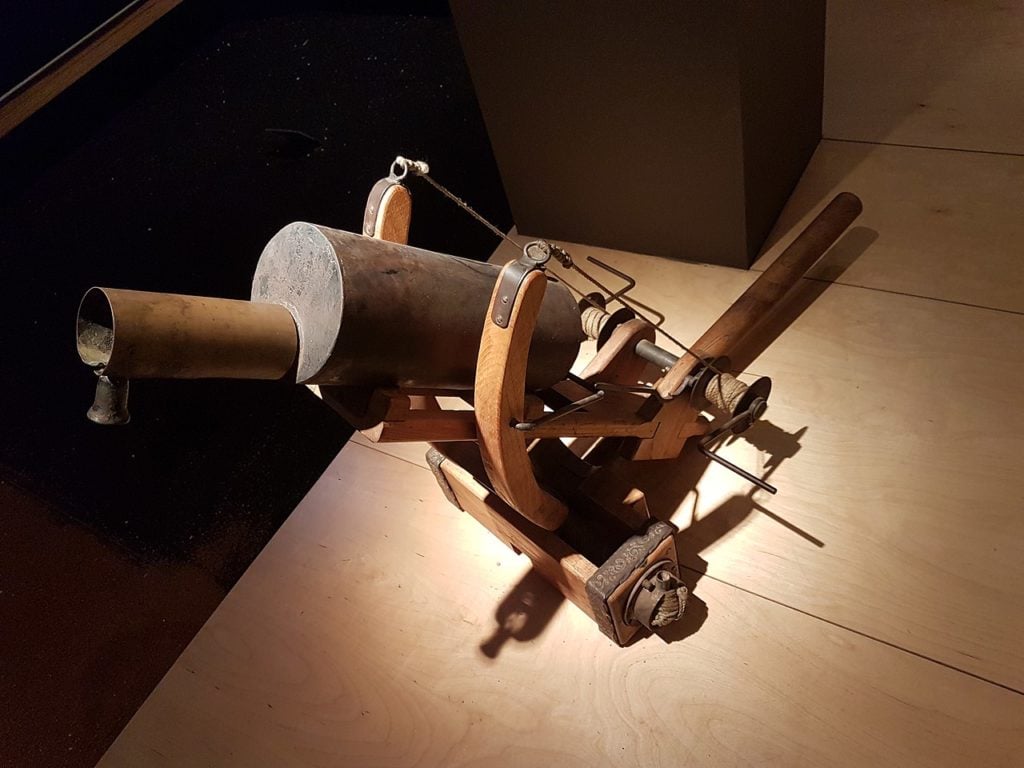
Arbalest flame-thrower spewing Greek fire, Byzantine Empire (reconstruction). Thessaloniki Technology Museum. Credit: Gts-tg/Wikimedia Commons CC BY-SA 4.0

Greek fire was the mysterious weapon used by the Byzantines to destroy enemies and prospective invaders, keeping the Empire strong and awe-inspiring.

The Byzantine liquid fire that protected the Empire was a terror-inspiring incendiary weapon that protected the Empire for centuries. Widely known as Greek Fire, this mighty weapon enabled the Byzantine Empire to survive and maintain its power through many attacks from various enemies.

The weapon could be compared to the modern day flame-thrower. To the enemy in Byzantine times, it looked like a machine spewing destructive fire from hell. However, its exact origin remains unclear, and the recipe for this formidable weapon is still unknown, puzzling scientists and historians.

Byzantine Greek fire
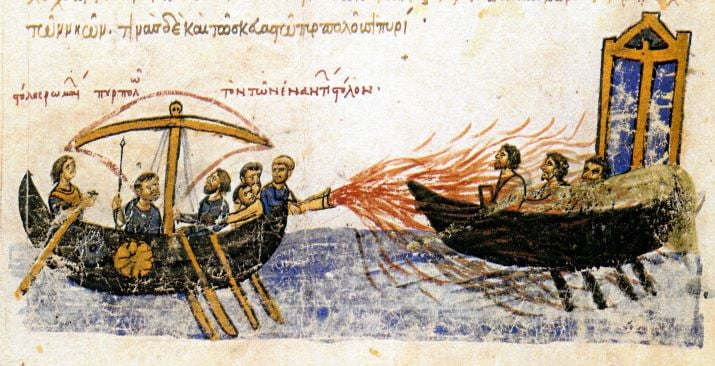
A Byzantine ship using Greek fire against a ship . On top, Greek alphabet in Byzantine form. Credit: Public Domain

Records suggest Greek fire contained a mix of petroleum, quicklime, and other unknown ingredients. This potent combination is believed to have made it one of the most flammable and dangerous substances of its time. What was truly amazing about the Byzantine liquid fire weapon was that it continued to burn on water and was practically impossible to put out with medieval means.

It helped the Empire maintain sovereignty over the mass land it occupied, spanning all of Southern Europe, North Africa, and Asia Minor. The weapon’s impact on the course of history is undeniable. It played a key role in the defense of Constantinople and the preservation of the Byzantine Empire.

A Brilliant Invention

Fire as a weapon had been used for centuries but never in such a sophisticated and destructive means  as the Greek fire (or Υγρόν πυρ – Hygron pyr, as it was referred to in Greek). It was the Crusaders who referred to it as Greek fire or “liquid fire,” “Roman fire,” or “sea fire.”  It was a significant weapon that never ceased to terrify the enemy.

This innovative weapon would fire massive flames in a continuous jet, burning a trail of destruction in its path that was nearly impossible to extinguish. When it came to naval warfare, it was a weapon that was impossible for the enemy to defend their ships from. Yet, the exact recipe for the liquid fire substances the Byzantines used remains a mystery to this day.

The Greek fire cannon-like machine was created in the seventh century. It most likely was the invention of Kallinikos of Heliopolis, a Jewish architect who fled from Syria to Constantinople. It was between 674 and 678 when the Byzantine Empire was attacked by the Islamic fleet of the Umayyad caliphate that had already taken over parts of Syria.

Concerned about an Islamic attack against Constantinople, Kallinikos experimented with a variety of materials until he discovered a mix for an incendiary weapon. Kallinikos sent the formula to the Byzantine emperor, and authorities developed a siphon that operated somewhat like a syringe, propelling the fiery concoction toward enemy ships.

Emperor Constantine IV reluctantly ordered the use of Greek fire to destroy the Umayyad fleet. However, the Byzantine weapon was very successful. According to historian Kelly DeVries and his book Medieval Military Technology, it was the first reported use of an incendiary weapon in battle.

Was Byzantine Liquid Fire a State Secret?

Some historians believe the reason the recipe for liquid fire remains unknown is because Byzantine emperors wanted to keep it a state secret, never to fall into the hands of the enemy. The vast Empire was surrounded by numerous enemies coveting its lands. Liquid fire was a potent deterrent to any army that would think of invading.

Constantine VII Porphyrogenitus warned his son Romanos II to not reveal the recipe “and not to prepare this fire but for Christians, and only in the imperial city.”

Anna Komnene, daughter of Emperor Alexios I Komnenos (r. 1081-1118) and a historian, wrote about the recipe for Greek fire:

This fire is made by the following arts: From the pine and certain such evergreen trees, inflammable resin is collected. This is rubbed with sulfur and put into tubes of reed, and is blown by men using it with violent and continuous breath. Then in this manner it meets the fire on the tip and catches light and falls like a fiery whirlwind on the faces of the enemies.

It was not that straight-forward, of course. Otherwise, it would be easy for the enemy to recreate the fiery weapon. It seems indeed that the Byzantines intended to keep the process of creating the liquid fire top secret, as no friend or enemy ever managed to gain insight into this so as to construct their own similar weapon.

The use of Greek fire in war helped the Byzantines maintain the empire for centuries
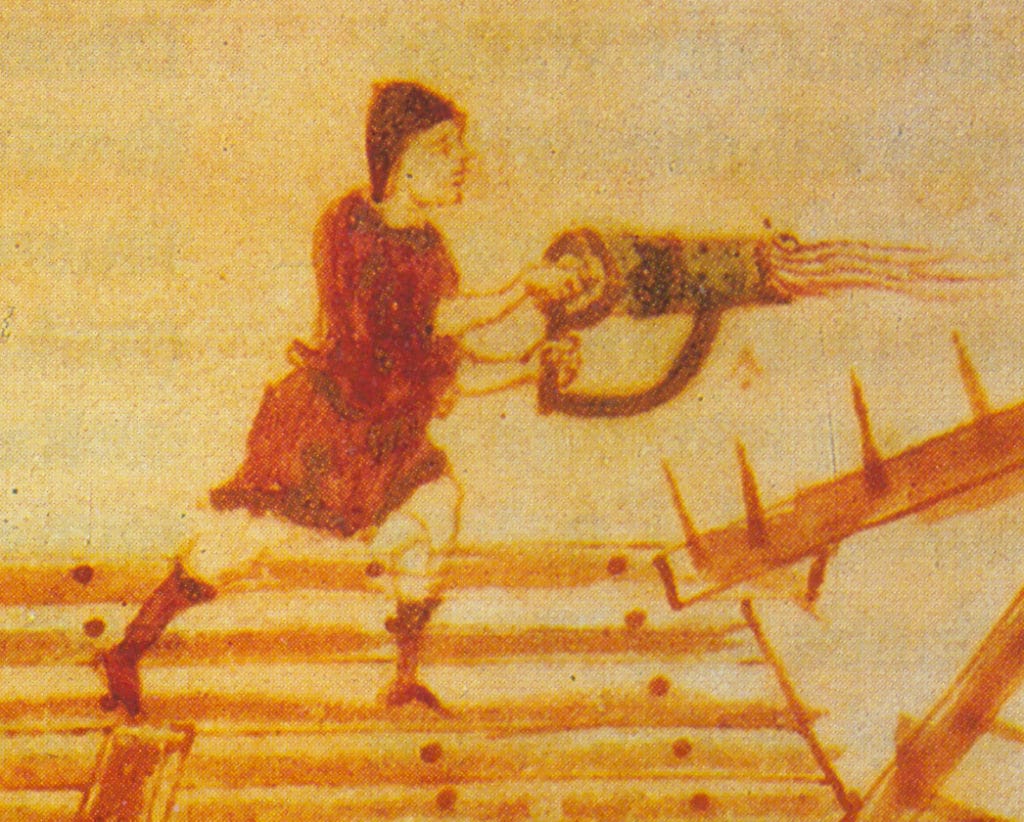
Use of a hand-siphon, a portable flame-thrower, from a siege tower. Detail from the medieval manuscript Codex Vaticanus Graecus 1605. Public Domain

Greek Fire in Battle

In his book, Devries explains that Greek fire can refer to three different weapons: firstly, a fiery liquid pumped out of a nozzle; secondly, a liquid weapon that was filled in small grenades; and thirdly, a solid incendiary probably based on gunpowder.

The third is impossible to have been used in Byzantium. Its reported use started in the fourteenth century in Western Europe. However, there are Byzantine era depictions of men carrying hand-held tubes spitting fire that look even more like modern flame-throwers.

In fact, Greek fire was rarely used except primarily in naval battles, as the apparatus was complicated and required technically equipped handlers. Furthermore, it was dangerous to have an incendiary mechanism on a wooden ship.

In 727, Emperor Leo sent a fleet to burn that of Hellas and Cyclades, who had been revolting against him. In 941, a Rus naval raid from Kiev across the Black Sea was stopped, and their fleet was annihilated by the Byzantines.

Reportedly, in the eleventh century, Viking Ingvar the Far Travelled encountered ships equipped with the weapon, which he described as “a brass (or bronze) tube and from it flew much fire against one ship, and it burned up in a short time so that all of it became white ashes…”

However, by the end of the twelfth century and the Angeloi emperors, the Empire started to decline, losing more and more land to the rising Ottoman Empire. As Byzantium began to fade, so did the use of Greek fire until it became but a simple chapter in the great history of the Byzantine Empire.

  •  

X-Rays Reveal Nazi Symbols Hidden Beneath Postwar Painting

Erich Mercker’s pre-1945 “Die Stätte des 9. November” is shown beside a postwar version from a private collection
Erich Mercker’s pre-1945 “Die Stätte des 9. November” is shown beside a postwar version from a private collection. Credit: Ioanna Mantouvalou et al. / CC BY 4.0

A painting found in a German family home has revealed how Nazi-era imagery may have been hidden beneath a more acceptable postwar scene. The work is linked to Erich Mercker, a Munich painter who lived from 1891 to 1973. Mercker had a successful career and painted several works during the Nazi period. Some included hidden Nazi symbols and political themes.

One of his known works, “Die Stätte des 9. November,” showed the Feldherrnhalle in Munich. The site carried strong meaning for the Nazi Party. It was tied to Adolf Hitler’s failed 1923 coup, also known as the Beer Hall Putsch.

Postwar versions removed Nazi symbols

After World War II, Mercker continued to paint the same Munich scene. But later versions appeared different. He removed soldiers, wreaths, and Nazi symbols. He also replaced the Nazi flag with the blue-and-white flag of Bavaria.

The works appeared under less politically charged titles, including “Feldherrnhalle” and “München am Odeonsplatz.”

Filmmaker and producer Dr. Thomas Schuhbauer found one version in his parents’ home. They had received it as a wedding gift in 1966.

At first, the painting looked like a postwar version of the scene. It showed the Bavarian flag and no clear Nazi symbols. But some details raised questions. The Nazi memorial at the Feldherrnhalle was still partly visible. That memorial was destroyed after Germany’s surrender in 1945. Reddish paint traces also appeared near the flag.

X-ray scans reveal hidden image

Schuhbauer contacted Helmholtz-Zentrum Berlin, known as HZB. He began working with Dr. Ioanna Mantouvalou, a physicist at TU Berlin and HZB. Mantouvalou specializes in X-ray fluorescence spectroscopy, or XRF.

X-ray scans have revealed Nazi symbols hidden beneath a postwar painting linked to Munich artist Erich Mercker.

Researchers found a red Nazi flag, wreaths, soldiers and raised arms painted over beneath a later Bavarian scene. pic.twitter.com/qrkIfazLhm

— Tom Marvolo Riddle (@tom_riddle2025) June 9, 2026

The method lets researchers identify chemical elements in materials without damaging them. It can also reveal paint layers beneath the surface.

The XRF scans showed that Nazi imagery had been painted over. A red Nazi flag lay beneath the Bavarian flag. Researchers also found covered wreaths on the monument, soldiers in the scene, and raised arms of passersby.

The overpainted areas contained high levels of titanium white. That pigment did not appear elsewhere in the painting. A tube of oil paint labeled “Titanium White 10103 Schmincke” was later found among Mercker’s paint tubes.

Evidence points to later alteration

Researchers said the evidence suggests that Mercker may have altered the painting himself. Some changes appeared rushed or careless.

The study, published in npj Heritage Science, also situates the painting within a broader postwar context. The authors noted that many artists faced little public criticism for their Nazi-era collaboration until well into the 1960s.

The painting now belongs to the Munich Documentation Centre for the History of National Socialism. The case shows how science, art history, and family memory can work together. It also shows how political symbols can disappear from view without fully leaving the historical record.

  •  

The Seven Ancient Greek Styles of Speech That Still Shape Rhetoric Today

Digital depiction of the Council of 500 meeting in ancient Athens, depicting a group of citizens engaged in discussion.
Hermogenes of Tarsus developed the seven ancient Greek styles of speech to explain how rhetoric shapes clarity, emotion, persuasion, character, and intellectual power. Credit: GreekReporter archive.

Among the greatest rhetorical theorists stood Hermogenes of Tarsus, an Ancient Greek sophist and rhetorician who lived during the second century AD and developed a sophisticated theory of style that categorized speech according to seven major rhetorical qualities or styles of speech. These included Clarity (saphēneia), Grandeur (megethos), Beauty (kallos or omorphia), Rapidity (gorgotēs), Ethos, Sincerity, and Force (deinotēs).

Although many people mistakenly associate these rhetorical categories with the rhetorician Demosthenes, the systematic classification belongs to Hermogenes himself. Together, these categories formed a complete philosophy of expression. Hermogenes did not view rhetoric as ornamental alone. Instead, he treated speech as a living art capable of shaping thought, emotion, and public action.

The Ancient Greek Hermogenes and the art of rhetoric qualities or styles of speech

Ancient Greek rhetoric shaped political life, education, philosophy, and literature for centuries. Public speech held enormous importance in the Greek world because success in courts, assemblies, and intellectual debates depended upon persuasive expression. As rhetoric evolved, Greek thinkers attempted to classify the qualities that made speech effective, elegant, and emotionally powerful.

Hermogenes of Tarsus gained fame at a very young age. He was a rhetorical prodigy whose abilities astonished teachers and audiences alike, and he later composed several influential rhetorical treatises, especially On Types of Style. This work became one of the most significant manuals of rhetoric in late antiquity and Byzantium. Byzantine scholars such as George of Trebizond studied Hermogenes extensively, and introduced his theories in the West during the Renaissance.

Unlike simpler rhetorical systems, Hermogenes established a highly nuanced approach. He understood that persuasive speech requires flexibility rather than rigid formulas. Differing situations demand different styles, tones, and emotional effects. For this reason, his seven categories of styles of speech function less as isolated techniques and more as interconnected dimensions of expression.

“Clarity,” or Saphēneia, as a critical style of speech according to the Ancient Greek Hermogenes

Hermogenes considered clarity the foundation of all effective speech. Without clarity, audiences are unable to follow arguments or comprehend meaning. A speaker may possess intelligence and passion, yet confusion eradicates persuasion. Clarity therefore requires precise vocabulary, logical structure, and direct expression. Sentences should communicate ideas without unnecessary obscurity.

Nevertheless, Hermogenes did not reduce clarity to simplicity alone. Clear speech can still remain elegant and intellectually sophisticated. The goal involves illumination rather than oversimplification.

Greek philosophers also highly valued clarity. The philosopher Plato often criticized sophists who concealed weak arguments beneath decorative language. Similarly, Aristotle emphasized intelligibility as an essential feature of rhetoric. Hermogenes continued this tradition while developing a more refined stylistic analysis.

Greek philosopher Plato
Plato criticized the sophists in his work “Gorgias.” Credit: Sebastian Bertrand. flickr

“Grandeur” as one of the most significant rhetorical qualities

Grandeur introduces elevation, dignity, and majesty into speech. This style suits heroic themes, political crises, moral exhortation, and public ceremonies. A grand style expands language through emotional intensity, powerful imagery, and elevated rhythm. Speakers using grandeur aim to inspire awe and admiration. Demosthenes often exemplified this quality in his speeches against Philip of Macedon. His rhetoric combined patriotic urgency with emotional force.

However, Hermogenes warned against excess. Grandeur must remain controlled. Otherwise, speech becomes inflated and artificial. True grandeur emerges from harmony between content and expression. Noble themes require compatible, equally noble language, yet authentic emotion must guide rhetorical elevation.

Statue of Ancient Greek god Zeus
Statue of Greek God Zeus. Credit: flickr / Richard Mortel CC BY 2.0

The speech style of “Beauty,” or Omorphia

Beauty in rhetoric concerns elegance, harmony, and aesthetic pleasure. Hermogenes believed that beautiful speech delights audiences through rhythm, imagery, and balanced structure. This quality resembles artistic composition in poetry, sculpture, or music. Beautiful speech flows smoothly and creates emotional resonance through sound and proportion.

Greek culture deeply associated beauty with order and harmony. Philosophers often linked external beauty with inner balance. Hermogenes applies this principle directly to language. A beautiful style does not merely persuade intellectually. It also captivates emotionally and aesthetically.

Writers achieve beauty through careful word choice, graceful transitions, and balanced phrasing. Metaphors, cadence, and musicality all contribute to this effect. Nonetheless, Hermogenes again emphasizes moderation. Excessive ornament weakens rhetorical effectiveness. Beauty must support meaning rather than overwhelm it.

Doryphoros, Roman copy of Ancient Greek statue
Doryphoros statue. Roman copy of the late 1st century BC — early 1st century AD, replica of a Greek bronze original by Polykleitos of the 5th century. Credit: flickr / Sergey Sosnovskiy cc by 2.0

The speech style of “Rapidity,” or Gorgotēs

Rapidity injects speech with energy, movement, and urgency. Hermogenes used the term gorgotēs to describe swift and dynamic expression that propels audiences forward. This style relies upon shorter clauses, quick transitions, and vigorous pacing. Rapid speech creates excitement and emotional momentum.

Orators often utilized this technique during moments of tension or conflict. Fast-moving rhetoric can produce feelings of urgency, danger, or passionate conviction. At the same time, rapidity demands careful control. If speech moves too quickly, audiences lose comprehension. Therefore, speakers must balance speed with clarity.

Hermogenes admired speakers who could accelerate rhythm without sacrificing coherence. Rapidity also reflects psychological intensity. Passionate conviction naturally produces energetic language and movement.

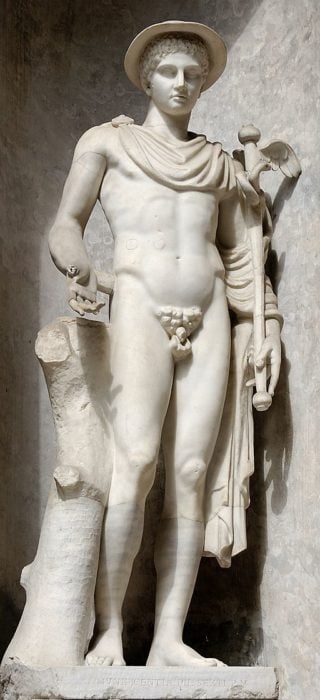
hermes Logios
Hermes Logios was the god that protected rhetoricians. Courtesy of Vatican Museums. Credit: Public domain, via Wikimedia Commons

Styles of speech, “Ethos,” and “Sincerity”

Ethos concerns character and moral presence within speech. Aristotle had already emphasized ethos as one of the three pillars of persuasion. Hermogenes expanded this concept stylistically. A speaker’s language reveals personality, values, and emotional disposition. Audiences trust speakers who appear honorable, wise, and sincere.

Ethos therefore demands moral credibility and emotional authenticity. Differing rhetorical situations also require varying forms of ethos. A judge, philosopher, general, or grieving citizen each projects distinct moral qualities through speech.

Hermogenes understood that persuasion depends heavily upon the audience’s perception of character. Even brilliant arguments fail when listeners distrust the speaker. Thus, rhetorical success involves ethical presence as much as intellectual ability.

Sincerity is another trait that creates emotional truthfulness and human immediacy. Hermogenes recognized that audiences respond deeply to speech that feels genuine. A sincere speaker avoids excessive theatricality or artificial ornament. Instead, sincerity emerges through direct emotional connection and honest expression. This style often appears in personal appeals, lamentations, or moral reflections. Sincere rhetoric results in intimacy between the speaker and audience.

Greek tragedy frequently employed this quality during scenes of grief or confession. Philosophers also valued sincerity because truth required alignment between speech and inner conviction. Hermogenes therefore treated sincerity as a rhetorical strength rather than weakness. Genuine emotion can persuade more powerfully than technical brilliance alone. Nonetheless, sincerity still requires artistic control. Raw emotion without structure can become chaotic or ineffective.

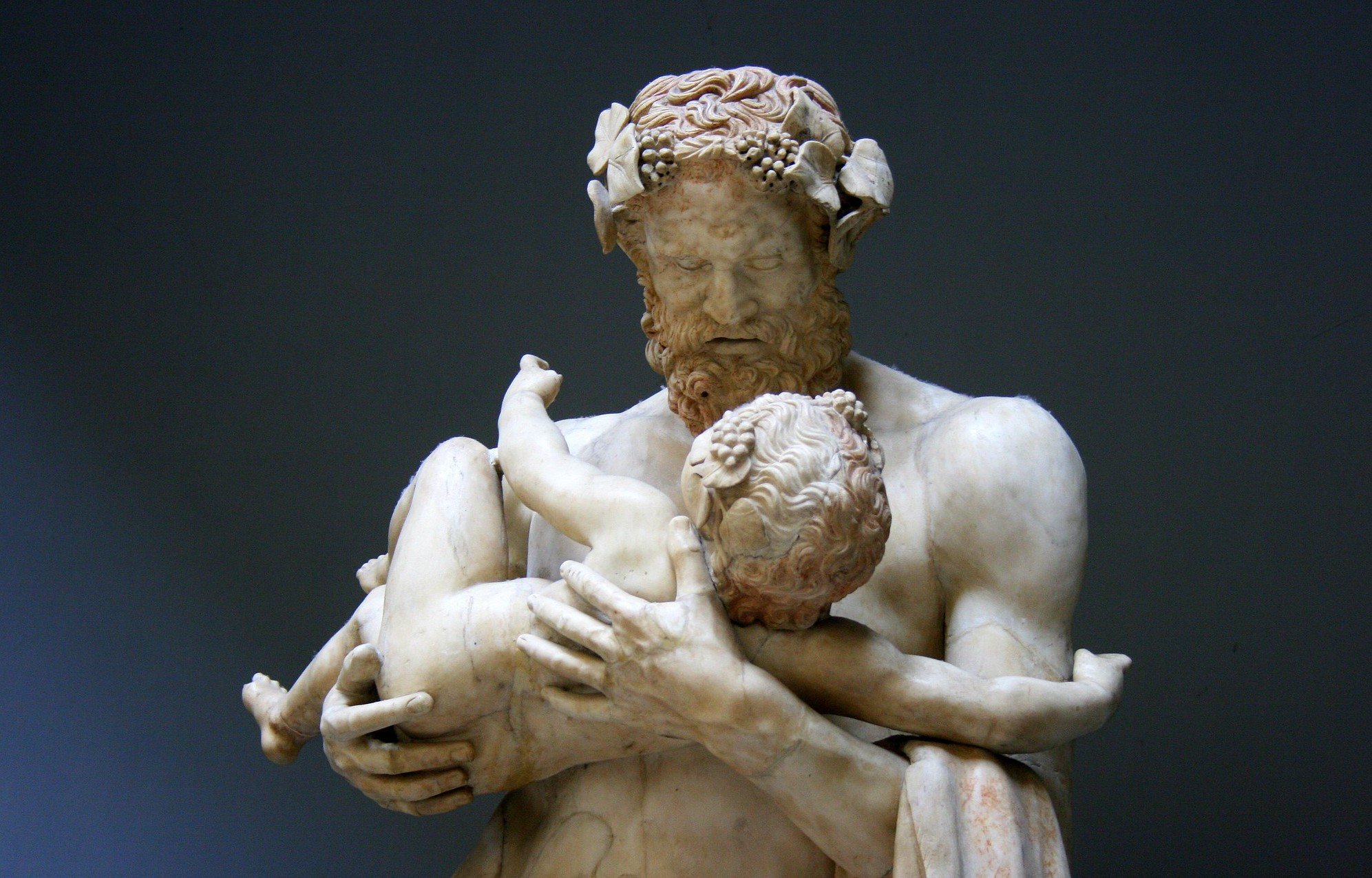
Silenus holds infant Dionysus
According to the philosopher Plutarch, Dionysus was also the god of sincerity. Credit: just.Luc / Flickr CC BY 2.0

“Force,” or Deinotēs, as the seventh of the major Ancient Greek styles of speech

Force represents the culmination of rhetorical power. Hermogenes viewed deinotēs as the ability to overwhelm audiences through intensity, authority, and commanding presence. This style combines emotional energy, intellectual precision, and persuasive momentum. Forceful rhetoric strikes listeners with irresistible impact. Demosthenes often embodied this quality during political speeches. His words carried urgency, moral conviction, and strategic precision simultaneously.

Force differs from mere aggression. True rhetorical force arises from mastery over every dimension of speech. Clarity, grandeur, rhythm, sincerity, and ethos all contribute to it. Hermogenes considered this quality extremely challenging to achieve, and only highly skilled speakers could combine all rhetorical elements harmoniously. Force therefore represented the highest form of rhetorical excellence.

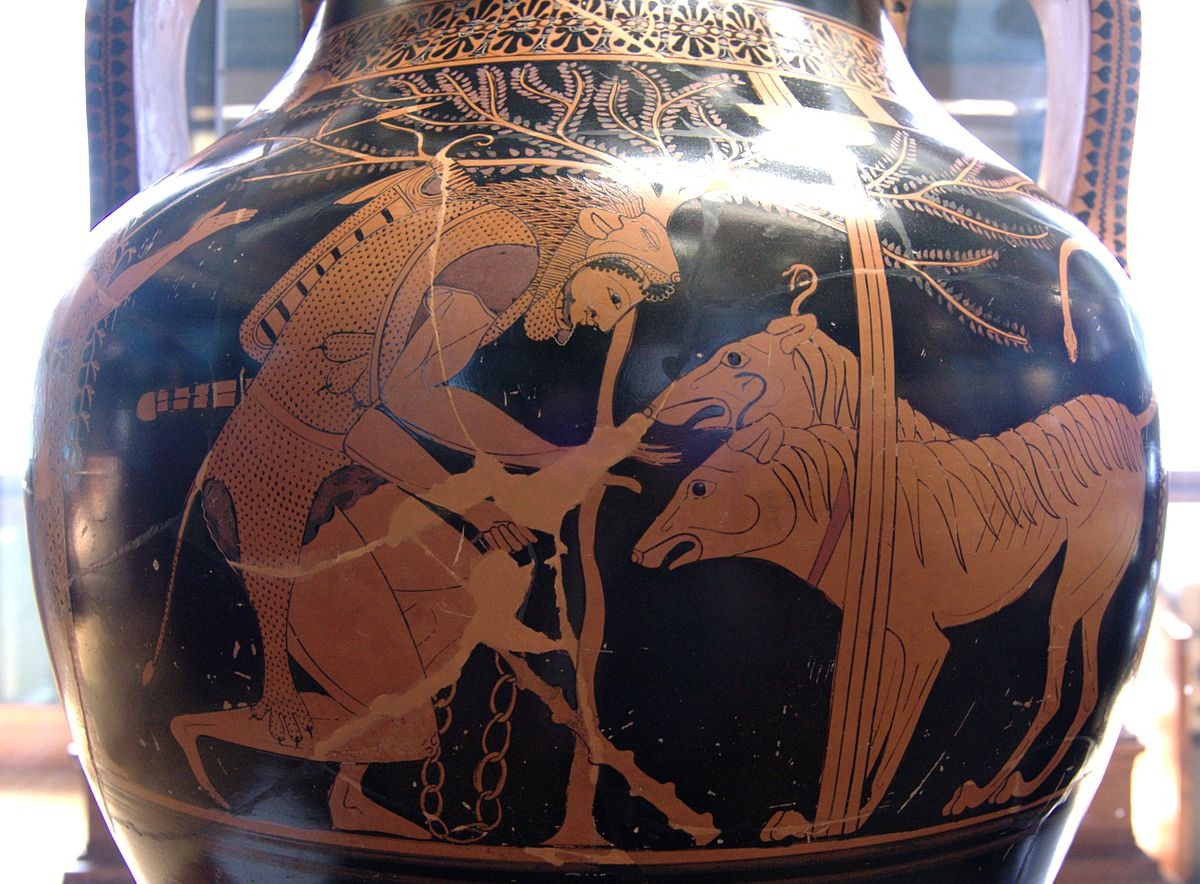
Cerberus and Heracles
Heracles, the strongest hero depicted on red-figure style Ancient Greek pottery. Credit: Louvre Museum / Public domain / Wikimedia Commons

The unity of the seven styles of speech

Hermogenes never intended these categories to function separately. Great rhetoric combines multiple styles according to circumstance. A political speech may require grandeur during patriotic appeals, clarity during argumentation, sincerity during emotional moments, and force during conclusions. This flexibility explains the lasting influence of Hermogenes. His system recognized the complexity of human communication.

Hermogenes of Tarsus shaped rhetorical education for more than a thousand years. Byzantine scholarship practically treated his works as sacred manuals of eloquence. Renaissance humanists later read his theories and incorporated them into European education. His influence extended beyond rhetoric into theology, literature, and philosophy. Christian preachers especially valued his understanding of emotional and ethical persuasion.

Even today, modern communication still reflects principles Hermogenes identified centuries ago in his seven styles of speeches. Political speeches, courtroom arguments, literature, and public debates all rely upon clarity, emotional force, sincerity, and character.

  •  

From Mussolini to mass incarceration: Why Gramsci matters today

A view of street artist Jorit's mural of philosopher and politician Antonio Gramsci that paid tribute to football player Diego Armando Maradona with a banner that read: 'Hasta siempre Diego' on November 27, 2020 in Florence, Italy. Photo by Laura Lezza/Getty Images

Imprisoned by fascist dictator Benito Mussolini in 1926, the prison writings of Italian Marxist theorist Antonio Gramsci remain essential 100 years later for understanding how fascism, policing, and incarceration function to suppress political dissent and preserve unequal systems of power. In this episode of Rattling the Bars, former Black Panther and political prisoner Mansa Musa speaks with renowned scholar Alberto Toscano about the importance and terrifying relevance of Gramsci today.

Guests:

Credits:

  • Producer / Videographer / Editor: Cameron Granadino
Transcript

The following rushed transcript may contain errors. It will be updated as soon as possible.

Mansa Musa:

Welcome to this edition of Rattling the Bars. I’m your host, Mansa Musa. Today, this is just a political conversation that we’ll be having about fascism, but more importantly, talking about the works of Antonio Gramsci. Joining me today is Alberto Toscano. Welcome to Rattling the Bars Alberto.

Alberto Toscano:

Thanks for having me.

Mansa Musa:

First, explain to our audience who Antonio Gramsci was.

Alberto Toscano:

So Gramsci is best known as former secretary of the Italian Communist Party and one of the most significant Marxist and communist theorists of the 20th century. And most of his theorizing, such as we know today, was done in prison in a series of no books, his prison notebooks that were published after his death and after the end of World War II. It’s actually this year is the 100th anniversary of his arrest, which took place on the 8th of November, 1926. He was arrested while a member of parliament for Italy by the fascist state under direct orders of the fascist dictator, Benito Mussolini, in fact breaching his parliamentary immunity, which he still had at the time. Before that, Gramsci had been a communist militant, but had also been a journalist. That was his trade and also that was one of the principle ways in which he engaged in political organizing first in the Italian Socialist Party and then in 1921 in the Communist Party, when there was a split from the Socialist Party to the left.

And so he only became a member of Parliament in 1924. So he was only in Parliament for a year and a half. And of course this was a very anomalous parliament because fascism had already

Come to power in 1922, but had become increasingly more repressive. And by the time of Gramsci’s arrest, then you essentially have in the wake of that, the formation of a one party state and the abolition of any kind of multiparty system.

Mansa Musa:

So to respond to him was predict based on not only so much of his being in the parliament, but based on his writing and his journalist and what he was reporting on is that what caused him to ultimately be arrested because in a parliamentary setting, you don’t have but so much power or you don’t have so much control over information. You either going to articulate your party position. I’m a communist or you going to advocate for policy change. But in a journalist capacity, you’re hitting home with information, educating people about repression and the disconnect between the government and people. Is that what led to his ultimate aggress?

Alberto Toscano:

Well, I think both those elements at once. So on the one hand, Gramsci was the leader of the most significant and most combative group among anti-fascist forces in Italy. He was very well known internationally, of course, in the context of the communist movement. He was the head of the party. And what fascism did from before it came to power until it really fully came to control Italy was to try to destroy and neutralize all forms of working class and popular opposition and resistance. So of course the papers, whether public or indeed clandestine, all forms of education, all forms of working class organizing. And so Gramsci in many ways brought together all of those figures. The journalist, the educator, the party leader, the organizer. And so the idea was that really to arrest them was to decapitate the

Mansa Musa:

Communist

Alberto Toscano:

Movement and the anti-fascist movement. And the famous sentence I believe voiced by Mussolini, but I think also spoken by the judge at his final trial, which was in 1928, was that we’re going to stop this brain from thinking. So the idea was not just the problem of organization, not just a problem of the political and even militant power of the communist movement. The idea was that their very ideas, their ideology, their capacity to organize the worldviews of the working and popular classes in Italy had to be quashed. And so that was key. And so along with a whole number of communist party leaders and militants, Gramsci was arrested on the basis that he was leading an insurrection. I think this was the crime, let’s say, for which he was convicted was the attempt to overthrow the Italian state because shortly before his arrest, there had been a botched assassination attempt on Mussolini.

So that was kind of used as a pretext.

Mansa Musa:

And let’s unpack the stop his brain from thinking because when you look at that particular sentiment, this is what Corntell Pro was designed for in the United States specifically to stop any, who would say the rise of a Black Messiah as it related to Black people. But his overall goal was to stop brains from thinking, stop people from organizing. Talk about how Gramsky, in terms of the abolition, mirrors what we see today, a lot of the theory and a lot of the perspective about abolishing prison come out of prison, come out of the thinking and what it looked like and what it will look like, come out of the space where people are incarcerated or people are in prison. Can you make a connection between the two?

Alberto Toscano:

Yeah. I think the connection is a connection we can make, but it’s also a tricky connection to the extent that certainly in the 1920s and ’30s, the communist movement or the socialist movement, or even the anti-fascist movement more broadly, did not in any straightforward way ascribe to an abolitionist position as part of its program. And in the case of Gramsci, of course, we do have this very strong parallel that imprisoned intellectuals have played an enormous role in political education and political organization

Mansa Musa:

Across

Alberto Toscano:

Anti-colonial, across anarchists, across communists, across black liberation movements, and of course into contemporary abolitionist thought. Just the other day I was looking at the list of the books in George Jackson’s prison cell, right? I think number 82 was a collection by Gramsci, the modern prince. So amongst other things, he was also reading Gramsci. And in fact, if we look at Jackson’s Blood in My Eye, there’s a remarkable amount of detailed writing in the chapters on fascism about the emergence of Italian fascism

Mansa Musa:

In

Alberto Toscano:

The early 1920s. So I think there’s really important links and also Gramsci, I think among Marxist theorists, even though I wouldn’t go as far as calling him an abolitionist, he certainly had a very complex and developed thinking around the nature of the police and policing, right?

Mansa Musa:

And

Alberto Toscano:

About thinking about the relationship between policing, repression, the modern state and fascism. And one thing I think we have to keep in mind is that the prison notebooks, which incidentally, Gramsci only started writing when he was allowed to have a pen and a notebook in his cell, which was, I think, three years into his imprisonment. So for the first two and a half, three years, these were thoughts that he could only sketch out in letters to his family. He was only allowed to write to his family, not to comrades. And only after a lot of work mainly by his sister-in-law, Tanya, was he allowed finally to have notebooks? He couldn’t keep the notebooks all in his cell. So he had to have a complex way of organizing his thoughts because then they would be stored by the prison warden. So he had this very, aside from having extremely difficult health conditions that eventually led to his very early death, of course, worsened by the fascist prison system, he was also working against all odds as most imprisoned intellectuals and most imprisoned people have in terms of writing, reading.

The most basic things become huge struggles. But Gramsci’s notebooks were there in many ways to try to figure out the nature and the causes of the defeat, at least partial or temporary defeat of the anti-fascist movement. And that’s, I think, partly the reason why he was so interested in thinking in this expansive and complex way about the police as something that reproduced the social order, but also, and this is key for Gramsci, the police as that which disorganizes or neutralizes the opposition to a dominant or hegemonic power. And in many ways, fascism’s success as well as a result of the weakness perhaps or the failures of anti-fascist forces was also a result of its ability in disorganizing the working class and disorganizing the parties of the left and disorganizing the anti-fascist front. There was a contemporary of Gramsci who started out in the fascist movement, ended up much later in the Communist Party.

Kutzio Malapalta wrote a famous book called The Technique of the Cudita, and he talks about the fascist march on Rome in 1922. And he says that fascism’s singular ability is, as he put it, to make a void around itself. So to disorganize and in that sense, going back to what you were mentioning before about Kointel Pro, this idea of stopping thought, of stopping the relationship between intellectuals, organizations and resistance is absolutely key to fascism, which is after all a counter-revolutionary movement. And so as a counter-revolutionary movement or a counter-revolutionary regime, it’s also always a form of counterinsurgency or Angela Davis and Marcusek borrowing from an Italian anarchist from the 1920s use this term, preventive counter-revolution. So that in many ways is what policing is, right? Including for Gramsci, the police in one of its aspects is this complex practice of preventing the possibilities for successful social transformation or revolutionary change.

And Gramsci, because he had this very expansive notion of the state, also argued that the work of policing is not necessarily just done by the police, like by the uniformed police,

Mansa Musa:

By police as

Alberto Toscano:

A branch of the state. It can also be done by all kinds of private, commercial, paramilitary, NGO, all sorts of different bodies can fulfill this function of reproducing a dominant order and preventing the emergence of its challenger.

Mansa Musa:

And to show you how study was, when you look at today, we talk about creating a disorganizing, we look at today, everything you just outlined, you got private police, you got private prison industries, you got everything that’s designed around this organized or keeping people disorganized is being perpetuated today through this system as we see it. A lot of misinformation, a lot of heavy-handed policing when we see what’s going on with ICE. So his perspective as it relates to this being a wing or armor of fascism is very astute. And I like the fact that how he look at the police because Hoover and that administration, they use every level of the police in this country to eradicate any opposition. They completely destroyed the Black Panther Party as a result of infiltration or just like what they did with Fred Hampton coming to kill you or send information, misinformation, create beefs between opposing parties, individuals, right?

But talk about Grumpy wrote on Foudism, viewing it not just as a factory system, but as a project to create a new type of man through disciplined labor and regulated private lives as that industrial mold collapse, how did the transition away from Foudism help pave the way for the castle system as we see it today?

Alberto Toscano:

Yeah, that’s a really complex question. I wanted to take a step back first just to make a quick comment about what you just said regarding the dismantling by Hoover and the FBI and the infiltration of the Panthers and of course of other movements as well. Actually, Gramsci’s arrest, and there’s still a lot of debate by historians about this, was seen by Gramsci himself and by many of his comrades as a result precisely of forms of infiltration. And we now know that high level members of the Italian Communist Party, including somebody who then became a very famous anti-communist writer in Yazosilone, were paid informants,

Mansa Musa:

Right?

Alberto Toscano:

And the problem already was a similar experience as that of other movements and parties that have been subjected to counterinsurgency practices and infiltration is that if you read biographies of Gramsci, you can see that for good reason he’d become extremely suspicious

Mansa Musa:

Of

Alberto Toscano:

A number of his comrades and the fascist infiltration had led to a lot of bad blood. Some of it, it’s like fed jacketing, right? Some of it was people who actually weren’t infiltrators, but who their comrades thought were. So that dynamic was something that the fascist secret police had very much implemented already in the 1920s and 30s and it was part and parcel even of the process that led to Gramsci’s arrest.

Now, to answer your question, even though Gramsci had never been to the United States and was writing all of this material with a trickle of books and newspaper, he was reconstructing the nature of what was to become the capitalist hegemon in the United States from the confines of his prison cell under these extremely trying conditions, but he became convinced in many ways in a fairly prescient or kind of prophetic way that the reorganization of labor, capital and society in the States around the time of course of the Great Crash of 29 and then of the beginning of the New Deal under Roosevelt was a kind of pioneering transformation. So he used this terminology of Americanism and then of course used the term Fordism after Henry Ford and after the forms of labor organization, but also the efforts by Ford to really transform the private, moral, social, even sexual lives of workers in Ford factories.

And this is what Gramsci’s getting at when he’s talking about the way in which capitalism is also tandentially creating a kind of new man or a new worker or a new person and so on.

Mansa Musa:

And so

Alberto Toscano:

Many people after World War II developed these insights to talk about the regime of accumulation and the regime of labor organization pioneered by the United States as a form of fortism often linked to relatively high wages for workers in exchange for their abstention from excessive forms of class struggle, the idea that workers could also become consumers rights, so the two car nuclear family and so on and so forth. So that whole kind of norm and also kind of vision of consumer society linked to mass production

And what people have been arguing since the crises of the 1970s has been that that arrangement which was just being formed around the time that Gramsci was writing his notebooks and then becomes really pervasive and dominant in the United States, but also in the so- called global north in the post-war period comes into a kind of crisis in the 1970s, a crisis that now people talk about in terms of the emergence of neoliberalism and so on and that the norm of fortism, which had to do with mass production, mass consumption, and what the geographer, Marxist geographer, David Harvey, called a kind of almost a pact or truce between big labor, big unions, big capital in the state, this kind of phrase and you have high inflation, unemployment, and then this move to withdraw the state from social welfare, social reproduction, to limit people’s social and civic rights and so on and so forth and to give much more liberty to capital,

Mansa Musa:

To

Alberto Toscano:

Accumulation, to markets and so on and so forth. And so many people read Gramsci’s analysis of fortism as a way by contrast to think about the crisis of fortism in the 1970s, which is of course in the United States, not just in the United States, but in the United States in particular, then sets the conditions, it’s not immediate, but sets the conditions for what will become the question of mass incarceration as a form

Mansa Musa:

Of

Alberto Toscano:

Class warfare against surplus and racialized populations. And that’s what’s interesting is that when Gramsci’s writing in the 1930s, late 20s, 1930s, he’s saying, “Well, Europe can’t really do fortism properly because we have this demographic issue

Mansa Musa:

And the

Alberto Toscano:

Demographic issue in Europe is that there’s large peasantry, but there’s also old classes of landowners and there’s a kind of like- Landmarks. Yeah. And then the United States from a European standpoint, a more modern country doesn’t have those issues, right? But in fact, when you look at the crisis of fortism, then the problem of surplus populations, unemployment as linked to these questions that we’re just talking about, like mass movements for emancipation, black liberation and left wing movements, that kind of comes together. And so on can see the emergence of what then comes to be called the prison industrial complex as a kind of confluence and articulation of a counterinsurgency project on the one hand to break the back of movements, challenging capitalism, white supremacy, so on. But then on the other hand, also as a question of political economy and labor, as a question of what to do with increasing deindustrialization with the desire by the capitalist class to break that postwar arrangement because it’s no longer attractive or feasible for them and therefore to shrink manufacturing labor to reduce social rights and so on.

So I think we can use Gramsci. Of course, he’s talking about a very different moment. He’s talking about the emergence, the moment of emergence of something

That then enters into crisis in the 1970s and creates the conditions, the social and political conditions for what will become the prison industrial complex, what people call mass incarceration and so on

Mansa Musa:

And so forth. And that’s the natural outcome of that contradiction, forwardism, industrialization, but the means of production versus how do you treat people that’s producing? And you create this illusion that they had what they call Leavitown where they create these massive housing projects, they call Leavitown for World War II and when they was coming back from the war, but at the same token, your income or what you’re getting to live this lifestyle cease to exist because to your point, greed is dominant. Capitalism, they’re not trying to share the wealth. They not sitting back saying,” Well, we’re going to give you equal pay for equal labor.

Once you unionize, we going to bust that, we’re going to subjugate you. We’re going to create factories that dehumanize you, which ultimately the contradiction will become so antagonicity that the work is going to respond and respond to that repression and respond to the repression is the prison industrial complex. Some way to contain that is going to be kill you or imprison you, and that’s the natural outcome of capitalism and imperialism. But Grumsky also talked about the contradiction between, or as far as in how rural produces and then the urban consumes, can you make a comparison between that and what we see today in this country as far as how that move into that particular part of the narrative goes into the prison industrial complex or how is it that is it a relationship between the two?

Alberto Toscano:

Well, Gramsci in the Italian context of the 1920s and ’30s, he’s also somebody who comes from, even though it’s an island, Saldania, what was considered part of the South. So an area that was viewed as underdeveloped and also Sardinians themselves in a way that’s of course different from Black and Brown folk in the United States, but they were certainly in the 19th century, kind of racialized as semi-savage, partly barbarian, backward,

Mansa Musa:

Same thing

Alberto Toscano:

With Sicilians and Southerners and so on. So for Gramsci, but also for the whole socialist and communist and workers movement, there was this issue which took the name of the Southern question. It was very common in the 19th century and 20th century in the workers movement to talk about, you would have the women question, the southern

Mansa Musa:

Question,

Alberto Toscano:

All these questions. But the southern question was a way for Gramsci to think both about this geographical differentiation in Italian capitalism, but also about the fact that there were forms of so to speak internal colonialism. And Gramsci does use this language, right? He says the relationship of northern capitalists to southern peasants is like a semicolonial relationship. He talks about the role of the police and of police violence in managing and reproducing this internal colonial relationship so much so that recently an American theorist, Michael Denning has made really interesting parallels between the prison notebooks and actually what Du Bois was writing about northern capital and southern black labor and black reconstruction, which is a text written at the same time, like pretty much contemporaneous with Gramshi. As a political analyst, as a journalist and as an organizer, the question for Gramsci who was based in Italy’s the center of Italy’s car industry, like Italy’s Detroit, so to speak, which is Turin, where the Fiat Factory was, was to think about how could the industrial workers movement and the proletarian movement make links to a peasantry that was much less politically organized, but of course was being massively exploited

Mansa Musa:

Through this form

Alberto Toscano:

Of internal colonism. So part of his issue, which was it’s like the issue of all communists and socialist movements that start out like the Russian Revolution in situations where you have high proportion of workers are still tied to the soil or tied to rural forms of life, was how to make this alliance, this like worker peasant alliance.

Now, if we fast forward to the 1970s, and I’m thinking here of the work on the emergence of the prison industrial complex in California by Ruth Wilson Gilmore, we can think how the rural and the urban in moments of crisis enter into a particular articulation that creates this kind of racialized prison fix. So in the case of 1970s to 1980s California as mapped out by Gilmore, this is the situation where you have surplus capital, you have surplus land because there is a There’s a crisis or partial crisis of agribusiness and certainly of rural employment because of mechanization. And then of course you also have this through the crises of the ’70s, this expansion in surplus labor, which is also racialized and criminalized in the kind of last hired first fired situation of racialized workers. And so it’s in that context that then prison building is presented and advanced as a way of linking what to do with the surplus labor, which is to say incarcerated or incarcerate some of it and threaten the rest surplus capital to then invest in these projects of prison building that are largely taking place in kind of rural context.

So I mean, that’s just one very sketchy presentation of what is a very complicated geographic and political and political economic argument by Gilmore. But I do think that that geographical dimension is really significant for thinking about the dynamics of domination, exploitation and resistance. And that’s also why Gramsci’s own kind of form of geographical thinking was significant to so many ant-colonial scholars. So the Gramsci’s writings in the Southern question are very significant for radical Indian historians. They’re very significant for the Palestinian American

Mansa Musa:

Critic,

Alberto Toscano:

Edward Said when he writes about culture and imperialism. So that geographic dimension I think is a really unique aspect of Gramsci’s thinking, but also comes from his personal experience as somebody who comes from this semi-internal colony, but who then moves as a very young man to become a journalist and a militant in the most industrial and most advanced center of Italian capitalism. So he experiences these multiple worlds and these juxtapositions in his own person. So I think that’s also significant. And I imagine one can also make links to all of the debates that took place in the history of US Black liberation movements around this theme of internal colonialism, going back to arguments about the Black Belt and the communist movement and so on.

Mansa Musa:

And you see the Southern question when he talks about, as you articulated, how the industrialization and then the decline of the industry in rural America, you see a good example here in Maryland. In Maryland they had in the western part of Maryland, they had the upper western part of Maryland, they had industry. When all their industry closed down, prior to their industry closing down, they was talking about building prisons in that part of the state and everybody in Western Maryland was opposed to it because they had a number of prisons in different parts already. So they was like, “Nah, we’re not having that. ” But a year or two later when the industry closed down, they were begging for them to build a prison. They literally begged for them to build a prison. And now when you get to western part of Maryland, as far as your eye can see, it’s nothing but prisons.

And this come out of the analysis you just made was like how at one point you had industry, you had this industrialization, you had money, but now the shift is you shift from agribusiness to concrete and steel that becomes your product and your product is human beings and you ain’t picking cotton there, you picking up human beings and that’s your product in that narrative, right?

💾

Locked up by fascist dictator Benito Mussolini in 1926, the prison writings of Italian Marxist theorist Antonio Gramsci remain essential and terrifyingly relevant 100 years later.
  •  

The new samizdat

While much of the media industry focused on the churn of headlines, we became increasingly interested in the undercurrents beneath them: the hidden systems, infrastructures and ideologies shaping events across borders and over time.

Again and again, our reporting led us back to the same realization: for a long time, the struggle over information was understood primarily as a question of censorship or access. Who controls information? Who gets to publish? Who gets silenced?

Those questions still matter. But they no longer fully describe the world we live in.

Today, the struggle over information is about who builds the systems through which reality is organized, distributed and trusted. From state propaganda to algorithmic feeds, from platform monopolies to AI-generated noise, the battle is not over facts. It is over the infrastructures that determine which narratives spread, which voices are amplified and which communities remain connected.

Over the past year, these questions led to a collaboration between Coda and The Continent, the pan-African newspaper founded in Johannesburg by Simon Allison and Sipho Kings. Although our reporting emerges from very different histories and geographies, we found ourselves arriving at remarkably similar conclusions about power, fragmentation and the future of journalism in an age of informational instability.

This two-chapter essay is the beginning of that collaboration, and marks the start of a new project called The Atlas. Pilot edition is available here — please feel free to share with friends, family and colleagues, preferably in its entirety.

In Chapter One, I return to the world of my Soviet childhood: propaganda, samizdat and the search for trustworthy signals through noise.

In Chapter Two, The Continent co-founder Simon Allison presents the Parable of Sinn Sisamouth: the story of how some of the greatest songs ever written were nearly lost, and then found, and then lost again. 

Taken together, these essays ask what journalism becomes in a world where information is no longer organized primarily to inform, but to capture attention, manufacture reaction and shape perception at planetary scale.

The Atlas grows out of that question.

Chapter One: Through the Static

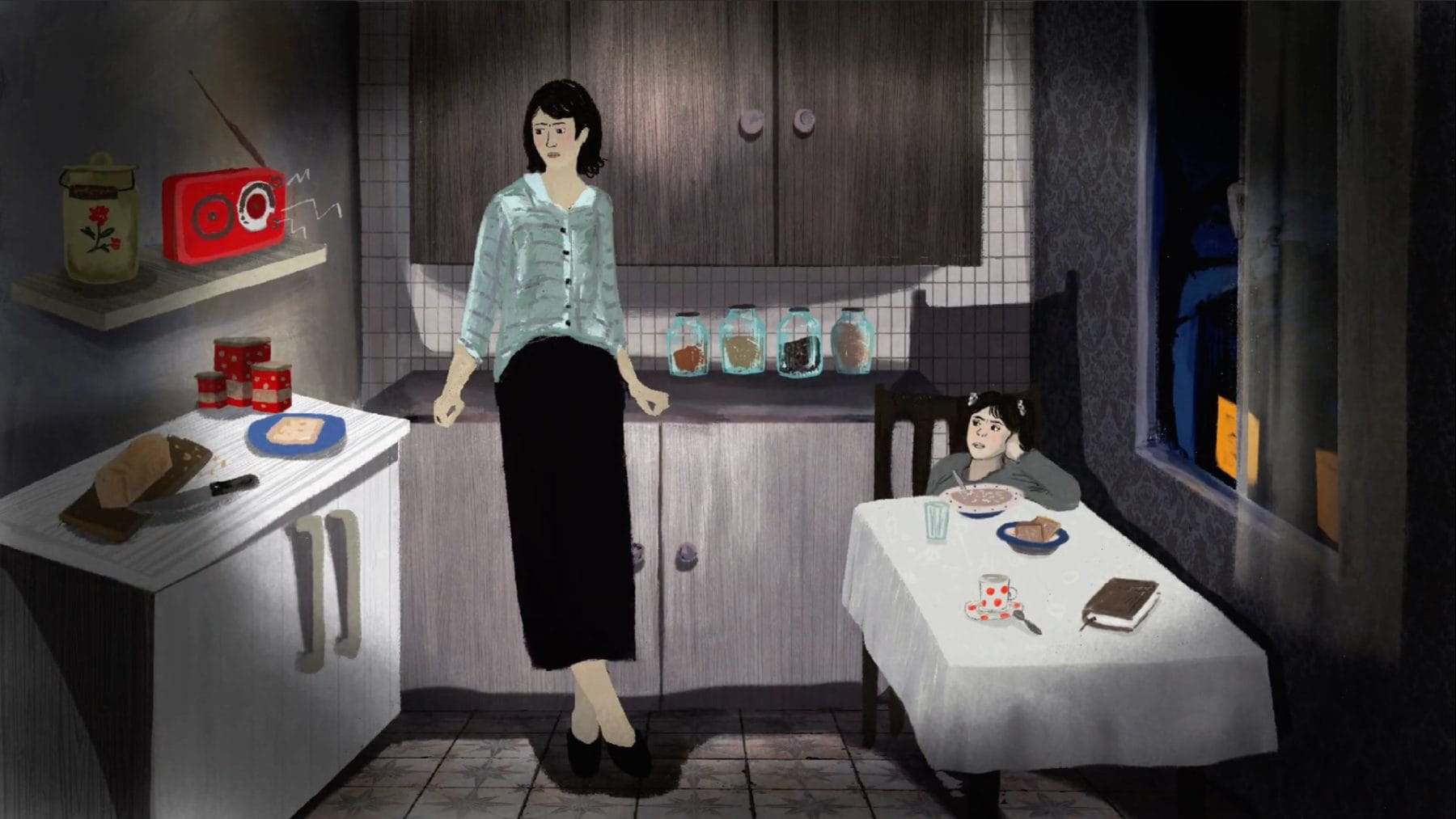
Whenever I am asked why I decided to become a journalist, an image from my childhood pops into my head. It’s dusk. I am 10, sitting in the kitchen with my mom. She is glued to a shortwave radio. Outside, the Soviet Union is on the cusp of collapse. Georgia, where we are, is on the brink of civil war. We didn’t use the term back then, but fake news was all we got through official channels. Real news — coming from the West — felt like a lifeline. I was in awe of the crackling radio that held my mother’s full attention. I wanted to become that voice.

Illustration: Anna Jibladze.

Years later, I got my dream job at the BBC and spent much of my adult life moving between wars, uprisings and authoritarian states. Again and again, I found myself in places where truth was contested terrain: Baghdad, Damascus, Donetsk, Sana’a. But over time I realized something fundamental had changed. Modern authoritarianism no longer relied primarily on suppressing information. It had discovered something more effective.

Information could simply be drowned out by static.

That realization became stark for me in eastern Ukraine in the summer of 2014. I arrived in a field of bright yellow sunflowers where the bodies from Flight MH17 still lay scattered across the ground. A Russian missile had blown the passenger plane out of the sky, killing all 298 people on board. Yet almost immediately, the Kremlin flooded the information space with competing explanations. It was a Ukrainian fighter jet. A failed assassination attempt on Putin. The plane had been filled with corpses before takeoff. Each theory contradicted the next, but that hardly mattered. The point was not to persuade, it was to exhaust. It was to create so much noise that truth itself began to feel unstable.

Over the following years, I watched versions of the same logic spread far beyond Russia. Social platforms transformed public conversation into a permanent stream of outrage, performance and distraction, collapsing vastly different kinds of information into the same endless feed. War footage, propaganda, conspiracy theories, journalism and gossip all began competing inside systems designed not to inform people but to capture and hold attention.

Noise became the new censorship.

And increasingly, I found myself thinking about the world of my childhood again. Not because history was repeating itself neatly, but because the emotional landscape felt strangely familiar: confusion, exhaustion, distrust, the constant sense that reality itself was becoming slippery. Back then, people searched desperately for clear signals through the static of Soviet propaganda. Today, we are drowning in a different kind of static, but the instinct, the search for clarity feels remarkably similar.

In the Soviet Union, people developed ways of navigating that confusion. Among my strongest memories from that time is the sound of my parents’ typewriter late at night. Friends would pass around copies of banned Soviet literature and my parents would sit at the kitchen table all night, retyping them page by page so they could be shared again. It was my first encounter with samizdat, although I didn’t know the word then.

Looking back now, what strikes me is that samizdat was never simply about forbidden texts. It was about building trusted alternative systems of circulation when official systems had lost credibility.

At Coda, we have spent years building journalism against the logic of noise. We slowed stories down. We followed themes instead of headlines. We built a reporting system designed to connect events across borders and over time, helping readers see patterns instead of fragments. But as our globally distributed newsroom adapted to an increasingly fractured information landscape, it became clear that journalism alone was not enough. Distribution shapes understanding as much as reporting does.

Around the same time, in Johannesburg, Simon Allison, Sipho Kings and their team were building something that challenged many of the assumptions dominating digital media. The Continent, their pan-African newspaper, spreads largely through direct sharing networks: passed from reader to reader rather than pushed by algorithms.

Illustration: Wynona Mutisi.

Different histories had brought us to remarkably similar questions. What does journalism look like when trust is collapsing, attention is fragmented and the systems that carry information have themselves become instruments of power?

Out of that convergence came The Atlas: a new publication that brings together Coda’s methodology of following systems across borders and over time with The Continent’s radically distributed model for reaching readers beyond algorithmic feeds.

The Atlas is built on a shared conviction: as fragmentation, distrust and informational overload spread across the world, some of the clearest ways through will come from places that have already spent decades navigating propaganda, instability and contested reality. Places once treated as peripheral are becoming essential to understanding the defining question of this age: how can meaning survive systems designed to overwhelm it.

Michael Macor/San Francisco Chronicle via Getty Images.

Chapter Two: The second silencing of Sinn Sisamouth

Imagine if your favourite song disappeared, forever

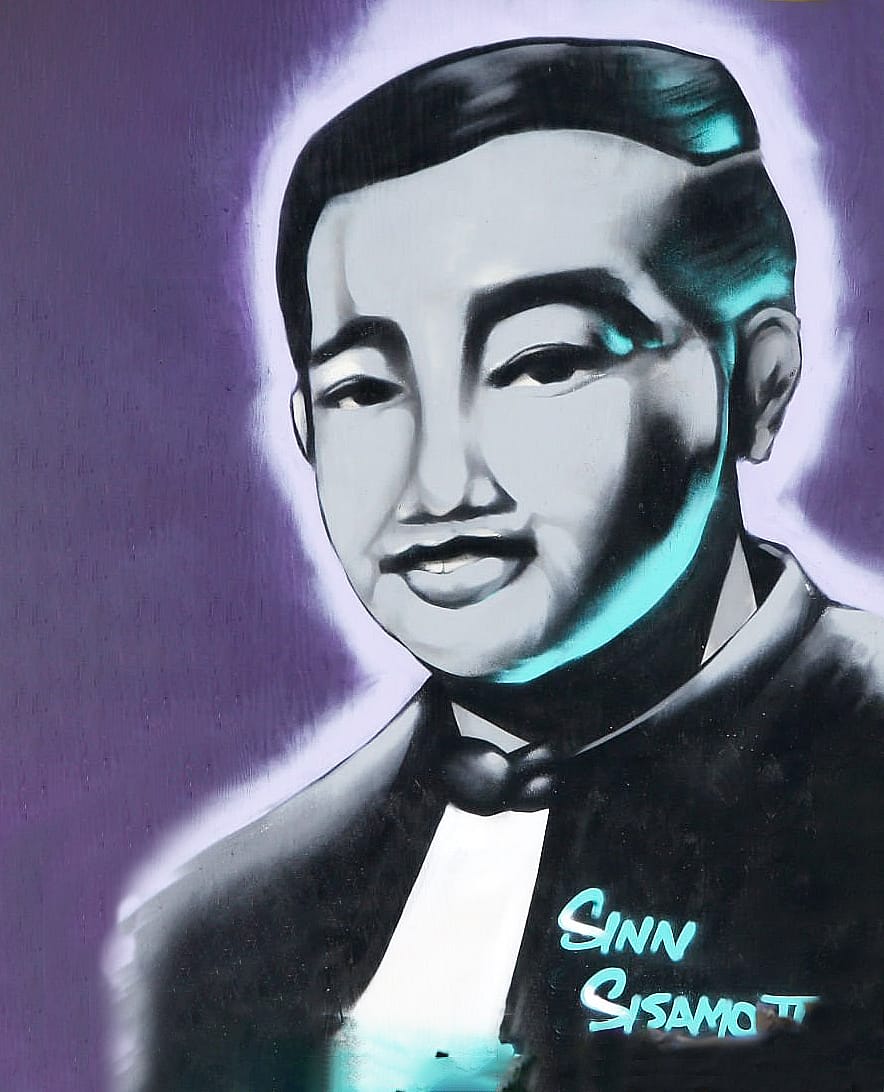
Almost every album I have ever loved was recommended to me by my friend An-Rui. A few months ago, he sent me a track by the undisputed King of Khmer Music, the Golden Voice, the Cambodian Elvis himself – Sinn Sisamouth.

I had never heard of him.

I didn’t respond at first, so he nudged me. That night, after the kids were asleep, I put on my headphones, sat in the garden and immediately lost myself in Cambodia’s psychedelic rock scene of the 1960s and ‘70s. I don’t know enough about music to explain exactly what I fell in love with, but within weeks I was, according to Spotify, among the top one percent of Sinn Sisamouth listeners worldwide.

An-Rui had added a note to his recommendation. “the songs are happy but since i know what his fate was and i don’t understand the words, it sounds incredibly sad to me”.

The story goes something like this: A small-town boy with an extraordinary voice moves to the big city, and conquers all before him. He writes hundreds of songs, bridging Khmer musical traditions with new western influences: jazz, rock & roll, bossa nova, blues, the Beatles, and, of course, Elvis Presley. He toured the country. He toured the world. He made music with an actual King, Norodom Sihanouk, and became Cambodia’s most beloved rockstar.

Then, in 1975, the Khmer Rouge seized power. In the course of committing a genocide, the communist regime disappeared Sinn Sisamouth, and banned his music. He has never been seen, or heard from, again.

But his music never died. It lived on brittle records, hidden for generations under floorboards. It lived on scratchy cassettes, passed hand to hand among the diaspora.

It was only decades later that his music was digitised and remastered, and made available on streaming platforms to the likes of me.

When I listen to Sinn Sisamouth, I can’t help but think about how easily we could have lost his masterpieces entirely. And I wonder what else might have been lost that we have not been able to recover.

And then it happened again.

There’s a particular track that I like to play in my car, where I can turn the bass up as high as it goes. I was driving one afternoon and looked for it on Spotify. It was gone, even though the rest of the album was there. 

I looked again on my laptop at home. Nothing. Gone from Spotify. Gone from Apple Music. Gone from YouTube. Like it had never been there in the first place. I started to wonder if I had gone crazy, and maybe imagined the song entirely. And then I started to panic: What if I never heard it again?

Eventually, I found a bootleg YouTube version, using a different transliteration of the Khmer title – Kanlang Pnheu Pran, instead of Konlong Phner Bran. Before I tracked that down, I had to wade through dozens of AI-generated Sinn Sisamouth ‘cover versions’, all uploaded to YouTube within the last few months. If I had never heard it before, I would never have been able to tell which was the original.

It’s not unusual for songs to disappear from the Internet, especially when the music is from non-English-speaking countries. I’ve had similar experiences with the music of Sharhabil Ahmed, the Sudanese jazz legend, and Ethiopia’s Tilahun “The Voice” Gessesse.

In fact, it’s not unusual for other kinds of information to disappear from the internet; to be edited after the fact; or to be simply lost among all the digital noise. Digital information is incredibly precarious, and becoming more so by the day. AI slop is taking over social media platforms. Algorithms determine what information we can and can’t see, shaping our cultural and political preferences. And powerful interests are becoming increasingly bold when it comes to brazenly manipulating information in their favour – or, of even greater concern, restricting the flow of information across borders.

Amazon changes the contents of books on people’s Kindles without telling anyone. News websites quietly alter critical stories, post-publication, to remove evidence of wrongdoing (my favourite example: the Financial Express published a story critical of India’s richest family; only to replace it with a glorified press release a few days later. They neglected to amend the URL, however, which contains the original headline). Governments shut down internet access on a whim, or legislate which apps and websites are available to specific populations.

For journalism, this is an existential threat. Our job is not just to hold power to account – it is also to write the first draft of history. But if we can’t preserve that first draft, or distribute it effectively, then what, exactly, is the point?

The Continent and Coda Story are working together to try something different. We want to publish news about the world, produced and verified by humans, that cannot be edited after the fact; and to distribute it in a way that dramatically decreases our reliance on unaccountable algorithms or search engine optimisation. The Atlas — pilot edition available here — is our answer to the precarity of information online. It’s a work in progress.

Stay tuned: if we’re going to succeed, we’ll need your help. And if we do succeed, the secret of our success will be those very same transnational networks that kept the music of Sinn Sisamouth alive. Communities of like-minded people, of friends and families will always find a way to stay connected, no matter how vast the distances between them, or how great the obstacles. So what does a global newspaper look like if we design it with exactly these communities in mind?

As soon as I found that bootleg on YouTube, I ripped an MP3 copy and sent it to An-Rui on Signal. “KEEP THIS SAFE,” I told him. I don’t know what happened to the song on Spotify, or if it is ever coming back. But I can’t take the risk of never hearing that bassline again. And here it is, in case you want to hear it too.

The post The new samizdat appeared first on Coda Story.

  •  

The afterlife of empire

On May 3, an unusual procession moved through Washington DC. Several hundred people walked beneath the monuments of the American capital carrying portraits of Red Army soldiers. Children waved Soviet flags. A live orchestra played wartime songs at the World War II memorial. The Russian embassy had filed the permit; the DC Metropolitan Police provided an escort. Russian state media celebrated the event as proof that, with the return of Donald Trump, historical truth too had returned to America.

One organizer told Russian state television: “We love, respect Russia, honor the memory of our heroes.”

Similar marches took place in Paris, Amsterdam and Busan. In Berlin, authorities announced that Soviet flags, Russian symbols and military songs would once again be banned near Soviet war memorials during May 8 and 9 commemorations.

But in Moscow, Victory Day itself appeared haunted by fear.

For decades, May 9 has been Russia’s most sacred annual political ritual, binding victory, patriotism and state power into a single language. But this year, Kremlin spokesman Dmitry Peskov was reduced to announcing that the Immortal Regiment march in Moscow would continue only “in electronic format.”

The run up to this year’s Victory Day became the most anxious Moscow has experienced in recent memory. The Kremlin canceled the traditional procession in the Russian capital, moving it online. Military equipment was removed from the parade. Mobile internet access across Moscow was intermittently shut down in the days leading up to May 9. Spectator numbers in St. Petersburg were reportedly slashed from thousands to just a few hundred. The Victory Parade in Kaliningrad was canceled entirely. Russian media outlets published extraordinary reports about Vladimir Putin retreating deeper into protected bunkers amid fears of Ukrainian drone strikes and assassination attempts.

Russia’s Foreign Ministry even warned foreign governments to evacuate diplomats from Kyiv before May 9, threatening massive retaliation if Ukraine targeted the celebrations with drones.

And then came another extraordinary twist. Volodymyr Zelensky publicly “allowed” the parade to proceed. In a deliberately tongue-in-cheek decree issued after negotiations around a temporary ceasefire, the Ukrainian president formally excluded Red Square from Ukraine’s operational strike plans for the duration of the celebrations, even listing the exact geographic coordinates of the square itself.

Watching it all unfold, I kept wondering whether empires collapse more easily than the systems of feeling they create. The Soviet Union fell apart more than 30 years ago, but the architecture built around victory, sacrifice and historical grievance survived it, stretching across borders, diasporas and rival political projects. What began as Soviet myth-making about liberation has evolved into a transnational political language through which governments, activists, diasporas and rival ideological movements compete over legitimacy, victimhood and belonging.

Over the years, at Coda, in our Rewriting History current, we have tracked how the remembrance of World War II became central to Putin’s machinery of legitimacy and repression. Soon after he came to power, Russian public culture became saturated with stories of the Great Patriotic War. Watching Russian state television often felt as if the war had ended yesterday. New films, schoolbooks, drama series, speeches, parades and television specials turned victory into the emotional foundation of Putin’s Russia. Scholars of Russian memory politics have described how, under Putin, collective memory of the war became a tool for claiming legitimacy, discrediting opposition and presenting the Russian state as the eternal defender against fascism.

 It resonated because it tapped into genuine emotion passed on for generations. It was never just propaganda. It rested on something real: the scale of Soviet loss and the private grief carried by millions of families.

The Immortal Regiment began in 2012 in the Siberian city of Tomsk as a local act of remembrance. Ordinary people walked through the streets carrying photographs of relatives who died in the war. By 2015, Putin was leading the Moscow procession himself, while state-backed organizations coordinated chapters in dozens of countries. But in Putin’s Russia, where victory had already become the central organizing myth of the state, the boundary between private mourning and political mythology dissolved.

The speed of that transformation still feels important to me. It says something about the way modern political systems absorb private emotion and fold it back into the language of the state.

The Kremlin framed these Victory Day rituals as a defense against what it called Western attempts to “rewrite history” by minimizing the Soviet role in defeating fascism or equating Stalinism with Nazism. Ukraine and many Eastern Europeans came to see the marches instead as vehicles for imperial nostalgia and wartime propaganda. 

But the argument, it seems, is no longer only about what happened in the past. It is about who gets to turn memory and grief into political legitimacy in the present.

This year Germany found itself in the extraordinary position of having to ban Soviet flags and military songs near Soviet memorials, effectively regulating the symbolic language of antifascism itself. Historian Timothy Snyder once warned that “if fascists take over the mantle of antifascism, the memory of the Holocaust will itself be altered.” That is precisely the moral and historical dilemma Berlin has now forced into the open. What happens when the symbols of genuine antifascist sacrifice become inseparable from the imagery of an ongoing war? When the flags carried by the soldiers who liberated Auschwitz are also flown at embassy-organized rallies while Russian bombs fall on Kharkiv? 

At Coda, we explored some of these tensions years ago, in our documentary “What To Do With Stalin,” which examined the strange afterlife of Stalin’s image across the former Soviet world. While filming in Georgia, we encountered arguments that now feel strikingly familiar: whether remembering Stalin represented patriotism or denial, historical pride or historical amnesia.

https://www.youtube.com/watch?v=NdfTH6rfe7E

Even then, it was obvious these battles were never really about the past.

Putin himself acknowledged as much during this year’s Victory Day speech, describing the war in Ukraine as a “just” continuation of the struggle against fascism and accusing the West of fueling confrontation with Russia “to this day.” Hours later, he suggested the war might finally be over. “I think that the matter is coming to an end,” he told reporters.

Victory Day 2026 may ultimately be remembered not for the military parade itself, but for revealing how unstable that memory system has become. Moscow performed triumph while fearing attack. Berlin restricted Soviet symbols in the name of democratic security. Washington hosted embassy-linked Soviet commemorations beneath American monuments.

I was ten years old when the Soviet Union collapsed. For those of us who grew up inside it, the end of the empire felt at once chaotic and exhilarating. Borders opened, old certainties disappeared and ideology lost its grip almost overnight. I still feel fortunate that, as a child, I witnessed an empire built on terror and repression collapse into history.

In the decades that followed, we watched Russia slowly turn the symbols and emotional reflexes of the Soviet system into instruments of political power once again. Victory Day became one of the most potent of these instruments: a ritual that fused together grief, patriotism, historical trauma and state legitimacy into a single, powerful sentiment.

Russia’s ambassador to Washington, Alexander Darchiev, praised what he described as the Trump administration’s dramatically changed attitude toward Victory Day commemorations. The holiday, he said, now played “an unequivocally positive role” in Russia-US relations. He pointed specifically to the marches held in the center of Washington, DC.

But the more I think about this year’s Victory Day, the less it feels like a story about Russia alone. When the Soviet Union collapsed, many of us assumed its emotional architecture would disappear with it. Instead, parts of it were patiently cultivated and repurposed for a new era by the men in charge of Putin’s Russia.  

The emotional logic that once underpinned the Soviet system no longer belongs only to Russia and the shattered geography of its former empire. Grievances, historical trauma and rituals of belonging now shape political life all around the world. Digital networks and algorithmic systems did not create these emotional impulses, but they amplified them at a scale the Soviet state could only dream of. Perhaps that is the true afterlife of an empire: not the survival of its borders or ideology, but of the emotional systems it builds to organize fear, belonging and historical destiny.

Additional research by Masho Lomashvili and Irina Matchavariani

The post The afterlife of empire appeared first on Coda Story.

  •  

Exclusive Study! “PFIZER MASKED TOXIC SUBSTANCE inside COVID-19 mRNA VACCINE” (Video). Groundbreaking Discovery on Dangerous ALC-0315 by an Italian Biochemist G. Segalla

by Fabio Giuseppe Carlo Carisio

ENGLISH VERSION

The Famous Italian Biochemist’s Latest Study on the Pfizer mRNA Vaccine

«ALC-0315, the ionizable cationic lipid enabling the Pfizer vaccine Comirnaty’s LNP platform, is presented in regulatory files as if its metabolic fate were straightforward and well controlled. Our analysis instead identifies a basic, consequential discrepancy that should never survive dossier assembly—let alone review: the hydrolysis product dictated by the ALC-0315 chemical structure is 2-hexyldecanoic acid (α-branched), yet key submissions by Pfizer repeatedly invoke the presence of distinct 6-hexyldecanoic isomer (not commercially available, not recognized as an analytical standard in established analytical protocols). This is a material misidentification with direct safety and compliance consequences».

In these few initial lines of his latest disruptive and groundbreaking study, we understand that on this occasion the Italian biochemist Gabriele Segalla has truly outdone himself by revealing a Sherlock Holmes-like instinct in discovering yet another sensational manipulation within the Covid-19 mRNA Comirnaty so-called “vaccine” produced by the New York-based pharmaceutical company Pfizer, perhaps the most used in the world and certainly in the European Union.

Segalla has now published his fourth scientific research paper on Pfizer’s experimental anti-Covid products (which were shown to be ineffective according to a Science study and highly dangerous according to hundreds of other medical articles) and is therefore well acquainted with the nanoparticles, which he immediately defined as “toxic” to humans, with the risk, later supported by dozens of other studies, of causing muscle inflammation, particularly in the heart, such as myocarditis or pericarditis.

A danger that Big Pharma Pfizer and Moderna themselves were then forced to include in the package leaflet by the EMA (European Medicines Agency).

THE PANDORA’S VACCINES – VIDEO. Toxic Nanoparticles inside Covid mRNA Jabs unveiled by Biochemist Segalla

Damage and Health Safety Violations from the Ghost Molecule 

Given the highly technical nature of the research published after peer-review on the American specialist journal International Journal of Vaccine, Theory, Practice, and Research on May 18 (title ALC-0315 Toxic Metabolites: Pharmacokinetic and Regulatory Criticalities in a COVID‑19 “mRNA Vaccine”), we asked out friend PhD Segalla to provide a brief simplified explanation.

«At the heart of the study is a major chemical discrepancy. To track how the vaccine’s protective fat shell (the ALC-0315 lipid) breaks down in pre-clinical tests, official files relied on a “ghost” molecule called 6-hexyldecanoic acid—a substance that does not even exist in international chemical databases.  In reality, the vaccine breaks down into a completely different molecule, 2-hexyldecanoic acid, which is globally classified as highly toxic and persistent. The study defines this switch as a “technical falsification” that hid the fact that these toxic ingredients remain trapped inside human cells instead of being safely eliminated».

Indeed, the Italian biochemist so detailed the same issue in his Absttract

«The authentic metabolite, 2-hexyldecanoic acid, concealed by Pfizer and disguised as 6-hexyldecanoic acid, carries an H410 classification (very toxic to aquatic life with long-lasting effects), while the “phantom”6-hexyl isomer is lacking any hazardous classification and presented as theoretically more degradable. In a CMA (Conditional Marketing Authorization) supporting pivotal preclinical study, substituting 2-hexyl with an unclassified 6-hexyl isomer materially compromises the clearance account, traceability, and any defensible claim of GLP (Good Laboratory Pratice) grade validation for Pfizer’s vaccine».

The cover of Abstract of the research (link in the sources)

Dr. Segalla’s research demonstrates that this hidden molecule triggers a domino effect of severe biological damage:

  • Energy Blackout: It shuts down the cell’s power plants (mitochondria), draining the energy needed to repair our DNA.
  • Cell Defense Breach: Another byproduct acts like a harsh chemical detergent, stripping away the protective shield around the cell’s nucleus and risking genomic instability.
  • Protein Factory Sabotage: It causes the cell’s internal factories (ribosomes) to glitch. This “factory error” forces the body to produce deformed, unnatural proteins, which can cause the immune system to misfire and attack its own tissues, potentially leading to heart inflammation like myocarditis and pericarditis.

“Toxic Nanoforms inside Pfizer-Biontech Covid Vaccine”. Vital Study by Italian Biochemist on US Journal of Virology highlights an Alleged Crime

The expert researcher, in an exclusive interview with the editor of Gospa News (currently only in Italian), highlighted the multiple public health violations resulting from his discovery making the request to withdraw the authorization for the Comirnaty mRNA vaccine inevitable:

«Chemical violations (because the declared metabolite does not correspond to the one actually produced by the biotransformation of ALC-0315), analytical violations, GLP violations, toxicological violations, pharmacokinetic violations, regulatory violations». 

A Discrepancy, Undetected by Drug Regulators, That Would Have Blocked the Authorization of Pfizer’s Gene Serum

This discrepancy is not a technical detail; it directly affects analytical validation, standard traceability, toxicological assessment, metabolic clearance, and the entire regulatory framework.

That is, as Segalla explains in the video interview, if the reporting of the metabolite produced by ALC-0315 in the human body had been correct, the Comirnaty “vaccine” would never have received approval from the competent bodies responsible for overseeing the drug authorization process (FDA, EMA, AIFA, Ministry of Health, etc.).

“European Medicines Agency Knew Toxicity of Pfizer Covid Vaccine”. Bombshell Study Published in US by an Italian BioChemist on Dangers mRNA-LNPs

Not only that. The Italian biochemist is surprised that the EMA failed to detect this enormous discrepancy, but in a previous study, Segalla himself had demonstrated that the EMA could not have been unaware of the toxicity of these nanoparticles, which are highly inflammatory to the muscular system (another recent study has reiterated this) and also potentially carcinogenic.

More Dangers from Trialkanolamine, a Destabilizer of the “Cellular DNA Safe”

«The second breakdown product (a trialkanolamine, pKa ≈ 9.6) is liable to lysosomal sequestration, there by impeding clearance; however, the Pfizer dossier offers only limited substantiation of its disposition. Critically, the pharmacokinetic dataset does not adequately account for dose biodistribution and is predicated on insufficiently documented—or omitted—testing standards. Given the scale of exposure (billions of subjects) and the potential oncological and cardiological consequences placed on these Pharmacokinetic criticalities, these omissions are not merely unfortunate; they are utterly unacceptable».

As we can read in the Segalla’s new study Abstract, the second critical front concerns trialkanolamine, another degradation product of ALC-0315, described as a cationic molecule capable of remaining trapped in lysosomes, altering cellular autophagy, promoting phospholipidosis, oxidative stress, mitochondrial dysfunction and destabilization of cellular and nuclear membranes.

The Italian biochemist Gabriele Segalla

In the interview, Segalla clarifies that this substance acts as “a degreaser capable of damaging the cellular DNA vault,” causing unpredictable genomic damage, which has also been confirmed by a recent, disconcerting American study, and potentially leading to turbo-cancer consequences.

COVID VACCINES. The Most CHILLING STUDY on GENETIC DAMAGES in USA! mRNA Jabs Induced Severe, Long-Lasting Disruption Linked to Cancer and Chronic Disease


A Call to Action and Immediate Recall for “Serious Safety Failure to Perform ”

The study argues that regulatory agencies, including the EMA, failed to spot these discrepancies, invalidating the vaccine’s conditional approval.

“This is not just a minor technicality,” states Dr. Segalla. “The lack of traceability masked a critical bioaccumulation risk, exposing the public to unmonitored chronic effects.” Invoking the precautionary principle and Article 10 of the Nuremberg Code, the study demands an immediate revocation of the vaccine’s marketing authorization and calls for an urgent international review of mRNA nanotechnology safety.

«Accordingly, we call for an independent, methodologically transparent and fully auditable re-assessment of ALC 0315 metabolism and clearance, and for all regulatory decisions concerning the Comirnaty medicinal product be reconsidered in view of what appears to amount to a grave and consequential omission in verification procedures» sentenced the Abstract of the study too.

The study links these critical issues to potential long-term biological consequences, including interference with genomic stability, the inflammatory response, cardiaological mechanisms, and protein translation processes, such as ribosomal stalling and frameshifting.

Serious Inflammatory Muscular Disorders after mRNA Vaccines. Korean Study confirms Segalla and McCullough Alarms. On Heart Dangers too

Regarding these issues, Gospa News has published countless disturbing studies on the potential harms of mRNA vaccines, from February 2021 until a week ago. This is precisely why our online news outlet has been banned or blocked from all social media (even Telegram, where we have been repeatedly suspended).

Fabio Giuseppe Carlo Carisio – Founder and Director of Gospa News

HELP GOSPA NEWS WITH A FREE DONATION via PayPal or Bank

The Interview with PhD Segalla by Gospa News (Italian only)

We are sorry but at the monent the Interview in the Video below is in Italian only but we are working to translate it to add subtitles in English 


MAIN SOURCE

STUDIO SEGALLA – ALC-0315 Toxic Metabolites: Pharmacokinetic and Regulatory Criticalities in a COVID‑19 “mRNA Vaccine”

Full pdf: https://ijvtpr.com/index.php/IJVTPR/article/view/128/437


RELATED POSTS

High Toxicity Risks inside mRNA Vaccines: MODERNA Scientists confirmed Results of Segalla’s Italian Study

Debilitating Autoimmune Muscle Disease after COVID Vaccine: New Study discover an Odds Higher of 6,800 %

Exclusive – “With Covid Vaccines Risks of Pulmonary’s Serious Injuries”. Shocking Research on Nature Journal, ignored by Scientific Community, Big Pharma and Media

“mRNA VACCINES NANOPARTICLES KILL THE HEART” NATURE Study Confirms Biochemist Segalla’s Warnings Ignored by Italian Ministers and Magistrates

SCIENCE Journal: “COVID-19 Vaccines FAILURE!”. Spike Proteins Too Far Apart in SARS-Cov-2, Immune Cells Flop


  •  
❌