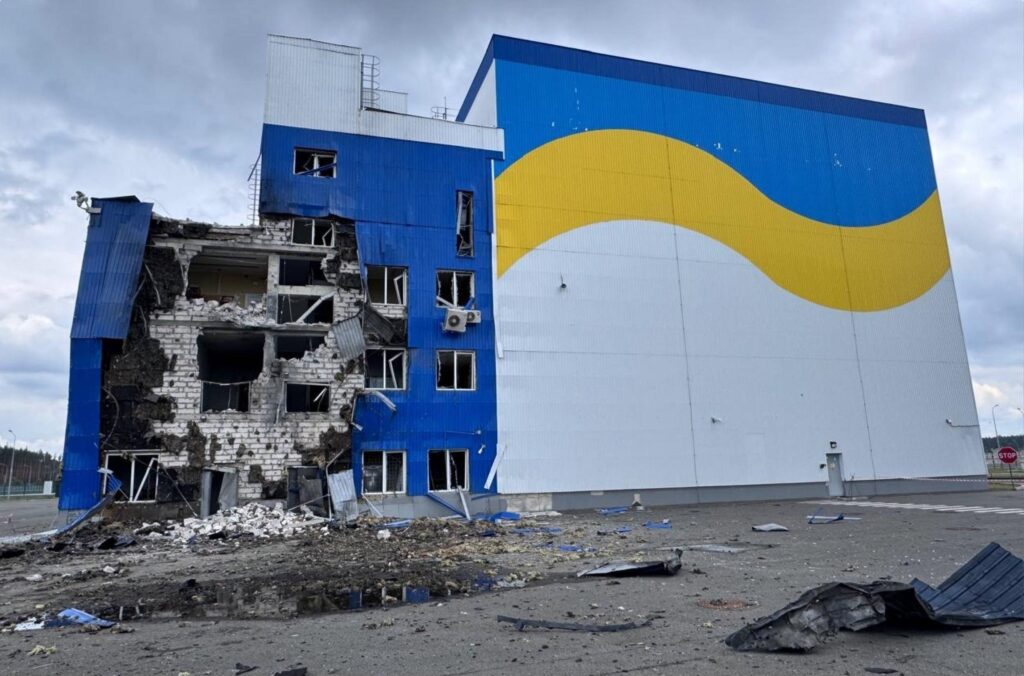
May was the deadliest month for civilians in Ukraine since April 2022, according to the United Nations, which presented updated casualty data to the UN Security Council during an emergency meeting requested by Kyiv, Suspilne reported.
Latvian UN envoy Sanita Pavļuta-Deslandes said preliminary figures show a sharp rise in civilian harm, warning that the final statistics for May are expected to be even higher.
She said attacks during the month included strikes on civilian gatherings, including a funeral in Sumy, which she cited as an example of Russia targeting “so-called legitimate objectives,” according to Suspilne.
She also noted that in the first quarter of 2026 alone, 190 attacks were recorded on medical facilities, including maternity hospitals, while more than 200 educational institutions were damaged or destroyed. The number of injured children increased by 49%, according to UN data cited at the session.
The Security Council meeting came on June 8 following a wave of Russian strikes across Ukraine.
Ukraine accuses Russia of systematic deception at UN
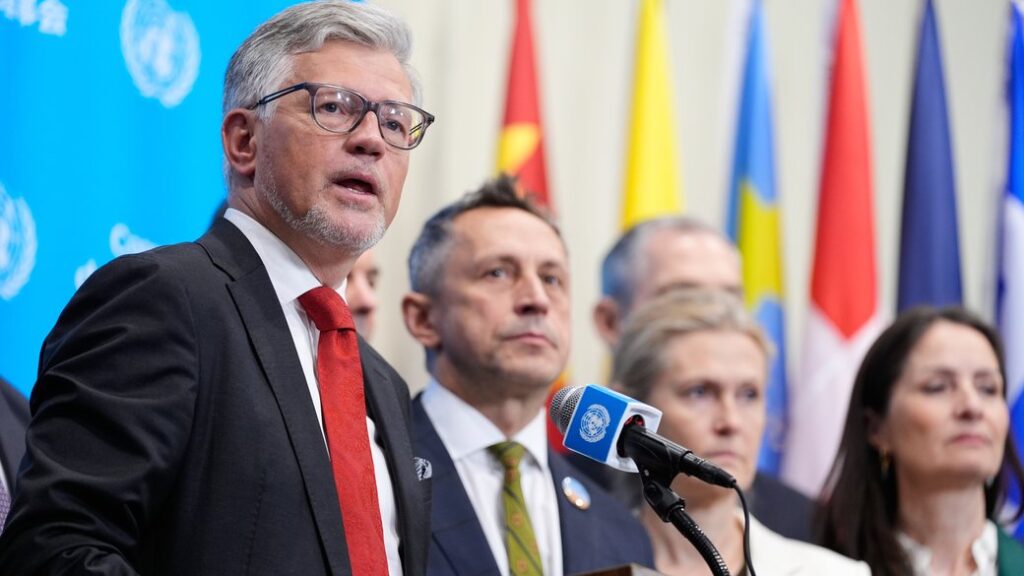
Ukraine’s permanent representative to the UN, Andrii Melnyk, used the session to sharply criticize Russia’s role at the United Nations, arguing that Moscow continues to deny responsibility while undermining international reporting on the war.
“Russia spits in our faces with lies, and we pretend it is just rain,” Melnyk said during the meeting, according to Suspilne.
He suggested that Russia should consider leaving the UN if it rejects its own obligations under international law and dismisses UN investigative findings.
Melnyk also called for Russia to be excluded from UN peacekeeping operations, pointing to its inclusion in UN listings related to sexual violence in conflict and repeated findings on violations involving children and armed conflict.
He urged member states to take action on these findings, saying Russia’s participation in UN structures undermines the credibility of the system itself.
The meeting highlighted growing tensions inside the Security Council as Russia continues to face accusations of escalating strikes on civilian infrastructure while maintaining its role as a permanent member of the body.
The European Union has proposed a 21st sanctions package against Russia that includes a visa ban on current and former Russian military personnel, as Brussels expands pressure on individuals and entities linked to Moscow’s war effort in Ukraine.
EU foreign policy chief Kaja Kallas said the package is part of a broader push to increase economic and political pressure on Russia.
“We are depriving Russia of the means to fund its war,” Kallas wrote on X.
Package includes over 170 proposed sanctions listings across sectors
The sanctions package will target Russia’s financial, energy, and industrial sectors, with more than 170 proposed listings.
These include banks, weapons manufacturers, oil traders, refineries, and crypto-related services, as well as entities in third countries accused of helping Moscow bypass existing restrictions.
Energy measures include a temporary freeze of the Russian oil price cap mechanism, alongside new restrictions on LNG transactions and additional action against Russia’s shadow fleet, with 30 more vessels proposed for designation.
Officials said the aim is to further reduce Russia’s export revenues and disrupt maritime logistics networks used to move sanctioned energy products.
Brick by brick, we are collapsing the foundations of Russia's war economy.
Today, we are presenting our proposals for a 21st sanctions package against Russia.
This includes a temporary freeze of the Russian oil price cap and designations of institutions used by Moscow to…
Measures expand to export controls and financial restrictions
The package also expands export controls on materials used in weapons production, including metals, alloys, and high-performance inputs, with companies in countries such as China, Türkiye, Kazakhstan, the UAE, and India included in the proposals.
Financial restrictions remain a central pillar, with expanded sanctions planned against banks and crypto platforms linked to sanctions evasion and war financing.
EU visa ban on Russian military personnel
The sanctions package includes a “comprehensive” visa ban proposal that would prohibit entry into the EU for current and former members of Russia’s armed forces, as well as “proxy groups,” marking an expansion of sanctions beyond economic measures to individuals linked to military operations.
“Europe’s door should not be open to Russia’s (ex-)combatants,” Kallas wrote.
Our sanctions are working.
They are weakening the economic foundations of Russia’s war effort.
Today we double down.
With a 21st package.
Covering energy, banks & crypto, trade including fisheries and visa for Russian soldiers ↓ https://t.co/fTIkATOSfN
— Ursula von der Leyen (@vonderleyen) June 9, 2026
Sanctions already cost Russia up to $1.5 trillion, EU says
The same day, Kallas told journalists that existing sanctions continue to intensify pressure on Moscow’s economy. Kallas noted that Western sanctions have already cost Russia an estimated $1.2 to $1.5 trillion, adding that “brick by brick, we are collapsing the foundations of Russia’s war economy.”
She said the aim remains to increase costs for Moscow across multiple sectors while maintaining unity among EU member states.
The package requires unanimous approval from EU member states before it can take effect.
Ukraine's drone campaign targeting Russian logistics is moving to sea
Ships carry supplies between Russia and occupied southern Ukraine
Striking the ships can force more supplies to move over land in vulnerable trucks
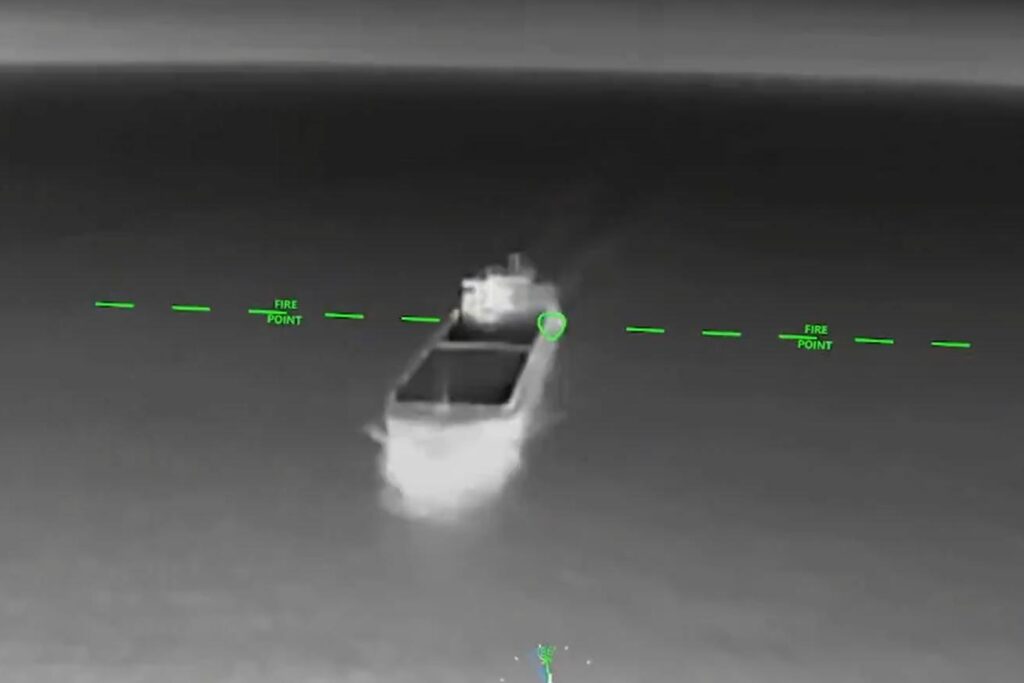
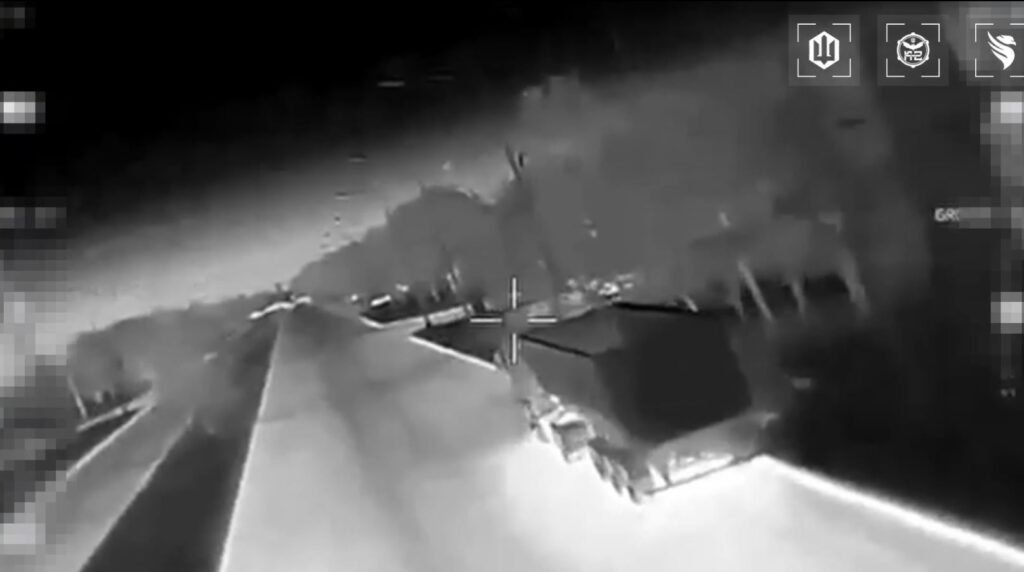
One-way attack drones from Ukraine's Unmanned Systems Forces struck five Russian cargo ships on the Sea of Azov on 5 June.
The strikes, which left at least one ship a burned-out hulk, are a kind of corollary to Ukraine's escalating campaign of middle-distance strikes on Russian supply lines on land in occupied territories. Aiming to weaken Russian regiments before they can attack across the disputed gray zone, Kyiv's drone units aren't only hitting trucks and vans on land—they're also hitting ships at sea.
"There's a method to the madness here," Ukraine Control Map explained. "Take out the ships, force Russia to use more trucks, more logistic bottlenecks." Then hammer the bottlenecks with drones.
The ultimate goal is to make it more difficult for the Kremlin to resupply and reinforce its 700,000 troops in occupied Ukraine. It's cheaper and easier to defeat an attack before it even begins by starving the attacking troops of food, fuel, batteries, ammunition and other vital supplies.
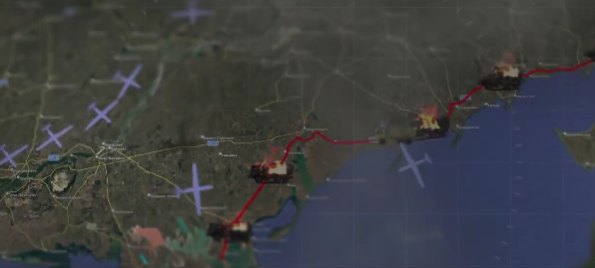
The ships the USF hit with Fire Point FP-1 drones on 5 June were spread out across a wide area. They were in occupied Mariupol and Berdiansk and along the coast of occupied Ukraine — the same Berdiansk port where Ukrainian drones struck a Russian munitions cargo ship on consecutive nights at the start of June.
What they had in common was their disguise. Civilian-owned but allegedly illegally working on behalf of sanctioned Russian entities, the ships sail without obvious markings or easily tracked radio transponders. There could be scores of such ships plying the Black Sea on Russia's behalf every day.
Two of the ships hit on 5 June, the dry cargo vessels Natra and Zirkon, were inbound from Türkiye to Rostov-on-Don when Ukrainian drones struck them in Taganrog Bay—empty, heading to load grain at a port Western governments and Ukraine identify as a transit hub for grain looted from occupied Ukrainian territory. Five Azerbaijani crew members on private contracts were killed and three wounded, Azerbaijan's foreign ministry said. Brovdi didn't address the deaths.
Telling apart a ship hauling Russian military fuel from a ship empty and heading to pick up looted grain is the kind of distinction that's hard to make from a drone's-eye view.
Ships that can haul thousands of tons of supplies every trip are much more efficient than trucks that can haul just a few tons apiece. Cargo ships can't deliver supplies to inland forces, of course, but they can move cargo between ports in southern Russia and ports in occupied Ukraine, bringing that cargo as close as possible to the gray zone before trucks must take over the shipping effort.
Map: Euromaidan Press
A thick-skinned ship is a tougher target than a thin-skinned truck, of course. But Ukraine's FP-1 drones carry a 100-kg blast-fragmentation warhead, with a TNT main charge boosted by the more powerful OKFOL explosive. The combination throws fragments outward and starts fires inside the target—the same mechanism that left the corvette Boikiy burning for hours at Kronstadt on 3 June.
— Special Kherson Cat (@bayraktar_1love) June 8, 2026
Sitting duck trucks
Russia's thousands of military supply trucks are already squarely in the crosshairs of Ukrainian drone units. Since launching their coordinated counterlogistics campaign this spring, the Ukrainians have increased their monthly truck strikes nearly tenfold, from around 60 per month to nearly 500, as per the Ukrainian general staff.
But a comprehensive assault on Russian logistics requires raids on sea traffic, as well. That effort may have begun in earnest on 5 June. "Cargo ships and tankers with their names painted over by Black Sea looters and their transponders switched off, used for the quiet theft of Ukrainian grain and the transport of military cargo and fuel, can no longer count on either long service lives or uninterrupted schedules," the 414th Unmanned Strike Aviation Brigade crowed.
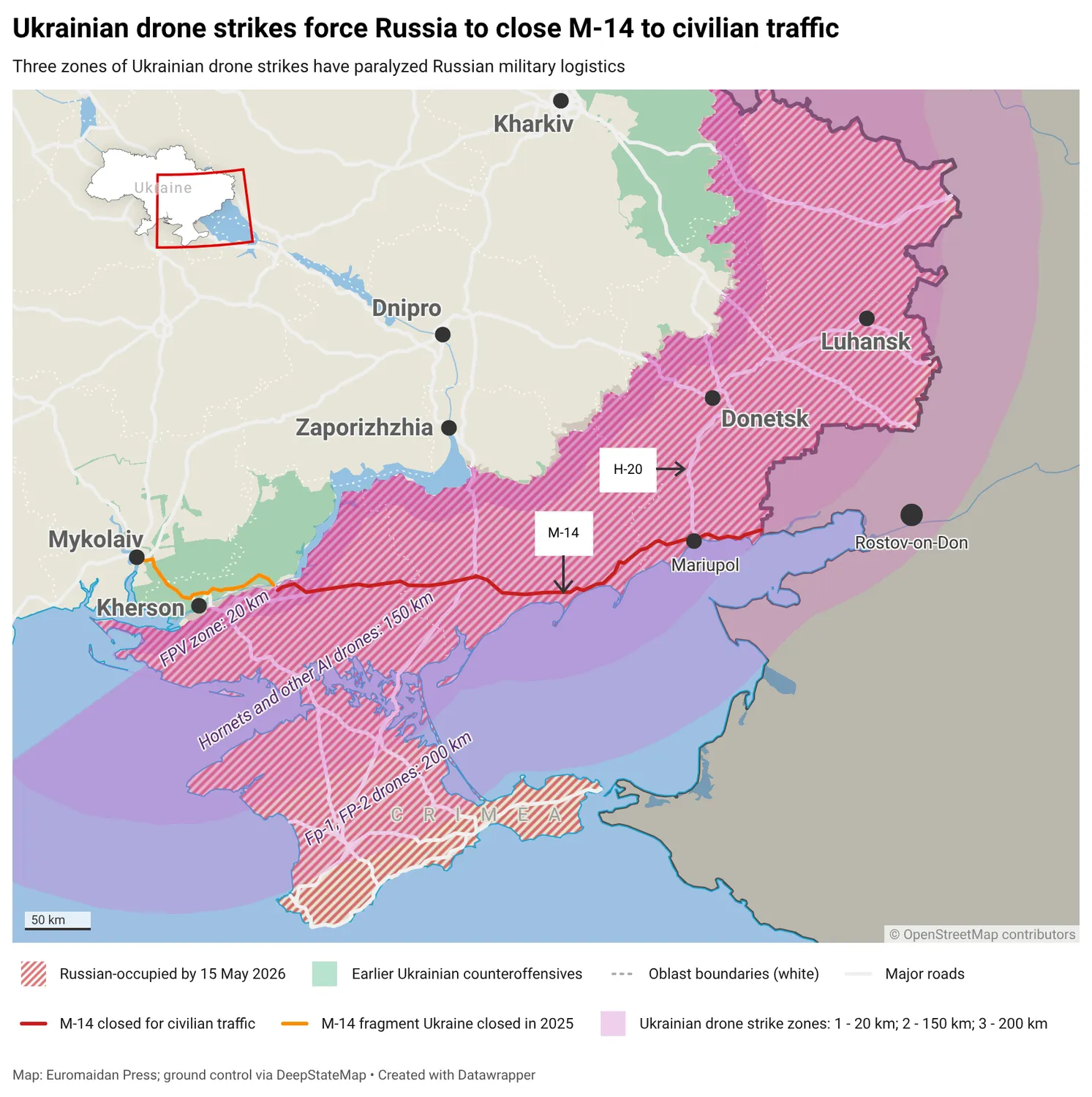
If they can disable enough ships, the Ukrainian drone teams may compel Russian logisticians to shift more supplies by land. To reach Russian regiments in southern and eastern Ukraine, those supplies normally travel east to west along the M-14 highway that runs close and parallel to the Black Sea coast.
That highway and connecting roads have become a kill zone for Russian trucks as more FP-1, FP-2, Hornet and Bulava drones take to the sky, increasingly unbothered by Russia's collapsing air defense network. Ukrainian industry now churns out tens of thousands of middle-strike drones every month, some for as cheaply as a few thousand dollars apiece.
The Russians are trying to find alternate routes that avoid the most heavily droned roads, but once a truck gets close to its destination, it has no choice but to follow a dwindling number of paths. Ukrainian intelligence knows where the Russians' main divisional bases are; they know the trucks must eventually turn into these bases. The near approaches are now becoming kill zones alongside the M-14 and other main roads.
It'll take many more strikes on Russian ships to seriously dent the sea logistics and force more supplies onto land routes. But the effort is underway. "The occupier's smuggling logistics must be stopped," the 414th Unmanned Strike Aviation Brigade explained.
Explore further
Russia keeps four field armies fed through three southern towns. Ukraine’s drones just arrived.
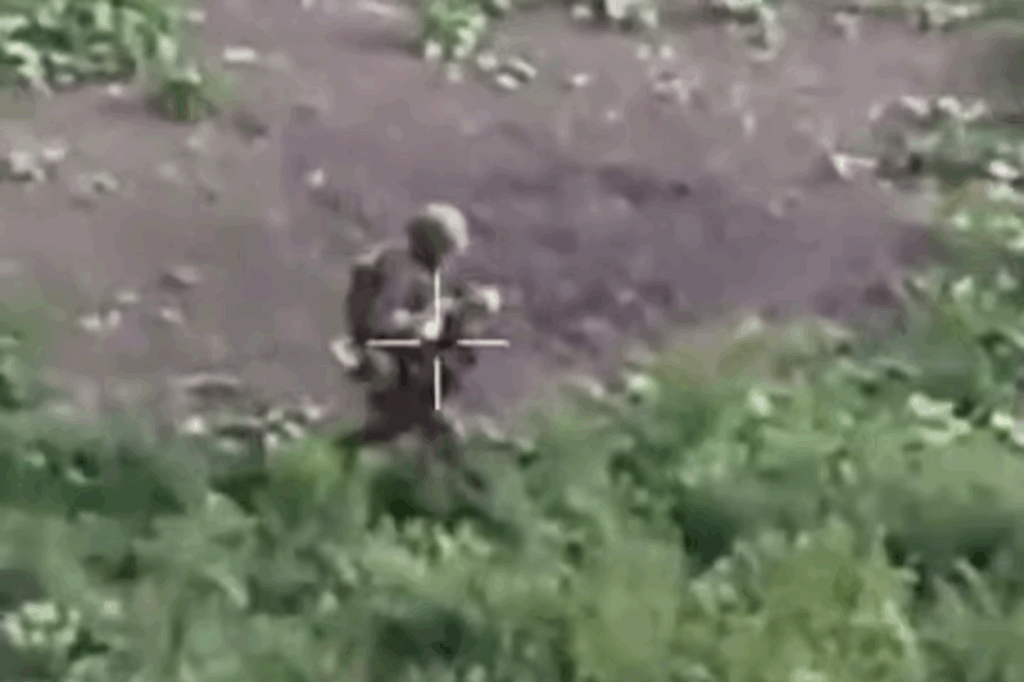
Ten Russian soldiers from a single regiment are accused of hunting civilians in Kherson with attack drones, and now face war-crimes charges filed in absentia, the Security Service of Ukraine (SBU) reported. Investigators say the operators tracked people through the streets and struck ambulances and rescue crews. The 10 are among those participating in a Russian long-lasting terror campaign against Khersoners known as a "human safari."
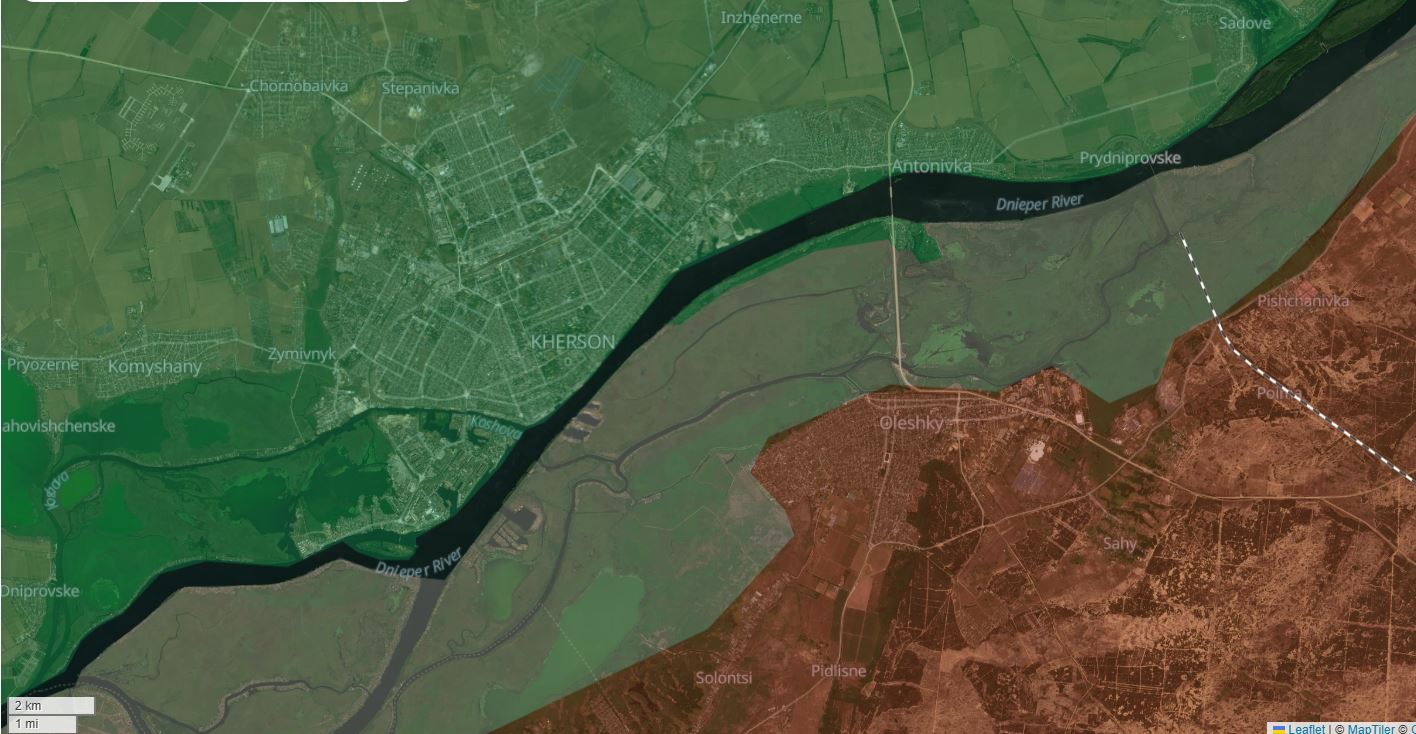
Kherson lies on the Dnipro River's west bank, with Russian-occupied land directly opposite, and the invading force has made it among the deadliest places to live in Ukraine by deliberately hunting civilians across the city for years.
The drone hunters of one regiment
Counterintelligence officers built a case against 10 drone operators from the 404th Motorized Rifle Regiment, a territorial-defense unit in Russia's "Dnepr" Group of Forces, the SBU reported. The investigation found that the men tracked residents as they moved along Kherson's streets and launched drones at them. The drones carried shaped-charge and high-explosive fragmentation munitions.
Kherson city (Russian-occupied area in red). Map: Deep State
Residents and rights monitors call this campaign a "human safari," the hunting of people going about their ordinary days.
Kherson: human safari rages.
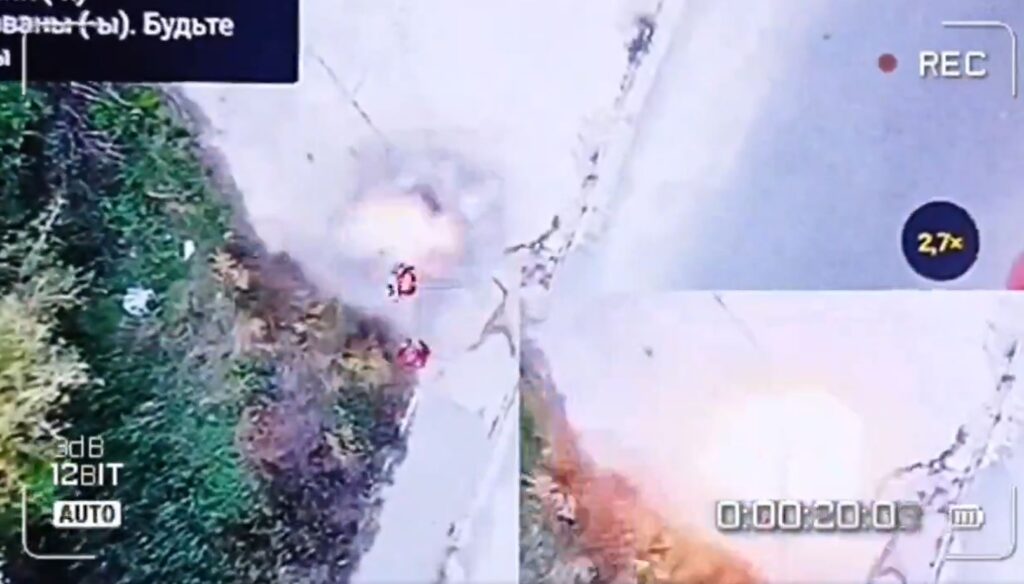
A Russian fiber optic FPV drone chases a car in a residential area; after civilians cut the cable, the drone falls, catches fire.
The documented episodes include attacks on civilian cars and residential blocks, the SBU said. Operators dropped explosives on ambulances at a city hospital. They also carried out a "double" strike on State Emergency Service (DSNS) rescuers who were clearing the aftermath of an earlier Russian shelling.
UN investigators have described this Russian method in Kherson: a first strike, then a second aimed at the people who come to help. Victims suffered shrapnel wounds, burns, and concussions, and civilian infrastructure took significant damage.
Russian soldiers attacked an ambulance in Kherson with a drone.
Based on the evidence, SBU investigators notified all 10 of suspicion under Article 438 of Ukraine's criminal code, which covers war crimes. The notices were issued in absentia. SBU officers in Kherson Oblast led the investigation with the 79th Border Detachment of the State Border Guard Service (DPSU), under the oblast prosecutor's guidance. The agency said efforts to hold the operators accountable continue.
The case fits a wider pattern Ukrainian prosecutors have documented across the oblast in thousands of proceedings.
Russia's overnight drone and missile barrage on 9 June killed and wounded civilians in the Kharkiv Oblast cities of Chuhuiv and Kharkiv, regional officials reported. More strikes over the past 24 hours left several people dead and dozens wounded elsewhere in Ukraine. Ukraine's Air Force said air defense stopped most of the drones, though missiles and others still reached homes.
Russia has pounded Ukrainian cities with nightly aerial barrages since 2022, sending waves of drones and missiles that air defenses can thin but not fully stop. Such daily attacks mainly target residential areas and civilian infrastructure.
Chuhuiv and Kharkiv bear the brunt
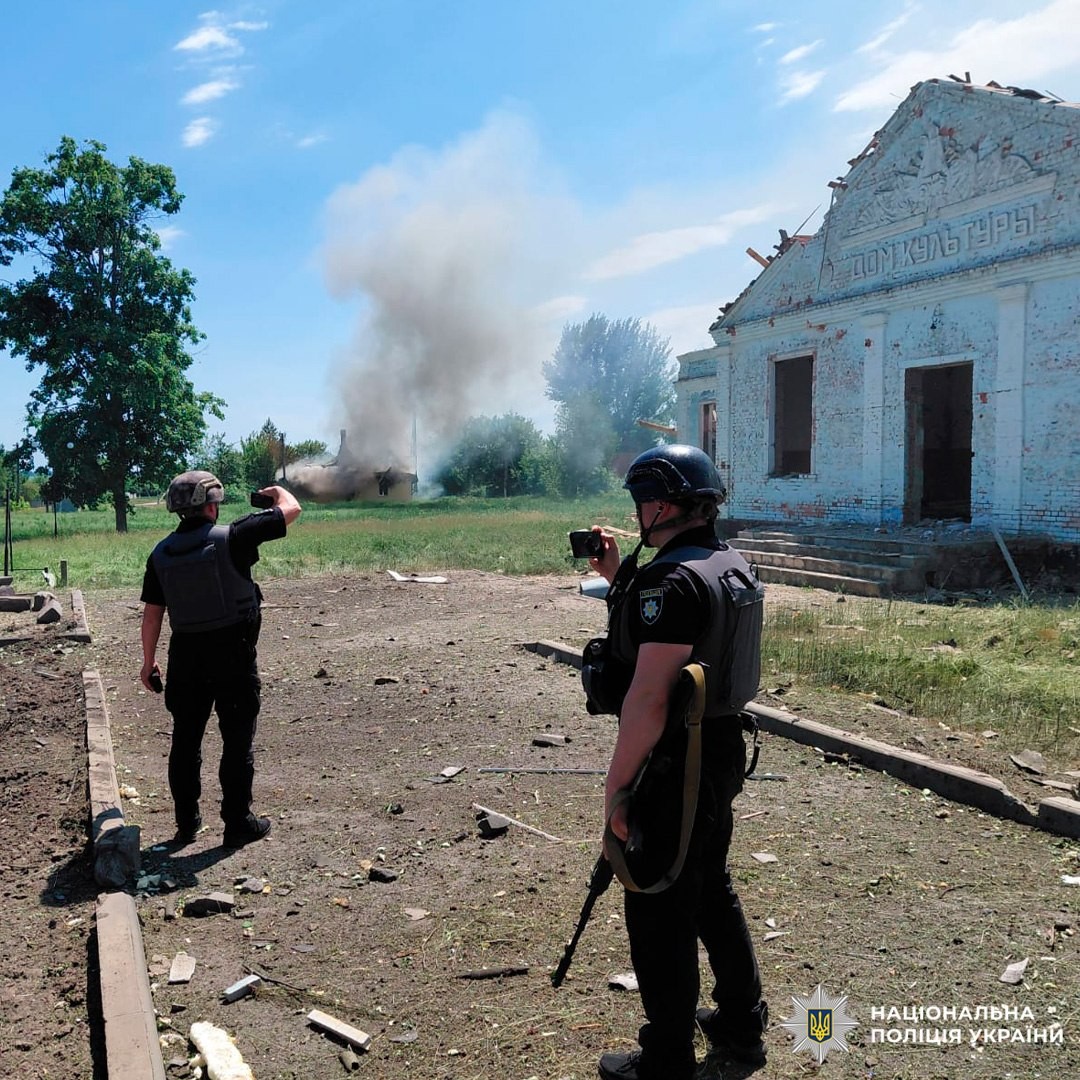
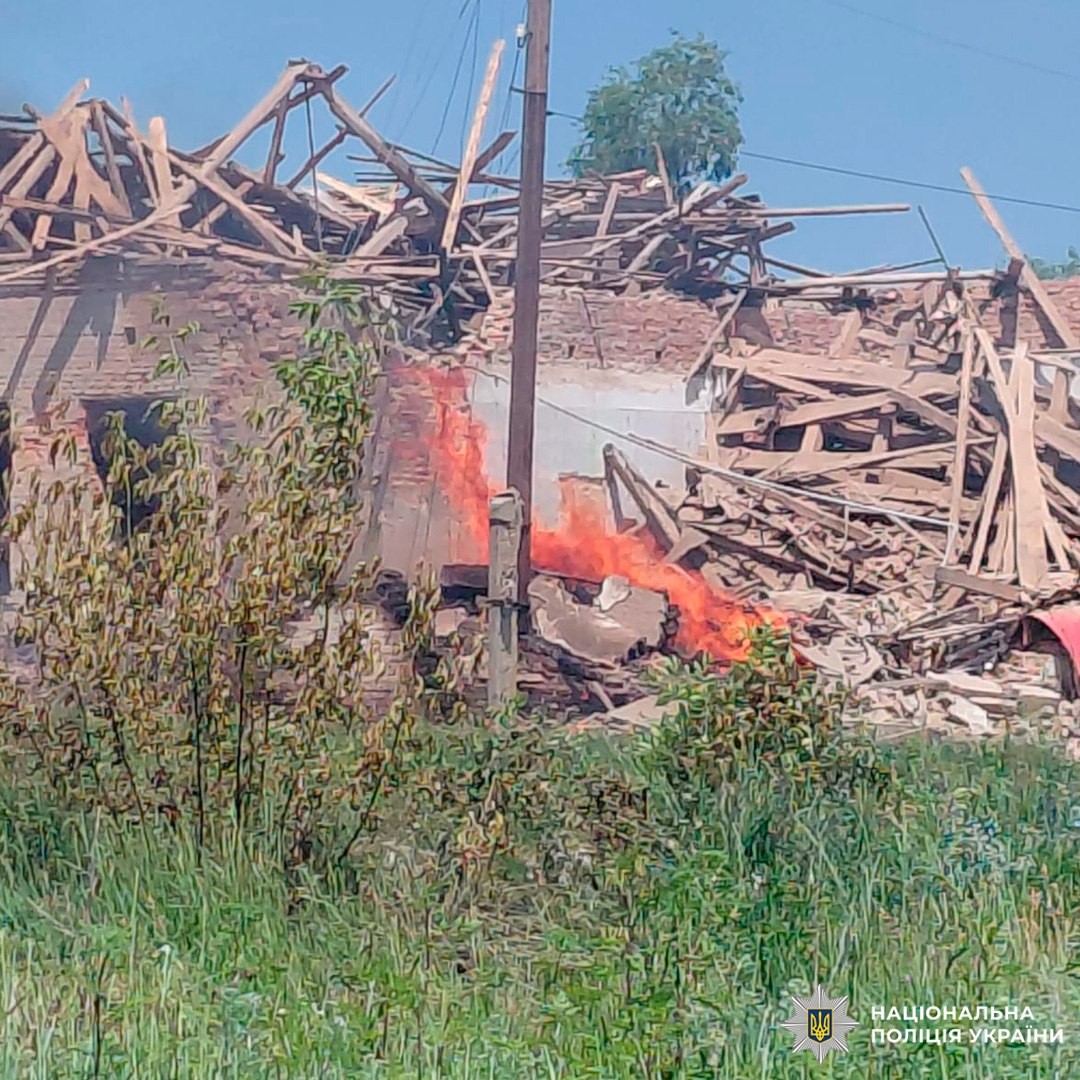
A series of Russian missile strikes on Chuhuiv overnight on 9 June killed at least three people and wounded six, the city's mayor, Halyna Minaieva, reported. Fire crews stayed at the impact sites as emergency services worked, she wrote, and the strikes damaged about eight apartment buildings and more than ten detached houses.
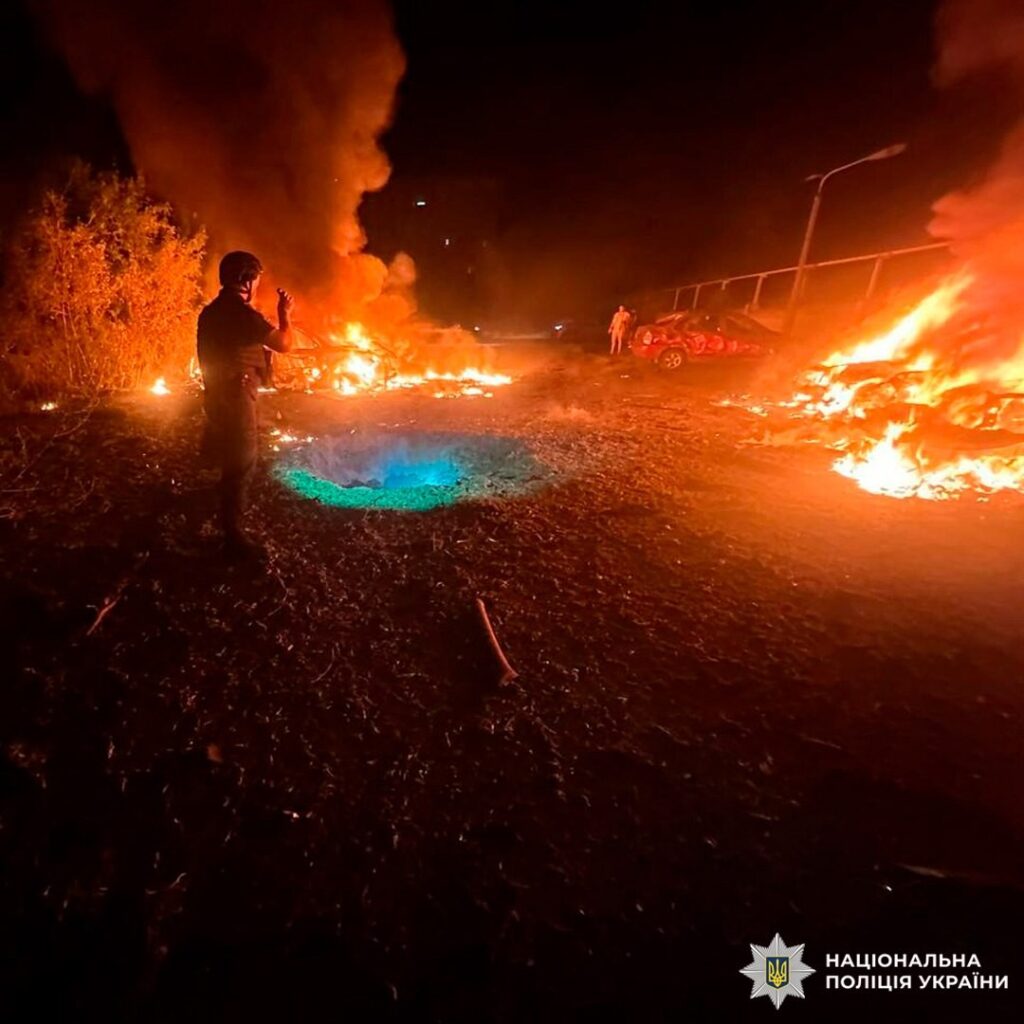
Police officers film the aftermath of a Russian strike in Kharkiv Oblast, 9 June 2026. Photo: National Police of Ukraine
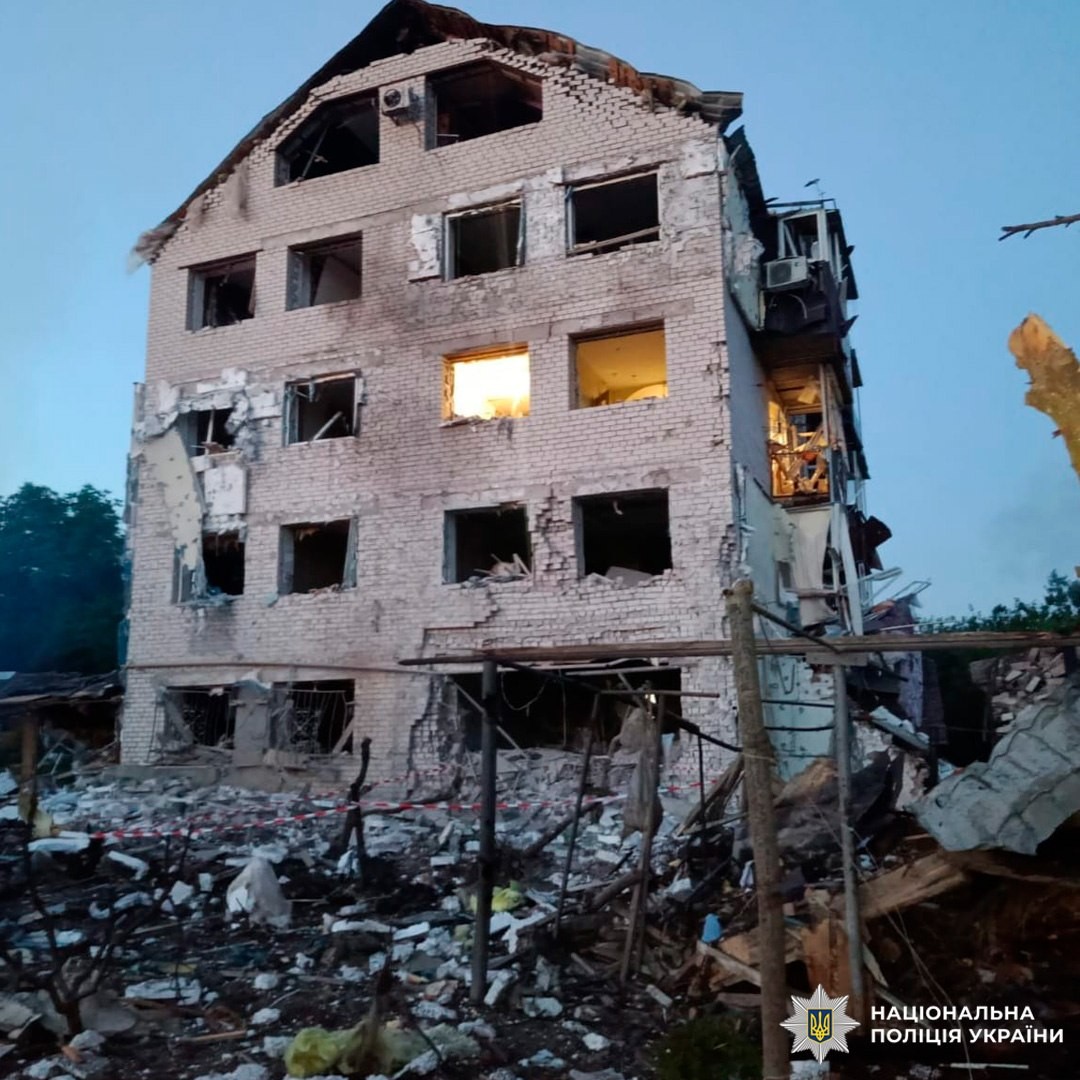
In Kharkiv—the regional capital—Russian drone strikes set off fires, damaged at least 18 cars, and blew out windows and facades in residential high-rises, Kharkiv Oblast head Oleh Syniehubov reported.
Police officers film the aftermath of a Russian strike in Kharkiv Oblast, 9 June 2026. Photo: National Police of Ukraine
He said 15 people were hurt, among them three children, including a one-year-old boy, and three women were hospitalized.
A multi-story residential building wrecked by a Russian strike in Kharkiv Oblast, 9 June 2026. Photo: National Police of Ukraine
Both cities sit dozens of kilometers from the Russian border and have been struck repeatedly through the war.
A barrage of two missiles and 166 drones
Russia launched two Kh-59/69 guided air missiles from Voronezh Oblast and 166 strike drones overnight, Ukraine's Air Force reported. The drones included Shahed types, some jet-powered, along with Gerbera, Italmas, "Banderol" loitering munitions, and "Parodiya" decoys, launched from Oryol, Kursk, Bryansk, Primorsko-Akhtarsk, and Millerovo in Russia, occupied Donetsk, and Hvardiiske in occupied Crimea.
By 08:00, air defense had downed or suppressed 146 of the drones. Two missiles and 17 drones struck 18 locations, and debris from intercepted drones fell at eight more.
Explore further
Moscow’s drone hits 10-story apartment block in Romania, injuring two as Russia fires 232 UAVs at Ukraine
Zaporizhzhia counts the damage from the day before
A Russian drone attack the previous day damaged 11 residential buildings across three districts of Zaporizhzhia, the city council reported. Six apartment blocks and five detached houses in the Khortytskyi, Zavodskyi, and Kosmichnyi districts lost windows, balconies, doors, and roofs to blast waves and debris. No one was hurt, and priority repairs were finished.
A nationwide wave
Russian attacks over 8 June killed two people in Sumy Oblast and wounded 13 across 21 hromadas, the regional police reported. A 78-year-old woman died in the Konotop hromada and a 71-year-old man in Seredyna-Buda, with a two-year-old boy and an eight-year-old boy among the injured.
In Donetsk Oblast, Russian forces killed two residents, in Bilozerske and Druzhkivka, and wounded 11 more, nine of them in Sloviansk, Oblast head Vadym Filashkin reported. Police recorded 1,309 attacks on the oblast's front line and residential areas, damaging 53 civilian sites. Hours later, Russia dropped three FAB-250 glide bombs on Sloviansk's outskirts, destroying one home and damaging more than 20.
In Kherson Oblast, drone and artillery attacks killed one person and wounded 13, including a child, Oblast head Oleksandr Prokudin reported.
Drone strikes in Dnipropetrovsk Oblast wounded three people.
Russian forces also hit 12 villages in four border hromadas of Chernihiv Oblast, the local border detachment told Suspilne.
The Russians also attacked communities in Mykolaiv Oblast with drones, where the administration reported no casualties.
Russians pulled a record 381.2 billion rubles (approximately $5.2 billion) in cash from the banking system in May 2026. It is the largest May cash outflow since the Russian Central Bank began publishing such data in 1995, The Moscow Times reports, citing RBK's analysis of Russian Central Bank data.
The 30-year record adds to a sustained 2026 pattern of Russians pulling cash from banks: April saw $9.2 billion in cash outflows, and March saw $4.1 billion.
The cumulative $14.8 billion in banknotes added to circulation since January reflects what Russian financial analysts describe as a confluence of geopolitical and macroeconomic uncertainty, internet outages limiting access to online banking, and the Central Bank rate cuts that have made deposits less attractive.
The Central Bank itself responded on 1 June by tightening controls on ATM cash withdrawals, with banks now able to track monthly withdrawal limits and may suspend "suspicious" operations, such as large withdrawals after long pauses or multiple operations in short timeframes.
2026 cash-flight progression
The monthly Russian cash-circulation data published by the Central Bank of Russia shows a sustained increase in cash held outside the banking system across 2026. Lead analyst Natalia Milchakova of Freedom Finance Global, quoted by The Moscow Times, explained that Russians are increasingly choosing cash due to uncertainty and a desire to have money for unplanned expenses "here and now."
Milchakova also warned that the cash shift may signal small and medium businesses moving into the shadow economy. The Central Bank itself identified business adaptation to the new 2026 tax rules as a primary driver, alongside internet outages. Sberbank's deputy chair, Aleksandr Vedyakhin, said Russians worry that digital transfers make their transactions visible to tax authorities.
Internet outages and the banking system
Russian internet outages have played a significant role in the cash-flight pattern, depriving Russians of access to online banking and cashless payment systems, Milchakova said.
The outage pattern is part of a wider disruption to Russian mobile internet across 2025-2026, in which Russian authorities have repeatedly shut down regional mobile internet.
Those shutdowns cut Russians' access to banking apps, fuel purchases, navigation, and messaging, with watchdog estimates of economic losses of $290 million in July 2025 alone. Russian Central Bank rate cuts also factor in: lower deposit rates have reduced the attractiveness of leaving money in banks, pushing households toward cash holdings as a default.
Central Bank's response
The Russian Central Bank's 1 June 2026 tightening of ATM withdrawal controls marks an acceleration of Russia's wartime capital controls. Under the new rules, Russian banks will track each customer's monthly cash withdrawal limit. "Suspicious" operations, defined to include large withdrawals after extended pauses, or multiple withdrawal operations conducted in short timeframes, may now be blocked or suspended pending review. Such administrative friction on cash withdrawals is being deployed at the same time the central bank is cutting interest rates, suggesting the regulator's primary concern is bank-system stability rather than monetary tightening.
More than 60% of Ukrainians categorically reject a ceasefire along the current frontline if Ukraine receives no security guarantees. The same share would approve a ceasefire if European troops were stationed near the frontline and would defend Ukraine against renewed Russian aggression, according to a new Kyiv International Institute of Sociology (KIIS) poll, conducted between 7 May and 3 June 2026.
The poll quantifies the substantive Ukrainian public position on the ongoing diplomatic process: the ceasefire itself is not the disputed question, but security guarantees are.
Across the four scenarios KIIS tested, the lowest level of support (32%) is for a ceasefire without guarantees. Mid-range support corresponds to mid-range guarantees: 42% for European troops deep in Ukraine that would not fight, and 53% for security guarantees in the form of large-scale financial and weapons support.
Four scenarios in detail
Scenario 1 — ceasefire without security guarantees, money, or weapons: 61% categorically reject, 32% willing to approve (mostly reluctantly). This is the substantive Ukrainian public position on the unconditional ceasefire that Russian negotiators have repeatedly framed as a starting point: the offer falls short by roughly two-to-one.
Scenario 2 — ceasefire with European troops deployed deep in Ukraine, NOT participating in combat if Russia attacks again: 49% categorically reject, 42% willing to approve. A passive Western presence is closer to acceptance but does not yet command majority support.
Scenario 3 — ceasefire with security guarantees in the form of large-scale money and weapons supply: 37% categorically reject, 53% willing to approve. Material guarantees alone gain majority support, but with significant skepticism remaining.
Scenario 4 — ceasefire with European troops near the frontline who WOULD defend Ukraine against renewed Russian aggression: 33% categorically reject, 61% willing to approve. Active defense by European forces commands the highest support, with a clear majority in favor of a ceasefire under conditions that make Russian re-invasion materially riskier.
Methodology and coverage
KIIS conducted the survey by computer-assisted telephone interview (CATI), using random sampling of mobile phone numbers. The sample of 2,007 Ukrainian citizens aged 18 and older was drawn exclusively from territory controlled by the Ukrainian government, meaning the data does not include displaced Ukrainians abroad or Ukrainians in Russian-occupied territories.
The polling period of 7 May through 3 June 2026 covered the full month of the current phase of US-mediated diplomatic activity, during which Russia continued striking Ukrainian cities with Shahed drones and missile attacks.
Ukraine's drone strikes on the highways that feed Russian forces in occupied southern and eastern Ukraine are disrupting Russian logistics and will likely bite deeper in the near future, according to the Institute for the Study of War (ISW). The campaign is also rattling Russia's pro-war online community, where bloggers have begun turning their anger on the Kremlin's own military leadership. Russian forces are already rerouting and disguising convoys to keep supplies moving.
Ukraine's drone war has dragged the fight off the trench line and into Russia's rear, where fuel and transport increasingly decide how long Moscow can keep its invasion supplied. If Ukrainian crews keep the main arteries under watch, Russia faces a slow squeeze on its rear and the political cost of admitting those roads are no longer safe.
Ukraine's drones now own a key supply road
Ukraine's 3rd Army Corps said on 31 May that its drones had won "fire control" over five occupied cities. All five sit on or near the M-04 highway: Luhansk City, Starobilsk, Alchevsk, Bryanka, and Kadiivka. In plain terms, Ukrainian crews can now strike traffic on that road.
Ukrainian drone strike zones layered over Russia's southern supply network. FPVs reach roughly 20 km from the front, Hornets and other AI-assisted drones to 150 km, and FP-1 and FP-2 long-range drones to 200 km. The M-14 highway (Rostov-on-Don to occupied Crimea) and H-20 (branches north from Mariupol into Donetsk Oblast) both fall inside the deeper rings. Russian authorities have closed the M-14 to civilian traffic. The Ukrainian segment of the same highway, between Kherson and Mykolaiv, was closed by Ukrainian authorities in August 2025 after Russian drones turned it into a "human safari" killing ground. Map: Euromaidan Press.
A Ukrainian drone operator argued the M-04 matters more to Russia than the better-known M-14. The M-14 links Rostov Oblast to occupied Crimea. The M-04 begins near Moscow and reaches Rostov-on-Don before carrying on to Russia's Black Sea coast and into the Caucasus. It feeds occupied Crimea, southern Ukraine, and Luhansk Oblast through the Russian towns of Millerovo and Kamensk-Shakhtinsky. It also supplies Donetsk Oblast through Novoshakhtinsk in Rostov Oblast.
Explore further
Flat steppe: Ukraine is strangling Crimea’s supply lines from air. Melitopol-Chonhar road is latest target
The two highways connect, and Ukrainian forces are also hitting the H-20 road that joins them through Donetsk City. ISW assessed that the strikes will likely generate "even more profound cascading effects" across Russia's rear. The effort extends Ukraine's wider push to drive deep strikes further behind the front.
Russia bans buses and repaints its trucks
The strikes are already forcing changes on the ground. Leonid Pasechnik, the Russian-installed head of occupied Luhansk Oblast, issued a decree on 6 June. It bars regular bus and coach services on the section of the highway crossing occupied Luhansk.
Explore further
The Crimean Bridge is heavily guarded. Ukraine struck its maritime security layer in the Kerch Strait.
Ukrainian Mariupol mayoral adviser Petro Andriushchenko reported on 7 June that Russian forces had changed their Mariupol–Berdiansk route. They now use local coastal roads instead of the M-14. ndriushchenko said the troops are passing army vehicles off as civilian, recoloring the tarpaulins over each cargo bed and spraying the trucks white. ISW assessed the detours will likely slow Russian supply runs as Ukraine keeps hunting vehicles.
Russia's war bloggers turn on the Kremlin's generals
Ukraine's strikes are landing in Russia's information space too. Russia's pro-war military bloggers are voicing discontent and panic over the campaign.
Explore further
Ukraine doubles deep strikes beyond 50 km as “Logistics Lockdown” shifts priority deeper into Russia’s transport nodes and rear logistics chains
A pro-war blogger and former Storm-Z assault-unit instructor complained on 7 June that Ukraine is now striking factories and defense plants deep inside Russia while degrading Russian air-defense radars and systems. He blamed bureaucracy and state-corporate infighting for Moscow's failure to respond, and separately complained that Russia cannot read Ukraine's battlefield trends and underrates its capabilities. Other bloggers piled on: one claimed fuel shortages were stoking panic in occupied Crimea, while others faulted the Russian Defense Ministry and top general Valery Gerasimov for not striking Ukrainian logistics, especially the Dnipro River bridges.
ISW found the complaints are escalating, and that the strike campaigns are becoming "points of neuralgia" in Russia's ultranationalist crowd. It noted the discontent feeds on Russia's poor battlefield results, rising casualties, and economic strain. Even before this, Russia's war bloggers had turned on the Kremlin's commanders over inflated victory claims.
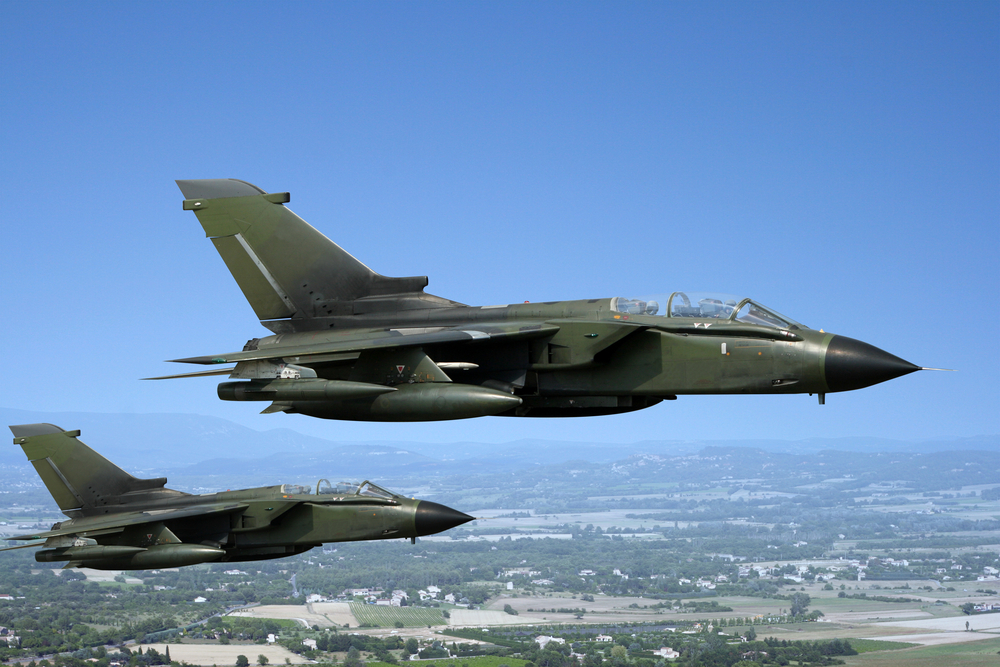
French fighter jets operating under NATO's Baltic Air Policing mission shot down a drone over eastern Latvia on 8 June, the country's National Armed Forces (NBS) confirmed. The drone was intercepted over Nautrēni parish between Rēzekne and Kārsava, near Latvia's border with Russia.
It was the first time NATO jets had downed a drone over Latvian territory.
The intercept is the second in Baltic airspace since 19 May, when a Romanian F-16 shot down a stray Ukrainian strike drone over Estonia's Lake Võrtsjärv. Latvia's drone crisis has been the most politically destabilizing in the region.
A 7 May crash near the Rēzekne oil storage facility toppled the ruling coalition after Prime Minister Evika Siliņa forced Defense Minister Andris Sprūds' resignation.
Latvia described the drone as deflected by Russian electronic warfare
The NBS described the aircraft as "a foreign unmanned aerial vehicle that had flown into Latvia as a result of Russian electromagnetic warfare," Latvian public broadcaster LSM reported. A military spokesperson told Reuters the drone entered Latvian airspace from Russia.
Baltic defense ministries have previously identified drones entering their airspace as Ukrainian, knocked off course by Russian electronic jamming while targeting sites inside Russia. Estonian Foreign Minister Margus Tsahkna has argued Moscow deliberately steers those drones into NATO territory to erode Western support for Kyiv.
Several allied foreign ministers echoed that claim at a 22 May meeting in Helsingborg.
The NBS issued cell-broadcast alerts to residents in the Rēzekne, Ludza, Balvi, and Alūksne municipalities at around 09:20 local time. The threat level in Rēzekne and Ludza was raised to orange at 09:40.
The alert was lifted by approximately 10:30 after the drone was confirmed destroyed.
Drone also violated Moldova's airspace overnight
Separately, an unidentified drone violated Moldovan airspace overnight and exploded on impact, Yevropeiska Pravda reported. Authorities are examining the fragments.
The incident came a day after Moldovan President Maia Sandu instructed the government to draft legislation enabling domestic production of interceptor drones, citing repeated airspace violations linked to Russia's war on Ukraine.
Last week, 56 countries and the EU condemned a Russian drone violation of Romanian airspace at a UN Security Council emergency session requested by Bucharest.
Escalating incursions are reshaping Baltic security
The shootdown caps a month that has transformed how the Baltic states approach drone defense. Estonia activated its first border drone-detection sensors on 30 May.
Ukraine and Estonia expanded drone cooperation on 3 June. Latvia's armed forces commander General Kaspars Pudāns warned last week that Russia could exploit its drone advantage to attack the Baltics by the end of 2028.
European leaders have agreed to develop a "drone wall" along their eastern borders, and a US anti-drone system has been deployed to NATO's eastern flank. A NATO counter-drone testing range at Sēlija in central Latvia hosted European startup demonstrations on 26 May.
Armenian Prime Minister Nikol Pashinyan's pro-EU Civil Contract party has won the country's parliamentary elections with 49.81% of the vote. The result came despite pro-Russian opposition and Russian electoral pressure, with 100% of ballots processed, according to News.am and the Central Election Commission.
The victory is a clear public endorsement of Pashinyan's turn toward European integration and away from the post-Soviet Russian sphere — a turn that has placed Armenia, like Ukraine before it, in the position of a former Soviet republic actively choosing the EU over Moscow's preferred order.
Previously, Russian President Vladimir Putin warned Armenia of a "Ukrainian scenario" over its EU push at the recent EAEU summit.
Vote breakdown
Four political forces enter the new Armenian parliament. Pashinyan's Civil Contract leads with 49.81%, followed by Samvel Karapetyan's pro-Russian "Strong Armenia" alliance at 23.29%, the "Armenia" electoral bloc at 9.94%, and the Prosperous Armenia party as the fourth force in parliament.
Karapetyan, a Russian-Armenian oligarch and founder of the Tashir Group, ran on a platform to restore closer ties with Moscow.
Post-Soviet context and EU push
Armenia, a former Soviet republic that gained independence in 1991, has been a member of the Russian-led Collective Security Treaty Organization (CSTO) and the Eurasian Economic Union (EAEU).
The relationship cooled sharply after the 2023 Azerbaijani military operation that ended Armenian control of Nagorno-Karabakh, with Yerevan accusing Russia and its CSTO of failing to deliver promised security guarantees.
Pashinyan's government has since suspended Armenia's participation in CSTO meetings, signed a bilateral strategic partnership charter with the US, and accelerated EU integration efforts.
Putin's "Ukrainian scenario" warning, delivered at the EAEU summit shortly before the election, was a direct threat that Russia would consider treating Yerevan's EU pivot the way Moscow has treated Ukraine's: economic pressure, hybrid operations, military threats.
Despite both, Armenia voted for Pashinyan and the EU path by a roughly two-to-one margin over the largest pro-Russian alternative.
Commander of Ukraine’s Unmanned Systems Forces, Robert “Madyar” Brovdi, says Russian losses reached 1,006 killed and 1,090 wounded during the first six days of June, as Ukrainian drone forces continued strikes against targets on and beyond the front line.
The commander of Ukraine’s Unmanned Systems Forces published the figures on 7 June alongside an update on overnight operations targeting Russian logistics and infrastructure in occupied territory and inside Russia.
More than 2,000 casualties reported in six days
Brovdi said Russian forces suffered a combined 2,096 killed and wounded between 1 and 6 June.
He described the losses as equivalent to the combat strength of a full Russian assault brigade lost within a single week.
The commander also used a railway comparison to illustrate the scale of the casualties, saying the losses would add the equivalent of 20 refrigerated and medical railcars to Russia’s “one-way ticket” train over the six-day period.
Drone strikes target rear-area infrastructure
According to Brovdi, Ukrainian forces also struck 26 targets overnight on 7 June across occupied parts of Luhansk, Donetsk, Zaporizhzhia, and Crimea, as well as Russia’s Bryansk Oblast.
He said Ukrainian units destroyed an air defense system and damaged three locomotives, two railway fuel tanks, four electrical substations, and six telecommunications towers. The strikes also disrupted the movement of military cargo toward the front, according to the statement.
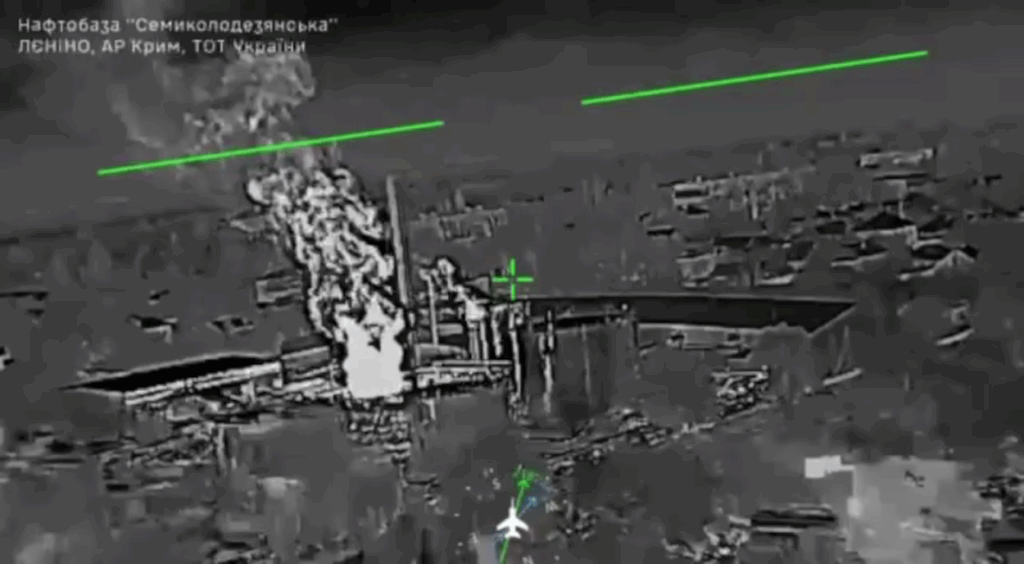
Earlier on 7 June, Ukrainian Special Operations Forces reported strikes on the Semikolodezyanska oil depot in Yedi-Quyu and a maritime fuel terminal in Feodosia. Ukrainian officials said the operation was intended to reduce Russia’s logistical and economic capacity to sustain military operations in occupied territory.
The reported targets fit a broader Ukrainian effort to degrade Russian logistics networks, transport infrastructure, and support systems operating behind the frontline.
Ukraine says it doubled the number of successful strikes on Russian targets more than 50 kilometers behind the front line in May under the “Logistics Lockdown” program, which prioritizes attacks on transport networks, fuel infrastructure, depots, and other systems supporting Russian military operations.
Ukrainian Special Operations Forces (SOF) say they carried out strikes on Russian fuel infrastructure in occupied Crimea overnight on 7 June, targeting the Semikolodezyanska oil depot and a maritime fuel terminal in Feodosia.
“The destruction of the enemy’s fuel infrastructure reduces its economic and logistical capabilities. The Special Operations Forces continue asymmetric actions aimed at the strategic weakening of the enemy’s ability to wage war against Ukraine,” the SOF said.
The SOF said both facilities are part of Russia’s fuel logistics system in occupied Crimea, used for storage, transfer, and redistribution of petroleum products supporting Russian military logistics in the region.
Semikolodezyanska oil depot hit in Yedi-Quyu
The SOF said the Semikolodezyanska facility is used by Russian forces as a fuel storage and transfer hub for diesel, fuel oil, and other petroleum products distributed across occupied territory.
The depot is located in Yedi-Quyu, a settlement in eastern Crimea which is known under Russian occupation administration as Lenine.
The site reportedly contains nine storage tanks ranging from 700 to 3,000 cubic meters and supports distribution across occupied territory through rail tanker loading and onward transport.
Ukrainian Special Operations Forces struck Russian fuel infrastructure in occupied Crimea overnight on 7 June, hitting the Semikolodezyanska oil depot in Yedi-Quyu (Lenine) and a maritime fuel terminal in Feodosia.
— Euromaidan Press (@EuromaidanPress) June 7, 2026
Open-source monitoring suggested fire activity at the site following the reported strike. The OSINT group Exilenova+ said the depot was hit overnight, while NASA FIRMS satellite data reportedly showed heat signatures consistent with burning at the location.
The monitoring group Crimean Wind also reported a fire at the site, citing satellite imagery and witness reports. It said residents reported multiple explosions between 02:05 and 02:14 local time, followed by visible flames near the facility.
The group described the depot as a large settlement-based fuel site, originally built in the Soviet period, closed in the 1990s, and later restored after 2015 under Russian administration.
Feodosia maritime fuel terminal targeted
Ukrainian forces also reported a strike on a maritime oil terminal in Feodosia, used for transferring fuel between rail and sea transport.
The facility includes seven storage tanks with capacities of 10,000 and 20,000 cubic meters and functions as a key fuel transshipment point between rail wagons and maritime tankers.
It forms part of a wider logistics network supplying occupied Crimea, enabling large-scale movement of petroleum products across rail and coastal routes.
Expansion of Ukraine’s “middle-strike” campaign
The reported attacks reflect Ukraine’s growing use of “middle-strike” operations targeting logistics and energy infrastructure deep in occupied territory.
The aim, according to officials, is to degrade Russia’s ability to sustain military operations by disrupting fuel supply chains and transport hubs beyond the front line.
A Ukrainian long-range drone struck a Russian military truck near occupied Horlivka, Donetsk Oblast, setting it ablaze and reportedly killing the driver.
Footage from the scene shows the vehicle burning in the middle of a key logistics route, forcing traffic to halt.
— Euromaidan Press (@EuromaidanPress) June 5, 2026
Russia reports large-scale drone interceptions
The Russian Ministry of Defense said air defense systems intercepted and destroyed 95 Ukrainian drones overnight across multiple regions of Russia and occupied territory, including Crimea and the Black Sea area.
The ministry listed other regions including Belgorod, Bryansk, Kaluga, Kursk, Novgorod, Rostov, Smolensk, Tula, Yaroslavl, Krasnodar Oblast, and Moscow Oblast.
A Russian drone struck the site of Ukraine’s Centralized Spent Fuel Storage Facility (CSFSF) in the Chornobyl exclusion zone overnight on 7 June, damaging a non-storage building and causing a fire that was later extinguished, according to Ukraine’s state nuclear operator Energoatom.
The attack occurred at approximately 02:10, when a Russian UAV hit the facility’s container reception building, Energoatom said. The building was partially destroyed, although no spent nuclear fuel was stored inside at the time.
Fire contained, radiation levels normal
Energoatom reported that a fire covering about 40 square meters broke out after the strike but was quickly localized and fully extinguished. No personnel were injured.
The company said radiation levels at the site remain within normal limits and are being continuously monitored.
“The radiation situation at the CSFSF site remains within normal parameters,” Energoatom said in a statement, adding that it is coordinating with relevant state agencies and continuing to monitor the situation.
The Centralized Spent Fuel Storage Facility is an important part of Ukraine’s nuclear infrastructure, designed to store spent fuel from the country’s nuclear power plants.
SBU opens war crimes case over drone strike on Chornobyl spent fuel facility
Update 17:00: Ukraine’s Security Service (SBU) said it is treating the Russian drone strike on the Centralized Spent Fuel Storage Facility near Chornobyl as a war crime and has opened a criminal case under Article 438 of the Criminal Code.
Investigators said Russian forces used a “Geran-2” type drone for the 7 June strike, which hit the facility at around 02:05. Fragments of the drone were reportedly recovered at the site.
The SBU said the blast damaged the spent nuclear fuel reception and handling building, as well as an administrative building used by the International Atomic Energy Agency.
It added that the strike did not disrupt operations at the facility and no casualties were reported.
Damage at Ukraine’s spent nuclear fuel storage facility in the Chornobyl exclusion zone after a Russian drone strike, which officials say hit a non-storage building and triggered a fire. Photo: General Staff of Ukraine's Armed Forces
IAEA to inspect Chornobyl spent fuel site after drone strike damage
Update 14:40: The International Atomic Energy Agency (IAEA) said it will soon send its team at Chornobyl to inspect damage caused by a drone strike on the Centralized Spent Fuel Storage Facility in the exclusion zone.
The agency said it was informed by Ukraine that the 7 June attack caused “significant damage” to the fuel reception building, including the facade, windows, and doors, with nearby structures also affected by the blast wave.
IAEA Director General Rafael Grossi said the incident is “deeply concerning,” noting it occurred at a facility storing nuclear material just meters from the impacted structure.
He said attacks on nuclear facilities are “completely unacceptable” and violate core nuclear safety principles, including the agency’s “Seven Indispensable Pillars” for nuclear safety and security during armed conflict.
Ukrainian officials condemn strike on nuclear infrastructure
Ukrainian Foreign Minister Andrii Sybiha condemned the attack, describing it as another example of what he called Russia’s systematic disregard for nuclear safety.
“This is not the first time Russia has endangered Ukrainian nuclear facilities,” Sybiha said. “Russian nuclear blackmail and disregard for nuclear safety principles are systemic, deliberate, and unacceptable.”
Ukrainian President Volodymyr Zelenskyy said the drone that struck the facility was a Shahed-type attack drone and accused Russia of deliberately targeting critical nuclear infrastructure.
“Russia consciously struck this nuclear infrastructure facility,” Zelenskyy said. He noted that radiation levels had not exceeded safety limits and praised emergency responders for extinguishing the fire.
The president linked the strike to a broader wave of Russian attacks across Ukraine, saying Russia had launched attacks on civilian targets in 13 regions overnight. According to Zelenskyy, Russia fired 88 missiles, more than 3,250 attack drones, and around 1,800 guided aerial bombs against Ukraine over the past week.
Ukraine has repeatedly accused Russia of using threats to nuclear facilities as part of its broader war strategy. Concerns over nuclear safety have remained high throughout the full-scale invasion, particularly following repeated incidents involving nuclear-related infrastructure and the Russian occupation of the Zaporizhzhia Nuclear Power Plant.
A Russian FPV drone strike near a residential building in Kramatorsk on the morning of 6 June killed a man born in 1976, the Kramatorsk City Council reports. These types of drones are operated in real time, so the Russian pilot saw the target before launching the weapon at the person.
The strike fits a documented pattern of Russian FPV-drone targeting of Ukrainian civilians in frontline cities that the UN Independent International Commission of Inquiry on Ukraine formally classified as crimes against humanity in May 2025 in its findings on Kherson Oblast, and that Ukrainian authorities continue to document across other frontline regions, including Donetsk Oblast.
Ukraine has documented more than 11,000 Russian FPV attacks on civilians, including "double-tap" strikes that hit the same site after medics and firefighters arrive at an initial attack.
Terrorism: no justification
"Each such crime will be documented, and the guilty parties will sooner or later answer for what they have done. No justification can explain the murder of civilians. This is not how military forces act — this is how terrorists act, for whom human life has no value," the Ukrainian authorities said.
UN findings: from Kherson to three-oblast pattern
In May 2025, the OHCHR-supported UN Commission of Inquiry on Ukraine concluded that Russian drone attacks against civilians in Kherson Oblast were "widespread, systematic, and conducted as part of a coordinated state policy" and constitute crimes against humanity of murder, as well as war crimes.
The Commission documented Russian targeting across more than 100 kilometers of the right bank of the Dnipro River, basing its findings on more than 300 videos, 600 Telegram posts, and 91 interviews with victims, witnesses, and local officials.
In its October 2025 follow-up report to the UN General Assembly, the Commission found that the same pattern had expanded across more than 300 kilometers covering Dnipropetrovsk, Kherson, and Mykolaiv Oblasts. Russian FPV operators have systematically pursued specific civilians along defined routes, including at bus stops, supermarket entrances, pension queues, and residential courtyards.
The Kramatorsk frontline context
Kramatorsk has been a focus of Russian targeting throughout the war, with repeated strikes including double-tap drone attacks on civilian infrastructure and first responders. The city's location near the contact line in Donetsk Oblast places it within FPV drone range.
Ukrainian Special Operations Forces drone operators have established aerial control over part of the Russian land supply route from occupied Melitopol to Chonhar. The path is the entry point to Crimea, and they are destroying Russian equipment and disrupting Russian military logistics on the road, the 3rd Separate Special Purpose Regiment announces.
Russian forces on the peninsula already depend on a constrained set of supply lines: the Kerch Bridge (under sustained Ukrainian threat since 2022), the rail and road corridor through occupied Donetsk Oblast, and the Melitopol-Chonhar bottleneck. Ukrainian aerial denial of any one of these links compounds pressure on the others.
Squeezing land corridor from both ends
The new operation puts pressure on the land corridor's western end. On 31 May, Mariupol residents reported in local group chats that Russia shut down part of its land corridor from Crimea to occupied Donetsk because of Ukrainian drones.
The Melitopol-Chonhar segment crosses flat steppe with limited cover and funnels Russian convoys through narrow bridge crossings over the Syvash to reach the peninsula, the terrain optimal for drone operators to deny the air with persistent surveillance and strike capability.
SSO drones as the strangulation instrument
The 3rd Separate Special Purpose Regiment is one of Ukraine's veteran Special Operations Forces units, named after the tenth-century Kyivan Rus prince.
The regiment's deployment of drone operators against Russian logistics on the Melitopol-Chonhar route fits within Ukraine's broader "logistics lockdown" approach to occupied territory. Ukraine's Defense Ministry has recently committed $113 million to medium-strike drones designed to target Russian rear logistics.
"Drones of the Special Operations Forces unit are destroying equipment and breaking the enemy's logistics routes on the Melitopol-Chonhar route," the 3rd Regiment said.
What does this change for Russia on peninsula?
Russia's military presence in Crimea depends on a continuous supply of fuel, ammunition, and food, as well as on personnel rotation.
"As a result, the already-difficult logistics for supplying the Russian army and fuel to the peninsula have grown harder," the SSO said.

 Login
Login