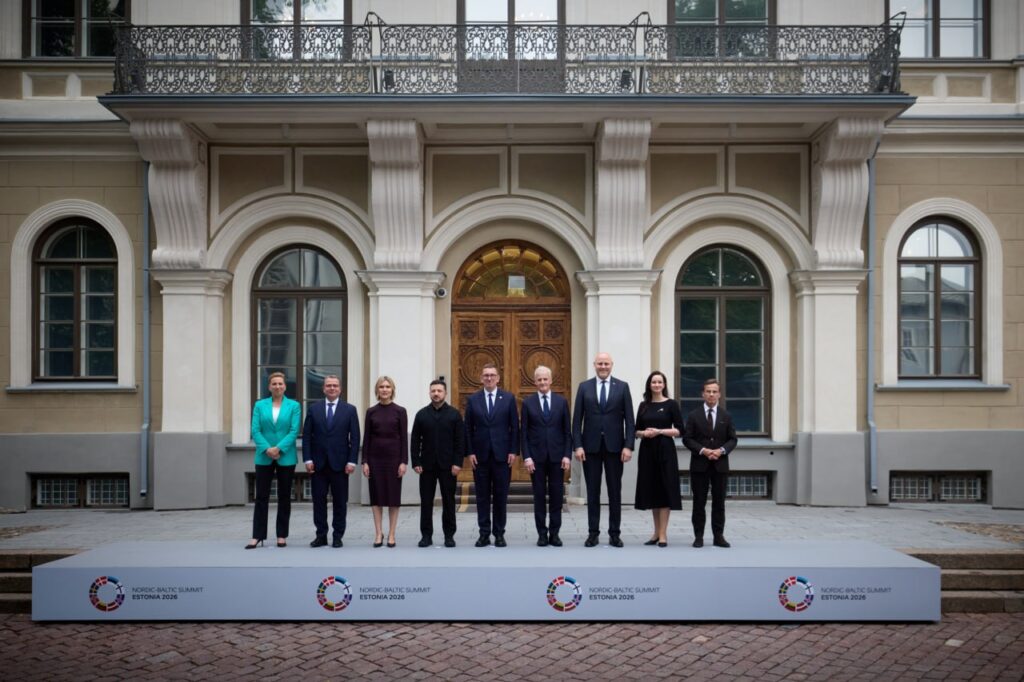
Ukraine and Latvia have signed a new “Drone Deal” aimed at expanding joint production and strengthening air and drone defense capabilities, Ukrainian President Volodymyr Zelenskyy said following meetings with Nordic and Baltic leaders on 9 June.
The agreement was signed during Zelenskyy’s first meeting with Latvia’s new Prime Minister Andris Kulbergs, which he described as a “concrete result” focused on co-production and shared defense development.
Zelenskyy said the deal reflects a broader model of cooperation Ukraine is building with partners who have supported Kyiv throughout the war, combining Ukrainian battlefield experience with European industrial capacity.
He said the aim is to strengthen shared protection against Russian threats, including expanding domestic production and improving coordination in drone and air defense systems.
The “Drone Deal” is a long-term cooperation format focused on developing drone capabilities through joint production, technology exchange, and practical defense support between Ukraine and partner countries.
Ukraine offers drone expertise to European partners
Zelenskyy also said Ukraine is ready to expand cooperation on drone warfare expertise, including sending specialist teams to partner countries to share operational experience gained during the war.
He said similar cooperation has already been carried out with partners in the Middle East and could now be scaled across Europe under the new drone cooperation framework.
Zelenskyy said Russia is attempting to escalate tensions across Europe, including through drone-related incidents near NATO borders, underscoring the need for coordinated defense responses among allies.
Air defense and drones central to talks with Nordic and Baltic partners
The announcement came during a series of meetings in Tallinn with leaders from Finland, Norway, Estonia, and other Nordic and Baltic states.
Zelenskyy said partners are increasingly recognizing stronger Ukrainian positions on the battlefield, while Russia continues to compensate for losses by striking civilian infrastructure.
He said air defense remains a key priority, including securing additional missile supplies and advancing work on European anti-ballistic defense systems.
Ukraine pushes for stronger sanctions and EU accession progress
Zelenskyy also discussed increased sanctions pressure on Russia, including measures targeting the shadow fleet, alongside continued support for Ukraine’s EU membership bid.
He urged rapid progress on opening EU accession negotiation clusters, saying Ukraine has met the necessary requirements and expects political decisions in the coming months.
“There is no reason to delay,” he said, calling for momentum in EU decision-making processes.
NATO fighters from the Baltic Air Policing mission shot down a foreign unmanned aerial vehicle over Latvia's Latgale region this morning, after the drone entered Latvian airspace as a result of Russian electronic warfare action, the Latvian Ministry of Defense says. It is the most direct documented NATO engagement of a drone over Latvian territory tied to Russia's war against Ukraine to date.
The shoot-down comes against a backdrop of repeated drone incursions over NATO territory along the eastern flank in 2026. In May, a Russian drone crashed into a residential building in Galați, Romania.
What did Latvia say?
"NATO Baltic Air Policing mission shot down a foreign unmanned aerial vehicle (drone) that had entered Latvia as a result of Russian electromagnetic warfare," the Latvian Ministry of Defense statement said.
The ministry stressed that the Latvian Armed Forces and NATO allies continuously monitor Latvian airspace to enable an immediate response to potential threats, and that the Latvian Armed Forces have reinforced air defense capabilities along the eastern border by deploying additional units.
"As long as Russia's aggression in Ukraine continues, the recurrence of incidents where a foreign unmanned aerial vehicle enters or approaches Latvian airspace remains possible," the ministry added.
Baltic context: Estonia's months of frustration
Latvia's incident comes after months of similar incidents in Baltic airspace. In May 2026, Estonia's Foreign Minister Margus Tsahkna and Defense Minister Hanno Pevkur publicly told Ukraine to control its drones better after months of airspace breaches across the Baltic states and Finland.
In March 2026, Tsahkna said, several drones breached Estonian airspace. One hit a chimney at the Auvere Power Plant, two kilometers from the Russian border, and another crashed in Tartu County, with debris washed up along Estonia's northern coast.
A drone also struck a fuel storage depot near the Latvian border. Russia has claimed the Baltic states are allowing Ukraine to use their airspace for attacks.
Ukraine has accused Russia of deliberately directing drones into Baltic airspace through electronic warfare. Today's Latvian statement that "Russian electronic warfare action" caused the intrusion aligns with Ukraine's reading of the pattern rather than Russia's.
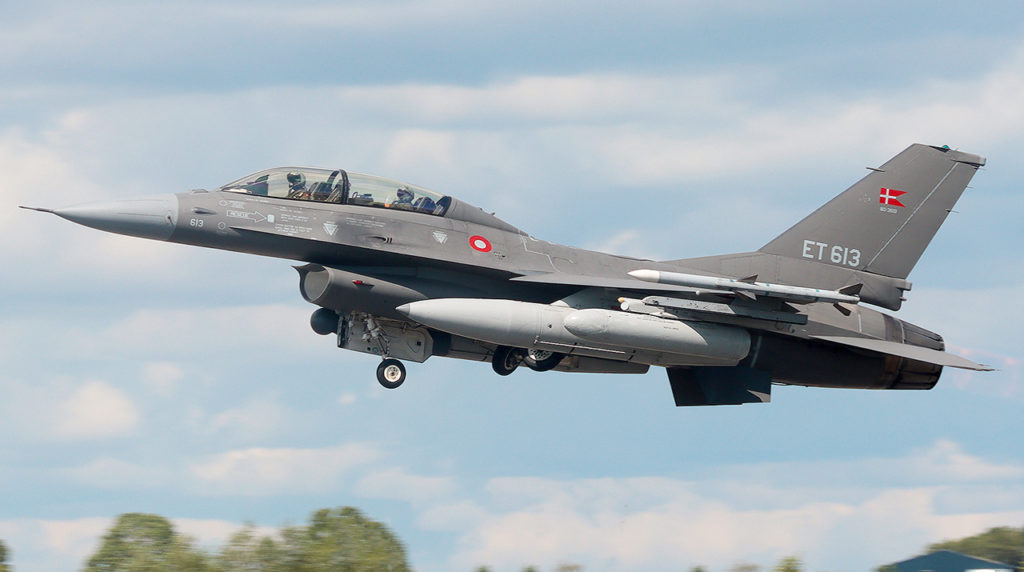
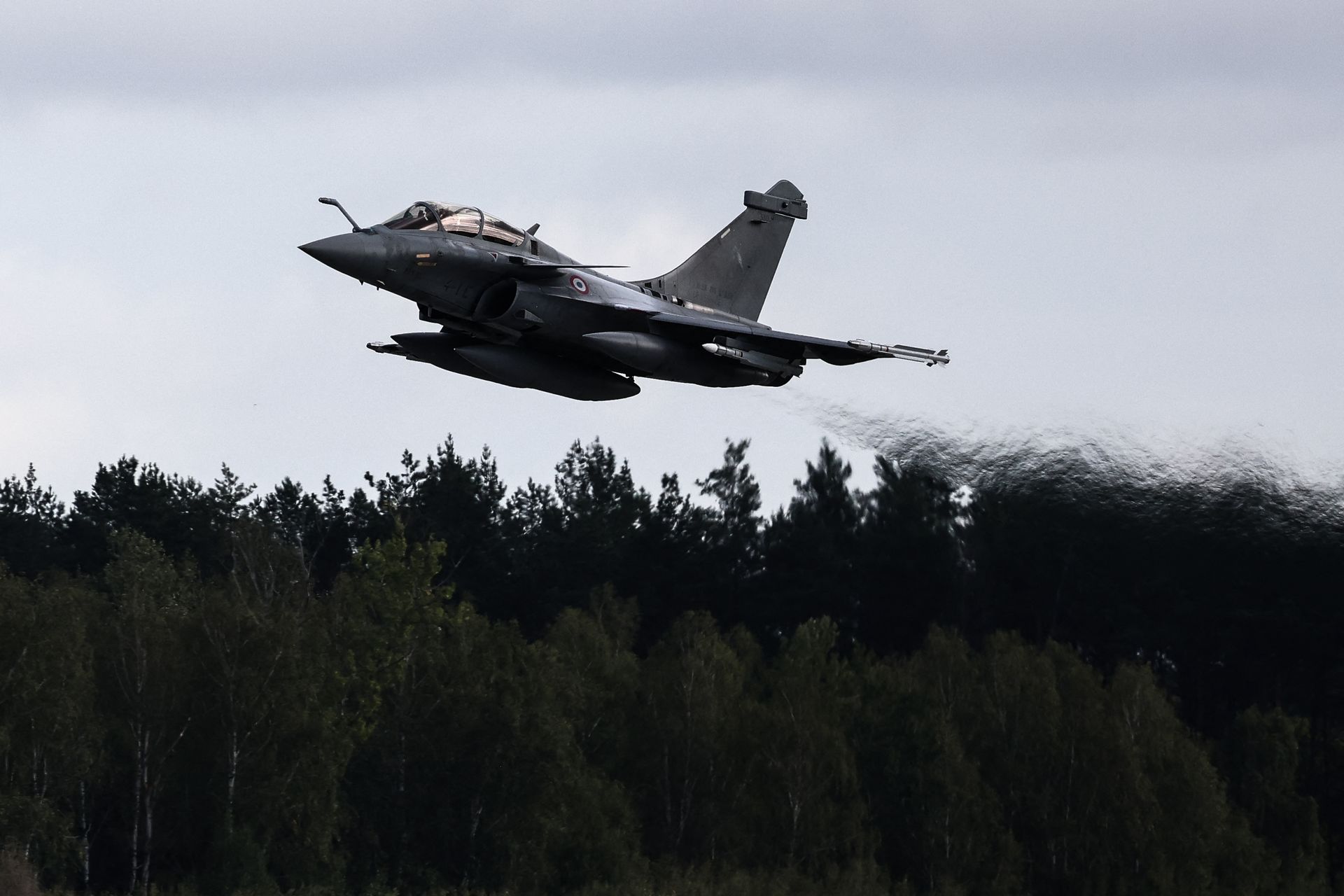
French fighter jets operating under NATO's Baltic Air Policing mission shot down a drone over eastern Latvia on 8 June, the country's National Armed Forces (NBS) confirmed. The drone was intercepted over Nautrēni parish between Rēzekne and Kārsava, near Latvia's border with Russia.
It was the first time NATO jets had downed a drone over Latvian territory.
The intercept is the second in Baltic airspace since 19 May, when a Romanian F-16 shot down a stray Ukrainian strike drone over Estonia's Lake Võrtsjärv. Latvia's drone crisis has been the most politically destabilizing in the region.
A 7 May crash near the Rēzekne oil storage facility toppled the ruling coalition after Prime Minister Evika Siliņa forced Defense Minister Andris Sprūds' resignation.
Latvia described the drone as deflected by Russian electronic warfare
The NBS described the aircraft as "a foreign unmanned aerial vehicle that had flown into Latvia as a result of Russian electromagnetic warfare," Latvian public broadcaster LSM reported. A military spokesperson told Reuters the drone entered Latvian airspace from Russia.
Baltic defense ministries have previously identified drones entering their airspace as Ukrainian, knocked off course by Russian electronic jamming while targeting sites inside Russia. Estonian Foreign Minister Margus Tsahkna has argued Moscow deliberately steers those drones into NATO territory to erode Western support for Kyiv.
Several allied foreign ministers echoed that claim at a 22 May meeting in Helsingborg.
The NBS issued cell-broadcast alerts to residents in the Rēzekne, Ludza, Balvi, and Alūksne municipalities at around 09:20 local time. The threat level in Rēzekne and Ludza was raised to orange at 09:40.
The alert was lifted by approximately 10:30 after the drone was confirmed destroyed.
Drone also violated Moldova's airspace overnight
Separately, an unidentified drone violated Moldovan airspace overnight and exploded on impact, Yevropeiska Pravda reported. Authorities are examining the fragments.
The incident came a day after Moldovan President Maia Sandu instructed the government to draft legislation enabling domestic production of interceptor drones, citing repeated airspace violations linked to Russia's war on Ukraine.
Last week, 56 countries and the EU condemned a Russian drone violation of Romanian airspace at a UN Security Council emergency session requested by Bucharest.
Escalating incursions are reshaping Baltic security
The shootdown caps a month that has transformed how the Baltic states approach drone defense. Estonia activated its first border drone-detection sensors on 30 May.
Ukraine and Estonia expanded drone cooperation on 3 June. Latvia's armed forces commander General Kaspars Pudāns warned last week that Russia could exploit its drone advantage to attack the Baltics by the end of 2028.
European leaders have agreed to develop a "drone wall" along their eastern borders, and a US anti-drone system has been deployed to NATO's eastern flank. A NATO counter-drone testing range at Sēlija in central Latvia hosted European startup demonstrations on 26 May.
 Login
Login