Normal view

Germany And Spain Launch ‘Team Gen 6’ After Europe’s Next-Gen Fighter Effort Collapses

12 June 2026 at 19:48

In a significant development for Europe’s future air combat ambitions, Airbus is trying to restart the program to develop a sixth-generation combat jet, now under German and Spanish leadership. This comes less than a week after the Franco-German-led New Generation Fighter (NGF) effort effectively collapsed in its original form, amid acrimony between Paris and Berlin. The NGF was planned as the crewed centerpiece of the pan-European Future Combat Air System (FCAS), which Airbus, as the leading European aerospace corporation, now hopes to get back on track.

An exciting step for European sovereignty at ILA Berlin: "Team Gen 6", a group of eight leading German defence and aviation companies signed a strategic positioning paper. The German and French governments have announced a realignment of the European Future Combat Air System… pic.twitter.com/aZcjAaO6dE

— Airbus Defence (@AirbusDefence) June 11, 2026

Airbus’s Defense and Space unit launched the ‘Team Gen 6’ initiative today with a message on X, declaring that it was “an exciting step for European sovereignty.” So far, eight German defense and aerospace contractors have signed a strategic positioning paper as part of the effort. Those firms are Autoflug, Diehl Defense, Hensoldt, Liebherr, MBDA Germany, MTU Aero Engines, and Rohde and Schwarz.

Reflecting the German-Spanish nature of the new program, those companies are now “closely integrated” with firms from Spain, comprising GMV, Grupo Oesia, Indra, ITP Aero, and Sener.

“While the development of the overarching [FCAS] ‘system of systems’ is progressing as before, the sixth-generation fighter aircraft integrated within it requires a new, agile industrial setup,” Airbus said.

A screencap from an Airbus video showing a notional future fighter working with remote-carrier-type drones. Airbus screencap

“As Team Gen 6, we have the capabilities and the capacities. Now, we are looking for close alignment with policymakers and the air force[s] to drive forward a superior European air combat system for collective security,” the X post stated.

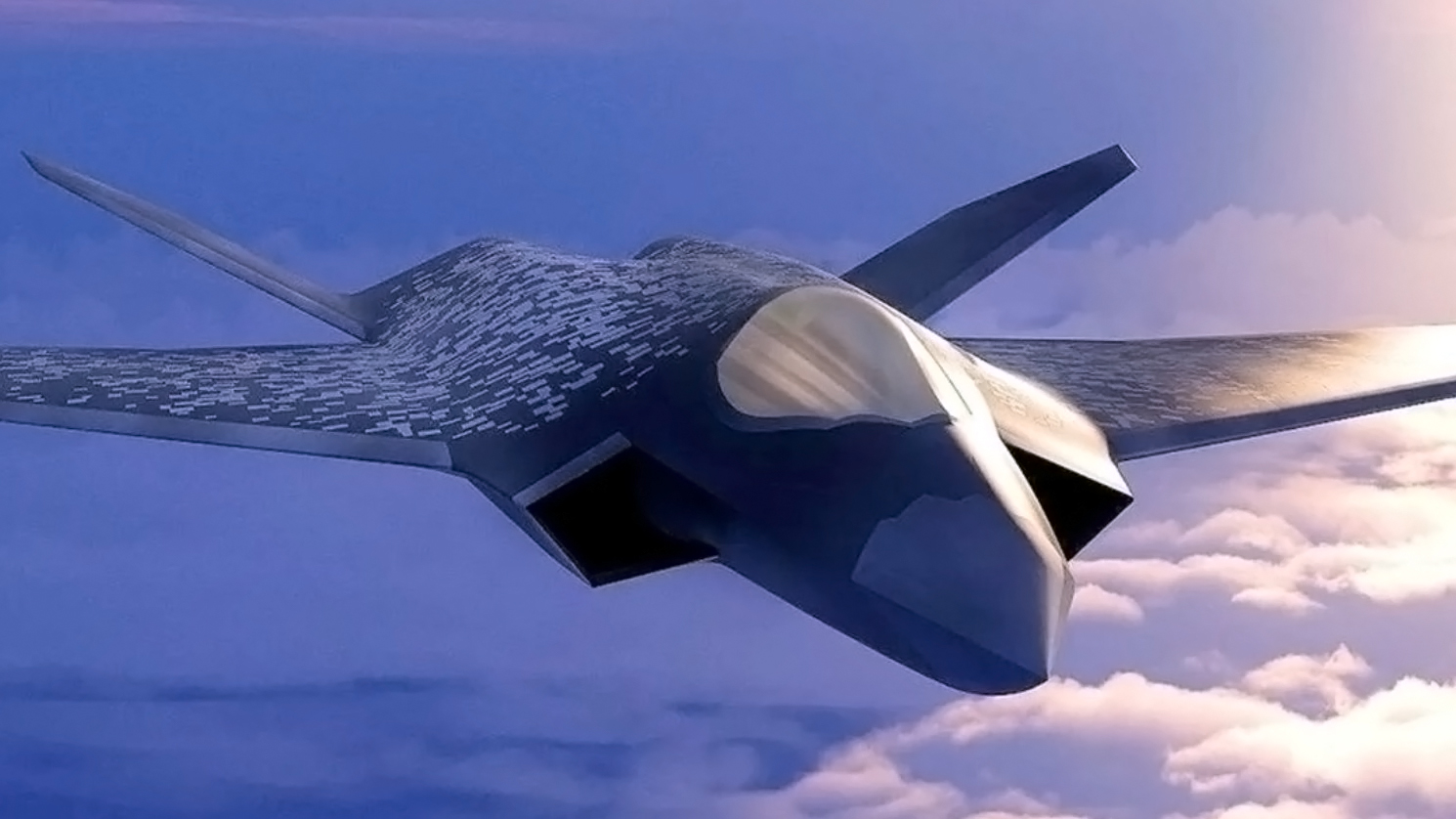
Airbus also presented a video showing a notional concept aircraft flying with multiple uncrewed platforms. While not too much (as in not much at all) should be read into this, the crewed aircraft features canard foreplanes, a chin intake, and an unusual cranked wing.

Speaking just ahead of the announcement, at the ILA Berlin airshow today, where TWZ was in attendance, Jean-Brice Dumont, head of air power at Airbus Defense and Space, said the company remains committed to delivering a sixth-generation combat jet. “There is a need for a bit of a reshaping and reconsidering the reality of today,” Dumont added.

SYMBOL - 10 June 2026, Brandenburg, Schönefeld: Federal Chancellor Friedrich Merz (2nd from left, CDU) and Jean-Brice Dumont (2nd from right), Head of Air Power at Airbus Defence and Space, stand in front of a drone during a tour of the International Aerospace Exhibition (ILA). Photo: Sebastian Gollnow/dpa (Photo by Sebastian Gollnow/picture alliance via Getty Images)
German Federal Chancellor Friedrich Merz (second from left) and Jean-Brice Dumont (second from right), head of air power at Airbus Defense and Space, stand in front of a drone during a tour of the International Aerospace Exhibition (ILA). Photo by Sebastian Gollnow/picture alliance via Getty Images

Dumont explained that the now-abandoned NGF was one of seven separate “pillars” of technology development being worked on under FCAS. As well as the crewed jet, pillars include powerplant, remote carrier vehicles, precision-guided weapons, and data connectivity.

“We have to consider safeguarding areas where it works, and how we reshape,” he added. “At the moment, we are going to seek guidance from our governments [on] what they want us to do. There has to be demonstrated an industrial feasibility of what is being asked — not only technical. That’s probably a lesson now,” Dumont added.

Dumont continued: “The world in 2026 is very different to the world of 2017 when the [FCAS] programme was launched. We have to accept that fact and reshape it — we need another way to get to the same goal, with faster milestones.”

“The problem we had is that we had drawn a line to 2040, and new technologies for everything,” Dumont added, referring to the goal of having the FCAS, including the NGF, in service by that date. “Today, you see demonstrations of connectivity, systems of systems and unmanned vehicles all around the world. The need is there, and in the countries that we are competing with, they are using it already.”

According to Dumont, the company has “put a number of options on the desk of our ministers and ministries of defense,” and is now awaiting further guidance from officials.

As the centerpiece of FCAS, in its original form, the NGF element was the most high-profile and challenging component of the project. However, it had long been dogged by disagreements over industrial workshare and leadership between Airbus and Dassault Aviation, which were the prime contractors for Germany and Spain, and France, respectively.

A 1:1 scale model of the NGF is unveiled at the Paris Airshow in 2019. Dassault Aviation

Dassault had demanded that it play the defining role in NGF, reflecting key requirements for the jet driven by the French Armed Forces. These included the ability to operate from aircraft carriers, and provision to deliver nuclear weapons. Germany or Spain needed neither of these functions.

Despite the disagreements that derailed NGF, Dumont argued that there had still been useful lessons learned from the FCAS program.

“What Phase 1A and 1B [of the program] have given is a very thorough analysis of the repartition of the work between the crewed and uncrewed platforms, and this remains. That kind of shapes what the manned aircraft will have to do.”

As an example of this work, Dumont pointed to ongoing work that will involve trials of a Eurofighter operating as a “command fighter” — a crewed jet that can operate in collaboration with drones, or what Airbus now refers to as uncrewed collaborative combat aircraft (UCCAs). The tests will see a Eurofighter fitted with a Rafael Litening 5 targeting pod modified to serve as the interface between the crewed jet and UCCAs. This should pave the way toward an in-service command fighter capability being introduced to the Eurofighter, something that will be incorporated in the sixth-generation combat jet from the outset.

Kampfflugzeug vom Typ Eurofighter mit Lenkbombe GBU-48 (Guided Bomb Unit 48) fliegt im Übungsgebiet im Rahmen der multinationalen Übung Green Flag West, am 08.05.2018. ©Bundeswehr
A German Eurofighter with a Litening laser targeting and reconnaissance pod on the centerline station. Crown Copyright

Initial trials will involve a Learjet test configured as a surrogate command fighter and flying with drones in an “enhanced teaming” mode. Airbus hopes to have the command fighter-configured Eurofighter ready for operational service in 2029.

“The demand from the customers is: be ready early,” Dumont explained. “This is not a contradiction to the Future Combat Air System challenge — it is the need to have our platforms evolved earlier than we had traditionally planned.”

A model of a notional sixth-generation fighter displayed at ILA as part of a command fighter study by the German Aerospace Center (DLR). Thomas Newdick

The termination of NGF and the launch of Team Gen 6 leaves plenty of questions over the future of Europe’s air combat landscape.

TWZ spoke to Douglas Barrie, senior fellow for military aerospace at the International Institute for Strategic Studies (IISS) research institute in London, for his take on what might happen next.

On the matter of Germany and Spain now teaming up under the Airbus umbrella, Barrie said that the relationship makes a lot of sense, but its success is far from certain. On the one hand, the two countries already work together within Airbus, and both Germany and Spain are seeking a replacement for their Eurofighter fleets.

SONY DSC
A pair of Spanish Air and Space Force Eurofighters. Spanish Ministry of Defense

“In terms of Team Gen 6, I do wonder if there’s an element of trying to kind of scramble to recover something from the wreckage of NGF, as it were, that the collapse of NGF doesn’t signal the end of Spanish industrial interest in next-gen combat aircraft development,” Barrie said. “But if somebody asked me, do I think between Germany and Spain, they can put together a credible program if nobody else is involved? I think that the numbers would be very difficult to stack up.”

Putting the German and Spanish future fighter requirements together, the two countries might, at best, need to build 300 new combat jets, with a figure of 250 more likely, Barrie contended. Team Gen 6 would then face a real struggle to break even.

This reality will, Barrie believes, force Germany and Spain to look for other partners, which will likely come down to a choice between the British-led Global Combat Air Program (GCAP) and the Swedish next-generation combat aircraft program, led by Saab. Of these, GCAP has the Tempest crewed fighter as its centerpiece, and also involves Italy and Japan. Sweden’s crewed fighter requirements are less clear at this point.

A scale model of a possible Tempest configuration, in Italian Air Force markings. Leonardo

Building a role for Airbus in GCAP would be difficult at this point. With the industrial architecture already in place, bringing not one, but two more partners into that program would be disruptive, particularly in terms of timeline. Already, the Japanese in particular are concerned about the pace of the program, especially since the United Kingdom has not yet fully committed to it in terms of funding.

“My own view is that the United Kingdom remains committed to the program, but there are financial pressures elsewhere,” Barrie noted. “I think that the more likely outcome in all of this is a kind of German, Spanish, Swedish tie-up. The kind of requirements in some ways are aligned a bit better.”

This extends to the size of the aircraft, Barrie observed.

“The kind of aircraft that the Swedes seem to be thinking about, the crewed element is probably more of a bigger Gripen E/F, heading towards Typhoon, in terms of size. This is more in keeping with what the Germans and the Spanish seem to be looking for. Obviously, the United Kingdom and Japan, in particular, need something with longer legs and bigger internal payload, hence GCAP.”

The Saab Gripen E. Saab

“GCAP will be highly capable,” Barrie continued. “That will come with a unit cost to go with it. Maybe what the Swedes, the Germans, and the Spanish might do will be cheaper.”

Provided a German, Spanish, Swedish teaming arrangement could work, the resulting combat jet could still enter a space where it would face competition for important export orders from France, which looks set to continue the development of the Rafale, especially now that NGF has collapsed. Further competition could be provided by South Korea with further developments of its KF-21 and Turkey with the TF Kaan, although these are notably less-ambitious fifth-generation designs.

The Tempest, as currently envisaged, with its very different set of requirements, would not necessarily be a direct competitor to Team Gen 6, Barrie argued, since it would be a closer match to the F-47 in terms of size, capabilities, and cost. While the potential size of this market would be more limited, probably U.S. reluctance to export the F-47 would play in the Tempest’s favor.

An official rendering of the Boeing F-47. U.S. Air Force

As to the possibility of the United States offering a ‘watered-down’ export model of the F-47, Barrie considers this unlikely to generate much interest.

“Yeah, you can have a downgraded version of my super airplane — as a kind of marketing slug that hardly sells, does it?” Barrie continued. “Even if it’s 10 percent less capable, even if it’s 10 percent less expensive, it’s still a likely unit cost of $250 million or more, which is eye-watering.”

This leaves us with the French, and what they might be able to recover from NGF.

If France goes it alone with a sixth-generation combat jet, Dassault will likely be strongly backed by the French government, and the company has traditionally punched well above its weight.

In the medium term, Dassault has a healthy backlog of orders for the Rafale and is very much at the right end of the cost curve. Barrie considers that the Rafale will remain a profitable airplane for the foreseeable future, but at some point, France will need to think about a successor based on an all-new airframe. Industrially, France has the capability to go alone with this, but they would likely look to a partner or partners to come on board. The likelihood of those partners coming from Europe has now been reduced, but other possibilities might be found in the Gulf states.

A pair of Rafales from the Qatar Emiri Air Force. Dassault Aviation www.twz.com

Then there is the question of India, which may still buy more Rafales but which, in the fullness of time, is likely to look for a new-generation fighter, and could be a potential partner for France.

“I don’t see the Indians ever being fully committed to only one country,” Barrie continued. India has already hinted that it might want to try and join the pan-European FCAS or GCAP. Meanwhile, Russia has been a long-term military partner for India, and Barrie thinks that the recent appearance of a two-seat version of the Su-57 Felon may well indicate another effort to sell that fighter to India.

Imagery has emerged that appears to show a previously unknown two-seat version of the Sukhoi Su-57 Felon, Russia’s most modern and capable fighter. Provided the available photo is legitimate, and there is nothing obvious to suggest otherwise, at this point, the Russian development would parallel China’s work on a two-seat version of the stealthy J-20.
The previously unknown two-seat version of the Sukhoi Su-57 Felon, which appeared earlier this year. UAC UAC

Were India to continue its pattern of buying Russian combat aircraft, that would give any potential European partner serious pause for thought, based on the security implications. Meanwhile, India also remains committed to developing its own next-generation fighter.

What the NGF debacle has demonstrated is that any potential partner with France on its next-generation combat aircraft program will likely have to be happy taking a junior role, with Dassault calling the shots.

The collapse of the New Generation Fighter could well be a pivotal moment for European defense cooperation, but it does not signal the end of Europe’s sixth-generation combat aircraft ambitions.

Airbus’s Team Gen 6 announcement marks the start of a German-Spanish-led industrial approach that its backers hope will be more agile and less contested than its Franco-German-led predecessor. However, significant political, financial, and industrial challenges remain, including the search for a reliable partner, or partners. As with NGF, the success of Team Gen 6 will ultimately depend on whether European governments can align their strategic priorities and industrial interests to deliver a sovereign future air combat capability.

Contact the author: thomas@thewarzone.com

The post Germany And Spain Launch ‘Team Gen 6’ After Europe’s Next-Gen Fighter Effort Collapses appeared first on The War Zone.

F-22’s ‘Catfish’ 757 Testbed Spotted Carrying Raptor’s New Infrared Sensor Pod

12 June 2026 at 00:15

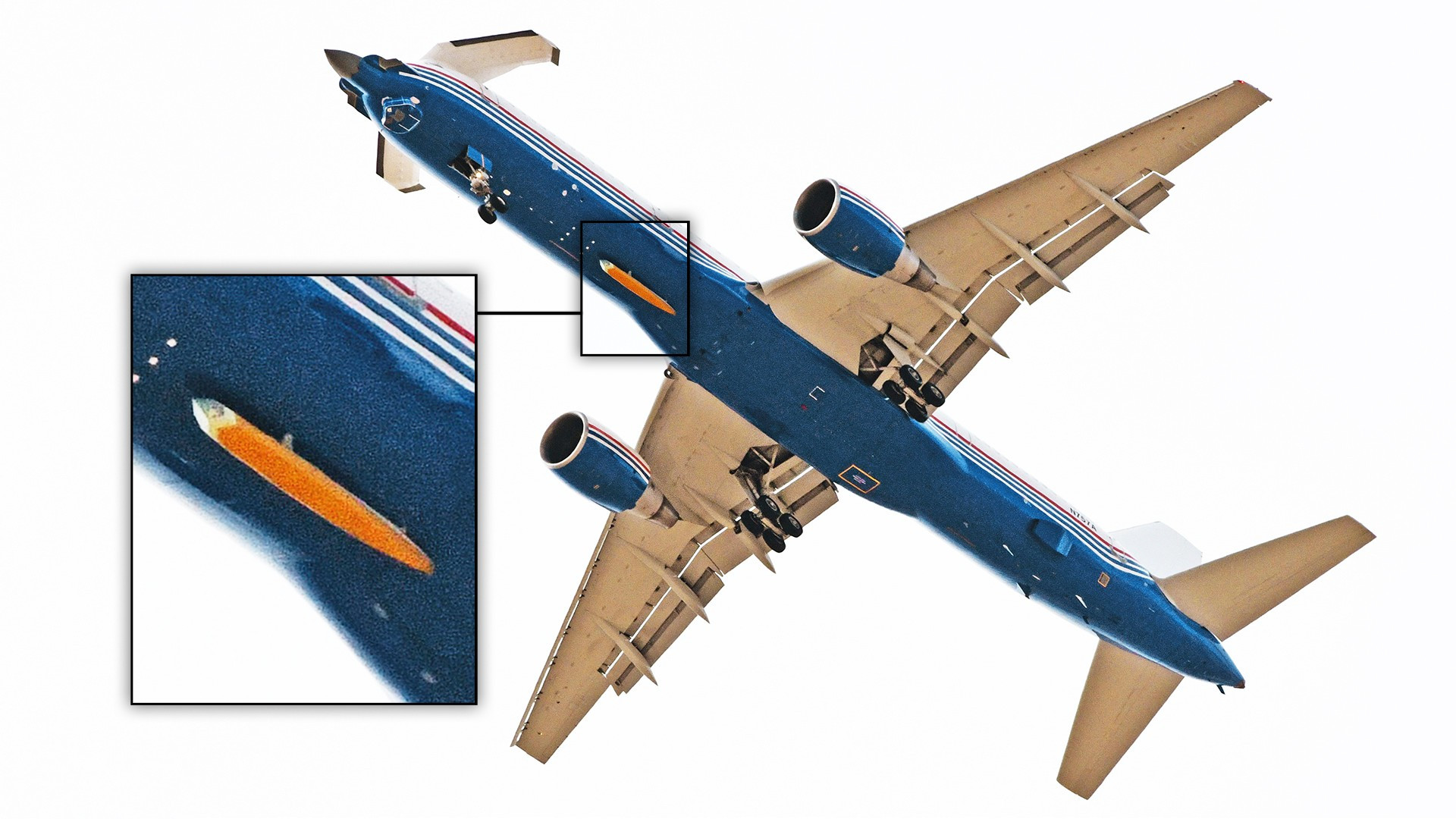
Boeing’s 757 Flying Test Bed was recently spotted carrying a stealthy underwing infrared sensor pod under its fuselage. This may be the first time this aircraft, better known as ‘The Catfish’ because of its unique and highly modified nose profile, has ever been seen lugging around a store on this station. The pod itself is part of a larger “Raptor 2.0″ upgrade package being developed for the F-22. Catfish has served as a key systems integration testbed for the Raptor since the 1990s.

Jerod Harris caught Catfish with the pod under its belly as it came in to land at Edwards Air Force Base in California on Monday. Edwards is the main hub for U.S. Air Force test and evaluation activities, and Catfish has been seen there many times over the years as part of its work. The aircraft, which carries the U.S. civil registration code N757A, also happens to be the first 757 ever built, and took to the skies for the first time back in 1982.

Catfish with the pod under its fuselage seen on approach to Edwards Air Force Base in California. Jerod Harris

As already noted, Catfish has already played a central role in the story of F-22. The aircraft’s heavily modified nose is designed to directly replicate that of the Raptor, and contains the same AN/APG-77 active electronically scanned array (AESA) radar as the fighter. The swept wings on top of the cockpit were also designed to support testing of the conformal antennas for the Raptor’s AN/ALR-94 electronic support measures system and other components of its ‘fused’ sensor suite. The aircraft has supported the development of a wide array of other systems for the F-22, and is packed inside with additional equipment to support those needs in particular, including a replica of the Raptor’s cockpit. You can read more about Catfish and its general history here.

So it is not surprising then that the heavily modified 757 would also be used now to help with continued testing of the new underwing infrared sensor pods for the Raptor. Carrying the pod under the forward end of the fuselage would offer the sensors inside a good open field of view to the front, as well as to the left, right, and down.

Another view of Catfish carrying the stealthy infrared sensor pod. Jerod Harris

The stealthy pods have been test-flown on actual F-22s for years now. At the same time, there are only a limited number of Raptors available, in total, and they are notoriously fuel-hungry, maintenance-intensive, and otherwise expensive to operate. If the particular test plan calls just for level flight, and over extended periods of time, a platform like Catfish could be an attractive alternative. With space for dozens of engineers and technicians in its main cabin, and workstations for them, the aircraft would also offer very different options for testing and evaluating the pod while in-flight. A North American Sabreliner business jet has also been used to test these pods in the past.

N33TR, a Rockwell Sabreliner 65 for Airborne Imaging returns to KJWY/Mid-Way regional Airport as " AIRBORNE33 " carrying one of the future F-22 pods.

It was at Nellis AFB testing the pod alongside RATT55/NT-43A, a radar test bed that regularly flies alongside B-2s. pic.twitter.com/kNADnga7H0

— 𝗦𝗥_𝗣𝗹𝗮𝗻𝗲𝘀𝗽𝗼𝘁𝘁𝗲𝗿 (@SR_Planespotter) July 1, 2024

The capability, in general, for Catfish to carry stores under its fuselage might open up additional possibilities for utilizing the aircraft in support of other testing efforts, if it hasn’t already.

Catfish continues on with its approach to Edwards. Jerod Harris

Catfish would also be well suited to supporting testing of other elements of the Raptor 2.0 package. Under the current plan, the Air Force’s F-22s are also set to get a new integrated distributed infrared search and track (IRST) system called the Infrared Defensive System (IRDS).

IRST systems have seen a renaissance across the U.S. military in recent years, as well as elsewhere globally. IRSTs detect and track targets via their infrared emissions, making them particularly valuable for helping spot stealthy targets with features designed to reduce their radar cross-sections. The sensors are also immune to radio frequency electronic warfare jamming and operate passively, meaning they do not emit signals that could alert a target to the fact they are being tracked. IRSTs can also be used to cue or otherwise be linked to other sensors, including AESA radars. This data fusion can provide higher fidelity tracks of multiple targets, as well as improved situational awareness overall.

Increased demand for IRSTs has led to a commensurate increase in demand for testing using multiple platforms. This, in turn, has been a major component of a general uptick in U.S. military flight testing in recent years to support a variety of new, advanced programs.

An F-22 with the stealthy underwing infrared sensor pods and drop tanks seen on a test flight over the Mojave Desert in March 2026. Jarod Hamilton

Other elements of the Raptor 2.0 upgrade plan include new stealthy drop tanks, improvements to the jet’s stealthy features, radar capabilities, electronic warfare suite, and more, as you can read about in detail here.

At least a portion of the Raptor fleet is also set to receive modifications to enable them to act as airborne controllers for Collaborative Combat Aircraft (CCA) drones. The Air Force’s F-22s are set to be the service’s first tactical jets to be used in that role, though others will follow.

The F-22 upgrade work is reflective of current Air Force plans to keep the Raptors in service for decades to come. In 2024, the Air Force said it no longer had a firm retirement schedule for the fighters.

Raptors have been used in recent years as surrogates to support work on the Next Generation Air Dominance (NGAD) initiative, a component of which is Boeing’s F-47 sixth-generation fighter. As such, Catfish will have already been feeding into those developments, which are now firmly a top Air Force priority.

Catfish seen flying together with a pair of F-22s near Edwards in 2024. Courtesy photo/Kyle Larson via USAF Chase Kohler

At the same time, Catfish is now 44 years old. Boeing 757s, in general, are increasingly disappearing from service globally as they become more complicated and cost-intensive to sustain. Especially with the work ongoing now on the F-47, it seems likely Boeing will start looking toward a new highly specialized testbed aircraft modified to reflect the particular physical geometry, unique avionics, and other features of the new fighter.

Similarly, the F-35 family also has a dedicated test jet, the Boeing 737-300-based Cooperative Avionics Testbed, nicknamed the CATbird. There are several other airliner and business jet-based testbeds flying globally today, though Catfish is certainly one of the largest and most visually distinctive. Improving digital simulation and modeling tools could allow for less reliance on surrogate testbed aircraft in the future, but they will in no way be eliminated.

China notably has something of a clone of Catfish based on a Russian-made Tupolev Tu-204C airliner, which itself was designed as an analog to the 757. The Chinese jet’s primary purpose has been supporting the development of the J-20 stealth fighter, the country’s closest answer to the F-22.

China’s Tu-204C-based ‘Catfish’ testbed jet. Chinese internet via X

In the meantime, Boeing Catfish remains a very important part of continued work to improve and expand the capabilities of the F-22. This now extends to testing of specialized underwing pods for the Raptor.

Special thanks again to Jerod Harris for sharing his pictures of Catfish carrying the stealthy sensor pod with us.

Contact the author: joe@twz.com

The post F-22’s ‘Catfish’ 757 Testbed Spotted Carrying Raptor’s New Infrared Sensor Pod appeared first on The War Zone.

Fire at California warehouse complex prompts evacuations as authorities fight blaze

No injuries reported as fire in Tracy destroys medical equipment warehouse and authorities investigate cause

A fire at a 1m sq ft warehouse complex continued to burn out of control in California early on Friday, as authorities warned the blaze could take days to extinguish and may contain toxic hazards.

The raging inferno was pumping thick black smoke up in billowing clouds as flame and a red hot glow were visible beneath from aerial images. The fire has destroyed the medical equipment warehouse in Tracy, in northern California, and prompted evacuations of other nearby facilities, with no injuries reported.

Continue reading...

© Photograph: Anadolu/Getty Images

© Photograph: Anadolu/Getty Images

© Photograph: Anadolu/Getty Images

Kongsberg Bets On High-Low Cruise Missile Mix With JSM And Rusty Dagger

11 June 2026 at 18:13

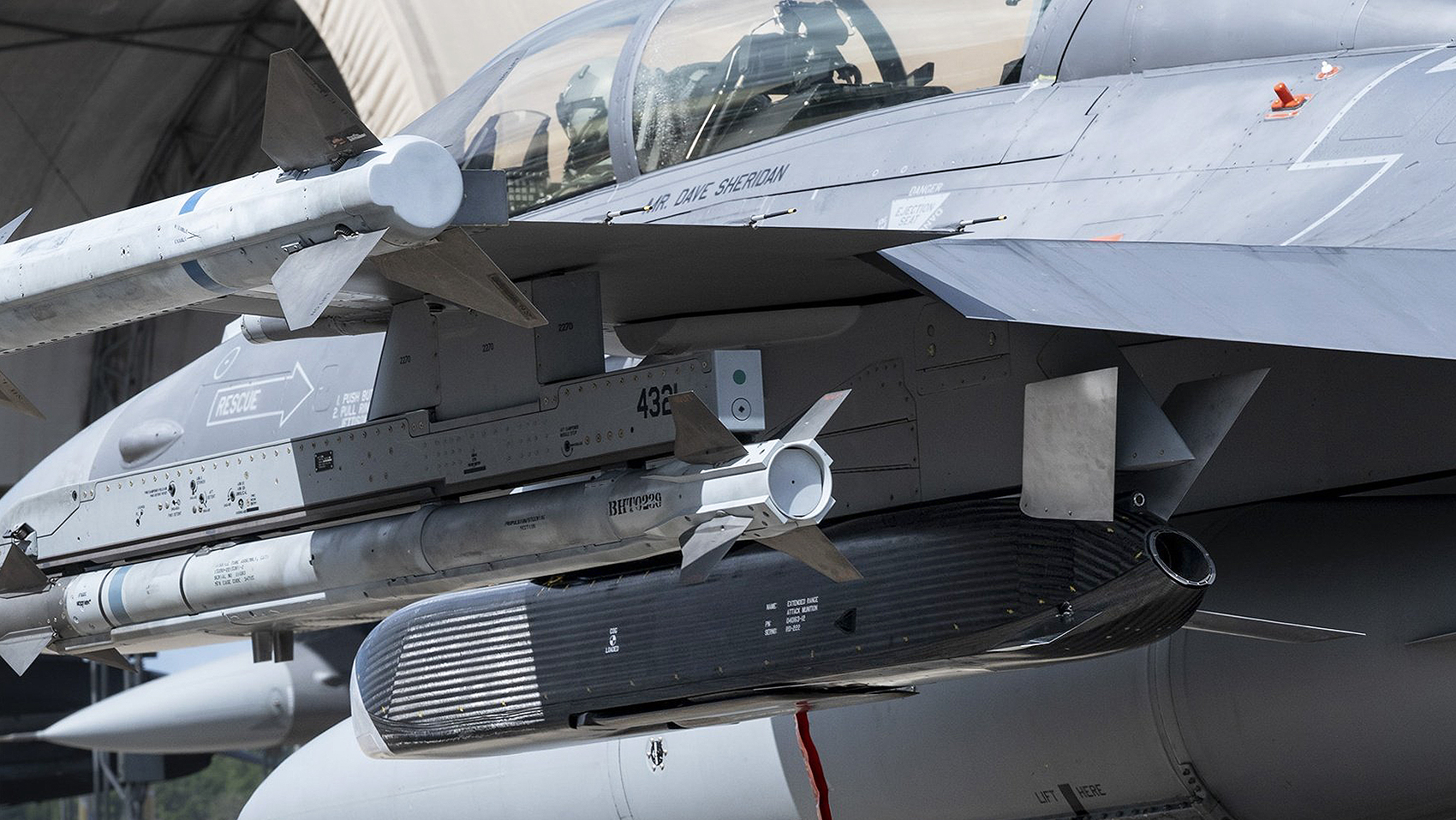
Norwegian missile-maker Kongsberg has finalized its acquisition of a majority stake in Zone 5 Technologies, bringing under its umbrella the U.S. start-up’s Rusty Dagger low-cost cruise missile, among others. With both those weapons already moving into large-scale production, the two companies are making the case for combining Kongsberg’s stealthy Joint Strike Missile (JSM) cruise missiles in operational scenarios. Zone 5 has also now confirmed that the Rusty Dagger, which is already being supplied to Ukraine, is now cleared for use on four different types of fighter aircraft, including the F-16.

At the ILA Berlin airshow yesterday, where TWZ was in attendance, officials from the two companies announced that Kongsberg has now formally acquired a 90 percent stake in Zone 5. California-based Zone 5 will continue to operate as an independent subsidiary under the Norwegian contractor. As well as discussing the industrial acquisition, the officials provided details of how the Rusty Dagger fits into the new-look portfolio, and updates on how that program is progressing.

Founded in 2011, Zone 5 is one of an emerging class of defense companies gaining prominence for developing low-cost, rapidly deployable capabilities. In many ways, they represent the inverse of traditional defense contractors, favoring speed, scalability, and cost efficiency over highly customized, high-priced systems.

Kongsberg first announced the acquisition in December, with executives noting that buying a stake in Zone 5 offered the fastest path to offering lower-cost missiles that still deliver meaningful combat capability, especially in terms of bringing these to the European market.

“What we’re doing here is that we’re combining Kongsberg’s niche, exquisite technologies with a company very capable of designing for cost efficiency and mass production,” explained Thomas Akers, founder and CEO of Kongsberg.

KONGSBERG announced today that it has closed the acquisition of US missile company Zone 5 Technologies LLC, following approval by US regulatory authorities.

🔗 https://t.co/meRxfmYHH6 pic.twitter.com/EXVbYhDers

— KONGSBERG (@kongsbergasa) June 10, 2026

As to why Kongsberg didn’t choose to develop its own equivalent to the Rusty Dagger, Harald Aarø, Kongsberg’s executive vice president for business development and strategy, provided the following answer:

“Technically, could we be capable of doing it? Yes, but we are not as capable, as we will probably spend a longer time, and perhaps not strike as smart solutions,” Aarø said. “That doesn’t mean that our engineers aren’t just as smart. Our engineers are just as smart, but on a different sports field, so to speak.”

A briefing slide with various details about the JSM’s capabilities. Kongsberg

Aarø also described how the specific combination of the Rusty Dagger and the JSM makes for “a very effective future strike solution.” Namely, the Rusty Dagger provides cost-effective but still highly capable standoff strike, while the more exquisite JSM comes with a heftier price tag but offers a greater chance of making it through to even heavily defended targets, on account of its sophisticated guidance and low-observable characteristics.

As well as being launched from a pylon on a fighter, the Rusty Dagger can be configured for palletized employment from a cargo aircraft, reflecting growing interest in this type of munition employment. It can also be surface-launched both on land and at sea.

According to Tom Kanewske, Zone 5’s chief strategy officer: “What’s interesting about our missile is that the same base, light cruise missile is field retrofittable for all employment modes, and that puts us in a very unique space, in that a country and their [armed] services are able to purchase the same munition and field retrofit for that to be surface launched, whether from land or the deck of a ship, or pylon launched from a fighter aircraft, or palletized.”

Since larger numbers of Rusty Daggers can be launched in any given scenario, they can overwhelm enemy air defenses and improve the chances of success.

According to Kanewske, Rusty Dagger and JSM “offer a weapon pairing that truly no other missiles in the world do.”

While the JSM can be carried internally in the F-35, the same is not currently the case for the Rusty Dagger, although Kanewske said that this is “something that is of keen interest to the [U.S. military] services and several of our international partners.”

A mock-up of a JSM in one of the internal weapons bays of an F-35. Kongsberg

When it comes to utilizing the Rusty Dagger and JSM together in a combat scenario, Kanewske noted the possibility of integrating capabilities that would allow the Rusty Dagger to offer “cooperative behaviors” with the JSM. This reflects a growing trend toward leveraging artificial intelligence to help make all munitions more effective and survivable, something that has been demonstrated via Golden Horde and follow-on programs.

Both missiles fly at high-subsonic speeds, the Rusty Dagger being able to strike targets at a range of 250 miles, according to Zone 5, while the JSM has a range of more than 215 miles.

In one highlighted scenario, F-35s could penetrate closer to the target, with their JSMs carried internally to preserve their low-observable features. Meanwhile, much larger numbers of Rusty Daggers could be pylon-launched from fighters, and dropped in palletized form out of the cargo holds of transports, from outside of the range of hostile air defenses.

Three views of a Rusty Dagger live-fire test on January 22, 2025, at Eglin Air Force Base, Florida. via U.S. Air Force

Kanewske confirmed that, this year, its first year of production, “well above 1,000 units for Rusty Dagger” will be completed, including for the U.S. Air Force, as the AGM-188, under the Family of Affordable Mass Missiles (FAMM) program. The Air Force’s proposed budget for the 2027 Fiscal Year laid out plans to buy nearly 28,000 FAMM munitions over the next five years.

Last month, the Pentagon laid out plans to acquire at least 10,000 lower-cost cruise missiles over the next three years, as part of a broader strategy to dramatically bolster its stockpiles of standoff strike munitions and prepare the industrial base to sustain those inventories going forward. This is seen as especially critical for supporting the demands of future high-end fights, such as one in the Pacific against China, and doing so in a cost-effective manner.

The Rusty Dagger has so far been cleared for use from four different types of fighter aircraft, Kanewske said. One of these is the F-16, which used the weapon in end-to-end live-fire trials at the Eglin Test and Training Range in Florida earlier this year. Another platform may be the A-4, with a contractor-operated example of the attack jet having been used in company trials. Then there is the Ukrainian Air Force, which is using the Rusty Dagger, under the Extended Range Attack Munition (ERAM) program, although the specific platforms have not been disclosed. Any of the MiG-29 Fulcrum, Su-25 Frogfoot, and Su-27 Flanker are likely candidates — as well as its own F-16s.

A series of unverified photos, first published by Russian sources, showing purported parts of Rusty Dagger missiles retrieved after being used by Ukraine:

It appears that the AGM-188A “Rusty Dagger” cruise missile has undergone field testing in Ukraine.

Russian sources are publishing photos of an unknown 8-element CRPA antenna. On the back side of the unit there is a circuit board with a large heatsink, which carries the CAGE code… pic.twitter.com/phZeOJfHJ0

— 𝔗𝔥𝔢 𝕯𝔢𝔞𝔡 𝕯𝔦𝔰𝔱𝔯𝔦𝔠𝔱△ 🇬🇪🇺🇦🇺🇲🇬🇷 (@TheDeadDistrict) June 7, 2026

In the case of the F-16, Kanewske said that only 72 hours were required to integrate the Rusty Dagger on the jet during the trials at Eglin.

A U.S. Air Force F-16 Fighting Falcon flies over the Gulf of America. The F-16 carried two Family of Affordable Mass Munitions – Lugged weapons.
A U.S. Air Force F-16 flies over the Gulf of America carrying a pair of Rusty Dagger Family of Affordable Mass Munitions (FAMM) weapons. U.S. Air Force U.S. Air Force photo by Staff Sgt. Blake Wiles

“We’re the only affordable mass munition that is currently on contract with an export international customer, and we are actively involved with them at this time,” Kanewske said, clearly referring to Ukraine.

Zone 5 is currently under U.S. Air Force contract for both FAMM and ERAM, and is also under contract with the U.S. Army for its Low-Cost Containerized Missile (LCCM) program, and for the U.S. Navy as part of its Coalition Heterogeneous Affordable Offensive Strike (CHAOS) program, which seeks a low-cost anti-ship cruise missile to provide to partner countries. Both LCCM and CHAOS involve surface-launched missiles.

As well as the ability to rapidly scale up production and a relatively low unit cost, the Rusty Dagger brings with it an open-architecture concept, applying to both software and hardware. This means new, sovereign features and capabilities can be introduced at short notice by customers. In the past, an operator might have to wait up to five years for unique subcomponents to be integrated in a similar weapon, Kanewske contended. With the Rusty Dagger, Zone 5 has demonstrated that this can be achieved in under 12 months.

Then, when it comes to producing the missile at mass, rather than having to “make that factory bigger and bigger,” Kanewske explained that the company offers a franchise model “that allows us to roughly parachute in the design, the equipment, the tooling, the fixtures, the quality control, so that countries can drop in their own subsystem capabilities, and we can achieve manufacturing at pace and at scale.”

A U.S. Air Force F-16 Fighting Falcon releases a Family of Affordable Mass Munition – Lugged weapon over the Gulf of America. This release was part of a rapid test series performed by the 96th Test Wing and 53rd Wing. (U.S. Air Force photo by Staff Sgt. Blake Wiles)
A U.S. Air Force F-16 releases a Rusty Dagger over the Gulf of America. U.S. Air Force photo by Staff Sgt. Blake Wiles

Speaking in Berlin yesterday, Kongsberg’s Harald Aarø confirmed that Germany is a particular target for this franchise model, including for the Rusty Dagger. He identified Germany as having “probably the best manufacturing capabilities on this planet,” making it an obvious choice for a European manufacturing footprint.

Reflecting on the changing security situation on the continent since Russia’s full-scale invasion of Ukraine, Aarø said that now is “a natural time to start looking at a production site in Europe,” providing nations there with national sovereign capabilities based on the Kongsberg/Zone 5 joint portfolio.

Kongsberg’s acquisition of a majority stake in Zone 5 evidences a broader shift in Western defense planning toward affordable, mass-produced precision weapons that can be fielded at scale alongside more sophisticated strike systems.

The war in Ukraine has exposed the harsh reality that Europe needs far more standoff weapons than it currently possesses, and it needs them at a price point that allows stockpiles to be measured in the thousands rather than the dozens. Rusty Dagger is very much indicative of a new generation of systems designed around that requirement, prioritizing low-cost mass production over the exquisite but scarce munitions that have traditionally dominated Western arsenals.

As conflicts in Ukraine and the Middle East continue to highlight the operational value of low-cost, long-range munitions, demand for capabilities such as the Rusty Dagger is likely to grow. In an increasingly crowded marketplace, Kongsberg and Zone 5 will hope they can leverage their partnership, the Rusty Dagger’s combat use in Ukraine, and the potential to harness its capabilities in combination with the JSM, to build on the missile’s success.

At the same time, Kongsberg’s interest in establishing European production reflects a wider recognition across the continent that long-range strike capacity, industrial resilience, and the ability to sustain missile inventories are becoming increasingly important elements of national and collective defense.

Contact the author: thomas@thewarzone.com


The post Kongsberg Bets On High-Low Cruise Missile Mix With JSM And Rusty Dagger appeared first on The War Zone.

Hong Kong Charges 7 People and 2 Companies Over Deadly Apartment Fire

10 June 2026 at 15:10
The 25 charges include manslaughter and conspiracy. They are the first to emerge from a monthslong investigation into a blaze that killed 168 people.

© Lam Yik Fei for The New York Times

The fire in the Wang Fuk Court apartment complex in November was the worst Hong Kong had seen in generations.

Franco-German Future Fighter Effort Collapses Over Irreconcilable Differences

8 June 2026 at 21:44

The troubled pan-European Future Combat Air System (FCAS) appears to have lurched to an undignified — but predictable — end, at least in its current form. A flurry of media reports today indicate that France and Germany, the two major partners in the program, have abandoned their program to develop a crewed New Generation Fighter (NGF) aircraft together, a conclusion supported by a French diplomat who spoke to TWZ today.

According to sources including the Frankfurter Allgemeine Zeitung, German Chancellor Friedrich Merz has urged French President Emmanuel Macron to pull the plug on the NGF. The German newspaper cited unnamed government sources in Berlin. Reportedly, the French and German leaders concluded that the companies involved — Dassault and Airbus — have been unable to reach agreement on key aspects of the project, specifically relating to the jointly developed fighter jet.

Concept artwork of the NGF future fighter. Dassault Aviation

At this stage, it is reported that Merz and Macron cannot see a future for the NGF, although it is apparently still unclear whether the French government fully shares this assessment and is prepared to accept its consequences.

At this point, it should be recalled that there are at least three separate FCAS initiatives in Europe.

As well as the pan-European version headed up by France and Germany, with Spain and Belgium as junior partners, there is a rival British-led FCAS. This has the Tempest crewed fighter as its centerpiece, involves Italy and Japan, and is now more commonly referred to as the Global Combat Air Program (GCAP). Finally, the Swedish next-generation combat aircraft program, led by Saab, is also known as FCAS.

Returning to today’s developments, French officials are reportedly surprised by what they viewed as uncoordinated messaging from Berlin. From Paris’s perspective, it is the responsibility of political leaders to provide industry with clear direction.

French President Emmanuel Macron talks with Eric Trappier, Chairman and CEO of Dassault Aviation, after the unveiling of the full-scale jet fighter model of the Systeme de Combat Aerien Futur (SCAF), the French-German-Spanish new generation Future Combat Air System (FCAS), during the 53rd International Paris Air Show at Le Bourget Airport near Paris, on June 17, 2019. (Photo by BENOIT TESSIER / POOL / AFP) (Photo credit should read BENOIT TESSIER/AFP via Getty Images)
French President Emmanuel Macron talks with Eric Trappier, chairman and CEO of Dassault Aviation, after the unveiling of a full-scale model of the NGF at the Paris Air Show in 2019. BENOIT TESSIER/AFP via Getty Images BENOIT TESSIER

The French government is also said to be frustrated over what it sees as Germany’s increasing preference for national solutions, which threatens to sideline its own industrial input.

A French diplomat told TWZ: “The President of the Republic and the Federal Chancellor have held extensive and frequent discussions on ways to move forward with this important project for European defense. Both leaders expressed regret that the industrial partners have been unable to reach an agreement on the continuation of the project. The German authorities considered that it was not possible to exert further pressure on the companies involved. France remains convinced that Franco-German cooperation is essential both for our two countries and for our European partners in the fields of defence and security.”

The diplomat added: “The French authorities will continue to encourage our industries and armed forces to explore avenues for ambitious European projects that are consistent with our national security interests.”

According to reports, Macron and Merz discussed the future of FCAS last week, in the latest of several recent efforts to keep the program on track. At the same time, however, Merz had become increasingly vocal about his skepticism regarding the project’s prospects.

The FCAS program was launched back in 2017, with the primary aim of replacing France’s Rafale fleet and Germany’s Eurofighters.

A German Luftwaffe Eurofighter pair. Bundeswehr/Bicker A pair of Eurofighters from Tactical Air Force Wing 73 “Steinhoff” during air-to-air training. Bundeswehr/Bicker

FCAS was envisioned as a next-generation European combat air system entering service around 2040, spearheaded by the NGF crewed fighter. As of 2022, it was envisaged that “in-flight demonstrations” would be achieved by 2028 or 2029. 

Before long, however, the project was overshadowed by arguments over workshare agreements, and it is unclear how far the partners had got in terms of agreeing on NGF requirements and starting its design.

For a while now, there have been reports that Germany is exploring alternative paths, including the possibility of separating itself from France within the program entirely.

By February of this year, Merz was publicly raising doubts about the program’s viability, arguing that key issues had never been fully resolved during the planning phase. According to the German leader, Germany and France have fundamentally different operational requirements for a future combat aircraft.

Merz pointed to the specific French requirements that call for aircraft to be capable of carrying nuclear weapons and operating from aircraft carriers. Merz argued that Paris is seeking to shape the aircraft around French military requirements, which do not necessarily align with Germany’s needs.

PARIS, FRANCE - JANUARY 06: French President Emmanuel Macron (R) greets German Chancellor Friedrich Merz upon his arrival at the Elysee Palace on January 06, 2026 in Paris, France. Leaders from around 30 countries are gathering in Paris to discuss military support for Ukraine, amid ongoing negotiations on a US-brokered peace plan to end Russia's war in Ukraine. (Photo by Tom Nicholson/Getty Images)
French President Emmanuel Macron (right) greets German Chancellor Friedrich Merz at the Elysee Palace in Paris in January 2026. Photo by Tom Nicholson/Getty Images Tom Nicholson

“This is not primarily a political disagreement,” Merz said. “The real issue lies in the requirements profile. If we cannot reconcile those differences, the project cannot continue.”

Within France, Dassault CEO Éric Trappier recently declared the FCAS project dead if Airbus refuses to cooperate, while Macron continued to make efforts to resuscitate the program.

There are indications that Paris will still try to do its best to keep the program alive, and it remains possible that the broader FCAS architecture, or parts of it, could continue even without the NGF. FCAS has always intended to field families of drones, air-launched weapons, and potentially other aerial platforms, within an overarching ‘combat cloud.’

An Airbus concept showing an NGF connected via satellite-based Combat Cloud to Remote Carriers, as well as a variety of legacy combat and support platforms. Airbus

The German government considers that the “true essence of FCAS” should be continued as a European system of systems, according to the Frankfurter Allgemeine Zeitung.

Whatever happens next, the program appears to be at a crossroads, and facing its biggest existential challenge yet.

It is highly questionable whether either France or Germany (even with Spanish industrial support and finance) could develop a fighter without the other major partner.

This could open the door to a radical reshaping of European combat air programs.

There have already been suggestions at the highest military levels that the British-led and Franco-German FCAS efforts could be fused in some way. However, it seems highly unlikely that all these partners could come together with agreement. Just as questionable is whether the GCAP effort would be able to admit new major partners at this late stage.

Then there is the issue of Sweden.

Last month, we reported on Airbus having raised the possibility of teaming with Saab on the manned tactical component of FCAS. That was one of the clearest indications yet that Airbus is actively exploring post-FCAS alternatives, or, at the least, a major overhaul of the program’s structure.

A Saab study for a supersonic uncrewed platform as part of its own FCAS effort. SVT screencap via X

Potentially, Airbus and Saab could now team up to develop a joint next-generation fighter, with their requirements likely to be more closely aligned than those of France. Germany and Sweden also have a less urgent need for a sixth-generation combat jet, with Sweden only now introducing the Gripen E, and with Germany looking forward to receiving F-35s as well as more Eurofighters.

jAS 39 E
The first Gripen E for the Swedish Air Force. Saab SAAB

For France, losing its partners for NGF could be more critical, although it continues to work on advanced versions of the Rafale. In 2024, France also unveiled plans to develop a new uncrewed combat air vehicle (UCAV) that will complement the forthcoming Rafale F5 crewed fighter. The industrial side of the drone program will be headed up by Dassault, drawing upon its previous nEUROn UCAV demonstrator, which has already been used in trials with crewed combat aircraft.

France has unveiled plans to develop a new uncrewed combat air vehicle (UCAV) that will complement the forthcoming Rafale F5 crewed fighter, as part of a new-look French Air and Space Force. The industrial side of the drone program will be headed up by Dassault Aviation, drawing upon its previous nEUROn UCAV demonstrator, which has already been used in trials with crewed combat aircraft.
A Rafale accompanies a nEUROn drone during a test flight. Dassault Aviation/Anthony Pecchi Dassault Aviation/Anthony Pecchi

The F5 standard of the Rafale is planned to keep the multirole combat aircraft in frontline service until around 2060. That will at least give France some time to consider what to do about a future crewed fighter.

A French Air and Space Force Rafale C. Dassault Aviation

Drones are also increasingly part of the combat-air picture in Germany, too. Delays in fielding a sixth-generation fighter could be mitigated, to a degree, by Airbus developing combat drones. Airbus and Kratos are already pitching the stealthy XQ-58A Valkyrie drone to Germany, and Airbus has also been working on a stealthy CCA-like concept of its own, known as Wingman.

A rendering of the Airbus Wingman CCA-like drone. Airbus

In the background, the U.S.-made F-35 continues to expand its customer base in Europe. There is also the prospect that, in the future, the sixth-generation F-47 might be offered for export in the region, although this might only be in a watered-down form.

Overall, though, the latest development is a poor reflection on Franco-German cooperation, which has singularly failed to come to agreement about what should be a flagship program, providing a cornerstone of efforts to strengthen Europe’s defense capabilities.

With the ILA Berlin airshow starting on Wednesday, this news could hardly be worse-timed. On the other hand, we may well learn more about Germany’s vision for its future combat aircraft program before the week is out.

Contact the author: thomas@thewarzone.com

The post Franco-German Future Fighter Effort Collapses Over Irreconcilable Differences appeared first on The War Zone.
Video Captures Rafale Fighter’s Drone Kill Over Baltic

8 June 2026 at 16:59

Footage has emerged showing the destruction of a drone by a French Rafale fighter over Latvia earlier today. The engagement underscores how the drone war unleashed by the Russian invasion of Ukraine is increasingly spilling over borders, as well as the growing reality of the drone threat to NATO.

The French Air and Space Force confirmed that its Rafales, currently deployed in neighboring Lithuania, were scrambled in response to the drone incursion. The drone was identified before one of the fighters shot it down over an uninhabited area. The incident was a “demonstration of the French Armed Forces’ commitment to contributing to the security of Europe’s eastern flank,” the service said in a statement on X.

📍Lettonie | Destruction d’un drone par les Rafale 🇫🇷💥

➡ Survol d’un drone au dessus du territoire letton 🇱🇻
➡ Décollage sur alerte des chasseurs 🇫🇷 engagés dans la mission de l’OTAN Baltic Air Policing depuis la base aérienne de Šiauliai 🇱🇹
➡ Identification et destruction… pic.twitter.com/NFIMSP7Ibl

— Armée française – Opérations militaires (@EtatMajorFR) June 8, 2026

A detachment of French Air and Space Force Rafale jets is currently engaged in the NATO Baltic Air Policing mission from Šiauliai Air Base, Lithuania.

This morning, French fighter jets deployed to NATO Air Policing at Šiauliai Air Base shot down a drone that entered Latvian airspace.

Lithuania thanks our French allies for their swift and professional action in safeguarding the security of our region.

— Lithuanian MOD 🇱🇹 (@Lithuanian_MoD) June 8, 2026

This is not the first time that a NATO fighter has shot down a drone in the Baltic region as part of the Baltic Air Policing mission. On May 19 of this year, a Romanian F-16 shot down a Ukrainian drone over Estonia after it strayed into NATO airspace, reportedly due to Russian electronic warfare interference. Last September, NATO fighters shot down at least three, and likely four, Russian drones, after 19 reported violations of Polish airspace. Polish authorities assessed that the drones “did not veer off course but were deliberately targeted.”

However, this is the first time that an incident of this kind has been captured on camera.

At least two videos are now circulating on social media showing the engagement playing out.

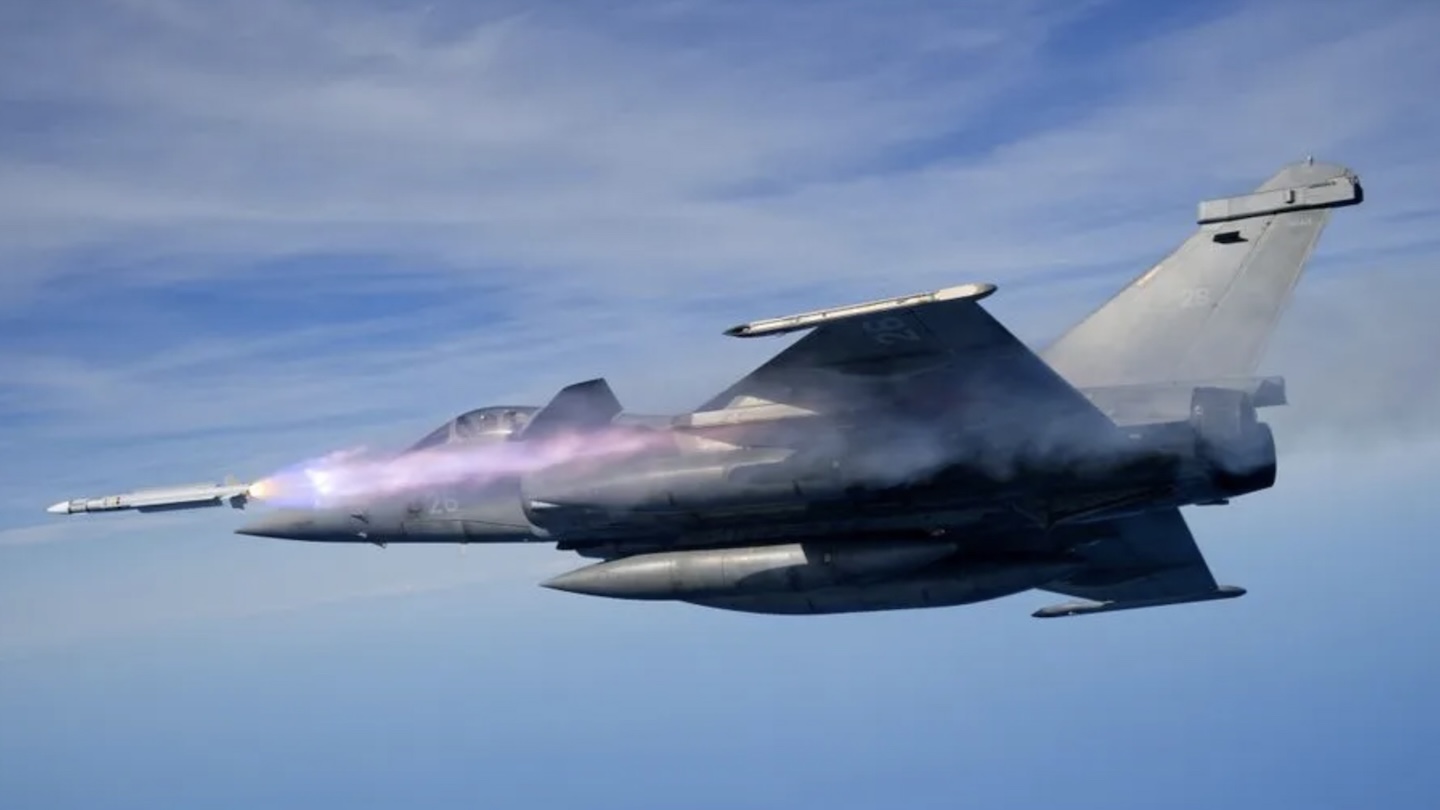
One shows the moment that a Rafale launches an air-to-air missile, leaving a prominent trail of smoke, before detonating seconds later.

NATO airpower in action this morning, safeguarding Latvian airspace. pic.twitter.com/Ugzbx8aaZS

— Marko Mihkelson 🇪🇪🇺🇦🇪🇺 (@markomihkelson) June 8, 2026

Another video, from a different angle, shows the immediate aftermath of the shootdown. Another trail is seen in the background of both videos, but it’s unclear if this is evidence of a previous missile launch, or a contrail from another aircraft that previously transited the airspace at a different altitude.

🇱🇻 Rogovkā, Rēzeknes novadā notriekts lidrobots. NBS apstiprina.#Rogovka #Rēzekne #Latvija pic.twitter.com/kBdojUHanB

— BreakingLV (@breakinglv) June 8, 2026

In a typical Baltic Air Policing configuration, the Rafale is armed with MICA air-to-air missiles. These beyond-visual-range weapons can be fitted with either an active radar seeker or an infrared seeker head, with a mix normally being loaded. The MICA uses a thrust-vectoring motor for improved agility and has a reported maximum range of around 37 miles.

📍 Lituanie | Le succès des vols conjoints commence au sol 🇫🇷🤝🇷🇴
 
➡ Préparation d'un vol d'entraînement avec des avions de chasse 🇫🇷 et 🇷🇴 :

🔧 Montage d'armements entre mécaniciens des deux pays alliés

💬 Échanges sur les procédures, matériel et méthodes des équipes… pic.twitter.com/LPYygu0P5r

— Armée française – Opérations militaires (@EtatMajorFR) June 6, 2026

The Latvian Armed Forces provided more details of the shootdown, noting that a yellow alert was originally issued for the Ludza, Balvi, and Aluksne districts this morning at 9:20 a.m. local time. This led to NATO fighters being launched.

At 9:40 a.m., this alert level was increased to orange for the Ludza and Rēzekne districts. At this point, it was confirmed that some kind of drone was entering Latvian airspace. A military spokesperson told the Reuters news agency that the drone entered Latvian airspace from Russia.

NATO iznīcinātāji šorīt neitralizēja ārvalstu dronu, kas krievijas elektromagnētiskās karadarbības rezultātā bija ielidojis Latvijas teritorijā 🇱🇻✈#WeAreNATO #StrongerTogether pic.twitter.com/07blbd7TUw

— NBS (@Latvijas_armija) June 8, 2026

🟠 Izsludināts gaisa telpas apdraudējums Krāslavas un Ludzas novados, informē Nacionālie bruņotie spēki.

Brīdinājums par iespējamu gaisa telpas apdraudējumu izsludināts Rēzeknes un Balvu novados. pic.twitter.com/PFcMZmhhga

— LTV Panorāma (@ltvpanorama) June 8, 2026

The Latvian Armed Forces warned residents in these areas to “Seek shelter indoors, close windows and doors — follow the two-wall principle.” It added: “If you notice a low-flying, suspicious, or dangerous object, do not approach it and call 112.”

At 10:05 a.m., the Latvian Armed Forces confirmed that NATO fighters were over the Rēzekne district, and a “foreign” drone was shot down over the Berzgale parish.

Berzgale is less than 20 miles from the nearest Russian border, and around 340 miles from the closest Ukrainian border, with Belarus, a close Moscow ally, separating Latvia and Ukraine.

A map showing the approximate location of the drone shootdown in Berzgale, Latvia. Also marked is the Russian naval base at Kronstadt that came under Ukrainian drone attack last week. Google Earth

NATO’s Baltic Air Policing mission has safeguarded the airspace of Estonia, Latvia and Lithuania since the three countries joined the alliance in 2004. Because the Baltic states do not maintain fighter fleets capable of continuous air-defense duties, allied nations rotate detachments of combat aircraft to bases in Lithuania and Estonia, where they remain on quick-reaction alert around the clock.

The mission routinely scrambles fighters to identify and intercept Russian military aircraft operating near NATO airspace, particularly flights to and from Russia’s heavily militarized Kaliningrad exclave that often occur without flight plans, radio contact, or active transponders.

French Rafales recently encountered this Russian Navy Su-24M carrying free-fall bombs during a flight over the Baltic. French Armed Forces
One of two Russian Navy Su-30SMs intercepted over the Baltic by French Rafales during the current Baltic Air Policing detachment. This example carries a Kh-31 series anti-ship or anti-radiation missile. French Armed Forces

Following Russia’s annexation of Crimea in 2014, NATO expanded the mission with additional aircraft and operating locations, making Baltic Air Policing one of the alliance’s most visible peacetime deterrence operations on its eastern flank.

Since Russia’s full-scale invasion of Ukraine, the expanding drone war between the two countries has provided another layer of responsibility to the Baltic Air Policing mission.

A Rafale B standard F4 fighter jet of France's air force is ready for take-off as part of NATO's Enhanced Air Policing (eAP) mission in the Baltic States, on Dezember 17, 2024 at Siauliai airbase in Lithuania. (Photo by PETRAS MALUKAS / AFP) (Photo by PETRAS MALUKAS/AFP via Getty Images)
A Rafale B is ready for takeoff as part of an earlier Baltic Air Policing mission in Lithuania, in the Baltic States, December 2024. Photo by PETRAS MALUKAS / AFP PETRAS MALUKAS

For most of its history, Baltic Air Policing centered on scrambling fighters to identify Russian bombers, fighters, reconnaissance aircraft, and transports flying near NATO airspace. The war in Ukraine has seen the increasing proliferation of drones that can travel hundreds or even thousands of miles, creating a new challenge for NATO air defenses.

Since 2022, there have been several incidents, including drones and missile debris entering or crashing in NATO territory, including in Poland and Romania. Late last month, a Russian kamikaze drone strayed into Romanian airspace before striking a residential building, injuring civilians, in what appears to have been the first incident of its kind.

A russian drone carrying explosives, involved in the bombing of infrastructure in Ukraine crashed in Galați, Romania, causing a fire on the roof of a residential apartment building.

Two persons sustained minor injuries and several residents required medical attention, the… pic.twitter.com/P8jzYFrEEp

— Toiu Oana (@oana_toiu) May 29, 2026

We asked NATO for more details of today’s incident, including whether it could confirm reports citing the Latvian military that the drone had entered its airspace as a result of Russian electronic warfare. This is a threat that is by now commonplace in the Baltic region.

“While the circumstances surrounding this incident are still under review, jamming is known to occur in this region, and can pose serious safety risks, including to civil aviation,” a spokesperson for the alliance told us.

In recent days, Ukraine has carried out a number of high-profile drone attacks against Russian targets in and around the Baltic region.

In the last week, Ukrainian drones appear to have hit the St. Petersburg oil terminal, the Baltic Fleet base at Kronstadt, and a weapons factory in the Tambov region.

As we observed in our previous reporting, there have been very few confirmed Ukrainian attacks of any kind against the Baltic Fleet. However, satellite and other imagery that emerged in the wake of the recent drone strike reveals extensive damage inflicted on the  Steregushchiy class corvette Boikiy.

Footage of the Russian Navy Baltic Sea Fleet corvette Boikiy burning in its Kronstadt drydock after a Ukrainian drone strike yesterday. pic.twitter.com/9CHz4aLdY8

— OSINTtechnical (@Osinttechnical) June 4, 2026

Another satellite image of the Russian corvette Boikiy following yesterday's Ukrainian strike. What is interesting here is that the active fire was captured before firefighting crews managed to extinguish it. @planet image taken on June 3 at 16:30 local time. It burned for hours. pic.twitter.com/PzcHxoSxGk

— Mark Krutov (@kromark) June 4, 2026

Today’s incident provides visual evidence of advanced NATO fighters used to shoot down drones over alliance territory. While effective on this occasion, this kind of interception can be inefficient due to the mismatch in cost between the drone and missile. It is notable that the French Ministry of Defense has plans to introduce a lower-cost counter-drone capability on the Rafale by the summer. Trials of a pod loaded with 68mm laser-guided rockets have already begun.

Un Rafale équipé de roquettes guidées laser aperçu à Istres. Les essais ont donc enfin démarré. Ici une nacelle Thalès JF12, donc 24 roquettes 68mm au total. Une corde de plus à l'arc du Rafale, la chasse au Shahed est OUVERTE ! pic.twitter.com/6v0xSMkUJ1

— bruno aviation (@Bruno_Aviation) April 16, 2026

As a result, NATO has accelerated work on layered defenses that include short-range ground-based air defenses, electronic warfare, and other counter-drone technologies.

Fighters, however, will always remain a critical last-resort option, especially when a drone poses an immediate threat or when a visual identification is required.

Today’s video not only illustrates the changing face of the Baltic Air Policing mission due to the Russian war in Ukraine, but highlights the growing threat posed by drones and cruise missiles that can cross borders with little warning, whether deliberately or not.

Contact the author: thomas@thewarzone.com

The post Video Captures Rafale Fighter’s Drone Kill Over Baltic appeared first on The War Zone.
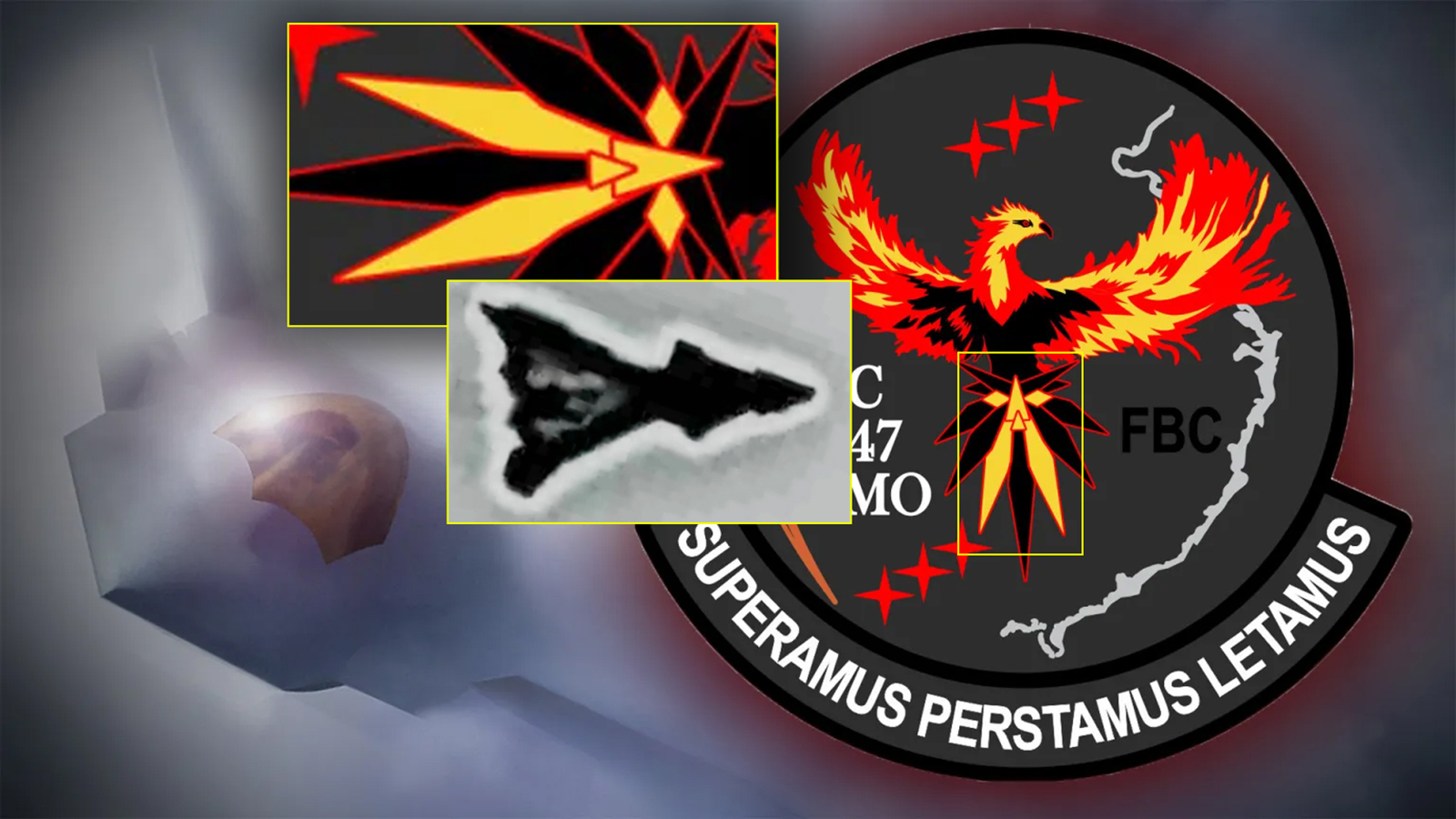
F-47’s Exotic Shape Was Hiding In Plain Sight On A Unit Patch

7 June 2026 at 21:44

The exotic planform configuration concept of Boeing’s Next Generation Air Dominance (NGAD) classified demonstrator aircraft that led to the F-47 looks indeed to have been hiding in plain sight on an F-47 Systems Management Office patch. The first actual imagery of this aircraft appears to have leaked this week. Interestingly enough, another exotic stealth demonstrator aircraft that was once also highly classified and directly related to the design of the F-47, Boeing’s Bird of Prey, also featured its planform cryptically on a patch in a very similar manner.

Yep… She was hiding on the patch the whole time. pic.twitter.com/hIEMEzMJwn

— Tyler Rogoway (@Aviation_Intel) June 5, 2026

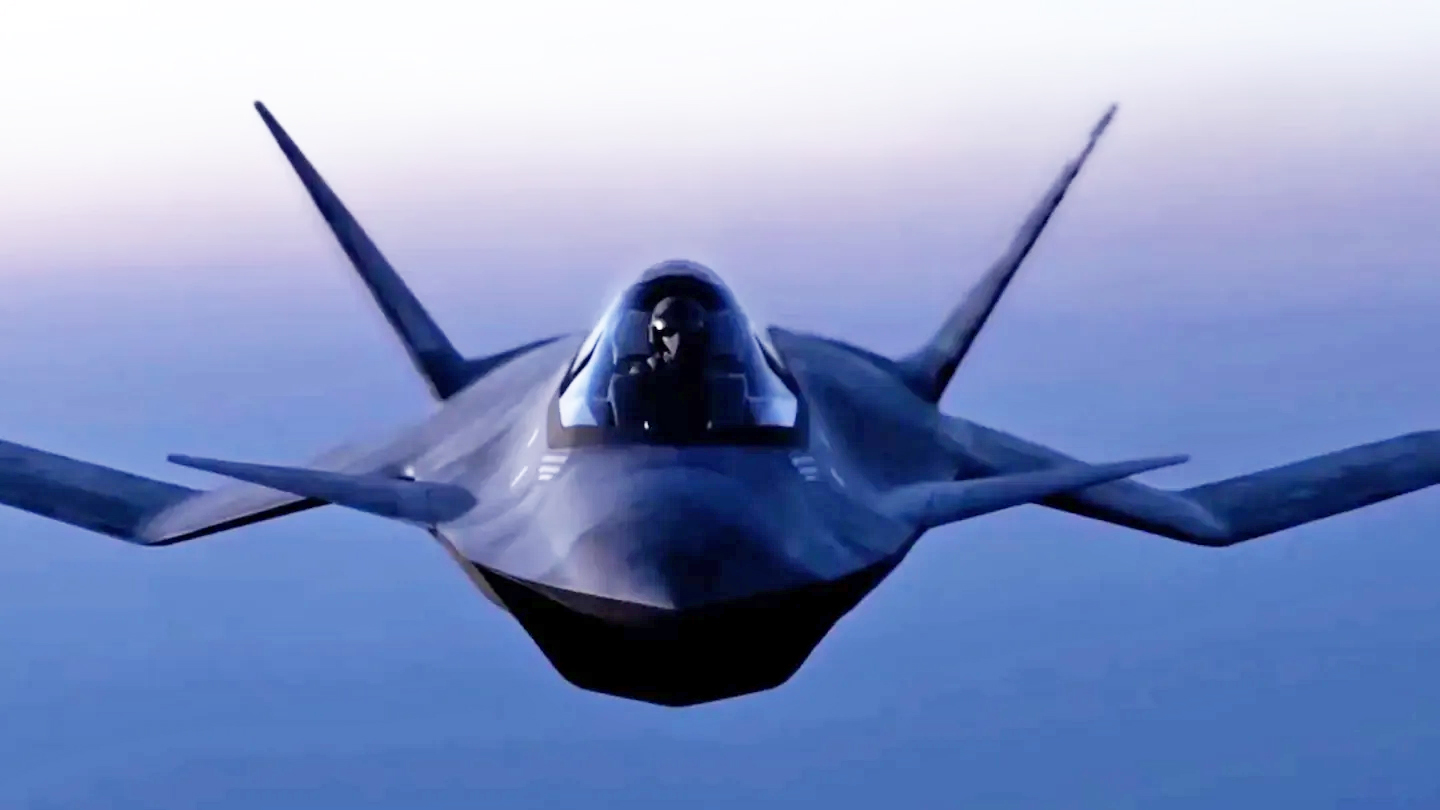
Inside the firebird motif of the F-47 patch, there is an exaggerated planform of what we see in Project Fear’s video of what is very likely Boeing’s NGAD demonstrator shot outside of Area 51. It also aligns with what we can extrapolate from the concept renderings of the F-47 that have been released.

Cropped version of the “new” Area 51 test article flying footage. https://t.co/zKdGNbW7qy pic.twitter.com/PmFApGArRh

— Thenewarea51 (@thenewarea51) June 5, 2026
F-47 renderings. (USAF)

Mainly, the design includes forward canard foreplanes with a tapered central fuselage, rear-set and highly-swept wings, and no traditional tails. The wings have a high dihedral before drooping toward their tips, creating an appearance akin to the Klingon Bird of Prey from the world of Star Trek. That reference isn’t just my own. Boeing’s Bird of Prey from the 1990s clearly shares design similarities, especially in the wing area, as we originally stated after the first official concept art’s release. The Bird of Prey’s patch also cryptically shared its basic planform.

On the Bird of Prey patch, we see a traditional Klingon knife, made famous by Star Trek, with the blade’s hilt making up the Bird of Prey’s planform. In fact, the only detail to throw it off is the t-guard at the bottom of the handle, which appears like canards. Even the cockpit is there. Of course, it isn’t clear at this time when this patch began to circulate in the public domain or if it was after the Bird of Prey was declassified in late 2002. Regardless, in the F-47’s case, the demonstrator’s exact features remain closely guarded secrets, at least officially.

(Screenshot)

Attempting to decode or draw insights into the military’s notoriously cryptic classified program patches is hardly a new practice. Books like Trevor Paglen’s I Could Tell You but Then You Would Have to Be Destroyed by Me is an excellent example of this and the fascination around this unique blending of art, technology, and national security.

In years of reporting on these topics, I have been told multiple times that there is more in patches than many realize, including hints at designs of classified aircraft. This runs pretty counterintuitive considering the government’s extreme protocol for classification, but vague representations of general design concepts are far from giving up an actual blueprint of a classified aircraft. Nonetheless, it is fascinating to see the practice occur for two highly classified aircraft that are directly related, and it’s something we keep an eye on regularly, as well.

Still, with all this in mind, it may be time to take a look back at some of the most interesting patches floating around to see if an exotic planform of an aircraft could be hiding amongst their stitches.

Contact the author: Tyler@twz.com

The post F-47’s Exotic Shape Was Hiding In Plain Sight On A Unit Patch appeared first on The War Zone.

Area 51 Mystery Aircraft Prompts Interest In “Christmas Tree” Stealth Fighter Concept

5 June 2026 at 22:58

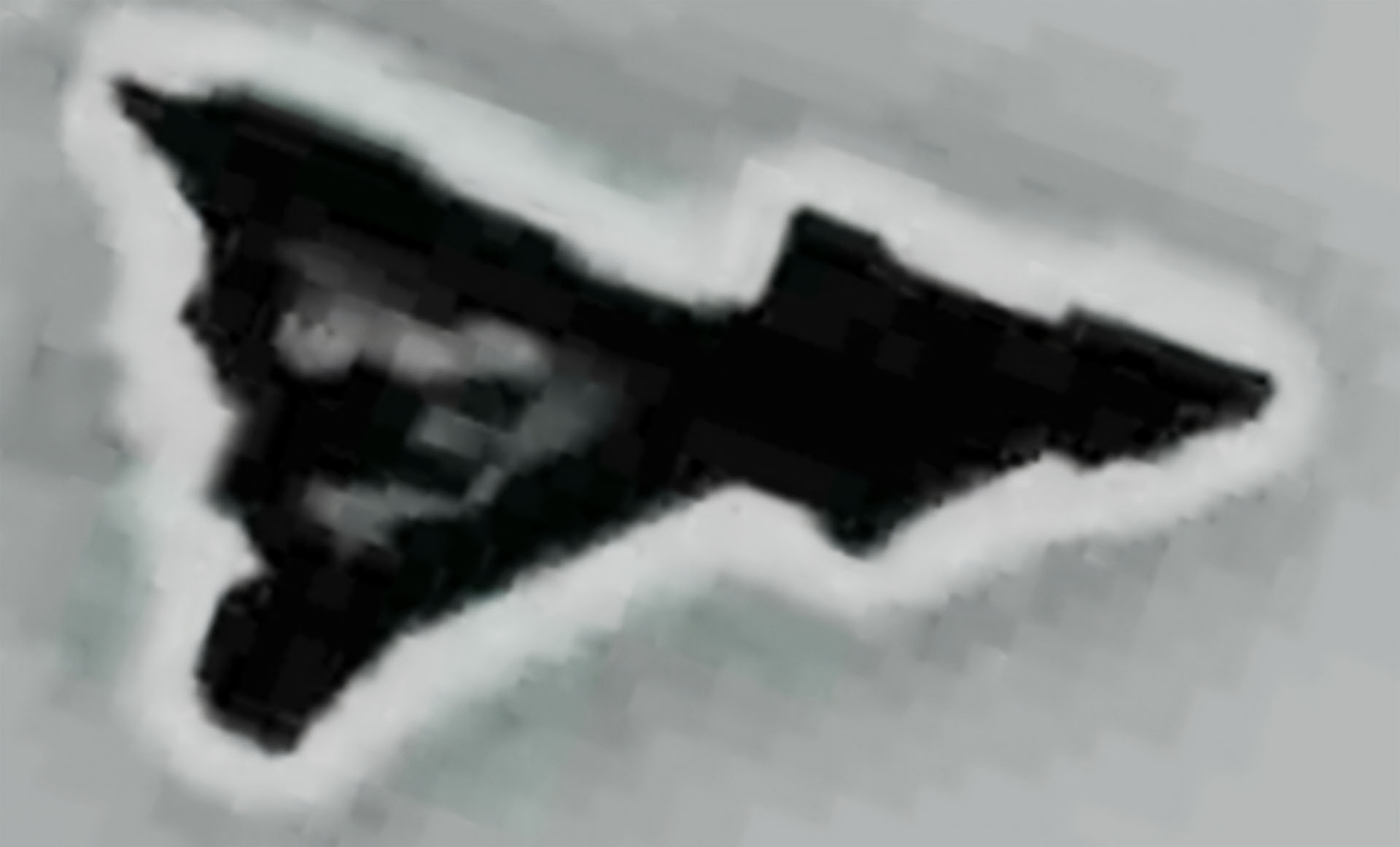
Yesterday, TWZ published an analysis of a thermal image purportedly showing a previously unseen advanced aircraft design, which appears to be a precursor to the U.S. Air Force’s forthcoming F-47 fighter from Boeing. The image, which went viral online and is from a video that has now been released, is said to have been captured near the U.S. military’s secretive Groom Lake test base, better known as Area 51. It turns out, as a number of our readers have pointed out, there may be some interesting similarities between this secret aircraft and a “Christmas tree” fighter design concept crafted decades ago by Darold Cummings, one of the top minds behind Northrop’s YF-23 Black Widow.

You can find our full initial assessment of what we may be seeing in the viral image, first posted online by the Project Fear YouTube channel earlier this week, here. What we saw initially, as shown below, appeared to feature what could be described as a “double arrowhead” profile to its forward fuselage. This is a very distinct design cue, but it could also be a result of the low quality of the image and the artifacts that come with consumer-grade thermal imagers, which was what the aircraft was recorded with.

A close-up look at what is visible in the viral thermal image. Capture via Project Fear

Project Fear has now released the full video it says it captured near Area 51, seen below, and it underscores the aforementioned points about image quality. So, it is possible the aircraft has a more traditional low-observable ‘shovel nose,’ instead. Nonetheless, the Christmas tree fighter is an interesting trip down lesser-known fighter development memory lane that is worth examining, in particular what such a unique nose configuration would provide an advanced fighter aircraft.

The full clip of the mysterious aircraft passing by starts at around 49:34 in the runtime of the video below if it does not automatically start playing at that point.

People are asking why it would be running a very bright light. Multiple reasons, could have had an emergency for all we know. But most likely, would be to keep its silhouette from being seen from certain aspects from the ground. Bright lights are established practice for… https://t.co/mxEvG2EUkz

— Tyler Rogoway (@Aviation_Intel) June 5, 2026

In a post on LinkedIn around the end of last year, Cummings shared an intriguing blueprint of a relevant-looking advanced fighter concept, along with additional details about the design and its genesis. Cummings is currently the founder and president of ForzAero, but has an extensive resume in the aviation industry dating back decades. As noted, he was a key figure at Northrop in the development of the YF-23, which ultimately lost out to what became Lockheed’s F-22 Raptor. He also led the team at Boeing that developed the X-40A Space Maneuver Vehicle, which was used as a testbed in support of work on what evolved into the X-37B reusable spaceplane. He was Chief Engineer/Chief Designer of Rockwell’s Ranger 2000 Jet Trainer, as well.

“I was hired by Bob Sandusky in 1982 to be the Chief Configurator for the Northrop ATF [Advanced Tactical Fighter] program (YF-23). In early 1983 Bob said that Northrop had tried to develop a ‘4-spike’ (like the B-2) fighter, but it couldn’t be done, since a flying wing fighter was not possible,” Cummings wrote in his post on LinkedIn. “I told him I could design one, and he said to give it a try. The only way to accomplish this was with a series of highly swept (55 degree) surfaces over the entire length of the aircraft. The result was the DP-21, created in June of 1983.”

“4-spike” here essentially refers to the total number of radar cross-section hot-spots and where they are located, each pointing in a different direction in azimuth. The fewer ‘spikes’ a low-observable (stealthy) aircraft has, the easier it is to manage its radar signature, and to make it harder to detect and lock onto, but it’s also where those spikes are located that matter.

The blueprint of the DP-21 “Christmas tree” fighter concept. Darold Cummings

A four-spike design like the B-2 critically has nothing from the head-on aspect, as well as from the rear, which helps immensely with survivability. These are the most critical signature areas, especially the front as the aircraft is heading into hostile territory. Also, because these are located along the path of flight, these spikes can stay consistent on a threat radar as the aircraft moves directly toward or away from the sensor, and are not fleeting in nature like those from the side. So a four spike aircraft would be very attractive for a tactical fighter meant to persist in contested territory.

“I never considered this to be a serious contender for the ATF program, as the aircraft was unstable beyond 10 degrees angle of attack!” he also noted.

“Back in 1983, the ‘Christmas Tree’ DP-21 would have been difficult to fly. However, with modern flight control systems, this design could be controlled, even at high angle of attack,” Cummings told TWZ directly today after we reached out for more information. “Low observability is always better served with long edges on the design, so the small arrow-shaped foreplane is not ideal, but it still has low RCS characteristics, just not the optimum.”

“Wing shaping is always a trade-off for maximizing LO. Most of the trades have to do with the leading edge contour, which is a large contributor to signature,” he continued. “The canard has to be designed to be ‘ported’ during penetration, as this minimizes the signature. On the YF-23, the V-Tail was ‘ported’ in penetration for the same reason. This is certainly possible with modern flight control systems.”

“Ported” in this instance refers to keeping the control surface locked in the same geometric plane as the wing while cruising.

A top-down look at the YF-23 during a flight test. USAF

We also asked Cummings directly whether it was possible his DP-21 concept had an influence on what is seen in the viral thermal image, assuming it is authentic. And we asked for his take on what impacts Boeing’s experimental X-36 and Bird of Prey designs may have had on the F-47, as well.

“My DP-21 aircraft image has been available publicly for quite some time, so it is possible it had some influence, but that is only speculation on my part,” he told us. “I believe the X-36 and Bird of Prey have both influenced the F-47 design. I have always been impressed by the X-36, as it seemed to be ahead of its time.”

Boeing’s X-36 demonstrator. NASA/Carla Thomas
Boeing’s Bird of Prey. USAF

“The Groom Lake images are truly intriguing,” he also noted. “It is a viable concept.”

“I think the main thing to remember is that NO ONE thought a 4-spike design (like the B-2) was possible, and my DP-21 was an example of how it was possible,” he added. “A 4-spike design for the F-47 would truly be impressive!”

An official rendering of the F-47. USAF

As TWZ already wrote yesterday, based on what is visible in the image:

“The image shows an exotic design by any interpretation. The aft-set lambda-type wings appear to have a camber and wingtip droop, as on the Boeing Bird of Prey demonstrator. There are very large canard foreplanes — a feature that appears prominently on F-47 renderings and which we have written in detail about in the past. The broad nose, too, is something that has been included in depictions of the F-47, although we have really no idea to what degree these are based in reality. It’s worth noting that in this new thermal image, it has a distinctive double-arrowhead shape, tapering in again in front of the canards. Even the canards themselves may have more than one plane, with the outer tips being drooped, matching similar architecture as the wing. The fuselage then tapers down in the center before the wing roots begin.”

“The aircraft is very likely to be tailless, a feature common to most sixth-generation concepts seen so far. However, since it’s seen from below, we cannot be sure about this aspect of its configuration.”

“As for the powerplant, it is most likely a twin-engine design, like the F-47, a theory reinforced by the sawtooth-type trailing edge. There is no obvious suggestion of any exhaust plumes, which seems odd, but that could be the result of the sensor being used in combination with the aircraft’s power setting at the time of recording, as well as general thermal signature reduction capabilities that are part of the design.”

“Soon after Boeing won the contract for the F-47, we looked at how it might have been influenced by the Phantom Works X-36, also a tailless-canard design.”

Another official rendering of the F-47. USAF

As mentioned earlier, the full video Project Fear released today does raise new questions about the exact profile of the front of the design seen in the footage. The idea of using a shovel nose profile on a stealthy aircraft dates back to Northrop’s Tacit Blue demonstrator, and it was found in its modern form: the YF-23. It has since become common to see on low-observable (stealthy) designs, and has been notably present in official renders of the F-47 released to date.

Beyond the nose end, there are still some very broad similarities in the shaping of the wing and main body of the aircraft seen in the footage and Cummings’ DP-21 concept.

To date, there are no indications that an F-47 EMD prototype has flown. Air Force officials have said on multiple occasions now that first flight of the service’s new sixth-generation fighter is expected to come in 2028.

We do know that Boeing and Lockheed built flying demonstrator designs that fed into the Next Generation Air Dominance (NGAD) initiative, under which initial development of what has become the F-47 was carried out. Past reports have raised the possibility that there was a third NGAD demonstrator, which might have been built by Northrop Grumman. That company voluntarily dropped out of the NGAD combat jet competition around 2023, and is said to have been on the verge of being cut at the time.

As we noted yesterday, what is seen in the viral thermal image could be unrelated entirely to the F-47. The Navy has also been pursuing a carrier-based sixth-generation fighter, commonly referred to as F/A-XX, in recent years. There has been at least some crossover between F/A-XX and the Air Force’s NGAD effort. A rendering Boeing has shared of its proposed F/A-XX design looks very much in line with what has been shown of F-47 to date. Northrop Grumman is the other company currently competing to build the Navy’s sixth-generation carrier fighter, and has released its own renderings.

Boeing’s F/A-XX render. Boeing

We're bringing tomorrow’s horizon into focus, faster, stronger and ready when the warfighter needs it.#SAS2026 pic.twitter.com/r0uORyR5kM

— Northrop Grumman (@northropgrumman) April 20, 2026

In addition, it should be said that official F-47 and F/A-XX renderings released to date will have been carefully manipulated to maximize security of the programs, both of which remain highly classified, and to provide disinformation to adversaries.

As an aside, Cummings also shared his take on a prospective navalized version of the F-47 in a separate post on LinkedIn last year. At that time he wrote:

“I received a DM asking if I had envisioned a Navy version of my recent F-47 fighter concept, such as the F-35A to F-35C approach. I recently completed my F-47 Navy version, which I call the F-47N. However, the approach I took was somewhat different: The F-35C used a larger wing for low speed lift, whereas I used my original F-47 wing planform, and added a canard for more low speed lift and control. The canard design (inspired by the X-36), coupled with the Multi-Axis Thrust Vectoring (inspired by the X-44), provided a very reasonable first cut at a Navy version. In general, a canard layout has been treated as adding more radar signature to a fighter. However, on the YF-23 we found that if the all-moving surface (it was a V-tail on the YF-23) was kept “ported”, in this case aligned with the wing plane during cruise, the impact on LO was not a large impediment to signature reduction. The ability to keep the canard ported is achievable using thrust vectoring for trim in cruise and penetration modes.”

Cummings’ interpretation of the F-47 design at that time notably did not reflect his previous DP-21 concept. The X-44 design he mentioned is also known as the Multi-Axis No-Tail Aircraft (MANTA), and was derived from F-22. At least to our knowledge, the MANTA never came to be. The designation was recycled for an entirely unrelated flying wing-type drone, the existence of which was first reported by TWZ.

Darold Cummings’ drawing of his notional “F-47N.” Darold Cummings
Renderings of the X-44A MANTA. Lockheed Martin/NASA

It’s also worth noting that the design in the newly emerged thermal video could be tied to one of many other programs, including uncrewed ones. Still, it is very much in line with what we would expect to see from a design related to the F-47 and it seems very likely this is the Boeing NGAD demonstrator, if the video is indeed authentic, which it appears to be.

It would be nice to say that we will have to wait and see whether this aircraft turns out to have a more traditional shovel-shaped nose, or even a mild Christmas tree-like design, but we may never see it again. Hopefully that is not the case, especially after the F-47 goes public, but the final design will have significant differences from its technology demonstrator forebears.

Special thanks to @ElectroFluidSys on X for bringing Darold Cummings’ posts on LinkedIn to our attention.

Contact the author: joe@twz.com

The post Area 51 Mystery Aircraft Prompts Interest In “Christmas Tree” Stealth Fighter Concept appeared first on The War Zone.
Is This A Glimpse Of The Aircraft That Gave Birth To The F-47?

4 June 2026 at 19:30

A thermal image purportedly shows a previously unseen aircraft design, said to have been captured when it was flying at night over the secretive Groom Lake facility, better known as Area 51. While the quality of the image is poor due to the sensor type that was supposedly used, from what we can see, the shape seems to be a relatively close match for what we know so far about the F-47 sixth-generation stealth fighter for the U.S. Air Force. This would point to it being the technology demonstrator ‘X-plane’ that served as a precursor to the contract being awarded to Boeing, although that is in no way a definitive assessment.

The image in question was first shared online by the Project Fear YouTube channel on June 3. The still image was promoted as a teaser for the full video that will be released tomorrow. It was published with the caption “A craft the public has never seen before.”

A craft the public has never seen before…
Video out this Friday. #ProjectFear #Area51 pic.twitter.com/8eOSJSUX1g

— Project Fear (@ProjectFearX) June 2, 2026

At this point, we need to be aware that there is no confirmation that the image is genuine, official or otherwise. We have reached out to the Air Force to try and establish its veracity, but they declined to comment.

However, the authenticity of the image and the forthcoming video was confirmed to TWZ by Anders Otteson, responsible for the Uncanny Expeditions YouTube channel, which explores classified locations at a distance around Nevada and California.

Otteson explained that he was approached by Project Fear, who was looking for advice in making a video outside Groom Lake.

“I’m generally happy to help other channels out, so I gave them a rundown on the gear I recommend buying, what specs are important, etc,” Otteson told us. “The thermal camera I suggested getting was the InfiRay HCH50R, and I can confirm that’s what this was shot with as I own one myself. I was out with them for their early filming and gave them a tour of some spots that I’ve had success spotting in the past. The following week is when they captured this aircraft.”

Otteson says the video was shot in the hills to the south of Rachel and that the aircraft was very low. He was not present during the sighting, which took place around two months ago, but Project Fear contacted him afterwards and shared the footage.

“I was obviously pretty excited when I saw it,” Otteson added.

While this may be the case, if the aircraft captured is real, the USAF likely shares the opposite sentiment.

Otteson also took to the r/area51 subreddit, where he further clarified his role and reiterated that the footage is, in his opinion, genuine.

“To be clear, my only involvement in this channel was an advisory role. I told them what equipment to buy and gave them general recommendations. I did go out with them but was not there at the time this clip was captured, though I was sent it immediately afterwards. I posted about this because I noticed some people calling it fake due to coming from a “paranormal” channel and wanted to clear that up. It is indeed real…” he wrote.

Otteson is certainly familiar with sightings of this kind. Earlier this year, he claimed to have captured thermal imagery of a ‘flying Dorito’-shaped aircraft that was also operating in the restricted airspace around Groom. The general triangular planform captured has a long history of rumored classified development going back to the dawn of stealth technology.

Newly released infrared footage dated January 14, filmed by videographer and explorer Anders Otteson, who runs a channel called Uncanny Expeditions on YouTube, shows an unidentified triangular-shaped aircraft flying over Area 51 and the Nevada Test and Training Range. pic.twitter.com/kQMmvI2tur

— OSINTdefender (@sentdefender) January 22, 2026

Among the many online discussions about this new image, it’s impossible not to make the connection with the Next Generation Air Dominance (NGAD) program, which Boeing won with its F-47 sixth-generation stealth fighter. That aircraft is now in early production for the U.S. Air Force.

An official rendering of the Air Force’s sixth-generation fighter, the F-47. U.S. Air Force graphic 

The image shows an exotic design by any interpretation. The aft-set lambda-type wings appear to have a camber and wingtip droop, as on the Boeing Bird of Prey demonstrator. There are very large canard foreplanes — a feature that appears prominently on F-47 renderings and which we have written in detail about in the past. The broad nose, too, is something that has been included in depictions of the F-47, although we have really no idea to what degree these are based in reality. It’s worth noting that in this new thermal image, it has a distinctive double-arrowhead shape, tapering in again in front of the canards. Even the canards themselves may have more than one plane, with the outer tips being drooped, matching similar architecture as the wing. The fuselage then tapers down in the center before the wing roots begin.

The Boeing Bird of Prey. U.S. Air Force

The aircraft is very likely to be tailless, a feature common to most sixth-generation concepts seen so far. However, since it’s seen from below, we cannot be sure about this aspect of its configuration.

As for the powerplant, it is most likely a twin-engine design, like the F-47, a theory reinforced by the sawtooth-type trailing edge. There is no obvious suggestion of any exhaust plumes, which seems odd, but that could be the result of the sensor being used in combination with the aircraft’s power setting at the time of recording, as well as general thermal signature reduction capabilities that are part of the design.

Soon after Boeing won the contract for the F-47, we looked at how it might have been influenced by the Phantom Works X-36, also a tailless-canard design.

Certainly, the official renderings of the F-47 have a superficial likeness to the X-36 Tailless Fighter Agility Research Aircraft, designed to be representative of a low-observable high-performance fighter.

An overhead view of the X-36. NASA

As Bill Sweetman, former editor-in-chief of Aviation Week and long-term observer of stealth programs, pointed out, the F-47 renderings also recalled some of the work of the late Alan Wiechman, who joined McDonnell Douglas from the Lockheed Skunk Works in the mid-1980s. He was responsible for the X-36 and the Bird of Prey. Sweetman also noted that, according to Wiechman’s obituary, he had ‘most recently’ been an adviser on stealth to the Air Force Rapid Capabilities Office.

So while everyone waits for the video of the A51 mystery plane, what did I write in March of last year?

"There are aspects of the artwork that call to mind the work of the late Alan Wiechman, who joined McDonnell Douglas… in the mid-1980s and headed the company’s stealth work… pic.twitter.com/9xJZK7CAOw

— Bill Sweetman (@ValkStrategy) June 4, 2026

Returning to the F-47, as far as we know, it has not flown yet, with the first example being under construction in St. Louis. Its first flight is expected in 2028.

On the other hand, as noted earlier, demonstrators associated with the NGAD program have taken to the air.

In 2020, it was first disclosed that at least one demonstrator design had already been flying for some years on behalf of NGAD.

Frank Kendall, when he was Secretary of the Air Force, also spoke openly about “X-planes,” in the plural, when describing the evolution of what became NGAD.

DARPA and the Air Force meanwhile confirmed that two X-planes were built for the Aerospace Innovation Initiative, and that they first flew in 2019 and 2022, respectively. Kendall further added that these were entirely experimental demonstrator aircraft and not reflective of a production prototype for a “tactical design.” They were built sometime after 2017, he said.

Frank Kendall, when he was Secretary of the Air Force. U.S. Air Force Secretary of the Air Force Frank Kendall. USAF

While we know that Boeing and Lockheed both built demonstrators, it’s possible that as many as three NGAD demonstrators were completed. This would reflect the fact that, at one point, three prime contractors or teams were involved, the other candidate being Northrop Grumman, which dropped out around 2023.

Now that the F-47 is in the engineering and manufacturing development (EMD) phase, we have speculated that the Boeing demonstrator and probably even the Lockheed Martin one are still doing test efforts, with the Boeing aircraft logically being used for risk reduction work while the EMD work continues.

Then there is the other NGAD effort being pursued separately by the U.S. Navy. The Navy program is also based around a crewed sixth-generation combat jet, known as F/A-XX. We know there is at least some crossover between the Air Force and Navy programs. The Navy has been especially tight-lipped about its F/A-XX program, and the aircraft seen could be a test asset related to it. In fact, it could be a direct descendant of the design that gave birth to the F-47, as Boeing’s renderings of their supposed entrant into the competition resemble the F-47. Again, we must state that renderings will be carefully manipulated prior to release to maximize security of the program and provide disinformation to adversaries. Still, the common through-lines are clearly there for the Boeing type.

Boeing’s F/A-XX render. Boeing

It’s also worth noting that the aircraft spotted on the thermal device does not match the aircraft seen in a satellite image at Area 51 during the time when the test effort for NGAD was underway. This could have been the Lockheed demonstrator or something else entirely.

Another possibility is that the aircraft in the thermal image is not a crewed next-generation fighter at all, but rather an advanced uncrewed combat air vehicle (UCAV). The U.S. military has invested heavily in stealthy drone programs in recent years, including highly classified systems designed for reconnaissance, electronic warfare, and loyal-wingman operations alongside crewed aircraft. Given the limited quality and single perspective of the thermal image, plenty of features could be misleading. It is therefore possible that the object is an experimental Collaborative Combat Aircraft or other uncrewed technology demonstrator rather than a prototype of a future sixth-generation fighter. However, while drones come in all configurations, the complexity of this aircraft design and its similarities to what we know about the F-47 make it being an unrelated uncrewed platform less likely. Area 51 also has many programs running at any given time, the vast majority of which we will never know about, so there have been and are many exotic designs that visit the airspace above the base for various reasons.

We can also say for sure that the aircraft in the new Area 51 image is fundamentally very different to the tailless new-generation combat aircraft designs that China is currently testing, the J-36 and the J-XDS, both of which you can read more about here.

A composite showing some of the images of the J-36 that have previously emerged. Chinese Internet via X
A pair of previously emerged images of the J-XDS. Chinese internet via X

It should also be noted that, provided the imagery is legitimate, its appearance at this point could well be a byproduct of an uptick in flight-test activity at Groom and elsewhere. This is something we had expected since the new era of great power competition began, and seems to be really metastasizing. With so many new technologies and systems in development, including entirely new categories of air combat aircraft, a whole new premium and level of activity is being placed on the base, as well as at non-classified facilities, like Edwards AFB.

At the same time, public insights into the activities at the already notoriously opaque base are becoming harder. In a recent land grab, the observation point at Tikaboo Peak — previously, the closest existing viewpoint into Area 51 — has been closed off in another huge land grab by the USAF.

So, as it sits, it isn’t clear exactly what we are seeing, if indeed it is a real aircraft, but there are strong indications that this is our first glimpse of the winning NGAD entrant and a preview of what the F-47 will look like when it finally thunders out of the shadows.

Contact the author: thomas@thewarzone.com

The post Is This A Glimpse Of The Aircraft That Gave Birth To The F-47? appeared first on The War Zone.
Are Ukrainian Mirage 2000s Now Flying Air-To-Ground Strike Missions?

2 June 2026 at 18:36

A French-made Mirage 2000-5F, streaking low over Ukraine in a newly emerged video, provides a relatively rare glimpse of the fighter in Ukrainian Air Force service. Compared with the more numerous F-16 fleet, Ukrainian Mirage operations are much less widely seen. Until now, accounts and imagery have shown the delta-wing fighters being used for air-to-air missions, primarily in the fight against Russian long-range attack drones and cruise missiles. The latest footage may suggest that they now have started to embark on air-to-ground sorties, too.

Some of the first footage of a French-supplied Mirage 2000-5F in Ukrainian service conducting a strike mission on the eastern frontline.

Seen here screaming just a few dozen feet over the ground before tossing its load of bombs (likely French AASMs) at a Russian target. pic.twitter.com/EEHgNxIxUg

— OSINTtechnical (@Osinttechnical) June 2, 2026

The footage, taken from a ground position possibly close to the front lines, shows a Mirage flying at a very low-level along a tree line, before pulling up into a steep climb. Potentially, the jet was engaged in an air defense patrol before pulling up to transit outside of the ground-based air defense threat ‘umbrella,’ but this exact maneuver is one we have frequently seen for air-to-ground weapons releases from other platforms.

While the moment of weapons release is not visible, the flight profile is consistent with toss bombing attacks. In particular, the French-made AASM-250 Hammer rocket-boosted munition, associated with the Mirage, has often been seen delivered by other platforms using this technique, which is exactly how the weapon was designed to be used, among other modes of delivery.

Footage reportedly showing Ukrainian MiG-29 fighter jet firing French-supplied AASM-250 Hammer guided bombs at a target in Belgorod Oblast of Russia.

Notice the very low altitude from which the munitions are being launched.

Geolocated impact point: Nekhoteevka border crossing,… pic.twitter.com/mGGuqRAmyK

— Status-6 (War & Military News) (@Archer83Able) June 27, 2024

A video of the moment of release of two French-supplied AASM-250 Hammer guided bombs from a Ukrainian MiG-29 fighter jet.

The pilot of this particular airframe, 27-year-old Captain Oleksandr Myhulia, perished while performing a combat mission on August 12, 2024.… pic.twitter.com/yNEbbaFUPt

— Status-6 (War & Military News) (@Archer83Able) August 14, 2024

After all, toss bombing is a key way to help mitigate the risks to combat jets over the battlefield, specifically ground-based air defenses. Russia’s surface-to-air missile umbrella is well layered and penetrates far beyond the front lines.

“Obviously, the lower you are, and the further away from the surface-to-air missiles that can detect you because of the curvature of the Earth” affect how far the bomb can travel, U.S. Air Force Gen. James Hecker, head of U.S. Air Forces in Europe (USAFE), as well as NATO’s Allied Air Command and U.S. Air Forces Africa (AFAFRICA), explained back in 2023. Hecker was speaking about Ukraine’s use of unpowered JDAM-ER glide bombs, but the same applies to Hammer. “There are tactics where you can go in low and do some things… and get back,” Hecker added.

Head-on view of a Ukrainian Mirage 2000 at a forward operating location. Ukrainian Air Force screencap

The toss/lofted technique does not reduce the accuracy of the Hammer or the U.S.-supplied JDAM-ER, which both come as standard with GPS-assisted inertial navigation system (INS) guidance packages that allow them to zero in on set coordinates even when employed indirectly.

Additionally, the Hammer can offer multi-mode guidance options with either imaging infrared or semi-active laser homing added in, which enables the engagement of moving targets and helps improve overall accuracy. This also offers alternative guidance options in GPS-degraded environments against some targets. So far, however, only the GPS/INS version has been positively identified in Ukrainian service.

A GPS/INS-guided AASM-250 Hammer rocket-assisted precision-guided bomb under the wing of a Ukrainian MiG-29 Fulcrum. via X

Hammers come in a variety of sizes, but Ukraine is understood to have received 250-kilogram (551-pound) class types, also sometimes referred to as AASM-250s.

To date, the Hammer has been seen in use on Ukrainian Air Force MiG-29 Fulcrums, which appear to be the service’s primary launch platform for the munitions, at least so far. Ukraine has also integrated the French-made bombs onto its Su-25 Frogfoot attack jets.

Low pass by a Ukrainian Air Force MiG-29, armed with a French-supplied AASM 250 HAMMER extended-range guided bomb. pic.twitter.com/FlibJ9VZfm

— OSINTtechnical (@Osinttechnical) March 15, 2024

Hammer’s solid-fuel rocket booster also gives the bomb unique benefits. The manufacturer, Safran, says the AASM-250 version can still hit targets at least up to nine miles away (15 kilometers) when released from low altitude. This can increase to around 43 miles (70 kilometers) when launched from higher altitude.

In its original form, the Mirage 2000-5F was not cleared to use the Hammer, reflecting the fighter’s primary air defense mission in French service. However, in March of last year, France confirmed that the Mirages being transferred to Ukraine would have Hammer compatibility. In the past, the Mirage has been tested in France with a six-Hammer load-out.

Today, France confirmed that Ukrainian Air Force Mirage 2000-5Fs will be outfitted with AASM extended-range guided bombs, giving Ukraine another capable strike platform.

Previously, a French Mirage 2000-5F was tested with a massive loadout of up to 6 AASM-250s. https://t.co/qSPdQ5GLHR pic.twitter.com/g2mB8WEpVr

— OSINTtechnical (@Osinttechnical) March 10, 2025

Earlier this year, the Ukrainian Air Force published a video including brief interviews with a Mirage pilot, as well as two members of the ground crew. The unnamed Mirage 2000 fighter pilot came to the delta-wing jet after serving on the Soviet-era Su-27 Flanker.

“Now I pilot the Mirage 2000, and my impressions of this aircraft are extremely positive,” he explained. “I trained in the French Republic together with French fighter pilots for about six months. I learned to fly and employ weapons on the twin-seat Mirage 2000B. Later, we transitioned to the single-seat version, the very aircraft I am flying now.”

The Ukrainian Mirage 2000 pilot in his jet. Ukrainian Air Force screencap

Two Ukrainian Air Force fighter jet technicians, David and Dmytro, shared their experiences of day-to-day combat operations with the Mirage.

“Right now, we’re at a forward operating airfield, our third one this week,” David pointed out, indicating the missile-armed Mirage behind him. “The enemy constantly tries to destroy our aircraft and equipment. Our forward team keeps relocating from site to site.”

Ukraine’s F-16s also routinely operate from dispersed locations around the country, supported, among others, by a fleet of vehicles dedicated to helping maintain them, as you can read about here. Moreover, these kinds of operations, and the challenges of generating air combat power under the constant threat of Russian attack, are something that is being keenly felt in the U.S. military. After all, the Pentagon is planning to operate crewed and uncrewed aircraft from distributed forward locations in future high-end fights, such as one against China in the Pacific. These concepts of operations would also be relevant in the event of a major conflict elsewhere in Europe.

Dmytro added: “During our last combat mission, we came under fire [from Shahed-series long-range one-way attack drones] and missiles, but fortunately, we managed to evacuate the aircraft and save our lives.”

The pilot and technicians praised the Magic 2 infrared-guided air-to-air missile that appears to be the primary air-to-air armament of the Ukrainian Mirage.

Ukrainian Mirage 2000 armed with a Magic 2 missile. Ukrainian Air Force screencap

“It has performed exceptionally well,” one technician said, before claiming that it has a kill probability of “practically 100 percent.”

The pilot further added that the kill probability against enemy drones and cruise missiles stands at 98 percent. No mention was made of the Mirage’s twin onboard 30mm cannons, although these are shown in detail in the video.

A 30mm DEFA 553 cannon on a Ukrainian Mirage 2000. Ukrainian Air Force screencap

As regards air-to-air kills, the particular Mirage seen in the video from earlier this year is marked with six silhouettes denoting Russian Kh-101 air-launched cruise missiles.

However, as the ground crew points out, another six still needed to be added to the same jet.

Six Kh-101 kill markings on a Ukrainian Mirage 2000. Ukrainian Air Force screencap

The prosaic reason behind this: “We don’t always have stencils with us at forward airfields… Sometimes we simply don’t have the time to apply all the markings.”

The reason the Mirage is less frequently seen in Ukrainian hands is chiefly due to numbers.

It’s unclear exactly how many Mirages have now been pledged to Ukraine by France. At first, France offered six, but last October, French President Emmanuel Macron said he would offer more. At least one has so far been lost in Ukrainian service.

On the subject of improving the combat potential of the Ukrainian Air Force, the pilot made a call for continued development, including “more modern aircraft [and] more modern weapons to counter the horde threatening us.” The appearance of the Hammer would provide evidence that this aspiration is being, to some extent, met.

Pre-flight checks on a Ukrainian Mirage 2000 at a forward operating location. The RDY marking behind the radome indicates the RDY radar, a mechanically scanned pulse-Doppler type with look-down/shoot-down capability, found on the Mirage 2000-5F version. Ukrainian Air Force screencap

As regards the particular deficiencies of the Mirage, the pilot said: “In my opinion, and in the opinion of my fellow pilots, this aircraft lacks longer-range air-to-air weapons.” He called for a weapon that represents “something in the middle ground between efficiency and cost so that we can engage the massive number of enemy aerial threats we face.”

It’s unclear if the pilot in question was including the more modern and capable MICA air-to-air missile within this assessment.

The first imagery of Ukrainian Mirages showed the jets exclusively armed with a pair of Magic 2 missiles, broadly analogous to the AIM-9L Sidewinder, rather than the MICA that the aircraft can also carry. At the start of this year, however, the MICA also began to appear on the fighters.

Ukrainian Mirage 2000 fighters have been equipped with French MICA medium-range air-to-air missiles to counter Russian air targets. https://t.co/AuliNF5G7i pic.twitter.com/y5zXa9vgKQ

— Special Kherson Cat 🐈🇺🇦 (@bayraktar_1love) January 5, 2026

Unusual for a modern Western beyond-visual-range AAM, the MICA can be fitted with either an active radar seeker or an infrared seeker head. When using the latter option, the seeker can act as a ‘poor man’s’ infrared search and track system and provide target detection indication in the pilot’s head-up display (HUD).

The MICA uses a thrust-vectoring motor for improved agility and has a reported maximum range of around 37 miles, far superior to the roughly nine-mile range of the Magic 2.

Despite the arrival of Western-supplied equipment, Ukraine continues to rely heavily on its Soviet-era fighters. The entirety of its combat fleet — Mirages and F-16s included — is in the latter stages of its service life and needs to be replaced before too long. With that in mind, Kyiv is planning to bolster its air force with more modern equipment.

“If I had the opportunity to transition to another aircraft superior to the Mirage, I would probably choose the Rafale,” the pilot continued. “It’s from the same country, and retraining for the Rafale would be much faster than transitioning to aircraft from other nations. The Rafale can also carry the Meteor, a missile with very long reach.”

Thanks to its ramjet motor, the Meteor’s all-important ‘no-escape zone’ is much larger than for comparable weapons. This means the enemy’s chance of evading the missile at the endgame of the engagement, using high-energy maneuvering, is considerably reduced. Another advantage of being able to throttle the motor is that the Meteor’s autopilot can calculate the most efficient route to the target for very long-range shots. Ukraine now looks set to receive the Meteor to arm its first Gripen C/D fighters, now scheduled to arrive next year.

Last November, Ukraine signed a letter of intent to buy up to 100 Rafale F4 multirole fighters from France over the next 10 years. The agreement came less than a month after Sweden and Ukraine unveiled a plan to export as many as 150 Gripen E fighters to Kyiv — last week, it was confirmed that Kyiv plans to buy an initial batch of 20 of the new-generation Gripens.

While the Rafale and Gripen E/F would be the most advanced combat aircraft in Ukraine’s inventory, there remain glaring questions about whether the acquisition of one of these aircraft types, let alone two, is actually feasible, especially in such numbers, as we discussed at the time.

Today marks a significant moment, truly historic for both our nations – France and Ukraine. Together with Emmanuel Macron, we signed a Declaration of Intent on Cooperation in the Acquisition of Defense Equipment for Ukraine. This document enables Ukraine to procure military… pic.twitter.com/0qzG41IsnP

— Volodymyr Zelenskyy / Володимир Зеленський (@ZelenskyyUa) November 17, 2025

At the same time, the Mirage pilot would be happy to get his hands on any kind of modern Western-made equipment.

“If I were offered something like the F-35, Rafale, or Gripen, I would gladly, without hesitation, transition to that platform.”

The possibility of Ukraine using Mirage 2000-5F fighters in an air-to-ground strike role would mark an important expansion of their combat role. If the aircraft are now contributing to both defensive and offensive operations, they will be further enhancing Ukraine’s steadily growing Western-origin air capabilities.

Contact the author: thomas@thewarzone.com

The post Are Ukrainian Mirage 2000s Now Flying Air-To-Ground Strike Missions? appeared first on The War Zone.

❌