Reading view

“Uma Estrela nos Palcos e na Vida”: livro sobre Maria Barroso lançado em Almada

O livro de Luísa Ducla Soares “Quem foi Maria Barroso?” destinado ao público infantojuvenil, integra as comemorações dos centenários dos nascimentos de Maria Barroso e de Mário Soares e será apresentado perante alunos do 1º ciclo. O filho João Soares e a presidente da Câmara Municipal de Almada, Inês de Medeiros, irão intervir no lançamento do livro que responde à questão que faz o título da obra.

O livro “Maria Barroso: Uma Estrela nos Palcos e na Vida” tem o objetivo de tornar a política, atriz e antiga primeira-dama conhecida do público juvenil. Da autoria de Luísa Ducla Soares, e com ilustrações de Susana Carvalhinhos, o livro “chama a atenção para a qualidade da intervenção política, cívica e artística de uma figura que foi ao longo de toda a sua vida uma permanente fonte de inspiração para as mulheres portugueses”, afirma Isabel Alçada, da Comissão dos Centenários de Mário Soares e de Maria Barroso (ver link com PDF do livro em anexo).

Seja como artista, atriz e leitora de poesia, como lutadora pela liberdade, como diretora do Colégio Moderno ou como mulher de Mário Soares, Maria Barroso distinguiu-se sempre pela forma como se empenhou na promoção da paz, da democracia e da cultura”, afirma Isabel Alçada, escritora e antiga ministra da Educação. “Tendo sido um apoio fundamental para a carreira política de Mário Soares, Maria Barroso teve sempre uma vida profissional e uma vida política próprias”.

Segundo a nota chegada ao diariOnline Região Sul, o lançamento do livro integra as comemorações dos centenários dos nascimentos de Maria Barroso e de Mário Soares, antigo primeiro-ministro, Presidente da República e fundador do PS.

O livro “Maria Barroso: Uma Estrela nos Palcos e na Vida” vai ser apresentado na Casa dos Zagallos, em Almada, na segunda-feira, 1 de junho, pelas 11:30 horas. Na apresentação irão participar duas turmas do 1.º ciclo da Escola Básica Elias Garcia. A sessão contará com intervenções de Isabel Alçada e da autora do livro, Luísa Ducla Soares, que conversará com os alunos.

Haverá também uma intervenção de João Soares, filho de Maria Barroso, e o encerramento será feito pela presidente da Câmara Municipal de Almada, Inês de Medeiros.
Eu tive a sorte de conhecer Maria Barroso, de a ter como amiga e gostava muito de a apresentar às crianças e jovens com quem ela estabeleceu sempre uma ligação especial, crescendo entre um rancho de irmãos, tendo filhos e sendo diretora de um colégio”, afirma Luísa Ducla Soares. “Distinguiu-se, entre as mulheres portuguesas, pelo seu talento como atriz, pela coragem na luta pela liberdade, pela entrega à Cruz Vermelha Portuguesa, bem como a outras causas de solidariedade”.

João Soares, filho de Maria Barroso e de Mário Soares, deixa uma nota mais afetiva. “A minha mamã é um amor que aqui está, e estará sempre: lindo e inspirador como ela”, afirma o antigo presidente da Câmara de Lisboa, deputado e eurodeputado. “Uma grande mãe, uma grande mulher, uma grande avó, uma grande portuguesa. Um exemplo vivo, e para sempre.

Isabel Alçada sublinha a prioridade de dar a conhecer às crianças duas figuras tão centrais na mudança da ditadura para a democracia em Portugal, no século XX, como Maria Barroso e Mário Soares. “Se há alguém que se distinguiu ao longo de toda a sua vida pelo combate pela igualdade de género, foi Maria Barroso”, afirma a responsável da Comissão dos Centenários. “O livro da Luísa Ducla Soares é uma obra notável para que os jovens possam ter contacto com esta referência cívica e política do nosso país”.

  •  

Why are there so many toxic disasters in the US right now?

An aerial of water being sprayed on large storage tanks at the GKN Aerospace facility on Sunday, May 24, 2026, in Garden Grove, CA. Kayla Bartkowski / Los Angeles Times via Getty Images

What the hell is going on with all these toxic disasters in the news?

Over the past week, we’ve had a terrifying crisis at the GKN Aerospace facility in Garden Grove, CA, involving a pressurized tank of toxic chemicals on the verge of spilling or exploding for days and the evacuation of 50 thousand people in Orange County.

At the same time, right up the road in LA, we had a spill of thousands of gallons of crude oil that got into the LA River  

Then, news broke of the horrifying tank rupture and explosion at the Nippon Dynawave paper mill in Longview, Washington, involving hundreds of thousands of gallons of toxic liquid and 11 workers who were killed

People have been asking me all week, “What the hell is going on?” And that’s because I’m a professional editor and an award-winning journalist who’s been covering toxic disasters like this for years. Also, I’m from Orange County, and my family lives in Garden Grove, about 10 minutes from the GKN Aerospace facility, so I’ve been watching all of this very closely. 

If you haven’t been obsessively investigating these kinds of stories like I have, the recent rapid-fire bombardment of headlines can make it seem like all these toxic disasters are coming out of nowhere. An explosion here, a toxic spill there, a fire there. “Why is this happening? And what the hell do we do?” 

So, right off the bat, the most important thing to understand is that this is not all just happening now. It’s been happening, and most of the time you just haven’t been hearing about it

Did you hear about the toxic explosion and fire at the Smitty’s Supply facility in Roseland, Louisiana in August? 

Did you hear about the toxic Biolab fire in Conyers, Georgia the year before that? 

How about the toxic lithium battery fire at the Moss Landing Energy Storage Facility in California?

I promise you, this is just the tip of the iceberg…

All the craziness this week actually gives me extreme deja vu that goes back to the first toxic disaster I covered while it was unfolding: The 2023 Norfolk Southern train derailment and chemical disaster in the small town of East Palestine, Ohio

From the train derailment itself to the disastrous and unnecessary decision three days later to empty five rail cars’ worth of toxic vinyl chloride and set it on fire—releasing a massive black death plume into the air and exposing communities for miles to deadly toxins—that story was so horrific and unbelievable that it drew the attention of the public and the media, and then the public and the media started noticing that more train derailments were happening all over the place. 

And it felt then exactly then like it does now. People were rightly asking, “What the hell is happening? Is the sky falling? Is this all part of some big conspiracy or what?” 

But because I had been interviewing so many railroad workers, I knew the reality that the US averages over 1,000 train derailments a year. Which is a big problem, but it’s not a problem the media had covered much before East Palestine, so when they finally did start covering derailments, it felt like it was all happening suddenly and it was all coming out of nowhere.

But, again, because I’ve spoken to railroad workers across the industry, I also knew that this is part of a larger problem that is the result of decades of deregulation, corporate consolidation, and ruthless, profit-seeking, cost-cutting railroad executives and their Wall Street shareholders destroying the rail industry and our supply chain so they could rake in record profits. Cutting jobs, year after year. Piling more work onto fewer workers and working them to the bone. Making the trains longer, heavier, and more unwieldy. Automating human jobs and removing layers of security designed to keep workers safe and the communities those trains are blazing through safe as well. 

This all comes down to these companies obsessively trying to lower their operating ratios, year after year, and sacrificing long-term safety for short-term profits. 

Don’t forget that, throughout 2022, railroad workers were preparing to go on strike for the first time in decades, and they were warning me and anyone who would listen that, if these greedy rail giants and Wall Street bloodsuckers weren’t reined in, it was only a matter of time before a deadly catastrophe happened on the rails. Then, President Joe Biden and both parties in Congress conspired to break the potential rail strike in early December of 2022, workers had contracts shoved down their throats, and nothing on the rails fundamentally changed. Then, two months later, the derailment in East Palestine happened.

There are two really important lessons here that we need to learn to understand what’s happening now, in 2026, with these toxic disasters around the country. 

First, like with the train derailments, there is a similar dynamic going on here where a high-profile disaster has people and the media just paying more attention to these things now. 

As a journalist who covers these kinds of disasters year round, all over the country, in red states and blue states, in cities and rural areas, I can tell you that: These disasters aren’t just starting now and they’re not freak accidents coming out of nowhere. And if you think you’re safe and far away from the danger, I have some bad news for you… 

You may be living in or near a “sacrifice zone” and not even know it. You could be breathing in toxic exhaust from nearby factories and trash incinerators, your pipes may have lead that’s poisoning you, your local water supplies may be contaminated by runoff from industrial plants, nuclear facilities, fracking operations, coal mines, landfills, massive industrial farms and concentrated animal feeding operations. A truck or train or ship, operated by exhausted and exploited workers and hauling hazardous chemicals, could crash by your home. A military base or government-owned plant could be polluting your body and blood with PFAS/PFOS or radiation. Or a giant damn data center could be moving to your town. 

Again, this shit is everywhere.

And if you’re only seeing this in Democrat or Republican terms, if you’re only looking at the headlines and not the history behind these toxic disasters, then you are not gonna see the full picture here. This is not a red state or a blue state problem, this is a working-class problem. Corporations and the government are turning more of America into one giant “sacrifice zone,” and more of us are being set up for sacrifice than we realize.  

Just like with the corporate behemoths and Wall Street vultures who destroyed the railroad system with the help of their bought-off politicians in both parties, the crisis we’re in now developed over time.  And while every toxic disaster is different, I often feel like I’m investigating a serial killer because I hear the same stories coming from different disaster zones around the country. 

And if I had to name that killer, its name would be: Profit. Specifically, it’s our political and economic system that prioritizes private profits over the public good and working people’s lives. 

That has been the driving force behind decades of policy measures to deregulate industries, corrupt the very government agencies that are supposed to regulate them, defang the penalties for polluting our community, and disempower the workers and local residents affected by them so they can’t do anything about it. And, of course, that is the driving force behind all these greedy executives and Wall Street shareholders across industries obsessively cutting costs while simultaneously speeding up production, ignoring safety protocols and removing safety measures, and almost always choosing short-term profits over long-term investments in safer facilities, stronger worker protections, and less outdated equipment until and unless a catastrophe happens

Basically, all this dangerous, life-threatening, environmentally hazardous stuff has ended up all around us, and it’s all gotten less safe, over many years of corporations and politicians “fucking around” for their own gain at our expense. Now, America is in the “find out” stage, and working people are the ones getting stuck with the toxic bill.

💾

"If you’re only seeing this in Democrat or Republican terms, if you’re only looking at the headlines and not the history behind these toxic disasters, then you are not gonna see the full picture here.
  •  

Navalny foundation researchers uncover millions in property and luxury goods held by family of VTsIOM director Valery Fyodorov, who for more than two decades has manipulated Russian public opinion

The Anti-Corruption Foundation (FBK) found more than 500 million rubles’ worth — roughly $7 million — of real estate, cars, and luxury goods belonging to the family of Valery Fedorov, director of the Russian state polling agency VTsIOM. FBK reached that conclusion after reviewing financial records, leaked data, and the Instagram account of Darya Vasilyeva, Fedorov’s 30-year-old second wife.

Fedorov has headed VTsIOM since 2003. The agency, among other things, publishes research on Russians’ trust in the current government. Meduza and other independent outlets have reported repeatedly on how the center utilizes such publications to manipulate public opinion. VTsIOM uses those surveys to shape the perception that a “majority” of Russians support Vladimir Putin and his political decisions.

Consider a recent case: Putin’s approval rating has been falling since late March, amid mobile internet shutdowns in Russia, bans on Telegram, and rising food prices. As the rating continued to fall, the center changed its polling methodology and began conducting not only phone interviews but also door-to-door surveys. However, after a brief reversal, poll results published on May 29 showed that 67.5 percent of respondents approved of Putin’s performance as president — down 1.9 percentage points from the previous week.

Until recently, Fedorov’s wife kept an Instagram blog documenting her high-society life and foreign travels. She and the VTsIOM director traveled to France, Italy, Germany, and Azerbaijan as early as 2018, when Fedorov was still married to his first wife. He later divorced and married Vasilyeva in 2021. The couple has a child together.

On her Instagram account, Vasilyeva posted, among other things, photos and videos of expensive cars and other luxury items. According to FBK, she owns:

  • A Porsche Cayenne worth 12.5 million rubles ($173,600)
  • A Zeekr minivan worth 9 million rubles ($125,000)
  • A collection of Hermès handbags (at least 24) worth roughly 53 million rubles ($736,100)
  • A collection of Cartier and Bulgari jewelry worth 19 million rubles ($263,890)

Vasilyeva also owns a 170-square-meter (1,830-square-foot) apartment in Moscow’s Smolensky De Luxe residential complex and four parking spaces, with a combined value of roughly 230 million rubles (about $3.2 million).

The Fedorov family has also invested in real estate at two other Moscow developments — Luzhniki Collection and Slava Residences — both still under construction, so the exact units they purchased remain unidentified. FBK put the value of 75-square-meter (800-square-foot) units at those developments at roughly 200 million rubles (nearly $2.8 million).

In 2023, Vasilyeva launched her own fashion label, DV. She rented store space in one of Moscow’s most expensive buildings — 12 Kutuzovsky Prospekt — where retail space costs 1.5 million rubles a month ($20,800). Soon after, DV also opened a boutique in Dubai.

The brand lasted about a year. DV’s social media accounts are now dark, and the website is defunct. Vasilyeva now describes herself as an “executive coach,” a “personal development trainer,” and the “author of a philosophical book about the joy of the soul.”

FBK notes that Vasilyeva has no significant income of her own, and Fedorov’s official earnings fall well short of accounting for his family’s wealth. According to VTsIOM’s financial filings, the center’s director earned roughly 14 million rubles ($194,450) in 2022, roughly 22 million ($305,560) in 2023, and roughly 15 million ($208,340) in 2024.

“That’s an enormous amount of money,” says Maria Pevchikh, head of FBK International, in the group’s report. “And it raises a separate question: why is a government official in this country — someone who handles public opinion polling — earning that much? To be fair, Fedorov does teach, write books, and make public appearances, and presumably gets paid for those too. But let’s be generous — even with all of that, he could have earned maybe 55 million [$763,925] over three years.”

FBK alleges that Fedorov “enriches himself by serving the interests of those in power” and runs “fraudulent contracting schemes” using government funds allocated to VTsIOM for sociological research. The foundation found that VTsIOM-affiliated entities transferred hundreds of millions of rubles to a network of independent contractors — many of whom, FBK says, have no connection to sociology whatsoever. Among the recipients were a photographer who now manages a water park, a retiree, and employees of travel agencies and car dealerships.

  •  

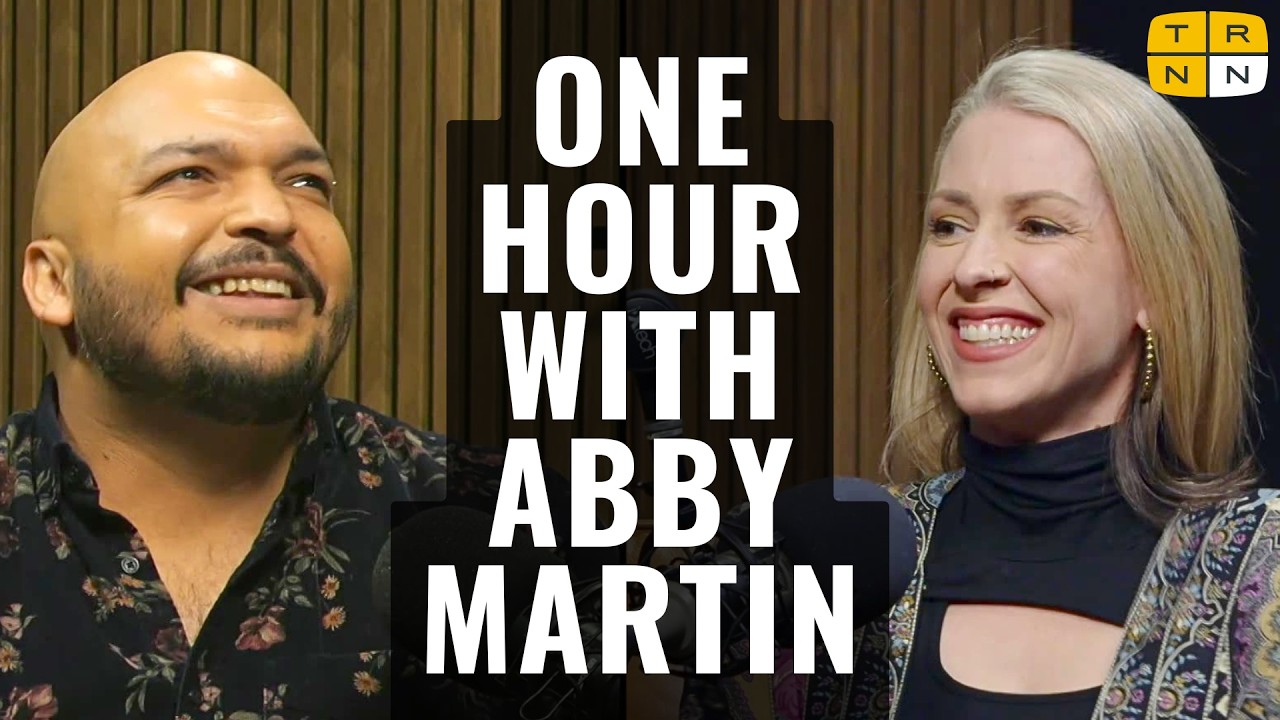
Abby Martin: The US military machine is destroying our planet

Still image of independent journalist and filmmaker Abby Martin speaking into a microphone at the TRNN studio in Baltimore, MD, on Jan. 29, 2026. Credit: TRNN.

We sit down for an hour-long discussion with legendary independent journalist and filmmaker Abby Martin to discuss her new blockbuster documentary, Earth’s Greatest Enemy, and the existential threat that US empire in general—and the US military specifically—poses to humanity and to our planet.

Editor’s Note: This conversation was recorded on Jan. 29, 2026, before the beginning of the illegal US-Israeli War in Iran.

Guests:

Additional links/info:

Credits:

  • Studio Production / Post-Production: David Hebden
Transcript

The following is a rushed transcript and may contain errors. A proofread version will be made available as soon as possible.

Maximillian Alvarez:

We’re here in the Real News Network studio in downtown Baltimore and I could not be more excited to have legendary independent journalist and filmmaker, the one and only Abby Martin here with me in person. Now, some of you may not know this, but Abby is actually a Real News alumnus. And Sister Abby, I know it’s been a minute since you’ve been back here in your old stomping grounds, but I just wanted to start by saying on behalf of the entire team here, welcome back to Baltimore. Congratulations on all the incredible essential work that you’ve done and we are all just so proud of you and so honored to be in this struggle for truth with you.

Abby Martin:

Oh my gosh. Well, the feeling’s more than mutual, Max. I mean, just being here back in the studio just brings me back to just the origins of Empire Files. Being in the Real News studio, working all hours of the night trying to knock out those weekly documentaries. And it was just such a cool crew to be a part of and it’s so amazing to be back.

Maximillian Alvarez:

Well, and what an incredible journey you and the Empire Files have been on since then. And we are of course here today to talk about your blockbuster new documentary, Earth’s Greatest Enemy, which is engrossing, expansive and frankly, terrifying investigation into the existential threat that US Empire in general and the US military specifically pose to humanity and to our planet. Now, I know that this project was years in the making and projects of this magnitude can often start as one thing and then become something much greater by the end of it. And so I wanted to start by asking, what is this documentary? Where did it start and what did it become by the time you and your co-director, Mike Prisner, were finished?

Abby Martin:

Wow. It was a long journey indeed and it was five years in the making, as you mentioned. And it started off during COVID with the birth of our first child and kind of joining our passions together, Mike, as an anti-imperialist, anti-war veteran organizer and me as an anti-war journalist who had been advocating against US imperialism my entire career as an advocacy journalist. So I advocate for issues. I wear my bias on my sleeve and I find it very refreshing in this kind of world of access, journalism and corporate media. And so combining those passions together and wanting to approach a subject that tackles the environmental impact of the military because of our obsession with the future, bringing a child into this world, having the responsibility of basically investing in the future. It is on our shoulders now. We’re all in. And so we saw that statistic kind of floating around that the US military was the largest institutional polluter in the world.

This is something that’s been kind of synthesized in academia when you look at just oil purchases, which the US military hadn’t even really disclosed until relatively recently. And there’s been some scholars who have addressed this in literature and studies, but no one had synthesized it in a cinematic way, certainly in a documentary fashion. But Max, once we got into the subject matter, every stone unturned is another documentary. And so we’re looking at legacy contamination of just radiation Agent Orange and then you look at the expansion of militarism all around the world with these 800 bases. Every base is a story. Every victim is another story. And then you add on top of that just the maintenance of the military arsenal, the actual infrastructure of the US military empire and how the entire thing exists as a self-fulfilling prophecy in order to maintain a fossil fuel infrastructure.

And it’s never been laid bare more with Trump in power with this kind of imperial belligerence when we see Venezuela, Greenland. So the documentary took a life of its own and started catapulting in every which way and kind of made us realize we wanted to prove the thesis here. We wanted to go into it not just talking about emissions, which is one story in itself, which we tackle. We wanted to tackle all of it. We wanted to go into the totality to sit someone down and inject them with the truth and you cannot walk away without having your brain rewired in terms of the way you look at the military in this country.

Maximillian Alvarez:

No, and I could say that as someone who’s watched it and was, like I said, quite terrified by what I was seeing and what you have given us kind of concrete evidence to prove. But I wanted to ask what kind of a monumental struggle that must have been to first research and then visualize the scope and scale of this problem. Could you just talk about that for a little bit?

Abby Martin:

I mean, especially when it comes to emissions, because this is something that’s been very secretive under the pretense of national security and not disclosed by the US military establishment. So it was unearthing so much data accumulated and synthesized by scientists independently to try to calculate these things based on just oil purchases. And then when you extrapolate that out and look at the lifecycle emissions, look at the application of the weaponry, the maintenance of this global supply chain, it totally becomes unquantifiable. And then you wrap into that the actual basically NATO, the machinery of the entire military empire, the great power competition with China, Russia, all of the building up of those arsenals and response to our aggression and belligerence. So it becomes simply unquantifiable and it was so difficult. And Max, at a point in the documentary, we bring in this philosopher and he says something really, really important where he says, number’s numb.

And he gives kind of this take on it’s so hard to get overwhelmed by the existential nature of US imperialism of capitalism because it’s so far reaching and all inclusive and all these issues are interconnected as we’re realizing more and more, but numbers, when you’re just looking at sheer facts and data, data, data, it can numb you. It can become meaningless. And I think we see that psychologically, I think with the genocide going on for three years straight, the data and the numbers become numbing. And so at a certain point it became more about just the storytelling and the emotion and collaging these narratives together to kind of give people that gut punch that it’s not about the numbers. Look, we proved the thesis over and over again, that’s done. But I think what really hits people is seeing how this is you, this is your children.

Your children are those children in Iraq. You are Alex Pretty. You are Renee Goode. You are every one of these victims of US imperialism because it affects every single person on the planet.

Maximillian Alvarez:

And I think back to the days of COVID-19 and when I heard those words in your documentary, Numbers Numb, that was the first thing that came to my head was sort of bearing witness to the monstrous spectacle of the bigger the numbers of people lost to COVID-19 got, the more numb people got to the human lives that were being lost. And I think there really is a terrifying truth there. And again, it speaks to the service that you and Mike Preisner have done in not just compiling what could be compiled in terms of the research numbers and from the emissions of all the military vehicles to the environmental impact of all the explosions and wasted munitions that are blown up or dumped into the ocean. I mean, the list is just so incredibly long and it’s impossible, like you said, to try to quantify it.

But I think what was even more horrifying to learn was that from Bill Clinton to now, all these kind of global US-led climate agreements don’t factor in the US military when they’re talking about our national emissions output.

Abby Martin:

Yeah, exactly. And people do not realize that. I’ve talked to several climate scientists, environmental academics, and they were absolutely flabbergasted at that fact that should be widely known, that militarism, not just US militarism, but every country’s militarism is excluded. Under the Paris Accords, they gave an option to opt in, but of course many countries are like, “Why would I do that? ” It’s not mandatory. Yeah, you know what? So it’s just completely insane and totally a farce that for the last 30 years of these international climate treaties, the US military has led the exemption of all military emissions and it’s gargantuan. It is completely gargantuan and totally hidden from this growing total. And so what’s astonishing to me is that why am I the first person to confront these major politicians at these conferences? Decades in the making, you see this bipartisan consensus for empire and just the acceptance of lying about this, of accepting it as normal and it’s totally outrageous.

And the whole dystopian nature of these climate conferences in general, which real news has covered extensively is just off the charts. I mean, it’s all about corporate profit. It’s all about how can we market this? How can we make money off of it? And then it’s like, well, no wonder you have a contingent of society that’s detaching itself less and less from that consensus reality that climate change is this existential threat that we need to globally cooperate on because simply the opposition to the fascist takeover, they’re not treating it like the emergency it is and they’re not acting accordingly. So it just makes it look like a money making venture and it’s really unfortunate.

Maximillian Alvarez:

Another word might be a racket.

Abby Martin:

Yeah, there you go. Yeah. It’s a goddamn racket. Yep.

Maximillian Alvarez:

There it is. I wanted to ask if you could sort of lay out this double helix death spiral of US wars and military imperialism around the world and like the climate crisis, like how those two things and how you unpack it in this documentary, but like how those two things are intertwined in the most monstrous way.

Abby Martin:

And this goes before obviously World War II with the advent of the war making industry, how because Europe was left in ruins, you had the US kind of concentrating the actual war machinery and that’s where you see the genesis of the war economy being a kind of a permanent footing in the US. It established well before that. I mean, we’re talking about the first extraterritorial military basis that were established through obviously the veins of the genocidal takeover in the first settler colonies here, but those first extraterritorial military bases were to protect extractive industries of fur and mining just to basically … I mean, we almost drove beavers into extinction just so people could have funny hats in Europe and then it became coal. So the first bases that were overseas were to access coal and to basically be infrastructural holding cells for coal. And of course, once the national security priority turned to oil, once oil was discovered and replaced coal, that’s when we saw that just completely combined where oil became the dominant priority for access and expansion.

And then like you said, it became the self-fulfilling prophecy where in order to expand the military, you needed more oil and more resources and then you need to justify the expanse of the military to get more resources. So now this massive empire around the world with 800 bases spread across nearly every continent, it maintains itself through the access to oil, the pillaging of every last vestige of natural resources on the planet. And that’s exactly laid bare with Trump’s rhetoric today. He is literally saying, “We need Greenland.” That is the last basically unbridled wilderness on the planet. I mean, the amount of coal oil and rare earth minerals that are under that ice, they are saying explicitly they need that for their national security interests. And so you just have to read between the lines here. I mean, you don’t even really have to. He’s saying, “We need the oil from Venezuela.

We need the oil from Iran.” That’s what this is about. You had the Bush administration spending about a year trying to propagandize us into complacency with invading a country that had nothing to do with nine eleven just to seize the oil, but they wasted a lot of time to propagandize us, ties with WMDs. And so now this mask is so ripped off where they don’t even need to pretend. They’re just saying explicitly, “We are trying to grab every last drop of oil because that’s ours.” So in a way, it’s an important moment, Max, because for the first time in my life, things are just very laid bare and I feel like people are really putting all of this together in their mind and organizing with that international scope with the US Empire being the machinery that’s oppressing all of us around the planet.

Maximillian Alvarez:

I think you’re right and it really makes me sort of reflect on the conditions that have made that more possible now than it was in the post nine eleven years. And I want to kind of break the fourth wall here and part of this question is going to be me asking if you could talk a bit about how this documentary, Earth’s Greatest Enemy embodies your own trajectory as a political activist, as a journalist, like from the Iraq war to now, because I’ll be honest, we would not be sitting next to each other, 23 years ago. I grew up very conservative. My family and I were totally bought in on the Iraq war propaganda. We were part of the US majority that just felt so hurt, shocked, and aimlessly hurt and shocked after nine eleven and trusted far too much in our own government to sort of tell us what to do next.

It took a lot of years for me to sort of uncouple myself from that conditioning. But at the time, I did not understand the kind of what to me was a left wing talking point of like, why would we be going to war with another country just for oil? What does that mean? And now here I am like nearly 25 years later being like, “Jesus, how could you not see what was right in front of you? ” So I guess first of all, how were you able to see what I was not? And I guess connect us from there to here like how the seeing of the monstrosity that was always there, like how more of us have actually come into the light and seen what we’re actually up against.

Abby Martin:

I think it all goes back to just my love for the environment, my love for nature, my love for humanity. I just really love people and I love connecting on an interpersonal level. I think when you look at this kind of death spiral, as you called it, this machinery of capitalism and the subjugation of the rest of the planet at the barrel of a nuclear armed gun to say subject or die to global capitalism, it is just so counterintuitive to like love, solidarity, having a habitable planet and future. And I never was able to really articulate that capitalism was the problem. I was kind of a confused anarchist, libertarian back when I was first being radicalized by politics, because I thought Bush was evil incarnate. I was just like, “Who the hell are these people? They’re demons. Why are they doing this? ” And then Nancy Pelot and then you slowly kind of unpack.

You’re like, “Hold on, the Democrats are part of this. Hold on. The media is part of this too.” But it was always so obvious to me because of my just repulsion for war. When the media started talking about Iraq, I was so confused, Max. I mean, I think it helped because I was surrounded by militarism at San Diego State University. I was just thrown into this where I was surrounded by military frat bros and I was just so taken aback. I mean, growing up in the Bay Area, so the proximity to Berkeley, the hippies, just that counterculture of the revolutionary fervor of Berkeley, Mario Savo and the free speech steps and things like that. And so that was always baked in, even though I was just kind of like a generic Demo from suburban Pleasanton, California. I think when the Iraq War started and the bombing of Baghdad, I was sitting in the cafeteria at San Diego State University and I felt nauseous.

I felt sick and people around me were cheering and I’ll never forget that moment. I just was like, “What’s going on? I’m so alone. Why people think this is good? This is sick. What did Saddam do to us?” I remember calling my mom, I said, “Did Saddam do something?” And she was like, “No, the media just started talking about this. ” And I just said, “What is happening?” And it was so hard to organize there, but it became so powerful to realize media was a tool to tell these stories because I started watching radical media. We were talking at the time, this was around 2003, it was like Democracy Now and Alex Jones. It was like a very weird … The internet was very strange, but you also had the capacity to do things. I mean, there was this egalitarian sense of the internet that was very exciting where you could build real friendships and find things that were just really like not … It wasn’t fed to you by the algorithm.

And so I was able to pursue so much knowledge and learn and be self-taught and how to do these tools. And so anyway, I’m going on this very long tangent to say it all synthesized for me very obviously, but it is also a journey I think for a lot of people. I’ve met people who are my age who said I didn’t know anything before October 7th, which brings me to your second question. I think October 7th and the genocide in Gaza has been an extremely revealing moment, catalyzing moment for tens of millions of people around the world. And I’m anecdotally, I can say that just traveling across the country with this documentary already going in rural, urban areas, driving everywhere, talking to people, everyone has been motivated by the fact that this government has subsidized and overseen this genocide and how it has been bipartisan and the failure of the so- called opposition and the Democratic Party to stop it and incubate what we now have.

It’s all just so crystal clear and it’s been actually really amazing to see the radicalization occur in circles that I never would’ve expected at all. Older religious people, I mean, but really it’s the youth. It’s the youth who are seen, they don’t have a future if they let this just grow unabated, if they let the data centers take over, they let the unregulated nature of global capitalism take over, unregulated nature of imperialism, which turns inward, which we’re seeing the ICE executions in the street. So I’d say there’s an explosion of consciousness around the world, synthesizing all these issues, putting Palestine as the cornerstone of our collective liberation and realizing how all these things interconnect. And it’s beautiful, Max, because on the streets during the Iraq war, Palestine was too controversial. In the streets were in Occupy Wall Street, Obama was off limits. And so it’s all burgeoning now.

It’s all right beneath the surface and people are so ready to hear that phrase national strike, national strike. They know we’ve been in the streets with sustained protests. I’m an activist and a journalist. Again, I’m an advocacy journalist, so I advocate my own activism and I embed myself in the people’s stories and people’s struggles and try to uplift those stories just as real news does. And so I’m speaking from the streets. I was just in the streets in Minneapolis. I’ve never seen energy like I have now and people standing up in solidarity with their brothers and sisters because they want to terrorize us in a submission and silence and fear and I’m seeing the opposite happen and that’s something extremely powerful and again, kind of incalculable in terms of like what will happen with this energy. It’s very exciting.

Maximillian Alvarez:

It is. And this is a moment in history not to be wasted because it won’t be around forever.

And it also sort of makes me think about like again, what is so different between our moment now in the year of our Lord 2026 and our moment then in the post nine eleven years at the turn of the millennium. And I of course can’t help but think about my own trajectory, my own family, like what has changed in our lives since then? Well, a massive economic global financial meltdown happened. We lost everything that my parents had worked for, including the house that I grew up in and it’s been a very long kind of struggle to get back to a place of peace and normalcy for our entire family since then. And now as someone who goes around interviewing, working people around the country talking about their lives and their stories, I hear a lot of echoes of that similar trajectory for a lot of people.

And I guess that’s just a long-winded way of saying that at the turn of the century when we were as a country much more gung-ho about … Yeah, we have the right as the United States to go around the world telling other countries what to do. We have the right to spread democracy because it’s the best system in the world. We’re liberating people, we’re not doing something bad, yada, yada, yada.That was a time pre 2008 crash when the American dream was still plausible for a lot of us. You go out on the streets now, you talk to people now, no one believes in the American dream. I mean, if a handful of billionaires own everything and all of our money is just being sucked out of the public coffers and into the war industry. And so what I hear now when I go to these demonstrations in Baltimore, DC, what I hear now when I talk to poor and working class people in deep red Trump country districts in the Midwest or the South or here in the Mid-Atlantic, the common refrain that I hear is like, “Why is my money going there when we’re all kind of floundering here?” And I think that that is also a very significant sign of where we are as a country, but also a significant kind of mobilizing factor that presents an opportunity for people to look around and realize we’re all getting screwed by very identifiable villains.

And I wanted to sort of like hook that back into earth’s greatest enemy and ask who are the identifiable villains in this story that you’re telling and how do we take them on?

Abby Martin:

Yeah. I mean, the problem with capitalism and the status quo of neoliberalism is that everything’s been co-opted, superficialized, tokenized, our struggles have been bought and sold back to us. And so for the last 50 years, labor density, unions, that revolutionary undercurrent of all the progressive struggles, it’s been kind of co-opted into these corporate branding and marketing campaigns and it’s been really, really horrific to see because we’re getting back to our footing where people were in the 60s and 70s with this fundamental understanding of ideology and being able to articulate what we are fighting for and against. And so we’re getting back to that. I think Bernie and Democratic socialists of America and things like that have really resurrected the spirit of what we can all kind of orient ourselves around. But for the longest time, Max, I mean, I grew up very anti-communist. I mean, this was very, very baked in to American society because of the history against the ruling class.

And so what you see now is parasitic billionaires who have basically seized that distrust that did exist for exactly the reasons that you’re talking about, the disaffected masses who lost everything during the financial crisis, who knew that we were lied to about nine eleven and in the Iraq war, they don’t trust these people, but Trump was very smart in the way that they seized that momentum and siphoned all of the energy into this faux populism. And again, there was no opposition infrastructure to counteract that. And so a lot of us are kind of flailing saying, “How do we gain ground when they have taken over everything?” And then the Democrats kind of incubated it and laid the groundwork for them to take over everything because they’re basically Republican lights because everything is about making profit at the end of the day. And so I think what we need to do is realize we are all victims of propaganda.

We’re all at different steps of our journey of breaking out of that, but that’s all baked into all of us. And so approaching each other, and I’m not talking about fascists or people who are apologists for genocide. There are certain contingent of society that can’t be helped. They’ve succumbed to the darkness. They’ve been beaten down by the system and they’ve commodified everything. They have lost their empathy. I’m not saying that they’re born like that. I’m just saying that a lot of them can’t be helped right now and we need to let that go. But I think the vast majority of people are empathetic. They’re humanitarians. They want civil liberties. They want the foundation of what they believed America to be, human rights, the First Amendment, free speech, the beautiful things that make this country supposedly great. Those are the people that we need to reach out to with humility and empathy and reaching them where they’re at.

I’m talking about service members. I’m talking about veterans. They are not the enemy. They are victims of the enemy. The enemy is the top brass of the military, the government officials who are complicit in this, who are profiting off of war, who are invested in the war machinery, editors in chief at the New York Times, the Washington Post who are putting out the propaganda that sows the seeds for genocide, who perpetuate the status quo of this death cycle. Earth’s greatest enemy, that was the Biden administration. That was before Trump. That’s the status quo. That’s what we’ve accepted as normal, barreling us off a cliff, killing every last living thing on the planet, a finite planet. It’s collective lunacy and madness to go into this year after year knowing the outcome max. And I think people are so ready. They’re starving for this information. They’re sick of being gaslit and lied to and they’re realizing, “Hey, this is not the reality that I see.

This is not the reality that my neighbor sees.” COVID was very important for the ruling class. We were fighting each other about vaccines, about God knows what while they cannibalized every last industry. They siphoned every last drop of wealth. They pillaged everything. They gained what tripled their wealth in the last five years. And what happened to us atomized, isolated, siloed off, brain rodted on our phones thinking we can’t ever do anything about this. We lost. That’s what they want. Just like Barry Sanders in the movie says, “See what you see. Don’t be duped. See what’s right in front of your face.” And I’m not talking about on your phone, on your screen. I’m talking about in reality, vast majority of people are ready. They’re waiting for you to talk about these things because they don’t have the chance. They don’t have that opportunity or those avenues because Elon Musk wants them to believe something else.

And we have to ask, why is the richest man in the world showing us what he’s showing us? So when we get on our devices, yes, the advent of social media, the advent of Palestinian voices dictating their reality and taking back their agencies, been monumental, revolutionary, assisted to all of this, but we have to also be calculating strategic, creative, getting off of these devices and meeting like we used to because that’s how we win. We don’t win on here. That’s just one tool for us.

Maximillian Alvarez:

I think that’s beautifully and powerfully put and vitally true. And we’re saying this as two media makers, you know, Media personalities. Media can only do so much and we are trying to do as much as we can with it and your new documentary is an incredible example of that. But I could not agree more with your last point that we’re not going to bring a coalition of poor working class regular people banding together to stop the destruction of our society and our planet online.That’s not going to happen.You don’t get 50,000 people marching through the streets of Minneapolis just by posting and sending emails. You have to have that in- person connection, which is all I’m hearing coming from Minneapolis. People are saying I’m both simultaneously more afraid of my government than I’ve ever been, but I’ve never felt safer in my own neighborhood because everyone’s talking to each other and everyone’s kind of working together.

We were already losing that basic infrastructure for society as such well before 2020. But I think COVID really did a number on what was left of our social infrastructure, on our social being. So many of us just stayed closed in, stayed cut off, stayed glued to our phones and our computers. And as you mentioned, the powers that be, the people who control the media, those platforms, they know that and they are manipulating that to the point that no one has an agreed upon basis of the reality that we’re actually all living in because depending on what feed you’re looking at, where you live, what your search history is, you’re going to see an entirely different world be outside your window than the person who’s living next door to you. And

Abby Martin:

That’s a

Maximillian Alvarez:

Very dangerous and dark place to be. But I wanted to kind of hook that back into something else that you said, which was the value of not only talking to service members and military veterans, but that was made manifest in this documentary. I mean, it’s important in and of itself because as you said, they are not the enemy. They are the victims of this monstrous machine. They are the human grist for the proverbial mill of US imperialism. But it also kind of hooks into the beginning of this conversation where we were talking about how hard it is to actually research and understand this topic of just how big of an environmental threat is the US military to the world. And it was so clear to me in your documentary that if you go and try to get answers to those questions from top government officials or military brass, you’re not going to get anywhere.

But when you and Mike Preisner are talking to veterans, the rank and file of the military, you get a very different perspective on the problem. And I wanted to ask if you could talk a little bit about how different that perspective actually is.

Abby Martin:

Okay. So there’s this hive mind that kind of operates in a similar fashion to how a corporate board would. So let’s say someone just has a conscience all of a sudden who’s on the executive board of Amazon or something, they would just be kicked out. You need to make money, you need to make more money than the last quarter, otherwise you’re not profitable. You’re a failing entity. That’s exactly how the US military operates. So when you’re looking at who’s sitting on the board of these board of directors of the defense contractors, they’re all interlocking with the media arms and all of these things. And that kind of explains this hive mind operational structure of a system that kind of works on its own. It doesn’t have a conscience, but of course it’s comprised of people who do and they can speak out and they have voices and they have their own minds, even though you’re beaten down in the military to not have your own mind.

So when you break out of that, when you see it for what it is, it’s such a powerful thing. I know hundreds of service members, because of my husband’s work, obviously, organizing soldiers and getting people out because anyone can get out of the military. It doesn’t need to be something specific. Anyone can file a CO packet and get out today. You never need to stay in and Mike can orient you through that. But it’s just so amazing to see people who are coming to the movie, watching it, who are active duty. My cousin who was a 20-year-old naval officer watched it and he was just like, “You know, because I don’t agree with your politics, but I’m here to support you. ” After the movie, he was just shaking. He’s like, “I’m ready to F and go, dude. I’m ready to fight.” And it’s just reaching people on a human level because I think especially when you reach out to service members, they’re victims, they’re not profiting off of this.

They don’t benefit from this system. They’re cannon fodder. They’re the human detritists that are going to be kicked out in the street like Levon, the homeless veteran at the beginning of the movie. He represents kind of the consequences of the system. I mean, he represents all of the destruction of the environment, the garbage that’s tossed in the ocean, every bullet fragment that’s exploded and the chemical exposure of all the toxins left everywhere that were bombing and shooting shells. And that story alone is so powerful, just one single homeless vet who was in a commercial for the army.

Levon:

First Air Cav Brigade. I was in US Army. I joined up in 2004, deployed out in 2006 and it was hell. I was at Camp Taji, seven miles south of Baghdad. I was one of the “Army of One” commercials. I was a guy with the helicopters.

Army Officer 1:

Everybody listen up. This is Levon.

Wenty:

Hey, Levon. I’m Wenty.

Army Officer 1:

You’re on the 120 today. So if there’s anything you need, just ask these guys. They’ll take care of it. All right?

Army Officer 2:

Welcome aboard.

Levon:

Thank you.

Army Officer 2:

You ever been around anything this fast before?

Levon:

He walks in and goes, “You ever worked around anything this fast before?” Yeah. My last job.

“Army of One” Commercial Narrator:

See how army training gives you strength for now, strength for later. GoArmy.Com.

Levon:

Yeah, it was all a lie. I have nerve damage, so I’m actually losing my hands. So I’m trying to use them as much as I can until they’re all gone. It hurts. It actually hurts. But that’s what the hydraulic fluid in service does. Laughing is the only way I can get through, otherwise I’m crying.

Abby Martin:

It encapsulates everything. It’s like you’re exploited, your story, your body, and then you’re thrown in the trash and you’re left to die with no help. And that’s the thing that veterans need to understand, whether it’s burn pits or agent orange, chemical exposure. There’s no help on the other end under this system. It’s just about churning your body out for profit. You’re just another commodity. And once you realize that you join the fight because you can always get out and you can make your own decisions and agency to realize it’s not worth it. It’s not worth your life. Your life has value and your life has dignity and you need to put it toward benefiting humanity and the planet.

Maximillian Alvarez:

Again, that was very beautifully and powerfully put and it really kind of chills my blood hearing everything that you’re saying because it sounds so eerily familiar from the reporting that I’ve been doing over the past few years starting in the small town of East Palestine, Ohio. And we are having this conversation at the end of January 2026. I’m going to be back in East Palestine next week. It’ll be the three year anniversary since the Norfolk Southern bomb train derailed in these people’s backyards, turned their lives upside down, trained filled with toxic chemicals that in an industry that has been just cut to the bone on the labor side, on the safety side, but is making more profits than it ever has. And who benefits from that? The shareholders and the executives. Who bears the costs of that? The workers on the rails and the people in towns like East Palestine, Ohio.

And this is an entire region that has been poisoned by industrial or corporate profit seeking greed and government complicity and negligence. Our own EPA was telling people there, “You’re fine. It’s okay to go back home. The air’s safe. The water’s safe.” And here they are three years later telling me people are getting all kinds of weird cancers. People have to leave because they can’t stay in their homes without getting nosebleeds, rashes, their kids bleeding out of every orifice. It is a shit show, a monstrous shit show that is sadly not unique to Ohio. What I have learned going to different sacrifice zones so called around the country, talking to different poor and working class people here in South Baltimore, down in Georgia near the biolab fire that happened last year, moss landing like in California, this is everywhere and people are being poisoned and abandoned in the exact same way that you just described as like military veterans and the people living abroad who are if not killed by our munitions are poisoned by them for years and the rest of their lives.

So all of that is here at home as much as it is there abroad. And frankly, I don’t think your average American knows that when it comes to like sites of industrial and mass pollution here in the United States, the biggest portion of super fun sites that come from one source is the Department of Defense. It’s like military bases. It’s weapons manufacturing plants. It’s the kind of foam that they use to put out fires that puts forever chemicals in the water that we’re all drinking. And so I wanted to kind of bring it back home for a second and ask if you could talk about the vast environmental kind of impact that the war machine is having on Americans and like how that connects to the imperial monster of American militarism abroad.

Abby Martin:

You look at just legacy contamination of what the US did during the Cold War, during World War II. I mean, you even still see dead zones from World War I from small munitions, which just kind of shows you how detrimental these are in just training. I mean, even just training alone, like you mentioned forever chemicals. I mean, the firefighting foam that’s used extensively by the military. The military is one of the most pervasive users of PFAS contamination. There are safe alternatives there have been forever, but they just don’t use them because it’s, I guess, less cost effective and they’d rather just dump them all and contaminate water supplies. So people may know peripherally about Camp Lejeune, which is the worst water contamination event in US history. This is now a super fun site, Camp Lejeune, North Carolina military base where they dumped toxic compounds for decades.

And after they knew that it was toxic, they continued to do it and cover it up. And so a million people were poisoned harmed by this toxic dumping and there was a huge amount of poisoned infants that were stillborn babies. And what was most shocking about this, Max, is this could be looked at as like, “Oh, it’s just a 60 year old story. The government took care of everyone and they’ll never do it again.” Maybe they just didn’t know any better. Well, it’s amazing to think that now 60 years later, people are still dying. They have ailments, they’re generational and physically impaired from the toxic water contamination and there’s no database. They are trying to try every single individual claim and the judge said it would take over a century to try to actually give all of these people what they deserve. And of course a lot of them have died.

They’re just waiting for all them to die off so they just don’t have to deal with them anymore. But I think it really just explains how they deal with victims of burn pits, with victims of aging orange poisoning. They deny, they deny, they deny. They try to just resist doling out even a penny for the victims and then the site is left destroyed. I mean, it’s a super fun site. This is just a poison toxic site that doesn’t go through proper remediation. There are hundreds of them all across the US. Like you said, the vast majority are either US military installations or have previously housed military uses. So bullet manufacturing, you have the Hanford nuclear site, which is like a ticking time bomb that can poison three states at once in the entire river that supplies water to half the country. So these are serious problems that are not being dealt with because we don’t have a functional government that is going around saying, “Hey, how do we do this clean up properly?” No, no, no.

We’re just going to commit fraud. We’re just going to lie. Governors don’t want the black spot on their record by saying, “We have a super fund site. We need to clean it up. We need to divert resources.” They’d rather ignore it. And of course, the military is sacred. It’s worshiped so they don’t even want to combat it. In on amazing instance, Jay Inslee, who was the governor, previous governor of Washington who ran on climate change as his entire doctrine, he wouldn’t even criticize the military. He wouldn’t even answer a basic question on should these be included or not in emissions reporting. I mean, the cowardice is frankly horrifying and disgusting.

It’s so far reaching here. When you put legacy contamination aside, just again, the maintenance of the arsenal here at home. We have hundreds of bases here in the US. Every base is dumping forever chemicals in the ground. Every base has contamination. Some of them much higher than Camp Lejeune. We talked to a person who is testing the groundwater around bases in the US. He is saying he is finding ground contamination higher than Camp Lejeune. Why don’t we hear about this, Max? Why? This is the most base level big tent ever for a human being. Clean water, clean air, clean food. If we can’t build an opposition or an organizational infrastructure around that, what are we doing? What are we doing? So again, it’s this total ignorance, total ignorance of the military being actually not a benevolent force spreading democracy and human rights. A force for profit that is destructive, deadly, totally dissociated from human life, the sanctity of life.

It’s willing to kill everything and everyone on the planet. So Jeff Bezos can have another yacht. Is it worth it? Hell no, it’s not. Hell no, it’s not. And so this just brings it all home and especially with ICE, because at the end of the movie we talk about the militarization of the police. So that concept of the imperial boomerang, I mean, of course it’s always been our tactics of colonialism, genocide. They’ve always been circling back, right? But I think the visceral nature of it now where we see storm troopers masked, immunized in the streets, state executioners in military guard where you can’t even distinguish, is this Palestine? Is this here? What am I looking at? It’s here, baby. It’s here to roost. And so I don’t even … There’s no difference anymore. I think for a long time people were trying to convince people, “Hey, no, no, you should care about Palestine.

This is all going to come back up. And you shouldn’t care about it because eventually it’s going to come back home. You should care about it because it’s human life. It’s human life and it’s on our shoulders. This is our government doing this. ” But I think especially now people are saying, “Oh my God, it’s here. It’s here and we’re all of our liberations intrinsically tied to one another.” And I think it’s becoming so, so clear. And especially when you tie in the environment, Max, because it’s not just one life loss, this is the air, this is the water, this is our planet and it doesn’t stop with Palestine. It doesn’t stop with the Congo, the rainforest, it’s the lungs of the planet. Every drop of water comes back and that’s what’s so crucial about the collaborative nature of approaching this existential crisis is that instead we have the great power competition where we’re fighting, we’re preparing a war with China when we should be cooperating.

How can we approach these together to actually give us a fighting chance?

Maximillian Alvarez:

I want to kind of end on that powerful note, right? Because as much fire as I’m feeling in my belly thinking about our collective duty

To respond to this moment in history for humanity, for life on this planet, for our children, our grandchildren, all of it. I am feeling more called to this fight than ever before at the same time that I, like everyone else who’s watching this right now am feeling more distraught about the state of things in the world right now and it seems like we just have a brick on the gas pedal careening in the exact wrong direction, not only in terms of tackling the climate crisis, but in that double helix fashion, like stopping the US war machine, Jesus, we’re only in the first month of 2026 and we’ve invaded Venezuela, kidnapped its president. US is talking about just going in and taking Greenland, invading Iran. It feels like the very monster that you photograph and document and detail in this documentary is on a murderous planet destroying rampage.

I know a lot of people out there are feeling like, “Oh my God, this can’t be stopped.” But I want to end on the note that it can

Abby Martin:

And

Maximillian Alvarez:

It must and what tools your documentary gives us to help make that a reality.

Abby Martin:

I think this is very important. Like we said, see what you see, don’t be duped. So see what you see, meaning the success stories, the things that the billionaire class does not want us to see the victories across the country, the mobilizations, the coalescing these movements, the burgeoning of consciousness. I mean, I always say empire, Zionism, it’s a paper tiger and that’s why the propaganda is so desperate and that’s why the violence is so extreme because the colonizer mind cannot beat a liberated on. They can kill. They can kill and destroy, but they can’t win. They can’t be victorious. And all an empire knows is that every problem is a nail. And so the more that they dig their own graves, the more people wake up, the question is, are we going to wake up fast enough? And I think that when we see success stories like last year, Max 35 data centers got stopped in the US, where is that on the news?

So it’s us seeking out the things that can actually reinvigorate our revolutionary spirit energy and not get despawned and paralyzed with the sheer, terrifying nature of it all because it is overwhelming. And again, it’s intentional to berate and barrage our minds like this. They’ve psychologically, it’s a psychic assault. It’s a physical assault. It’s an all body, all mind assault and they know exactly how to manipulate us. If they’ve learned anything from the last mass uprising, it’s that. And so I think having that consciousness, yes, they’ve wanted to individualize everything and that’s the whole problem with liberalism, capitalism, individualizing our struggles and the solution. Papers, straws, driving … Look, and I have solar panels. I’m a militant composter. You don’t get a shred of food past me. Ask my husband, but it doesn’t mean that I don’t understand who is the perpetrator, who’s actually at fault.

It’s not us, it’s them. And so while you need to act in your individual choices with whatever capacity you have, with whatever talents you have, build and guide that to the struggle, because if it didn’t matter what you said online, they wouldn’t be spending billions of dollars on propaganda to manipulate and curate our realities. If it didn’t matter what you did out there, they wouldn’t be spending billions of dollars on storm troopers to terrorize us and to make us feel scared to walk out of our houses, obey or die, comply or die, right? That’s what they said about Alex Pretty. You should have stayed inside. No, we have the right to assert our liberties. We have the right to do these things. So to kind of reclaim reality is like a revolutionary act in itself because it is a war on our minds. That’s the first step, joining an organization, getting out there, being a part of the community.

Because Max, we don’t do this. We don’t do this work because we know we’re going to win tomorrow. We do it because we have to. Like Chris Hedges said, we fight fascists because they’re fascists. We have to fight it because we brought children in this world and not just that, because I love this planet. I want my children to go scuba diving in Noko Bay. I want them to meet the Tugong. I don’t want him to think that I gave up because I just succumbed to the darkness. I want them to know that we fought till the end. And so we have to. We do it because we have to because we love life and we do it to preserve life and we win when we know that we can because guess what? We have the power. We have billions of people on this planet and the rest of the world is ready to go.

They’re waiting for Americans. They’re looking at us saying, “It’s time. It’s time for you guys to wake up because we don’t want our planet destroyed because if you’re out of control government and military empire.” So as crazy and dystopian as things may seem, and yes, indeed they are, there is an alternative path that is becoming more and more urgent by the day and I think people are realizing that more and more, that the status quo is death, that you’re in or out and I think a lot more people are choosing life. They’re choosing to be all in organizationally lending whatever they can to the struggle because we have to Max and I think once that consciousness flips, mass education, of course, is a very important tool. That’s why we do what we do. Once that flips, it’s going to happen quick. Occupy happened quick. That was amazing.

That was one thing that I was like, “This is going to end in a couple days.” And it lasted for months and months. That was beautiful, revolutionary. And we took that spirit and I think it still carries on with us today and we’re waiting for that moment and I think it’s really right around the corner. It’s coming. And once it’s here, it’s unstoppable and we need millions of people, civil disobedience, nonviolent civil disobedience, because we cannot fight the military empire with violence. We can’t fight it with military might. We shut down capital. That’s the language these people speak. We haven’t even tried to strike, but baby, when we do it, that’s going to send shockwaves through the world and we can move mountains when we stop business as usual.

💾

“The rest of the world is ready to go. They're waiting for Americans. They're looking at us and saying, ‘It's time for you guys to wake up, because we don't want our planet destroyed [by] your out-of-control government and military empire."
  •  

Mucosite: um efeito secundário frequente no tratamento do cancro que exige atenção e prevenção

Os tratamentos utilizados no combate ao cancro, como a quimioterapia, a imunoterapia e a radioterapia, sobretudo quando aplicados na região da cabeça e pescoço, podem provocar vários efeitos secundários. Um dos mais frequentes e debilitantes é a mucosite, uma inflamação da mucosa da boca e da garganta que pode afetar os lábios, as gengivas e outras estruturas da cavidade oral.

A mucosite é considerada um dos efeitos secundários com maior impacto na qualidade de vida das pessoas em tratamento oncológico.

Nem todos os medicamentos utilizados no tratamento do cancro provocam mucosite, mas trata-se de um sintoma relativamente comum, que exige vigilância, prevenção e intervenção precoce.

Geralmente, o doente apresenta irritação da mucosa e úlceras semelhantes a aftas, que podem causar dor intensa ao mastigar, engolir ou mesmo ao beber líquidos.

A dor e o desconforto dificultam a alimentação e a fala, afetando não só o bem-estar físico, como o emocional do doente.

Apesar de existirem tratamentos para a mucosite, a prevenção continua a ser uma das estratégias mais eficazes. Manter uma boa higiene oral é fundamental, com escovagem dos dentes após as refeições e antes de dormir, utilizando uma escova de cerdas macias e uma pasta de dentes adequada para dentes sensíveis.

O uso de elixires sem álcool para bochechar após as refeições ajuda a manter a boca limpa, enquanto a hidratação dos lábios e da mucosa oral é essencial. Evitar o tabaco é igualmente recomendado, pois o fumo agrava a irritação da mucosa e atrasa a cicatrização.

Quando a mucosite já está presente, a alimentação deve ser adaptada para reduzir o desconforto e garantir uma nutrição adequada. Alimentos cremosos e fáceis de mastigar e engolir, como sopas, purés, batidos, fruta cozida, gelatinas, arroz e massa bem cozidos, bem como carne e peixe desfiados ou triturados, são opções a considerar.

Sul Informação

Os alimentos devem ser ingeridos à temperatura ambiente, evitando temperaturas muito quentes ou muito frias, e as refeições devem ser fracionadas ao longo do dia, com pequenas quantidades ingeridas várias vezes. A ingestão de água, entre 1,5 e 2 litros por dia, é fundamental, podendo ser consumida em pequenos goles durante as refeições para facilitar a deglutição. Em alguns casos, e se o tratamento permitir, a aplicação de frio na mucosa, como gelo ou gelados, pode aliviar a dor.

Por outro lado, devem ser evitados alimentos secos ou ásperos, como torradas, tostas, frutos secos e bolachas, bem como alimentos salgados, ácidos, cítricos ou muito condimentados. Bebidas alcoólicas, gaseificadas e com cafeína, como café e chá preto, também podem agravar a irritação da mucosa e devem ser reduzidas ou evitadas.

Nos últimos anos, o uso de produtos naturais na prevenção e no tratamento da mucosite tem sido alvo de investigação científica. O mel tem demonstrado resultados promissores, com evidência de redução da dor e da gravidade das lesões. Outros produtos naturais, como camomila, própolis, cúrcuma e aloe vera, apresentam algumas evidências de eficácia, mas ainda necessitam de mais estudos antes de serem integrados de forma sistemática na prática clínica.

É fundamental que os doentes informem a sua equipa de saúde ao primeiro sinal de mucosite oral. Para além das medidas de higiene, alimentação e cuidados gerais, pode ser necessária medicação específica para aliviar os sintomas e prevenir complicações.

A deteção precoce e o acompanhamento adequado permitem reduzir o impacto da mucosite, melhorar a qualidade de vida e garantir a continuidade dos tratamentos oncológicos com maior segurança e conforto.

Sul Informação
Gostou do que leu? Ajude-nos a continuar!
 
O nosso compromisso é levar até si notícias rigorosas, relevantes e próximas da sua comunidade. Para continuarmos a fazer o que fazemos, precisamos do seu apoio. Qualquer donativo, por mais pequeno que seja, faz a diferença e ajuda a garantir a continuidade deste projeto. Juntos, mantemos a informação viva no Algarve e no Alentejo.
Obrigado por fazer parte desta missão!
Contribua aqui!

O conteúdo Mucosite: um efeito secundário frequente no tratamento do cancro que exige atenção e prevenção aparece primeiro em Sul Informação.

  •  

Abbasso Zapatero !

Cade un altro mito progressista falso come l’oro di Bologna che diventava rosso di
vergogna. L’ex primo ministro spagnolo José Luis Rodrìguez Zapatero è indagato per gravi
reati di corruzione e riciclaggio; gli sono stati sequestrati gioielli per il valore di milioni e
somme di denaro. Sembra che prima del rapimento di Maduro fosse sul punto di fuggire in
Venezuela, paese in cui esercitava grande influenza politica ed economica. E’ stato tra i
simboli del Gruppo di Puebla, il forum che riunisce decine di leader progressisti europei e
latino americani. Noto è il suo legame con Delcy Rodrìguez, oggi presidente venezuelana
con il beneplacito Usa. E’ assai probabile che l’attacco a Zapatero, Bambi per amici e
adoratori, Mister Bean per i detrattori, sia stato alimentato da informazioni dei servizi Usa
e forse venezuelani.
Circola un meme in cui il volto e il busto di Bambi sono avvolti da collane e gioielli. Brutta
fine, in attesa di un interrogatorio in cui ZP – all’ex potente non mancavano i soprannomi-
dovrà scegliere se salvare il Partito Socialista o le figlie, collaboratrici e secondo l’accusa
prestanome del padre in molti affari, a partire dal salvataggio con denaro pubblico della
compagnia aerea privata Plus Ultra. Un pessimo soggetto, amatissimo dalla sinistra
internazionale. Fu capo del governo dal 2004 al 2011, vincendo elezioni date per perse,
sull’onda dell’emozione all’indomani del terribile attentato a Madrid dell’11 marzo
(duecento morti e duemila feriti) che l’uscente Aznar, ingannato da settori infedeli dei
“servizi” spagnoli, attribuì improvvidamente al terrorismo basco,.
La sinistra italiana subì per anni la fascinazione di Zapatero: nel 2005 uscì addirittura un
film di Sabina Guzzanti- attrice militante della sinistra radicale- intitolato Viva Zapatero!
con tanto di punto esclamativo, una denuncia della censura mediatica italiana, paragonata
alla riforma televisiva del presidente spagnolo. In realtà Bambi spalancò le porte del
mercato radiotelevisivo iberico ai grandi gruppi privati. Tuttora è il dominus del Partito
Socialista Operaio Spagnolo, il cui nome contiene tre menzogne. Non di un partito
socialista si tratta, ma di un contenitore radical progressista. Operaio non lo è più, mentre
l’odio antinazionale verso la Spagna, la sua unità e le sue istituzioni è diventato il suo
marchio di fabbrica.
Ma chi è stato davvero Bambi/Mr. Bean, l’uomo convinto di aver portato l’illuminismo in
Spagna, e perché è diventato il campione della nuova sinistra super progressista ? Carmen
Calvo, presidente di nomina politica del Consiglio di Stato, lo ha descritto come persona
assolutamente buona. L’adulazione nei confronti dell'uomo ora accusato di cospirazione
criminale è stata una costante del personaggio. In occasione della consegna del Premio per
la Concordia e i Diritti Umani a lui attribuito, pronunciò un discorso ricco di pause
ispirate, intonazioni emotive e toni lacrimosi più consono a un predicatore che a un
gestore di società offshore, spedizioni di petrolio, detentore di centotre gioielli in
cassaforte. Eppure l’elogio sdolcinato della Calvo, sua ex subordinata , arrivò a definire “il
mio compagno José Luis ”un romantico della politica. Mi piacerebbe studiare filosofia,
afferma spesso. A sessantasei anni, ne avrebbe avuto tutto il tempo .

La sua reazione ai guai attuali è gridare alla persecuzione, anzi al lawfare, il neologismo
dei dotti che descrive l’uso politico della giustizia. Nel difendere un’altra corrotta,
l’argentina Cristina Kirchner poi condannata, disse che “le azioni legali contro un
rappresentante politico sono motivo di allarme; senza dubbio il lawfare è una delle
espressioni più preoccupanti delle deviazioni dei sistemi politici liberaldemocratici".
Verissimo, ma che dire di Silvio Berlusconi, Marine Le Pen, Gianni Alemanno, delle
elezioni bloccate in Romania, della costante minaccia di illegalizzazione di Afd in
Germania ? Durante una visita in Colombia, Zapatero definì così Gustavo Petro, presidente
sospettato di profitti da narcotraffico: "Ho visto in lui ciò che i presidenti vedono quando
un leader abbraccia un progetto per il proprio paese. Ciò che mi interessa di più di Petro è
la sua curiosità intellettuale. Quando trovi qualcuno così, sai che c'è speranza".
Negli ultimi tempi, mentre gli inquirenti indagavano sul suo coinvolgimento in una rete di
traffico di influenze, Zapatero ha coltivato l'immagine di pensatore e umanista con
messaggi semplicistici, vuoti. Un omaggio carico di piaggeria gli fu tributato in occasione
del ventesimo anniversario della sua legge più famosa, il matrimonio tra persone dello
stesso sesso, ribattezzato egualitario, in cui ZP attaccò la magistratura, la chiesa cattolica e
le istituzioni che si opposero alle nozze gay. Poche settimane fa ha tenuto il discorso
conclusivo alla Mobilitazione Progressista Globale di Barcellona, invocando più
internazionalismo e maggiore unità dei progressisti.
Rimettiamo le cose al loro posto: come scrisse il giornalista e teorico Walter Lippman, il
progressismo è l'ideologia di cui il capitalismo aveva bisogno per completare la mutazione
antropologica necessaria a imporre la sua egemonia. Esige “il riadattamento dello stile di
vita" delle masse e un cambiamento di "costumi, leggi, istituzioni e politiche", sino a
trasformare "la concezione che l'uomo ha del proprio destino sulla Terra e le sue idee sulla
propria anima". Per realizzare questa riconfigurazione, il nuovo capitalismo si serve
principalmente di forze progressiste che, con una retorica banale, moralista al contrario,
“sono riuscite a trasformare le società in un insieme di Robinson Crusoe in cui la comunità
diventa un'associazione costruita sulle scelte dell'individuo. “ In questo senso è innegabile
che Zapatero, sancendo i “diritti” più svariati, sia un eminente progressista.
Contemporaneamente ha alimentato l’odio contro il cattolicesimo, legalizzato l’aborto
libero anche per le minorenni, fomentato la divisione tra spagnoli favorendo la banda
terrorista Eta e i separatismi, peggiorato le condizioni economiche del paese, trasformato
le istituzioni in organismi al servizio del suo partito ed incoraggiato l’immigrazione
nonostante un tasso di disoccupazione del venti per cento . Questa è stata la figura
celebrata dal coro mainstream. Hanno ragione, però, in base alla definizione di
progressismo di Pier Paolo Pasolini: una forza al servizio del capitalismo, incaricata di
realizzare la mutazione antropologica che uccide l'identità popolare e sterilizza le lotte dei
lavoratori, li rende incapaci di difendere i propri diritti ed estingue l’ antagonismo
liberandoli dai tabù tradizionali (religiosi, familiari, sessuali, comunitari) fino a farli
diventare consumatori edonisti e individualisti. Zapatero è stato il perfetto paladino di
questo progressismo di servizio. Di qui il suo inesausto impegno per ampliare i diritti civili.
Ossia imporre finti diritti ad altezza di biancheria intima ( J. M. de Prada) che hanno

trasformato le classi popolari in una poltiglia sterile, senza identità, indifesa contro gli
abusi plutocratici che era incaricato di attuare.
Fu lui a imporre la riforma che anteponeva gli interessi dei mercati finanziari ai bisogni
sociali del popolo, ponendo l'economia nazionale al servizio del capitale speculativo. Rese
meno onerosi i licenziamenti, elevò a 67 anni l'età pensionabile; approvò i cosiddetti sfratti
lampo voluti dalle banche , offrendo ai più vulnerabili il divorzio lampo e l’aborto lampo.
Aumentò pesantemente l’IVA, la tassa sui consumi che danneggia soprattutto chi ha
redditi modesti. Ridusse gli investimenti pubblici in sanità, istruzione, opere pubbliche,
proseguendo le privatizzazioni avviate dai suoi predecessori . Liberalizzò gli orari di
apertura dei negozi, favorendo così le grandi catene e rovinando il piccolo commercio.
Infine, smantellò le casse di risparmio e i loro programmi sociali. Tutte queste misure al
servizio della plutocrazia furono attuate da Zapatero con grande clamore e finto
disappunto, con atteggiamenti di studiata sofferenza interiore, come se ne fosse
profondamente addolorato.
Un brillante mentitore seriale per la nuova sinistra postborghese, apolide e antipopolare,

L'articolo Abbasso Zapatero ! proviene da Blondet & Friends.

  •  

Ukrainian gymnasts protest as Russian and Belarusian anthems return to the European Championships

Russian junior Yana Zaikina wins the ribbon event. To her left is Ukraine’s Sofiia Krainska, who finished second. To her right is Germany’s Melissa Diete, who took bronze.

The Rhythmic Gymnastics European Championships in Varna, Bulgaria — held May 27–31 — marked the first international competition since 2021 at which athletes from Russia and Belarus competed under their national flags and anthems. The International Gymnastics Federation lifted restrictions in mid-May.

The restrictions had been in place since February 2022, imposed following Russia’s invasion of Ukraine and covering not only rhythmic gymnastics but also artistic gymnastics, trampoline, acrobatic gymnastics, and aerobic gymnastics. Russian and Belarusian athletes were barred from competition entirely. Starting in 2024, they were allowed to compete under neutral status — without national flags or anthems.

Ukraine opposed the decision to lift the restrictions. The Ministry of Youth and Sports called it an “official endorsement of war, murder, and genocide.” Even so, the Ukrainian Gymnastics Federation did not boycott the championship, saying it “could not afford to cede empty podiums and international platforms to the enemy for their propaganda.”

Junior gymnast Sofiia Krainska was among Ukraine’s silver medalists. The individual ribbon event final was held on Thursday, May 28, with first place going to Russia’s Yana Zaikina, who trained at Alina Kabaeva’s academy “Nebesnaya Gratsiya” (“Heavenly Grace”). As the Russian national anthem played during the medal ceremony, Krainska put on headphones and covered her eyes with her hands.

That same day, Belarus’s Kira Babkevich won gold in the ball event. Varvara Chubarova, who finished third, did the same as Krainska when the Belarusian national anthem played.

Following the protests by Krainska and Chubarova, the Ukrainian Gymnastics Federation announced the #CloseYourEyesAndEars campaign in memory of the victims of the war, calling on sports federations worldwide — regardless of sport — as well as athletes, coaches, and fans to join.

No one at Varna joined the campaign. Babkevich’s gold remained Belarus’s only one, and the Russian anthem played again on Sunday when Sofia Ilteryakova won gold in the hoop event. Silver went to Belarus’s Alina Harnasko, bronze to Italy’s Sofia Raffaeli.

Sofia Ilteryakova (center), coach Natalya Glemba (left), and Russian gymnast David Belyavsky (right) during the hoop event final

Russian gymnasts finished the European Championships with nine medals — two gold, four silver, and three bronze. Belarusian gymnasts took one gold and two silver. In the overall standings, Russia placed fourth and Belarus fifth. Bulgaria led with four gold medals, followed by Germany and Spain. Ukrainian gymnasts won two silver and two bronze, finishing seventh.

Echo noted that 13 of the 15 Russian gymnasts who competed at the European Championships train at “Nebesnaya Gratsiya” in Krasnodar Krai. Sofia Ilteryakova trains in Moscow but has previously competed in events associated with Kabaeva’s academy. The only gymnast unaffiliated with the academy is junior Eva Chevtayeva.

Tatiana Sergeeva, who also works at “Nebesnaya Gratsiya,” became the national team’s head coach in February 2025, replacing Irina Viner, who had led the team since 2001. Viner previously coached Kabaeva, among others. As BBC Russia reported, a conflict between them cost Viner several senior positions in Russian sports.

The heavy representation of “Nebesnaya Gratsiya” in the national team drew criticism in a dedicated Telegram chat used by gymnasts, their parents, journalists, and coaches, Echo reported. One commenter said they had hoped things would improve under Sergeeva, describing her as a neutral coach who stood for fairness and would not play favorites, but concluded that everything now depends on what Ms. Kabaeva wants.

Russia’s Sports Minister Mikhail Degtyarev said the results “confirm the high level of the Russian school of rhythmic gymnastics, its traditions and quality of preparation” — even though Russian gymnasts had performed far better before their suspension. In 2021, they topped the medal standings at both the European Championships and the World Championships.

At Meduza, we are committed to transparency about our use of artificial intelligence in the newsroom. The story you’re reading was written by one of our living, breathing journalists and translated from Russian using an AI model configured to follow our strict editorial standards. This translation process is the result of extensive testing and refinements to ensure our English-language coverage is timely and accurate. A Meduza editor reviews every draft before publication.

If you find any errors in this translation, please contact us at reports@meduza.io.

To read Meduza’s exclusive content in English, please subscribe to our newsletter.

  •  

Labor Unions Celebrate World Court Ruling Enshrining Right to Strike


The right to strike is under attack throughout the world, including in the United States. Labor strikes are currently forbidden or restricted in the majority of countries.

Now, in a landmark 43-page advisory opinion issued May 21, the International Court of Justice (ICJ, or World Court) has determined that the right to strike is protected under the International Labour Organization’s (ILO) Convention No. 87 on Freedom of Association and Protection of the Right to Organise.

“At a moment when workers’ organizations face sustained attacks around the world, this opinion reaffirms that the freedom to withhold one’s labor is not a privilege granted by the powerful, but a fundamental human right grounded in international law,” AFL-CIO President Liz Shuler said in a statement.

The ILO is the United Nations agency that sets global labor standards. It has 187 member states and has adopted 191 conventions since its founding in 1919. The ILO considers Convention No. 87 to be one of its 11 fundamental conventions.

In 2023, the ILO asked the ICJ to settle an internal dispute about whether Convention No. 87 gives workers the right to strike, which is not specifically addressed in the convention. Although advisory opinions of the ICJ are not legally binding, many courts accept them as authoritative legal decisions.

The ICJ ruled in its 10-4 opinion that a strike “is one of the main activities engaged in and tools used by workers and their organizations to promote their interests and improve conditions of labour, thereby ensuring the effective exercise of the freedom of association protected under Convention No. 87.”

The Court found “that protection of the right to strike is encompassed in the protection of the freedom of association provided for in Convention No. 87.”

In reaching that conclusion, the Court considered provisions in two 1996 Covenants that contain relevant rules of international law regarding the right to strike. Both refer to Convention No. 87.

Article 8, paragraph 1 (d) of the International Covenant on Economic, Social and Cultural Rights (ICESCR) expressly protects the right to strike, if it is exercised in conformity with domestic laws.

Article 22, paragraph 1 of the International Covenant on Civil and Political Rights (ICCPR) provides for the right to freedom of association. The ICJ noted that for more than 25 years, the Human Rights Committee — which monitors the implementation of the ICCPR — has considered the right to strike to be encompassed in the protection of freedom of association.

Due to the high degree of overlap between the states parties to the ICESCR and ICCPR, and Convention No. 87, the ICJ determined there was a common understanding among them on the right to strike. The Court thus concluded “that an interpretation taking into account the relevant rules of international law contained in the ICESCR and the ICCPR indicates that the protection of the right to strike is encompassed in the protection of the freedom of association provided by Convention No. 87.”

No Right to Organize Without the Right to Strike

“For generations, working people have understood a simple truth: The freedom to join a union means nothing if you cannot withhold your labor when bosses refuse to listen. Now, the world’s highest court has affirmed that truth,” said Jeffrey Vogt, director of the International Lawyers Assisting Workers (ILAW) Network, which issued the call for the ILO referral of this case to the ICJ.

The ICJ decision “affirms decades of judicial precedent and what workers around the world know: there is no right to organize and bargain collectively without the right to strike,” Shuler said in her statement. “When workers are barred from taking collective action on the job, they cannot defend their rights and demand the workplace conditions and contracts they are owed. The freedom to join a union becomes an empty formality.”

“This is an important day for the International Labor Organization [ILO], and for its continued relevance in the world of work. However, the significance of this opinion extends well beyond the institutional context in Geneva,” the ILAW Network wrote in a statement.

The ICJ advisory opinion came “at a moment of acute pressure on the international labour rights system,” ILAW stated. “Across the world, the right to strike is under sustained attack — through restrictive legislation, expansive judicial interpretation of essential services, the criminalisation of trade union activity, and the use of dismissals, injunctions, and damages claims to deter collective action.”

Legal restrictions on the right to strike are increasing. In 2022, strikes were outlawed or stringently restricted in 129 of the 148 countries tallied by the International Trade Union Confederation (ITUC), one of the six organizations with consultative status at the ILO Governing Body.

The ITUC, which represents 191 million workers in 169 countries and territories, is dedicated to trade union democracy and independence. It has regional organizations in Africa, Asia, and Latin America. The ICJ decision “is important not only for workers and trade unions, but also for governments and responsible businesses,” ITUC stressed.

This decision “will serve as a powerful interpretive tool before national constitutional and labour courts, before regional human rights bodies, and before the ILO’s own supervisory bodies,” ILAW noted. “It strengthens the hand of every worker and union challenging strike bans, broad essential-services designations, criminal sanctions against strikers, prohibitions on solidarity and political strikes, and the dismissal and blacklisting of workers who exercise this right.”

Ruling Will Affect Tens of Millions of Workers

In October, 18 countries and five international organizations, including the ILO, presented oral testimony before the ICJ, and other nations filed written contributions. The majority of participants supported the right to strike, which is guaranteed in most European countries.

Harold Koh, who represented the International Trade Union Confederation (ITUC) before the ICJ, told the judges that the case would “affect the real rights of tens of millions of working people around the world.” If the Court ruled that the Convention didn’t protect the right to strike, Koh warned, “National employer groups would contest the right to strike country by country, focusing first on nations with compliant courts, weak civil societies and ineffective media.”

Jeffrey Vogt worked with the legal team of the ITUC on the briefs and oral arguments presented to the ICJ. Vogt’s co-authored book, The Right to Strike in International Law, provided a legal roadmap for the case.

Vogt told Truthout that “the written view of the US (under the Biden administration) was to support the right to strike, albeit on narrower grounds than what we had argued. When the Trump administration came in, they withdrew the Biden era brief but fortunately did not appear for oral arguments and take a contrary view.”

“The decision deals with the right to strike in the abstract — does the convention protect it — but does not go into the modalities,” Vogt added. The Court wrote that its “conclusion that the right to strike is protected by Convention No. 87 does not entail any determination on the precise content, scope, or conditions for the exercise of that right.”

“That was a conscious decision,” Vogt noted. “We did not want the court to attempt to define the scope, especially since we believe that is the proper role of the ILO supervisory system.” Vogt said that “the ICJ gave ‘great weight’ to the views of the supervisory system, which is helpful.” And although “the ILO has supported secondary strikes,” in which workers strike in solidarity with other workers at a different employer, the ICJ decision didn’t opine on that specific issue.

The Right to Strike in the US

“The right to withhold one’s labor, inherent in the right to strike, belongs to all workers, but it has been restricted,” Jeanne Mirer, a labor lawyer in private practice working with the International Commission for Labor Rights, told Truthout. “Many unions have agreed never to strike while a collective bargaining agreement is in effect.”

Most private sector workers in the US have the right to strike under the National Labor Relations Act (NLRA). Employees, including international and undocumented workers, cannot be fired or disciplined for participating in a lawful strike.

“Those exempted from the NLRA, such as agricultural and domestic workers, are not restricted in the right to strike but have no protections against discharge if they strike and do not have the power to prevent such retaliation,” Mirer added.

Some states have their own laws granting protection to domestic workers and 14 states guarantee farmworkers collective bargaining rights.

Railroad and airline workers are not covered by the NLRA, but they come under the Railway Labor Act, which has several limitations on the right to strike.

In recent years, Congress and the courts have narrowed the definition of “protected concerted activity” under the NLRA. Union membership is dropping. Nevertheless, strike actions in the US increased by almost 50 percent in 2022, according to the Economic Policy Institute.

In 2023, the US Supreme Court weakened the legal protections for striking in Glacier Northwest, Inc. v. International Brotherhood of Teamsters, making it easier for employers to sue unions in state courts. Only Justice Ketanji Brown Jackson dissented, writing, “The right to strike is fundamental to American labor law.” She noted:

Workers are not indentured servants, bound to continue laboring until any planned work stoppage would be as painless as possible for their masters. They are employees whose collective and peaceful decision to withhold their labor is protected by the [National Labor Relations Act] even if economic injury results.

The NLRA’s protections for private sector workers don’t extend to public sector employees. “Public employees in the United States have been restricted in many ways from striking,” Mirer said.

Federal workers are legally prohibited from striking. Thirty-six states prohibit public sector workers from striking. Three other states that haven’t addressed the issue would likely outlaw public sector strikes as well. In the 12 states where strikes are not per se unlawful, various preconditions must be met before workers can engage in strikes.

The World Federation of Trade Unions, which played a decisive role in the creation of Convention No. 87 in 1948, applauded the ICJ’s decision:

[I]t is clear that the existence of a class-oriented and militant trade union movement is the essential, decisive, and irreplaceable factor to ensure that the right to strike, as well as conventions, collective bargaining, labor laws, and workers’ achievements, are not merely empty words on paper but are implemented in practice. The WFTU reiterates its call for struggle in every country, sector, and workplace to safeguard the sacred right to strike in practice.

“It is up to workers and their organizations to build on the ICJ decision to ensure the right to strike can be an effective tool to build worker power,” Mirer said.

This article was originally published at Truthout

  •  

Chaos erupts in Paris after PSG wins Champions League (VIDEOS)

More than 400 people were arrested in the French capital, police said

Fans torched scooters and clashed with police in Paris on Saturday after local football club Paris Saint-Germain (PSG) won the Champions League, defeating Arsenal.

According to AFP, around 20,000 people gathered on the Champs-Elysees to watch a broadcast of the match, which was played in Budapest, Hungary. The crowd erupted in celebration after the French club beat its English rival in a dramatic 4-3 penalty shootout.

Violence soon broke out as fans set scooters on fire and launched fireworks at police.

Des poubelles et vélos en libre service sont incendiés en marge des célébrations de la seconde victoire du PSG en finale de LDC. Une habitante tente de s’interposer.#PSGARS #TeamPSG pic.twitter.com/3psl3NIzjd

— CLPRESS / Agence de presse (@CLPRESSFR) May 30, 2026

Paris (May 30) — Rioters started fires in the street to celebrate Paris Saint-Germain winning the soccer Champions League. pic.twitter.com/5w5PMqy43f

— Andy Ngo (@MrAndyNgo) May 30, 2026

Interior Minister Laurent Nunez said 416 people were arrested. One officer was injured.

Tensions autour du Parc des Princes pendant la finale de Ligue des Champions.

Les policiers pris à parti suite à une tentative d’interpellation.#PSGARS pic.twitter.com/PkCZaBIb7M

— CLPRESS / Agence de presse (@CLPRESSFR) May 30, 2026

Police detained several people outside the Parc des Princes stadium.

AFP reported that six vehicles and two businesses were damaged. According to L’Equipe, a kiosk near the Champs-Elysees was set on fire and a bus stop was vandalized.

#PSG, der Moslem- und Afrikanerclub aus #Paris hat gespielt. Natürlich erschüttern sofort schwerste Unruhen Paris. Die Nacht wird blutig. #PSGARS #Elfmeterschießen CL Sieger pic.twitter.com/mbf9JI0f9m

— Max van Stetten (@homo_est_liber) May 30, 2026

Gros affrontements en cours près du àParc des Princes.

Des policiers sont pris pour cible par de nombreux tirs de feux d'artifice et projectiles.#PSG #PSGARS #Arsenal #UCLfinal #Paris pic.twitter.com/tHHxQ5wkeh

— Luc Auffret (@LucAuffret) May 30, 2026

PSG won the title for the second consecutive year, and is only the second French club, after Marseille in 1993, to win Europe’s premier club competition.

The club’s triumph last year was also marred by riots in Paris, resulting in two deaths and nearly 500 arrests.

  •  

Not the finest hour: BBC slammed over Churchill and Gandhi deepfakes (VIDEO)

The British public broadcaster aired a Question Time segment featuring AI-generated historical figures

The BBC has been accused of producing “AI slop” after an episode of Question Time featured AI-generated versions of World War II-era British leader Winston Churchill and Indian independence activist Mahatma Gandhi.

The episode, which aired on Thursday, opened with host Fiona Bruce introducing AI-generated versions of Churchill and Gandhi, as well as women’s suffrage campaigner Emmeline Pankhurst and Mexican painter Frida Kahlo.

“That would be something, wouldn’t it, if they really were on our panel. Of course they’re not. They are AI-generated. Just a small insight into the use of technology,” Bruce said before introducing the actual panelists for a discussion on the rapid rise of AI.

Tonight Question Time features an imagined AI panel made up of historical figures who shaped the modern world

Watch the #bbcqt AI special now on @BBCiPlayer and @BBCNews to see what our REAL panel have to say on AI, including how it can blur the lines between reality and fakery pic.twitter.com/G1HVSUyt5t

— BBC Question Time (@bbcquestiontime) May 28, 2026

The segment was widely mocked online, with some users calling it “AI slop.”

“Your funding should be cut just based on this,” one user wrote on X, calling the BBC staff involved “a plague to the film-making and television industry.”

Read more
General view of the BBC headquarters in London, UK.
BBC to slash budgets as viewers tune out

“Genuinely a joke that I am forced to pay a fee for this dross,” another user wrote.

The British broadcaster, which is largely funded through license fees paid by the public, is reportedly losing around $1.36 billion annually as audiences increasingly turn to streaming platforms and other formats.

According to The Guardian, at least 314,000 households stopped paying the license fee last year. The BBC announced a 10% budget cut in February amid mounting controversies over its reporting and declining license-fee revenue.

  •  

Tacheles #207 ist online

Nach einer recht anstrengenden Woche mit umständlichen beruflichen Reisen haben Röper und Stein trotzdem noch die Zeit gefunden, eine aktuelle Tacheles-Sendung aufzuzeichnen, die nun online ist. Natürlich ging es darin um meine Reise zum Ort des ukrainischen Massakers, aber es ging auch um mal wieder um sehr viele Themen, über die deutsche Medien nicht berichten. […]
  •  

Migrants arrested over 72-hour gang rape – Italian police (VIDEO)

The victim, a Colombian tourist, was allegedly drugged and abused by a group of men at an abandoned building in Rome

Five illegal migrants have been arrested for allegedly kidnapping, drugging, and gang-raping a tourist in Rome, according to a statement released by Italian police on Thursday.

Investigators said the 32-year-old Colombian woman was abducted last week after dining alone at a restaurant in the Italian capital. According to police, she was approached by a man after telling him she was looking to buy hashish.

According to police, the man lured the woman to a secluded area, where she was allegedly forced into a van and taken to an abandoned building housing at least 22 migrants. Investigators said her phone and identification documents were also stolen.

Police allege that over the next three days, the woman was repeatedly raped by multiple men, kept under the influence of drugs, and threatened with death.

The woman reportedly seized an opportunity to flee when her alleged attackers became distracted. Half-naked and in a state of shock, she sought help from a passerby, who alerted police. She was taken to hospital, where doctors found injuries consistent with her account and traces of narcotics in her bloodstream, according to the police statement.

Una donna è rimasta rinchiusa per tre giorni in uno stabile abbandonato a Roma, dove, a più riprese, sarebbe stata costretta a subire violenze sessuali di gruppo dietro minacce di morte. Eseguiti 5 fermi a seguito delle indagini dei poliziotti della #squadra mobile#28maggio pic.twitter.com/W9KXiSNeO5

— Polizia di Stato (@poliziadistato) May 28, 2026

Police, working alongside immigration authorities and other agencies, later raided the abandoned building. Officers found 22 illegal migrants at the site. Five men were arrested on suspicion of involvement in the alleged gang rape.

According to RAI News, 11 of the migrants found at the site are set to be deported. The Daily Mail reported that all five suspects arrested in connection with the alleged rape are of African origin.

Read more
FILE PHOTO.
‘Child migrants’ arriving in UK revealed to be adults – Sun

Italy remains a key entry point for migrants crossing the Mediterranean from Africa, with UNHCR data indicating that more than 66,000 people arrived by sea over the past year.

Migrant crime has become a major political issue in Italy, with high-profile cases of sexual violence and other serious offenses fueling public debate. According to data from the Italian Foreign Ministry analyzed by media outlet Il Sole 24 Ore, foreign nationals accounted for about 43% of reported sexual assaults in 2024, while making up roughly 9% of the population.

  •  

Despite the ceasefire, Israel resumes bombing entire residential blocks in Gaza, displacing dozens of families

Palestinians inspect the extensive damage to their homes and streets after the Israeli army violated the ceasefire and bombed a house and shops in the Bureij Refugee Camp in the central Gaza Strip, Palestine on May 23, 2026. Photo by Moiz Salhi/Anadolu via Getty Images

This story originally appeared in Mondoweiss on May 29, 2026. It is shared here with permission.

On May 24, Karam Ismael, 43, received a phone call from someone who identified himself as an Israeli army officer. The caller delivered one message: evacuate your home in 20 minutes before we bomb it. At first, he thought it was another scare tactic, similar to the messages the Israeli army used to send during incursions into neighborhoods. It was one of several calls made to residents of Nuseirat refugee camp in central Gaza, with a warning that covered residential blocks near al-Quds Supermarket and a local UNRWA clinic. The area included dozens of homes that had not previously been bombed throughout the past two years.

Four minutes after receiving his first call, Ismael’s phone rang again. The officer told him they had 10 minutes left, ordering him to evacuate immediately and to notify his neighbors. This time, he took the threat seriously and fled with his neighbors, leaving his belongings behind.

After half an hour, quadcopter drones appeared and hovered above the residential block, followed by the fighter jets. The entire block was leveled.

This was not the first such incident in recent weeks in which the Israeli army warned entire residential areas to evacuate and then bombed their homes. The Israeli army has been following a new pattern during the ceasefire: targeting residential blocks that had not experienced a ground invasion and had not been bombed during the war, remaining intact and still sheltering their owners. Over the past week, the army appears to have escalated this approach by specifically targeting residential blocks that had previously remained undamaged.

The officer who had called Karam Ismael stayed on the line with him for more than half an hour, making sure everyone had left. When Ismael asked which house they were targeting, the officer cut him off. “That’s none of your concern,” he recalled being told. “Just inform the neighbors.”

Over the past week alone, the army struck residential blocks belonging to the Al-Kurd family in Nuseirat on May 22, the al-Khatib family in al-Bureij and the Abu Shamala family in al-Maghazi on May 23, and the al-Tawil family in Nuseirat again on May 26. In each case, the pattern that emerged was clear: civilian residential blocks with no apparent connection to military activity were bombed for the first time in the war, displacing their families for the first time as well.

The escalation comes as Israel has been openly threatening to resume the genocide in Gaza. After Palestinian factions refused a U.S. demand to disarm, rejecting conditions put forward by Trump’s envoy Nickolay Mladenov in mid-April, Israeli media reported that the army was preparing to restart operations “as early as next month.” Netanyahu signaled the same after the U.S.-Iran ceasefire, stating that Israel would now “focus on Hamas.” According to reporting by Drop Site News, Mladenov presented Hamas with a 15-point roadmap, making total disarmament a precondition for any reconstruction or Israeli withdrawal. Hamas and other factions rejected these terms as “the occupation’s conditions,” pointing out that Israel had not implemented a single one of its own obligations under the first phase of the deal: the Rafah crossing remained blocked, no reconstruction materials had been allowed in, and Israeli forces had expanded their presence deep beyond the agreed boundaries.

Palestinians inspect the extensive damage to their homes and streets after the Israeli army violated the ceasefire and bombed a house and shops in the Bureij Refugee Camp in the central Gaza Strip, Palestine on May 23, 2026. Photo by Moiz Salhi/Anadolu via Getty Images

No more options

According to residents who were made homeless during the Nuseirat bombing, the Israeli army targeted one home, but the strike damaged six neighboring houses, rendering them uninhabitable.

Ahmad al-Kurd, 34, said that the army did not initially specify which house it intended to strike, instead ordering the entire block to evacuate. “We left our homes carrying nothing and returned to rubble, finding nothing,” he told Mondoweiss

Al-Kurd added that even the house that had been targeted was home to over 12 families, each comprising at least 5 people, while the surrounding buildings housed many more, totaling around 25 families.

“What did we do to deserve this?” he exclaimed. “This is happening during a ceasefire, during blessed days as we await Eid al-Adha”.

Al-Kurd also mentioned that there was no Hamas presence in the residential neighborhood. “There’s no resistance here,” he said. “There was no justification for the Israeli army to target us.”

Khalil al-Najjar, 41, a resident of al-Bureij who experienced a similar strike, told Mondoweiss that residents also received the same calls from Israeli officers.

“We ran out in fear that missiles would fall on our heads,” he said. “We couldn’t even take a change of clothes. Just what we had on our backs.” 

When they returned to the site of the bombing, they found their homes lying in ruins, al-Najjar added, leaving over 50 families homeless and without any belongings.

“We have no more options left,” he said, explaining that every school-turned-shelter in the area turned them away, while tent encampments had no room or tents to speak of. “So we’re just going to live in the ruins of our homes. What else can we do?”

A displaced Palestinian child runs with her schoolbag past building destroyed the day after a house was targeted in an Israeli strike in the Bureij refugee camp, in the central of Gaza Strip on May 20, 2026. Photo by Eyad Baba / AFP via Getty Images

‘In Gaza, even the child is wanted’

Naama Salem, 49, said that at first she saw neighbors carrying some belongings and rushing out of their homes. When she asked what was happening, they told her a call had come from the Israeli army ordering the neighborhood to evacuate within twenty minutes. 

“At that moment, I felt that the house could be bombed at any second, so I got dressed and left,” she said. “I could not even reach my ID card, which I kept in my bag beside me.”

Her daughter, a high school student, lost all of her books, notebooks, and study materials in the bombing. For the entire war, Salem’s home hadn’t been bombed. She considered herself lucky to have escaped that fate that had befallen most of Gaza’s population, and believed that the worst was behind her in light of the ceasefire. She assumed the army might strike the home of a wanted person, and that would be it.

“We never imagined that the policy of bombing whole residential blocks would return,” she said.

She added that the situation is getting worse day by day, even during the ceasefire. “Every day, there are people killed. Every day, homes are destroyed, and families are displaced. We sleep in fear of the bombing, we walk the streets in fear, and we sit with our children in fear. Fear has become a permanent guest in our homes, our hearts, and among our loved ones,” she said. “This situation is unbearable. It is more than human beings can stand.”

Khalil al-Najjar, the Bureij resident who lost his home, said he knows his neighborhood and all of its residents one by one — and that there are no members of Hamas or resistance groups among them.

There was no one wanted by the Israeli army inside the residential block, he asserted. Rather, what Israel really wants is to turn as many Palestinians in Gaza as possible into displaced and homeless people. “It’s to pressure us into leaving our homeland,” he explained.

“In Gaza, the child is wanted. The woman is wanted. The man is wanted. The elder is wanted. Even the animals are wanted by the Israeli army,” he said.

  •  

Workers, students, and indigenous movements shut down Bolivia in popular rebellion

An Indigenous woman gestures in front of riot police during a protest against the government of President Rodrigo Paz on Mother's Day in La Paz on May 27, 2026. Photo by Marvin RECINOS / AFP via Getty Images

This article was originally published by Truthout on May 28, 2026. It is shared here under a  Creative Commons (CC BY-NC-ND 4.0) license.

For more than a week, the nation of Bolivia has been in a state of full-on revolt.

In response to neoliberal reforms by the recently elected right-wing government led by President Rodrigo Paz, unions have launched a general strike, peasants and Indigenous peoples have set up dozens of roadblocks throughout the country, and massive marches have been held in the capital, La Paz. These are just a few expressions of a much broader social discontent, which has brought the country to a halt and stoked mass resistance to the larger project of U.S-aligned, right-wing attacks on workers and social movements in Latin America.

Joseph Bouchard, a social scientist and journalist currently in La Paz as a visiting fellow at the Universidad Mayor de San Andrés, explained the diverse character of the movement. “It’s sort of a grouping of different social movements and groups that I think represents the wide spectrum within the Bolivian left,” Bouchard told Truthout. “You have teachers unions and workers unions. You have mining unions. You have just regular people joining who are not necessarily part of any movement. You have an Indigenous federation who used to be part of an anti-dictatorship movement in the 1980s. You have [former president Evo Morales’s] people … And so you have really all these groups that together add up to sort of the largest representation of the Bolivian left, disaffected voters, organized groups, disorganized groups.”

While the diversity of the movement also brings a wide range of demands, one of the most popular is for President Paz to resign, with some sectors of the movement arguing that the country should maintain a general strike indefinitely until Paz has been ousted. The level of outrage is especially profound considering that Paz has only been in office for six months.

How to Lose a Populace in 6 Months

In October 2025, Bolivia elected right-wing populist Rodrigo Paz, ending 20 years of government by the left-wing MAS (Movement to Socialism) party founded by former president Evo Morales. Paz, running on a campaign of “capitalism for all,” promised to address economic hardships plaguing the country. His campaign also benefited from the implosion of MAS, which was experiencing intense infighting from which it has not recovered.

Despite appealing to the economic concerns of the Bolivian people and positioning himself as more of a centrist than the country’s established (and much more extreme) right, once elected Paz wasted no time in carrying out attacks on the country’s workers and poor. One of his first moves was to eliminate a tax on large fortunes. He has also proposed education policies that teachers have criticized as privatization-oriented measures.

Two policies in particular have incited the outrage now rocking the country: a land privatization law and Supreme Decree 5503, which eliminated state fuel subsidies.

Two policies in particular have incited the outrage now rocking the country: Law 1720, a land privatization law which many see as a move to hand over Indigenous lands to agribusiness and other large-scale landowners, and Supreme Decree 5503, which eliminated state fuel subsidies, practically doubling the consumer cost of fuel overnight. Along with the rising fuel costs, Paz’s government has further angered Bolivians by importing low quality fuel, or “junk fuel,” as the people call it, which has reportedly damaged people’s vehicles, imposing repair costs many cannot afford.

It did not take long for the outrage to spread. Bolivia had already seen significant protests in December 2025, just a month into Paz’s presidency, but these were halted due to negotiations between the government and the country’s largest union federation, Central Obrera Boliviana (COB). Despite these negotiations the Paz administration continued advancing neoliberal reforms, further fueling outrage and forcing COB and other unions, including teachers unions, to call strikes at the start of May. Around the same time, rural Indigenous communities embarked on a long march to the capital, while other peasant and Indigenous communities erected blockades across major roads.

Despite its best efforts, the Bolivian government has not yet quashed the nationwide shutdown, though on May 26 the country’s Chamber of Deputies voted to repeal restrictions on the use of military force against protesters. Even before the vote, the state had deployed militarized forces against protesters. This repression has only further radicalized the movement, with some protesters using dynamite, rocks, and slingshots to defend themselves against the military, according to multiple sources on the ground who spoke with Truthout. Reports emerging on social media confirm this as well.

A history student at the Universidad Mayor de San Andrés who spoke with Truthout described the repressive climate that the protesters are braving.

“Especially police, they have been repressing the movement with chemical agents, rubber bullets, and so on,” she told Truthout. “[The military] tried to stop the blockades which have been in the roads, but 30 minutes after they left, the blockades were rebuilt with even more people.”

The student, who is a member of the socialist youth group Combate Rojo, asked to remain anonymous due to the doxxing to which members of her organization have been subjected from the far right. She mentioned that arrests and violence have been common in the crackdown on protests.

A Challenge to the Regional Right and U.S. Imperialism

The protests in Bolivia are not merely a national issue. They have implications for a regional strategy in which the United States is relying on far-right allies in Latin America to advance U.S. interests. These interests are expressed clearly in Trump’s 2025 National Security Strategy, which names the Western Hemisphere as the administration’s top region of strategic interest. It states, “The goal is for our partner nations to build up their domestic economies, while an economically stronger and more sophisticated Western Hemisphere becomes an increasingly attractive market for American commerce and investment.”

The protests in Bolivia have implications for a regional strategy in which the United States is relying on far-right allies in Latin America to advance U.S. interests.

Paz has closely aligned Bolivia with the United States, joining the recently formed Shield of the Americas, a military alliance composed mostly of right-wing governments with the stated mission of fighting cartels. On May 21, the alliance issued a joint statement condemning the protests in Bolivia, alleging that the protesters are being led by “criminals and drug traffickers.”

Under the Trump administration, allegations of drug trafficking have been used to justify a wide range of interventionist and militaristic policies including the attack on Venezuela and kidnapping of President Nicolás Maduro, the establishment of a seemingly permanent military occupation along the U.S.-Mexico border, dozens of illegal and deadly strikes on boats in the Caribbean, and a growing military campaign in Ecuador that has resulted in the bombing of a civilian farm in a rural village.

Bouchard argued that the U.S. response to the protests is a rejection of Latin American sovereignty.

“You can vote for a government and then decide you’re unhappy with what they’re doing if you feel like they’re betraying their promises or not fulfilling what they voted for,” Bouchard said. “This is how democracy works. U.S. government and right-wing allies in Latin America are basically saying that no protests are ever legitimate; if you vote for a government you’re basically supposed to accept whatever they do after.”

Several of the Latin American governments who signed the Shield of the Americas statement are likely observing the protests in Bolivia with concern that their own populations could draw inspiration from them.

The same week that Bolivian trade unions launched their general strike, Argentina and Chile saw massive student-led demonstrations against attacks on public education. Both Argentine President Javier Milei and Chilean President José Antonio Kast have been pushing their own neoliberal reforms similar to those carried out by Paz.

They know that they can bring down governments … They’ve done it before many times. These tactics work and they can get concessions.

Even in Brazil, which is currently governed by the left-wing government of President Luiz Inácio Lula da Silva, university students and municipal teachers in São Paulo have been on strike and held combative marches against austerity pushed by the state’s far right governor. While the protests in Brazil, Argentina, and Chile have not reached anywhere near the level of widespread anger expressed in Bolivia, they demonstrate a regional trend in which workers, students, and broader communities are beginning to rise up against economic strain and far right movements.

The history student who spoke with Truthout said that there are many in the movement in Bolivia who understand that their uprising poses a challenge to far more than just Paz’s agenda.

“[Protesters] mention Milei, they mention the genocide [in Gaza],” she said. “That internationalist connection to U.S. imperialism and Israel, it’s there. You just can’t hide it.”

Bouchard said that the Bolivian people understand their country’s history, and this informs how radical the movement has become and how much more radical it can get.

“They know that they can bring down governments,” Bouchard said. “They’ve done it before many times. These tactics work and they can get concessions. They know that the Paz government is quite weak, and if they use these tactics like they’ve done before they can win.”

  •  

‘Logical conclusion’ of Citizens United as Delaware judge lets corporations vote in local elections

Attendees hold signs as they listen to speakers during a rally calling for an end to corporate money in politics and to mark the fifth anniversary of the Supreme Court's Citizens United decision, at Lafayette Square near the White House, January 21, 2015 in Washington, DC. Photo by Drew Angerer/Getty Images
Common Dreams Logo

This story originally appeared in Common Dreams on May 27, 2026. It is shared here under a Creative Commons (CC BY-NC-ND 3.0) license.

A judge in Delaware—a state with more registered business entities than people—ruled Monday in favor of a small town that allows corporations to vote in local elections.

Delaware Superior Court Judge Craig Karsnitz ruled that the town of Fenwick Island, population 400, did not violate the state Constitution by permitting business entities—which make up 12% of the town’s “population”—to vote in municipal elections, as case plaintiff the ACLU of Delaware had claimed.

“What is a ‘person?’ When one cuts to the heart of this case, that is the question,” Karsnitz wrote to open his 20-page ruling.

‼️‼️Delaware Superior Court upholds a municipal ordinance allowing individuals to cast votes on behalf of LLCs, trusts, and corporations in local elections against a challenge that the ordinance constitutes unlawful vote dilution for real persons under the state constitution. aboutblaw.com/blQg

Anthony Michael Kreis (@anthonymkreis.bsky.social) 2026-05-27T20:46:10.133Z

“According to the law, a person is anyone or anything that can initiate and be subject to legal proceedings. By this conception, any adult, corporation, or institution is a person, but a minor is not a person, a fetus is not a person, and a humanoid robot… is not a person,” the ruling continues. “This highlights that legal personhood is dependent solely on legal recognition.”

The judge noted that in 2008, the Delaware General Assembly amended Fenwick Island’s charter “to expand its voter registration rolls to allow individuals to cast votes on behalf of trusts, limited liability companies, partnerships, and corporations that own property in Fenwick.”

“Today, the overwhelming majority of legal entity property owners in Fenwick registered to vote, and on whose behalf votes are cast, are trusts,” Karsnitz added.

“I appreciate that Plaintiff may disagree with Delaware’s policy of authorizing certain municipalities to allow voting on behalf of entity property owners,” the judge wrote.

“Visions of faceless large corporations, or even HAL, controlling a small town are frightening and the stuff of science fiction,” he continued,“ referring to the malevolent artificial intelligence-powered computer in Stanley Kubrick’s 1968 film version of Arthur C. Clarke’s 2001: A Space Odyssey. ”However, Plaintiff has not demonstrated that this policy violates the principle of one person/entity/one vote.“

“Plaintiff points to no other persuasive independent authority than the Elections Clause of the Delaware Constitution itself,” Karsnitz concluded. “And matters of policy are appropriately left to legislative bodies, not the courts.”

Fenwick Island Mayor Natalie Magdeburger told Reuters earlier this year that “a property owner who pays taxes and is subject to our ordinances should have a say in who represents them on our Town Council.”

Meanwhile, the ACLU of Delaware contends that “with over 2 million business entities incorporated in Delaware–roughly double the amount of actual people living in the state–the people of Delaware risk having their voices drowned out when towns like Fenwick Island allow corporate voting.”

Karsnitz’s ruling does not mention Citizens United v. Federal Election Commission, the 2010 US Supreme Court decision affirming that political spending by corporations, nonprofit organizations, labor unions, and other groups is a form of free speech protected by the 1st Amendment that government cannot restrict. The decision ushered in the era of super PACs—which can raise unlimited amounts of money to spend on campaigns—and secret spending on elections with so-called “dark money.”

While Delaware’s corporate personhood laws long predate Citizens United, numerous critics of Monday’s ruling referred to the case, including the progressive legal advocacy group Demand Justice.

A Delaware state judge just ruled that corporations can vote in local elections.

Over 200 "artificial entities" (LLCs, trusts, corporations) are now registered voters in Fenwick Island. That's 12% of the electorate.

Delaware has more corporations chartered in the state than… pic.twitter.com/YJ5EZ1F1en

— Demand Justice (@WeDemandJustice) May 27, 2026

“Corporations aren’t people,” the group asserted on X. “They don’t have kids in local schools, they don’t drink the water, they can’t be jailed for crimes, and they shouldn’t get a vote.”

Some compared Hawaii, where Democratic Gov. Josh Green recently signed legislation clarifying that corporations are not people, with Delaware.

“Hawaii made a move to rein in Citizens United,” writer Van Dennis posted on X, “and Delaware responded, ”The fuck you are.“

  •  
❌