Portugal’s minister for the environment and energy announced today that the government scheme to support the purchase of electric cars, which opened on Thursday, closed “within a few hours” (because
A truly bizarre series of events off the coast of Iran today that in my opinion were entirely provoked, if not staged, by the US. It started with multiple news reports that a US Army Apache helicopter had been shot down in the Persian Gulf but the two pilots emerged unscathed. What the hell was an Apache helicopter doing?
The AH-64 Apache is a twin-engine attack helicopter primarily designed for anti-armor warfare, close air support, and armed reconnaissance. Apparently it was conducting reconnaissance. The US claims that Iran shot it down, but Iran insists it did no such thing.
I am bothered by the claim it was shot down… If the rocket or bullets had hit the cockpit or damaged the main rotor, the craft would have plunged into the water and the pilots would not have survived. So what happened? Was one of the twin engines damaged but still able to function? Was the rear rotor damaged? Those are the only two scenarios I can imagine that would not have caused a catastrophic crash. Once the helo landed in the water, the pilots had to open the canopy and jump into the water. Hopefully the main rotor — assuming it was intact when the copter hit the water — shattered on impact. Otherwise, the pilots would have been shredded trying to escape.
Coincidentally with this crash, the NY Timespublished a story, written by David Sanger, discussing the state of US and Iranian negotiations over Iran’s nuclear program. Sanger wrote:
In the days before the latest flare-ups of violence in the Middle East, President Trump’s aides were negotiating with Tehran on four major elements of a nuclear agreement that U.S. officials contend would grind the program to a halt for 15 years or so. . . .
According to the officials and diplomats, here are the four major points of negotiation on a nuclear agreement between the United States and Iran:
1. A lengthy suspension of uranium enrichment
The United States has demanded for months that Iran agree to conduct no uranium enrichment for at least 20 years. The Iranians have countered by offering a 10-year halt, but American officials believe they will settle for 15 years.
2. Iran’s current stockpile of enriched uranium is diluted, or “downblended”
The United States would work with the International Atomic Energy Agency, the U.N. inspection body, to dilute, or “downblend,” Iran’s stockpile of enriched uranium, according to two American officials familiar with the negotiations. American officials envision an active role in handling the nuclear material, something Iran has always forbidden. Iranian officials say the United States would serve only as an observer. . . .
3. Iran dismantles its nuclear sites
The United States has demanded that Iran dismantle its three major nuclear sites at Natanz, Fordo and Isfahan. The United States struck all three in Operation Midnight Hammer nearly a year ago, severely damaging them. Iran has discussed dismantling two facilities but insists on leaving one open, in part to demonstrate it has not surrendered what it views as a “right to enrich.”. . .
4. Iran agrees to “snap” inspections
The United States wants international inspectors to be able to conduct “snap” inspections, anytime and anyplace inside Iran. It is not clear if the Iranian government will agree. As a practical matter, many of the suspect nuclear sites are inside Revolutionary Guards military bases, where inspectors have frequently been barred at the gates.
This summary represents the US position. I doubt the Iranians will agree to an end to all enrichment… They will likely insist on retaining the right to enrich up to 20% for medical isotopes. Dismantling Iranian nuclear sites is a non-starter. The IRGC will simply not accept such a condition. I think Iran will be willing to “downblend” the 60% enriched uranium it currently possesses but that will come with a price tag: immediate lifting of sanctions and the return of frozen assets. What about “Snap” Inspections? That will depend on the composition of the international inspectors. Iran has already been burned by the IAEA inspectors who reportedly collected intelligence on Iranian nuclear scientists and passed that information to Israeli and Western intelligence agencies. That information was used in June 2025 and in the current war to assassinate Iranian scientists.
While Pakistani sources who have access to the status and substance of the negotiations remain optimistic that a deal will be struck, I remain very skeptical. Beyond the nuclear items — which Iran says it refuses to discuss until the US lifts its blockade and there is a genuine ceasefire, which includes Lebanon and Gaza — I do not believe that Iran is going to compromise on its demands: lift sanctions, release frozen assets and recognize its joint-control over the Strait of Hormuz with Oman.
I think that today’s US attack on Iran was an effort to scuttle the negotiations. While Iran struck back hard at targets in Bahrain, Kuwait, Jordan and Kurdish controlled territory in northern Iraq, it limited its retaliation. Iran apparently still believes that there is a viable accord that will end the war, not only the attacks on Iran, but also bring security to Lebanon and Gaza. The onus is on Donald Trump to force Israel to accept the terms. That has the Zionists very nervous, which explains why they are spying on Trump’s negotiators.
I think the negotiations will fail — I hope I am proven wrong — because I do not believe Donald Trump will be willing to accept the concessions demanded by Iran. We will know more by close of business Wednesday.
The Eastern Mediterranean Energy Center (EMEC) will be based at at Rice University. Credit: Stavros Papastavrou/Facebook
The United States, Cyprus, Greece, and Israel have formalized a new energy partnership aimed at securing infrastructure and boosting natural gas development in the Eastern Mediterranean.
US Energy Secretary Chris Wright signed a Declaration of Intent (DOI) alongside Cypriot Energy Minister Michael Damianos, Greek Environment and Energy Minister Stavros Papastavrou, and Israeli Ambassador to the US Dr. Yechiel Leiter. To anchor the initiative, the group partnered with Rice University President Reginald DesRoches to establish the Eastern Mediterranean Energy Center (EMEC) on the university’s Houston campus.
The agreement operationalizes a core objective of the Eastern Mediterranean Security and Energy Partnership Act, a bipartisan framework originally passed by Congress in 2019 to counter Russian and Chinese influence in the region by solidifying US allied energy ties.
Eastern Mediterranean Energy Center will focus on infrastructure and LNG
According to the agreement, the center will serve as a hub for both public and private sector collaboration. Key priorities include:
Securing regional energy transportation networks and bolstering power grid reliability
Facilitating scientific research, joint technology development, and workforce training
The decision to place the center in Houston, the energy capital of the US, is aimed at directly connecting Eastern Mediterranean policymakers with American industry leaders and engineering talent.
Strategic regional realignment
The partnership arrives as Europe and the Mediterranean continue to reshape their supply chains. With the US currently operating as the world’s leading oil and gas producer and largest LNG exporter, Washington views the Eastern Mediterranean as a critical geographic corridor for global energy stability.
“The Eastern Mediterranean is an increasingly important region for global energy development,” Secretary Wright said, noting that the Houston-based center will leverage “industry leaders in hydrocarbon development” to benefit all member nations.
Papastavrou described the occasion as a “historic moment,” saying that “Greece, Cyprus, Israel and the United States are joining forces to deepen our strategic cooperation and enhance connectivity in the Eastern Mediterranean through the establishment of the East Med Energy Center.”
He added that EMEC would provide a permanent platform for advancing regional stability, energy security, and economic cooperation by bringing together scientific expertise, academic excellence, the private sector, technological innovation, and energy know-how.
According to Papastavrou, the 3+1 scheme has demonstrated that reliable partners sharing a common strategic vision can deliver tangible results, advance shared interests, and contribute to a safer, more prosperous and affordable energy future. While the administrative details of the center’s funding and exact rollout schedule have not yet been disclosed, the declaration establishes the formal diplomatic and academic framework required to begin joint operations.
Solar supplied 12.8% of US electricity in May even as Trump boosts coal over clean energy
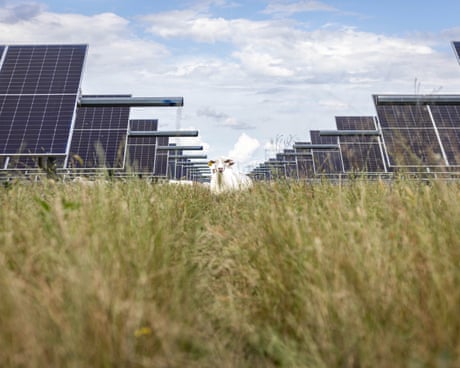
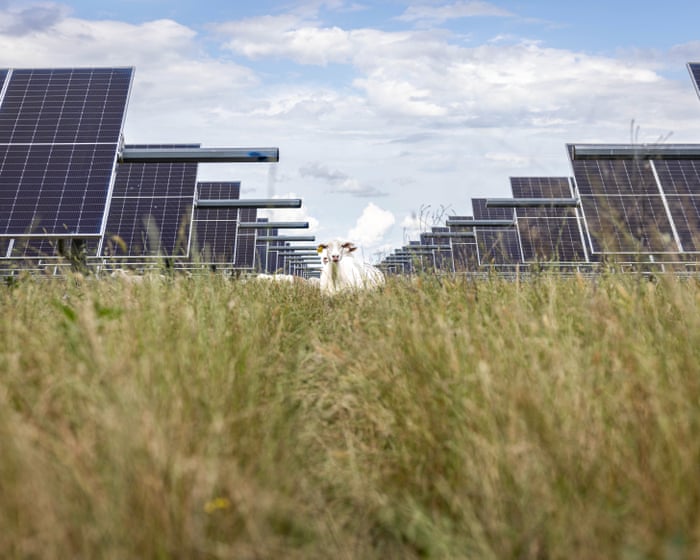
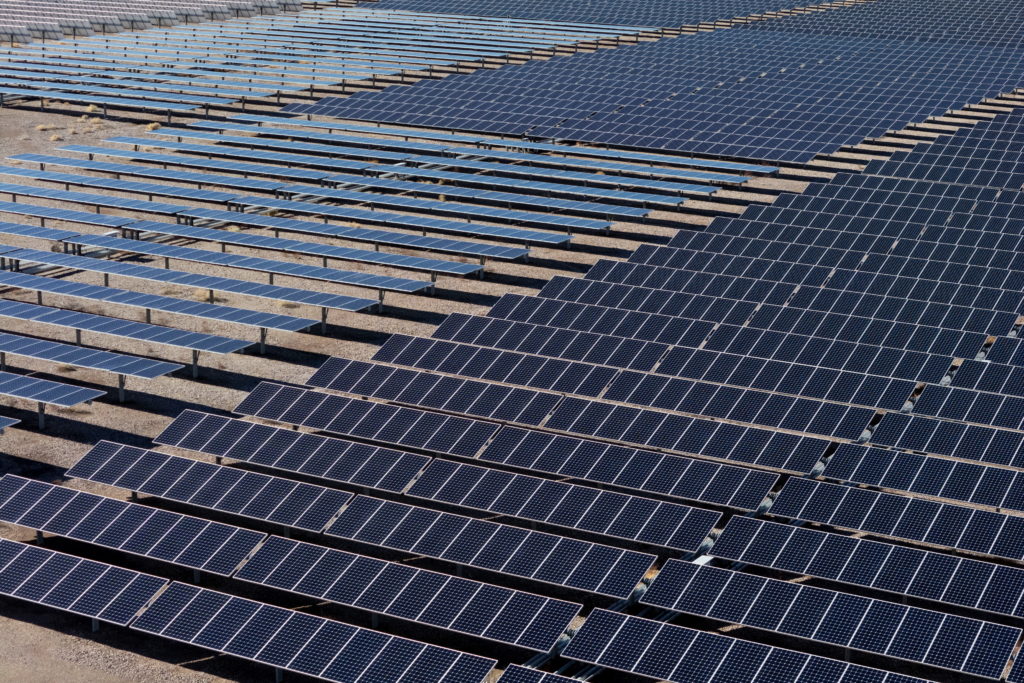
Even as Donald Trump boosts coal over clean energy, solar power is hitting new milestones in the US and remains the leading source of new power.
Data released Wednesday by global energy thinktank Ember, along with a report by the Solar Energy Industries Association (Seia) and analytics firm Wood Mackenzie, show the continued growth of solar and decline of coal in the United States despite federal policy. In May, for the first time, solar supplied more of the nation’s electricity than coal, or 12.8%, Ember said. Coal supplied 12.2%, its fourth-lowest monthly share ever.
A talk on rising energy costs on Capitol Hill hosted by Democrats, from left, Sen. Martin Heinrich of New Mexico, Senate Minority Leader Chuck Schumer and Sen. Sheldon Whitehouse of Rhode Island, in March.
High Commissioner Dinesh Patnaik said at the Global Energy Show in Calgary that officials from the two countries are meeting regularly to discuss Canadian energy opportunities.
High Commissioner Dinesh Patnaik said at the Global Energy Show in Calgary that officials from the two countries are meeting regularly to discuss Canadian energy opportunities.
Even as President Donald Trump boosts coal over clean energy, solar power is hitting new milestones in the U.S. and remains the leading source of new power.
The 700 projects include wind and solar farms, battery storage, gas and hydro plans
More than half the renewable energy projects needed to meet the government’s clean power targets by 2030 are now able to plug into the electricity grid after years of delay, according to the system operator.
The National Energy System Operator (Neso) has offered more than 700 clean energy projects in Great Britain a grid connection date since the start of the year, after a two-year process to unblock a bottleneck that threatened to delay projects into the 2030s.
Government plan to de-link gas and electricity prices aims to reduce bills for consumers after global surge in prices
Households in England, Scotland and Wales could save nearly £200 a year on their energy bills if the government stepped into the market to act as the sole buyer of electricity, according to a thinktank.
The research found that public procurement of electricity, meaning the government would become the “single buyer” of power before it is resold to consumers, could shave billions of pounds from electricity prices.
The Middle East conflict has caused global stockpiles of oil to plummet to their lowest level since 2003 while petroleum prices have spiked, according to a new energy data report.
The Middle East conflict has caused global stockpiles of oil to plummet to their lowest level since 2003 while petroleum prices have spiked, according to a new energy data report.
The federal government has repeatedly raised concerns about an American company’s bid to frack for gas in Western Australia’s Kimberley region, part of the world’s largest and most intact tropical savanna.
Texas-based Black Mountain Energy, through its subsidiary Bennett Resources, is seeking federal approval to drill 20 gas wells for its Valhalla project west of Fitzroy Crossing.
Agora é mais fácil ler o seu Jornal Económico em formato digital. De segunda a sexta-feira, a partir da meia-noite, pode ver a primeira página e ler os principais conteúdos de cada edição no nosso espaço reservado a assinantes, o JE Leitor. Para receber a edição completa, subscreva a newsletter Edição da Manhã e terá o Jornal Económico no seu email, de segunda a sexta-feira, às 7h00.
Veja aqui a primeira página do Jornal Económico desta terça-feira, 9 de junho:
As empresas do setor agrícola já podem candidatar-se ao novo apoio governamental “Investimento em Eficiência Energética, Produção e Armazenamento de Energia no setor agrícola”, uma medida que pretende acelerar a transição energética e reforçar a competitividade das explorações agrícolas portuguesas. Neste processo, a SunEnergy, empresa especializada em soluções de energias renováveis, posiciona-se como parceira das organizações que pretendam aproveitar esta oportunidade de financiamento, segundo o comunicado da empresa especializada em soluções de energias renováveis.
O programa prevê uma taxa de cofinanciamento até 80% a fundo perdido para investimentos em painéis fotovoltaicos, sistemas de armazenamento de energia através de baterias, auditorias e certificação energética, bem como sistemas de climatização e aquecimento solar.
As candidaturas decorrem até 30 de junho e contemplam apoios até 50 mil euros para produtores agrícolas, agropecuários e produtores de leite, podendo atingir os 300 mil euros no caso das Associações de Regantes, anuncia a SunEnergy.
“Com uma vasta experiência na implementação de soluções de energia renovável em diferentes setores de atividade, incluindo a agricultura, a SunEnergy está a disponibilizar apoio e informação às entidades interessadas em beneficiar deste incentivo”, refere a empresa que destaca a sua especialização em projetos de autoconsumo fotovoltaico e eficiência energética, áreas diretamente abrangidas pelo novo programa de financiamento.
Segundo Raul Santos, CEO da SunEnergy, a empresa reúne as competências técnicas e a experiência necessárias para apoiar os agentes do setor agrícola na concretização de investimentos que permitam reduzir custos energéticos e aumentar a sustentabilidade das suas operações. O responsável sublinha ainda a aposta contínua da empresa na qualidade dos equipamentos e na especialização das suas equipas técnicas.
A experiência da SunEnergy no setor agrícola foi recentemente reforçada com a conclusão de um projeto de autoconsumo fotovoltaico para a Associação de Regantes e Beneficiários de Idanha-a-Nova (ARBI), no distrito de Castelo Branco, explica a empresa. A instalação integrou 796 painéis solares fotovoltaicos de 550W, totalizando uma potência de 550 kW. De acordo com a empresa, o sistema permitirá uma redução significativa da fatura energética da associação, contribuindo simultaneamente para uma diminuição estimada de 350 toneladas de emissões de CO2 por ano.
Com presença nacional através de uma rede de delegações e profissionais especializados, a SunEnergy procura afirmar-se como “um dos principais parceiros para as empresas agrícolas que pretendam aproveitar os apoios públicos disponíveis para investir na produção e gestão eficiente de energia, reforçando a sustentabilidade e a competitividade do setor”.
A Goldenergy, comercializadora de eletricidade 100% verde e gás natural, e a Panike, empresa que atua no setor da panificação e pastelaria ultracongelada, formalizaram uma parceria estratégica para o fornecimento de biometano com garantias de origem certificadas. O acordo, que marca a estreia da Goldenergy no abastecimento deste gás renovável ao setor alimentar, visa apoiar a transição energética e a descarbonização da indústria panificadora.
O fornecimento de biometano foi reforçado em junho de 2026 com um aumento dos volumes adquiridos, passando a representar cerca de 2% do consumo total de gás da Panike.
Esta incorporação ecológica será implementada nas três unidades industriais da empresa, localizadas na Maia, em Santo Tirso e em Tondela. De acordo com a Panike, a utilização do biometano complementa os investimentos já realizados em eficiência energética e eletrificação, permitindo avançar na descarbonização de processos produtivos que dependem de energia térmica e cuja eletrificação total ainda não é tecnicamente viável.
O combustível utilizado garante compatibilidade total com as redes de transporte existentes, o que permite à Panike avançar no processo sem a necessidade de realizar investimentos adicionais em novos equipamentos ou alterações nas linhas de produção atuais.
A Goldenergy, comercializadora de eletricidade e gás natural, e a Panike, líder no setor da panificação e pastelaria ultracongelada, formalizaram uma parceria estratégica. O objetivo é reforçar a transição energética da indústria de panificação em Portugal através do fornecimento de biometano com garantias de origem certificadas.
Este acordo marca a expansão da Goldenergy na introdução de gases renováveis no tecido industrial português, uma vez que a empresa já fornece biometano a setores como a cerâmica e o têxtil, além do turismo. O fornecimento à Panike foi reforçado em junho de 2026, com um aumento dos volumes adquiridos, representando atualmente cerca de 2% do consumo total de gás da empresa.
Henrique Soares, CEO e fundador da Panike, afirmou que “esta incorporação ecológica será implementada nas três unidades industriais da PANIKE – Maia, Santo Tirso e Tondela – e constitui mais um passo na estratégia de sustentabilidade da empresa.” Ele acrescentou que a utilização de biometano complementa os investimentos em eficiência energética e eletrificação, permitindo a descarbonização de processos produtivos que ainda dependem de energia térmica.
Miguel Checa, General Manager da Goldenergy, expressou o seu orgulho em apoiar a Panike na sua jornada rumo à neutralidade carbónica, destacando que a empresa já descarbonizou 15 empresas em Portugal através do biometano. Esta parceria representa a estreia da Goldenergy no abastecimento de biometano ao setor alimentar, alargando a sua quota de descarbonização industrial.
O biometano utilizado garante compatibilidade com as redes de transporte existentes, permitindo à Panike complementar a descarbonização do seu processo de fabrico sem a necessidade de investimentos adicionais em novos equipamentos ou alterações estruturais nas suas linhas de produção atuais.
A federal judge over the weekend struck down a Trump administration effort to restrict tax credits for wind and solar energy. While the ruling is a win for renewable energy supporters, it comes less than a month before a key deadline to phase out the credits entirely under Republicans’ “Big Beautiful Bill,” so it’s unclear how wide-reaching the…
An early draft of the annual defense policy bill, or National Defense Authorization Act (NDAA), for the 2027 Fiscal Year, would authorize the addition of $5 million to the Navy’s budget for work on a containerized HELIOS. It would also add $2.5 million for a “Containerized Maritime High Energy Laser Weapon System,” which does not otherwise appear to be mentioned, at least by that name, in the service’s proposed budget for the 2027 Fiscal Year. The House Armed Services Committee released this draft NDAA earlier this week.
The one HELIOS laser directed energy weapon in Navy service currently, which is integrated onto the Arleigh Burke class destroyer USS Preble, seen being tested. USN USN
The Navy’s proposed budget for the next fiscal cycle does already include a request for $75.6 million for a separate Joint Laser Weapon System (JLWS) effort. The development of a containerized 150-kilowatt-class laser directed energy weapon, along with work toward 300 and 500-kilowatt-class designs, are part of the stated plans for JLWS. It’s unclear whether the Maritime High Energy Laser Weapon System mentioned in the draft NDAA is related to JLWS.
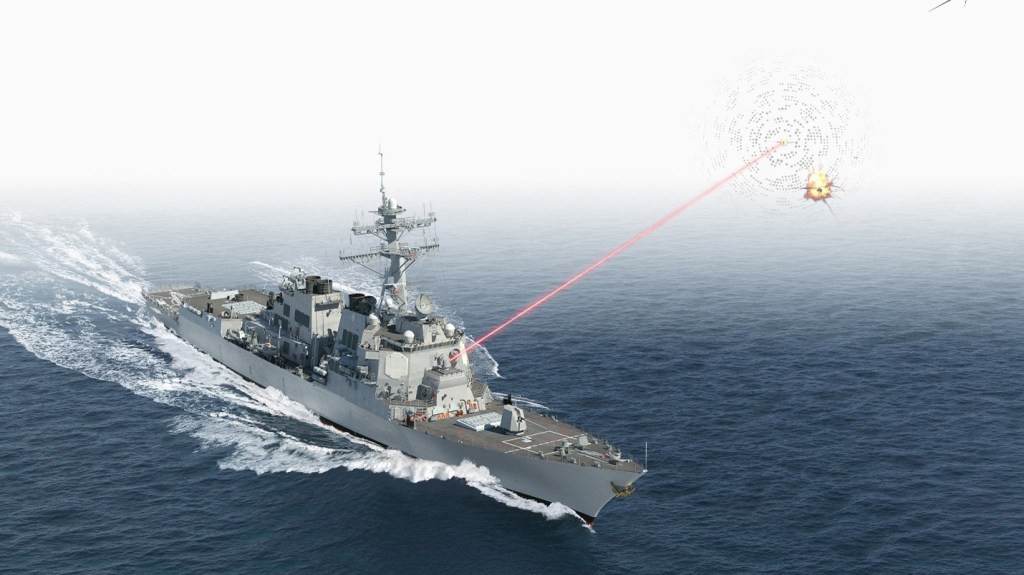
HELIOS, which the Navy has also designated Mk 5 Mod 0, is a 60-kilowatt-class laser directed energy weapon. At that power level, it is able to destroy or at least damage certain targets, such as drones or small boats, a capability that has now been demonstrated in multiple tests. There has been talk in the past about scaling HELIOS’s power rating up to 150 kilowatts.
Currently, the Navy only has one HELIOS laser, installed on the Arleigh Burke class destroyer USS Preble. Despite integration on an operational warship, the service describes this system as a “Non-Program of Record (POR) Research & Development (R&D) asset” in its most recent budget request.
A graphic depicting an Arleigh Burke class destroyer firing a HELIOS laser. Note that the beam would not be visible to the naked eye during a real engagement. Lockheed Martin
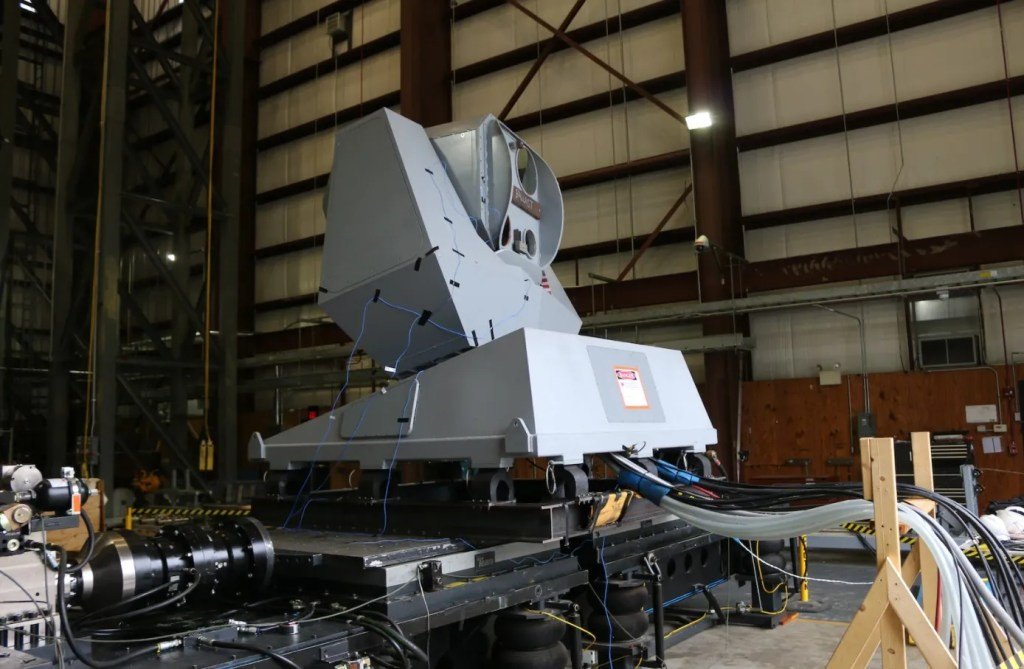
As an aside, another laser system, the Optical Dazzling Interdictor, Navy (ODIN), is currently found on seven other Arleigh Burke class destroyers. An eighth example was integrated on the USS Kidd, but has been temporarily removed while that ship is completing a two-year maintenance availability. That ODIN system is currently being used for land-based training at the Naval Surface Warfare Center, Port Hueneme Division, in California. Designed as a “dazzler,” ODIN is lower-powered than HELIOS, and is intended to blind or confuse electro-optical and/or imaging infrared systems, including seekers on incoming munitions, sending them off course rather than shooting them down.
An ODIN system seen undergoing testing on land. USN
As noted, HELIOS offers demonstrated capability now, and a containerized version is something the Navy might be able to field more widely in the near-term. This, in turn, could help provide a bridge to future developments under JLWS. Containerized systems, as well as palletized ones, inherently offer valuable flexibility, especially in a maritime context. Integration can be more readily achieved on a broad array of ships – including carriers, amphibious warfare ships, sea base-type vessels, and sealift ships, as well as certain surface combatants – as long as there is sufficient deck space and available power.
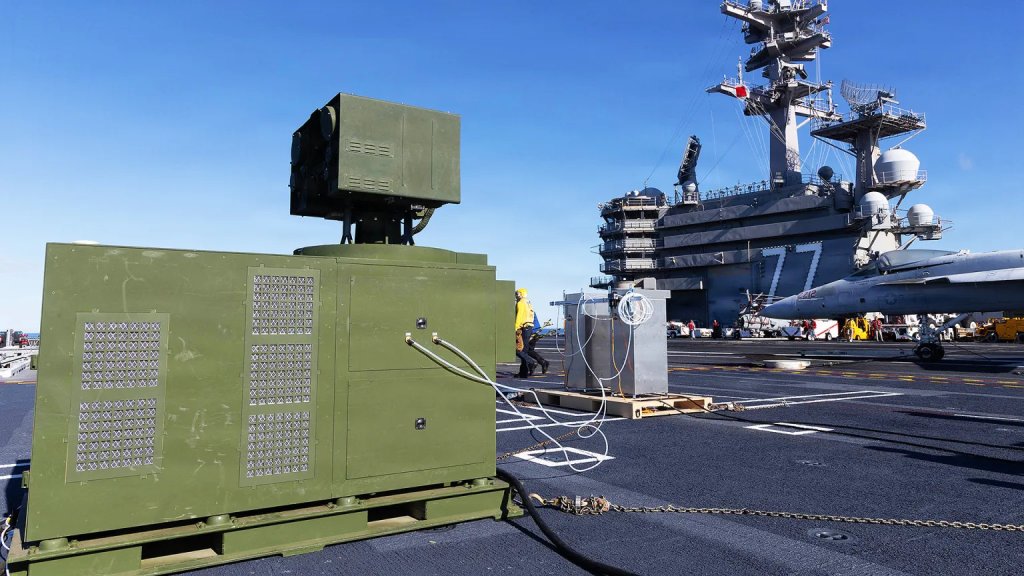
In April, the Navy disclosed a test of a palletized version of AeroVironment’s LOCUST laser counter-drone system on the Nimitz class aircraft carrier USS George H.W. Bush, underscoring exactly this kind of flexibility. For that test, AeroVironment leveraged a palletized configuration of LOCUST it had already developed for the U.S. Army. However, various changes were made to adapt it to shipboard use, including “hardened electronics for salt fog, humidity, vibration, and long deployments” and the addition of “stabilization hardware to manage ship motion,” according to a company press release.
The palletized LOCUST system seen on the deck of the USS George H.W. Bush. USN
When it comes to a containerized version of HELIOS, which could also be used to bolster defenses ashore, it would benefit from having been developed for maritime use from the start. It might still be less hardened against environmental conditions, as well as battle damage, than its more deeply integrated counterpart on the USS Preble. There are also questions about how the system might be integrated onto the host ship and its combat system, if it has one at all.
Laser directed energy weapons do also have limitations, especially when employed in the maritime domain, as TWZ has highlighted in the past:
“A single laser can only engage one target at once. As the beam gets further away from the source, its power also drops, just as a result of it having to propagate through the atmosphere. This can be further compounded by the weather and other environmental factors like smoke and dust. More power is then needed to produce suitable effects at appreciable distances. Adaptive optics are used to help overcome atmospheric distortion to a degree. Altogether, laser directed energy weapons generally remain relatively short-range systems.”
“In addition, laser directed energy weapons, especially sensitive optics, present inherent reliability challenges for use in real-world military operations. Shipboard use adds rough sea states and saltwater exposure to the equation. There is also the matter of needing to keep everything properly cooled, which creates additional power generation and other demands.”
Overall, the Navy’s current top leadership is already very supportive of containerized systems and directed energy weapons, including both lasers and high-power microwave types. In March, Chief of Naval Operations (CNO) Adm. Daryl Caudle, the service’s top officer, unveiled a formal Containerized Capability Campaign.
Chief of Naval Operations Adm. Daryl Caudle, left, speaks at a separate budget-related hearing before members of the House Appropriations Committee on May 12, 2026. USN
“From towed-array-systems, to drone swarms, to electronic attack systems, to high-powered lasers … I want to containerize everything,” Caudle said at the annual McAleese Defense Programs Conference in March. “Tailored capabilities give our combatant commanders something they value above all else: options.”
Laser directed energy weapons are also central to the current plan for the Navy’s future Trump class battleships, but they are expected to be deeply integrated into that design rather than containerized. Adm. Caudle has been outspoken more broadly in his view that laser-directed energy weapons are key to bolstering close-in defenses on his service’s warships going forward, including against the growing threat posed by drones.
A rendering of a Trump class battleship firing various weapons, including laser directed energy weapons. USN
“My thesis research at [the] Naval Post Graduate School was on directed energy and nuclear weapons,” the CNO told TWZ and other outlets at a roundtable at the Surface Navy Association’s (SNA) annual symposium in January. “This is my goal, if it’s in line of sight of a ship, that the first solution that we’re using is directed energy.”
In particular, “point defense needs to shift to directed energy,” Caudle added at that time. “It has an infinite magazine.”
Even before assuming his current role as CNO, Caudle has been a vocal supporter of Navy directed energy weapon developments. At the same time, as mentioned, the service has faced continued stumbling blocks to more widespread fielding of these capabilities. This is, in many ways, reflected just in HELIOS, which remains a largely experimental effort despite years of testing and previous talk about expanding it into a broader operational capability. The Navy has integrated other one-off lasers onto other ships in the past. This includes the Laser Weapon System Demonstrator Mk 2 Mod 0 installed for a time on the San Antonio class amphibious warfare ship USS Portland, which is seen being tested in this video below.
Despite it adding funding for containerized system development, the draft NDAA that the House Armed Services Committee also proposes to cut $5 million from the Navy’s Directed Energy and Electric Weapon Systems line item due to what it simply describes as “unjustified growth.” The bill is also very likely to change in substantial ways in the coming weeks and months before it is ever put to a full vote, let alone sent to President Trump’s desk.
Whether or not the extra funding for a containerized version of HELIOS, or the Maritime High Energy Laser Weapon System, comes across in the end, the Navy is already heavily committed to new developments in this arena despite the continued challenges.

 Login
Login