Reading view

German company that already supplies Ukraine with drones has unveiled Shahed-hunter aircraft with four weapons categories on single airframe
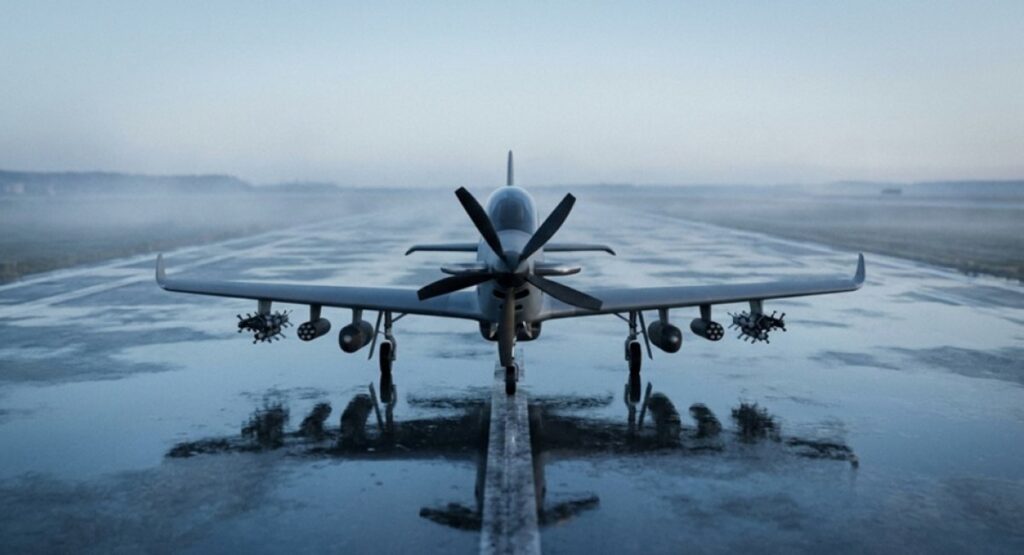
Render of the Pulse P19 multi-purpose optionally piloted aircraft. Source: Quantum Systems

Germany's Quantum Systems has unveiled the Pulse P19, an optionally-piloted aircraft designed to hunt drones and repel massed drone attacks, per Defense Express. The technology company already supplies Vector reconnaissance drones to Ukraine. 

The Pulse P19's primary mission profile, which is hunting drones and repelling massed drone attacks, addresses exactly the Russian Shahed threat that Ukraine has been responding to.

Ukraine is now intercepting 95% of incoming Russian Shaheds, using a layered defense system that includes Patriot, NASAMS, IRIS-T, naval-platform interceptors, helicopter-based interceptors, Ukrainian-made Bullet interceptors, and autonomous drone-on-drone systems.

The Pulse P19 would add a dedicated, optionally piloted drone-hunter platform to this layered defense,  though the aircraft is currently in early design stages, with only renders released.

What does Pulse P19 carry, and how would it hunt? 

For air-target detection and tracking, the Pulse P19 can be equipped with an active electronically scanned array (AESA) radar and an electro-optical targeting station.

The aircraft's armament options are unusually broad. The Pulse P19 is designed to carry interceptor drones, loitering munitions, missiles with semi-active laser homing heads (APKWS class), pod-mounted machine guns, and additional weapons that may be developed in the future.

The interceptor drones referenced in the Quantum Systems presentation are likely the same systems being integrated onto the Airbus U145 helicopter, which Quantum Systems also unveiled at ILA Berlin 2026 with anti-drone armament.

Specifications: small, fast, with significant payload

The Pulse P19 has a maximum speed of 556 km/h and a service ceiling of 7,620 meters. The aircraft's empty weight is approximately 1,700 kg, while it can carry up to 2,500 kg of payload and armament.

The payload-to-empty-weight ratio is unusually high. This indicates the design is built around the requirement to carry multiple weapons systems simultaneously. The 556 km/h maximum speed places the Pulse P19 in the slow-to-mid-tier of fixed-wing combat aircraft, but adequate for the Shahed-pursuit mission, given that Shahed-136 drones typically cruise at 180 km/h.

Development status: renders only, timeline undisclosed

Quantum Systems has presented only renders of the Pulse P19. The project's development stage has not been disclosed. The aircraft is likely still in early design phases. No first-flight timeline has been published.

The aircraft's specifications and weapons configuration represent design intent rather than current operational capability. Ukrainian defense procurement officials would likely engage with Quantum Systems on the Pulse P19 trajectory once the aircraft reaches the flight-test stage, given Quantum Systems' established relationship with Ukraine and the operational fit between the Pulse P19's mission profile and Ukraine's defensive needs.

  •  

Ukraine’s drone commander says his branch killed or wounded 102,000 Russians in 12 months. It started with a grenade taped to drone that filmed weddings

Collage. Left: Russian Ka-52 helicopter at low altitude seen through a Ukrainian FPV drone camera. Right: Major Robert "Magyar" Brovdi in fatigues and beret, speaking to camera with the Motherland Monument in Kyiv visible behind him.

Major Robert "Madiar" Brovdi marked Ukraine's first official Day of Unmanned Systems Forces on 11 June 2026 with a single number. His drone branch claims 102,000 Russian soldiers killed or wounded over twelve months, alongside 360,000 enemy targets hit and 1.7 million combat sorties flown, the commander said in a Telegram address.

The number translates four years of homemade weaponry into industrial output. By Brovdi's own reckoning, drones from his Unmanned Systems Forces (SBS) now account for one in every three Russian soldiers falling on the battlefield, and at a unit cost he prices in hundreds of dollars apiece.

"We exchange the plastic and metal of a drone worth a few hundred dollars for the carcass of an occupier. And that is the best exchange rate in the world," Brovdi said. 

"Birds changed both plan and course"

Brovdi narrated the four-year arc of Ukrainian drone warfare in a single Telegram thread. In 2022, he said, the starting slogan was "artillery, shovel, drone" to locate, correct, hide. Then, in spring 2022, he taped a grenade to a commercial quadcopter and pushed video of the drop to social media.

"No weapon in human history has evolved so quickly. A wedding drone, no joke, performed well at the front, fundamentally and forever changing world doctrine," he revealed. 

The unit he founded that month — Madiar's Birds — has since grown from platoon to brigade to a separate branch of the armed forces. The 414th brigade tripled in size in late 2024. On 3 June 2025, President Volodymyr Zelenskyy made Brovdi commander of the entire SBS, replacing Colonel Vadym Sukharevskyi.

Four targets, 2,000 kilometers deep

Madiar listed four target priorities for the year ahead: enemy manpower, sources of war financing, weapons production, and Russian air defense. The branch's reach now extends from frontline FPV strikes to deep-strike platforms confirmed beyond 1,700 kilometers inside Russia.

"The birds changed both the plan and the course," Madiar said. 

Art-collecting commander

Russian state TV calls him a "terrorist." A Russian court sentenced him in absentia to life in prison in March 2026 on charges of organizing a terrorist attack. Russian prosecutors have filed 46 counts against him in total.

The Center for European Policy Analysis calls him "a bearded talisman of Ukraine's defense" — a "swashbuckling, plain-spoken" commander whose journey ran from "besuited grain trader" to the top of the world's first dedicated drone branch.

Madiar's biography reads like Carpathian Tony Stark's: an ethnic Hungarian from Uzhhorod who ran one of Ukraine's largest grain traders, served on the Zakarpattia Regional Council from 2010 to 2015, and funded contemporary Ukrainian art through his BrovdiArt Foundation before walking into a recruitment office at the start of the full-scale war.

He closed his anniversary speech in his usual register: "And now to work, ladies and gentlemen, at all available depths, across all the hated enemy. The way we know how, with what we have, where we are."

  •  

Russia’s fuel crisis jumps from 15 to 25 regions in five days—plus six occupied Ukrainian areas

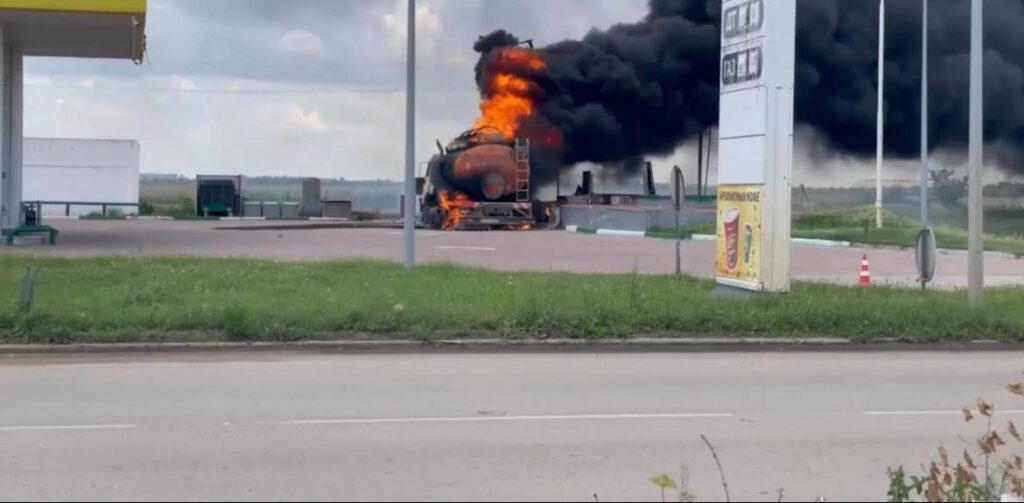
russia's fuel crisis jumps 15 25 regions five days—plus six occupied ukrainian areas · post russian truck burns gas station skadovsk kherson oblast after logistic lockdown mid-range strike 11 2026

Russia's gasoline crisis has spread to 25 of its own regions and six occupied Ukrainian ones, the Russian-language Moscow Times reported on 10 June. Six days earlier, the count stood at 15. Ukrainian strikes on Russian refineries hit a wartime monthly record in May 2026, dropping Russian refining loading well below the start of the year.

This comes amid the Ukrainian long-range drone strike campaign, targeting Russian oil processing, transportation, and storage facilities almost every day. Additionally, Ukraine has escalated its mid-range "Logistic Lockdown" campaign, targeting Russian logistics in the occupied territories at depths of up to 200 km.

From 15 regions to 25 in under a week

The Russian Telegram channel 7×7 counted at least 25 Russian regions facing gasoline shortages and supply disruptions as of 10 June. Less than a week earlier, on 4 June, the number stood at 15. Restrictions also apply across six Russian-occupied Ukrainian regions: Crimea, Sevastopol, and the Luhansk, Donetsk, Kherson, and Zaporizhzhia oblasts.

Bloomberg counted 38 Ukrainian strikes on Russian refineries from January through May 2026. May alone saw 16 — the highest monthly figure of the war. According to OilX, Russian refinery loading has dropped 14% since the start of the year and stays roughly 20% below pre-war levels.

afipsky oil refinery burns again ukrainian drones return krasnodar krai · post fire after drone strike russia 11 2026 5282989402957225318 ukraine news reports
Explore further

Afipsky oil refinery burns again as Ukrainian drones return to Krasnodar Krai

Regional officials have responded unevenly. The acting governor of Belgorod Oblast, Alexander Shuvaev, acknowledged the shortage. Krasnodar Krai governor Veniamin Kondratyev called the situation "artificial hype." Residents publicly mocked the claim under his Telegram post, which was republished on a local channel. Gas stations in Krasnodar Krai have begun closing due to a shortage.

Fuel prices have spiked in occupied Crimea. On 10 June, AI-92 cost about $1.14 per liter, against $0.96 in Moscow. AI-95 traded near $1.25, up from $1.04 in the Russian capital. Resellers were offering fuel at $1.81-$2.08 per liter — about 50% above official Crimean prices.

On 8 June, Russia's Energy Ministry announced the creation of a task force to manage the fuel crisis, citing "growing enemy air attacks."

Occupied Sevastopol cancels fuel coupons after tankers fail to arrive

Sevastopol's Russian-installed governor said on 10 June that planned distribution of rationed petrol had been delayed, Reuters wrote on 11 June. Mikhail Razvozhayev claimed oil tanker trucks could not bring fuel into the city, following recent Ukrainian strikes on supply routes. Crimea, occupied by Russia in 2014, introduced fuel rationing last month due to shortages on the peninsula.

"Unfortunately, oil tanker trucks were unable to come to the city tonight," Razvozhayev wrote on Telegram. 

ukrainian drones knocking out northwestern entrance crimea bridges damaged one night · post rl9vo -ukraine-targets-four-bridges-at-crimea-s-northwestern-choke-point- struck four vehicular crimea's overnight 11 2026 quisling official vladimir saldo claimed strikes part ukraine's
Explore further

Ukrainian drones knocking out the northwestern entrance to Crimea: four bridges targeted in one night

He said priority for refueling on 11 June would go to public transport, utilities, emergency vehicles, and government vehicles.

"I am addressing everyone: there is no point in lining up at... the gas stations tomorrow," he added late on 10 June. 

Existing rationing coupons would be canceled and new ones issued today.

Razvozhayev later claimed over two dozen Ukrainian drones were downed in the early hours of Thursday in a fresh attack on Sevastopol. The city is Crimea's second-largest and home to Russia's Black Sea Fleet.

On the same day, a major drone attack hit Russia's Volga region of Samara, more than 900 km from the front line, forcing state-owned oil giant Rosneft to halt processing at its Kuibyshevsky refinery.

rosneft's kuibyshev refinery joins syzran novokuibyshevsk offline after ukrainian drone strike yesterday · post fires raging kuybyshevsky oil samara russia 10 2026 fires-rage-at-samara-kuybyshevsky-oil-refinery ukraine news reports
Explore further

All three Rosneft Samara refineries now offline or reduced as drones halt Kuibyshevsky operations yesterday

Ukrainian President Volodymyr Zelenskyy said Wednesday evening that Ukraine’s recently launched mid-range strike campaign against Russian logistics, including large-scale strikes on supply and fuel trucks, had proved its worth.

"In recent months, we are especially grateful for the mid-strikes: Russian military logistics throughout the entire depth of the temporarily occupied territory are now within reach of Ukrainian drones," he said. "Our impact reaches Russia’s border regions as well. The enemy feels it, and we will continue to expand it."

  •  

Ukrainian drones knocking out the northwestern entrance to Crimea: four bridges targeted in one night

ukrainian drones knocking out northwestern entrance crimea bridges damaged one night · post rl9vo -ukraine-targets-four-bridges-at-crimea-s-northwestern-choke-point- struck four vehicular crimea's overnight 11 2026 quisling official vladimir saldo claimed strikes part ukraine's

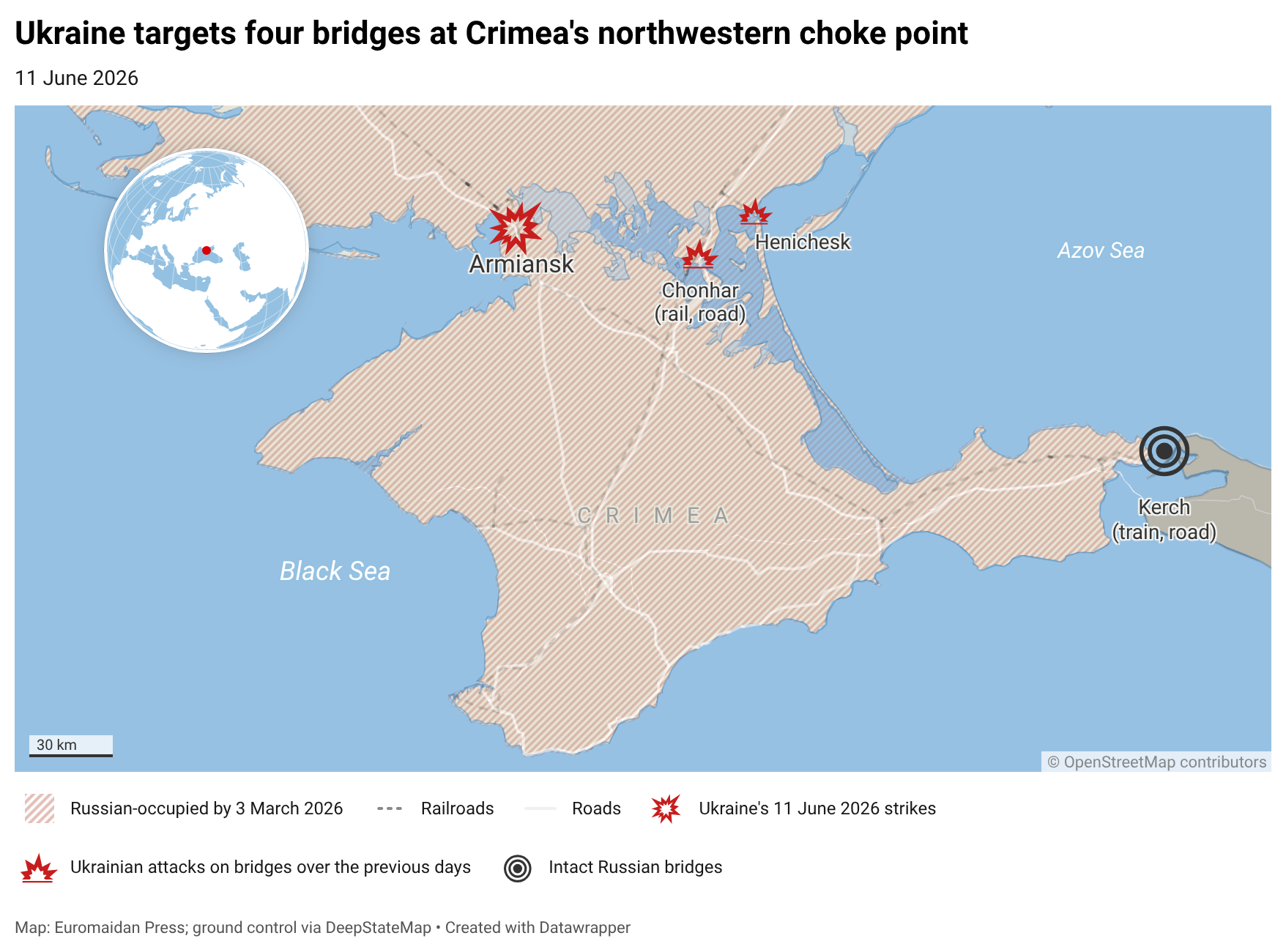
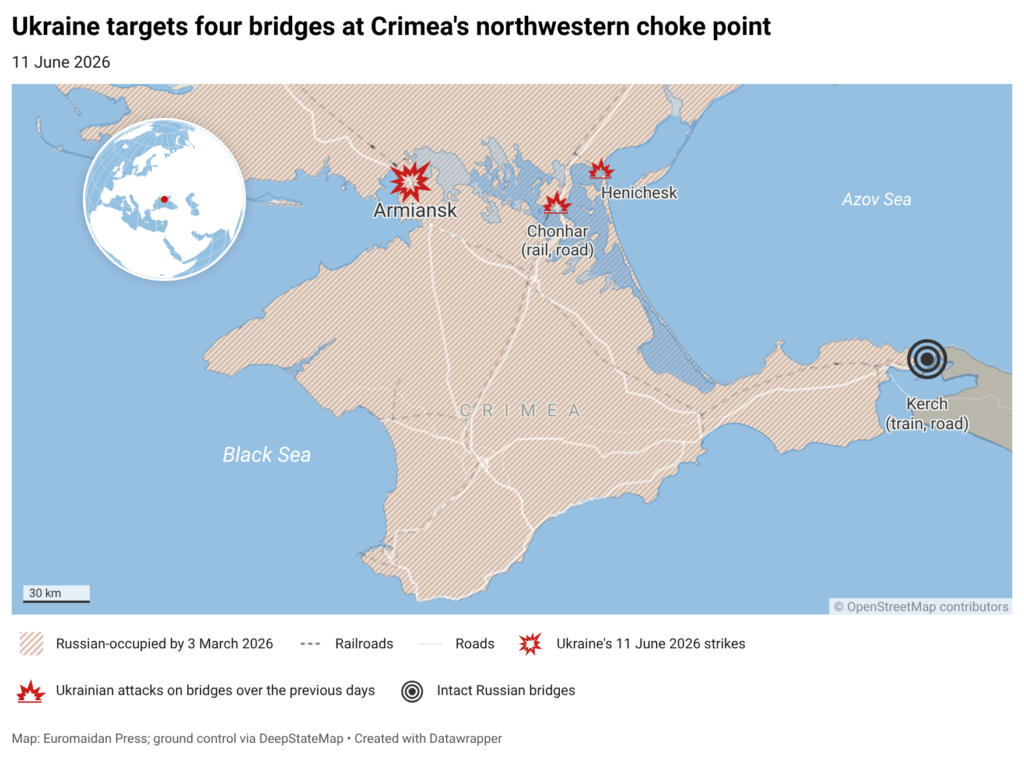
Ukrainian drones struck four vehicular bridges at Crimea's northwestern entrance overnight on 11 June 2026, quisling official Vladimir Saldo claimed. The strikes are part of Ukraine's most recent mid-range strike push—now at its fourth day—reaching every road corridor between Crimea and mainland Ukraine. The same night, drone attacks also rolled across Sevastopol, Bakhchysarai, Saky, and other Crimean sites.

Russia depends on the Crimean land corridor to push fuel, ammunition, and replacements to its forces in occupied southern Ukraine. Ukrainian mid-range drones operating under the military's Logistics Lockdown program have steadily shrunk that corridor's reliability since May. Ukraine has now struck all three major connection points between occupied Crimea and mainland Ukraine within four days, damaging some bridges and destroying others.

Four bridges damaged at the Armiansk isthmus

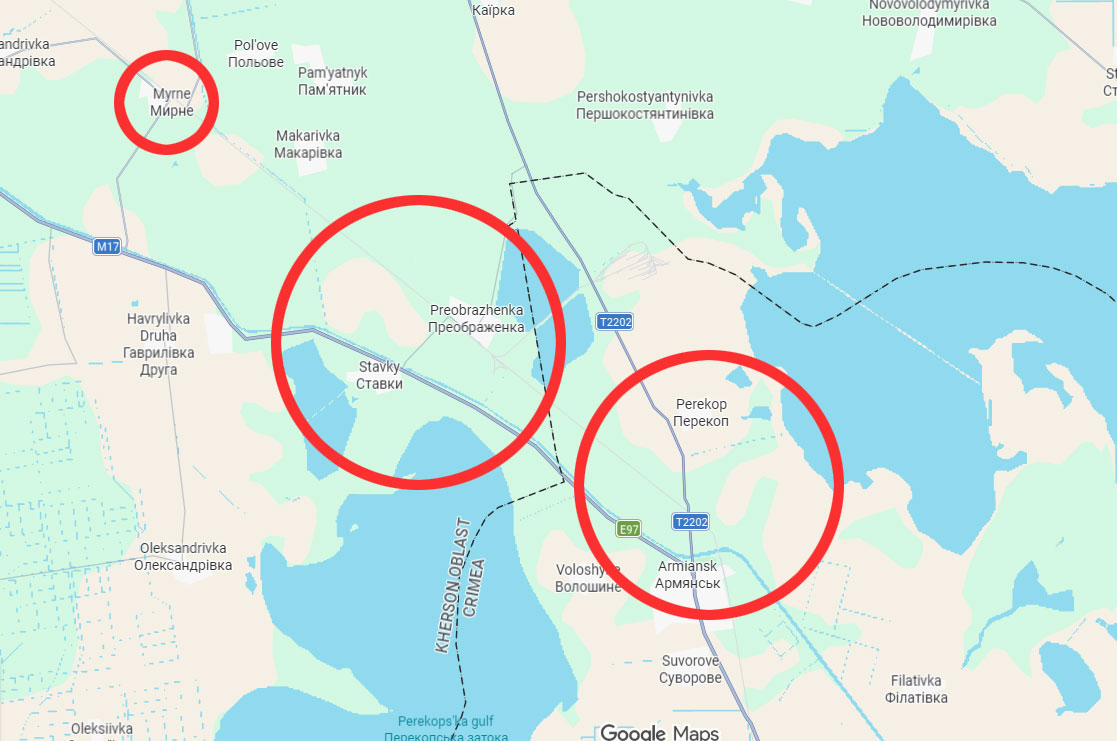
Saldo, the Russian-installed head of occupied Kherson Oblast, named the four targets on his Telegram. They include the automobile bridge in the Perekop-Armiansk area and a bridge near Stavky, Kherson OblastTwo more bridges near Myrne and Preobrazhenka span the North Crimean Canal. Saldo stated all four spans sustained damage.

ukrainian drones knocking out northwestern entrance crimea bridges damaged one night · post google maps view four struck overnight 11 2026 — near myrne between stavky preobrazhenka perekop armiansk crimean
Google Maps view of the four bridges struck by Ukrainian drones overnight on 11 June 2026 — near Myrne, between Stavky and Preobrazhenka, and at Perekop near Armiansk in the northwestern Crimean isthmus. Map: Google Maps

Three Crimean northern choke points hit in four days

Ukraine struck the Chonhar bridge on 7 and 9 Juneclosing Russia's main road link to occupied Crimea, yet the Russians reportedly installed a pontoon bridge next to the severely damaged crossing. On 10 June, Ukrainian drones hit the bridge from Henichesk to Arabat Spit. With both routes fully or partially shut, Russia had rerouted traffic through Armiansk and Perekop — the very corridor struck overnight. DeepState analysts noted that Ukrainian strikes on the bridges are an important part of the blockade of occupied southern Ukraine.

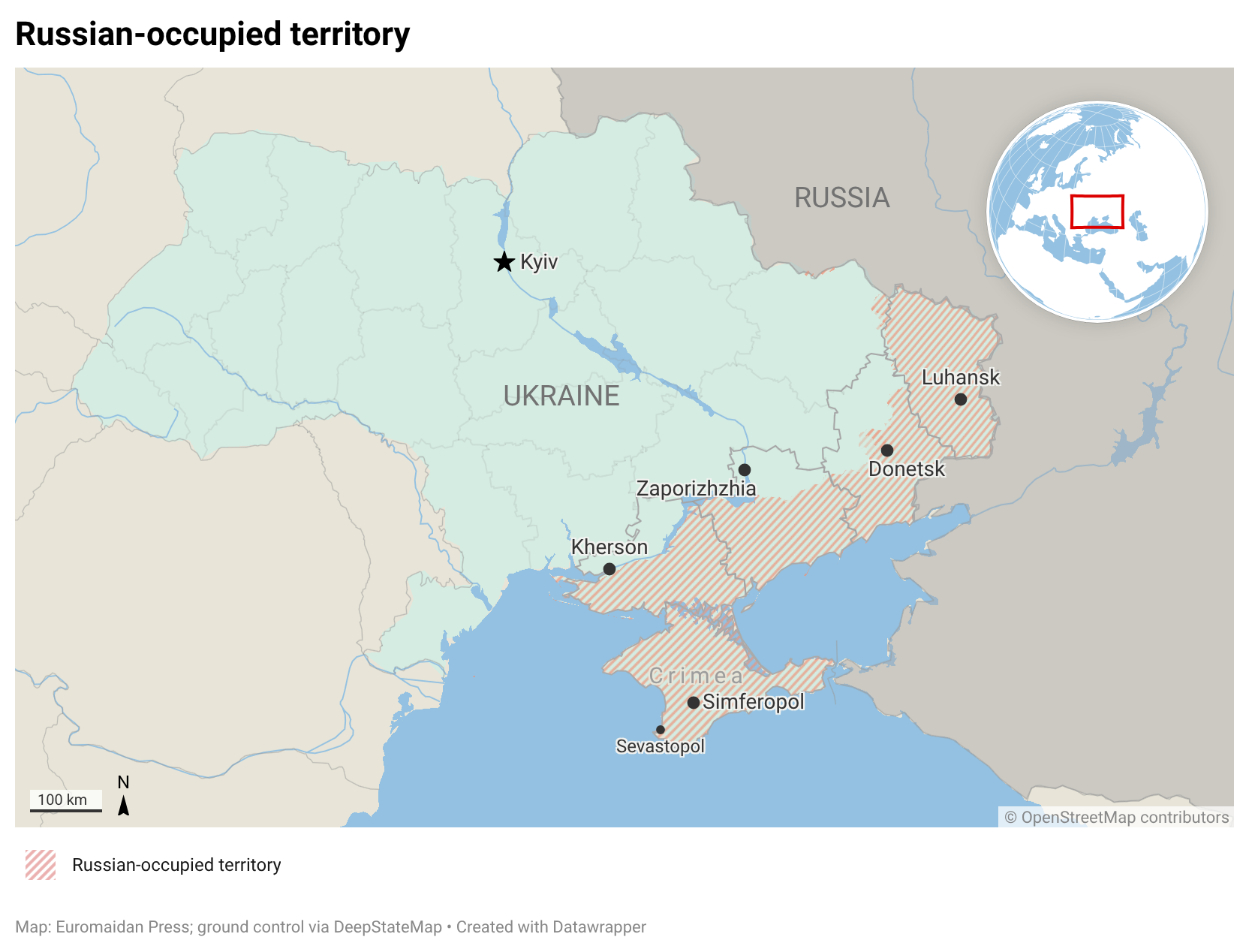
Russian-occupied Ukrainian territory, including Crimea and parts of Luhansk, Donetsk, Zaporizhzhia, and Kherson oblasts. Illustrative map: Euromaidan Press

Not only an entrance, but also targets across the peninsula

Russia's occupation governor, Mikhail Razvozhayev, claimed 32 drones were shot down over Sevastopol between 22:00 and midnight. He claimed the drones fell near Sevastopol Bay, Cape Fiolent, and Balaklava. The city declared two air alerts during the night and the morning.

Monitoring Telegram channel Krymsky Veter reported machine-gun fire in Pishchane at 21:40 and in Andriivka shortly after, citing subscribers. 

"At 21:40 a machine gun started firing in Pishchane, at 21:48 a machine gun started in Andriivka, after which an anti-aircraft gun fired a couple of bursts," the channel wrote. 

Detonations followed near Cape Fiolent, in Sevastopol, and later in Bakhchysarai. By morning, Krymsky Veter reported explosions and shooting in Saky.

Russia's Defense Ministry claimed the destruction of 330 drones over Russia and the occupied territories in the same overnight period.

Update

The First Assault Brigade shared the footage of the strikes:

Videos emerged of some of the Ukrainian strikes on bridges linking occupied Crimea to occupied Kherson Oblast

Ukraine's 1st Assault Brigade, 475th Assault Regiment, and SBU's Alfa reportedly took part.

📹 1st Assault Brigade
More on the strikes: https://t.co/xkKf15akux https://t.co/7FhAOJbWl0 pic.twitter.com/WFXUcKjfWm

— Euromaidan Press (@EuromaidanPress) June 11, 2026
  •  

ISW: Russia gains ground in Kostiantynivka but Fortress Belt stays out of reach

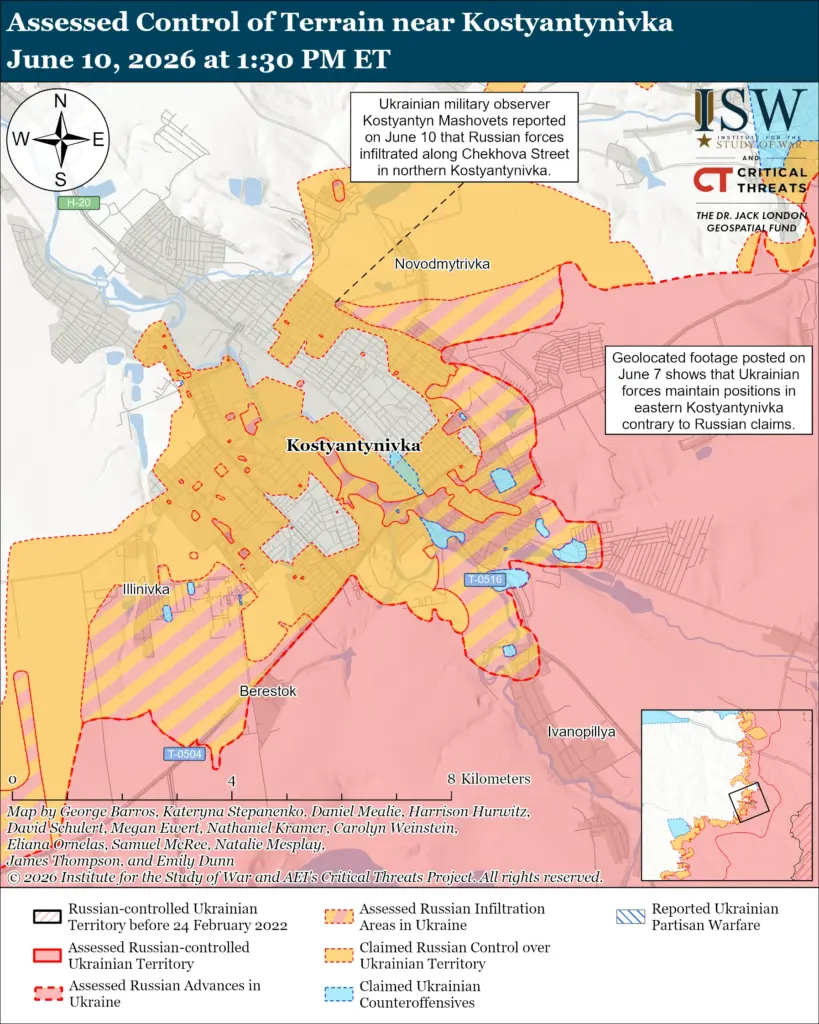
isw russia gains ground kostiantynivka fortress belt stays out reach · post assessed control terrain near 10 2026 kostyantynivka-june-10-2026 ukraine news ukrainian reports

Russian forces have made fresh tactical advances into Kostiantynivka, the Institute for the Study of War (ISW) assessed on 10 June. The city sits at the southern tip of Ukraine's Donetsk Oblast Fortress Belt — Moscow's main effort for the spring-summer 2026 offensive. Russia missed its own May deadline to take the city, and the wider fortified chain stays out of operational reach.

For more than four years now, Russia has been struggling to seize the rest of Donetsk Oblast in eastern Ukraine, making only gradual costly advances. Ukraine's Fortress Belt anchors the region's defense. Unable to capture the Ukrainian-controlled part, the Kremlin demanded the whole region in peace talks, which predictably isn't a condition Ukraine can accept. Slow infiltration drains Russian reserves while Ukrainian drone interdiction continues to erode Moscow's assault tempo across the theater.

Two Russian tactical groups push into eastern Kostiantynivka

Two named Russian formations have pushed into eastern Kostiantynivka from the south, Ukrainian military observer Kostiantyn Mashovets reported on 10 June. He identified them as the "Bakhmut" tactical group and the "Dzerzhinsk" (Toretsk) tactical group. The "Bakhmut" group is built around Russia's 3rd Army Corps (AC) under the Southern Grouping of Forces. The "Dzerzhinsk" group operates in the area of responsibility of the 8th Combined Arms Army (CAA) of the Southern Military District. It likely includes elements of five CAAs, the 3rd AC, and Russian naval fleets, Mashovets noted.

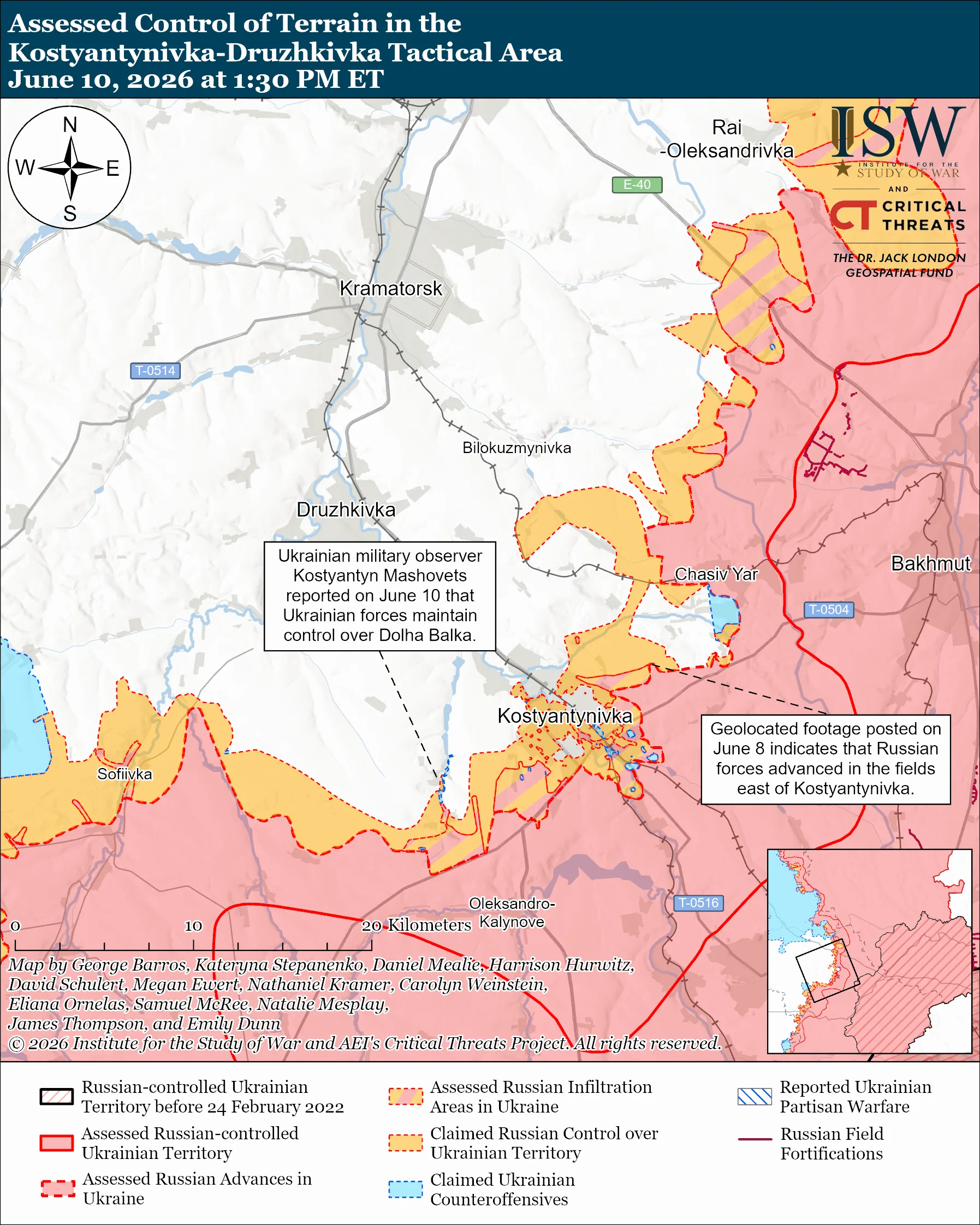
Elements of the "Bakhmut" group pushed from Stupochky through Novodmytrivka into northeastern Kostiantynivka. They also advanced along the T-0504 Pokrovsk-Bakhmut road as far as the city's railway station. The "Dzerzhinsk" group moved from Illinivka, south of the city, into areas stretching from northwestern to southwestern Kostiantynivka near the railway station. Mashovets assessed that it has likely achieved a tactical breakthrough in the western, central part of the city. Forward assault elements of the two groups now stand roughly two kilometers apart. Russian forces have so far failed to seize the railway station. Ukrainian troops cleared the village of Dovha Blaka southwest of the city of Russian infiltrators.

isw russia gains ground kostiantynivka fortress belt stays out reach · post kostyantynivka-druzhkivka-tactical-area-june-10-2026 ukraine news ukrainian reports
Map: ISW

Eight months of grinding, one missed deadline

ISW noted that Russian forces opened the campaign for Kostiantynivka in August 2025 after seizing the majority of Chasiv Yar and Toretsk, with Toretsk alone running to roughly 26,000 Russian casualties. The first Russian troops infiltrated Kostiantynivka itself in October 2025. Russia has since worked into at least 12.69% of the city. Ukrainian officials reported earlier this spring that the Russian command had set a May 2026 deadline for the seizure. That deadline has come and gone.

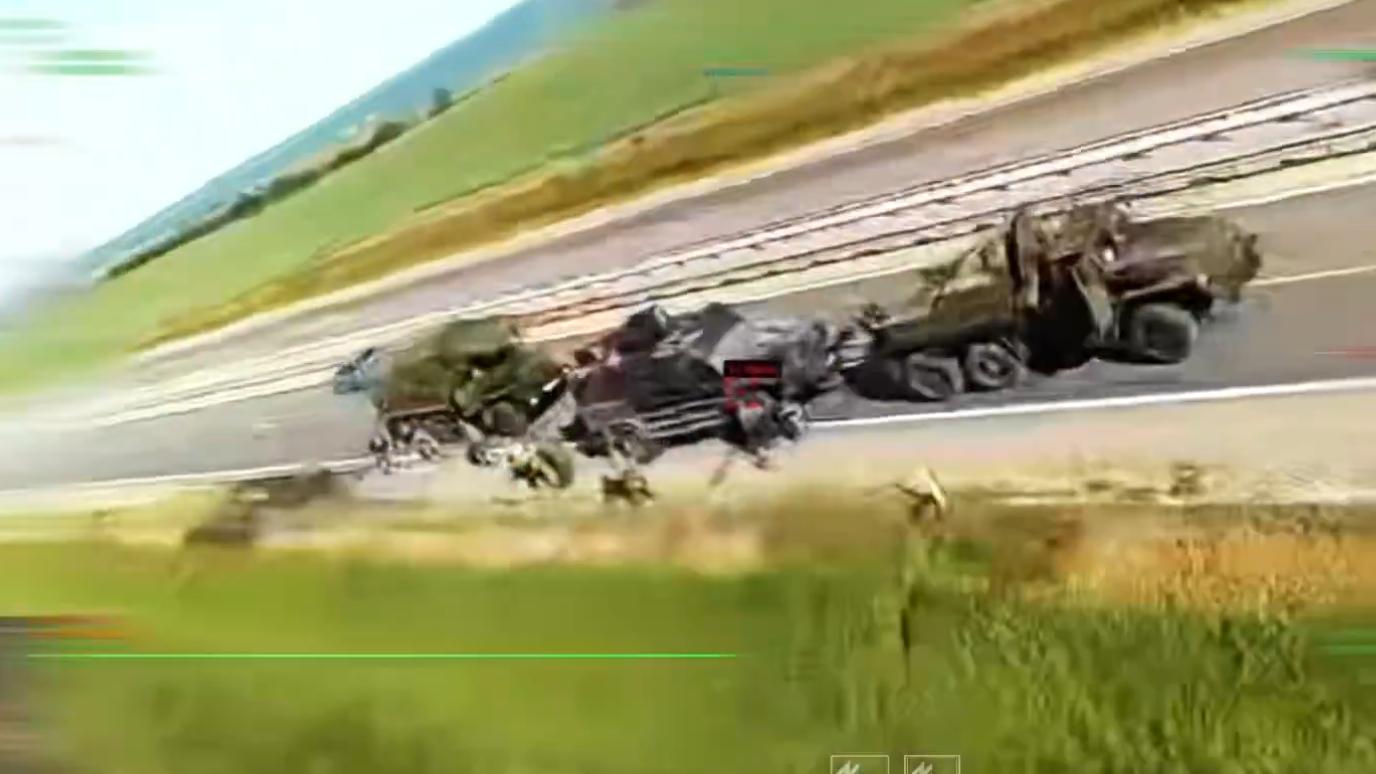
russia's monthly land grab ukraine has collapsed hundreds km² 14 · post double tap strike russian trucks rear highway russian-occupied occupied territory 1st azov corps news ukrainian reports
Explore further

Russia’s monthly land grab in Ukraine has collapsed from hundreds of km² to 14, OSINT data show

Russia has poured forces into the effort regardless. Ukrainian Commander-in-Chief Oleksandr Syrskyi said on 2 May that Russian activity in this direction noticeably increased in April. Russian units in the area had reportedly been replenished by 80% as of 6 June, ISW noted. The Russian command reportedly redeployed elements of the 70th Motorized Rifle Division to the Kostiantynivka-Chasiv Yar area last December. The redeployment likely came in preparation for the spring push.

Tactical gains likely, the Fortress Belt still out of reach

ISW assessed that Russian forces will likely keep infiltrating throughout Kostiantynivka. They will likely consolidate positions in parts of the city while suffering high casualties. Russia's 3rd AC northeast of the city appears to be struggling to dislodge Ukrainian forces from Chasiv Yar. That inhibits any move to envelop Kostiantynivka from the north. A Russian milblogger claimed on 9 June that Ukrainian forces recently counterattacked near Chasiv Yar. The milblogger added that Ukraine still holds Podilske and Mykolaivka west of the town.

russia's new kyiv strike threat posturing victory day humiliation retaliation—isw · post russian president vladimir putin during 9 parade red square 2026 photo_2026-05-09_10-53-10 25 russia threatened systematic strikes violation spirit
Explore further

ISW: Russia’s grand territorial ambitions are divorced from battlefield reality

The northern flank of the Fortress Belt is also bogged down. Russia opened its spring-summer 2026 offensive with mechanized assaults around Lyman. Those assaults signaled intent to advance on Sloviansk from the northeast. They produced no significant gains, ISW noted. The Russian command likely shifted weight south to Kostiantynivka. Russia's Western Grouping of Forces covers the front from Kupiansk through Lyman. It likely lacks the combat power to push on Sloviansk while balancing operations toward Kupiansk and Borova. 

Ukrainian counterattacks in the Borova direction have likely forced Russian units to choose between defending their positions and pushing north or northwest of Lyman, ISW says.
  •  

Afipsky oil refinery burns again as Ukrainian drones return to Krasnodar Krai

afipsky oil refinery burns again ukrainian drones return krasnodar krai · post fire after drone strike russia 11 2026 5282989402957225318 ukraine news reports

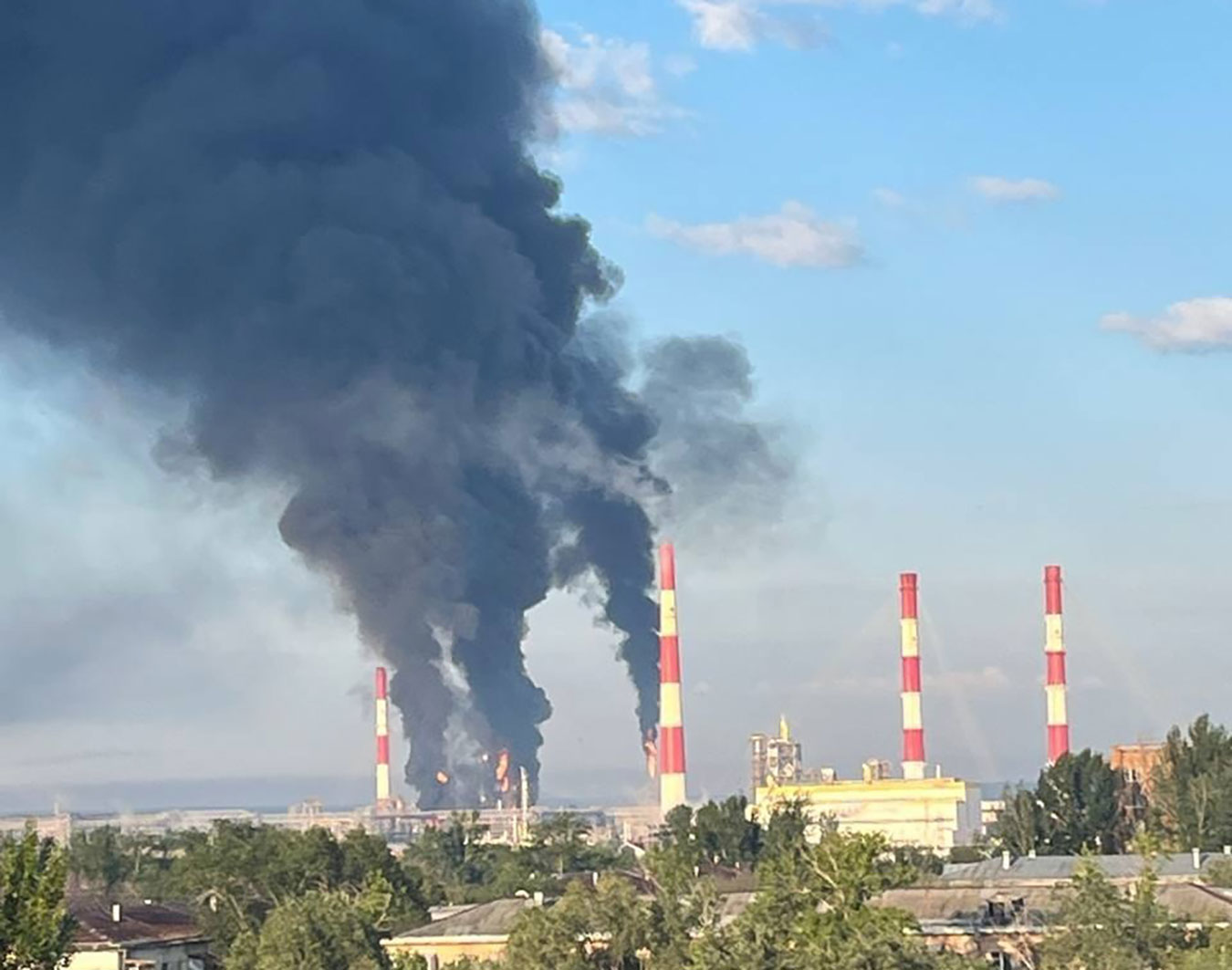
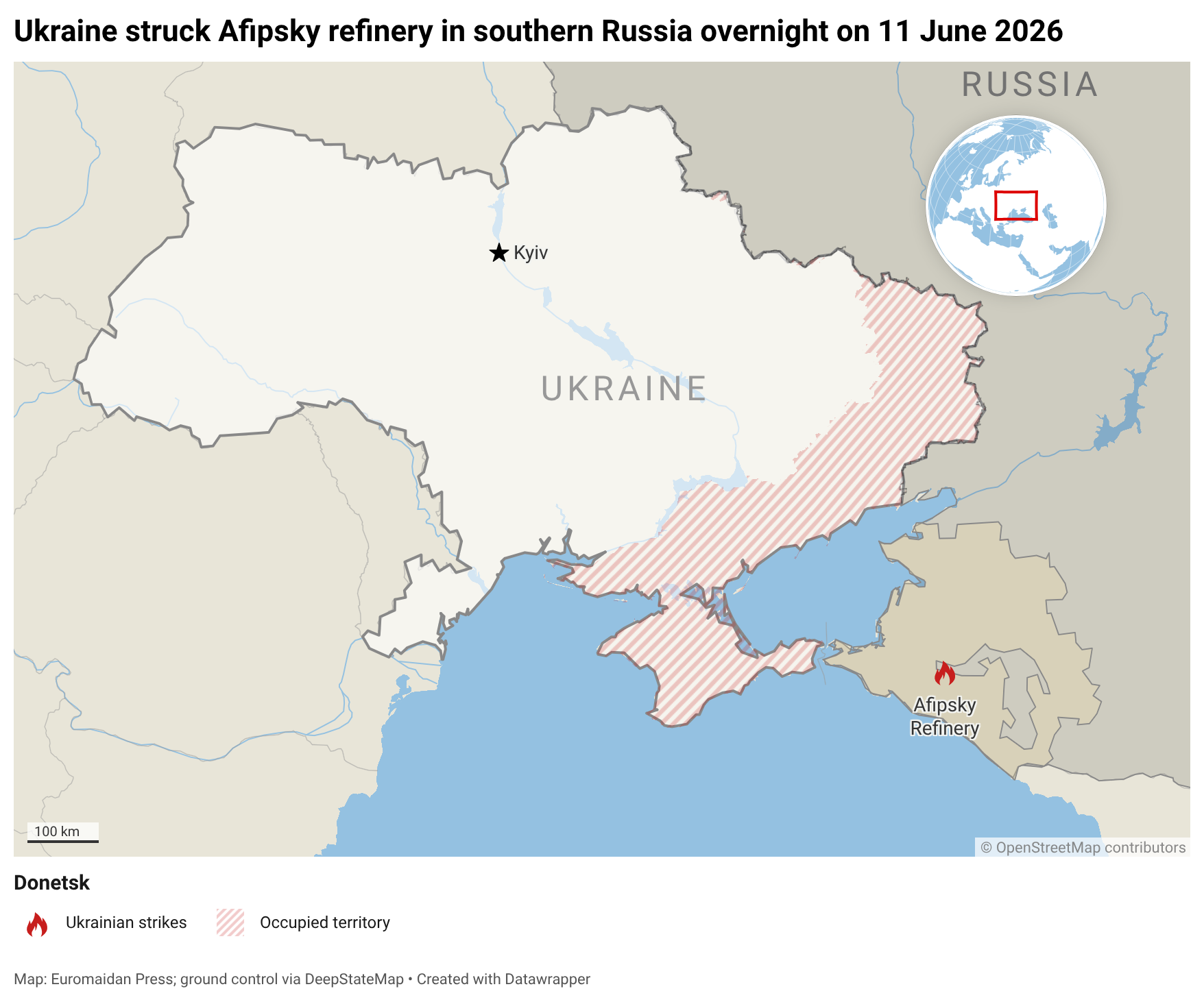
Ukrainian drones struck the Afipsky oil refinery in Russia's Krasnodar Krai overnight on 11 June, sparking a fire later extinguished, according to the Krasnodar Krai operational headquarters. The southern Russian plant, repeatedly targeted by Ukrainian strikes, supplies fuel to the Russian military.

Amid the ongoing Russo-Ukrainian war, the Russian oil industry has been under sustained pressure from Ukrainian deep strikes, with gasoline rationing currently spreading across multiple regions and occupied territories. Output at Russian refineries has been falling on Rosstat's own index as repeated hits keep facilities offline.

A blaze at one of southern Russia's largest refineries

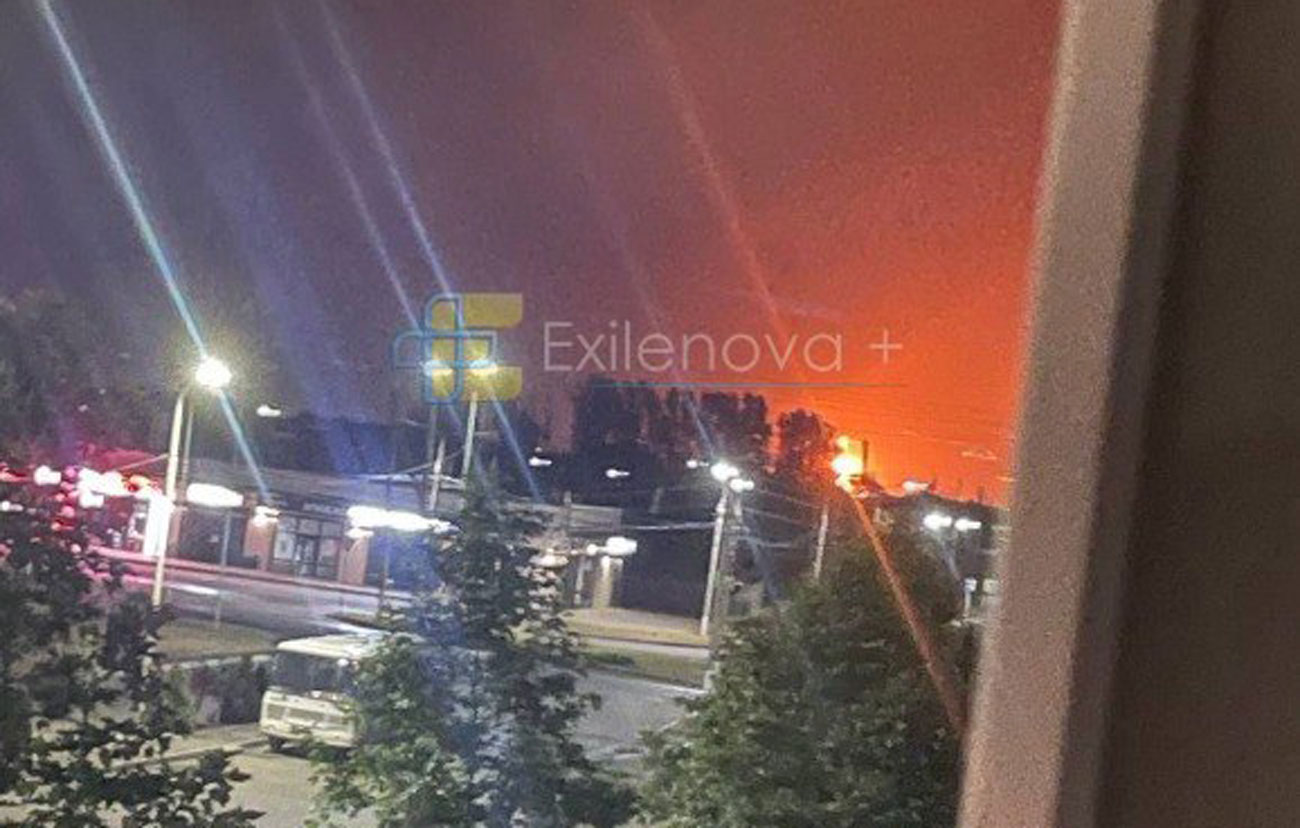
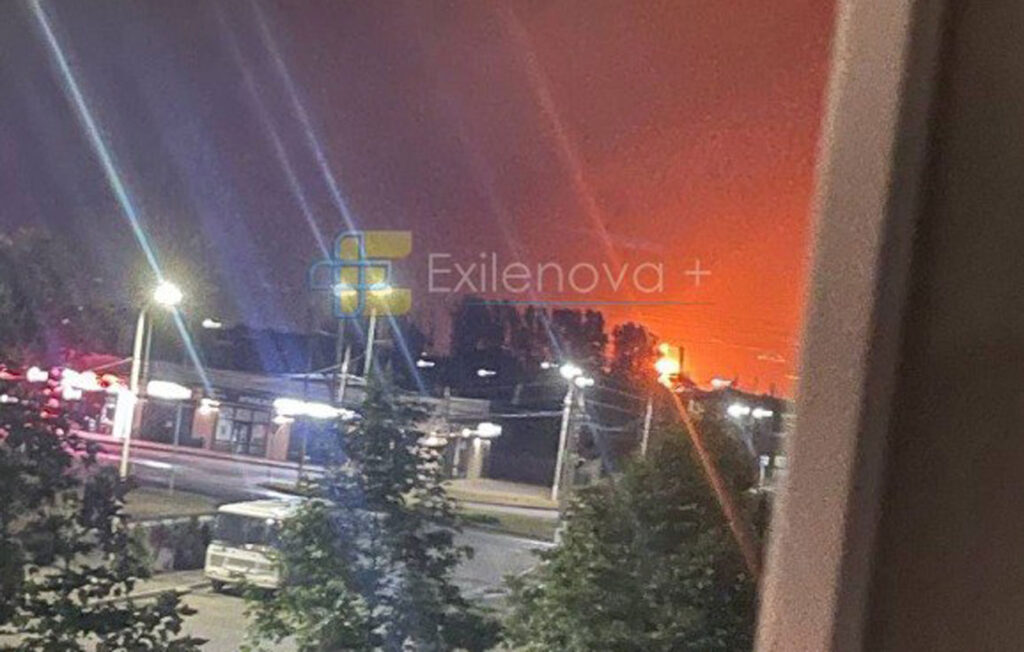
The Ukrainian Telegram channel Exilenova+ posted footage from local witnesses showing air defense fire and a blaze. The attack started after midnight, with residents reporting drone overflights and explosions at intervals of a few minutes. 

Krasnodar Krai authorities claimed drone "debris" fell in the village of Afipsky and set the refinery on fire — Moscow's standard framing for Ukrainian strikes on Russian energy targets. The fire was out by 07:32 Moscow time, the operational headquarters later stated. Russian authorities reported no casualties at the plant itself.

The Afipsky plant is one of southern Russia's largest oil-processing facilities, with a capacity of over 6 million tons of crude a year. It produces gasoline, diesel, gas oil, vacuum gas oil, fuel oil, sulfur, and gas condensate distillates. The facility supplies fuel to the Russian army. Ukraine's General Staff has assessed that the refinery processes about 2.1% of Russia's total oil refining.

The plant runs two primary oil distillation units with capacities of 9,786 and 8,829 tons per day. It is export-oriented and does not currently produce gasoline or diesel for Russia's domestic market. Combined throughput at the Afipsky plant and the affiliated Krasnodar refinery reached 7.2 million tons in 2024. Another 3 million tons were processed in the first half of 2025.

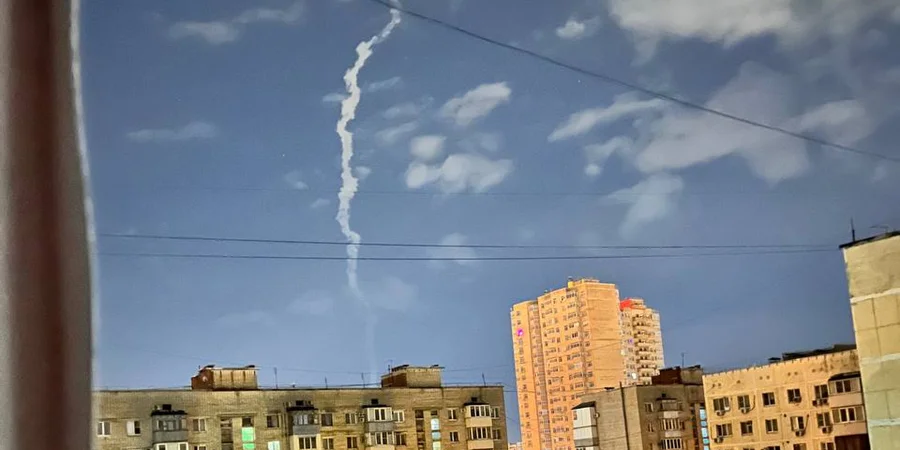
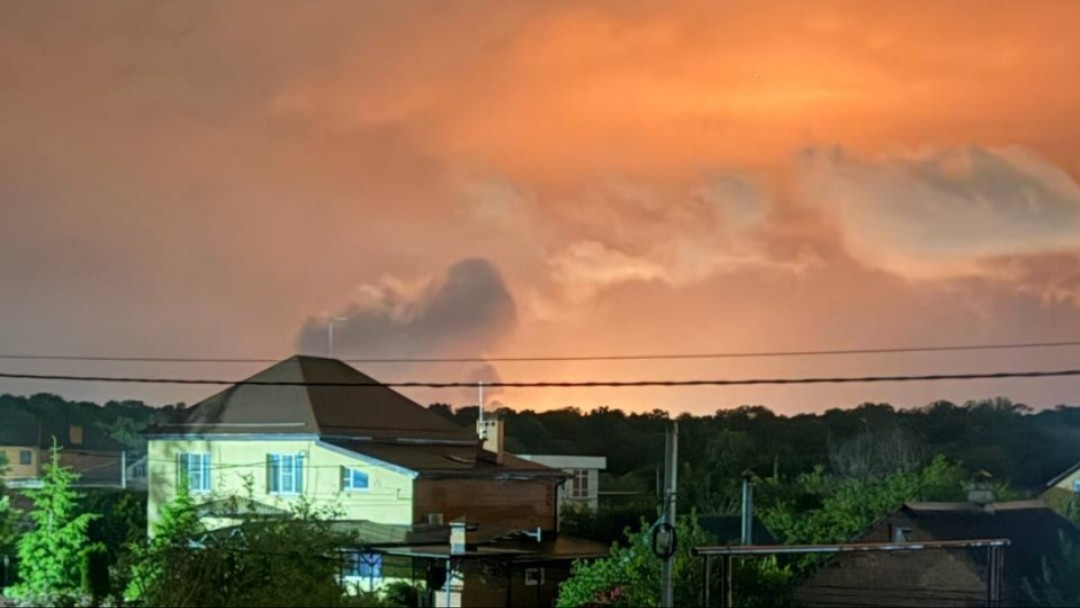
afipsky oil refinery burns again ukrainian drones return krasnodar krai · post smoke trail over amid drone attack russia 11 2026 краснодар у росії атакували дрони вночі червня року exilenova+
Smoke trail over Krasnodar amid a Ukrainian drone attack, Russia, 11 June 2026. Photo: Exilenova+ Telegram channel

Third strike on Afipsky in 2026 amid wider drone campaign

Russia's Defense Ministry claimed its air defenses intercepted and destroyed 330 Ukrainian drones over Russian territory overnight, the Moscow Times reported. According to the ministry, drones were spotted over Bryansk, Kursk, Belgorod, Oryol, Smolensk, Kaluga, Tula, Tver, Vladimir, and Moscow oblasts, as well as Krasnodar Krai and occupied Crimea. Russian aviation regulator Rosaviatsia restricted operations at airports in Tambov, Krasnodar, Sochi, Gelendzhik, and Zhukovsky outside Moscow.

afipsky oil refinery burns again ukrainian drones return krasnodar krai · post smoke plume after drone strike russia 11 2026 пожежа на афіпському нпз в рф червня telegram-канал exilenova+ ukraine
Smoke plume after a Ukrainian drone strike on the Afipsky oil refinery, Krasnodar Krai, Russia, 11 June 2026. Photo: Exilenova+ Telegram channel

The 11 June raid was the third attack on the Afipsky refinery this year, following hits on 21 January and 14 March. During the March hit, drones damaged the AT-22/4 primary oil processing unit at Afipsky — the plant's refining starting point. Satellite imagery had previously confirmed structural damage from a November 2025 drone attack.

  •  

“Fourth house. Blue doors”: Four years ago three Ukrainians changed global warfare forever (VIDEO)

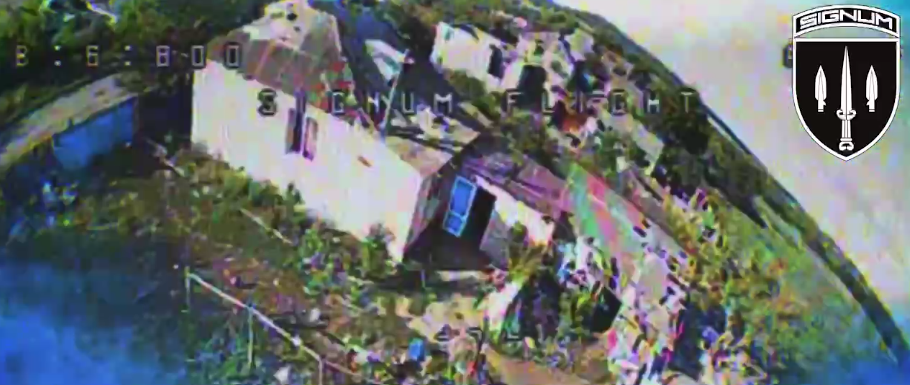
Screenshot

On 10 June 2022, the world's first successful FPV drone combat strike was carried out by Ukrainian Armed Forces fighters from the SIGNUM battalion. The three operators with call signs "Turyst," "Shvaiger," and "Bagdad" fired the strike against a Russian target, an advisor to the Defense Minister, Serhii Sterneko, recalls

The footage of the strike has become a defining artifact of the Russo-Ukrainian war. Four years later, Ukraine's Unmanned Systems Forces (SBS) has struck nearly $40 billion worth of Russian targets and grown into a full branch of the Armed Forces with its own doctrine and eleven combat units.

The 10 June 2022 FPV strike is recognized as the moment that changed not only the Russo-Ukrainian war but the broader rules of armed conflict. The combat application of a commercial-grade quadcopter against a moving Russian target opened a new category of warfare that has since been replicated by militaries worldwide.

Ukraine remains the operational pioneer in this category, with the SBS now leading the Logistics Lockdown program targeting Russian rear-area logistics, deploying $113 million in mid-strike drones.

"Fourth house. Blue doors" 

The footage of the 10 June 2022 strike captures Ukrainian SIGNUM battalion fighters operating an FPV drone against a Russian target on the frontline.

The radio call "Fourth house. Blue doors." — used by the operators to identify the target — has become one of the most recognizable phrases from the early war.

The day that changed military doctrine worldwide: On 10 June 2022, Ukraine carried out the world's first FPV drone combat mission

As a result, Ukraine established Unmanned Systems Forces, helping save thousands of Ukrainian lives
📹Sternenko pic.twitter.com/kbk5KphZBG

— Euromaidan Press (@EuromaidanPress) June 11, 2026

From battlefield improvisation to separate branch of armed forces

The 10 June 2022 strike was an act of battlefield improvisation. Ukrainian forces were using commercial drone technology adapted for combat, with no formal doctrine, no procurement pipeline, and no command structure for FPV operations.

Three years later, on 11 June 2025, Ukraine formally established the Unmanned Systems Forces (SBS) as a dedicated grouping within the Armed Forces.

SBS now has eleven combat units and its own military doctrine. President Volodymyr Zelenskyy on 10 June 2026 signed a decree establishing the Day of Unmanned Systems Forces as an annual commemorative day, to be observed each 11 June.

Robert "Madiar" Brovdi: from volunteer to branch commander

The SBS commander is Major Robert Brovdi with a call sign "Madiar". Brovdi is a Hero of Ukraine, the founder of the "Madiar's Birds" unit, and one of the originators and leading practitioners of innovations in unmanned systems for combat applications.

He traveled the path from volunteer to commander of a separate branch of the Armed Forces. The trajectory is consistent with the SBS's broader institutional history, which began with battlefield improvisation in places like the 10 June 2022 SIGNUM strike, and has developed into a formal military structure with doctrine, procurement, and command.

The footage of the strike has become a defining artifact of the Russo-Ukrainian war. Four years later, Ukraine's Unmanned Systems Forces (SBS) has struck nearly $40 billion worth of Russian targets and grown into a full branch of the Armed Forces with its own doctrine and eleven combat units.
  •  

Ukraine created drone army one year ago. It already destroyed $40 billion worth in Russian targets

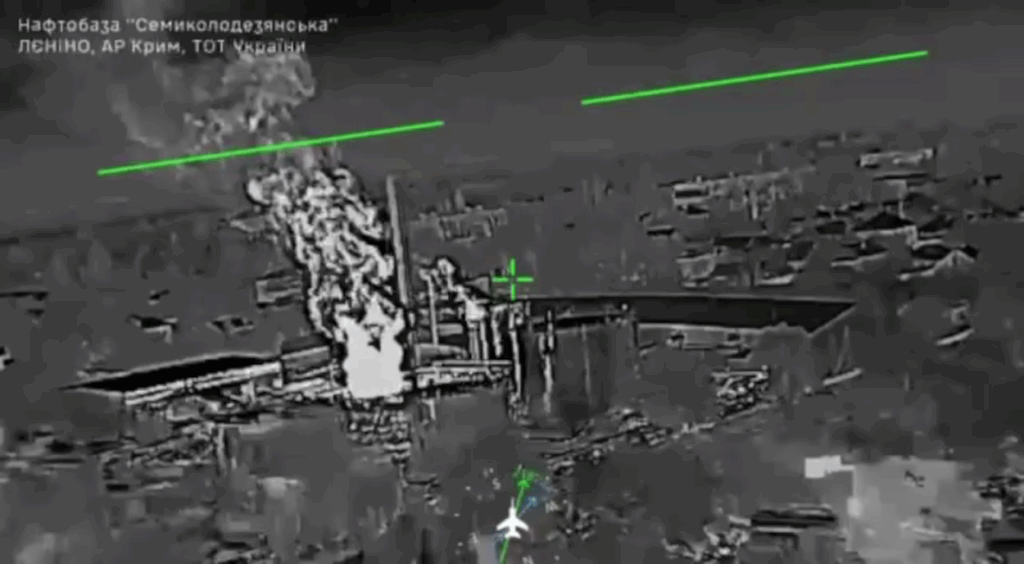
Semikolodezyanska oil depot in Yedi-Quyu (Lenine), occupied Crimea, amid a Ukrainian drone attack. Screenshot from video: Ukraine's Special Operations Forces

Ukraine's Unmanned Systems Forces (SBS) have struck Russian targets worth nearly $40 billion in the year since the branch's creation, Volodymyr Zelenskyy said. On 10 June, the Ukrainian president signed a decree establishing the Day of Unmanned Systems Forces (SBS Day).

The $40 billion cumulative damage figure Zelenskyy cited represents a 57% increase over the $25.5 billion in cumulative Russian losses that Commander-in-Chief Oleksandr Syrskyi reported in April 2026.

The SBS Day decree institutionalizes the unmanned forces as a permanent feature of Ukraine's military doctrine, alongside the army, navy, and air force.

What Zelenskyy said about SBS's achievements

"Only a year since the creation of the SBS group, Russian targets at various levels worth nearly $40 billion have already been hit," Zelenskyy said in his evening address.

He added that SBS is really a model for many other armies, and "these months we are especially grateful for middlestrikes."

"Russian military logistics across the entire depth of the temporarily occupied territory is now accessible to Ukrainian drones. The Russian border zone also experiences our impact," he stated.

The president added that Russia already feels the effect of these strikes, and Ukraine will continue to scale them.

"The most important thing is that these are different types of strikes, and each one adds to our ability to save lives," the Ukrainian president added.

What does middlestrike mean operationally? 

The middlestrike concept Zelenskyy invoked refers to Ukrainian drone strikes against Russian military logistics in the depth of occupied territory and across the Russian border zone. The depth zone covers Donetsk, Luhansk, Crimea, and parts of Zaporizhzhia and Kherson Oblasts. The Russian border zone reaches Belgorod and Kursk. Middlestrikes sit between the very-long-range deep strikes against strategic Russian infrastructure, such as the Volgograd refineries, and the tactical frontline FPV operations. The SBS is led by Brigadier General Robert Brovdi, call sign "Madiar".

  •  

Kostiantynivka is one of Ukraine’s “Fortress Belt cities” Russia demands. It may fall by end of summer 2026, says observer

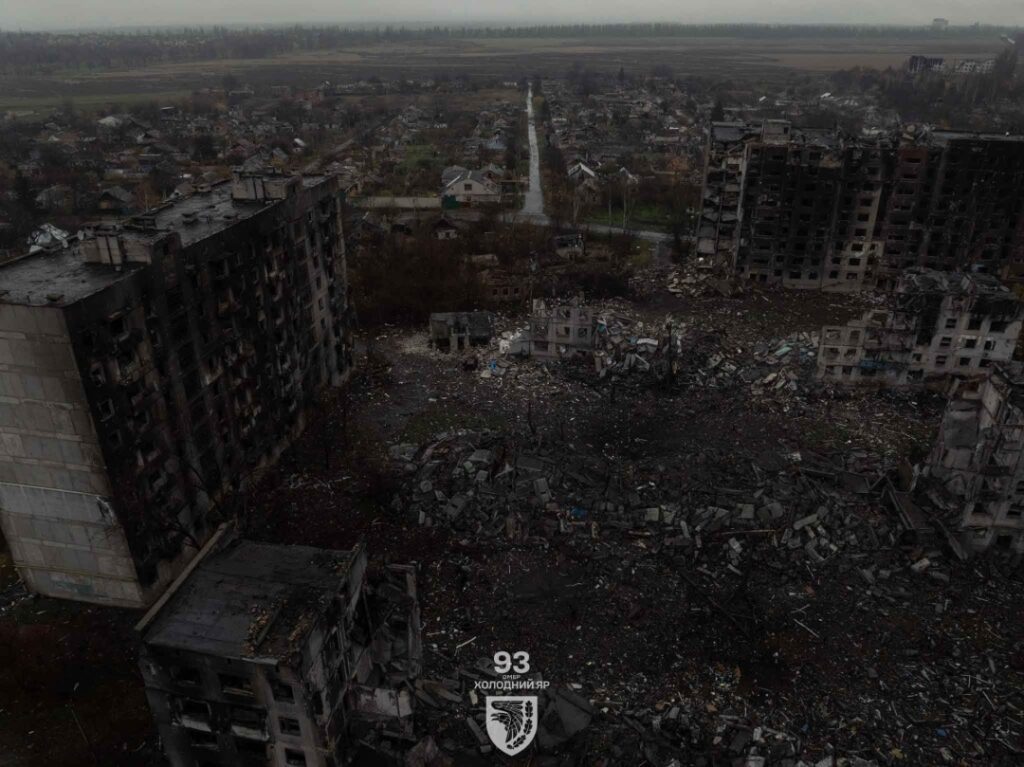
The city of Kostiantynivka after Russia's advances. Source: The 93rd Separate Mechanized Brigade "Kholodnyi Yar"

Russian forces may capture Kostiantynivka in Donetsk Oblast by the end of summer 2026, Ukrainian military observer Denys Popovych said on Radio NV. The warning comes as DeepState analysts have documented the Russian conversion of Kostiantynivka into ruins, and as Russian forces continue to consolidate in Pokrovsk and Myrnohrad.

Kostiantynivka is one of the "Fortress Belt cities" that Russia has demanded as part of its territorial conditions to take the entire Donetsk Oblast in the peace negotiations, even as it continues striking Ukrainian cities.

Popovych says Russia could capture the city despite what he himself characterizes as the broader operational failure of Russia's spring-summer offensive.

Russian success would come even as Ukraine's deep-strike envelope reaches 1,800 km into Russia and the "Logistics Lockdown" campaign degrades Russian rear-area infrastructure. 

Pokrovsk tactic that may be repeated

"We are now talking about the general failure of the spring-summer phase of Russian army offensive actions in the east and the south. But the prize in the form of Kostiantynivka they may take during this summer," Popovych said.

He added that Russian occupiers in Kostiantynivka are attempting to apply the same tactic they used in Pokrovsk: entrenching on the outskirts, then progressively infiltrating into the city itself by occupying multi-story buildings.

"Those enemy infiltration groups are being destroyed. But the question is whether we have enough resources to destroy every group," he continued. 

According to the expert, if one of them holds, settles in, and Ukraine doesn't notice it, then that chain, that path, will be trampled by the Russians.

"They will spread further through the city. This is the standard scenario the Russians have used during those cities that held defense for a long time," Popovych believes.

Russian drone crews may take same actions used in Pokrovsk, but now in Kostiantynivka

After the seizure of Pokrovsk and Myrnohrad per DeepState's assessment, Russian forces continue to build up forces inside them, particularly drone crews who have taken control of urban airspace. 

"The enemy is establishing itself in the cities and currently maintains the active task of advancing into the depths of our defense," DeepState noted in its analysis.

The combination of Russian drone control of urban airspace in already-captured cities and the slow-infiltration approach for the next target city is what makes Kostiantynivka's risk, as Popovych described, not hypothetical. Russia has demonstrated that the tactic produces results, slowly, against cities that hold out for extended periods.

  •  

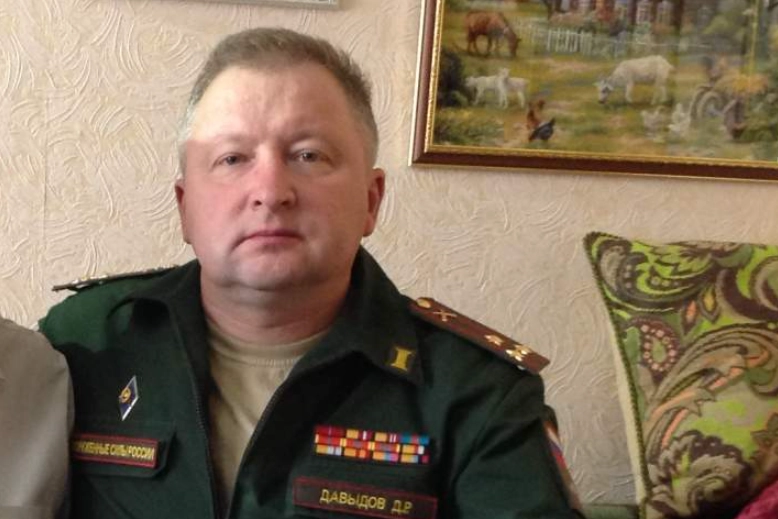
Car bomb kills Russian general who armed Russia’s war on Ukraine—fourth top officer assassinated near Moscow since late 2024

GRAU

The car exploded around 5:30 am on 9 June as Davydov pulled the BMW X3 out of its parking spot on Koldunova Street in Balashikha's Aviatorov microdistrict. Bystanders pulled him from the wreckage still alive, but he died at the scene before medical teams arrived, The Insider said. The outlet published the SUV's license plate and the apartment address on Kozhedub Street, several hundred meters from the blast, to confirm the identification.

Davydov, 57, had headed the missile and artillery ammunition supply directorate within the Main Missile and Artillery Directorate (GRAU) of Russia's Defense Ministry since 2017. Ukraine's Myrotvorets database lists him as a participant in planning and organizing Russia's full-scale invasion on 24 February 2022, with operational responsibility for keeping Russian forces supplied with shells and missiles. Russia's Investigative Committee confirmed the death of one man in the blast and opened a criminal case but did not name the victim.

The improvised explosive device carried the force of up to 500 grams of TNT and was attached to the underside of the vehicle, the Russian business daily Kommersant reported. Conflict Intelligence Team founder Ruslan Leviev reviewed the footage and concluded the bomb had been hidden in a separate parked vehicle and detonated remotely as the BMW drew alongside. The Insider attributed the operation to Ukraine's Security Service (SBU) without citing further sources, and Ukrainian officials had not commented as of late Tuesday.

A second device, then a third

Hours after the Balashikha blast, a Zeekr electric vehicle caught fire in a parking lot at the intersection of Butlerova and Vvedensky streets in Moscow's Konkovo district. Bomb technicians found a device under the car and neutralized it with a controlled detonation. Around 6 p.m., Moscow police evacuated the Nebo shopping center in Solntsevo after another suspicious object was discovered beneath a parked vehicle. Russian authorities ordered mass under-vehicle inspections across the capital region.

The pattern of four

Tuesday's killing fits a deepening pattern: the fourth senior Russian officer assassinated in the rear since late 2024. Lt. Gen. Igor Kirillov, head of Russia's chemical defense troops, was killed by a scooter bomb outside his Moscow apartment in December 2024 in an operation the SBU claimed openly. Lt. Gen. Yaroslav Moskalik, deputy chief of the General Staff's Main Operational Directorate, died in April 2025 in a car bombing 350 meters from Tuesday's blast site, also in the Aviatorov microdistrict; Russia's FSB later sentenced Ignat Kuzin, who said he worked for the SBU, to life in prison. Lt. Gen. Fanil Sarvarov, who oversaw the General Staff's operational training, was killed by a bomb planted under his Kia Sorento in southern Moscow in December 2025.

Background

The slain officer grew up in the closed nuclear city of Penza-19, now called Zarechny, where his father worked at the Start production association, a facility that built nuclear warheads until 2002. He held patents in rocket-engine design and artillery ammunition. In 2009 he led the Central Testing Technical Bureau attached to the 51st GRAU arsenal in the Vladimir region, and bought the BMW X3 in 2024 from a businessman in that same area, the Russian Telegram channel VChK-OGPU reported. The Kremlin, the Defense Ministry, and the SBU had not commented publicly as of late Tuesday.

  •  

Chonhar bridge halted twice, now Arabat Spit crossing hit — Kherson’s occupied south loses two routes

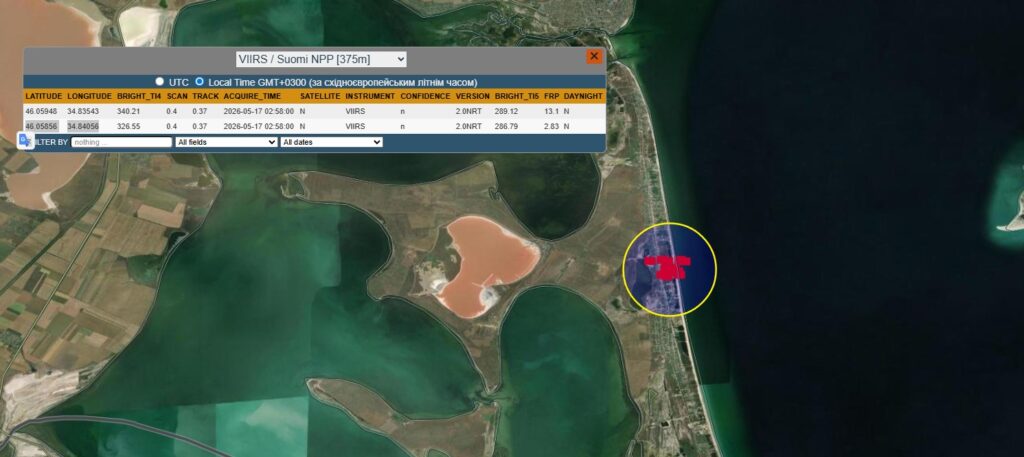
russian air-defense crews now hunted ukraine bolts rocket pods its long-range drones · post nasa firms satellite detection fire arabat spit kherson oblast after ukrainian drone strike 0258 17 2026

Ukraine attempted a missile strike on a bridge connecting Henichesk to the Arabat Spit early on 10 June 2026, according to Vladimir Saldo, Russia's installed head of the occupied part of Kherson Oblast, who posted the claim on social media.

The strike is the latest in a series of Ukrainian attacks targeting road links between Russian-occupied Kherson Oblast and Crimea. The Chonhar bridge—the main overland route—was first struck on 7 June, after which traffic resumed in reversible mode; a second Ukrainian drone strike on 9 June halted movement again. Saldo had advised drivers to use alternative routes through Armyansk and Perekop.

Traffic across the Henichesk–Arabat Spit bridge has been temporarily closed, Saldo said, with emergency services on site establishing the circumstances.

Power outages across eight districts

In the same post, Saldo reported that eight municipalities were left without electricity following a separate overnight Ukrainian drone attack: Henichesk, Novotroitske, Chaplynka, Kalanchak, Ivanivka, Hornostaivka, Kakhovka, and Nova Kakhovka. Utility and emergency crews were working to restore power, he said.

Broader logistics pressure

Russian pro-war bloggers have in recent weeks reported an intensified Ukrainian drone campaign against military transport in southern Ukraine, Hromadske reports. On 30 May, Russian-occupied Crimea imposed limits on sales of A-95 petrol, citing drone strikes on Russian oil refineries; occupied Luhansk Oblast followed with similar restrictions shortly after.

  •  

Fire reported at Kuibyshev oil refinery in Russia’s Samara after drone strike

title · post fires raging kuybyshevsky oil refinery samara russia 10 2026 fires-rage-at-samara-kuybyshevsky-oil-refinery ukraine news ukrainian reports

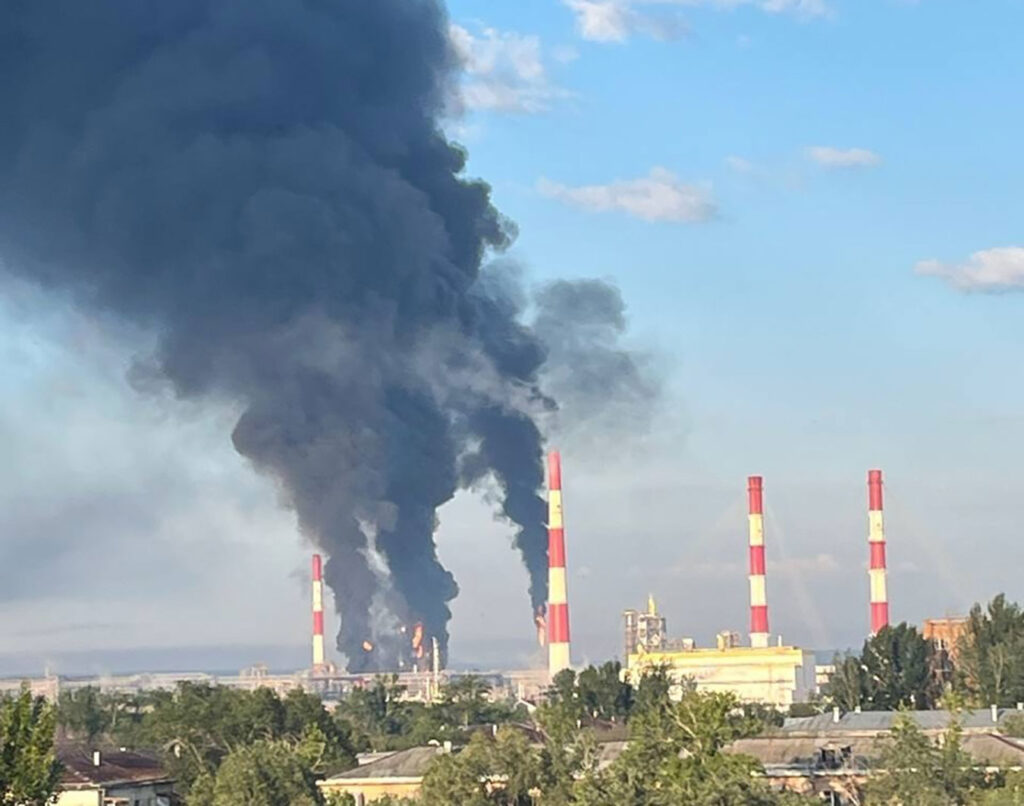
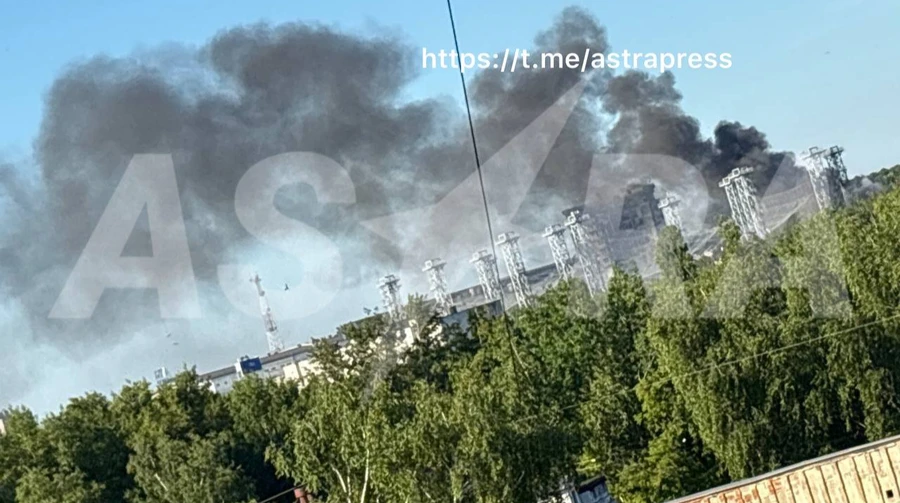
A fire broke out at the Kuibyshev oil refinery in Samara, Russia, following a drone strike on 10 June, according to OSINT analysis by Astra and Russian Telegram channels.

The Kuibyshev refinery is one of the largest oil industry facilities in the region and is part of Rosneft. The 10 June strike is the third reported attack on the plant since August 2025.

What happened overnight

Residents of Samara Oblast reported explosions during the night of 9–10 June. The regional governor wrote of a missile threat in the oblast.

Astra said its analysis of eyewitness footage established that the Kuibyshev refinery in Samara was struck and caught fire.

The same refinery halted operations in August 2025 following a drone attack, Russian social media channels reported. It was struck again in January 2026.

  •  

Ukraine reportedly strikes Russian defense plant ‘Progress’ in Cheboksary with Flamingo missiles

Russia

A fire broke out at what is reportedly the Progress defense plant in Cheboksary, Russia, following a missile strike on 10 June, the governor of Russia's Chuvash Republic said, according to Russian telgram channel Astra.

The incident marks the second reported strike on the same facility in under a week — on 5 May, Ukrainian FP-5 Flamingo missiles were reported to have struck the VNІIR-Progress defense enterprise in the same city, with President Volodymyr Zelenskyy confirming the attack.

Oleg Nikolaev, governor of Chuvash Republic, confirmed on Telegram that Cheboksary had come under missile attack. He did not specify casualties or damage.

What the strike targeted

Photos and video of a fire following the strike in Cheboksary were published by Russian social media channels, including footage of a missile passing over the city. According to OSINT analysis by Astra, the targeted facility is the VNIIR-Progress defense enterprise.

The plant manufactures Kometa antennas — systems designed to protect drones from electronic warfare — as well as other components used in Russian Shahed drones and Iskander-M and Kalibr missiles.

Astra analysts also noted that the VNIIR-Progress premises had been fully covered with camouflage netting following the previous strike.

The weapon used

Monitoring channel Exilenova+ identified the missiles used as Ukrainian FP-5 Flamingo cruise missiles. Denis Shtilerman, founder of the Ukrainian company FirePoint, which produces the Flamingo, published a photo of a launch on X on 10 June, without providing further details.

Previous strike

The 5 May attack on the same plant caused a large-scale fire after a missile struck the facade of one of the factory buildings, according to OSINT analysts. Zelensky confirmed the use of Flamingo missiles in that incident.

  •  

“Russia spits in our faces” and the UN pretends it’s “just rain” – UN envoy reports May deadliest month for Ukrainian civilians since 2022

Andrii Melnyk, Permanent Representative of Ukraine to the UN. Photo: Suspilne

May was the deadliest month for civilians in Ukraine since April 2022, according to the United Nations, which presented updated casualty data to the UN Security Council during an emergency meeting requested by Kyiv, Suspilne reported.

Latvian UN envoy Sanita Pavļuta-Deslandes said preliminary figures show a sharp rise in civilian harm, warning that the final statistics for May are expected to be even higher. 

She said attacks during the month included strikes on civilian gatherings, including a funeral in Sumy, which she cited as an example of Russia targeting “so-called legitimate objectives,” according to Suspilne.

She also noted that in the first quarter of 2026 alone, 190 attacks were recorded on medical facilities, including maternity hospitals, while more than 200 educational institutions were damaged or destroyed. The number of injured children increased by 49%, according to UN data cited at the session.

The Security Council meeting came on June 8 following a wave of Russian strikes across Ukraine.

Ukraine accuses Russia of systematic deception at UN

Ukraine’s permanent representative to the UN, Andrii Melnyk, used the session to sharply criticize Russia’s role at the United Nations, arguing that Moscow continues to deny responsibility while undermining international reporting on the war.

“Russia spits in our faces with lies, and we pretend it is just rain,” Melnyk said during the meeting, according to Suspilne.

He suggested that Russia should consider leaving the UN if it rejects its own obligations under international law and dismisses UN investigative findings.

Melnyk also called for Russia to be excluded from UN peacekeeping operations, pointing to its inclusion in UN listings related to sexual violence in conflict and repeated findings on violations involving children and armed conflict.

He urged member states to take action on these findings, saying Russia’s participation in UN structures undermines the credibility of the system itself.

The meeting highlighted growing tensions inside the Security Council as Russia continues to face accusations of escalating strikes on civilian infrastructure while maintaining its role as a permanent member of the body.

  •  

EU’s 21st sanctions package would ban Russia’s soldiers from European soil

EU High Representative for Foreign Affairs and Security Policy Kaja Kallas delivers press remarks following the Foreign Affairs Council on 20 October 2025

The European Union has proposed a 21st sanctions package against Russia that includes a visa ban on current and former Russian military personnel, as Brussels expands pressure on individuals and entities linked to Moscow’s war effort in Ukraine.

EU foreign policy chief Kaja Kallas said the package is part of a broader push to increase economic and political pressure on Russia.

“We are depriving Russia of the means to fund its war,” Kallas wrote on X.

Package includes over 170 proposed sanctions listings across sectors

The sanctions package will target Russia’s financial, energy, and industrial sectors, with more than 170 proposed listings.

These include banks, weapons manufacturers, oil traders, refineries, and crypto-related services, as well as entities in third countries accused of helping Moscow bypass existing restrictions.

Energy measures include a temporary freeze of the Russian oil price cap mechanism, alongside new restrictions on LNG transactions and additional action against Russia’s shadow fleet, with 30 more vessels proposed for designation.

Officials said the aim is to further reduce Russia’s export revenues and disrupt maritime logistics networks used to move sanctioned energy products.

Brick by brick, we are collapsing the foundations of Russia's war economy.

Today, we are presenting our proposals for a 21st sanctions package against Russia.

This includes a temporary freeze of the Russian oil price cap and designations of institutions used by Moscow to…

— Kaja Kallas (@kajakallas) June 9, 2026

Measures expand to export controls and financial restrictions

The package also expands export controls on materials used in weapons production, including metals, alloys, and high-performance inputs, with companies in countries such as China, Türkiye, Kazakhstan, the UAE, and India included in the proposals.

Financial restrictions remain a central pillar, with expanded sanctions planned against banks and crypto platforms linked to sanctions evasion and war financing.

EU visa ban on Russian military personnel

The sanctions package includes a “comprehensive” visa ban proposal that would prohibit entry into the EU for current and former members of Russia’s armed forces, as well as “proxy groups,” marking an expansion of sanctions beyond economic measures to individuals linked to military operations.

“Europe’s door should not be open to Russia’s (ex-)combatants,” Kallas wrote.

Our sanctions are working.

They are weakening the economic foundations of Russia’s war effort.

Today we double down.

With a 21st package.

Covering energy, banks & crypto, trade including fisheries and visa for Russian soldiers ↓ https://t.co/fTIkATOSfN

— Ursula von der Leyen (@vonderleyen) June 9, 2026

Sanctions already cost Russia up to $1.5 trillion, EU says

The same day, Kallas told journalists that existing sanctions continue to intensify pressure on Moscow’s economy. Kallas noted that Western sanctions have already cost Russia an estimated $1.2 to $1.5 trillion, adding that “brick by brick, we are collapsing the foundations of Russia’s war economy.”

She said the aim remains to increase costs for Moscow across multiple sectors while maintaining unity among EU member states.

The package requires unanimous approval from EU member states before it can take effect.

  •  

Ukraine is droning Russian ships. The goal: to create supply bottlenecks on land.

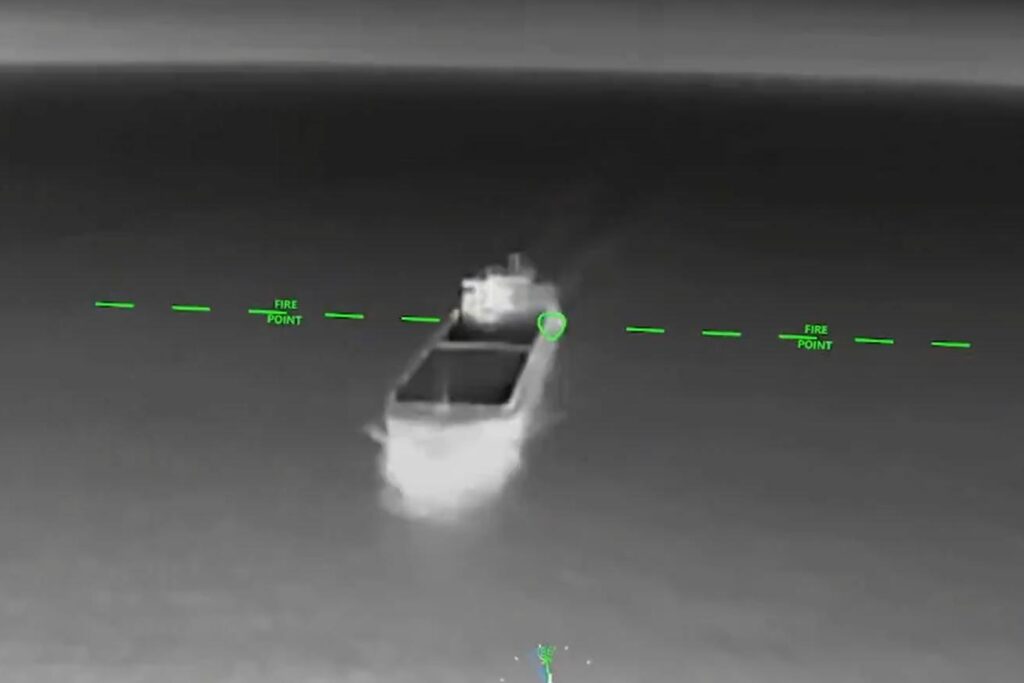
An FP-1 barrels toward a Russian ship.

  • Ukraine's drone campaign targeting Russian logistics is moving to sea
  • Ships carry supplies between Russia and occupied southern Ukraine
  • Striking the ships can force more supplies to move over land in vulnerable trucks

One-way attack drones from Ukraine's Unmanned Systems Forces struck five Russian cargo ships on the Sea of Azov on 5 June.

The strikes, which left at least one ship a burned-out hulk, are a kind of corollary to Ukraine's escalating campaign of middle-distance strikes on Russian supply lines on land in occupied territories. Aiming to weaken Russian regiments before they can attack across the disputed gray zone, Kyiv's drone units aren't only hitting trucks and vans on land—they're also hitting ships at sea.

"There's a method to the madness here," Ukraine Control Map explained. "Take out the ships, force Russia to use more trucks, more logistic bottlenecks." Then hammer the bottlenecks with drones.

The ultimate goal is to make it more difficult for the Kremlin to resupply and reinforce its 700,000 troops in occupied Ukraine. It's cheaper and easier to defeat an attack before it even begins by starving the attacking troops of food, fuel, batteries, ammunition and other vital supplies.

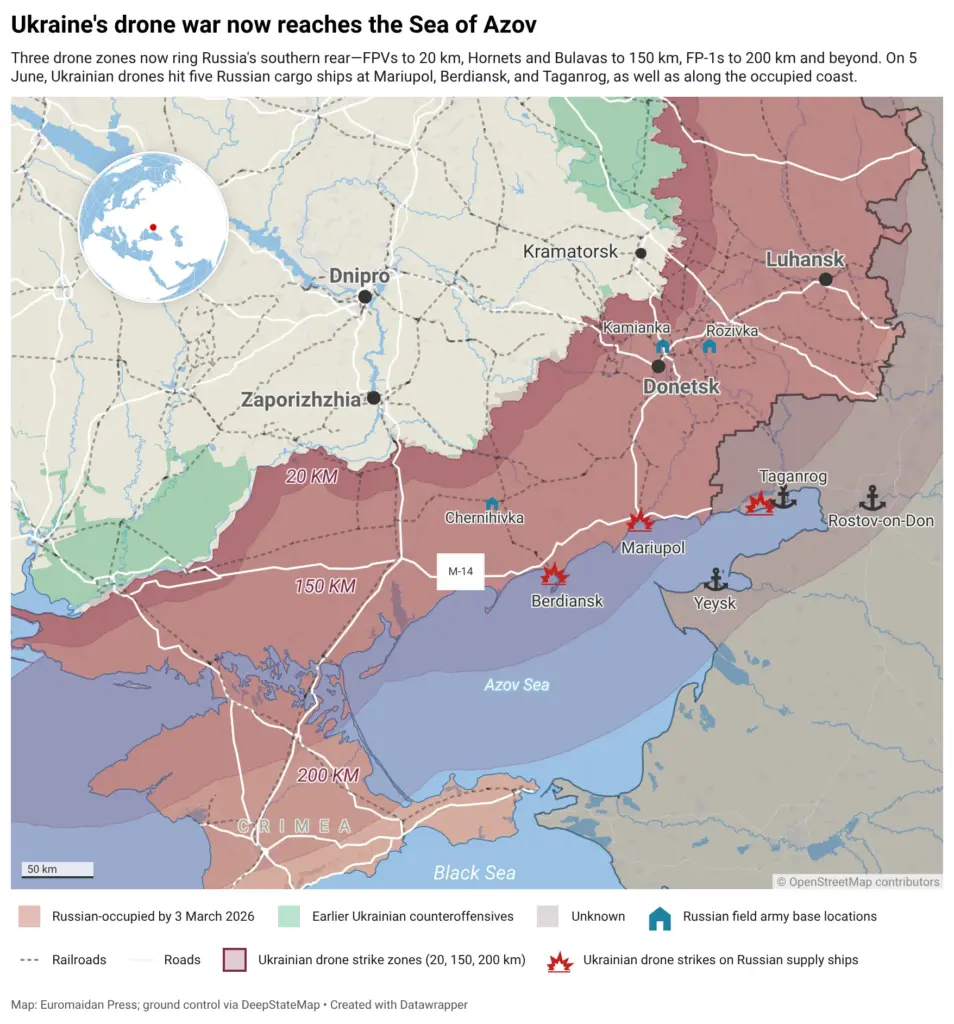
The ships the USF hit with Fire Point FP-1 drones on 5 June were spread out across a wide area. They were in occupied Mariupol and Berdiansk and along the coast of occupied Ukraine — the same Berdiansk port where Ukrainian drones struck a Russian munitions cargo ship on consecutive nights at the start of June.

What they had in common was their disguise. Civilian-owned but allegedly illegally working on behalf of sanctioned Russian entities, the ships sail without obvious markings or easily tracked radio transponders. There could be scores of such ships plying the Black Sea on Russia's behalf every day.

Two of the ships hit on 5 June, the dry cargo vessels Natra and Zirkon, were inbound from Türkiye to Rostov-on-Don when Ukrainian drones struck them in Taganrog Bay—empty, heading to load grain at a port Western governments and Ukraine identify as a transit hub for grain looted from occupied Ukrainian territory. Five Azerbaijani crew members on private contracts were killed and three wounded, Azerbaijan's foreign ministry said. Brovdi didn't address the deaths.

Telling apart a ship hauling Russian military fuel from a ship empty and heading to pick up looted grain is the kind of distinction that's hard to make from a drone's-eye view.

Ships that can haul thousands of tons of supplies every trip are much more efficient than trucks that can haul just a few tons apiece. Cargo ships can't deliver supplies to inland forces, of course, but they can move cargo between ports in southern Russia and ports in occupied Ukraine, bringing that cargo as close as possible to the gray zone before trucks must take over the shipping effort.

ukraine's drones now strike ports in occupied Ukraine
Map: Euromaidan Press

A thick-skinned ship is a tougher target than a thin-skinned truck, of course. But Ukraine's FP-1 drones carry a 100-kg blast-fragmentation warhead, with a TNT main charge boosted by the more powerful OKFOL explosive. The combination throws fragments outward and starts fires inside the target—the same mechanism that left the corvette Boikiy burning for hours at Kronstadt on 3 June.

🚢🔥 The destroyed cargo ship CIRCON (IMO 8887519), targeted by Ukraine’s Unmanned Systems Forces in the Sea of Azov several days ago. https://t.co/0Xpc3K9XXf pic.twitter.com/KI1PCzsjKf

— Special Kherson Cat 🐈🇺🇦 (@bayraktar_1love) June 8, 2026

Sitting duck trucks

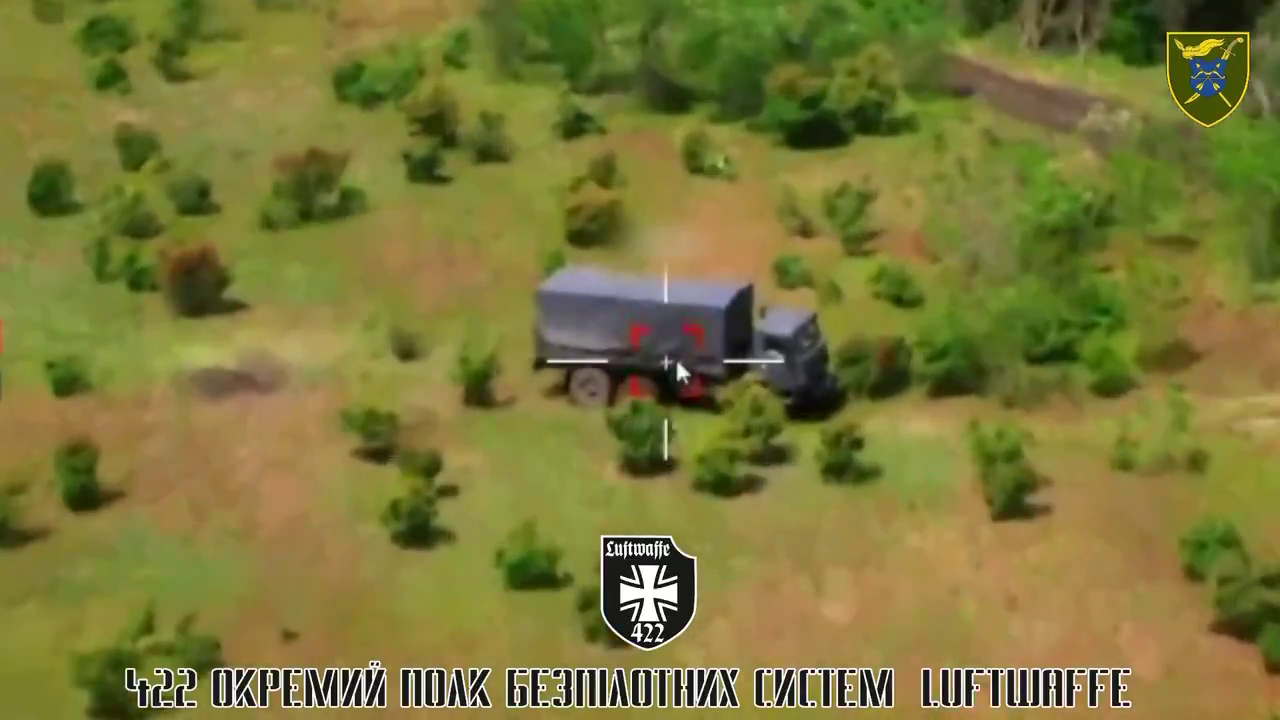
Russia's thousands of military supply trucks are already squarely in the crosshairs of Ukrainian drone units. Since launching their coordinated counterlogistics campaign this spring, the Ukrainians have increased their monthly truck strikes nearly tenfold, from around 60 per month to nearly 500, as per the Ukrainian general staff.

But a comprehensive assault on Russian logistics requires raids on sea traffic, as well. That effort may have begun in earnest on 5 June. "Cargo ships and tankers with their names painted over by Black Sea looters and their transponders switched off, used for the quiet theft of Ukrainian grain and the transport of military cargo and fuel, can no longer count on either long service lives or uninterrupted schedules," the 414th Unmanned Strike Aviation Brigade crowed.

If they can disable enough ships, the Ukrainian drone teams may compel Russian logisticians to shift more supplies by land. To reach Russian regiments in southern and eastern Ukraine, those supplies normally travel east to west along the M-14 highway that runs close and parallel to the Black Sea coast.

That highway and connecting roads have become a kill zone for Russian trucks as more FP-1, FP-2, Hornet and Bulava drones take to the sky, increasingly unbothered by Russia's collapsing air defense network. Ukrainian industry now churns out tens of thousands of middle-strike drones every month, some for as cheaply as a few thousand dollars apiece.

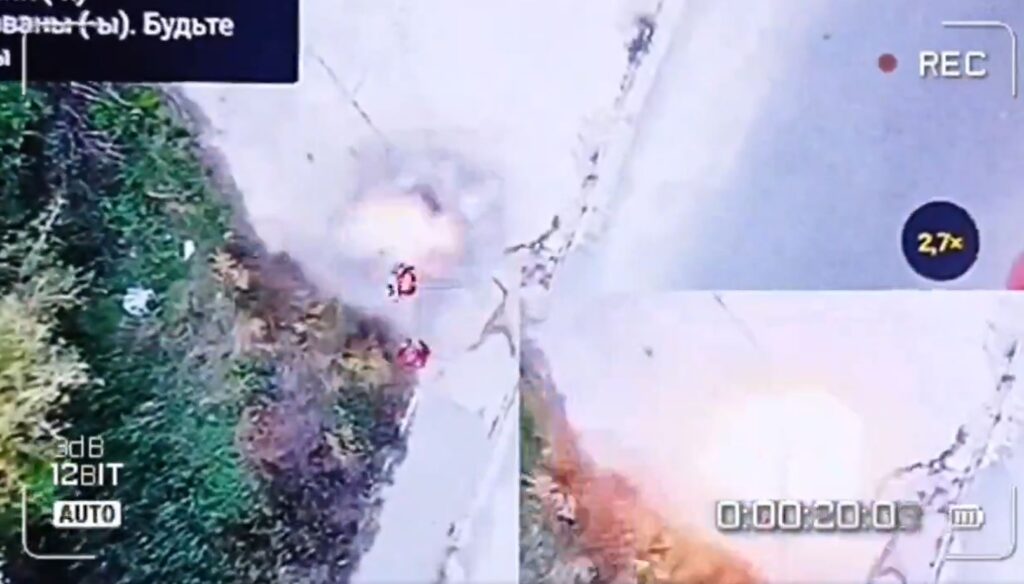
The Russians are trying to find alternate routes that avoid the most heavily droned roads, but once a truck gets close to its destination, it has no choice but to follow a dwindling number of paths. Ukrainian intelligence knows where the Russians' main divisional bases are; they know the trucks must eventually turn into these bases. The near approaches are now becoming kill zones alongside the M-14 and other main roads.

It'll take many more strikes on Russian ships to seriously dent the sea logistics and force more supplies onto land routes. But the effort is underway. "The occupier's smuggling logistics must be stopped," the 414th Unmanned Strike Aviation Brigade explained.

A Russian truck under drone attack near Chernihivka.
Explore further

Russia keeps four field armies fed through three southern towns. Ukraine’s drones just arrived.

  •  

SBU names 10 Russians tied to “human safari” drone hunt on civilians in Kherson

sbu names 10 russians tied human safari drone hunt civilians kherson · post munition dropped russian explodes near two 2024 explosion civilian khersoners telegram channels ten soldiers single regiment accused

Ten Russian soldiers from a single regiment are accused of hunting civilians in Kherson with attack drones, and now face war-crimes charges filed in absentia, the Security Service of Ukraine (SBU) reported. Investigators say the operators tracked people through the streets and struck ambulances and rescue crews. The 10 are among those participating in a Russian long-lasting terror campaign against Khersoners known as a "human safari." 

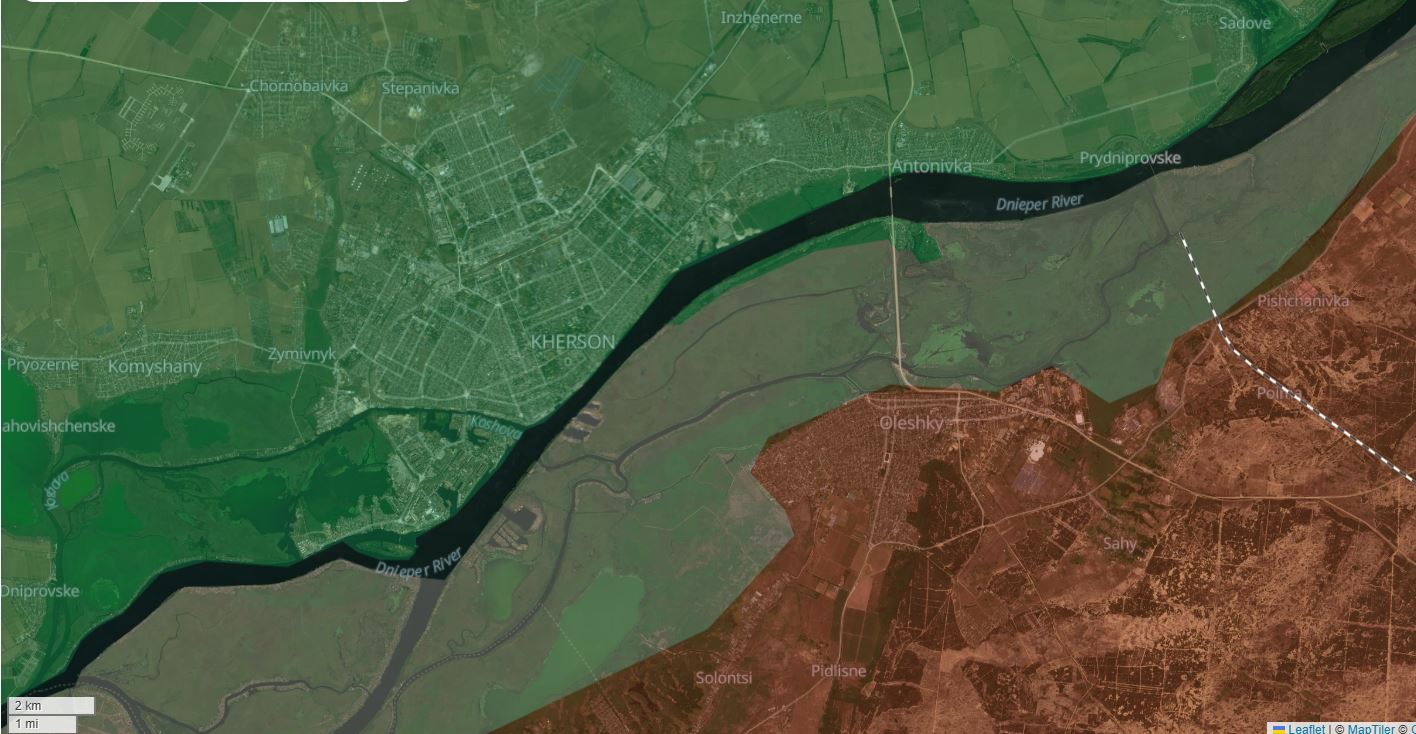
Kherson lies on the Dnipro River's west bank, with Russian-occupied land directly opposite, and the invading force has made it among the deadliest places to live in Ukraine by deliberately hunting civilians across the city for years.

The drone hunters of one regiment

Counterintelligence officers built a case against 10 drone operators from the 404th Motorized Rifle Regiment, a territorial-defense unit in Russia's "Dnepr" Group of Forces, the SBU reported. The investigation found that the men tracked residents as they moved along Kherson's streets and launched drones at them. The drones carried shaped-charge and high-explosive fragmentation munitions.

Kherson city (Russian-occupied area in red). Map: Deep State

Residents and rights monitors call this campaign a "human safari," the hunting of people going about their ordinary days.

Kherson: human safari rages.

A Russian fiber optic FPV drone chases a car in a residential area; after civilians cut the cable, the drone falls, catches fire.

More drones hit cars.

10 injured as a drone attacks a bus.

Drones attack high rises, flying inside the windows. pic.twitter.com/eeaeyyJdz5

— Zarina Zabrisky 🇺🇸🇺🇦 (@ZarinaZabrisky) May 13, 2026

The 10 named operators

The SBU published each suspect's name and military call sign:

  • Tsolak Grigoryan, call sign "Boroda"
  • Nikita Gubar, "Drovosek"
  • Nikolai Denisenko, "Gami"
  • Vladimir Klimov, "Klim"
  • Vyacheslav Kornenkov, "Skif"
  • Viktor Nizhnikov, "Flyaga"
  • Ruslan Nugaev, "Dok"
  • Vladimir Orlov, "Yakut"
  • Ivan Prusachenko, "Prus"
  • Oleg Pukhlyakov, "Pulya"

russians continue their human safari in Ukraine.

They’re not just killing.

They’re hunting unarmed people like animals — from drones, to cheerful music.

This is not war. This is pure evil.

Anyone still justifying russia is standing on their side.

We will never forget. pic.twitter.com/GtrjNfaU0w

— UAVoyager🇺🇦 (@NAFOvoyager) June 8, 2026

Ambulances and a double strike on rescuers

The documented episodes include attacks on civilian cars and residential blocks, the SBU said. Operators dropped explosives on ambulances at a city hospital. They also carried out a "double" strike on State Emergency Service (DSNS) rescuers who were clearing the aftermath of an earlier Russian shelling. 

UN investigators have described this Russian method in Kherson: a first strike, then a second aimed at the people who come to help. Victims suffered shrapnel wounds, burns, and concussions, and civilian infrastructure took significant damage.

Russian soldiers attacked an ambulance in Kherson with a drone.

Three medics were injured.

Another deliberate war crime. pic.twitter.com/xu3WFUQ2H0

— Денис Казанський (@den_kazansky) June 4, 2026

Charged in absentia

Based on the evidence, SBU investigators notified all 10 of suspicion under Article 438 of Ukraine's criminal code, which covers war crimes. The notices were issued in absentia. SBU officers in Kherson Oblast led the investigation with the 79th Border Detachment of the State Border Guard Service (DPSU), under the oblast prosecutor's guidance. The agency said efforts to hold the operators accountable continue.

The case fits a wider pattern Ukrainian prosecutors have documented across the oblast in thousands of proceedings. 

  •  

Russian missiles kill three and wound six in Chuhuiv as drones injure 15 in Kharkiv, including a one-year-old

russian missiles kill three wound six chuhuiv drones injure 15 kharkiv including one-year-old · post fire burns amid rubble destroyed building after strike oblast 9 2026 fdd39292-265f-4a90-a09d-e1288a16f6ae ukraine news ukrainian

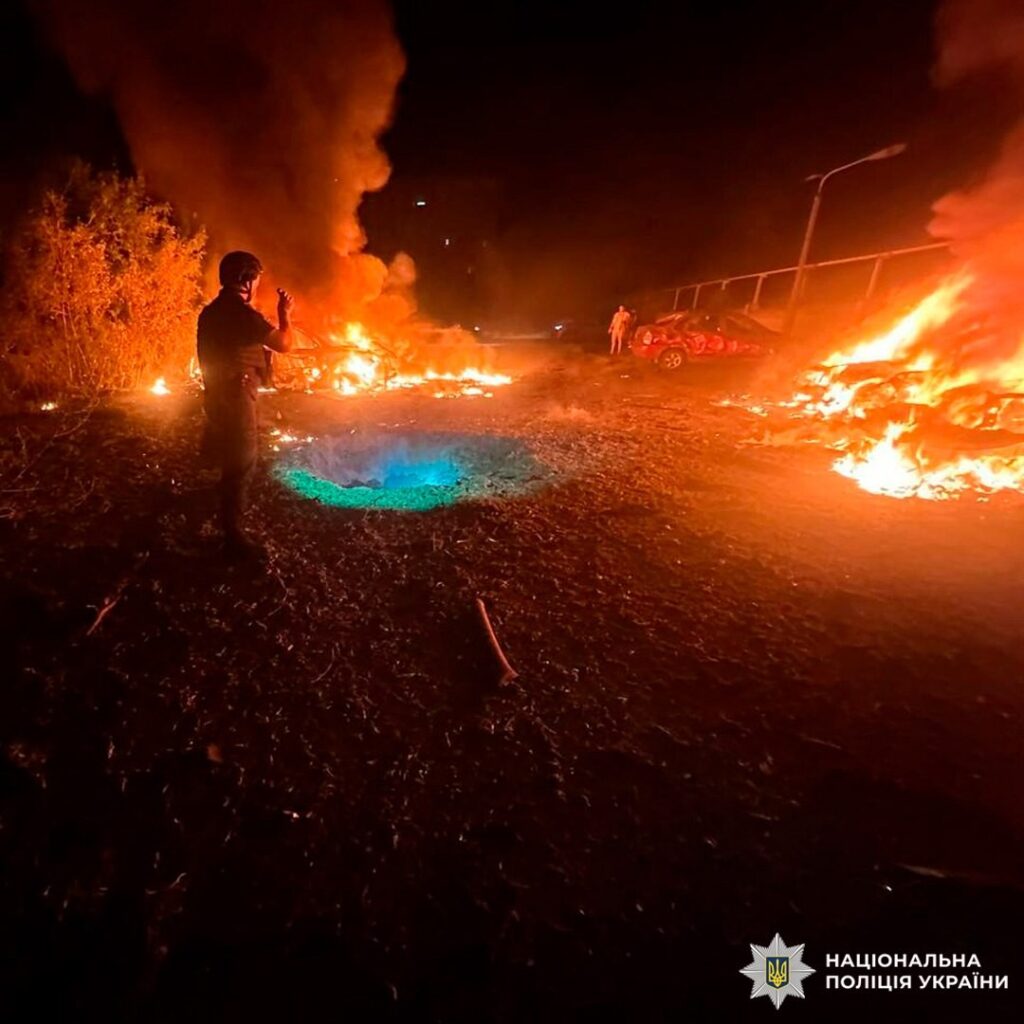
Russia's overnight drone and missile barrage on 9 June killed and wounded civilians in the Kharkiv Oblast cities of Chuhuiv and Kharkiv, regional officials reported. More strikes over the past 24 hours left several people dead and dozens wounded elsewhere in Ukraine. Ukraine's Air Force said air defense stopped most of the drones, though missiles and others still reached homes.

Russia has pounded Ukrainian cities with nightly aerial barrages since 2022, sending waves of drones and missiles that air defenses can thin but not fully stop. Such daily attacks mainly target residential areas and civilian infrastructure.

Chuhuiv and Kharkiv bear the brunt

A series of Russian missile strikes on Chuhuiv overnight on 9 June killed at least three people and wounded six, the city's mayor, Halyna Minaieva, reported. Fire crews stayed at the impact sites as emergency services worked, she wrote, and the strikes damaged about eight apartment buildings and more than ten detached houses.

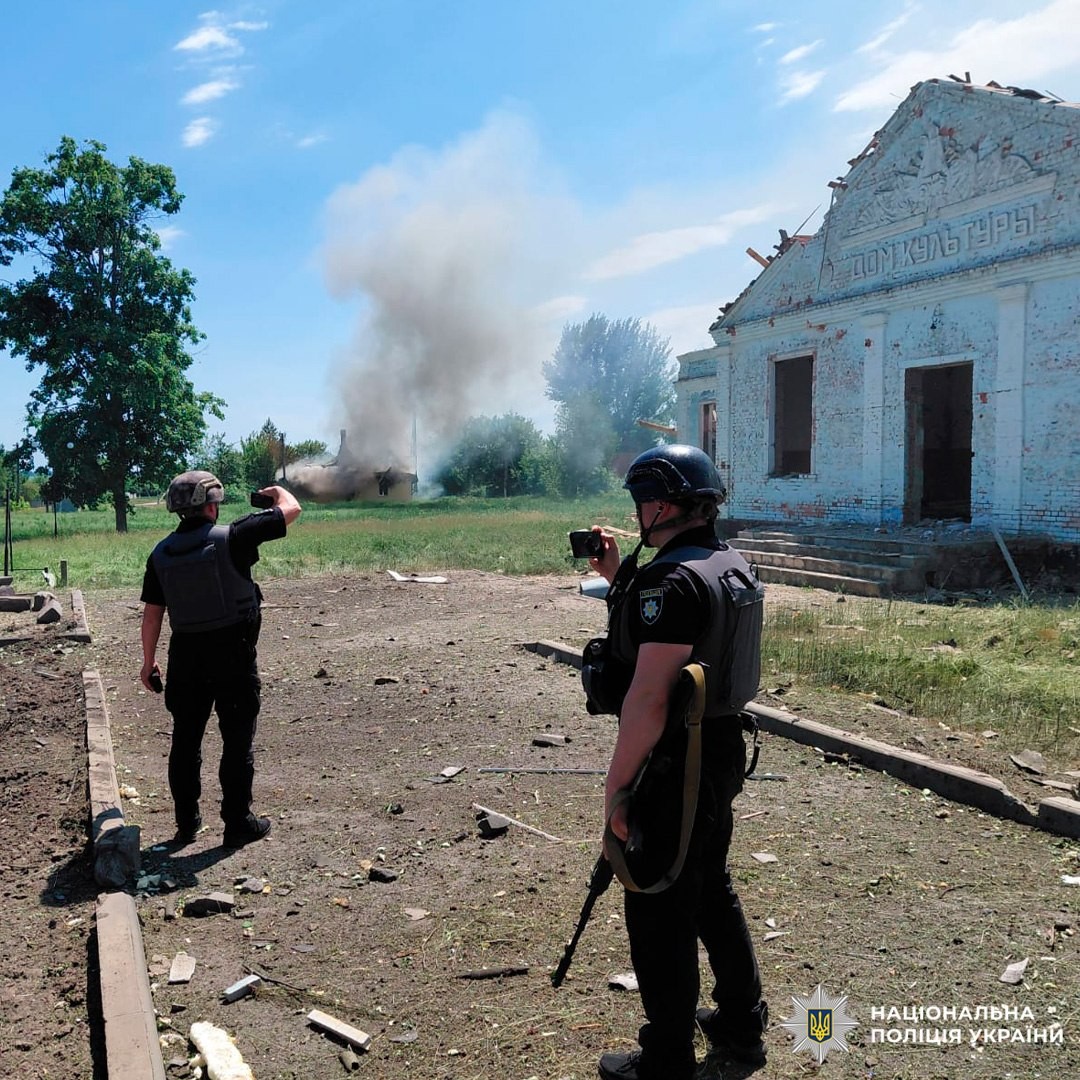
russian missiles kill three wound six chuhuiv drones injure 15 kharkiv including one-year-old · post police officers film aftermath strike oblast 9 2026 b8d379e4-6e28-40e3-8f78-aabbdd235e3e ukraine news ukrainian reports
Police officers film the aftermath of a Russian strike in Kharkiv Oblast, 9 June 2026. Photo: National Police of Ukraine

In Kharkiv—the regional capital—Russian drone strikes set off fires, damaged at least 18 cars, and blew out windows and facades in residential high-rises, Kharkiv Oblast head Oleh Syniehubov reported.

russian missiles kill three wound six chuhuiv drones injure 15 kharkiv including one-year-old · post police officers film aftermath strike oblast 9 2026 3ddd3d71-89b5-4771-8e78-a7d9f5512ce8 ukraine news ukrainian reports
Police officers film the aftermath of a Russian strike in Kharkiv Oblast, 9 June 2026. Photo: National Police of Ukraine

He said 15 people were hurt, among them three children, including a one-year-old boy, and three women were hospitalized

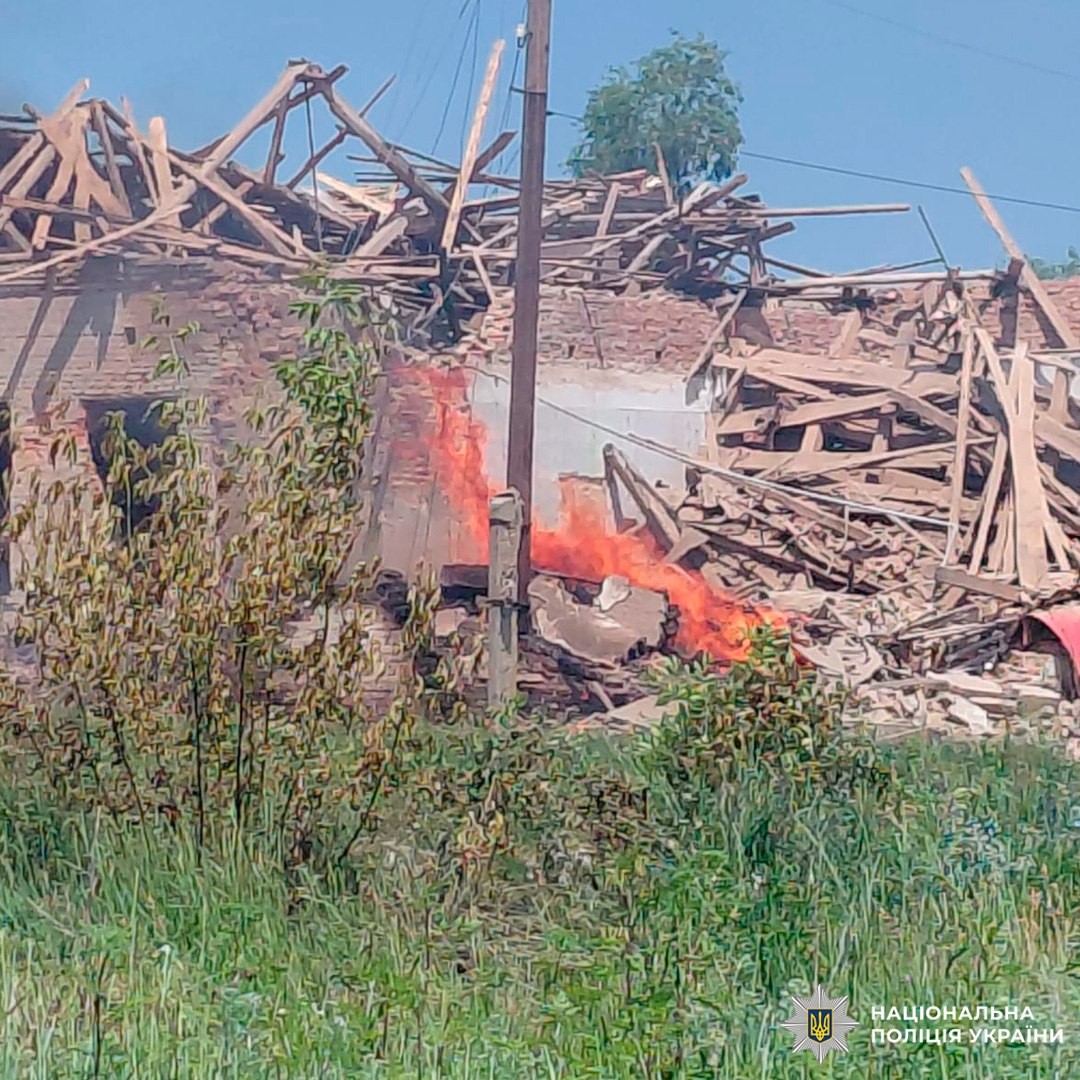
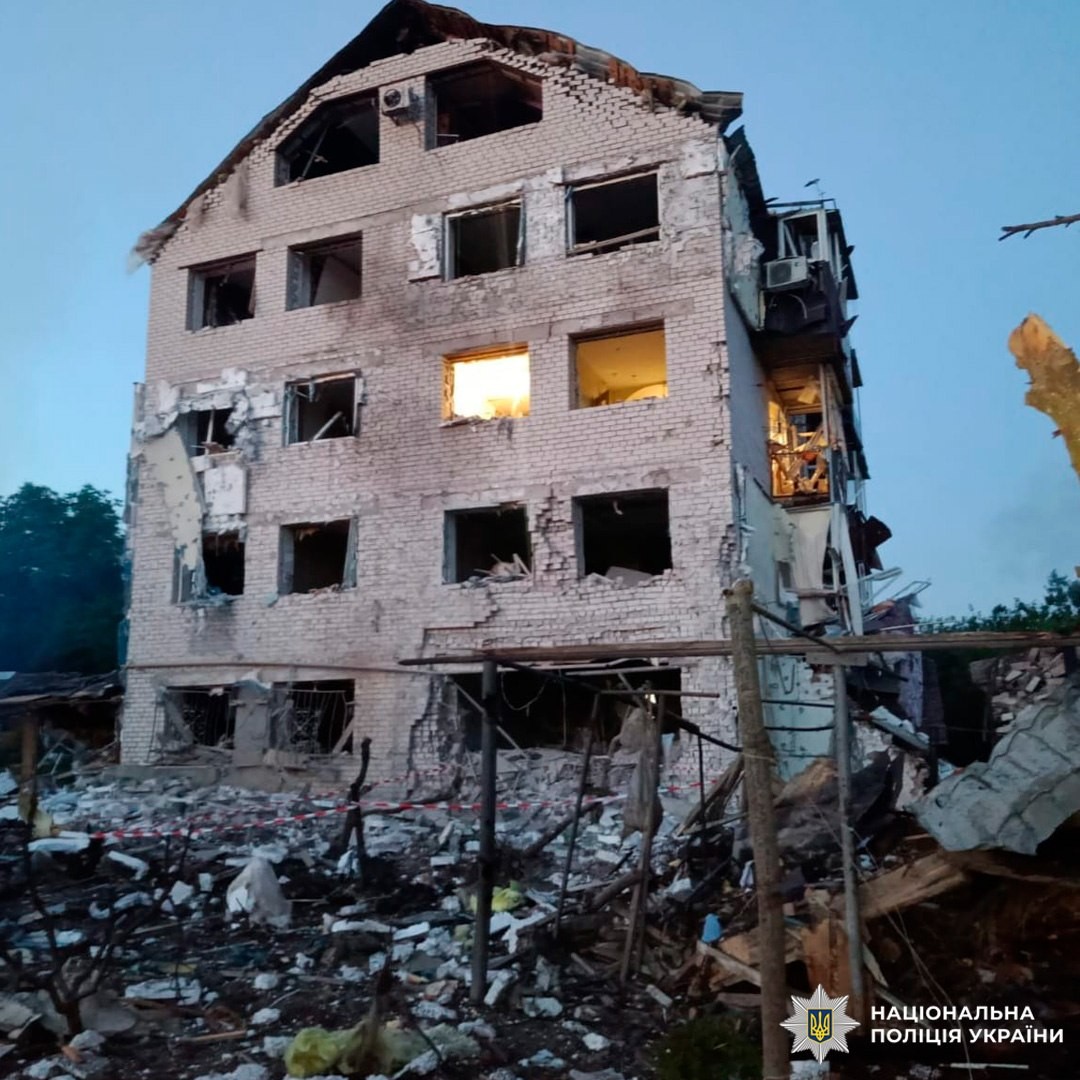
russian missiles kill three wound six chuhuiv drones injure 15 kharkiv including one-year-old · post multi-story residential building wrecked strike oblast 9 2026 8f58a8d8-9c07-4f40-bc34-494323214028 ukraine news ukrainian reports
A multi-story residential building wrecked by a Russian strike in Kharkiv Oblast, 9 June 2026. Photo: National Police of Ukraine

Both cities sit dozens of kilometers from the Russian border and have been struck repeatedly through the war.

A barrage of two missiles and 166 drones

Russia launched two Kh-59/69 guided air missiles from Voronezh Oblast and 166 strike drones overnight, Ukraine's Air Force reported. The drones included Shahed types, some jet-powered, along with Gerbera, Italmas, "Banderol" loitering munitions, and "Parodiya" decoys, launched from Oryol, Kursk, Bryansk, Primorsko-Akhtarsk, and Millerovo in Russia, occupied Donetsk, and Hvardiiske in occupied Crimea.

By 08:00, air defense had downed or suppressed 146 of the dronesTwo missiles and 17 drones struck 18 locations, and debris from intercepted drones fell at eight more

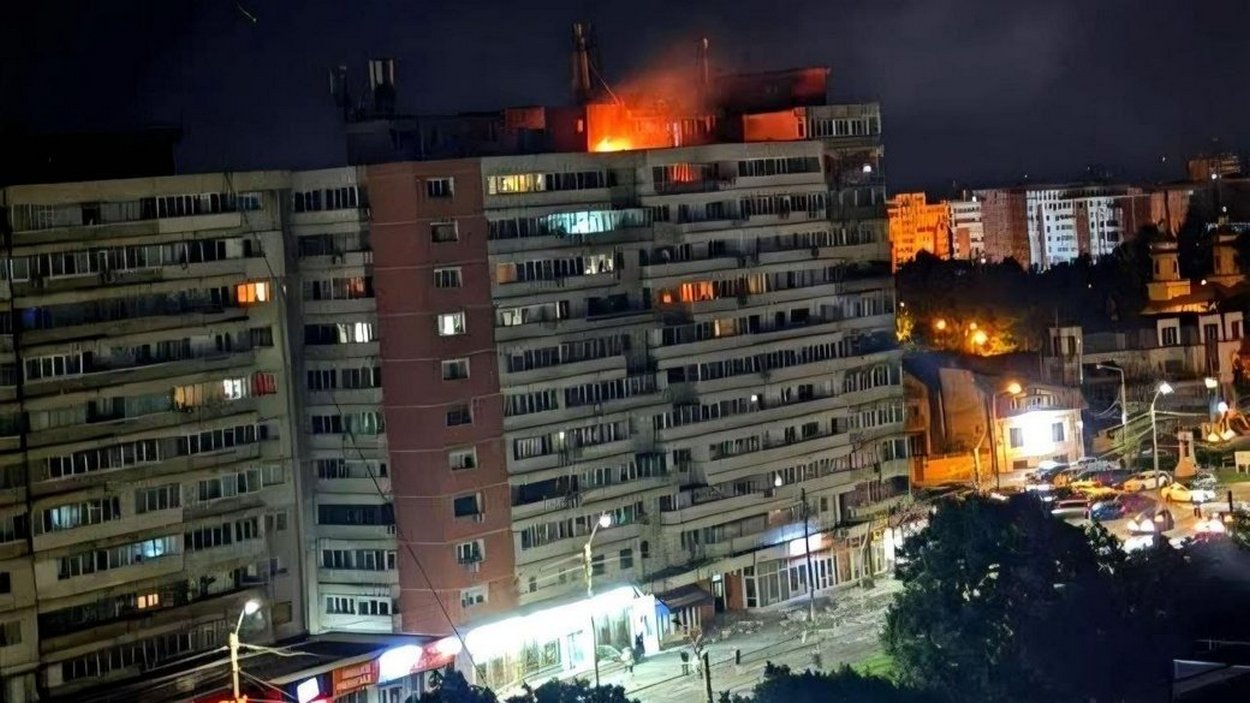
moscow's drone hits 10-story apartment block romania injuring two russia fires 232 uavs ukraine · post fire top-floor residential building galați after russian crashed 29 2026 пожежа у квартирі багатоповерхівки
Explore further

Moscow’s drone hits 10-story apartment block in Romania, injuring two as Russia fires 232 UAVs at Ukraine

Zaporizhzhia counts the damage from the day before

A Russian drone attack the previous day damaged 11 residential buildings across three districts of Zaporizhzhia, the city council reported. Six apartment blocks and five detached houses in the Khortytskyi, Zavodskyi, and Kosmichnyi districts lost windows, balconies, doors, and roofs to blast waves and debris. No one was hurt, and priority repairs were finished.

A nationwide wave

  • Russian attacks over 8 June killed two people in Sumy Oblast and wounded 13 across 21 hromadas, the regional police reported. A 78-year-old woman died in the Konotop hromada and a 71-year-old man in Seredyna-Buda, with a two-year-old boy and an eight-year-old boy among the injured.
  • In Donetsk Oblast, Russian forces killed two residents, in Bilozerske and Druzhkivka, and wounded 11 more, nine of them in Sloviansk, Oblast head Vadym Filashkin reported. Police recorded 1,309 attacks on the oblast's front line and residential areas, damaging 53 civilian sites. Hours later, Russia dropped three FAB-250 glide bombs on Sloviansk's outskirts, destroying one home and damaging more than 20.
  • In Kherson Oblast, drone and artillery attacks killed one person and wounded 13, including a child, Oblast head Oleksandr Prokudin reported
  • Drone strikes in Dnipropetrovsk Oblast wounded three people
  • Russian forces also hit 12 villages in four border hromadas of Chernihiv Oblast, the local border detachment told Suspilne.
  • The Russians also attacked communities in Mykolaiv Oblast with drones, where the administration reported no casualties. 
  •  

Russians pulled 30-year record of cash from banks in May. Central Bank now tracks monthly cash limits, can freeze “suspicious” withdrawals

isw russia burning candle both ends—bankers quietly brace bailouts central bank russia’s top financial execs reportedly fear growing debt crisis despite claims stability ukraine news ukrainian reports

Russians pulled a record 381.2 billion rubles (approximately $5.2 billion) in cash from the banking system in May 2026. It is the largest May cash outflow since the Russian Central Bank began publishing such data in 1995, The Moscow Times reports, citing RBK's analysis of Russian Central Bank data. 

The 30-year record adds to a sustained 2026 pattern of Russians pulling cash from banks: April saw $9.2 billion in cash outflows, and March saw $4.1 billion.

The cumulative $14.8 billion in banknotes added to circulation since January reflects what Russian financial analysts describe as a confluence of geopolitical and macroeconomic uncertainty, internet outages limiting access to online banking, and the Central Bank rate cuts that have made deposits less attractive.

The Central Bank itself responded on 1 June by tightening controls on ATM cash withdrawals, with banks now able to track monthly withdrawal limits and may suspend "suspicious" operations, such as large withdrawals after long pauses or multiple operations in short timeframes.

2026 cash-flight progression

The monthly Russian cash-circulation data published by the Central Bank of Russia shows a sustained increase in cash held outside the banking system across 2026. Lead analyst Natalia Milchakova of Freedom Finance Global, quoted by The Moscow Times, explained that Russians are increasingly choosing cash due to uncertainty and a desire to have money for unplanned expenses "here and now."

Milchakova also warned that the cash shift may signal small and medium businesses moving into the shadow economy. The Central Bank itself identified business adaptation to the new 2026 tax rules as a primary driver, alongside internet outages. Sberbank's deputy chair, Aleksandr Vedyakhin, said Russians worry that digital transfers make their transactions visible to tax authorities.

Internet outages and the banking system

Russian internet outages have played a significant role in the cash-flight pattern, depriving Russians of access to online banking and cashless payment systems, Milchakova said.

The outage pattern is part of a wider disruption to Russian mobile internet across 2025-2026, in which Russian authorities have repeatedly shut down regional mobile internet.

Those shutdowns cut Russians' access to banking apps, fuel purchases, navigation, and messaging, with watchdog estimates of economic losses of $290 million in July 2025 alone. Russian Central Bank rate cuts also factor in: lower deposit rates have reduced the attractiveness of leaving money in banks, pushing households toward cash holdings as a default.

Central Bank's response

The Russian Central Bank's 1 June 2026 tightening of ATM withdrawal controls marks an acceleration of Russia's wartime capital controls. Under the new rules, Russian banks will track each customer's monthly cash withdrawal limit. "Suspicious" operations, defined to include large withdrawals after extended pauses, or multiple withdrawal operations conducted in short timeframes, may now be blocked or suspended pending review. Such administrative friction on cash withdrawals is being deployed at the same time the central bank is cutting interest rates, suggesting the regulator's primary concern is bank-system stability rather than monetary tightening.

  •  

61% of Ukrainians reject ceasefire without security guarantees. Same 61% would accept one with European troops on frontline

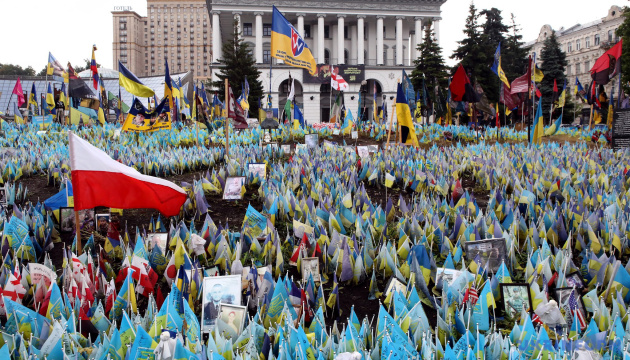
The photo shows a Memorial on the Independence Square in Kyiv, where families of fallen defenders leave thousands of flags with the names, photos, and dates of death of their relatives who gave their lives in the Russian-Ukrainian war. Source: UkrInform

More than 60% of Ukrainians categorically reject a ceasefire along the current frontline if Ukraine receives no security guarantees. The same share would approve a ceasefire if European troops were stationed near the frontline and would defend Ukraine against renewed Russian aggression, according to a new Kyiv International Institute of Sociology (KIIS) poll, conducted between 7 May and 3 June 2026.

The poll quantifies the substantive Ukrainian public position on the ongoing diplomatic process: the ceasefire itself is not the disputed question, but security guarantees are.

Across the four scenarios KIIS tested, the lowest level of support (32%) is for a ceasefire without guarantees. Mid-range support corresponds to mid-range guarantees: 42% for European troops deep in Ukraine that would not fight, and 53% for security guarantees in the form of large-scale financial and weapons support.

Four scenarios in detail

Scenario 1 — ceasefire without security guarantees, money, or weapons: 61% categorically reject, 32% willing to approve (mostly reluctantly). This is the substantive Ukrainian public position on the unconditional ceasefire that Russian negotiators have repeatedly framed as a starting point: the offer falls short by roughly two-to-one.

Scenario 2 — ceasefire with European troops deployed deep in Ukraine, NOT participating in combat if Russia attacks again: 49% categorically reject, 42% willing to approve. A passive Western presence is closer to acceptance but does not yet command majority support.

Scenario 3 — ceasefire with security guarantees in the form of large-scale money and weapons supply: 37% categorically reject, 53% willing to approve. Material guarantees alone gain majority support, but with significant skepticism remaining.

Scenario 4 — ceasefire with European troops near the frontline who WOULD defend Ukraine against renewed Russian aggression: 33% categorically reject, 61% willing to approve. Active defense by European forces commands the highest support, with a clear majority in favor of a ceasefire under conditions that make Russian re-invasion materially riskier.

Methodology and coverage

KIIS conducted the survey by computer-assisted telephone interview (CATI), using random sampling of mobile phone numbers. The sample of 2,007 Ukrainian citizens aged 18 and older was drawn exclusively from territory controlled by the Ukrainian government, meaning the data does not include displaced Ukrainians abroad or Ukrainians in Russian-occupied territories.

The polling period of 7 May through 3 June 2026 covered the full month of the current phase of US-mediated diplomatic activity, during which Russia continued striking Ukrainian cities with Shahed drones and missile attacks.

  •  
❌