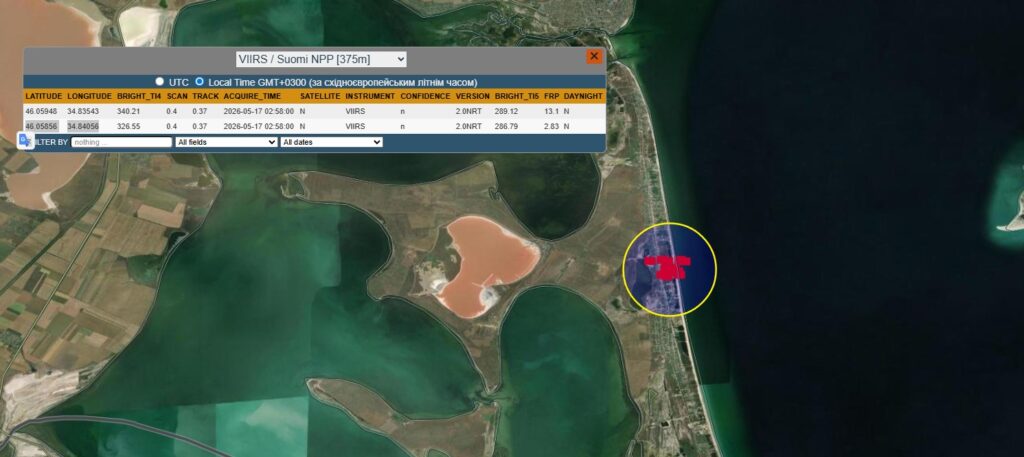
Ukraine attempted a missile strike on a bridge connecting Henichesk to the Arabat Spit early on 10 June 2026, according to Vladimir Saldo, Russia's installed head of the occupied part of Kherson Oblast, who posted the claim on social media.
The strike is the latest in a series of Ukrainian attacks targeting road links between Russian-occupied Kherson Oblast and Crimea. The Chonhar bridge—the main overland route—was first struck on 7 June, after which traffic resumed in reversible mode; a second Ukrainian drone strike on 9 June halted movement again. Saldo had advised drivers to use alternative routes through Armyansk and Perekop.
Traffic across the Henichesk–Arabat Spit bridge has been temporarily closed, Saldo said, with emergency services on site establishing the circumstances.
Power outages across eight districts
In the same post, Saldo reported that eight municipalities were left without electricity following a separate overnight Ukrainian drone attack: Henichesk, Novotroitske, Chaplynka, Kalanchak, Ivanivka, Hornostaivka, Kakhovka, and Nova Kakhovka. Utility and emergency crews were working to restore power, he said.
Broader logistics pressure
Russian pro-war bloggers have in recent weeks reported an intensified Ukrainian drone campaign against military transport in southern Ukraine, Hromadske reports. On 30 May, Russian-occupied Crimea imposed limits on sales of A-95 petrol, citing drone strikes on Russian oil refineries; occupied Luhansk Oblast followed with similar restrictions shortly after.
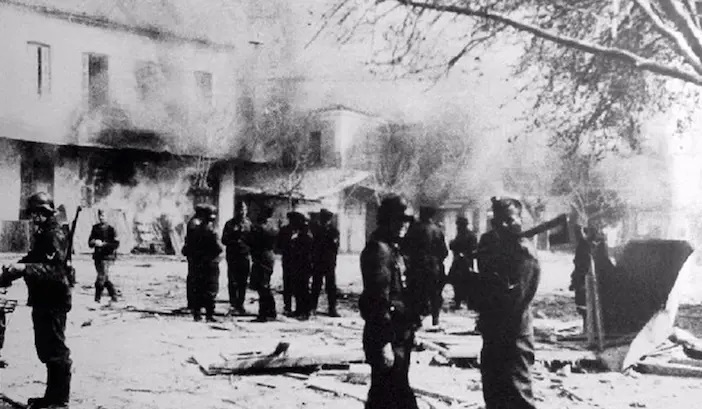
Photo of German troops in the burning village of Distomo. Original description: “The photo was preserved by Pantelis Karakitsis and was made well-known by Spyros Meletzis. It was found in the pocket of a German soldier held prisoner by ELAS. Depicts Germans in Distomo on fire.” Public Domain.
The massacre at Distomo remains to this day one of the most heinous crimes the Nazis committed against innocent women and children just months before the German occupying forces pulled out of Greece.
On June 10, 1944, Fritz Laufenbach, captain of the 2nd company of the 1st battalion of the 7th SS armored regiment, was ordered to move his troops from Livadia to Distomo, Steiri and Kyriaki to locate guerrillas on the western side of Helicon Mountain.
This move by the German soldiers was in retaliation for several troops whom the Greek Resistance had killed. As bait, the Nazis had used two Greek civilian trucks filled with SS men disguised as villagers. The two trucks were moving ahead of the main phalanx.
At the same time, the 10th and 11th Amphissa companies of the 3rd Battalion were directed to Distomo to meet the 2nd company. The German troops met outside Distomo without finding any resistance fighters, save for eighteen children hiding near the village. Six of the children who tried to escape were executed.
The Germans entered Distomo, and after intimidating the villagers, they discovered that there were Greek guerrillas at Steiri. The 2nd company headed toward the village, and at Litharaki near Steiri, they were ambushed by fighters from the ELAS resistance group.
The battle at Steiri was so bloody that the Germans were forced to retreat. Approximately forty of them were killed.
Cold-blooded massacre at Distomo
After the casualties they had suffered at Steiri, the Nazis entered Distomo with a clear intention of retaliation for their losses. The cold-blooded massacre of everyone they found in the village then began.
Around 600 people were killed by the Nazis in the wider region of Distomo in 1944. Public Domain.
They went from door to door, killing anyone in sight. Their fury was such that they were careless about whether they killed women or children. The slaughter lasted into the night until the Nazi troops had to return to Livadia. However, they did not leave before burning the entire village to the ground.
According to survivors describing the atrocities, SS soldiers bayoneted babies in their cribs, stabbed pregnant women, and beheaded the village priest.
However, the Germans did not stop at Distomo. The executions continued all the way back to their base, as they killed any civilian they encountered on the way. The death count in Distomo amounted to 228 of which 117 were women and 111 men while 53 were children under the age of sixteen.
According to the testimony of International Red Cross Swiss envoy George Wehrly, who arrived in Distomo a few days later, about six hundred people were killed by the Nazis in the wider region.
Haunting pictures from Distomo
Maria Padiska in mourning several months after the massacre. Public Domain.
A few months after the Distomo massacre, LIFE magazine published a haunting report on the Nazi atrocity. Under the headline “What the Germans did to Greece,” the US magazine interviewed survivors and published photos of the town in ruins.
Among the survivors was Maria Padiska, who came to be known as the “Woman of Distomo.” She passed away in March 2009 at the age of 84.
Her photo adorns the Museum of the Victims of Nazism, located at the entrance of Distomo. The museum was founded in 2005 at the site of the old primary school. It was inaugurated by then President of the Hellenic Republic Carolos Papoulias.
The total area of the museum, which is roughly about 200 square meters, is divided into two levels. On the first floor, one can see photos of all the victims, and there is also a special area with photos of the ossuary, which is located intact at the Mausoleum on Kanales Hill of Distomo.
The ancient Greek Acropolises meant very different things to different people across history. A new study finds its symbolic meaning shifted dramatically over centuries, starting as a marker of civic pride and freedom before becoming firmly associated with tyranny and oppression.
Robin Rönnlund, an archaeologist at the University of Gothenburg in Sweden, published the study in the Annual of the British School at Athens. He examined ancient texts from Homer through the second century A.D. and traced how writers, philosophers, and inscription makers actually understood the word “acropolis” across roughly 1,000 years.
The research directly challenges a widely accepted scholarly narrative. For decades, historians described acropolises as prehistoric royal strongholds that were later abandoned and converted into either religious sanctuaries or civilian refuges during attacks.
Scholars built a false narrative around misread Aristotle
Rönnlund traces this narrative back to a misreading of a passage in Aristotle’s Politics, in which Aristotle theorized that acropolises suited oligarchies and monarchies.
Past scholars interpreted this theoretical statement as a historical sequence rather than a practical observation about fortifications, and the misreading quietly shaped academic thinking for generations.
Remains of the Temple of Artemis with the Acropolis. Credit: Carole Raddato / Wikimedia Commons / CC BY-SA 2.0
The word itself is also commonly misunderstood. Rönnlund explains “acropolis” does not mean “upper city,” as dictionaries suggest. It more precisely means “the farthest polis” or “the polis on the edge,” and it first appeared in the Odyssey in reference to Troy.
In early Greek poetry, the ancient Greek acropolis carried an unmistakably positive meaning. Simonides described the Acropolis as a symbol of Greek resistance to Persian invaders.
Ancient Greek Acropolis once stood for freedom and pride
Sparta was celebrated as the “acropolis of Greece” in the famous Lysander monument at Delphi. Philosophers extended the metaphor further. Plato called the head the “acropolis of the soul.”
Diocles of Karystos described the mind as a sacred statue placed on the acropolis of the body. These uses reflected strength, protection, and honor.
The meaning turned darker as foreign military occupation became widespread. Ancient sources contain 66 passages linking tyrants to acropolises. Plutarch recorded a warning that Caesar should not be established as “tyrant in the acropolis.”
Macedonian forces turned a civic symbol into oppression
After 322 B.C., Macedonian forces systematically garrisoned acropolises across Greece to keep conquered cities under control. Both Demosthenes and Isocrates described how garrisoned acropolises kept entire regions in submission.
Civilian populations almost never used acropolises as refuges, contrary to popular assumption. The sites lacked sufficient water and supplies for prolonged occupation, and literary sources confirm people typically fled to the walled city below or into the countryside during attacks.
Rönnlund reviewed 133 individual acropolises mentioned in ancient sources and calls for future research combining archaeology, epigraphy, and field surveys to properly reconstruct how these sites functioned in ancient Greek life.
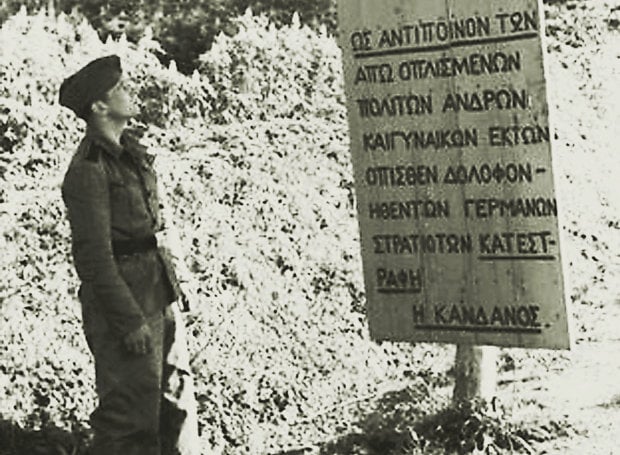
A German soldier in front of one of the signs erected after the razing. The text reads: “Kandanos was destroyed in retaliation for the bestial ambush murder of a paratrooper platoon and a half-platoon of military engineers by armed men and women.” Credit: Bundesarchiv, CC BY-SA 3.0 de/Wikipedia
The village of Kandanos on Crete was burned to the ground, and Nazi troops massacred all 180 residents on June 3, 1941 during the years of the German occupation.
It was one of the worst atrocities committed by the occupiers and has haunted Crete and Greece for decades.
Battle of Crete
The Battle of Crete began on May 20, 1941, with Germany employing 750 glider-borne troops, 10,000 paratroopers, 5,000 airlifted mountain soldiers, and 7,000 seaborne troops. It was the first occasion when German parachutists were used en masse and the first mainly airborne invasion in military history.
It was also the first time German soldiers had encountered mass resistance from a civilian population, and they suffered unexpectedly large numbers of casualties.
The outnumbered Greek soldiers, along with the Allied forces based on Crete, fought bravely but were vastly outnumbered. Cretan civilians joined the battle with whatever weapons were at hand—mostly kitchen knives, but rakes, clubs, and even walking sticks were used in desperate hand-to-hand combat for their homeland.
German parachutists were often knifed or clubbed to death as they landed on fields of Crete. In one recorded incident, an elderly Cretan man clubbed a paratrooper to death with his walking cane before the German could even disentangle himself from his parachute.
In another incident, a local priest and his son broke into a village museum, took two rifles from the Balkan War era, and sniped at German paratroops as they landed. The Cretans also began to use small arms from captured German soldiers as the battle continued.
However, this courage came at a terrible cost, as the Germans retaliated as soon as they managed to gain control of Crete.
The temporary German commander of the island, Kurt Student, ordered a series of brutal reprisals against the local population immediately after the surrender of Crete on May 31, 1941.
The Nazi occupying forces massacred civilians on Crete. Credit: Bundesarchiv, CC BY-SA 3.0 de/Wikipedia
Every last resident of Kandanos, amounting to a total of 180 men, women, and children, were brutally massacred, and their ancient village was burned to the ground.
Nazis order for the destruction of Kandanos
Below is the order of the German commander:
“It is certain that the civilian population including women and boys have taken part in the fighting, committed sabotage, mutilated and killed wounded soldiers. It is therefore high time to combat all cases of this kind, to undertake reprisals and punitive expeditions which must be carried through with exemplary terror. The harshest measures must indeed be taken and I order the following: shooting for all cases of proven cruelty, and I wish this to be done by the same units who have suffered such atrocities. The following reprisals will be taken: 1. Shooting 2. Fines 3. Total destruction of villages by burning 4. Extermination of the male population of the territory in question My authority will be necessary for measures under 3 and 4. All these measures must, however, be taken rapidly and omitting all formalities. In view of the circumstances the troops have a right to this and there is no need for military tribunals to judge beasts and assassins.”
After the surrender of Germany, General Kurt Student was captured by the British. In May 1947, he came before a military tribunal to answer to charges of mistreatment and murder of prisoners of war by his forces on Crete.
Greece’s demand to have Student extradited was declined. Student was found guilty of three out of eight charges and sentenced to five years in prison. However, he was given a medical discharge and was released in 1948. Student was never tried for crimes against civilians.
Today, Kandanos has been rebuilt and is the seat of the eponymous municipality. Reproductions of the somber Wehrmacht signposts commemorating the village’s destruction are displayed on a local war memorial.

 Login
Login