Os Supermercados Apolónia, marca premium de referência no setor da distribuição alimentar, anunciam a nomeação de Rute Rodrigues para o cargo de Diretora de Marketing e Comunicação. Com mais de 10 anos de experiência nas áreas de marketing, comunicação e branding nos setores do turismo, hotelaria e retail, Rute Rodrigues integra agora a equipa de liderança da insígnia algarvia, […]
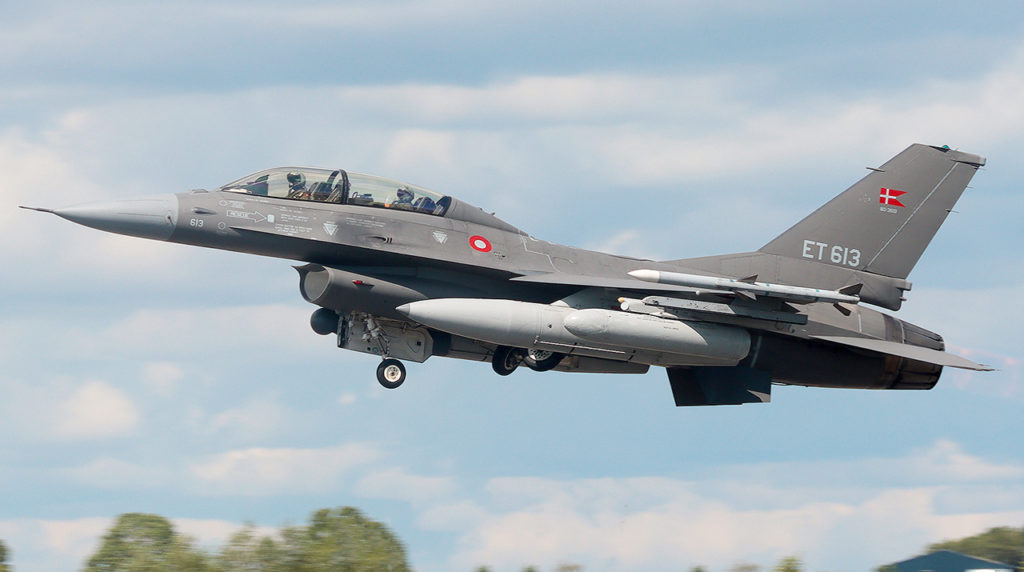
NATO fighters from the Baltic Air Policing mission shot down a foreign unmanned aerial vehicle over Latvia's Latgale region this morning, after the drone entered Latvian airspace as a result of Russian electronic warfare action, the Latvian Ministry of Defense says. It is the most direct documented NATO engagement of a drone over Latvian territory tied to Russia's war against Ukraine to date.
The shoot-down comes against a backdrop of repeated drone incursions over NATO territory along the eastern flank in 2026. In May, a Russian drone crashed into a residential building in Galați, Romania.
What did Latvia say?
"NATO Baltic Air Policing mission shot down a foreign unmanned aerial vehicle (drone) that had entered Latvia as a result of Russian electromagnetic warfare," the Latvian Ministry of Defense statement said.
The ministry stressed that the Latvian Armed Forces and NATO allies continuously monitor Latvian airspace to enable an immediate response to potential threats, and that the Latvian Armed Forces have reinforced air defense capabilities along the eastern border by deploying additional units.
"As long as Russia's aggression in Ukraine continues, the recurrence of incidents where a foreign unmanned aerial vehicle enters or approaches Latvian airspace remains possible," the ministry added.
Baltic context: Estonia's months of frustration
Latvia's incident comes after months of similar incidents in Baltic airspace. In May 2026, Estonia's Foreign Minister Margus Tsahkna and Defense Minister Hanno Pevkur publicly told Ukraine to control its drones better after months of airspace breaches across the Baltic states and Finland.
In March 2026, Tsahkna said, several drones breached Estonian airspace. One hit a chimney at the Auvere Power Plant, two kilometers from the Russian border, and another crashed in Tartu County, with debris washed up along Estonia's northern coast.
A drone also struck a fuel storage depot near the Latvian border. Russia has claimed the Baltic states are allowing Ukraine to use their airspace for attacks.
Ukraine has accused Russia of deliberately directing drones into Baltic airspace through electronic warfare. Today's Latvian statement that "Russian electronic warfare action" caused the intrusion aligns with Ukraine's reading of the pattern rather than Russia's.
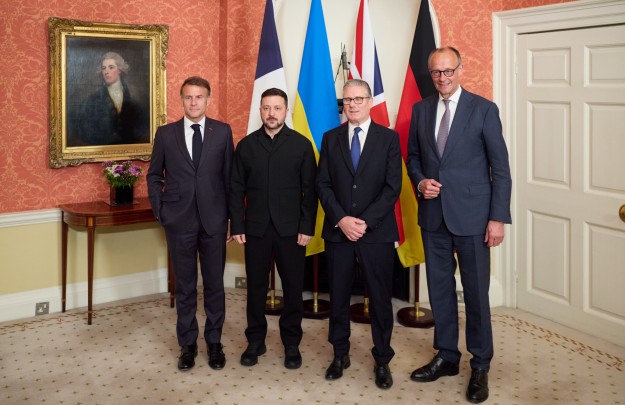
Britain, France, and Germany backed Ukraine's terms for ending the war after meeting its President Volodymyr Zelenskyy in London, according to their joint statement. They endorsed Kyiv's push for direct talks with Moscow and an immediate ceasefire, while spelling out what a lasting peace would require. The leaders also called for tightening the squeeze on Russia's war economy and scaling up Ukraine's air defenses.
Russia has been invading Ukraine since 2014 and waging all-out war since February 2022, and with Moscow still rejecting every ceasefire on offer, Kyiv and its Western partners are now trying to map out how the fighting could actually end.
Five conditions for peace
Meeting on 7 June, UK Prime Minister Keir Starmer, French President Emmanuel Macron, and German Chancellor Friedrich Merz set out five conditions for a just and lasting peace. The E3, as the three are known, are Ukraine's leading European backers. Their terms:
An immediate, complete ceasefire, which they urged Putin to accept.
The current front line as the starting point for talks, with no borders changed by force and Ukraine free to choose its alliances.
Robust, legally binding security guarantees once a ceasefire holds, building on the allies' December 2025 Berlin and January 2026 Paris commitments, including a multinational force in Ukraine.
Russian assets remain immobilized until Moscow ends its aggression and compensates Ukraine.
European interests safeguarded, with any EU- or NATO-related terms requiring both blocs' consent.
Explore further
“It was never formulated as Ukraine winning”—NATO’s ex-military chief on the missing strategy
Backing for direct talks with Moscow
The leaders commended Ukraine's president for his 4 June letter to Putin calling to end the war. They backed direct Ukraine-Russia dialogue, with the US and Europe actively taking part, to secure a ceasefire. Europe must play a role in any settlement, they said, working closely with Kyiv, the rest of Europe, and Washington.
Explore further
Germany, France, and UK sketch plan to bring Putin to the negotiating table
Pressure on Russia and more air defense
They denounced Russia's barrage of missiles and drones, including repeated strikes with the Oreshnik, a Russian missile. They also condemned dangerous Russian drone incursions into NATO territory and offered condolences to the victims. The leaders welcomed Ukraine's recent battlefield gains, from liberated territory to advances in drone warfare. They agreed to coordinate more support at the coming G7 summit in Evian, the next Coalition of the Willing meeting, and the NATO summit in Ankara. That includes choking off more of Russia's wartime revenue and a bigger military pledge at the NATO talks. They also urged scaling up interceptor production and co-developing anti-ballistic and deep-strike weapons.
In his recent resignation speech, Wes Streeting attempted to merge Reform, the SNP, Plaid Cymru and Sinn Fein into a mega-threat of "nationalism" to which he was the antidote. But it fell flat, says Dr Nicholas Tate.
North Yorkshire Police made a grovelling public apology to "our LGBTQ+ communities" – but has refused to apologise to a Christian officer it wrongly sacked for asking a question about Islam at a training day.
For decades, hemp-based construction materials remained on the fringes of the building industry due to regulatory restrictions and misconceptions surrounding the plant. Today, that picture has changed dramatically. Hempcrete, a composite made from hemp hurd and lime binder, has entered international building codes and is increasingly finding its place in modern sustainable architecture. Supporters say it offers significantly better thermal performance than conventional concrete while creating healthier indoor environments.
Why Architects Are Turning to Hempcrete
The core ingredient in hempcrete is hemp hurd, the woody inner part of the hemp stalk. Builders mix this plant-based material with a lime binder to create a lightweight composite commonly used as infill within timber or metal frame structures.
The material's biggest advantage lies in its thermal insulation. Hempcrete walls retain heat far more effectively than traditional concrete, helping buildings stay warm during winter and cool throughout the summer. This improved energy efficiency can reduce heating and cooling demands while enhancing indoor comfort.
A pair of U.S. adversaries — China and North Korea — appear to be strengthening relations, with Chinese President Xi Jinping's arrival in Pyongyang on Monday for a rare state visit.
This is Xi's first trip to North Korea in seven years, and experts say the visit is likely aimed at reasserting China’s unique influence over North Korea in exchange for providing economic and political benefits.
Xi is scheduled to meet North Korean leader Kim Jong Un in what will be their first summit since September, when they met in Beijing after viewing a military parade alongside Russian President Vladimir Putin and other foreign leaders.
No specific agenda has been mentioned, but foreign experts predict the meeting to have a significant impact on bilateral ties and more, as both sides seek to fully restore their traditional alliance amid separate disputes with the U.S. government.
Xi’s trip comes after his back-to-back summits with U.S. President Donald Trump and Putin in Beijing last month. Xi plans to meet Trump again for a U.S. visit in September.
China has, for years, been North Korea's economic lifeline and primary diplomatic backer. China has refrained from fully enforcing U.N. sanctions on North Korea and sent clandestine aid to support its impoverished neighbor.
This year marks 65 years since the two nations signed a mutual defense treaty.
Despite this, there have been questions about their ties in recent years, as North Korea has prioritized cooperation with Russia by supplying troops and weapons to support its war against Ukraine and received economic and military assistance from Moscow in return.
Experts warn that restoring China's exclusive influence over North Korea would give Xi leverage with Trump, who has repeatedly expressed his wish to restart diplomacy with Kim.
Analysts said Xi would likely offer Kim economic aid packages such as shipments of rice and fertilizers, a resumption of Chinese group tourism to North Korea and joint economic projects.
Xi may also avoid the issue of denuclearization of North Korea, which wants to achieve international recognition as a nuclear weapons state, as a way to call for lifting of U.N. sanctions on North Korea, according to experts.
After last month’s summit between Trump and Xi, the U.S. government said the two leaders affirmed their shared goal to denuclearize North Korea.
But China only said the leaders spoke about the nuclear issue on the Korean Peninsula. Kim’s sister and senior official Kim Yo Jong dismissed the readout of the meeting as "false information."
Last week, Kim unveiled a new plant to produce nuclear ingredients and pledged to bolster the country’s nuclear forces "at an exponential rate." He also said he is seeking to speed up efforts to build a nuclear-armed navy.
On Sunday, Kim Yo Jong described a U.S. plan for the denuclearization of North Korea as an "escapist and anachronistic dream."
Kim Jong Un has dismissed U.S. and South Korean offers for talks as he focuses on enlarging and modernizing his nuclear arsenal. The North Korean leader in September urged the U.S. to withdraw its demand for North Korea to denuclearize as a precondition for resuming diplomacy.
BANGKOK — More than 600 residents of Chiang Mai and Chiang Rai provinces embarked May 31 on a roughly 68-kilometer, six-day ‘peace walk’ to demand the Thai government take action on the river pollution crisis that has seen Thai rivers polluted with heavy metals. The ensemble of affected residents, civil society groups, monks and students marched from Tha Ton subdistrict in Chiang Mai to the city of Chiang Rai in northern Thailand, reaching their destination on June 5, World Environment Day. For more than a year, Thailand’s Pollution Control Department has reported dangerous levels of arsenic, mercury, cadmium and other heavy metals in rivers across northern Thailand, with mining operations across eastern Myanmar suspected to be responsible for the pollution. “We are walking because our rivers are slowly dying,” Pianporn Deetes, executive director of the Rivers and Rights Foundation, which helped to organize the peace walk, told Mongabay by phone. “Toxic contamination from unregulated mining upstream is already affecting water, fish, food, livelihoods, and public health. We do not want to wait until more people become sick. This is an emergency.” Pianporn said the walk (42 miles) was about taking collective action to share information, document impacts and build public pressure in a bid to force the government to address the issue, which Pianporn said has, so far, been lacking. “Monitoring has improved, but action has not matched the scale of the crisis,” she said. “We need urgent diplomatic engagement with neighboring countries, stronger health monitoring, transparency, and action to…This article was originally published on Mongabay
This is part six of a series examining the challenges confronting the NATO alliance.
As President Donald Trump presses NATO allies to shoulder more of Europe's defense burden, countries closest to Russia are moving fastest — while some of Western Europe's biggest economies face growing pressure to catch up.
Retired Rear Adm. Mark Montgomery, senior director at the Foundation for Defense of Democracies and former deputy director for strategy, policy and plans at U.S. European Command, said the shift is already visible across the alliance.
"Europe is clearly stepping up, but they're stepping up by geographic variation," Montgomery told Fox News Digital.
"If you ask me who's doing the most, the Eastern Europeans are clearly."
Montgomery pointed to the Baltic states, Poland, Romania and Bulgaria as countries moving aggressively to strengthen deterrence against Russia.
His assessment comes as NATO allies work toward a new defense spending benchmark agreed at the 2025 summit in The Hague, which calls on members to invest 5% of GDP in defense and security-related spending by 2035, including 3.5% for core defense requirements and 1.5% for defense-related infrastructure and security investments.
John Deni, a research professor at the U.S. Army War College, said the trend shouldn't be surprising.
"Given the threat of Russia, allies in the East are acquiring capabilities more quickly, and they're spending even more than allies in the West," Deni told Fox News Digital. "This shouldn't surprise us because they're the ones closest to the threat."
Deni noted that many eastern allies are rapidly purchasing equipment already available on the market rather than waiting years for domestic defense programs to mature.
The transformation is visible across NATO's eastern and northern flanks. Poland has become one of the alliance's largest military spenders, Romania is increasing defense investments, and Finland and Sweden have added advanced military capabilities to NATO following their accession.
Secretary of State Marco Rubio praised Finland and Sweden Thursday at the Senate Foreign Relations Committee hearing, using them as examples of allies strengthening the alliance.
"Sweden and Finland have actually contributed because they brought their own defense industry, their own advanced technology," Rubio said. "They have been great partners."
Romanian Foreign Minister Oana-Silvia Ţoiu echoed that message in an interview with Fox News Digital following an emergency U.N. Security Council session convened after a Russian drone strike injured civilians in the Romanian city of Galați.
"We do agree with President Trump on the need to increase budgets," Ţoiu said.
Ţoiu said Romania raised defense spending to 2% of GDP during Trump's previous term and plans to allocate "an average of 3.4 percent" next year through military procurement and strategic infrastructure investments.
"We need better deterrence, better defense capabilities there in order to ensure our responsibility in protecting not just the Romanian border, which is the longest border to the war, but also it is in the same time a European border and the border of the Allied territory," Ţoiu said.
For frontline states, the urgency is driven by geography as much as politics. Romania shares a border with Ukraine and repeatedly has dealt with Russian drones entering its airspace. Poland has become one of NATO's top military spenders, while the Baltic states are racing toward defense expenditures approaching 5% of GDP.
Montgomery said the eastern flank's urgency contrasts sharply with the pace in much of Western Europe.
Among the continent's five largest economies, and despite a slight decrease in military spending in 2025, the U.K. remains the largest investor relative to GDP, with 2.4%, trailed by Germany (2.3%), Spain (2.1%), France (2%) and Italy (1.9%), according to the Stockholm International Peace Research Institute (SIPRI).
"The Germans are the one country, I think, with a large economy that is starting to make the right kind of investments."
Germany, he argued, could become the backbone of Europe's future defense industrial base.
"Germany developing a large, impressive defense industrial base is good for NATO, it's good for Western security, and it's even good for our primes," Montgomery said.
German Chancellor Friedrich Merz has embraced higher defense spending and backed NATO's new spending goals, positioning Berlin as a potential hub for Europe's future defense industrial base as allies seek to reduce long-term dependence on the United States.
Barak Seener, a senior fellow at the Henry Jackson Society, said Europe still relies on the United States for many of the systems required to fight a modern war.
"Europe is heavily dependent on NATO for its strategic airlift and sea lift, its air-to-air refueling, its cyber capabilities, its space assets, its intelligence, surveillance and reconnaissance," Seener said.
Without those capabilities, he warned, European forces would struggle to maintain situational awareness during a major conflict.
Montgomery said Europe faces three major challenges: expanding military capacity, rebuilding its defense industrial base and developing high-end support capabilities that have long been provided by the United States.
"When you are freeloading for 30 years, you create enormous deficits in terms of people, equipment, technology and know-how," he said.
"The primary forces to defend Europe should be European," he said. "The United States should provide additional forces that allow maneuver and offensive operations."
Montgomery also criticized reported Pentagon deliberations over delaying long-range strike deployments to Germany and reconsidering future Tomahawk missile sales, arguing the systems are critical for deterring Russia.
"The goal here is not to fight Russia in the Baltics or in Poland. The idea here is we want to deter Russia from even trying to attack."
Looking ahead, Montgomery remains optimistic about NATO's future.
Montgomery predicted Europe will continue increasing defense spending and expanding its defense industrial base, while the alliance benefits from steadier transatlantic relations.
"I think you'll have a U.S. president that probably doesn't provoke the Europeans as much. You'll have Europe that's investing more," he said.
The man was brought by boat to shore, but paramedics weren’t able to revive him.
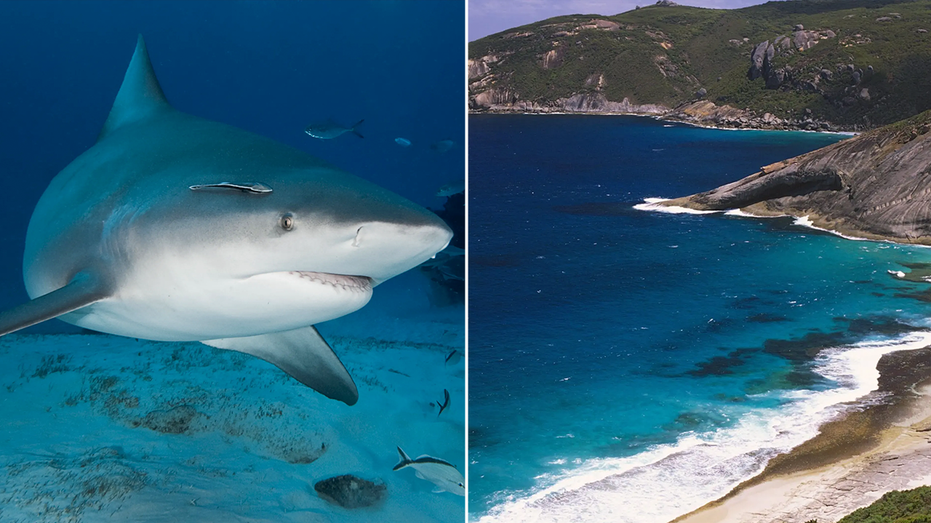
On May 24, 39-year-old Michael Jensz was killed after suffering head injuries while spearfishing along the Great Barrier Reef off the country’s northeast coast.
A bull shark is suspected in his death.
On May 16, 38-year-old Steve Mattabonni was killed by a white shark at Rottnest Island, a popular resort in Western Australia. He was also spearfishing.
Australia usually averages around three shark deaths per year.
"We do see an increase in larger sharks this time of the year, particularly chasing the sardine and the salmon along the coast, which is quite normal," commercial fisherman Gregory Sharp told the Australian Broadcasting Company Saturday.
He added that sharks also tend to attack in areas "where there's a lot of seals, and the island area in King George Sound is renowned for seals."
Michaelmas Island is located in King George Sound.
Western Australia Premier Roger Cook said in a Facebook post Saturday that he was deeply saddened to hear of this morning's fatal shark attack in Albany.
This is a tragedy and my thoughts are with the victim's family and friends, as well as the first responders."
El presidente de Rusia, Vladímir Putin, y el líder de China, Xi Jinping, mantuvieron este miércoles una ronda de conversaciones que concluyó con la firma de un amplio conjunto de…
«¿Podrán China y Estados Unidos superar la llamada ‘trampa de Tucídides’ y forjar un nuevo paradigma para las relaciones entre grandes potencias?», dijo el presidente chino Xi Jinping en la…
El presidente norteamericano, Donald Trump, se ha reunido este jueves en Pekín con su homólogo chino, Xi Jinping, para sus esperadas conversaciones sobre el comercio, la venta de armas estadounidenses…
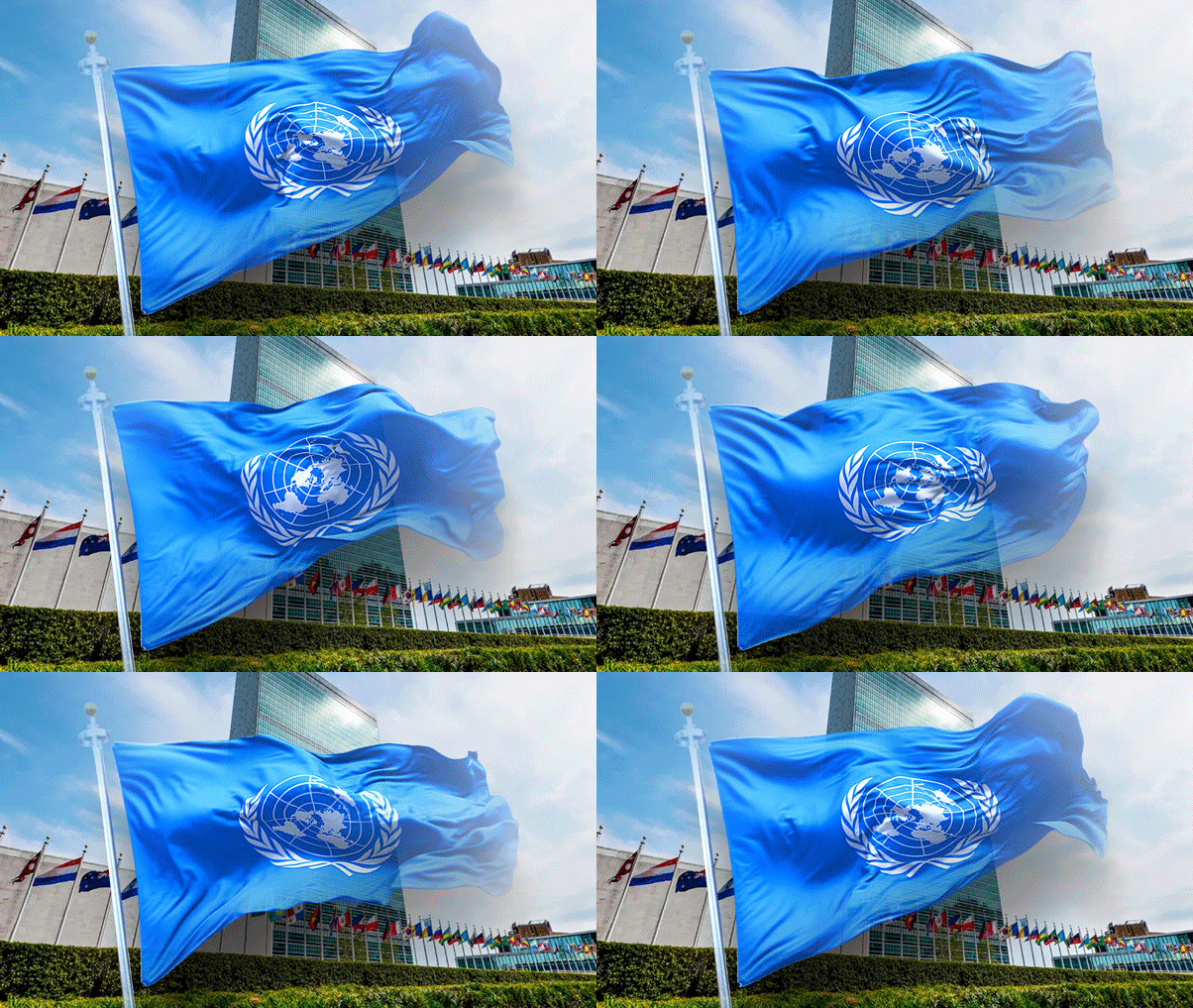
UNITED NATIONS — When Jeff Bartos appeared before the Senate Foreign Relations Committee in 2025 for his confirmation hearing, he was warned that the job he was seeking might not exist.
The Pennsylvania businessman, former political candidate and endurance athlete had been nominated by President Donald Trump to serve as U.S. ambassador for United Nations Management and Reform — a title that has long sounded aspirational in a building famous for bureaucracy.
During his confirmation hearing, Bartos recalled being greeted with a dose of skepticism.
Less than a year later, Bartos believes the impossible is beginning to happen.
In an exclusive interview with Fox News Digital, the Trump administration official laid out an ambitious campaign to reshape an institution critics say has become bloated, inefficient and increasingly disconnected from its founding mission.
The effort comes at a pivotal moment for the United Nations. The stakes extend well beyond budgets. As the U.N. confronts a cash crunch, prepares to choose its next secretary-general and faces growing scrutiny from the administration, the debate over reform has become a battle over the institution's future: whether it remains on its current course or undergoes its most significant restructuring in decades.
Secretary-General António Guterres has repeatedly warned of a growing liquidity crisis as the organization struggles with delayed member-state payments, including billions owed by the United States. At the same time, the Trump administration has made clear that future funding and support will be increasingly tied to reforms.
Bartos argues that pressure is already producing results.
Sitting at the U.N. headquarters, he points to what he calls historic achievements: roughly $570 million cut from the U.N.'s regular budget and 2,900 positions eliminated through negotiations among all 193 member states.
"Again, never happened before in 80 years," Bartos said.
"$570 million cut to the regular budget, approximately 3,000 posts cut. Unanimity. That's by consensus. All 193 countries had to come together."
For Bartos, the achievement is particularly striking because many diplomats viewed meaningful reform as impossible.
"I promised you we wouldn't let you down," he recalled telling Senate Foreign Relations Committee Chairman Jim Risch months after his confirmation.
The reforms represent only what Bartos describes as a "down payment." The next phase is already underway.
As member states negotiate peacekeeping budgets for the coming year, the administration is pushing to reduce spending, streamline missions and eliminate programs it believes no longer serve their intended purpose.
One example, Bartos said, involves changing how the U.N. reimburses countries that contribute equipment to peacekeeping missions.
Previously, reimbursement was largely based on whether equipment was present.
"The methodology that the U.N. used to reimburse troop-contributing countries for equipment was: 'Is it there?'" Bartos said.
The United States pushed for a simple change: "You get reimbursed when the equipment is put into action to do work."
The reform could save roughly $30 million annually, according to U.S. estimates.
For Bartos, however, the dollar figure matters less than what it represents.
"It's a culture change," he said. "Being efficient, being respectful of every dollar, thinking about the taxpayers who fund all this."
That mindset is driving the administration's next major targets: employee compensation and pensions.
Bartos argues that the U.N.'s pension system and benefits structure consume resources that could otherwise be directed toward humanitarian operations.
Not everyone at the United Nations agrees with Bartos' assessment. U.N. officials argue that many of the reforms predate the Trump administration and were already being pursued under Guterres.
"From day one, the secretary-general has been committed to reforms," U.N. spokesman Stéphane Dujarric told Fox News Digital. "A few days ago, on 28 May, the secretary-general told member states that they need to act on structural reform, saying, ‘Genuine reform requires tough choices. This is no time for complacency, self-interest, or foot-dragging.’"
The UN80 initiative is Guterres' flagship reform effort, aimed at cutting duplication, reviewing mandates and making the U.N. system more efficient.
Still, Bartos argues the pace and scope of reform changed dramatically once the United States began applying pressure through budget negotiations and funding discussions.
"The U.N. is at a decision point," Bartos told Fox News Digital.
The debate comes as the organization faces mounting financial pressure. Dujarric said Guterres remains deeply concerned about ongoing liquidity challenges caused by delayed payments from member states, including the United States.
"Unlike a government, the U.N. cannot borrow or print money," Dujarric said, warning that the organization is expected to execute programs with funds it has not received while also returning unused funds at the end of the year.
Earlier in 2026, Guterres urged member states either to pay their assessed contributions in full and on time or overhaul the U.N.'s financial rules to prevent what he described as the risk of financial collapse.
The reforms are unfolding as the U.N. begins preparing for one of the most consequential transitions in years: the search for a successor to Guterres, whose term expires at the end of 2026.
According to Bartos, reform has become a central topic in discussions with prospective candidates.
The administration hopes the next secretary-general will embrace efforts to reduce bureaucracy and return the institution to what Bartos repeatedly describes as a "back-to-basics" approach.
The challenge, he acknowledges, is enormous.
Yet Bartos insists the experience has prepared him in unexpected ways.
Before entering government, he completed two Iron Man triathlons while balancing work and family life.
"It's discipline, planning, prioritization," he said. "It's not dissimilar to budget negotiations."
The comparison may sound unusual, but it reflects how Bartos views the job: not as a sprint but as an endurance race requiring patience, persistence and long-term thinking.
After two unsuccessful statewide campaigns in Pennsylvania — first as the Republican nominee for lieutenant governor in 2018 and later as a candidate in the state's 2022 Republican Senate primary — Bartos said he had largely stepped away from politics before returning to public service following the Oct. 7, 2023, Hamas attacks on Israel.
Bartos recalled his wife urging him to get involved: "You've spent your life working on these issues. You need to do something."
He ultimately joined efforts to help elect Trump and later accepted the U.N. role.
Now, after tackling what many considered the first impossible mission — reforming the United Nations — Bartos is preparing for what may prove an even harder challenge.
Bartos said he was recently tasked by U.S. Ambassador to the U.N. Mike Waltz with helping lead efforts to combat what the administration views as entrenched anti-Israel bias across the U.N. system, including agencies, special rapporteurs and investigative bodies.
The debate intensified following the publication of the U.N. secretary-general's annual report on conflict-related sexual violence, which added Israeli security forces to the report's blacklist of parties credibly suspected of patterns of sexual violence in armed conflict. Israel rejected the allegations and announced it would suspend engagement with Secretary-General António Guterres' office.
Responding to the report, Waltz told Fox News Digital the U.N. has failed to address what he described as a longstanding pattern of institutional antisemitism.
"The U.N. was built in the wake of World War II and the Holocaust, and yet, remarkably, it continues to be weaponized against the Jewish people and Israel," Waltz said. "Whether it's a U.N. official regularly referencing Israel as a 'stain on humanity' and attacking American companies for doing business with Israel, or reports that spread misinformation and propaganda, this antisemitism is completely unacceptable.
"It's been over a year since the secretary-general signed off on an 'action plan' to fight antisemitism at the institution. It would be nice if the institution actually used it."
Bartos argues that anti-Israel bias has become embedded across multiple U.N. bodies and says the administration is working to dismantle what he calls that infrastructure through diplomacy, funding decisions and engagement with the next generation of U.N. leadership.
"There is not a day that goes by that we're not working on that," Bartos said.
The United Nations rejects accusations that it has ignored antisemitism within its ranks.
Dujarric told Fox News Digital the secretary-general launched a formal Action Plan to Combat Antisemitism in January 2025 aimed at tracking antisemitism within U.N. structures and evaluating whether the organization's policies and actions are effectively addressing the problem.
Dujarric also disputed suggestions that Guterres directly controls some of the U.N. bodies most frequently criticized by Israel and its supporters.
"The U.N. mechanisms that you allude to, including human rights mechanisms, are created by and accountable to member states," Dujarric said. "The secretary-general has no authority over them.
"It is very important for member states to actively engage in these mechanisms if they have concerns about their content and tone.
"The U.N. is at a decision point."
Whether the institution changes enough to satisfy its largest financial contributor remains one of the most consequential questions facing the organization, and the man charged with answering it insists the work is only beginning.
A Sherpa guide whose family had already begun funeral rituals after he vanished on Mount Everest was found alive and crawling toward base camp nearly a week later, surviving alone on the world's highest peak without food, water or supplemental oxygen in what rescuers called "nothing short of a miracle."
Dawa Sherpa, 52, disappeared around May 29 while descending Everest after turning back short of the summit with a Polish climber he was guiding. The client made it safely to base camp, but Dawa had not, triggering fears that he had died on the mountain.
A cleanup crew from the Sagarmatha Pollution Control Committee found him Thursday morning crawling through the treacherous Khumbu Icefall, one of the most dangerous sections of Everest, just above base camp, Pemba Sherpa of 8K Expeditions told The Associated Press.
Rescuers carried him to safety, gave him food and water, and flew him by helicopter to a hospital in Kathmandu, where his wife and daughter were waiting.
His teenage daughter, Mendo Lhamu Sherpa, told the outlet that relatives were in the middle of funeral rites when news of the rescue broke.
"When we first heard about it (the rescue), we could not be sure if that person was indeed our father," she said. "So to be certain we asked for photos to be sent and then only we were sure and very happy."
His wife, Damu Sherpa, added that the family learned he was alive through local news reports and phone calls from friends.
"We first heard that he was still alive on the local news and from a person we know who called with the news that ... he is being brought down," she said.
Dawa was still wearing his climbing jacket when rescuers found him. His family said he is being treated for frostbite and other complications but is conscious and able to speak.
"He recognized me … is good and speaks," his daughter told Reuters. "We are happy."
The Nepal Mount Everest hiking company called his survival extraordinary.
"Dawa survived alone for nearly a week without food, water, or supplemental oxygen navigating the treacherous Khumbu Icefall (even after the fixed ladders were removed for the season)," the company said in a social media post. "This is nothing short of a miracle."
It was unclear how Dawa became separated from his client during the descent or why there was a delay in launching a search team when he went missing last week. Helicopters were eventually dispatched but failed to locate him.
His rescue came at the end of a record-breaking Everest climbing season. More than 1,000 climbers and guides reached the summit this year after Nepal issued a record 494 permits.
Indigenous Peoples in Voluntary Isolation and Initial Contact (PIACI) in the Yavarí-Tapiche Territorial Corridor, one of the largest contiguous, intact forests in the Amazon and home to the world’s highest concentrations of PIACI, are under threat by extractive and large-scale industrial activities, which pose an existential threat to its inhabitants and the ecosystems they depend on. This is according to a new report co-authored by Earth Insight, the Regional Organization of Indigenous Peoples of the East (ORPIO), the Coordination of the Indigenous Organizations of the Brazilian Amazon (COIAB) and the Interethnic Association for the Development of the Peruvian Rainforest (AIDESEP). The report finds that oil and gas blocks overlap with 10% of the 16-million-hectare (39.5-million-acre) corridor, including almost 1.7 million hectares (4.2 million acres) of intact tropical moist forest, 907,000 hectares (2.2 million acres) of Key Biodiversity Areas and 713,000 hectares (1.8 million acres) of protected areas. “Pressure from hydrocarbons is increasing on the Peruvian side of the Yavarí Tapiche corridor,” Edith Espejo, senior program manager at Earth Insight and author of the report, told Mongabay over WhatsApp messages. “Our report serves as a warning for the irreversible harm that could take place if these oil blocks move into this corridor. Mining concessions within and on the peripheries of the corridor also pose a threat of encroachment and contamination of waterways.” A critical corridor for ecosystems and Indigenous communities The Yavarí-Tapiche Corridor covers Brazil’s western border states of Amazonas and Acre and Peru’s Loreto and Ucayali departments in the Amazon…This article was originally published on Mongabay
The Logitech G512 X 98 lets you swap between mechanical and analog switches in an attempt to achieve the best of both worlds. Unfortunately, its solution isn't as well thought out as I’d hoped.
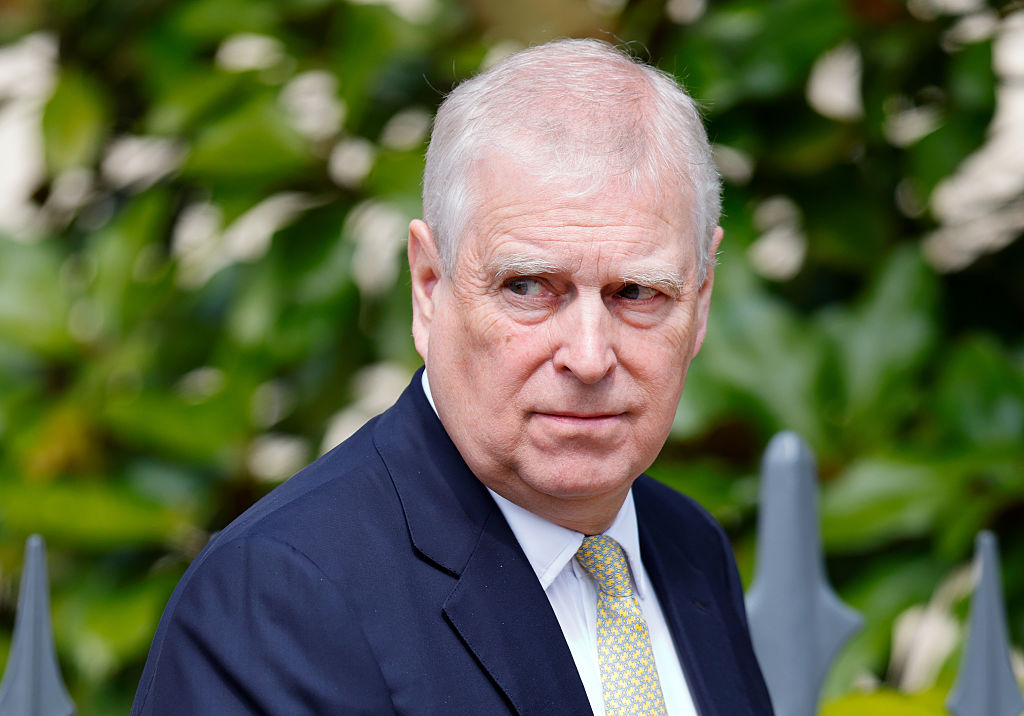
A National Audit Office report said Mountbatten-Windsor had received income from renting out three cottages on the Royal Lodge estate, his former home near Windsor Castle.
A National Audit Office report said Mountbatten-Windsor had received income from renting out three cottages on the Royal Lodge estate, his former home near Windsor Castle.
BANGKOK — Seven hundred days after activists from the environmental group Mother Nature Cambodia were imprisoned on charges widely regarded as retaliatory for their activism, 73 international and Cambodian civil society organizations have renewed calls for their unconditional release. After a trial lasting just over a month, 10 activists from Mother Nature Cambodia were sentenced on July 2, 2024, to between six and eight years in prison. Only five of the defendants attended the hearings, which saw Long Kuntha, 28, Ly Chandaravuth, 26, Phuon Keoraksmey, 25, and Thun Ratha, 34, each sentenced to six years behind bars for plotting against the government; fellow activist Yim Leanghy, 36, received an eight-year sentence for both plotting against the government and insulting the king. The five activists who did not attend the trial were sentenced in absentia. The appeals hearing for all 10 convicted activists was slated to take place on June 2, but has been postponed indefinitely by the Phnom Penh Court of Appeals. “The MNC5 are incarcerated in prisons in overcrowded and harsh living conditions, separated from each other and spread out all across Cambodia, hundreds of kilometers away from their families and legal counsel,” wrote the 73 NGOs in an open letter addressed to Prime Minister Hun Manet. “The … NGOs who have signed this letter sincerely request you take immediate action to ensure the unjust convictions of these five activists are reversed either prior to or at their upcoming appeals court hearing in Phnom Penh, and that their freedom…This article was originally published on Mongabay

 Login
Login