
Normal view

US adversaries China, North Korea strengthening ties as Xi, Kim set to begin talks

8 June 2026 at 07:55

A pair of U.S. adversaries — China and North Korea — appear to be strengthening relations, with Chinese President Xi Jinping's arrival in Pyongyang on Monday for a rare state visit.

This is Xi's first trip to North Korea in seven years, and experts say the visit is likely aimed at reasserting China’s unique influence over North Korea in exchange for providing economic and political benefits.

Xi is scheduled to meet North Korean leader Kim Jong Un in what will be their first summit since September, when they met in Beijing after viewing a military parade alongside Russian President Vladimir Putin and other foreign leaders.

No specific agenda has been mentioned, but foreign experts predict the meeting to have a significant impact on bilateral ties and more, as both sides seek to fully restore their traditional alliance amid separate disputes with the U.S. government.

NORTH KOREA UPDATES CONSTITUTION TO REQUIRE AUTOMATIC NUCLEAR STRIKE IF KIM JONG UN ASSASSINATED: REPORT

Xi’s trip comes after his back-to-back summits with U.S. President Donald Trump and Putin in Beijing last month. Xi plans to meet Trump again for a U.S. visit in September.

China has, for years, been North Korea's economic lifeline and primary diplomatic backer. China has refrained from fully enforcing U.N. sanctions on North Korea and sent clandestine aid to support its impoverished neighbor.

This year marks 65 years since the two nations signed a mutual defense treaty.

Despite this, there have been questions about their ties in recent years, as North Korea has prioritized cooperation with Russia by supplying troops and weapons to support its war against Ukraine and received economic and military assistance from Moscow in return.

Experts warn that restoring China's exclusive influence over North Korea would give Xi leverage with Trump, who has repeatedly expressed his wish to restart diplomacy with Kim.

Analysts said Xi would likely offer Kim economic aid packages such as shipments of rice and fertilizers, a resumption of Chinese group tourism to North Korea and joint economic projects.

Xi may also avoid the issue of denuclearization of North Korea, which wants to achieve international recognition as a nuclear weapons state, as a way to call for lifting of U.N. sanctions on North Korea, according to experts.

After last month’s summit between Trump and Xi, the U.S. government said the two leaders affirmed their shared goal to denuclearize North Korea.

But China only said the leaders spoke about the nuclear issue on the Korean Peninsula. Kim’s sister and senior official Kim Yo Jong dismissed the readout of the meeting as "false information."

NORTH KOREAN DICTATOR SAYS GOVERNMENT WILL KEEP CEMENTING NATION'S 'IRREVERSIBLE STATUS AS A NUCLEAR POWER'

Last week, Kim unveiled a new plant to produce nuclear ingredients and pledged to bolster the country’s nuclear forces "at an exponential rate." He also said he is seeking to speed up efforts to build a nuclear-armed navy.

On Sunday, Kim Yo Jong described a U.S. plan for the denuclearization of North Korea as an "escapist and anachronistic dream."

CLICK HERE TO DOWNLOAD THE FOX NEWS APP

Kim Jong Un has dismissed U.S. and South Korean offers for talks as he focuses on enlarging and modernizing his nuclear arsenal. The North Korean leader in September urged the U.S. to withdraw its demand for North Korea to denuclearize as a precondition for resuming diplomacy.

The Associated Press contributed to this report.

Pro-US conservative faces leftist in Peru's high-stakes presidential runoff

7 June 2026 at 11:00

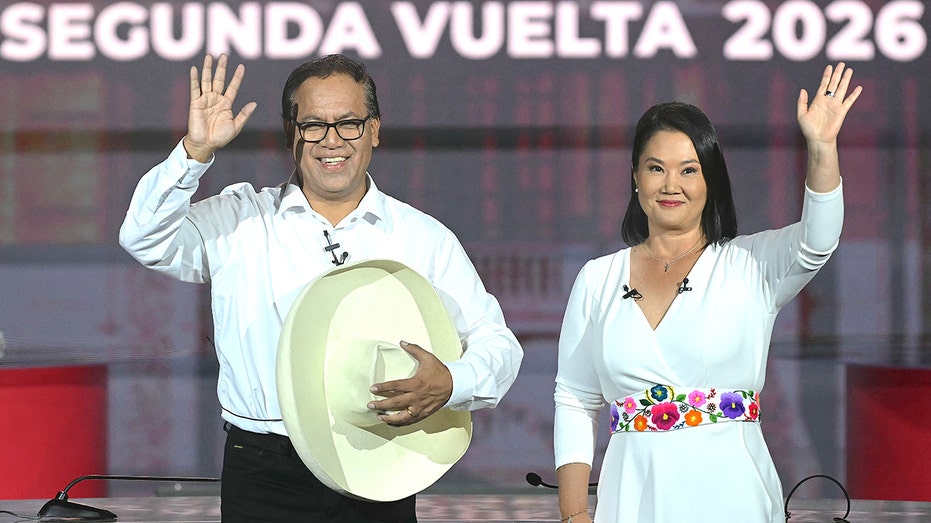
Peruvians head to the polls in a pivotal presidential runoff June 7 in an election that could reshape not only the country’s future but also the balance of power across Latin America.

Two candidates are vying to become the country's ninth president in just 10 years. Conservative candidate Keiko Fujimori is campaigning on law and order, free-market policies and closer ties with the United States, while left-wing challenger Roberto Sánchez represents a political movement that many see as a continuation of the leftist currents that have challenged U.S. interests in the region.

José Ignacio Beteta, executive director of Asociación de Contribuyentes, a think tank in Peru, told Fox News Digital, "Peru’s June 7 runoff carries consequences well beyond its borders. When analyzed against the current U.S. National Security Strategy, this election will determine whether Peru consolidates its alignment as a U.S. partner or devolves into deeper geopolitical contention. Peru’s institutional weakness has already allowed China to expand into strategic sectors."

MEET ‘CHINA’S MAN IN LIMA’ WHO JETTED OVER TO US TO COLLECT TRAINS DONATED BY BIDEN ADMIN

Beteta added, "Meanwhile, the vote is seen as a choice between a return to freer and more competitive economic and security policies with Fujimori and a second attempt at left-wing governance with Sanchez, a binary that mirrors South America’s broader ideological fractures."

The election follows years of political instability in Peru, a country that has seen multiple presidents removed from office over the past decade and remains deeply divided between urban and rural constituencies.

Sunday’s election's outcome is expected to be very close, with the possibility of a final result not being known for days, according to the Associated Press. 

For Washington, Peru’s election represents more than a domestic political contest. It is another test of the broader political direction of Latin America. Over the past several years, several countries in the region have experienced electoral shifts toward center-right or conservative governments, including Argentina under Javier Milei and Ecuador under Daniel Noboa who are all more friendly to Washington.

A Fujimori victory would reinforce that trend and could position Peru alongside a growing bloc of governments favoring tougher approaches to crime, stronger ties with the United States and market-oriented economic policies.

Presidential candidate Keiko Fujimori told Fox News Digital that if she wins, "My government's foreign policy will be based on a very clear premise: defending Peru's interests. Specifically, regarding the United States, my government will seek a relationship of cooperation, mutual respect and investment promotion. We welcome the Trump administration's renewed perspective on Latin America and, especially, on Peru, which occupies a strategic geopolitical position in the region."

Fujimori continued: "We want to seize this opportunity by generating greater stability, legal certainty, and confidence for investment. Peru must always be a country open to the world, committed to freedom, free competition, and the free market. Our goal is to lay the groundwork so that investors from the United States and around the world find in Peru a reliable, stable, and attractive country in which to invest, produce, and create jobs."

Fox News Digital reached out to Sánchez’ campaign but did not get a response.

ALLIANCE WITH US ‘DISMANTLED’ BY LEFTIST PETRO REGIME, COLOMBIA’S FORMER DEFENSE MINISTER SAYS

Peruvian analyst and legal expert Lucas Ghersi told Fox News Digital, "Roberto Sánchez represents a rather radical left. His platform includes nationalizations and expropriations, and he is close to Evo Morales and Nicolás Maduro. This election is highly polarizing Peruvian society."

Ghersi continued, "If Keiko Fujimori wins, she would have a good relationship with the United States. She is a reasonable person who defends the constitutional framework and the rule of law, and she has ties to the United States because she has done academic work at Florida International University (FIU).

"Roberto Sánchez, on the other hand, would create tension in the relationship with the United States. During his campaign and in the presidential debate, he bitterly criticized Peru's purchase of F-16 jets from the United States. He said that Peru shouldn't buy from the United States and should instead use that money for health or education. He also has ties to illegal mining and has been accused of drug trafficking. This could create tensions in the relationship with the United States."

TRUMP LOOMS LARGE AS BIDEN SET TO MEET CHINA'S XI DURING LATIN AMERICA SUMMITS

Ghersi concluded, "Peru is a very strategic country and has been the focus of competition between the United States and China. Peru has one of the largest proven copper reserves and is a major gold producer. Therefore, both China and the United States are vying for influence in Peru, and China has been promoting mega-investment projects there, such as a mega-port that is already operational. In response, the United States offered to renovate the Peruvian Navy's base and invest in large port projects."

A Fujimori victory would likely be interpreted in Washington as a continuation of the recent trend toward center-right governance in parts of Latin America. Fujimori has campaigned on restoring public security, strengthening economic growth, and maintaining Peru’s market-oriented model. Her supporters argue that these policies could encourage greater foreign investment and closer cooperation with the United States on security and economic issues.

CLICK HERE TO DOWNLOAD THE FOX NEWS APP

A Sánchez victory would present a different scenario. Although he has recently moderated portions of his platform, emphasizing respect for private property, free trade agreements and macroeconomic stability, questions remain about how his administration would approach relations with Washington and regional left-wing movements.

The next Peruvian president will help determine whether one of South America’s most important countries moves closer to Washington, or charts a leftward course.

The Associated Press reports that voting is mandatory in Peru for citizens from the ages of 18 to 70, with more than 27 million people registered.

The Associated Press contributed to this report.
❌