Normal view

Afipsky oil refinery burns again as Ukrainian drones return to Krasnodar Krai

11 June 2026 at 10:14

afipsky oil refinery burns again ukrainian drones return krasnodar krai · post fire after drone strike russia 11 2026 5282989402957225318 ukraine news reports

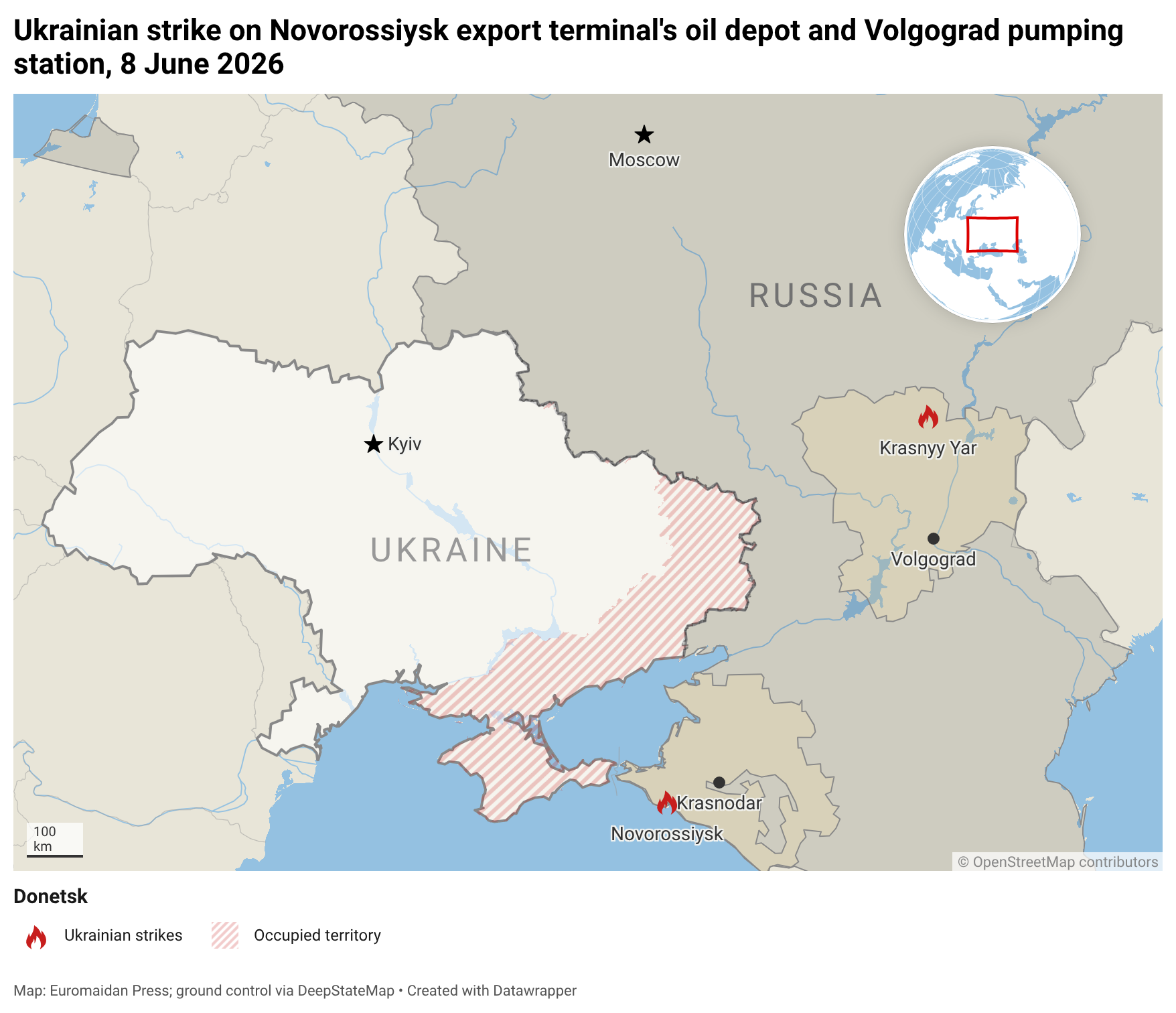
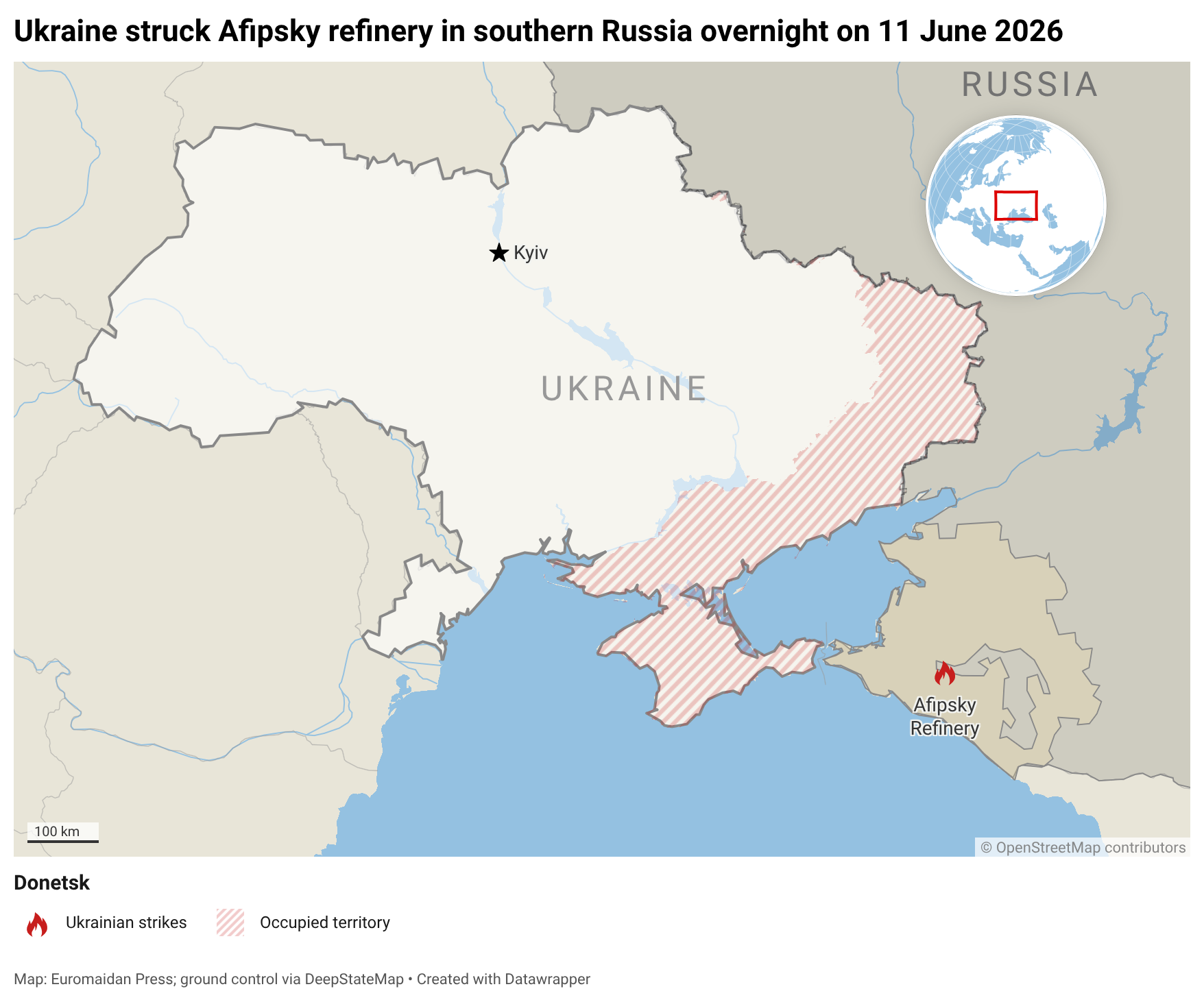
Ukrainian drones struck the Afipsky oil refinery in Russia's Krasnodar Krai overnight on 11 June, sparking a fire later extinguished, according to the Krasnodar Krai operational headquarters. The southern Russian plant, repeatedly targeted by Ukrainian strikes, supplies fuel to the Russian military.

Amid the ongoing Russo-Ukrainian war, the Russian oil industry has been under sustained pressure from Ukrainian deep strikes, with gasoline rationing currently spreading across multiple regions and occupied territories. Output at Russian refineries has been falling on Rosstat's own index as repeated hits keep facilities offline.

A blaze at one of southern Russia's largest refineries

The Ukrainian Telegram channel Exilenova+ posted footage from local witnesses showing air defense fire and a blaze. The attack started after midnight, with residents reporting drone overflights and explosions at intervals of a few minutes. 
Krasnodar Krai authorities claimed drone "debris" fell in the village of Afipsky and set the refinery on fire — Moscow's standard framing for Ukrainian strikes on Russian energy targets. The fire was out by 07:32 Moscow time, the operational headquarters later stated. Russian authorities reported no casualties at the plant itself.

The Afipsky plant is one of southern Russia's largest oil-processing facilities, with a capacity of over 6 million tons of crude a year. It produces gasoline, diesel, gas oil, vacuum gas oil, fuel oil, sulfur, and gas condensate distillates. The facility supplies fuel to the Russian army. Ukraine's General Staff has assessed that the refinery processes about 2.1% of Russia's total oil refining.

The plant runs two primary oil distillation units with capacities of 9,786 and 8,829 tons per day. It is export-oriented and does not currently produce gasoline or diesel for Russia's domestic market. Combined throughput at the Afipsky plant and the affiliated Krasnodar refinery reached 7.2 million tons in 2024. Another 3 million tons were processed in the first half of 2025.
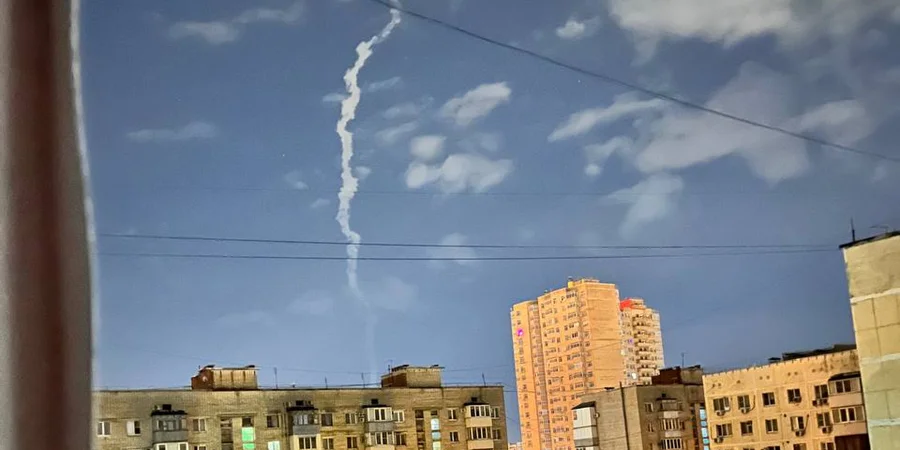
afipsky oil refinery burns again ukrainian drones return krasnodar krai · post smoke trail over amid drone attack russia 11 2026 краснодар у росії атакували дрони вночі червня року exilenova+
Smoke trail over Krasnodar amid a Ukrainian drone attack, Russia, 11 June 2026. Photo: Exilenova+ Telegram channel

Third strike on Afipsky in 2026 amid wider drone campaign

Russia's Defense Ministry claimed its air defenses intercepted and destroyed 330 Ukrainian drones over Russian territory overnight, the Moscow Times reported. According to the ministry, drones were spotted over Bryansk, Kursk, Belgorod, Oryol, Smolensk, Kaluga, Tula, Tver, Vladimir, and Moscow oblasts, as well as Krasnodar Krai and occupied Crimea. Russian aviation regulator Rosaviatsia restricted operations at airports in Tambov, Krasnodar, Sochi, Gelendzhik, and Zhukovsky outside Moscow.
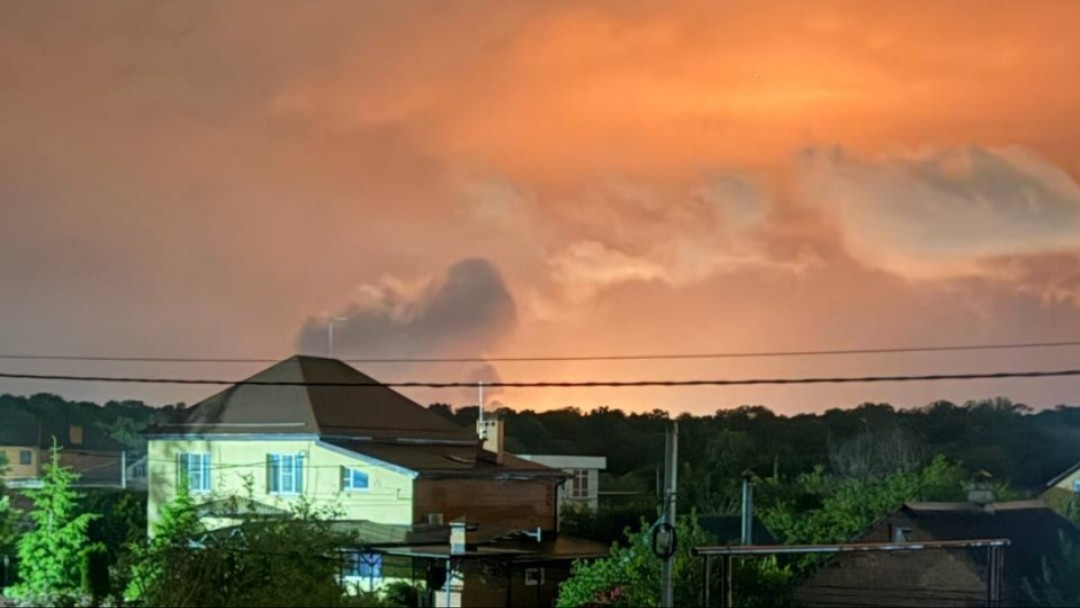
afipsky oil refinery burns again ukrainian drones return krasnodar krai · post smoke plume after drone strike russia 11 2026 пожежа на афіпському нпз в рф червня telegram-канал exilenova+ ukraine
Smoke plume after a Ukrainian drone strike on the Afipsky oil refinery, Krasnodar Krai, Russia, 11 June 2026. Photo: Exilenova+ Telegram channel

The 11 June raid was the third attack on the Afipsky refinery this year, following hits on 21 January and 14 March. During the March hit, drones damaged the AT-22/4 primary oil processing unit at Afipsky — the plant's refining starting point. Satellite imagery had previously confirmed structural damage from a November 2025 drone attack.

India Completes Key Himalayan Tunnel Near China Border

10 June 2026 at 19:01
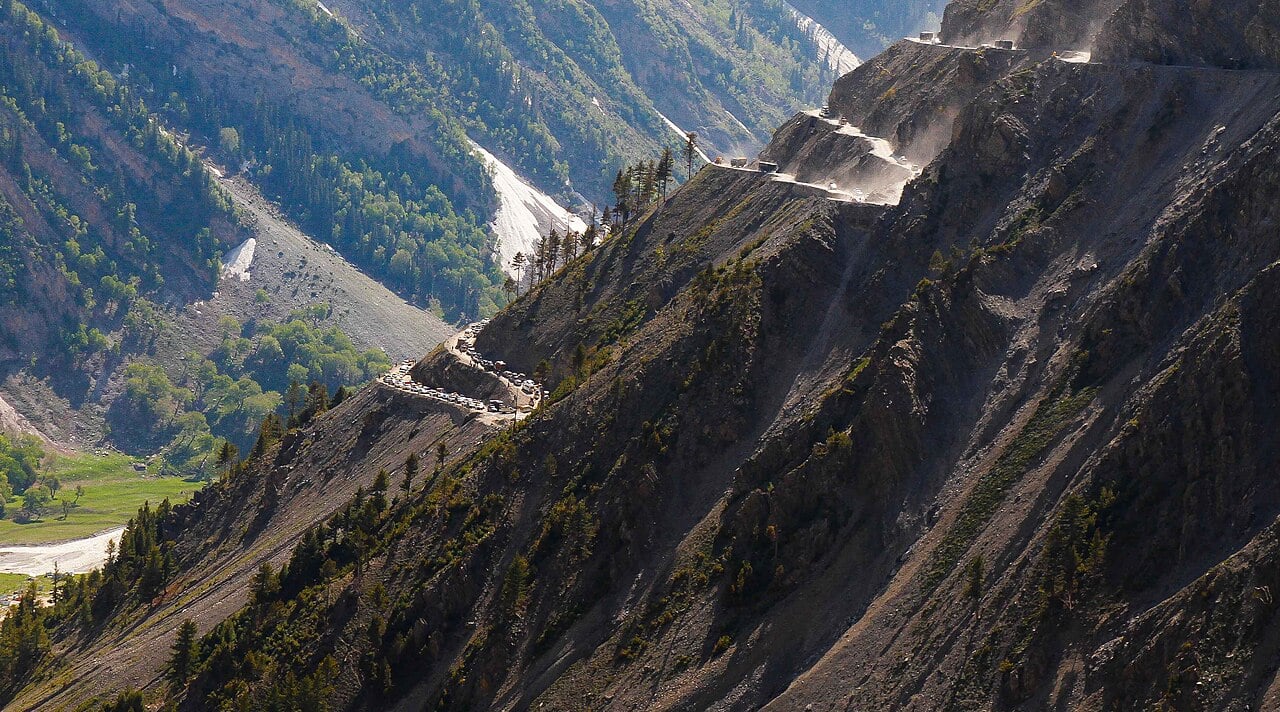
Road to Zoji La Pass from Srinagar
Road to Zoji La Pass from Srinagar. Credit: VinayakPhadatare / Wikimedia Commons / CC BY-SA 4.0

On Tuesday, engineers working inside a Himalayan mountain completed the final blast of a critical tunnel that links India’s Kashmir Valley to its Ladakh frontier with China, marking a key step in the country’s push to secure year-round access to one of its most sensitive border areas.

The Zojila Tunnel, stretching 13.14 kilometers (8.2 miles) beneath the mountains, will become India’s longest road tunnel once finishing work is done, with full operation expected by 2028.

Road Minister Nitin Gadkari remotely triggered the last detonation at the eastern portal near Minimarg in Ladakh, joining excavations driven from both ends of the mountain over more than five years.

Gadkari described the project as far more than a transport link, saying it serves as a vital lifeline for communities cut off by winter weather.

Project engineer Manmohan Singh said the team completed the job without a single accident despite working through extreme cold and difficult conditions around the clock.

Himalayan tunnel gives India year-round access near China

The Zojila Pass, which the tunnel cuts beneath at an elevation of 11,578 feet, currently shuts down every winter under heavy snowfall that can pile well above the roof of a large truck, blocking road travel between Srinagar and Leh for months. More than 3,000 workers have been involved in excavation since October 2020.

In Photos | Zojila Tunnel Poised for Historic Breakthrough

Security personnel stand guard outside the Zojila Tunnel in Minamarg ahead of the landmark breakthrough ceremony of the ₹6,500-crore project. Set to provide all-weather connectivity between Kashmir and Ladakh, the… pic.twitter.com/PkM4tqDIC3

— Kashmir Observer® (@kashmirobserver) June 9, 2026

This tunnel is one of four major passages in a $712 million road corridor that also includes the 6.5-kilometer (4 miles) Sonamarg tunnel, with all components targeted for full operation by 2028.

Beyond road access, India launched a $3.9 billion railway from its lowland plains to Kashmir in June 2025, as reported by Al Jazeera, featuring the Chenab Rail Bridge, currently the world’s tallest railway bridge.

The 272-kilometer (169 miles) line starts at Udhampur, the base of the Indian Army’s northern command.

Billions in rail and roads back India’s border push

The push behind all these projects traces to a deadly confrontation in Galwan Valley in June 2020, when Indian and Chinese soldiers fought hand-to-hand at high altitude, killing 20 Indian troops.

The clash set off an accelerated construction race on both sides of the 3,500-kilometer (2,175 miles) shared border.

The Himalayan tunnel is central to India’s effort to close the infrastructure gap with China, where both countries completed troop disengagement at contested frontier points in October 2024, as reported by The Diplomat.

Kashmir has been split between India and Pakistan since the end of British rule in August 1947, with both countries claiming it in full.

Greece’s Aging Water Networks Face Losses of More Than 50% in Some Areas

10 June 2026 at 12:37
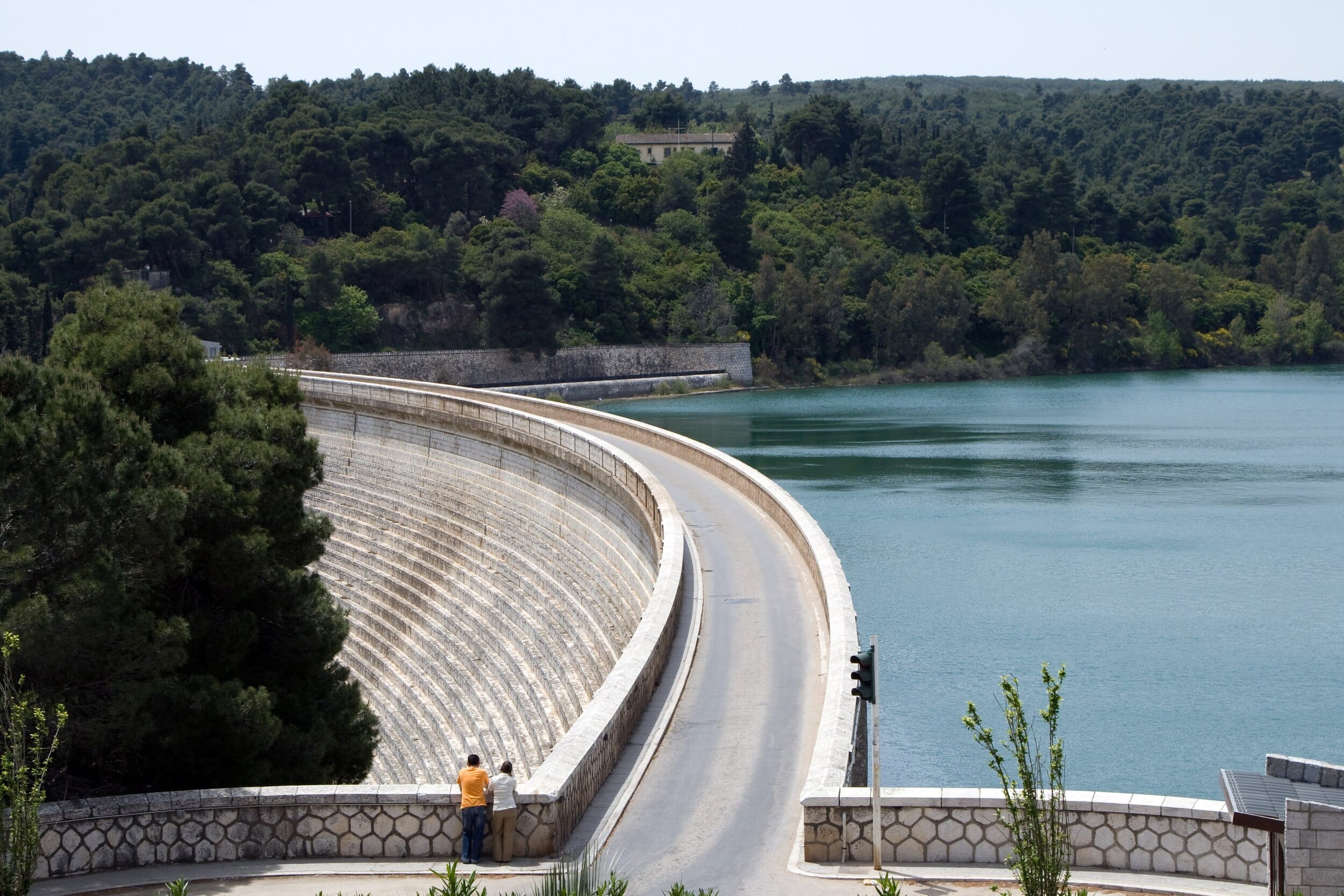
Lake Marathon Dam in Greece, with a curved stone dam wall, reservoir water, and forested hills in the background.
Lake Marathon Dam in Greece. The country’s aging water networks are facing growing pressure from water loss, drought, and rising investment needs. Credit: Vitaly / Wikimedia Commons / CC BY-SA 3.0

Water loss in parts of Greece’s aging water networks exceeds 50 percent, according to a new analysis by EY-Parthenon, highlighting the urgent need for infrastructure upgrades and a new approach to water management.

The report warns that climate pressures, prolonged drought, declining water reserves, and outdated infrastructure are pushing Greece’s water sector to a critical turning point.

Greece’s water networks are now increasingly viewed as core national infrastructure with direct implications for economic stability, environmental protection, and long-term public planning.

A loss of over 50% in some of Greece’s aging water networks

According to EY-Parthenon, the global strategy consulting arm of Ernst & Young (EY), water losses across Greek networks exceed 30 to 40 percent in many cases, while certain areas face losses of over 50 percent. The high losses reflect aging infrastructure, insufficient maintenance, limited monitoring of water flows and consumption data, and the need for more efficient management systems.

The analysis also notes that water reuse remains extremely limited in Greece, at around two percent. At the same time, irrigation accounts for approximately 85 percent of total water consumption. More than 70 percent of irrigation water comes from underground reserves, which highlights the need for more efficient resource use and a more pronounced shift toward circular water management.

Fragmented water sector faces growing pressure in Greece

EY-Parthenon identifies fragmentation as one of the main weaknesses of Greece’s water management sector. The market includes 129 municipal water and sewage companies, more than 450 irrigation organizations, and a broad network of local authorities. This dispersed operating model makes coordination harder, limits economies of scale, and slows modernization projects.

The challenge becomes more urgent as the sector faces increasing demands related to resilience, governance, service quality, and regulatory compliance. Numerous smaller providers remain under financial pressure, as revenue from water bills often does not fully cover operating costs or support major infrastructure investments.

Greece’s water infrastructure needs reach €10 billion

Although the sector faces serious structural problems, EY-Parthenon sees significant room for investment in Greece’s water market. The country’s medium- and long-term infrastructure needs stand at around €10 billion ($11.5 billion). Meanwhile, Greece’s two largest water companies have planned or ongoing investments that exceed €3 billion ($3.46 billion).

These investments focus on network upgrades, expansion, modernization, and efficiency improvements. According to the report, investor confidence in the sector also continues to rise, as shown by the recent market performance of listed companies operating in the water industry.

New rules could reshape Greece’s aging water networks

Changes in Greece’s regulatory framework could further transform the sector. The expanded role of the Regulatory Authority for Waste, Energy and Water (RAAEY), stricter European obligations on wastewater management, and efforts to reduce fragmentation are shifting reform from discussion to implementation.

These changes create opportunities, but they also impose new requirements on water providers. They call for greater transparency, more rigorous reporting obligations, improved accountability, and more reliable long-term planning. EY-Parthenon emphasizes that the sector’s future challenges are not only technical. They also involve financial sustainability, pricing policies, digital transformation, investment priorities, and cooperation between public and private stakeholders.

Russian crude reaches the sea through tunnels under a mountain ridge—and Ukraine hit the storage end near Novorossiysk

8 June 2026 at 12:12

russian crude reaches sea through tunnels under mountain ridge—and ukraine hit storage end near novorossiysk · post smoke fire rise over after ukrainian drone strike grushovaya oil depot krasnodar krai

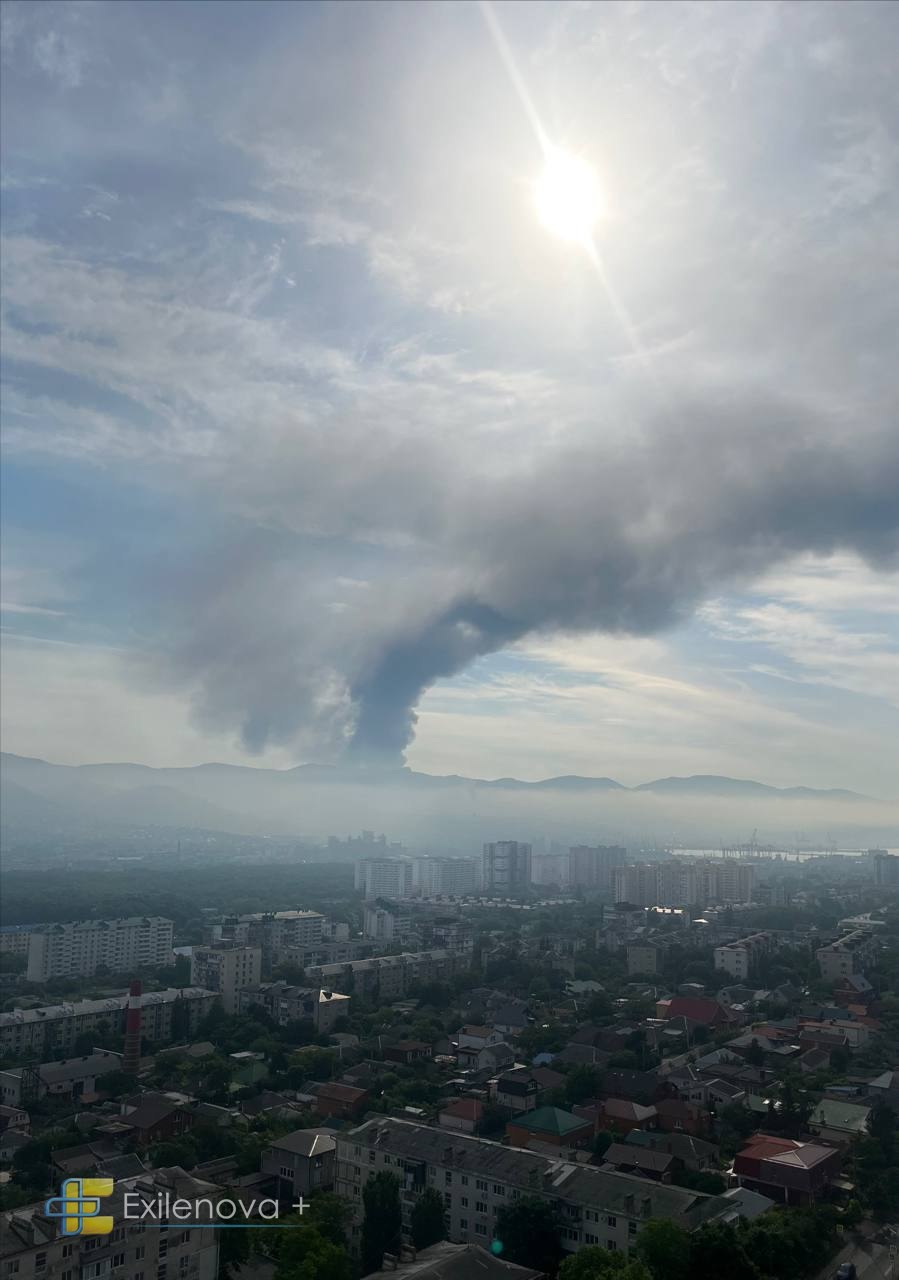
Ukrainian drones set a major oil depot ablaze near the Russian Black Sea port of Novorossiysk overnight on 7-8 June 2026, in a strike confirmed by Ukraine's Unmanned Systems Forces (SBS). Residents reported a string of blasts and heavy smoke over the Grushovaya storage site, which feeds Russia's busiest oil-export port. Ukrainian forces hit two more targets in southern Russia the same night.

Ukraine has spent the past year pushing its deep-strike campaign further into Russia, hunting the refineries, pipelines, and export ports that turn crude into the cash funding the invasion. Each hit on this Black Sea network forces costly repairs and brief loading halts, and steady Ukrainian success deep in Russia's rear, alongside a steadier front, is shifting how the West reads the war.

Drones spark a blaze at Novorossiysk's oil hub

The strike came before dawn. Residents of Novorossiysk, in Russia's Krasnodar Krai, reported about 50 blasts, then heavy smoke over the Grushovaya oil depot. Operators of the SBS's 1st Separate Center, working with Special Operations Forces (SSO) and other units, confirmed the hit. Ukraine's General Staff also confirmed the strike and said a fire broke out, with damage still being assessed. Russian officials claimed no one was hurt.

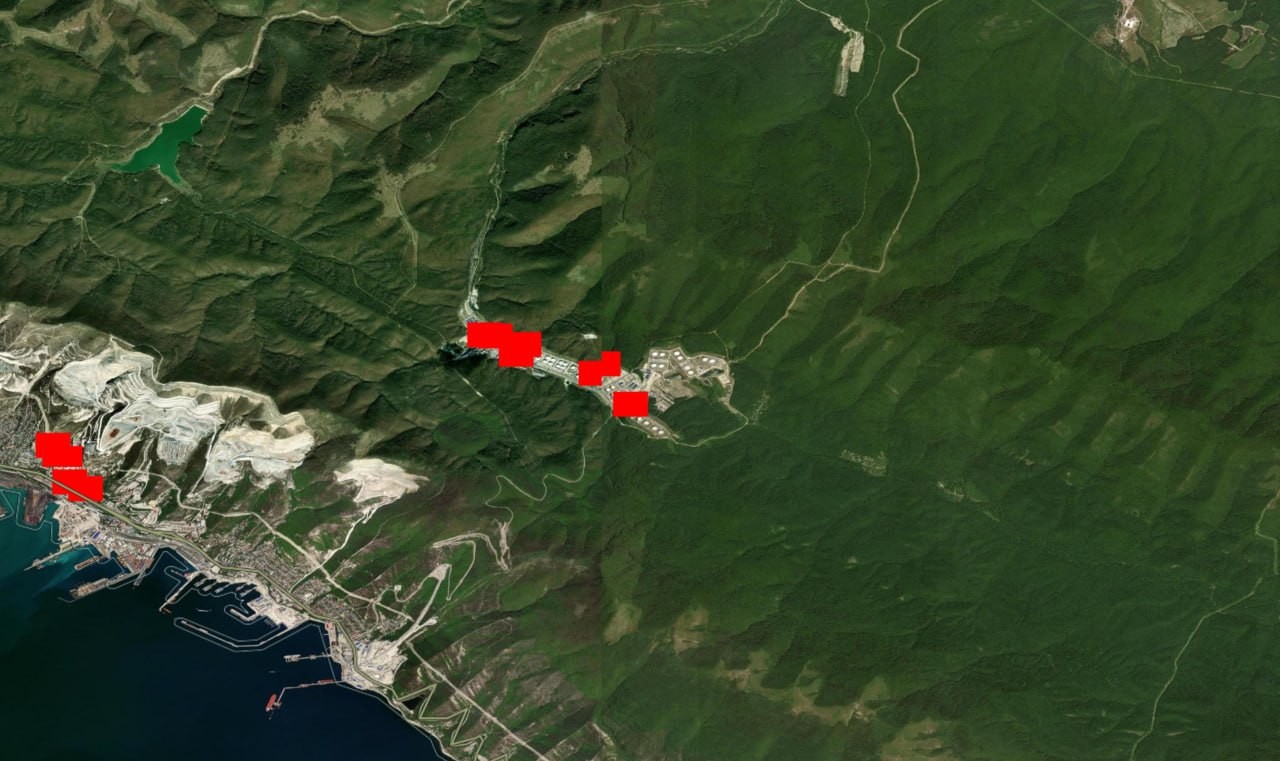
russian crude reaches sea through tunnels under mountain ridge—and ukraine hit storage end near novorossiysk · post nasa firms satellite data fire hotspots (the red squares top right) grushovaya oil
NASA FIRMS satellite data showing fire hotspots (the red squares, the cluster to the right) at the Grushovaya oil depot near Novorossiysk, 8 June 2026. Map: NASA FIRMS

NASA's FIRMS satellite service detected abnormal heat at the site at 02:48 on 8 June. Ukrainian Telegram channel Exilenova+ began reporting the attack around 3 a.m., posting photos and videos of fire in the mountains above the city. OSINT Telegram channel Falcon insight pinpointed the location. Russian news Telegram channel ASTRA confirmed the burning tank farm from eyewitness footage shot about 11 km away.

A fuel storage depot is burning in Novorossiysk, Russia, after a drone strike hit the tank farm overnight

Novorossiysk is one of Russia's most strategically important Black Sea ports, handling a significant share of Russian oil exports
🎥 Supernova pic.twitter.com/d2ab4SSuH0

— Euromaidan Press (@EuromaidanPress) June 8, 2026

What the Grushovaya depot feeds

The Grushovaya site is a transshipment depot for the Sheskharis terminal. Chernomortransneft runs it, under Russia's state pipeline monopoly Transneft. It sits in the Grushovaya Balka tract beyond the Markotkh Ridge, about 12 km from Novorossiysk. The tank farm holds more than 1.2 million m³ of fuel across dozens of tanks, on a site of about 212 hectares. SBS called it one of the largest oil-product stores in the Caucasus.

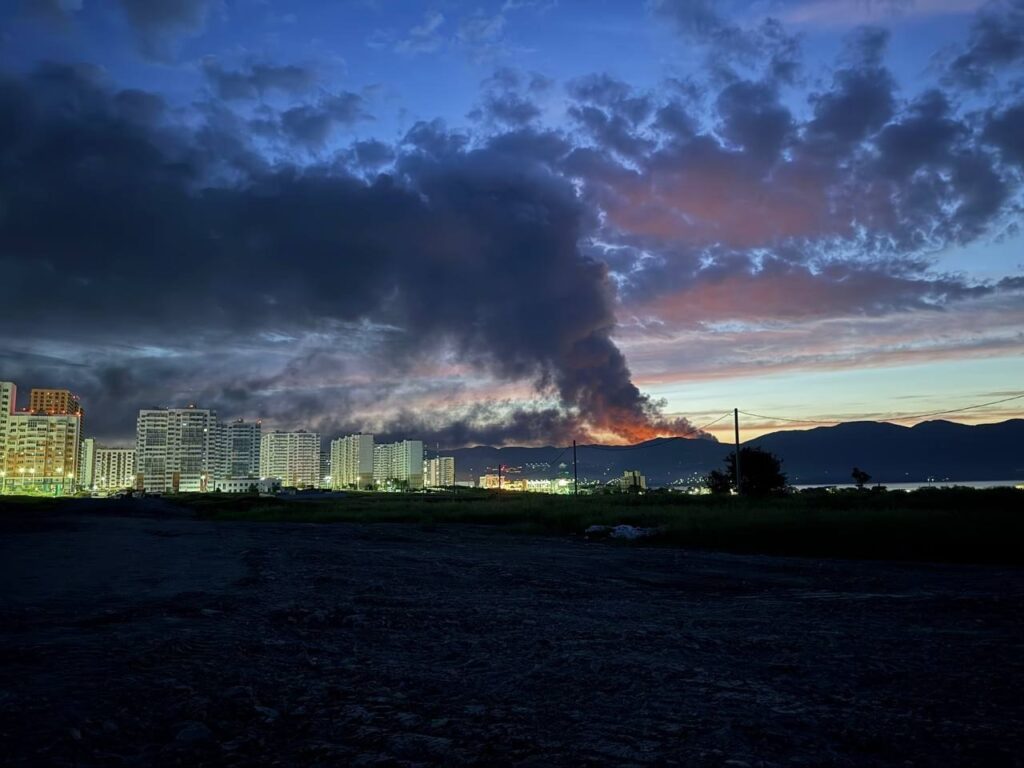
russian crude reaches sea through tunnels under mountain ridge—and ukraine hit storage end near novorossiysk · post smoke burning grushovaya oil depot drifts over after ukrainian drone strike 8 2026
Smoke from the burning Grushovaya oil depot drifts over Novorossiysk after the Ukrainian drone strike, 8 June 2026. Photo: Exilenova+

Novorossiysk is southern Russia's biggest oil-export hub, the Moscow Times reported. The port ships up to 700,000 barrels a day, and its terminals moved 19.8 million tonnes of oil products in 2025. That trade feeds Russia's budget, which bankrolls the war on Ukraine. The port has become a recurring target in Ukraine's strikes on Russia's Black Sea oil logistics.

Volgograd and a coastal radar also hit

The same night, Ukraine's General Staff said its forces struck the Krasny Yar oil-pumping station in Volgograd Oblast, where a fire broke out. Volgograd governor Andrei Bocharov claimed the blaze came from falling drone debris at the Zhirnovsk pumping station and was quickly put out, the Moscow Times reported. Ukrainian forces also hit a Russian radar station near Kabardinka in Krasnodar Krai, according to the General Staff.

Ukrainian drones struck Russia's Baltic Fleet base at Kronstadt near St. Petersburg overnight, flying nearly 1,000 km. Source: Zelenskiy
Explore further

Kronstadt, Russia’s major naval Base after Black Sea Fleet losses, gets hit by Ukrainian drones (VIDEO)

Not the first strike on Novorossiysk's oil chain

Ukrainian forces have hit this infrastructure before. Ukrainian defense outlet Militarnyi reported that drones struck the Grushovaya depot on 23 May 2026, when fire spread across much of the site. Strike drones also hit the Sheskharis terminal on 6 April, damaging oil-metering systems and shut-off valves at the loading berths. ASTRA said the wider complex was attacked in early March, early April, and on 22 May.

Extra £174m earmarked for ‘spiralling’ bill for Lower Thames Crossing

8 June 2026 at 06:00

More than £3bn is due to be spent on the proposed road tunnel between Kent and Essex, which is estimated to have higher costs per mile than HS2

Ministers have earmarked more than £170m extra to help build the Lower Thames Crossing road tunnel, fuelling concerns over the “spiralling” costs of one of the UK’s largest planned infrastructure projects.

The proposed £11bn route under the Thames between Kent and Essex is already estimated to cost more each mile than the HS2 high-speed rail link from London to Birmingham. It was given the funding boost as part of a plan to spend £3.1bn of public money on the project, before a hoped-for injection of £7.5bn by a private sector firm.

Continue reading...

© Photograph: Joas Souza Photographer/Joas Souza/National Highways

© Photograph: Joas Souza Photographer/Joas Souza/National Highways

© Photograph: Joas Souza Photographer/Joas Souza/National Highways

In Peru and Brazil, extractivism threatens Indigenous people in isolation: Report

5 June 2026 at 22:58
Indigenous Peoples in Voluntary Isolation and Initial Contact (PIACI) in the Yavarí-Tapiche Territorial Corridor, one of the largest contiguous, intact forests in the Amazon and home to the world’s highest concentrations of PIACI, are under threat by extractive and large-scale industrial activities, which pose an existential threat to its inhabitants and the ecosystems they depend on. This is according to a new report co-authored by Earth Insight, the Regional Organization of Indigenous Peoples of the East (ORPIO), the Coordination of the Indigenous Organizations of the Brazilian Amazon (COIAB) and the Interethnic Association for the Development of the Peruvian Rainforest (AIDESEP). The report finds that oil and gas blocks overlap with 10% of the 16-million-hectare (39.5-million-acre) corridor, including almost 1.7 million hectares (4.2 million acres) of intact tropical moist forest, 907,000 hectares (2.2 million acres) of Key Biodiversity Areas and 713,000 hectares (1.8 million acres) of protected areas. “Pressure from hydrocarbons is increasing on the Peruvian side of the Yavarí Tapiche corridor,” Edith Espejo, senior program manager at Earth Insight and author of the report, told Mongabay over WhatsApp messages. “Our report serves as a warning for the irreversible harm that could take place if these oil blocks move into this corridor. Mining concessions within and on the peripheries of the corridor also pose a threat of encroachment and contamination of waterways.” A critical corridor for ecosystems and Indigenous communities The Yavarí-Tapiche Corridor covers Brazil’s western border states of Amazonas and Acre and Peru’s Loreto and Ucayali departments in the Amazon…This article was originally published on Mongabay

❌