Russian President Vladimir Putin rejected a proposal by his Ukrainian counterpart Volodymyr Zelenskyy, to meet for talks to end the war as senseless, calling for the country's military to "do the job."
This story originally appeared in Prism on June 04, 2026.
When members of The New School’s Student Senate were faced with a report detailing how Hillel International was providing material and logistical support to Israel’s atrocities in Gaza, they voted on May 1 to cut all ties with their campus chapter of the national Jewish college network and to strip its funding. The student leaders hoped the school’s administration would go on to investigate Hillel’s presence on its New York City campus.
Instead, after an intense pressure campaign by pro-Israel groups, advocates, and elected representatives, the university’s administration is now investigating the student senators who voted to cut ties with Hillel.
“We were hoping that the university would act on the the evidence provided by the Student Senate report about Hillel’s complicity in genocide. They are investigating us instead,” said Ryder Glickman, who is chair of The New School Student Senate and helped produce the report.
The Student Senate acted upon the recommendations of the Registered Student Organizations (RSO) Compliance Committee, which presented a comprehensive report about the ways in which Hillel had assisted the Israeli military during its ongoing genocide in Gaza.
The report found that students from The New School and a host of other New York City-based schools volunteered at the Israeli military’s Hatzerim Air Force Base in January 2024, as part of the Hillel on Base program. “Our students are packaging a days worth of rations to our soldiers,” stated an Instagram story by Hillel at Baruch College, the umbrella organization of Hillel at The New School, alongside a photo from the airbase, according to the report.
The Hatzerim airbase reportedly has been used by the Israeli Air Force for hundreds of airstrikes in Gaza, with F-15s from the base dropping bombs in civilian areas.
In the days following the publication of the report and the Student Senate vote to terminate funding to The New School’s Hillel, the university’s administration acted swiftly to discredit the findings.
“To avoid any misunderstanding, the University Student Senate does not have the authority to determine official status, funding eligibility, or the recognition of RSOs. Our Hillel chapter remains, as it always has been, in good standing, eligible for funding, and supporting Jewish life at The New School,” said an schoolwide email sent to from the university signed by President Joel Towers, Provost Richard Kessler, and Vice Provost Robert Mack.
“By distorting a qualified student organization and characterizing it as something it is not,” the statement continued, “the [University Student Senate] is using its platform to target fellow students in a misguided attempt to hold those students responsible for the acts of governments.”
On May 3, two days after the vote, Ilya Bratman, the executive director of Hillel at Baruch College, wrote in an email to Towers and other members of The New School’s leadership that the Student Senate’s actions were “a direct attack on Jewish students.” Bratman bcc’d the Student Senate email address, and members shared the email with Prism.
“We hope to meet with you in the coming days so that you can hear directly from the students affected by this action, and so that we can better understand the university’s plan of action moving forward. The [University Student Senate] has shown no indication that it intends to step back from these egregious and deeply troubling actions,” Bratman wrote.
The New School administration and Hillel at Baruch College did not respond to Prism’s inquiry about whether university leadership and Hillel officials had the meeting.
Days later, on May 8, Glickman received an email, viewed by Prism, from The New School’s office of Student Equity, Accessibility & Title IX. The email said that the school was investigating him for an allegation that the Student Senate’s decision to cut ties with Hillel was in “potential violation of Title VI of the Civil Rights Act of 1964 on the basis of race, color, or national origin in any program or activity receiving federal financial assistance.” The administration later clarified to Glickman that the university is investigating all student senators involved in the vote.
External pushback
The university launched its investigation into student senators following a string of social media activity by pro-Israel groups, advocates, media, and elected representatives attacking the report.
Glickman was called a “virulent anti-Israel activist” in an X post by Canary Mission, the secretive group notorious for doxing and targeting pro-Palestinian activists.
A string of articles by pro-Israel publications, including The New York Post and The Times of Israel, reported on The New School administration rejecting the Student Senate vote while omitting the details and evidence found by the RSO about Hillel’s ties with the Israeli military.
Two New York members of Congress took to social media to denounce the report. Rep. Dan Goldman—who recently marched in New York’s Israel Day parade featuring Israeli cabinet ministers who are wanted by the International Criminal Court for war crimes or have made genocidal statements about Palestinians—said the students were engaged in “hateful and vile antisemitism.” Rep. Ritchie Torres also condemned the vote, calling it “shameful” and “discrimination against Jewish individuals and institutions.” Goldman and Torres are heavily backed by the American Israel Public Affairs Committee.
“The fact that there was such open repression and universal condemnation of the report shows that the administration’s response was coordinated with Zionist organizations accusing us of antisemitism,” Glickman told Prism. “This is extremely worrying when we made a very basic case about international law.”
Students volunteering with the Israeli military
Hillel at Baruch, which organized trips to Israel, acts as an umbrella organization for chapters in multiple New York schools in addition to The New School, including Fordham University, John Jay College, and City College.
“Volunteer on an IDF (Israeli Defense Force) base in Southern Israel, wear IDF uniform, give back to the community on base, and explore Israel!” reads a description about the program on Hillel at Baruch’s website.
The 38-page report by the RSO compliance committee found that Hillel at Baruch organized several trips between May 2022 and January 2025 for students to volunteer at multiple Israeli army and air force bases. Hillel International also operates the Onward Israel program which organizes internship trips for American students to Israel and facilitates volunteering opportunities within the Israeli military.
The report further found that in July 2024, another post from Hillel at Baruch and New School Hillel’s Instagram account said, “Tonight, some of our onward students had the incredible opportunity to volunteer at the Tze’elim army base, where they helped prepare a barbecue for over 700 soldiers from the Oketz, Kfir, Golani and Handasa units in the IDF.”
Soldiers of the Golani Brigade’s 631st Reconnaissance Battalion were behind the March 24, 2025, killing of 15 Palestinian emergency responders that included Red Crescent ambulance workers in Rafah, according to an investigation by Haaretz.
In May 2024, a BBC analysis found that 11 soldiers of the Kfir brigade were responsible for posting photos and videos of Palestinian prisoners being abused.
By registering for the Hillel on Base program, participants also automatically register for the Volunteers for Israel (VFI) program, the report found.
“VFI is the ONLY organization that creates opportunities for American students to volunteer in Israel on IDF bases,” says a description of the program, which includes activities such as packing medical supplies and repairing machinery and equipment for military units.
The VFI program is run by Sar-El, an Israeli volunteer nonprofit organization under the direction of the Israeli Logistics Corps, a support branch of the Israeli military, establishing direct collaboration between Hillel and the Israeli government, according to the report.
“I am nauseated by the fact that I have classmates who have provided direct material and logistical support to genocide,” Glickman said.
A week after The New School vote, the student leadership of the Hillel chapter of Middlebury College, Vermont, voted to change its name to the Jewish Association at Middlebury, after growing demand from its members to disaffiliate from Hillel International and its activities, according to reporting by the school’s newspaper.
Editorial Team: Sahar Fatima, Lead Editor Lara Witt, Top Editor Rashmee Kumar, Copy Editor
A team at the University of Cambridge say this is the first time that a vaccine whose active component was 'designed entirely by computer simulations has been tested in humans.'
A team at the University of Cambridge say this is the first time that a vaccine whose active component was 'designed entirely by computer simulations has been tested in humans.'
At the rate at which Spain’s population has grown in recent years, a country of 50 million inhabitants could soon become a reality. The National Institute of Statistics (INE) is expected to reveal this month, in its 2026-2076 population projections, when it believes this milestone will be reached. According to the 2025 census, Spain surpassed 49.1 million inhabitants last year, but data from the Continuous Population Statistics—which combines census data with quarterly estimates—indicate that Spain already had 49,687,120 inhabitants in April.
The Philippines is more of an object than a subject of the political processes unfolding in Southeast Asia. Nevertheless, everything connected with this country, one way or another, is not only under close observation by leading regional players but also involves their participation to various extents. The question of control over the Philippines is becoming […]
Gas stations across Russian-occupied Crimea are facing worsening fuel shortages, with long queues, rationing, and voucher-based distribution reported by residents. Ukrainian strikes on fuel-supply routes to the peninsula are cited as one of the contributing factors to the crisis.
Riding into Russia on a motorcycle to see his ailing father, Mikhail Loshchinin was detained at the border, tortured, and tried on a treason charge over a $245 transfer to a Ukrainian ex-girlfriend, he and relatives and supporters say. This week, he was convicted and sentenced to 16 years in prison.
From Ukraine to Tehran, asymmetric warfare is redefining the modern battlefield. Superiority is no longer measured solely by jets and naval fleets, but by inexpensive unmanned drones.
WASHINGTON -- In a rare display of bipartisan cooperation and a rebuke to the administration's approach toward Ukraine, the US House of Representatives approved a sweeping Ukraine aid and Russia sanctions package, with 18 Republicans joining Democrats to pass the legislation.
With new IPOs coming up for Musk’s SpaceX and for Sam Altman’s OpenAI, Wall Street, which is increasingly becoming less tech savvy and just investing in hype, is going to take the next step in bankrupting America.
Haven’t people learned from Elon Musk’s constant lies for the past two decades?
Where are his fully autonomous driverless taxis? Where are the $35K human robots that he promised would be in everyone’s homes by now?
It’s all BS! But people keep feeding it, too scared to be left behind.
Now the biggest IPO in the nation’s history is set to happen next week for SpaceX.
Is SpaceX rolling in the cash with record sales? Nope. It is actually losing money.
So why will Wall Street groupies invest?
Because Musk promised them there would be floating data centers in space to fuel the expansion of AI, in the future.
Everyone and anyone who is investing in Musk is continuing to invest in the future, for a version of science fiction which will never happen.
And because Musk is also behind removing regulations to protect American’s retirement accounts from such risky investments, within the next few weeks a majority of Americans’ retirement accounts may be left holding the bill for these mammoth Big Tech IPOs, whether they want to or not.
They say Rome did not fall in one day, but America just might.
Elon Musk and Sam Altman don’t often see eye to eye, as they made clear in their recent legal dispute. But when it comes to making outlandish projections about future growth, the two men seem to share a common philosophy.
As we reported earlier on Thursday, SpaceX’s lead bank on its upcoming IPO, Goldman Sachs, has told investors it expects SpaceX’s revenue to hit $474 billion by 2030, from $18.7 billion last year.
That’s even more ambitious than OpenAI’s projection—which we reported in February—that its revenue will grow to $284 billion by 2030 from $13 billion in 2025.
Both companies also expect to burn massive amounts of cash in the same period, although SpaceX outdoes OpenAI on that count as well.
Neither of these sets of projections is particularly believable, of course. Sure, OpenAI might become a major player in digital advertising—a key part of its growth story—but it has presented little that would support the long-range forecasts it has put forward. SpaceX’s projections are no better.
Our story today, by my colleague Cory Weinberg, says two-thirds of the projected 2030 revenue would come from AI, which implies SpaceX thinks it will be bigger than OpenAI by then.
And yet right now, SpaceX’s AI unit is nowhere. Its revenue last year of $3.2 billion was mostly from ads generated by X, the business formerly known as Twitter, which doesn’t count as AI (the discourse on X could be better described as a lack of intelligence, artificial or otherwise).
OpenAI, for all its travails, at least has real AI revenue, amounting to $5.7 billion in the first quarter. Moreover, constant employee turnover has turned xAI upside down, and the status of its model development is unclear. Musk has leased out much of its computing infrastructure to rivals such as Anthropic.
We get that the credibility of these projections isn’t important to the Musk fans who are likely to support SpaceX’s stock offering, which is expected to go to market next week.
But it is worth noting Musk’s dismal history of meeting projections.
In 2022, for instance, he told investors he expected to lift Twitter’s revenue to $26.4 billion in 2028, up from $5 billion in 2021, according to this New York Times account.
How’s he doing?
X’s ad business has dropped by half. (SpaceX’s IPO prospectus shows the AI segment’s revenue was $2.6 billion in 2024, “substantially all” of it from X.)
Musk combined X into xAI, and the resulting AI unit is also generating revenue from selling subscriptions to its Grok AI chatbot and renting out computing capacity.
Those X numbers are no longer relevant, but they are a reminder of the value of long-term revenue projections.
Elon Musk’s $1.75 trillion SpaceX valuation leaves virtually zero room for error
Want to buy SpaceX stock? History suggests it will struggle to reward IPO investors.
SpaceX’s sky-high market valuation — $1.75 trillion at a proposed $135-a-share price — makes it extremely unlikely its stock will be able to even keep up with the S&P 500 in coming years.
Here’s why: Consider the company’s price-to-sales ratio (PSR) at its offering price. This ratio is highly useful when valuing IPOs. Other valuation ratios aren’t particularly insightful since many IPOs come to market before booking any earnings.
At the $135-per-share price that SpaceX is targeting for its IPO, its PSR will be more than 90-to-1 — one of the highest in U.S. market history. Even IPOs that came to market with PSRs half as high have proceeded to underperform the market over the three years after going public.
This is illustrated in the chart above, which plots data from Jay Ritter, a University of Florida finance professor who has compiled the premier academic database of U.S. IPOs. There is a strong inverse correlation between an IPO’s PSR and its subsequent three-year return. Those whose PSRs were above 40 when coming to market lagged the market by 58.5% over the three years after coming to market. (A full description of Ritter’s calculations are available here.)
To put SpaceX’s PSR in context, consider that the S&P 500’s comparable ratio is 3.7. Of course, fast-growing stocks typically trade at higher PSRs, so the S&P 500 may not be the most appropriate comparison. But even the growth-oriented Nasdaq 100 indexhas a current PSR of just 6.1, and none of that index’s constituent stocks has a PSR as high as what SpaceX’s will be at its expected initial offering price.
A good story — but maybe not a good stock
Given these numbers, it’s safe to say that SpaceX’s IPO is not being sold as a valuation play.
SpaceX and Anthropic are about to go public—and your 401(k) may be forced to buy in
Two of the most valuable companies in history are about to go public, and because of their sheer size, they may fundamentally alter what sits inside millions of Americans’ retirement accounts.
With SpaceX’s IPO also sparking index providers to change the rules on how stocks are added to major stock market indexes (like Nasdaq or the S&P 500), you may soon feel the effects of the IPO much faster than you would have otherwise.
Index funds are usually the backbone of most 401(k)s, and because they’re obligated to buy whatever is in the index, changing the rules may be the mechanism that forces one’s exposure to a new IPO, such as SpaceX’s, and eventually Anthropic’s.
But simply because SpaceX and Anthropic are so enormous at their debut (SpaceX at $1.77 trillion as of Wednesday and Anthropic expected at nearly $1 trillion), index providers can’t necessarily leave them out.
So they’ve shortened or even eliminated the seasoning period, meaning your 401(K) will reflect their presence in the stock market that much sooner.
Wasted AI budgets at Uber, Microsoft and Nvidia trigger hiring — because human workers are cheaper
Uber blew its entire 2026 AI budget by April. Here’s why replacing workers with bots backfired.
Excerpts:
Corporate executives are realizing that it’s more expensive to replace employees with artificial intelligence, contrary to what was previously believed. That’s good news for the U.S. labor market.
What’s causing this about-face? Blame the tokens. When an employee asks AI for help, the request consumes digital tokens, which are the currency of LLMs and a cost of doing business.
Workers at tech companies in particular have been encouraged to ramp up their token consumption — known as “tokenmaxxing” — by employers conflating AI tools with productivity. It has become somewhat of a status symbol amongst employees to be tokenmaxxing to prove that you’re going above and beyond to meet key performance indicators.
But tokenmaxxing is expensive. For text-based inquiries, the math is simple, with 750 words costing 1,000 tokens. But generating video, images, code and more can cost a lot more — and it’s not until after the task has been carried out that the bill comes due.
These costs have been catching employers off guard, especially with the increased use of agentic AI sucking up tokens. As a result, employers are frequently blowing through their AI budgets, putting them in a situation where it’s no longer clear that using AI is cheaper than hiring people.
For example, Uber Technologies’ operations chief recently raised concerns about the cost of tokenmaxxing, especially because by April, the ride-hailing company had already blown through its entire 2026 AI budget. Microsoft has canceled its Claude Code licenses and asked employees to use its own GitHub Copilot CLI — with many speculating that high costs drove the decision.
A team at Nvidia for months has reported higher costs for AI than humans. Amazon.com axed its internal AI leaderboard. One company even accidentally spent $500 million in a month recently on Claude, according to Axios.
The widespread pullback shows that companies are dissatisfied with the return on investment on AI.
Big Tech companies have poured billions of dollars into building out AI infrastructure over the past few years in hopes that it’s the future.
Enterprises have adopted AI into their workflows to fare better against competitors.
While Big Tech stocks may still be flying high, some companies are realizing they can’t sustain this level of spending on tokens.
This article was written by Human Superior Intelligence (HSI)
See Also:
Understand the Times We are Currently Living Through
Ukrainian President Volodymyr Zelenskyy has written an open letter to his Russian counterpart Vladimir Putin, urging him to attend a meeting between the two leaders at a neutral location to agree an end to the war.
Ancient Greeks and Romans used spiderwebs in medicine, believing their natural fibers could stop bleeding and protect wounds from infection. Credit: Wikimedia Commons, public domain
Among the most intriguing practices in Ancient Greek medicine was the use of spiderwebs—and even live spiders—in healing treatments. Ancient medicine often surprises modern readers with remedies that seem unusual at first glance, yet many of these traditional approaches contained a practical logic beneath layers of symbolism and inherited belief.
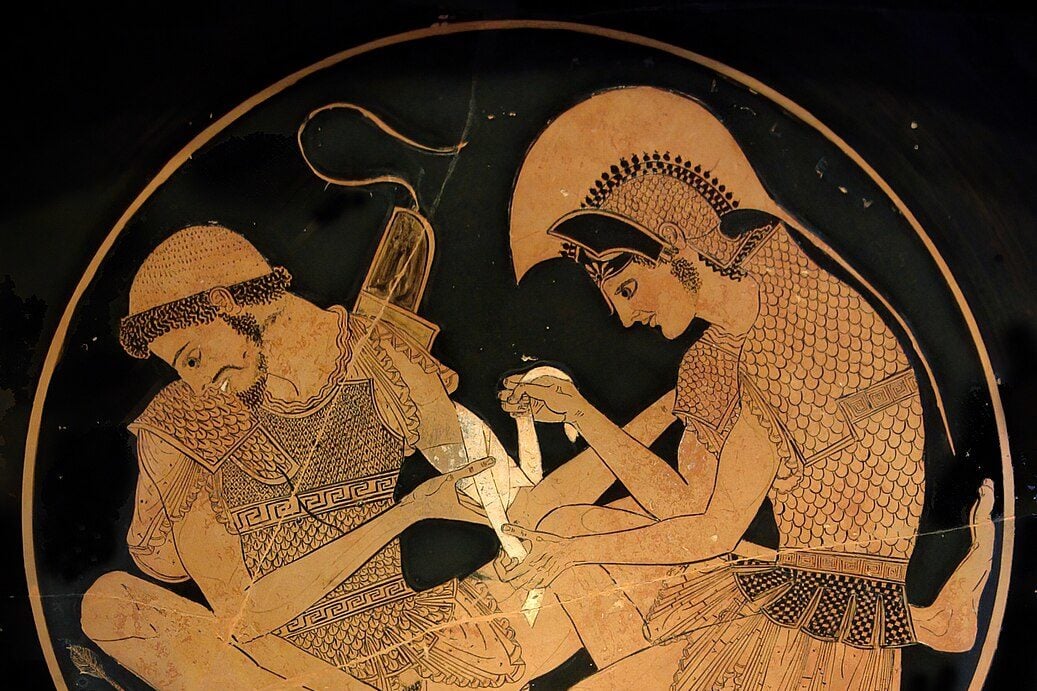
Greek and Roman physicians placed particular emphasis on controlling bleeding, especially in the context of warfare and surgery. Soldiers frequently sustained deep wounds from swords, spears, and arrows, while physicians had no access to modern antiseptics or advanced surgical instruments. In response, healers continuously experimented with natural materials that could help stop blood flow and protect exposed tissue. One of the more unusual solutions they turned to was spiderwebs.
Ancient Greek and Roman medical writers do, in fact, refer to the use of spiderwebs in medicine. Spider silk was observed to have properties that made it unexpectedly effective for wound care. Physicians noted its ability to absorb blood, cover injuries, and support the clotting process. While they lacked any understanding of modern biochemistry, their meticulous attention to such effects often led them to surprisingly effective medical practices.
Pliny the Elder and natural remedies, such as the use of spiderwebs, in the medicine of Ancient Greece and Rome
The Roman author Pliny the Elder offers some of the clearest references to spider-based medicine in his encyclopedic work Natural History. He describes a range of remedies involving both spiderwebs and actual spiders, noting that the former could help stop bleeding and support healing when applied directly to wounds. He also made mention that spiders were believed to serve as effective remedies for a variety of diseases and injuries in antiquity.
For Ancient Greek healers, spiderwebs appeared naturally suited for wound treatment. Their soft, fibrous texture allowed them to cover cuts with ease, while their adhesive qualities helped seal damaged tissue and protect it. Ancient warfare produced particularly severe injuries. Greek hoplites and Roman soldiers fought in brutal close combat, where swords and spears regularly tore flesh open. Even relatively minor wounds could turn fatal due to blood loss or infection. Physicians accompanying armies therefore required treatments that acted quickly and could be easily carried onto the battlefield.
The use of spiderwebs among the Ancient Romans and Greeks provided several practical advantages in medicine. They were lightweight, widely available in nature, and naturally adhesive when applied to skin. Healers thus collected cobwebs and preserved them for medical use, and soldiers are sometimes described as carrying small containers filled with spiderwebs during military campaigns.
Long before the development of modern antibiotics, healers frequently relied on natural substances that appeared to reduce infection risk and support faster healing.
Galen and Ancient Greek traditions in medicine
The great Greek physician Galen likewise discussed spider cobwebs in his work On the Powers of Simple Remedies in which he refers to their Ancient Greek medicinal applications in the treatment of injuries and the control of bleeding. Because gladiators suffered frequent injuries, Galen gained extensive experience treating wounds and preventing infection. Greek medicine placed strong emphasis on observation and practical effectiveness, so physicians often tested remedies repeatedly under real and demanding conditions.
This connection makes historical sense. Ancient doctors valued materials that combined absorbency, flexibility, and ease of application. Spider silk possessed all three qualities. Furthermore, physicians in antiquity often preferred natural substances that were readily available in military environments, where medical resources were limited.
Modern science helps explain why ancient healers valued spiderwebs. Spider silk is composed of strong protein fibers capable of forming protective coverings over wounds. The silk also absorbs moisture effectively and creates a temporary barrier against dirt and contaminants. Additionally, spiderwebs may exhibit mild antiseptic properties due to natural compounds present within the silk. Although ancient physicians could not observe bacteria, they recognized through experience that some treatments reduced infection more effectively than others.
Many people also associate spiderwebs with clotting because webs can contain traces of vitamin K from insect remains and environmental material. Vitamin K is a nutrient that contributes to blood coagulation in the human body. Most importantly, however, the web itself functions physically as a mesh. When pressed against a wound, the fibers help gather blood and support clot formation.
Modern medicine even studies spider silk for advanced surgical materials due to its exceptional strength and biocompatibility. Ironically, contemporary science now investigates properties that ancient healers observed intuitively thousands of years ago. Thus, ancient healers may have developed practical wound-care techniques through centuries of observation rather than theoretical science.
Galen, the pioneering Greek physician who influenced Western medicine through the 1700s. Portrait by Pierre-Roch Vigneron. Credit: Wikimedia Commons Public Domain
Ancient medicine and empirical knowledge
The use of spiderwebs highlights a central feature of ancient medicine, namely that Greek and Roman physicians often relied on empirical observation rather than formal scientific theory. They closely observed which remedies appeared effective and preserved those methods within medical tradition.
Greek physicians, in particular, placed great value on careful observation. The Hippocratic tradition encouraged doctors to study symptoms, environments, diets, and physical responses in detail. As a result, treatments survived not because they were theoretically justified but because they produced visible and consistent results. In this context, spiderwebs were valued because their silk fibers formed a natural covering over wounds while also helping to control blood flow. Folk medicine across many cultures likewise used cobwebs as anti-fungal and antiseptic remedies for cuts and open injuries.
Spiderwebs likely entered medical practice through precisely this kind of experiential process. Healers observed reduced bleeding and improved healing following their application, and over time, the practice spread across regions and generations. Cobwebs were part of a much broader landscape of natural medicine in antiquity. Ancient healers regularly used honey, wine, herbs, oils, vinegar, and minerals in wound care and general treatment.
Many of these substances also possessed genuine antibacterial or medicinal properties. Honey, for instance, inhibits bacterial growth and is still used in certain modern wound treatments. Wine and vinegar functioned as early disinfectants due to their alcohol and acid content. Within this framework, spiderwebs would not have seemed unusual to ancient physicians. Instead, they represented another readily available natural material with observable healing potential. Greek and Roman medicine thus consistently explored the relationship between nature and health, making use of natural resources, including even something so peculiar to modern eyes as spiderwebs.
Honey was used by the Ancient Greeks in medicine as well. Credit: The Drug Users Bible, CC BY SA, 2.0
The symbolic dimension of spiderwebs and their silk in Ancient Greece
Ancient cultures attached rich symbolic meaning to spiders and the act of weaving, and in Greek tradition, these associations carried particular weight. Mythology linked weaving to intelligence, fate, and skilled craftsmanship through figures such as Athena and Arachne, embedding it within a broader cultural framework that connected material creation with order, skill, and even divine influence. Spider silk itself likely appeared mysterious and almost otherworldly, given its delicate structure and surprising strength—qualities that blurred the boundary between natural substance and something almost magical.
This symbolic dimension may have reinforced confidence in cobweb-based remedies, since ancient medicine often operated at the intersection of practical treatment and cultural meaning. In battlefield contexts especially, where speed and improvisation were essential, surgeons had to remove arrows, close wounds, cauterize bleeding, and stabilize fractures under extreme conditions with limited equipment, relying heavily on whatever materials were immediately available. Spiderwebs fit this environment well, both practically and symbolically, as soldiers or assistants could gather them quickly from camps, caves, or buildings, requiring no preparation and allowing for rapid application under pressure.
Even when cobwebs were not perfectly effective, they could still provide a basic protective layer that was often better than leaving wounds exposed, which would have only allowed dirt and uncontrolled bleeding to pose immediate risks to survival. In many cases, this simple barrier alone may have made a meaningful difference in outcomes. Today, the same material that once carried symbolic and practical value in antiquity is again attracting scientific interest, as researchers explore spider silk for potential applications in surgery, tissue engineering, and regenerative medicine.
Latvia's eastern region of Latgale is adjusting to a new reality of air raid alerts after several drones crossed into the country's airspace in recent weeks. The warnings have raised concerns about safety in communities near the borders with Russia and Belarus.
Hungarian and Ukrainian diplomats reached a deal on Hungarian minority rights late on June 3, allowing Ukraine and Moldova to finally start de facto accession talks with the European Union later this month, after two years of Budapest vetoing this step under its previous government.
A number of European Union member states are pushing the European Commission to put forward legislation that makes it easier to deny tourist visas to Russian citizens over Moscow's full-scale invasion of Ukraine.
These wine sacks were favoured by nomads and travellers because they were lightweight, durable, and flexible. To prevent the wine from seeping through, the leather was traditionally lined with pine
Dass in der heutigen Ukraine ein Regime herrscht, das seine Wurzeln im deutschen Nationalsozialismus hat, ist keine russische Propaganda. Dass der Nazi-Kollaborateur Bandera in der Ukraine als Nationalheld verehrt und gefeiert wird, ist allgemein bekannt. Aber die Heldenverehrung umfasst noch weit mehr Kriegsverbrecher, die an der Seite der Nazis gekämpft und Massaker in der Zivilbevölkerung […]
Dass die Ukraine für ihre Drohnenangriffe auf die russische Region St. Petersburg die Lufträume Polens, der baltischen Staaten und Finnlands nutzt, ist längst kein Geheimnis mehr, wird im Westen offen zugegeben und war schon oft Thema auf dem Anti-Spiegel. Die Angriffe ukrainischer Drohnen der Nacht auf Mittwoch, bei denen zum ersten Mal auch Ziele in […]

 Login
Login