Greek fire was the mysterious weapon used by the Byzantines to destroy enemies and prospective invaders, keeping the Empire strong and awe-inspiring.
The Byzantine liquid fire that protected the Empire was a terror-inspiring incendiary weapon that protected the Empire for centuries. Widely known as Greek Fire, this mighty weapon enabled the Byzantine Empire to survive and maintain its power through many attacks from various enemies.
The weapon could be compared to the modern day flame-thrower. To the enemy in Byzantine times, it looked like a machine spewing destructive fire from hell. However, its exact origin remains unclear, and the recipe for this formidable weapon is still unknown, puzzling scientists and historians.
A Byzantine ship using Greek fire against a ship . On top, Greek alphabet in Byzantine form. Credit: Public Domain
Records suggest Greek fire contained a mix of petroleum, quicklime, and other unknown ingredients. This potent combination is believed to have made it one of the most flammable and dangerous substances of its time. What was truly amazing about the Byzantine liquid fire weapon was that it continued to burn on water and was practically impossible to put out with medieval means.
It helped the Empire maintain sovereignty over the mass land it occupied, spanning all of Southern Europe, North Africa, and Asia Minor. The weapon’s impact on the course of history is undeniable. It played a key role in the defense of Constantinople and the preservation of the Byzantine Empire.
A Brilliant Invention
Fire as a weapon had been used for centuries but never in such a sophisticated and destructive means as the Greek fire (or Υγρόν πυρ – Hygron pyr, as it was referred to in Greek). It was the Crusaders who referred to it as Greek fire or “liquid fire,” “Roman fire,” or “sea fire.” It was a significant weapon that never ceased to terrify the enemy.
This innovative weapon would fire massive flames in a continuous jet, burning a trail of destruction in its path that was nearly impossible to extinguish. When it came to naval warfare, it was a weapon that was impossible for the enemy to defend their ships from. Yet, the exact recipe for the liquid fire substances the Byzantines used remains a mystery to this day.
The Greek fire cannon-like machine was created in the seventh century. It most likely was the invention of Kallinikos of Heliopolis, a Jewish architect who fled from Syria to Constantinople. It was between 674 and 678 when the Byzantine Empire was attacked by the Islamic fleet of the Umayyad caliphate that had already taken over parts of Syria.
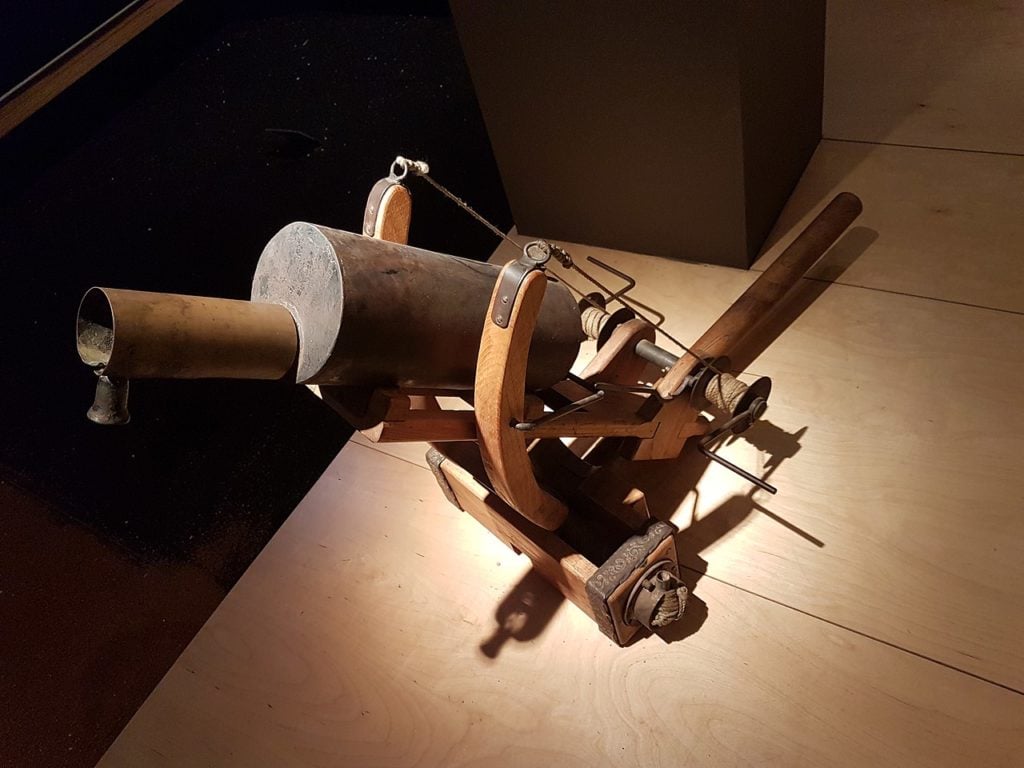
Concerned about an Islamic attack against Constantinople, Kallinikos experimented with a variety of materials until he discovered a mix for an incendiary weapon. Kallinikos sent the formula to the Byzantine emperor, and authorities developed a siphon that operated somewhat like a syringe, propelling the fiery concoction toward enemy ships.
Emperor Constantine IV reluctantly ordered the use of Greek fire to destroy the Umayyad fleet. However, the Byzantine weapon was very successful. According to historian Kelly DeVries and his book Medieval Military Technology, it was the first reported use of an incendiary weapon in battle.
Was Byzantine Liquid Fire a State Secret?
Some historians believe the reason the recipe for liquid fire remains unknown is because Byzantine emperors wanted to keep it a state secret, never to fall into the hands of the enemy. The vast Empire was surrounded by numerous enemies coveting its lands. Liquid fire was a potent deterrent to any army that would think of invading.
Constantine VII Porphyrogenitus warned his son Romanos II to not reveal the recipe “and not to prepare this fire but for Christians, and only in the imperial city.”
Anna Komnene, daughter of Emperor Alexios I Komnenos (r. 1081-1118) and a historian, wrote about the recipe for Greek fire:
This fire is made by the following arts: From the pine and certain such evergreen trees, inflammable resin is collected. This is rubbed with sulfur and put into tubes of reed, and is blown by men using it with violent and continuous breath. Then in this manner it meets the fire on the tip and catches light and falls like a fiery whirlwind on the faces of the enemies.
It was not that straight-forward, of course. Otherwise, it would be easy for the enemy to recreate the fiery weapon. It seems indeed that the Byzantines intended to keep the process of creating the liquid fire top secret, as no friend or enemy ever managed to gain insight into this so as to construct their own similar weapon.
Use of a hand-siphon, a portable flame-thrower, from a siege tower. Detail from the medieval manuscript Codex Vaticanus Graecus 1605. Public Domain
Greek Fire in Battle
In his book, Devries explains that Greek fire can refer to three different weapons: firstly, a fiery liquid pumped out of a nozzle; secondly, a liquid weapon that was filled in small grenades; and thirdly, a solid incendiary probably based on gunpowder.
The third is impossible to have been used in Byzantium. Its reported use started in the fourteenth century in Western Europe. However, there are Byzantine era depictions of men carrying hand-held tubes spitting fire that look even more like modern flame-throwers.
In fact, Greek fire was rarely used except primarily in naval battles, as the apparatus was complicated and required technically equipped handlers. Furthermore, it was dangerous to have an incendiary mechanism on a wooden ship.
In 727, Emperor Leo sent a fleet to burn that of Hellas and Cyclades, who had been revolting against him. In 941, a Rus naval raid from Kiev across the Black Sea was stopped, and their fleet was annihilated by the Byzantines.
Reportedly, in the eleventh century, Viking Ingvar the Far Travelled encountered ships equipped with the weapon, which he described as “a brass (or bronze) tube and from it flew much fire against one ship, and it burned up in a short time so that all of it became white ashes…”
However, by the end of the twelfth century and the Angeloi emperors, the Empire started to decline, losing more and more land to the rising Ottoman Empire. As Byzantium began to fade, so did the use of Greek fire until it became but a simple chapter in the great history of the Byzantine Empire.
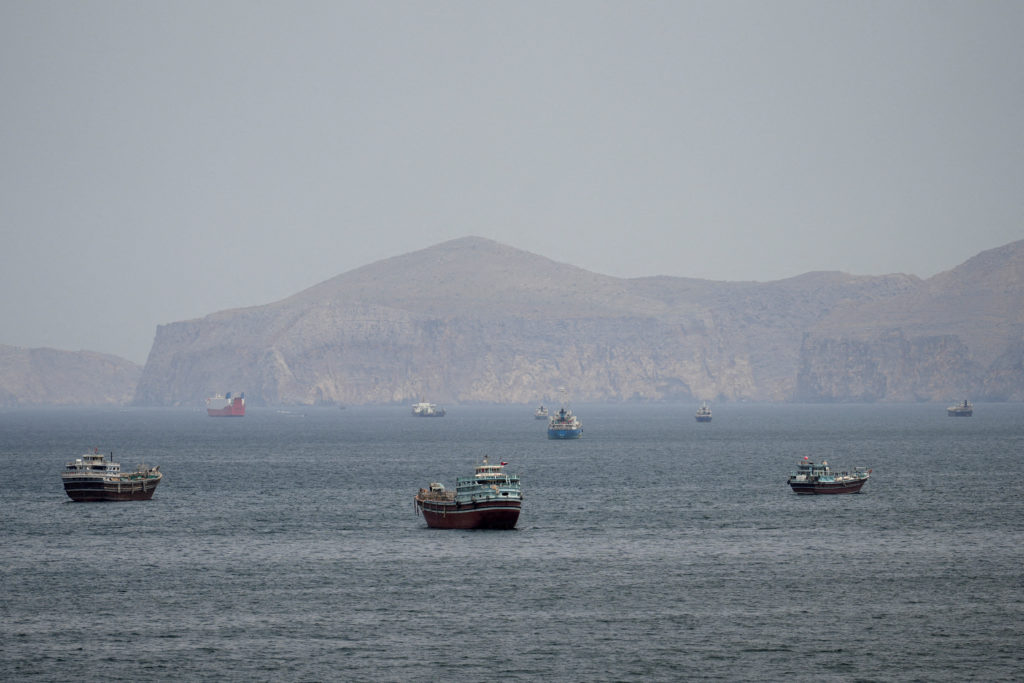
Former Defense Secretary Lloyd Austin on Monday said the U.S. could reopen the Strait of Hormuz but should only undertake the effort with the support of international allies. “Certainly, the United States Navy could open the Strait of Hormuz,” Austin, who served under former President Biden, told Bloomberg during remarks at the HSBC Gulf Cooperation…
Former Defense Secretary Lloyd Austin on Monday said the U.S. could reopen the Strait of Hormuz but should only undertake the effort with the support of international allies. “Certainly, the United States Navy could open the Strait of Hormuz,” Austin, who served under former President Biden, told Bloomberg during remarks at the HSBC Gulf Cooperation…
President Trump on Monday said two crew members who were aboard a U.S. attack helicopter when they crashed near the Strait of Hormuz are “fine.” The two crew members, whose AH-64 Apache helicopter was patrolling regional waters, were rescued within two hours after they crashed near Oman’s coast, according to U.S. Central Command (Centcom). The…
President Trump on Monday said two crew members who were aboard a U.S. attack helicopter when they crashed near the Strait of Hormuz are “fine.” The two crew members, whose AH-64 Apache helicopter was patrolling regional waters, were rescued within two hours after they crashed near Oman’s coast, according to U.S. Central Command (Centcom). The…
More than 60% of Ukrainians categorically reject a ceasefire along the current frontline if Ukraine receives no security guarantees. The same share would approve a ceasefire if European troops were stationed near the frontline and would defend Ukraine against renewed Russian aggression, according to a new Kyiv International Institute of Sociology (KIIS) poll, conducted between 7 May and 3 June 2026.
The poll quantifies the substantive Ukrainian public position on the ongoing diplomatic process: the ceasefire itself is not the disputed question, but security guarantees are.
Across the four scenarios KIIS tested, the lowest level of support (32%) is for a ceasefire without guarantees. Mid-range support corresponds to mid-range guarantees: 42% for European troops deep in Ukraine that would not fight, and 53% for security guarantees in the form of large-scale financial and weapons support.
Four scenarios in detail
Scenario 1 — ceasefire without security guarantees, money, or weapons: 61% categorically reject, 32% willing to approve (mostly reluctantly). This is the substantive Ukrainian public position on the unconditional ceasefire that Russian negotiators have repeatedly framed as a starting point: the offer falls short by roughly two-to-one.
Scenario 2 — ceasefire with European troops deployed deep in Ukraine, NOT participating in combat if Russia attacks again: 49% categorically reject, 42% willing to approve. A passive Western presence is closer to acceptance but does not yet command majority support.
Scenario 3 — ceasefire with security guarantees in the form of large-scale money and weapons supply: 37% categorically reject, 53% willing to approve. Material guarantees alone gain majority support, but with significant skepticism remaining.
Scenario 4 — ceasefire with European troops near the frontline who WOULD defend Ukraine against renewed Russian aggression: 33% categorically reject, 61% willing to approve. Active defense by European forces commands the highest support, with a clear majority in favor of a ceasefire under conditions that make Russian re-invasion materially riskier.
Methodology and coverage
KIIS conducted the survey by computer-assisted telephone interview (CATI), using random sampling of mobile phone numbers. The sample of 2,007 Ukrainian citizens aged 18 and older was drawn exclusively from territory controlled by the Ukrainian government, meaning the data does not include displaced Ukrainians abroad or Ukrainians in Russian-occupied territories.
The polling period of 7 May through 3 June 2026 covered the full month of the current phase of US-mediated diplomatic activity, during which Russia continued striking Ukrainian cities with Shahed drones and missile attacks.
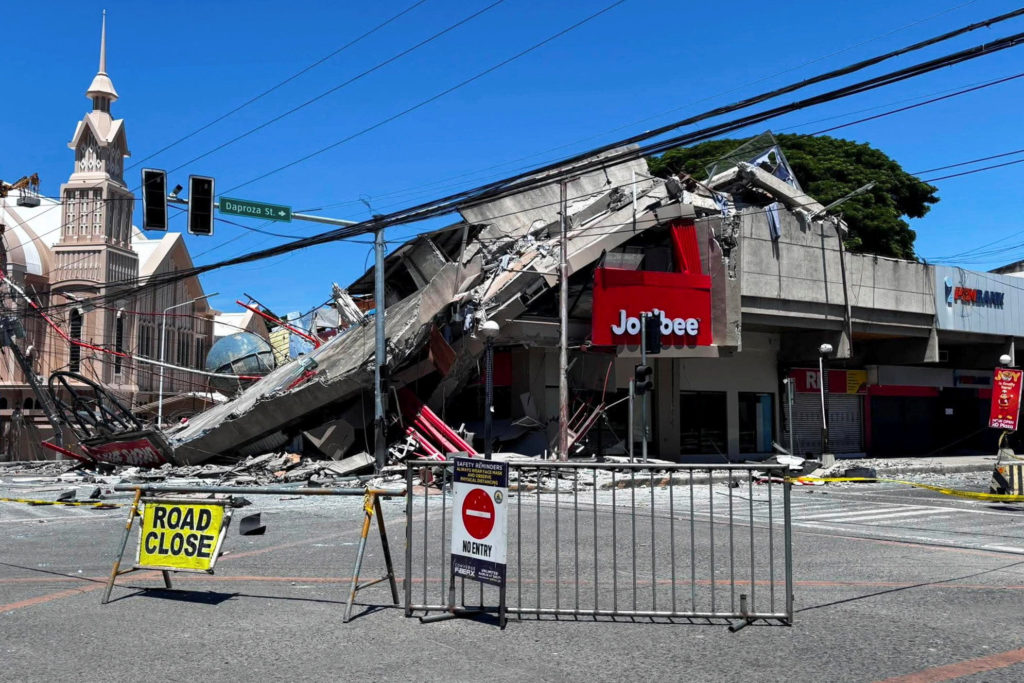
Here is a look at some of the most recent major earthquakes in the Philippines, which sits on the Pacific "Ring of Fire", is one of the world's most earthquake-prone countries.
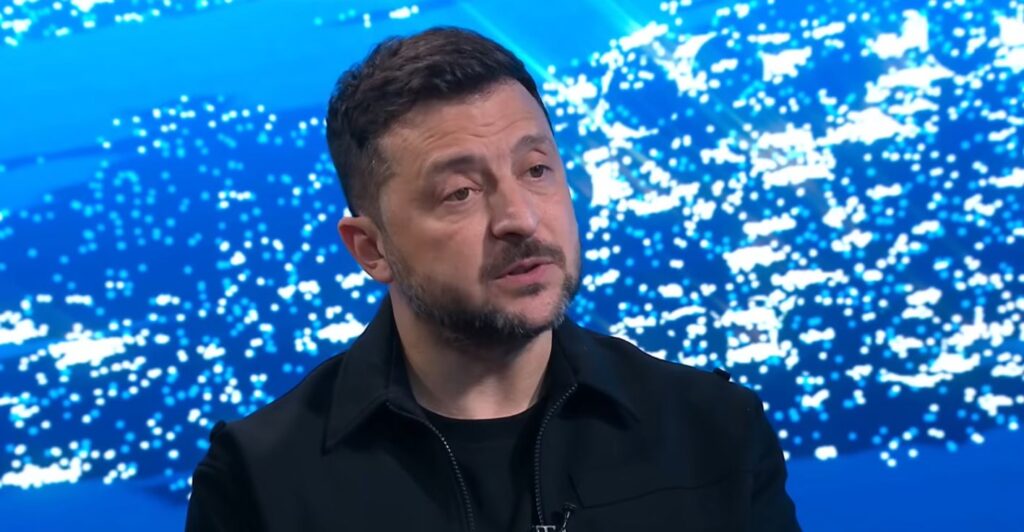
Ukrainian President Volodymyr Zelenskyy is willing to stop the war along the current line of contact and move to negotiations, he said in a Sky News interview. He presented the idea as the quickest route to a ceasefire, while rejecting any deal that hands Russia Ukrainian land. He also urged allies to close Ukraine's air defense gaps.
Russia has rejected every ceasefire Ukraine and the US have put forward and keeps refusing to halt an all-out war it has waged since its full-scale invasion in 2022. Whether a freeze ever takes hold rests with the Kremlin, whose demands still stretch far beyond the territory its army has managed to seize.
"The quickest way" to stop the fighting
Asked where he would freeze the lines if Russia agreed to a ceasefire, Zelenskyy said he is ready to accept today's positions.
"Yes, it's the quickest way," he said.
He insisted this is not a giveaway. He does not want to simply freeze the conflict, but to stop the war so it cannot restart "because of some crazy people." A freeze would let Ukraine save children's lives and bring soldiers home. Any ceasefire must be total and free of Russian games, watched by American and European partners. Only then would the sides sit down to end the war through diplomacy. A ceasefire, he added, is "the biggest compromise from our side."
The most urgent need from allies is air defense, Zelenskyy said. Ukraine faces a large deficit in anti-ballistic missiles, with US transfers slowed by the war in the Middle East. He again asked for more Patriot systems. Russia attacks daily, usually with around 300 long-range explosive drones. On the heaviest nights it launches 600 to 850 drones and dozens of missiles.
Ukraine's interceptors now down most of them, but the gaps remain dangerous.
Explore further
10% now, 23% after a ceasefire, 59% only at peace—Ukraine’s verdict on a wartime vote hasn’t moved all year
Ukraine's own arsenal
Ukraine has built more than 400 defense companies since the full-scale invasion, Zelenskyy said. Dozens rank among the world's strongest. They produce drones and missiles, some underground, and the country is close to its own ballistic missile. Ukraine can now share that expertise with allies and even build air defenses for Europe, he said. Kyiv aims to mass-produce drones on a scale few countries can match.
Bringing the war back to Russia
Ukraine's recent strikes on St. Petersburg and the Moscow region answer Russian attacks on Ukrainian energy, Zelenskyy said. St. Petersburg was hit twice last week. He wants Russians far from the front to feel the war they started. Russian President Vladimir Putin understands only "total pressure," he said. Sanctions on Russia's shadow fleet of sanctions-dodging tankers and its oil and gas exports hit hardest.
Zelenskyy said Putin does not want to stop the war and is signaling he wants to win. Whether the fighting ends "100% depends on his decision," he said. His 4 June open letter, which Moscow called rude and rejected, was meant to force an answer and pierce a Russian public living in "some fantastic world." Russian businessman Roman Abramovich came to Kyiv to carry messages to Putin, Zelenskyy said.
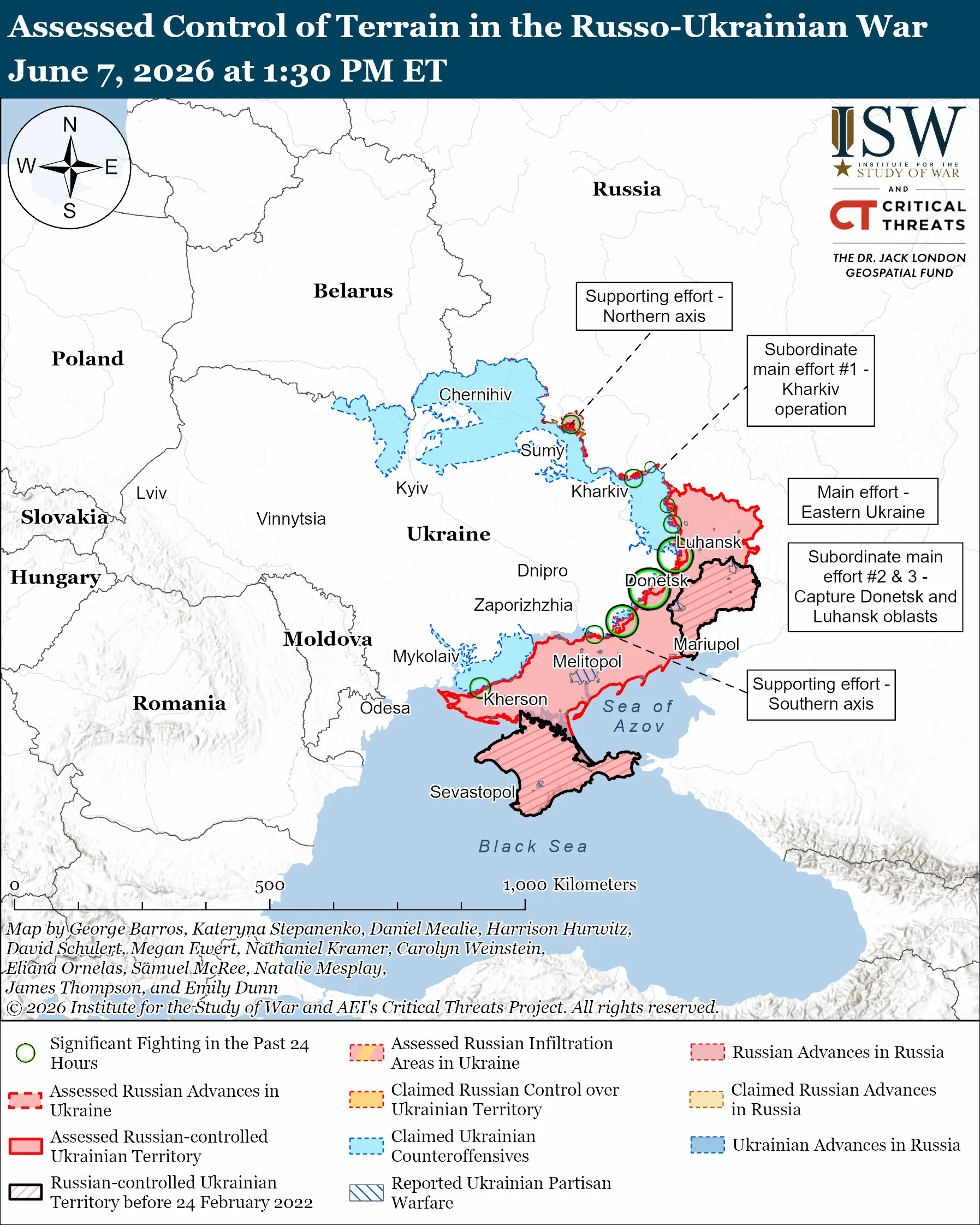
The so-called Donbas is a historic name for Ukraine’s two easternmost regions, Luhansk and Donetsk oblasts. Russia still failed to occupy a small part of Luhansk Oblast, as well as a significant swathe of Donetsk Oblast, which contains the so-called “Fortress Belt” that Russia has failed to break through despite its years-long ongoing offensive campaign. Map: ISW
His key message was on the Donbas: Ukraine will not leave its land, and compromises come only after a ceasefire. He is ready to meet in any format, but not in Moscow, Belarus, or Minsk. Leaders cannot decide "without us about us," he said, in a message aimed at Washington. Russia, by contrast, keeps insisting that Ukraine surrender all of the Donbas first.
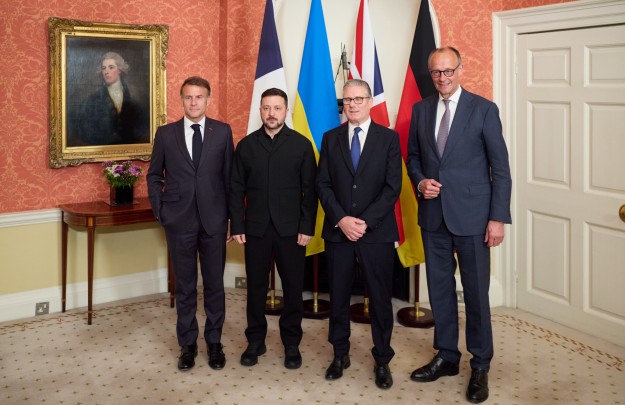
Britain, France, and Germany backed Ukraine's terms for ending the war after meeting its President Volodymyr Zelenskyy in London, according to their joint statement. They endorsed Kyiv's push for direct talks with Moscow and an immediate ceasefire, while spelling out what a lasting peace would require. The leaders also called for tightening the squeeze on Russia's war economy and scaling up Ukraine's air defenses.
Russia has been invading Ukraine since 2014 and waging all-out war since February 2022, and with Moscow still rejecting every ceasefire on offer, Kyiv and its Western partners are now trying to map out how the fighting could actually end.
Five conditions for peace
Meeting on 7 June, UK Prime Minister Keir Starmer, French President Emmanuel Macron, and German Chancellor Friedrich Merz set out five conditions for a just and lasting peace. The E3, as the three are known, are Ukraine's leading European backers. Their terms:
An immediate, complete ceasefire, which they urged Putin to accept.
The current front line as the starting point for talks, with no borders changed by force and Ukraine free to choose its alliances.
Robust, legally binding security guarantees once a ceasefire holds, building on the allies' December 2025 Berlin and January 2026 Paris commitments, including a multinational force in Ukraine.
Russian assets remain immobilized until Moscow ends its aggression and compensates Ukraine.
European interests safeguarded, with any EU- or NATO-related terms requiring both blocs' consent.
Explore further
“It was never formulated as Ukraine winning”—NATO’s ex-military chief on the missing strategy
Backing for direct talks with Moscow
The leaders commended Ukraine's president for his 4 June letter to Putin calling to end the war. They backed direct Ukraine-Russia dialogue, with the US and Europe actively taking part, to secure a ceasefire. Europe must play a role in any settlement, they said, working closely with Kyiv, the rest of Europe, and Washington.
Explore further
Germany, France, and UK sketch plan to bring Putin to the negotiating table
Pressure on Russia and more air defense
They denounced Russia's barrage of missiles and drones, including repeated strikes with the Oreshnik, a Russian missile. They also condemned dangerous Russian drone incursions into NATO territory and offered condolences to the victims. The leaders welcomed Ukraine's recent battlefield gains, from liberated territory to advances in drone warfare. They agreed to coordinate more support at the coming G7 summit in Evian, the next Coalition of the Willing meeting, and the NATO summit in Ankara. That includes choking off more of Russia's wartime revenue and a bigger military pledge at the NATO talks. They also urged scaling up interceptor production and co-developing anti-ballistic and deep-strike weapons.
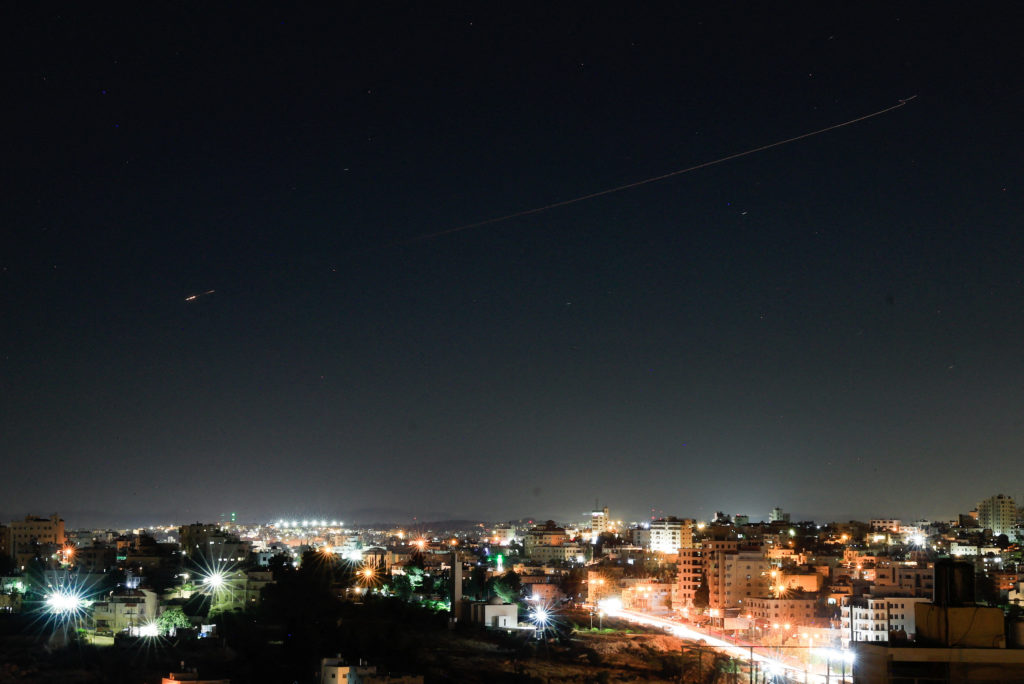
Iran launched missiles at Israel in the first such bombardment since a fragile ceasefire took effect in early April, raising the possibility of a return to heavy fighting and complicating mediation efforts to end the war.
Iran fired ballistic missiles and drones toward Bahrain and Kuwait that were intercepted early Saturday, Bahrain's government said, and called on Tehran to halt attacks on Gulf neighbors that test a fragile ceasefire in the Middle East conflict.
The nominal ceasefire between Iran and the U.S. has been repeatedly tested with back-and-forth attacks, even as officials from both countries try to negotiate an end to the war.
The nominal ceasefire between Iran and the U.S. has been repeatedly tested with back-and-forth attacks, even as officials from both countries try to negotiate an end to the war.
 Login
Login