Normal view

Ravenstorm At The Center Of Airbus’s New Combat Drone Portfolio

9 June 2026 at 19:05

Airbus has pulled the wraps off the U760 Ravenstorm, a combat drone designed to operate alongside fighter aircraft in air-to-air combat, strike missions, and electronic warfare roles. The new uncrewed aircraft is part of a revamped drone portfolio from the company, which also includes a Europeanized version of the stealthy XQ-58A Valkyrie, a medium-altitude long-endurance (MALE) platform, various tactical solutions, counter-drone systems, as well as the U145 uncrewed helicopter that you can read more about here.

The timing of the announcement — and the unveiling of the Ravenstorm, in particular — is especially notable given the recent collapse of the Franco-German-led plan to build a crewed New Generation Fighter (NGF) aircraft, as part of the broader, pan-European Future Combat Air System (FCAS) initiative. You can read more about this development here.

Concept artwork of the NGF, the crewed combat jet once intended to operate alongside various classes of drones. Dassault Aviation

On the eve of the ILA Berlin airshow, starting in the German capital tomorrow, Airbus showcased what it describes as “Europe’s most versatile drone portfolio.” The various products have been newly assigned a “U” prefix for uncrewed systems. This reflects the company’s policy of prefixing with an “A” for crewed fixed-wing aircraft, and an “H” for crewed helicopters.

“Whatever uncrewed or ‘drone’ capability our customers need to strengthen sovereign air power, we deliver,” said Mike Schoellhorn, CEO of Airbus Defence and Space, in a company press release. “Our portfolio ranges from rapid-response drone interceptors and various tactical drones, autonomous cargo helicopters to uncrewed fighter aircraft UCCAs (uncrewed collaborative combat aircraft) operating co-operatively with crewed fighter jets.”

A graphic showing the new Airbus drone portfolio includes a Eurofighter (at far left) controlling examples of the U740 Valkyrie and U760 Ravenstorm. Airbus

“On the other side of the spectrum we have the Eurodrone, our very high payload and very long endurance ISTAR (intelligence, surveillance, target acquisition, and reconnaissance) platform,” Schoellhorn continued. “Airbus provides the entire envelope of uncrewed capabilities required for modern multi-domain warfare. All our systems come with open architectures and a European mission system compatible with the wider European and international defence ecosystem.”

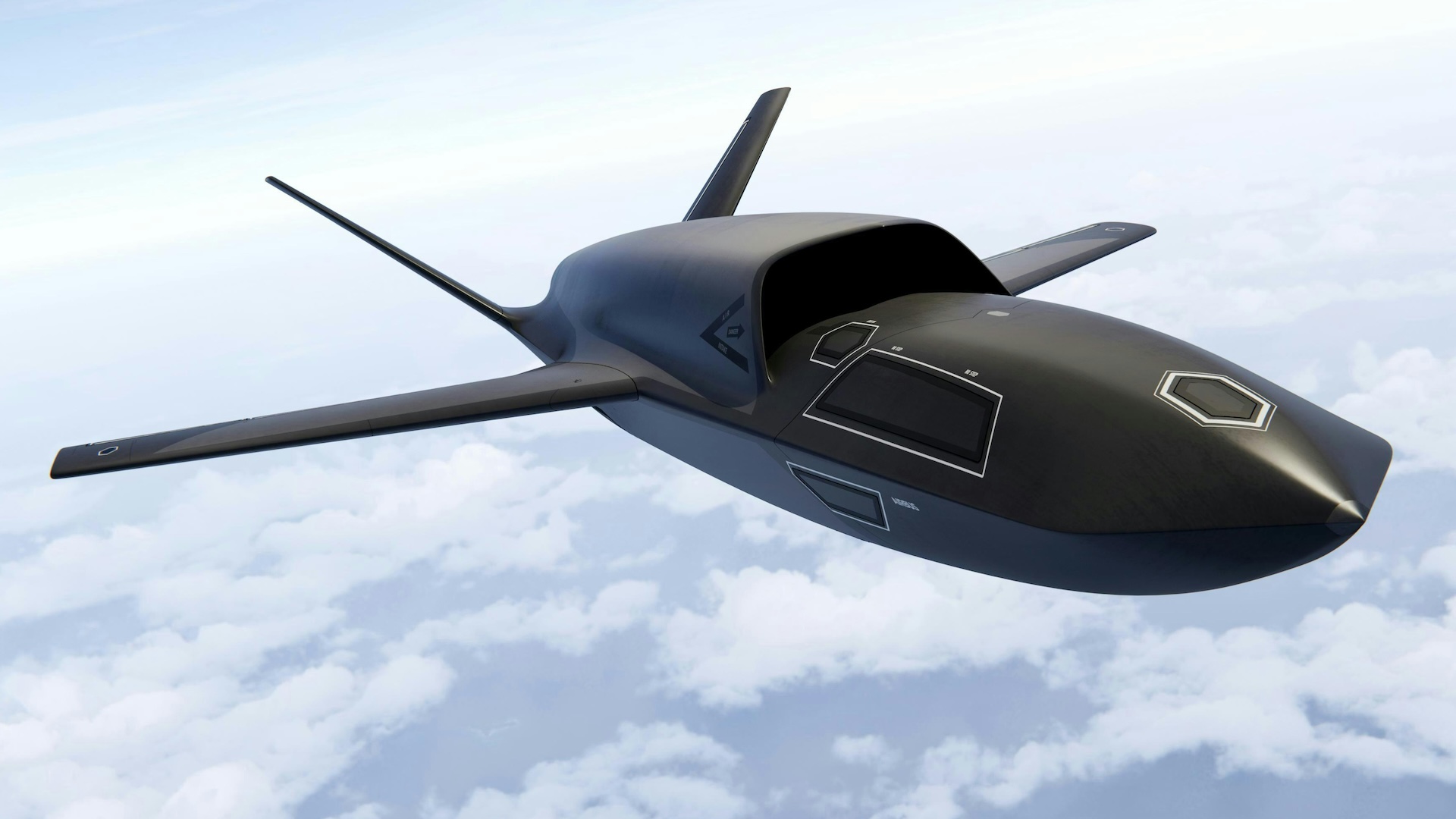
The most significant new arrival in the “U”-product line is the Ravenstorm combat drone, or U760.

A 1:1 model of the Ravenstorm will be on display at ILA. The drone is approximately 43 feet long and has a wingspan of 33 feet. In terms of rough size and general appearance, the drone strongly recalls General Atomics’ YFQ-42A ‘fighter drone’ prototype, now flying under the first phase of the U.S. Air Force’s Collaborative Combat Aircraft (CCA) program. Like the U.S. drone, the Ravenstorm features a swept, mid-wing configuration optimized for stealth and maneuverability. It also has the same twin-tail configuration. Like the YFQ-42, the Ravenstorm has a dorsal inlet, although this is closer to that which appeared on the EADS Barracuda demonstrator that flew for the first time 20 years ago. The drone is clearly optimized with low-observable (stealthy) characteristics, although the inlet is notably large and lacks the trapezoidal shape found on the YFQ-42.

Ground crew working on the Barracuda technology demonstrator. Airbus

At the same time, it should be noted that, when it comes to combat drones in general, many of them take on a relatively familiar form driven by similar requirements.

Airbus describes the Ravenstorm as “the next evolution” in its “roadmap towards a scalable family of uncrewed collaborative combat aircraft.” It is not clear how many related designs might be planned, and in what kinds of sizes they may come, but the company has highlighted the kinds of missions they will be expected to fly. These include air-to-surface strikes using precision-guided munitions, air-to-air defense with long and medium-range air-to-air missiles, and electronic warfare for suppressing enemy air defenses. Further offensive counter-air missions will involve UCCAs providing non-kinetic jamming.

Ravenstorm will be available in the early 2030s, according to the manufacturer, which is, interestingly, offering the new design alongside a version of the XQ-58. In Airbus parlance, the Valkyrie is designated U740 and combines the Kratos-designed airframe with Airbus’ proprietary Multiplatform Autonomous Reconfigurable and Secure (MARS) Mission System.

A U.S. Air Force XQ-58A deploying an ALTIUS-600 UAV from a Common Launch Tube. U.S. Air Force

For the U740, Airbus provides a notably precise planned date of service entry: 2029, with the German Air Force. This would appear to reflect a specific Luftwaffe requirement for a drone in this class, although it remains unclear if the Valkyrie has been formally selected by the German military. Airbus furthermore expects the U740 to be used in operational experimentation teamed with the Luftwaffe’s Eurofighter combat jet, including demonstrating initial air-to-ground capabilities.

The U740 Valkyrie on its launcher. Airbus

Returning to MARS, this is Airbus’ sovereign mission system, consisting of an AI-supported software core to enable platform autonomy. The system is scalable so that it can be used across the entire Airbus drone portfolio. It is also planned for use on the U950 Eurodrone — the new designation for the Eurodrone MALE platform. This twin-turboprop drone is now in development for missions including ISTAR, early warning, and anti-submarine warfare, and is planned to make its first flight in 2029.

A rendering of the Eurodrone MALE conducting a maritime mission. Airbus

As for Airbus’s two-track approach to UCCAs — U740 Valkyrie and U760 Ravenstorm — the thinking behind the two offerings, also of broadly similar sizes, likely reflects different cost points. The Valkyrie was designed from the ground up as a lower-cost aircraft and is runway-independent in its original form (since then, Kratos has announced a version with wheeled landing gear and there also exists the ability to launch the Valkyrie from a wheeled launch trolley, if required). Meanwhile, the Ravenstorm appears to be a more capable and costly platform, making it a closer match to Increment 1, the first phase of the U.S. Air Force’s CCA program.

The Anduril YFQ-44, produced for Increment 1, the first phase of the U.S. Air Force’s CCA program. U.S. Air Force

It could be that the company has already identified specific national or service requirements (such as the Valkyrie for the Luftwaffe) that it aims to capitalize on. There could also be a plan to use the Valkyrie more for operational experimentation of the UCCA concept before focusing more on the fully sovereign Ravenstorm, including potentially scaling it up or incorporating other significant airframe changes — like higher performance, larger payload, improved low-observable characteristics.

Also unclear is the status of Airbus’s stealthy Wingman, a CCA-like concept that was unveiled at the last ILA Berlin airshow in 2024. This was also presented in the form of a 1:1 model, with a length of 51 feet and a wingspan of 39 feet. The drone was planned to be powered by the same Eurojet EJ200 turbofan as the Eurofighter, providing a proven powerplant and useful commonality.

The Airbus Wingman concept aircraft, which Airbus leadership said should provide a unit cost that’s equivalent to one-third that of a modern crewed fighter. Thomas Newdick

At the time, Airbus noted that the German Air Force had “expressed a clear need” for a drone that would be able to operate in conjunction with crewed fighters before the arrival in service of the NGF, which was then slated for some time in the 2040s.

Whether the Wingman has now been abandoned entirely is unclear, but the Luftwaffe still has a requirement for an uncrewed companion that can work alongside its forthcoming Eurofighter EK electronic warfare jets. This is a role for which Airbus is earmarking the Ravenstorm, in particular, although it should be noted that the U.S. Marine Corps is also focusing heavily on the electronic warfare mission for the Valkyrie drone.

A rendering of a Eurofighter EK for the German Air Force. Airbus

All of these Airbus efforts are being informed by experience testing the Barracuda, work on which began in 2003, initially as a ‘black program.’ After six test campaigns, the Barracuda was retired.

The company will also be leveraging prior work from the Airbus Low Observable UAV Testbed (LOUT) program. A stealthy demonstrator, LOUT was not flown but was run by the company in strict secrecy until finally it was publicly disclosed in 2019, as you can read about here.

A four-ton LOUT model used for aerodynamic and anechoic chamber testing. Airbus

Undoubtedly, the significance of Airbus’s new-look drone roster, and above all the appearance of the U760 Ravenstorm alongside the U740 Valkyrie, is greater now that the FCAS program’s crewed New Generation Fighter is seemingly defunct.

It was always anticipated that the NGF would be operated as part of a wider ecosystem that also included CCA-like drones — what Airbus now refers to as UCCAs. Indeed, there were already efforts in place to start integrating combat drones with crewed fourth-generation-plus fighters like the Eurofighter and Rafale. Now that FCAS, or at least the NGF component of it, has been thwarted, Ravenstorm and Valkyrie offer a glimpse of where Europe’s combat aviation ambitions may be headed instead.

Collaborative combat aircraft like these emerged as a higher-mass, force-multiplying capability for current and future crewed fighters. In the interim, at least, the demise of the NGF means that these kinds of combat drones could be in even greater demand within Europe, where there is already a pressing need for larger tactical air combat fleets, while resources are limited. At the same time, CCA-like drones promise to make existing fourth- and fifth-generation fighters even more potent, further driving demand both in Europe and elsewhere.

Contact the author: thomas@thewarzone.com


The post Ravenstorm At The Center Of Airbus’s New Combat Drone Portfolio appeared first on The War Zone.
France, Germany end joint fighter jet development project amid reported industry dispute

8 June 2026 at 21:37
France and Germany have decided to abandon the Future Combat Air System (FCAS) fighter jet program, according to multiple media reports citing French and German government sources.

France and Germany abandon joint project to build European fighter jet

Paris and Berlin conclude firms involved unable to agree on way forward in blow to Europe’s common defence push

France and Germany have concluded that the companies involved in building a joint fighter jet will not be able to reach an agreement and have abandoned the project, officials in Berlin have said in a blow to Europe’s common defence efforts.

The French president, Emmanuel Macron, and the German chancellor, Friedrich Merz, had “reached the shared assessment that the companies will not be able to come together”, an official told Agence France-Presse. “They acknowledge this reality.”

Continue reading...

© Photograph: Charles Platiau/Reuters

© Photograph: Charles Platiau/Reuters

© Photograph: Charles Platiau/Reuters

Airbus Unveils U145 Uncrewed Cargo Helicopter

8 June 2026 at 18:50

In a significant development, Airbus has announced that its H145 twin-engine light helicopter is being developed in an uncrewed version, the U145. The move continues and expands the manufacturer’s work in the uncrewed helicopter space and reflects similar developments around the globe — most notably, an uncrewed version of the UH-72 Lakota, which is the U.S. Army’s variant of the H145.

The U145 was officially revealed today, ahead of the ILA Berlin airshow, starting this week, during which a full-scale mock-up will be displayed. Airbus says it is planning a first flight of the U145 — with a safety pilot onboard — before the end of this year, and is aiming for entry into service at the beginning of the next decade. 

At @ILA_Berlin, we introduce the Airbus U145: an uncrewed, fully autonomous variant of the H145. Optimised for cargo with no cockpit, an integrated nose door, and full autonomy, its first flight is set for late 2026. https://t.co/MbodUxYxyI pic.twitter.com/2EnMXzog6c

— Airbus Helicopters (@AirbusHeli) June 8, 2026

“With the U145, we are offering our customers an autonomous, uncrewed version of our H145 helicopter — combining the proven airframe, power and useful load of the H145 with the autonomy of a UAS,” said Matthieu Louvot, CEO of Airbus Helicopters, in a company media release. “To develop the U145 and its capabilities as a multi-mission UAS, we will be teaming up with leading autonomous mission partners to further expand the UAS ecosystem in Europe,” he added. 

The U145 will have a maximum takeoff weight of around 8,400 pounds, and is described as a “mission-agnostic solution for civil and military applications, primarily high-volume cargo supply.” Airbus has announced the payload will be up to 2,600 pounds. In comparison, the uncrewed version of the Lakota, the MQ-72C Lakota Connector, will carry a maximum payload of around 4,000 pounds, although this includes slung loads. With that in mind, the U145 and MQ-72C will likely end up offering very similar payload capacities.

A model of the uncrewed version of the Lakota, now known as the MQ-72C, on display at the 2024 Sea Air Space convention. Jamie Hunter

The MQ-72C is expected to be able to cruise at speeds of 135 knots out to ranges of at least 350 nautical miles, according to the Airbus website.

Already at this stage, the company is pitching the U145 for specific military roles, including armed scouting and surveillance. Airbus is also planning to adapt the U145 as a “drone mothership” that will carry “launched effects,” on which the company is partnering with European missile house MBDA. A similar concept is currently being pitched by Sikorsky, with its uncrewed version of the Black Hawk helicopter, dubbed the U-Hawk, which is also intended to be able to fire dozens of launched effects such as surveillance and reconnaissance drones and loitering munitions.

Airbus also envisages the U145 operating in conjunction with conventional helicopters as part of crewed-uncrewed teaming. 

German air force special forces members take off from Lechfeld Air Base, Germany aboard an H145M Airbus aircraft during exercise Air Defender 2023 (AD23), June 14, 2023. Exercise AD23 integrates both U.S. and allied air-power to defend shared values, while leveraging and strengthening vital partnerships to deter aggression around the world. (U.S. Air National Guard photo by Staff Sgt. Joseph R. Morgan)
German special forces members take off from Lechfeld Air Base, Germany, aboard a pair of H145Ms during Exercise Air Defender 2023. U.S. Air National Guard photo by Staff Sgt. Joseph R. Morgan Tech. Sgt. Joseph Morgan

The U145 will offer full autonomy, Airbus says, being equipped with a specialized sensor suite and artificial intelligence. For an uncrewed logistics aircraft, the ability to autonomously navigate along a predetermined route using programmed waypoints would provide a practical foundation for autonomous operations. However, more advanced capabilities — such as dynamically adjusting flight paths and responding in real time to emerging threats or unexpected obstacles — would also be very valuable, especially when conducting resupply missions in contested or high-risk environments.

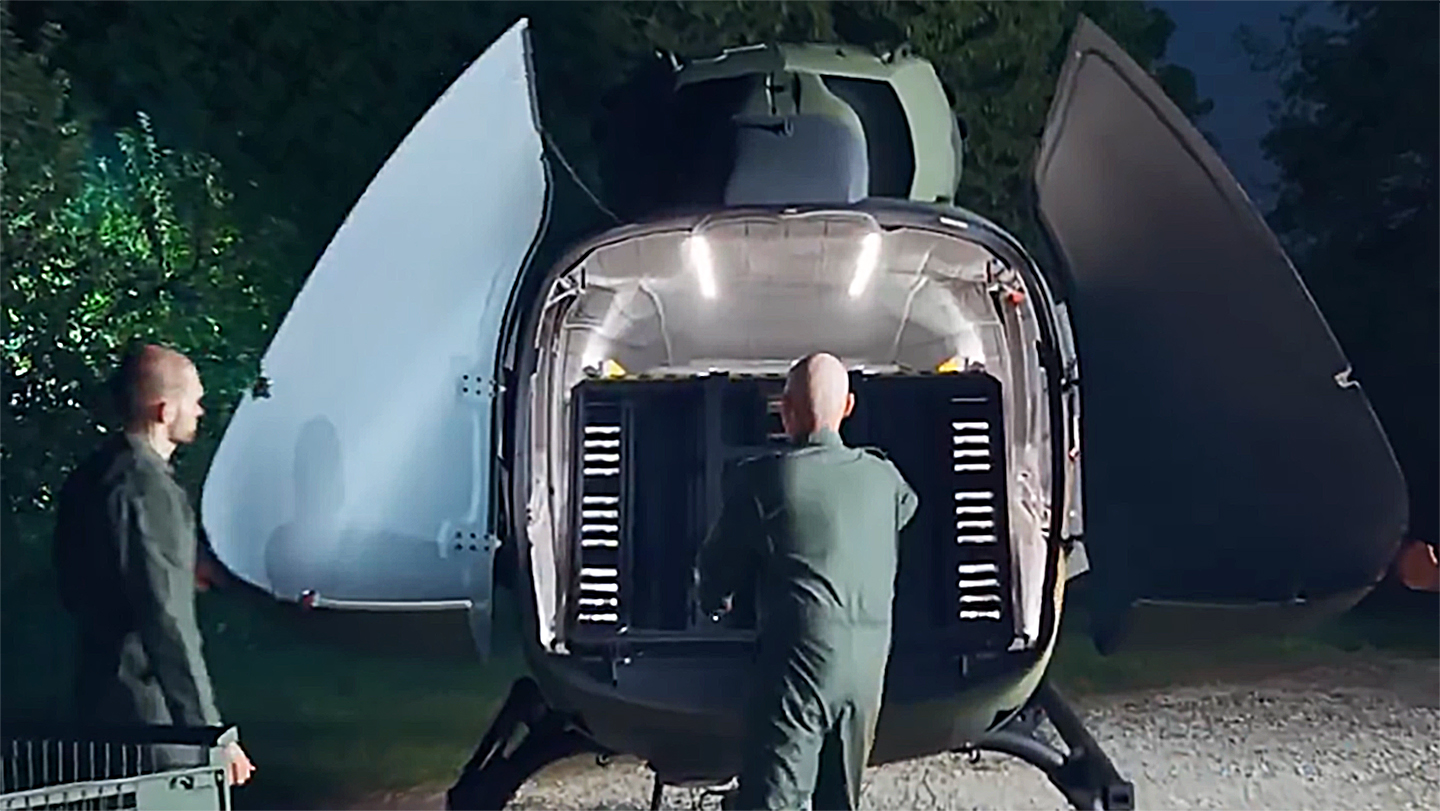
The U145 will have no physical cockpit, so it cannot be flown with human pilots onboard. Other significant changes include adaptations for cargo missions, including a clamshell nose door, a loading platform, and a dedicated cargo floor. The existing rear clamshell doors are retained, as are the cabin side doors. The same configuration has been adopted for the MQ-72C, and a pass-through cargo hold is a big advantage that other crewed helicopters in this class cannot match.

A look in through the rear of a UH-72 in a medical evacuation configuration. The H145 is essentially similar. U.S. Army National Guard

Other features of the new uncrewed helicopter will be carried directly over from the H145, more than 1,800 of which are currently in service.

These features include a powerplant of two Safran Arriel 2E engines equipped with a full-authority digital engine control (FADEC) and a fenestron tail rotor.

The U145 is the next step in the manufacturer’s development of uncrewed helicopters. As such, it follows on from the smaller VSR700, a rotary-wing uncrewed air system which was derived from the crewed Cabri G2 light helicopter.

A VSR700 completes a test flight, accompanied by an H145. Airbus

It is unclear what elements might be ported across from the MQ-72C, also called the Unmanned Logistics Connector (ULC), which is being developed separately by Airbus U.S. Space and Defense, together with its partners Shield AI, L3 Harris, and Parry Lab. Based on the U.S.-made UH-72B Lakota, the MQ-72C is similarly autonomous and is primarily aimed at the U.S. Marine Corps. You can read more about the MQ-72C in our previous coverage of the aircraft, here and here.

In the context of the MQ-72C, we have previously looked at how this platform fits with the U.S. Marine Corps’ vision for future fleets of cargo-carrying drones. The Marines see uncrewed logistics ‘connectors’ in the air and down below as essential for supporting future expeditionary and distributed operations, especially in the context of a possible future high-end fight with China in the Pacific.

Other U.S. efforts in this space include optionally crewed and uncrewed versions of the larger H-60 Black Hawk series. The U-Hawk demonstrator, a fully uncrewed version of the Black Hawk helicopter, is intended to carry cargo and deliver launched effects and similarly features clamshell doors in the nose. At the heavier end of the scale, Boeing has said its future plans for the H-47 Chinook include creating a path toward an uncrewed version of the aircraft.

However, these kinds of capabilities are increasingly being eyed by other services around the world, too.

With this in mind, Airbus is hoping to leverage the existing customer base for the H145, which has footprints on six continents. The H145 is already in service, or on order, with a growing number of international military operators for utility and light-attack missions. The uncrewed version maintains significant commonality, which will bring down support and maintenance costs.

At the same time, the U145 has obvious commercial applications. Airbus highlights its suitability for roles like disaster management and firefighting, although it would also be ideal for cargo conveyance, especially remote resupply work and logistics support to offshore platforms and remote areas on land, for example.

A standard H145 demonstrates its capabilities for offshore missions. Airbus

An Airbus spokesperson told Breaking Defense that the U145 has not been developed for any specific national or European acquisition.

Undoubtedly, there is growing recognition in Europe, in particular, that changes in the geopolitical landscape mean that the continent cannot necessarily rely on the United States to meet its defense needs. Developing the U145 in addition to the MQ-72C aligns with Europe’s ambition to strengthen its sovereign capabilities.

With the U145, Airbus is betting that autonomous rotorcraft will become an increasingly important part of military operations. By leveraging a proven helicopter platform, it should accelerate the transition to uncrewed operations, but the drone helicopter will be entering an increasingly competitive marketplace.

Contact the author: thomas@thewarzone.com

The post Airbus Unveils U145 Uncrewed Cargo Helicopter appeared first on The War Zone.

Britain, France, and Germany back Ukraine’s peace terms and press Putin for a ceasefire

8 June 2026 at 12:43

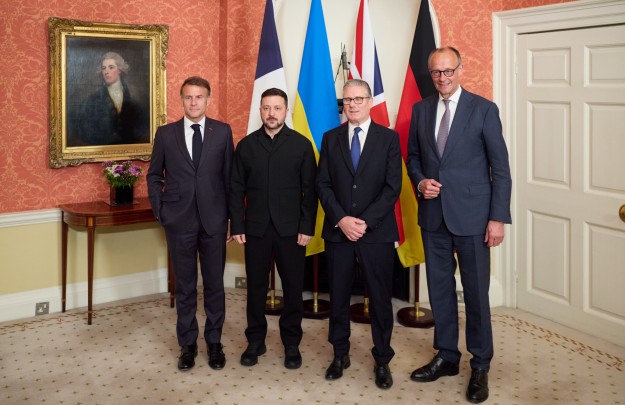
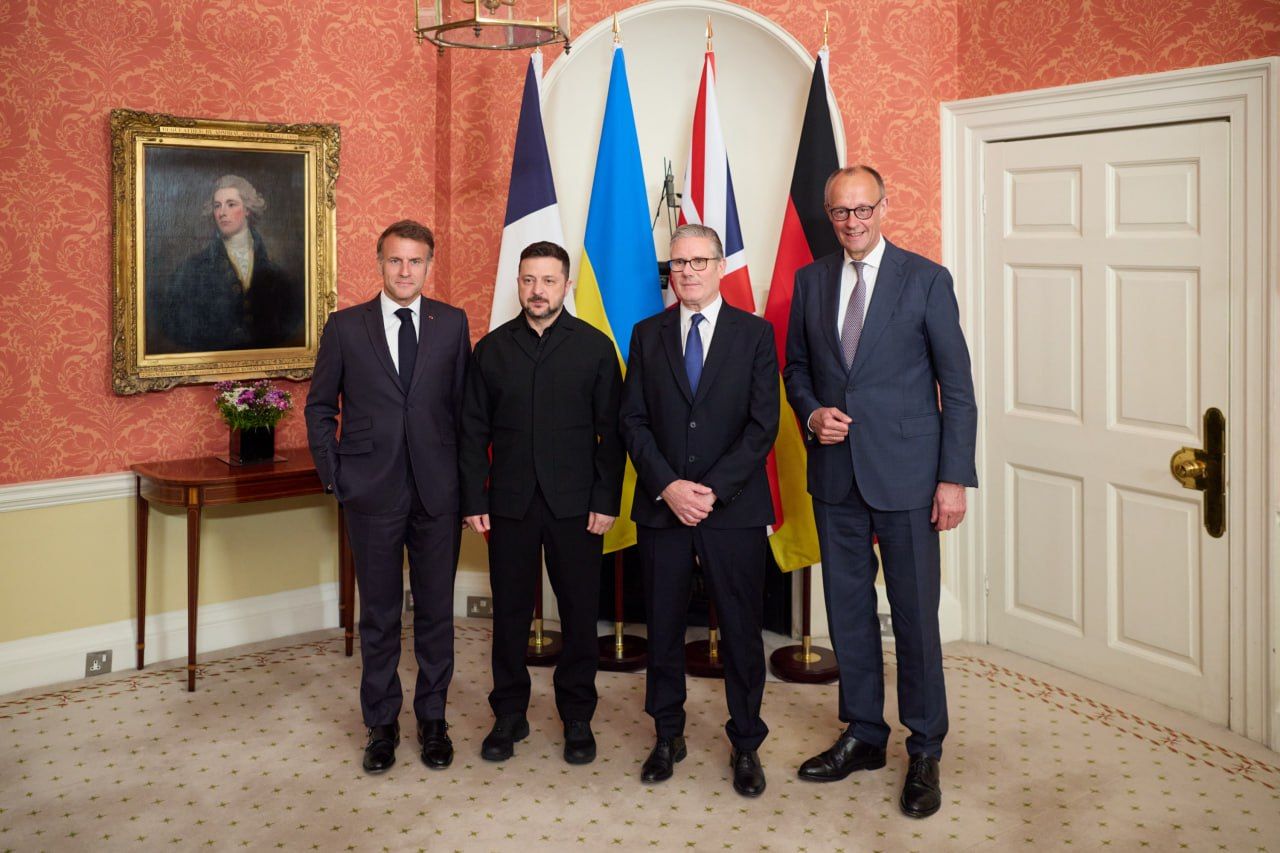
britain france germany back ukraine's peace terms press putin ceasefire · post left right french president emmanuel macron ukrainian volodymyr zelenskyy uk prime minister keir starmer german chancellor friedrich merz

Britain, France, and Germany backed Ukraine's terms for ending the war after meeting its President Volodymyr Zelenskyy in London, according to their joint statement. They endorsed Kyiv's push for direct talks with Moscow and an immediate ceasefire, while spelling out what a lasting peace would require. The leaders also called for tightening the squeeze on Russia's war economy and scaling up Ukraine's air defenses.

Russia has been invading Ukraine since 2014 and waging all-out war since February 2022, and with Moscow still rejecting every ceasefire on offer, Kyiv and its Western partners are now trying to map out how the fighting could actually end.

Five conditions for peace

Meeting on 7 June, UK Prime Minister Keir Starmer, French President Emmanuel Macron, and German Chancellor Friedrich Merz set out five conditions for a just and lasting peace. The E3, as the three are known, are Ukraine's leading European backers. Their terms:

  • An immediate, complete ceasefire, which they urged Putin to accept.
  • The current front line as the starting point for talks, with no borders changed by force and Ukraine free to choose its alliances.
  • Robust, legally binding security guarantees once a ceasefire holds, building on the allies' December 2025 Berlin and January 2026 Paris commitments, including a multinational force in Ukraine. 
  • Russian assets remain immobilized until Moscow ends its aggression and compensates Ukraine.
  • European interests safeguarded, with any EU- or NATO-related terms requiring both blocs' consent.
Admiral Bauer Ukraine NATO membership
Explore further

“It was never formulated as Ukraine winning”—NATO’s ex-military chief on the missing strategy

Backing for direct talks with Moscow

The leaders commended Ukraine's president for his 4 June letter to Putin calling to end the war. They backed direct Ukraine-Russia dialogue, with the US and Europe actively taking part, to secure a ceasefire. Europe must play a role in any settlement, they said, working closely with Kyiv, the rest of Europe, and Washington.

Zelenskyy
Explore further

Germany, France, and UK sketch plan to bring Putin to the negotiating table

Pressure on Russia and more air defense

They denounced Russia's barrage of missiles and drones, including repeated strikes with the Oreshnik, a Russian missile. They also condemned dangerous Russian drone incursions into NATO territory and offered condolences to the victims. The leaders welcomed Ukraine's recent battlefield gains, from liberated territory to advances in drone warfare. They agreed to coordinate more support at the coming G7 summit in Evian, the next Coalition of the Willing meeting, and the NATO summit in Ankara. That includes choking off more of Russia's wartime revenue and a bigger military pledge at the NATO talks. They also urged scaling up interceptor production and co-developing anti-ballistic and deep-strike weapons.

The jailing of Germany’s most wanted woman – podcast

Dancer, dog owner, bank robber. Germany’s most wanted woman, Daniela Klette, has been sentenced to 13 years in prison after decades on the run. Deborah Cole and Jason Burke report

To her friends and neighbours, there was nothing extraordinary about Claudia Ivone.

As our Berlin correspondent, Deborah Cole, explains, the silver-haired 67-year-old had spent years living in the same apartment in a bohemian neighbourhood of west Berlin. She led an ordinary life: she owned a dog, went shopping and pursued an unusual hobby as an active member of a local capoeira dance group.

Continue reading...

© Photograph: Sina Schuldt/EPA

© Photograph: Sina Schuldt/EPA

© Photograph: Sina Schuldt/EPA

Zelenskyy discusses ‘urgent need to scale up’ air defences with key allies in London

Keir Starmer hosts Ukrainian, French and German leaders in Downing Street after Russia fires hypersonic weapons at Ukraine

Volodymyr Zelenskyy and the leaders of the UK, France and Germany discussed “the urgent need to scale up” Ukraine’s air defences and deep-strike capabilities in London on Sunday night, after Russia fired hypersonic weapons at Ukraine, Downing Street said.

The meeting of Ukraine’s staunchest allies in London came hours after a Russian drone strike damaged a storage centre for spent nuclear fuel nine miles from the Chornobyl nuclear power plant.

Continue reading...

© Photograph: James Veysey/Shutterstock

© Photograph: James Veysey/Shutterstock

© Photograph: James Veysey/Shutterstock

Germany’s New Government Promises to Provide a Digital Identity for Every Citizen

21 April 2025 at 17:40
by Melissa Stern | Secuzine Germany’s new coalition government, formed by the conservative bloc and the center-left Social Democratic Party (SPD), has outlined an ambitious plan to digitize public services and provide a digital identity for every citizen. The incoming government, led by Chancellor Friedrich Merz, is focused on modernizing the state with a major digital overhaul. One of the key components of this transformation is the establishment of a new Ministry of Digital and State Modernization, aimed at streamlining public administration. Read Full Article >
❌