Normal view

NSW Labor officials investigated over allegedly disguising donations to Minns – as it happened

This blog is closed

‘If Australian datacentres are going to power the AI revolution, we deserve a fair return’ – David Pocock

Independent senator David Pocock has published an opinion piece about the growth of AI datacentres in Australia and how the gold rush should benefit Australians. He writes:

Huge investment in this space is pouring into Australia. In the past year, Microsoft has announced $25bn will go into Australian datacentres and Amazon Web Services has committed another $20bn.

The prime minister has posed for photos with the CEOs of both companies, welcoming the investment with open arms despite a growing backlash by communities against AI and datacentre construction. At a time when economic growth is sluggish, the government sees billions of dollars in investment as making for a good headline.

I think if you look at the programme itself, it’s a great podcast that she’s done a great job on a topic that I’m sure will be of real interest and real importance to many Australians who suffer from those conditions, and particularly young Australians and young Australian women.

So there’s a balance in all these things … for the ABC to be ensuring that we bring great content to air and also acknowledging that, you know, with some of the people that we work with, sometimes there will be controversy.

Obviously we’ve looked at Charlie’s comments. I think he did express that they were his own view. They weren’t represented at the ABC. It was a little bit on the hop and a little bit not. So I think we felt comfortable that we were able to accept that his comments weren’t a breach of the ABC code of conduct.

Continue reading...

© Photograph: Dan Himbrechts/AAP

© Photograph: Dan Himbrechts/AAP

© Photograph: Dan Himbrechts/AAP

Zelenskyy hopes Reform UK councils will allow Ukraine flags to be flown again

Exclusive: Ukrainian president says ‘small mistake can break a big friendship’ in wide-ranging interview with Guardian

Volodymyr Zelenskyy has said the decision by some Reform UK councils to take down the Ukrainian flag was the kind of “small mistake that can break a big friendship”, as he underlined the significance of strong bilateral relations.

The Ukrainian president tempered his rare foray into UK domestic politics by stressing how much the two countries “need each other” in the battle against Russia, which he said posed a threat not only to Ukraine but to Britain too.

Continue reading...

© Photograph: David Levene/The Guardian

© Photograph: David Levene/The Guardian

© Photograph: David Levene/The Guardian

Israel and Iran step back from renewed conflict after Trump calls for halt

Netanyahu acknowledges pause in fighting in TV speech but vows forceful response to future attacks

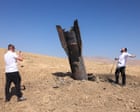
Fears of a return to a full-scale regional war in the Middle East eased on Monday as Israel and Iran said they had halted attacks on each other after an appeal from Donald Trump to “immediately stop shooting”.

Benjamin Netanyahu, Israel’s prime minister, acknowledged the halt in fighting with Iran in a televised speech, but vowed to respond “with force” to future attacks.

Continue reading...

© Photograph: Ahmad Gharabli/AFP/Getty Images

© Photograph: Ahmad Gharabli/AFP/Getty Images

© Photograph: Ahmad Gharabli/AFP/Getty Images

Will Iran give up on ceasefire talks as strait of Hormuz blockade continues?

Chokehold on shipping route draws Houthis in Yemen back into conflict as commenters see ‘no turning back’

Iran’s reversion to large-scale military exchanges with Israel broadened the conflict that began in February not only by making the Israeli attacks on Hezbollah a direct casus belli for Iran for the first time, but also by drawing the Houthis in Yemen back into the conflict with as yet incalculable consequences.

Some in Tehran, buoyed up by past perceived military success and emboldened by the chokehold of the strait of Hormuz, would like to turn this moment into the point of no return in the conflagration with Israel. A minority would welcome the abandonment of ceasefire talks with the US, an outcome for which they have been agitating for weeks.

Continue reading...

© Photograph: Abedin Taherkenareh/EPA

© Photograph: Abedin Taherkenareh/EPA

© Photograph: Abedin Taherkenareh/EPA

Israel and Iran exchange strikes as Middle East crisis threatens to escalate

Attacks raise fears of return to full-scale regional war and come after Trump says ‘I call all the shots’, not Netanyahu

The Israeli military has launched airstrikes on Iran after the Iranians fired missiles at northern Israel in the first exchange of fire between the two countries since a ceasefire was reached on 8 April, raising fears of a return to a full-scale regional war in the Middle East.

Yemen’s Iran-aligned Houthi rebels also fired at Israel and warned they would target Israeli-affiliated ships in the Red Sea, further escalating tension.

Continue reading...

© Photograph: Abbas Salman/EPA

© Photograph: Abbas Salman/EPA

© Photograph: Abbas Salman/EPA

Zelenskyy discusses ‘urgent need to scale up’ air defences with key allies in London

Keir Starmer hosts Ukrainian, French and German leaders in Downing Street after Russia fires hypersonic weapons at Ukraine

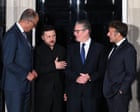
Volodymyr Zelenskyy and the leaders of the UK, France and Germany discussed “the urgent need to scale up” Ukraine’s air defences and deep-strike capabilities in London on Sunday night, after Russia fired hypersonic weapons at Ukraine, Downing Street said.

The meeting of Ukraine’s staunchest allies in London came hours after a Russian drone strike damaged a storage centre for spent nuclear fuel nine miles from the Chornobyl nuclear power plant.

Continue reading...

© Photograph: James Veysey/Shutterstock

© Photograph: James Veysey/Shutterstock

© Photograph: James Veysey/Shutterstock

UK readies sanctions against Israel to deter proposed illegal West Bank settlement

Move comes as 137 Labour MPs sign letter demanding ‘urgent, concrete action’ to stop settler violence

The UK Foreign Office and a group of western countries are due to announce a package of sanctions against Israel this week designed to deter companies from becoming involved in a proposed West Bank settlement that would split the territory in two and render the concept of a two-state solution near impossible.

Nine countries including France, the UK and Australia have warned that settlement violence must stop and no company should be involved in what is known as the E1 development.

Continue reading...

© Photograph: Hazem Bader/AFP/Getty Images

© Photograph: Hazem Bader/AFP/Getty Images

© Photograph: Hazem Bader/AFP/Getty Images

❌