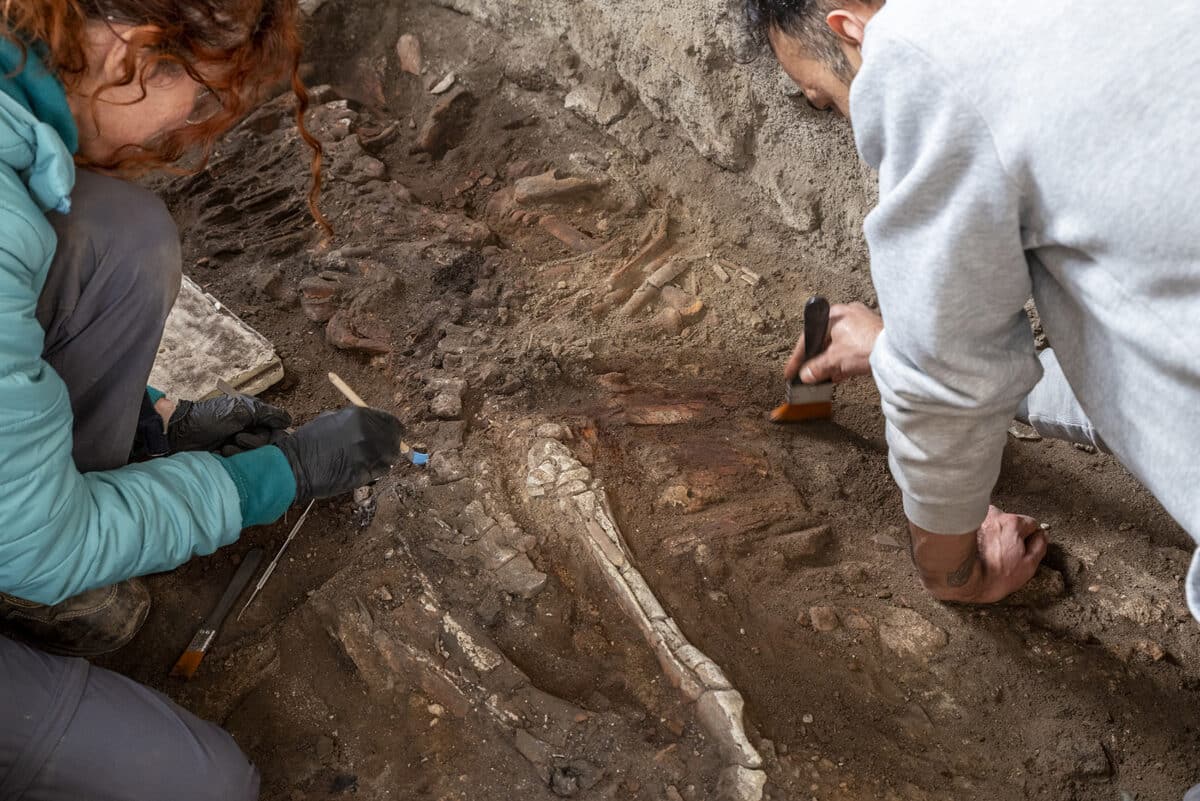
The skeleton of an equine at an ancient bread-making complex in Pompeii. Credit: Pompeii Archaeological Park
Archaeologists in Pompeii have uncovered an equine skeleton inside a bread-making workshop at one of the city’s most celebrated ancient complexes, opening a new chapter in the understanding of how humans and animals lived and worked together nearly 2,000 years ago.
The remains were discovered at the Insula of the Chaste Lovers, a large residential and commercial site renowned for its striking “chaste kiss” fresco, painted inside the dining room of the owner’s home.
The complex includes a working bakery, storage rooms, processing spaces, and the owner’s private residence. Researchers had previously found other equids at the site’s stables, where animals were used to power grain mills and transport the grain needed for bread production.
Pompeii’s chaste lovers complex was also a busy bakery
This latest skeleton was not found in the stables. Researchers found it in a separate room, suggesting the animal had fled there during the catastrophic eruption of Mount Vesuvius in 79 AD.
The excavation brought together archaeologists and specialists from the Applied Research Laboratory, including experts in animal remains, plant life, and human bones. This interdisciplinary approach has become one of the most important aspects of modern archaeological research at the site.
Archaeologists are excavating the skeleton of an equine. Credit: Pompeii Archaeological Park
Laboratory analysis is still ongoing. Researchers expect it to reveal more about the animal’s specific role in the production complex and the conditions it faced during the eruption.
The study could also contribute to a wider understanding of how animals responded to the disaster in real time, adding detail to the reconstruction of those final, chaotic hours.
Pompeii equine skeleton suggests a desperate Vesuvius escape
Gabriel Zuchtriegel, director of the Pompeii Archaeological Park, said that Pompeii offers far more than beautiful frescoes and ancient objects.
He said it gives researchers the opportunity to understand lives that were ended by the eruption, and that this extends to animals as well as people. The horse or donkey, he noted, was found inside a house with remarkable frescoes that also served as a working mill and bakery.
Its location in a room away from the stables points to an attempt to escape the eruption. Zuchtriegel called the excavation a strong example of the daily multidisciplinary collaboration at the site and said ongoing lab results will continue to offer significant scientific value.
Pompeii continues to yield new layers of ancient life. The site preserves not just objects and artwork but the full texture of daily existence, including the bonds between people, animals, and the spaces they shared.
The equine skeleton discovered in Pompeii’s ancient bread workshop is the latest reminder that the city still holds stories waiting to be told.
The Quadrilateral Security Dialogue (Quad) and AUKUS have yet again unveiled a flawed strategy for influence in the Pacific. Both security alliances are ambitious and are planning to invest more in aggressive capabilities. These days, the West is meticulously taking calculated strategic initiatives, especially in the Asia Pacific region, to build alliances, groups, and security […]
Imagina por un momento que formas parte de ese escaso 0,3–0,4% de la población que tiene un gemelo idéntico. Mismo ADN, mismo punto de partida ante la vida. Durante años, prácticamente indistinguibles. Pero con el paso del tiempo, algo empieza a cambiar: pequeñas diferencias que eran casi imperceptibles se acentúan. En la piel, en la energía, en la salud. Uno parece envejecer más rápido que el otro.
Con un detalle clave: su alimentación, entrenamiento y hábitos de vida han sido prácticamente iguales. Todos salvo uno. La única diferencia relevante entre ambos no es lo que comen ni cuánto entrenan, sino cuánto duermen. Aquí aparece uno de los conceptos más importantes para entender el envejecimiento: el sueño moldea, de manera silenciosa, cómo envejecemos. Estos dos gemelos acabarán siendo distintos tanto por fuera como por dentro.
Dormir no es simplemente "descansar". Durante el sueño, el organismo activa procesos esenciales de reparación celular, regulación hormonal y limpieza metabólica. Detente un segundo en este último concepto. Limpieza metabólica. Es decir, eliminar desechos. Tu cuerpo, literalmente, se limpia por dentro mientras duermes.
El cerebro se limpia de noche
El cerebro tiene su propio servicio de limpieza nocturna: el sistema glinfático, uno de los descubrimientos más fascinantes de la neurociencia reciente. Puede imaginarse como una red de tuberías que solo se abre de noche, cuando hay menos tráfico.
Mientras duermes —especialmente en las fases de sueño profundo— este sistema elimina residuos acumulados durante el día. Entre ellos, la proteína beta-amiloide, cuya acumulación se ha relacionado con enfermedades como el Alzheimer. ¿Y cuánto más activo es este sistema durante el sueño? Hasta diez veces más que cuando estás despierto.
Durante el sueño se produce un proceso de limpieza clave en nuestro organismo
Durante el sueño también se regula el cortisol, la hormona del estrés; se libera la hormona del crecimiento y se activan los exosomas, unas pequeñas vesículas implicadas en la comunicación entre células y la regeneración de tejidos.
Son procesos que el cuerpo no puede realizar igual de bien con todo el ruido del día. Cuando el sueño falla, todo este sistema empieza a desajustarse. Y el cuerpo lo paga.
La huella invisible de dormir mal
Dormir mal deja huella. Y no es una metáfora. Vivimos atentos a la huella que dejamos en el planeta —carbono, impacto ecológico—, pero hablamos mucho menos de la huella que dejamos en nuestro propio cuerpo cuando dormimos mal noche tras noche. Esa huella, cada vez lo sabemos mejor, es profunda.
Dormir menos de seis horas de forma crónica se ha asociado con mayor riesgo cardiovascular, alteraciones metabólicas como la resistencia a la insulina, aumento de la inflamación, mayor probabilidad de obesidad y deterioro cognitivo a largo plazo. No es un solo efecto: son varios actuando a la vez, de forma silenciosa, acumulando daño.
Hay un mecanismo especialmente revelador: los telómeros. Imagina tu ADN como un cordón de zapatilla. En los extremos hay unos 'plásticos' que evitan que se deshilache. Eso son los telómeros. Con cada división celular se acortan un poco. Cuando se vuelven demasiado cortos, la célula deja de funcionar bien o muere. Es el reloj del envejecimiento biológico.
La privación crónica de sueño se ha asociado con un acortamiento acelerado de los telómeros. No solo sentimos que envejecemos cuando dormimos mal: biológicamente, lo estamos haciendo.
Cuando el sueño pasa al primer plano
Durante mucho tiempo la salud pública ha puesto el foco en el tabaco, la dieta o el sedentarismo. El sueño ha quedado en segundo plano, como si fuera una cuestión de comodidad y no de salud. Hoy, esa visión empieza a cambiar.
Dormir mal podría ser uno de los factores más infravalorados del envejecimiento, con efectos comparables —y acumulativos— a otros riesgos bien conocidos. No se trata de decir que "dormir poco sea peor que fumar", sino de entender que su impacto sostenido afecta a múltiples sistemas del organismo al mismo tiempo. Una huella que no siempre se ve, pero que se acumula.
El efecto de un mal descanso termina haciéndose visible
Existe una imagen muy conocida en medicina: la de un conductor de camión cuya cara ha estado durante años expuesta al sol solo por un lado. La diferencia entre ambos lados del rostro es evidente. Uno envejece antes; el otro, protegido, se mantiene.
Dormir mal actúa de forma similar, pero desde dentro. No lo vemos día a día, pero el efecto termina haciéndose visible: en la piel, en la energía, en la concentración y, sobre todo, en órganos que no vemos en el espejo.
Dormir poco no es una virtud
Vivimos en una cultura que premia la productividad a costa del descanso. Dormir poco se ha normalizado, incluso se presume de ello. En medicina, durante la residencia MIR, era frecuente interpretar que tras una guardia de 24 horas irse a dormir era señal de falta de compromiso. Descansar parecía rendirse. Biológicamente ocurre lo contrario: descansar es una forma de sostener el rendimiento.
Reducir el sueño de manera crónica no mejora la productividad. Mantiene al organismo en estrés continuo. No es eficiencia. Es desgaste silencioso. No es casualidad que deportistas de élite, modelos o profesionales de alta exigencia protejan el sueño como un ritual. En el deporte de máximo nivel, el descanso es parte del entrenamiento.
Pau Gasol ha sido uno de los grandes divulgadores del sueño como pilar de salud
LeBron James duerme entre 8 y 10 horas diarias. Roger Federer ha explicado que durante la competición priorizaba dormir hasta 10–12 horas, siestas incluidas. Pau Gasol ha sido uno de los grandes divulgadores del sueño como pilar de salud.
En todos estos ámbitos el patrón se repite: cuando el rendimiento, la imagen o la toma de decisiones están en juego, el sueño deja de ser un lujo y se convierte en una herramienta estratégica.
Un cambio sencillo: dormir bien
Buscamos soluciones complejas: suplementos, tecnología, biomarcadores. Y sin embargo, una de las intervenciones más potentes sigue siendo gratuita, accesible y al alcance de cualquiera.
No requiere receta.
No requiere equipamiento.
No requiere inversión.
Solo requiere algo que cada vez cuesta más: priorizarlo. Porque la diferencia entre envejecer mejor o peor puede no estar solo en lo que hacemos durante el día, sino en lo que dejamos que ocurra cada noche. Cierra el móvil. Apaga la luz. Deja que el cuerpo haga su trabajo.
Millones de conductores españoles han optado por no comprar todavía la baliza V16, ya sea a modo de protesta o por desconocimiento de la normativa actual. De igual forma, los hay que no llevan la luz en la guantera de alguno de sus vehículos. Por ello, se exponen a la multa de 80 euros que puede suponer no encender el dispositivo en caso de emergencia.
La DGT ya explicó que no iba a ordenar a los agentes de tráfico revisaren los controlessi los conductores llevaneldispositivo conectado a la DGT 3.0en la guantera del coche, pero muchos todavía dudan si en la Inspección Técnica del Vehículo (ITV) será un requisito para superarla este mismo año o si podría acarrear multa.
¿Podemos pasar la ITV sin la baliza V16?
Sí, según confirmó hace unos meses el propio director de la Dirección General de Tráfico, Pere Navarro, los mecánicos de la ITV no se están fijando en si llevamos o no la luz conectada, al igual quetampoco lo hacían en si traíamos los triángulos de emergencia que cumplían las veces de la baliza a nivel normativo.
Por lo tanto, actualmente se puede pasar la inspección técnica del vehículo sin llevar la baliza V16 sin ningún tipo de problema, pese a su obligatoriedad. Sin embargo, los técnicos sí que están empezando a fijarse en elementos a los que antes no se prestaba atención, como los ADAS o las baterías de los eléctricos, ya que la Unión Europea lo ha requerido para adaptarse a los vehículos modernos.
¿Qué partes del coche revisan en la ITV?
En una estación de ITV se realiza una inspección prácticamente completa del vehículo para certificar que está capacitado para circular con seguridad.
El proceso se inicia con la identificación del automóvil: En primer lugar, secomprueba que el número de bastidor y el modelo coincidan exactamente con lo que figura en su documentación oficial. A continuación, se examina el estado exterior, incluyendo la carrocería, el chasis y los cristales, además de verificar que el interior del habitáculo no presente defectos.
Los técnicos se fijan especialmente en los sistemas de seguridad dinámica: alumbrado, la señalización y el estado de los neumáticos, los cuales deben cumplir con los estándares del fabricante. También se revisan a fondo los frenos, la dirección, la suspensión, los ejes, el motor y la transmisión. Por último, se emplea un analizador para confirmar que las emisiones contaminantes se mantienen dentro de los límites legales.
Kilómetros de la autovía A-11 y las carreteras nacionales N-122 y N-601, así como una vía de servicio, van a recibir actuaciones para ser mejorados en los próximos meses. El Ministerio de Transportes ha adjudicado por 12,4 millones de euros un contrato para la conservación y explotación de 203 kilómetros encuadrados en ellas.
El contrato, con una duración inicial de tres años, con posibilidad de prórroga de dos años más y otra adicional por un máximo de nueve meses, recoge actuaciones como la vigilancia y atención de accidentes, la viabilidad invernal o el control de túneles.
¿Qué puntos concretos de estas vías recibirán mejoras?
Según explican desde el ministerio dirigido por Óscar Puente, los trabajos se destinan al mantenimiento y conservación de 203,009 km de carreteras del sector n.º 1 de Valladolid.
Por un lado, las obras están previstas en74,753 kilómetros de la autovía A-11 en varios tramos a lo largo de unos 67 km, entre Tudela de Duero (km 344) y Valladolid (km 358), y entre Tordesillas (km 394) y el límite provincial con Zamora (km 412). Se incluyen los tramos actualmente en construcción de la vía: Quintanilla de Arriba-Olivares de Duero y Olivares de Duero-Tudela de Duero.
Por su parte, la N-122 recibirá mejoras: entre Nava de Roa (km 296) y Tudela de Duero (km 344), y entre Tordesillas (km 395) y el límite con Zamora (km 412). En el caso de la N-601, la conservación se llevará a cabo entre Puras (km 135) y Valladolid (km 186).
Junto a estas carreteras, el contrato incluye también la rehabilitación del firme de la vía de servicio en el margen izquierdo de la N-601 entre los km 179,3 y 181,1, entre Boecillo y Laguna de Duero, al sur de la capital vallisoletana.
¿Qué modelo de conservación se va a seguir en este caso?
En contratos como este, las empresas adjudicatarias tienen la obligación de calcular la huella de carbono derivada de sus actuaciones y presentar, en los primeros seis meses, un plan de descarbonización que permita alcanzar un balance neutro de carbono en un plazo de cinco años.
Técnicamente, se trata de un modelo de contratos mixtos de servicios y obra. Con este formato, el Ministerio de Transportes señala que se busca una gestión integral de la movilidad que optimice los recursos públicos y garantice que la Red de Carreteras del Estado sea más segura, fiable y eficiente para todos los usuarios.
AI-generated Iliad trailer shared by Elon Musk on X amid debate over Christopher Nolan’s The Odyssey. Credit: Screenshot / Elon Musk’s official twitter account
Elon Musk has entered the controversy surrounding Christopher Nolan’s upcoming The Odyssey by sharing an AI-generated trailer featuring an all-white cast of ancient Greek heroes.
Musk posted the video on X on Thursday, June 4, as debate continues over Nolan’s decision to cast Lupita Nyong’o as Helen of Troy in The Odyssey. Musk, who has already criticized the casting online, introduced the clip as an “Iliad (Troy) trailer made by Grok Imagine 1.5,” referring to the video-generation model developed by his artificial intelligence company xAI.
The 40-second trailer quickly went viral and drew more than 18.4 million views, according to the original Greek report. Although Musk did not explicitly mention Nolan’s film in the post, the timing and visual choices linked the clip to the wider argument over how ancient Greek figures should appear on screen.
An AI version of Homer’s world
The trailer presents a dramatic version of the Trojan War, with burning cities, warships, battlefield speeches, emotional close-ups, and large-scale combat scenes. Its visual style closely resembles a Hollywood historical epic. However, AI tools produced the video rather than a traditional studio production.
The choice of The Iliad also matters. Homer’s Iliad and Odyssey are two of the foundational works of ancient Greek literature. The Iliad centers on the Trojan War, while The Odyssey follows Odysseus on his long journey home after the fall of Troy.
That connection made Musk’s post look less like a random AI experiment and more like a response to the current debate around Nolan’s film. By using AI to create his own vision of the Trojan War, Musk placed himself directly inside a cultural dispute involving Greek mythology, Hollywood casting, and the future of filmmaking.
Nolan’s The Odyssey is scheduled for release on July 17, 2026. The film stars Matt Damon as Odysseus and Anne Hathaway as Penelope. Its cast also includes Tom Holland, Zendaya, Robert Pattinson, Charlize Theron, and Lupita Nyong’o.
Much of the online backlash has focused on Nyong’o’s role as Helen of Troy. Critics of the casting argue that Helen, one of the most famous figures of Greek mythology, should reflect the traditional image associated with the character.
Supporters of the film, however, say Homeric myth is not documentary history. They argue that artists have reinterpreted the epics for centuries through theater, literature, painting, and cinema. Nyong’o has also addressed the criticism, saying the film’s cast reflects the world and emphasizing that the story belongs to mythology rather than historical reconstruction.
Musk’s AI trailer now adds another layer to the dispute. The clip does not simply promote artificial intelligence as a filmmaking tool. Instead, it presents an alternative visual version of the Homeric world at the exact moment when Hollywood’s version is under scrutiny.
Was very fun to try out the latest 1.5 Grok Imagine model for this one! https://t.co/x5OwuhySyH
Elon Musk turns AI Iliad trailer into a cultural statement
After Musk posted the trailer, the creative studio Heavy Pulp, which worked on the project, said it had enjoyed making it. Musk then asked whether the team wanted to make a full-length film. Heavy Pulp replied that it was already in.
That exchange helped transform the video from a short viral experiment into a possible challenge to Hollywood. Musk appeared to test whether AI could generate not only trailers, but also full-scale mythological films outside the traditional studio system.
The response online came quickly. Many users praised the trailer’s cinematic look and argued that it showed how fast AI video tools are improving. Others viewed the clip as a direct provocation toward Hollywood, especially because it appeared during a high-profile debate over representation in a film based on Greek mythology.
Νέο διαδικτυακό θόρυβο προκαλεί ο Ίλον Μασκ, ο οποίος επανέρχεται στη δημόσια συζήτηση γύρω από τις επιλογές casting στην πολυαναμενόμενη κινηματογραφική μεταφορά της Οδύσσειας από τον Κρίστοφερ Νόλαν. Με αφορμή τη συζήτηση που έχει ανοίξει για τον ρόλο της Ωραίας Ελένης, ο Μασκ ανάρτησε στο Χ ένα βίντεο που παρουσιάζεται ως AI trailer της Ιλιάδας, με όλους τους πρωταγωνιστές να απεικονίζονται ως λευκοί ηθοποιοί. Η Βαλεντίνα Καραγεωργίου είναι μαζί μας με όλες τις λεπτομέρειες και τις αντιδράσεις που έχει προκαλέσει η νέα παρέμβαση του Ίλον Μασκ. #starchannelnews#tiktokgreece#newsgr
New archaeological evidence suggests that Paleolithic humans may have baked simple types of bread as early as 30,000 years ago. Credit: 2368zauber, Wikimedia Commons, CC-BY-SA-3.0
For decades, conventional wisdom held that bread didn’t exist among Paleolithic people and was a relatively recent human innovation, an agricultural byproduct that emerged with the rise of farming in the Neolithic era, roughly 10,000 years ago. Recent archaeological discoveries have radically challenged this view, however, pushing the timeline of breadmaking back by at least 20,000 years.
In what can only be described as a groundbreaking study, a team of Italian researchers has revealed that Paleolithic hunter-gatherers in Europe not only consumed wild plants but also processed them into flour and baked a primitive flatbread. These findings were published in the prestigious journal Proceedings of the National Academy of Sciences (PNAS). They suggest that the roots of culinary innovation run far deeper than previously imagined.
Grinding stones and starch residue
At the heart of this discovery are ancient grinding stones. The archaeologists unearthed these flat stone slabs and pestle-like tools at sites across Italy, Russia, and the Czech Republic. The tools, dated to around 30,000 years ago, were originally assumed to have been used for processing pigments or crushing seeds. Nevertheless, when researchers Anna Revedin and Laura Longo of the Italian Institute of Prehistory and Early History in Florence conducted a detailed microscopic analysis, they uncovered traces of starch granules embedded in the stone surfaces.
The starches were identified as those of cattails, ferns, and other starchy wild plants, which would have required careful preparation to be rendered digestible. Revedin’s team concluded that these Paleolithic humans had not only harvested the plants but had dried, ground, and mixed them with water to form a kind of dough. Additionally, they likely cooked the resulting paste on hot stones near the fire, producing an early version of unleavened bread.
Rethinking the Paleolithic diet
The ancient Greeks themselves had a clear grasp of the evolution of human diet. Hippocrates, the father of medicine, wrote in his work On Ancient Medicine:
“It is for this reason, I believe, that people sought out food more suited to human nature, and eventually discovered the kind we now use. From wheat, after soaking, grinding, kneading, sifting, and baking, they made bread; from barley, they made flatcakes. After many efforts, they cooked, baked, mixed, and blended foods, diluting the strong and raw with milder ingredients, shaping everything according to human nature and capacity.”
The implications are profound. Until now, the standard narrative of Paleolithic diets emphasized a reliance on animal protein. This included meat and fish, with foraged fruits and plants playing only a minor role. The recent discovery challenges that model, however. Moreover, the implication is that these early humans were actually greatly skilled in the complex processing of wild plant foods. In other words, they also possessed the sophisticated ability to cook.
Furthermore, the evidence of flour production long before the advent of agriculture hints at a continuity of knowledge. The leap from gathering and grinding wild plants to cultivating domesticated grains may not have been as abrupt or revolutionary as once believed. Paleolithic peoples were far from passive consumers of raw resources, and the rise of farming could in fact have been the result of millennia of experimentation, habit, and accumulated expertise.
Ancient Greek woman taking bread out of the oven. Terracotta figure found in Tanagra, Greece. Credit: Marie-Lan Nguyen CC BY 2.5
A quiet revolution
Perhaps most striking is what this discovery on bread reveals about Paleolithic ingenuity. The production of flour and bread is not simply a dietary choice. It reflects planning, patience, and an understanding of food chemistry. Drying plant roots, grinding them into powder, and then baking them requires more than survival instinct. It also requires culture.
As more research sheds light on the lives of our Paleolithic ancestors, it becomes increasingly clear that they were not the brutish cave-dwellers of outdated caricatures. They were observant, resourceful, and remarkably sophisticated in their interaction with the natural world.
Bread, it turns out, is not just the food of civilization. It may have been the food of pre-civilization, as well.
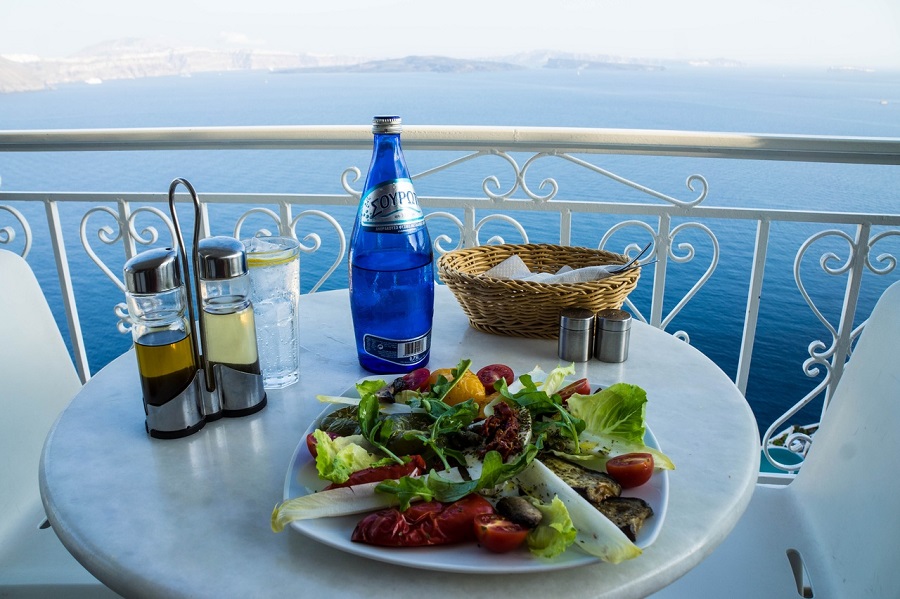
Greek cuisine is based on fresh seasonal vegetables and fruit, grains, legumes, and greens. Credit: Pxhere/Public Domain
Greece offers vegetarians a large variety of highly nutritional, delicious dishes to choose from. Using fresh ingredients, prepared with age-old recipes, Greek cuisine is full of delightful surprises for which your taste buds will be thankful.
Greek cuisine is based on fresh seasonal vegetables and fruit, grains, legumes, and greens—the perfect combination for vegetarians and vegans.
Across Greece, you will find a large variety of wholesome and flavorful but meat-free dishes for your palate to savor. It goes to show that Greek food is not just comprised of souvlaki, moussaka, or roasted lamb on a spit.
Vegetarianism as a practice, the idea of nonviolence to animals, has its roots in Ancient Greece as well as Ancient Indian civilizations. Ancient Greek historian Plutarch could be considered the first outspoken vegetarian in the West, as he believed that it was “immoral” to eat animal flesh.
In his book Morals, Plutarch devoted an entire chapter on meat-eating. Therein, he wrote that since man has access to so many fresh fruits, vegetables, and nuts, the fact that he is forcing himself to eat bloody animal flesh while “trying to cover the taste of blood with thousands of spices” is inconceivable.
Appetizers, salads, and dips for vegetarians
Choriatiki is quite a popular Greek salad made with freshly cut thick wedges of tomatoes, cucumber and onion slices, feta cheese, flavorful olives, virgin olive oil, and crushed, dried oregano leaves. It’s the perfect starter that will whet your appetite for the main course.
Dakos salad is a Cretan salad, which contains round, water-dampened barley rusk topped with chopped fresh tomatoes, crumbled feta or myzithra cheese, olive slices, capers, and a sprinkle of dried oregano A useful tip is to allow the juices to soak the rusk for a few minutes.
It is highly recommended that one try the following tempting mezedes (appetizers or side dishes): fried or grilled vegetables or cheese, including such delicacies as fried tomato balls, green vegetable patties, and saganaki cheese (fried feta or hard yellow cheese). Sliced zucchini can be boiled or fried, while zucchini is also used to make delicious patties (mixed with herbs and/or cheese). The sweet-tasting fried slices of eggplant and the rice and herb-stuffed zucchini blossoms are two must-try dishes, mostly served in the summer and autumn.
Accompany your vegetarian appetizers with some great-tasting dips:
Taramosalata: A mousse salad made from fish roe blended with lemon, bread, and olive oil
Melitzanosalata: A puree of grilled or smoked aubergines with olive oil, garlic and vinegar
Tzatziki: The most famous Greek appetizer around, made with creamy Greek yoghurt, grated cucumber and garlic, and finely chopped dill, blended with oil, vinegar and salt.
Skordalia: A vegan dip made with mashed potatoes or bread, garlic, olive oil, vinegar, salt and pepper. It usually accompanies fried cod and boiled beets (patzaria in Greek).
Main courses in Greece for vegetarians
Legumes & pulses
Pulses have been an essential part of the Greek diet since antiquity. Yellow split peas, gigantes (large dried white runner beans), broad beans, lentils, black-eyed peas, and chickpeas all hold an important place in the Greek cuisine and are an essential part of the Mediterranean Diet. Pulses are cooked in hot nourishing soups in the winter. Tey are also great in salads mixed with herbs and vegetables in the summer.
Northern Greece yields top quality pulses, as the soil is rich in potassium, an element that makes them more flavorful and contributes to shorter boiling times. Among these are beans from the Lake Prespes area, lentils from Voio, Kozani, yellow split peas from Feneos, Korinthia, and Santorini, lentils from Eglouvi, Lefkada, and chickpeas from Larisa or Grevena. These are all well-known, top quality produce on account of each area’s favorable microclimate.
Ladera (meaning cooked with olive oil)
Olive oil has always been a product precious to Greeks, one that has been considered sacred since ancient times. Ladera dishes are colorful and flavorful. Vegetables are cooked either fresh or dried in the pot at low to medium temperatures so as to best retain their shape and flavor.
Below are some tasty Greek vegetarian dishes for you to try:
peas and okra (stewed with tomatoes)
artichokes (cooked with potatoes, carrots, lots of finely chopped dill, and lemon juice—the “a la polita” dish)
zucchini, potatoes, carrots, bell peppers, eggplant, and onions baked with tomato sauce and spices (a dish called “briam”)
eggplant cooked with tomatoes, onions, garlic, parsley, dill, and spices (a dish called “imam”)
oven-baked stuffed tomatoes, peppers, zucchini, and eggplant filled with a mixture made of rice, the flesh of the above vegetables, herbs, and spices (a heavenly dish called “gemista”).
Pies, the vegetarian way in Greece
Pies hold a special place in the country’s cuisine, as they are among the oldest, simplest, and most delicious dishes one can find in Greece. There are so many variations of ”pites,” as they are known in Greek, that it may be nearly impossible to determine precisely how many different kinds of Greek pies there are out there.
Pies are very popular among Greeks, and they come in all sorts of variations: savory, sweet, dressed with phyllo sheet or flaky pastry (called “sfoliata”), round, triangular or coil-shaped with either few ingredients or more elaborate ones. Age-old household management rules point towards the optimum use of seasonal produce, resulting in a large variety of tasty creations. Pies can be served as a main or side dish or as a healthy and tasty snack during the day.
Pie filling variations depend only on the maker’s imagination and the local bounty of nature. Practically everything can be included in a pie: cheese, greens, pasta, rice, trachanas, and vegetables, among other things. Greek ingenuity has led to a large number of pie creations, including cheese pie, spinach pie, leek pie, nettle pie, mushroom pie, onion pie, cabbage pie, potato pie, pasta pie, pumpkin pie, and many more.
Greek Pasta
You can find Greek pasta in many a shape and size. Some types contain milk and eggs. They can be a simple yet very tasty mixture of durum wheat or semolina, water, and salt.
The pasta-making tradition is kept alive mostly by women living in the countryside who usually prepare the pasta and allow it to dry out in the sun during the summer. They also participate in regional cooperatives, producing and selling a large variety of artisan pasta.
by Michael Snyder, End Of The American Dream: The Great Middle East War has been raging for more than two and a half years, but the vast majority of the population still does not understand the full importance of this conflict. This isn’t just another Middle Eastern crisis that will come and go. The truth […]
A Comunidade Intermunicipal do Douro participou no “Portugal Nação Global” com o objetivo de “reforçar a ligação à diáspora portuguesa e promover novas oportunidades de investimento no território duriense”. O encontro, realizado no Centro Cultural de Belém, em Lisboa, no…
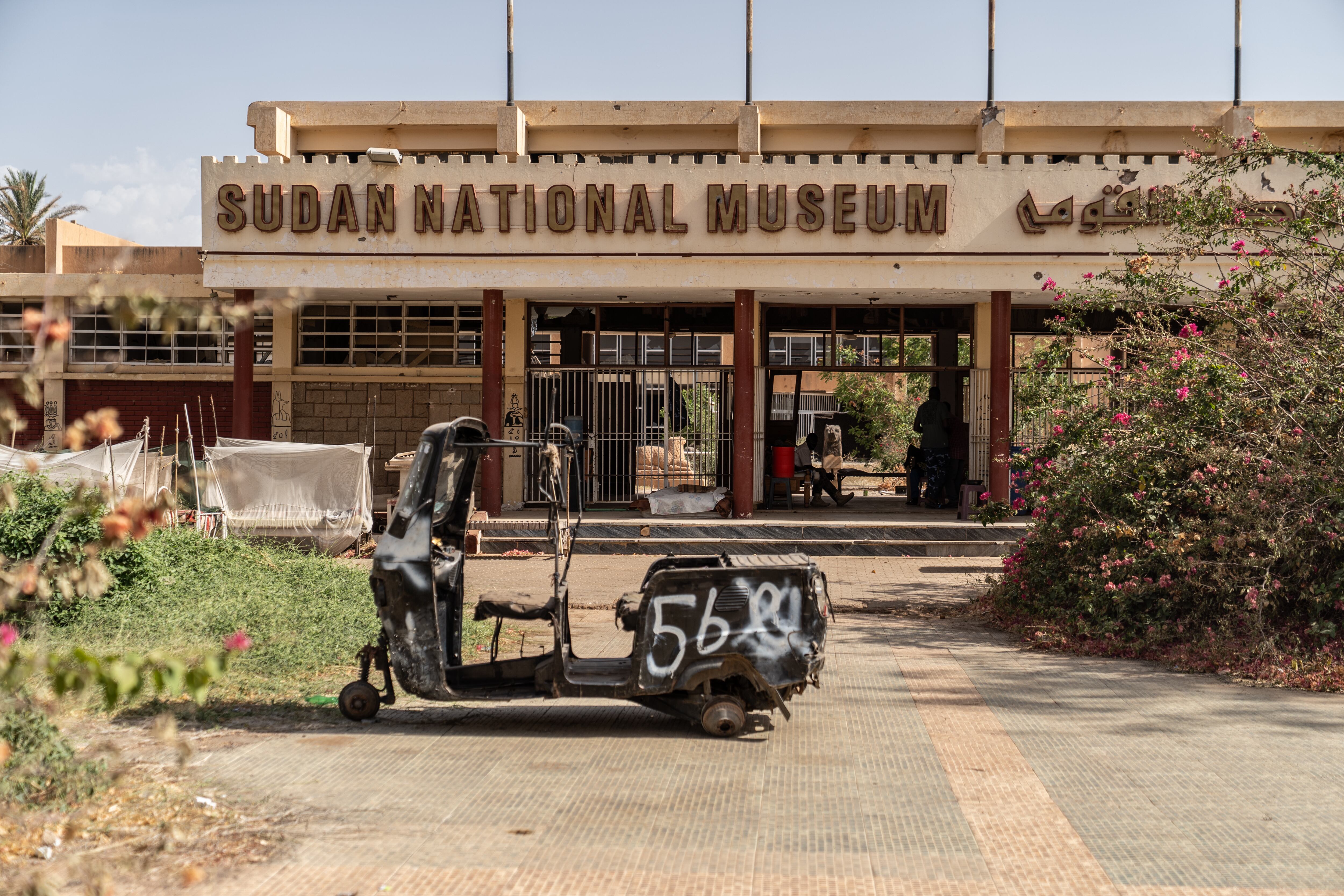
Just two months after civil war erupted in Sudan, in June 2023, a video circulated on social media showing paramilitary fighters inside a laboratory at the National Museum of Sudan, located in the heart of the country’s capital, Khartoum. While fierce fighting with the army continued outside the compound, the footage showed a group of men claiming that the corpses around them were victims of the regime.
¿Has estado atento a la actualidad de los últimos días? En 20minutos te proponemos poner a prueba tus conocimientos con un nuevo trivial de diez preguntas que repasa algunos de los temas que más han marcado la conversación informativa de las últimas semanas. Política, cultura, deporte, sociedad y actualidad internacional se dan cita en este desafío pensado para los lectores más informados.
¿Recuerdas por qué ha sido noticia José Luis Rodríguez Zapatero? ¿Sabes qué comparación hizo recientemente la Casa Blanca sobre los migrantes o qué premio recibieron Los Javis en el Festival de Cannes? Estas son solo algunas de las cuestiones incluidas en un cuestionario que también aborda asuntos como la Feria del Libro de Madrid, el Real Madrid, la selección española o los últimos acontecimientos políticos y sociales.
Participar es muy sencillo: responde a las diez preguntas y comprueba cuántos aciertos consigues. Después, comparte tu resultado con familiares y amigos y reta a otros lectores a superar tu puntuación. ¿Serás capaz de lograr un pleno y demostrar que eres un auténtico experto en la actualidad?
The U.S. Secretary of State’s visit to India and the meeting of the foreign ministers of the “QUAD” countries confirmed a commitment to strengthening the strategic partnership, despite differences. U.S. Secretary of State Marco Rubio’s first visit to India, May 23–26, 2026—timed to coincide with the meeting in Delhi of the foreign ministers of the […]

 Login
Login