
Normal view

Elon Musk Fuels Odyssey Casting Debate With AI Trailer Featuring All-White Greek Heroes

4 June 2026 at 21:58
A bronze ancient Greek-style warrior helmet with a red plume lies on a battlefield, with spears, shields, smoke, and armies in the background.
AI-generated Iliad trailer shared by Elon Musk on X amid debate over Christopher Nolan’s The Odyssey. Credit: Screenshot / Elon Musk’s official twitter account

Elon Musk has entered the controversy surrounding Christopher Nolan’s upcoming The Odyssey by sharing an AI-generated trailer featuring an all-white cast of ancient Greek heroes.

Musk posted the video on X on Thursday, June 4, as debate continues over Nolan’s decision to cast Lupita Nyong’o as Helen of Troy in The Odyssey. Musk, who has already criticized the casting online, introduced the clip as an “Iliad (Troy) trailer made by Grok Imagine 1.5,” referring to the video-generation model developed by his artificial intelligence company xAI.

The 40-second trailer quickly went viral and drew more than 18.4 million views, according to the original Greek report. Although Musk did not explicitly mention Nolan’s film in the post, the timing and visual choices linked the clip to the wider argument over how ancient Greek figures should appear on screen.

An AI version of Homer’s world

The trailer presents a dramatic version of the Trojan War, with burning cities, warships, battlefield speeches, emotional close-ups, and large-scale combat scenes. Its visual style closely resembles a Hollywood historical epic. However, AI tools produced the video rather than a traditional studio production.

The choice of The Iliad also matters. Homer’s Iliad and Odyssey are two of the foundational works of ancient Greek literature. The Iliad centers on the Trojan War, while The Odyssey follows Odysseus on his long journey home after the fall of Troy.

That connection made Musk’s post look less like a random AI experiment and more like a response to the current debate around Nolan’s film. By using AI to create his own vision of the Trojan War, Musk placed himself directly inside a cultural dispute involving Greek mythology, Hollywood casting, and the future of filmmaking.

Iliad (Troy) trailer made by Grok Imagine 1.5, which was just released pic.twitter.com/o0zITVlvpn

— Elon Musk (@elonmusk) June 4, 2026

The Helen of Troy debate

Nolan’s The Odyssey is scheduled for release on July 17, 2026. The film stars Matt Damon as Odysseus and Anne Hathaway as Penelope. Its cast also includes Tom Holland, Zendaya, Robert Pattinson, Charlize Theron, and Lupita Nyong’o.

Much of the online backlash has focused on Nyong’o’s role as Helen of Troy. Critics of the casting argue that Helen, one of the most famous figures of Greek mythology, should reflect the traditional image associated with the character.

Supporters of the film, however, say Homeric myth is not documentary history. They argue that artists have reinterpreted the epics for centuries through theater, literature, painting, and cinema. Nyong’o has also addressed the criticism, saying the film’s cast reflects the world and emphasizing that the story belongs to mythology rather than historical reconstruction.

Musk’s AI trailer now adds another layer to the dispute. The clip does not simply promote artificial intelligence as a filmmaking tool. Instead, it presents an alternative visual version of the Homeric world at the exact moment when Hollywood’s version is under scrutiny.

Was very fun to try out the latest 1.5 Grok Imagine model for this one! https://t.co/x5OwuhySyH

— Heavy Pulp (@heavypulp) June 3, 2026

Elon Musk turns AI Iliad trailer into a cultural statement

After Musk posted the trailer, the creative studio Heavy Pulp, which worked on the project, said it had enjoyed making it. Musk then asked whether the team wanted to make a full-length film. Heavy Pulp replied that it was already in.

That exchange helped transform the video from a short viral experiment into a possible challenge to Hollywood. Musk appeared to test whether AI could generate not only trailers, but also full-scale mythological films outside the traditional studio system.

The response online came quickly. Many users praised the trailer’s cinematic look and argued that it showed how fast AI video tools are improving. Others viewed the clip as a direct provocation toward Hollywood, especially because it appeared during a high-profile debate over representation in a film based on Greek mythology.

@starchannelnews

Νέο διαδικτυακό θόρυβο προκαλεί ο Ίλον Μασκ, ο οποίος επανέρχεται στη δημόσια συζήτηση γύρω από τις επιλογές casting στην πολυαναμενόμενη κινηματογραφική μεταφορά της Οδύσσειας από τον Κρίστοφερ Νόλαν. Με αφορμή τη συζήτηση που έχει ανοίξει για τον ρόλο της Ωραίας Ελένης, ο Μασκ ανάρτησε στο Χ ένα βίντεο που παρουσιάζεται ως AI trailer της Ιλιάδας, με όλους τους πρωταγωνιστές να απεικονίζονται ως λευκοί ηθοποιοί. Η Βαλεντίνα Καραγεωργίου είναι μαζί μας με όλες τις λεπτομέρειες και τις αντιδράσεις που έχει προκαλέσει η νέα παρέμβαση του Ίλον Μασκ. #starchannelnews #tiktokgreece #newsgr

♬ original sound – Star News_official – Star News_official

Did Paleolithic People Eat Bread?  

4 June 2026 at 07:07
Assorted bread rolls with different seed toppings in a wicker basket.
New archaeological evidence suggests that Paleolithic humans may have baked simple types of bread as early as 30,000 years ago. Credit: 2368zauber, Wikimedia Commons, CC-BY-SA-3.0

For decades, conventional wisdom held that bread didn’t exist among Paleolithic people and was a relatively recent human innovation, an agricultural byproduct that emerged with the rise of farming in the Neolithic era, roughly 10,000 years ago. Recent archaeological discoveries have radically challenged this view, however, pushing the timeline of breadmaking back by at least 20,000 years.

In what can only be described as a groundbreaking study, a team of Italian researchers has revealed that Paleolithic hunter-gatherers in Europe not only consumed wild plants but also processed them into flour and baked a primitive flatbread. These findings were published in the prestigious journal Proceedings of the National Academy of Sciences (PNAS). They suggest that the roots of culinary innovation run far deeper than previously imagined.

Grinding stones and starch residue

At the heart of this discovery are ancient grinding stones. The archaeologists unearthed these flat stone slabs and pestle-like tools at sites across Italy, Russia, and the Czech Republic. The tools, dated to around 30,000 years ago, were originally assumed to have been used for processing pigments or crushing seeds. Nevertheless, when researchers Anna Revedin and Laura Longo of the Italian Institute of Prehistory and Early History in Florence conducted a detailed microscopic analysis, they uncovered traces of starch granules embedded in the stone surfaces.

The starches were identified as those of cattails, ferns, and other starchy wild plants, which would have required careful preparation to be rendered digestible. Revedin’s team concluded that these Paleolithic humans had not only harvested the plants but had dried, ground, and mixed them with water to form a kind of dough. Additionally, they likely cooked the resulting paste on hot stones near the fire, producing an early version of unleavened bread.

Rethinking the Paleolithic diet

The ancient Greeks themselves had a clear grasp of the evolution of human diet. Hippocrates, the father of medicine, wrote in his work On Ancient Medicine:

“It is for this reason, I believe, that people sought out food more suited to human nature, and eventually discovered the kind we now use. From wheat, after soaking, grinding, kneading, sifting, and baking, they made bread; from barley, they made flatcakes. After many efforts, they cooked, baked, mixed, and blended foods, diluting the strong and raw with milder ingredients, shaping everything according to human nature and capacity.”

The implications are profound. Until now, the standard narrative of Paleolithic diets emphasized a reliance on animal protein. This included meat and fish, with foraged fruits and plants playing only a minor role. The recent discovery challenges that model, however. Moreover, the implication is that these early humans were actually greatly skilled in the complex processing of wild plant foods. In other words, they also possessed the sophisticated ability to cook.

Furthermore, the evidence of flour production long before the advent of agriculture hints at a continuity of knowledge. The leap from gathering and grinding wild plants to cultivating domesticated grains may not have been as abrupt or revolutionary as once believed. Paleolithic peoples were far from passive consumers of raw resources, and the rise of farming could in fact have been the result of millennia of experimentation, habit, and accumulated expertise.

Ancient Greek bread
Ancient Greek woman taking bread out of the oven. Terracotta figure found in Tanagra, Greece. Credit: Marie-Lan Nguyen CC BY 2.5

A quiet revolution

Perhaps most striking is what this discovery on bread reveals about Paleolithic ingenuity. The production of flour and bread is not simply a dietary choice. It reflects planning, patience, and an understanding of food chemistry. Drying plant roots, grinding them into powder, and then baking them requires more than survival instinct. It also requires culture.

As more research sheds light on the lives of our Paleolithic ancestors, it becomes increasingly clear that they were not the brutish cave-dwellers of outdated caricatures. They were observant, resourceful, and remarkably sophisticated in their interaction with the natural world.

Bread, it turns out, is not just the food of civilization. It may have been the food of pre-civilization, as well.

Beyond the Gyro: Why Vegetarians Love Greece

3 June 2026 at 14:06
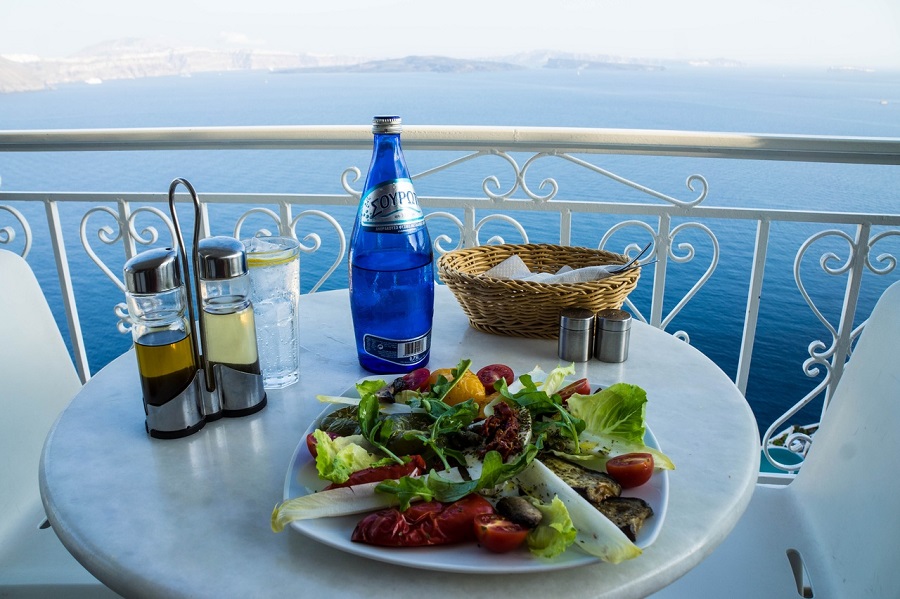
A plate of salad in Greece, which has a cuisine based on fresh seasonal vegetables and fruit, grains, legumes, and greens.
Greek cuisine is based on fresh seasonal vegetables and fruit, grains, legumes, and greens. Credit: Pxhere/Public Domain

Greece offers vegetarians a large variety of highly nutritional, delicious dishes to choose from. Using fresh ingredients, prepared with age-old recipes, Greek cuisine is full of delightful surprises for which your taste buds will be thankful.

Greek cuisine is based on fresh seasonal vegetables and fruit, grains, legumes, and greens—the perfect combination for vegetarians and vegans.

Across Greece, you will find a large variety of wholesome and flavorful but meat-free dishes for your palate to savor. It goes to show that Greek food is not just comprised of souvlaki, moussaka, or roasted lamb on a spit.

Vegetarianism as a practice, the idea of nonviolence to animals, has its roots in Ancient Greece as well as Ancient Indian civilizations. Ancient Greek historian Plutarch could be considered the first outspoken vegetarian in the West, as he believed that it was “immoral” to eat animal flesh.

In his book Morals, Plutarch devoted an entire chapter on meat-eating. Therein, he wrote that since man has access to so many fresh fruits, vegetables, and nuts, the fact that he is forcing himself to eat bloody animal flesh while “trying to cover the taste of blood with thousands of spices” is inconceivable.

Appetizers, salads, and dips for vegetarians

Choriatiki is quite a popular Greek salad made with freshly cut thick wedges of tomatoes, cucumber and onion slices, feta cheese, flavorful olives, virgin olive oil, and crushed, dried oregano leaves. It’s the perfect starter that will whet your appetite for the main course.

Traditional Greek salad
Choriatiki, the traditional Greek salad. Credit: Creative Commons Attribution 2.0/Wikipedia

Dakos salad is a Cretan salad, which contains round, water-dampened barley rusk topped with chopped fresh tomatoes, crumbled feta or myzithra cheese, olive slices, capers, and a sprinkle of dried oregano A useful tip is to allow the juices to soak the rusk for a few minutes.

It is highly recommended that one try the following tempting mezedes (appetizers or side dishes): fried or grilled vegetables or cheese, including such delicacies as fried tomato balls, green vegetable patties, and saganaki cheese (fried feta or hard yellow cheese). Sliced zucchini can be boiled or fried, while zucchini is also used to make delicious patties (mixed with herbs and/or cheese). The sweet-tasting fried slices of eggplant and the rice and herb-stuffed zucchini blossoms are two must-try dishes, mostly served in the summer and autumn.

Tzatziki dip
Tzatziki dip. Credit: Nikodem Nijaki, Creative Commons Attribution-Share Alike 3.0/Wikipedia

Accompany your vegetarian appetizers with some great-tasting dips:

  • Taramosalata: A mousse salad made from fish roe blended with lemon, bread, and olive oil
  • Melitzanosalata: A puree of grilled or smoked aubergines with olive oil, garlic and vinegar
  • Tzatziki: The most famous Greek appetizer around, made with creamy Greek yoghurt, grated cucumber and garlic, and finely chopped dill, blended with oil, vinegar and salt.
  • Skordalia: A vegan dip made with mashed potatoes or bread, garlic, olive oil, vinegar, salt and pepper. It usually accompanies fried cod and boiled beets (patzaria in Greek).

Main courses in Greece for vegetarians

Legumes & pulses

Pulses have been an essential part of the Greek diet since antiquity. Yellow split peas, gigantes (large dried white runner beans), broad beans, lentils, black-eyed peas, and chickpeas all hold an important place in the Greek cuisine and are an essential part of the Mediterranean Diet. Pulses are cooked in hot nourishing soups in the winter. Tey are also great in salads mixed with herbs and vegetables in the summer.

Northern Greece yields top quality pulses, as the soil is rich in potassium, an element that makes them more flavorful and contributes to shorter boiling times. Among these are beans from the Lake Prespes area, lentils from Voio, Kozani, yellow split peas from Feneos, Korinthia, and Santorini, lentils from Eglouvi, Lefkada, and chickpeas from Larisa or Grevena. These are all well-known, top quality produce on account of each area’s favorable microclimate.

Ladera (meaning cooked with olive oil)

Olive oil has always been a product precious to Greeks, one that has been considered sacred since ancient times. Ladera dishes are colorful and flavorful. Vegetables are cooked either fresh or dried in the pot at low to medium temperatures so as to best retain their shape and flavor.

Below are some tasty Greek vegetarian dishes for you to try:

  • peas and okra (stewed with tomatoes)
  • artichokes (cooked with potatoes, carrots, lots of finely chopped dill, and lemon juice—the “a la polita” dish)
  • zucchini, potatoes, carrots, bell peppers, eggplant, and onions baked with tomato sauce and spices (a dish called “briam”)
  • eggplant cooked with tomatoes, onions, garlic, parsley, dill, and spices (a dish called “imam”)
  • oven-baked stuffed tomatoes, peppers, zucchini, and eggplant filled with a mixture made of rice, the flesh of the above vegetables, herbs, and spices (a heavenly dish called “gemista”).

Pies, the vegetarian way in Greece

Pies hold a special place in the country’s cuisine, as they are among the oldest, simplest, and most delicious dishes one can find in Greece. There are so many variations of ”pites,” as they are known in Greek, that it may be nearly impossible to determine precisely how many different kinds of Greek pies there are out there.

Spanakopita
Spanakopita. Credit: Tanya Bakogiannis/Wikimedia Commons/CC BY 3.0

Pies are very popular among Greeks, and they come in all sorts of variations: savory, sweet, dressed with phyllo sheet or flaky pastry (called “sfoliata”), round, triangular or coil-shaped with either few ingredients or more elaborate ones. Age-old household management rules point towards the optimum use of seasonal produce, resulting in a large variety of tasty creations. Pies can be served as a main or side dish or as a healthy and tasty snack during the day.

Pie filling variations depend only on the maker’s imagination and the local bounty of nature. Practically everything can be included in a pie: cheese, greens, pasta, rice, trachanas, and vegetables, among other things. Greek ingenuity has led to a large number of pie creations, including cheese pie, spinach pie, leek pie, nettle pie, mushroom pie, onion pie, cabbage pie, potato pie, pasta pie, pumpkin pie, and many more.

Greek Pasta

You can find Greek pasta in many a shape and size. Some types contain milk and eggs. They can be a simple yet very tasty mixture of durum wheat or semolina, water, and salt.

The pasta-making tradition is kept alive mostly by women living in the countryside who usually prepare the pasta and allow it to dry out in the sun during the summer. They also participate in regional cooperatives, producing and selling a large variety of artisan pasta.

Greece vegetarians
A bowl of trachanas. Credit: Vangelisg4, Creative Commons Attribution-Share Alike 4.0/Wikipedia

Such regional co-ops exist all over Greece on the mainland and islands alike. In these co-ops, you will find popular Greek pasta such as:

  • chylopites (noodles that come in two basic shapes, namely small squares or thin, fettuccine-like strips)
  • kritharaki (orzo)
  • trachanas (a granular pasta made with semolina flour, wheat flour, or cracked wheat, kneaded with milk, yoghurt, buttermilk)
  • lazania (broad strips of egg pasta)
  • fides (angel hair)
  • astraki (a small star-shaped pasta)

CIM Douro quer acelerar modernização do território

24 May 2026 at 12:16

A Comunidade Intermunicipal do Douro participou no “Portugal Nação Global” com o objetivo de “reforçar a ligação à diáspora portuguesa e promover novas oportunidades de investimento no território duriense”. O encontro, realizado no Centro Cultural de Belém, em Lisboa, no…

O post CIM Douro quer acelerar modernização do território aparece primeiro no Diáspora Lusa.

Tracking looted antiquities in Sudan’s war

2 June 2026 at 12:12

Just two months after civil war erupted in Sudan, in June 2023, a video circulated on social media showing paramilitary fighters inside a laboratory at the National Museum of Sudan, located in the heart of the country’s capital, Khartoum. While fierce fighting with the army continued outside the compound, the footage showed a group of men claiming that the corpses around them were victims of the regime.

Seguir leyendo

© Giles Clarke (Getty Images)

The National Museum of Sudan in Khartoum.

¿Has seguido la actualidad en mayo? Ponte a prueba con estas diez preguntas

31 May 2026 at 07:17

¿Has estado atento a la actualidad de los últimos días? En 20minutos te proponemos poner a prueba tus conocimientos con un nuevo trivial de diez preguntas que repasa algunos de los temas que más han marcado la conversación informativa de las últimas semanas. Política, cultura, deporte, sociedad y actualidad internacional se dan cita en este desafío pensado para los lectores más informados.

¿Recuerdas por qué ha sido noticia José Luis Rodríguez Zapatero? ¿Sabes qué comparación hizo recientemente la Casa Blanca sobre los migrantes o qué premio recibieron Los Javis en el Festival de Cannes? Estas son solo algunas de las cuestiones incluidas en un cuestionario que también aborda asuntos como la Feria del Libro de Madrid, el Real Madrid, la selección española o los últimos acontecimientos políticos y sociales.

Participar es muy sencillo: responde a las diez preguntas y comprueba cuántos aciertos consigues. Después, comparte tu resultado con familiares y amigos y reta a otros lectores a superar tu puntuación. ¿Serás capaz de lograr un pleno y demostrar que eres un auténtico experto en la actualidad?

Rubio in India: An Attempt to Smooth Over Differences and Strengthen Cooperation

27 May 2026 at 09:30
The U.S. Secretary of State’s visit to India and the meeting of the foreign ministers of the “QUAD” countries confirmed a commitment to strengthening the strategic partnership, despite differences. U.S. Secretary of State Marco Rubio’s first visit to India, May 23–26, 2026—timed to coincide with the meeting in Delhi of the foreign ministers of the […]
❌