Normal view

Received — 8 June 2026 Euromaidan Press

Freezing the war along today’s lines is “the quickest way” to peace, Ukraine’s leader told Sky News

8 June 2026 at 14:10

freezing war along today's lines quickest way peace ukraine's leader told sky news · post ukrainian president volodymyr zelenskyy during interview london 7 2026 zele skynews ukraine reports

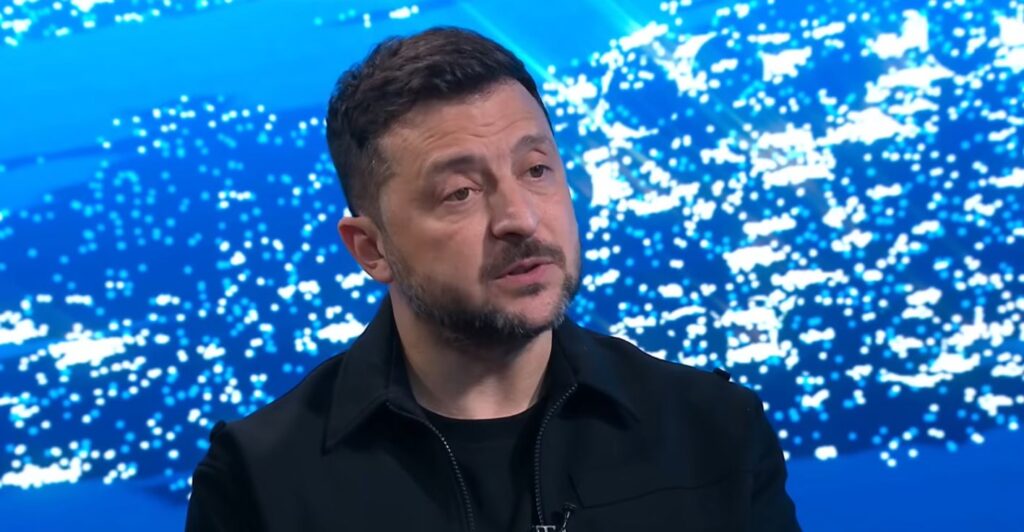
Ukrainian President Volodymyr Zelenskyy is willing to stop the war along the current line of contact and move to negotiations, he said in a Sky News interview. He presented the idea as the quickest route to a ceasefire, while rejecting any deal that hands Russia Ukrainian land. He also urged allies to close Ukraine's air defense gaps.

Russia has rejected every ceasefire Ukraine and the US have put forward and keeps refusing to halt an all-out war it has waged since its full-scale invasion in 2022. Whether a freeze ever takes hold rests with the Kremlin, whose demands still stretch far beyond the territory its army has managed to seize.

"The quickest way" to stop the fighting

Asked where he would freeze the lines if Russia agreed to a ceasefire, Zelenskyy said he is ready to accept today's positions

"Yes, it's the quickest way," he said. 

He insisted this is not a giveaway. He does not want to simply freeze the conflict, but to stop the war so it cannot restart "because of some crazy people." A freeze would let Ukraine save children's lives and bring soldiers home. Any ceasefire must be total and free of Russian games, watched by American and European partners. Only then would the sides sit down to end the war through diplomacy. A ceasefire, he added, is "the biggest compromise from our side."

Air defense comes first

The most urgent need from allies is air defense, Zelenskyy said. Ukraine faces a large deficit in anti-ballistic missiles, with US transfers slowed by the war in the Middle East. He again asked for more Patriot systems. Russia attacks daily, usually with around 300 long-range explosive drones. On the heaviest nights it launches 600 to 850 drones and dozens of missiles. 

Ukraine's interceptors now down most of them, but the gaps remain dangerous.
tymofii brik and kateryna kobernyk
Explore further

10% now, 23% after a ceasefire, 59% only at peace—Ukraine’s verdict on a wartime vote hasn’t moved all year

Ukraine's own arsenal

Ukraine has built more than 400 defense companies since the full-scale invasion, Zelenskyy said. Dozens rank among the world's strongest. They produce drones and missiles, some underground, and the country is close to its own ballistic missile. Ukraine can now share that expertise with allies and even build air defenses for Europe, he said. Kyiv aims to mass-produce drones on a scale few countries can match.

Bringing the war back to Russia

Ukraine's recent strikes on St. Petersburg and the Moscow region answer Russian attacks on Ukrainian energy, Zelenskyy said. St. Petersburg was hit twice last week. He wants Russians far from the front to feel the war they started. Russian President Vladimir Putin understands only "total pressure," he said. Sanctions on Russia's shadow fleet of sanctions-dodging tankers and its oil and gas exports hit hardest.

Putin, the letter, and a Kremlin go-between

Zelenskyy said Putin does not want to stop the war and is signaling he wants to win. Whether the fighting ends "100% depends on his decision," he said. His 4 June open letter, which Moscow called rude and rejected, was meant to force an answer and pierce a Russian public living in "some fantastic world." Russian businessman Roman Abramovich came to Kyiv to carry messages to Putin, Zelenskyy said. 
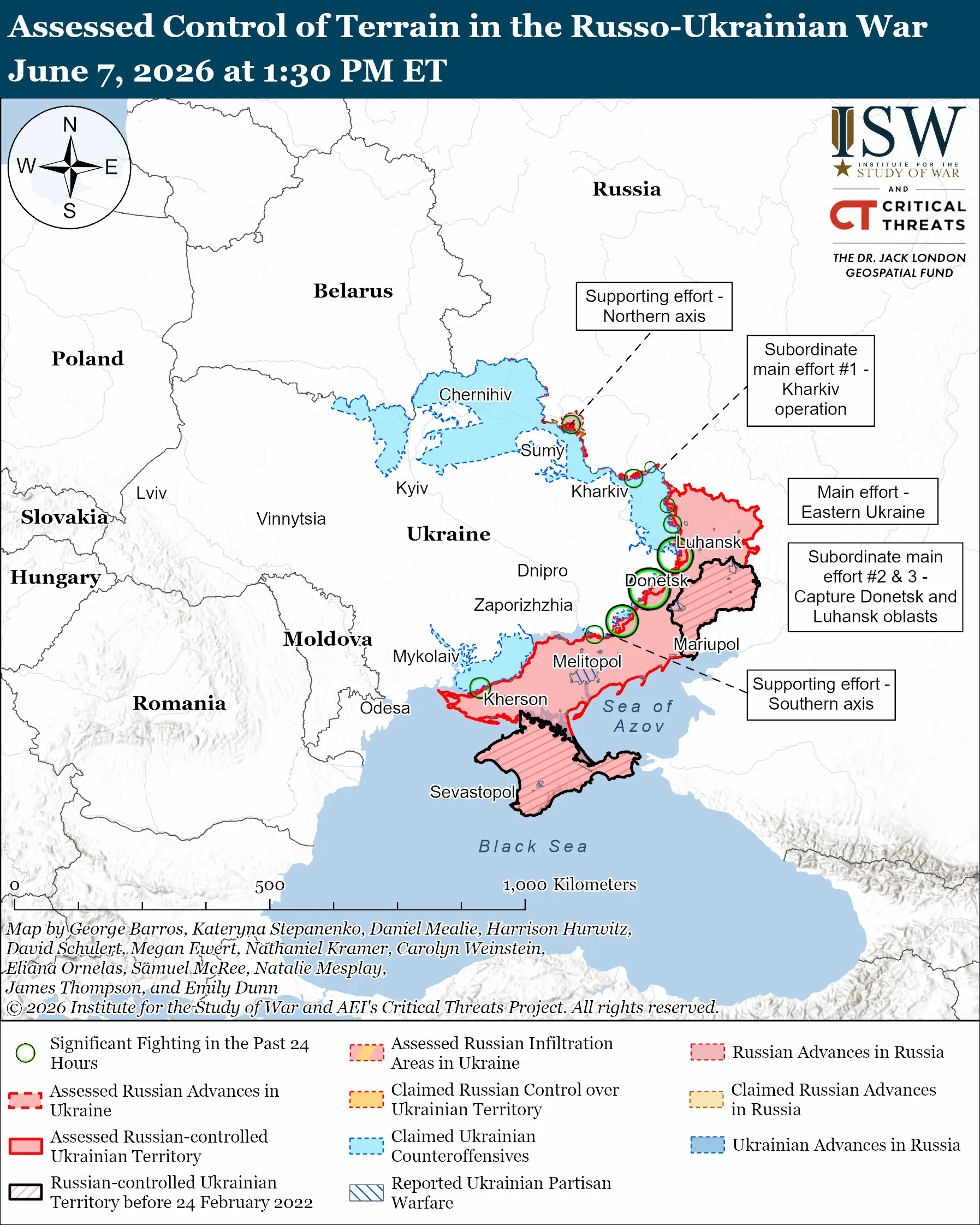
The so-called Donbas is a historic name for Ukraine’s two easternmost regions, Luhansk and Donetsk oblasts. Russia still failed to occupy a small part of Luhansk Oblast, as well as a significant swathe of Donetsk Oblast, which contains the so-called “Fortress Belt” that Russia has failed to break through despite its years-long ongoing offensive campaign. Map: ISW

His key message was on the Donbas: Ukraine will not leave its land, and compromises come only after a ceasefire. He is ready to meet in any format, but not in Moscow, Belarus, or Minsk. Leaders cannot decide "without us about us," he said, in a message aimed at Washington. Russia, by contrast, keeps insisting that Ukraine surrender all of the Donbas first.

Premature births are climbing in Ukraine’s front-line regions, and doctors blame the ongoing war

8 June 2026 at 14:06

premature births climbing ukraine's front-line regions doctors blame ongoing war · post newborn temperature-controlled incubator hospital zaporizhzhia ukraine new born baby ap news ukrainian reports

Premature births are rising in several Ukrainian regions near the front line, where war-driven stress on pregnant women appears to be taking a tollaccording to the Associated Press (AP). Doctors in cities like Zaporizhzhia keep fragile newborns alive between air raid sirens, in wards with windows boarded up against Russian blast waves. The trend compounds a deepening crisis as fewer Ukrainian women give birth at all.

Russia's war is grinding down Ukraine's population on every front, from the men dying at the line to the families displaced and the children who never arrive. A generation born under fire will carry the war's medical and demographic cost for decades, long after any ceasefire, deepening the strain on a health system Russia keeps targeting.

How far the rate has climbed

In Kherson Oblast, early births climbed from 5.4% of deliveries in 2019 to 9.8% by 2025 — close to twice the rate, UN figures show.  Zaporizhzhia Oblast rose from 5.7% to 7.6%, and Poltava Oblast from 7.7% to 9.8% over the same period. The front line runs through Kherson and Zaporizhzhia oblasts. Poltava sits farther back but takes regular aerial strikes. Fewer Ukrainian women are giving birth overall, yet a larger share of births now come early, AP reported.

Keeping newborns alive under bombardment

The medical work is delicate and unforgiving. In a Zaporizhzhia intensive care unit, one baby born at 30 weeks weighs just 700 grams, far below the 2,500-gram threshold the World Health Organization (WHO) uses for low birth weight. Marharyta Nekhoroshyva's son arrived even earlier, at 26 weeks and 940 grams. Now nine months old, he still battles chronic breathing problems while she raises him alone, her husband fighting in the war.


Doctors must manage oxygen precisely, since too much risks abnormal blood-vessel growth in the eyes and, in severe cases, blindness, said Dr. Andrii Lobanov, who heads neonatal intensive care at Zaporizhzhia's children's hospital. When sirens sound, staff stay beside the incubators rather than risk moving the babies.

The danger is not abstract. Dr. Nataliia Bohuslavska, who runs the neonatal unit at the city's maternity hospital, opened a shift last month to alarms warning of incoming missiles. Hours later, a Russian glide bomb hit a commercial part of the city and killed at least 12 people. Her team delivered a baby and performed two cesareans that same day, while treating a woman who miscarried after witnessing an airstrike.

Aftermath of a Russian strike on Shostka, Sumy region. Photo: State Emergency Service of Ukraine
Explore further

Russia hits two hospitals, kills one woman overnight in strikes on Ukrainian cities

The longer cost

Surviving the delivery is only the start. Premature babies often need years of treatment for respiratory, neurological, and developmental conditions, a heavy bill for a country at war. Hospital services get hit "both literally and metaphorically," said Dr. Andrew Weeks, a maternal-health professor at the University of Liverpool.

It also lands on a country whose birth rate has collapsed to about one child per woman — less than half the 2.1 a population needs simply to hold steady.

Britain, France, and Germany back Ukraine’s peace terms and press Putin for a ceasefire

8 June 2026 at 12:43

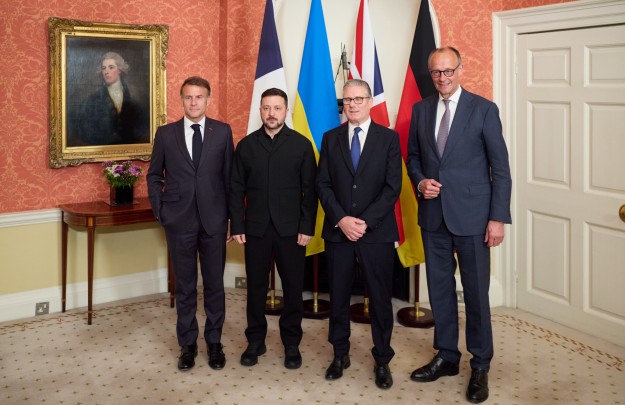
britain france germany back ukraine's peace terms press putin ceasefire · post left right french president emmanuel macron ukrainian volodymyr zelenskyy uk prime minister keir starmer german chancellor friedrich merz

Britain, France, and Germany backed Ukraine's terms for ending the war after meeting its President Volodymyr Zelenskyy in London, according to their joint statement. They endorsed Kyiv's push for direct talks with Moscow and an immediate ceasefire, while spelling out what a lasting peace would require. The leaders also called for tightening the squeeze on Russia's war economy and scaling up Ukraine's air defenses.

Russia has been invading Ukraine since 2014 and waging all-out war since February 2022, and with Moscow still rejecting every ceasefire on offer, Kyiv and its Western partners are now trying to map out how the fighting could actually end.

Five conditions for peace

Meeting on 7 June, UK Prime Minister Keir Starmer, French President Emmanuel Macron, and German Chancellor Friedrich Merz set out five conditions for a just and lasting peace. The E3, as the three are known, are Ukraine's leading European backers. Their terms:

  • An immediate, complete ceasefire, which they urged Putin to accept.
  • The current front line as the starting point for talks, with no borders changed by force and Ukraine free to choose its alliances.
  • Robust, legally binding security guarantees once a ceasefire holds, building on the allies' December 2025 Berlin and January 2026 Paris commitments, including a multinational force in Ukraine. 
  • Russian assets remain immobilized until Moscow ends its aggression and compensates Ukraine.
  • European interests safeguarded, with any EU- or NATO-related terms requiring both blocs' consent.
Admiral Bauer Ukraine NATO membership
Explore further

“It was never formulated as Ukraine winning”—NATO’s ex-military chief on the missing strategy

Backing for direct talks with Moscow

The leaders commended Ukraine's president for his 4 June letter to Putin calling to end the war. They backed direct Ukraine-Russia dialogue, with the US and Europe actively taking part, to secure a ceasefire. Europe must play a role in any settlement, they said, working closely with Kyiv, the rest of Europe, and Washington.

Zelenskyy
Explore further

Germany, France, and UK sketch plan to bring Putin to the negotiating table

Pressure on Russia and more air defense

They denounced Russia's barrage of missiles and drones, including repeated strikes with the Oreshnik, a Russian missile. They also condemned dangerous Russian drone incursions into NATO territory and offered condolences to the victims. The leaders welcomed Ukraine's recent battlefield gains, from liberated territory to advances in drone warfare. They agreed to coordinate more support at the coming G7 summit in Evian, the next Coalition of the Willing meeting, and the NATO summit in Ankara. That includes choking off more of Russia's wartime revenue and a bigger military pledge at the NATO talks. They also urged scaling up interceptor production and co-developing anti-ballistic and deep-strike weapons.

Russian crude reaches the sea through tunnels under a mountain ridge—and Ukraine hit the storage end near Novorossiysk

8 June 2026 at 12:12

russian crude reaches sea through tunnels under mountain ridge—and ukraine hit storage end near novorossiysk · post smoke fire rise over after ukrainian drone strike grushovaya oil depot krasnodar krai

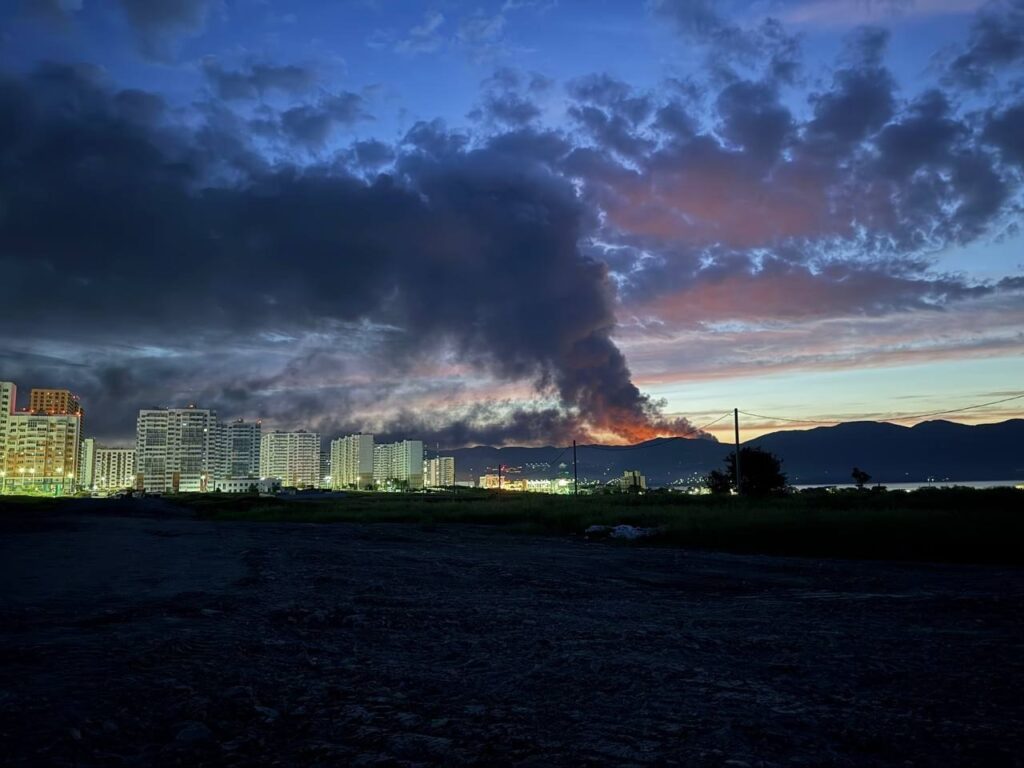
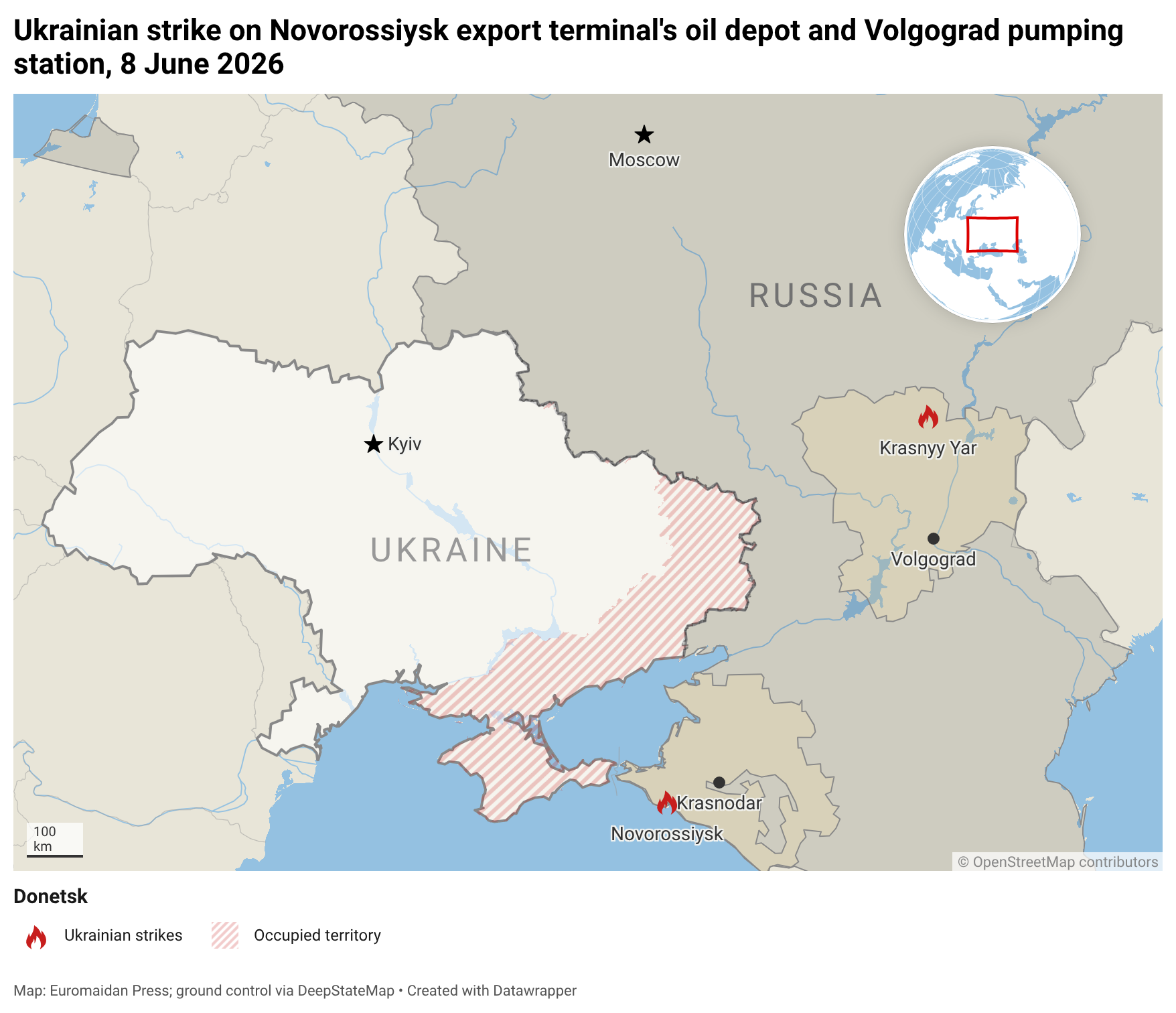
Ukrainian drones set a major oil depot ablaze near the Russian Black Sea port of Novorossiysk overnight on 7-8 June 2026, in a strike confirmed by Ukraine's Unmanned Systems Forces (SBS). Residents reported a string of blasts and heavy smoke over the Grushovaya storage site, which feeds Russia's busiest oil-export port. Ukrainian forces hit two more targets in southern Russia the same night.

Ukraine has spent the past year pushing its deep-strike campaign further into Russia, hunting the refineries, pipelines, and export ports that turn crude into the cash funding the invasion. Each hit on this Black Sea network forces costly repairs and brief loading halts, and steady Ukrainian success deep in Russia's rear, alongside a steadier front, is shifting how the West reads the war.

Drones spark a blaze at Novorossiysk's oil hub

The strike came before dawn. Residents of Novorossiysk, in Russia's Krasnodar Krai, reported about 50 blasts, then heavy smoke over the Grushovaya oil depot. Operators of the SBS's 1st Separate Center, working with Special Operations Forces (SSO) and other units, confirmed the hit. Ukraine's General Staff also confirmed the strike and said a fire broke out, with damage still being assessed. Russian officials claimed no one was hurt.

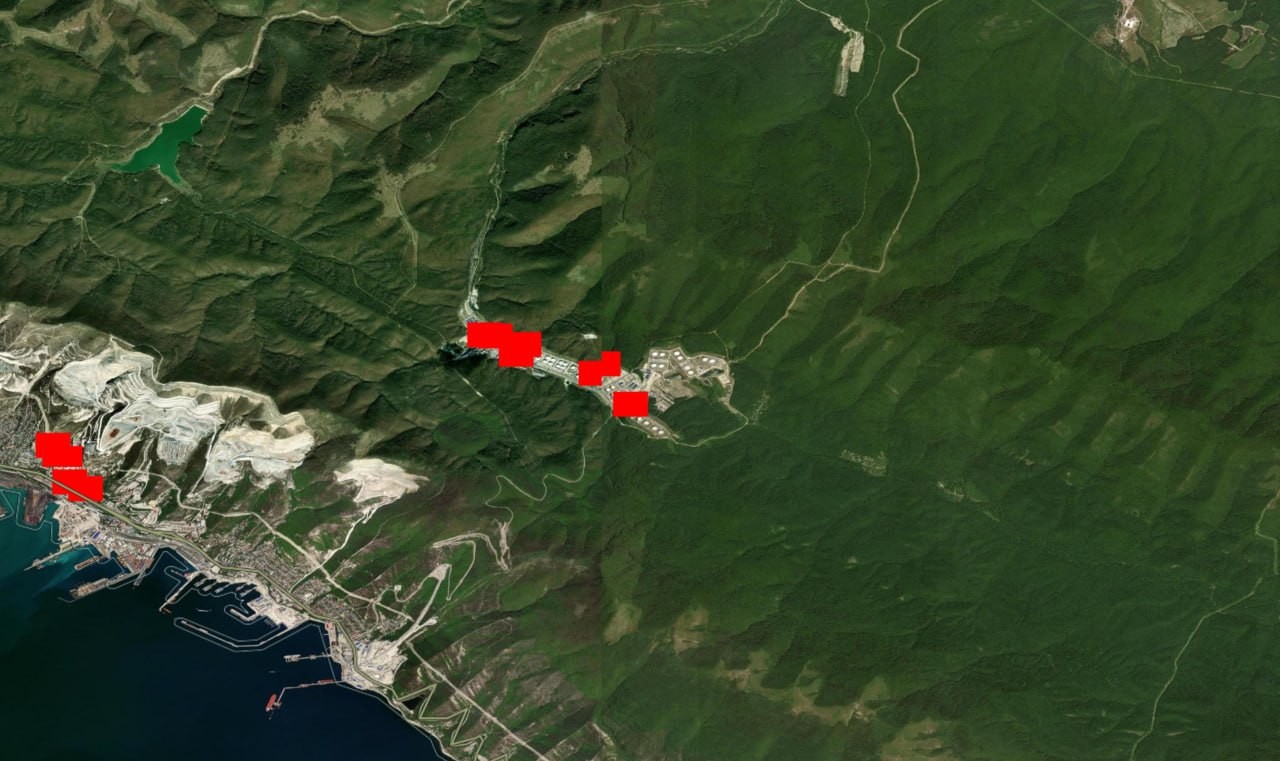
russian crude reaches sea through tunnels under mountain ridge—and ukraine hit storage end near novorossiysk · post nasa firms satellite data fire hotspots (the red squares top right) grushovaya oil
NASA FIRMS satellite data showing fire hotspots (the red squares, the cluster to the right) at the Grushovaya oil depot near Novorossiysk, 8 June 2026. Map: NASA FIRMS

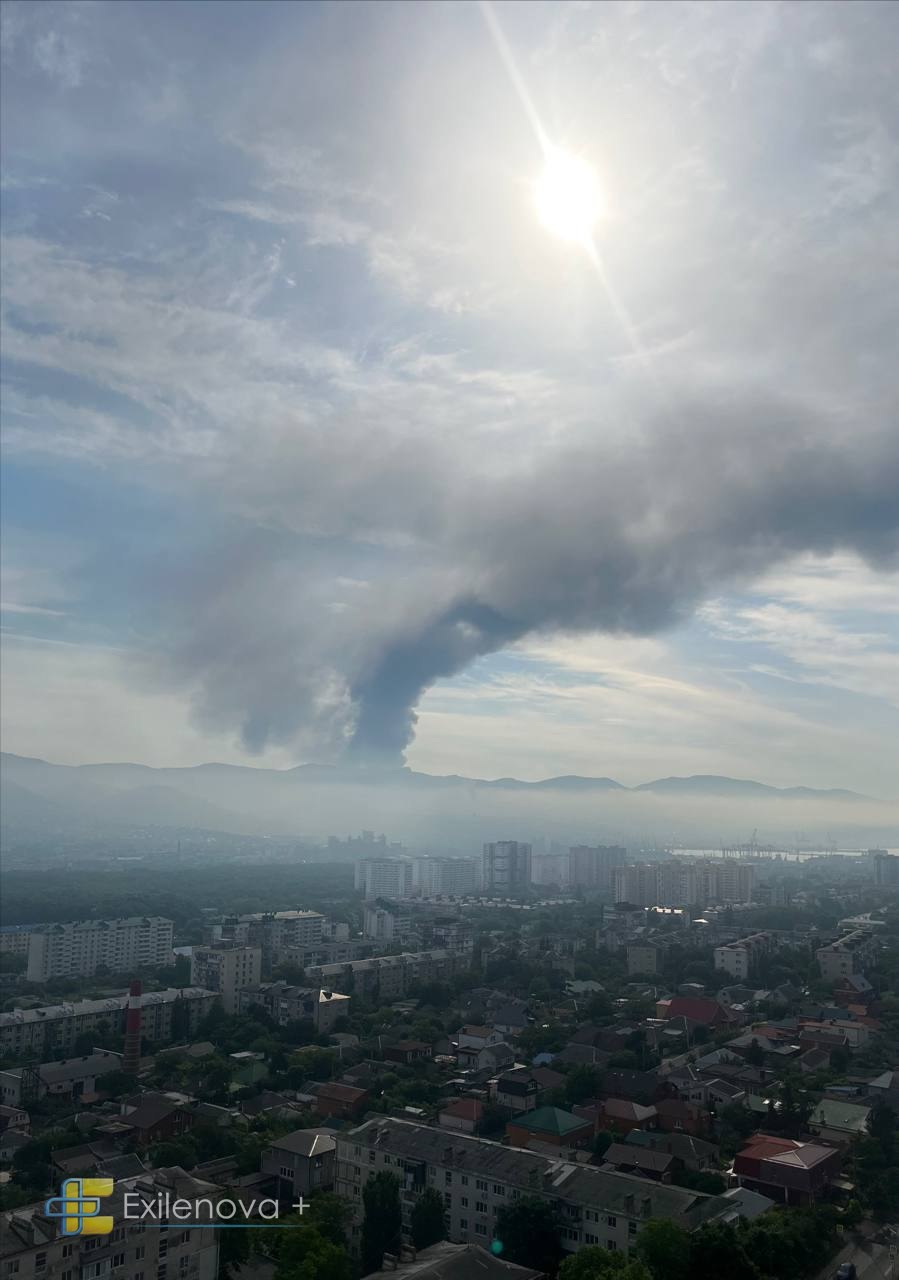
NASA's FIRMS satellite service detected abnormal heat at the site at 02:48 on 8 June. Ukrainian Telegram channel Exilenova+ began reporting the attack around 3 a.m., posting photos and videos of fire in the mountains above the city. OSINT Telegram channel Falcon insight pinpointed the location. Russian news Telegram channel ASTRA confirmed the burning tank farm from eyewitness footage shot about 11 km away.

A fuel storage depot is burning in Novorossiysk, Russia, after a drone strike hit the tank farm overnight

Novorossiysk is one of Russia's most strategically important Black Sea ports, handling a significant share of Russian oil exports
🎥 Supernova pic.twitter.com/d2ab4SSuH0

— Euromaidan Press (@EuromaidanPress) June 8, 2026

What the Grushovaya depot feeds

The Grushovaya site is a transshipment depot for the Sheskharis terminal. Chernomortransneft runs it, under Russia's state pipeline monopoly Transneft. It sits in the Grushovaya Balka tract beyond the Markotkh Ridge, about 12 km from Novorossiysk. The tank farm holds more than 1.2 million m³ of fuel across dozens of tanks, on a site of about 212 hectares. SBS called it one of the largest oil-product stores in the Caucasus.

russian crude reaches sea through tunnels under mountain ridge—and ukraine hit storage end near novorossiysk · post smoke burning grushovaya oil depot drifts over after ukrainian drone strike 8 2026
Smoke from the burning Grushovaya oil depot drifts over Novorossiysk after the Ukrainian drone strike, 8 June 2026. Photo: Exilenova+

Novorossiysk is southern Russia's biggest oil-export hub, the Moscow Times reported. The port ships up to 700,000 barrels a day, and its terminals moved 19.8 million tonnes of oil products in 2025. That trade feeds Russia's budget, which bankrolls the war on Ukraine. The port has become a recurring target in Ukraine's strikes on Russia's Black Sea oil logistics.

Volgograd and a coastal radar also hit

The same night, Ukraine's General Staff said its forces struck the Krasny Yar oil-pumping station in Volgograd Oblast, where a fire broke out. Volgograd governor Andrei Bocharov claimed the blaze came from falling drone debris at the Zhirnovsk pumping station and was quickly put out, the Moscow Times reported. Ukrainian forces also hit a Russian radar station near Kabardinka in Krasnodar Krai, according to the General Staff.

Ukrainian drones struck Russia's Baltic Fleet base at Kronstadt near St. Petersburg overnight, flying nearly 1,000 km. Source: Zelenskiy
Explore further

Kronstadt, Russia’s major naval Base after Black Sea Fleet losses, gets hit by Ukrainian drones (VIDEO)

Not the first strike on Novorossiysk's oil chain

Ukrainian forces have hit this infrastructure before. Ukrainian defense outlet Militarnyi reported that drones struck the Grushovaya depot on 23 May 2026, when fire spread across much of the site. Strike drones also hit the Sheskharis terminal on 6 April, damaging oil-metering systems and shut-off valves at the loading berths. ASTRA said the wider complex was attacked in early March, early April, and on 22 May.

WSJ: Putin’s sanctioned inner circle keeps buying Western business jets through a web of middlemen

8 June 2026 at 10:47

wsj putin's sanctioned inner circle keeps buying western business jets through web middlemen · post bombardier global 7500 same type western-built jet flown russia's elite graham hughes/bloomberg news similar have

Members of Russian President Vladimir Putin's sanctioned inner circle are still flying Western-built luxury business jets, according to the Wall Street Journal (WSJ). A network of European brokers buys the aircraft, registers them in countries that ignore sanctions, and then sends them to Russia. Western enforcement, meanwhile, has gone slack.

Western governments imposed sanctions to punish Russia's leaders and oligarchy for the 2022 full-scale invasion of Ukraine and to cut off the money funding the war, freezing their assets and barring them from Western markets, but the people those measures target keep finding ways to evade them.

Sanctioned, but still flying Western jets

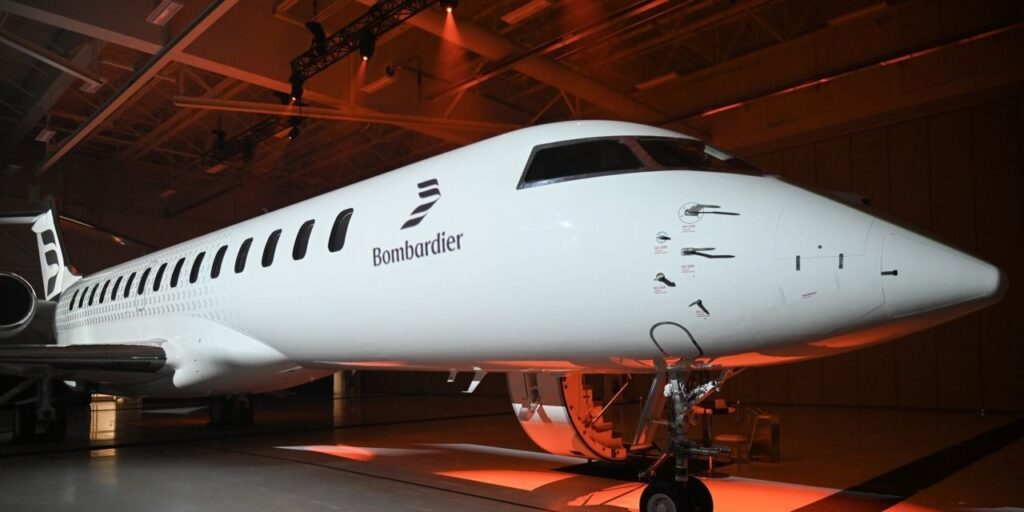
A $75 million Bombardier Global 7500 sits at Moscow's Vnukovo airport. The Canadian-built jet sells to the global super-rich, and close Putin allies fly aircraft like it. WSJ reviewed records from an aviation-data firm, import filings, and flight-tracker logs to map the pattern.

oleg boyko
Explore further

A Putin-list oligarch runs Poland’s vape market. The EU won’t sanction him.

Sergei Chemezov runs Rostec, Russia's state defense conglomerate, and has known Putin since their KGB days in East Germany. He has flown a Bombardier to Dubai, Türkiye, and Southeast Asia. Flightradar24 tracked roughly six of his UAE flights between October 2025 and January 2026. In Dubai, he holds a property fronting its own private beach on the Palm Jumeirah, the emirate's palm-shaped artificial island, Radio Free Europe reported earlier. Leaked financial files known as the Pandora Papers once tied him to estates in Spain.

The same circle, the same perks

Arkady Rotenberg, a boyhood judo partner of Putin's in St. Petersburg, built a fortune on state contracts. International sanctions have targeted him since Russia seized Crimea in 2014. He gained access to two Bombardier Global jets in late 2022. Flightradar24 shows them flying to Azerbaijan and the UAE.

Igor Kesaev made his money in tobacco and alcohol, then moved into retail and weapons. Forbes puts his fortune at $4.8 billion. The US and the EU blacklisted him after the invasion for helping arm Russia's military. In 2023, he brought in a jet-black Bombardier Global Express XRS, according to Ch-Aviation and Import Genius records.

protest oligarch #MakeRussiaPay frozen assets sanctions UK Ukraine Solidarity Campaign Campaign for Ukraine Vsesvit Protesters gather outside the UK Conservative Party headquarters in London on 7 January, calling for an end to “business as usual” with Kremlin-linked oligarchs and demanding that frozen Russian assets be transferred to support Ukraine. Photo: ICUV
Explore further

Russian oligarch hired UK opposition’s top legal adviser to fight his sanctions. Protesters want him fired

Until the all-out war, much of Russia's elite parked their jets with European management firms in tax havens like Switzerland and Luxembourg. The war cost them those deals, and sometimes the planes themselves. They gave up London, the French Riviera, and the Swiss chalets, and now head to the UAE, Türkiye, and Azerbaijan.

How the jets reach Russia

These days, sanctioned Russians reach Western aircraft by going through middlemen and broker firms. European dealers buy Bombardier and Gulfstream aircraft secondhand. They register them in places like the UAE, Oman, Kazakhstan, and South Africa, then fly them to Russia. Similar shadow schemes were tracked before.

The planes moved through a Vienna firm, Avcon, and its subsidiaries before landing in Russian hands. Chemezov's jet started out registered in Bermuda under Avcon's management. A firm called Tarp Aviation later moved it onto Russia's registry. A separate Vienna-based fiduciary, SecuTrust, holds shares in both Avcon and Tarp.

Hungary’s anti-corruption watchdog says Orbán’s former inner circle should be prosecuted over billions in missing EU funds

8 June 2026 at 10:27

hungary's anti-corruption watchdog says orbán's former inner circle prosecuted over billions missing eu funds · post hungarian then-prime minister viktor orban prior delivering speech during spring session parliament budapest hungary

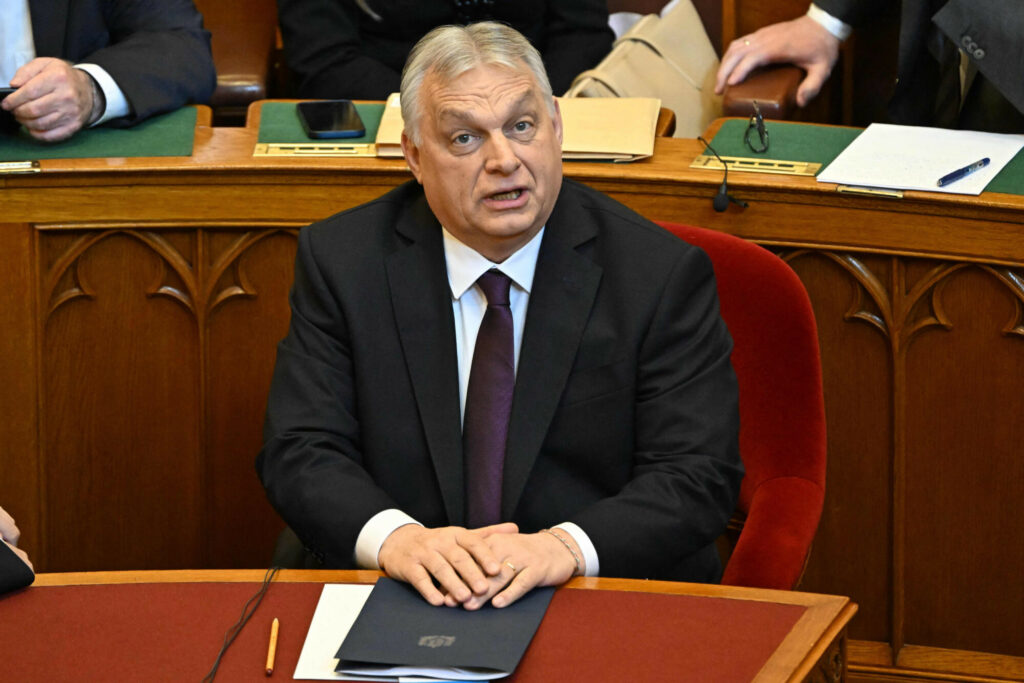
Hungary's long reckoning with alleged graft is shifting from accusations to prosecutions, the country's anti-corruption watchdog has told Politico. Senior figures from Viktor Orbán's former government could face charges over EU money the authority believes was systematically misused. Those words arrive as Orbán's successor works to rebuild trust with Brussels and reclaim funds frozen for years.

The watchdog claims some of the EU money Orbán fought over was siphoned off at home. PM Magyar must still submit a credible reform plan before the end of August. Otherwise, Hungary risks losing €16.4 billion in newly unlocked funds. For years, then-Prime Minister Orbán blocked EU aid and loans to Ukraine. He used the bloc's money as leverage against Kyiv. Magyar has branded his predecessor corrupt over and over. His government dropped a two-year veto and released billions in EU arms payments for Ukraine. 

Senior officials in the crosshairs

Ferenc Pál Biró, who heads the Hungarian Integrity Authority, said top politicians "can and may well be prosecuted." He described it as an alleged effort to bilk EU taxpayers over the course of Orbán's 16 years in power. His team had flagged several criminal cases, he said. Biró wants Hungary to recover the money and have it repatriated, since most has already left the country. He stopped short of naming Orbán or anyone in his inner circle. 

opposition party Tisza
Explore further

Hungary unblocks $7.7 billion in EU arms payments after dropping two-year veto on Ukraine aid

The alleged procurement scheme

The watchdog claims that three companies won most government contracts at artificially inflated prices. The key figures he laid out:

  • Roughly €10 billion paid to just three firms in four years
  • About €3.5 billion, the watchdog treats as overpricing tied to corruption risk
  • Everyday goods and services billed at multiples of their market value

Biró said tenders were manipulated and that the Hungarian state "became the largest entity on the market."

voted out facing investigators orbán could reach un cover sources say · post visit vice president jd vance rally support viktor 7 2026 budapest hungary beata zawrzel/reporter (from left) orban
Explore further

Voted out and facing investigators, Orbán could reach for UN cover, sources say

The watchdog Orbán was made to create

Brussels required the Integrity Authority in 2022 as a condition for releasing frozen money. It monitors how EU funds are spent and sits independently of the government. The body should help unwind patronage empires built under Orbán, spanning construction, utilities, and media. Biró has led it since it launched. Hungary has had billions frozen over corruption and rule-of-law concerns. Orbán himself now faces corruption investigations under the new government.

Bribes and intimidation

Biró said the previous government targeted him while he investigated the scheme. He described attempts at bribery and politically motivated pressure. His wife was offered a job with high pay and no work, he said, though he would not say by whom. He was also held over an accusation of misusing his company car. 

ISW: The strikes will likely cascade into deeper disruption across Russia’s rear supply network

8 June 2026 at 10:05

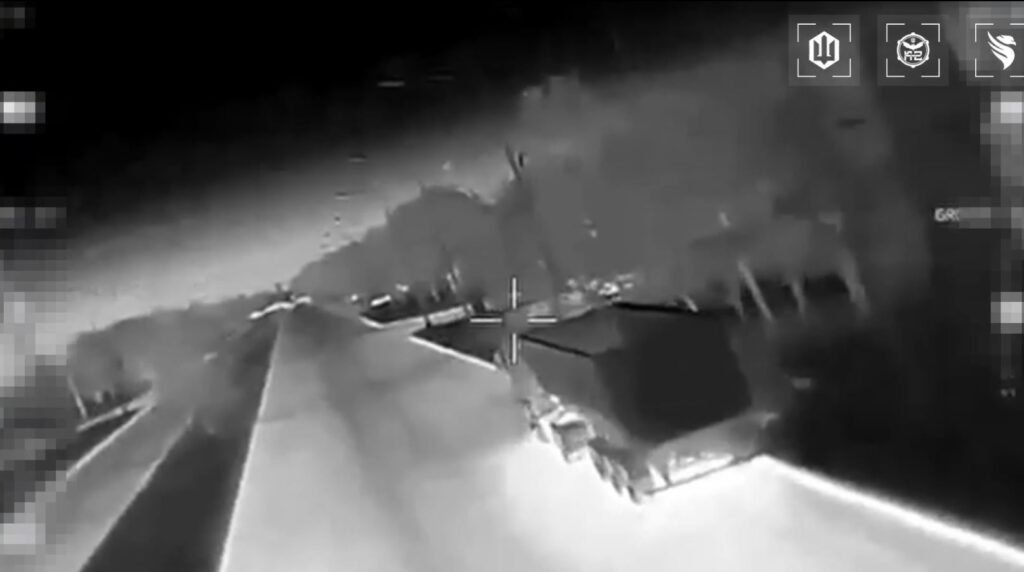
Drones of the 20th Separate Brigade of Ukraine's Unmanned Systems Forces (SBS), known as K-2, and the Phoenix drone unit strike a Russian military truck on a logistics route in Donetsk Oblast, 7 June 2026. Photo: SBS

Ukraine's drone strikes on the highways that feed Russian forces in occupied southern and eastern Ukraine are disrupting Russian logistics and will likely bite deeper in the near future, according to the Institute for the Study of War (ISW). The campaign is also rattling Russia's pro-war online community, where bloggers have begun turning their anger on the Kremlin's own military leadership. Russian forces are already rerouting and disguising convoys to keep supplies moving.

Ukraine's drone war has dragged the fight off the trench line and into Russia's rear, where fuel and transport increasingly decide how long Moscow can keep its invasion supplied. If Ukrainian crews keep the main arteries under watch, Russia faces a slow squeeze on its rear and the political cost of admitting those roads are no longer safe.

Ukraine's drones now own a key supply road

Ukraine's 3rd Army Corps said on 31 May that its drones had won "fire control" over five occupied cities. All five sit on or near the M-04 highway: Luhansk City, Starobilsk, Alchevsk, Bryanka, and Kadiivka. In plain terms, Ukrainian crews can now strike traffic on that road.

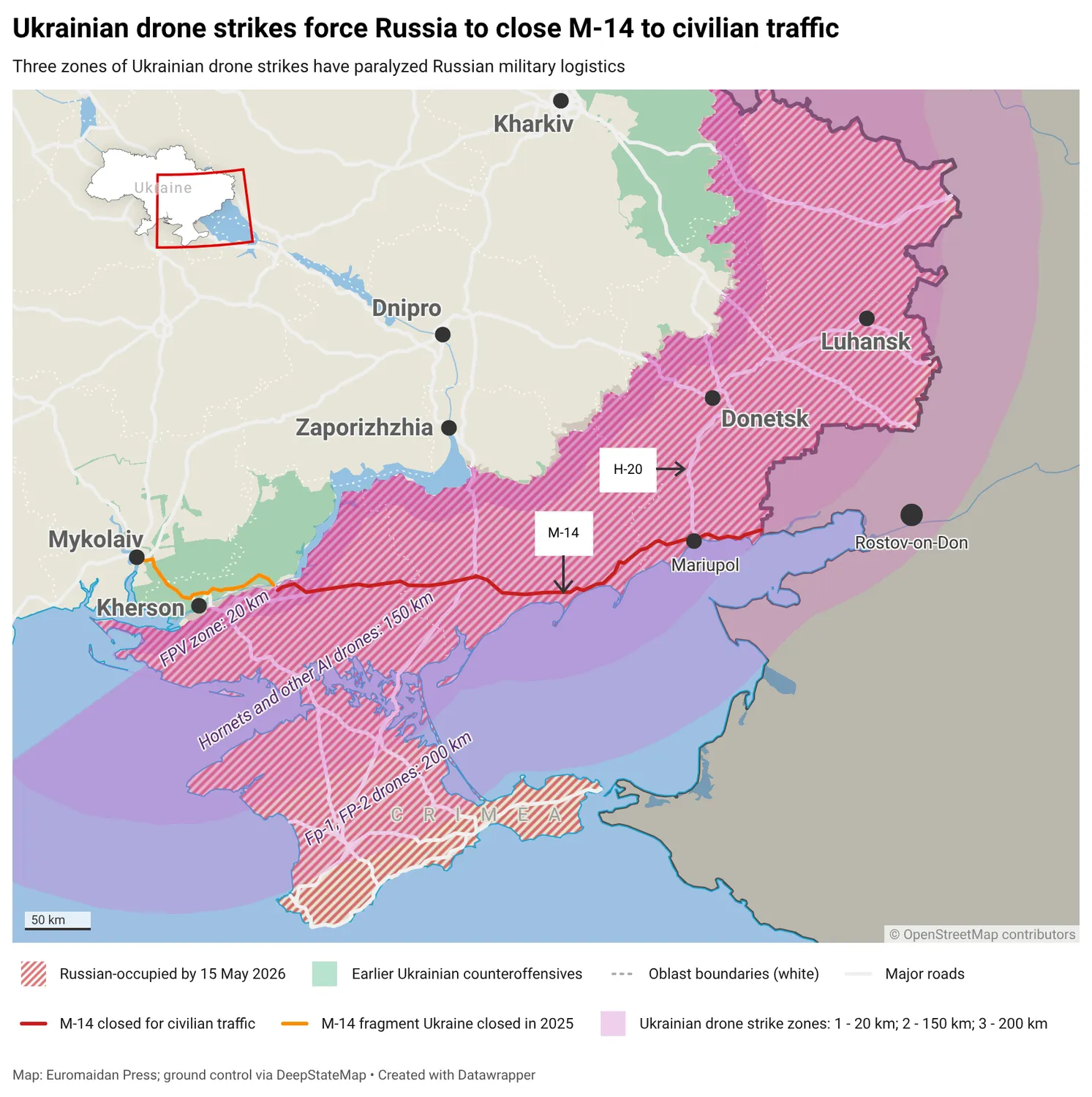
Map of southern Ukraine and adjacent Russian territory showing three concentric Ukrainian drone strike zones — FPV at 20 km, AI-assisted Hornets at 150 km, and FP-1/FP-2 long-range drones at 200 km — layered over the M-14 highway (Rostov to occupied Crimea) and the H-20 (Mariupol north into Donetsk Oblast). The Mariupol-Crimea-Rostov segment of M-14 is highlighted as closed by Russia for civilian traffic. The Mykolaiv-Kherson segment is highlighted as closed by Ukraine in 2025.
Ukrainian drone strike zones layered over Russia's southern supply network. FPVs reach roughly 20 km from the front, Hornets and other AI-assisted drones to 150 km, and FP-1 and FP-2 long-range drones to 200 km. The M-14 highway (Rostov-on-Don to occupied Crimea) and H-20 (branches north from Mariupol into Donetsk Oblast) both fall inside the deeper rings. Russian authorities have closed the M-14 to civilian traffic. The Ukrainian segment of the same highway, between Kherson and Mykolaiv, was closed by Ukrainian authorities in August 2025 after Russian drones turned it into a "human safari" killing ground. Map: Euromaidan Press.

A Ukrainian drone operator argued the M-04 matters more to Russia than the better-known M-14. The M-14 links Rostov Oblast to occupied Crimea. The M-04 begins near Moscow and reaches Rostov-on-Don before carrying on to Russia's Black Sea coast and into the Caucasus. It feeds occupied Crimea, southern Ukraine, and Luhansk Oblast through the Russian towns of Millerovo and Kamensk-Shakhtinsky. It also supplies Donetsk Oblast through Novoshakhtinsk in Rostov Oblast.

The Russian vehicles are burning on the route to Crimea. Source: The 3rd Separate Special Purpose Regiment
Explore further

Flat steppe: Ukraine is strangling Crimea’s supply lines from air. Melitopol-Chonhar road is latest target

The two highways connect, and Ukrainian forces are also hitting the H-20 road that joins them through Donetsk City. ISW assessed that the strikes will likely generate "even more profound cascading effects" across Russia's rear. The effort extends Ukraine's wider push to drive deep strikes further behind the front.

Russia bans buses and repaints its trucks

The strikes are already forcing changes on the ground. Leonid Pasechnik, the Russian-installed head of occupied Luhansk Oblast, issued a decree on 6 June. It bars regular bus and coach services on the section of the highway crossing occupied Luhansk.

A Russian “Svitlyak” border patrol ship seen from a Ukrainian drone before a strike near Yurkine, occupied Crimea. Screenshot from video: Madyar
Explore further

The Crimean Bridge is heavily guarded. Ukraine struck its maritime security layer in the Kerch Strait.

Ukrainian Mariupol mayoral adviser Petro Andriushchenko reported on 7 June that Russian forces had changed their Mariupol–Berdiansk route. They now use local coastal roads instead of the M-14. ndriushchenko said the troops are passing army vehicles off as civilian, recoloring the tarpaulins over each cargo bed and spraying the trucks white. ISW assessed the detours will likely slow Russian supply runs as Ukraine keeps hunting vehicles.

Russia's war bloggers turn on the Kremlin's generals

Ukraine's strikes are landing in Russia's information space too. Russia's pro-war military bloggers are voicing discontent and panic over the campaign.

Russian military truck on fire after a Ukrainian drone strike near occupied Horlivka, Donetsk Oblast, 5 June 2026. Screenshot from video: Supernova+
Explore further

Ukraine doubles deep strikes beyond 50 km as “Logistics Lockdown” shifts priority deeper into Russia’s transport nodes and rear logistics chains

A pro-war blogger and former Storm-Z assault-unit instructor complained on 7 June that Ukraine is now striking factories and defense plants deep inside Russia while degrading Russian air-defense radars and systems. He blamed bureaucracy and state-corporate infighting for Moscow's failure to respond, and separately complained that Russia cannot read Ukraine's battlefield trends and underrates its capabilities. Other bloggers piled on: one claimed fuel shortages were stoking panic in occupied Crimea, while others faulted the Russian Defense Ministry and top general Valery Gerasimov for not striking Ukrainian logistics, especially the Dnipro River bridges.

ISW found the complaints are escalating, and that the strike campaigns are becoming "points of neuralgia" in Russia's ultranationalist crowd. It noted the discontent feeds on Russia's poor battlefield results, rising casualties, and economic strain. Even before this, Russia's war bloggers had turned on the Kremlin's commanders over inflated victory claims.

❌