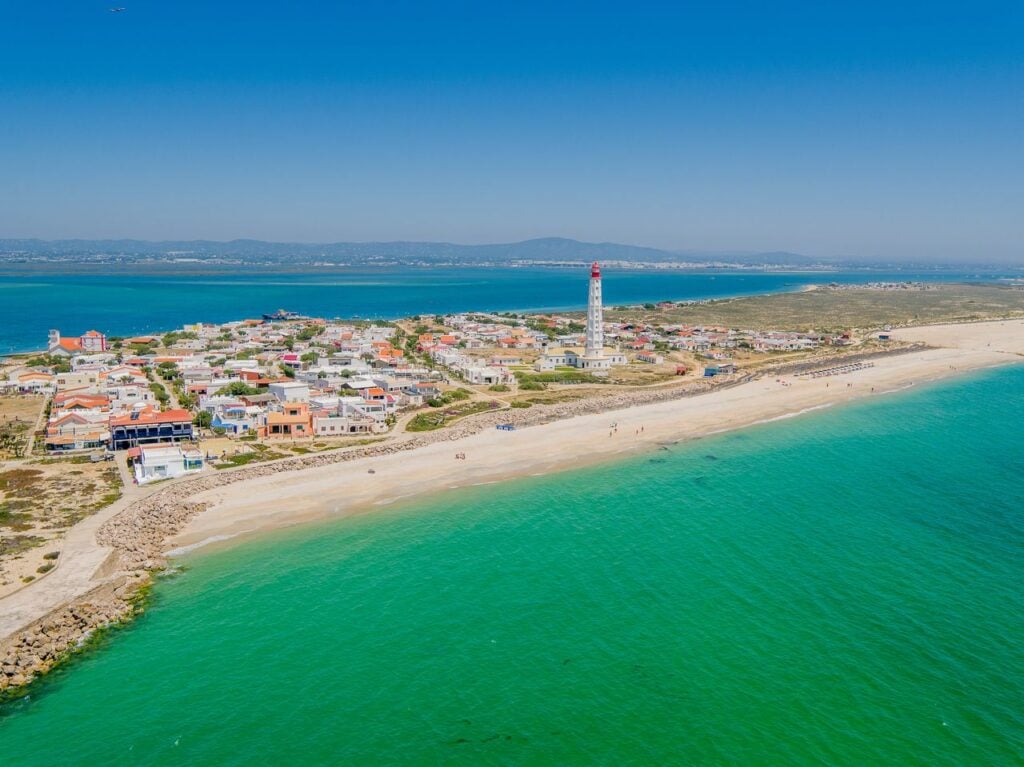
A ocupação hoteleira no Algarve vai rondar os 80% durante as miniférias proporcionadas pelos feriados de junho, com um ligeiro aumento da procura face ao ano passado, afirmaram fontes do setor.
Em declarações à Lusa, o presidente da Associação de Hotéis e Empreendimentos Turísticos do Algarve (AHETA), Hélder Martins, disse que a expectativa é que a ocupação na região no período dos feriados de junho ronde os 80%. Quem optou pela região está também a beneficiar de tempo quente e sem chuva, observou o próprio.
Também o presidente do Turismo do Algarve afirmou que os feriados contribuíram para um ligeiro aumento da procura de portugueses pela região, “embora os níveis se mantenham em linha com os registados no ano passado”.
André Gomes sublinhou que o Algarve continua a ser “um destino de eleição” para o mercado interno durante períodos festivos, refletindo-se numa dinâmica positiva da atividade turística. Estes períodos funcionam também como um “bom indicador” para o comportamento da procura na época alta.
Os hoteleiros apontam para um pequeno aumento de reservas do mercado interno, “embora sem variações significativas face à ocupação turística do ano anterior”.
O alerta foi dado por volta das 15h30, sendo que a GNR tomou conta da ocorrência.
Para o local foram mobilizados os Bombeiros de Sabrosa e da Cruz Verde de Vila Real, bem como elementos do Instituto Nacional de Emergência Médica
As causas do acidente não são conhecidas.
Ao que a VTM apurou, à chegada dos meios, o homem estava em paragem cardiorrespiratória. Apesar das manobras, não foi possível reverter a situação e o óbito acabou por ser declarado no local.
A ACT foi, entretanto, contactada para, segundo fonte da GNR, “ficar a par do sucedido e formalizar as diligências à posterior”.
Ukraine at war; weapons from all over the world (Flickr)
Half way through the fifth year of the war in Ukraine it is reasonable to ask why it has lasted so long. Why has Russia not crushed Ukraine quickly as expected, it is after all a much bigger country with a far greater population and industry to call on?
Robert Harneis (DR)
By Robert Harneis
It is standard for the Western Media to talk of deadlock and to say that the Russians are not advancing because their armies are incompetent, when they are not drunk or poorly equipped. At regular intervals Western media announces that the Russian side is running out of ammunition, missiles, drones, tanks or even men. In short they are not advancing in overwhelming force to capture Kiev because they are incapable of doing so. The latest fantasy in the US, UK and European media, is that the Russian economy is crumbling in the face of the problems created by the war and sanctions.
Russia’s self-imposed restrictions
President Putin imposed severe constraints on his generals from the start. They are, to an extent, fighting with one hand tied behind their backs. Contrary to the endless claims by the Western media, the Russian forces do everything they can to avoid civilian casualties. This in borne out by their low level throughout the war. In a recent massive attack involving 1500 missiles and drones right across Ukraine, only six civilians were reported killed. It is only natural that this should be so. Russia regards Ukrainians as brother Slavs. Approximately one fifth of Russian families have close relatives in Ukraine. The brother of the Ukrainian Commander in Chief is a colonel in the Russian army. They have no interest in killing them, if it can be avoided, especially as they will have to live with them after the war.
The second restriction is the requirement to avoid heavy casualties amongst their own forces. Wars are lost on the home front when the body bags start coming home in big numbers. The constant allegations in the Western media that Russians launch human wave attacks and suffer heavy casualties doing so, are false. This desire to restrict losses is reinforced by Russia’s demographic problems. Lives are precious.
The third restriction that Putin has imposed on his generals and ministers is that the war will not stop Russian economic progress, vital for political stability. Of course it goes without saying that it is not possible to fight a major war without financial and budgetary stress. An example is the necessity of delaying the naval building program as a result of which only sixteen corvettes have been built out of the forty planned. This has made it more difficult for Russia to protect its merchant fleet and stop the current harassment of oil tankers. On the other hand the management of the economy has been a classic case of successful military Keynesianism as with the United States in World War II. Throughout the war real wages have risen and economic growth has been maintained. Unemployment is at record low levels.
Tactical considerations
There are other less obvious reasons for hastening slowly. If Moscow’s war aims are denazification and demilitarization then the longer the fighting goes on the more of the Ukrainian military is eliminated, especially the elite ultra-nationalists who are Ukraine’s most committed soldiers. The effect of the manpower attrition is obvious from the many videos appearing on social media showing Ukrainian press gangs snatching citizens from the street, often with violent resistance.
Further by keeping the fighting in the Donbass, the invading Russians have short lines of communications, whilst Kiev’s main bases are over a thousand kilometers away in Poland, with supplies at risk of constant air attack on their way to the front. Paradoxically then, the invading force has better lines of communications than the defenders in their own country.
The wish to avoid destruction is another explanation for Russian circumspection. It is obvious that the retreating Ukrainian army is indifferent to the damage it causes to the cities it loses. The greater the area of the fighting the greater the destruction that Russia will likely have to rebuild after the war. Better to ground away the Ukrainian ability to resist and if an advance into the rest of the country is needed, to wait until effective military resistance has collapsed.
However an undoubted factor in the slow Russian progress is the nature of the great Donbas urban area, which was massively fortified with NATO assistance over eight years after the 2014 coup d’état when Ukraine moved definitively into the Western camp. Whatever plans the Russian government may have for the rest of Ukraine, especially the Black Sea Coast, the source of many missile attacks on Russia, they will not wish to make any major moves until the Donbass is firmly in their hands. Two important fortified towns remain to be captured Kramatorsk and Slavyansk. Russian forces are already approaching them. It remains to be seen how long it will take to break their resistance.
We cannot know what President Putin and the Russian High Command are thinking but it is also obvious that by not committing to a major offensive Russia not only avoids casualties but retains the strategic initiative. Hundreds of thousands of Russian troops are held in reserve. Uncommitted forces are a potential threat as well as being available for defense elsewhere if needed.
The Russians will also have learnt the bitter lessons of the US army that quickly smashed its way into Afghanistan and Iraq but was unable hold the territory conquered in the face of tough local resistance. Already, at the beginning of the war in March 2022, the Washington Post published an article that assumed a quick Russian advance and talked about the planned guerilla resistance. There is every reason for Russia to move gradually and consolidate as it goes.
The diplomatic front
There is also the diplomatic aspect, which is of vital importance to Russia. Moscow views the struggle in Ukraine as part of a world confrontation. It has been clear from the start of the war that whilst the West and Kiev worry about public opinion to get support for the war, Russia is concerned about what he world’s diplomats think. Good relations with India and BRICS countries and especially China dictate moderation at all times. A shock and awe approach, whilst it might get quicker results, would have offended much international opinion and unfavorably reminded the world’s diplomats of the Soviet Union, something Putin wishes to avoid at all costs. Similarly Russia is very patient with small countries on its borders that indulge in vexatious provocations, notably the Baltic States… so far. The contrast with the brazen bullying of Venezuela, Cuba, Greenland and Iran by the United States is striking and has had an effect on world public opinion. The recent humiliation of Merz’s new militaristic Germany in the recent United Nations General Assembly vote is a striking example of the success of this softly softly approach, as is Russia’ success in expanding its influence in Africa from Mali to Madagascar.
Also on the diplomatic front, with a long war, the Black Sea remains closed to the warships of outside countries under the Montreux Convention of 1936, which governs traffic through the Dardanelles strait. The convention allows Turkey to close the straits to all warships in times of war and to permit merchant ships free passage. This suits the Russians as NATO likes to flex its muscles by bringing warships into the Black Sea in times of international tension. For four and a half years they have not been able to do this. Once the war ends, Turkey will have to let them through again. Another reason why the Russian forces have taken their time.
The change in the nature of war
Every war is different and brings its surprises. The drone revolution has transformed this one. The omnipresence of drones is all the more deadly, given the absolute impossibility for both sides, of hiding concentrations of troops, thanks to satellites that see pretty much everything happening on the ground. So now advances are made by small groups of infantry that infiltrate defenses that are then taken out by artillery, drones and missiles. Slow work if casualties are to be kept to a minimum.
NATO intervention
NATO intervention, with a huge supply of arms, finance and electronic intelligence, after sabotaging the peace talks, has increased Russian difficulties in defeating the Ukrainian army,. It is this that definitively imposed the choice of a long slow war of attrition on the Russians – a war that Russia is clearly winning. Not only have Ukraine’s forces been degraded in this process but NATO’s as well. One reason the United States has reduced arms supplies to Kiev is that they are running short. This became very obvious when Washington’s priority turned to the defense of Israel. The Pentagon has had to search the globe, asking allies as far apart as South Korea and Germany to hand over any Patriot air defense missiles they might have. The US air force is seriously short of vital stand-off munitions to attack Iran. The result for Kiev is that it has little defense industry of its own left and NATO has completely failed to match Russian weapons production levels.
Russian rearmament
It is also obviously the case Russia needed time to build its army to its present strength, as well as arm and equip it. Russia has greatly increased its military production across the board. This has been possible because of the continued existence of much of the old Soviet military industrial infrastructure on Russian territory. Whilst the combined Western nominal GDP greatly exceeds Russia’s, when it comes to purely military industrial capacity Russia is well capable of holding its own. Tank production and reconditioning has increased from a few hundred to more than a thousand a year. The United States can barely produce one hundred new Abrams tanks each year. Russia alone now produces over five million drones each year. Importantly Russia is fourth in the world in the number of STEM students graduating annually after China, India and the United States.
Irreconcilable differences block peace talks
Putin’s latest statements indicate that the Russian government is not interested in a ceasefire that fails to solve its Europe wide security problems. The United States does not want to lose face in Ukraine, particularly after its recent military failures in Afghanistan and now Iran. It also wants to continually weaken Russia. Europe is determined to persevere in its support for Ukraine despite the major economic and energy problems they have created for themselves. The statement from the latest meeting of the leaders of France, Germany and the United Kingdom, on June 7, refers to the need for a peace treaty that leaves Ukrainian frontiers unchanged. Clearly something Russia will never accept. Brussels sees failure in Ukraine as a threat to its plans for ever greater union, even the institution itself. Against this background it is not surprising that there have been no meaningful peace talks. As Josep Borrell former EU High Representative for foreign affairs commented at the beginning of the war, it will have to be settled on the battle field and that takes time.
Finally in Ukraine, whilst the people would agree to negotiations with Russia, the regime and its ultra nationalist supporters know that if there is peace and Russia wins there is no future for them. Putin’s final phrase in his recent speech at St Petersburg Economic Conference “Keep on fighting my comrades” is ominous for Zelensky and his neo Nazi colleagues. It is a reference to a famous quotation, the last words of a Russian policeman knowing he was about to die at the hands of terrorists. It reflects the Russian leader’s determination to focus Russian society in a patriotic way and finally settle the Ukrainian problem for good. He has used the long war to encourage a new generation of Russian leaders based around distinguished war veterans. This has been accompanied by a determined anti-corruption drive. None of this would have been possible without a long war.
However that may be, the Russian President is coming under increasing pressure to move faster. Like the US, Russia has parliamentary elections approaching in the autumn, September of this year, and there are signs that the tempo is quickening all along the front line. The long war has had advantages for Russia but it may be time to bring it to a close, whatever the cost.
O processo de atribuição de direitos para a exploração experimental de depósitos de tungsténio, estanho, prata e chumbo do projeto denominado de Vila Verde, abrangendo territórios dos concelhos de Vila Real e Sabrosa, deverá avançar para uma nova fase administrativa, apesar da maioria das participações registadas durante a consulta pública se ter manifestado contra o projeto.
Segundo o relatório final da consulta pública promovida pela Direção-Geral de Energia e Geologia (DGEG), e publicado no portal Participa, foram recebidas 26 participações, das quais 18 manifestaram discordância com a pretensão da empresa Minerália – Minas, Geotecnia e Construções, Lda., enquanto apenas sete expressaram concordância. Foi ainda registada uma reclamação.
Entre os participantes estiveram várias autarquias e associações da região, incluindo a União de Freguesias de Silva Escura e Dornelas, a Junta de Freguesia de Souto Maior, a Freguesia de Mouçós e Lamares, a Freguesia de São Lourenço de Ribapinhão, a Associação Povo e Natureza do Barroso e a Associação Palombar – Conservação da Natureza e do Património Rural.
As principais preocupações apontadas pelos opositores prendem-se com os potenciais impactos ambientais da exploração experimental. Entre os receios manifestados encontram-se possíveis contaminações de águas superficiais e subterrâneas, destruição de coberto vegetal, fragmentação de habitats e perturbação de espécies protegidas. Foram ainda levantadas dúvidas sobre a suficiência dos estudos apresentados, a ausência de Avaliação de Impacte Ambiental e a compatibilidade do projeto com atividades agrícolas, vitivinícolas e de turismo de natureza existentes na região.
Diversos participantes consideram igualmente que a classificação do projeto como “exploração experimental” não corresponde à dimensão real das intervenções previstas, receando que esta constitua o primeiro passo para uma futura exploração mineira de maior escala.
Apesar destas críticas, o relatório da DGEG conclui que o procedimento reúne condições para prosseguir para uma proposta de atribuição de direitos e para o início da negociação contratual com a empresa promotora, desde que sejam dadas respostas às preocupações identificadas durante a consulta pública.
A posição da DGEG surge na sequência dos pareceres emitidos pelas entidades públicas consultadas, que se revelaram globalmente favoráveis ou favoráveis condicionados.
A Câmara Municipal de Vila Real pronunciou-se favoravelmente, considerando que os trabalhos previstos se enquadram nas áreas identificadas pelo Plano Diretor Municipal como potenciais zonas de exploração de recursos geológicos. Também a Agência Portuguesa do Ambiente e a CCDR-Norte admitiram o avanço do projeto, embora impondo diversas condicionantes relacionadas com a proteção dos recursos hídricos e das áreas abrangidas pela Reserva Ecológica Nacional.
O Instituto da Conservação da Natureza e das Florestas (ICNF) emitiu igualmente parecer favorável condicionado, alertando para a presença de lobo-ibérico na área do Bloco A e para a existência do abrigo de morcegos da antiga Mina do Vale das Gatas, considerado de importância nacional. O organismo exige estudos complementares e medidas específicas de mitigação para a proteção destas espécies.
Por sua vez, o Laboratório Nacional de Energia e Geologia (LNEG) reconhece o potencial mineral da área e considera adequados os métodos de prospeção propostos, embora tenha identificado incoerências técnicas entre os documentos apresentados pela empresa, recomendando esclarecimentos adicionais.
O projeto prevê a realização de 12 sondagens e de uma escavação experimental na zona da Cumieira, no concelho de Vila Real, com o objetivo de avaliar o potencial económico dos recursos minerais identificados durante campanhas de prospeção anteriores.
Um estudo sobre o ratinho espinhoso africano (Acomys), uma espécie com elevada capacidade de regeneração tecidular e resistência ao desenvolvimento de tumores, abriu novas perspetivas de investigação sobre os mecanismos biológicos que podem contribuir para a prevenção do cancro e para avanços na medicina regenerativa.
O estudo foi publicado na revista Scientific Reports por uma equipa de investigadores do Algarve Biomedical Center Research Institute (ABC-Ri), da UAlg e do Instituto de Investigação Biomédica Sols-Morreale (IIBM-CSIC-UAM).
“Ao contrário da maioria dos mamíferos, que cicatrizam quando sofrem uma lesão, este roedor consegue regenerar pele, músculo e até recuperar ligações funcionais na medula espinhal”, explica a UAlg em comunicado, acrescentando que a referida capacidade tornou-o um modelo de “grande interesse” para o estudo da regeneração dos tecidos.
Os investigadores compararam a resposta do ratinho espinhoso com a de ratinhos de laboratório convencionais (Mus musculus), após ambos serem submetidos “a um modelo experimental de indução de tumores na pele”. “Enquanto os ratinhos convencionais desenvolveram vários tumores, os ratinhos espinhosos não desenvolveram nenhum”, ilustra.
A equipa analisou, ao longo de 28 dias, a atividade dos genes das duas espécies, concluindo que o ratinho espinhoso “desencadeia uma resposta biológica diferente quando exposto a fatores que podem provocar cancro”, ativando mais rapidamente genes que ajudam a impedir o desenvolvimento do processo cancerígeno. Além disso, apresenta uma resposta imunitária mais eficaz e quando o dano é controlado, “a atividade destes genes regressa rapidamente aos níveis normais”.
“Estes resultados indicam que a capacidade regenerativa e a resistência ao cancro não são incompatíveis, podendo antes estar relacionadas”, explica Wolfgang Link, investigador do CSIC e autor correspondente do estudo.
O trabalho posiciona os mecanismos de regeneração tecidular como “uma possível chave para a prevenção do cancro”. Compreender como o ratinho espinhoso consegue controlar a multiplicação celular poderá contribuir para o desenvolvimento de estratégias inovadoras para a prevenção e tratamento do cancro humano, bem como para avanços na medicina regenerativa.
A equipa responsável pelo estudo e pela publicação do artigo é composta por Marta Vitorino, Gonçalo G. Pinheiro, Inês Grenho, Inês M. Araújo, Bibiana Ferreira, Wolfgang Link e Gustavo Tiscornia, investigadores da Universidade do Algarve.
The disappearance and subsequent death of 11-year-old Lyhanna, whose body was found on June 4 in an agricultural silo in the Gers region of southwestern France, has triggered an unprecedented institutional crisis in France. Politicians are shifting blame onto judges, who are doing what they can with the resources available to them.
France’s judicial institution is facing both genuine operational failures and unacceptable political exploitation. By offloading their own responsibilities onto judges and prosecutors, neither Justice Minister Gérald Darmanin nor Interior Minister Laurent Nuñez is likely to emerge from this ordeal with enhanced credibility.
A troubling case file
The facts currently known in the Lyhanna case are undeniably damaging to the judicial system. The primary suspect, a 41-year-old man and the father of one of Lyhanna’s classmates, had an extensive judicial and administrative record before being formally charged with kidnapping and unlawful confinement of a minor under the age of 15.
Several complaints and reports had already been brought to the attention of the relevant authorities. One of the most sensitive aspects of the case involves a complaint filed on August 22, 2025, by the mother of a child alleging repeated sexual assaults. On September 11, a medical report reportedly identified findings described as consistent with the child’s statements. Yet the suspect was never interviewed before Lyhanna disappeared on May 29.
This timeline raises a fundamental question: why did a complaint alleging the rape of a minor, supported by medical evidence, fail to result in an interview of the suspect before the tragedy occurred? This question goes beyond the understandable public emotion surrounding the case and requires examination of how criminal investigations are actually processed.
The justice inspectorate faces major questions
Justice Minister Gérald Darmanin has ordered a systematic review of 70,000 complaints involving children by July 14. A general administrative inspection is currently underway to determine whether delays, errors, or procedural failures occurred in the handling of cases involving the suspect.
This directive from the Ministry of Justice responds to both political and moral urgency. Its purpose is to ensure that no comparable case is sitting unattended in an investigative unit or prosecutor’s office, particularly those involving rape or sexual abuse allegations. At the same time, it reflects a clear lack of confidence in the ordinary functioning of France’s criminal justice system.
The major challenge following this review will be actually processing those complaints: interviewing suspects, verifying testimony, prioritizing investigative actions, and making the necessary judicial decisions. Without additional operational resources, the scope of the problem may be revealed without being solved.
Judges and prosecutors thrown to the wolves
Frédéric Chevallier, Chief Prosecutor of Chartres and president of the National Conference of Public Prosecutors, has spoken out in defense of prosecutors while acknowledging that the case demands answers. His comments reflect the intense pressure currently weighing on the judicial institution.
On one hand, he rejects the idea that “judges and prosecutors should be thrown to the wolves” in response to public outrage. He stresses the need to avoid premature conclusions before inspections are completed, urging public officials to “keep a cool head.” His central argument is that no serious conclusions can be drawn before the entire chain of events has been reconstructed.
On the other hand, Chevallier has not ruled out individual responsibility, noting that “judges are not beyond accountability.” This cautious approach is intended to prevent the Lyhanna case from becoming a public trial of an individual magistrate or prosecutor’s office before investigators have completed their work.
Yet this institutional defense remains fragile. Explaining that the courts are overloaded, that investigative services are overwhelmed, and that prosecutors constantly triage competing emergencies only partially addresses families’ concerns. When a child dies and prior warnings existed, the judicial system must be able to explain why certain procedures moved so slowly and whether individual decisions contributed to an identified risk.
The impossible equation of priorities
Prosecutors point out that they are managing enormous backlogs of cases. Chevallier referenced not only the 70,000 complaints involving minors now under review, but also millions of cases of all types awaiting action within investigative services.
This argument reveals an institution that is clearly overwhelmed, at times buried beneath mountains of case files. It highlights a criminal justice system confronting systemic saturation. Yet it does not end the legitimate debate over how cases are prioritized. If everything is considered urgent, then nothing truly is. The Lyhanna case compels the judicial system to explain precisely how complaints are prioritized, especially when they involve sexual violence against children.
This issue connects to a structural problem that judges’ unions have denounced for decades: chronic underfunding. The Judicial Magistrates’ Union (USM), which has been highly visible in the media since the tragedy, argues that judges should not serve as lightning rods for the state’s failure to provide adequate judicial resources.
Political exploitation and death threats
The USM has condemned what it sees as unacceptable political exploitation of the tragedy. It points to statements by President Emmanuel Macron dismissing resource-related concerns from the outset, threats of sanctions raised by the Justice Minister before the inspectorate had reached any conclusions, and proposals by political figures to create a special disciplinary court for judges.
This political escalation has been accompanied by serious consequences. The Chief Prosecutor of Auch has been targeted with death threats circulating on social media. The Ministry of Justice has filed a criminal complaint, marking a dangerous turning point: public anger is being transformed into personal targeting and threats against judges and prosecutors themselves.
This is precisely the danger prosecutors fear. Judicial unions have significantly increased their media presence, with senior officials speaking publicly. Their coordinated effort is intended to give voice to rank-and-file judges and prosecutors facing what they view as opportunistic attacks.
Restoring public trust
The prosecutors’ calls for caution regarding the administrative investigation will only be heard if the judicial institution provides complete and transparent answers to the legitimate questions raised by families, advocacy groups, and the broader public.
The central challenge is reconciling two seemingly conflicting imperatives: protecting judicial independence from political interference while acknowledging that the public deserves explanations when a child dies and previous warnings may have been overlooked.
This case reveals that the French judicial system is facing a profound crisis of confidence. Families, citizens, and the public need to understand how the criminal justice process actually works, what priorities genuinely guide the handling of complaints involving minors, and how insufficient resources concretely affect child protection.
Without restoring public trust through transparency and meaningful operational reforms, the Lyhanna case will leave a lasting mark on the relationship between the justice system and French society. The inspectorate may establish the facts, but only clear and responsible institutional communication can help ease the current tensions.
O avançado internacional português Gonçalo Ramos, atualmente ao serviço do Paris Saint-Germain, regressou na semana passada, ao local onde deu os primeiros passos no futebol. A visita ao Estádio José Arcanjo e às instalações do Sporting Clube Olhanense foi divulgada pelo clube algarvio através das suas redes sociais.
“Foi ali que Gonçalo Ramos deu os primeiros pontapés na bola”, destaca o Olhanense na publicação, assinalando o regresso de um dos jogadores mais emblemáticos formados no clube.
Natural de Olhão, o avançado iniciou o seu percurso futebolístico ao serviço dos rubro-negros, antes de prosseguir a formação no Benfica. Desde então, construiu uma carreira de destaque, representando a Seleção Nacional e, atualmente, o Paris Saint-Germain.
Ao serviço do clube francês, Gonçalo Ramos conquistou recentemente o bicampeonato da Ligue 1 e a Liga dos Campeões, reforçando o estatuto de um dos futebolistas portugueses mais relevantes da sua geração.
Segundo o Olhanense, a visita teve um significado especial para o jogador, marcada pelo reencontro com o clube e com as origens que marcaram o início da sua carreira. “Apesar da projeção internacional e dos muitos sucessos alcançados, Gonçalo nunca esquece a terra que o viu crescer nem o clube onde nasceu para o futebol”, escreveu o clube.
A visita foi recebida com entusiasmo por dirigentes, colaboradores e adeptos, que veem no percurso do internacional português um motivo de orgulho para a cidade e para a instituição. Na mesma publicação, o Olhanense sublinha que “as portas do José Arcanjo estarão sempre abertas para quem aqui começou a sonhar e nunca esqueceu o caminho percorrido”.
O clube termina a mensagem com uma declaração de reconhecimento ao jogador: “Gonçalo Ramos será sempre um dos nossos.”
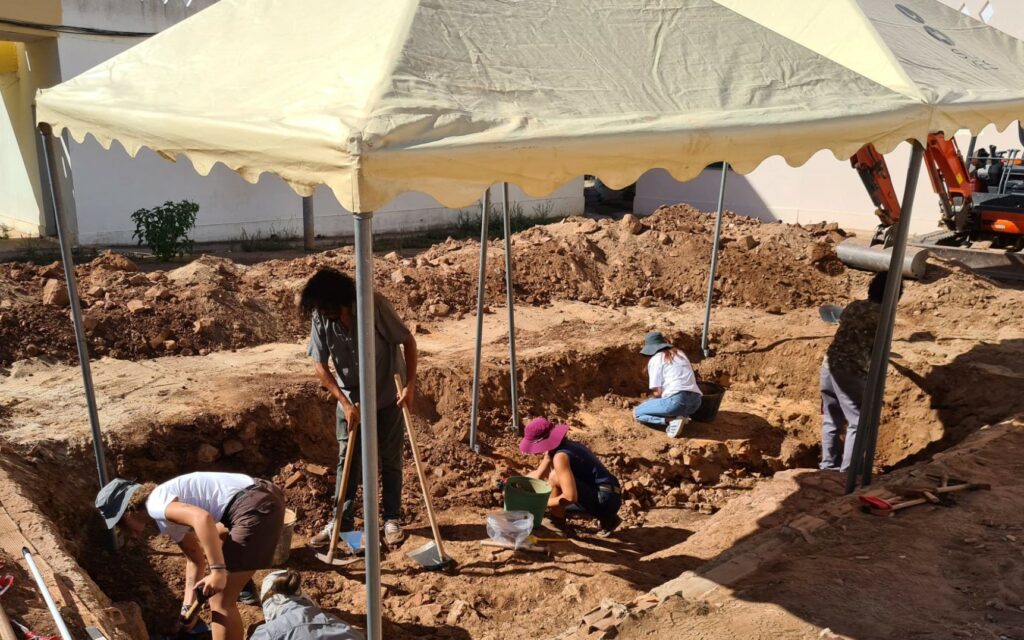
No âmbito das Jornadas Europeias de Arqueologia 2026, vai decorrer no dia 13 de junho a iniciativa “Silves Subterrânea”, um conjunto de visitas guiadas que dão a conhecer os mais importantes espaços arqueológicos e estruturas históricas da cidade.
“Reconhecida pela riqueza do seu legado histórico e arqueológico, Silves guarda sob as suas ruas edifícios e monumentos testemunhos de diferentes épocas que ajudam a compreender a evolução da cidade ao longo dos séculos”, pode ler-se num comunicado da autarquia.
O programa inclui visitas guiadas às ruínas arqueológicas localizadas sob a Biblioteca Municipal de Silves, à Couraça Islâmica, ao Poço-Cisterna, à Cisterna da Rua do Castelo e às Ruínas Arqueológicas da Arrochela. As visitas decorrem entre as 10h e as 16h, com ponto de encontro na Biblioteca Municipal.
A iniciativa pretende aproximar a comunidade do património arqueológico local, sensibilizando para a sua importância “histórica, científica e cultural”.
Mais informações através do contacto 282 440 800 ou do endereço arqueologia@cm-silves.pt.
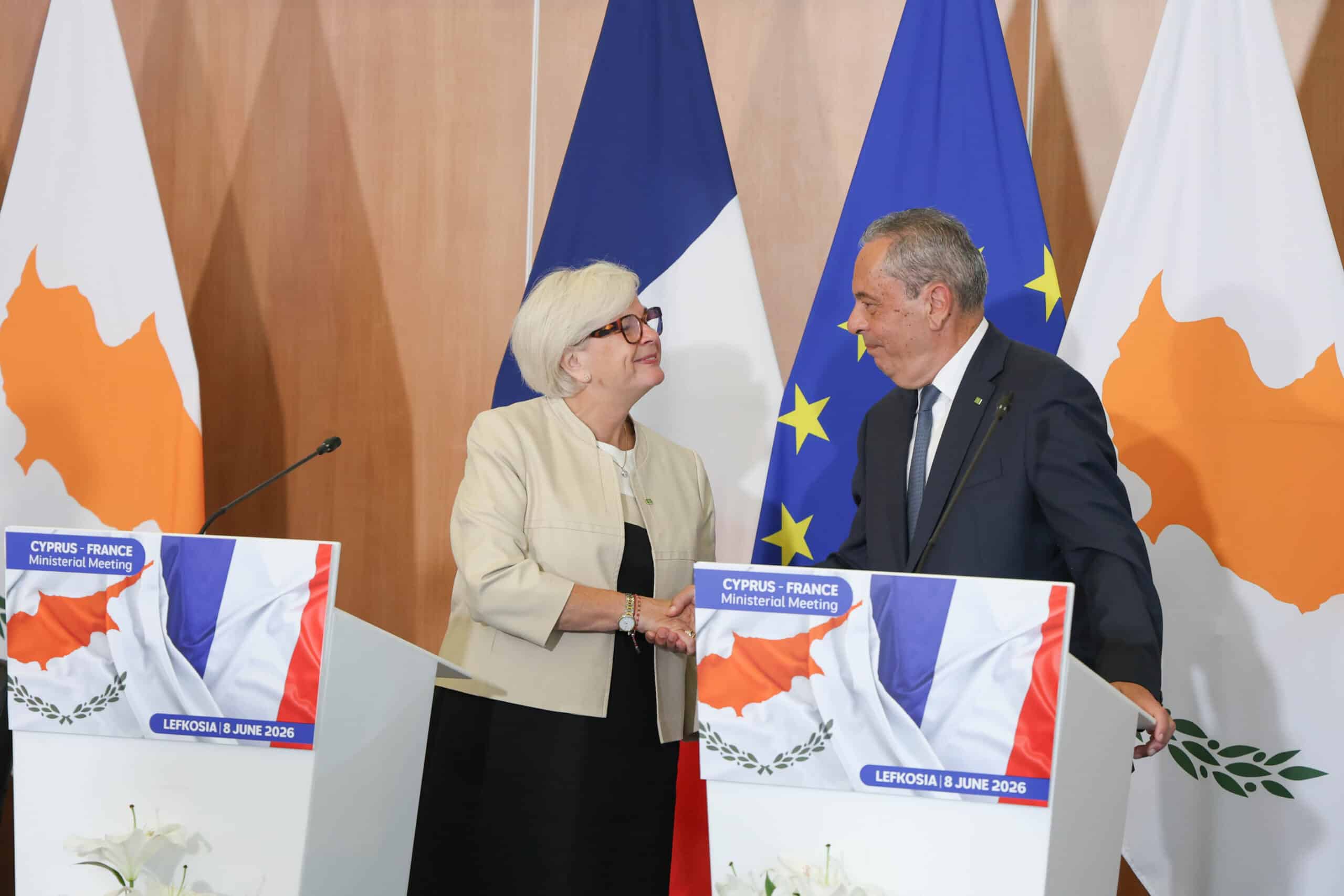
Defense Minister Vasilis Palmas and his French counterpart, Catherine Vautrin, signed the defense agreement on Monday. Credit: European Council
Cyprus and France signed a Status of Forces Agreement (SOFA) on Monday that strengthens defense cooperation between the two nations and allows for the conditional deployment of French troops on the island nation.
The agreement was signed in Nicosia by Defense Minister Vasilis Palmas and his French counterpart, Catherine Vautrin, on the sidelines of the informal meeting of EU defense ministers, hosted by Cyprus.
Vautrin described Cyprus as a key strategic partner for France and an essential hub for French military operations in the Eastern Mediterranean and the Middle East. “Cyprus is an essential support point for the conduct of our military operations in the Eastern Mediterranean and the Near East,” she said.
She noted that the ports of Larnaca and Limassol host around thirty French naval visits annually, with twenty-one already recorded since the beginning of this year. The French Minister highlighted the extensive cooperation between the two countries’ armed forces, pointing to joint naval exercises, including Argonaut and Eunomia, aimed at strengthening maritime security, freedom of navigation, and crisis response capabilities.
According to Vautrin, cooperation has also expanded in recent years to include land and air operations, military mobility, air defense, operational readiness, and logistical support.
Provisions of the Cyprus-France defense agreement
Cyprus President Nikos Christodoulides announced the agreement’s entry into force on his official social media accounts, stating that the signing and implementation of the SOFA contribute to the shared European objective of strengthening the European Union’s strategic autonomy.
Όταν ο Γάλλος Προέδρος Emmanuel Macron επισκέφθηκε την Κύπρο στις 23 Απριλίου 2026, είχαμε αναφερθεί δημόσια, κατά τη διάρκεια της διάσκεψης τύπου, στην πολυεπίπεδη στρατηγική μας συνεργασία, ειδικότερα στους τομείς της Άμυνας και της Ασφάλειας. Μέσα σε αυτό το πλαίσιο, είχα… pic.twitter.com/E3Gk5IZgX8
— NikosChristodoulides (@Christodulides) June 8, 2026
Under the SOFA, which was discussed during French President Emmanuel Macron’s visit to Nicosia on April 23 and subsequently negotiated between the two sides, the military assets of France may be deployed in southern Cyprus under certain conditions. The agreement also provides a legal framework for the presence of French military forces in Cyprus in support of various activities in the Eastern Mediterranean and the Middle East.
Furthermore, the SOFA, whose entry into force was announced by Christodoulides, grants France access to military bases and infrastructure in Cyprus. The agreement is reported to also include provisions on military technology sharing, joint exercises, and strategic dialogue between France and Cyprus.
President Donald Trump is reportedly considering Patriarch Theophilos III of Jerusalem as a potential mediator in Russia-Ukraine peace efforts. Credit: Jerusalem Patriarchate
In a novel diplomatic development, US President Donald Trump has reportedly approached the Greek Orthodox Patriarch of Jerusalem, Theophilos III, to act as an informal mediator to help de-escalate the war between Russia and Ukraine.
According to reports from Israeli media, including Ynet, and Greek news outlet iefimerida, the proposal was discussed during a recent forty-minute meeting between Trump and the Patriarch at the White House. Sources close to the Patriarchate reveal that Trump asked Theophilos III to leverage his long-standing communication channels with Moscow—and specifically with Russian President Vladimir Putin—to explore avenues toward a ceasefire.
Jerusalem Patriarch: A religious intermediary?
Theophilos III is widely regarded as a figure of immense moral and religious authority, largely viewed as free from direct political alignment. Crucially, the Jerusalem Patriarchate has maintained close ties with the Russian Orthodox Church and has notably abstained from recognizing the autocephaly (independence) of the Ukrainian Orthodox Church, which was granted by the Ecumenical Patriarchate in 2019. This stance, combined with Moscow’s historical interest in protecting the Holy Sites in Jerusalem, gives the Patriarch unique diplomatic leverage with the Kremlin.
Furthermore, the Patriarch is no stranger to sensitive diplomacy. He previously assisted in securing the release of Israeli citizen Naama Issachar from a Russian prison. Trump is reportedly eager to utilize these open channels to demonstrate swift progress in resolving the conflict, especially as official diplomatic avenues remain heavily strained.
Mixed reactions and official caution
A meeting between Patriarch Theophilos III and Vladimir Putin is already scheduled for later this month. While no official mediation proposal has formally been presented to Kyiv, a Ukrainian government source generally welcomed the initiative. “Why not? The more mediators there are, the more responses we will get from Russia showing that Putin wants to keep fighting,” the source stated.
However, ecclesiastical sources in Athens have expressed deep skepticism regarding the feasibility of the endeavor, questioning whether Ukraine will ultimately accept a mediator with such close ties to Moscow.
Diplomatic talks shift to Athens
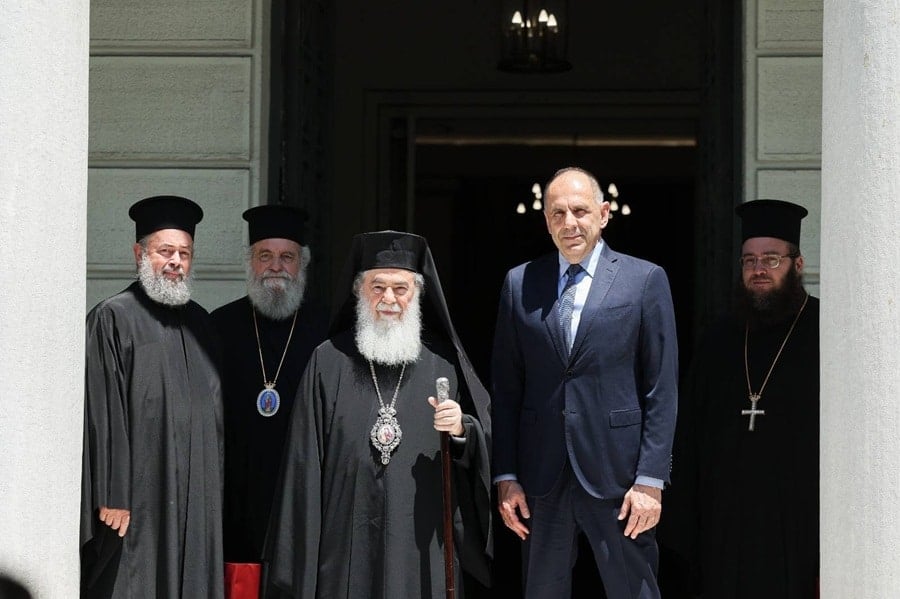
Greek FM Gerapetritis welcomes Patriarch Theophilos III in Athens. Credit: Greek Ministry of Foreign Affairs
Amid these backstage diplomatic maneuvers, Patriarch Theophilos III arrived in Athens for an official visit, where he met with Greek Foreign Minister George Gerapetritis. While the Greek Ministry of Foreign Affairs focused on regional stability, Gerapetritis reaffirmed Greece’s unwavering support for the Patriarchate and the protection of Christian populations in the volatile Middle East.
The meeting concluded with the signing of a Memorandum of Cooperation between the Greek Ministries of Foreign Affairs and Culture and the Patriarchate to preserve the Holy See’s cultural heritage. Gerapetritis also underscored the vital importance of maintaining the historical Status Quo of Jerusalem, emphasizing the unity required among the ancient Eastern Patriarchates during this highly complex geopolitical era.
Even the noblest of work cannot preserve meaning under the sun. This critique dismantles the modern mythology of progress. Progress assumes that accumulation equals significance, that advancement produces value simply by virtue of expansion. Yet Solomon exposes the internal contradiction of this assumption: progress operates within time, but time erodes what progress produces. Without a Divine reference... Continue Reading
We’ve lost a horse to a lightning strike once. A predator got another animal years ago. We’ve had grizzlies on this property, plenty of mountain lions, and a couple of years ago I watched a wolf lope across a field one winter afternoon. Those are the dangers you think about out here. I wasn’t watching... Continue Reading
The Bible only acknowledges separation of body and soul at one point in life: death. In the end every Babelish expression of bending technology to our will is to escape the awful reality of that ultimate separation. Yet that won’t stop us trying for new Babels as newer and more integrated bricks and mortar become... Continue Reading
We should be careful that we are not merely ‘whitewashed tombs’, that appear godly and righteous to the church, but have hearts full of pomposity and pride (Matt 23:27). Such hearts are ripe for judgmentalism, devoid of grace, and empty of true virtue; underneath my signals of holiness is the assumption that I consider myself... Continue Reading
We naturally tend to focus on the “Mount Moriah” moments of our faith—the dramatic crises, the agonizing tests, the miraculous, last-second rescues. But Genesis 22 reminds us that the God who intervenes in the earthquake and the fire is also the God who works in the quiet, mundane, invisible details of family trees and distant... Continue Reading
“The doctrine of justification by faith is one of the most majestic and comforting doctrines in the Scriptures, but it never appears alone in the life of the Christian. The work of progressive sanctification, a grace of equal beauty, always accompanies it.” Paul Washer The second half of Hebrews 12:14 says that “without holiness... Continue Reading
Too many American Christians have a bias against formal Bible translations, theological texts (such as old catechisms), and hymns. These were great crowning achievements of the Protestant world. Now they’re perceived as too stuffy and churchy, and we mock them or even imply that they send people to Hell, because people don’t find them “relatable”... Continue Reading
The tabernacle texts show the Lord is not only a king who is holy but also a king who desires to be with his people. This is the very reason he gives for the building of the tabernacle: “Let them make me a sanctuary, that I may dwell in their midst ” (Ex. 25:8). As noted... Continue Reading
God desires Christian fathers to be fair by taking the time to know, develop, and celebrate each child’s particular gifts, limitations, and personality. He desires us to demonstrate flexibility by listening carefully and then nurturing patiently while directing the child toward proper action. God wants us to be fathers who firmly correct by gently but... Continue Reading

 Login
Login