Meta says it has resolved an issue that allowed hackers to trick its AI assistant into granting access to other users' accounts, according to media reports.
Meta says it has resolved an issue that allowed hackers to trick its AI assistant into granting access to other users' accounts, according to media reports.
O futebol de seleções se consolidou como uma indústria multibilionária, e o valor de mercado dos elencos nacionais passou a refletir não apenas o desempenho esportivo, mas também a força econômica das principais potências do esporte.
O chamado “valor de plantel” representa a soma das avaliações individuais de todos os jogadores convocáveis de uma seleção. Levantamento elaborado com base em dados da Transfermarkt e da Sports Value aponta a Inglaterra como a seleção mais valiosa do mundo em 2026.
De acordo com o ranking, o elenco inglês está avaliado em aproximadamente € 1,62 bilhão, o equivalente a R$ 9,44 bilhões. A França aparece na segunda colocação, com valor estimado em R$ 8,57 bilhões, seguida pela Espanha, com R$ 7,64 bilhões.
A Alemanha ocupa o quarto lugar, com um plantel avaliado em R$ 5,89 bilhões, enquanto Portugal aparece logo atrás, com R$ 5,63 bilhões.
O Brasil surge na sexta posição entre as seleções mais valiosas da Copa do Mundo de 2026, com valor de mercado estimado em R$ 5,28 bilhões. O ranking é influenciado pela presença de atletas que atuam nos principais clubes da Europa e possuem elevado valor de transferência no mercado internacional.
Confira as 10 seleções mais valiosas da Copa do Mundo de 2026:
Inglaterra — R$ 9,44 bilhões
França — R$ 8,57 bilhões
Espanha — R$ 7,64 bilhões
Alemanha — R$ 5,89 bilhões
Portugal — R$ 5,63 bilhões
Brasil — R$ 5,28 bilhões
Holanda — R$ 4,45 bilhões
Argentina — R$ 4,44 bilhões
Bélgica — R$ 3,25 bilhões
Turquia — R$ 3,06 bilhões
O ranking evidencia a concentração de talentos nas principais ligas europeias e mostra como o mercado do futebol influencia diretamente a valorização das seleções nacionais às vésperas da Copa do Mundo de 2026.
AI Minister Evan Solomon said the government has signed onto Project Glasswing, which Anthropic launched to allow companies to use Mythos to test for security vulnerabilities.
AI Minister Evan Solomon said the government has signed onto Project Glasswing, which Anthropic launched to allow companies to use Mythos to test for security vulnerabilities.
by Tim Hinchcliffe | The Sociable The RAND Corporation wargames scenarios to see if AI could contribute to human extinction by facilitating nuclear war, creating and deploying pathogens, and malicious geoengineering. According to three simulations conducted in the new RAND report called “On the Extinction Risk from Artificial Intelligence,” AI is currently unlikely to wipe out humanity on its own; however, it could still cause considerable devastation if it were programmed to do so, if it were given enough access to critical systems, and if it were granted decisionmaking powers. “The capabilities of artificial intelligence (AI) have accelerated to the […]
by Kevin Hughes | Natural News The 2009 leak of emails from the Climatic Research Unit at the University of East Anglia revealed efforts by scientists to hide flaws, exclude skeptics and withhold data, raising serious questions about the transparency and credibility of the IPCC. The IPCC has been criticized for using non-peer-reviewed sources, such as environmental advocacy group newsletters, leading to retractions of claims about the Amazon rainforests, African crop harvests and Himalayan glaciers. The NIPCC report challenges the IPCC’s assertion that most warming since the mid-20th century is due to human greenhouse gas emissions, arguing that natural causes are […]
by Willow Tohi | Natural News The U.K. government is developing an AI-driven “homicide prediction” system that analyzes personal data — including ethnicity, mental health and past police interactions — to identify potential future murderers, drawing comparisons to sci-fi film “Minority Report.” The system aggregates sensitive personal data from crime victims, witnesses and non-convicted individuals, raising concerns about racial profiling, wrongful targeting and erosion of civil liberties. Advocacy groups warn it could criminalize vulnerable people preemptively. Experts compare the project to flawed U.S. predictive policing tools (e.g., NYPD’s CompStat), citing bias, inaccuracy and disproportionate harm to marginalized communities. Past attempts, like […]
by Tyler Durden | Zero Hedge Rogue climate activists in Northern California are launching balloons filled with sulfur dioxide into the upper atmosphere in an effort to manipulate the Earth’s temperature. In exchange, the climate startup behind the operation sells “cooling credits” priced at $30 for a subscription or $5 to offset 1 ton of carbon dioxide. The startup’s unregulated operations are causing a major stir and have drawn the attention of EPA Administrator Lee Zeldin. “Make Sunsets is a startup that is geoengineering by injecting sulfur dioxide into the sky and then selling “cooling credits.” This company is polluting the air […]
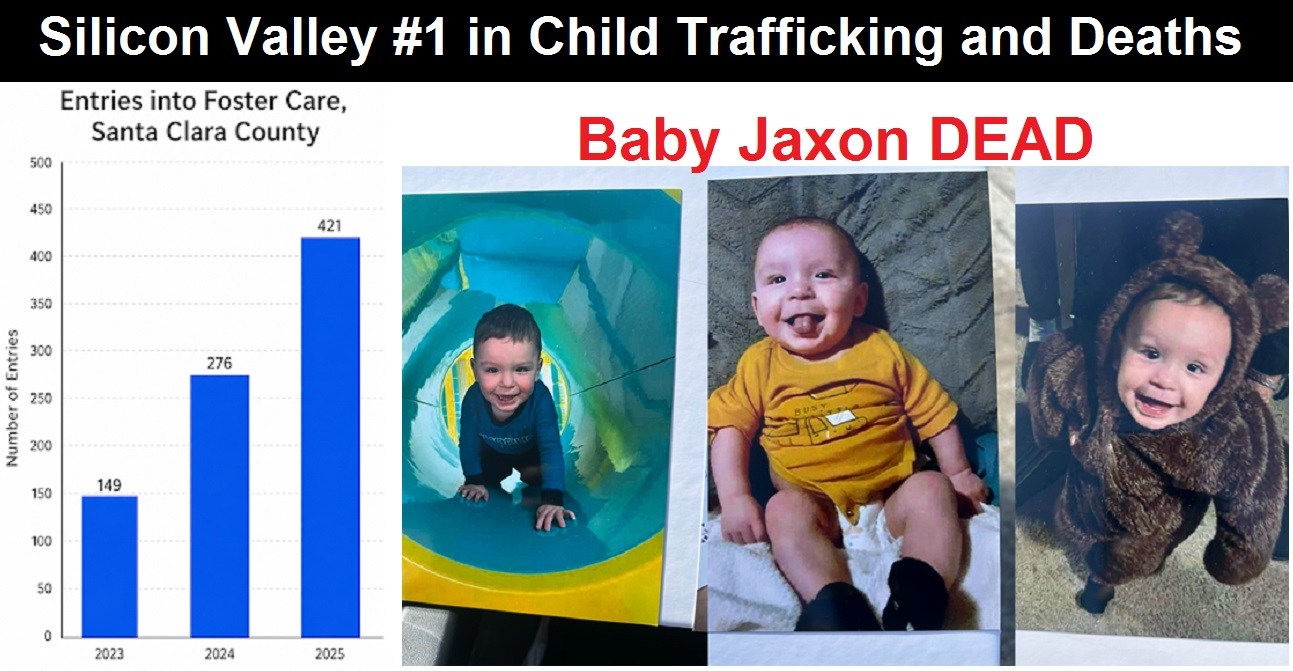
Richard Wexler, the Executive Director of the National Coalition for Child Protection Reform has recently reported that Santa Clara County, home to Silicon Valley in California, now leads the nation in ripping children out of their homes and putting them into their foster care system where children are now dying at a rate higher than anywhere else in the U.S.
As I have been reporting for over a decade now, the foster care system in the United States is the #1 pipeline for child sex trafficking. Most of the foster care system in the U.S. is run by Christians who partner together with the government and their churches in this very lucrative system of “legalized” child trafficking. See:
Multiple studies over the years have clearly shown that children who are left in their homes with their parents, even if they are “troubled homes” where drug abuse may be occurring, for example, have far better lives than being put into the evil foster care system.
Santa Clara County in Silicon Valley, home to billionaires and some of the richest people in the world, has an especially notorious reputation for trafficking and sexually abusing children, while protecting the pedophiles.
Here is a video testimony from Debra Grant, who had her children taken away from her and then given to her pedophile husband, where she explains how these people get away with trafficking children that was recorded 13 years ago. (Amazingly, this video is still up on YouTube. But if it disappears, we have a copy here.)
WARNING! GRAPHIC CONTENT!
Calculating the price of foster-care panic – in children’s lives and health
Researchers estimate that the foster-care panic in Santa Clara County will lead to anywhere from four to 12 foreseeable premature deaths, and a whole lot of serious illness, that would not have happened had the children been left in their own homes.
Their methodology can be applied to any foster-care panic anywhere, and to states that regularly tear apart families at rates far above the national average.
KEY POINTS
Researchers have examined scores of studies following millions of foster children around the world, showing the inherent harm of foster care placement. They were able to estimate the percentage of children who will have worse outcomes – including premature death – because they were taken from their families and placed in foster care. They were able to show that the harm to health and the premature deaths are directly attributable to the separation from their families, not anything their families supposedly did to the children beforehand.
Then they applied the findings to what is, proportionately, the nation’s worst foster-care panic, the one in Santa Clara County, Calif. In that county, over the past two years, entries into foster care over the course of a year nearly tripled. Over that time, 399 more children were torn from their families than would have been taken had there been no panic. They applied their findings about harm to health and premature death to those 399 children.
Their conclusion: 42 children will suffer long-term illness and/or disability that they would not have suffered had they remained in their own homes.
Between four and 12 children will suffer premature death that would not have happened had they remained in their own homes. The researchers emphasize that the death estimate is conservative.
Their report, sent to the Santa Clara County Board of Supervisors on Saturday, includes seven specific recommendations for making all vulnerable children in the county safer.
Among the most popular pages on NCCPR’s website is one that summarizes some of the mass of evidence comparing what happens to children in foster care when compared to comparably-maltreated children left in their own homes.
Over and over, the studies find that in typical cases, the foster children do worse.
How, then does this apply to Santa Clara County?
In the wake of two high-profile child abuse deaths, the Vice President of the County Board of Supervisors, Sylvia Arenas, and the San Jose Mercury News, in particular, reporter Julia Prodis Sulek, rushed to falsely scapegoat efforts to keep families together.
That set off what is, proportionately, the worst foster-care panic I’ve seen anywhere in America in at least 40 years.
Indeed, the panic may have made the latest tragedy more likely by overloading workers, so they have less time to investigate any case thoroughly. None of that has stopped Arenas or Sulek from continuing to throw gasoline on the fire.
Neither has the massive study of more than 3.4 million case records and more than 24,000 child abuse deaths which found that increasing entries into foster care does nothing to decrease such deaths.
What all this research tells us is that increasing foster care does nothing to save lives, but can, in itself, lead to premature deaths.
Landowner Carlos Roberto Simonetti gets three harvests per year from the corn, soy and cotton plantations on his 17,000-hectare (about 42,000 acres) farm called Fazenda Natureza Feliz, or Happy Nature, in the Brazilian state of Mato Grosso. Over the course of four years, he would also get what he calls a fourth harvest, this time from the forested areas of his property, located where the Cerrado savanna meets the Amazon Rainforest. That’s because Simonetti would receive regular payments for protecting native vegetation beyond what the law requires, as part of a pilot project for payment for ecosystem services (PES) run by the Amazon Environmental Research Institute (IPAM), an NGO, in the states of Mato Grosso and Pará. The program, called CONSERV, gives landowners financial incentives to keep the forest standing even in areas which they are legally allowed to clear. The pilot project, which initially ran between 2020 and 2024 on 23 different properties, protected 20,707 hectares (about 51,170 acres) of land in the Cerrado and Amazon biomes with funding from the governments of Norway and The Netherlands. Ongoing contracts funded by Soft Commodities Forum members – agribusiness companies committed to preserving the Cerrado – are protecting a further 7,000 hectares (about 17,300 acres) in the states of Mato Grosso and Maranhão. IPAM is now seeking to scale up the program without relying on donations. The risk of legal deforestation The idea for CONSERV goes back to 2016, when an internal IPAM report calculated that around 1.5 million hectares (3.7…This article was originally published on Mongabay
CONCEPCIÓN DE SOLUTECA, Honduras — In the 1970s, the Honduran government granted a piece of land in the mountains of Concepción de Soluteca to Roberto González’s parents. They duly grabbed a chainsaw and a machete to clear the forest. On the 12 hectares (30 acres) they received as part of a land reform, they planted corn, beans and bananas, the basic staple foods. It was a hard life up in the mountains, allowing the farmers and their families to just survive. There wasn’t much public infrastructure, and most children had to help with farmwork early on. This included González, who only attended elementary school for three years. When González inherited the land 20 years later, coffee cultivation was just taking off. Middlemen promised the farmers good money for the export crop, and the banks provided loans for cultivation. At first, this worked well, González, now 39, remembers. Coffee helped the farmers to generate income and improve living conditions. But it didn’t last long. They grew coffee much the same way they did other crops, without adequate soil or shade management. When harvests dwindled, they expanded their area, cutting the last standing forests and damaging water sources. Around 2012, they faced an outbreak of coffee rust, a fungal disease. It was a complete disaster: many farmers were thrown into poverty and forced to migrate. “We destroyed the foundations of our livelihoods, but it was out of ignorance; we just didn’t know better,” González tells Mongabay. Under the EUDR, coffee farmers step…This article was originally published on Mongabay
Deep below the ocean surface, at roughly the depth of 130 five-story buildings stacked end to end, a robot has unfurled a protest sign that reads: “LISTEN TO THE SCIENCE!” A Greenpeace remotely operated vehicle (ROV) holds the banner more than 2,300 meters (7,500 feet) below the surface of the Norwegian Sea, in front of a hydrothermal vent field known as Loki’s Castle. “This marks the deepest banner protest in history, to speak for ecosystems that have no voice of their own,” Sandra Schöttner, chief scientist for the Deep Arctic Expedition, Greenpeace International, said in a press release. The protest, carried out on May 27 during Greenpeace’s Deep Arctic Expedition, targeted an area of the Arctic seabed that the Norwegian government opened to deep-sea mining in early 2024 before reversing course under political pressure. Loki’s Castle was discovered in 2008 in the Arctic Ocean between Greenland and Norway. Here in the depths, hot fluid, between 300 and 320 degrees Celsius (572 and 608 degrees Fahrenheit), pours from mineral chimneys on the seafloor. These vents support a rich and unusual community of life, including microbes that resemble the distant ancestors of complex life on Earth. A 2024 study in Scientific Reports documented the animals living around the vents, including five new-to-science species. The authors suggested areas like this along the Arctic Mid-Ocean Ridge should be treated as “vulnerable ecosystems” and protected. In January 2024, the government of Norway opened roughly 281,000 square kilometers (108,000 square miles) of Arctic waters (an area…This article was originally published on Mongabay
Bringing a beloved video game franchise back from the dead is always a risky move. Fans carry years—sometimes decades—of expectations, and even small missteps can feel magnified when compared to the original titles. Developers often promise to recapture what made these series special, but that balance between nostalgia and innovation is notoriously difficult to achieve. […]
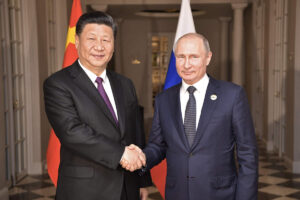
Xi Jiping et Vladimir Poutine en 2018 (Kremlin.ru, CC BY 4.0 , via Wikimedia Commons), via Wikimedia Commons)
Xi Jiping et Vladimir Poutine en 2018 (Kremlin.ru, CC BY 4.0
One week after Donald Trump, Vladimir Putin is traveling to China for a 48-hour official visit aimed at strengthening the comprehensive partnership and strategic cooperation between Russia and China.
A Diplomatic Trip Rich in Geopolitical Symbolism
Putin’s visit to China, expected on Tuesday, May 19, is part of a carefully planned diplomatic strategy. The timing is no coincidence: it coincides with the 25th anniversary of the signing of the Treaty of Good-Neighborliness and Friendly Cooperation, a landmark agreement signed by the two countries in 2001.
This treaty holds major significance in Sino-Russian relations, as it marked the end of decades of mutual mistrust, border disputes, and geopolitical rivalries that characterized the Soviet era.
The timing of the visit is particularly revealing of current international dynamics. By arriving in China one week after Trump’s departure from Beijing, Putin creates a symbolic succession that deserves close analysis. This diplomatic “passing of the baton” among the world’s three major powers offers a valuable lens through which to observe today’s balance of power and each country’s positioning strategy.
Strengthening the Comprehensive Strategic Partnership Amid Global Turbulence
The official purpose of the visit is clear: to reinforce the comprehensive partnership and strategic cooperation between Russia and China.
Beyond formal statements, however, the trip carries deeper significance for both governments. Moscow is seeking to consolidate its ties with Beijing at a time when the international environment has become highly volatile.
Dmitry Peskov, spokesperson for the Russian presidency, said on Friday that the trip would be “a good opportunity to exchange views on the contacts the Chinese have had with the Americans.”
This statement clearly shows that trilateral diplomacy lies at the heart of the visit. Russia wants to understand how China is negotiating with the United States and ensure that Russian interests are not sidelined in Sino-American discussions.
An “Eternal Friendship” Tested by Geopolitical Realities
The concept of an “eternal friendship” between Russia and China, frequently reaffirmed by both powers, is a central element of their diplomatic rhetoric.
However, this visit demonstrates that both countries are actively seeking to prove the strength of their ties in the face of current global upheavals. The phrase itself is revealing: it implicitly acknowledges that the international order is going through a period of major instability.
For Xi Jinping, the meeting with Putin offers a valuable opportunity to present himself as a world leader committed to geopolitical balance and harmony.
By hosting Trump and Putin in succession, the Chinese leader positions himself as a potential mediator in global conflicts and as a guardian of international stability. This posture significantly enhances China’s prestige and influence on the world stage.
The Dynamics of a Three-Way Geopolitical Rivalry
The triangular relationship among the United States, Russia, and China now shapes global geopolitics as a whole.
Every bilateral meeting between two of these powers is closely watched by the third as an indicator of emerging alliances and growing fractures. Putin’s trip to China must therefore be understood within this three-dimensional strategic framework.
Russia, while a major regional power, remains economically secondary compared with China. As a result, Moscow must continually reaffirm the importance of its partnership with Beijing.
This relative asymmetry helps explain why Russia places such importance on diplomatic rituals and public displays of strategic friendship. Maintaining strong ties despite structural imbalances is essential to preserving international equilibrium.
Toward a New Global Geopolitical Architecture
This visit takes place during a period of profound transformation in the international order.
China’s rise, Russia’s return as a disruptive power, and shifts in American foreign policy have created an environment in which old certainties no longer apply.
Diplomatic exchanges between Beijing and Moscow are therefore strategically crucial to maintaining stability in international relations.
The strengthening of the Sino-Russian partnership is not necessarily intended to form an alliance against the United States. Rather, it aims to establish a balance of power capable of withstanding external pressures and attempts at hegemony.
In this context, strategic cooperation between Russia and China has become an essential stabilizing factor in contemporary global geopolitics.
Putin has arrived in Beijing and received the same “warm welcome” package as Trump: a red carpet, the PLA Tri-Service Honor Guard, and the jumping children…
Xi Jinping can be heard saying “hello” (“你好,” nǐ hǎo) to Putin.
Taiwanese politician Cheng Li-wun, who is notably tall, can be heard approaching with the click of her heels and long strides down the corridor of the headquarters of the Kuomintang (KMT), the main opposition party in Taiwan. In April, during a visit to Beijing, she looked the Chinese president, Xi Jinping, in the eye. In the photograph that captured their meeting in the Great Hall of the People they are not smiling; neither do they appear distant. Their expressions are neutral, perhaps waiting to see how the coming years unfold.
 Login
Login





 by Tim Hinchcliffe | The Sociable The RAND Corporation wargames scenarios to see if AI could contribute to human extinction by facilitating nuclear war, creating and deploying pathogens, and malicious geoengineering. According to three simulations conducted in the new RAND report called “On the Extinction Risk from Artificial Intelligence,” AI is currently unlikely to wipe out humanity on its own; however, it could still cause considerable devastation if it were programmed to do so, if it were given enough access to critical systems, and if it were granted decisionmaking powers. “The capabilities of artificial intelligence (AI) have accelerated to the […]
  by Kevin Hughes | Natural News The 2009 leak of emails from the Climatic Research Unit at the University of East Anglia revealed efforts by scientists to hide flaws, exclude skeptics and withhold data, raising serious questions about the transparency and credibility of the IPCC. The IPCC has been criticized for using non-peer-reviewed sources, such as environmental advocacy group newsletters, leading to retractions of claims about the Amazon rainforests, African crop harvests and Himalayan glaciers. The NIPCC report challenges the IPCC’s assertion that most warming since the mid-20th century is due to human greenhouse gas emissions, arguing that natural causes are […]
  by Willow Tohi | Natural News The U.K. government is developing an AI-driven “homicide prediction” system that analyzes personal data — including ethnicity, mental health and past police interactions — to identify potential future murderers, drawing comparisons to sci-fi film “Minority Report.” The system aggregates sensitive personal data from crime victims, witnesses and non-convicted individuals, raising concerns about racial profiling, wrongful targeting and erosion of civil liberties. Advocacy groups warn it could criminalize vulnerable people preemptively. Experts compare the project to flawed U.S. predictive policing tools (e.g., NYPD’s CompStat), citing bias, inaccuracy and disproportionate harm to marginalized communities. Past attempts, like […]
  by Tyler Durden | Zero Hedge Rogue climate activists in Northern California are launching balloons filled with sulfur dioxide into the upper atmosphere in an effort to manipulate the Earth’s temperature. In exchange, the climate startup behind the operation sells “cooling credits” priced at $30 for a subscription or $5 to offset 1 ton of carbon dioxide. The startup’s unregulated operations are causing a major stir and have drawn the attention of EPA Administrator Lee Zeldin. “Make Sunsets is a startup that is geoengineering by injecting sulfur dioxide into the sky and then selling “cooling credits.” This company is polluting the air […]
















Putin has arrived in Beijing and received the same “warm welcome” package as Trump: a red carpet, the PLA Tri-Service Honor Guard, and the jumping children…