Reading view

Antyllus: The Ancient Greek Surgeon Whose Methods Lasted Until the 19th Century

Relief sculpture depicting Asclepius treating a reclining patient in ancient Greek style.
Antyllus pioneered vascular surgery, and his aneurysm procedure remained a standard for over a millennium. Credit: Wikimedia Commons, Public Domain

Αntyllus, one of antiquity’s most skilled and innovative surgeons, was an ancient Greek physician active in Rome around 150 AD. Though influenced by earlier Greek medical traditions, he broke from the conservative models of physicians such as Hippocrates and Galen and introduced practical surgical procedures, especially for vascular conditions. These shaped medicine for centuries.

Beyond aneurysms: A versatile surgeon

Antyllus is best known for designing the first effective surgical treatment for aneurysms. While earlier physicians feared vascular surgery, Antyllus embraced it with precision.
He classified aneurysms into traumatic and spontaneous types. His method involved tying off the artery both above and below the swollen vessel. Then, he excised the aneurysmal sac.

This direct approach represented a major advancement. It became the standard procedure for aneurysm treatment and remained in use until the 19th century. Unlike Galen, who emphasized theory, Antyllus prioritized anatomical understanding through practice. He accepted surgical risks others avoided, setting the foundation for vascular surgery.

Antyllus’s contributions extended beyond arteries. He developed surgical techniques for the abdomen, eyes, bones, joints, and breasts. He was also a pioneer in plastic surgery.
His reconstructive operations addressed eyelids, ears, noses, and cheeks. In trauma cases or for cosmetic repair, no one could match his precision.

To control bleeding during operations, Antyllus used cauterization. He also performed early tracheotomies, a high-risk but potentially life-saving procedure.

Oribasius, a later Greek physician, reported that Αntyllus wouldn’t operate on exceptionally large aneurysms due to high risk. For more manageable aneurysms in the limbs and head, Antyllus applied ligatures to the arteries entering and leaving the aneurysm. He then incised the sac, evacuated its contents, and packed the cavity.

Legacy and transmission of Antyllus’ aneurysm technique

Most importantly, Antyllus did not resect the aneurysm sac. He warned against excising the dilated section between ligatures, stating:

“Those who tie the artery, as I advise, at each extremity, but amputate the intervening dilated part, perform a dangerous operation. The violent tension of the arterial pneuma often displaces the ligatures.”

Oribasius also preserved one of the earliest known classifications of aneurysms into true and false types. Specifically, he said:

“There are two types of aneurysms: the first is due to dilatation of the arteries and the second is caused by rupture of the artery emptying blood into the tissues. When an aneurysm is due to dilatation, the form is cylindrical, while the one caused by injury is round.”

Aetius of Amida was a 7th century physician. In his work “On the Dilatation of the Vessels,” he described in detail a surgery likely based on Antyllus’ method:

“An aneurysm located in the bend of the elbow is treated thus. First we carefully trace the artery leading to it, from armpit to elbow, along the inside of the upper arm. Then we make an incision on the inside of the arm, three or four finger-breadths below the armpit, where the artery is felt most easily. We gradually expose the blood vessel and, when it can be lifted free with a hook, we tie it off with two firm ligatures and divide it between them. We fill the wound with incense and lint dressing, then apply a bandage. Next we open the aneurysm itself and no longer need fear bleeding. We remove the blood clots present, and seek the artery which brought the blood. Once found, it is lifted free with the hook, and tied as before.”

Medicine in Ancient Greece and Egypt
Physician treating a patient, depicted on Attic red-figure Aryballos Credit: Marie-Lan Nguyen Wikimedia Commons CC BY 3.0

Preventative medicine and physical health

Antyllus believed health required daily effort and discipline. He championed preventative medicine alongside surgical skill. For instance, he prescribed exercise regimens that included structured vocal routines. One of his most distinctive practices was vociferation, a method of controlled, loud vocalizing.

He recommended reciting memorized poetry at various volumes while walking and believed deep tones helped expand the trachea and chest, strengthening respiratory health. This practice combined breath control, posture, and movement in a holistic approach to physical well-being.

Before such vocal workouts, Antyllus suggested preparation consisting of massage, bowel evacuation, and a cold sponge bath. These details reflected his methodical attention to physiology.

While Hippocrates emphasized prognosis and symptom observation, he likely saw aneurysms but avoided surgical intervention. Moreover, Galen offered greater anatomical theory, drawn from animal dissection but still steered clear of artery operations.

Antyllus surpassed both in operative practice. Whereas Hippocrates and Galen used caution, Antyllus applied bold innovation grounded in anatomy. His hands-on techniques proved enduring. Byzantine and Islamic medical texts preserved his methods, which reached medieval Europe through translation.

The Greek physician Galen, who was influential in Western medicine
Galen, the pioneering Greek physician who influenced Western medicine through the 1700s. Portrait by Pierre-Roch Vigneron. Credit: Wikimedia Commons Public Domain

Legacy of a Forgotten Surgeon

Despite the historical focus on Hippocrates and Galen, Αntyllus, the Greek physician, remains a towering figure in the evolution of medicine, uniting theory with surgical practice. His aneurysm procedure became standard practice for over 1,500 years. Antyllus developed detailed and replicable techniques in plastic and general surgery.


Αntyllus’s advocacy for preventative care—including vocal and physical training—also marks him as an early holistic health thinker. To say the least, he deserves recognition as the first true vascular surgeon of antiquity, as his skill, anatomical knowledge, and forward-thinking philosophy left a lasting imprint on medical history.

@theculturemuse

Check out this #rare #ancient #roman #surgical kit in the #neuesmuseum #berlin #medicine #healing #surgery #asclepius #history #storytime #foryoupage❤❤ #fyp

♬ original sound – The Culture Muse

  •  

Eratosthenes: The Ancient Greek Who Measured the Earth More Than 2,000 Years Ago

earth eratosthenes circumference
The shuttle “Discovery” orbiting the Earth. Ancient Greek mathematician, Eratosthenes, measured the circumference of the Earth in antiquity. Credit: Public Domain

Ancient Greeks made some of the most impressive astronomical discoveries in history, including Eratosthenes’ calculation of the circumference of the Earth.

It wasn’t until the mid-20th century that we managed to launch satellites into space and determine the exact kilometers of the circumference of the Earth: 40,030.2 kilometers.

But how, then, could the ancient Greek mathematician, Eratosthenes, manage to find pretty much the exact same number without having any pictures of Earth from space or even proper measuring tools?

Amazingly, Eratosthenes didn’t have much more than a stick and his brain when he made the amazing discovery.

How Eratosthenes discovered the circumference of the Earth

Born in Cyrene, an ancient Greek colony in modern-day Libya in 276 BC, Eratosthenes was a polymath, meaning that he had vast knowledge of many different subjects, including mathematics, astronomy, music theory, and poetry.

Over two thousand years ago, Eratosthenes heard that in Syene, a town south of Alexandria in Egypt, no vertical shadows were cast at noon on the summer solstice, as the sun was directly overhead.

The Greek mathematician wondered if this was the case in Alexandria, too, a few hundreds of miles to the north of Syene.

He decided to conduct an experiment. On June 21st, he went to Alexandria and put a stick directly in the ground and waited to see if a shadow would be cast at noon.

It turns out there was one, and he tried to measure it. The shadow cast measured to about seven degrees.

After conducting the experiment, Eratosthenes came to a very logical conclusion that if the sun’s rays are coming in at the same angle at the same time of day and a stick in Alexandria casts a shadow of seven degrees while the stick in Syene does not cast a shadow at all, it must mean that the Earth’s surface is curved.

Carl Sagan, the American astronomer, author, and science communicator was renowned for making difficult scientific concepts understandable to the millions; he did exactly this at the beginning of his renowned series Cosmos by explaining the thought process of Eratosthenes.

His calculation

The idea of a spherical Earth was already known by Pythagoras around 500 BC and validated by Aristotle a few centuries later.

If the Ancient Greeks before him were right, and the Earth was a sphere, Eratosthenes could use his observations to calculate the circumference of our planet.

After hiring a man to pace the distance between Syene and Alexandria, he found out that the two cities were five thousand stadia apart, which is about eight hundred kilometers.

He could then use simple proportions to find the Earth’s circumference—7.2 degrees is 1/50 of 360 degrees, so 800 times 50 equals 40,000 kilometers.

And just like that, an ancient Greek calculated precisely the circumference of our entire planet with just a stick and his brain over two thousand years ago.

Eratosthenes accomplished many feats throughout his life, including the creation of a chronology of Greek history, an algorithm to find every prime number, and the first global projection of the Earth.

  •  

Eratosthenes: The Ancient Greek Who Measured the Earth More Than 2,000 Years Ago

earth eratosthenes circumference
The shuttle “Discovery” orbiting the Earth. Ancient Greek mathematician, Eratosthenes, measured the circumference of the Earth in antiquity. Credit: Public Domain

Ancient Greeks made some of the most impressive astronomical discoveries in history, including Eratosthenes’ calculation of the circumference of the Earth.

It wasn’t until the mid-20th century that we managed to launch satellites into space and determine the exact kilometers of the circumference of the Earth: 40,030.2 kilometers.

But how, then, could the ancient Greek mathematician, Eratosthenes, manage to find pretty much the exact same number without having any pictures of Earth from space or even proper measuring tools?

Amazingly, Eratosthenes didn’t have much more than a stick and his brain when he made the amazing discovery.

How Eratosthenes discovered the circumference of the Earth

Born in Cyrene, an ancient Greek colony in modern-day Libya in 276 BC, Eratosthenes was a polymath, meaning that he had vast knowledge of many different subjects, including mathematics, astronomy, music theory, and poetry.

Over two thousand years ago, Eratosthenes heard that in Syene, a town south of Alexandria in Egypt, no vertical shadows were cast at noon on the summer solstice, as the sun was directly overhead.

The Greek mathematician wondered if this was the case in Alexandria, too, a few hundreds of miles to the north of Syene.

He decided to conduct an experiment. On June 21st, he went to Alexandria and put a stick directly in the ground and waited to see if a shadow would be cast at noon.

It turns out there was one, and he tried to measure it. The shadow cast measured to about seven degrees.

After conducting the experiment, Eratosthenes came to a very logical conclusion that if the sun’s rays are coming in at the same angle at the same time of day and a stick in Alexandria casts a shadow of seven degrees while the stick in Syene does not cast a shadow at all, it must mean that the Earth’s surface is curved.

Carl Sagan, the American astronomer, author, and science communicator was renowned for making difficult scientific concepts understandable to the millions; he did exactly this at the beginning of his renowned series Cosmos by explaining the thought process of Eratosthenes.

His calculation

The idea of a spherical Earth was already known by Pythagoras around 500 BC and validated by Aristotle a few centuries later.

If the Ancient Greeks before him were right, and the Earth was a sphere, Eratosthenes could use his observations to calculate the circumference of our planet.

After hiring a man to pace the distance between Syene and Alexandria, he found out that the two cities were five thousand stadia apart, which is about eight hundred kilometers.

He could then use simple proportions to find the Earth’s circumference—7.2 degrees is 1/50 of 360 degrees, so 800 times 50 equals 40,000 kilometers.

And just like that, an ancient Greek calculated precisely the circumference of our entire planet with just a stick and his brain over two thousand years ago.

Eratosthenes accomplished many feats throughout his life, including the creation of a chronology of Greek history, an algorithm to find every prime number, and the first global projection of the Earth.

  •  

The Lost Plant Ancient Greeks Used for Medicine, Food and Contraception

silphium
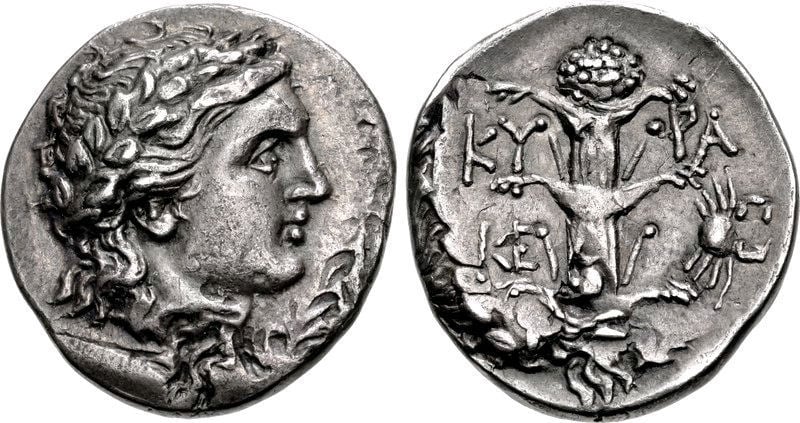
A plant used by the ancient Greeks for medicine, food and even contraception was one of the most sought-after goods in the ancient world. Credit: Classical Numismatic Group/Wikimedia Commons/CC BY-SA 3.0

An ancient Greek plant, now extinct, called Silphium, was used by the ancient Greeks and Romans for perfume, seasoning, medicine, and even contraception. It was one of the most sought-after goods in the ancient world.

The plant was so useful that Julius Caesar himself was said to have a large stash of silphium on hand at all times.

Silphium only grew in a narrow strip of land near the North African city of Cyrene in modern-day Libya and was essential to the city’s economy. The cultivation and trade of the plant transformed Cyrene into the richest region of Africa at the time.

Its widespread use in the ancient world allowed Cyrene’s economy to flourish, which in turn transformed the city into a center of art, culture, and medicine in the ancient Greek world.

In fact, it was home to a famous medical school and even a philosophical movement based around happiness whose members were called the Cyrenaics. Eratosthenes, the famous Greek mathematician, was a native of the city.

Although now extinct, researchers have determined, through studying ancient drawings and descriptions of the plant’s taste and appearance, that silphium likely belonged to the genus Ferula, which includes existing plants like giant fennel and asafoetida.

This theory is bolstered by the fact that asafoetida, which is still widely used today in Indian and central Asian cooking, was used as a cheaper substitute for silphium in antiquity, meaning that it was either related to the plant or had a very similar flavor.

The extinct plant silphium had many uses for ancient Greeks

Plants of the genus tend to resemble ancient depictions of the plant, which was widely found on coins from Cyrene due to its economic importance to the city.

It seems to have been a tall, flowering plant with a heart-shaped seedpod on the top. In fact, some theories about the origins of the modern symbol for love point to the shape of silphium’s seedpod, as the plant was widely used as an aphrodisiac.

Silphium was long used throughout the ancient Mediterranean. Both the Minoans and ancient Egyptians had specific glyphs to represent the plant, and it was widely lauded in songs and poems across ancient cultures.

According to myth, silphium came from the god Apollo himself. It had a wide variety of medicinal properties and was used to treat cough, pain, warts, fever, and indigestion. Although considered an aphrodisiac, it was also used as a contraception and even as an abortifacient.

The father of medicine Hippocrates himself even prescribed the plant for a protruding gut.

Silphium was likewise found in Greek and Roman cuisine and featured prominently in recipes by Apicius, who compiled one of the most well-preserved collections of ancient recipes in existence today.

Its earthy scent and medicinal properties also made it an important ingredient in perfume, as well as in ancient lotions and creams.

Why did silphium go extinct?

Due to its varied uses, silphium was in very high demand. Yet, by the time of the Roman emperor Nero, who lived from 37 to 68 AD, the plant was virtually extinct. According to Pliny, when the last remaining silphium plant was found, it was given to Nero.

Scholars theorize the plant was over-harvested and over-farmed due to its popularity, causing the soil in the limited area where the plant grew to become devoid of nutrients.

Additionally, shepherds used to feed silphium to their flocks, as the plant would transform the meat, making it tender and delicious. Scholars theorize that overgrazing of the plant likely contributed to its demise.

Others claim that regional climatic changes, which caused once green fields to turn into an arid desert, resulted in the plant’s extinction.

Ancient writers, such as Theophrastus, noted that silphium was very sensitive to changes in soil and therefore could not be cultivated in large  numbers nor in areas outside of Cyrene.

  •  

How the Ancient Greeks Founded Naples in Italy

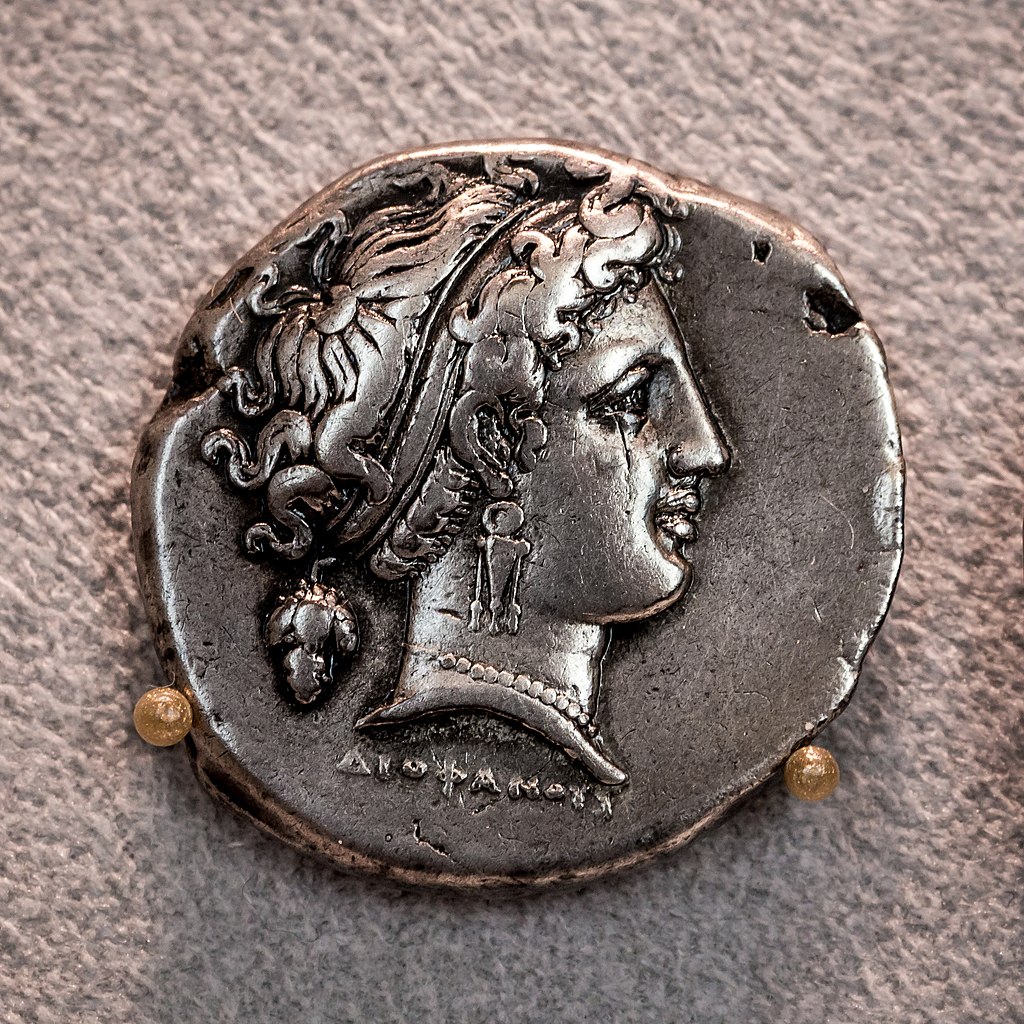
Ancient coin from Naples depicting head of Parthenope, mythical siren
Ancient Greek coin from Naples depicting the head of Parthenope, mythical siren whose body marked the future site of the city, fourth century BCE. Credit: Wikipedia Commons, cc-by-sa 4.0

The Greeks have a long and fascinating history in some of the most famous cities of Italy. One example is Naples, which is Italy’s third-largest city. The ancient Greeks founded this city well over 2000 years ago, and their influence is still felt there even today. But how did the ancient Greeks end up founding this city all the way over in Italy? We can learn the answer through ancient historical records as well as from archaeology.

The Legend of the Ancient Greeks Founding Naples

The legend of how the ancient Greeks founded Naples starts with the legend of Jason and the Argonauts. The poem Alexandra, which may have been written in c. 200 BC, records a tradition concerning Naples. It refers to a certain ‘tower of Phalerus’ already existing there in the time of Odysseus. Since Odysseus lived at the time of the Trojan War, this ‘tower’ must be named after a Phalerus who lived before then.

There is only one Phalerus who this could be – the Phalerus who accompanied Jason on his voyage to find the Golden Fleece. Other ancient sources describes this Phalerus as the founder of Gyrton in Thessaly, Phalerum in Athens, and a temple in Cyprus. Therefore, Greek legend clearly associates this Phalerus with the founding of cities. This adds even more support to the conclusion that he was the Phalerus who founded some kind of ‘tower’ in Naples before the time of Odysseus.

Therefore, the reference in Alexandra indicates that Phalerus, an Argonaut, led the ancient Greeks to establish the earliest settlement at Naples.

The Legend of the Foundation of Parthenope

The story of the ancient Greeks founding Naples also involves the legend of Odysseus. On his famous journey home from Troy after the Trojan War, he passed a group of sirens. They tried to use their enchanting singing to get Odysseus and his men to walk overboard and drown. However, Odysseus blocked his men’s ears with wax and then tied himself to his ship’s mast, thus keeping them all safe.

After defeating the sirens, one in particular, named Parthenope, threw herself into the sea in despair at her failure. She drowned, and the waves washed her body ashore at the tower of Phalerus. That location was then named Parthenope in her honor, with a city being built on the site of her grave.

This was not in exactly the same place as the later city of Naples, but it was very nearby, and it is within modern Naples. Parthenope was essentially the precursor to Naples. The two have always been so closely associated that the word ‘Parthenopean’ is a synonym of ‘Neapolitan’ even today.

What Archaeology Reveals About the Ancient Greek Foundation of Naples

Those are the legends, but how well do they match the archaeological facts? Firstly, let us consider the very earliest settlement, supposedly founded by Phalerus, one of the Argonauts. The legend about this location does not reveal where exactly in Naples the ancient Greeks supposedly established it. Nonetheless, in Naples in general, archaeology indicates that the ancient Greeks first settled there in the eighth century BC.

Whether this is actually related to the legend of Phalerus the Argonaut establishing a settlement there or not is up for debate. The archaeological evidence comes from centuries after the traditional era of the Argonauts. Nonetheless, it is possible that they lived later than usually believed.

What about the settlement of Parthenope? Archaeologists have found a Greek necropolis, or cemetery, dating to the early seventh century BC and associated with the hill of Pizzofalcone. This is further evidence that the ancient Greeks were starting settle the area of Naples at that period in history.

How the Ancient Greeks Transformed Parthenope into Naples

This settlement developed into a bustling city over the years. It became a prominent military and trading port. However, its success became its downfall. Cumae, the city from which the settlers of Parthenope primarily came, became jealous of their colony’s success. They did not want it to cause the original city, Cumae, to become abandoned. Therefore, they allegedly decided to destroy Parthenope.

There is little, if any, archaeological evidence for destruction at Parthenope dating to this time. However, whatever really happened, the evidence is clear that another settlement was then established in the Naples area, again by the ancient Greeks of Cumae. They called this city Neapolis, meaning ‘New City’. This eventually evolved into ‘Naples’, the English name for that city today.

The old settlement of Parthenope then started going by the name ‘Palaeopolis’, meaning ‘Old City’. However, it did not disappear completely. It became absorbed into the new settlement, becoming part of Naples.

  •  

The Neighboring Cultures of the Ancient Greeks

Scythian rider
A gold plaque depicting a Scythian on horseback. Credit: Public Domain / Wikimedia Commons

The ancient Greeks, renowned for their cultural and intellectual achievements, interacted with numerous neighboring cultures that influenced and enriched their own civilization. Understanding these lesser-known cultures provides valuable insights into the complex web of interactions that shaped the ancient world, making this topic still relevant today.

As one of the most popularly studied civilizations of antiquity, the ancient Greeks tend to overshadow many of the neighboring cultures they interacted with.

However, the Greeks shared the ancient world with a myriad of other interesting cultures and civilizations, some of which are severely underappreciated in mainstream historical discourse.

In this article, we’ll be skipping over the other “heavyweights” of the ancient world, such as the Romans, Egyptians, Persians, and Phoenicians to focus on some of the lesser-known cultures the Greeks were familiar with to various extents.

What did the ancient Greeks think of neighboring cultures?

The term “barbarian” likely finds its roots in the Sumerian word “barbar,” which meant “foreigner.” In Greek, it served as both a loan word and an onomatopoeic representation, mimicking the unintelligible babbling sounds that the Greeks associated with foreigners speaking their languages.

Originally, “barbaroi” served as a neutral, collective name for all non-Greeks, without inherently negative connotations. However, over time, the term acquired a negative meaning, reflecting the prevailing Greek perception of non-Greeks as uncivilized or inferior.

As noted by the academic Stavros Moutsios,  “This political designation of the barbarians, however, did not entail lack of acknowledgment nor of admiration of their achievements.” Indeed, the ancient Greeks often displayed a great deal of curiosity toward neighboring cultures and civilizations.

A good example of this was the practice of religious syncretism, whereby the Greeks would merge the gods of their pantheon with similar foreign deities. For example, the Graeco-Egyptian god Serapis possessed a combination of the Egyptian deities Osiris and Apis with the Greek deities Hades and Demeter.

Naturally, the perceptions of the Greeks toward other cultures varied a great deal. Often, our modern preconceptions of ancient peoples are shaped by the surviving literary sources written by ancient Greek authors about neighboring peoples who were themselves not literate.

The Scythians

The Scythians were one of the most enigmatic peoples of antiquity, famous for their mastery over horses. To call the Scythians “neighbors” of the ancient Greeks is somewhat of a misnomer since the Scythians were nomads and had no fixed borders, but the Greeks had fairly frequent contact with them through trade and war.

The Scythians were an Eastern Ianic people who inhabited the region north of the Black Sea, in present-day Ukraine, southern Russia, Kazakhstan, and parts of Central Asia, from around the 9th century BC to the 4th century AD.

Our main source on the perceptions of the ancient Greeks regarding the Scythians is the accounts of the historian Herodotus of Halicarnassus and later Greek writers. Incidentally, Herodotus, the”Father of History”, is also our main literary source on the Scythians generally.

According to Herodotus, the arrival of the Scythians led to conflict among the Cimmerians, with the royal tribe wanting to defend their lands and the rest of the population seeking to flee. Another account stated that the Scythians chased the Cimmerians out of their territory, forcing them to migrate south into West Asia.

Scythian
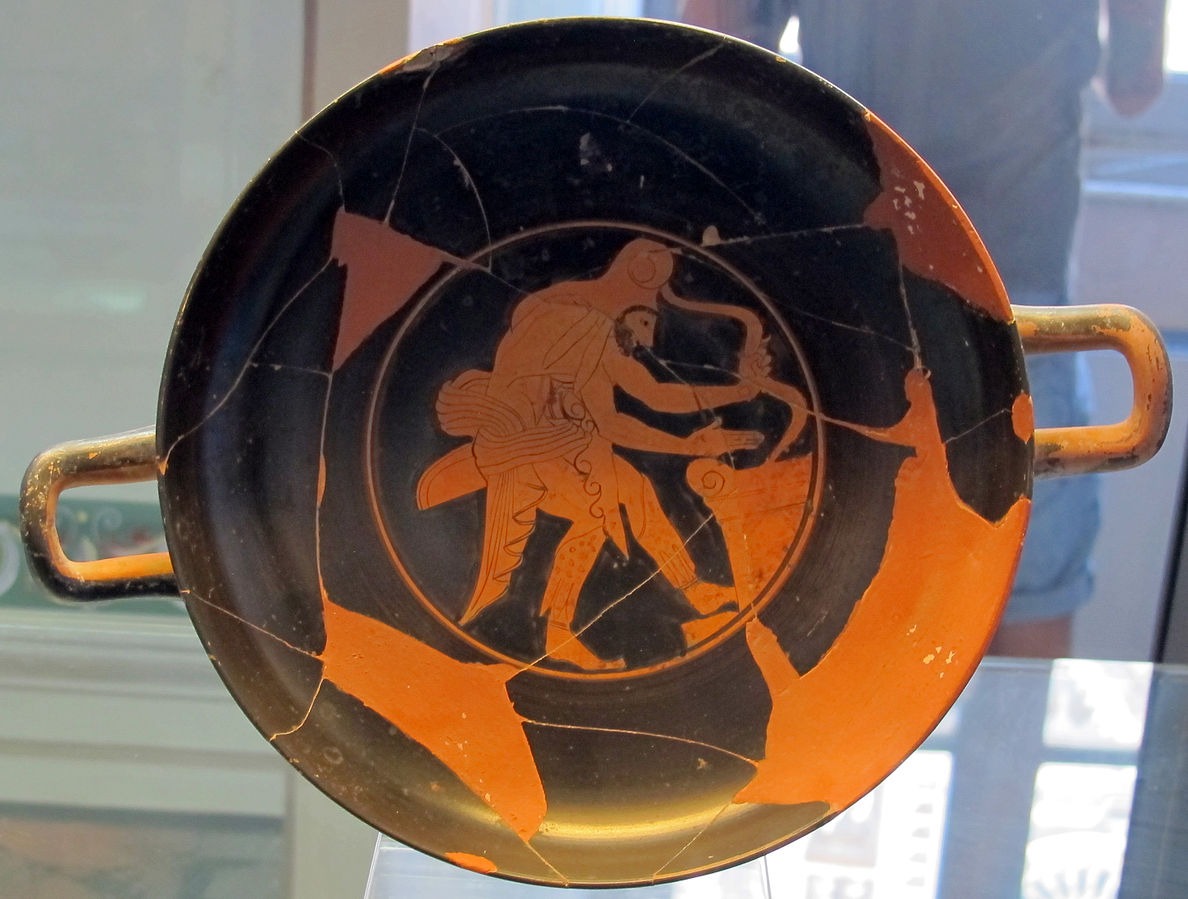
A Scythian depicted on ancient Greek red-figure pottery. Credit: Sailko / CC BY-SA 3.0 / Wikimedia Commons

As time passed, the image of the Scythians in Athens became the quintessential stereotype used for non-Greeks, and they were associated with drunkenness due to Greeks’ caricatural representation of foreigners as unmoderated drinkers.

Later Greek literature transformed the Scythian prince Anacharsis into a legendary figure representing “Barbarian wisdom.” He became one of the Seven Sages of Greece and an ideal “man of nature” or “noble savage” figure. Ephorus of Cyme, a 4th-century BC historian, idealized the Scythians as “invincible” people, creating a fictitious account of a legendary Scythian king named Idanthyrsos who defeated the legendary pharaoh Sesostris and ruled all of Asia. This perception of the Scythians as a powerful and wise people became a tradition in Greek literature.

The Scythians were also included in Greek mythology, with mythical Scythian characters appearing in stories. Herodotus of Heraclea, for instance, portrayed Teutarus, a mythical Scythian, as a herdsman who served Amphitryon and taught archery to Heracles. Additionally, the Titan Prometheus was described as a Scythian king, and his son Deucalion was also linked to the Scythians in Greek myths.

The Thracians

The Thracians were a group of Indo-European-speaking people who inhabited significant portions of Southeast Europe during ancient history. They mainly resided in regions that now correspond to modern-day Bulgaria, Romania, and northern Greece. However, Thracian settlements were not confined solely to Southeast Europe; they also extended to north-western Anatolia (Asia Minor) in what is present-day Turkey.

The Greeks and Romans described Thracian culture as tribal, and they remained largely disunited until the establishment of the Odrysian kingdom. The Odrysian Kingdom was a state union of over 40 Thracian tribes and 22 kingdoms that flourished from the 5th century BC to the 1st century AD. It encompassed mainly present-day Bulgaria, with extensions into parts of Southeastern Romania (Northern Dobruja), Northern Greece, and modern-day European Turkey.

By the fifth century BC, Herodotus referred to the Thracians as the second-most numerous people in the known world after the Indians and potentially the most powerful, had it not been for their lack of unity. The Thracians were generally not known for constructing cities, and Seuthopolis was their sole polis.

Thracians Greek pottery
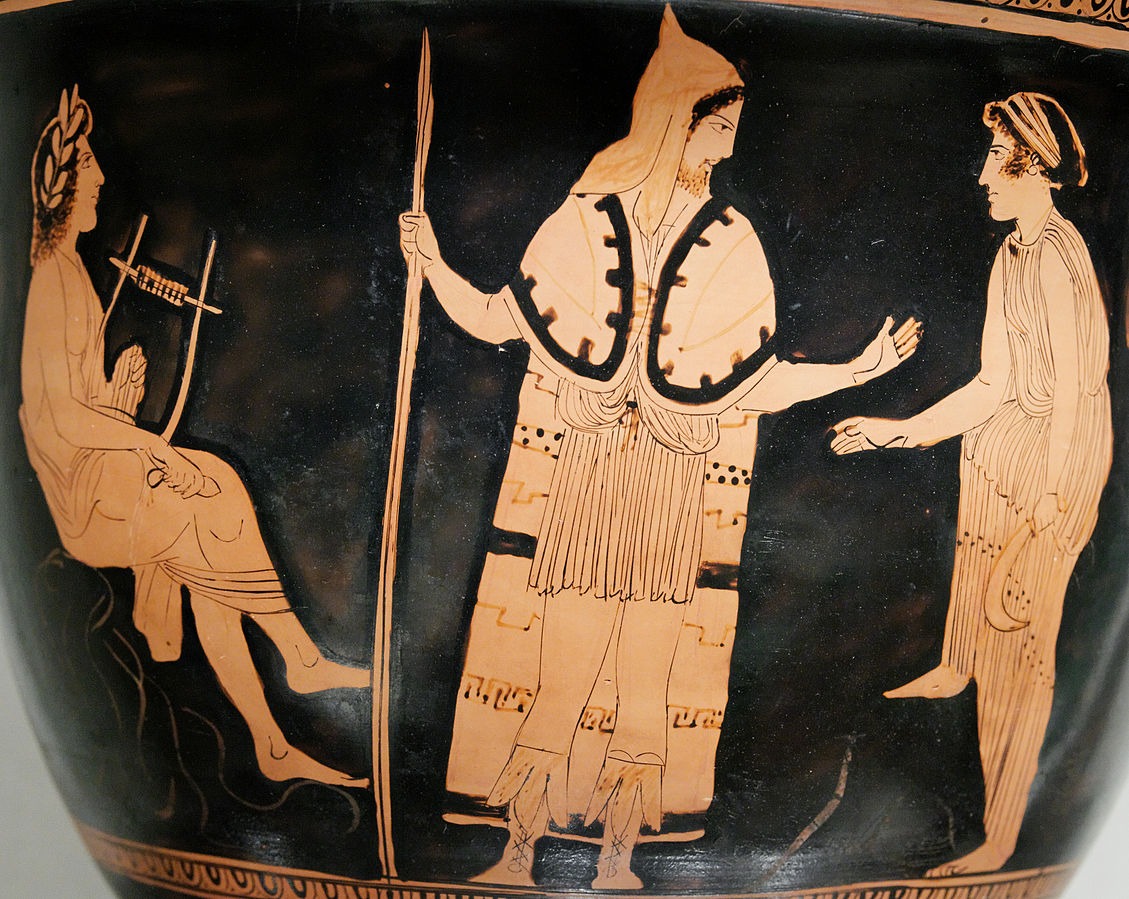
Orpheus amongst the Thracians. Side A of an Attic red-figure bell-krater, c. 440 BC. Credit: Metropolitan Museum of Art / CC BY 2.5

The Greeks frequently fought with the Thracians but also admired them for their martial prowess and hired them as mercenaries. Both Alexander the Great and his father Philip II fought on the Thracians on various occasions.

The Thracian ruler Kersebleptes was Philip’s most consequential Thracian enemy. Over a series of campaigns from 356 to 340 BC, Philip II succeeded in bringing Kersebleptes under his control as a tributary vassal, and in the process, he conquered a substantial portion of Thrace. Alexander again successfully fought the Thracians – among the other peoples – during the Balkan Campaign of 335 BC.

The Phrygians

The Phrygians were an ancient Indo-European-speaking people who resided in central-western Anatolia. Ancient Greek authors used “Phrygian” as a broad term to refer to a diverse ethnocultural grouping situated mainly in the central regions of Anatolia, rather than denoting a single “tribe” or “people.”

The ethnolinguistic homogeneity of the Phrygians is subject to debate. According to Herodotus, the Phrygians were originally dwelling in the southern Balkans under the name of Bryges (Briges), but they later changed their name to Phryges after migrating to Anatolia through the Hellespont.

While numerous historians purport the theory of a Phrygian migration from Europe to Asia Minor around 1200 BC, Anatolian archaeologists have largely dismissed this notion. Instead, it has been proposed that the Phrygian migration to Asia Minor, which Greek sources indicate took place shortly after the Trojan War, actually occurred much earlier and in multiple stages.

Phrygian soldiers
Phrygian soldiers depicted on a reconstruction of a Phrygian building in Turkey. Credit: Carole Raddato / CC BY-SA 2.0 / Wikimedia Commons

The Greeks and Phrygians had significant cultural connections, particularly in the realm of music. The earliest traditions of ancient Greek music were partly influenced by Phrygian music, which was transmitted through the Greek colonies in Anatolia. The Phrygian mode, known as the warlike mode in ancient Greek music, was one of the musical elements borrowed from the Phrygians.

The Phrygian king, Midas, renowned for his “golden touch,” was said to have been tutored in music by the legendary Orpheus himself, according to mythological accounts. Moreover, the aulos, a reed instrument with two pipes, was another musical invention attributed to Phrygia and subsequently embraced by the Greeks.

In classical Greek iconography, Paris, a Trojan prince famous for abducting Helen in the Iliad, is depicted as non-Greek by wearing a Phrygian cap. This distinct headgear was also worn by Mithras and has persisted in modern imagery as the “Liberty cap” of the American and French revolutionaries, symbolizing freedom and rebellion. More amusingly, the Smurfs also wear the Phrygian cap.

The Importance of Cultural Exchange in the Ancient World

In the context of increasing globalization, examining how ancient cultures, like the Greeks and their neighbors, interacted and exchanged ideas is crucial. These exchanges facilitated the spread of technology, religious practices, and art forms, which had a profound impact on the development of Western civilization.

  1. Technological Exchange: The Greeks adopted various technologies from their neighbors, such as the alphabet from the Phoenicians, which became the basis for the Greek writing system. This exchange was pivotal in the development of Greek literature and philosophy.
  2. Religious Syncretism: Religious practices were often blended, as seen in the fusion of Greek and Egyptian deities into figures like Serapis, symbolizing a blending of beliefs that enriched both cultures.
  3. Artistic Influences: Greek art, especially in pottery and sculpture, shows influences from Thracian, Scythian, and Phrygian styles, highlighting how these cultures contributed to what we now consider classical Greek art.
  •  

Diomedes: The Greek Warrior Whose Extraordinary Bond With Horses Made Him a Trojan War Hero

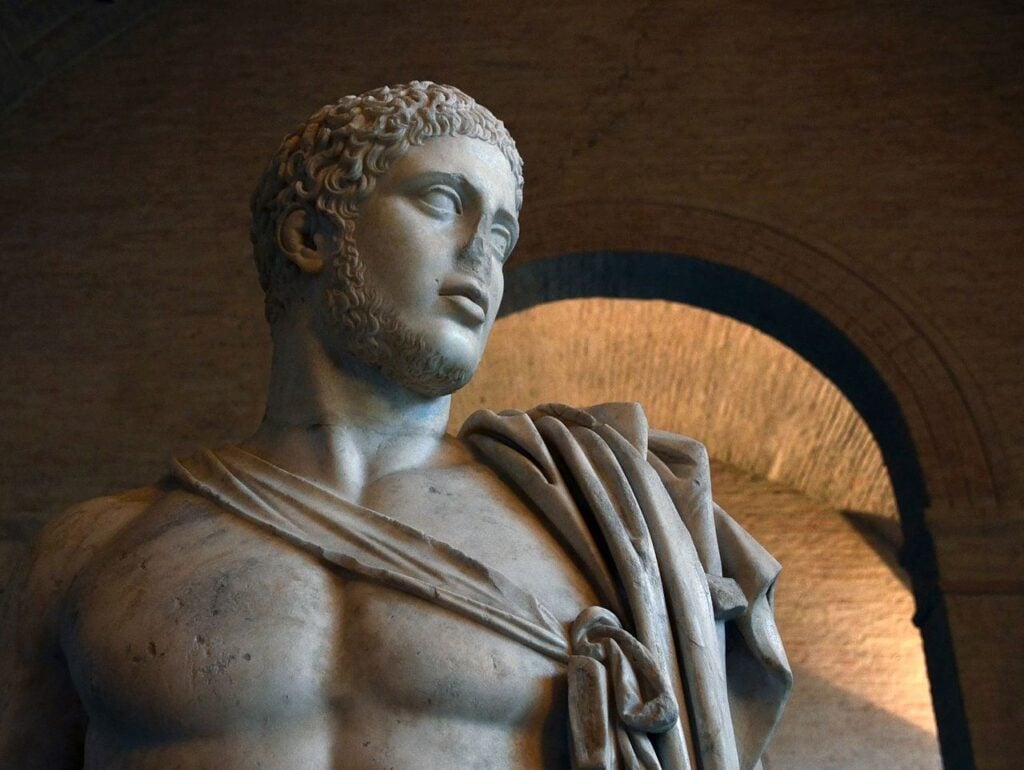
Statue of Greek hero Diomedes
Greek hero Diomedes fought in battle with the help of his divine horses. Roman copy of Diomedes statue attributed to Kresilas 440-430 BC. Exhibited at the Glyptothek in Munich, Germany. Photo credit: Bassil Wikimedia Commons CC0

Diomedes was a distinct Greek hero whose story in Homer’s Iliad is marked by his battle skills, courage, intelligence, and aid from the gods, as well as his association with horses of divine ancestry. However, he is often overshadowed by legendary figures such as Achilles and Odysseus in accounts of the Trojan War. Nevertheless, Diomedes, the king of Argos, remains a central figure in Homeric tradition, particularly within the Iliad itself.

In Craig Russell’s paper, “Diomedes’ Magical Horses,” the scholar explores the Greek hero’s extraordinary relationship with horses, especially those believed to possess exceptional ancestry. This is an often overlooked aspect of the Greek hero’s identity. Drawing on mythological sources, Russell demonstrates that Diomedes’ horses are not merely possessions or instruments of war but symbols of heroic excellence, divine favor, and aristocratic status. Their significance reveals key aspects of Greek heroic culture and highlights the close connection between humans, animals, and the gods.

In Greek mythology, horses frequently symbolize nobility, power, and divine intervention. Greek heroes and kings are often associated with divine horses that distinguish them from ordinary warriors. Russell argues that Diomedes’ own horses belong within this tradition. According to Homeric accounts, the ones ridden by Diomedes during the Trojan War were descended from immortal steeds originally given by Zeus to the Trojan Prince Tros. Through a long genealogical chain, these remarkable horses eventually came into the possession of Diomedes, the Argive Greek hero. Their lineage connected them to the divine realm and elevated their status beyond that of ordinary warhorses.

The Greek hero Diomedes and his divine horses as a unified team

The divine ancestry of Diomedes’ horses is particularly significant because Greek mythology frequently draws on genealogy to establish authority and prestige. Just as heroes traced their lineage to gods and legendary ancestors, animals associated with heroes could also possess sacred origins. Russell emphasizes that the horses’ connection to Zeus reflects the broader Greek belief that excellence often derives from divine favor. By possessing such animals, Diomedes demonstrates not only wealth and military strength but also a special relationship with the gods. The horses become visible markers of his status.

Russell further notes that Diomedes’ horses are closely linked to his success on the battlefield. In the Iliad, mobility and speed are essential components of warfare. Chariots allowed warriors to move quickly across the battlefield, pursue enemies, and withdraw from danger. The quality of a hero’s horses could therefore determine military effectiveness. Diomedes’ steeds are repeatedly described as powerful, swift, and reliable, characteristics that mirror the hero’s own virtues. Their performance contributes directly to his battlefield achievements, reinforcing the idea that the hero and his horses function as a unified team.

The connection between Diomedes and his horses also reflects the broader theme of the relationship between humans and animals within Greek epic literature. Unlike modern perspectives that often separate humanity from nature, Greek mythology frequently portrays animals as intelligent companions capable of sharing in heroic destinies. Russell argues that Diomedes’ horses should be understood within this context. They are not passive creatures but active participants in the hero’s adventures. Their divine heritage grants them an elevated status, and their loyalty reflects the mutual dependence between warrior and steed.

Horses as symbols of status and power

An important aspect of Russell’s analysis involves comparison with other famous horses in Greek mythology, most notably the immortal horses Xanthus and Balius, owned by Achilles. Like Diomedes’ horses, these animals possess divine ancestry and extraordinary abilities. The comparison reveals a recurring pattern in heroic narratives: remarkable Greek heroes are often accompanied by exceptional animals whose qualities complement their masters. However, Russell suggests that Diomedes’ horses have received far less scholarly attention despite their comparable significance. This neglect may stem from the greater fame of Achilles, whose dramatic story dominates much of the Homeric tradition.

The symbolic importance of horses extends beyond warfare. In Ancient Greek society, horse ownership was associated with aristocratic status and political power. Maintaining horses required substantial wealth, making them markers of elite identity. Russell highlights this social dimension in his discussion of Diomedes. As a king and military leader, the Greek hero embodies the values of the warrior aristocracy. His possession of magnificent horses reinforces his position within the social hierarchy and affirms his legitimacy as a ruler. Thus, the horses function not only as military companions but also as indicators of social prestige.

Another key theme in Russell’s essay is the relationship between divine gifts and human responsibility. Greek mythology often portrays gifts from the gods as both blessings and challenges. Heroes who receive divine assistance must prove themselves worthy of it through courage, wisdom, and self-discipline. Diomedes’ horses exemplify this principle. Their divine lineage grants him advantages, but those become meaningful only through Diomedes’ own skill and character. Russell’s interpretation underscores the central Greek idea that excellence results from the combination of divine favor and human achievement.

Athena’s intervention in the Trojan War

The role of the goddess Athena further strengthens this interpretation. Among all the Olympian deities, Athena is the divine patron most closely associated with Diomedes. During the Trojan War, she grants him extraordinary strength and clarity of vision, enabling him to confront even gods, such as Ares, the god of war, on the battlefield. Russell suggests that Diomedes’ horses complement this broader pattern of supernatural support. Together, Athena’s guidance and the horses’ divine ancestry create an image of a Greek hero uniquely favored by divine powers. Yet, Diomedes never relies solely on these advantages; his personal bravery remains essential to his success.

Russell also highlights the narrative function of the horses within epic storytelling. In oral tradition, recurring symbols help audiences recognize and remember key figures. The mention of Diomedes’ horses serves as such a marker, reinforcing his heroic stature. Whenever they appear, listeners are reminded of his exceptional qualities and distinguished lineage. This symbolic role contributes to the enduring significance of the horses within the mythological tradition.

Furthermore, the story of Diomedes’ horses illustrates the interconnected nature of Greek mythology. Their lineage links different generations, kingdoms, and legendary figures. Such connections reflect a characteristic feature of Greek myth in which individual stories rarely exist in isolation. Instead, heroes, gods, and extraordinary creatures form part of a vast narrative network. Russell demonstrates that tracing the history of Diomedes’ horses reveals broader patterns of inheritance, divine intervention, and heroic identity that extend far beyond a single tale.

According to Russell, Diomedes’ horses are far more than simple war animals. Their divine ancestry, battlefield importance, symbolic value, and connection to aristocratic culture make them essential to the Greek hero’s identity. They embody Greek ideals of excellence, divine favor, and noble status while highlighting the close relationship between humans, animals, and the gods.

  •  

Does the Biblical Moses Appear in Greek Mythology?

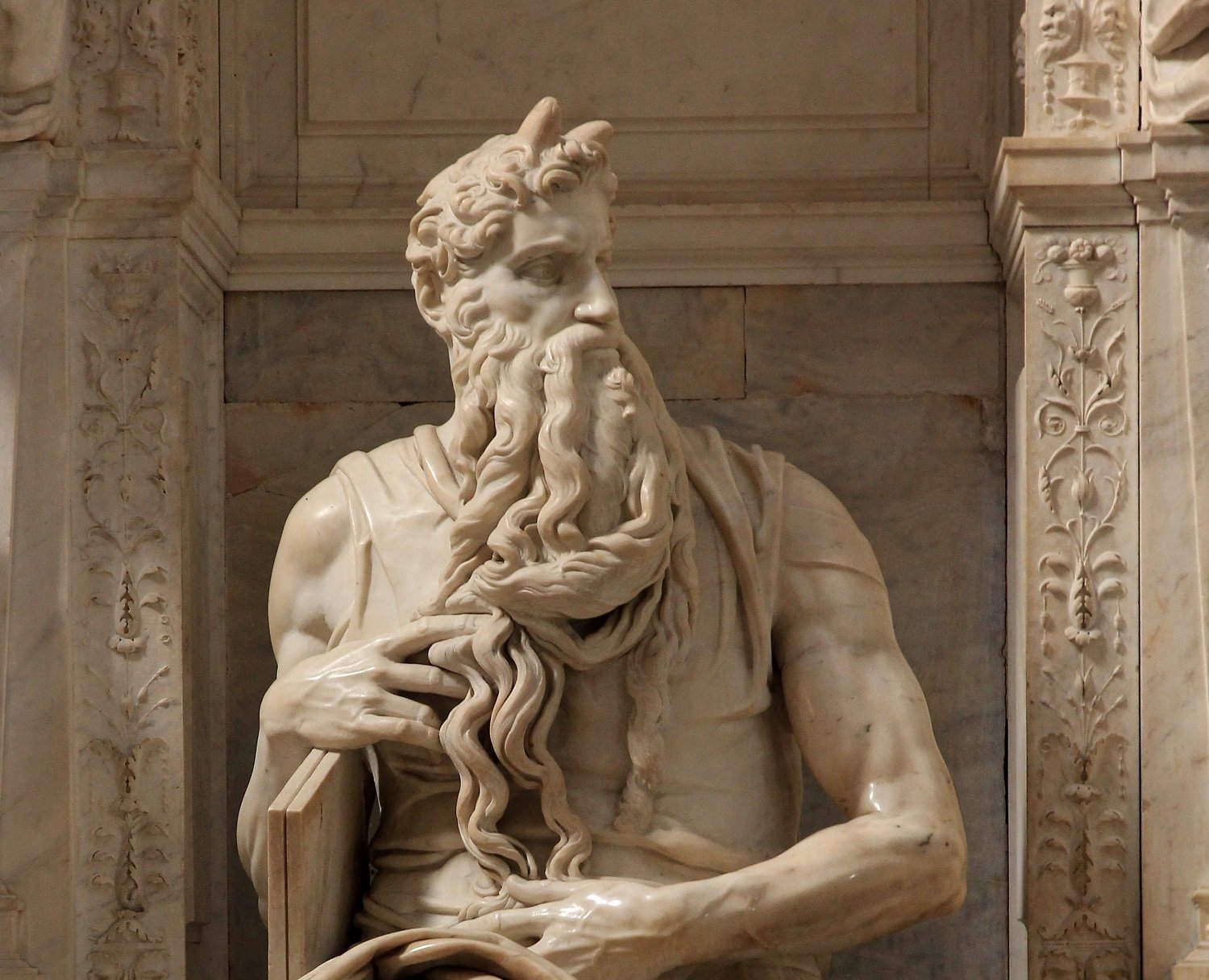
Moses by Michalangelo
Moses by Michelangelo, c. 1513. Credit: Wikipedia Commons, CC-BY-SA-3.0

Scholars acknowledge that some legends from Greek mythology are strikingly similar to stories from the Bible. According to some theories, a few individual characters from the Bible might also appear in Greek mythology. One theory argues that the famous Moses of Egypt can be found in Greek records. Does Moses really appear in Greek mythology, or is this just wishful thinking?

Who was Moses?

Firstly, let us establish who Moses was. He appears in the Bible books of Exodus, Leviticus, Numbers, and Deuteronomy. Exodus contains the most famous part of his life story. It tells the story of how he was a Hebrew boy placed in the Nile River, where the Pharaoh’s daughter then found him.

When Moses was an adult, he tried to help his fellow Hebrews, who were slaves in Egypt, but then he ran away and remained in a distant land for forty years. He eventually returned after God allowed him to go and free his people from Egypt. Pharaoh refused to let the Hebrews go, but after ten devastating plagues from God, he relented.

Moses led the people out of Egypt across the Red Sea (where Pharaoh and his army drowned after trying to pursue them) and into the Sinai wilderness. There, he gave his people an extensive list of regulations from God, collectively known as the Mosaic Law. He also wrote many religious writings. The first five books of the Bible are attributed to him, as well as several poetic writings.

Did the Greeks know about Moses?

The theory that Moses appears in Greek mythology depends on the idea that the Greeks could have known of Moses in the first place. After all, he could not have appeared in their mythology if they did not know about him.

As it so happens, Moses does appear in quite a few Greek records. The Egyptian priest Manetho, from the third century BCE, mentioned Moses in his history of Egypt. Since Manetho lived in Egypt during its Hellenistic era, it is virtually certain that the Greeks of that region were aware of Moses. They certainly would have known of him after reading Manetho’s history.

Interestingly, there is evidence that the Greeks knew about Moses even before the Hellenistic era of Egypt. The first-century BCE Greek historian Diodorus Siculus wrote about the origin of the Jews. His account came from Hecataeus of Abdera, a Greek traveler from c. 300 BCE.

Hecataeus’ account differs from the Bible’s account in numerous ways, but it is still fundamentally the same story of Moses. Therefore, at least as early as 300 BCE, the Greeks definitely knew about Moses.

Was Musaeus from Greek mythology the same as Moses?

In ancient times, several writers explicitly identified Moses with a certain figure from Greek mythology. This figure was Musaeus. It is obvious that the main reason for identifying the two figures is due to the similarity between their names. But is there any more of a connection than this? Well, what does Greek mythology say about Musaeus?

Musaeus was a legendary intellectual, philosopher, seer, prophet, poet, musician, and historian. The Greeks believed that he founded a class of priestly poetry in Athens. He allegedly lived in the time of Heracles and was associated with Orpheus, another prominent poet and prophet from Greek mythology.

Immediately, we can see that there are some definite similarities between Moses and Musaeus from Greek mythology. In addition to the similarity in their names, their roles are also similar. Moses was a prophet, since he relayed messages from God. He was a poet, since he wrote the poetic book of Job and several of the Psalms. He was also a historian, since he wrote part of the history of the Jews.

Why Musaeus could not have been Moses

Despite these similarities, there is a key reason why Musaeus could not have been Moses. The key reason is that they did not live at the same time.

At first glance, it might look like the chronology works very well. Moses is usually placed at the time of Ramesses II, who ruled in the 13th century BCE. He is also placed in the time of Heracles, who lived about half a century prior to the Trojan War. That would also put him in the 13th century BCE according to the traditional date of the Trojan War. Therefore, it seems at first glance that Musaeus and Moses would have been exact contemporaries.

However, the reality is not so simple. Despite the popular association between Moses and Ramesses II, this has no historical or Biblical basis. The Bible’s internal chronology, along with its genealogical record of the prophet Samuel, places Moses firmly in c. 1500 BCE. That means he lived almost three centuries earlier than the traditional era of Musaeus.

The true era of Musaeus

The theory connecting Moses with Musaeus is further disproved if we examine the information about Musaeus from Greek mythology even more closely. For one thing, there is evidence that the Trojan War occurred several centuries later than the traditional date.

Furthermore, recall that Musaeus was closely associated with Orpheus. Some records say that Musaeus was Orpheus’ son, while other records give the inverse relationship. In either case, they lived at about the same time.

Greek tradition claims that Homer was a tenth generation descendant of Orpheus. That would place Orpheus, and therefore his associate Musaeus, about 200 to 250 years prior to the time of Homer. Since Homer lived in the seventh century BCE, that would mean that Musaeus would have probably lived in the ninth or tenth century BCE. Hence, this would have been long after the time of Moses. Therefore, it is virtually certain that Moses was not Musaeus from Greek mythology.

  •  

Emporion, Where Ancient Greece Met Spain and Thrived

Emporion
The atrium of Roman House (domus) No. 1 at Empuries (Emporiae/Emporion), Spain. 1st century BC – 1st century AD. Credit: Mark Cartwright, World History Encyclopedia, CC BY-NC-SA 4.0

The Greeks were famous in antiquity for their adventurous and curious spirit, which led to the establishment of numerous Greek colonies across the Mediterranean and beyond. Tucked away on Spain’s beautiful Costa Brava, one of these ancient Greek colonies, called Emporion, was a truly remarkable Greek settlement that thrived far from metropolitan Greece on the other side of the Mediterranean.

Emporion is an excellent example of early Greek expansion, as it became a place where Greek traders and settlers converged to establish a bastion of Greece at the far western end of the Mediterranean.

Emporion became a thriving hub that, for centuries, played a crucial role in shaping the foundations of early European exchange and people’s movements. When discussing Greek colonies, we normally focus on Asia Minor and the Italian Peninsula. However, here on the Iberian Peninsula, these ancient Greek explorers left their unique mark, proving that the ancient Greeks were, in fact, quite the adventurers.

Emporion was a Greek gem on Spanish soil

The story of Emporion started around 575 BC, when Greek seafarers from Phocaea, a Greek city in Asia Minor (modern-day Turkey), set their sights on the western horizon, seeking more land to expand their opportunities. These people were the same adventurous men and women who founded Massalia (today’s Marseille) on the opposite side of Emporion, on today’s Mediterranean coast of France.

Their initial settlement, the “Palaiapolis” or Old City, was cleverly positioned on a small island, now comfortably part of the mainland, due to thousands of years of land reclaiming in the broader area. We can only imagine the spectacle of Greek ships filled with exquisite pottery, fine olive oil, and the kind of wine that only ancient Greeks could produce, setting foot on Iberia.

What was different at that time was that these people weren’t just there to exchange goods and sell their produce; they were there to stay permanently, injecting Greek culture into the local populations, importing fresh ideas, and the unique “Greek spirit” into the local area.

A Greek mosaic in the Neapolis. The Greek word "Ηδύκοιτος" ("the pleasure of lying down") is at the top.
A Greek mosaic in the Neapolis. The Greek word “Ηδύκοιτος” (“the pleasure of lying down”) is at the top. Credit AugusteBlanqui, Wikimedia Commons, CC BY-SA 4.0

The very name they gave to the city, “Emporion,” means “market” or “trading post” in Greek. It leaves no room for doubt about its core purpose and the reason why this settlement was named after the Greek word for trade. Emporion was intended to become a cosmopolitan crossroads, a vibrant meeting point where Greek merchants met local Iberian populations, thereby establishing a robust trade route in a wide range of goods, from precious metals to essential food supplies.

What is particularly fascinating about Emporion is the relationship that developed between the Greek colonists in the area and the local Iberian tribes, especially the Indiketes. Initially, there was a clear divide—a literal wall separated the Greek and Iberian communities, as is often the case with newly established colonies throughout history.

But as often happens, shared interests and a healthy dose of realism slowly eroded those barriers, bringing locals and settlers together. Over time, mutual benefit led them to achieve a remarkable degree of cultural exchange, resulting in a truly blended society that contributed to the development of a unique community with its own strengths and characteristics.

A Greek vessel found in Emporion. Credit
A Greek vessel found in Emporion. Credit: Kontrollstellekund, Wikimedia Commons, CC BY-SA 2.0

This community thrived through commerce and cultural exchanges. Centuries later, during the Roman era, Emporion’s strategic value became undeniable. During the tumultuous Punic Wars, Emporion became a crucial landing point for Roman legions, demonstrating its geopolitical importance. The Romans, ever efficient, established their adjacent settlement, which eventually merged with the pre-existing Greek city. The collective name, Emporiae, perfectly encapsulates this dual Greco-Roman identity and heritage, where two powerful cultures merged on one remarkable site.

Today, what truly makes Empúries a must-see is the extraordinary chance it offers to walk through both Greek and Roman streets in a single visit. It’s not every day you get to stand where an ancient agora once buzzed with philosophical debate, and just right next to it, you can envision a Roman forum alive with political drama that only the Romans could offer.

The ongoing excavations, which commenced in 1908, continue to unearth incredible treasures—from formidable city walls and elegant temples, including one dedicated to Asclepius, the Greek god of medicine (perhaps an early version of a Greek health resort), to private homes adorned with breathtaking Roman mosaics.

The next time you visit northeastern Spain and Catalonia, be sure to visit this site of ancient Greek heritage on the Iberian Peninsula. Admire what is now known as Empúries, a name closely resembling its original one.

For a more detailed description of what led to the Greek colonization of the area, read here.

  •  

Emporion, Where Ancient Greece Met Spain and Thrived

Emporion
The atrium of Roman House (domus) No. 1 at Empuries (Emporiae/Emporion), Spain. 1st century BC – 1st century AD. Credit: Mark Cartwright, World History Encyclopedia, CC BY-NC-SA 4.0

The Greeks were famous in antiquity for their adventurous and curious spirit, which led to the establishment of numerous Greek colonies across the Mediterranean and beyond. Tucked away on Spain’s beautiful Costa Brava, one of these ancient Greek colonies, called Emporion, was a truly remarkable Greek settlement that thrived far from metropolitan Greece on the other side of the Mediterranean.

Emporion is an excellent example of early Greek expansion, as it became a place where Greek traders and settlers converged to establish a bastion of Greece at the far western end of the Mediterranean.

Emporion became a thriving hub that, for centuries, played a crucial role in shaping the foundations of early European exchange and people’s movements. When discussing Greek colonies, we normally focus on Asia Minor and the Italian Peninsula. However, here on the Iberian Peninsula, these ancient Greek explorers left their unique mark, proving that the ancient Greeks were, in fact, quite the adventurers.

Emporion was a Greek gem on Spanish soil

The story of Emporion started around 575 BC, when Greek seafarers from Phocaea, a Greek city in Asia Minor (modern-day Turkey), set their sights on the western horizon, seeking more land to expand their opportunities. These people were the same adventurous men and women who founded Massalia (today’s Marseille) on the opposite side of Emporion, on today’s Mediterranean coast of France.

Their initial settlement, the “Palaiapolis” or Old City, was cleverly positioned on a small island, now comfortably part of the mainland, due to thousands of years of land reclaiming in the broader area. We can only imagine the spectacle of Greek ships filled with exquisite pottery, fine olive oil, and the kind of wine that only ancient Greeks could produce, setting foot on Iberia.

What was different at that time was that these people weren’t just there to exchange goods and sell their produce; they were there to stay permanently, injecting Greek culture into the local populations, importing fresh ideas, and the unique “Greek spirit” into the local area.

A Greek mosaic in the Neapolis. The Greek word "Ηδύκοιτος" ("the pleasure of lying down") is at the top.
A Greek mosaic in the Neapolis. The Greek word “Ηδύκοιτος” (“the pleasure of lying down”) is at the top. Credit AugusteBlanqui, Wikimedia Commons, CC BY-SA 4.0

The very name they gave to the city, “Emporion,” means “market” or “trading post” in Greek. It leaves no room for doubt about its core purpose and the reason why this settlement was named after the Greek word for trade. Emporion was intended to become a cosmopolitan crossroads, a vibrant meeting point where Greek merchants met local Iberian populations, thereby establishing a robust trade route in a wide range of goods, from precious metals to essential food supplies.

What is particularly fascinating about Emporion is the relationship that developed between the Greek colonists in the area and the local Iberian tribes, especially the Indiketes. Initially, there was a clear divide—a literal wall separated the Greek and Iberian communities, as is often the case with newly established colonies throughout history.

But as often happens, shared interests and a healthy dose of realism slowly eroded those barriers, bringing locals and settlers together. Over time, mutual benefit led them to achieve a remarkable degree of cultural exchange, resulting in a truly blended society that contributed to the development of a unique community with its own strengths and characteristics.

A Greek vessel found in Emporion. Credit
A Greek vessel found in Emporion. Credit: Kontrollstellekund, Wikimedia Commons, CC BY-SA 2.0

This community thrived through commerce and cultural exchanges. Centuries later, during the Roman era, Emporion’s strategic value became undeniable. During the tumultuous Punic Wars, Emporion became a crucial landing point for Roman legions, demonstrating its geopolitical importance. The Romans, ever efficient, established their adjacent settlement, which eventually merged with the pre-existing Greek city. The collective name, Emporiae, perfectly encapsulates this dual Greco-Roman identity and heritage, where two powerful cultures merged on one remarkable site.

Today, what truly makes Empúries a must-see is the extraordinary chance it offers to walk through both Greek and Roman streets in a single visit. It’s not every day you get to stand where an ancient agora once buzzed with philosophical debate, and just right next to it, you can envision a Roman forum alive with political drama that only the Romans could offer.

The ongoing excavations, which commenced in 1908, continue to unearth incredible treasures—from formidable city walls and elegant temples, including one dedicated to Asclepius, the Greek god of medicine (perhaps an early version of a Greek health resort), to private homes adorned with breathtaking Roman mosaics.

The next time you visit northeastern Spain and Catalonia, be sure to visit this site of ancient Greek heritage on the Iberian Peninsula. Admire what is now known as Empúries, a name closely resembling its original one.

For a more detailed description of what led to the Greek colonization of the area, read here.

  •  

The Forgotten Clash: How the Normans Bled the Byzantine Empire

A digital depiction of a battle during the war between the Byzantine Empire and the Normans
A digital depiction of a battle during the Byzantine-Norman wars. Credit: Greek Reporter archive

The invasion of the Byzantine Empire by the Normans is a fascinating chapter of Roman history that is often overlooked.

Imagine descendants of Viking raiders, now known as Normans after settling in northern France, setting their sights on southeastern Europe and threatening the Eastern Roman (Byzantine) Empire. Eager to expand their influence beyond their French territories, these ambitious warriors turned their attention to the wealthy Byzantine lands. What followed was a century-long struggle that would fundamentally reshape the balance of power in medieval Europe.

The beginning of the story between the Normans and the Byzantine Empire

The first signs of trouble appeared around AD 1017, when small groups of Norman knights began turning their attention toward southern Italy, initially in search of mercenary work. The Byzantines, who still controlled significant territories on the Italian peninsula, believed these foreign fighters could prove useful in defending their holdings. After all, they needed additional manpower to deal with local rebellions as well as the frequent Arab raids originating from Sicily.

What the Byzantine administration failed to grasp early on was that the Normans came from a culture that placed extraordinary value on land acquisition above almost everything else. In Normandy, in northern France, younger sons were often left landless due to inheritance laws that favored the eldest child. Southern Italy, with its patchwork of competing communities and loosely defined borders, therefore looked like an ideal opportunity for expansion.

The Byzantines would learn this lesson the hard way. Within a few decades of their arrival, the Normans—initially seen as hired help—had begun establishing permanent bases across the region. Although Norman groups often fought one another in the early years, a more unified front gradually emerged. They would accept Byzantine payment for military service, only to use their positions to seize territory for themselves and steadily challenge Byzantine authority throughout the region.

The rise of Robert Guiscard

A man who would play a crucial role in what followed was Robert de Hauteville, better known as Robert Guiscard, “the Cunning.” This Norman was not the eldest son nor was he especially wealthy, and he was certainly not expected to carve out lands and establish his own realm. Nonetheless, he did so anyway.

Guiscard arrived in southern Italy around AD 1047 and immediately set about strengthening and consolidating Norman power. He possessed an almost uncanny ability to turn enemies into allies and allies into subjects. Through a combination of strategic marriages—a common practice at the time—military strength, and sheer boldness (which others might have called recklessness), he gradually unified the fragmented Norman factions under his leadership.

It would take until AD 1071 for Byzantine Italy to finally collapse. Guiscard captured Bari, the last major Byzantine stronghold on the Italian peninsula. For the Byzantines, the loss was deeply symbolic. For more than five centuries, the Eastern Roman Empire had maintained a presence in Italy, a living link to the legacy of the Western Roman Empire and the origins of the Roman world itself. That connection was now severed by a band of opportunistic outsiders.

Norman aggression against Constantinople

The conquest of southern Italy was only the beginning for the Normans. Robert Guiscard’s ambitions extended far beyond the Italian peninsula. His ultimate goal was Constantinople itself. In AD 1081, he launched what can only be described as one of the most audacious military campaigns of the Middle Ages.

The plan was bold in scope. Guiscard intended to cross the Adriatic Sea, establish a beachhead in what is now Albania, and then march overland toward the Byzantine capital through northern Greece. His first objective was Dyrrhachium, the critical fortress controlling access to the main route into the Greek mainland.

Emperor Alexios I Komnenos suddenly found himself confronting a nightmare scenario. The Normans had already demonstrated their ability to seize and hold territory, and now they were effectively at his doorstep, threatening the survival of the Byzantine Empire itself. To make matters worse, his army was a patchwork force of mercenaries, including (ironically) Anglo-Saxon refugees who had fled the Norman conquest of England.

The Battle of Dyrrhachium in October AD 1081 proved disastrous for the Byzantines. Guiscard’s tactical skill, combined with his son Bohemond’s aggressive cavalry charges, shattered the imperial army. The road to Constantinople lay open, and for a brief moment, it seemed as though the thousand-year-old Eastern Roman Empire might actually fall to these descendants of Viking raiders.

Desperate measures and unlikely alliances

Alexios I was many things, but he was not a man to surrender easily. Faced with the possibility of total collapse, he executed one of the most impressive diplomatic maneuvers of the medieval world. First, he effectively bribed the Holy Roman Emperor Henry IV to attack Norman territories in Italy, forcing Guiscard to divide his attention across two fronts. Then, in a move that would have lasting consequences, he granted extensive trading privileges to Venice in exchange for naval support against the Normans.

These concessions were enormous for an empire like Byzantium. The commercial rights awarded to Venice would eventually help transform the city-state into one of the wealthiest powers in Europe, often at Byzantium’s own expense. However, in AD 1082, Alexios was fighting for survival, and generosity was not a choice but a necessity.

The strategy worked—but only just. Guiscard was compelled to return to Italy to confront the German intervention, leaving Bohemond to continue the eastern campaign against Constantinople. What followed was several years of brutal mountain warfare across the Balkans, with neither side able to secure a decisive victory and both remaining locked in a tense stalemate.

The long shadow of conflict and the Byzantine Empire attack by the Normans

Although Robert Guiscard’s ambition to destroy the Byzantine Empire ultimately failed, the Norman-Byzantine conflict did not end with his death in AD 1085. A few years later, Bohemond attempted to revive the campaign in AD 1107, launching another invasion that also ended in failure. The final (and perhaps most devastating) Norman assault came in AD 1185, when a joint Norman-Sicilian force captured and sacked Thessaloniki, the empire’s second-largest city.

The events in Thessaloniki were brutal. Contemporary sources describe widespread slaughter of civilians and the systematic destruction of the city. The scale of devastation shocked even medieval observers, who were accustomed to the violence of war. For the Byzantines, the psychological impact was profound. It demonstrated that no part of the empire was truly safe from Norman ambition, as even its greatest cities could fall to such overwhelming force.

The Norman campaigns against Byzantium had consequences that extended far beyond Thessaloniki. They helped establish a powerful Catholic kingdom in southern Italy that would remain a persistent rival to the Byzantine Empire for centuries. More importantly, they drained Byzantine resources at a time when the empire was increasingly pressured by Turkish advances in the east.

The prolonged conflict also deepened the divide between the Greek Orthodox and Roman Catholic worlds, turning former Christian counterparts into bitter adversaries. The Normans saw themselves as champions of Latin Christendom, while the Byzantines regarded them as little more than barbarian raiders. This growing hostility would ultimately culminate in the Fourth Crusade, when Crusader forces turned against Constantinople itself and sacked the city.

Even today, traces of this once-forgotten conflict remain scattered across the Mediterranean. Norman castles still stand along the coastlines of southern Italy and Sicily.

  •  

Six Ancient Greek Aphrodisiacs Available Everywhere Today

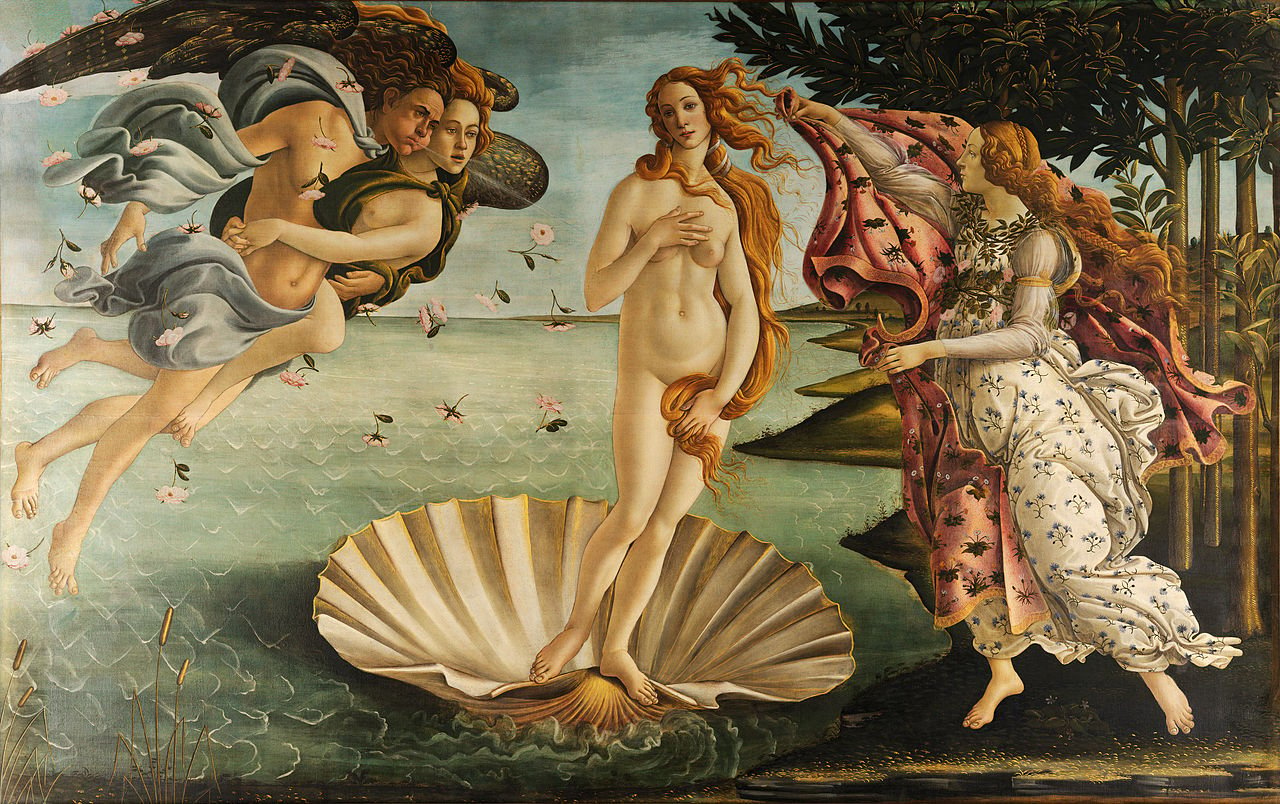
The Birth of Aphrodite-Venus, the Ancient Greek goddess of beauty, sensuality and love.
The Birth of Aphrodite-Venus, the goddess of beauty, sensuality and love. Credit: Wikipedia/Public domain

Ancient Greeks were big believers in aphrodisiacs and ancient love potions and used a variety of fruits, herbs, and other foods in their concoctions. The word “aphrodisiac” itself comes from the ancient Greek goddess of love, Aphrodite.

Those looking to harness the power of ancient Greek love potions don’t need to go on a quest to hunt down obscure ingredients. In fact, six of the most common Greek aphrodisiacs that have been used throughout the centuries can still be found today at your local supermarket.

Natural foods considered aphrodisiacs in Ancient Greece

1. Pomegranates

pomegranate was an ancient greek aphrodisiac food
Pomegranate was considered one of the most common natural aphrodisiac foods in Ancient Greece. Credit: Joergens.mi/Wikimedia commons/CC BY-SA 3.0

Pomegranates have long been lauded for their nutritional properties, as they include many nutrients and antioxidants.

Even back in Ancient Greece, the pomegranate fruit was considered nutritious, and it was also believed, in both ancient times and today, that the juice contains aphrodisiac properties.

The link between pomegranates and sexuality may come from the fact that Aphrodite herself is credited with planting the first ever pomegranate tree in Greek mythology.

2. Truffles

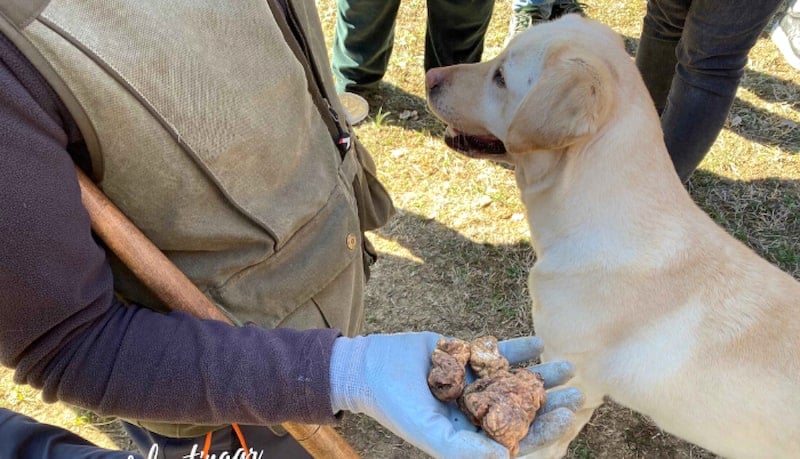
truffles were considered aphrodisiac foods
Truffle hunting in Greece’s Meteora region. Credit: Meteora Museum

Dating as far back as the 1st century AD, this fungus found its way into the limelight as an aphrodisiac.

It is believed that truffles came into existence as a result of the combined action of water, heat, and the power of the god Zeus himself, as Zeus hurled a thunderbolt to Earth which landed close to an oak tree, producing the truffle.

The ancient Greek physician Galen claimed that the truffle, apart from imparting delicious flavor to any dish, can increase sexual prowess.

3. Figs

aphrodisiacs
Figs and plums. Credit: E. Abadjieva/Wikimedia Commons/CC BY-SA 4.0

Figs belong to the category of the most nutritious fruits while at the same time they have at least nine recognized medicinal qualities. Along with grapes, figs were known to be one of the favorite fruit of Ancient Greeks.

Figs are rich in vitamins A, B1, and B2 and minerals such as calcium, iron, phosphorus, magnesium, sodium, and potassium among others. They are recognized as being good for our health for their many proven medicinal qualities.

The ancient Greeks linked figs to sexuality, possibly because the shape of the fruit resembles the shape of female genitalia.

4. Leeks

Similarly, leeks were probably considered an aphrodisiac in Ancient Greece because of their phallic shape.

In ancient Greece, leeks were eaten raw and whole or cooked. They provide tons of flavor to any meal.

Nowadays, people still believe that leeks are an aphrodisiac, as they are in the same family as onions and garlic, which have similar properties.

5. Garlic

At some point in time, people stopped believing that garlic was toxic and started consuming it to prevent illness and congestion, and of course, just because it is delicious.

In ancient Greece, people ate garlic nearly everyday. People began to believe that the spiciness of raw garlic made it a natural aphrodisiac.

Try making the Greek dish skordalia, and you’ll be sure to eat a considerable amount of garlic. It is a mixture of garlic and purée of potatoes, walnuts, almonds, or milk-soaked stale bread.

6. Legumes

lentil
Dried red lentils. Credit: Mytinytank/Wikimedia Commons/CC BY-SA 3.0

Hippocrates, the father of medicine, prescribed legumes, such as lentils, as an essential part of the menu for men hoping to maintain their virility.

Hippocrates advised a variety of legumes to be consumed by the bowlful to those struggling with sexual dysfunction.

Lastly, the Greek philosopher Aristotle was a believer in the notion that lentils with the addition of saffron were essential in maintaining a man’s libido active and in top shape.

  •  

When the Ancient Persians Freed the Jews From Babylon

A depiction of the destruction of Jerusalem by the Babylonians, 1896
A depiction of the destruction of Jerusalem by the Babylonians, 1896. Credit: Wikimedia Commons, public domain

The first interaction between the Jews and the Persians (the ancient Iranians) was a profoundly important and beneficial one. This initial interaction between the two nations was not a battle. Rather, the Persians freed the Jews from captivity in Babylon. What were the circumstances behind this event, and what exactly did the Persians do?

Why the Jews were captives in Babylon

The background to this event is that the ancient Babylonians attacked and destroyed the Jewish city of Jerusalem near the turn of the seventh century BCE. Consequently, the Babylonians took the surviving Jews captive, deporting them to the region of Babylon.

Despite not enduring the extreme hardships of slavery, as in their Egyptian bondage, they nevertheless faced harsh and unpleasant conditions. They were captives in the region, along with many other peoples whom the Babylonians had conquered.

This captivity lasted for several decades. According to the Hebrew Scriptures of the Bible, there were ancient Jewish prophets who had foretold that this captivity would end and Babylon would fall. Historically, what occurred?

The Persian conquest of Babylon

Eventually, the Persians freed the Jews from Babylon. How did this happen?

During much of the sixth century BCE, the Babylonians ruled over a vast empire. It controlled essentially the entire Fertile Crescent, from the Persian Gulf to the Egyptian border. It also ruled over much of northern Arabia. Historians believe that the city of Babylon at that time was the largest in the world.

For that reason, its downfall was a shock to the world. In 550 BCE, King Cyrus I of Persia began conquering the Middle East with the defeat of the Medes. He then travelled to Anatolia, where he conquered the Lydian Empire. Finally, he turned his attention to Babylon.

In 539 BCE, Cyrus’s army marched towards the powerful and intimidating city of Babylon. They diverted the Euphrates River, which surrounded the city like a moat. This lowered the water level enough for the Persian army to wade across.

For some reason, the gates of the city had been left open, and the army simply marched in. The Babylonians were completely unprepared for a battle, resulting in a swift and definitive Persian victory.

The Persians freed the Jews

The Babylonians had a policy of never releasing their prisoners of war. The Persians, in contrast, had no such policy. Cyrus the Great—and the Persian Empire in general—is famous today for the relatively lenient position taken regarding subject peoples.

According to the ancient Hebrew Scriptures, in the first year of Cyrus’s rule over Babylon, he ordered the Jews to be released and return to their land of Jerusalem. Thus, the Persians freed the Jews from Babylon. In fact, rather than merely allowing them to go, Cyrus positively supported them in their return.

According to the Bible’s Book of Ezra, written in the fifth century BCE, Cyrus took the treasure of Jerusalem’s temple that the Babylonians had plundered and gave it directly to the Jews. He allowed them to take it back with them to Jerusalem.

Furthermore, when the Persians freed the Jews, they went even further in their support for them. The record in Ezra states that Cyrus encouraged his subjects to assist the Jews by giving them financial support for their return trip.

Did the Persians really free the Jews?

Did the Persians really free the Jews from ancient Babylon, or is the Bible’s account about this event fictional? Archaeologists uncovered an ancient artifact known as the Cyrus Cylinder in 1879. This dates to just after the fall of Babylon and describes Cyrus’ conquest of the city. Notably, it includes the following description:

“I returned to sacred cities on the other side of the Tigris, the sanctuaries of which have been ruins for a long time, the images which (used) to live therein and established for them permanent sanctuaries. I (also) gathered all their (former) inhabitants and returned (to them) their habitations.”

Although this does not mention Jerusalem and the Jews specifically, it does provide significant support to the Biblical narrative. As we can see, Cyrus claimed to have been responsible for the restoration of certain sanctuaries, or sacred temple sites, in distant cities.

He even specifically mentions returning the “images”, or idols, that came from those sanctuaries. This ties in very well with the Bible’s claim that Cyrus returned the Jews’ temple treasures to Jerusalem.

Furthermore, alongside the restoration of the temples, Cyrus claims that he returned the inhabitants of those cities to their respective sanctuaries. This aligns perfectly with the Bible’s assertion that the Persians freed the Jews and allowed them to return to Jerusalem.

All evidence indicates that the construction of the Second Temple of Jerusalem began only after the Persians defeated Babylon. This logically concludes that the Persians freed the Jews, thereby allowing them to return to their city and build the Second Temple.

  •  

Byzantine Princess Anna Komnene Proved Medieval Women Weren’t Meant to Be Silent

Anna Komenne and the Alexiad
Anna Komnene, the 11th-century Byzantine princess and historian, defied medieval norms by writing The Alexiad, a groundbreaking account of her father’s reign and the First Crusade. Credit: Wikimedia Commons, Public Domain, Greek Reporter collage

When you think of medieval princesses, what comes to mind is probably some beauty locked in a tower, waiting around for a prince to show up. Well, Anna Komnene would have rolled her eyes at that stereotype. This 11th-century Byzantine princess had better things to do than wait for rescue—she was busy writing one of history’s most important chronicles!

Born in 1083 to Emperor Alexios I Komnenos, Anna grew up in the heart of the Byzantine Empire during one of its most turbulent periods. Instead of learning needlework like most girls her age, she was reading Homer and studying philosophy. Her parents, surprisingly ahead of their time, decided their daughter deserved a real education, something that was normally reserved for the male offspring. And when we say education, we don’t mean just the basics—we’re talking about advanced studies in history, mathematics, medicine, and literature.

This education paid off in ways nobody could have predicted.

Anna Komnene was more than Daddy’s little Princess

Anna’s masterpiece, the Alexiad, is her marvellous creation that chronicles her father’s reign with the kind of detail that makes historians rub their eyes from tears of joy. She was there for everything: the First Crusade (imagine those rough Western knights showing up at your doorstep), the Norman invasions, the constant political drama and machinations that kept the empire on the verge of falling apart.

Now, let’s be honest, once someone reads her chronicle, it is more than obvious that Anna worshipped her father. Reading the Alexiad, you’d think Alexios could walk on water. But even accounting for her obvious bias, the work is incredibly valuable to us all today. She provides simply unparalleled insights into Byzantine court life, military strategy, and cultural dynamics.

Her descriptions of the Crusaders are particularly entertaining, too. She thought these Western “barbarians” were crude and uncivilized, but she also recognized their military effectiveness and value when it came to battlefields. It’s like getting a sophisticated gossip column about one of history’s most significant events. That’s what her Chronicles feels like to scholars.

Alexios I Komnenos
Emperor Alexios I Komnenos and Empress Irene Doukaina, the parents of Anna Komnene, championed education and imperial stability during a turbulent era in Byzantine history. Credit: Dumbarton Oaks, Wikimedia Commons, Public Domain

Anna Komnene wrote her way into history

What makes Anna truly remarkable isn’t that she wrote a good book—it’s that she dared to write it at all by herself. You see, medieval women weren’t supposed to be historians. They certainly weren’t supposed to have opinions about military campaigns or imperial policy.

Anna didn’t care about “supposed to.”

The Alexiad is bold, confident, and sometimes brutally honest about her era. She criticizes incompetent officials, praises effective leadership, and offers her analysis of complex political situations. It was serious scholarship demanding to be taken seriously, and it worked. The Alexiad became one of the most important sources for understanding this period of Byzantine history. Scholars today still cite her work, debate her interpretations, and marvel at her accomplishments.

Anna Komnene’s life wasn’t all intellectual triumph, though. After her father died, she found herself increasingly sidelined by those in court. She had hoped to see her husband become emperor, but politics didn’t work out in her favor. Writing the Alexiad partly became a way to preserve her family’s legacy and partly a way to assert her own importance in a world that preferred women to remain silent rather than take on the role of a protagonist in the Empire’s political affairs.

It is easy to understand her frustration coming through the text sometimes. Here was this brilliant, educated woman who understood imperial politics better than most of the men making decisions, and she was expected to just… fade into the background after her father passed away.

So, instead of remaining silent, she picked up her pen and made sure her voice would be heard for centuries.

John II
John II Komnenos, Anna Komnene’s younger brother and successor to the Byzantine throne, whose rise to power dashed her political ambitions and reshaped the imperial legacy she sought to preserve. Credit: Wikimedia Commons, Public Domain

Why Anna Komnene’s attitude is still relevant

Anna Komnene proved something that seems obvious now but was revolutionary at the time: women could be serious scholars, thoughtful historians, and compelling writers. She opened a door that had been firmly shut and wedged it open for everyone who came after. Every time a woman publishes a memoir, writes a historical analysis, or offers her perspective on current events, she follows the path that Anna Komnene created. Not that Anna gets credit for it—most people have never heard of her. But the precedent she set matters.

The Alexiad remains in print today, nearly 1,000 years later. Students still read it in history classes. Scholars still argue about her interpretations. That’s not bad for someone who was supposed to stay in her (luxurious) room and let the men handle the important issues.

She had something to say, and she said it. In a world that preferred women to stay silent, that was pretty revolutionary.

  •  

“Know Thyself”: The Ancient Saying of Delphi That Changed Philosophy

The theatre of Delphi and the temple of Apollo below. The Delphic Maxims carried profound meaning for Ancient Greeks, expressing ideals of self-knowledge, moderation, harmony, and spiritual balance.
The Delphic Maxims carried profound meaning for Ancient Greeks, expressing ideals of self-knowledge, moderation, harmony, and spiritual balance. Credit: Mark Cartwright / CC BY-NC-SA 4.0

Delphi offered more than prophecy in the times of the Ancient Greeks, as inscribed on the temple were a series of brief sayings with deep philosophical meaning known as the Delphic Maxims.

These concise statements distilled profound ideas about ethics, self-control, and human nature. Though short in form, they helped shape Greek thought for centuries and left a lasting influence on philosophers such as Socrates and Plato.

Among these maxims, two became especially well known: “Know Thyself” (Γνῶθι Σεαυτόν) and “Nothing in Excess” (Μηδὲν Ἄγαν). The Ancient Greeks did not treat these as simple moral slogans but rather as guiding principles for inner harmony and a philosophical pursuit of knowledge.

Delphi and the center of the Greek world

Few sacred places in the Ancient Greek world carried the same spiritual authority and symbolic weight as Delphi. Greeks from across the region traveled to the sanctuary of Apollo to consult the oracle, offer sacrifices, and seek divine guidance. Kings, generals, philosophers, and ordinary citizens all stood before the same sacred center, hoping to receive wisdom from the god.

The sanctuary was located on the slopes of Mount Parnassus in central Greece, and the Ancient Greeks regarded it as the spiritual center of the world. According to myth, Zeus released two eagles from opposite ends of the earth, and they met above Delphi. The famous omphalos, or sacred stone, marked this divine center. The sanctuary belonged to Apollo, the god of light, harmony, music, prophecy, and rational order. Pilgrims arrived from across the Mediterranean to hear the oracle delivered through the Pythia, Apollo’s priestess.

Yet Delphi also functioned as a philosophical and ethical center. Visitors encountered sacred inscriptions carved directly into the temple itself. Tradition often attributed the Delphic Maxims to the Seven Sages of Greece, legendary figures associated with practical wisdom and political insight. Various sources preserve differing lists, though names such as Solon, Thales, Bias, Pittacus, and Chilon frequently appear among them. According to tradition, Chilon of Sparta is credited with “Know Thyself,” while Solon or Cleobulus is often associated with “Nothing in Excess.” Regardless of authorship, the Greeks regarded the maxims as expressions of divine wisdom connected to Apollo himself.

“Know Thyself” and the common interpretation of the Delphic maxim

The maxim “Know Thyself” became one of the most influential phrases in Western philosophy. Most people interpret it as a call to humility. In this reading, the maxim reminds human beings of their limitations and the notion that mortals should not imagine themselves equal to gods. Pride, arrogance, and excessive ambition were seen as paths toward destruction.

This interpretation certainly existed in Ancient Greece. Greek tragedy repeatedly warned against hubris, the dangerous overestimation of human power. Delphi therefore urged visitors to recognize their finite condition. The maxim also encouraged a more practical form of self-awareness. A wise person understands both strengths and weaknesses, and this kind of understanding helps prevent poor decisions and reckless behavior. However, Socrates and Plato had a far more profound interpretation.

John Collier, Priestess of Delphi, 1891.
John Collier, Priestess of Delphi, 1891. Credit: Public Domain / WIkimedia Commons

Socrates and the ontological meaning of “Know Thyself”

Plato’s dialogue First Alcibiades presents one of the most profound interpretations of the Delphic maxim. In the dialogue, Socrates questions the ambitious young Alcibiades, who is eager for political power and glory in Athens. Socrates asks Alcibiades a deceptively simple question: what exactly is the “self” that one must know?

Through careful reasoning, Socrates gradually argues that a human being cannot be reduced to the physical body alone. The body functions more like an instrument used by something deeper. Just as a musician plays a lyre, the soul uses the body. The true self, therefore, must be the soul rather than the body.

This interpretation transforms this Delphic maxim into an ontological and spiritual imperative. “Know Thyself” no longer refers only to recognizing personal limits. Instead, it becomes a call to discover one’s true essence and, in some readings, one’s divine orientation. For Socrates, self-knowledge forms the foundation of wisdom and political virtue. A person who does not understand the soul cannot govern properly because ignorance already governs from within.

In this sense, the Delphic maxim directs human beings toward inner awakening. Socrates takes the argument even further in First Alcibiades. He suggests that the soul knows itself by contemplating what is most like the divine. Wisdom, reason, and truth become the means through which the soul aligns with a higher reality. This idea deeply influenced later Platonic philosophy and Neoplatonism in which thinkers increasingly read the Delphic maxim as a spiritual path toward union with the divine intellect.

Within this framework, self-knowledge becomes sacred knowledge. To know oneself is to understand the soul’s origin, structure, and ultimate destiny. The Delphic inscription thus becomes more than an ethical reminder—it stands as a gateway into metaphysics.

Alcibiades and Plato
“Alcibiades being taught by Socrates.” Credit: Marcello Bacciarelli, 1776-7. Credit: Wikimedia Commons/Public Domain

The Delphic maxim “Nothing in Excess” and the harmony of the soul

Another great Delphic maxim is “Nothing in Excess,” which carried far deeper meaning than simple moderation. At a practical level, the saying encouraged balance and restraint. Ancient Greeks admired sophrosyne, or self-control. A wise person avoids extremes in pleasure, anger, ambition, and behavior.

Plato later developed this idea philosophically through his theory of the soul. In works such as Republic, Plato describes the soul as composed of distinct parts. Reason must govern spirit and desire in a balanced and harmonious way. When one part dominates excessively, disorder and inner suffering follow.

From this perspective, “Nothing in Excess” reflects a geometrical and proportional vision of the soul. Justice and wisdom arise through equilibrium. Greek philosophy often linked beauty itself to proportion and harmony. The Delphic maxim, therefore, expresses not only a moral principle but also a broader cosmic order.

Photo of the remains of the Sanctuary of Apollo at Delphi, where the Delphic Maxims were also a significant part.
The Sacred Wars in Ancient Greece were fought for the control of the Oracle of Delphi. Photo of the remains of the Sanctuary of Apollo at Delphi. Credit: George E. Koronaios Wikimedia Commons CC BY-SA 4.0

The speech of Aspasia

Plato places a striking interpretation of “Nothing in Excess” into the mouth of Aspasia in Menexenus. This passage expands the maxim into a broader philosophy of inner independence and self-mastery. Aspasia declares:

“The saying ‘Nothing in Excess,’ spoken since ancient times, appears entirely correct. Indeed, it is the truest principle. The person who depends only on themselves and their own capacities for happiness, and who does not suspend their life on the fortunes of others, is best prepared for life. This individual is moderate, heroic, and wise. Whether they gain wealth and children or lose them, they remain faithful to this maxim above all. They will neither rejoice nor grieve beyond measure because they rely primarily on themselves and their inner strength.”

This interpretation reveals the ethical depth of the Delphic maxim. Moderation here is not merely quantitative but qualitative, shaping one’s entire way of living. It becomes a question of inner freedom.

A balanced person does not collapse under misfortune nor become intoxicated by success. Inner stability produces courage, wisdom, and resilience. Plato therefore connects moderation directly to philosophical strength.

  •  

The 2,500-Year-Old Machine That Helped Ancient Greeks Fight Corruption

Kleroterion made of marble with identification tickets (pinakia) that were inserted in the slots to indicate eligible jurors in a system of democracy. Exhibited at the Ancient Agora Museum in Athens.
Kleroterion made of marble with identification tickets (pinakia) that were inserted in the slots to indicate eligible jurors. Exhibited at the Ancient Agora Museum in Athens. Credit: Sharon Mollerus Flickr CC BY 2.0

One of the most remarkable inventions of Ancient Athenian democracy was a device used to randomly select citizens for public duties such as jury service and public office.

The kleroterion consisted of a stele with horizontal rows of slots on its front and a vertical metal tube attached to the side. Prospective jurors inserted small, flat bronze tokens known as pinakia into these slots, each engraved with their name, their father’s name, and their deme (municipality). Black and white metal spheres were then placed into a funnel and released into the tube in a randomized sequence.

Candidates whose pinakia aligned with a white sphere were selected as jurors, while those aligned with a black sphere were not. Multiple kleroteria (plural) were installed in front of each court to handle the selection process.

Developed in Classical Athens during the 5th century BC, the kleroterion embodied a radical principle for its time: that ordinary citizens, rather than elites or hereditary rulers, should take part in governing the state through equitable civic participation. Within the broader framework of Ancient Athenian democracy, it represented a systematic effort to formalize political equality.

Although the process may appear simple by modern standards, it was highly innovative in the ancient world. Instead of elections shaped by wealth, family influence, or popularity, the Athenians relied heavily on sortition, or selection by lottery. The kleroterion mechanized this system and significantly reduced opportunities for corruption. Eligible citizens would arrive at the court and place their pinakia into the appropriate slots of the kleroterion, with each column representing a tribe and reflecting the political organization of Athens established after the reforms of Cleisthenes around 508 BC.

Archaeological discoveries, particularly from the Athenian Agora, have confirmed ancient written accounts and revealed the sophistication of the system. The kleroterion ultimately illustrates how deeply equality, civic participation, and safeguards against corruption were valued within Athenian democracy.

The foundations of Athenian democracy and the kleroterion

The foundations of Ancient Greek democracy in Athens were established through the reforms of Cleisthenes in 508–507 BC and later expanded during the 5th century BC under leaders such as Pericles. During this period, Athens actively sought to prevent the concentration of political power in the hands of aristocratic elites. One of the key mechanisms used to achieve this goal was random selection. As Aristotle explains in Politics (Book IV, 1294b), the distinction between democracy and oligarchy was clear and fundamental: “It is accepted as democratic when public offices are allocated by lot; and as oligarchic when they are filled by election.”

This statement highlights the ideological importance of the kleroterion within Athenian democracy. Elections tended to favor wealthy and influential citizens who already possessed reputation, education, and good social networks. Random allotment, by contrast, gave ordinary citizens an equal opportunity to participate in governance. The Athenians believed that political equality, or isonomia, depended on broad participation from the citizen body rather than dominance by a small elite.

The kleroterion was particularly significant in the selection of jurors for the dikasteria, the large popular courts of Athens. Each day, thousands of jurors were chosen to hear legal and political cases. Aristotle also describes this procedure in The Constitution of the Athenians (63): “Each juror, after presenting his ticket, receives a staff and enters the court to which the lot assigns him.”

Random selection in the courts was designed to make bribery and manipulation far more difficult. Because no one could predict who would serve on a given jury, corrupt politicians and wealthy litigants found it harder to influence outcomes in advance. In this way, the kleroterion functioned as a safeguard against corruption and tyranny in Ancient Athenian democracy. In a society deeply wary of concentrated power, randomness itself became an essential democratic instrument.

The randomization process in Ancient Athenian democracy

The randomization process operated in several stages. Citizens first inserted their tokens into the designated slots of the kleroterion. Colored balls were then released from the attached tube in a randomized sequence. A white ball typically indicated that a corresponding row had been selected, while a black ball signaled rejection. Citizens whose tokens aligned with the selected rows would then serve on juries or councils.

This system helped ensure a fair distribution of civic responsibility across different tribes and social groups. Over the course of their lives, thousands of Athenians could participate directly in governing roles. Thus, political participation was understood not merely as a privilege but as a civic duty requiring active engagement.

Regular rotation of officeholders also helped limit the emergence of entrenched political elites. Ancient historians often emphasized the active role of ordinary citizens in Athenian political life. Thucydides, in his account of Pericles’ Funeral Oration in History of the Peloponnesian War (II.37), captures this democratic ethos: “Our constitution is called a democracy because power is in the hands not of a minority but of the whole people.”

Through the kleroterion, this ideal of collective governance was translated into practical reality. Ordinary citizens could be selected to serve on juries or councils at any time. A farmer, craftsman, or merchant might suddenly find himself serving alongside fellow citizens, reinforcing civic identity and strengthening a shared sense of responsibility for the polis.

Modern classicists on the significance of the kleroterion in Ancient Athenian democracy

Modern historians have long recognized the revolutionary nature of the kleroterion system. The classical scholar M. H. Hansen writes in The Athenian Democracy in the Age of Demosthenes: “The Athenians regarded sortition as the most democratic method of selecting officials because it gave every citizen an equal chance of holding office.”

Hansen’s observation underscores how differently the Athenians understood democracy compared to most modern states. Today, democracy is commonly associated with representative elections, but in Athens, elections were often viewed as less democratic precisely because they enabled wealth, status, and rhetorical skill to dominate political life. In contrast, the kleroterion directly challenged social hierarchy by affirming that ordinary citizens were fully capable of public service.

Hansen also emphasizes that the system reflected confidence in collective civic wisdom rather than reliance on specialized expertise. Offices assigned by lot were typically short in duration, and officials were subject to scrutiny both before and after their terms of service. This structure helped reduce the risks associated with inexperience while maintaining broad participation. In practice, Athenian governance depended less on professional politicians and more on the continual rotation of citizens through public duties.

Another modern scholar, Paul Cartledge, highlights the symbolic dimension of the kleroterion in Democracy: A Life, writing: “The allotment machine was democracy made stone.” Cartledge’s phrase captures the broader cultural significance of the device. The kleroterion functioned not only as an administrative tool but also as a physical embodiment of democratic equality. Each citizen’s bronze token occupied an identical slot, with no distinction between aristocrat and laborer once the allotment process began. In this sense, the machine itself stood as a tangible symbol of political fairness and civic equality.

Ordinary citizens in public office

The kleroterion also reflected broader Greek ideas about fate, equality, and civic order. Although the use of chance in political selection may seem unusual to modern observers, the Athenians believed that sortition helped prevent factionalism and personal ambition from undermining the state. Because officeholders could not easily manipulate or predict their selection, the process reduced political competition and eased social tensions.

As historian Josiah Ober explains in his book Mass and Elite in Democratic Athens, “Lottery selection was intended to institutionalize political equality and to minimize elite domination.” Ober argues that Athenian democracy succeeded in part because it actively integrated ordinary citizens into the institutions of the state. The kleroterion was central to this integration. By opening public roles to a broad cross-section of the citizen body, it encouraged loyalty to the polis and helped reduce the alienation often associated with political exclusion.

At the same time, the system had clear limitations. Citizenship was restricted to free adult males born to Athenian parents, while women, enslaved people, and foreigners were excluded from participation. As a result, the democracy supported by the kleroterion was limited according to modern standards. Even so, within the citizen body itself, it pursued political equality to a remarkable degree. The idea that ordinary individuals could collectively govern was profoundly innovative in the ancient world.

The decline of Athenian democracy in the 4th century BC and the subsequent rise of Macedonian power led to the reduced use of institutions such as the kleroterion. Nevertheless, its intellectual legacy endured. Political philosophers and modern democratic theorists continue to debate the value of sortition, and some contemporary scholars have even proposed reintroducing forms of random selection to modern governments as a way to counter corruption, polarization, and elite dominance. In several modern democracies, citizens’ assemblies selected by lot reflect renewed interest in these ancient practices.

Archaeological evidence has further enriched modern understanding of the kleroterion. Excavated examples, now displayed in museums, reveal the advanced administrative organization of Athens. These carefully constructed stone devices demonstrate the seriousness with which democratic participation was approached. Far from being primitive or chaotic, Athenian democracy relied on highly structured procedures to ensure fairness, accountability, and broad civic involvement.

  •  

The Colossus of Rhodes: Six Facts About the Wonder of Ancient World

Colossus of Rhodes
Artist’s depiction of the Colossus of Rhodes (one of the Seven Wonders of the Ancient World). Credit: Public Domain.

Most people today know of the Colossus of Rhodes as one of the Seven Wonders of the Ancient World, but there are many little-known facts about the masterpiece that may surprise you.

The ancient island of Rhodes, the kállistin (best) of the Greek cities as historians like to call it, has long attracted the attention of the world due to its beautiful beaches, rich history, and advanced civilization that stretches far back in time.

Rhodes was a city with philosophical and other schools, conservatories, markets, stadiums, harbors, and at least 3,000 public statues.

The masterpiece of all, though, was the Colossus of Rhodes, built between 292 to 280 BC. The huge bronze statue was about 30 meters (98.4 feet) tall and portrayed the god of the Sun, Helios.

The construction of the Colossus lasted for 12 years, but the statue was destroyed a few decades later in 226 BC by an earthquake.

Lesser known facts about the Colossus of Rhodes

The Colossus of Rhodes and the Statue of Liberty

Both monuments were built as symbols of freedom, and people have made the connection between both statues since the Statue of Liberty was created.

The Statue of Liberty has been referred to as the “Modern Colossus” and stands just a little higher at 34 meters (111.5 feet) tall.

There is also a plaque inside the pedestal of the Statue of Liberty that is inscribed with a sonnet title “The New Colossus, not like the brazen giant of Greek fame.”

The debate about the statue’s feet

There has been a debate among historians about whether the statue was standing with one foot on either side of the Rhodes harbor.

Some have discounted this theory and believe that he stood in a more usual Greek statue pose on one side of the harbor.

If the Colossus of Rhodes was built with its legs straddling the harbor, then the harbor would have had to have been closed for 12 years for the initial construction, and then it would have once again been blocked for years when the statue fell.

The statue has an iron skeleton

The statue was actually built with an iron frame like a skeleton over which the Rhodians placed carved and sculptured brass plates to create the outer structure of Helios, creating his muscle and skin.

Chares of Lindos designed the Colossus of Rhodes

We owe the design of the Colossus of Rhodes to Chares of Lindos. Chares was a student of the famous sculptor Lysippus, who had previously created a 19-meter (62 foot) tall statue of Zeus.

The metal used to construct the statue later scrapped, sold

In the 7th century A.D., the Arabs conquered Rhodes and dismantled any remnant of the Colossus of Rhodes after it was toppled by an earthquake and later sold the once beautiful statue as scrap metal.

It took approximately 900 camels to carry away all the scrap metal.

Was the destruction of the Colossus the will of the gods?

Finally, Ptolemy III, the king of Egypt, offered to pay for the Colossus’ reconstruction, but the Rhodians refused because they believed that Helios, having been angered by the construction of the statue, was the one who caused the earthquake that destroyed it.

  •  

Geology of Greece: How the Country’s Beautiful Landscape Formed

Greece geology landscape
A stunningly unique phenomenon of geology in Greece: The Folded Marls near Agios Pavlos, on the island of Crete. Credit: Tony Cross.

By Tony Cross

Greece and its geology are a wonder of nature, with the nation a paradise blessed with high mountains, blue seas, and over six thousand islands. But it’s all a big geological accident, the result of millions of years of violent earth movements on a planetary scale.

Geology in Greece: in the beginning…

The story of Greece and its geology begins around 250 million years ago when the continents had all come together into one single land mass that geologists call Pangea.

The area that would one day become Greece lay on the southern shore of what would eventually become Europe and on the northern edge of a great ocean called Tethys. On the southern edge of Tethys lay the continent that would one day become Africa.

The Earth’s crust is not all the same, nor is it a single unit. The crust making up the continents is very thick—30 km to 40 km (18.6 to 24.85 miles) thick—and thicker still under mountain ranges. The crust under the oceans is quite thin, however, at only around 7 km (4.3 miles) thick.

In addition, the crust is not one single unit but is broken up into various-sized chunks known as tectonic plates. These plates move relative to one another because they are literally floating on the deformable layer of the upper mantle beneath them in much the same way that a ship floats on the sea.

In some places, these plates are moving together, and where oceanic crust is pushed into continental crust, the thinner oceanic crust is forced beneath the thicker continental crust and down into the mantle, where it begins to sink and melt. Geologists call this type of plate boundary a subduction zone.

The Greek landscape and geology that we see today is here because of a subduction zone. Without it, Greece would simply not exist.

The compressive phase

Around 150 million years ago, the great continent of Pangea started to break up. The African plate began to move northwards, and the Tethys Ocean started to shrink. The northwards movement of Africa meant that the oceanic crust beneath Tethys was subducted under the southern edge of the continental crust of Europe.

As the oceanic crust under Tethys slid beneath the continental crust of Europe, all of the rocks that had formed on the ocean floor over many millions of years were scraped off by the leading edge of the European continent. These rock scrapings, which would have been hundreds of meters thick and many kilometers long, were piled up one on top of the other on the southern edge of Europe.

This rock pile (geologists call it a nappe) was likely many kilometers thick in the end. It contained all the rocks that would eventually form Greece’s geology all piled up in the same place.

Greece geology landscape
A thrust fault near Kavousi, Crete. Credit: Tony Cross.

The photo shown here is of a large sea cliff near Kavousi on Crete. The rocks on the left are a gray color with clearly defined horizontal layers. Those on the right are a greenish brown color with a nearly vertical layering. Clearly, this cliff is composed of two very different rock types.

The rocks on the left are limestones while those on the right are phyllites. The compressional forces of the subduction zone forced the phyllites over and on top of the limestones. The junction between the two (known as a thrust fault) lies roughly in the center of the picture, running diagonally up from right to left.

Millions of years of weathering and erosion have ground both sets of rocks down so that to the casual observer today, they appear to be a single unit.

The tensional phase

Around 65 million years ago, the continent of Africa finally collided with the continent of Europe and closed the Tethys Ocean forever. It would eventually be reborn as the Mediterranean Sea.

When two continental plates come together, there is no subduction since they are both too thick. Instead, the continents themselves are deformed, and mountains are created. In the west, this collision formed the Alpine mountains while in it formed the Balkan mountains in the east.

In these mountain areas, the continental collision destroyed the subduction zone, but in the area in between, where modern Greece lies, the subduction zone remained active.

Even though Africa could no longer move northwards as fast as was previously the case, the oceanic plate in the area of Greece was still sinking into the mantle. As it sank, the subduction zone itself rolled back southwards. This rollback of the subduction zone put the nappe pile under enormous tension.

When rocks are placed under tension, they break, causing normal faults. One side of the fault moves downwards on a sloping surface to relieve the tension. Normal faults often occur in parallel and in swarms leaving alternating areas of high ground with lower ground in between.

The rollback of the subduction zone caused massive parallel swarms of normal faults in the nappe pile. Because the subduction zone is fixed in the east and in the west, the rollback created an arc that is ever expanding as the rollback progresses.

Greece geology landscape
A normal fault in the Corinth Canal. Credit: Tony Cross

The photo above is of a small section of the north wall of the Corinth Canal. The rocks here are nicely layered; we can see yellow, white, red, and black layers.

The two diagonal lines in these rocks are normal faults, breaks in the rocks caused by tensional forces due to the rollback of the subduction zone. The rocks to the right of each fault have dropped down relative to the rocks on the left; this is clearly visible in the displacement of the colored layers of rock.

The total vertical displacement here is only a few meters, but in the massive regional faulting that shaped Greece and its geology, displacements are measured in kilometers.

The modern topography of Greece

Looking at a topographical map of Greece today, you can see how a subduction zone, starting roughly in the area of the north Aegean and rolling back southwards in an expanding arc would create the “ripped” and “torn” appearance of Greece today. You can also see how regional faulting created the alternating series of high mountain ranges and islands, with lower plains or sea in between.

The Pindus Mountains, for example, the backbone of mainland Greece, run southeastward in a gently curving arc. On both sides are lower plains. These mountains, like so many others in Greece, are bounded by massive regional faults.

The expanding arc of the subduction zone caused extensive local faulting, too. On Crete, for example, all of the mountain ranges are bounded by faults. They stand tall because the ground around them has dropped due to faulting. Such local, fault-bounded structures are widespread in Greece.

What about the volcanoes?

There are many volcanoes in Greece—on Santorini, Milos, Nisiros, Methana, and Sousaki among others. Some are active, like Santorini; most are dormant, like Milos, and one or two are extinct, like Sousaki.

If you look closely, all the Greek volcanoes sit on an arc that parallels the arc of the subduction zone but is north of it by about 100 km.

As the oceanic plate is subducted deep into the mantle, it begins to melt. Magma from the melting plate rises to the surface where it erupts, forming volcanoes.

The hot springs of Thermoplyae (of Spartan fame) sit at one end of this volcanic arc; the hot springs of Pamukkale in Turkey sit at the other. In between are all the Greek volcanoes, formed above the spot where, deep in the mantle, the subducted oceanic crust is melting.

Greece’s geology continues to change

The subduction zone today runs in a great arc down the western side of the Ionian Islands, around the Peloponnese and south of Crete, and then curves up northwards again past Kasos, Karpathos, and Rhodes.

Greece and its geology as we see these today are not an end point, however; this is simply the way things are right now.

The subduction zone is still active, and the oceanic plate is still descending as Africa creeps northward. The subduction zone is still rolling back, and the arc is still expanding. That’s why we have so many earthquakes in Greece—we’re still being torn apart by tectonic forces.

We don’t need to worry about this too much though, as these geological processes happen on a timescale that is measured in millions of years. Chances are, that beautiful Greek beach in the travel brochure will still be there when you arrive.

  •  

The Year That Forged the Roman Empire

Sack of Corinth, by Thomas Allom, 1872
Sack of Corinth, by Thomas Allom, 1872. Credit: Wikimedia Commons, public domain

The formation of the Roman Empire was a gradual process, unfolding over several centuries. Nevertheless, there is one specific year that we can point to as arguably the single most significant year in the formation of the Roman Empire. This was the year 146 BCE. How did the events of this year lead to the creation of the Roman Empire?

The gradual formation of the Roman Empire

In an administrative sense, the Roman Empire was founded in the year 27 BCE. This was when Octavian, the son of Julius Caesar, became the emperor. The Roman Senate recognized him as possessing overarching military power and designated him Augustus in recognition of his new position as emperor.

Octavian established reforms to the constitution, officially changing Rome into an empire. Hence, in 27 BCE, the Roman Empire came into existence. Before then, it had been a republic.

However, although it only became an empire in an administrative sense in 27 BCE, Rome already controlled a vast empire before that. In the basic sense of “a group of countries ruled by a single person, government, or country“, Rome was already an empire long before the days of Octavian.

The Roman Republic conquered most of the territory that would constitute the future Empire. Therefore, to understand how Rome became powerful, we need to examine that era.

The acquisition of territory was a gradual process that took several centuries. However, the year 146 BCE, arguably more than any other, was crucial in the formation of the Roman Empire.

The Battle of Corinth

In 146 BCE, two significant events occurred for the Romans. One of these was the Battle of Corinth, marking the culmination of the Achaean War, which lasted only a single year.

At that time, the Achaean League ruled over the Peloponnese. They had recently assimilated Sparta into the league, which troubled Rome. Both sides were concerned with the other’s expansionist tendencies. Rome had conquered Macedonia in the early part of the second century BCE and had reconquered it in 150-148 BCE.

In the final year of the war against Macedonia, the Achaean League took control of Sparta, solidifying their hold on the Peloponnese. With tensions high due to the actions of both sides, war broke out two years later, in 146 BCE.

The war did not last long. The Achaean League was woefully unprepared, both militarily and financially, for a full-scale war against Rome. The Romans quickly subdued the Greek cities, many of which took the initiative to surrender.

A Roman consul and military general named Lucius Mummius led the Romans in their siege of Corinth. This was the climax of the war. The Romans successfully defeated and utterly destroyed it. Their brutality was noted even by ancient historians. With this victory, the Romans gained direct control of all of Greece.

The Siege of Carthage

The same year, 146 BCE, also marked the climax of another war. The war in question was the Third Punic War. This was the third war between the Roman Republic and the Carthaginian Empire.

Carthage was located in modern-day Tunisia. Rome had already defeated them in the Second Punic War, which had ended in 201 BCE. One of the terms of the treaty was that Carthage was prohibited from engaging in war without Rome’s permission. This allowed Rome’s ally, Numidian king Masinissa, to repeatedly invade Carthage’s territory.

Carthage’s decision to fight back and send an army against Masinissa in 149 BCE provided the Romans with a justification for a third war against Carthage. In reality, Rome harbored animosity towards Carthage and was merely seeking an excuse to destroy it.

When the Roman army arrived, the Carthaginians offered a complete surrender. Nevertheless, the Romans persisted and besieged the city. Eventually, after considerable brutality and bloodshed, the Romans utterly destroyed their enemy.

Just like Corinth in that same year, Carthage was completely, mercilessly destroyed, and the Romans took over the territory.

How the year 146 BCE led to the creation of the Roman Empire

Given this information, 146 BCE can be regarded as vital in the creation of the Roman Empire. The Romans achieved two major victories this year: the defeat of the Achaean League and the defeat of Carthage.

Both of these victories significantly expanded the territory of the Roman Republic. Rome took over control of all of Greece and also the core territory of the Carthaginian Empire in Tunisia. Granted, this was only a tiny portion of what later became the territory of Rome’s vast empire.

However, the main impact that this year had on the formation of the Roman Empire was not the territory gained. Rather, it was the geopolitical consequences of these victories that mattered the most.

Carthage and the Achaean League were both major powers in the Mediterranean. With their defeat, Rome became the undisputed master of that part of the earth. While it still had numerous enemies to confront, it no longer had a single, major, powerful rival.

Over in Anatolia, Pergamon was friendly with Rome. Ptolemaic Egypt was also their ally, with Rome exerting considerable influence over that region. With Greece and Carthage out of their way, Rome’s position as the dominant force in the Mediterranean was firmly established. It is for that reason that we can consider 146 BCE as such a crucial year in the formation of the Roman Empire.

  •  

Did Ancient Greek Hero Odysseus Travel to Ireland?

odysseus Ireland
Did Odysseus Travel to Ireland? Credit: Public Domain

Homer’s Odyssey tells the tale of Odysseus returning to his home after the Trojan War. For a variety of reasons, the trip is not an easy one. It takes him a full ten years to return home.

But the journey from Troy to Ithaca, Odysseus’ home island, should not have been too difficult and certainly not a ten-year trip. For this reason, some researchers have claimed that Odysseus actually traveled outside of the Mediterranean. There is even the suggestion that he traveled to Ireland.

Odysseus travel to Ogygia and its connection to Ireland

In the Odyssey, one of the places Odysseus visits is an island called Ogygia. This was the home of the nymph Calypso, who offers Odysseus immortality if he agrees to marry her. She refuses to let him leave otherwise. The gods intervene and force Calypso to release him. Hence, after seven years on the island, Odysseus builds a raft and sails away.

The location of Ogygia has been the subject of considerable speculation. According to Homer’s account, the island is a place of beautiful meadows, fountains, woods, and various types of birds. However, none of this is particularly helpful. All sorts of islands could fit this description.

In ancient times, various suggestions were made as to where Ogygia might actually be located. More recently, some scholars have argued that Ogygia is identical to Ireland. If this identification is correct, this would mean that Odysseus spent seven years in Ireland.

The most notable scholar to have come to this conclusion was Roderick O’Flaherty. In 1685, he used the name ‘Ogygia’ as a synonym for Ireland in the title of one of his books. It was called: Ogygia: Or a Chronological Account of Irish Events.

Plutarch’s account of Ogygia

One of the key pieces of evidence used to support the identification of Ireland as Ogygia is a passage written by Plutarch, a historian of the first century CE. He wrote about Homer’s account of Ogygia in conjunction to other additional information he provided. According to Plutarch, Ogygia was situated to the west of Britain, which is where Ireland is in fact located.

Additionally, Plutarch tells us that Ogygia was five thousand stadia away from the ‘great continent’ which surrounded the ‘great sea.’ Several scholars have suggested that this ‘great continent’ actually refers to America. Examples include Wilhelm von Christ, an eighteenth-century German scholar, and Johannes Kepler, a sixteenth-century German scholar.

If the ‘great continent’ mentioned by Plutarch really was America, then that would mean that Ogygia was actually an island somewhere between Britain and America. Since Plutarch says that Ogygia was five thousand stadia from the great continent but only several days distant from Britain, this indicates that it was much closer to Britain than to America. Therefore, Ireland would seem to be a good match.

Problems with identifying Ogygia as Ireland

While Ireland does match Plutarch’s basic description, there are certain issues with this identification. For one thing, Ireland is not five thousand stadia from America. This distance would be the equivalent of a little over nine hundred kilometers. Nevertheless, the distance between Ireland and America is about three thousand kilometers.

Hence, the distance specified by Plutarch means that Ireland is in fact not Ogygia, if America was indeed the ‘great continent’ to which he referred. Clearly, however, there is no other option for the great continent that would fit the passage.

Another problem is that Plutarch states that it takes five days of sailing to travel between Britain and Ogygia. This would indicate an island much further west than Ireland because it would barely take two days of sailing to reach Ireland from the furthest part of the western side of Britain.

In reality, there is no island which is exactly five days’ sailing away from Britain and also five thousand stadia away from America. The measurements simply do not correspond to any real location.

Perhaps, then, some researchers could use this as evidence that the measurements must be incorrect, meaning that Ireland could still be the intended location. Alternatively, it could of course also mean that Plutarch was not really describing an actual location at all.

  •  
❌