A depiction of the destruction of Jerusalem by the Babylonians, 1896. Credit: Wikimedia Commons, public domain
The first interaction between the Jews and the Persians (the ancient Iranians) was a profoundly important and beneficial one. This initial interaction between the two nations was not a battle. Rather, the Persians freed the Jews from captivity in Babylon. What were the circumstances behind this event, and what exactly did the Persians do?
Why the Jews were captives in Babylon
The background to this event is that the ancient Babylonians attacked and destroyed the Jewish city of Jerusalem near the turn of the seventh century BCE. Consequently, the Babylonians took the surviving Jews captive, deporting them to the region of Babylon.
Despite not enduring the extreme hardships of slavery, as in their Egyptian bondage, they nevertheless faced harsh and unpleasant conditions. They were captives in the region, along with many other peoples whom the Babylonians had conquered.
This captivity lasted for several decades. According to the Hebrew Scriptures of the Bible, there were ancient Jewish prophets who had foretold that this captivity would end and Babylon would fall. Historically, what occurred?
The Persian conquest of Babylon
Eventually, the Persians freed the Jews from Babylon. How did this happen?
During much of the sixth century BCE, the Babylonians ruled over a vast empire. It controlled essentially the entire Fertile Crescent, from the Persian Gulf to the Egyptian border. It also ruled over much of northern Arabia. Historians believe that the city of Babylon at that time was the largest in the world.
For that reason, its downfall was a shock to the world. In 550 BCE, King Cyrus I of Persia began conquering the Middle East with the defeat of the Medes. He then travelled to Anatolia, where he conquered the Lydian Empire. Finally, he turned his attention to Babylon.
In 539 BCE, Cyrus’s army marched towards the powerful and intimidating city of Babylon. They diverted the Euphrates River, which surrounded the city like a moat. This lowered the water level enough for the Persian army to wade across.
For some reason, the gates of the city had been left open, and the army simply marched in. The Babylonians were completely unprepared for a battle, resulting in a swift and definitive Persian victory.
The Persians freed the Jews
The Babylonians had a policy of never releasing their prisoners of war. The Persians, in contrast, had no such policy. Cyrus the Great—and the Persian Empire in general—is famous today for the relatively lenient position taken regarding subject peoples.
According to the ancient Hebrew Scriptures, in the first year of Cyrus’s rule over Babylon, he ordered the Jews to be released and return to their land of Jerusalem. Thus, the Persians freed the Jews from Babylon. In fact, rather than merely allowing them to go, Cyrus positively supported them in their return.
According to the Bible’s Book of Ezra, written in the fifth century BCE, Cyrus took the treasure of Jerusalem’s temple that the Babylonians had plundered and gave it directly to the Jews. He allowed them to take it back with them to Jerusalem.
Furthermore, when the Persians freed the Jews, they went even further in their support for them. The record in Ezra states that Cyrus encouraged his subjects to assist the Jews by giving them financial support for their return trip.
Did the Persians really free the Jews?
Did the Persians really free the Jews from ancient Babylon, or is the Bible’s account about this event fictional? Archaeologists uncovered an ancient artifact known as the Cyrus Cylinder in 1879. This dates to just after the fall of Babylon and describes Cyrus’ conquest of the city. Notably, it includes the following description:
“I returned to sacred cities on the other side of the Tigris, the sanctuaries of which have been ruins for a long time, the images which (used) to live therein and established for them permanent sanctuaries. I (also) gathered all their (former) inhabitants and returned (to them) their habitations.”
Although this does not mention Jerusalem and the Jews specifically, it does provide significant support to the Biblical narrative. As we can see, Cyrus claimed to have been responsible for the restoration of certain sanctuaries, or sacred temple sites, in distant cities.
He even specifically mentions returning the “images”, or idols, that came from those sanctuaries. This ties in very well with the Bible’s claim that Cyrus returned the Jews’ temple treasures to Jerusalem.
Furthermore, alongside the restoration of the temples, Cyrus claims that he returned the inhabitants of those cities to their respective sanctuaries. This aligns perfectly with the Bible’s assertion that the Persians freed the Jews and allowed them to return to Jerusalem.
All evidence indicates that the construction of the Second Temple of Jerusalem began only after the Persians defeated Babylon. This logically concludes that the Persians freed the Jews, thereby allowing them to return to their city and build the Second Temple.
Anna Komnene, the 11th-century Byzantine princess and historian, defied medieval norms by writing The Alexiad, a groundbreaking account of her father’s reign and the First Crusade. Credit: Wikimedia Commons, Public Domain, Greek Reporter collage
When you think of medieval princesses, what comes to mind is probably some beauty locked in a tower, waiting around for a prince to show up. Well, Anna Komnene would have rolled her eyes at that stereotype. This 11th-century Byzantine princess had better things to do than wait for rescue—she was busy writing one of history’s most important chronicles!
Born in 1083 to Emperor Alexios I Komnenos, Anna grew up in the heart of the Byzantine Empire during one of its most turbulent periods. Instead of learning needlework like most girls her age, she was reading Homer and studying philosophy. Her parents, surprisingly ahead of their time, decided their daughter deserved a real education, something that was normally reserved for the male offspring. And when we say education, we don’t mean just the basics—we’re talking about advanced studies in history, mathematics, medicine, and literature.
This education paid off in ways nobody could have predicted.
Anna Komnene was more than Daddy’s little Princess
Anna’s masterpiece, the Alexiad, is her marvellous creation that chronicles her father’s reign with the kind of detail that makes historians rub their eyes from tears of joy. She was there for everything: the First Crusade (imagine those rough Western knights showing up at your doorstep), the Norman invasions, the constant political drama and machinations that kept the empire on the verge of falling apart.
Now, let’s be honest, once someone reads her chronicle, it is more than obvious that Anna worshipped her father. Reading the Alexiad, you’d think Alexios could walk on water. But even accounting for her obvious bias, the work is incredibly valuable to us all today. She provides simply unparalleled insights into Byzantine court life, military strategy, and cultural dynamics.
Her descriptions of the Crusaders are particularly entertaining, too. She thought these Western “barbarians” were crude and uncivilized, but she also recognized their military effectiveness and value when it came to battlefields. It’s like getting a sophisticated gossip column about one of history’s most significant events. That’s what her Chronicles feels like to scholars.
Emperor Alexios I Komnenos and Empress Irene Doukaina, the parents of Anna Komnene, championed education and imperial stability during a turbulent era in Byzantine history. Credit: Dumbarton Oaks, Wikimedia Commons, Public Domain
Anna Komnene wrote her way into history
What makes Anna truly remarkable isn’t that she wrote a good book—it’s that she dared to write it at all by herself. You see, medieval women weren’t supposed to be historians. They certainly weren’t supposed to have opinions about military campaigns or imperial policy.
Anna didn’t care about “supposed to.”
The Alexiad is bold, confident, and sometimes brutally honest about her era. She criticizes incompetent officials, praises effective leadership, and offers her analysis of complex political situations. It was serious scholarship demanding to be taken seriously, and it worked. The Alexiad became one of the most important sources for understanding this period of Byzantine history. Scholars today still cite her work, debate her interpretations, and marvel at her accomplishments.
Anna Komnene’s life wasn’t all intellectual triumph, though. After her father died, she found herself increasingly sidelined by those in court. She had hoped to see her husband become emperor, but politics didn’t work out in her favor. Writing the Alexiad partly became a way to preserve her family’s legacy and partly a way to assert her own importance in a world that preferred women to remain silent rather than take on the role of a protagonist in the Empire’s political affairs.
It is easy to understand her frustration coming through the text sometimes. Here was this brilliant, educated woman who understood imperial politics better than most of the men making decisions, and she was expected to just… fade into the background after her father passed away.
So, instead of remaining silent, she picked up her pen and made sure her voice would be heard for centuries.
John II Komnenos, Anna Komnene’s younger brother and successor to the Byzantine throne, whose rise to power dashed her political ambitions and reshaped the imperial legacy she sought to preserve. Credit: Wikimedia Commons, Public Domain
Why Anna Komnene’s attitude is still relevant
Anna Komnene proved something that seems obvious now but was revolutionary at the time: women could be serious scholars, thoughtful historians, and compelling writers. She opened a door that had been firmly shut and wedged it open for everyone who came after. Every time a woman publishes a memoir, writes a historical analysis, or offers her perspective on current events, she follows the path that Anna Komnene created. Not that Anna gets credit for it—most people have never heard of her. But the precedent she set matters.
The Alexiad remains in print today, nearly 1,000 years later. Students still read it in history classes. Scholars still argue about her interpretations. That’s not bad for someone who was supposed to stay in her (luxurious) room and let the men handle the important issues.
She had something to say, and she said it. In a world that preferred women to stay silent, that was pretty revolutionary.
The Delphic Maxims carried profound meaning for Ancient Greeks, expressing ideals of self-knowledge, moderation, harmony, and spiritual balance. Credit: Mark Cartwright / CC BY-NC-SA 4.0
Delphi offered more than prophecy in the times of the Ancient Greeks, as inscribed on the temple were a series of brief sayings with deep philosophical meaning known as the Delphic Maxims.
These concise statements distilled profound ideas about ethics, self-control, and human nature. Though short in form, they helped shape Greek thought for centuries and left a lasting influence on philosophers such as Socrates and Plato.
Among these maxims, two became especially well known: “Know Thyself” (Γνῶθι Σεαυτόν) and “Nothing in Excess” (Μηδὲν Ἄγαν). The Ancient Greeks did not treat these as simple moral slogans but rather as guiding principles for inner harmony and a philosophical pursuit of knowledge.
Delphi and the center of the Greek world
Few sacred places in the Ancient Greek world carried the same spiritual authority and symbolic weight as Delphi. Greeks from across the region traveled to the sanctuary of Apollo to consult the oracle, offer sacrifices, and seek divine guidance. Kings, generals, philosophers, and ordinary citizens all stood before the same sacred center, hoping to receive wisdom from the god.
The sanctuary was located on the slopes of Mount Parnassus in central Greece, and the Ancient Greeks regarded it as the spiritual center of the world. According to myth, Zeus released two eagles from opposite ends of the earth, and they met above Delphi. The famous omphalos, or sacred stone, marked this divine center. The sanctuary belonged to Apollo, the god of light, harmony, music, prophecy, and rational order. Pilgrims arrived from across the Mediterranean to hear the oracle delivered through the Pythia, Apollo’s priestess.
Yet Delphi also functioned as a philosophical and ethical center. Visitors encountered sacred inscriptions carved directly into the temple itself. Tradition often attributed the Delphic Maxims to the Seven Sages of Greece, legendary figures associated with practical wisdom and political insight. Various sources preserve differing lists, though names such as Solon, Thales, Bias, Pittacus, and Chilon frequently appear among them. According to tradition, Chilon of Sparta is credited with “Know Thyself,” while Solon or Cleobulus is often associated with “Nothing in Excess.” Regardless of authorship, the Greeks regarded the maxims as expressions of divine wisdom connected to Apollo himself.
“Know Thyself” and the common interpretation of the Delphic maxim
The maxim “Know Thyself” became one of the most influential phrases in Western philosophy. Most people interpret it as a call to humility. In this reading, the maxim reminds human beings of their limitations and the notion that mortals should not imagine themselves equal to gods. Pride, arrogance, and excessive ambition were seen as paths toward destruction.
This interpretation certainly existed in Ancient Greece. Greek tragedy repeatedly warned against hubris, the dangerous overestimation of human power. Delphi therefore urged visitors to recognize their finite condition. The maxim also encouraged a more practical form of self-awareness. A wise person understands both strengths and weaknesses, and this kind of understanding helps prevent poor decisions and reckless behavior. However, Socrates and Plato had a far more profound interpretation.
John Collier, Priestess of Delphi, 1891. Credit: Public Domain / WIkimedia Commons
Socrates and the ontological meaning of “Know Thyself”
Plato’s dialogue First Alcibiades presents one of the most profound interpretations of the Delphic maxim. In the dialogue, Socrates questions the ambitious young Alcibiades, who is eager for political power and glory in Athens. Socrates asks Alcibiades a deceptively simple question: what exactly is the “self” that one must know?
Through careful reasoning, Socrates gradually argues that a human being cannot be reduced to the physical body alone. The body functions more like an instrument used by something deeper. Just as a musician plays a lyre, the soul uses the body. The true self, therefore, must be the soul rather than the body.
This interpretation transforms this Delphic maxim into an ontological and spiritual imperative. “Know Thyself” no longer refers only to recognizing personal limits. Instead, it becomes a call to discover one’s true essence and, in some readings, one’s divine orientation. For Socrates, self-knowledge forms the foundation of wisdom and political virtue. A person who does not understand the soul cannot govern properly because ignorance already governs from within.
In this sense, the Delphic maxim directs human beings toward inner awakening. Socrates takes the argument even further in First Alcibiades. He suggests that the soul knows itself by contemplating what is most like the divine. Wisdom, reason, and truth become the means through which the soul aligns with a higher reality. This idea deeply influenced later Platonic philosophy and Neoplatonism in which thinkers increasingly read the Delphic maxim as a spiritual path toward union with the divine intellect.
Within this framework, self-knowledge becomes sacred knowledge. To know oneself is to understand the soul’s origin, structure, and ultimate destiny. The Delphic inscription thus becomes more than an ethical reminder—it stands as a gateway into metaphysics.
“Alcibiades being taught by Socrates.” Credit: Marcello Bacciarelli, 1776-7. Credit: Wikimedia Commons/Public Domain
The Delphic maxim “Nothing in Excess” and the harmony of the soul
Another great Delphic maxim is “Nothing in Excess,” which carried far deeper meaning than simple moderation. At a practical level, the saying encouraged balance and restraint. Ancient Greeks admired sophrosyne, or self-control. A wise person avoids extremes in pleasure, anger, ambition, and behavior.
Plato later developed this idea philosophically through his theory of the soul. In works such as Republic, Plato describes the soul as composed of distinct parts. Reason must govern spirit and desire in a balanced and harmonious way. When one part dominates excessively, disorder and inner suffering follow.
From this perspective, “Nothing in Excess” reflects a geometrical and proportional vision of the soul. Justice and wisdom arise through equilibrium. Greek philosophy often linked beauty itself to proportion and harmony. The Delphic maxim, therefore, expresses not only a moral principle but also a broader cosmic order.
The Sacred Wars in Ancient Greece were fought for the control of the Oracle of Delphi. Photo of the remains of the Sanctuary of Apollo at Delphi. Credit: George E. Koronaios Wikimedia Commons CC BY-SA 4.0
The speech of Aspasia
Plato places a striking interpretation of “Nothing in Excess” into the mouth of Aspasia in Menexenus. This passage expands the maxim into a broader philosophy of inner independence and self-mastery. Aspasia declares:
“The saying ‘Nothing in Excess,’ spoken since ancient times, appears entirely correct. Indeed, it is the truest principle. The person who depends only on themselves and their own capacities for happiness, and who does not suspend their life on the fortunes of others, is best prepared for life. This individual is moderate, heroic, and wise. Whether they gain wealth and children or lose them, they remain faithful to this maxim above all. They will neither rejoice nor grieve beyond measure because they rely primarily on themselves and their inner strength.”
This interpretation reveals the ethical depth of the Delphic maxim. Moderation here is not merely quantitative but qualitative, shaping one’s entire way of living. It becomes a question of inner freedom.
A balanced person does not collapse under misfortune nor become intoxicated by success. Inner stability produces courage, wisdom, and resilience. Plato therefore connects moderation directly to philosophical strength.
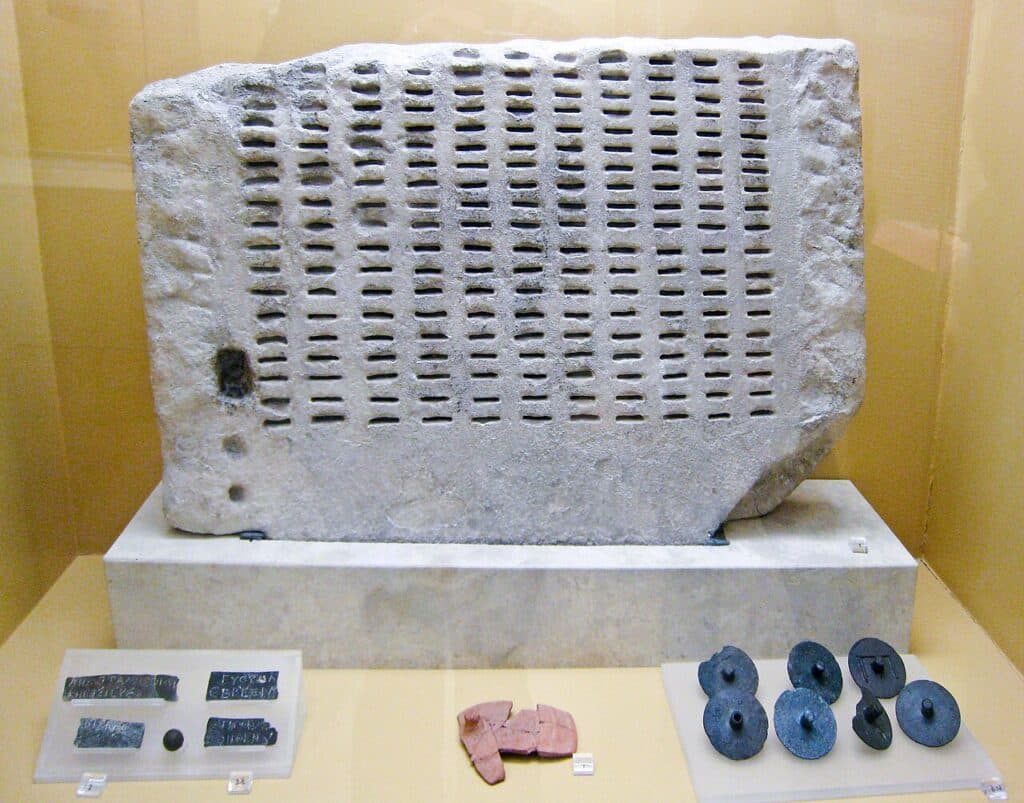
Kleroterion made of marble with identification tickets (pinakia) that were inserted in the slots to indicate eligible jurors. Exhibited at the Ancient Agora Museum in Athens. Credit: Sharon Mollerus Flickr CC BY 2.0
One of the most remarkable inventions of Ancient Athenian democracy was a device used to randomly select citizens for public duties such as jury service and public office.
The kleroterion consisted of a stele with horizontal rows of slots on its front and a vertical metal tube attached to the side. Prospective jurors inserted small, flat bronze tokens known as pinakia into these slots, each engraved with their name, their father’s name, and their deme (municipality). Black and white metal spheres were then placed into a funnel and released into the tube in a randomized sequence.
Candidates whose pinakia aligned with a white sphere were selected as jurors, while those aligned with a black sphere were not. Multiple kleroteria (plural) were installed in front of each court to handle the selection process.
Developed in Classical Athens during the 5th century BC, the kleroterion embodied a radical principle for its time: that ordinary citizens, rather than elites or hereditary rulers, should take part in governing the state through equitable civic participation. Within the broader framework of Ancient Athenian democracy, it represented a systematic effort to formalize political equality.
Although the process may appear simple by modern standards, it was highly innovative in the ancient world. Instead of elections shaped by wealth, family influence, or popularity, the Athenians relied heavily on sortition, or selection by lottery. The kleroterion mechanized this system and significantly reduced opportunities for corruption. Eligible citizens would arrive at the court and place their pinakia into the appropriate slots of the kleroterion, with each column representing a tribe and reflecting the political organization of Athens established after the reforms of Cleisthenes around 508 BC.
Archaeological discoveries, particularly from the Athenian Agora, have confirmed ancient written accounts and revealed the sophistication of the system. The kleroterion ultimately illustrates how deeply equality, civic participation, and safeguards against corruption were valued within Athenian democracy.
The foundations of Athenian democracy and the kleroterion
The foundations of Ancient Greek democracy in Athens were established through the reforms of Cleisthenes in 508–507 BC and later expanded during the 5th century BC under leaders such as Pericles. During this period, Athens actively sought to prevent the concentration of political power in the hands of aristocratic elites. One of the key mechanisms used to achieve this goal was random selection. As Aristotle explains in Politics (Book IV, 1294b), the distinction between democracy and oligarchy was clear and fundamental: “It is accepted as democratic when public offices are allocated by lot; and as oligarchic when they are filled by election.”
This statement highlights the ideological importance of the kleroterion within Athenian democracy. Elections tended to favor wealthy and influential citizens who already possessed reputation, education, and good social networks. Random allotment, by contrast, gave ordinary citizens an equal opportunity to participate in governance. The Athenians believed that political equality, or isonomia, depended on broad participation from the citizen body rather than dominance by a small elite.
The kleroterion was particularly significant in the selection of jurors for the dikasteria, the large popular courts of Athens. Each day, thousands of jurors were chosen to hear legal and political cases. Aristotle also describes this procedure in The Constitution of the Athenians (63): “Each juror, after presenting his ticket, receives a staff and enters the court to which the lot assigns him.”
Random selection in the courts was designed to make bribery and manipulation far more difficult. Because no one could predict who would serve on a given jury, corrupt politicians and wealthy litigants found it harder to influence outcomes in advance. In this way, the kleroterion functioned as a safeguard against corruption and tyranny in Ancient Athenian democracy. In a society deeply wary of concentrated power, randomness itself became an essential democratic instrument.
The randomization process in Ancient Athenian democracy
The randomization process operated in several stages. Citizens first inserted their tokens into the designated slots of the kleroterion. Colored balls were then released from the attached tube in a randomized sequence. A white ball typically indicated that a corresponding row had been selected, while a black ball signaled rejection. Citizens whose tokens aligned with the selected rows would then serve on juries or councils.
This system helped ensure a fair distribution of civic responsibility across different tribes and social groups. Over the course of their lives, thousands of Athenians could participate directly in governing roles. Thus, political participation was understood not merely as a privilege but as a civic duty requiring active engagement.
Regular rotation of officeholders also helped limit the emergence of entrenched political elites. Ancient historians often emphasized the active role of ordinary citizens in Athenian political life. Thucydides, in his account of Pericles’ Funeral Oration in History of the Peloponnesian War (II.37), captures this democratic ethos: “Our constitution is called a democracy because power is in the hands not of a minority but of the whole people.”
Through the kleroterion, this ideal of collective governance was translated into practical reality. Ordinary citizens could be selected to serve on juries or councils at any time. A farmer, craftsman, or merchant might suddenly find himself serving alongside fellow citizens, reinforcing civic identity and strengthening a shared sense of responsibility for the polis.
Modern classicists on the significance of the kleroterion in Ancient Athenian democracy
Modern historians have long recognized the revolutionary nature of the kleroterion system. The classical scholar M. H. Hansen writes in The Athenian Democracy in the Age of Demosthenes: “The Athenians regarded sortition as the most democratic method of selecting officials because it gave every citizen an equal chance of holding office.”
Hansen’s observation underscores how differently the Athenians understood democracy compared to most modern states. Today, democracy is commonly associated with representative elections, but in Athens, elections were often viewed as less democratic precisely because they enabled wealth, status, and rhetorical skill to dominate political life. In contrast, the kleroterion directly challenged social hierarchy by affirming that ordinary citizens were fully capable of public service.
Hansen also emphasizes that the system reflected confidence in collective civic wisdom rather than reliance on specialized expertise. Offices assigned by lot were typically short in duration, and officials were subject to scrutiny both before and after their terms of service. This structure helped reduce the risks associated with inexperience while maintaining broad participation. In practice, Athenian governance depended less on professional politicians and more on the continual rotation of citizens through public duties.
Another modern scholar, Paul Cartledge, highlights the symbolic dimension of the kleroterion in Democracy: A Life, writing: “The allotment machine was democracy made stone.” Cartledge’s phrase captures the broader cultural significance of the device. The kleroterion functioned not only as an administrative tool but also as a physical embodiment of democratic equality. Each citizen’s bronze token occupied an identical slot, with no distinction between aristocrat and laborer once the allotment process began. In this sense, the machine itself stood as a tangible symbol of political fairness and civic equality.
Ordinary citizens in public office
The kleroterion also reflected broader Greek ideas about fate, equality, and civic order. Although the use of chance in political selection may seem unusual to modern observers, the Athenians believed that sortition helped prevent factionalism and personal ambition from undermining the state. Because officeholders could not easily manipulate or predict their selection, the process reduced political competition and eased social tensions.
As historian Josiah Ober explains in his book Mass and Elite in Democratic Athens, “Lottery selection was intended to institutionalize political equality and to minimize elite domination.” Ober argues that Athenian democracy succeeded in part because it actively integrated ordinary citizens into the institutions of the state. The kleroterion was central to this integration. By opening public roles to a broad cross-section of the citizen body, it encouraged loyalty to the polis and helped reduce the alienation often associated with political exclusion.
At the same time, the system had clear limitations. Citizenship was restricted to free adult males born to Athenian parents, while women, enslaved people, and foreigners were excluded from participation. As a result, the democracy supported by the kleroterion was limited according to modern standards. Even so, within the citizen body itself, it pursued political equality to a remarkable degree. The idea that ordinary individuals could collectively govern was profoundly innovative in the ancient world.
The decline of Athenian democracy in the 4th century BC and the subsequent rise of Macedonian power led to the reduced use of institutions such as the kleroterion. Nevertheless, its intellectual legacy endured. Political philosophers and modern democratic theorists continue to debate the value of sortition, and some contemporary scholars have even proposed reintroducing forms of random selection to modern governments as a way to counter corruption, polarization, and elite dominance. In several modern democracies, citizens’ assemblies selected by lot reflect renewed interest in these ancient practices.
Archaeological evidence has further enriched modern understanding of the kleroterion. Excavated examples, now displayed in museums, reveal the advanced administrative organization of Athens. These carefully constructed stone devices demonstrate the seriousness with which democratic participation was approached. Far from being primitive or chaotic, Athenian democracy relied on highly structured procedures to ensure fairness, accountability, and broad civic involvement.
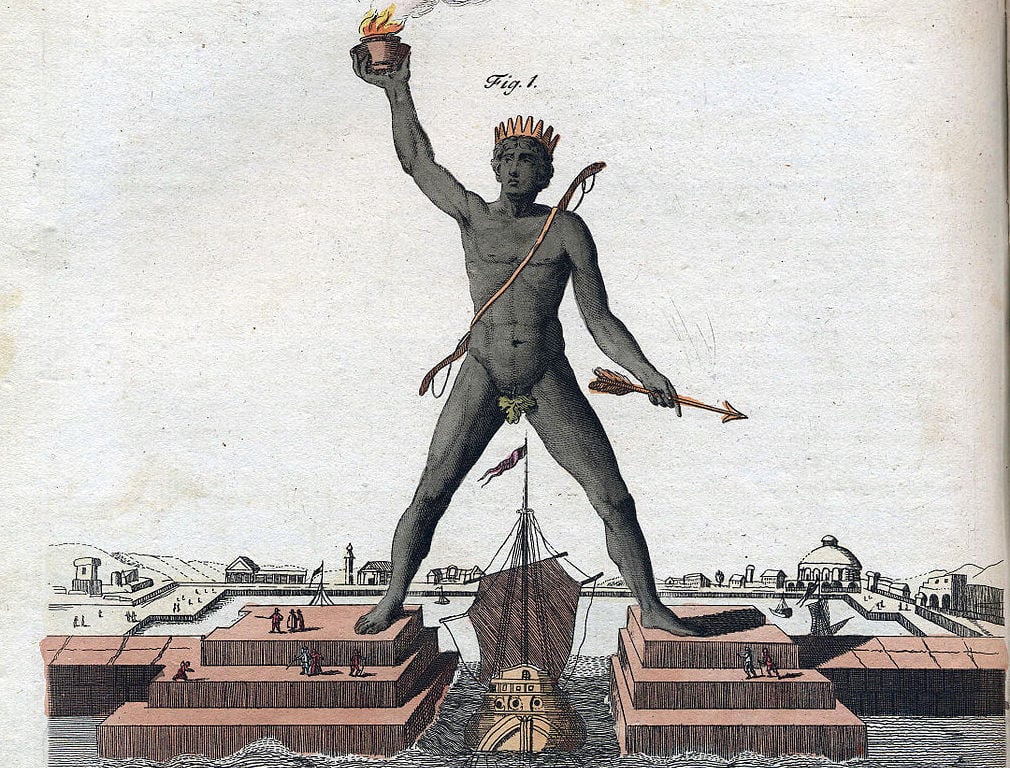
Artist’s depiction of the Colossus of Rhodes (one of the Seven Wonders of the Ancient World). Credit: Public Domain.
Most people today know of the Colossus of Rhodes as one of the Seven Wonders of the Ancient World, but there are many little-known facts about the masterpiece that may surprise you.
The ancient island of Rhodes, the kállistin (best) of the Greek cities as historians like to call it, has long attracted the attention of the world due to its beautiful beaches, rich history, and advanced civilization that stretches far back in time.
Rhodes was a city with philosophical and other schools, conservatories, markets, stadiums, harbors, and at least 3,000 public statues.
The masterpiece of all, though, was the Colossus of Rhodes, built between 292 to 280 BC. The huge bronze statue was about 30 meters (98.4 feet) tall and portrayed the god of the Sun, Helios.
The construction of the Colossus lasted for 12 years, but the statue was destroyed a few decades later in 226 BC by an earthquake.
Lesser known facts about the Colossus of Rhodes
The Colossus of Rhodes and the Statue of Liberty
Both monuments were built as symbols of freedom, and people have made the connection between both statues since the Statue of Liberty was created.
The Statue of Liberty has been referred to as the “Modern Colossus” and stands just a little higher at 34 meters (111.5 feet) tall.
There is also a plaque inside the pedestal of the Statue of Liberty that is inscribed with a sonnet title “The New Colossus, not like the brazen giant of Greek fame.”
The debate about the statue’s feet
There has been a debate among historians about whether the statue was standing with one foot on either side of the Rhodes harbor.
Some have discounted this theory and believe that he stood in a more usual Greek statue pose on one side of the harbor.
If the Colossus of Rhodes was built with its legs straddling the harbor, then the harbor would have had to have been closed for 12 years for the initial construction, and then it would have once again been blocked for years when the statue fell.
The statue has an iron skeleton
The statue was actually built with an iron frame like a skeleton over which the Rhodians placed carved and sculptured brass plates to create the outer structure of Helios, creating his muscle and skin.
Chares of Lindos designed the Colossus of Rhodes
We owe the design of the Colossus of Rhodes to Chares of Lindos. Chares was a student of the famous sculptor Lysippus, who had previously created a 19-meter (62 foot) tall statue of Zeus.
The metal used to construct the statue later scrapped, sold
In the 7th century A.D., the Arabs conquered Rhodes and dismantled any remnant of the Colossus of Rhodes after it was toppled by an earthquake and later sold the once beautiful statue as scrap metal.
It took approximately 900 camels to carry away all the scrap metal.
Was the destruction of the Colossus the will of the gods?
Finally, Ptolemy III, the king of Egypt, offered to pay for the Colossus’ reconstruction, but the Rhodians refused because they believed that Helios, having been angered by the construction of the statue, was the one who caused the earthquake that destroyed it.
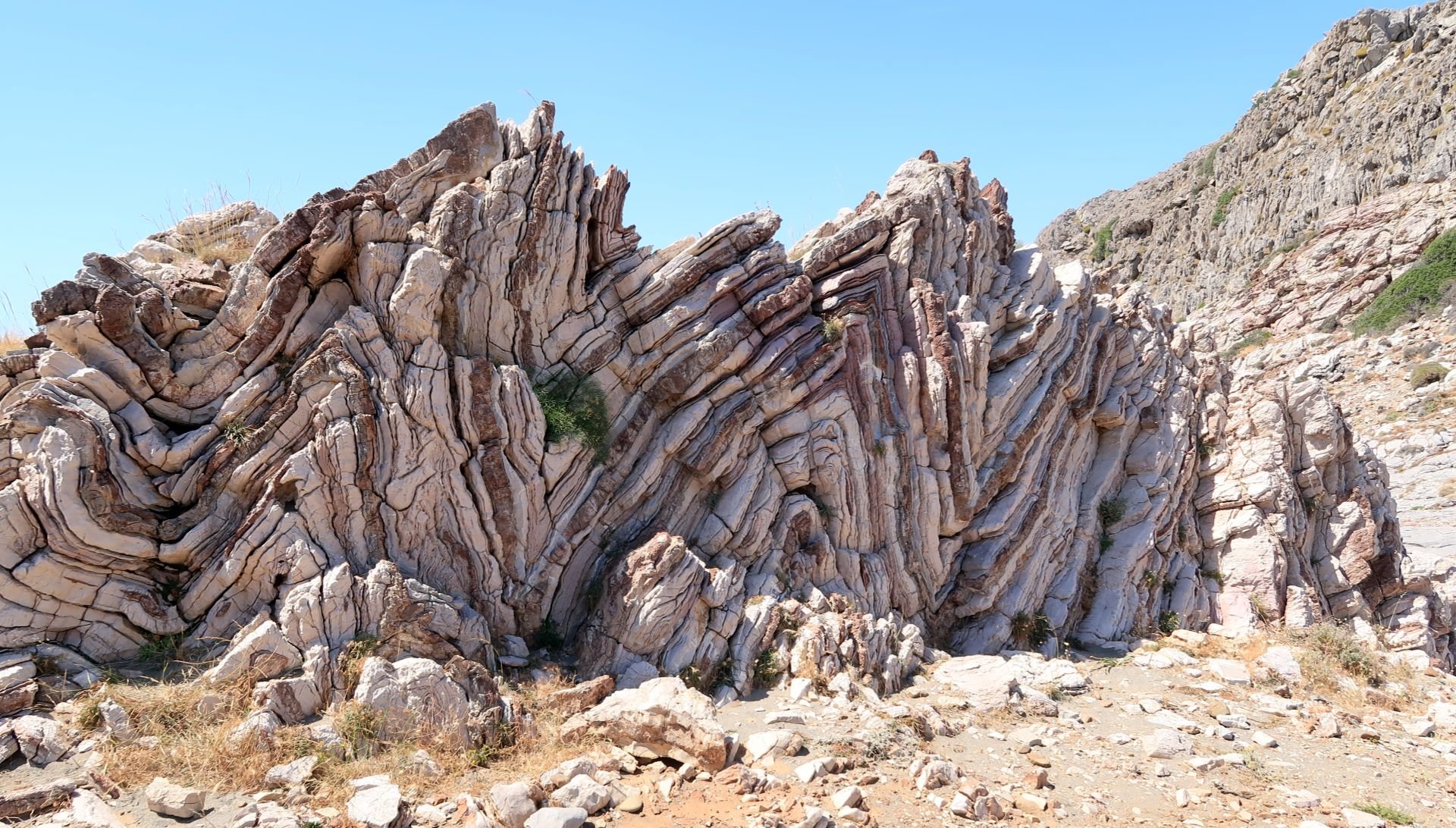
A stunningly unique phenomenon of geology in Greece: The Folded Marls near Agios Pavlos, on the island of Crete. Credit: Tony Cross.
By Tony Cross
Greece and its geology are a wonder of nature, with the nation a paradise blessed with high mountains, blue seas, and over six thousand islands. But it’s all a big geological accident, the result of millions of years of violent earth movements on a planetary scale.
Geology in Greece: in the beginning…
The story of Greece and its geology begins around 250 million years ago when the continents had all come together into one single land mass that geologists call Pangea.
The area that would one day become Greece lay on the southern shore of what would eventually become Europe and on the northern edge of a great ocean called Tethys. On the southern edge of Tethys lay the continent that would one day become Africa.
The Earth’s crust is not all the same, nor is it a single unit. The crust making up the continents is very thick—30 km to 40 km (18.6 to 24.85 miles) thick—and thicker still under mountain ranges. The crust under the oceans is quite thin, however, at only around 7 km (4.3 miles) thick.
In addition, the crust is not one single unit but is broken up into various-sized chunks known as tectonic plates. These plates move relative to one another because they are literally floating on the deformable layer of the upper mantle beneath them in much the same way that a ship floats on the sea.
In some places, these plates are moving together, and where oceanic crust is pushed into continental crust, the thinner oceanic crust is forced beneath the thicker continental crust and down into the mantle, where it begins to sink and melt. Geologists call this type of plate boundary a subduction zone.
The Greek landscape and geology that we see today is here because of a subduction zone. Without it, Greece would simply not exist.
The compressive phase
Around 150 million years ago, the great continent of Pangea started to break up. The African plate began to move northwards, and the Tethys Ocean started to shrink. The northwards movement of Africa meant that the oceanic crust beneath Tethys was subducted under the southern edge of the continental crust of Europe.
As the oceanic crust under Tethys slid beneath the continental crust of Europe, all of the rocks that had formed on the ocean floor over many millions of years were scraped off by the leading edge of the European continent. These rock scrapings, which would have been hundreds of meters thick and many kilometers long, were piled up one on top of the other on the southern edge of Europe.
This rock pile (geologists call it a nappe) was likely many kilometers thick in the end. It contained all the rocks that would eventually form Greece’s geology all piled up in the same place.
A thrust fault near Kavousi, Crete. Credit: Tony Cross.
The photo shown here is of a large sea cliff near Kavousi on Crete. The rocks on the left are a gray color with clearly defined horizontal layers. Those on the right are a greenish brown color with a nearly vertical layering. Clearly, this cliff is composed of two very different rock types.
The rocks on the left are limestones while those on the right are phyllites. The compressional forces of the subduction zone forced the phyllites over and on top of the limestones. The junction between the two (known as a thrust fault) lies roughly in the center of the picture, running diagonally up from right to left.
Millions of years of weathering and erosion have ground both sets of rocks down so that to the casual observer today, they appear to be a single unit.
The tensional phase
Around 65 million years ago, the continent of Africa finally collided with the continent of Europe and closed the Tethys Ocean forever. It would eventually be reborn as the Mediterranean Sea.
When two continental plates come together, there is no subduction since they are both too thick. Instead, the continents themselves are deformed, and mountains are created. In the west, this collision formed the Alpine mountains while in it formed the Balkan mountains in the east.
In these mountain areas, the continental collision destroyed the subduction zone, but in the area in between, where modern Greece lies, the subduction zone remained active.
Even though Africa could no longer move northwards as fast as was previously the case, the oceanic plate in the area of Greece was still sinking into the mantle. As it sank, the subduction zone itself rolled back southwards. This rollback of the subduction zone put the nappe pile under enormous tension.
When rocks are placed under tension, they break, causing normal faults. One side of the fault moves downwards on a sloping surface to relieve the tension. Normal faults often occur in parallel and in swarms leaving alternating areas of high ground with lower ground in between.
The rollback of the subduction zone caused massive parallel swarms of normal faults in the nappe pile. Because the subduction zone is fixed in the east and in the west, the rollback created an arc that is ever expanding as the rollback progresses.
A normal fault in the Corinth Canal. Credit: Tony Cross
The photo above is of a small section of the north wall of the Corinth Canal. The rocks here are nicely layered; we can see yellow, white, red, and black layers.
The two diagonal lines in these rocks are normal faults, breaks in the rocks caused by tensional forces due to the rollback of the subduction zone. The rocks to the right of each fault have dropped down relative to the rocks on the left; this is clearly visible in the displacement of the colored layers of rock.
The total vertical displacement here is only a few meters, but in the massive regional faulting that shaped Greece and its geology, displacements are measured in kilometers.
The modern topography of Greece
Looking at a topographical map of Greece today, you can see how a subduction zone, starting roughly in the area of the north Aegean and rolling back southwards in an expanding arc would create the “ripped” and “torn” appearance of Greece today. You can also see how regional faulting created the alternating series of high mountain ranges and islands, with lower plains or sea in between.
The Pindus Mountains, for example, the backbone of mainland Greece, run southeastward in a gently curving arc. On both sides are lower plains. These mountains, like so many others in Greece, are bounded by massive regional faults.
The expanding arc of the subduction zone caused extensive local faulting, too. On Crete, for example, all of the mountain ranges are bounded by faults. They stand tall because the ground around them has dropped due to faulting. Such local, fault-bounded structures are widespread in Greece.
What about the volcanoes?
There are many volcanoes in Greece—on Santorini, Milos, Nisiros, Methana, and Sousaki among others. Some are active, like Santorini; most are dormant, like Milos, and one or two are extinct, like Sousaki.
If you look closely, all the Greek volcanoes sit on an arc that parallels the arc of the subduction zone but is north of it by about 100 km.
As the oceanic plate is subducted deep into the mantle, it begins to melt. Magma from the melting plate rises to the surface where it erupts, forming volcanoes.
The hot springs of Thermoplyae (of Spartan fame) sit at one end of this volcanic arc; the hot springs of Pamukkale in Turkey sit at the other. In between are all the Greek volcanoes, formed above the spot where, deep in the mantle, the subducted oceanic crust is melting.
Greece’s geology continues to change
The subduction zone today runs in a great arc down the western side of the Ionian Islands, around the Peloponnese and south of Crete, and then curves up northwards again past Kasos, Karpathos, and Rhodes.
Greece and its geology as we see these today are not an end point, however; this is simply the way things are right now.
The subduction zone is still active, and the oceanic plate is still descending as Africa creeps northward. The subduction zone is still rolling back, and the arc is still expanding. That’s why we have so many earthquakes in Greece—we’re still being torn apart by tectonic forces.
We don’t need to worry about this too much though, as these geological processes happen on a timescale that is measured in millions of years. Chances are, that beautiful Greek beach in the travel brochure will still be there when you arrive.
Sack of Corinth, by Thomas Allom, 1872. Credit: Wikimedia Commons, public domain
The formation of the Roman Empire was a gradual process, unfolding over several centuries. Nevertheless, there is one specific year that we can point to as arguably the single most significant year in the formation of the Roman Empire. This was the year 146 BCE. How did the events of this year lead to the creation of the Roman Empire?
The gradual formation of the Roman Empire
In an administrative sense, the Roman Empire was founded in the year 27 BCE. This was when Octavian, the son of Julius Caesar, became the emperor. The Roman Senate recognized him as possessing overarching military power and designated him Augustus in recognition of his new position as emperor.
Octavian established reforms to the constitution, officially changing Rome into an empire. Hence, in 27 BCE, the Roman Empire came into existence. Before then, it had been a republic.
However, although it only became an empire in an administrative sense in 27 BCE, Rome already controlled a vast empire before that. In the basic sense of “a group of countries ruled by a single person, government, or country“, Rome was already an empire long before the days of Octavian.
The Roman Republic conquered most of the territory that would constitute the future Empire. Therefore, to understand how Rome became powerful, we need to examine that era.
The acquisition of territory was a gradual process that took several centuries. However, the year 146 BCE, arguably more than any other, was crucial in the formation of the Roman Empire.
The Battle of Corinth
In 146 BCE, two significant events occurred for the Romans. One of these was the Battle of Corinth, marking the culmination of the Achaean War, which lasted only a single year.
At that time, the Achaean League ruled over the Peloponnese. They had recently assimilated Sparta into the league, which troubled Rome. Both sides were concerned with the other’s expansionist tendencies. Rome had conquered Macedonia in the early part of the second century BCE and had reconquered it in 150-148 BCE.
In the final year of the war against Macedonia, the Achaean League took control of Sparta, solidifying their hold on the Peloponnese. With tensions high due to the actions of both sides, war broke out two years later, in 146 BCE.
The war did not last long. The Achaean League was woefully unprepared, both militarily and financially, for a full-scale war against Rome. The Romans quickly subdued the Greek cities, many of which took the initiative to surrender.
A Roman consul and military general named Lucius Mummius led the Romans in their siege of Corinth. This was the climax of the war. The Romans successfully defeated and utterly destroyed it. Their brutality was noted even by ancient historians. With this victory, the Romans gained direct control of all of Greece.
The Siege of Carthage
The same year, 146 BCE, also marked the climax of another war. The war in question was the Third Punic War. This was the third war between the Roman Republic and the Carthaginian Empire.
Carthage was located in modern-day Tunisia. Rome had already defeated them in the Second Punic War, which had ended in 201 BCE. One of the terms of the treaty was that Carthage was prohibited from engaging in war without Rome’s permission. This allowed Rome’s ally, Numidian king Masinissa, to repeatedly invade Carthage’s territory.
Carthage’s decision to fight back and send an army against Masinissa in 149 BCE provided the Romans with a justification for a third war against Carthage. In reality, Rome harbored animosity towards Carthage and was merely seeking an excuse to destroy it.
When the Roman army arrived, the Carthaginians offered a complete surrender. Nevertheless, the Romans persisted and besieged the city. Eventually, after considerable brutality and bloodshed, the Romans utterly destroyed their enemy.
Just like Corinth in that same year, Carthage was completely, mercilessly destroyed, and the Romans took over the territory.
How the year 146 BCE led to the creation of the Roman Empire
Given this information, 146 BCE can be regarded as vital in the creation of the Roman Empire. The Romans achieved two major victories this year: the defeat of the Achaean League and the defeat of Carthage.
Both of these victories significantly expanded the territory of the Roman Republic. Rome took over control of all of Greece and also the core territory of the Carthaginian Empire in Tunisia. Granted, this was only a tiny portion of what later became the territory of Rome’s vast empire.
However, the main impact that this year had on the formation of the Roman Empire was not the territory gained. Rather, it was the geopolitical consequences of these victories that mattered the most.
Carthage and the Achaean League were both major powers in the Mediterranean. With their defeat, Rome became the undisputed master of that part of the earth. While it still had numerous enemies to confront, it no longer had a single, major, powerful rival.
Over in Anatolia, Pergamon was friendly with Rome. Ptolemaic Egypt was also their ally, with Rome exerting considerable influence over that region. With Greece and Carthage out of their way, Rome’s position as the dominant force in the Mediterranean was firmly established. It is for that reason that we can consider 146 BCE as such a crucial year in the formation of the Roman Empire.
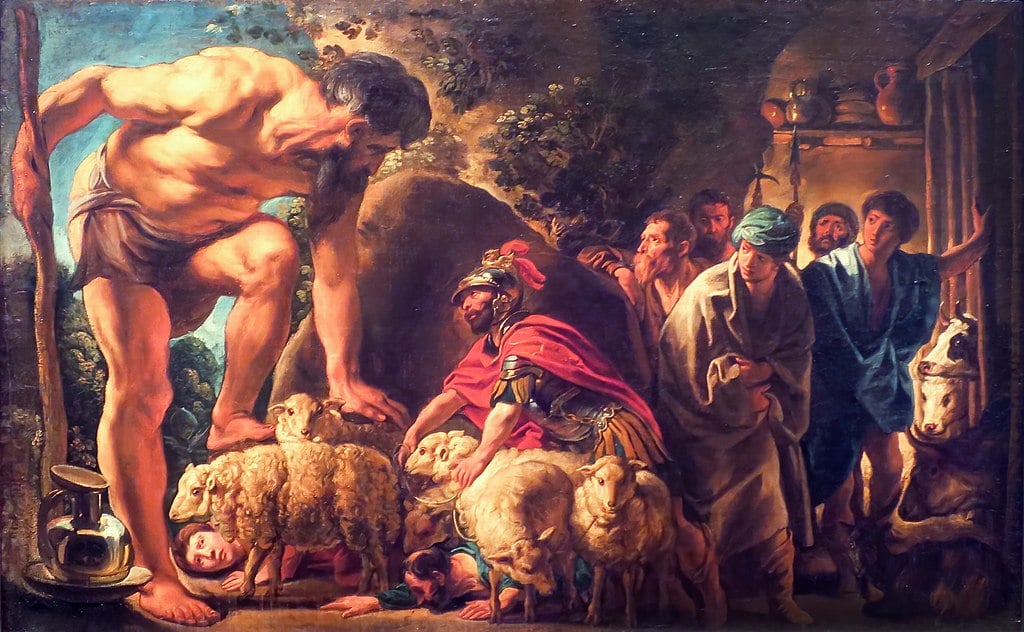
Did Odysseus Travel to Ireland? Credit: Public Domain
Homer’s Odysseytells the tale of Odysseus returning to his home after the Trojan War. For a variety of reasons, the trip is not an easy one. It takes him a full ten years to return home.
But the journey from Troy to Ithaca, Odysseus’ home island, should not have been too difficult and certainly not a ten-year trip. For this reason, some researchers have claimed that Odysseus actually traveled outside of the Mediterranean. There is even the suggestion that he traveled to Ireland.
Odysseus travel to Ogygia and its connection to Ireland
In the Odyssey, one of the places Odysseus visits is an island called Ogygia. This was the home of the nymph Calypso, who offers Odysseus immortality if he agrees to marry her. She refuses to let him leave otherwise. The gods intervene and force Calypso to release him. Hence, after seven years on the island, Odysseus builds a raft and sails away.
The location of Ogygia has been the subject of considerable speculation. According to Homer’s account, the island is a place of beautiful meadows, fountains, woods, and various types of birds. However, none of this is particularly helpful. All sorts of islands could fit this description.
In ancient times, various suggestions were made as to where Ogygia might actually be located. More recently, some scholars have argued that Ogygia is identical to Ireland. If this identification is correct, this would mean that Odysseus spent seven years in Ireland.
The most notable scholar to have come to this conclusion was Roderick O’Flaherty. In 1685, he used the name ‘Ogygia’ as a synonym for Ireland in the title of one of his books. It was called: Ogygia: Or a Chronological Account of Irish Events.
Plutarch’s account of Ogygia
One of the key pieces of evidence used to support the identification of Ireland as Ogygia is a passage written by Plutarch, a historian of the first century CE. He wrote about Homer’s account of Ogygia in conjunction to other additional information he provided. According to Plutarch, Ogygia was situated to the west of Britain, which is where Ireland is in fact located.
Additionally, Plutarch tells us that Ogygia was five thousand stadia away from the ‘great continent’ which surrounded the ‘great sea.’ Several scholars have suggested that this ‘great continent’ actually refers to America. Examples include Wilhelm von Christ, an eighteenth-century German scholar, and Johannes Kepler, a sixteenth-century German scholar.
If the ‘great continent’ mentioned by Plutarch really was America, then that would mean that Ogygia was actually an island somewhere between Britain and America. Since Plutarch says that Ogygia was five thousand stadia from the great continent but only several days distant from Britain, this indicates that it was much closer to Britain than to America. Therefore, Ireland would seem to be a good match.
Problems with identifying Ogygia as Ireland
While Ireland does match Plutarch’s basic description, there are certain issues with this identification. For one thing, Ireland is not five thousand stadia from America. This distance would be the equivalent of a little over nine hundred kilometers. Nevertheless, the distance between Ireland and America is about three thousand kilometers.
Hence, the distance specified by Plutarch means that Ireland is in fact not Ogygia, if America was indeed the ‘great continent’ to which he referred. Clearly, however, there is no other option for the great continent that would fit the passage.
Another problem is that Plutarch states that it takes five days of sailing to travel between Britain and Ogygia. This would indicate an island much further west than Ireland because it would barely take two days of sailing to reach Ireland from the furthest part of the western side of Britain.
In reality, there is no island which is exactly five days’ sailing away from Britain and also five thousand stadia away from America. The measurements simply do not correspond to any real location.
Perhaps, then, some researchers could use this as evidence that the measurements must be incorrect, meaning that Ireland could still be the intended location. Alternatively, it could of course also mean that Plutarch was not really describing an actual location at all.
Greek fire was the mysterious weapon used by the Byzantines to destroy enemies and prospective invaders, keeping the Empire strong and awe-inspiring.
The Byzantine liquid fire that protected the Empire was a terror-inspiring incendiary weapon that protected the Empire for centuries. Widely known as Greek Fire, this mighty weapon enabled the Byzantine Empire to survive and maintain its power through many attacks from various enemies.
The weapon could be compared to the modern day flame-thrower. To the enemy in Byzantine times, it looked like a machine spewing destructive fire from hell. However, its exact origin remains unclear, and the recipe for this formidable weapon is still unknown, puzzling scientists and historians.
A Byzantine ship using Greek fire against a ship . On top, Greek alphabet in Byzantine form. Credit: Public Domain
Records suggest Greek fire contained a mix of petroleum, quicklime, and other unknown ingredients. This potent combination is believed to have made it one of the most flammable and dangerous substances of its time. What was truly amazing about the Byzantine liquid fire weapon was that it continued to burn on water and was practically impossible to put out with medieval means.
It helped the Empire maintain sovereignty over the mass land it occupied, spanning all of Southern Europe, North Africa, and Asia Minor. The weapon’s impact on the course of history is undeniable. It played a key role in the defense of Constantinople and the preservation of the Byzantine Empire.
A Brilliant Invention
Fire as a weapon had been used for centuries but never in such a sophisticated and destructive means as the Greek fire (or Υγρόν πυρ – Hygron pyr, as it was referred to in Greek). It was the Crusaders who referred to it as Greek fire or “liquid fire,” “Roman fire,” or “sea fire.” It was a significant weapon that never ceased to terrify the enemy.
This innovative weapon would fire massive flames in a continuous jet, burning a trail of destruction in its path that was nearly impossible to extinguish. When it came to naval warfare, it was a weapon that was impossible for the enemy to defend their ships from. Yet, the exact recipe for the liquid fire substances the Byzantines used remains a mystery to this day.
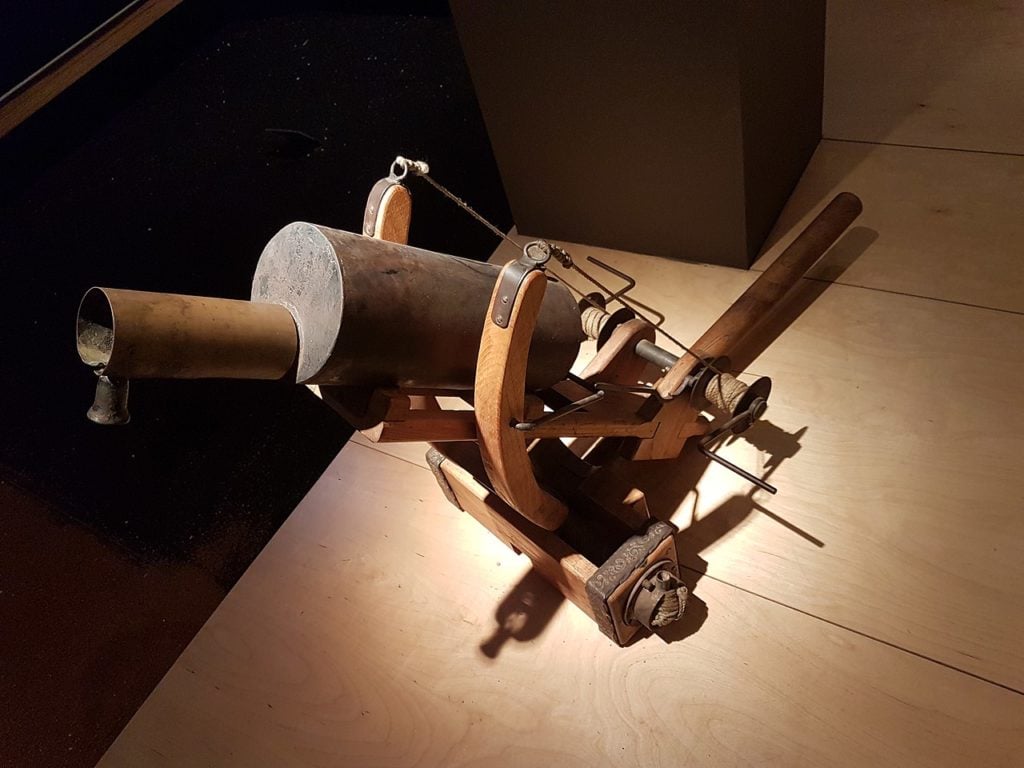
The Greek fire cannon-like machine was created in the seventh century. It most likely was the invention of Kallinikos of Heliopolis, a Jewish architect who fled from Syria to Constantinople. It was between 674 and 678 when the Byzantine Empire was attacked by the Islamic fleet of the Umayyad caliphate that had already taken over parts of Syria.
Concerned about an Islamic attack against Constantinople, Kallinikos experimented with a variety of materials until he discovered a mix for an incendiary weapon. Kallinikos sent the formula to the Byzantine emperor, and authorities developed a siphon that operated somewhat like a syringe, propelling the fiery concoction toward enemy ships.
Emperor Constantine IV reluctantly ordered the use of Greek fire to destroy the Umayyad fleet. However, the Byzantine weapon was very successful. According to historian Kelly DeVries and his book Medieval Military Technology, it was the first reported use of an incendiary weapon in battle.
Was Byzantine Liquid Fire a State Secret?
Some historians believe the reason the recipe for liquid fire remains unknown is because Byzantine emperors wanted to keep it a state secret, never to fall into the hands of the enemy. The vast Empire was surrounded by numerous enemies coveting its lands. Liquid fire was a potent deterrent to any army that would think of invading.
Constantine VII Porphyrogenitus warned his son Romanos II to not reveal the recipe “and not to prepare this fire but for Christians, and only in the imperial city.”
Anna Komnene, daughter of Emperor Alexios I Komnenos (r. 1081-1118) and a historian, wrote about the recipe for Greek fire:
This fire is made by the following arts: From the pine and certain such evergreen trees, inflammable resin is collected. This is rubbed with sulfur and put into tubes of reed, and is blown by men using it with violent and continuous breath. Then in this manner it meets the fire on the tip and catches light and falls like a fiery whirlwind on the faces of the enemies.
It was not that straight-forward, of course. Otherwise, it would be easy for the enemy to recreate the fiery weapon. It seems indeed that the Byzantines intended to keep the process of creating the liquid fire top secret, as no friend or enemy ever managed to gain insight into this so as to construct their own similar weapon.
Use of a hand-siphon, a portable flame-thrower, from a siege tower. Detail from the medieval manuscript Codex Vaticanus Graecus 1605. Public Domain
Greek Fire in Battle
In his book, Devries explains that Greek fire can refer to three different weapons: firstly, a fiery liquid pumped out of a nozzle; secondly, a liquid weapon that was filled in small grenades; and thirdly, a solid incendiary probably based on gunpowder.
The third is impossible to have been used in Byzantium. Its reported use started in the fourteenth century in Western Europe. However, there are Byzantine era depictions of men carrying hand-held tubes spitting fire that look even more like modern flame-throwers.
In fact, Greek fire was rarely used except primarily in naval battles, as the apparatus was complicated and required technically equipped handlers. Furthermore, it was dangerous to have an incendiary mechanism on a wooden ship.
In 727, Emperor Leo sent a fleet to burn that of Hellas and Cyclades, who had been revolting against him. In 941, a Rus naval raid from Kiev across the Black Sea was stopped, and their fleet was annihilated by the Byzantines.
Reportedly, in the eleventh century, Viking Ingvar the Far Travelled encountered ships equipped with the weapon, which he described as “a brass (or bronze) tube and from it flew much fire against one ship, and it burned up in a short time so that all of it became white ashes…”
However, by the end of the twelfth century and the Angeloi emperors, the Empire started to decline, losing more and more land to the rising Ottoman Empire. As Byzantium began to fade, so did the use of Greek fire until it became but a simple chapter in the great history of the Byzantine Empire.
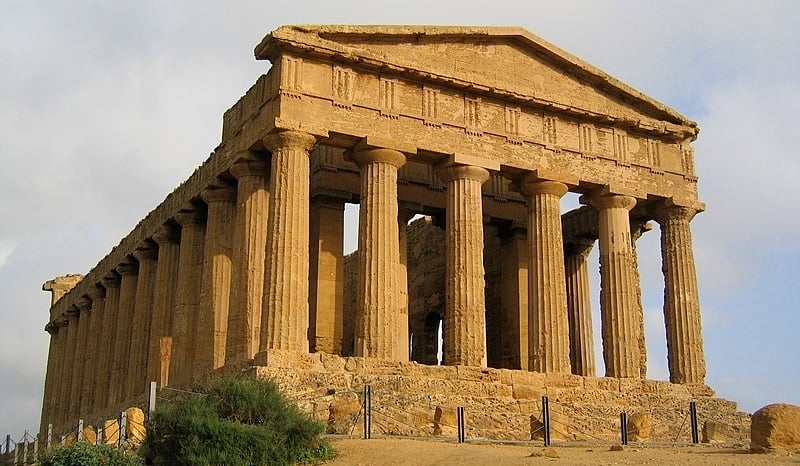
Temple of Concordia – Agrigento, Italy. Credit: Public Domain
When you think about Italy and ruins, your mind’s eye automatically brings up scenes of the Roman Forum and the Colosseum. However, Italy is home to countless ruins which are actually ancient Greek—many of which remain in stellar condition.
The country’s mainland, as well as the island of Sicily, are dotted with Greek ruins—some of which are integrated into modern-day cities and are still even used to host events! Others can be found in isolated locations well off the beaten path.
Ancient Greek Ruins of Italy
As you travel through Italy, as you really should if you call yourself a well-traveled individual, be sure to say “Opa!” as often as you say “Mamma mia!” The following are just some of the truly jaw-dropping ancient Greek ruins which are scattered throughout the Italian countryside.
Paestum
Located in southern Italy along the coast of the Tyrrhenian Sea in what was then called “Greater Greece” or Magna Graecia, this was a major Greek city in ancient times. The ruins date back to 600 to 450 B.C. and are some of the best-preserved Greek temples in the world!
The three famous ancient Greek temples at this site are of the Doric type, and the ancient city walls and amphitheater are mostly intact. The bottom section of walls from many other structures are completely intact.
It is an amazing experience to be able to walk along the ancient stone-paved roads and view the buildings along the roadsides just as the ancients did. The site is open to the public, and there is a modern national museum on-site for you to check out as well.
Another plus is that this archeological site is well off the beaten path and is seldom crowded with visitors!
Locri Epizefiri
Also on the mainland of Italy, in Reggio di Calabria, you will come across the ancient ruins at Locri. The ancient city has been mostly taken over by the encroachment of the nearby towns.
However, the area is very much worth a visit because the atmosphere quiets as you pass through shady olive groves and meander along the overgrown pathways. It is here where you will inevitably, and literally, stumble across a treasure of ancient ruins.
Greek temples, amphitheaters, and the well-known Sanctuary of Persephone grace the Locri area. The magical experience is truly something you shouldn’t miss out on.
On the island of Sicily, some truly remarkable ruins are yours to explore, starting with the still-used ancient Greek Theater of Taormina!
The Ancient Greek Theater of Taormina
With the beautiful Mediterranean sea lapping at the shores below and the active volcano of Etna looming over the city, Taormina is an upscale destination, featuring cultural events, museums, and priceless antiquities—right in the middle of a bustling city!
The ancient theatre of Taormina. Credit: Public Domain
Here you will find an ancient Greek amphitheater with exquisite views of both the volcano and the sea. While there, you might even be lucky enough to see a show at the ancient theater. It was originally built in 300’s B.C. and subsequently rebuilt by the Romans in the second century B.C.
Valle dei Templi in Agrigento
In Argrigento, you will be treated to refreshing views of expansive fields and woodlands—as well as one of the most pristine ancient Greek ruins in existence in the Valle dei Templi (the Valley of Temples).
Many of the temples and ruins here are not fenced off, so travelers may walk inside and be transported back to the fifth century B.C., when the Greeks first built the ancient city of Akragas. One of the most well-preserved Greek temples in the world, the Temple of Concord, is in this valley.
Segesta Archaeological Site
Segesta is located only 70 kilometers (43 miles) southwest of Palermo. Fortunate travelers here can visit what is perhaps the second most well-preserved temple in the world after those in the Valle dei Templi. Segesta also boasts a beautiful amphitheater, situated atop Mount Barbaro, which is also in pristine condition.
The temple dates back to the fifth century B.C. and has typical Doric architecture. Each summer the ancient amphitheater hosts a series of classical Greek dramas performed in Italian. If you’re lucky enough to visit during the summertime, be sure to catch a show.
Ancient Greek Colony in Siracusa
A favorite for all are the ancient ruins at Siracusa (Syracuse), where the ancient Greek colony dates back to the 5th century B.C. This area boasts a Greek theater and the Temple of Apollo, which dates back to the 6th century. Siracusa also has the ruins of the famous Altar of Hieron II—the largest altar from ancient Greece!
Located on the southeastern coast of Sicily and founded by ancient Greeks from Corinth, the city of Siracusa was once one of the most powerful city-states of ancient times. It was once described by the Roman orator Cicero as “the greatest Greek city, and the most beautiful of them all.”
Siracusa is so rich in historical treasures that it is listed as a UNESCO World Heritage Site.
Of course, there are many other Greek ruins that you will come across in your travels through Italy and Sicily, and we have merely scratched the surface in highlighting some of the more popular and well-preserved sites.
Be sure to work a little bit of Greek history into your itinerary on your visit to Italia!
Hermogenes of Tarsus developed the seven ancient Greek styles of speech to explain how rhetoric shapes clarity, emotion, persuasion, character, and intellectual power. Credit: GreekReporter archive.
Among the greatest rhetorical theorists stood Hermogenes of Tarsus, an Ancient Greek sophist and rhetorician who lived during the second century AD and developed a sophisticated theory of style that categorized speech according to seven major rhetorical qualities or styles of speech. These included Clarity (saphēneia), Grandeur (megethos), Beauty (kallos or omorphia), Rapidity (gorgotēs), Ethos, Sincerity, and Force (deinotēs).
Although many people mistakenly associate these rhetorical categories with the rhetorician Demosthenes, the systematic classification belongs to Hermogenes himself. Together, these categories formed a complete philosophy of expression. Hermogenes did not view rhetoric as ornamental alone. Instead, he treated speech as a living art capable of shaping thought, emotion, and public action.
The Ancient Greek Hermogenes and the art of rhetoric qualities or styles of speech
Ancient Greek rhetoric shaped political life, education, philosophy, and literature for centuries. Public speech held enormous importance in the Greek world because success in courts, assemblies, and intellectual debates depended upon persuasive expression. As rhetoric evolved, Greek thinkers attempted to classify the qualities that made speech effective, elegant, and emotionally powerful.
Hermogenes of Tarsus gained fame at a very young age. He was a rhetorical prodigy whose abilities astonished teachers and audiences alike, and he later composed several influential rhetorical treatises, especially On Types of Style. This work became one of the most significant manuals of rhetoric in late antiquity and Byzantium. Byzantine scholars such as George of Trebizond studied Hermogenes extensively, and introduced his theories in the West during the Renaissance.
Unlike simpler rhetorical systems, Hermogenes established a highly nuanced approach. He understood that persuasive speech requires flexibility rather than rigid formulas. Differing situations demand different styles, tones, and emotional effects. For this reason, his seven categories of styles of speech function less as isolated techniques and more as interconnected dimensions of expression.
“Clarity,” or Saphēneia, as a critical style of speech according to the Ancient Greek Hermogenes
Hermogenes considered clarity the foundation of all effective speech. Without clarity, audiences are unable to follow arguments or comprehend meaning. A speaker may possess intelligence and passion, yet confusion eradicates persuasion. Clarity therefore requires precise vocabulary, logical structure, and direct expression. Sentences should communicate ideas without unnecessary obscurity.
Nevertheless, Hermogenes did not reduce clarity to simplicity alone. Clear speech can still remain elegant and intellectually sophisticated. The goal involves illumination rather than oversimplification.
Greek philosophers also highly valued clarity. The philosopher Plato often criticized sophists who concealed weak arguments beneath decorative language. Similarly, Aristotle emphasized intelligibility as an essential feature of rhetoric. Hermogenes continued this tradition while developing a more refined stylistic analysis.
Plato criticized the sophists in his work “Gorgias.” Credit: Sebastian Bertrand. flickr
“Grandeur” as one of the most significant rhetorical qualities
Grandeur introduces elevation, dignity, and majesty into speech. This style suits heroic themes, political crises, moral exhortation, and public ceremonies. A grand style expands language through emotional intensity, powerful imagery, and elevated rhythm. Speakers using grandeur aim to inspire awe and admiration. Demosthenes often exemplified this quality in his speeches against Philip of Macedon. His rhetoric combined patriotic urgency with emotional force.
However, Hermogenes warned against excess. Grandeur must remain controlled. Otherwise, speech becomes inflated and artificial. True grandeur emerges from harmony between content and expression. Noble themes require compatible, equally noble language, yet authentic emotion must guide rhetorical elevation.
Statue of Greek God Zeus. Credit: flickr / Richard Mortel CC BY 2.0
The speech style of “Beauty,” or Omorphia
Beauty in rhetoric concerns elegance, harmony, and aesthetic pleasure. Hermogenes believed that beautiful speech delights audiences through rhythm, imagery, and balanced structure. This quality resembles artistic composition in poetry, sculpture, or music. Beautiful speech flows smoothly and creates emotional resonance through sound and proportion.
Greek culture deeply associated beauty with order and harmony. Philosophers often linked external beauty with inner balance. Hermogenes applies this principle directly to language. A beautiful style does not merely persuade intellectually. It also captivates emotionally and aesthetically.
Writers achieve beauty through careful word choice, graceful transitions, and balanced phrasing. Metaphors, cadence, and musicality all contribute to this effect. Nonetheless, Hermogenes again emphasizes moderation. Excessive ornament weakens rhetorical effectiveness. Beauty must support meaning rather than overwhelm it.
Doryphoros statue. Roman copy of the late 1st century BC — early 1st century AD, replica of a Greek bronze original by Polykleitos of the 5th century. Credit: flickr / Sergey Sosnovskiy cc by 2.0
The speech style of “Rapidity,” or Gorgotēs
Rapidity injects speech with energy, movement, and urgency. Hermogenes used the term gorgotēs to describe swift and dynamic expression that propels audiences forward. This style relies upon shorter clauses, quick transitions, and vigorous pacing. Rapid speech creates excitement and emotional momentum.
Orators often utilized this technique during moments of tension or conflict. Fast-moving rhetoric can produce feelings of urgency, danger, or passionate conviction. At the same time, rapidity demands careful control. If speech moves too quickly, audiences lose comprehension. Therefore, speakers must balance speed with clarity.
Hermogenes admired speakers who could accelerate rhythm without sacrificing coherence. Rapidity also reflects psychological intensity. Passionate conviction naturally produces energetic language and movement.
Hermes Logios was the god that protected rhetoricians. Courtesy of Vatican Museums. Credit: Public domain, via Wikimedia Commons
Styles of speech, “Ethos,” and “Sincerity”
Ethos concerns character and moral presence within speech. Aristotle had already emphasized ethos as one of the three pillars of persuasion. Hermogenes expanded this concept stylistically. A speaker’s language reveals personality, values, and emotional disposition. Audiences trust speakers who appear honorable, wise, and sincere.
Ethos therefore demands moral credibility and emotional authenticity. Differing rhetorical situations also require varying forms of ethos. A judge, philosopher, general, or grieving citizen each projects distinct moral qualities through speech.
Hermogenes understood that persuasion depends heavily upon the audience’s perception of character. Even brilliant arguments fail when listeners distrust the speaker. Thus, rhetorical success involves ethical presence as much as intellectual ability.
Sincerity is another trait that creates emotional truthfulness and human immediacy. Hermogenes recognized that audiences respond deeply to speech that feels genuine. A sincere speaker avoids excessive theatricality or artificial ornament. Instead, sincerity emerges through direct emotional connection and honest expression. This style often appears in personal appeals, lamentations, or moral reflections. Sincere rhetoric results in intimacy between the speaker and audience.
Greek tragedy frequently employed this quality during scenes of grief or confession. Philosophers also valued sincerity because truth required alignment between speech and inner conviction. Hermogenes therefore treated sincerity as a rhetorical strength rather than weakness. Genuine emotion can persuade more powerfully than technical brilliance alone. Nonetheless, sincerity still requires artistic control. Raw emotion without structure can become chaotic or ineffective.
According to the philosopher Plutarch, Dionysus was also the god of sincerity. Credit: just.Luc / Flickr CC BY 2.0
“Force,” or Deinotēs, as the seventh of the major Ancient Greek styles of speech
Force represents the culmination of rhetorical power. Hermogenes viewed deinotēs as the ability to overwhelm audiences through intensity, authority, and commanding presence. This style combines emotional energy, intellectual precision, and persuasive momentum. Forceful rhetoric strikes listeners with irresistible impact. Demosthenes often embodied this quality during political speeches. His words carried urgency, moral conviction, and strategic precision simultaneously.
Force differs from mere aggression. True rhetorical force arises from mastery over every dimension of speech. Clarity, grandeur, rhythm, sincerity, and ethos all contribute to it. Hermogenes considered this quality extremely challenging to achieve, and only highly skilled speakers could combine all rhetorical elements harmoniously. Force therefore represented the highest form of rhetorical excellence.
Heracles, the strongest hero depicted on red-figure style Ancient Greek pottery. Credit: Louvre Museum / Public domain / Wikimedia Commons
The unity of the seven styles of speech
Hermogenes never intended these categories to function separately. Great rhetoric combines multiple styles according to circumstance. A political speech may require grandeur during patriotic appeals, clarity during argumentation, sincerity during emotional moments, and force during conclusions. This flexibility explains the lasting influence of Hermogenes. His system recognized the complexity of human communication.
Hermogenes of Tarsus shaped rhetorical education for more than a thousand years. Byzantine scholarship practically treated his works as sacred manuals of eloquence. Renaissance humanists later read his theories and incorporated them into European education. His influence extended beyond rhetoric into theology, literature, and philosophy. Christian preachers especially valued his understanding of emotional and ethical persuasion.
Even today, modern communication still reflects principles Hermogenes identified centuries ago in his seven styles of speeches. Political speeches, courtroom arguments, literature, and public debates all rely upon clarity, emotional force, sincerity, and character.
The burning feathers tactic used by the Ancient Greeks is considered one of the first chemical weapons in human history. Credit: Greek Reporter archive
In 189 BC, Ancient Greeks defending the city of Ambracia used an early form of chemical warfare against Roman forces during a siege, deploying a clay jar filled with burning chicken feathers.
At first, the story sounds almost absurd, but it becomes far more striking once the details are unpacked and we understand what was happening beneath the city walls—and, more importantly, why this moment even matters in the history of ancient warfare.
Ancient Greeks turn to chemical warfare and burning feathers as siege intensifies
The Romans arrived in Ambracia with overwhelming force. Consul Marcus Fulvius Nobilior deployed battering rams under a two-hundred-foot covered gallery, a massive mobile shed designed to protect his engineers from arrows and boiling pitch as they hammered away at the walls. The Ambraciot defenders held firm. The walls didn’t collapse.
Frustrated and running out of options above ground, the attackers eventually turned underground. Their plan was straightforward enough: tunnel beneath the city, collapse the foundations, and force the stubborn Greeks to surrender. For a while, the effort proceeded in silence. Then the Greeks noticed the piles of excavated earth building up outside the camp and understood exactly what was going on. Locating the tunnel was another matter. The Greeks solved it with one of the most clever pieces of field engineering in ancient history.
They placed thin bronze vessels against the ground at various points inside the city and then pressed their ears to them to listen. The vibrations traveling through the earth from the pickaxes told them exactly where the tunnel was heading. It functioned as an early acoustic detection system, and it worked brilliantly. They then dug a counter-tunnel and broke through into the mine. What followed was the kind of close-quarters underground fighting where normal weapons become useless. Spears are too long, shields too wide, and you can’t even see the man you’re fighting, so they built something new.
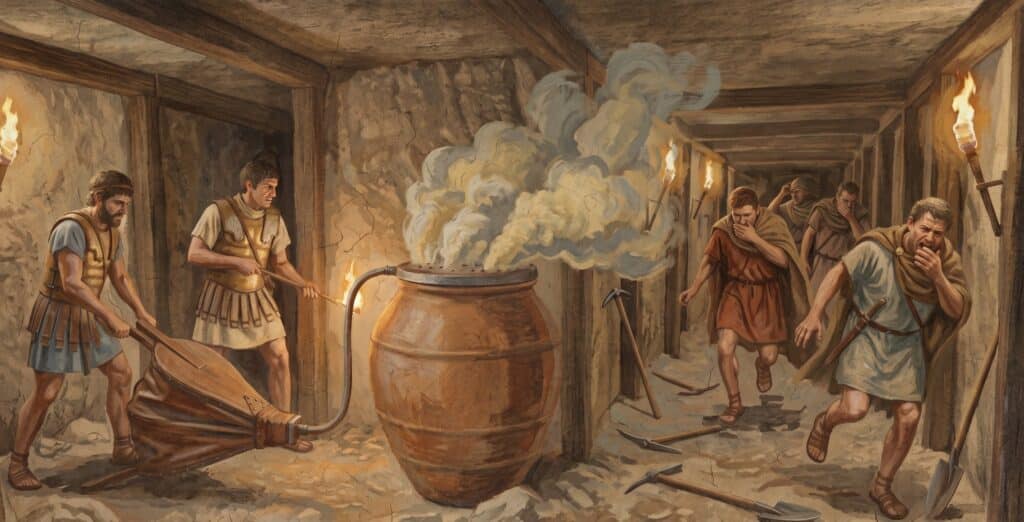
The Greeks took a large clay jar, a pithos, sized to precisely fit the tunnel, capped it with an iron lid drilled with holes, inserted an iron tube connected to a blacksmith’s bellows, and filled the jar with glowing charcoal covered in a dense layer of fine feathers, creating what can be described as an early chemical warfare device. When it was pushed into the tunnel and activated with the bellows, it produced a thick cloud of acrid, choking smoke that billowed forward into the darkness.
The Roman miners couldn’t breathe, couldn’t see, and had nowhere to go. They abandoned their tools and fled to the surface to escape the choking fumes. The Greeks had driven off a superior Roman force solely with clay, iron, fire, and feathers. Military historian Adrienne Mayor has pointed to this episode as evidence of just how sophisticated ancient weapons technology really was.
This deliberate act of chemical engineering would be remembered in later accounts of ancient warfare. The pithos was matched to the tunnel width specifically to prevent blowback. The feathers were chosen for the particular quality of smoke they produced when burned at high temperatures. Someone thought this through. The parallels to later warfare are hard to ignore. The same basic horror—an invisible, suffocating enemy in a dark enclosed space—would define trench warfare on the Western Front more than two thousand years later.
The psychology hasn’t changed even if the chemistry has. Ambracia ultimately surrendered. Cut off and outnumbered, the city eventually negotiated terms rather than fight on indefinitely, but the defenders had already shown what was possible. Historians now regard what happened in those tunnels as one of the earliest documented uses of asphyxiating chemical weaponry in a tactical military context—a genuine milestone in the history of warfare.
During the Roman siege of Ambracia in 189 BC, the defenders deployed what is one of the earliest recorded uses of a chemical weapon in history — and they used it underground. Rome was besieging the Greek city, held by the Aetolian League. When the walls held and the siege artillery failed, the Romans turned to mining — digging a tunnel beneath the walls, concealed behind a two-hundred-foot covered walkway, worked in relays day and night. For days the defenders didn’t notice. Then the pile of excavated earth grew too large to hide. Unable to see the tunnel, the defenders pressed bronze vessels against the ground to detect the vibration of digging, located the Roman mine, and dug a counter-tunnel straight toward it. The two tunnels met. Soldiers fought face to face in darkness too cramped to swing a sword. When direct combat failed, the defenders built a device described in detail by the historian Polybius: a clay jar fitted to the tunnel’s width, packed with feathers over burning coals, sealed with a perforated iron lid, and connected to a blacksmith’s bellows. They pumped the choking smoke directly into the Roman tunnel. The Romans were driven out of their own mine. According to Polybius, it was among the first uses of toxic smoke in the history of war. Further reading — Polybius, The Histories: https://amzn.to/4uWM9wN #AncientHistory#RomanEmpire#Ambracia#Shorts#HistoryShorts#ChemicalWarfare#TimelineHistory#history#shorts#ancientrome#education
Ancient civilizations pioneered early versions of contemporary mechanisms, offering valuable insights into the origins of modern technology. An astrolabe. Credit: Anders Sandberg / Flickr / CC-BY-2.0
Across history, ancient civilizations crafted prototypes for many of the modern mechanisms that have become integral to contemporary life. From the compass’s early forms that transformed navigation to the predecessors of today’s vending machines, these ancient artifacts offer insights into the roots of modern technology.
Although some of these ancient mechanisms were lost over time, their hidden potential was eventually revealed by subsequent generations, shedding light on the remarkable foresight of the ancient inventors.
Baghdad Battery
Baghdad Battery
found near Baghdad,considered galvanic cell that was created 2,000 years before A.Volta was born.The "battery"was a 13-centimeter vessel.Its neck was filled with bitumen an iron rod passed through it.Inside the vessel was a copper cylinder with an iron rod in it pic.twitter.com/zpPi36yxs7
An ancient artifact, which became known as the Baghdad Battery, has fascinated the minds of scientists for the last century. According to chemist Dr. Von Handorf, this find allows to believe that “an ancient tinkerer could have invented an electroplating process.”
Discovered in 1938 by a German archaeologist Wilhelm Konig, the Baghdad Battery is potentially around 2,000 years old. It comprises a clay jar, a copper cylinder, and an iron rod. When filled with a mild acid, such as vinegar, this assembly generates approximately 1-2 volt of electricity.
Attention to the mechanism arose with new force after the Second World War. American scientist Willard Gray conducted experiments in the post-war period, making copies and demonstrating that the device could generate two volts of electricity when filled with electrolyte. German researchers in the 1970s replicated this setup and successfully used it to electroplate a thin layer of silver, proving its potential as a battery.
Several theories have been proposed regarding the purpose of the Baghdad Battery. One hypothesis suggests that its primary use was for therapeutic purposes, drawing inspiration from the ancient Greek practice of using electricity to relieve pain. Another theory suggests that the batteries could have been hidden inside religious statues or idols. Dr. Paul T Craddock suggested that those who touched the statues would “experience a little shock with a small, mysterious flash of blue light.”
However, this mystery is likely destined to remain unsolved, since the artifact was stolen from the National Museum of Iraq in 2003.
The Lycurgus Cup
The Lycurgus Cup appears jade green, but changes color to a rich blood red when lit from behind. Credit: Public Domain / Wikimedia Commons
This 1600-year-old cup has a feature that proves that the ancient Romans were pioneers of nanotechnology. The perfectly preserved artifact amazed minds with its ability to change color depending on position and lighting.
Since the 1950s, the Lycurgus Cup has been in the British Museum. It received its name because of the masterfully depicted king of Thrace, Lycurgus. According to ancient Greek legends, he was at enmity with the god of wine Dionysus and is depicted on a cup entangled in a trap of grapevines.
When lit from the front, the cup appears jade green, but changes color to a rich blood red when lit from behind. This unusual and extremely modern property for that era has amazed scientists for decades.
Subsequently, scientists still managed to solve the mystery of the ancient mechanism behind the cup. They examined the glass under a microscope and discovered that Roman artisans had impregnated it with particles of silver and gold. These grains were so small that their size was less than one thousandth of a grain of table salt. Researcher Ian Freestone from University College London called the painstaking work of the ancient craftsmen “an amazing feat.”
The operation of the color changing mechanism has also found its explanation. When hit by light, the electrons belonging to the metal particles vibrate in such a way that they change color depending on the position of the observer. Gan Logan Liu, a professor at the University of Illinois at Urbana-Champaign, said that when the cup was filled with liquid, it changed the way the vibrating electrons in the glass interacted. He underlined that the romans “knew how to make and use nanoparticles for beautiful art.” Consequently, the color of the cup also changes.
This ancient technology is reflected in the modern world. Thus, home pregnancy tests use nanoparticles that turns the white line into pink.
South-Pointing Chariot, Ancient Mechanism Before Compass
A model of a south-pointing chariot. Credit: Andy Dingley / CC-BY-3.0 / Wikimedia Commons
The prototype of a navigational instrument, this Chinese south-pointing chariot became an ancient analogue of the compass. The history of this ancient mechanism dates back to approximately 5th century BC.
The chariot was described as a horse-drawn cart indicating the southern direction. It featured a figure that consistently pointed south, irrespective of the cart’s orientation. Employing differential gears, the mechanism comprised four wooden gears and additional gearing connecting the differential to the wheels. As the wheels turned, the gears rotated the figure to maintain its southern alignment. Notably, the chariot necessitated manual adjustment at the start of every journey, unlike a compass, which aligns automatically.
Chinese scientists rapidly developed their technologies and learned to magnetize iron needles back in the 7th–8th centuries AD. However, for several more centuries they did not use magnetic compasses and continued to produce chariots. It is believed that they went out of use only around the year 1300.
First Vending Machine
Vending machines are older than you might think.
The first such machine was designed and produced by Heron of Alexandria in the 1st century BC.
Vending machines, which have become a common attribute of modern life, owe their appearance to the ancient Greek scientist Heron. One of the best ancient mathematicians and inventors, he lived and worked in Alexandria. Heron developed many remarkable ancient mechanisms, and even the first steam engine of its kind.
His vending machine was a very modern mechanism for dispensing holy water. To use it, a person had to insert a coin into a special slot. Then it fell onto a tray connected to a lever. The weight of the coin opened the valve, from which water flowed out for the liars. Eventually, a coin would then slide off the tray, causing the lever to return to its place.
Astrolabe, Ancient Mechanism that Could Measure Time
An exploded view of an astrolabe, an instrument that was invented by the Greek scientist Ptolemy. Credit: Elrond / CC BY-SA 4.0 / Wikimedia Commons
Alexandria was home to another brilliant ancient inventor, Ptolemy, who invented a mechanism that could measured time.
This ancient instrument for timekeeping and celestial observation included the planispheric type, allowing astronomers to compute the positions of the Sun and stars relative to the horizon and meridian.
Originating in the 6th century, astrolabes gained prominence in the early Middle Ages across Europe and the Islamic world. It become crucial for maritime navigation by the mid-15th century before the emergence of sextants. Ranging from 3 to 18 inches, the typical planispheric astrolabe was predominantly crafted from brass or iron. It featured the base plate with celestial coordinates, the open-pattern disk illustrating stellar maps, and the alidade used for celestial sightings.
The astrolabe’s intricate construction and widespread usage underscored its significance as a multifunctional scientific tool in the medieval period. Its application extended beyond astronomy, finding utility in fields such as geography, timekeeping, and surveying.
Deep in Taiwan’s misty mountains, researchers have confirmed the tallest tree in the country: a thousand-year-old fir tree higher than a 20-story building, which they’ve named “the heaven sword of the Da’an River.” Climbers scaled the tree and dropped a measuring tape from the top to the forest floor during the Lunar New Year holiday in January 2023. The tree measured 84.1-meters (276-feet). The findings have been published in Frontiers in Forests and Global Change. A team of ecologists, geologists, remote-sensing specialists, professional climbers and Indigenous people that calls itself the “Taiwan tree seekers” began the search in 2014. “The common characteristics [of the team] are probably that we are all tree lovers and like adventures,” Rebecca Chia-Chun Hsu, lead author from Division of Forest Ecology, Institute of Taiwan Forestry Research, told CNN. ‘The Heaven Sword’, Taiwan’s tallest tree, measures 84.1 meters. Photo courtesy of Steven Pearce. Taiwan is one of the few places on Earth where trees can grow this tall. The island sits where the tropics meet the subtropics, and its mountains host several giant conifer species. The species behind the new record, Taiwania cryptomerioides, is known to the Indigenous Rukai people as “the tree that hits the moon.” Although nearly 60% of Taiwan is covered in forest, loggers cleared much of the island’s old-growth forest between 1912 and 1991. However, its steep slopes were too dangerous to reach, and pockets of ancient forest survived. Still, finding the tallest tree amid the rugged terrain was a task. Taiwan…This article was originally published on Mongabay
Mycenaean religious practice included structured sacred spaces, and the evidence challenges the idea that Mycenaean temples did not exist. Credit: Wikimedia Commons, Andreas Trepte, www.avi-fauna.info, CC-BY-SA-2.5
According to a long-standing urban legend, the Mycenaeans did not build temples but worshiped outdoors under open skies. This claim appears in popular books, casual discussions, and also surfaced in earlier scholarly interpretations of Bronze Age Greece.
However, archaeological evidence challenges this view. Material finds, Linear B texts, and remains of cult architecture all point in a different direction. The Mycenaeans did not restrict worship to open-air rituals alone; they also used structured sacred spaces within buildings. In fact, they developed organized religious environments that functioned in ways comparable to early temples.
The origin of the “open-air only” idea
The idea that the Mycenaeans worshiped exclusively outdoors stems from early comparisons with Minoan Crete. Some early researchers assumed that Bronze Age societies possessed no formal religious architecture and interpreted the absence of large, classical-style temples as evidence of informal worship practices.
In addition, early archaeologists often struggled to identify religious buildings at Mycenaean sites. Many structures appeared domestic or administrative in character, leading to an underestimation of their possible ritual functions. Over time, these assumptions produced a simplified narrative suggesting that Mycenaean religion remained primitive or underdeveloped. In this interpretation, formal temple construction was seen as something that emerged only in later Greek civilization.
Today, this view is considered outdated and overlooks both textual and archaeological evidence. It also projects later Greek architectural expectations onto an earlier cultural and historical context.
What the Linear B tablets reveal about Mycenaean temples and religious practice
The Iliad already refers to a temple within the Trojan citadel that houses the statue of a goddess, suggesting that structured sacred spaces were part of early Greek religious imagination. Beyond literary tradition, the Linear B tablets provide some of the strongest evidence against the “open-air-only” interpretation. These tablets preserve administrative and religious records from Mycenaean palace centers, offering a rare direct glimpse into how cult activity was organized.
They record offerings and mention deities associated with the later Greek pantheon, including Zeus, Poseidon, Hera, Artemis, and Hermes, while also documenting the management of cult resources by officials. This points to a system of structured worship rather than purely spontaneous outdoor ritual.
Importantly, the tablets often connect deities with specific locations, referring to sanctuaries, priests, and offerings tied to defined, organized spaces. This suggests that religious practice was not confined to natural settings but also embedded within institutional environments. Taken together, this written evidence weakens the idea of exclusively outdoor worship. Instead, it reveals planning, hierarchy, and dedicated sacred functions within Mycenaean religious life.
Tablet with Linear B Script from the Palace of Knossos – 1375 BC. Credit: TimeTravelRome. CC BY 2.0/flickr
Archaeological evidence of cult spaces
Archaeology strengthens this conclusion. Excavations at Mycenaean sites have uncovered buildings with clearly identifiable ritual functions, including altars, offering areas, and religious artifacts. One of the most significant examples comes from Mycenae itself. The so-called “Tsountas House” provides key evidence for structured cult activity within a designed landscape.
The Tsountas House is located near the citadel of Mycenae and was first excavated during early investigations led by Christos Tsountas. The structure dates to the Late Bronze Age. At first glance, the building does not resemble a later classical temple, lacking the monumental stone columns associated with later Greek religious architecture. However, its interior evidence tells a different story. Researchers such as Kim Shelton have identified signs of ritual activity within the structure, including figurines, offering vessels, and spatial arrangements that suggest ceremonial use. The layout also indicates controlled movement through the building, reinforcing the impression of organized ritual practice.
Taken together, these features are significant. They show that Mycenaeans used enclosed architectural spaces for ritual purposes, effectively functioning as cult centers. Worship was not confined solely to mountains, peak sanctuaries, or open courtyards. Instead, structured sacred environments existed within administrative and residential settings. This evidence points to a broader religious system in which cult activity, palace administration, offerings recorded in Linear B texts, and outdoor sacred landscapes all formed interconnected components of Mycenaean religious life rather than isolated or competing practices.
Remarkable gold artifacts discovered within the Mycenaean citadel. Credit: Xuan Che / CC BY 2.0
Why the “no temples during the Mycenaean period” narrative fails
The “no temples” narrative fails largely because it relies on a narrow, anachronistic definition of what a temple must be. If one expects Mycenaean sacred architecture to resemble later classical Doric structures, then such buildings will not appear in the archaeological record. However, this expectation sets a false standard. It overlooks architectural evolution over time and ignores the cultural and functional differences between the Bronze Age and later Greek periods.
Mycenaean sacred architecture followed its own internal logic. Ritual spaces were frequently integrated into palatial complexes or elite residences, and smaller, multi-functional buildings often served religious purposes in place of large, freestanding temples. For this reason, the absence of classical-style temples does not imply the absence of religious architecture.
At the same time, Mycenaeans did perform rituals outdoors, likely at natural features such as hills, caves, and mountain peaks. Outdoor worship was an important component of Bronze Age religious practice, a pattern that continued into later Greek tradition. Nonetheless, outdoor ritual activity did not exclude indoor sacred spaces. Rather, both forms coexisted and fulfilled different roles within a broader religious system.
Mycenaean religion combined palace-based cult administration, offerings recorded in Linear B texts, enclosed ritual spaces, and outdoor sacred sites in the landscape. Together, these elements formed a structured, multi-layered system operating across both constructed environments and the natural world. This combination underscores not only complexity and organization but also continuity with later Greek religion. Structured sacred space did not emerge suddenly in the Classical period but developed gradually from earlier Bronze Age practices.
Kadmeion. Mycenaean palace complex of Thebes. Credit: Zde / Wikimedia Commons CC BY-SA 4.0
Why the myth persists today
The persistence of the “no temples” myth can be traced to three main sources. First, early scholarship shaped the expectations of later generations. Once an interpretation enters textbooks and reference works, it tends to persist, even when new evidence complicates or overturns it.
Secondly, the very word “temple” carries a strong classical bias. Readers often imagine columns, symmetry, and monumental marble architecture. When such features are absent in the Bronze Age record, this is interpreted as a lack of temples rather than a difference in architectural form.
Lastly, simplified narratives tend to spread more easily than nuanced archaeological interpretations. The idea of “primitive outdoor worship” is easy to remember and communicate, whereas the actual picture is more complex and layered. In reality, the Mycenaeans did not rely exclusively on open-air worship but also built and used structured indoor spaces for ritual activity that can reasonably be understood as early temple forms.
The claim that Mycenaeans lacked organized religious buildings does not withstand scrutiny. It reflects early interpretive bias more than archaeological evidence. Mycenaean religion combined indoor and outdoor elements and showed early forms of institutional organization. In this sense, it laid important foundations for the development of later Greek religious architecture and practice.
Ring of Minos Heraklion. Credit: Wikipedia/Jebulon/Public domain
The story of the ring known as the “Ring of King Minos” sounds like a tale made in Hollywood. It is a mix of ancient Greek history, mythology, and a plot involving a poor boy, a cunning priest, an English archaeologist, and hidden treasure.
The story begins in 1928, when a boy, Michalis Papadakis (1918-1974), accidentally found a ring at the archaeological site of Knossos. The place of discovery alone meant that the ring certainly had a very long history attached to it probably even going back to the Minoan civilization.
Indeed, several decades later, the shiny, gold, seal ring proved to be 3,500 years old (1,500 to 1,400 BC), as archaeologists assured him, and his was the most significant discovery of Minoan Civilization.
The boy’s father, a destitute farmer named Emmanouil, for some unknown reason, hid the ring from his wife and, for another unknown reason, two years later, he handed it over to the village priest, Father Nikolaos Polakis. Yet, before giving it away, he carved a line on the ring with his knife in order to mark its originality.
Father Polakis initially presented it to English archaeologist Sir Arthur Evans with the intention of selling it. However, there was no deal struck between the two since the priest demanded an astronomical amount of money.
In 1933 or 1934, Father Polakis decided to take the ring to the Heraklion Museum. At the time, the distinguished archaeologists, Nikolaos Platon and Spyridon Marinatos, were on the staff of the institution. Platon decided that the ring was genuine while Marinatos believed the ring was a fake.
Since the two archaeologists could not come to an agreement, they decided it was best to return the ring to the priest.
The King Minos Ring at the Heraklion Archaeological Museum. Credit: Twitter/Bokeras
However, Platon kept a copy of the ring by casting it in plasticine. The cast was later located in Platon’s archive. Several years later, he manifested a new interest in the ring and returned to the priest to ask for it. Father Polakis told him that he had given it to his wife for safekeeping, but she had lost it.
Minos ring depicts three themes
Platon wrote a treatise on the ring saying that it depicts three themes: the Minoans’ rule of the seas (“thalassocracy”), tree worship (dendrolatry), and a goddess descending from heaven to earth and getting into a row boat.
There are other, more recent interpretations of the depictions of the ring including the worship of goddesses, such as Mother Dimitra, and offerings to the Great Mother Rhea and the Great Mother Artemis.
For some time, the ring remained lost. The only information about the ring came from the copies that had been made and a number of archaeological reports which were associated with those copies.
Many years later, when Father Polakis was in his final days, he felt great regret about the “disappearance” of the precious ring. He called Evangelia Papadakis, the wife of the farmer Emmanouil, and apologized for lying to her family. He admitted that he had actually sold the ring to Evans, the English archaeologist, for 100,000 drachmas back in 1938.
However, that was one last lie by the cunning priest. What he had actually sold to Evans was a fine replica of the ring.
Evans had returned to England with the belief that he had bought the actual ring, along with a copy, and donated both, along with other precious artifacts, to the Ashmolean Museum. Today, two replicas of the legendary ring continue to be exhibited at the Ashmolean.
The story of the ring was forgotten for decades, but in the early 2000s, Giorgos Kazantzis, a retired police officer, inherited the house of the priest who was the last person in Greece who had had possession of the priceless artifact.
During renovation work, Kazantzis found a jar hidden inside the wall next to the fireplace. Inside the jar was a ring, which indeed proved to be the original Ring of King Minos. It even had the scratch made by Papadakis over seventy years ago.
Kazantzis delivered the precious artifact to the state, and in 2002, the Central Archaeological Council and a panel of expert archaeologists confirmed the authenticity of the ring. The actual monetary value of the ring was estimated to be €400,000 although its cultural value is incalculable.
Yet, for finding the ring and promptly delivering it to the appropriate authorities, Kazantzis was given a measly finder’s fee of €440.
Today, the priceless, gold Minoan ring is exhibited in all its splendor at the Heraklion Archaeological Museum.
Marx and Aristotle, though centuries apart, both recognized that value is rooted in social relations rather than in objects themselves. Credit: GreekReporter Archive
When the philosopher Karl Marx set out to unravel the mysteries of value, exchange, and labor in capitalist society, he found a surprising intellectual ally in Aristotle, the ancient Greek philosopher who lived two millennia earlier. Despite their different historical contexts, both thinkers examined how value arises not inherently from things but from their social relations—especially through the lens of use and exchange.
Marx, in Capital, openly acknowledged Aristotle’s importance. Not only did Aristotle lay the groundwork for distinguishing use-value from exchange-value but his reflections on early human society, property, and the role of labor and technology revealed a conceptual framework that Marx would radicalize for modern critique.
Use-value and exchange-value: Aristotle’s anticipation
Aristotle’s analysis of value in Politics distinguishes between two uses of a commodity. One is proper and natural while the other is improper or derivative. He writes:
“Every commodity has two uses: both belong to the thing itself, but not in the same manner—one is the proper use, the other is not. For example, a shoe serves either to be worn or to be exchanged; both are uses of the shoe, for he who gives a shoe in exchange to someone who needs it, receiving in return money or food, uses the shoe as a shoe, but not according to its proper use, for it was not made to be exchanged.”
This distinction—between use-value and exchange-value—is a cornerstone of Marx’s analysis. For Marx, this Aristotelian formulation prefigures what he calls the “value-form” of the commodity. Commodities are useful in particular ways (use-value), but also enter into a social system of equivalence when exchanged (exchange-value).
Marx directly builds on this by showing that exchange-value does not exist inherently in an object but arises through the abstraction of labor—because human labor makes different useful things commensurable. Aristotle notes that a shoe does not exist for exchange. Marx took this insight and asked: What kind of society inverts this logic and makes objects valuable only in proportion to their exchangeability rather than their utility?
From the household to the marketplace: society before exchange
Aristotle’s theory of the household (oikos) as the first form of society was essential for Marx’s historical materialism. In Politics, Aristotle describes early society as beginning with families. In these families, property was communal and exchange unnecessary. It was only as the population grew and self-sufficiency gave way to interdependence that markets and money emerged.
Marx adopts this trajectory in Capital and his Grundrisse notebooks, writing that commodity exchange is not a timeless activity. Instead, it is a historically specific development that reflects changes in social relations and property forms. The transition from common property to private ownership and from useful production to production for exchange is the material foundation of class society.
In Aristotle, we already see the seeds of this analysis. He distinguishes between natural wealth-getting (production for use) and unnatural chrematistics (the accumulation of wealth for its own sake). Marx seizes upon this distinction to critique capitalism as a system in which the unnatural pursuit of profit replaces human need as the goal of production.
A statue of Aristotle. Credit: Public Domain, via Wikimedia Commons
The machine and slavery
One of the most striking moments in Capital (Vol. I) occurs when Marx discusses machinery and automation. Here, he ironically invokes Aristotle’s dream that if tools could operate themselves, no slaves would be needed:
“If—dreamed Aristotle, the greatest thinker of antiquity—if every tool could perform its task at command or even by anticipation, like the statues of Daedalus that moved of their own accord, or the tripods of Hephaestus that spontaneously began their sacred work, if the shuttles of the loom wove by themselves, then master craftsmen would not need assistants, nor masters slaves.”
This vision did not remain uniquely Aristotelian. Antipatros, a Greek poet from the era of Cicero, hailed the invention of the watermill—the earliest rudimentary form of productive machinery—not simply as a technical advancement but as a social revolution. He praised it as the liberator of enslaved women who had been condemned to grind grain by hand. He envisioned it as the usher of a new golden age of human dignity and freedom.
In these ancient myths and poetic praises, technology is seen not merely as efficiency but as emancipation. The ancients, despite their slave-based economies, understood that the highest purpose of tools was to free people from servitude.
Gaziantep Zeugma Museum Daedalus mosaic. Credits: Dosseman / Wikimedia Commons CC BY-SA 4.0
Marx’s irony and the betrayal of the promise of automation
Marx, however, saw this ancient hope turned upside down in modern capitalist society. In his words, what was supposed to free labor had become its jailer:
“Ah, those idolaters! They knew nothing of political economy or Christianity, as discovered by clever Bastiat and even cleverer McCulloch. They failed to understand, among other things, that the machine is the most reliable means for lengthening the working day.”
Here, Marx mocks the liberal economists of his time. Frédéric Bastiat and John Ramsay McCulloch, champions of laissez-faire capitalism, celebrated mechanization without recognizing its role in intensifying exploitation. Unlike the “idol-worshiping pagans,” who at least had the imagination to conceive of automation as a force for liberation, these modern theorists lacked even that mythical foresight.
Marx continues with biting irony:
“They failed to understand, among other things, that the machine is the most reliable means for lengthening the working day.
Thus the strange phenomenon arises in the history of modern industry. That the machine, the most powerful instrument for reducing labor time, becomes the most unfailing means of converting the whole life of the worker and his family into labor-time for capital’s valorization.”
The true paradox for Marx is that mechanization offers a means to liberate humanity but capital instead weaponizes it to intensify exploitation. The ancients envisioned automation as a means of human emancipation. Capitalism uses it to deepen alienation and dependency.
The irony is profound: the ancients dreamed of freedom through the machine, and capitalism delivered machines that reinforce dependency. In this way, Marx reclaims the ancient vision but also shows how the promise of automation has been betrayed.
Antipatros celebrated the invention of the watermill as a liberating force, heralding it as a symbol of a new golden age of human dignity. Credit: Pietro da Cortona, Wikimedia Commons, Public Domain
Aristotle and Marx: From ancient slavery to modern compulsion
Marx’s dialogue with Aristotle was not just academic—it was dialectical. He admired Aristotle’s clarity in distinguishing between types of value and his historical insight into the development of exchange. However, Marx also showed how the slave economy of antiquity historically constrained Aristotle’s ideas.
Ironically, in an age in which full automatism is increasingly possible, the prevailing economic model continues to reproduce the conditions that Aristotle associated with slavery—not through direct ownership of people but through economic compulsion and structural inequality. In that sense, Marx saw in Aristotle both the seed of critical insight and the limit of pre-modern social theory.
Hence, while Aristotle could not imagine that labor determines value in commodities, he sensed something essential: that value is not a thing but a relation and that social forms of labor determine the shape of society itself.
Portrait of the king of Pontus Mithridates VI as Heracles, a mythical association that Alexander the Great often touted. Marble, Roman imperial period (1st century), Credit: Musée du Louvre, Paris, Public Domain.
Alexander the Great’s (356-323 BC) death meant his vision for a Greco-Persian Empire was extinguished with him—or was it?
A hodgepodge of East and West, Mithridates’ Pontic Empire emerges as a compelling possibility of what Alexander’s empire could’ve been, a faint apparition of that fleeting dream.
Alexander 2.0
Mithridates (135–63 BC) was the inheritor of two cultures and, naturally, an incarnation of two worlds. He delighted in his Macedonian heritage as much as his Persian forbearers.
Claiming Macedonian ancestry on one side and Persian dynastic lineage on the other, Mithridates used his mixed descent to reveal the commonalities between his diverse subjects.
Taking on Alexander’s mantle of global empire, Mithridates envisioned an alternative to Roman supremacy, a new world order.
To achieve this ambitious aim, the Pontian King united his Greek, Anatolian, and Persian subjects under an anti-Roman cross-cultural coalition.
The result of this cooperation was three wars mounted against Rome, wars that escalated to the point of genocide.
How could he amass such a diverse following against such a formidable foe?
Mithridates took a page from Alexander’s book and embodied East and West, both in appearance and idea.
Pontus: Alexander’s vision of empire?
Map of the Kingdom of Pontus. Credit: Photograph by Javierfv1212, Public Domain, via Wikimedia Commons.
Mithridates hailed from the Kingdom of Pontus, a cultural melting pot that Alexander the Great would have approved of.
The north of Pontus’s snow-clad Alps was a largely Hellenic-dominated coastline. There, Greek colonists had erected the city of Sinope, Mithridates’ capital.
The historian Strabo, himself a Pontian, claimed that it was “the most noteworthy of the cities in the region.”
South of the Alps was known as Katpatuka (land of horses) by the Iranians and, later, Cappadocia by the Greeks. There, villages predominated apart from a few settlements, such as Amaseia, Strabo’s hometown, and Cabeira.
While Hellenic culture dominated the coast, the Cappadocian hinterland preserved its old Anatolian non-Greek heritage. Rostovtzeff (1932), a pioneer in Pontic history, described the Hellenic influence around the Black Sea as “a thin Greek shell around a hard native kernel.”
The third influence on the region was Iranian. The enduring relics of Persian rule would have been visible to many a Hellenistic Pontian. Strabo says that the Pontic people took sacred vows at the state temple, Zela, which were dedicated to Persian deities: Anaitis, Omanus, and Anadatus.
Moreover, Zeus Stratios, most likely a syncretic reincarnation of Ahura Mazda, received lavish offerings from Persian Kings, which Pontian rulers, including Mithridates Eupator, continued. The continuation of Persian religious customs well after an eclipse of Achaemenid authority attests to the impression Persian presence had made on Pontic royalty and their subjects.
In the subsequent Hellenistic period, the increasing pace of Hellenization of the kingdom meant that the Mithridates Dynasty had to evolve. There needed to be a balance between the new incoming wave of this ancient form of globalization with their Perso-Anatolian traditions that still held sway in their domain.
Divine descent
Mithridates Eupator depicted as Dionysus, Credit PHGCOM, Public Domain, via Wikimedia Commons.
Mithridates Eupator’s dual lineages afforded him illustrious ancestors and a unique hybrid set of dynastic customs. He was a Helleno-Persian Prince who practiced mixed religious rites.
Mithradates divine connections are well in accordance with Alexander the Great’s own claims. Like the Pontic King, Alexander claimed Heracles and Dionysus, among other numinous figures, as ancestors.
Consequently, the Pontic King embodied redemptive qualities resonating in the Greek and Perso-Anatolian worlds. For the Greeks, he established a mythical connection with Dionysus, the god of liberation and new beginnings, and took the theonym Mithridates Eupator Dionysus.
Likewise, Mithridates claimed heritage from Herakles, who emancipated the titan Prometheus, humanity’s creator. On the other hand, Mithridates’ star-signaling birth was said to fulfill Persian prophecies of a coming savior from the East, as did his name, “Mithras-sent.”
Global principles
Persian Magus-king conducting a fire ritual. Mithradates’ fire ceremony followed the traditional customs of his Persian ancestors. Detail from red-figure vase 3297, side A, by the Underworld Painter, 4th century BC. Credit: Staatliche Antikensamm lungen und Glyptothek, Munich, Public Domain
In addition to religious mediation, Mithridates weaponized the growing resentment of his subjects. Just like Alexander’s vision for his diverse empire, the Pontian King tried to respect Greek and Iranian values.
Both Greeks and Perso-Anatolians were chafing under Roman occupation. In mainland Greece and Anatolia, the common hatred towards Roman rule provoked a transcultural antagonism against Roman hegemony.
Debt accrued by Roman taxation hindered asa or Truth, a prominent Persian tenet. For the Greeks, Roman occupation was seen as compromising their eleutheria, or freedom, which was fundamental to Greek identity.
Mithridates acknowledged these grievances in his speeches, along with coins and other allusions. By showing sensitivity to both cultures, the Pontian King illustrated how compatible Iranian and Greek cultures could be.
This may be surprising, considering the tumultuous history that plagued the relations between Greeks and Iranians. Egregious crimes were committed in Athens by the Persians and by Greeks in Persepolis at Alexander’s instigation as punishment.
Yet Mithridates successfully harmonized the two cultures, as Alexander the Great’s policies aimed to accomplish.
Was Mithridates’ Pontian kingdom what Alexander’s empire could have been?
Sensitive to Greek and Perso-Anatolian culture, Mithridates entangled much of the Eastern Mediterranean in opposition to Rome. Mithridates carried on Alexander’s vision for an international empire even though he was unsuccessful in his wars against Rome. By doing so, the Pontian king proved Alexander the Great’s Helleno-Persian hypothesis was possible.
Alexander’s vision for joining East and West wasn’t an idyllic dream but was ultimately an achievable reality.
Thetis takes the magical shield for Achilles from Hephaestus. Attic red-figure Kylix, 490–480 BC. Credit: Public Domain
In Homer’s Iliad, Thetis plays an important role in shaping the destiny of her son, Achilles. As a goddess, she intervenes at key moments in the epic, pushing the Greek hero to alter the course of events.
Although Thetis appears less frequently than many of the warriors and gods who dominate the battlefield at Troy, her actions influence some of the most significant developments in the poem. As a sea goddess and the mother of the greatest Greek warrior, she occupies a unique position between the divine and mortal worlds. She cannot prevent Achilles from dying, since the Fates have already decreed it, yet she repeatedly intervenes to protect his honor, ease his suffering, and ensure that his glory endures.
Through Thetis’ character, Homer explores themes of maternal love, fate, mortality, glory, and divine power. The first major instance of Thetis helping Achilles occurs in Book 1. After Agamemnon captures Briseis, a captive woman awarded to Achilles as a war prize, the Greek hero feels deeply dishonored and withdraws from battle. In his grief and anger, Achilles calls upon his mother. Thetis immediately rises from the sea to comfort him and listen to his complaint.
This scene reveals the extraordinary bond between mother and son. Unlike many divine figures in Greek mythology, Thetis responds with sympathy and tenderness. She understands Achilles’ suffering because she is painfully aware of his short lifespan. Her lament for him reflects a mother’s helplessness in the face of fate.
Thetis petitions Zeus to turn events in favor of Troy
After hearing Achilles’ request, Thetis undertakes one of the most consequential actions in the epic. She travels to Olympus and petitions Zeus to punish the Greeks by granting success to the Trojans. Her aim is not simply revenge but the restoration of Achilles’ honor. Zeus eventually agrees, and his decision alters the course of the war. The Trojans begin to gain the upper hand, while the Greeks suffer devastating losses. Through this intervention, Thetis helps Achilles achieve the recognition he believes Agamemnon has denied him.
This episode demonstrates the extent of Thetis’ influence among the gods. Although she cannot alter fate itself, she is capable of shaping the chain of events that leads toward it. Her appeal to Zeus succeeds in part because of a previous favor she had done for him. In this sense, her assistance rests not only on maternal devotion but also on her standing within the divine order. Achilles’ withdrawal from battle would have remained a private grievance without Thetis’ intervention. Instead, it escalates into a crisis that engulfs the entire Greek army.
The second major instance of Thetis helping Achilles occurs after the death of Patroclus. Patroclus, Achilles’ closest companion, enters battle wearing Achilles’ armor and is killed by Hector. When Achilles learns of his friend’s death, he is overwhelmed by grief and rage. Once again, Thetis hears her son’s cries and goes to him. This scene is among the most emotional in the Iliad. Thetis is aware that Achilles’ decision to return to battle will lead directly to his own death, yet she does not attempt to stop him. Instead, she offers comfort and practical assistance.
Hephaestus forges the invincible shield of Achilles
Achilles cannot immediately rejoin the fighting because Hector has confiscated his armor. Recognizing his need, Thetis travels to the forge of Hephaestus and requests new armor for her son. Hephaestus responds by crafting the magnificent shield of Achilles, one of the most celebrated objects in world literature. The shield depicts scenes of war and peace, labor and celebration, and life and death. With this armor, Thetis enables Achilles to return to battle and fulfill his heroic destiny.
This act of assistance is particularly significant because it highlights the limits of divine power. Thetis can secure the finest armor ever made, but she cannot save Achilles from mortality. Her help therefore reflects the tragic paradox that every action she takes to aid her son also brings him closer to the fate she most fears. The armor allows Achilles to defeat Hector, but it also marks the final stage of his journey toward death.
Thetis’ role after Hector’s death further underscores her importance. Achilles becomes consumed by grief and rage, dragging Hector’s body around the tomb of Patroclus. The gods disapprove of this behavior and decide that Hector must be returned to his family. Zeus sends Thetis to deliver his command to Achilles. She successfully persuades her son to release the body in exchange for ransom, helping restore moral balance and preparing the tale for closure.
This final intervention reveals another dimension of Thetis’ assistance. Earlier, she helped Achilles gain honor through vengeance; now she helps him regain humanity through compassion. Her influence guides him from destructive rage toward acceptance. The reconciliation between Achilles and Priam, one of the most moving scenes in ancient literature, would not have occurred without Thetis serving as the messenger between gods and mortals.
The complexity of Thetis, the mother of Achilles
Modern scholars have emphasized the complexity of Thetis’ character. Rather than portraying her simply as a nurturing mother, recent studies highlight her power and agency. Thetis is more than a grieving parent. She is a divine force capable of influencing both Olympus and the battlefield for the benefit of her son. This is evident in actions such as her request to Hephaestus to forge an impenetrable suit of armor for Achilles.
At the same time, scholars frequently stress the tragic nature of her motherhood. Classicist Emily Wilson observes that she has come to view the Iliad as “a poem about the pain of a goddess mother who adores her mortal child and can’t protect him.” This insight captures the emotional core of Thetis’ role in the epic. Despite her divine status, she remains powerless as a mother in the face of fate. Her interventions can shape events, but they cannot prevent the loss she knows is imminent.
Other scholars have also noted that grief defines Thetis’ presence throughout the epic poem. Classicist Serena Cannavale describes Thetis in the Iliad as “a figure of grief,” emphasizing that her sorrow is present long before Achilles actually dies. Her laments anticipate the tragedy that hangs over the entire narrative.
Ultimately, Thetis helps Achilles in three essential ways: she restores his honor by persuading Zeus to favor the Trojans, she equips him for revenge by obtaining new armor from Hephaestus, and she guides him back toward humanity by conveying Zeus’s command to release Hector’s body to Priam. These actions shape the central events of the Iliad and reveal the profound connection between mother and son. Yet the tragedy of Thetis lies in the fact that her power cannot overcome destiny. She can comfort Achilles, protect his reputation, and secure his everlasting glory, but she cannot save his life.
For this reason, Thetis embodies the tension between divine power and human mortality. Every time she helps Achilles, she demonstrates her love, yet every act of assistance also reminds readers that fate is stronger than even the gods. Through Thetis, Homer presents a moving portrait of maternal devotion in the face of inevitable loss, making her one of the emotional centers of the Iliad.
Pottery depicting three runners at the Olympic Games. Credit: Wikimedia Commons, CC-BY-SA-2.5
For many centuries, the ancient Macedonians lived on the fringes of the Greek world far removed from the prominent city-states of the south. For this reason, many have called their status as Greeks into question. Famously, only the Greeks could participate in the ancient Olympic Games. So then, what was the status of this northern tribe in that regard? Did the Macedonians participate in the ancient Greek Olympic Games or not?
The early years of the Olympic Games
According to the earliest tradition, the Greek hero Heracles founded the Olympic Games. The ancient historians placed the founding of this athletic competition in 776 BCE. For the first two centuries, there is no evidence that the Olympic Games involved the Macedonians. Why is this?
Put simply, the Macedonians generally did not have much to do with the Greeks of the south due to the fact that they lived so far north. This applied to numerous aspects of the Greek world and not just to the Olympics. They were generally quite isolated in terms of socio-political developments even though they worshipped the same gods and had the same traditions and language as the rest of the Greeks.
For this reason, it is no surprise that the Macedonians apparently did not, initially, express any interest in participating in the Olympic Games. They took place in Olympia at Elis in the Peloponnese far to the south of Macedonia.
King Alexander I, the first Macedonian in the Olympics
This changed at the turn of the 5th century BCE. At this time, King Alexander I of Macedonia wanted to participate in the athletic competition of Olympia. When he attempted to enter, the Hellanodikai, the judges of the competition, denied his request. There was, naturally, prejudice against Alexander’s people since they lived so far away from the rest of the Greeks.
However, Alexander was able to convince the judges to allow him to participate. He pointed out that his dynasty was founded by Perdiccas, the son of Temenus, a descendant of Heracles (Hercules). After hearing this explanation, the judges accepted that Alexander was a true Greek.
After Alexander participated in the Olympic Games, various other Macedonians also began doing so. It seems that he initiated an interest in the competition in his homeland.
Macedonians in the Olympic Games
At first, participation in the Olympic Games among Macedonians was limited to the royal dynasty. After Alexander I, there is a record of King Archelaus I participating. He competed in a chariot race and was victorious. This occurred in 408 BCE, still long before the expansion of Macedonian hegemony to all the Greek city-states.
In the following century, King Philip II also competed in the Games. He was the father of Alexander the Great. Philip actually participated three times. All three times, two of which were chariot races, he was the winner. These three victories occurred in 356, 352, and 348 BCE.
Tetradrachm coin of Philip II of Macedon. Credit: Classical Numismatic Group / CC BY-SA 2.5 / Wikimedia Commons
Just after this era, we find records of non-royal Macedonians participating in the Olympic Games. Perhaps King Philip’s impressive series of victories had something to do with this. In 328 BCE, there is a record of a man named Cliton winning the important running race. Based on the available records, he was the first non-royal Macedonian to win in the Games.
After Cliton, we find records of various other Macedonians participating in and winning many of the events in the Olympic Games. In fact, we find an average of approximately one Macedonian winner per decade over the next six decades. Additionally, we need to consider the fact that we only have records of the winners. Likely, many other Macedonians participated in the Olympic Games during this period, and we certainly know that they continued to do so thereafter.

 Login
Login