Normal view

Archaeologists Uncover Rare Medieval Game Board in Morocco

8 June 2026 at 21:27
The gameboard in the hammam at Walīla, Morocco
The gameboard in the hammam at Walīla, Morocco. Credit: Tim Penn / CC BY 4.0

A stone game board carved inside a medieval bathhouse in Morocco could rewrite what historians know about board games in early Islamic North Africa.

The discovery, published in the journal Libyan Studies, pushes back evidence for a game still played today by several centuries and sheds new light on social life in one of the region’s earliest Islamic settlements.

Tim Penn of the University of Reading led the study examining a previously unpublished game board at Walila, the site of ancient Roman Volubilis in Morocco. The board was carved into a stone step leading into a cold plunge pool inside a bathhouse, or “hammam,” built in the late eighth or early ninth century.

The structure was abandoned by the tenth or eleventh century. That narrow window gives researchers a rare, secure date for the board, something that is extremely difficult to establish for carved game boards found at ancient sites.

Morocco bathhouse yields a precisely dated medieval game board

The bathhouse was part of a larger complex that researchers believe served as the residence of Idrīs I, the founder of the Idrisid dynasty and one of the earliest Islamic rulers in North Africa.

Idrīs I arrived at Walila in 788 after fleeing the Hijaz and was declared imam by a local Berber tribe. The complex included a domestic building, a reception hall, and a storage compound, all built in a courtyard style more common to the Levant than North Africa.

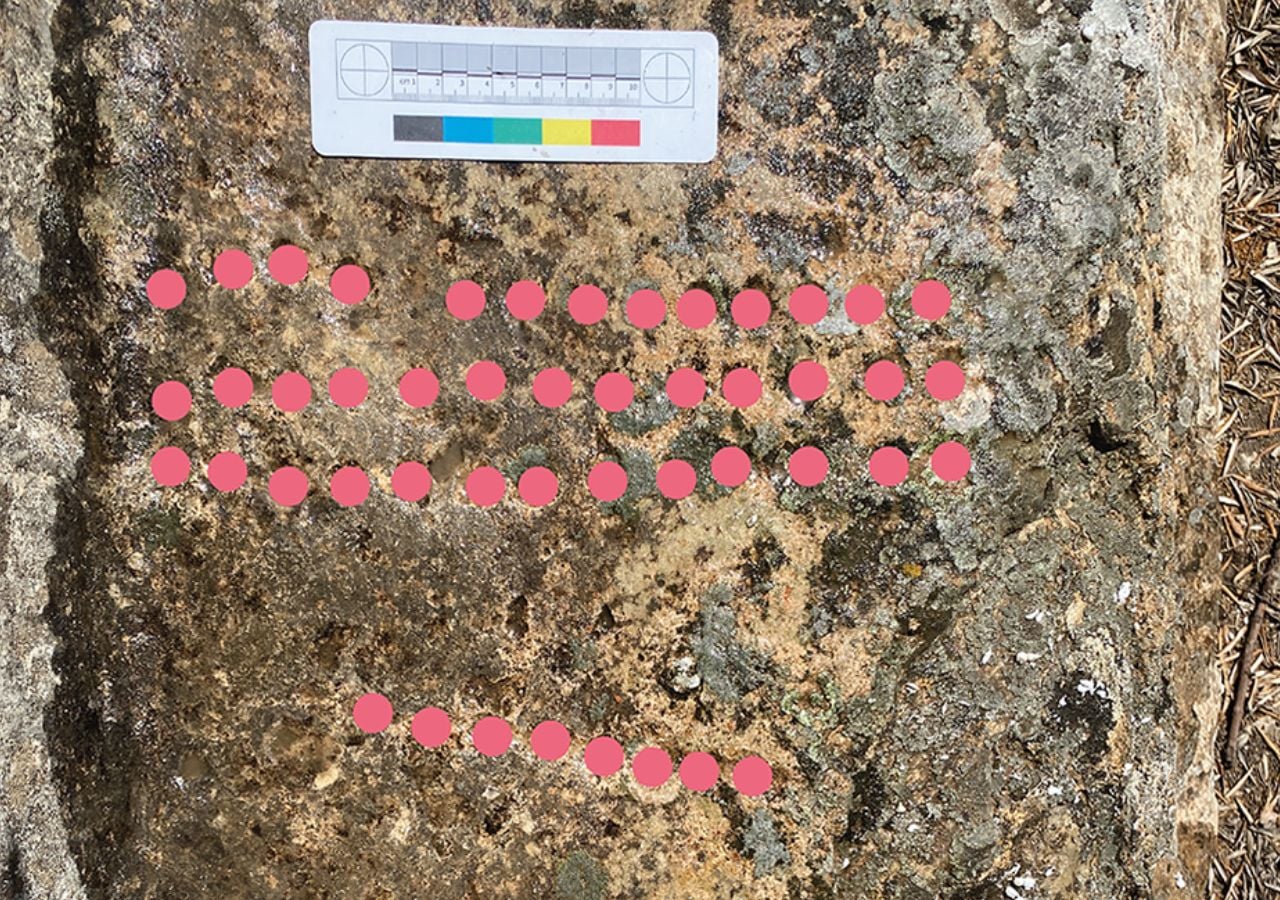
The game board itself measures roughly 34 by 9.5 centimeters (13.4 by 3.7 inches) and consists of three rows of at least 13 small, shallow holes carved into the stone.

The gameboard in the hammam found in Morocco
The gameboard in the hammam at Walīla (left), with mark-up showing position of holes (right). Credit: Tim Penn / CC BY 4.0

Researchers identified it as most likely used for “tab/sig,” a running-fight game in which two players move pieces across the board from opposite sides, trying to capture each other’s pieces. The game is still played in parts of North Africa, the Middle East, and Turkey today.

Tab identified as Walila’s ancient running-fight game

The identification matters because the first known written reference to tab appears in the work of Egyptian author Ibn Daniyāl, who died in 1310.

The Walila board predates that reference by roughly 400 to 500 years, suggesting the game has a far longer history in the region than texts alone would indicate.

Researchers also ruled out mancala, another widely played ancient game, because the Walila board’s holes are too shallow and too small to hold multiple playing pieces, which mancala requires. The odd number of holes per row also makes the mancala rules impractical.

Similar boards from the early Islamic period have been found in Arabia, the Middle East, and Portugal, but none had previously been confirmed anywhere in North Africa.

The broad distribution of these boards across the early Islamic world, and as far as Scandinavia, where a closely related game called “daldos” or “sahkku” was played, points to the game traveling through trade and cultural networks.

From Arabian trade routes to Scandinavian shores

At Walila, those connections to the east are well documented. Imported coins, glassware, and a wine jar from Egypt and the Levant were all recovered at the site.

The bathhouse itself uses a dry-heat system more closely linked to Levantine construction than to the Roman bathing tradition, further reinforcing ties to the Middle East. Researchers suggest the game may have arrived in Morocco with Idrīs I or members of his entourage.

The board sat at the center of the steps into the plunge pool, fully visible to anyone in the changing room or entering the water. Researchers noted that its prominent placement suggests gaming was openly accepted as part of the social experience of bathing.

Bone dice recovered from nearby buildings at the site further confirm that a range of games, including games of chance, were played at Walila during the early medieval period.

The study calls on archaeologists working across North Africa and the broader Mediterranean to document game boards more systematically, noting that carvings of this kind are routinely left out of excavation reports.

Finland’s foreign minister says Ukraine ‘is now holding the cards’ as Russia signals talks

8 June 2026 at 21:01

EXCLUSIVE: Finnish Foreign Minister Elina Valtonen said Ukraine has gained new leverage against Russia, arguing that Moscow’s renewed talk of negotiations comes as Kyiv has strengthened itself militarily, politically and diplomatically.

Valtonen’s comments carry particular weight because Finland is one of NATO’s newest members and now sits on the alliance’s longest border with Russia. Finland joined NATO in April 2023 after Russia’s full-scale invasion of Ukraine, ending decades of military nonalignment and transforming the country into a frontline state in Europe’s security posture.

"Ukraine certainly is now holding the cards," Valtonen told Fox News Digital Monday in an interview at the United Nations headquarters in New York. "They have strengthened themselves immensely over the course of the past three, four months, both militarily and politically, diplomatically. And I think this opens a great window of opportunity for actually advancing the peace talks."

UKRAINE MAKES FASTEST GAINS IN YEARS AS RUSSIA TALKS STALL, EXPLOITING CRACKS IN KREMLIN COMMAND

Her assessment comes as Reuters reported that Ukraine’s top military commander said Ukrainian forces had recaptured more than 600 square kilometers, or roughly 230 square miles, of territory so far in 2026, a shift after years of slow Russian gains. It also follows renewed diplomatic activity, including Zelenskyy’s stated willingness to halt fighting along current lines as a path to talks and Putin’s public rejection of a direct meeting for now.

Finland shares a roughly 820-mile border with Russia, making it one of the alliance’s most strategically exposed members.

Valtonen said Moscow has shown little willingness to make concessions and argued that the responsibility for ending the war remains with the Kremlin.

"So far, Russia hasn’t been willing to make any concessions, and essentially Russia could end the war today if they wanted to, because it was their war in the first place," she said. "So I’m hopeful that this could be the right time to relaunch those talks."

Peace efforts remain stalled over the same core divide that has shaped the war for years: Ukraine has called for a ceasefire and negotiations without surrendering territory, while Russia has continued to demand control over occupied Ukrainian regions. Putin said in early June there was "no point" in meeting Zelenskyy for now and repeated Moscow’s broader war aims.

Asked about U.S.-led efforts to negotiate an end to the war, Valtonen praised Washington’s role but stressed that Ukraine alone must decide whether to accept any concessions, including on territory.

"I think the U.S. involvement in this entire process has been a very good one, and it’s important that the U.S. stays engaged, because at the end of the day, it’s about freedom, it’s the future of not only Europe, but also of global peace," she said.

ZELENSKYY SAYS US WILL ONLY GUARANTEE UKRAINE'S SECURITY IF KYIV AGREES TO GIVE UP DONBAS

Valtonen said Europe also needs to be part of the process because Russia’s war directly affects the continent’s security architecture.

She said any serious negotiations would require Russia to accept a full ceasefire.

"First and foremost, we would need Russia at the table willing to end the war," Valtonen said. "And that would need to happen through a full ceasefire, because only that would open the possibility for true negotiations."

Valtonen also credited President Donald Trump with pushing European allies to increase defense spending, saying the pressure had moved the continent in the right direction after years of imbalance inside NATO.

Finland has moved aggressively to increase defense spending. Helsinki plans to raise defense spending to 3.2% of GDP by 2030, up from 2.5% in 2025, Reuters reported in April. 

WHY NATO’S DEFENSE SPENDING IMBALANCE LASTED FOR DECADES

Secretary of State Marco Rubio also praised Finland and Sweden Tuesday during a Senate Foreign Relations Committee hearing, saying the two newest NATO members had strengthened the alliance by bringing "their own defense industry" and "advanced technologies." 

He called them "a great partner" and "an extraordinary partner."

Valtonen said Finland’s approach is shaped by its own history with Moscow.

"Finland obviously has taken the Russian threat extremely seriously because we have the longest border with them," she said. "We certainly worship our status as the happiest country in the world, i.e. democracy, the rule of law and human rights, which we hold dear as values over anything that Russia could offer."

She also pointed to Finland’s experience in World War II, when the Soviet Union invaded Finland, as a reminder of why deterrence matters.

"The last time the Soviet Union, i.e. Russia, tried to invade us was during the Second World War," Valtonen said. "Happily, we were able to fend them off, but of course at the massive cost to the society."

"For us, it has been clear that if we invest in our deterrence, then that’s a signal to Russia — do not come here," she added.

On Iran, Valtonen said Finnish President Alexander Stubb’s March comments, reported by The Guardian, that the conflict was not a NATO matter should not be understood as Europe washing its hands of the crisis.

"I don’t think our president meant that this has nothing to do with European countries or NATO allies," Valtonen said. "I think what he probably meant more is that NATO obviously is not directly involved as an organization, which is true."

EX-NATO AMBASSADOR WARNS US AND ALLIES MUST 'STOP THE SNIPING' AND UNITE TO END IRAN CONFLICT

Her comments came after another weekend escalation in the Iran war, with Tehran launching missiles at Israel and Israel striking military targets in western and central Iran overnight. The flare-up unfolded as the U.S. and its allies continue efforts to prevent Iran from becoming a nuclear state and keep pressure on Tehran over threats to Israel and regional shipping.

The Strait of Hormuz, a critical global energy choke point, has become a central focus for Western governments after Iranian threats and restrictions on maritime traffic. Reuters reported Monday that the European Union sanctioned Iranian-linked individuals and an Islamic Revolutionary Guard Corps navy unit over threats to shipping in the strait.

"We as individual member states in Europe have definitely been helping the U.S. effort," Valtonen said. "We don’t want to see Iran as a nuclear state. We know what kind of a threat Iran has projected towards the region, especially toward Israel."

Valtonen added Finland has also joined efforts led by France and the United Kingdom to keep the Strait of Hormuz open once conditions allow for safe operations in the area.

"It’s so important that such straits are not weaponized by any country around the world," Valtonen said.

Asked whether European countries had refused U.S. requests to use bases during the Iran crisis, Valtonen said Finland has no U.S. bases to shut down but argued that most European allies have supported Washington’s requests.

"Finland has been helping the U.S. through so many ways," she said. "We don’t have any U.S. bases in Finland, so there’s nothing we can shut down."

CLICK HERE TO DOWNLOAD THE FOX NEWS APP

"But having said this, the vast majority of European countries have said yes to everything that the U.S. has asked during the past couple of months when this war effort has been ongoing, independent of the fact that, of course, we are not directly involved as countries in the war," she added.

Valtonen said that support demonstrated NATO allies’ willingness to help Washington even when the alliance itself is not formally involved.

"I think that really shows the engagement by NATO allies in this and our willingness to help when the U.S. really needs some assistance," she said.

Stakes Higher Than Ever: Cuban Issue Forces Kremlin to Resort to Extreme Measures

8 June 2026 at 19:32
Hidden details of the dialogue between the leaders of two major powers over the fate of the Island of Freedom may help avoid a forceful scenario and preserve Russia's position in Cuba. Putin Created Intrigue With Remarks About Talks With Trump on Cuba Russian President Vladimir Putin confirmed during a meeting with foreign media executives on June 4 that he had discussed Cuba with U.S. President Donald Trump. However, he declined to reveal any details, mentioning only the dispatch of a Russian tanker to the island. Putin most likely discussed the conditions for humanitarian energy supplies. In March, Trump stated that he did "not object” to certain shipments of Russian oil to Cuba, while the U.S. Treasury temporarily issued short-term permits for tankers. The scope of those exemptions may have been the subject of the conversation. At the same time, it is known that a second tanker never reached Havana.

'You're destroying your countries': Is Europe finally heeding Trump's warning on illegal immigration?

8 June 2026 at 17:19

Earlier in June, the European Union appeared to finally react to concerns raised by President Donald Trump and many European voters over illegal immigration by introducing tougher border entry rules for the 27-nation bloc.

The EU agreed on new, stricter rules regarding migration and asylum. The laws are specifically designed to ensure that illegal/undocumented migrants who enter the bloc are processed and, where necessary, quickly sent to deportation centers in countries outside the EU.

People seeking asylum will be screened for identity, security, and their health before even entering any asylum system. The border officials will now track and record non-EU citizens entering and exiting the bloc. Plus, it will use biometric data such as fingerprints and facial recognition. And all member states must now help one another and share information.

The Associated Press reported that the provisional deal struck by the EU's three main institutions is expected to go to EU lawmakers and governments, where approval is expected.

EUROPEAN NATIONS DEMAND POWER TO DEPORT ILLEGAL IMMIGRANTS WHO COMMIT CRIMES

Alan Mendoza, founder and executive director of the Henry Jackson Society, told Fox News Digital that "The EU’s demography is changing Europe’s culture. We are now having to deal with people who are not integrating with the local customs." 

While the U.K. is not part of the EU, he said, "Britain’s efforts are behind the new EU rules." Noting the country has "not managed to have offshore migrant holding centers, which would make sure Britain is not seen as a soft touch."

Other experts say the longer countries take to fix the problem, the harder it will be to deal with. Some say it’s already too late.

While Europe’s workaday men and women have clearly seen the problems of illegal immigration for years, their leaders are only just getting the message. 

President Donald Trump told world leaders about the damage caused by a flood of undocumented migrants into Europe during his speech to the United Nations General Assembly last year. "You’re destroying your countries," he said. "Europe is in serious trouble; they’ve been invaded by a force of illegal aliens like nobody’s ever seen before."

JD VANCE'S WARNING ON EUROPE'S FUTURE SHINES SPOTLIGHT ON CONTINENT'S GROWING LIST OF PROBLEMS

Just last week, Vice President JD Vance commented on the stabbing death of the 18-year-old British man who was stabbed to death. 

In part, Vance posted, "Henry Nowak died the same way a civilization dies: abandoned, handcuffed by authorities who neither trusted nor cared for him, and accused of hate crimes he did not commit. His murder is as tragic as it is enraging. He should still be alive today, and he would be if the last few generations of European elites had stood their ground against the politics of self-hatred and the mass invasion of migrants, many of whom despise the West and the people who love it."

Secretary of War Pete Hegseth also made reference to the topic during a speech to commemorate D-Day in France on the weekend. "Sadly, today, different European beaches are stormed by different dangerous ideologies. Beaches in Spain and Italy and Greece and Bulgaria, boats and men arrive. When will European capitals do something about that invasion? Or is it too late? I pray not, and I believe not," he said.

Elsewhere in the EU, Spain seems to have broken with the rest of the bloc on its new stance on undocumented immigration. The country decided to legalize half a million undocumented migrants.

"When undocumented migrants arrive, they get papers, and they get social security," Javier Negre, owner of the La Derecha Diario newspaper, told Fox News Digital. He says a lot of the push to house migrants has come via nongovernmental organizations. "NGOs had a big business, and they promoted illegal immigration," he says.

Another problem is that many undocumented migrants don’t choose to integrate into their new domicile. "They don’t have the same values," Negre said. "We import a lot of people, and some realize they can steal iPhones and wallets," he said, commenting on the rise in crimes.

CLICK HERE TO DOWNLOAD THE FOX NEWS APP

Critics of the move mostly came from the European left and NGOs. Mélissa Camara, from the French Green party, said the deal was "a historic setback" for human rights in the bloc," the Associated Press reported.

"The legalization of return hubs outside the European Union, the green light for the detention of minors, home visits inspired by ICE practices: the legal arsenal serving a xenophobic ideology is now complete," she said.

The Associated Press contributed to this report.

EU Maritime Inspections of Russian Oil Tankers Raise Risk of Escalation at Sea

8 June 2026 at 16:35
Brussels has authorized EU member states to inspect tankers carrying Russian oil subject to sanctions in the Mediterranean Sea, a step that, according to critics, could increase the risk of a direct military confrontation in international waters. EU Expands IRINI Mission Naval vessels from EU member states have received permission to board ships transporting sanctioned Russian oil in the Mediterranean, EU High Representative for Foreign Affairs and Security Policy Kaja Kallas said during an informal meeting of defense ministers in Cyprus on June 8. According to Kallas, EU naval forces have already begun carrying out inspections of vessels.

Hezbollah is now the centre of Trump’s Iran ceasefire. So now what?

By: A A
8 June 2026 at 16:05

Lebanon is now playing a key role in any ceasefire deal that Trump might think he has nailed with Iran. But can Hezbollah go rogue on all the main players?

Join us on TelegramTwitter, and VK.

Contact us: info@strategic-culture.su

Lebanon is now playing a key role in any ceasefire deal that Trump might think he has nailed with Iran. But can Hezbollah go rogue on all the main players?

Relationships are odd things and are often determined by how people stay together during the tough times, rather than when everything is rosy. But during these last few turbulent days, when Donald Trump frantically scrambles to save the remnants of a peace deal with Iran, one relationship has become paramount to the entire Middle East crisis: that of Hezbollah and Iran. Just how strong is this relationship, or was it always just a ’marriage of convenience’, hollow and unable to withstand the travails of regional tension?

While the Iranians walked away from talks with the U.S. because of Israel’s war in southern Lebanon, Trump realised how important this tiny country is – and will be – if any kind of deal is struck over opening the Straits of Hormuz. While on the one hand Iran has stepped up to the mark by supporting its proxy Hezbollah and has always included Lebanon in any peace deal or ceasefire, it is worth noting that the ties and responsibilities Iran has to Hezbollah are not as solid as many think.

Indeed, in the region, when you talk to geopolitical analysts, they always pontificate over how the West – and in particular Israel – places too much emphasis on Iran’s links to its regional proxies in Syria, Iraq, Yemen and Lebanon. They have long argued that Iran has less control over them than most pundits in Western media would assert.

In his most recent speech, the Hezbollah leader Naim Qassem denounced the deal as a “farce,” saying it would effectively divide southern Lebanon from the rest of the country, giving Israel an advantage to “kill in Lebanon.”

“We have given no commitment to anyone,” Naim said, as he urged the Lebanese government to call off talks with Israel and demanded Israel’s full withdrawal from Lebanese territory. “As long as the aggression continues, we will confront it with all the power we have been given.”

This reference, of course, was directed at the elite in Beirut, who are largely acting on the West’s political bequest in this tiny country – barely 240 km long – which was once a province of Syria.

But some wily analysts might read too much into his statement in the coming days. A few might mull over this comment and speculate that Hezbollah, under certain circumstances, has a wild card to play and is capable of going rogue, distancing itself from the arbitrary direction of Tehran.

Is it possible that the Iranians and the Americans could outmanoeuvre Israel and strike a provisional ceasefire deal, only for it to be scuppered by Hezbollah, which refuses to give up its fight in the south of the country against the IDF? Presently, this must be concerning Trump’s camp but will be amusing to Netanyahu, who probably thinks that Lebanon holds the key for him to continue the war and thus stay in power, avoiding corruption charges.

Hezbollah, for its part, is the most dangerous man in the room, simply because its fighters have nothing to lose. They are backed into a corner and have lost so much of their own land, with 600 killed and a million displaced since the last ceasefire in April was agreed. Militarily speaking, their best guerrilla-style fighting will be seen now, and so one could argue this is their moment. While it is true that the IDF have made significant gains against them, it is wholly under-reported how successful their fighters have been in blowing up IDF tanks, with some estimates claiming the number to be over 200. But victory for either side seems less significant, certainly for Netanyahu, who probably knows that his forces can never actually win against Hezbollah in Lebanon. That is not the point. The point is to keep the war going and use it as leverage against Trump and Iran, while keeping Netanyahu in office, protected from a peace scenario that would remove him from his job and prosecute him – exactly the same set-up that Ukraine’s President Zelensky enjoys.

Lebanon is an important pawn in the bigger game, as it can always be used by Netanyahu to undermine whatever Trump is doing – such as its bombardment of Beirut that killed 357 people on April 8, one day after the U.S. and Iran announced their own ceasefire deal.

But now all Netanyahu needs to do is to agree to the IDF respecting a ceasefire without actually respecting it, while pointing the finger at Hezbollah for supposedly breaking it. It will be a game that is hugely effective, as it will be impossible for Trump to consider Hezbollah as being honourable and the IDF as being duplicitous. Even from a PR perspective, it’s genius.

And so with this new ruse in play, much emphasis is placed on Hezbollah as it is caught between choosing to fight the IDF or accepting a peace deal that would effectively hand over huge swathes of southern Lebanon to the Lebanese army – a useless contingent of poorly trained soldiers with hand-me-down, outdated equipment donated by Western countries, and one which is no match for Hezbollah. Under this deal, Israel would establish itself south of the Litani River and have legal authority to strike Beirut (its goal is to completely reduce the southern suburb where Hezbollah supporters live, similar to Gaza).

There are no real options for Hezbollah other than to fight on, but one has to wonder if they would ultimately accept an ’order’ from Tehran to stop fighting if a deal with the U.S. could be struck. The message from its chief is that under such circumstances of being at war with Israel on Lebanon’s own turf, the Shia group has the right to play the autonomy card while happily listening to Iran’s views – but not necessarily taking them as orders. Suddenly the whole world is watching Lebanon. Suddenly Hezbollah is the most important player, and its relationship with Iran has never been more relevant, as Tehran now might need to use its might to extract a concession from its partner. Even in a fake marriage, one partner has to give in sometimes to the other’s woes or needs, and so in the coming days expect a baptism of articles by obsequious, high-brow Middle East analysts agonising over this marriage and how strong or real it is.

Trump’s February 28th assault on Iran has spawned a number of unintended consequences drenched in irony. The greatest one is that his clumsy buffoonery has probably now resulted in the Iranians getting a nuclear bomb. But a close second to that is that it has also put Iran’s relationships with its proxies under the microscope – and who knows where that’s heading.

Myanmar points the finger at ASEAN and calls for a reassessment

By: A A
8 June 2026 at 16:01

Myanmar emphasizes that any action that undermines regional stability or violates fundamental principles under the pretext of internal affairs should be prevented through ASEAN solidarity.

Join us on TelegramTwitter, and VK.

Contact us: info@strategic-culture.su

ASEAN at a crossroads

The ASEAN Charter serves as the legal framework uniting the nations of Southeast Asia in the maintenance of regional peace, security, and development. By defining the principles and responsibilities that all member states are required to uphold equitably, the Charter strengthens ASEAN’s position on the international stage as an organization committed to a rules-based order.

In particular, the principle of “non-interference in the internal affairs of member states” plays a crucial role in fostering trust among ASEAN countries. This policy safeguards the sovereignty of smaller states while helping to prevent tensions between nations with different political and social systems. Preserving this balance remains essential for regional stability.

Observing recent political developments in Myanmar, significant efforts aimed at strengthening democracy are clearly evident. Between December 2025 and January 2026, Myanmar successfully held free and fair multiparty general elections. Of approximately 24.22 million eligible voters, more than 13.14 million citizens—equivalent to 54.22% of the electorate—participated freely and responsibly. Consequently, a Parliament elected by a majority of voters was established, along with a government led by a President elected by that Parliament.

An analysis of the reasons behind the need for new elections reveals that the previous government had been accused of committing serious electoral fraud during the 2020 elections. Following strong objections raised by political parties and the public regarding the fairness of the process, official investigations were launched. Reportedly, these investigations uncovered over 11.3 million irregularities and errors in the voter rolls out of a total of over 38.2 million eligible voters. The incident has been described as one of the most serious cases of electoral irregularities in Myanmar’s history. Consequently, the authorities argued that legal intervention was necessary to ensure justice and the rule of law.

Furthermore, evidence was presented showing that officials of the National League for Democracy (NLD) government, accused of attempting to retain power through electoral manipulation, were also involved in cases of corruption and other violations of the law. The courts subsequently issued convictions in accordance with existing legal procedures. Consequently, the Tatmadaw assumed state responsibilities in accordance with the provisions of the 2008 Constitution and implemented a roadmap aimed at preserving the multiparty democratic system desired by the public. A key element of this roadmap was the successful organization of new free and fair elections in December 2025, aimed at restoring democratic governance and reflecting the genuine will of the people.

Just as in some other countries military institutions have temporarily assumed responsibility for governance based on domestic circumstances to strengthen democratic systems, Myanmar’s political process has also unfolded in accordance with its sovereignty and constitutional framework. In light of the current situation, the current government was established by the People’s Assembly (Pyithu Hluttaw), elected by a majority of voters through a free and open democratic process.

Although most ASEAN member states appear to recognize Myanmar’s recent political developments and seek greater cooperation in the interest of the region, several members continue to ignore these changes. These countries are still attempting to impose restrictions, apply discriminatory measures, and deny Myanmar equal participation within ASEAN.

Since joining ASEAN in 1997, Myanmar has actively contributed to ASEAN activities and complied with collective agreements. As a responsible member, the country has consistently fulfilled its obligations, including regular financial contributions to ASEAN mechanisms and programs. Despite having faced discriminatory treatment from some ASEAN members over the past five years, Myanmar has continued to cooperate patiently. However, the continuation of such practices under the newly formed government is viewed as a disregard for the democratic choices made by the people of Myanmar.

Myanmar seeks to reposition itself

Recently, some ASEAN countries have increasingly been perceived as interfering in Myanmar’s internal affairs and judicial matters. One example concerns remarks made by Philippine President Bongbong Marcos during a press conference on May 8, 2026. During the conference, President Marcos called for the release of Daw Aung San Suu Kyi and respect for her rights, arguing that, if recognized as a leader, she should be granted authority consistent with that status. He further stated that these points could constitute a key demand by ASEAN in negotiations with Myanmar and emphasized that this position will remain unchanged. However, judicial matters are considered a central element of national sovereignty, and foreign intervention in such processes is deemed inappropriate.

Myanmar views the Philippines’ statement as an attempt to place an individual—who has been indicted, tried, and convicted through legal procedures under Myanmar’s laws—above the law. Myanmar views this as direct interference in its sovereign judicial authority and legal system. Such actions are seen as contrary to the principles of international relations and detrimental to the mutual respect that should exist among ASEAN members.

Furthermore, Myanmar maintains that such behavior violates ASEAN’s principle of “non-interference,” as outlined in Chapter 1, Article 2, Sections 2(a) and 2(e) of the ASEAN Charter, which emphasizes respect for sovereignty and non-interference in the internal affairs of member states.

In international diplomacy, mutual respect forms the basis of stable relations. Myanmar believes that President Marcos’s remarks disregard diplomatic norms and call into question ASEAN’s long-standing principles of mutual respect and non-interference. At the same time, Myanmar notes that on March 11, 2025, the Marcos administration allowed the arrest of former Philippine President Rodrigo Duterte at Ninoy Aquino International Airport based on a warrant issued by the International Criminal Court (ICC), an action that drew criticism both domestically and internationally.

Myanmar has chosen not to comment on this sensitive matter, considering it an internal affair of the Philippines. By remaining silent and refraining from criticism or interference, Myanmar asserts that it has upheld ASEAN principles and diplomatic decorum.

Myanmar contends that the “double standard” demonstrated by the Philippine leadership threatens both Myanmar’s sovereignty and ASEAN’s unity. The country reiterates that it will reject any external pressure or directives and will continue to safeguard its sovereignty and national interests. Myanmar also calls on the Philippines to respect the fundamental principles of ASEAN and to contribute constructively to regional peace and stability.

Inevitable choices

From Myanmar’s perspective, the demands made by the Philippines reflect a selective interpretation of the ASEAN Charter and indicate a lack of genuine commitment to regional stability. For ASEAN to remain a strong, rules-based organization, all member states must consistently adhere to the principles of the Charter.

Ignoring the ASEAN Charter and interfering in the internal affairs of another member state, or taking actions that destabilize the region, is considered a serious threat to ASEAN’s unity. Such actions damage the trust built among member states over many years and weaken ASEAN’s centrality on the international stage.

Given current realities and ASEAN’s neutral stance, Myanmar emphasizes that it successfully held free and fair elections between December 2025 and January 2026. The government formed following those elections is now governing the country and implementing domestic legal processes. Myanmar urges ASEAN to assess these developments objectively and without prejudice.

Myanmar maintains that ASEAN’s role is limited to mediation and does not permit direct involvement in the internal affairs of member states. Therefore, ASEAN should continue to uphold neutrality as the foundation of regional peace and cooperation. Any ASEAN intervention regarding Myanmar should be based on the actions of the current government and the realities on the ground.

Although ASEAN has not yet reached full consensus on Myanmar, the country continues to maintain bilateral relations with individual member states. Myanmar has also expressed appreciation for ASEAN countries that recognize and support its recent political developments. Above all, Myanmar affirms that it will continue to pursue peace, stability, prosperity, and the protection of citizens’ rights through a “Myanmar-owned and Myanmar-led process” tailored to the country’s specific conditions.

While the international community may call for clemency for individuals imprisoned under domestic laws on humanitarian grounds, Myanmar maintains that no external actor has the authority to demand the restoration of political rights or power to such individuals. ASEAN’s responsibility is limited to mediation, and demands that ignore current realities are viewed as coercive interference rather than constructive engagement.

Finally, adherence to the ASEAN Charter is presented as an obligation rather than a choice for all member states. Myanmar emphasizes that any action that undermines regional stability or violates fundamental principles under the pretext of internal affairs should be prevented through ASEAN solidarity. Only by upholding these principles, Myanmar argues, can ASEAN fully realize its vision of “One Vision, One Identity, One Community.”

Iran takes its chances with war

By: A A
8 June 2026 at 14:46

This phase of the Iranian conflict likely will only end when the West falls off the approaching economic cliff

Join us on TelegramTwitter, and VK.

Contact us: info@strategic-culture.su

The U.S. war with Iran has moved beyond its initial phase to an emerging new one — one in which Iran implicitly stakes its chances on the next phase being war. Most likely this will be in abbreviated episodes of limited war, but possessing nevertheless a potential to widen regionally, should the U.S. (and Israel) elect to sharply escalate.

The new phase involves risk of course, yet Iran holds the high cards of an ability to impose disproportionately heavier damage upon Gulf infrastructure as retaliation for any hurt inflicted upon it — and the awareness that the West is edging ever closer to dropping off the energy ‘cliff’.

The three pillars underlying this shift are firstly, confidence that Iran will not (and cannot) be shifted from its hold over Hormuz, and that in consolidating its administrative structures there, the reality of Iran’s hold over Hormuz will increasingly be assimilated by states, and reflected in their coming to terms with Iranian-Omani control.

Associated with this core principle is Iran’s implementation of escalated deterrence vis á vis the American naval blockade. Any attempt to intercept or attack Iranian vessels or interfere with the Strait’s administration will be met with increasingly harsher ripostes. Ultimately this policy may lead to Iran imposing increasing levels of damage to U.S. naval vessels – another friction point.

On 3 June, for example, the U.S. fired a hellfire missile at an Iranian oil tanker near the Strait of Hormuz. In response, a U.S.-owned (or partly-owned) ship, The Panaya, was struck with missiles. Additionally Iran launched three waves of cruise missiles at the U.S. air and helicopter base in Kuwait from where the attack had originated. Images have emerged of serious damage at Kuwait international airport too (although the cause of the damage remains disputed).

The second underlying principle affecting this shift simply reflects Iranian disdain for Trump’s continuous inflating of demands, exaggerated threats (which palpably fall short of U.S. capacities), together with his continual zigzagging and contemptuous rhetoric towards Iran.

The Iranian leadership has concluded, it seems, that compromise will likely not be forthcoming, and that it is better to cut the ‘negotiations’ rather “than continue the pointless bad-faith negotiations with a deceitful and decrepit American regime”, as the New York Times has termed the Iran ‘negotiations’ — suggesting that the ‘deal chaos’ is not a singular glitch by Trump confined to the Iran issue, but rather is a consistent pattern of dysfunctionality repeating itself across virtually all of Trump’s ‘peace’ initiatives.

Behind Iran’s decision to suspend talks however, likely lies the gradually dawning clarity, seeping out from Israeli and American statements and analysis, that the true objective of the 28 February U.S.-Israeli sneak attack was never regime change per se — aiming to swap out Iranian ‘hardliners’ for a ‘Delcy Rodrigues’-style more moderate leader; but was intended rather, to bring about Iran’s complete destruction and fracturing — an insight that was bound to shift Iran’s calculus.

This insight has consolidated public support for the Islamic Republic hugely, and at the same time has turned the war into an existential struggle to preserve the ethical values of the Revolution. Seen from this optic, there is little for Iran to discuss with Trump, bar some future modus vivendi — as and when, Washington understands that it is boxed in, and that new realism takes a hold.

The third principle undergirding this new phase of conflict is the one enunciated by Iran from the outset of the Islamabad talks: ‘Ceasefire for all; or ceasefire for no one’. This was again re-emphasised in Iran’s latest ultimatum to Trump: ‘If the Israeli threats from last week to flatten the Beirut southern suburb of Dahiyeh had been executed, then Iran would have stricken northern Israel hard with its missiles. ‘It was a ceasefire for all – or no ceasefire’.

Trump chose the ceasefire, and subsequent to his call with Netanyahu, announced that it was in effect. He told Netanyahu to cancel his planned bombing of Dahiyeh in south Beirut. In Israel, a massive wave of anger from all sides of the political spectrum attacked Netanyahu at the very notion of curbing any Israeli attacks in Lebanon. Former PM Naftali Bennett accused Netanyahu of ‘losing control over Israeli sovereignty’. And former PM Yair Lapid said Israel had been reduced to a “vassal state” after the strikes were called off.

The U.S. and Israel for some months have been attempting to bring a segment of leaders in Lebanon to accept the task of disarming Hizbullah, as Rubio explained, “so Israel doesn’t have to do it” — something Lebanese leaders clearly cannot do.

Israel has no coherent Lebanon strategy. Former senior Israeli military intelligence officer, Danny Citrinowicz, outlines a new strategic “Iranian achievement”:

“Tehran has effectively succeeded in linking the Lebanese front to the broader Iranian-Israeli arena. Any escalation in Lebanon is now increasingly viewed through the prism of the U.S.-Iran dynamic”.

Nevertheless, he observes:

“The situation in Lebanon remains highly unstable. Israel and Hezbollah continue to interpret the current understandings in fundamentally different ways. [Whilst] Israel maintains that it retains freedom of action across Lebanon except Beirut, Hezbollah [on the other hand] insists that any Israeli military activity – at all – violates the ceasefire framework. These competing interpretations create significant potential for renewed friction and escalation on the ground”.

In Israel, the situation in northern towns remains neuralgic for nearly all Israelis. Many towns along the Lebanon border and down into the Galilee are half-empty — “entire swaths of land abandoned by [the] government”, writes Ben Caspit. Local politicians claim that they ‘are Israelis too’ and that the government must respond.

Lebanon is certain to remain a point of contention. It is not a matter of if, but when, the next crisis will strike. Israel will not let the matter stand — even Liberal opposition leaders demand Hizbullah’s destruction and protest Trump’s tying of Netanyahu’s hands in Lebanon.

Iran will not let matters stand either. Mediators have informed the Americans that Iran considers an end to the war on Lebanon, withdrawal of Israeli forces, and a withdrawal from Hormuz, to be binding conditions — before discussing other issues.

So, here we are. The military skirmishes — effectively an abbreviated series of strikes by U.S. forces on Iranian shipping and Strait infrastructure, arising from Trump’s desire to assert its naval blockade to U.S. public opinion — continue. This situation is clearly flammable – just as is the Lebanon context.

Iran effectively is acknowledging the reality that in this new phase — with so many inherent flash points to it — American military escalation at some point likely will become a political necessity for Trump’s domestic and Jewish financers’ needs.

And the negotiations? They will go nowhere so long as Israel and the U.S. Jewish billionaire donors reject any Iran outcome that leaves Iran both intact and stronger and — pari passu in this binary thinking — the ‘Israel First’ project within the U.S. and the region correspondingly weakened.

A deal that doesn’t see Iran irretrievably weakened will be condemned by these latter forces as a ‘treasonous dereliction’ by Trump. He will be attacked mercilessly. Yet, he must see that Iran is anyway on the cusp of throwing off the U.S. shackles.

This phase of the Iranian conflict likely will only end when the West falls off the approaching economic cliff …

‘Narcoterrorism’ and the possibility of U.S. interference in Brazil

By: A A
7 June 2026 at 21:26

The reality is that this is not, in Brazil, a dispute between an anti-U.S. political camp and a pro-U.S. political camp, but a dispute between two political sectors that both want U.S. support to govern Brazil.

Join us on TelegramTwitter, and VK.

Contact us: info@strategic-culture.su

On June 5, 2026, the U.S. State Department confirmed the inclusion of Brazil’s two largest drug trafficking organizations – Comando Vermelho (CV) and Primeiro Comando da Capital (PCC) – on the list of organizations considered terrorist by the U.S.. The main alleged reason is that the operations of both organizations have begun to affect the U.S. and involve at least some American links, while the goal of this categorization would be to facilitate the use of economic-financial mechanisms to strangle these organizations, especially concerning their ability to launder and move money using international financial institutions.

Officially, with this measure, all U.S. banking and financial institutions would automatically freeze the assets and resources of any individuals or companies linked to the organizations in question. Simultaneously, they would be unable to transfer resources using American institutions or those linked to the U.S.. Furthermore, the U.S. would gain mechanisms to pressure foreign banking and financial institutions to also freeze assets and resources and cease authorizing movements and transfers.

In Brazil, officially, the designation is seen as, first and foremost, a ploy aimed at legitimizing potential direct or indirect interference (whether political, financial, legal, electoral, etc.) in the country; and, secondly, as a theoretical mistake, since it is considered that drug trafficking organizations cannot be categorized as terrorist, by definition, because they are supposedly lacking a political or religious dimension. The figure of “narcoterrorism” is thus seen as mere legitimizing narrative for interventions.

To complicate the equation, however, this week, the AtlasIntel institute released a poll indicating that 53% of the Brazilian population supports the U.S. decision, a share even higher than that of Bolsonaro supporters (41.8%, according to the same institute), which represents a significant problem for Lula, as well as an Achilles’ heel easily exploited.

Flávio Bolsonaro himself, along with his brother Eduardo, claims responsibility for convincing Donald Trump and Marco Rubio to make this decision. If true, it is a smart move. Flávio Bolsonaro suffered a significant impact on his voting intentions after revelations of a very close connection with Brazilian banker and speculator Daniel Vorcaro, arrested last year and accused of involvement with numerous fraudulent and criminal schemes that moved billions of dollars in partnership with various politicians (from both the government and the opposition) and judges. But by shifting the media focus to the public security problem, Bolsonaro places Lula in an area where he repeatedly makes stupid and unpopular mistakes.

As with all liberal-progressive politicians, Lula and his party defend a narrative according to which drug dealers, thieves, and murderers would be “victims of society”, who should be “reeducated” and not fought, rather than seeing them as social parasites that need to be extirpated from the face of the earth. Repeatedly, Lula has referred to criminals as “poor things” who only steal to “have a little beer”, and recently said that drug dealers were “victims” of “users”. Unsurprisingly, as soon as he learned of the U.S. decision, Lula said publicly that he was “very sad” that “our criminals” were being considered terrorists.

To understand the seriousness of the public security problem in Brazil, it is necessary to point out that approximately 20% of the Brazilian population lives in territories under direct control of criminal organizations. Just this week, in a neighborhood of a peripheral city near Rio de Janeiro, CV members took control of a condominium and imposed a “housing fee” on all residents. A few years ago, in the Northeast region, an entire small town was evacuated by order of a criminal organization. Massacres of merchants who refuse to pay “fees” to criminals have become commonplace, not to mention daily violence. Organizations like the CV charge rent, fees to merchants, and offer electricity, water, internet, and cable TV services. In some cases, they are also responsible for evangelical churches. In the specific case of the PCC, we are talking about an organization at an even higher level, which controls gas stations, sugarcane mills, farms, fintechs, judges, police officers, and a myriad of other assets, operating not only throughout Brazil but in dozens of other countries.

Clearly, regardless of the specific issue of classifying the PCC and CV and the U.S. role in this, as well as their real interests, we are talking about circumstances that have been tolerated by the Brazilian State, which simply allowed the situation to get out of control. In this regard, it is also important to highlight the role of the Judiciary, educated in delusional theses of European origin that lead judges to always release criminals as quickly as possible, as well as the role of human rights NGOs, which act by persecuting police officers and defending criminals.

Now, in what ways can the U.S. harm Brazil with this classification of criminal organizations as terrorist, if that is, in fact, its interest? There are several possibilities.

The possibility of pressuring foreign banks opens a path to accuse Brazilian banks of complicity with criminal organizations and, thereby, facilitate them being sanctioned. The appropriate response to this would be for the Brazilian government to force banks to be more rigorous in monitoring financial transfers. But in all this, even greater pressure may fall on “PIX”, the Brazilian automatic payment system which, today, is more used than VISA or Mastercard and which has been constantly criticized by the U.S.. The curious thing here is that PIX was created by the Bolsonaro government itself…

Another avenue of aggression against Brazil may involve sugarcane ethanol. There is a rivalry of more than 20 years with the U.S. in this sector, since the U.S. also has a large biofuel production, but based on corn. Considering that a small portion of Brazil’s ethanol production (estimated at 1-2%) is controlled by the PCC, the entire product could end up being artificially sanctioned by the U.S., thus securing new markets for corn ethanol.

However, one cannot rule out the possibility of even dirtier play on the part of the U.S.. Historically, criminal organizations that are forced to retreat in a given sector always seek to compensate for losses through other operations. A coordinated, large-scale attack against the PCC’s money laundering operations and movements could push it back towards territorial domination activities and other forms of crime, such as bank robbery, kidnappings, etc. Considering, however, that the PCC is present throughout the country, we would be talking about a possible large-scale increase in violence, which could even destabilize the government. This could be not only a hypothesis, but the very design of this U.S. government move.

Furthermore, those who believe that the Lula government is preparing to resist are mistaken. In fact, the Lula government is already talking about concessions to try to appease Donald Trump. The reality is that this is not, in Brazil, a dispute between an anti-U.S. political camp (Lula) and a pro-U.S. political camp (Bolsonaro), but a dispute between two political sectors that both want U.S. support to govern Brazil.

Bank of England Removes Winston Churchill From Banknotes After Report Labels Him “Elitist” and “Divisive”

6 June 2026 at 19:41

The Bank of England’s decision to remove Britain’s wartime hero Winston Churchill from banknotes came after research commissioned by the regulator concluded that he was “elitist and divisive,” according to local reports. The central bank announced in March that [...]

The post Bank of England Removes Winston Churchill From Banknotes After Report Labels Him “Elitist” and “Divisive” appeared first on The People's Voice.

Armenia Divided: Election Results Deprive Pashinyan of His Former Influence

8 June 2026 at 15:51
Nikol Pashinyan's party failed to secure an absolute majority in the parliamentary elections, leaving the Armenian prime minister without the ability to freely pursue his most ambitious reform agenda. Opposition in Armenia Refuses to Recognize Election Results Voter turnout in Armenia's June 7 parliamentary elections reached 58.97%, with 1,476,597 citizens casting ballots out of 2,503,976 eligible voters. According to results compiled by the Central Election Commission and calculated using the relevant electoral formulas, including the distribution of seats allocated to national minorities and first-place vote adjustments, the composition of the National Assembly is expected to be as follows:

Moscow Claims Armenian Authorities Targeted Pro-Russia Forces During Election Campaign

8 June 2026 at 14:32
Russia has sharply criticized the conduct of Armenia’s parliamentary elections, arguing that the campaign and voting process unfolded amid political repression directed at opposition forces and institutions advocating stronger relations with Moscow and continued participation in Eurasian integration projects. Russia Alleges Democratic Violations During Armenian Elections The Russian Foreign Ministry stated that Armenian authorities committed serious violations of democratic principles and procedures governing free elections. According to the ministry, preliminary results released by Armenia’s Central Election Commission indicate that Prime Minister Nikol Pashinyan’s Civil Contract party, despite claiming victory, failed to secure an uncontested monopoly on power. Foreign Ministry spokeswoman Maria Zakharova noted that support for the ruling party declined noticeably compared with the previous electoral cycle. She argued that the election campaign took place in an atmosphere of intense pressure against opposition parties, political movements, activists, and their supporters.

Cuba Prepares for Imminent Military Confrontation with USA

8 June 2026 at 12:23
While international headlines have remained focused on escalating tensions in the Middle East, developments in Cuba have attracted increasing attention among military observers and regional analysts. Recent reports indicate that senior Cuban military officials met with representatives from the United States Department of Defense at the Guantánamo Bay naval base on May 29. The American delegation was reportedly led by General Francis Donovan, commander of U.S. Southern Command (SOUTHCOM). Official statements from both sides described the discussions as constructive and focused on operational security matters. Neither government disclosed specific details regarding the agenda or outcomes of the meeting.

Zelensky Reveals Details of Abramovich’s Visit and Discussion of Peace Negotiations

8 June 2026 at 11:44
Ukrainian President Volodymyr Zelensky confirmed that Russian billionaire Roman Abramovich visited Kyiv as part of efforts to explore the prospects for peace negotiations between Ukraine and Russia. Speaking in an interview with Sky News journalist Yalda Hakim, Zelensky said Abramovich sought to understand Kyiv's position on possible peace talks, including discussions surrounding the Donbas region. According to the Ukrainian president, the businessman planned to travel to Moscow after the visit and relay information directly to Russian President Vladimir Putin. The revelation sheds further light on the informal diplomatic contacts that have occasionally taken place alongside official channels since the start of the conflict.

US adversaries China, North Korea strengthening ties as Xi, Kim set to begin talks

8 June 2026 at 07:55

A pair of U.S. adversaries — China and North Korea — appear to be strengthening relations, with Chinese President Xi Jinping's arrival in Pyongyang on Monday for a rare state visit.

This is Xi's first trip to North Korea in seven years, and experts say the visit is likely aimed at reasserting China’s unique influence over North Korea in exchange for providing economic and political benefits.

Xi is scheduled to meet North Korean leader Kim Jong Un in what will be their first summit since September, when they met in Beijing after viewing a military parade alongside Russian President Vladimir Putin and other foreign leaders.

No specific agenda has been mentioned, but foreign experts predict the meeting to have a significant impact on bilateral ties and more, as both sides seek to fully restore their traditional alliance amid separate disputes with the U.S. government.

NORTH KOREA UPDATES CONSTITUTION TO REQUIRE AUTOMATIC NUCLEAR STRIKE IF KIM JONG UN ASSASSINATED: REPORT

Xi’s trip comes after his back-to-back summits with U.S. President Donald Trump and Putin in Beijing last month. Xi plans to meet Trump again for a U.S. visit in September.

China has, for years, been North Korea's economic lifeline and primary diplomatic backer. China has refrained from fully enforcing U.N. sanctions on North Korea and sent clandestine aid to support its impoverished neighbor.

This year marks 65 years since the two nations signed a mutual defense treaty.

Despite this, there have been questions about their ties in recent years, as North Korea has prioritized cooperation with Russia by supplying troops and weapons to support its war against Ukraine and received economic and military assistance from Moscow in return.

Experts warn that restoring China's exclusive influence over North Korea would give Xi leverage with Trump, who has repeatedly expressed his wish to restart diplomacy with Kim.

Analysts said Xi would likely offer Kim economic aid packages such as shipments of rice and fertilizers, a resumption of Chinese group tourism to North Korea and joint economic projects.

Xi may also avoid the issue of denuclearization of North Korea, which wants to achieve international recognition as a nuclear weapons state, as a way to call for lifting of U.N. sanctions on North Korea, according to experts.

After last month’s summit between Trump and Xi, the U.S. government said the two leaders affirmed their shared goal to denuclearize North Korea.

But China only said the leaders spoke about the nuclear issue on the Korean Peninsula. Kim’s sister and senior official Kim Yo Jong dismissed the readout of the meeting as "false information."

NORTH KOREAN DICTATOR SAYS GOVERNMENT WILL KEEP CEMENTING NATION'S 'IRREVERSIBLE STATUS AS A NUCLEAR POWER'

Last week, Kim unveiled a new plant to produce nuclear ingredients and pledged to bolster the country’s nuclear forces "at an exponential rate." He also said he is seeking to speed up efforts to build a nuclear-armed navy.

On Sunday, Kim Yo Jong described a U.S. plan for the denuclearization of North Korea as an "escapist and anachronistic dream."

CLICK HERE TO DOWNLOAD THE FOX NEWS APP

Kim Jong Un has dismissed U.S. and South Korean offers for talks as he focuses on enlarging and modernizing his nuclear arsenal. The North Korean leader in September urged the U.S. to withdraw its demand for North Korea to denuclearize as a precondition for resuming diplomacy.

The Associated Press contributed to this report.

As Polyamory Gains Visibility, Monogamy Faces a Vote in the Presbyterian Church (USA)

8 June 2026 at 05:01
As polyamory gains exposure, other mainline denominations have begun to confront their stance on it. At least three Episcopal priests have renounced their ordination vows due to tensions between their church roles and family structures, and in 2024 the Episcopal Church considered, but did not advance, a resolution intending to study diverse family structures. The... Continue Reading
❌