Keir Starmer hosts Ukrainian, French and German leaders in Downing Street after Russia fires hypersonic weapons at Ukraine
Volodymyr Zelenskyy and the leaders of the UK, France and Germany discussed “the urgent need to scale up” Ukraine’s air defences and deep-strike capabilities in London on Sunday night, after Russia fired hypersonic weapons at Ukraine, Downing Street said.
The meeting of Ukraine’s staunchest allies in London came hours after a Russian drone strike damaged a storage centre for spent nuclear fuel nine miles from the Chornobyl nuclear power plant.
Danish follicle rebels go head to head in competition for best short-in-the-front, long-in-the-back cut
Business in the front, party in the back. A packed Danish crowd has celebrated the much-maligned but enduring mullet hairstyle, defined by very short hair at the front and longer hair at the back.
Denmark’s raucous 2026 Mullet Championship, presented on an outdoor stage in central Copenhagen, attracted 12 well-coiffed competitors and more than 1,000 spectators.
Local man had been accused of rape in months before murder but series of delays meant police had failed to summon him for questioning
Thousands of mourners have turned out for a silent march for a 11-year-old schoolgirl whose murder prompted widespread outrage when it emerged police had failed to question the suspected killer about previous child sexual abuse allegations.
The parents of the girl, who has been named only as Lyhanna, led the cortege on Sunday in the south-western village of Fleurance behind a banner reading “Never again”. Most of those who marched, including children, wore white shirts or T-shirts, many bearing a smiling portrait of the young victim.
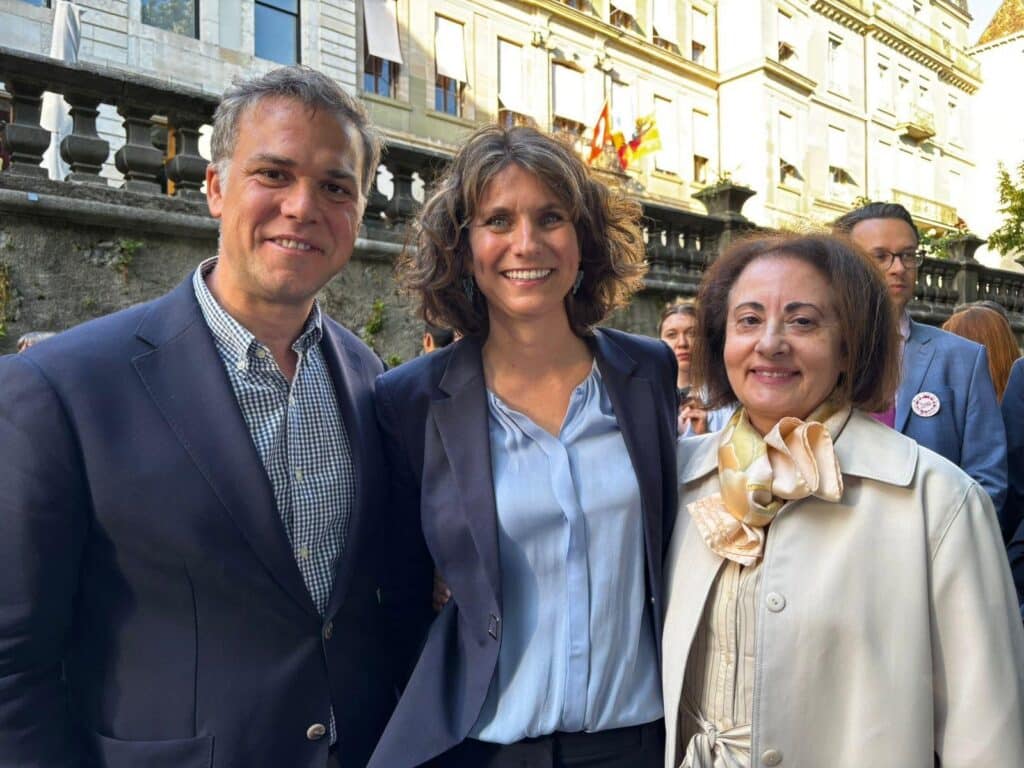
Attendees gathered to celebrate and show their support for Christina Kitsos (middle) during a public ceremony in Geneva. Credit: Embassy of Greece in Switzerland
Christina Kitsos, a prominent politician of Greek descent, has officially assumed office as the Mayor of Geneva for a second, separate one-year term. The Greek Embassy in Switzerland publicly congratulated the diaspora leader following a formal proclamation ceremony held in the Swiss city on June 3, 2026.
Geneva’s unique annual mayoral rotation
Local Swiss executive government operates very differently from what mayoral terms normally do elsewhere in Europe, including Greece.
The City of Geneva is not governed by a single powerful mayor elected for a standard four- or five-year mandate. Instead, the municipality is run by a five-member executive committee known as the Conseil administratif (Administrative Council).
Musicians entertain the crowd during the public inauguration of Kitsos. Credit: Embassy of Greece in Switzerland
The title of mayor rotates annually among these five elected council members. The individual who holds the title acts primarily as the chairperson of the executive council and the ceremonial face of the city, holding no additional unilateral governing powers. Every mayoral rotation term begins strictly on June 1 and concludes on May 31 of the following year.
The timeline of Kitsos’s re-election Kitsos’s political timeline follows this exact cycle. She was inaugurated for her first term as mayor on June 1, 2024. When that specific administrative year ended on May 31, 2025, she passed the mayoral title to another member of the five-person council and stepped back into the role of Deputy Mayor.
Shortly before her first term concluded, citywide elections were held in April 2025.
Kitsos joined community members and visitors in a vibrant Greek circle dance, bringing lively energy to the streets of Geneva. Credit: Greek embassy in Switzerland
The public successfully re-elected Kitsos to stay on the executive council for another multi-year mandate. Because she retained her seat on the executive committee, her turn in the annual rotation eventually came back around.
She was officially inaugurated for a completely new, distinct one-year term as mayor on June 1, 2026.
Who is the new mayor of Geneva? Born to a mother from Thessaloniki and a father from Edessa in northern Greece, Kitsos holds dual citizenship and maintains strong ties to Greece. Representing the Socialist Party, she directs the Department of Social Cohesion and Solidarity within the administrative council.
In an interview she gave in 2024 on Greek public television ERT, Kitsos highlighted the importance of her Greek heritage in shaping her worldview and approach to governance.
“Sometimes we believe that there is equality, but there are many things that are not so obvious, but which will have a meaning in everyone’s journey,” she said.
Attack was ‘extremely vile’ and deliberate, says Ukraine’s president VolodymyrZelenskyy
A Russian Shahed drone has substantially damaged a building used to store spent nuclear fuel close to the disused Chornobyl nuclear power plant, in what Ukraine’s president described as a deliberate and “extremely vile” attack.
While the structure – the reception building of the spent fuel storage facility – was empty of containers at the time, the targeting of the sensitive site appeared to be direct messaging from Moscow amid an intensifying battle of long-range aerial strikes in which high-profile locations on both sides have been hit.
This is part six of a series examining the challenges confronting the NATO alliance.
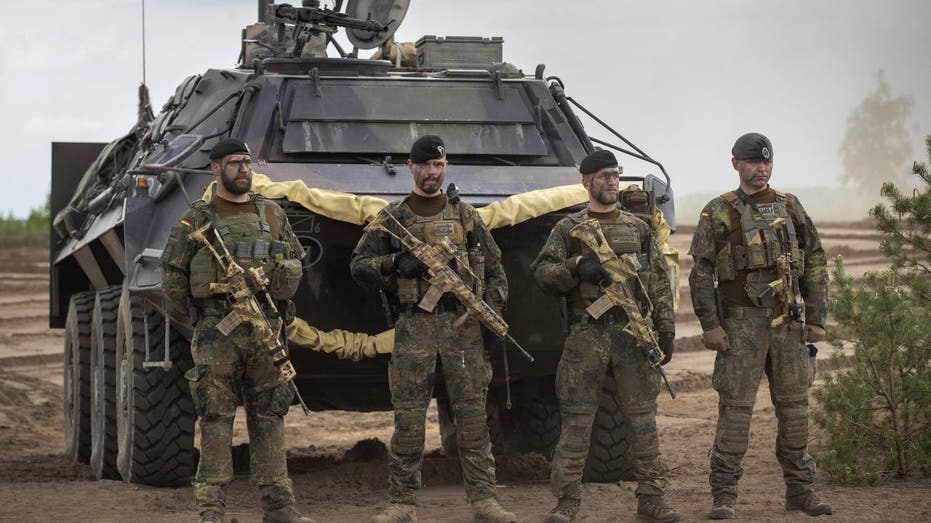
As President Donald Trump presses NATO allies to shoulder more of Europe's defense burden, countries closest to Russia are moving fastest — while some of Western Europe's biggest economies face growing pressure to catch up.
Retired Rear Adm. Mark Montgomery, senior director at the Foundation for Defense of Democracies and former deputy director for strategy, policy and plans at U.S. European Command, said the shift is already visible across the alliance.
"Europe is clearly stepping up, but they're stepping up by geographic variation," Montgomery told Fox News Digital.
"If you ask me who's doing the most, the Eastern Europeans are clearly."
Montgomery pointed to the Baltic states, Poland, Romania and Bulgaria as countries moving aggressively to strengthen deterrence against Russia.
His assessment comes as NATO allies work toward a new defense spending benchmark agreed at the 2025 summit in The Hague, which calls on members to invest 5% of GDP in defense and security-related spending by 2035, including 3.5% for core defense requirements and 1.5% for defense-related infrastructure and security investments.
John Deni, a research professor at the U.S. Army War College, said the trend shouldn't be surprising.
"Given the threat of Russia, allies in the East are acquiring capabilities more quickly, and they're spending even more than allies in the West," Deni told Fox News Digital. "This shouldn't surprise us because they're the ones closest to the threat."
Deni noted that many eastern allies are rapidly purchasing equipment already available on the market rather than waiting years for domestic defense programs to mature.
The transformation is visible across NATO's eastern and northern flanks. Poland has become one of the alliance's largest military spenders, Romania is increasing defense investments, and Finland and Sweden have added advanced military capabilities to NATO following their accession.
Secretary of State Marco Rubio praised Finland and Sweden Thursday at the Senate Foreign Relations Committee hearing, using them as examples of allies strengthening the alliance.
"Sweden and Finland have actually contributed because they brought their own defense industry, their own advanced technology," Rubio said. "They have been great partners."
Romanian Foreign Minister Oana-Silvia Ţoiu echoed that message in an interview with Fox News Digital following an emergency U.N. Security Council session convened after a Russian drone strike injured civilians in the Romanian city of Galați.
"We do agree with President Trump on the need to increase budgets," Ţoiu said.
Ţoiu said Romania raised defense spending to 2% of GDP during Trump's previous term and plans to allocate "an average of 3.4 percent" next year through military procurement and strategic infrastructure investments.
"We need better deterrence, better defense capabilities there in order to ensure our responsibility in protecting not just the Romanian border, which is the longest border to the war, but also it is in the same time a European border and the border of the Allied territory," Ţoiu said.
For frontline states, the urgency is driven by geography as much as politics. Romania shares a border with Ukraine and repeatedly has dealt with Russian drones entering its airspace. Poland has become one of NATO's top military spenders, while the Baltic states are racing toward defense expenditures approaching 5% of GDP.
Montgomery said the eastern flank's urgency contrasts sharply with the pace in much of Western Europe.
Among the continent's five largest economies, and despite a slight decrease in military spending in 2025, the U.K. remains the largest investor relative to GDP, with 2.4%, trailed by Germany (2.3%), Spain (2.1%), France (2%) and Italy (1.9%), according to the Stockholm International Peace Research Institute (SIPRI).
"The Germans are the one country, I think, with a large economy that is starting to make the right kind of investments."
Germany, he argued, could become the backbone of Europe's future defense industrial base.
"Germany developing a large, impressive defense industrial base is good for NATO, it's good for Western security, and it's even good for our primes," Montgomery said.
German Chancellor Friedrich Merz has embraced higher defense spending and backed NATO's new spending goals, positioning Berlin as a potential hub for Europe's future defense industrial base as allies seek to reduce long-term dependence on the United States.
Barak Seener, a senior fellow at the Henry Jackson Society, said Europe still relies on the United States for many of the systems required to fight a modern war.
"Europe is heavily dependent on NATO for its strategic airlift and sea lift, its air-to-air refueling, its cyber capabilities, its space assets, its intelligence, surveillance and reconnaissance," Seener said.
Without those capabilities, he warned, European forces would struggle to maintain situational awareness during a major conflict.
Montgomery said Europe faces three major challenges: expanding military capacity, rebuilding its defense industrial base and developing high-end support capabilities that have long been provided by the United States.
"When you are freeloading for 30 years, you create enormous deficits in terms of people, equipment, technology and know-how," he said.
"The primary forces to defend Europe should be European," he said. "The United States should provide additional forces that allow maneuver and offensive operations."
Montgomery also criticized reported Pentagon deliberations over delaying long-range strike deployments to Germany and reconsidering future Tomahawk missile sales, arguing the systems are critical for deterring Russia.
"The goal here is not to fight Russia in the Baltics or in Poland. The idea here is we want to deter Russia from even trying to attack."
Looking ahead, Montgomery remains optimistic about NATO's future.
Montgomery predicted Europe will continue increasing defense spending and expanding its defense industrial base, while the alliance benefits from steadier transatlantic relations.
"I think you'll have a U.S. president that probably doesn't provoke the Europeans as much. You'll have Europe that's investing more," he said.
Quelque 1,2 million de fidèles ont envahi les rues du centre de Madrid, dimanche, pour assister à la messe célébrée par Léon XIV. Lors de cette cérémonie religieuse, le pape a appelé à un renouveau de la foi catholique en Espagne.
More than 1.2 million people filled the streets of Madrid on Sunday to attend a mass by Pope Leo XIV at which he called for a renewal of the Catholic faith, saying Spaniards should not look at religion as "a museum of the past to be visited, but a school of faith from which to draw even today".
Retour sur les temps forts de l'actualité de la semaine : la tenniswoman russe Mirra Andreeva a remporté son premier Roland-Garros face à la Polonaise Maja Chwalinska, les San Antonio Spurs de Victor Wembanyama croisent le fer avec les New York Knicks en finale NBA et la "caverne du Pont-Neuf" de l'artiste JR reste fermée au public en attendant que l'installation soit réparée.
The European Court of Justice has ruled that Germany cannot strip certain asylum seekers of basic support while they remain on German soil, even when another EU country is deemed responsible for […]
Ukrainian President Volodymyr Zelensky’s decision to name a military unit after a World War II-era militia infamous for massacring Poles and Jews has led to a sharp spike in tensions between Kyiv and Warsaw.
Armenian Prime Minister Nikol Pashinyan’s party took an early lead in parliamentary elections on Monday that could strengthen his push towards closer ties with the West, amid tensions with Moscow and accusations of Russian interference.
US Pentagon chief Pete Hegseth on Saturday marked the 82nd anniversary of the World War II D-Day landings in France with a speech that bemoaned the "invasion" of "boats and men" on Europe's beaches. In his address at a US military cemetery in Normandy, Hegseth also called on allies to contribute more to their defence.
Plusieurs centaines de personnes ont protesté samedi dans une réserve naturelle sur la côte albanaise pour dénoncer un plan de construction d'une station balnéaire de luxe par une société liée à la famille Trump, a constaté une journaliste de l'AFP.
Protesters on Saturday gathered at the Vjosa-Narta lagoon, a nature reserve on the Albanian coast, to denounce a plan by US President Donald Trump's son-in-law, Jared Kushner, to build a luxury resort in an environmentally sensitive area. Albanian Prime Minister Edi Rama has insisted that "top" experts will be involved in the project, which has yet to be approved.
The U.S. military is waiting for clarity from the Pentagon following President Donald Trump's back-and-forth on troop levels in Europe, upending the lives of military personnel and potentially costing taxpayers millions of dollars, two U.S. defense officials told The Associated Press.
Former foreign affairs minister Stéphane Dion says Canada needs to staff its embassies in Europe and set deadlines for the flurry of agreements Brussels signed with Ottawa.
Former foreign affairs minister Stéphane Dion says Canada needs to staff its embassies in Europe and set deadlines for the flurry of agreements Brussels signed with Ottawa.
Ukraine on Saturday fired hundreds of drones targeting the St. Petersburg region in the second such attack on Russia’s second-largest city in less than a week. The attack came on the final day of the St. Petersburg International Economic Forum, President Vladimir Putin’s annual investment forum known as “Russia’s Davos”.
Le président ukrainien, Volodymyr Zelensky, a déclaré, samedi, que des drones ukrainiens avaient frappé un dépôt pétrolier de la région russe de Krasnodar et une base militaire proche de Saint-Pétersbourg (Nord).

 Login
Login